Begin
14 pages · ~28 min
Stakeholder Communication for Customer Education
This training helps customer education teams present program value and results to stakeholders, enabling them to secure buy-in and align leaders on key initiatives.
A digital instructor presents all 14 pages. Hold “Ask” at any point and ask out loud — the answer comes from this course. No sign-up needed.
What you’ll learn
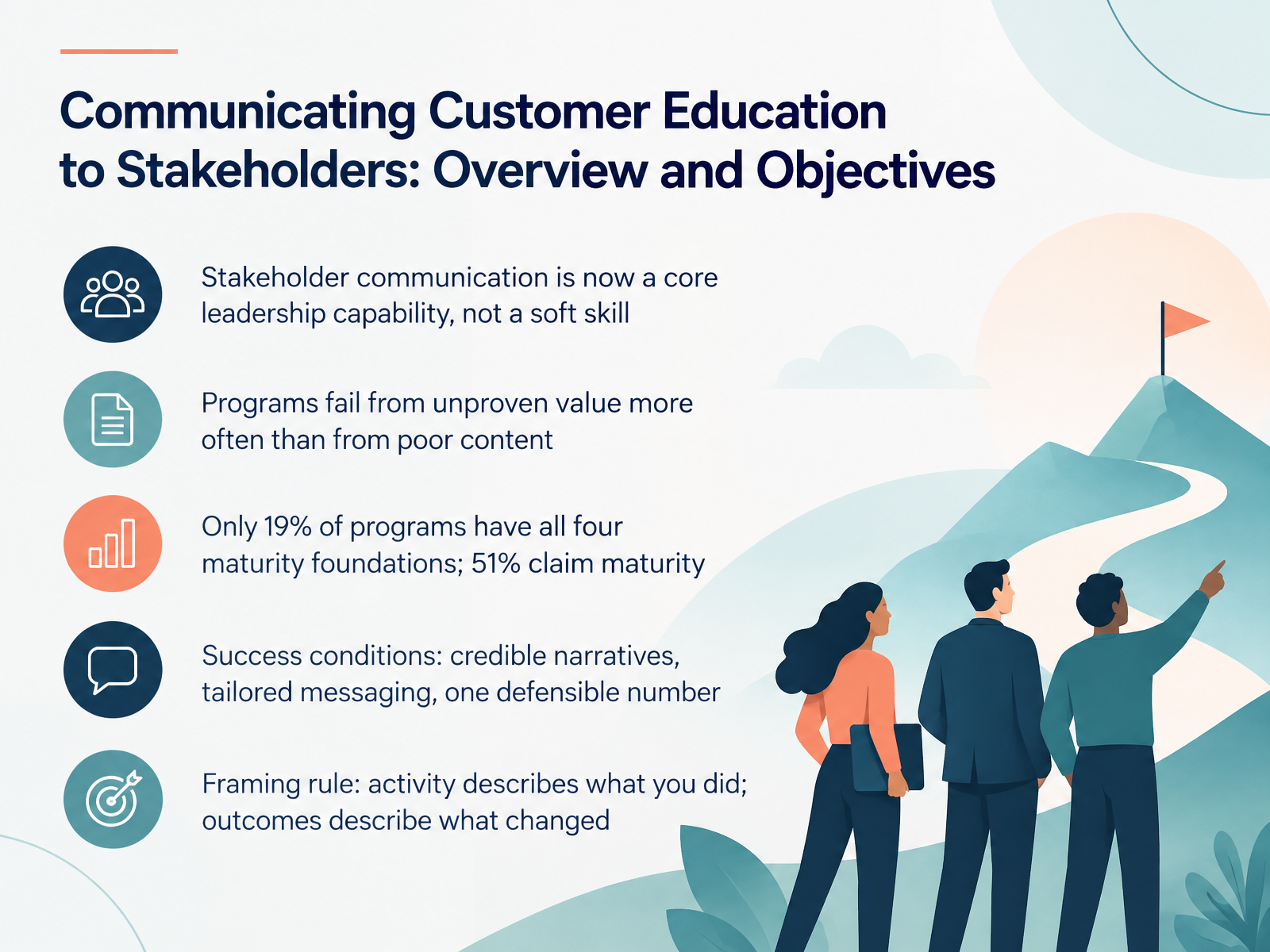
- 01Communicating Customer Education to Stakeholders: Overview and ObjectivesWelcome. Over the next fourteen slides, we're going to work on one skill that now sits at the center of customer education leadership: communicating your program to stakeholders. Not as a soft skill. As a core leadership capability. Because programs rarely fail from poor content. They fail from unproven value. Here's the number to hold onto. Only nineteen percent of programs have all four maturity foundations in place. Yet fifty-one percent claim maturity. That gap is exactly where budget conversations get uncomfortable. So across this course, we'll build three things: credible narratives, messaging tailored to each stakeholder, and one defensible number you can repeat without hesitation. And we'll follow a simple framing rule. Activity describes what you did. Outcomes describe what changed. Let's start with why the scrutiny is rising right now.intellum.comthinkific.comabsorbai.com+21 min
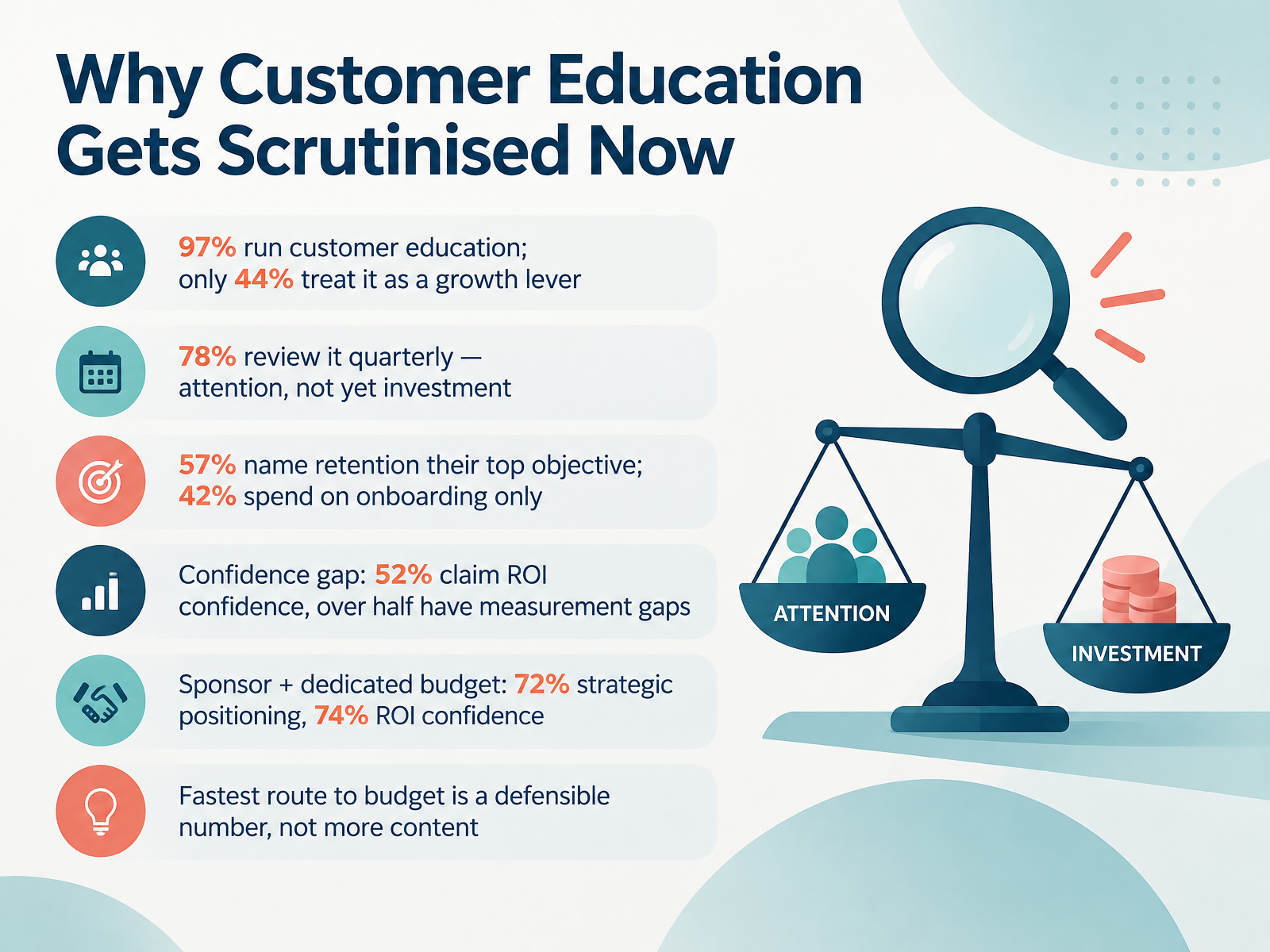
- 02Why Customer Education Gets Scrutinised NowLet's talk about why customer education gets scrutinised right now. Ninty seven percent of organisations run some form of customer education. But only forty four percent treat it as a growth lever. And seventy eight percent review it every quarter. That's attention, not yet investment. When fifty seven percent name retention as their top objective, yet forty two percent still spend on onboarding only, something doesn't add up. There's a confidence gap too. Fifty two percent claim ROI confidence, but over half have measurement gaps. Here's the pattern that matters. Programs with both a sponsor and a dedicated budget report seventy two percent strategic positioning and seventy four percent ROI confidence. So the fastest route to budget isn't more content. It's a defensible number. Next, we'll look at how to map your stakeholders by influence, interest, and decision authority.
 intellum.comthinkific.comabsorbai.com+21 min
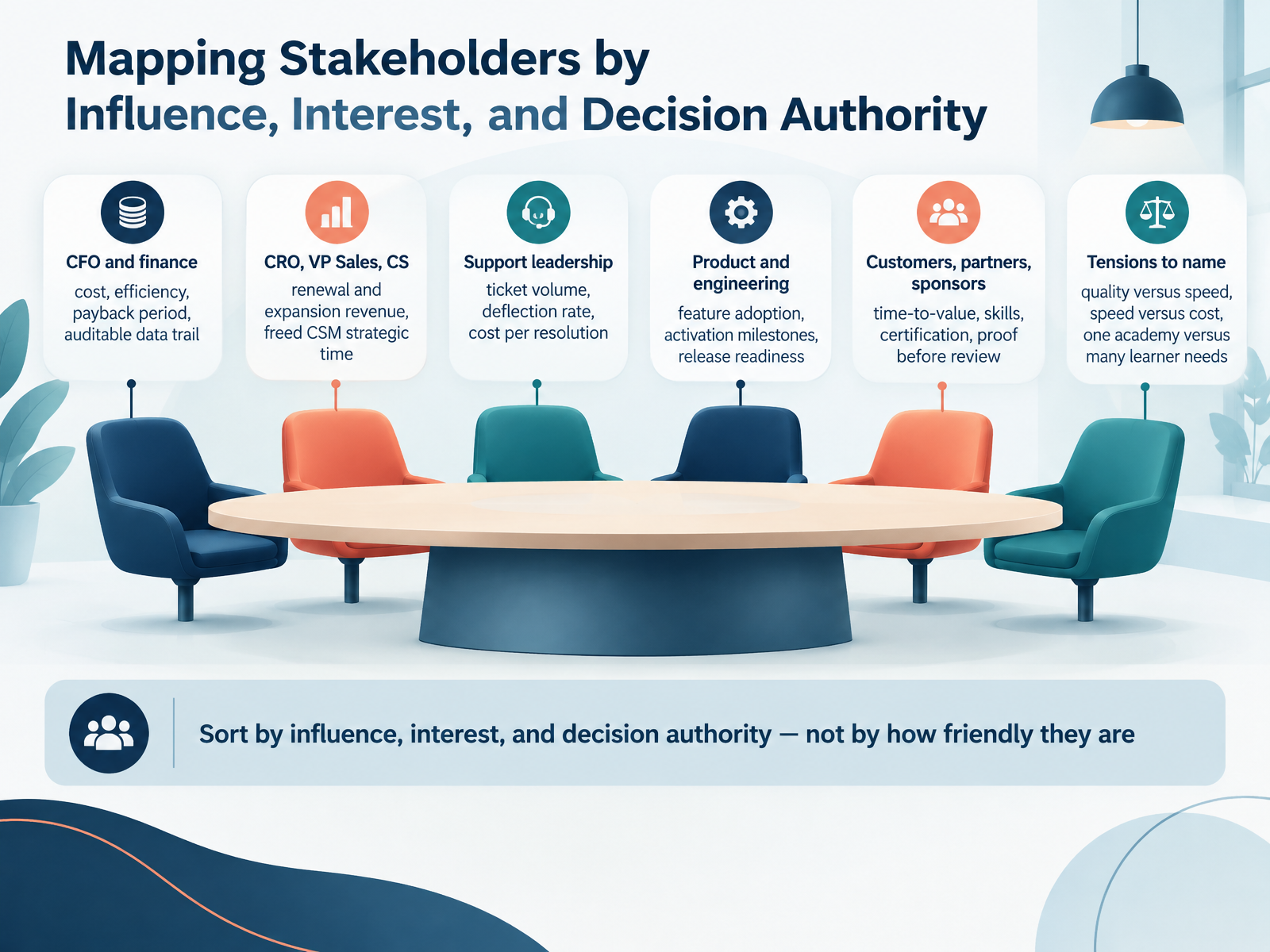
 - 03Mapping Stakeholders by Influence, Interest, and Decision AuthorityNow, how do you decide who to talk to first? Sort your stakeholders by influence, interest, and decision authority. Not by how friendly they are. Friendliness does not release budget. So map the room chair by chair. Your CFO and finance care about cost, efficiency, payback period, and an auditable data trail. Your CRO, sales, and customer success leaders care about renewal and expansion revenue, plus freed-up CSM time for strategic accounts. Support leadership wants ticket volume, deflection rate, and cost per resolution. Product and engineering want feature adoption, activation milestones, and release readiness. And customers, partners, and sponsors want time to value, skills, and certification, with proof before review. Then name the real tensions out loud, because they will surface anyway. Quality versus speed. Speed versus cost. One academy versus many learner needs. Naming them builds credibility. Now let's put you in each skeptic's seat before you present. That is where we go next: The Skeptic's Seat: Occupying Each Chair Before You Present.
 teachable.comcheck-n-click.comtrainn.co+22 min
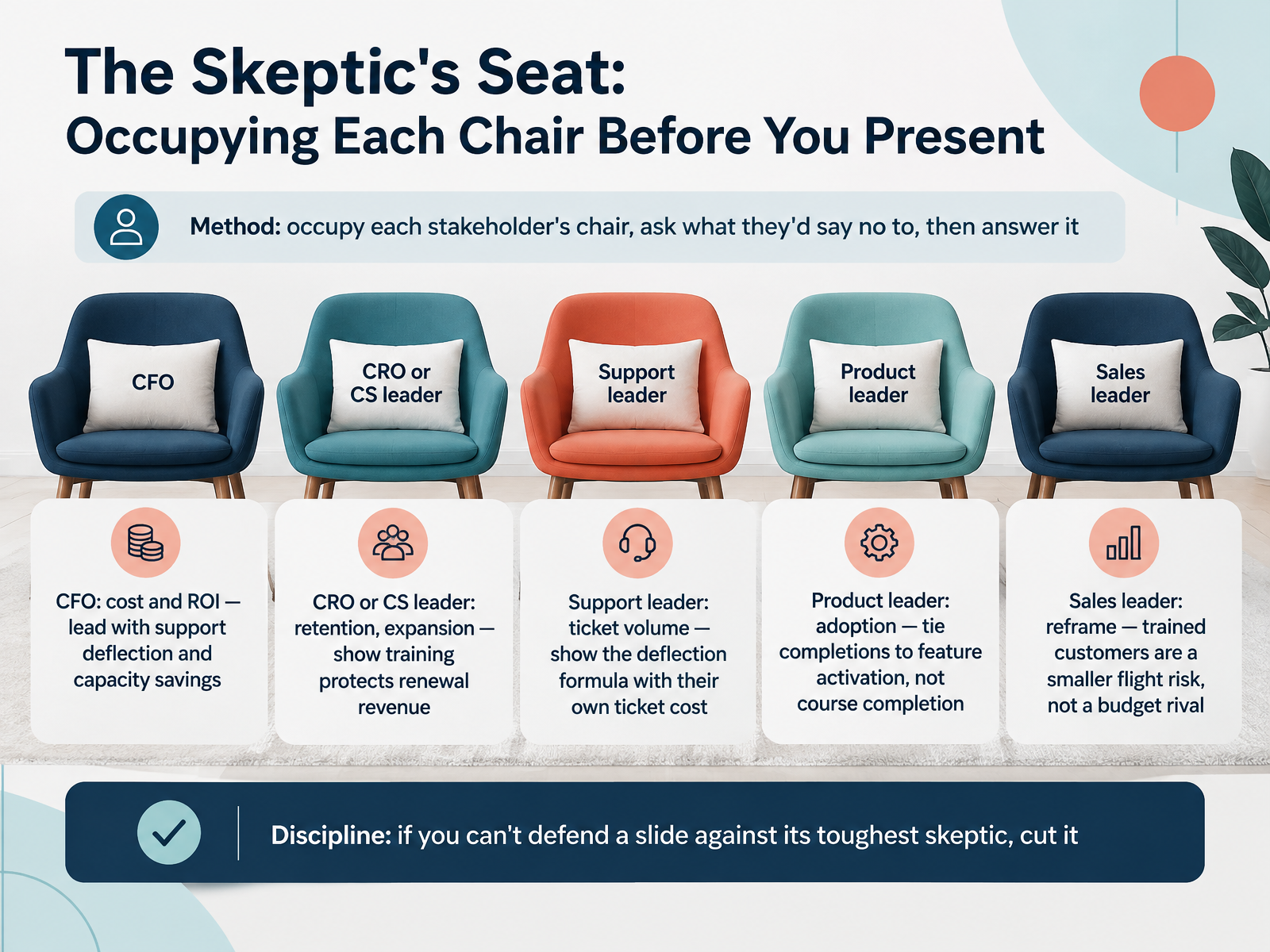
 - 04The Skeptic's Seat: Occupying Each Chair Before You PresentLet's talk about the skeptic's seat. Before you write a single slide, sit in each stakeholder's chair and ask a simple question. What would this person say no to? Then build your data point as the direct answer. So, put on the CFO's hat. They listen for cost and ROI. Lead with support deflection and capacity savings, because those have the cleanest data trail. Now sit in the CRO or CS leader's seat. They care about retention and expansion. Show how training protects renewal revenue. The support leader wants ticket volume. Bring the deflection formula, with their own ticket cost plugged in. The product leader cares about adoption. Tie completions to feature activation, not course completion. And the sales leader? Reframe training as a teammate. A trained customer is a smaller flight risk, not a rival for the same budget. Here's your discipline. If you can't defend a slide against its toughest skeptic, cut it. Don't soften the claim just to keep it. From learning activity to business outcome, the five-rung evidence ladder.
 absorbai.comintellum.comresumly.ai+21 min
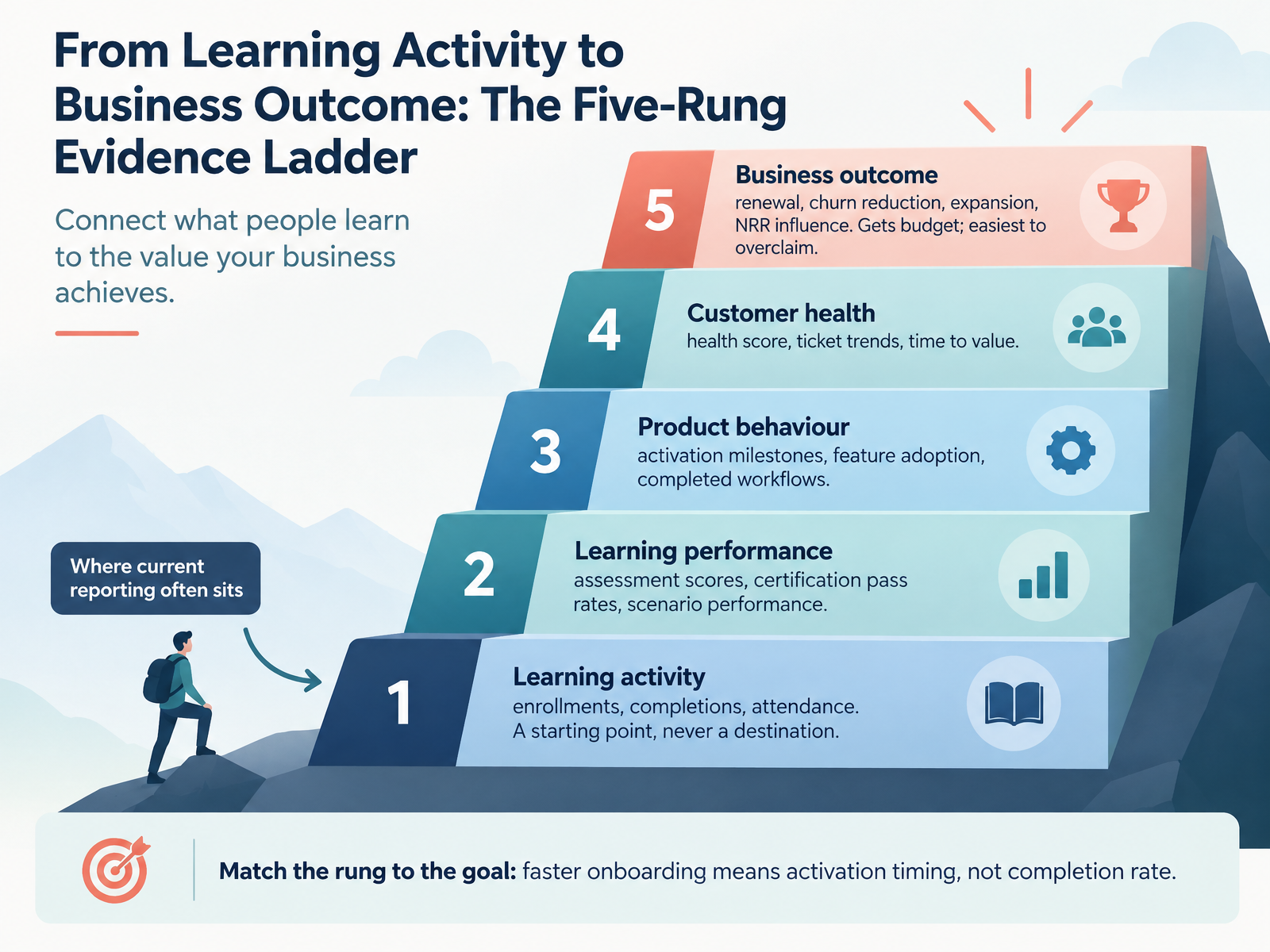
 - 05From Learning Activity to Business Outcome: The Five-Rung Evidence LadderLet's talk about turning learning activity into evidence you can defend. Think of it as a five-rung ladder. Rung one is learning activity: enrollments, completions, attendance. Treat that as a starting point, never a destination. Rung two is learning performance: assessment scores and certification pass rates. Rung three is product behaviour: activation milestones, feature adoption, completed workflows. Rung four is customer health: health scores, ticket trends, time to value. And rung five is business outcome: renewal, churn reduction, expansion, and influence on net revenue retention. That top rung is what gets your budget, and it's also the easiest to overclaim. So match the rung to the goal. If the goal is faster onboarding, your evidence is activation timing, not completion rate. Ask yourself one question: which rung proves the decision you're asking your stakeholders to make? Building the Evidence Pipeline: LMS, CRM, and Product Analytics.
 intellum.comthinkific.comabsorbai.com+21 min
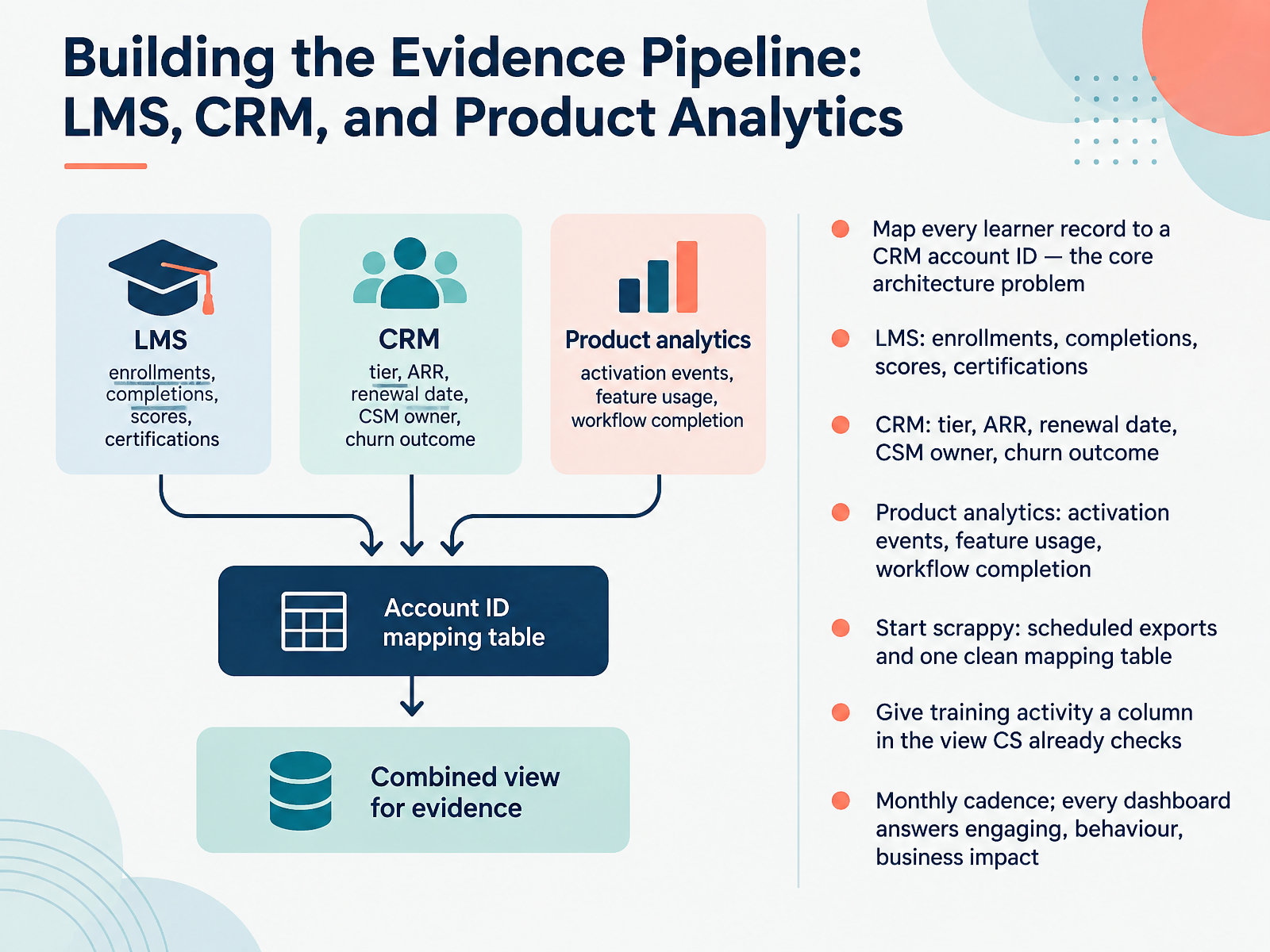
 - 06Building the Evidence Pipeline: LMS, CRM, and Product AnalyticsNow let's talk about the pipeline that makes all of this provable. The core architecture problem is simple to state and hard to skip: every learner record needs to map to a CRM account ID. Without that link, you have training data in one pile and revenue data in another, and no way to introduce them.
Here's the pipe. Your LMS holds enrollments, completions, scores, and certifications. Your CRM holds tier, ARR, renewal date, CSM owner, and the churn outcome. Product analytics holds activation events, feature usage, and workflow completion. Three sources, one account key.
You don't need perfect infrastructure to start. Start scrappy. Run scheduled exports and build one clean mapping table. Then give training activity a column in the view your CS team already checks. Don't build a separate report nobody opens.
Set a monthly cadence. Every dashboard should answer three questions: are they engaging, has behaviour changed, and did it move the business?
Next, we'll look at proving the education effect without overclaiming.
 intellum.comcheck-n-click.comeverestgrp.com+22 min
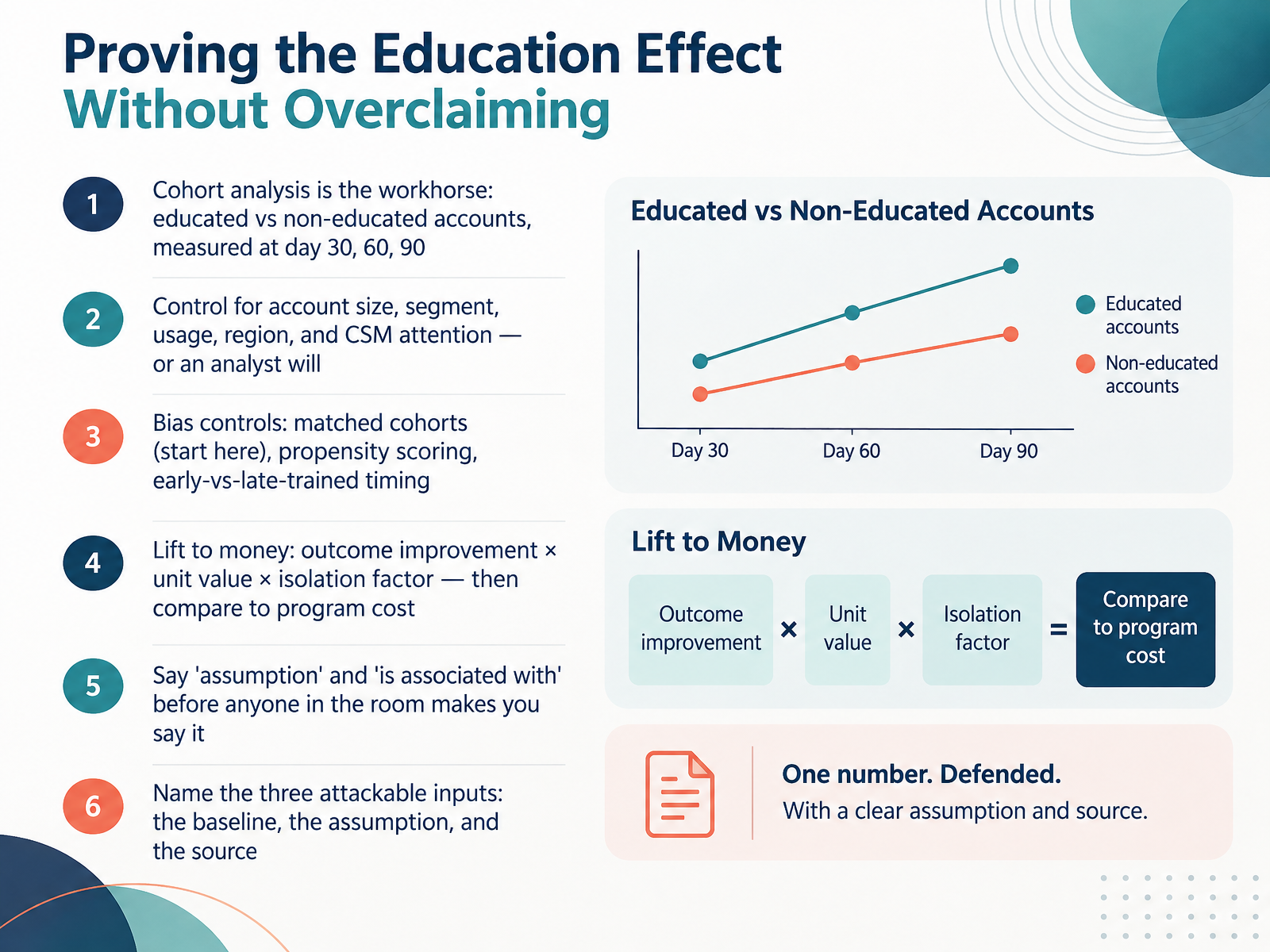
 - 07Proving the Education Effect Without OverclaimingNow let's talk about proving the education effect without overclaiming. Cohort analysis is your workhorse here. Compare educated and non-educated accounts at day thirty, day sixty, and day ninety. Just be careful: control for account size, segment, usage, region, and CSM attention, or an analyst will do it for you. Bias controls matter too. Start with matched cohorts, then try propensity scoring and early-versus-late-trained timing. To turn lift into money, multiply outcome improvement by unit value by an isolation factor, then compare that to your program cost. Before anyone in the room makes you say it, say assumption and is associated with yourself. And always name the three attackable inputs: the baseline, the assumption, and the source. Next, we'll look at choosing two or three levers you can actually defend.
 intellum.comthinkific.comabsorbai.com+21 min
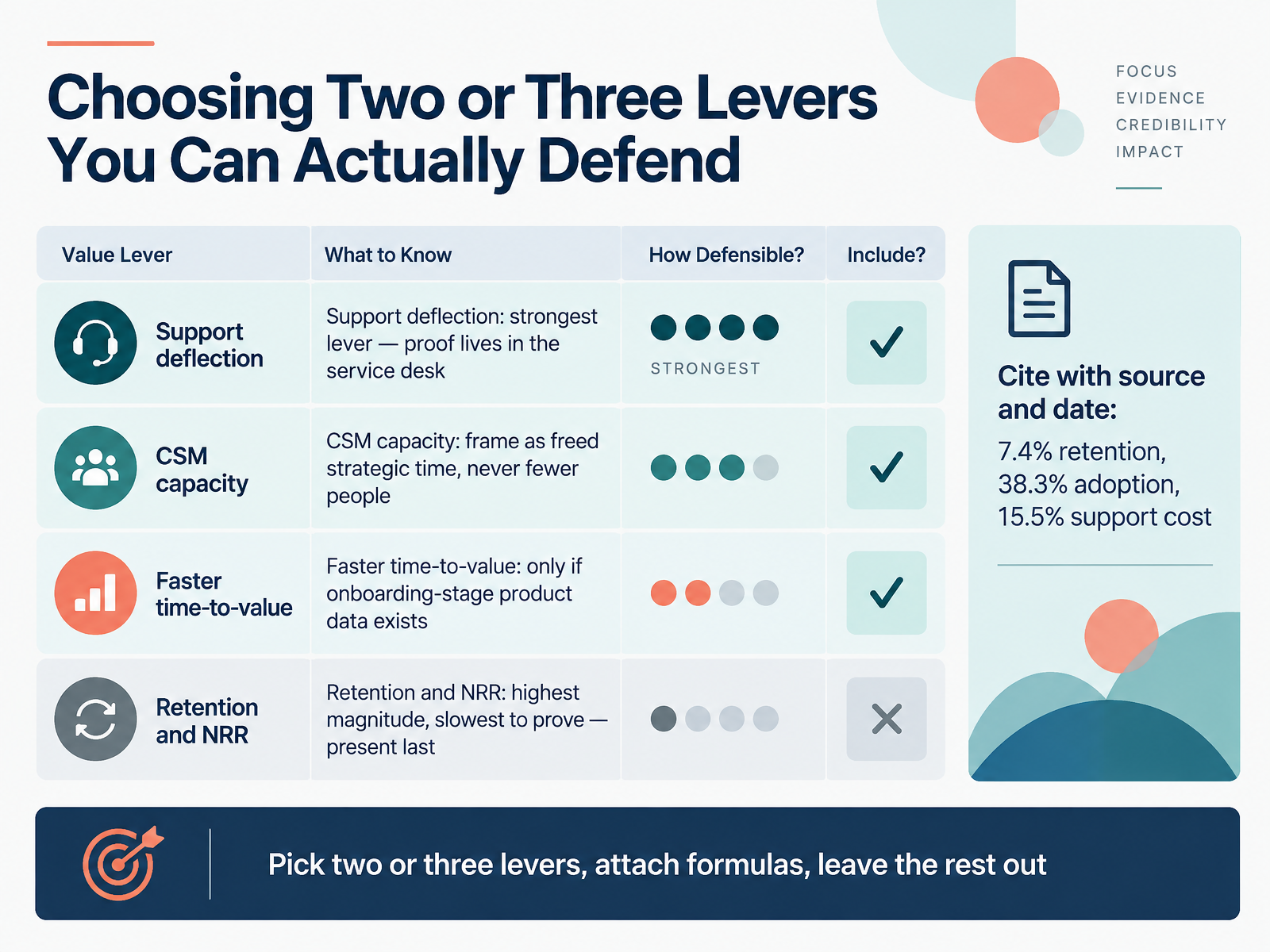
 - 08Choosing Two or Three Levers You Can Actually DefendNow let's get practical. You cannot defend every lever, so choose two or three you can prove. Here's how to rank them. Support deflection is usually your strongest lever, because the proof already lives in the service desk. If trained customers open fewer tickets, that's a real cost line finance already trusts. Next, C S M capacity. Frame it as freed strategic time per account, never as fewer people. Say fewer people, and the room stops hearing education and starts hearing layoffs. Faster time to value comes third. Only lean on it if you already have onboarding-stage product data. Then retention and net revenue retention. Highest magnitude, slowest to prove, so present it last, and use contribution language, not causation. Cite with a source and a date. For example, a seven point four percent retention lift, a thirty eight point three percent adoption increase, and a fifteen point five percent support cost reduction. Pick your two or three levers, attach the formulas, and leave the rest out. Next, we'll look at audience-specific messaging and value narratives.
 intellum.comthinkific.comabsorbai.com+22 min
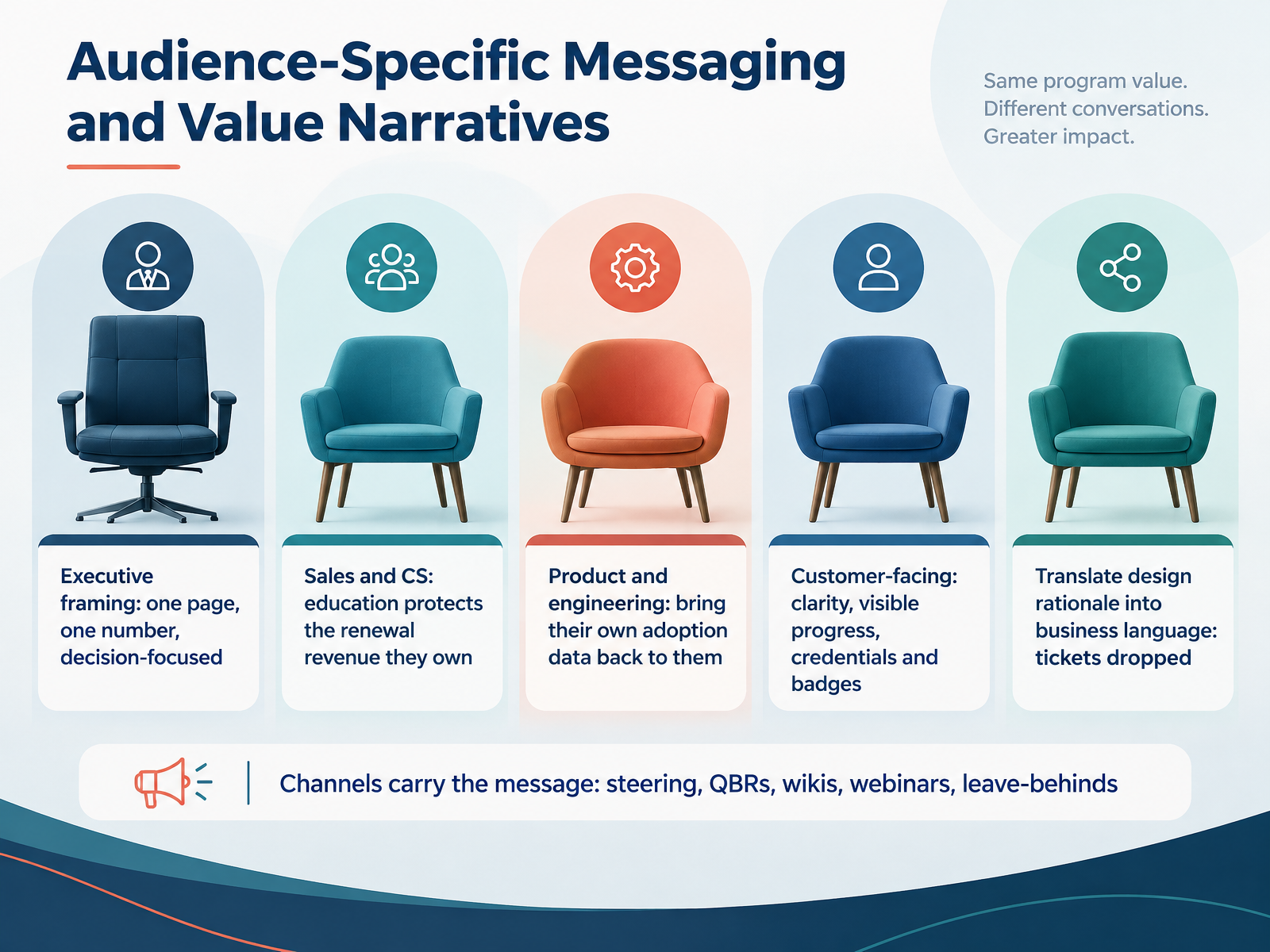
 - 09Audience-Specific Messaging and Value NarrativesNow, one message never fits every room. So let's match the narrative to the audience.
For executives, keep it to one page and one number, framed as a decision. For sales and customer success, say it plainly. Education protects the renewal revenue they own. With product and engineering, bring their own adoption data back to them. It lands differently when the numbers are theirs.
For customer-facing teams, lead with clarity, visible progress, and credentials. Badges and certifications give learners something to show for the effort.
And here's the translation move. When you justify a design choice, say it in business language. Don't describe the interaction pattern. Say support tickets dropped after the redesign.
Finally, the channel carries the message. Steering meetings, quarterly business reviews, internal wikis, webinars, and leave-behinds. Same evidence, different framing.
So pick your audience, pick your number, and pick the channel. Next, let's look at the practical assets that make this repeatable: the one-page brief, the roadmap, and the dashboard.
 teachable.comcheck-n-click.comtrainn.co+22 min
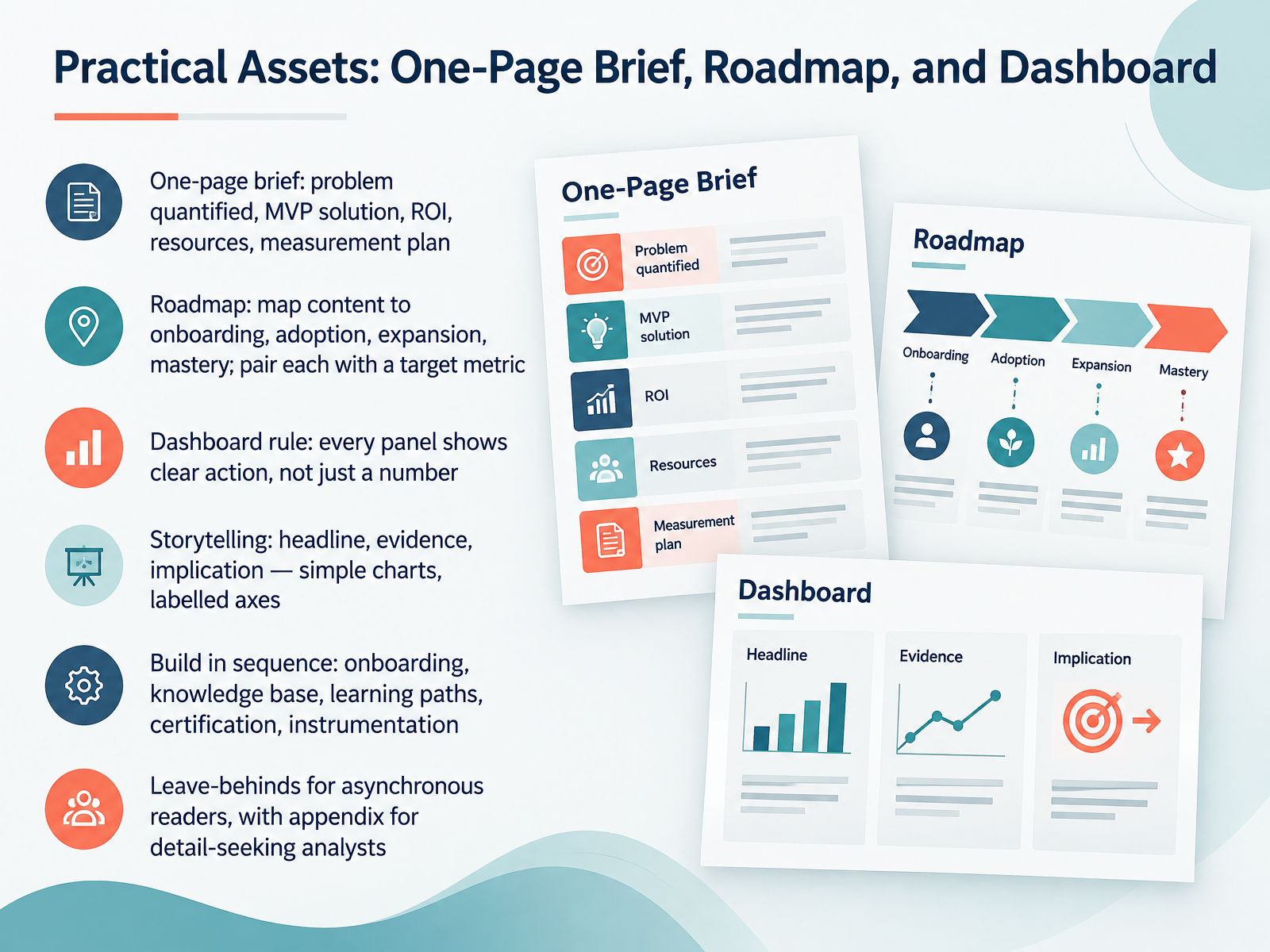
 - 10Practical Assets: One-Page Brief, Roadmap, and DashboardOkay, so what do you actually bring into the room? Five assets, and you can build them in a weekend, not a quarter. Start with a one-page brief. Quantify the problem, name your minimum viable solution, show the ROI, list the resources, and state your measurement plan. One page, because that is what gets read. Next, a roadmap that maps content to onboarding, adoption, expansion, and mastery, and pairs each stage with a target metric. If a stage has no metric, it has no owner. Then the dashboard rule. Every panel shows a clear action, not just a number. If a panel cannot tell someone what to do next, delete it. For storytelling, use headline, evidence, implication, with simple charts and labelled axes. And build in sequence. Onboarding first, then your knowledge base, then learning paths, certification, and finally instrumentation. These become leave-behinds for asynchronous readers, with an appendix for the analysts who want the detail. Let's move on to handling pushback and difficult conversations.
 teachable.comcheck-n-click.comtrainn.co+22 min
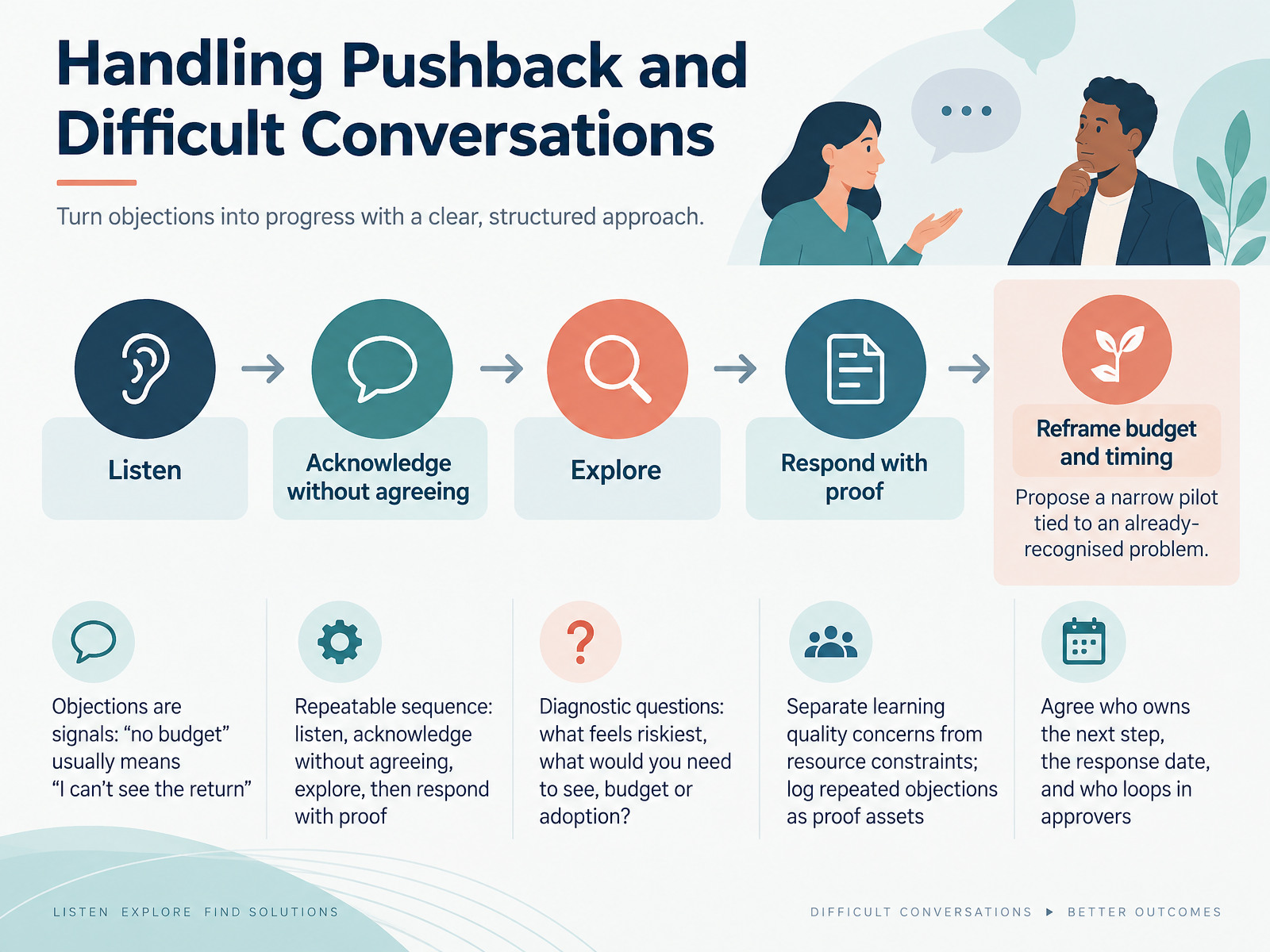
 - 11Handling Pushback and Difficult ConversationsLet's talk about pushback, because it is going to happen. Here is the reframe I want you to hold onto. An objection is a signal, not a rejection. When someone says there is no budget, they usually mean they cannot see the return yet. So you work a repeatable sequence. Listen. Acknowledge without agreeing. Explore. Then respond with proof. Ask diagnostic questions like, what feels riskiest right now, what would you need to see, and is this really about budget or about adoption? That last one separates the two all the time. Then reframe. Instead of a full rollout, propose a narrow pilot tied to a problem the business already recognises. Keep learning quality concerns separate from resource constraints, and log every repeated objection. Those become your proof assets. Last, never leave the room vague. Agree who owns the next step, the response date, and who loops in approvers. Next, we put this into practice with a scenario exercise covering a budget request, bad news, and a sceptical sales team.
 trainn.cokompassify.comlearnworlds.com+22 min
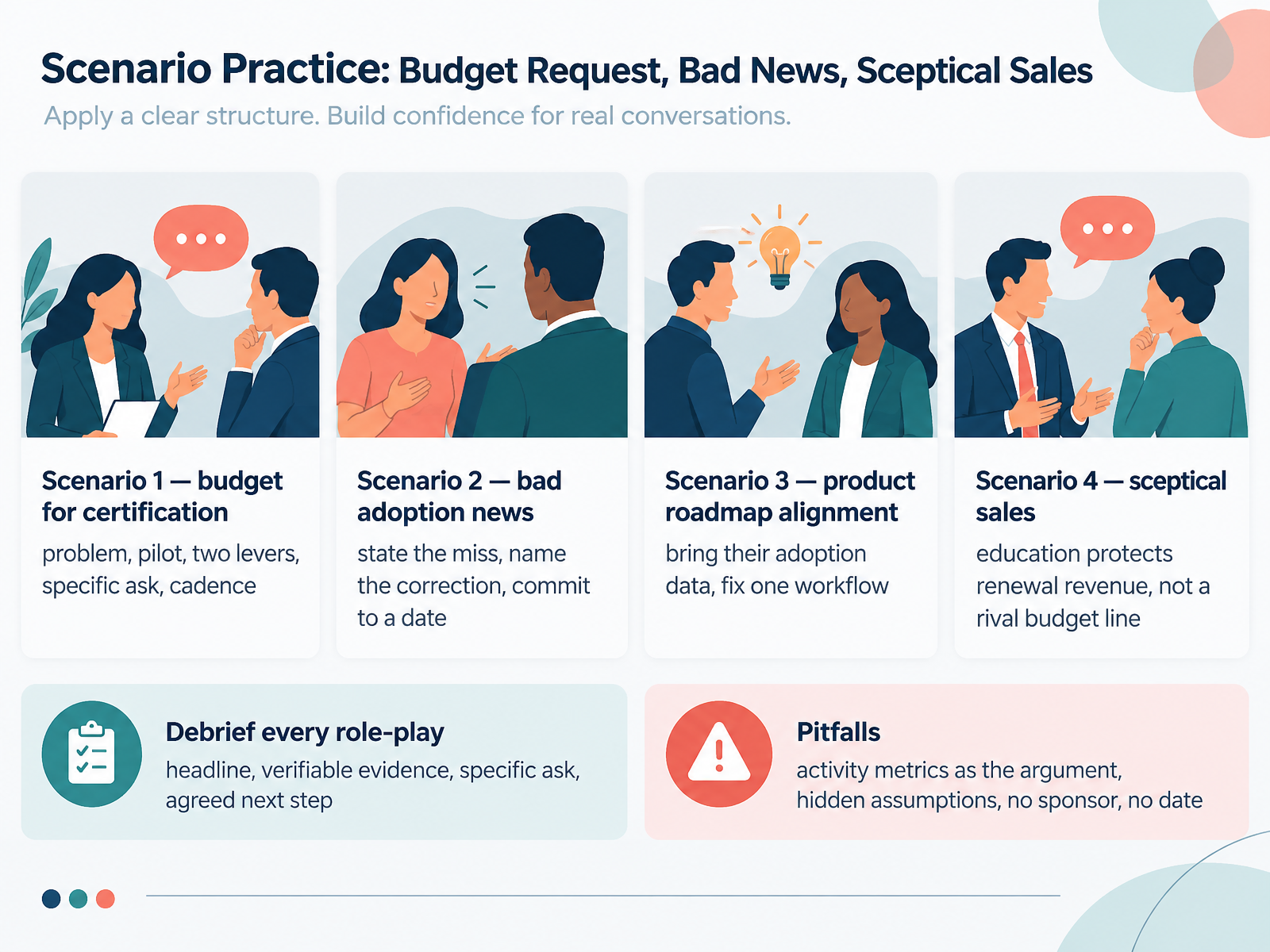
 - 12Scenario Practice: Budget Request, Bad News, Sceptical SalesNow let's rehearse. Because in these conversations, your credibility is built before the meeting, not in it. Four scenarios to practise.
Scenario one, a certification budget request. State the problem, propose a pilot, name two ROI levers, make one specific ask, and commit to a reporting cadence.
Scenario two, bad adoption news. State the miss plainly, name the correction, commit to a date. No hedging.
Scenario three, product roadmap alignment. Bring their adoption data, and agree on fixing one workflow.
Scenario four, sceptical sales. Your line: education protects renewal revenue. It's not a rival budget line.
Debrief every role-play on four things: the headline, verifiable evidence, a specific ask, and an agreed next step.
Watch these pitfalls: activity metrics used as the argument, hidden assumptions, no sponsor, and no date. You noticed both no sponsor and no date appear twice. They're the difference between a conversation and a decision.
Next, reporting cadence, governance, and keeping the story credible.
 trainn.cokompassify.comlearnworlds.com+22 min
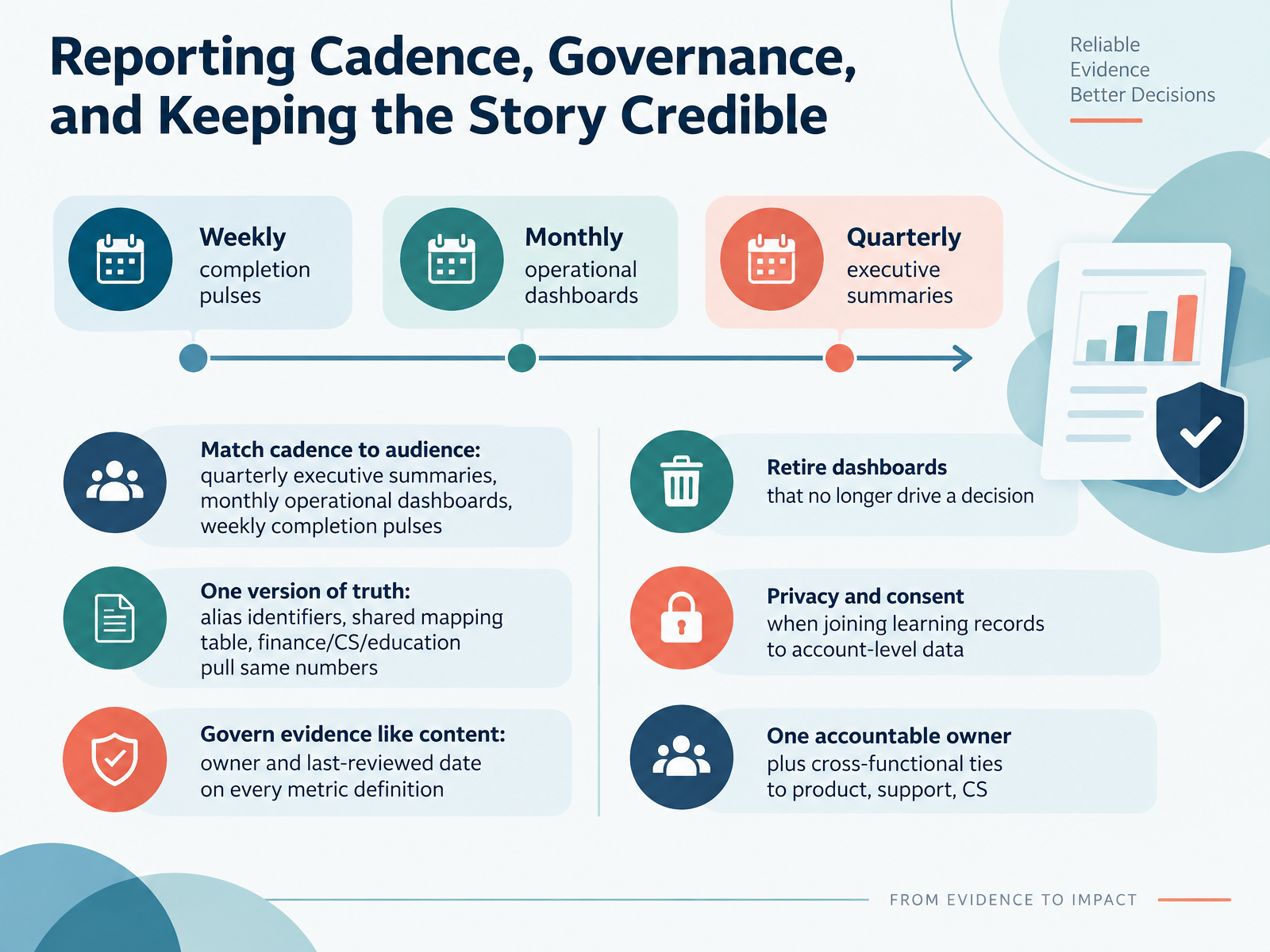
 - 13Reporting Cadence, Governance, and Keeping the Story CredibleLet's talk about how you report this evidence without losing credibility. First, match cadence to audience. Quarterly executive summaries for strategy and investment. Monthly operational dashboards for the teams running the program. Weekly completion pulses for the people working a launch. Next, one version of truth. Alias your identifiers, keep a shared mapping table, and make sure finance, customer success, and education pull the same numbers. When those numbers disagree in a meeting, the story dies. Govern evidence like content. Every metric definition gets an owner and a last-reviewed date. And retire dashboards that no longer drive a decision, because a stale dashboard quietly erodes trust. Handle privacy and consent carefully when you join learning records to account-level data. Finally, name one accountable owner, with cross-functional ties to product, support, and customer success. That's how the story stays credible quarter after quarter. Next, we'll turn this into action with Your 30-Day Communication Action Plan.
 intellum.comcheck-n-click.comeverestgrp.com+22 min
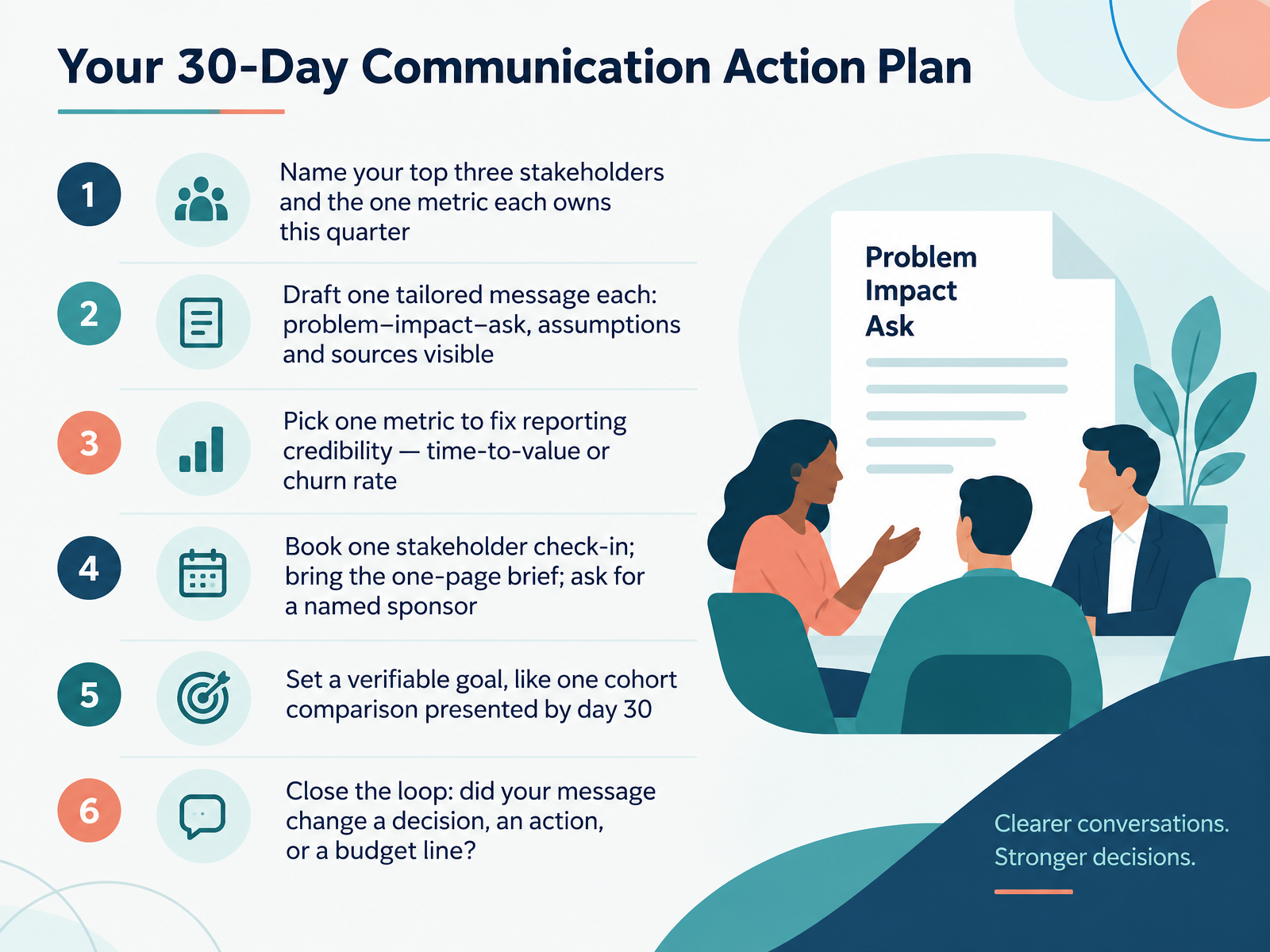
 - 14Your 30-Day Communication Action PlanLet's close with your thirty-day action plan. Keep it small enough to actually finish. Week one, name your top three stakeholders and the one metric each of them owns this quarter. Then draft one tailored message per person, using problem, impact, ask, with your assumptions and sources visible. Week two, pick a single metric to fix reporting credibility. Time-to-value or churn rate are the safest starting points. Week three, book one stakeholder check-in. Bring the one-page brief, and ask for a named sponsor, because a sponsor plus a budget is what separates programs with confidence from programs that stall. Week four, set a verifiable goal, like one cohort comparison presented by day thirty. Then close the loop. Ask yourself honestly, did your message change a decision, an action, or a budget line? That's your scorecard. You now have the framing and the numbers to make education a strategic conversation. Thanks for working through this with me. Go book that check-in, bring your evidence, and keep going.
 teachable.comcheck-n-click.comtrainn.co+22 min
Take the deck with you
Download this course as a file — free, no sign-up needed.
- PDF handoutEvery slide page, ready to print or share.15 pages · 3.4 MBDownload
- Narrated PowerPointThe deck that presents itself — every slide carries the digital human's narration video.15 pages · 14.1 MBDownload
- PowerPoint slidesThe full deck as a .pptx — open it in PowerPoint, Keynote, or Google Slides.15 pages · 3.4 MBDownload
Free to use in your own training — please keep the PersonWise credit page at the end.
Have your own deck? Turn it into a course
Sources consulted
Web sources consulted while building this course.
- Customer Education Metrics to Measure — intellum.com
- From Learning To Revenue — thinkific.com
- Customer education KPIs: The metrics that actually predict retention | Absorb LMS Software — absorbai.com
- Customer Education Statistics 2026: Sourced Data | TryTami — trytami.com
- New Absorb Software and Lighthouse Research & Advisory Study Reveals How the Highest-Performing Customer Education Programs Turn Learning into Measurable Growth - Business Intelligence — businessintelligence.mo
- How to build a customer education program → Teachable — teachable.com
- Customer Education Metrics Guide: Proving ROI (2026) - Check N Click Learning and Technologies Pvt. Ltd. — check-n-click.com
- Customer Education Best Practices: 12 Proven (2026) | Trainn — trainn.co
- Customer Education Platform: Build & Measure for 2026 — aicoursify.com
- The state of customer education in 2026 | Absorb LMS Software — absorbai.com
- How to build a customer education business case leaders trust | Absorb LMS Software — absorbai.com
- How to Make a Customer Education Business Case | Intellum — intellum.com
- How to Present Customer Education Program Results — resumly.ai
- The 2024 Guide To Executive Business Reviews and QBRs — zapscale.com
- From QBR to CEO Briefing: How to Speak the Language of Growth — karthickjl.substack.com
- Customer Education Maturity Assessment (CEMA) - Everest Group Research Portal — everestgrp.com
- Customer Education: How to Build a Program That Drives Adoption (2026) — kompassify.com
- How to improve customer education in 2026 | LearnWorlds — learnworlds.com
- Customer Training Programs: Complete Guide [2026] | Konstantly Blog — konstantly.com
- Customer Education: The Complete SaaS Guide for 2026 | Docsio — docsio.co