Begin
14 pages · ~28 min
How New Species Form: Speciation
This training explains the mechanisms of speciation, teaching learners how new species form through evolutionary processes. Ideal for biology students and educators.
A digital instructor presents all 14 pages. Hold “Ask” at any point and ask out loud — the answer comes from this course. No sign-up needed.
What you’ll learn
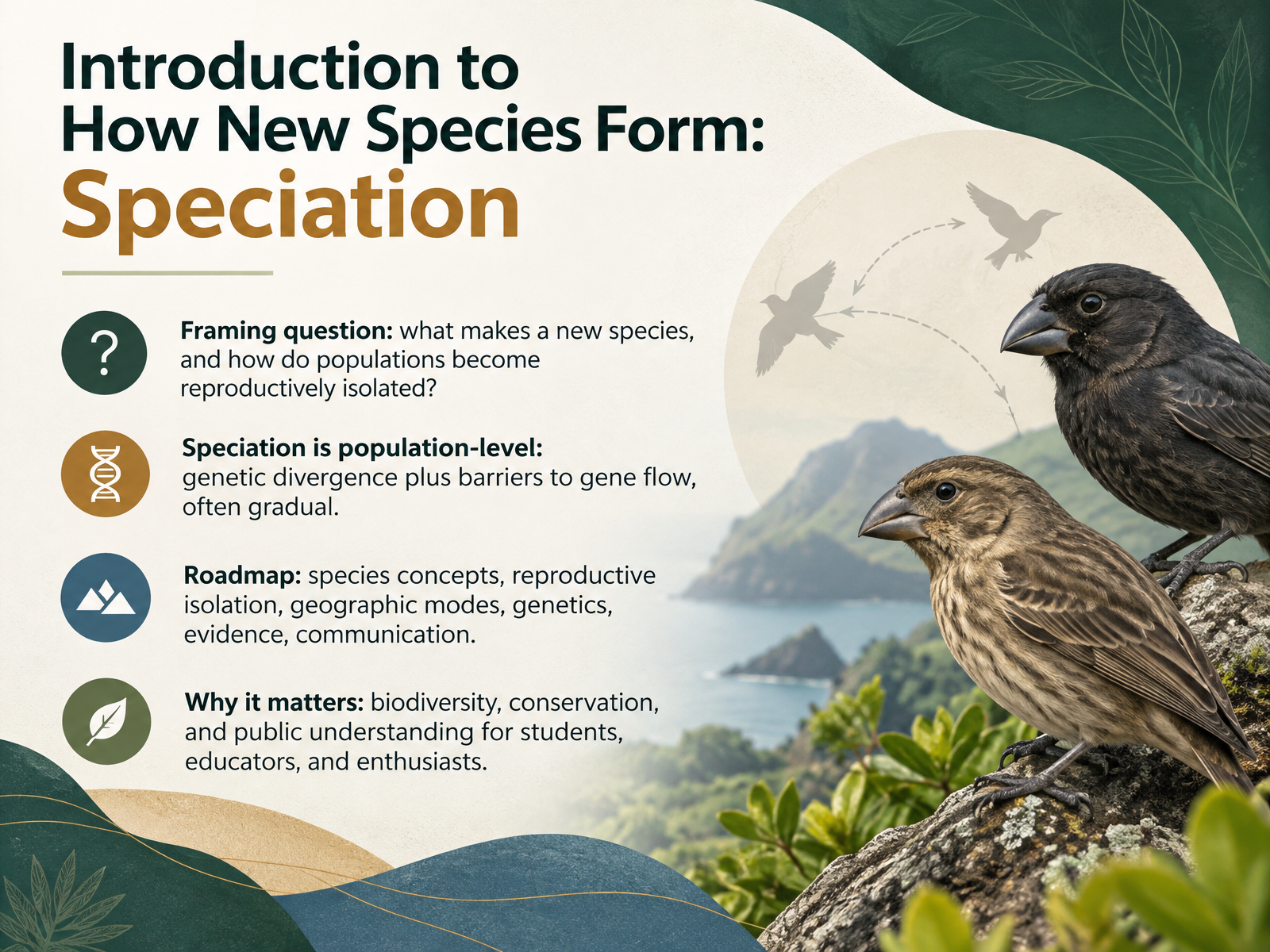
- 01Introduction to How New Species Form: SpeciationWelcome. Today we're exploring one of biology's most important questions: how do new species actually form? Here's our framing question. What makes a new species, and how do populations become reproductively isolated? First, keep one idea in mind. Speciation is population-level. It involves genetic divergence plus barriers to gene flow, and it is often gradual. Next, we'll move through a clear roadmap: species concepts, reproductive isolation, geographic modes, genetics, evidence, and how to communicate it. Why does this matter? Because speciation connects directly to biodiversity, conservation, and public understanding, whether you are a student, an educator, or a natural history enthusiast. Let's begin by asking what a species actually is, and why definitions matter.2 min
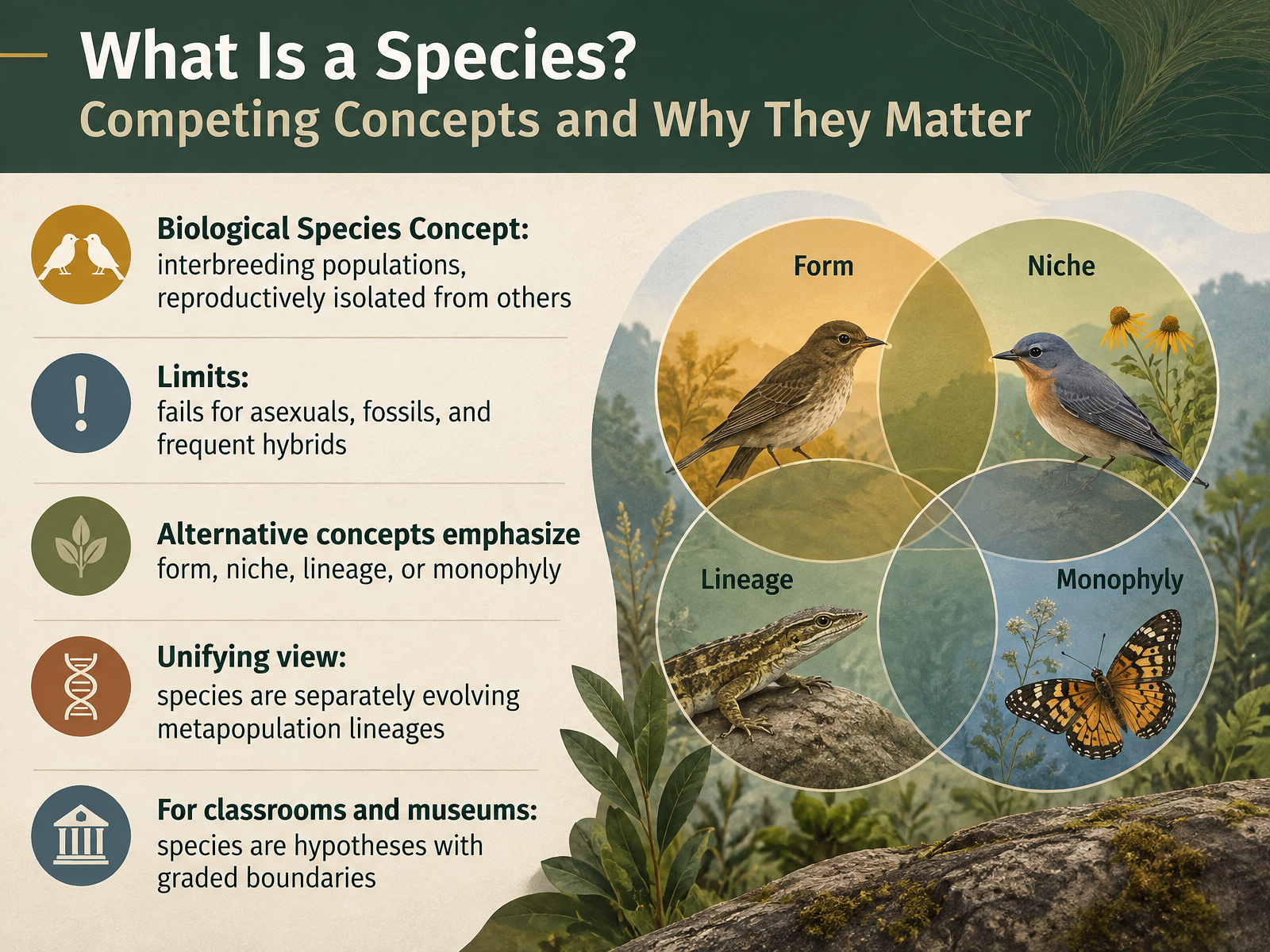
- 02What Is a Species? Competing Concepts and Why They MatterBefore we trace how new species form, we need to ask what a species actually is. The most familiar answer is the biological species concept. It defines a species as a group of interbreeding populations that are reproductively isolated from other such groups. In other words, members can produce fertile offspring together, but not with outsiders. This works well for many animals, such as distinct frog species that never interbreed in nature. However, the concept has limits. It fails for asexual organisms, for fossils, and for groups that hybridize often, like some plants and birds. So biologists also use alternative concepts. Some emphasize form, or morphology. Others emphasize ecological niche, evolutionary lineage, or monophyly, meaning a single shared ancestry. A unifying view treats species as separately evolving metapopulation lineages. For classrooms and museums, the key takeaway is that species are hypotheses with graded boundaries, not always sharp lines. Next, we look at the barriers that keep species apart: reproductive isolation, starting with prezygotic barriers.
 2 min
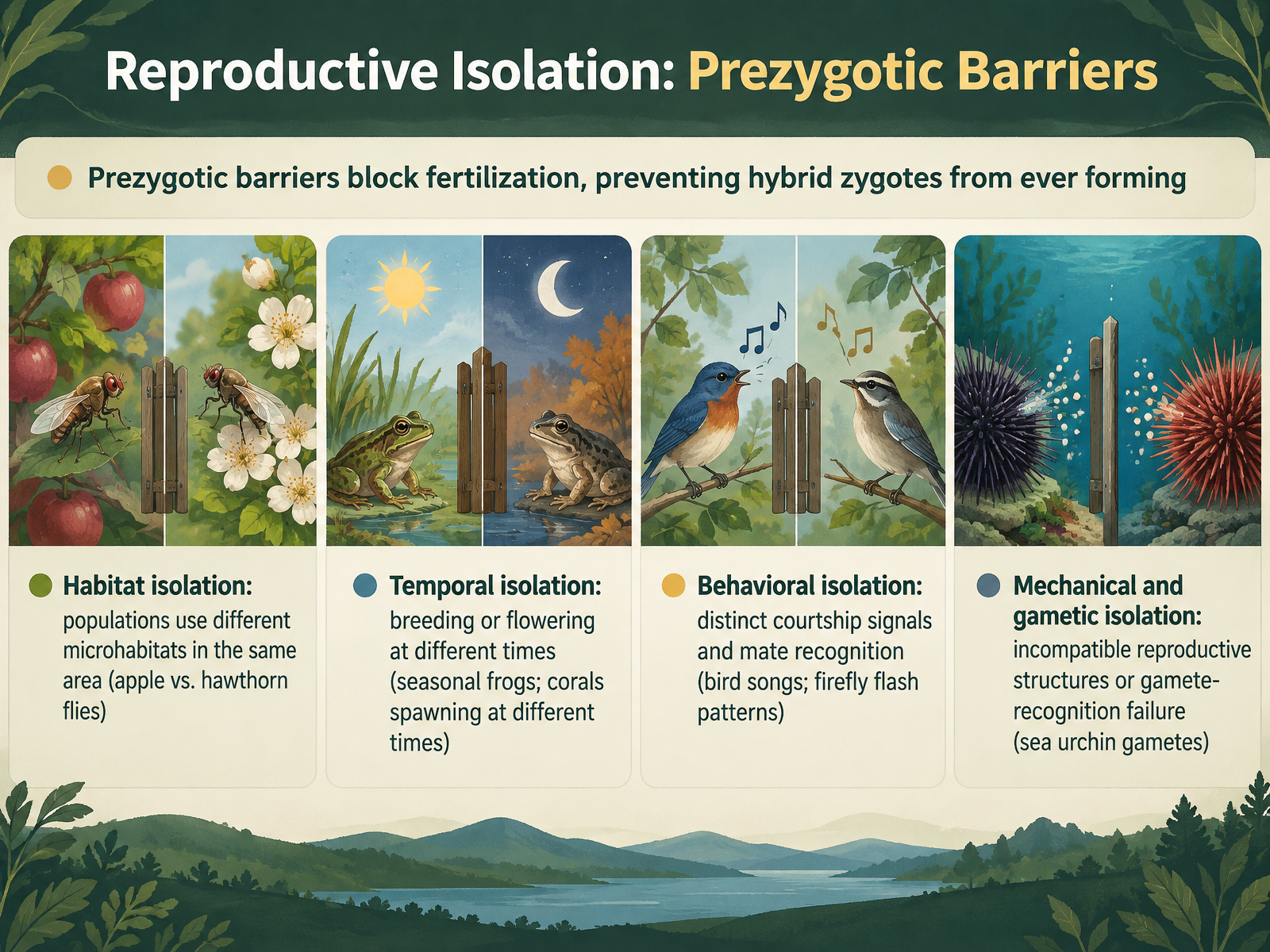
- 03Reproductive Isolation: Prezygotic BarriersNow let's focus on the first major category of reproductive isolation: prezygotic barriers. These barriers block fertilization before it can happen, so a hybrid zygote never forms. First, habitat isolation occurs when populations use different microhabitats in the same area. For example, apple and hawthorn flies breed on different host fruits. Next, temporal isolation means populations breed or flower at different times. Consider frogs that breed in different seasons, or corals that spawn at different times of night. Then there is behavioral isolation, driven by distinct courtship signals and mate recognition. Think of bird songs or firefly flash patterns. Finally, mechanical and gametic isolation involve incompatible reproductive structures or failures in gamete recognition, as seen in some sea urchin gametes. Together, these prezygotic barriers stop gene flow early. But what happens after fertilization? Next, we examine postzygotic barriers and reinforcement.
 1 min
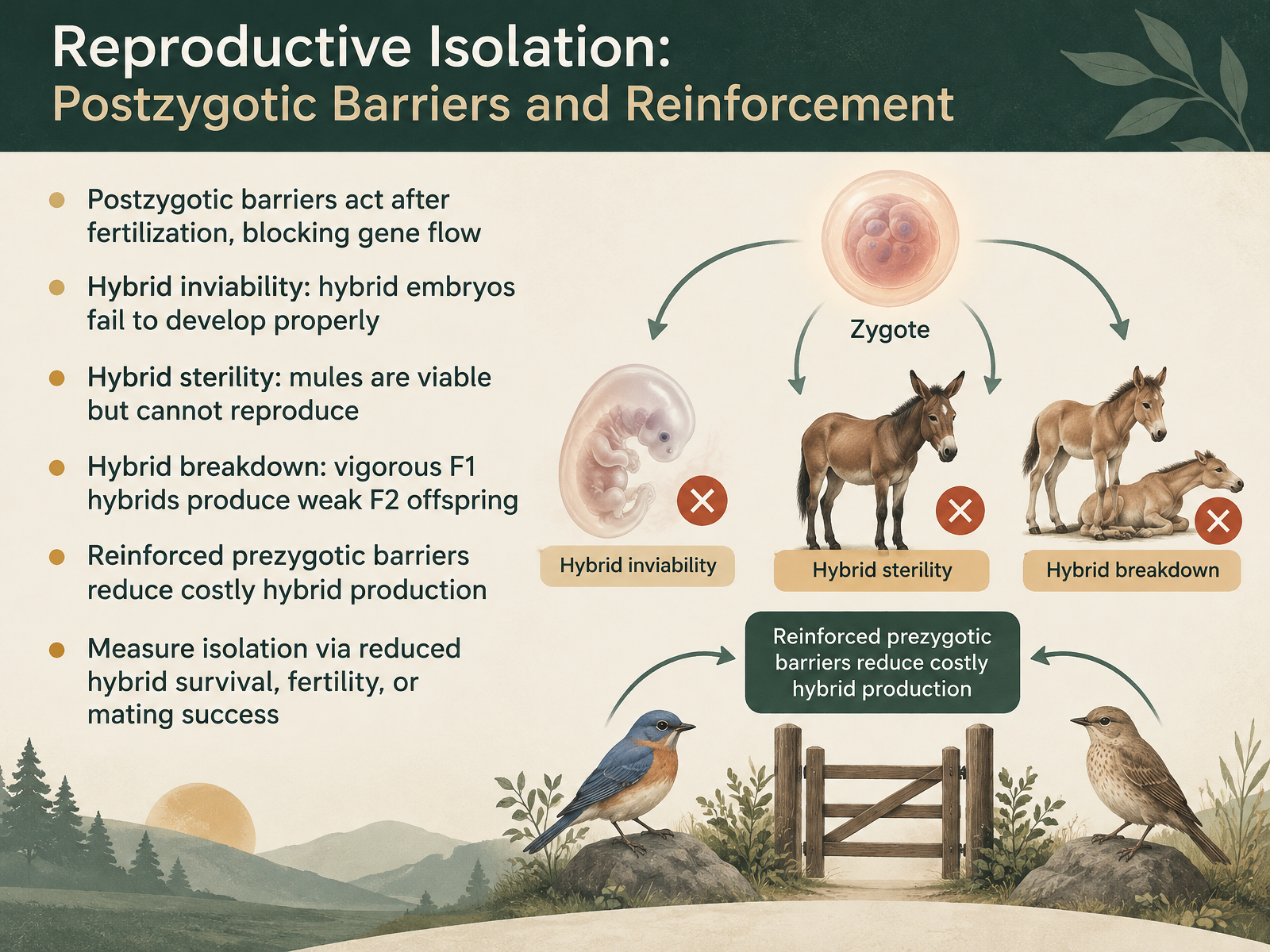
- 04Reproductive Isolation: Postzygotic Barriers and ReinforcementNow let's examine what happens after fertilization. Postzygotic barriers act after a sperm and egg have fused, and they block gene flow by reducing the success of hybrid offspring. First, hybrid inviability: a hybrid embryo fails to develop properly and never reaches adulthood. Next, hybrid sterility. Think of mules, which are viable and strong but cannot reproduce. Then there is hybrid breakdown. Here, the first generation hybrids are vigorous, but their offspring, the second generation, are weak or infertile. As a result, these failed hybrids are costly. Reinforced prezygotic barriers evolve to reduce wasted mating effort. You can measure isolation by comparing hybrid survival, fertility, or mating success. Next, we turn to the geography of speciation, starting with allopatric divergence.
 2 min
- 05Geography of Speciation: Allopatric DivergenceNow let's look at the geography of speciation, starting with allopatric divergence. In allopatry, a continuous range is split by a barrier, which blocks gene flow between the separated populations. Next, genetic drift, mutation, and divergent selection begin to accumulate differences on each side. There are two classic routes to this split. Vicariance means barriers arise in place, like the Isthmus of Panama separating marine populations. Dispersal means organisms cross an existing barrier and colonize a new area, such as finches reaching remote islands. But here is the key point. Allopatry alone is not enough. Selection and drift are the forces that actually drive reproductive isolation. Next, we will see what happens when those separated populations meet again, in secondary contact, hybrid zones, and reinforcement.
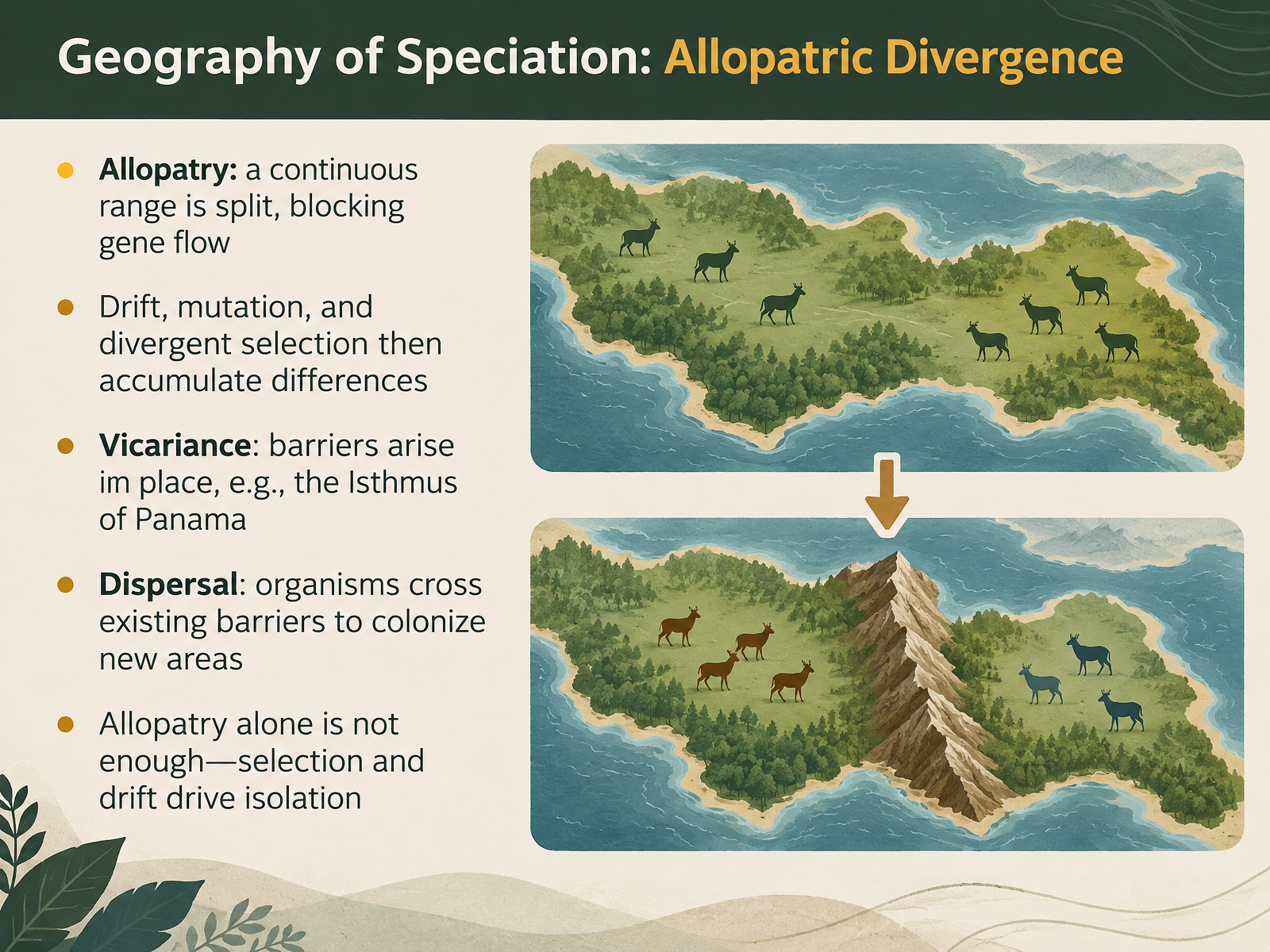 2 min
- 06Secondary Contact, Hybrid Zones, and ReinforcementNow let's consider what happens when diverged populations meet again. There are three possible outcomes: fusion, where the populations merge; stable hybrid zones, where they persist as distinct lineages; or reinforcement, where selection strengthens reproductive isolation. Think of hybrid zones as natural laboratories. By studying clines, the gradual changes in gene frequencies across a hybrid zone, we can identify genes that resist gene flow. For example, in barn swallows, sexually selected traits like color and tail length stay distinct across hybrid zones, showing that sexual selection can maintain species boundaries. When hybrids have low mating success, reinforcement drives the evolution of stronger prezygotic barriers, such as differences in courtship signals. These hybrid zones make the gradual, often messy nature of species boundaries visible, which is perfect for museum exhibits and classroom discussions. Next, we'll explore sympatric and parapatric speciation, where divergence can occur even with gene flow.
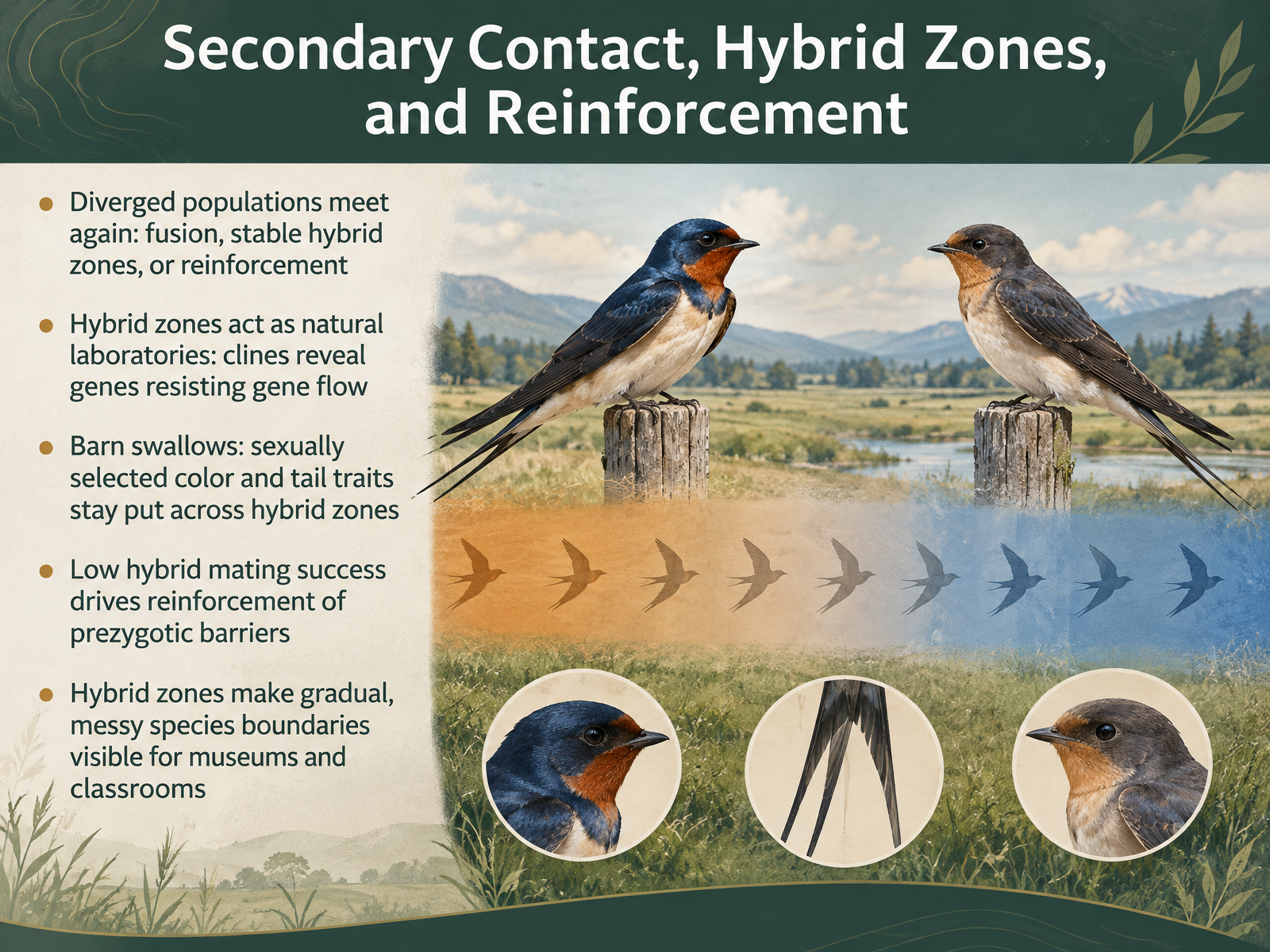 1 min
- 07Sympatric and Parapatric Speciation: Divergence with Gene FlowNext, let's consider divergence with gene flow. In sympatric speciation, populations split without geographic isolation. Host shifts, polyploidy, or sexual selection can drive this. Parapatric speciation occurs along environmental gradients, with limited but ongoing gene flow. The core challenge is gene flow, which mixes populations. Divergent selection, combined with reduced recombination, builds genomic islands of differentiation. Classic examples include apple maggot host races, cichlid radiations, polyploid plants, and stickleback ecotypes. But be cautious: many celebrated sympatric cases reveal complex histories of allopatric phases plus secondary gene flow. So ask, what does the evidence really show? This sets the stage for the genetics of speciation, where we examine genes, genomes, and barrier loci.
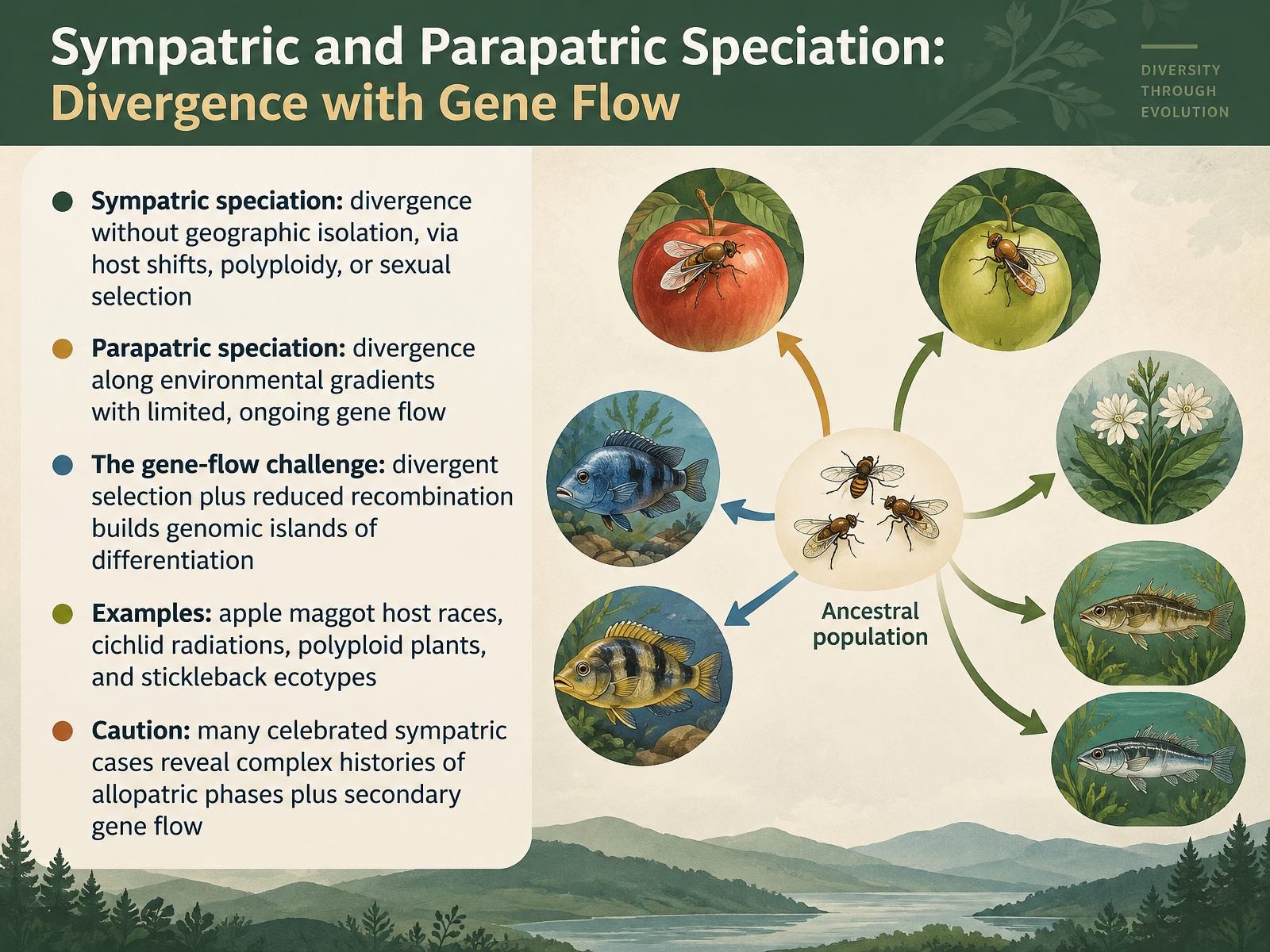 2 min
- 08Genetics of Speciation: Genes, Genomes, and Barrier LociNow let's look at the genetics behind speciation. First, hybrid incompatibility genes are now known in many non-model organisms, not just lab favorites like fruit flies. Next, the number of documented incompatibility genes has grown roughly sevenfold since twenty ten. As a result, we can compare mechanisms across many lineages. Three mechanisms matter here: genic incompatibilities, inversions that suppress recombination, and intragenomic conflict. But be careful with genomic islands. They may reflect true barrier loci, or they may arise from linked selection and low recombination. Consider Antirrhinum, the snapdragon. Its flower-color loci link selective sweeps to hybrid-zone barriers, a concrete museum example. So the emerging trait-centered view is that many small-effect genes, plus non-genic inheritance, often matter. Next, we turn to adaptive radiation and ecological speciation.
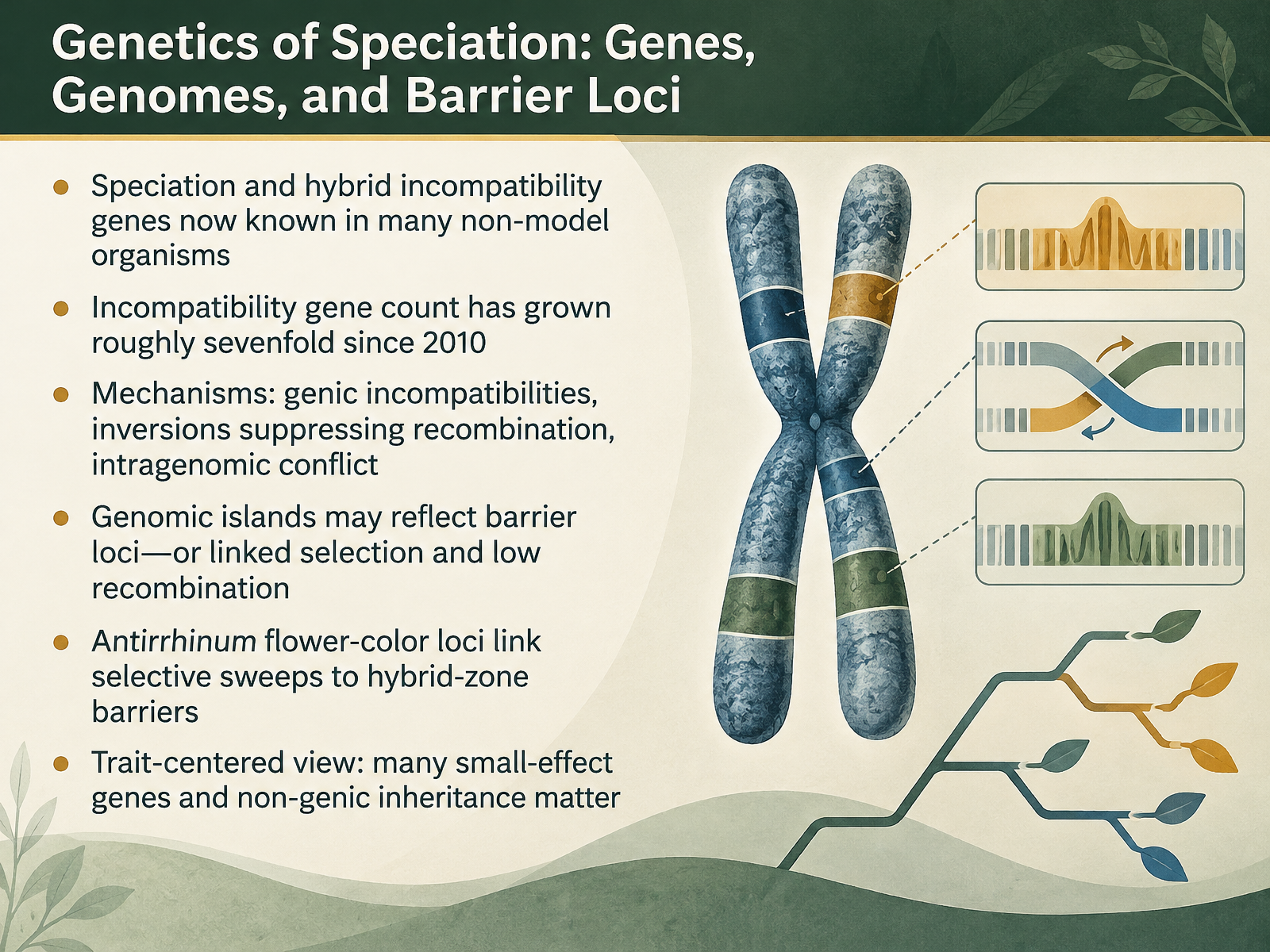 2 min
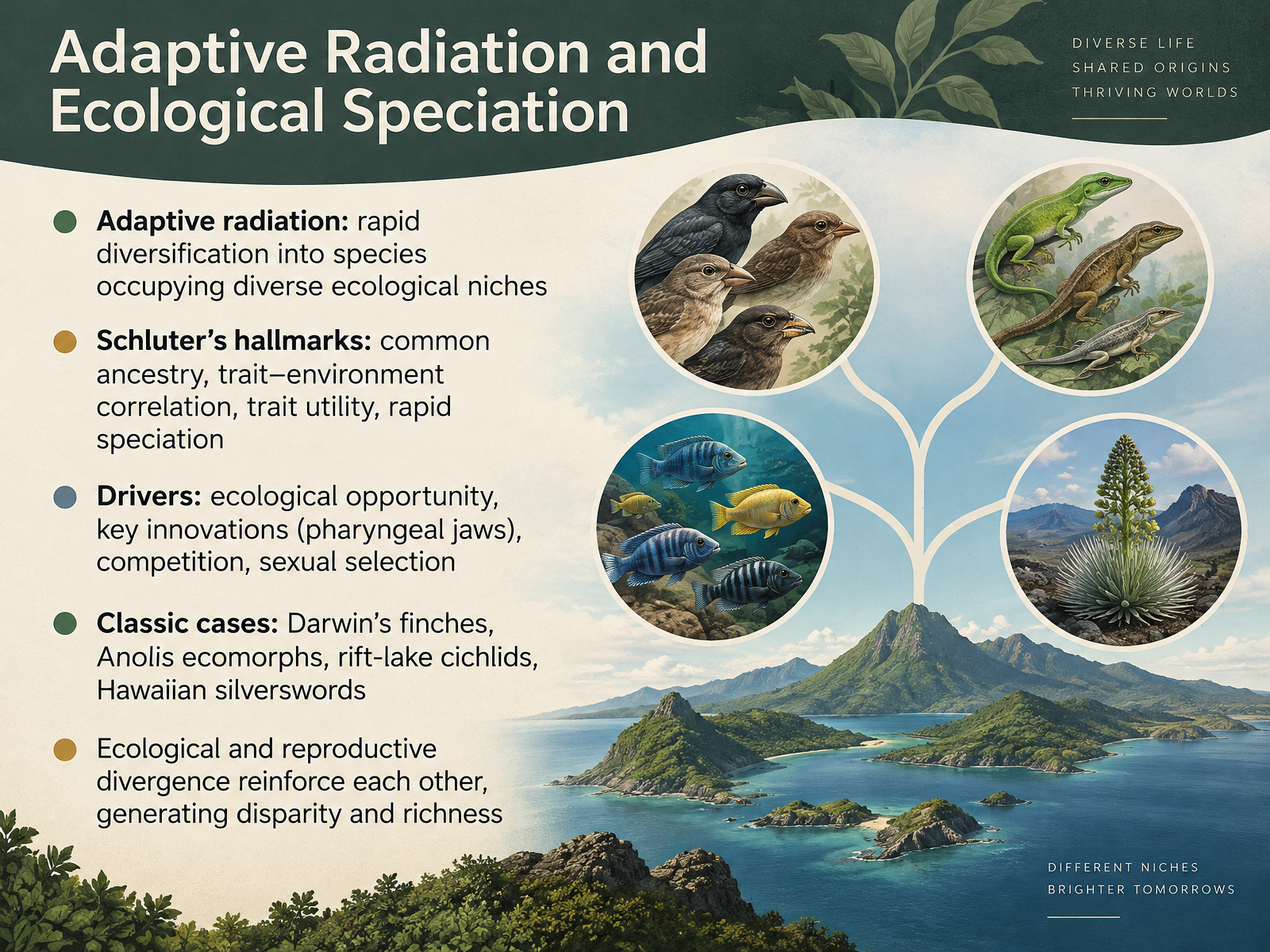
- 09Adaptive Radiation and Ecological SpeciationNow let's look at how ecological opportunity can fuel rapid speciation. Adaptive radiation is the rapid diversification of one lineage into many species that occupy diverse ecological niches. Dolph Schluter identifies four hallmarks: common ancestry, a correlation between traits and environment, trait utility, and rapid speciation. What drives this? First, ecological opportunity, such as unoccupied habitat. Next, key innovations, like the pharyngeal jaws of cichlid fishes. Competition and sexual selection also play roles. Classic cases include Darwin's finches, Anolis lizards, rift-lake cichlids, and Hawaiian silverswords. As a result, ecological and reproductive divergence reinforce each other, generating remarkable disparity and richness. Next, we will examine evidence and methods for testing speciation hypotheses.
 1 min
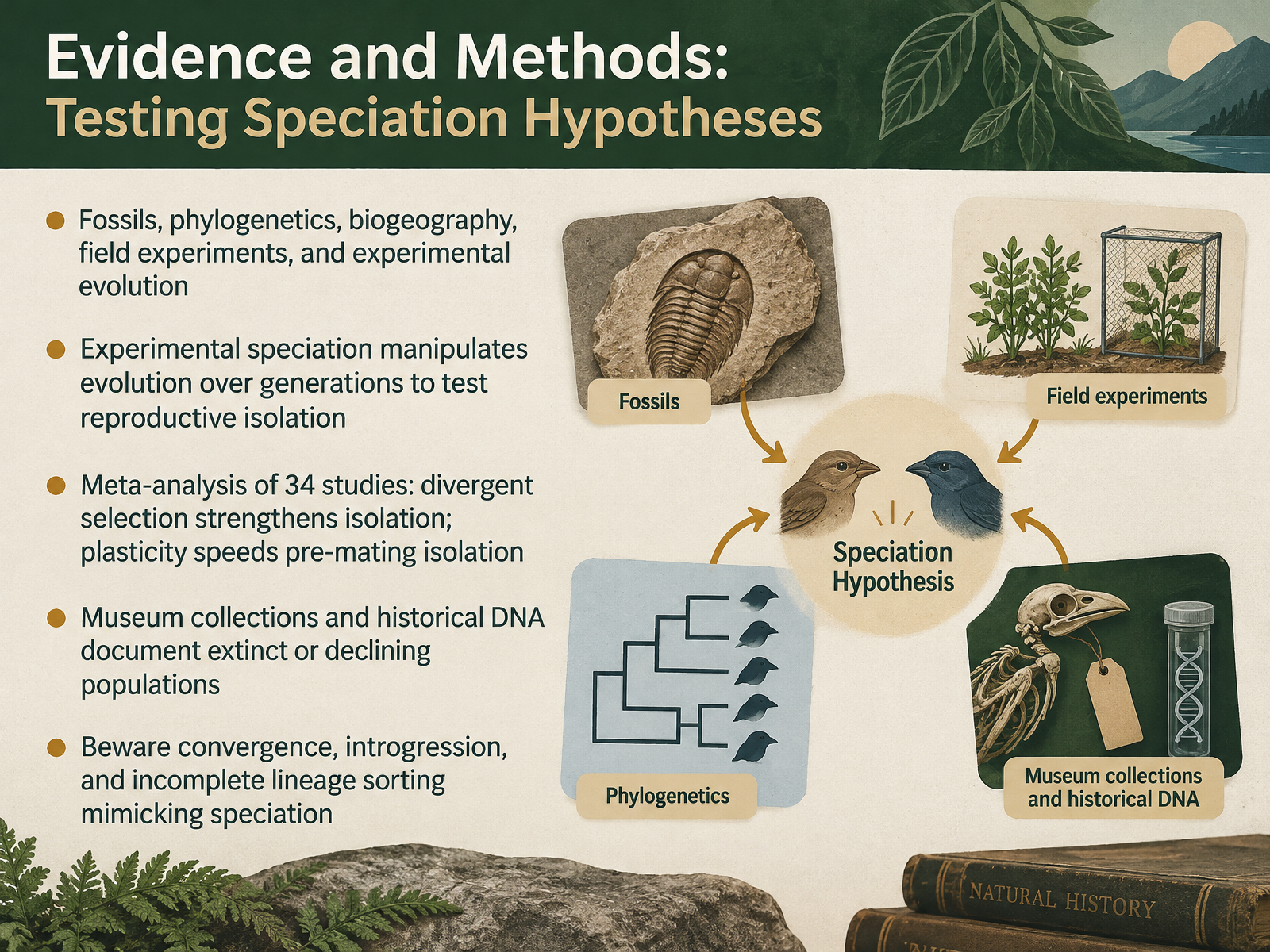
- 10Evidence and Methods: Testing Speciation HypothesesSo how do we actually test a speciation hypothesis? First, we gather independent lines of evidence: fossils, phylogenetics, biogeography, field experiments, and experimental evolution. Experimental speciation is especially powerful. Researchers manipulate populations over many generations and watch whether reproductive isolation evolves. Next, consider a meta-analysis of thirty-four studies. It found that divergent selection strengthens isolation, and plasticity can speed up pre-mating isolation. Museum collections and historical DNA are also valuable, because they document extinct or declining populations. But be careful. Convergence, introgression, and incomplete lineage sorting can all mimic speciation, so always cross-check your evidence. Next, we turn to hybridization, polyploidy, and cryptic diversity.
 2 min
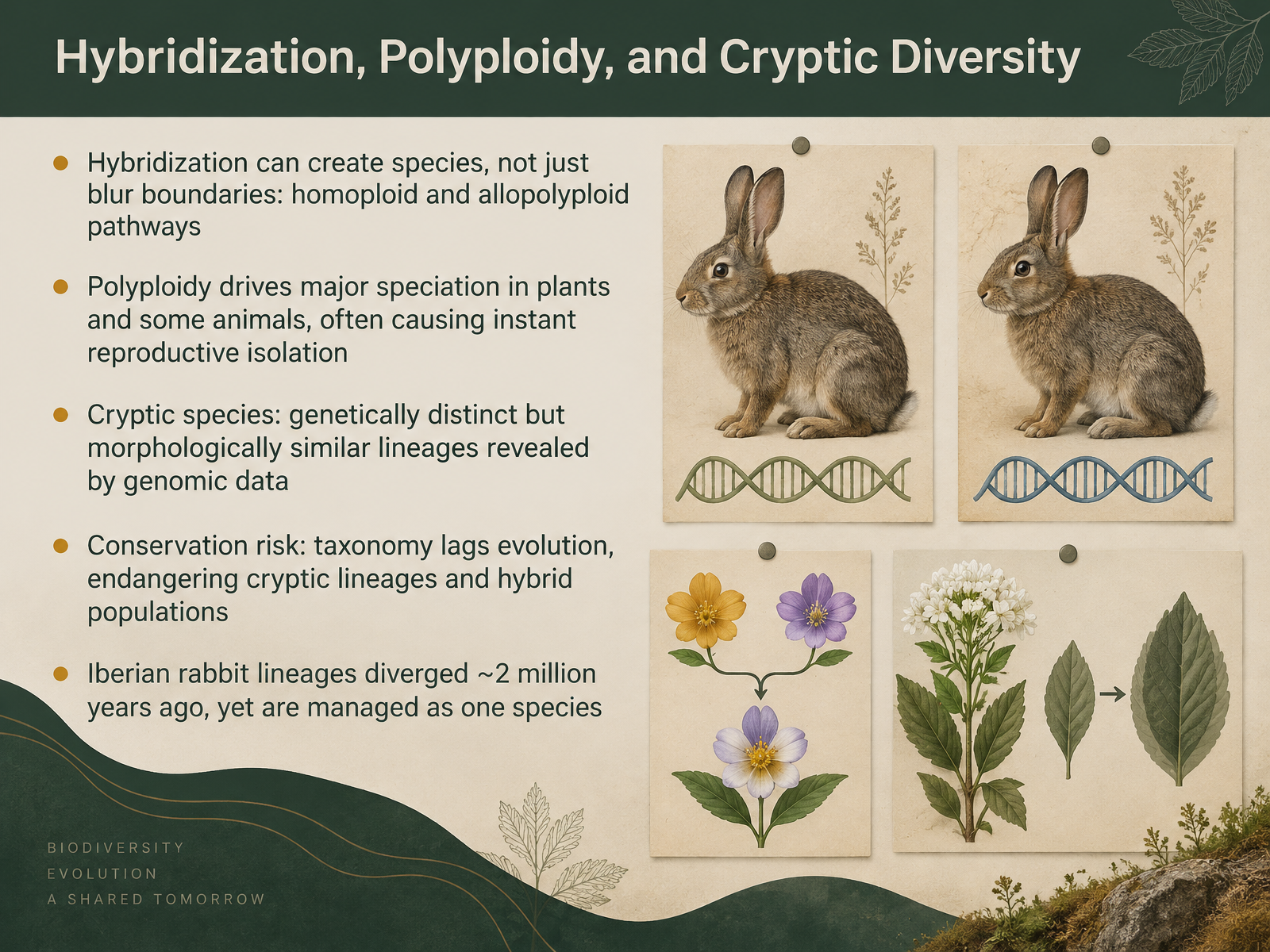
- 11Hybridization, Polyploidy, and Cryptic DiversityNow let's look at how hybridization and polyploidy complicate the picture. First, hybridization does not only blur boundaries. It can create new species through homoploid pathways, where chromosome number stays the same, or allopolyploid pathways, where chromosome sets combine. Next, polyploidy, the duplication of whole chromosome sets, drives major speciation in plants and some animals. It often causes instant reproductive isolation, because polyploids cannot successfully breed with their diploid parents. Then there are cryptic species: lineages that are genetically distinct but look almost identical. Genomic data reveal them. This matters for conservation, because taxonomy lags behind evolution. Consider Iberian rabbit lineages. They diverged roughly two million years ago, yet they are still managed as one species. As a result, cryptic lineages and hybrid populations can be endangered before we even name them. Next, we will turn to teaching speciation, including common misconceptions and practical strategies.
 2 min
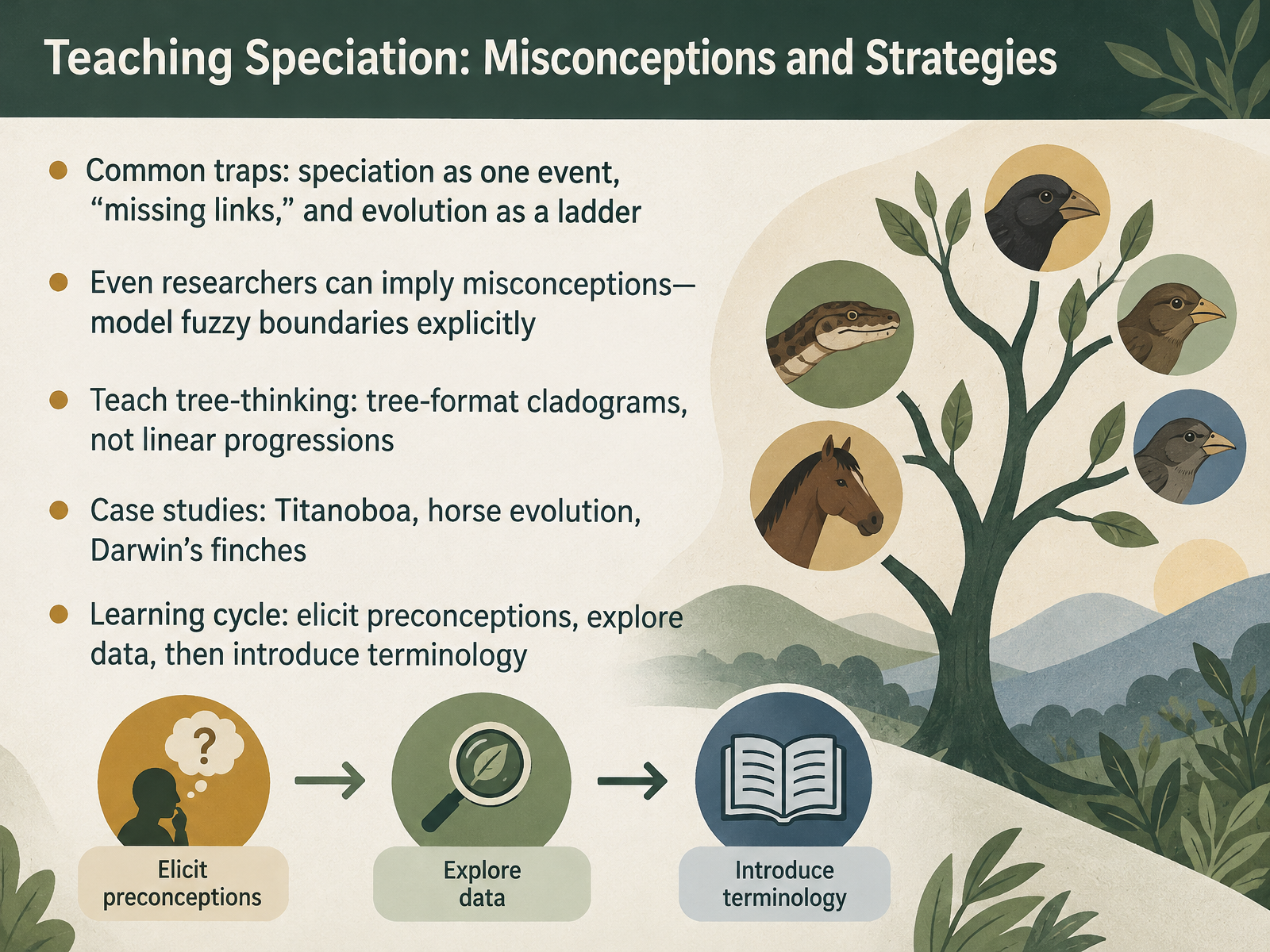
- 12Teaching Speciation: Misconceptions and StrategiesLet's turn to teaching speciation and the misconceptions that come with it. First, watch for three common traps: treating speciation as a single event, searching for so-called missing links, and picturing evolution as a ladder. Next, remember that even researchers can imply these ideas, so model fuzzy boundaries explicitly. For instance, ring species show gradual divergence. Then teach tree-thinking using cladograms drawn in true tree format, not linear progressions. Concrete case studies help. Titanoboa illustrates size change over time, horse evolution is often taught falsely as a straight line, and Darwin's finches show branching adaptation. As a result, use a learning cycle: elicit preconceptions, explore data, then introduce terminology. To make it tangible, next we move to museum and public communication.
 1 min
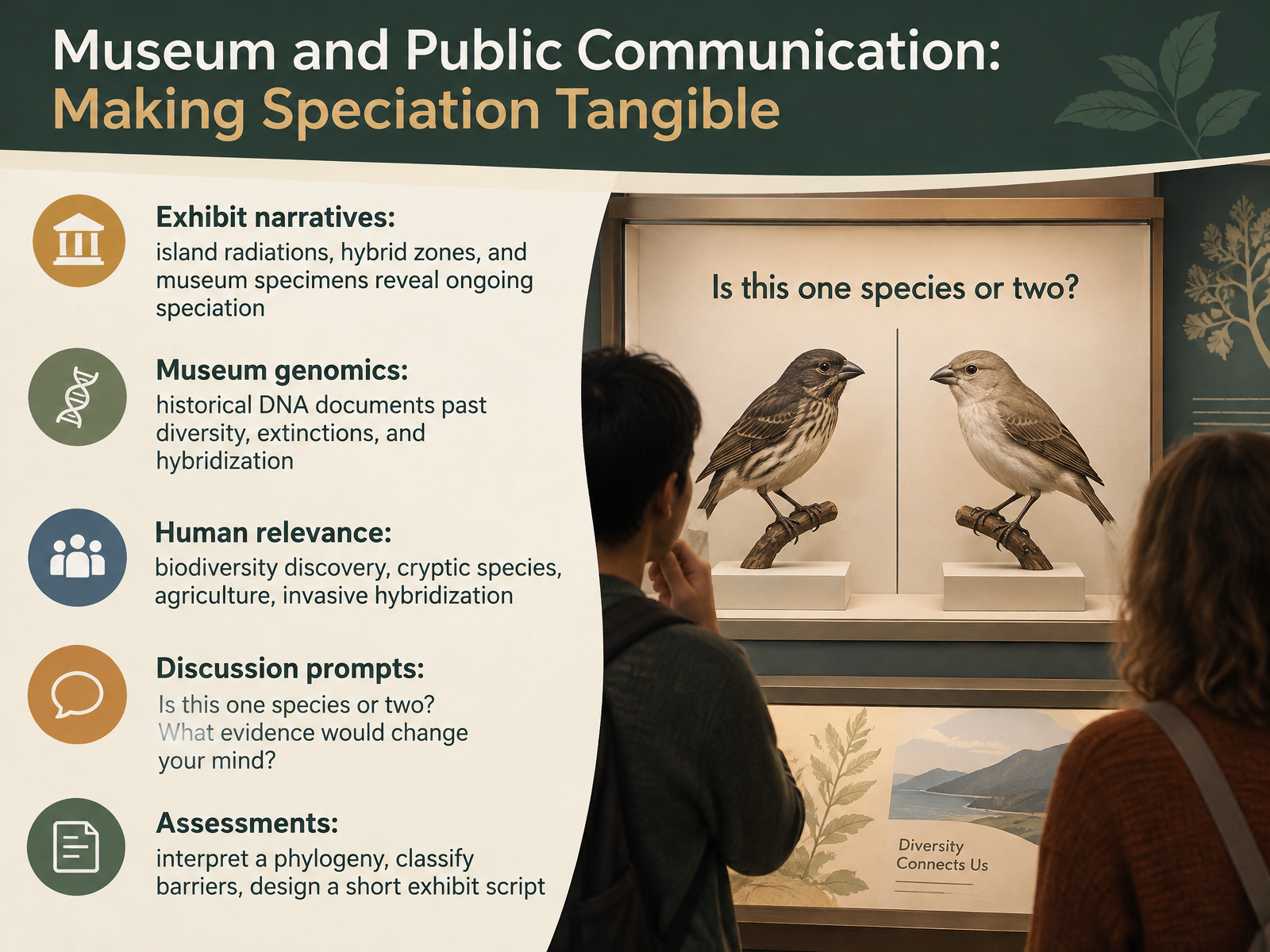
- 13Museum and Public Communication: Making Speciation TangibleLet's look at how we bring speciation to the public, in museums and classrooms. First, exhibit narratives. Island radiations, like Darwin's finches, and hybrid zones, where two species interbreed, let visitors see speciation as an ongoing process. Museum specimens anchor these stories in real evidence. Next, museum genomics. Historical DNA from old specimens documents past diversity, extinctions, and hybridization, revealing changes we cannot observe directly. Human relevance matters too. Biodiversity discovery uncovers cryptic species that look alike but are genetically distinct. Agriculture depends on understanding pest speciation. Invasive hybridization can threaten native species. Here are discussion prompts you can use: Is this one species or two? What evidence would change your mind? For assessment, ask learners to interpret a phylogeny, classify reproductive barriers, or design a short exhibit script. The takeaway is that clear narratives and real specimens make speciation tangible and memorable. Next, we move to synthesis: patterns, processes, and open questions.
 2 min
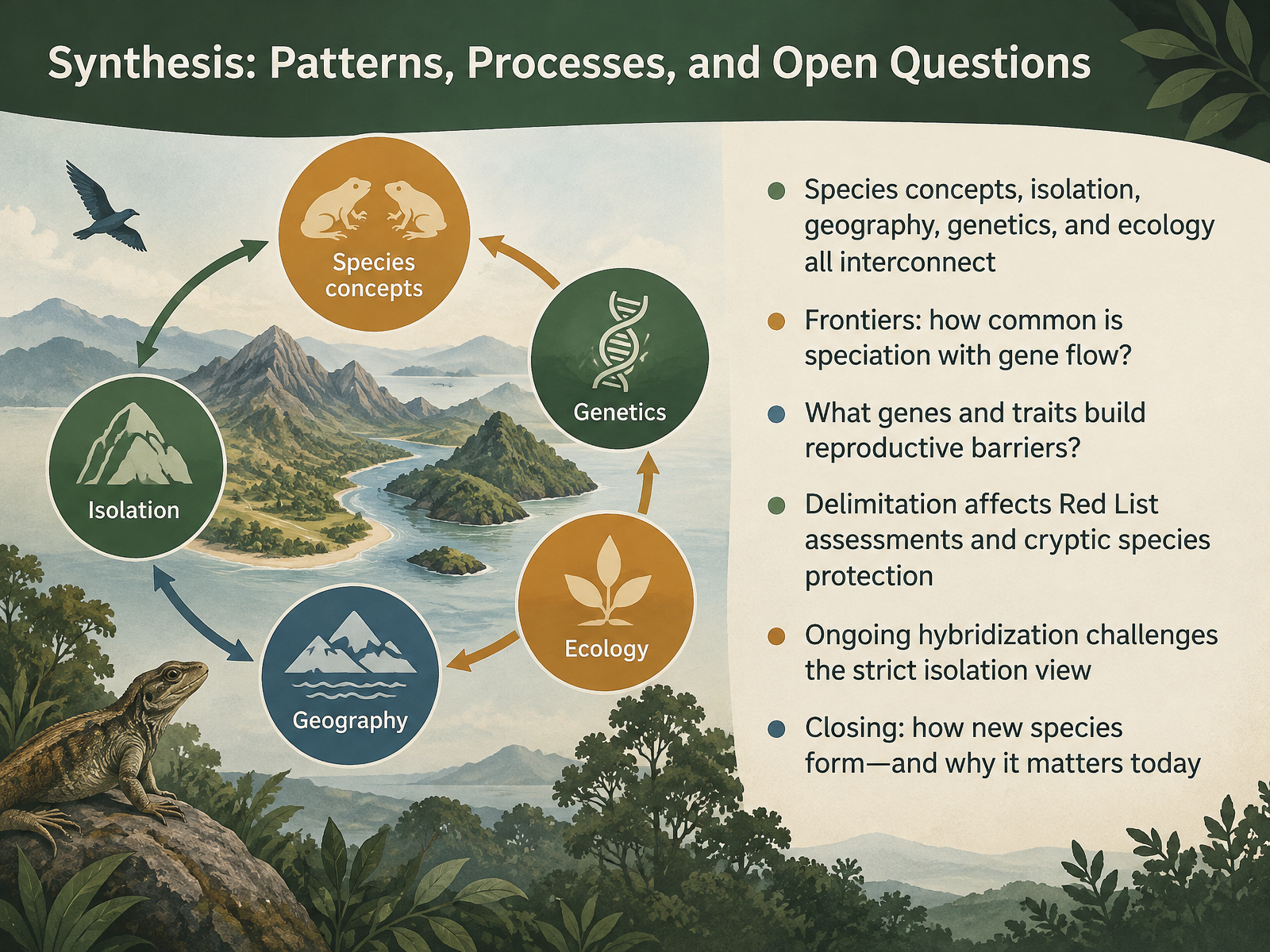
- 14Synthesis: Patterns, Processes, and Open QuestionsLet's bring the threads together. Species concepts, reproductive isolation, geography, genetics, and ecology all interconnect. A single case, like the apple maggot fly shifting hosts, can involve all five at once. Next, the frontiers. How common is speciation with gene flow? Mounting evidence suggests it may be more frequent than once assumed. Which genes and traits actually build reproductive barriers? Genomic studies in organisms like Heliconius butterflies are beginning to answer that. This matters beyond the classroom. Delimitation affects Red List assessments, and cryptic species can be overlooked and left unprotected. Ongoing hybridization, as in many salamanders and oaks, challenges a strict isolation view. So, how do new species form? Through connected processes we can observe and test. And why does it matter today? Because accurate species boundaries guide conservation in a changing world. Thank you for learning with me. Keep asking how the living world divides, and how it stays connected.
 2 min
Take the deck with you
Download this course as a file — free, no sign-up needed.
- PDF handoutEvery slide page, ready to print or share.15 pages · 5.3 MBDownload
- Narrated PowerPointThe deck that presents itself — every slide carries the digital human's narration video.15 pages · 15.5 MBDownload
- PowerPoint slidesThe full deck as a .pptx — open it in PowerPoint, Keynote, or Google Slides.15 pages · 5.3 MBDownload
Free to use in your own training — please keep the PersonWise credit page at the end.
Have your own deck? Turn it into a course