Begin
14 pages · ~28 min
PM Roles, Responsibilities & Handoffs
This training clarifies project management roles, responsibilities, and handoffs to help team members understand their duties and collaborate effectively across project stages.
A digital instructor presents all 14 pages. Hold “Ask” at any point and ask out loud — the answer comes from this course. No sign-up needed.
What you’ll learn
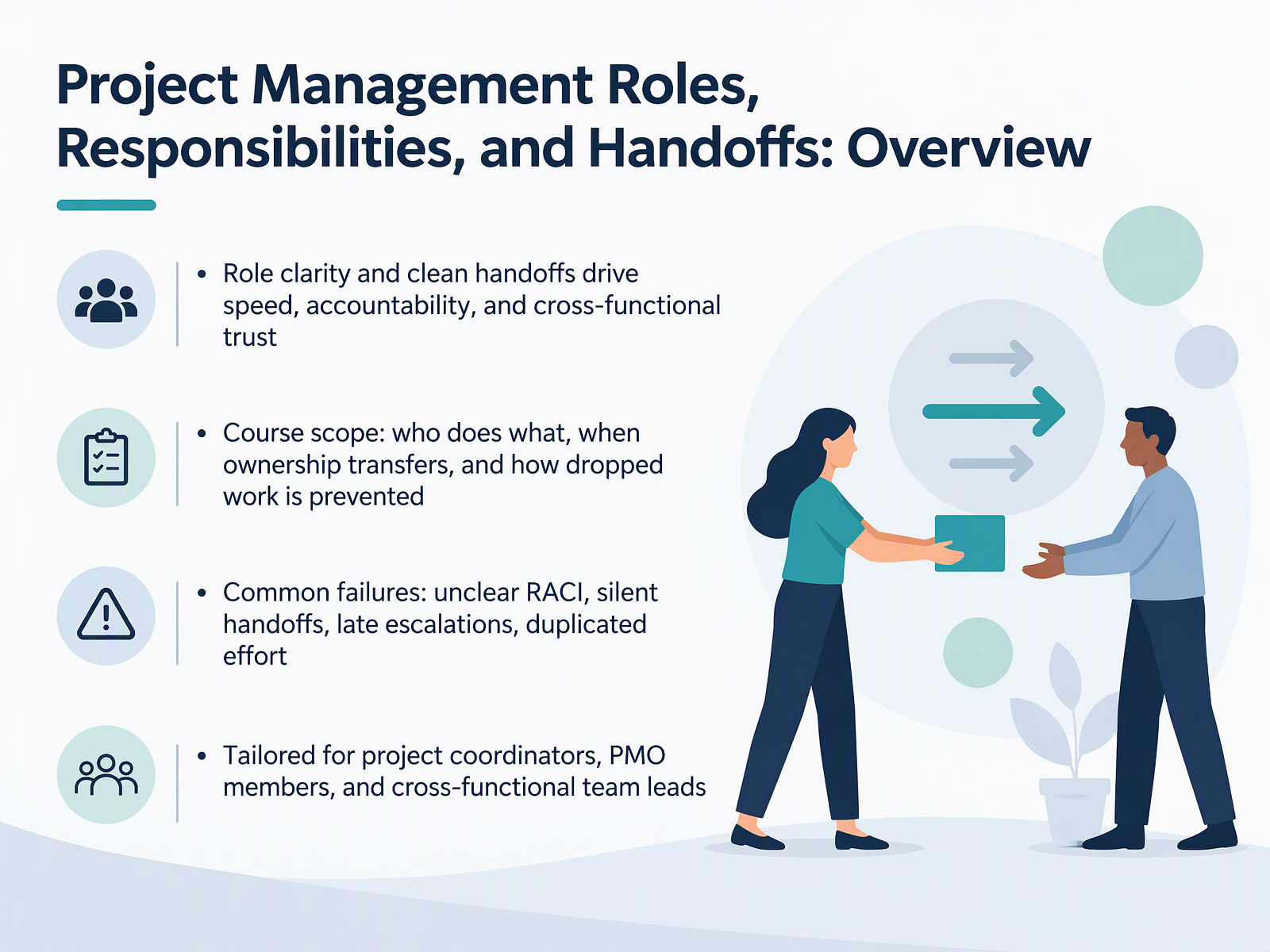
- 01Project Management Roles, Responsibilities, and Handoffs: OverviewWelcome. This course is about roles, responsibilities, and handoffs. You already juggle competing priorities. So we will not explain the basics of project management. We will focus on ownership, and on what happens when work moves between people. Role clarity and clean handoffs drive speed, accountability, and cross-functional trust. Here is the scope. We cover who does what. We cover when ownership transfers. And we cover how dropped work gets prevented. We also look at four common failures. An unclear RACI. Silent handoffs. Late escalations. And duplicated effort. You will see short scenarios you can test against your own workflow. This is built for project coordinators, PMO members, and cross-functional team leads. Here is one action for your next meeting. Confirm who is accountable for each cross-functional deliverable, and confirm what triggers the handoff. Next, we look at why handoffs and ownership break. That is the execution gap.atlassian.compmo-its.media.uconn.eduasana.com+22 min
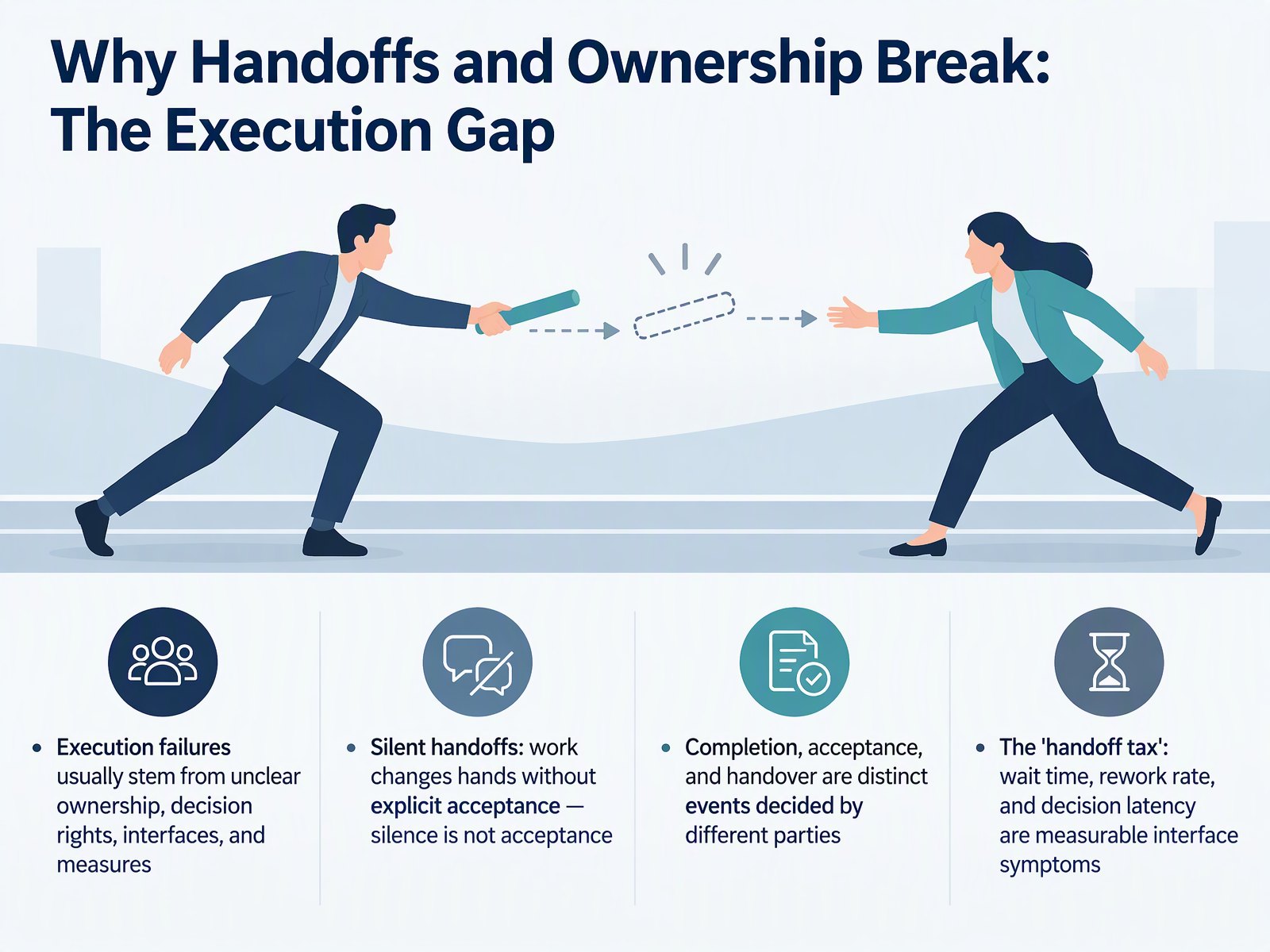
- 02Why Handoffs and Ownership Break: The Execution GapLet's look at why handoffs and ownership break. Execution failures usually come from four gaps: unclear ownership, decision rights, interfaces, and measures. Now consider the silent handoff. Work changes hands without anyone explicitly accepting it. Silence is not acceptance. Completion, acceptance, and handover are three distinct events, decided by different parties. The team completes. The requester accepts. The receiving team takes ownership. Skip one, and work stalls. That cost has a name: the handoff tax. Watch three measures. Wait time, meaning how long work sits between teams. Rework rate, meaning the share returned for missing inputs. And decision latency, meaning the time from issue raised to decision made. Pick one workflow and measure all three for thirty days. At your next meeting, name one handoff where no one has explicitly accepted ownership. Confirm who accepts it, and by when. Next, we cover core concepts: roles, responsibilities, and decision rights.
 monday.comdocs.gitscrum.comelevateforward.ai+22 min
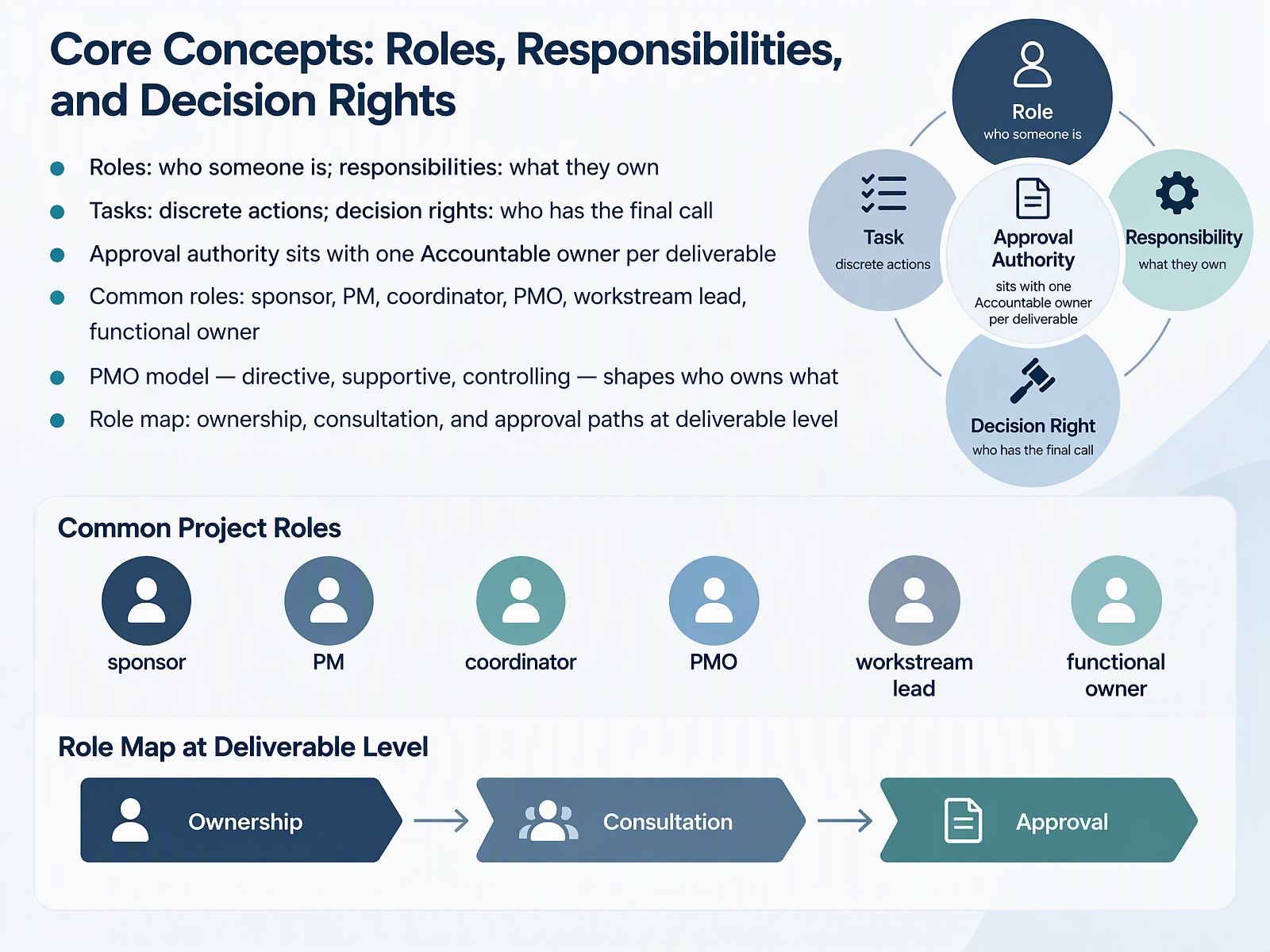
- 03Core Concepts: Roles, Responsibilities, and Decision RightsLet's ground this in a few core concepts you'll use on every handoff. A role is who someone is. A responsibility is what they own. Tasks are discrete actions. Decision rights are different. They define who has the final call. Keep approval authority with exactly one Accountable owner per deliverable. Two names there means no one is truly on the hook. Typical roles you'll map include the sponsor, the PM, the coordinator, the PMO, workstream leads, and functional owners. Your PMO model, whether directive, supportive, or controlling, shapes who owns what. So confirm the model before you assign. When you build your role map at the deliverable level, spell out ownership, consultation, and approval paths. Then test it. If you're a coordinator waiting on a sign off, can you name the single Accountable owner right now? If not, escalate that gap this week. Next, we'll look at RACI and its variants and how to choose the right matrix for your team.
 atlassian.compmo-its.media.uconn.eduasana.com+22 min
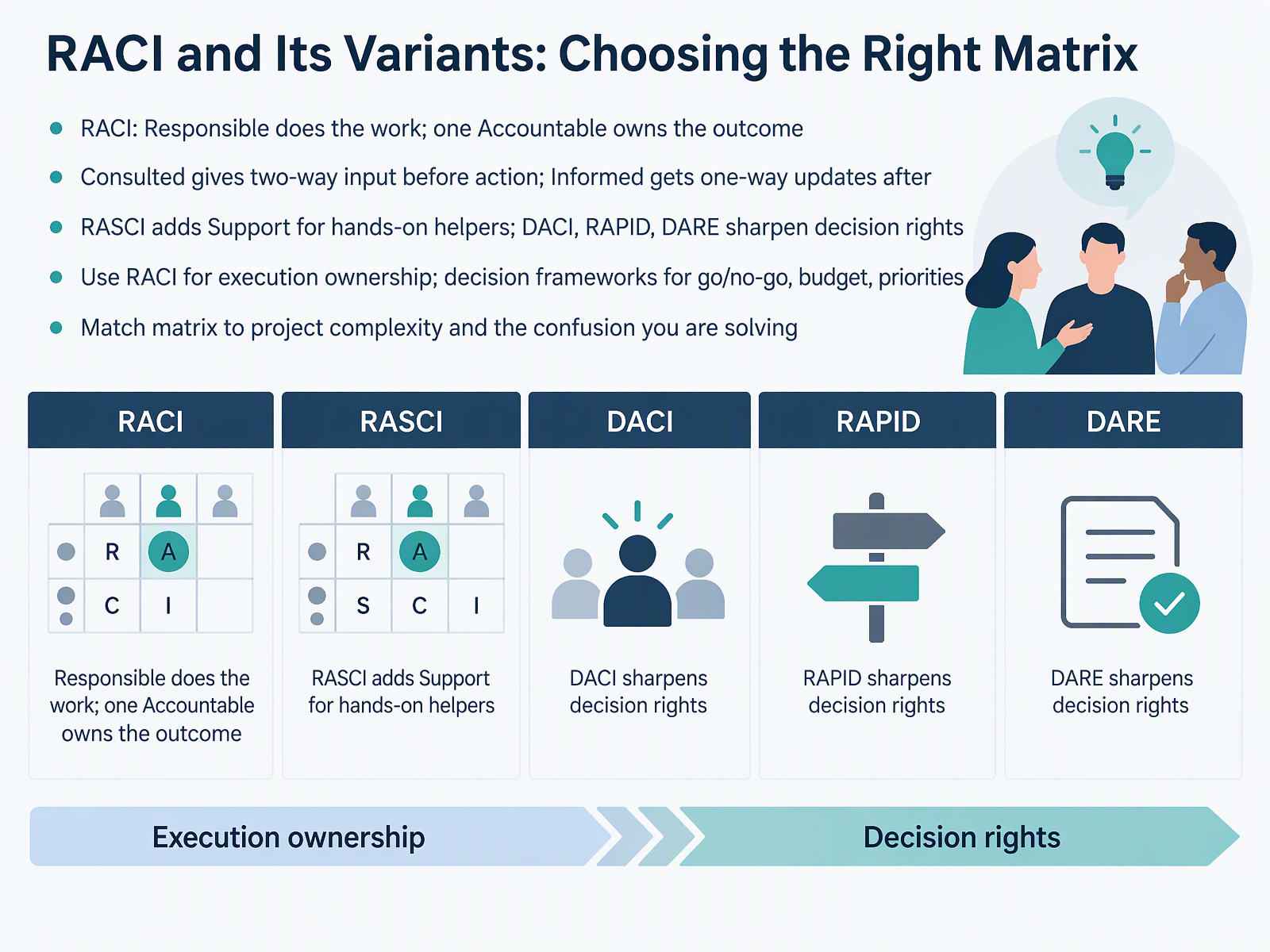
- 04RACI and Its Variants: Choosing the Right MatrixNow let's talk about choosing the right matrix. In RACI, the Responsible person does the work. One Accountable person owns the outcome. That single owner is what prevents work from stalling. Consulted gives you two-way input before action. Informed gets one-way updates after. RASCI adds Support for hands-on helpers. DACI, RAPID, and DARE sharpen decision rights. Here's the practical split. Use RACI for execution ownership. Use decision frameworks for go or no-go calls, budget, and priorities. For example, if your team keeps debating who approves a scope change, that is a decision-rights problem, not a task-ownership problem. Match the matrix to your project complexity and to the confusion you are actually solving. So before your next meeting, name the one confusion you need to fix, and confirm the matrix fits it. Next, we will look at writing responsibilities that actually stick.
 docs.aws.amazon.comit.cornell.educoe.qualiware.com+22 min
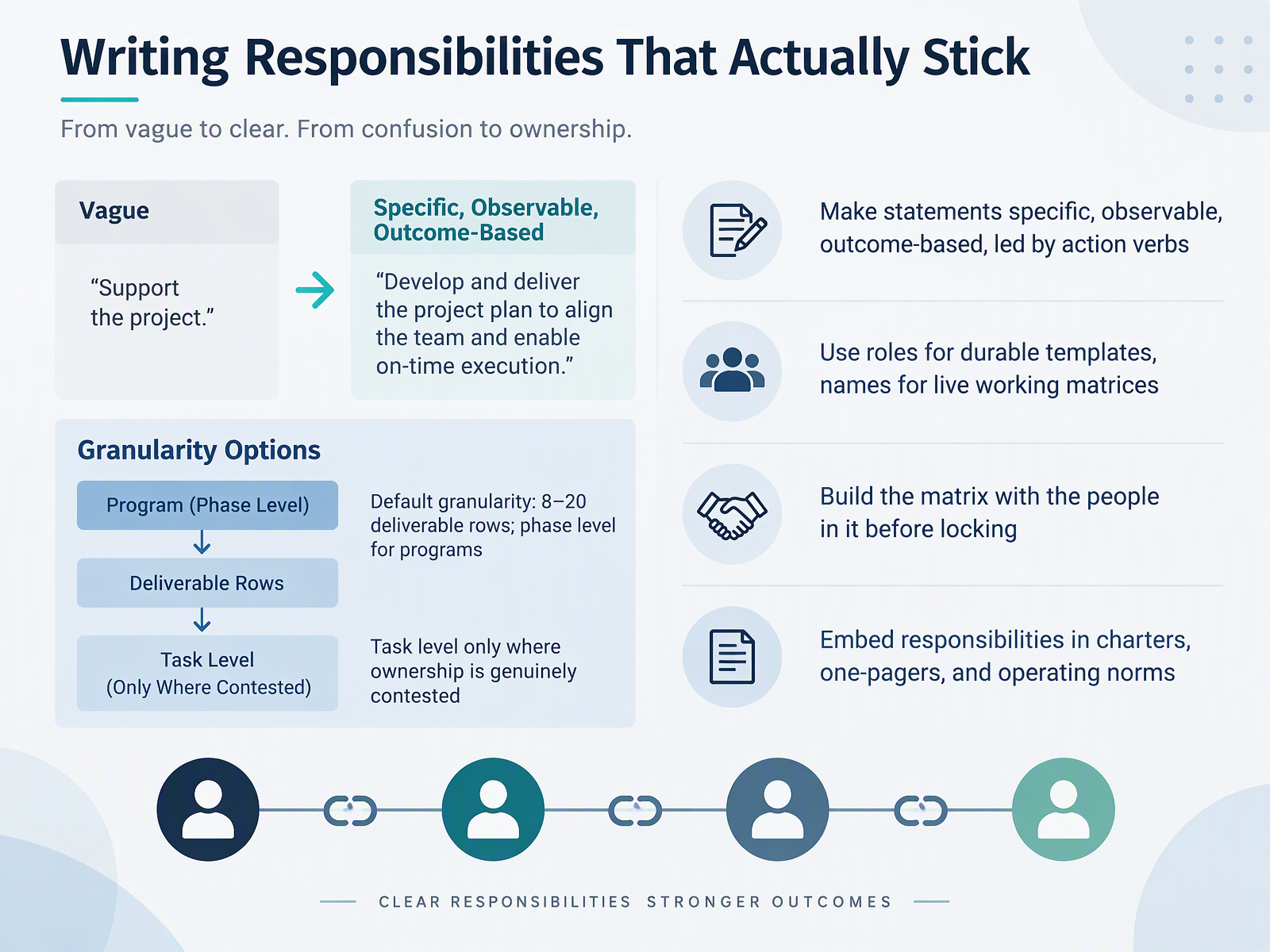
- 05Writing Responsibilities That Actually StickNow let's make responsibilities stick. Write each statement with an action verb, and make it specific, observable, and tied to an outcome. For example, confirm UAT sign-off by Friday, rather than help with testing. Default to eight to twenty deliverable rows. For programs, work at phase level. Drop to task level only where ownership is genuinely contested. Use roles in durable templates. Use names in live working matrices. Here's a testable handoff scenario. Before you lock the matrix, walk it through with the people in it. If a coordinator sees an empty accountable cell, they confirm the owner on the spot. Then embed the result in your charter, your one-pager, and your operating norms. Action for your next meeting: pick one vague responsibility and rewrite it with a verb and an outcome. Next, we look at RACI anti-patterns and how to repair a broken matrix.
 atlassian.compmo-its.media.uconn.eduasana.com+21 min
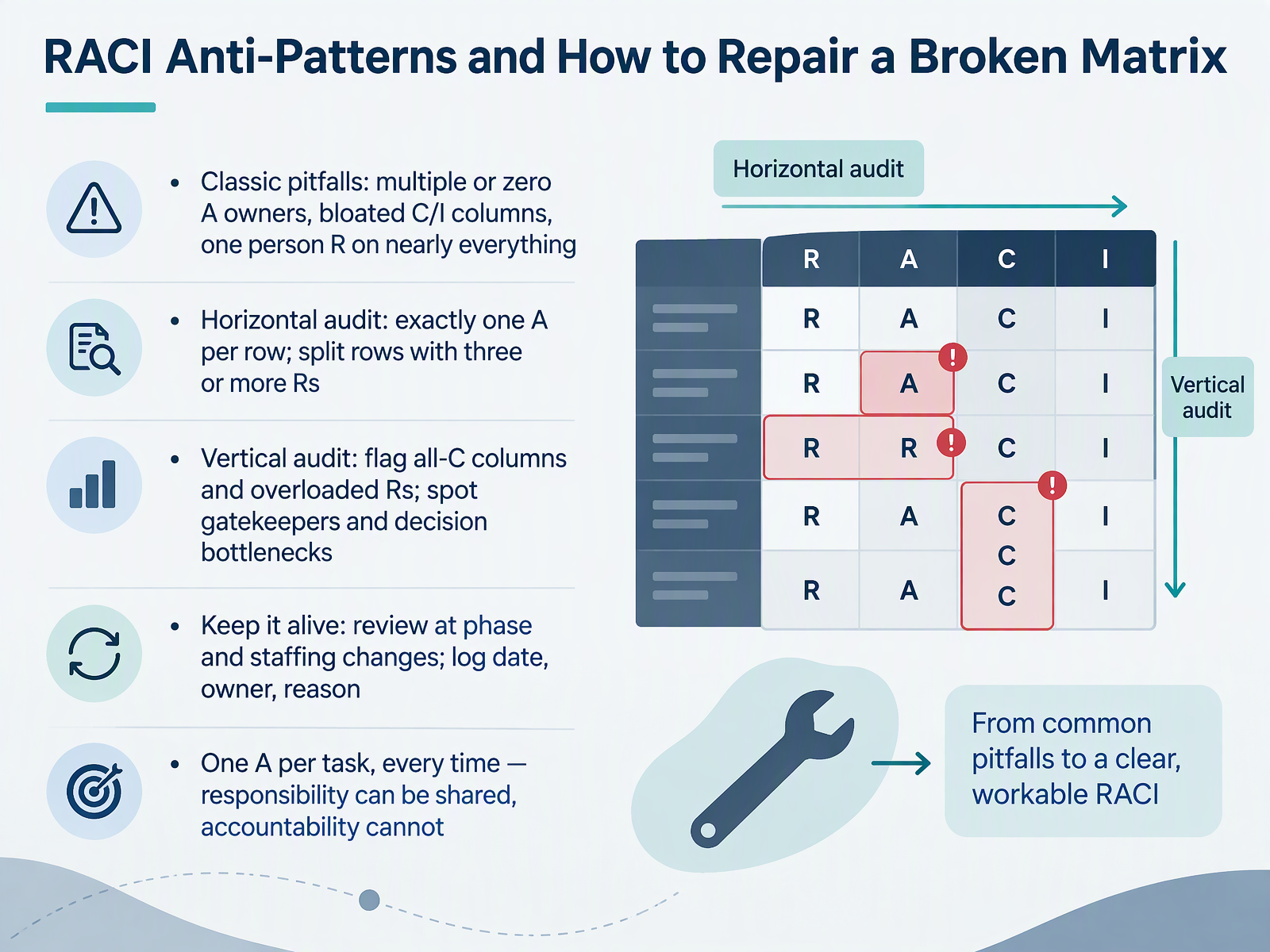
- 06RACI Anti-Patterns and How to Repair a Broken MatrixLet's talk about what a broken RACI matrix looks like, and how to repair it. The classic pitfalls are easy to spot once you know them. Multiple A owners on one row, or none at all. Bloated C and I columns. Or one person marked R on nearly everything. Here's the repair process. Start with a horizontal audit, row by row. Confirm exactly one A per row. If a row has three or more Rs, split it into smaller deliverables. Then run a vertical audit, column by column. Flag all-C columns, and columns where one person is overloaded. That's how you spot gatekeepers and decision bottlenecks. Next, keep the matrix alive. Review it at every phase change and every staffing change. Log the date, the owner, and the reason. So when your lead asks who owns a deliverable, you can hand off the answer in one sentence. One A per task, every time. Responsibility can be shared. Accountability cannot. In your next meeting, take one row and confirm its single A. Next, we look at handoff mechanics across the project lifecycle.
 atlassian.compmo-its.media.uconn.eduasana.com+22 min
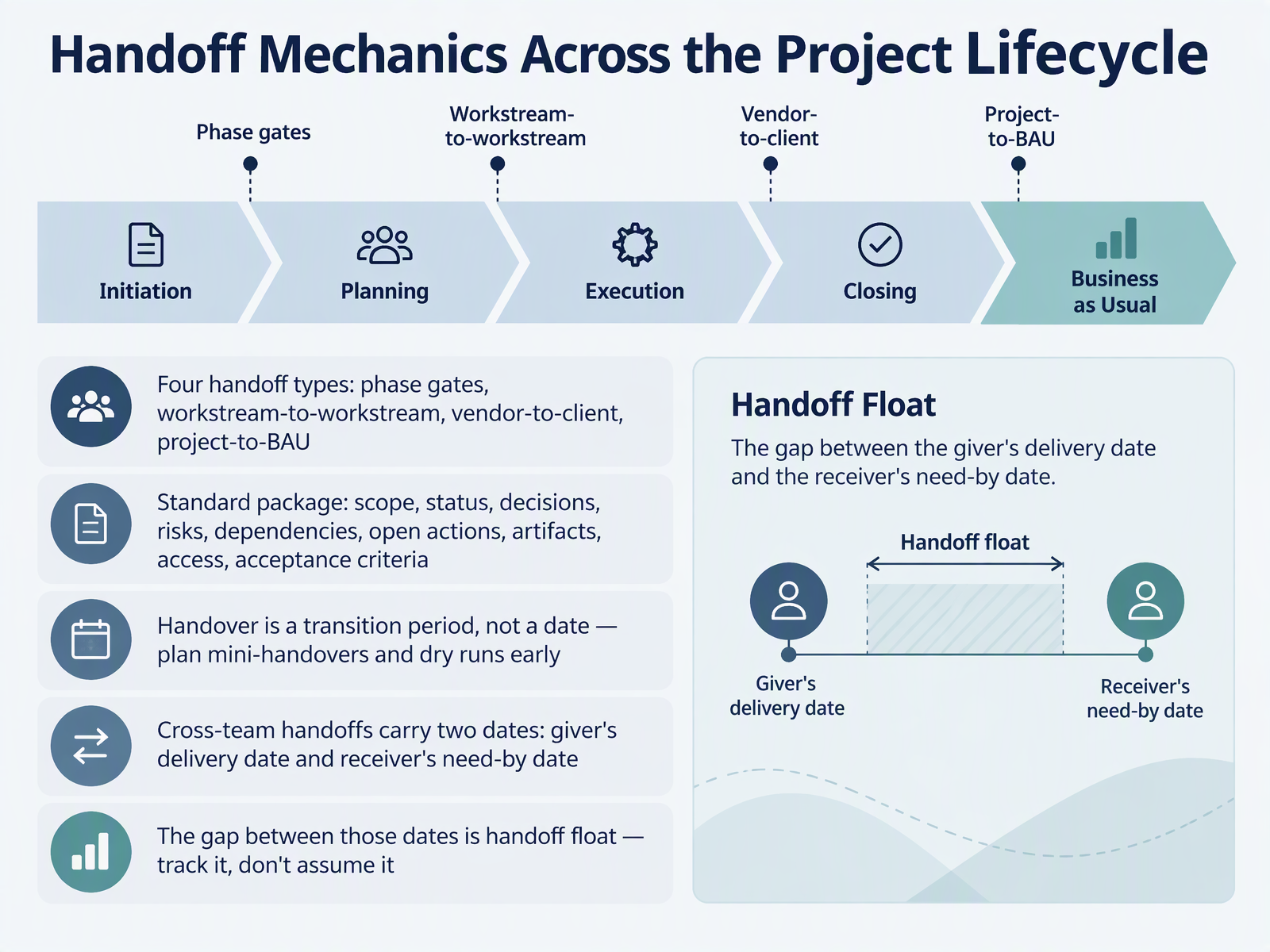
- 07Handoff Mechanics Across the Project LifecycleLet's look at how handoffs actually work across the lifecycle. There are four types to plan for. Phase gates, where one stage closes and the next opens. Workstream-to-workstream moves. Vendor-to-client transfers. And project-to-business-as-usual. Each one follows the same standard package: scope, status, decisions, risks, dependencies, open actions, artifacts, access, and acceptance criteria. Confirm every item before you hand off. Treat handover as a transition period, not a date. Plan mini-handovers and dry runs early. Cross-team handoffs carry two dates: the giver's delivery date and the receiver's need-by date. The gap between them is handoff float. Track it. Don't assume it. Next, we'll walk through the handoff readiness review and acceptance.
 apm.org.ukproject.infoactionbridge.io+21 min
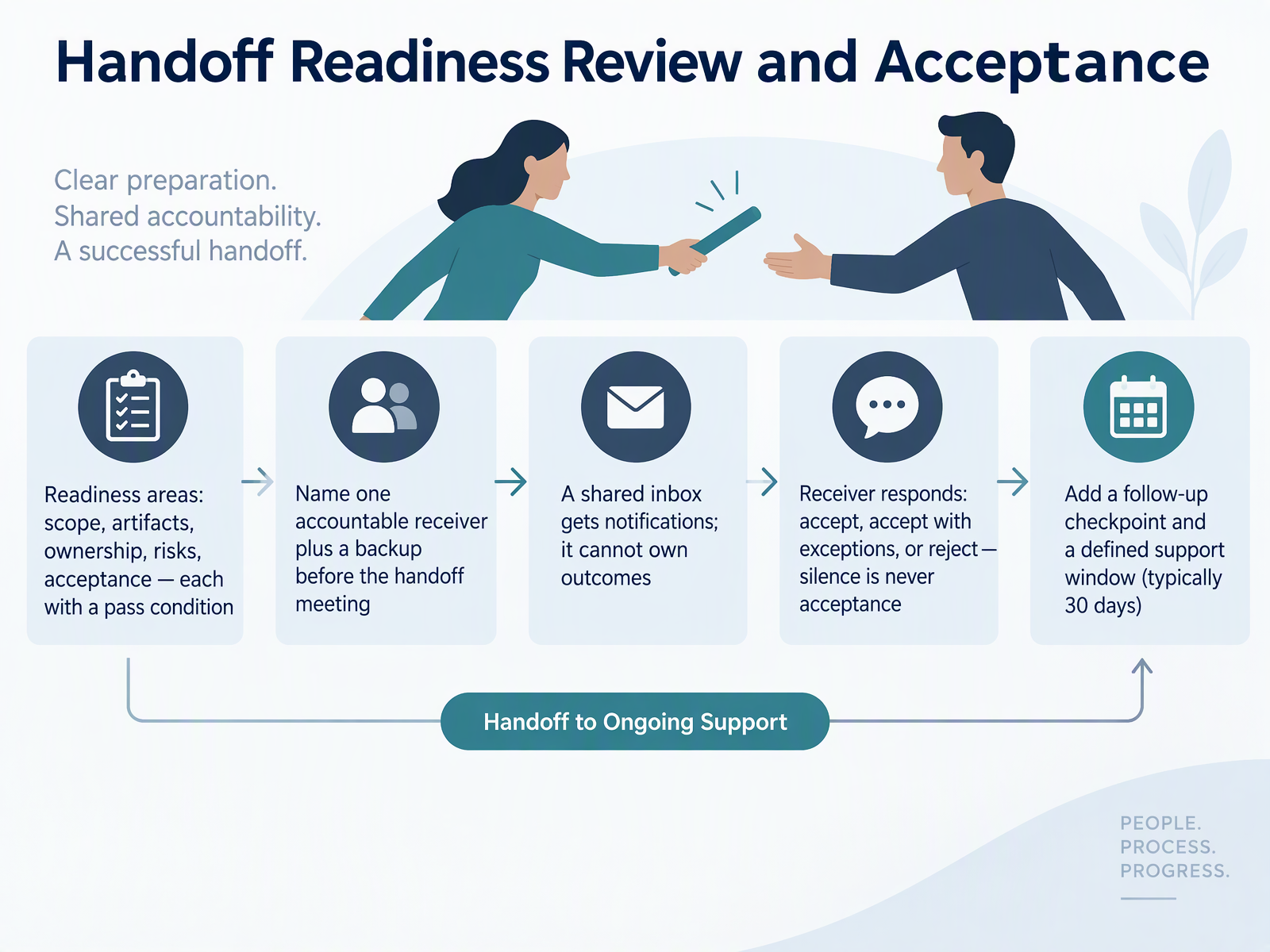
- 08Handoff Readiness Review and AcceptanceLet's talk about how a handoff actually gets accepted. Before the handoff meeting, confirm five readiness areas against pass conditions: scope, artifacts, ownership, risks, and acceptance. The receiver should understand what is in and out. The artifacts should be attached or linked, not sitting in someone's memory. Name one accountable receiver and a backup. A shared inbox gets notifications, but it cannot own outcomes. After the walkthrough, the receiver responds in one of three ways: accept, accept with exceptions, or reject. Silence is never acceptance. Then add a follow-up checkpoint and a defined support window, typically thirty days. So before your next handoff meeting, confirm a named receiver and backup, and get acceptance recorded in writing. Next, we look at communication protocols and escalation paths.
 apm.org.ukproject.infoactionbridge.io+22 min
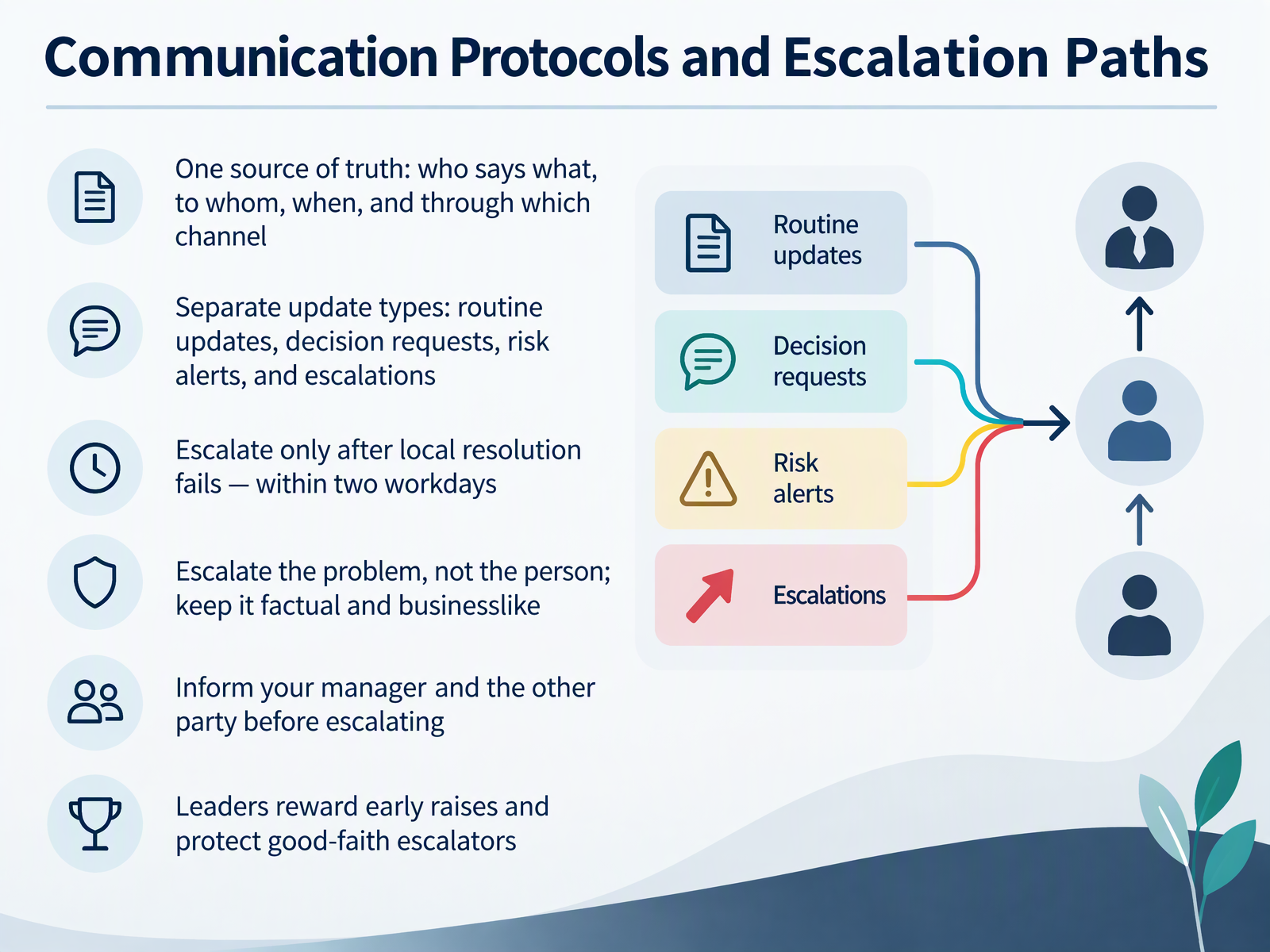
- 09Communication Protocols and Escalation PathsNow let's lock down communication protocols and escalation paths. Agree on one source of truth. It states who says what, to whom, when, and through which channel. Then separate your update types. Routine updates are not decision requests. Decision requests are not risk alerts. And escalations are their own category. Try to resolve an issue locally first. If that fails, escalate within two workdays. Escalate the problem, not the person. Keep it factual and businesslike. Before you escalate, inform your manager and the other party. Leaders should reward early raises and protect people who escalate in good faith. So this week, confirm your team's escalation path and its two-workday trigger. Next, we'll look at PMO, cross-functional, and vendor collaboration patterns.
 1 min
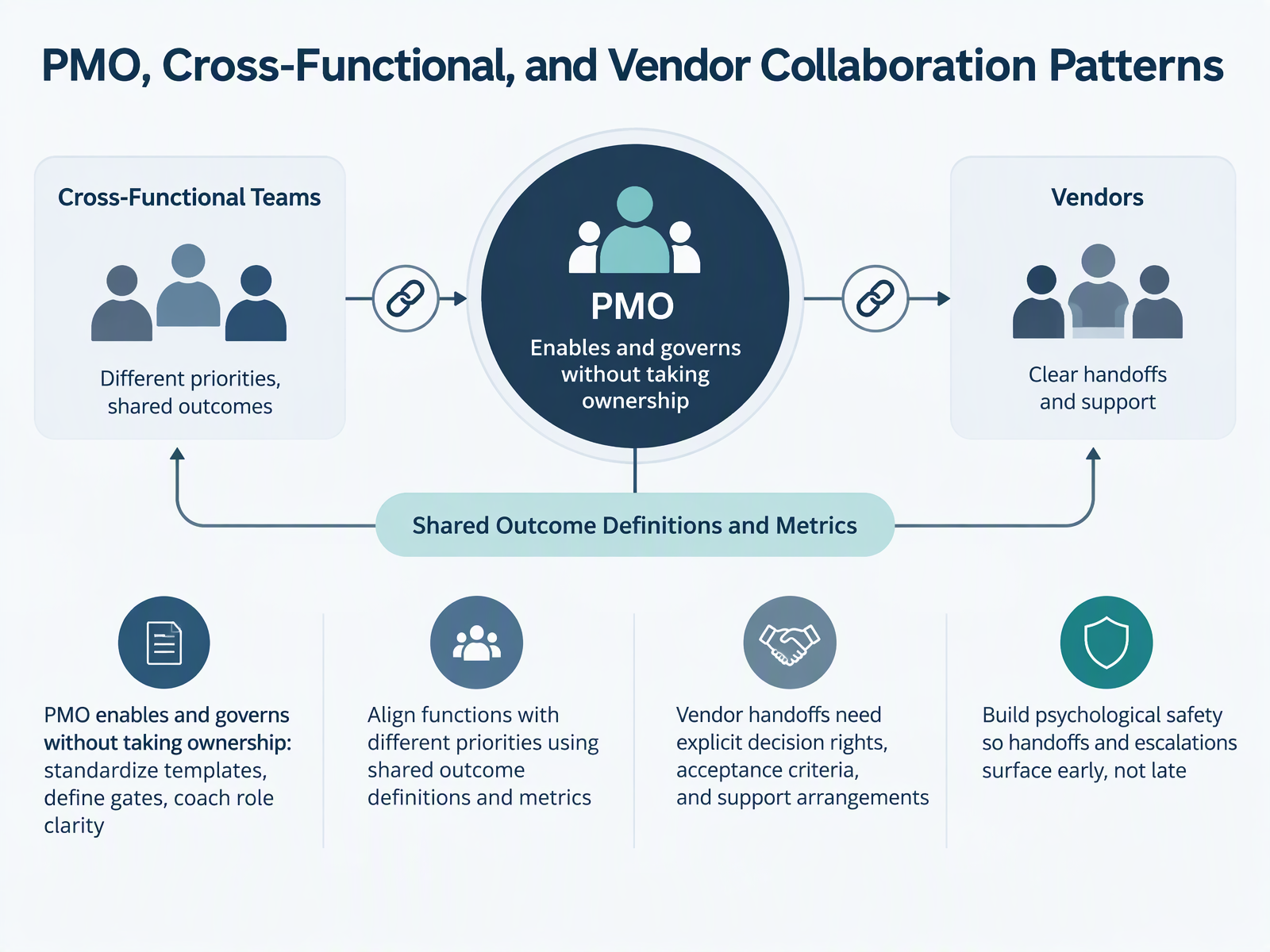
- 10PMO, Cross-Functional, and Vendor Collaboration PatternsNow let's look at collaboration patterns. Three groups matter most here: the PMO, cross-functional teams, and vendors. The PMO enables and governs without taking ownership. It standardizes templates, defines gates, and coaches role clarity. Ownership stays with the delivery teams. Next, cross-functional groups often carry different priorities. Align them with one shared outcome definition and one set of metrics. So when marketing and operations disagree, they argue about the same numbers, not competing scoreboards. Then vendor handoffs. Confirm three things in writing: explicit decision rights, acceptance criteria, and a named support arrangement after go-live. And build psychological safety, so escalations surface early, not after a missed date. Your action for the next meeting: confirm one vendor handoff checkpoint, with a named receiver and clear acceptance criteria. Next, we move to the toolkit: templates and measures for role clarity.
 monday.comdocs.gitscrum.comelevateforward.ai+22 min
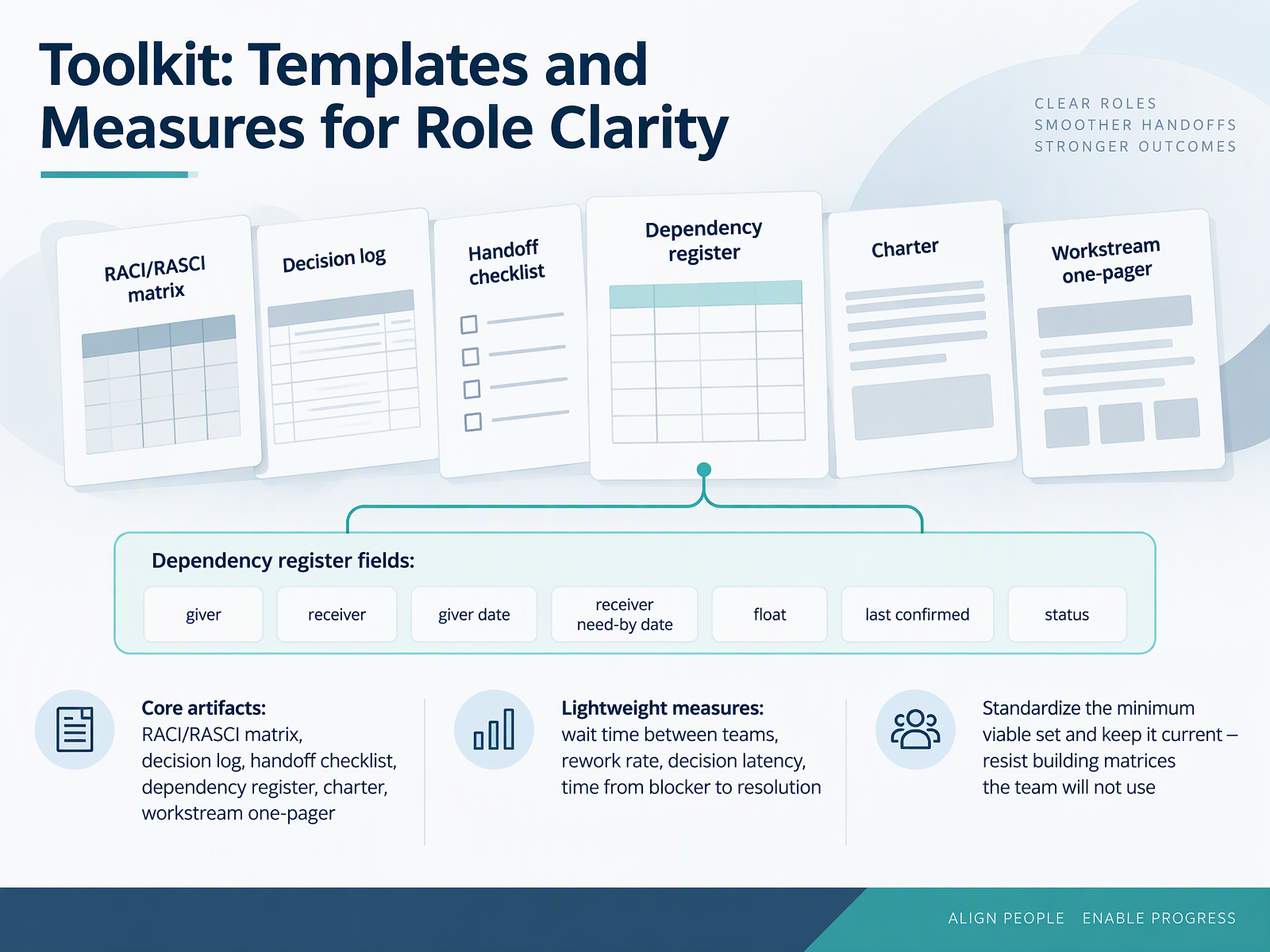
- 11Toolkit: Templates and Measures for Role ClarityNext, let us look at the toolkit. Keep it small and keep it current. The core artifacts are a RACI matrix, a decision log, a handoff checklist, a dependency register, a one-page charter, and a workstream one-pager. For the dependency register, every row names the giver, the receiver, the giver date, the receiver need-by date, the float, the last confirmed date, and the status. Confirm the float on each row. If it is zero or negative, escalate to the next delivery review. For measures, track four things: wait time between teams, rework rate, decision latency, and time from blocker to resolution. Pick one workflow and measure it for thirty days. Before your next meeting, agree the minimum viable set with your team, assign one owner to keep it current, and retire any matrix nobody uses. That discipline sets up our next topic, Common Failure Modes and Risk Controls.
 monday.comdocs.gitscrum.comelevateforward.ai+22 min
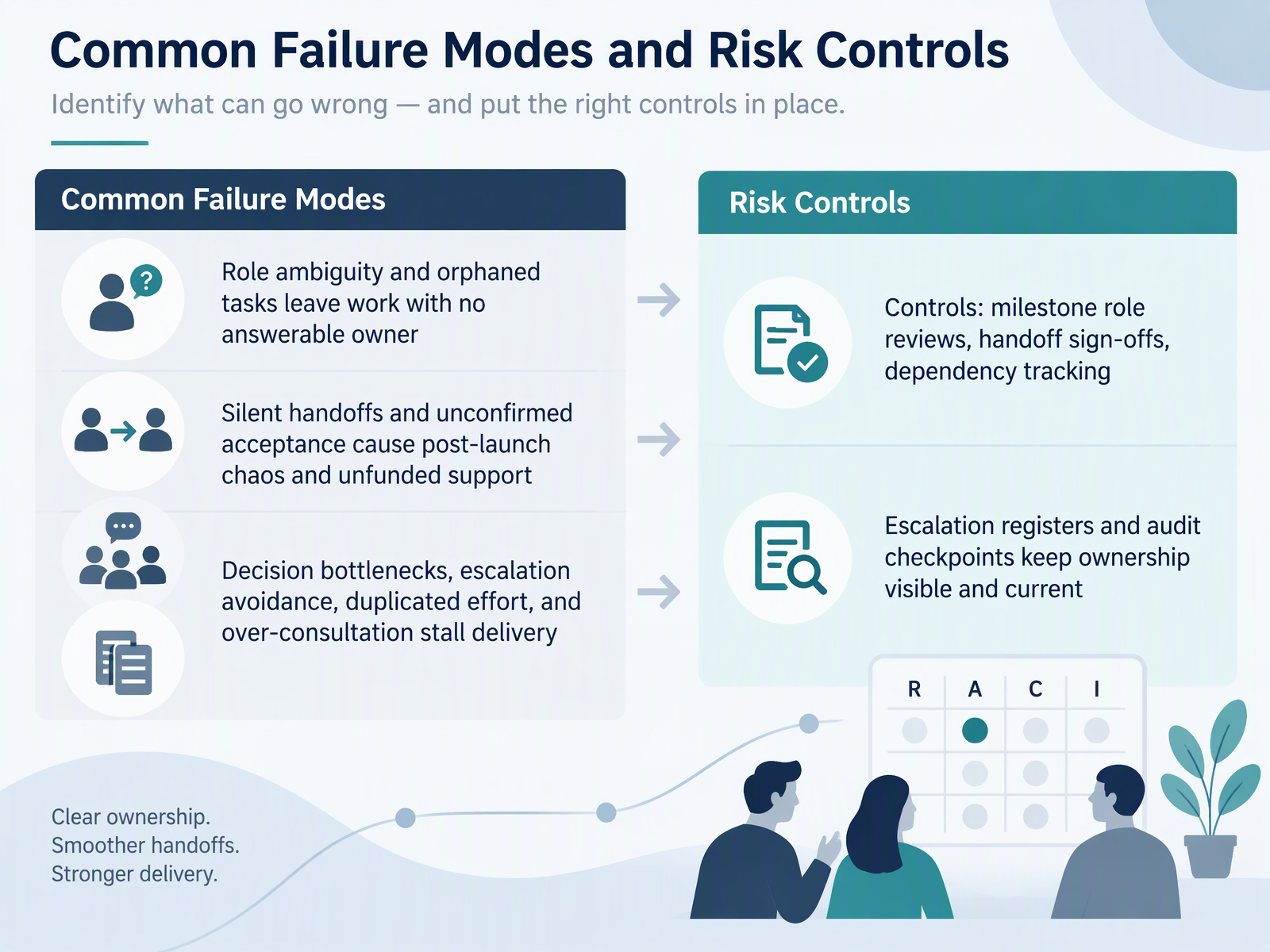
- 12Common Failure Modes and Risk ControlsNow let's look at where ownership tends to break down, and the controls that keep it intact. Start with role ambiguity. When no one can name the person who owns a task, that task becomes orphaned. It sits there, and nobody is answerable. Silent handoffs cause similar damage. The giver assumes the receiver accepted; the receiver assumes someone confirmed. That gap surfaces after launch as unfunded support and extra patches. On the delivery side, watch for decision bottlenecks, escalation avoidance, duplicated effort, and over-consultation. All four slow the work and blur accountability. So apply three controls. First, run role reviews at each milestone and confirm one accountable owner per task. Second, require handoff sign-offs, so acceptance is explicit, not assumed. Third, track dependencies in one visible place and escalate early through a named path. Escalation registers and audit checkpoints keep ownership current. Before your next meeting, pick one milestone and confirm every role and handoff is signed off. Next, we'll put this into practice with Practical Strategies and Mini-Case Exercise.
 apm.org.ukmonday.comatlassian.com+22 min
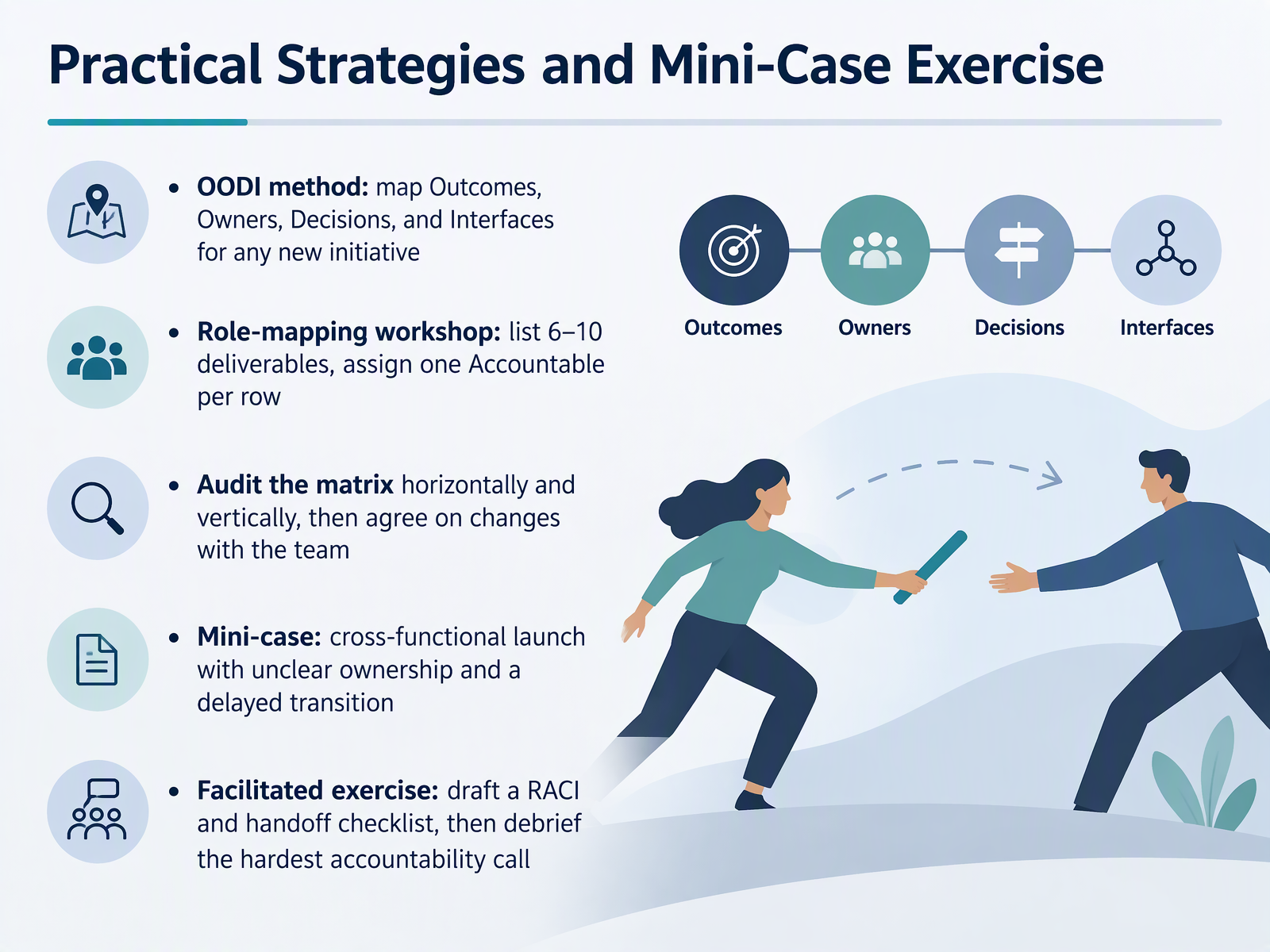
- 13Practical Strategies and Mini-Case ExerciseLet's make this practical. Start with the OODI method for any new initiative. Map Outcomes, Owners, Decisions, and Interfaces. Then run a role-mapping workshop. List six to ten deliverables, and assign exactly one Accountable owner per row. Audit the matrix horizontally, checking every row has one A, then vertically, checking no one role is overloaded. Agree on changes with the team, not for them. Now the mini-case. A cross-functional launch with unclear ownership and a delayed transition. Your exercise: draft a RACI and a handoff checklist, then debrief the hardest accountability call. For example, when support and engineering both claim ownership of the release, confirm who accepts the handoff and escalate the rest. Close with one action you can apply in your next meeting: pick one stalled handoff and name its single Accountable owner. Next, we turn to your Action Plan and Next Steps.
 apm.org.ukmonday.comatlassian.com+21 min
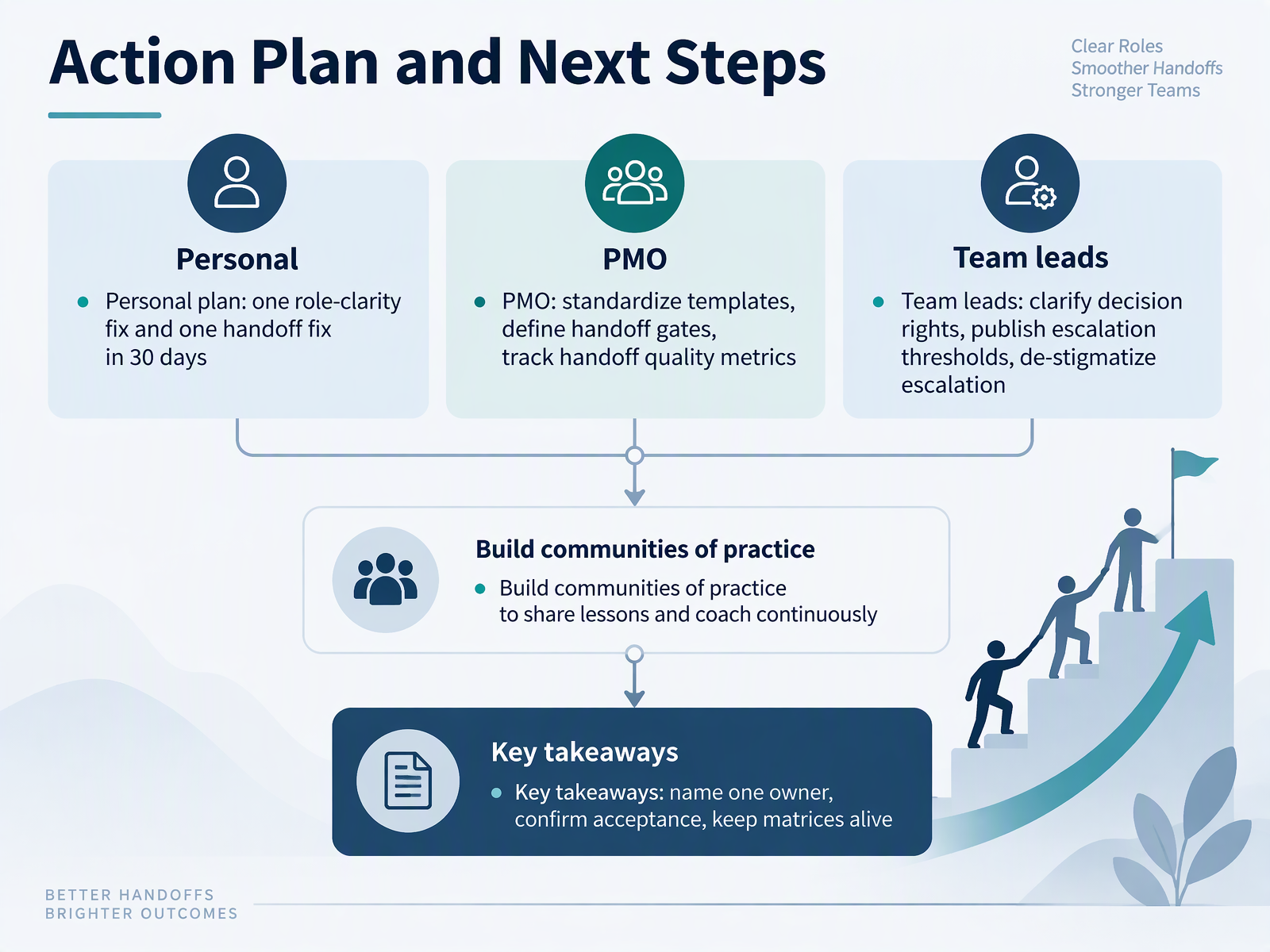
- 14Action Plan and Next StepsLet's close by turning this into action. For your personal plan, pick one role-clarity fix and one handoff fix to complete within thirty days. For example, name the single accountable owner on a contested deliverable. Then confirm acceptance with the receiving team in writing. For the PMO, standardize templates, define your handoff gates, and track handoff quality metrics. For team leads, clarify decision rights, publish escalation thresholds, and make escalation normal rather than risky. Build communities of practice so lessons get shared and coaching continues between projects. Three takeaways to hold onto. Name one owner. Confirm acceptance. Keep your matrices alive and current. Revisit them whenever ownership or scope shifts. Thank you for your attention today. You have the practices and the sequence. Now put one of them to work in your next meeting.
 monday.comdocs.gitscrum.comelevateforward.ai+21 min
Take the deck with you
Download this course as a file — free, no sign-up needed.
- PDF handoutEvery slide page, ready to print or share.15 pages · 3.0 MBDownload
- Narrated PowerPointThe deck that presents itself — every slide carries the digital human's narration video.15 pages · 12.1 MBDownload
- PowerPoint slidesThe full deck as a .pptx — open it in PowerPoint, Keynote, or Google Slides.15 pages · 2.9 MBDownload
Free to use in your own training — please keep the PersonWise credit page at the end.
Have your own deck? Turn it into a course
Sources consulted
Web sources consulted while building this course.
- RACI Chart: What is it & How to Use | The Workstream — atlassian.com
- How to Do RACI Charting and... — pmo-its.media.uconn.edu
- How to Define Roles and Responsibilities (RACI Guide) — asana.com
- The limits of RACI—and a better way to make decisions — mckinsey.com
- RACI Matrix: Complete Guide & Template | Artifactly — artifactly.ai
- Project Handoff Guide: 8 Steps For Smooth Transitions — monday.com
- Project Handoff Best Practices | 2026 — docs.gitscrum.com
- Cross-Functional Role Clarity: The Fastest Path to Execution Speed — elevateforward.ai
- Processes to Prevent Unclear Project Scope and Ownership — ones.com
- What is a project handover? Steps, checklist, and best practices | Plane Blog — plane.so
- Create a RACI or RASCI matrix for a cloud operating model - AWS Prescriptive Guidance — docs.aws.amazon.com
- RACI and RASCI Definitions | IT@Cornell — it.cornell.edu
- RACI and RASCI | QualiWare Center of Excellence — coe.qualiware.com
- RACI vs RASCI: a Comprehensive Overview - Delivery Management — deliverymgt.com
- Responsibility matrix | University of Essex — essex.ac.uk
- How can we hand over projects better? — apm.org.uk
- The finish line | OPEN | Center for Project Innovation — project.info
- 7.1 Project Handover: From Delivered to Owned / Project Management Essentials - AB — actionbridge.io
- ProjectManagement.com - Project Handoff Checklist — projectmanagement.com
- Phase Checklists - BVDLC Framework — bvdlc.ai