Employee Onboarding Strategy
Begin
14 pages · ~28 min
Employee Onboarding Strategy
This training helps HR and hiring managers design effective employee onboarding strategies by clarifying goals, key choices, and tradeoffs.
What you’ll learn
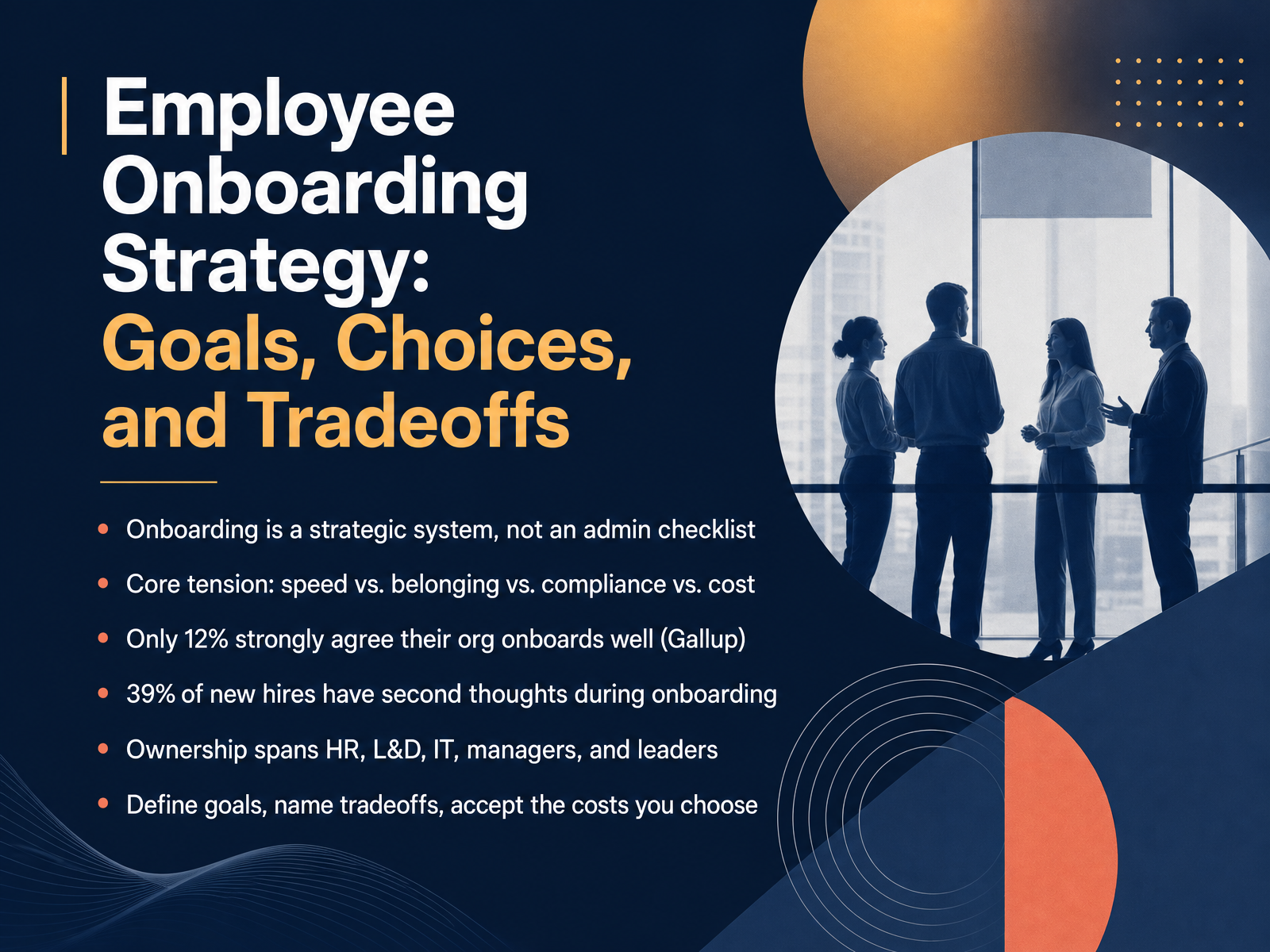
- 01Employee Onboarding Strategy: Goals, Choices, and TradeoffsWelcome. This course is about employee onboarding as a strategic system, not an administrative checklist. If you lead people operations, learning and development, or a function that owns onboarding, this is for you. Here is the core tension. You are balancing four things at once: speed, belonging, compliance, and cost. You cannot maximize all four. Gallup finds that only twelve percent of employees strongly agree their organization onboards well. And thirty-nine percent of new hires have second thoughts about the job during onboarding. Those numbers are a strategy problem, not a logistics problem. Notice also that ownership is shared. HR, learning and development, IT, hiring managers, and senior leaders all shape the experience. So your first decision is to define your goals clearly, then name the tradeoffs out loud, and accept the costs you are choosing. That honesty is what makes an onboarding strategy defensible. In the next section, we will look at why onboarding succeeds or fails.bamboohr.comonboardingcost.comrewordin.com+22 min
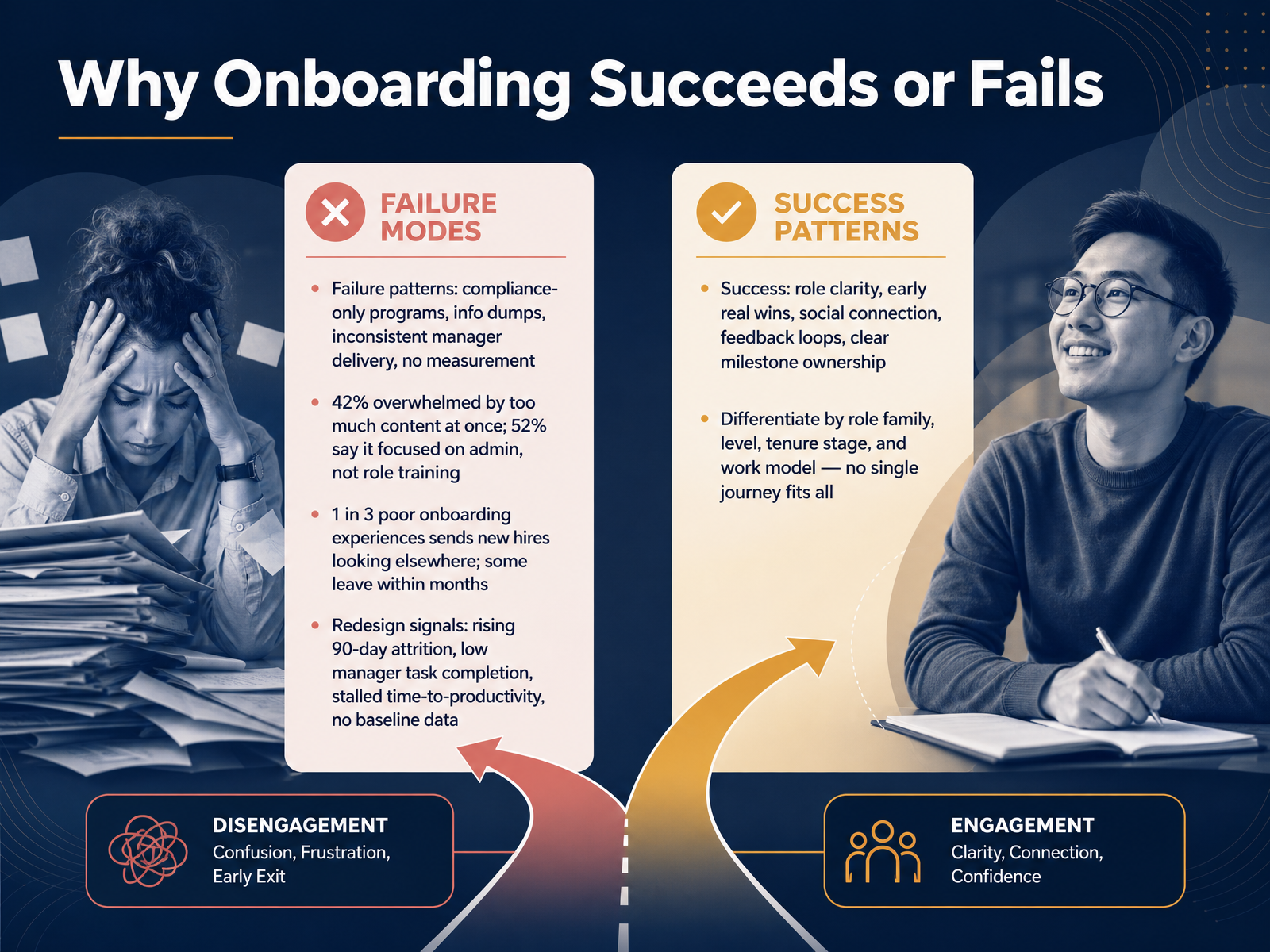
- 02Why Onboarding Succeeds or FailsLet us look at why onboarding succeeds or fails. The patterns are fairly consistent. Programs fail when they are compliance only, when they dump too much information at once, when managers deliver inconsistently, and when nobody measures the outcome. In one global survey, forty-two percent of new hires felt overwhelmed by too much content, and fifty-two percent said onboarding focused on administration rather than their actual role. Success looks different. It comes from early role clarity, an early real win, genuine social connection, feedback loops, and clear ownership of each milestone. The stakes are high. One in three poor onboarding experiences sends new hires looking elsewhere, and some leave within months. So differentiate by role family, level, tenure stage, and work model, because no single journey fits everyone. Watch for redesign signals, like rising ninety-day attrition, low manager task completion, stalled time to productivity, or no baseline data at all. The practical implication is this: pick the failure pattern you can measure and fix that first. Setting Goals and Choosing Outcome Metrics.
 doi.orgthecaragroup.comlitmos.com+22 min
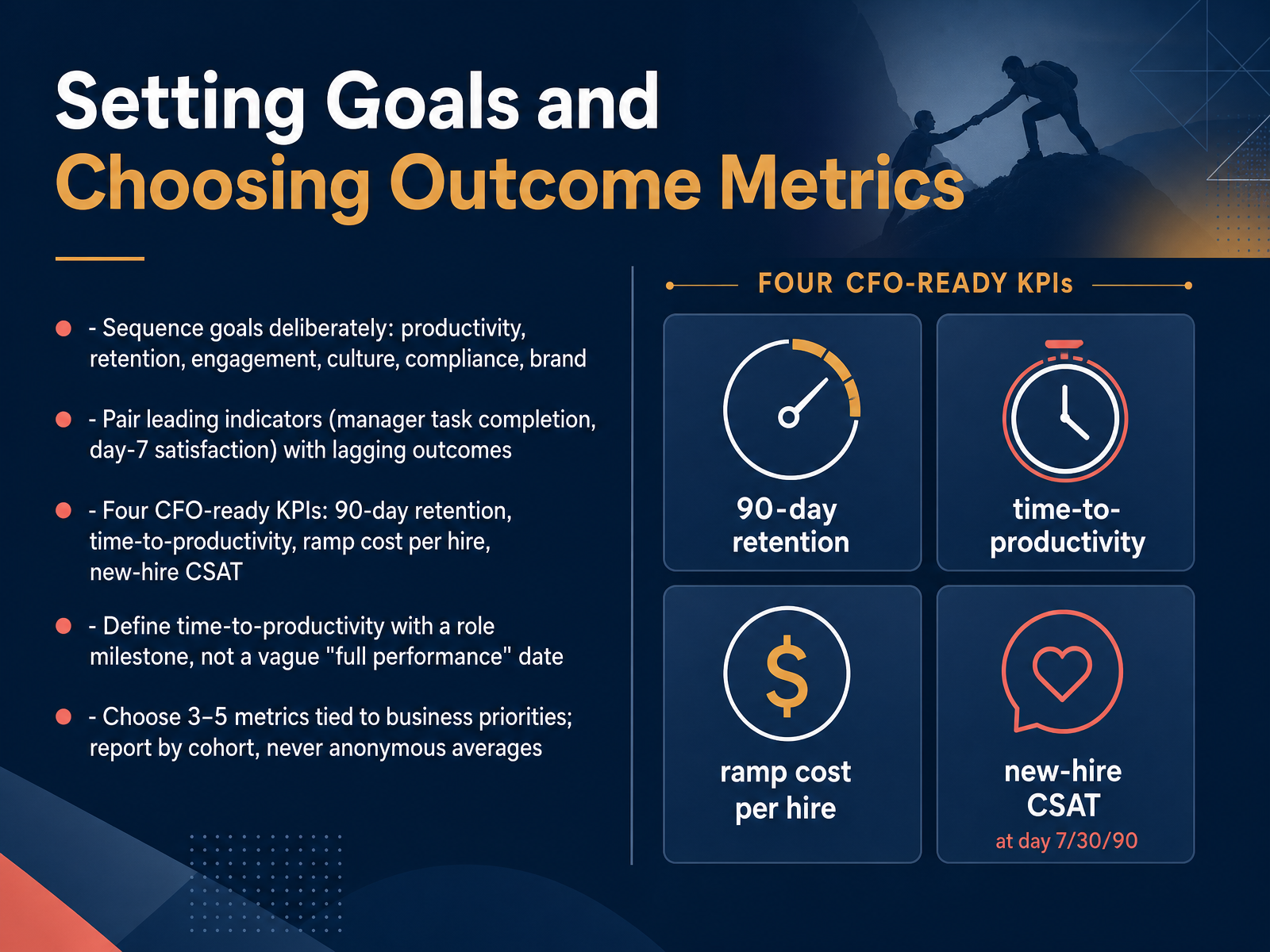
 - 03Setting Goals and Choosing Outcome MetricsLet us turn to setting goals and choosing outcome metrics. Sequence your goals deliberately, starting with productivity and retention, then engagement, culture, compliance, and brand. Not every goal deserves equal weight. Pair leading indicators, like manager task completion and day seven satisfaction, with lagging outcomes such as retention and ramp speed. A weak manager task completion rate today predicts higher attrition three months from now. Then bring four finance ready measures to the table: ninety day retention, time to productivity, ramp cost per hire, and new hire satisfaction. Define time to productivity with a specific role milestone, like independently handling eighty percent of case volume. Avoid the vague full performance date. Finally, choose three to five metrics tied to business priorities, and report them by cohort. Anonymous averages hide the very patterns you need to act on.
 enboarder.combamboohr.compeopleelement.com+21 min
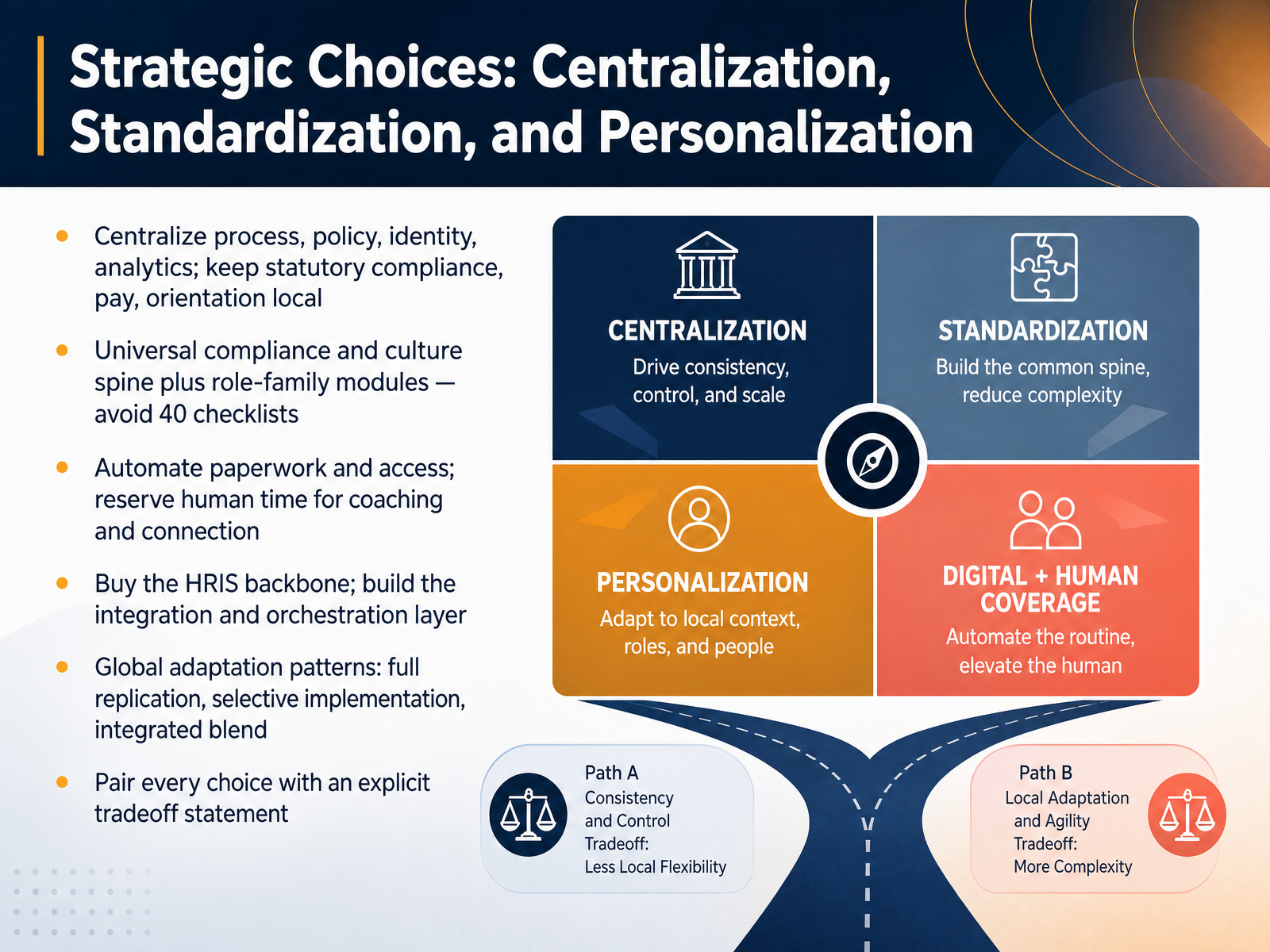
 - 04Strategic Choices: Centralization, Standardization, and PersonalizationLet's turn now to the strategic choices that shape your onboarding design. These are decisions, not defaults, and each one carries a tradeoff you should name out loud. First, centralize the process, policy, identity, and analytics, while keeping statutory compliance, pay, and local orientation with the entity. Centralization buys consistency, but it costs local responsiveness, so be deliberate about where the line falls. Second, build a universal compliance and culture spine with role-family modules layered on top. This avoids the trap of forty separate checklists while keeping content relevant. Third, automate paperwork and access provisioning so your people can spend their time on coaching and connection. Fourth, buy the H R I S backbone and build the integration and orchestration layer yourself. And fifth, choose your global adaptation pattern: full replication, selective implementation, or an integrated blend. Whatever you decide, pair every choice with an explicit tradeoff statement so leaders can weigh the implications before committing. Now let's look at how these choices come together when designing the onboarding journey.
 appitsoftware.combeyondintranet.comdoi.org+22 min
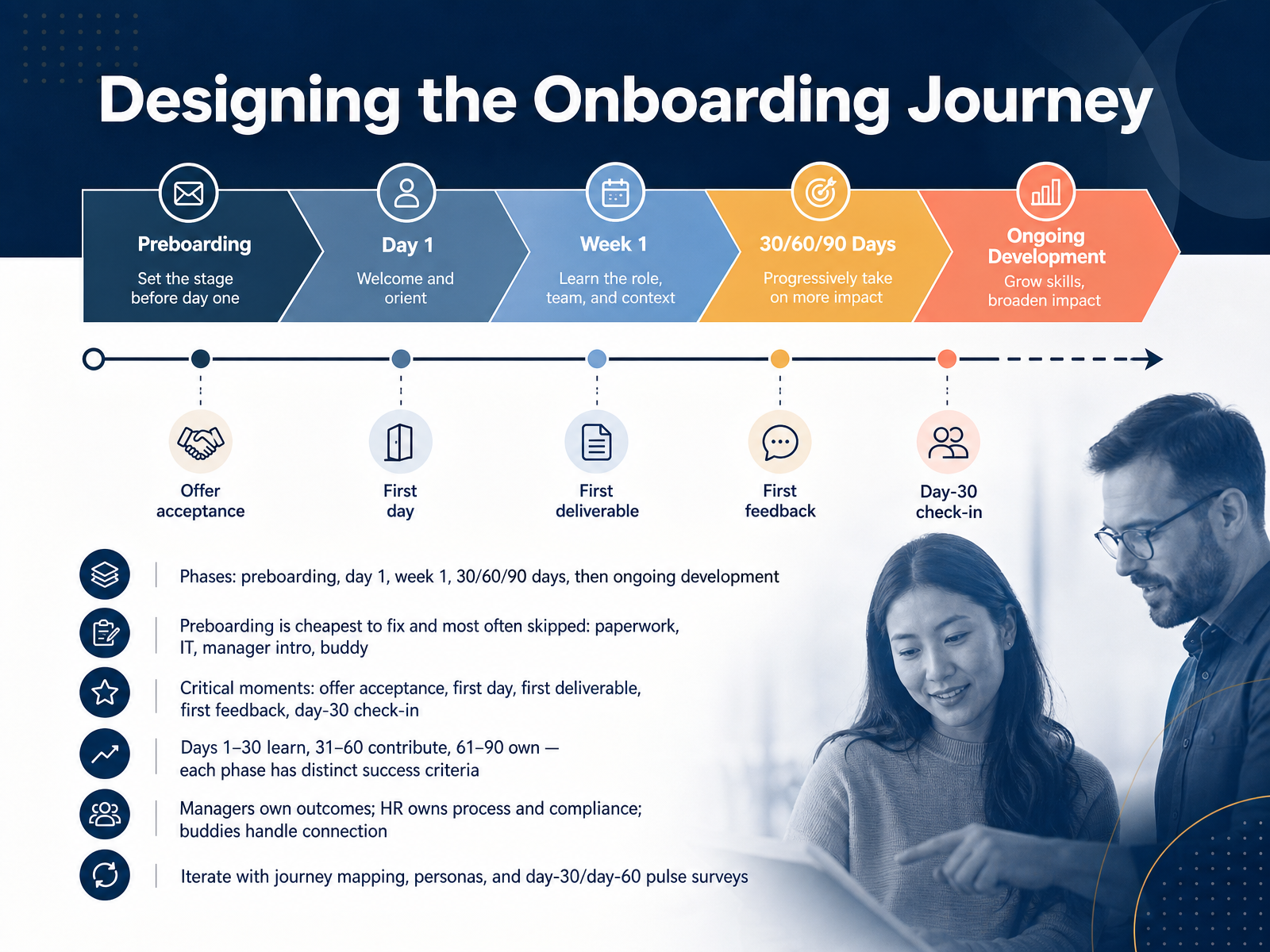
 - 05Designing the Onboarding JourneyLet's turn now to designing the onboarding journey itself. Think of it as a sequence of phases: preboarding, day one, week one, then thirty, sixty, and ninety days, and finally ongoing development. Preboarding is the cheapest phase to fix and the one most often skipped. Get the paperwork, IT setup, a manager introduction, and a buddy in place before day one. There are five critical moments to protect: offer acceptance, the first day, the first deliverable, the first feedback, and the day-thirty check-in. The arc is simple. Days one to thirty, they learn. Days thirty-one to sixty, they contribute. Days sixty-one to ninety, they own the work. Each phase needs its own success criteria, so you can tell whether someone is actually ramping up. Ownership matters just as much. Managers own the outcomes, HR owns the process and compliance, and buddies handle connection. And remember, this is never finished. Use journey mapping, personas, and short pulse surveys at day thirty and day sixty to iterate. Now, to make any of this stick, you need clear roles and decision rights, which brings us to the next section, Role Clarity and Ownership: Operating Model and Governance.
 aikdesigns.com2 min
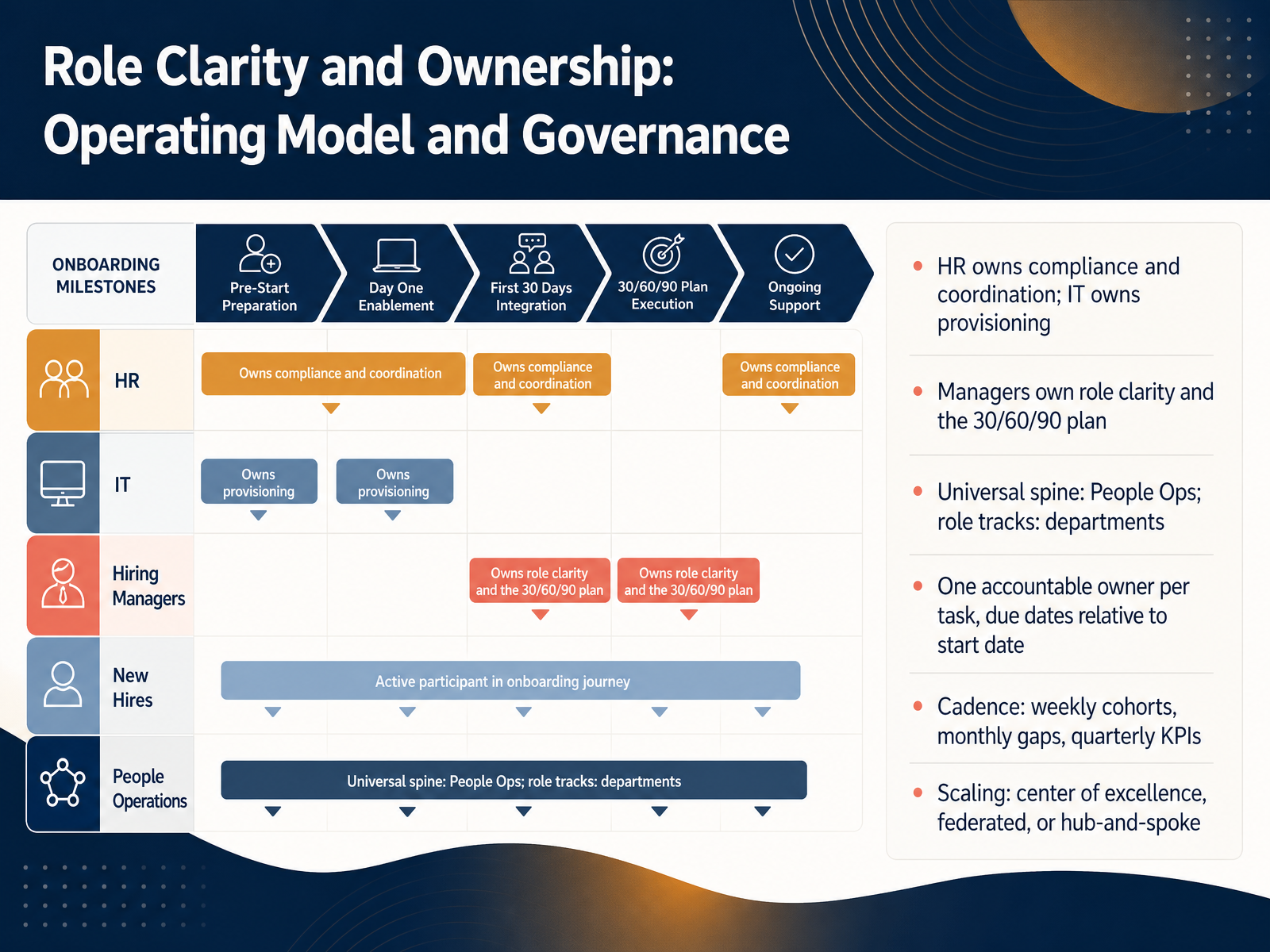
 - 06Role Clarity and Ownership: Operating Model and GovernanceLet's talk about who owns what. This is where onboarding either holds together or quietly falls apart. Start with the division of labor. HR owns compliance and coordination. IT owns provisioning, meaning devices, access, and accounts. Managers own role clarity and the 30/60/90 plan. That last one matters most, because managers directly shape whether a new hire becomes productive. A simple structure makes this work. People Ops owns the universal spine, the culture, compliance, and systems setup everyone shares. Departments own the role tracks, the skills and tools specific to the job. Now here is the tradeoff. Consistency versus personalization. Too much central control, and role tracks feel generic. Too much local control, and compliance drifts. The fix is one accountable owner per task, with due dates tied to the start date rather than fixed calendar entries. So a device order is due five days before start, not on a random Tuesday. Then set your cadence. Weekly cohort reviews, monthly gap reviews, quarterly KPI checks. As you scale, choose your model deliberately. A center of excellence, a federated model, or hub-and-spoke. Each trades speed against consistency. Next, we look at technology, data, and automation, and where they help or hurt.
 2 min
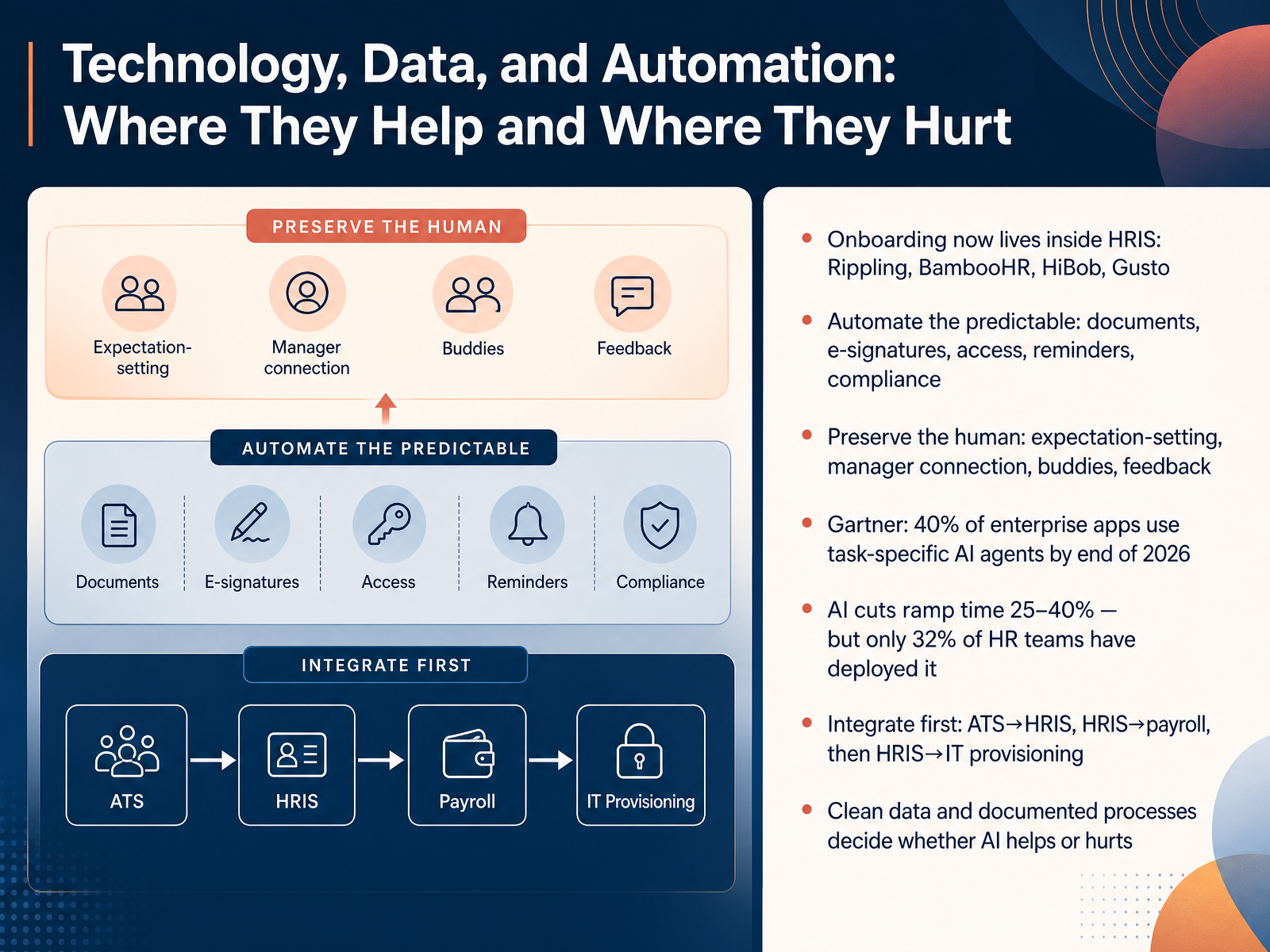
2 min - 07Technology, Data, and Automation: Where They Help and Where They HurtNow let's talk about where technology helps, and where it quietly hurts. Onboarding today lives inside your HRIS, so decisions here are platform decisions. Automate the predictable parts: documents, e-signatures, system access, reminders, and compliance tracking. That work has clear rules and immediate return. But preserve the human moments: expectation-setting, manager connection, buddies, and honest feedback. Those shape whether someone stays. Gartner estimates that forty percent of enterprise applications will use task-specific A I agents by the end of twenty twenty-six. And A I-assisted onboarding can cut ramp time by twenty-five to forty percent, yet only thirty-two percent of HR teams have deployed it. So sequence your integrations deliberately, applicant tracking to HRIS, then HRIS to payroll, then HRIS to IT provisioning. And remember: clean data and documented processes decide whether A I helps or hurts. Let's examine that business case next.
 2 min
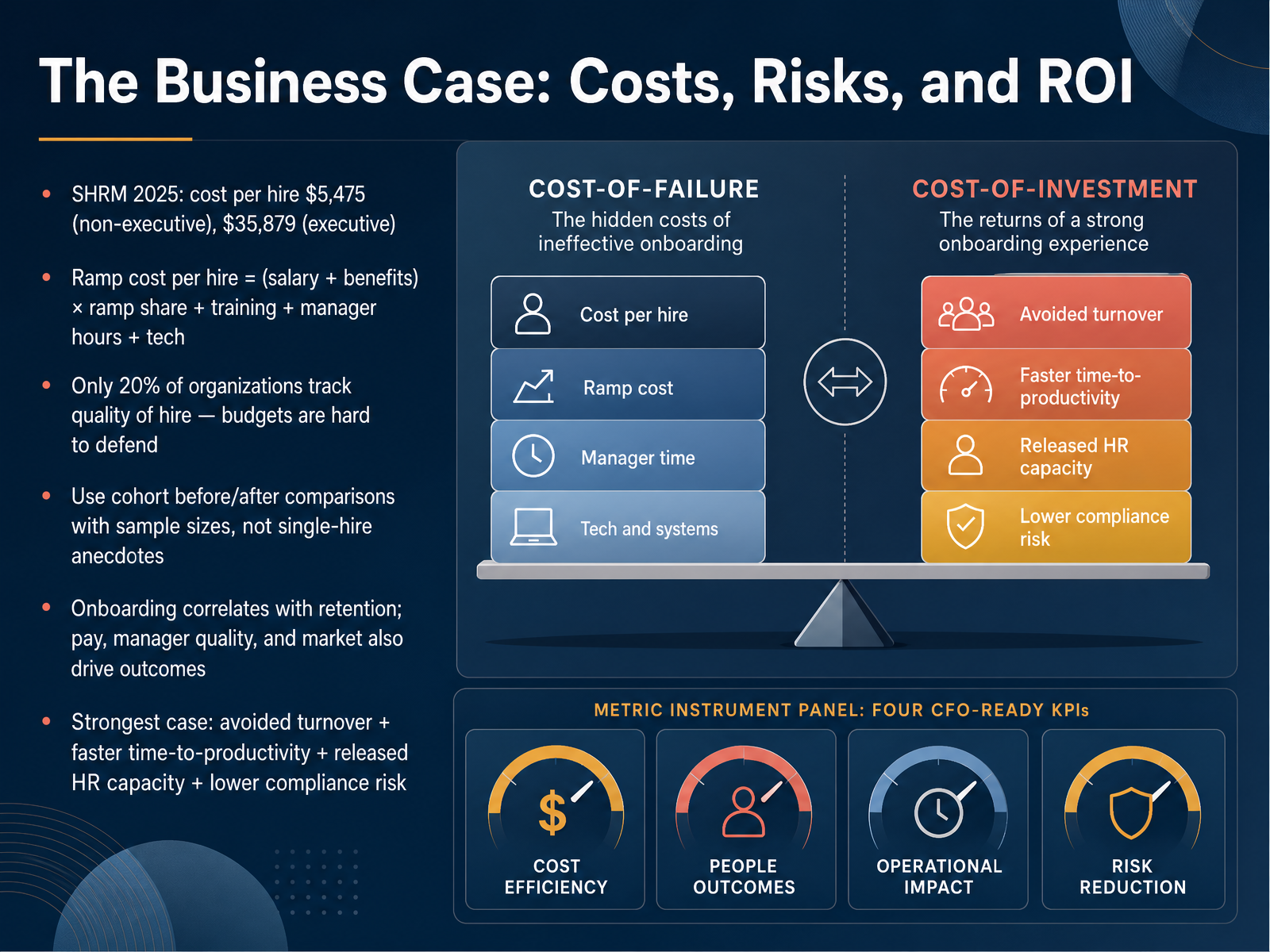
2 min - 08The Business Case: Costs, Risks, and ROILet us turn to the business case. Start with the real number. SHRM's 2025 benchmarking report puts cost per hire at five thousand four hundred seventy five dollars for non-executive roles, and thirty five thousand eight hundred seventy nine dollars for executives. But that is direct hiring spend only. It excludes the ramp. The honest figure is ramp cost per hire. Take salary plus benefits, multiply by the share of the ramp period, then add training cost, manager hours at a loaded hourly rate, and technology cost. That total is what finance actually funds. Here is the core problem. Only twenty percent of organizations track quality of hire. Four in five cannot show whether onboarding works, so budgets are hard to defend. So build your case on before and after cohorts with real sample sizes, never a single story about one great hire. Be precise about causation too. Structured onboarding correlates with retention, but pay, manager quality, and the market also drive outcomes. The strongest argument combines four things: avoided turnover, faster time to productivity, released HR capacity, and lower compliance risk. State each one in dollars your finance team can audit. Next, we map the implementation roadmap: diagnose, design, pilot, scale.
 bamboohr.comonboardingcost.comrewordin.com+22 min
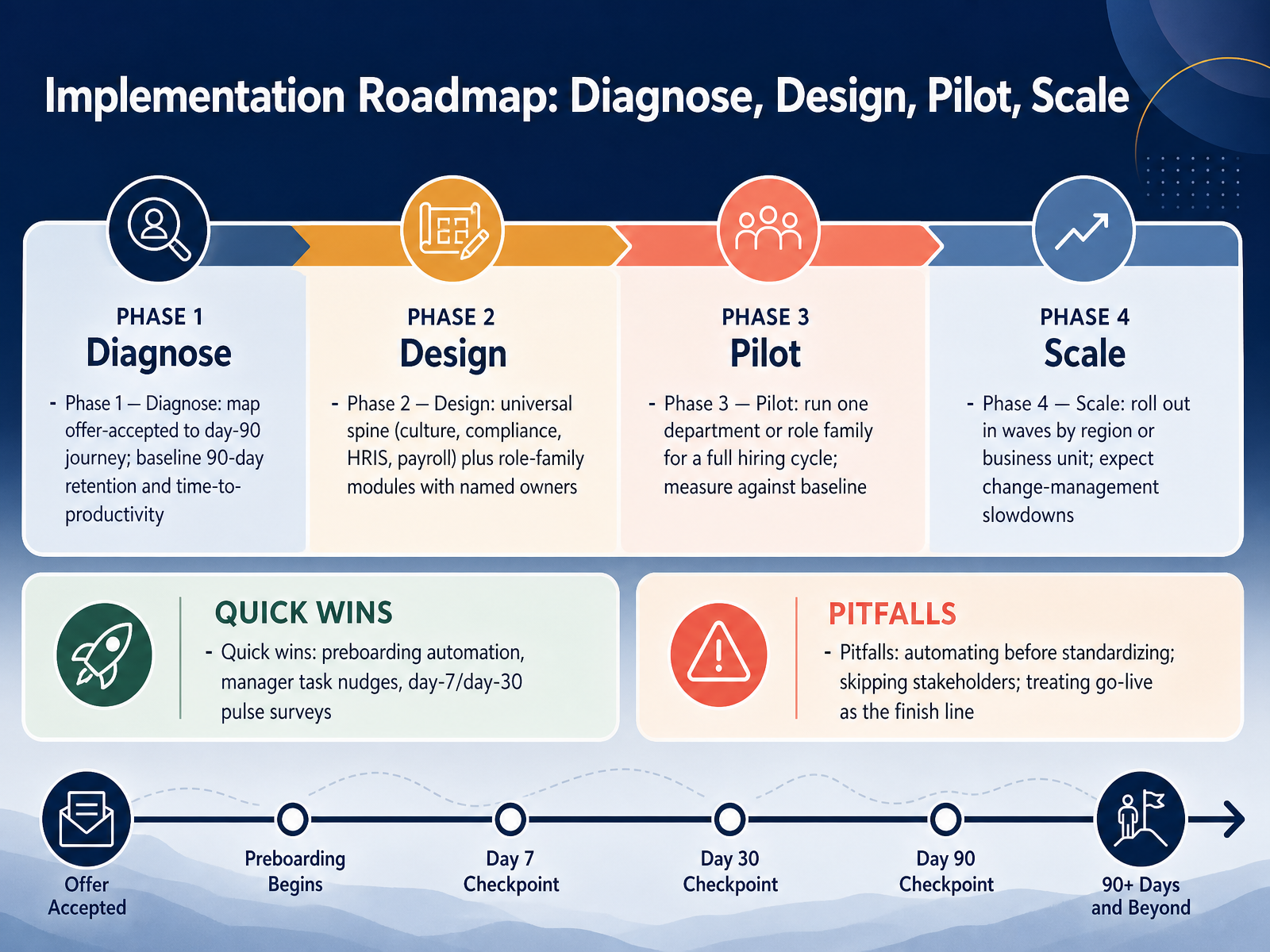
 - 09Implementation Roadmap: Diagnose, Design, Pilot, ScaleWith that context in mind, here is a roadmap you can actually run: diagnose, design, pilot, scale.
In phase one, diagnose. Map the journey from offer accepted to day ninety, and baseline your ninety-day retention and time-to-productivity. You cannot prove improvement without a starting number.
In phase two, design a universal spine for culture, compliance, your H R I S, and payroll. Add role-family modules, each with a named owner. Consistency first, personalization second.
Phase three, pilot. Run one department or role family across a full hiring cycle, and measure it against your baseline.
Phase four, scale in waves by region or business unit. Expect change-management slowdowns. That friction is normal, not failure.
For quick wins, automate preboarding, nudge managers on tasks, and run day-seven and day-thirty pulse surveys.
And watch three pitfalls. Automating before you standardize. Skipping stakeholders. And treating go-live as the finish line.
Now let us look at how you measure impact and keep improving.
 2 min
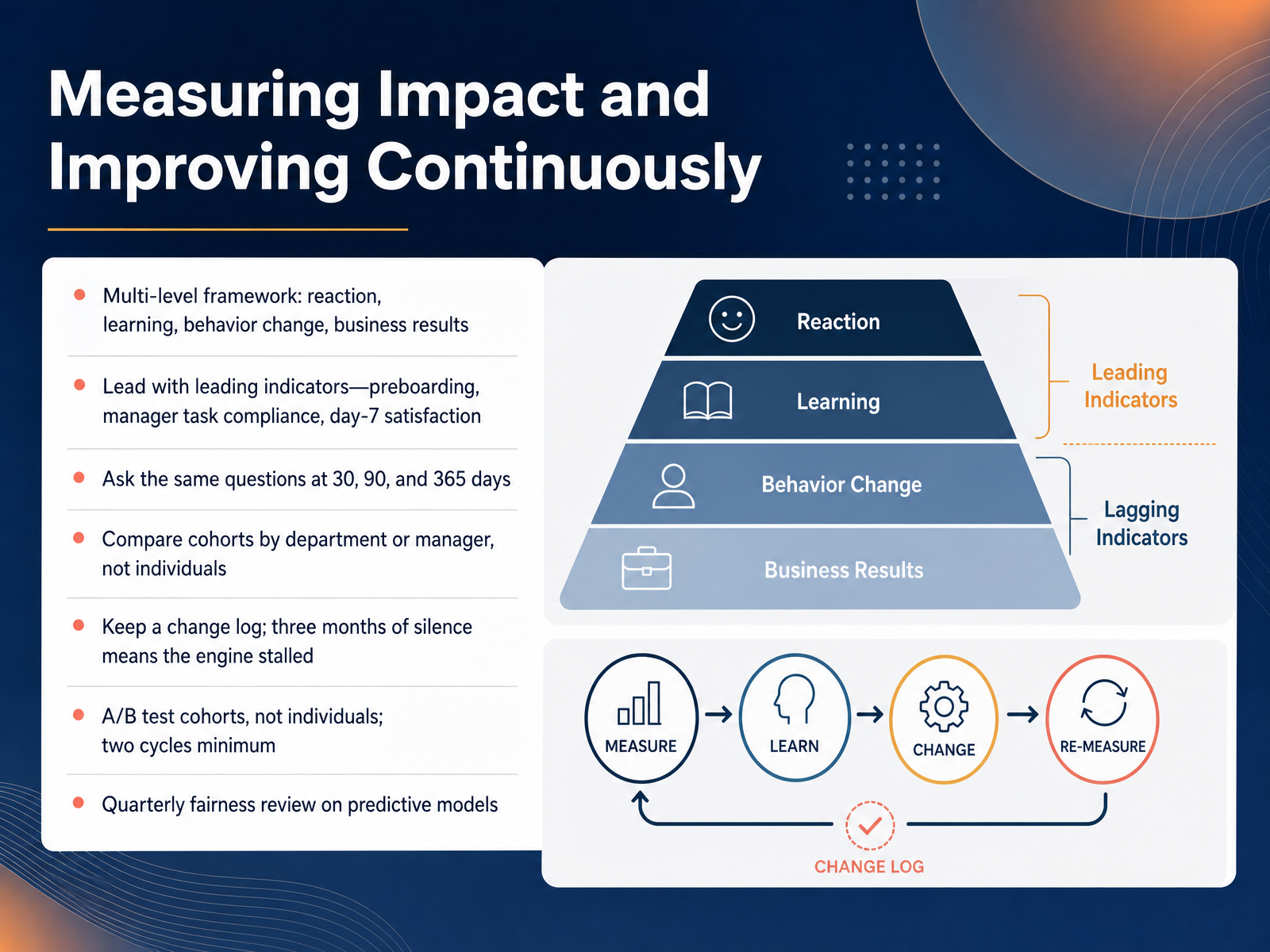
2 min - 10Measuring Impact and Improving ContinuouslyLet's turn to measurement, because a strategy you cannot see is a strategy you cannot improve. Use a four level framework. Reaction, learning, behavior change, and business results. But lead with leading indicators. Preboarding completion, manager task compliance, and day seven satisfaction tell you where a cohort is heading while you can still intervene. Then ask the same questions at thirty, ninety, and three hundred sixty five days, so you can track experience over time. Compare cohorts by department or manager, not individuals. The goal is to find broken processes, not struggling people. Keep a change log, and treat three months of silence as a warning that the improvement engine has stalled. When you test, test cohorts, not individuals, and run at least two cycles before you trust the result. And if you use predictive models, hold a quarterly fairness review, because historical data can carry historical bias. So the takeaway is simple. Measure leading signals, compare groups, log every change, and review fairly. Next, we move into Segment Playbooks: Hybrid, Remote, Frontline, and Executive.
 onboardswift.com2 min
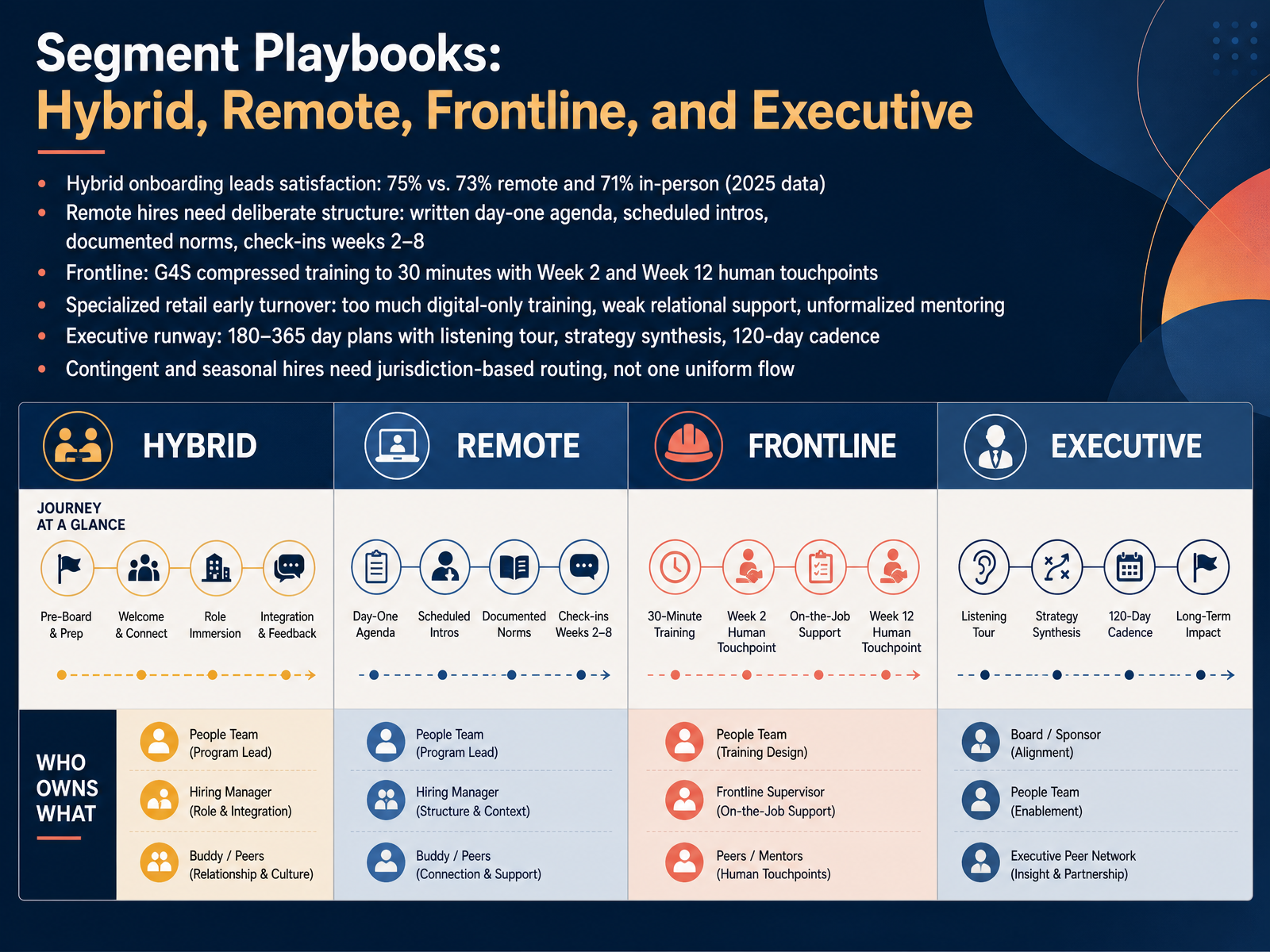
 - 11Segment Playbooks: Hybrid, Remote, Frontline, and ExecutiveLet's turn now from strategy to execution, because the right onboarding design depends entirely on who you are onboarding. Start with the data. Hybrid onboarding currently leads satisfaction, at 75 percent, just ahead of remote at 73 percent and in-person at 71. That gap matters, because remote hires need the most deliberate structure. Give them a written day-one agenda, scheduled introductions, documented norms, and frequent check-ins through weeks two to eight. Frontline tells a different story. G4S compressed training to thirty minutes, with real human touchpoints at Week 2 and Week 12. Specialized retail shows the failure mode: too much digital-only training, weak relational support, and mentoring that was never formalized. And executives need a longer runway altogether, with plans spanning 180 to 365 days, a listening tour, strategy synthesis, and a 120-day cadence. Notice the tradeoff running through all of these: consistency versus personalization. Also remember contingent and seasonal hires, who need jurisdiction-based routing rather than one uniform flow. So ask yourself: are you running one process, when you actually need four playbooks? Next, let's move into Action Planning: Goals, Tradeoffs, and the Next 90 Days.
 doi.orgthecaragroup.comlitmos.com+22 min
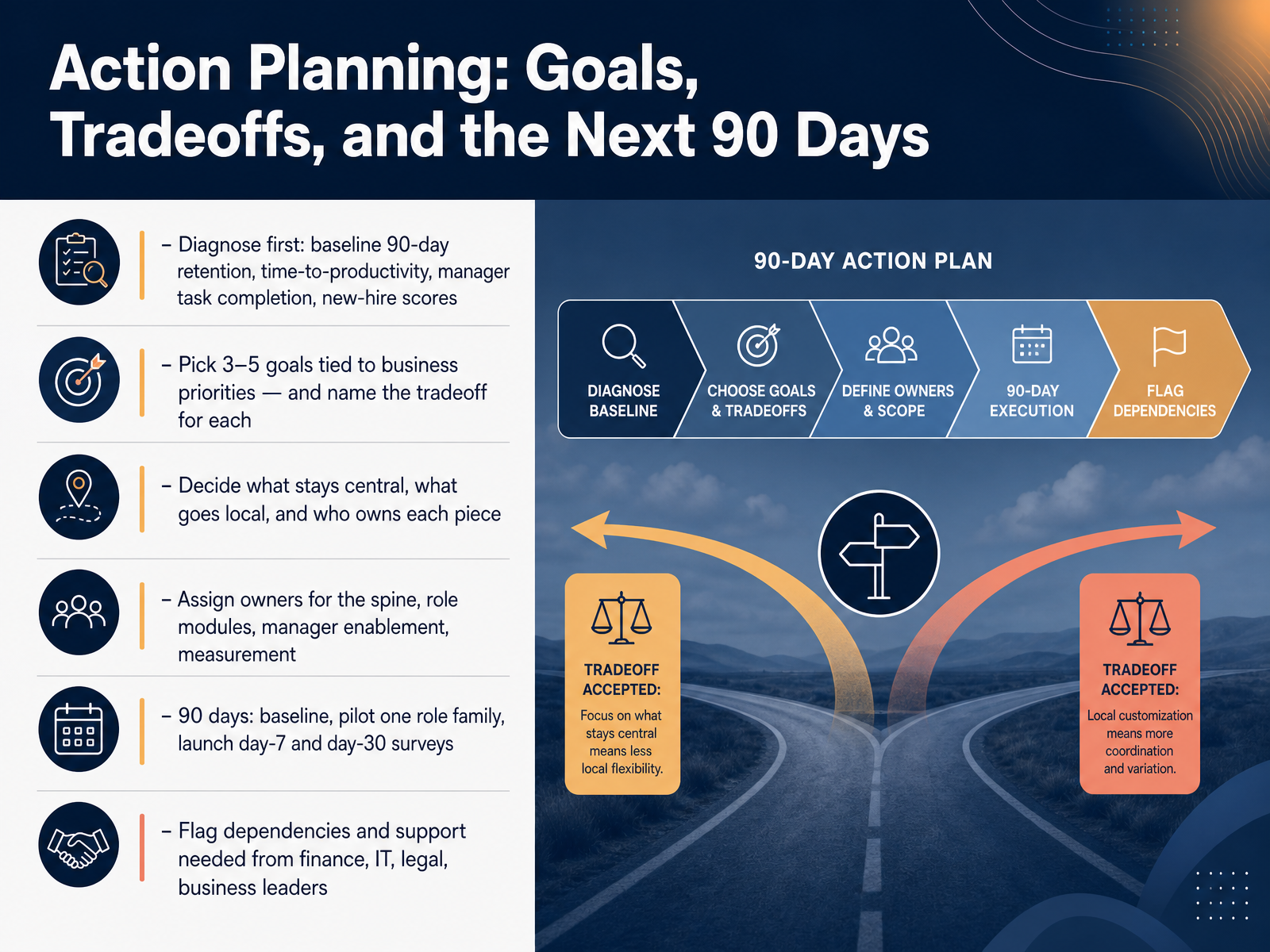
 - 12Action Planning: Goals, Tradeoffs, and the Next 90 DaysLet's turn all of this into an action plan for the next ninety days. Start by diagnosing before you redesign. Baseline four numbers: ninety-day retention, time to productivity, manager task completion, and new-hire experience scores. Here is the hard truth. Only about one in five organizations tracks quality of hire at all, so most teams cannot yet prove onboarding is working. Then pick three to five goals tied to business priorities, and for each one, name the tradeoff out loud. If you prioritize speed, managers carry more load. If you prioritize depth, time to productivity may stretch. Next, decide the split. What stays central for consistency, and what goes local for relevance. Assign one accountable owner for each piece: the universal spine, role modules, manager enablement, and measurement. Over the ninety days, baseline your data, pilot one role family, and launch day-seven and day-thirty surveys. Finally, flag your dependencies clearly, the support you need from finance, IT, legal, and business leaders. Because onboarding rarely fails on ambition. It fails on unowned handoffs. Building the Ongoing Improvement Loop.
 bamboohr.comonboardingcost.comrewordin.com+22 min
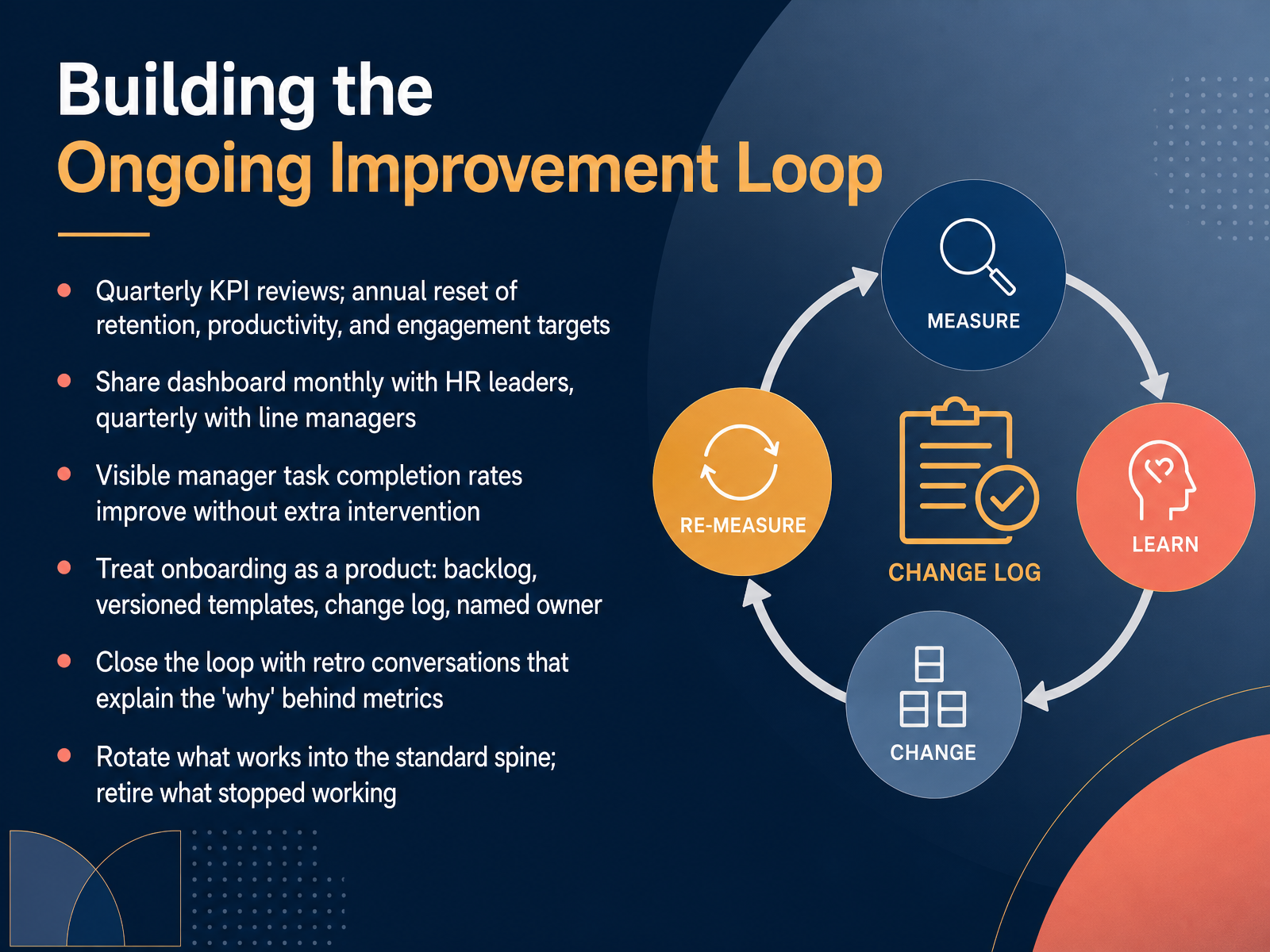
 - 13Building the Ongoing Improvement LoopLet's talk about building the ongoing improvement loop. Onboarding is never finished, because your company keeps changing. So the discipline here is rhythm. Review your core KPIs quarterly, and reset retention, productivity, and engagement targets once a year. Share the dashboard monthly with HR leaders, and quarterly with line managers. Here's a quiet win: when managers can see their task completion rates, those rates tend to improve on their own, with no extra intervention. Treat onboarding as a product. Keep a backlog, version your templates, maintain a change log, and name one accountable owner. Then close the loop with retrospective conversations that explain the why behind the metrics, not just the numbers. Finally, rotate what works into your standard spine, and retire what stopped working. The takeaway is simple: improvement becomes real when it has a cadence, an owner, and a habit of retiring what no longer serves you. Now, let's bring this together with Your Onboarding Strategy Decision Canvas.
 onboardswift.com2 min
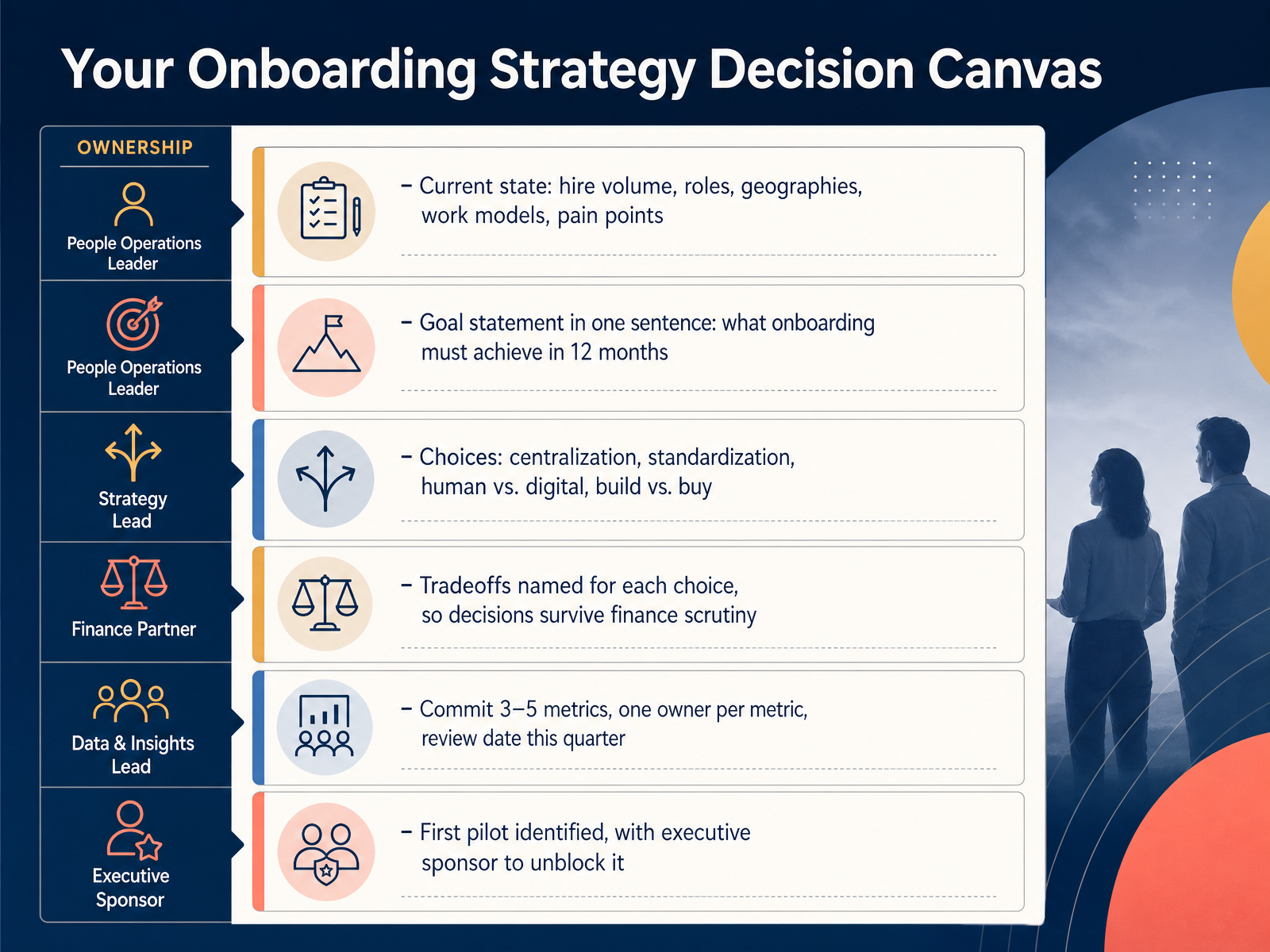
 - 14Your Onboarding Strategy Decision CanvasLet's close by putting all of this on one page you can actually work from. This is your onboarding strategy decision canvas. Start with current state. Name your hire volume, your role types, your geographies, your work models, and the pain points you already know about. Then write a single goal statement, one sentence, describing what onboarding must achieve in the next twelve months. Next, make your choices explicit: centralization, standardization, human versus digital delivery, and build versus buy. Here is the part leaders skip. Name the tradeoff behind each choice, in plain financial language, so your decisions survive finance scrutiny. Then commit to three to five metrics, assign one owner per metric, and set a review date this quarter. Finally, identify your first pilot and name an executive sponsor who can unblock it. Remember, only about twelve percent of employees strongly agree their organization onboards well, and most companies never measure it. That gap is your opportunity. So pick your metrics carefully, because you cannot defend what you never baseline. Thank you for working through this with me. You now have a canvas, a goal, and a first move. Go turn it into a decision this quarter.
 bamboohr.comonboardingcost.comrewordin.com+22 min
Take the deck with you
Download this course as a file — free, no sign-up needed.
- PDF handoutEvery slide page, ready to print or share.15 pages · 3.9 MBDownload
- Narrated PowerPointThe deck that presents itself — every slide carries the digital human's narration video.15 pages · 16.1 MBDownload
- PowerPoint slidesThe full deck as a .pptx — open it in PowerPoint, Keynote, or Google Slides.15 pages · 3.8 MBDownload
Free to use in your own training — please keep the PersonWise credit page at the end.
Have your own deck? Turn it into a course
Sources consulted
Web sources consulted while building this course.
- First Day Fog: Onboarding Benchmarking Report for 2025 | BambooHR — bamboohr.com
- 2026 Onboarding Cost Benchmarks: SHRM, Gallup, Brandon Hall, Aberdeen | OnboardingCost.com — onboardingcost.com
- Employee Onboarding Statistics 2026: Verified Data & Benchmarks — rewordin.com
- The 2026 onboarding benchmarks that actually move a comex, and the ones to stop citing — onboarding-experience.net
- 25+ Employee Onboarding Statistics & Trends (2026) — proprofstraining.com
- Redesigning Onboarding and Early Talent Retention in Specialized Retail: A Critical Analysis — doi.org
- Case Study – Reimagined Onboarding Transforms Retail Giant’s Hiring Experience - The CARA Group — thecaragroup.com
- Using an LMS for Onboarding - Staffing Industry Case Study — litmos.com
- Please quote as: Reinhard, P., Neis, N., Kolb, L., Wischer, D., Li, M. M., Winkelmann, A., Teuteberg, F. & Lechner, U. (2024). Augmenting Frontline Service Employee Onboarding via Hybrid Intelligence: Examining the Effects of Different Degrees of Human-GenAI Interaction. In M. Y. Mandviwalla, M. Söl — pubs.wi-kassel.de
- Global Enboarder Survey: 1 in 3 Employees Report Poor Onboarding Experiences, With Remote and Hybrid Teams Hit the Hardest - Silicon Canals — siliconcanals.com
- Enboarder 2025 HR Leader Survey: Winning the First 90 Days — enboarder.com
- Top 12 Onboarding & New Hire Survey KPIs | People Element — peopleelement.com
- Onboarding Metrics That Matter: What to Measure and Why | OnboardSwift — onboardswift.com
- Onboarding KPIs: 9 Metrics That Matter | FirstHR | FirstHR — firsthr.app
- Centralised Multi-Entity HR Onboarding: How Conglomerates Manage 2,000 Joiners Across 20 Group Companies — appitsoftware.com
- Standardize Global Onboarding, Keep Local Culture — beyondintranet.com
- Making global HR practices work locally: a practitioner’s guide to adaptation in multinational organisations — doi.org
- Centralized HR: When and How (Not) To Implement It - AIHR — aihr.com
- Global HR Decision Frameworks for Strategic Leaders 2026 – HROpsLab — hropslab.com
- Designing a 30‑60‑90 Day Plan: A UX‑Inspired Approach for New‑Hire Success - Aik Designs — aikdesigns.com