Columbian Exchange Consequences
Begin
14 pages · ~28 min
Columbian Exchange Consequences
Explore the Columbian Exchange's transformative impact on global history, trade, and culture. This training examines its consequences for students of world history seeking deeper understanding.
What you’ll learn
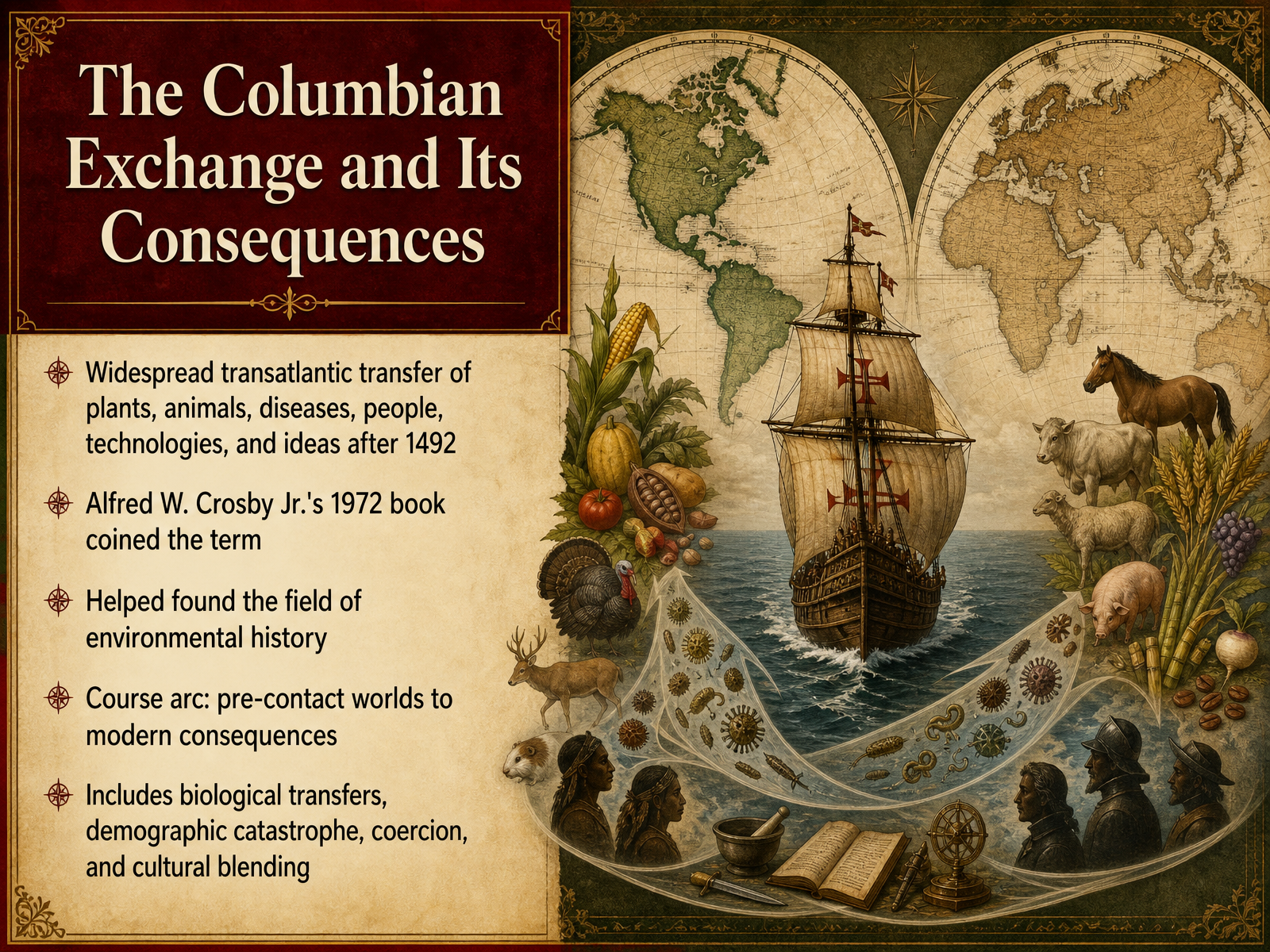
- 01The Columbian Exchange and Its ConsequencesWelcome to The Columbian Exchange and Its Consequences. Over the next few modules, we'll trace one of the most consequential processes in world history. The term itself was coined by historian Alfred W. Crosby Jr. in his 1972 book, and it describes something broader than trade routes or imperial expansion. It names a vast, transoceanic exchange that began after 1492, a transfer not just of plants, animals, and diseases, but of people, technologies, and ideas. Crosby's framing helped found the field of environmental history, reminding us that human events are always shaped by biological and ecological forces. This course moves from pre-contact worlds to modern consequences. Along the way, we'll examine biological transfers, demographic catastrophe, systems of coercion, and the profound cultural blending that followed. The goal is not simply to catalogue what crossed the Atlantic, but to understand how those crossings remade societies on every continent. Let's begin with the event's deeper significance. Next, we consider why a biological event still matters.britannica.comen.wikipedia.orgenvironmentandsociety.org+22 min
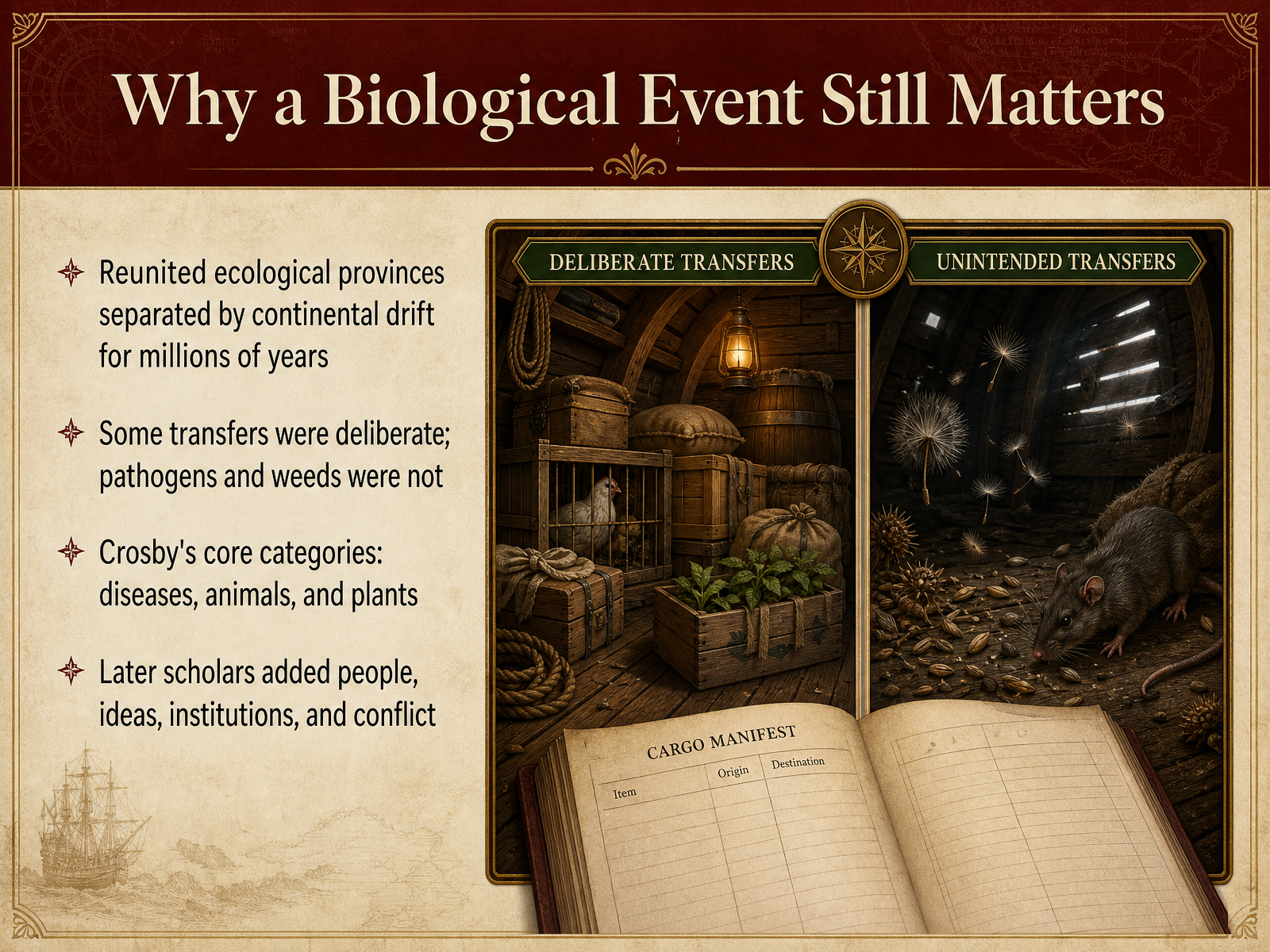
- 02Why a Biological Event Still MattersWhy does a biological event from five centuries ago still matter? The Columbian Exchange, as Alfred Crosby described it in 1972, reunited ecological provinces that continental drift had separated for millions of years. Some of these transfers were deliberate, like the movement of crops and livestock. Others were not, including pathogens and weeds that traveled unseen. Crosby's core categories were diseases, animals, and plants. Later scholars expanded the framework to include people, ideas, institutions, and conflict. Each category shaped societies in ways that still echo today. Up next, we look at the two worlds before 1492, Afro-Eurasia and the Americas.
 britannica.comen.wikipedia.orgenvironmentandsociety.org+21 min
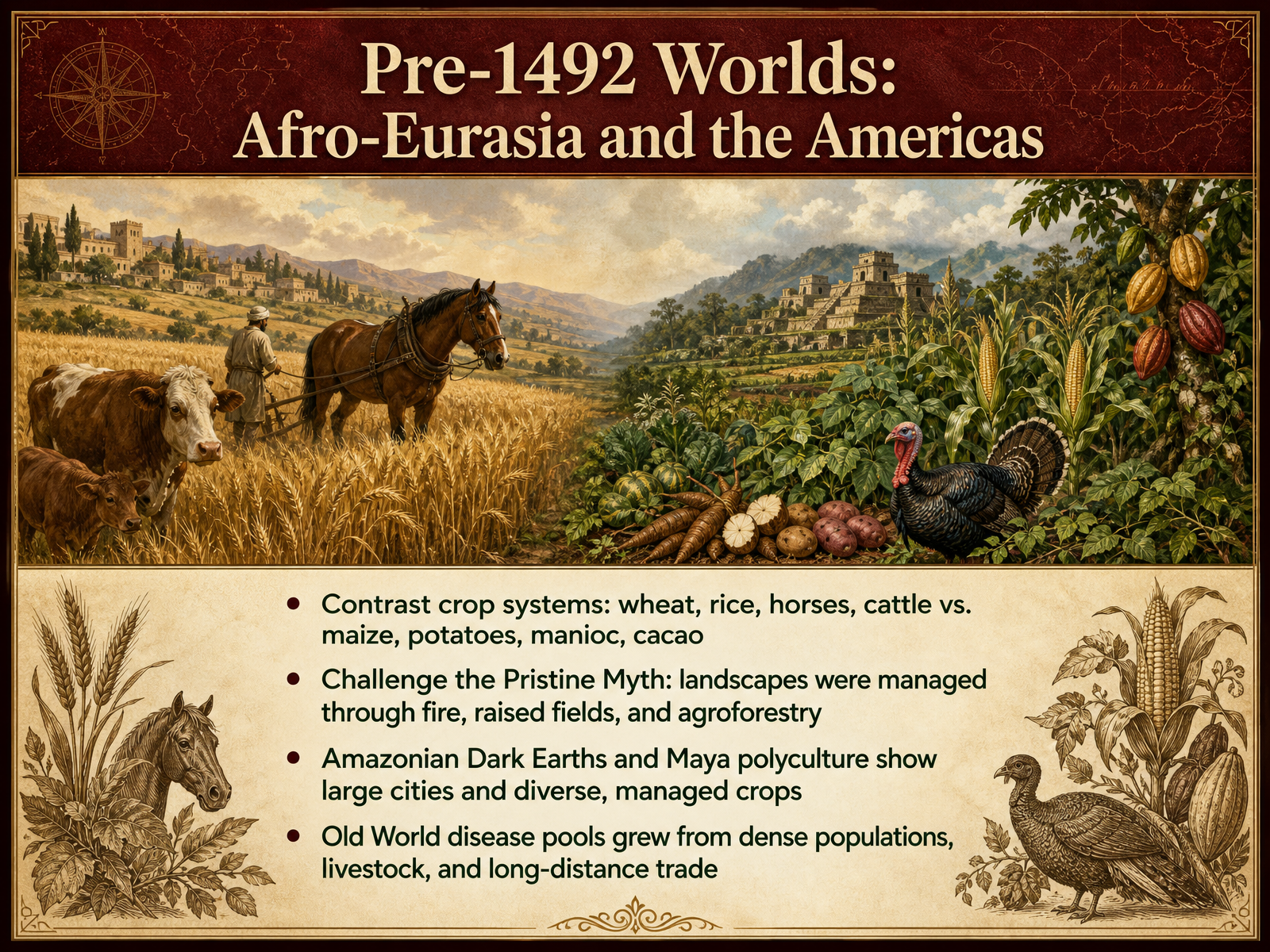
 - 03Pre-1492 Worlds: Afro-Eurasia and the AmericasBefore 1492, the Old World and the Americas had developed very different agricultural systems. Afro-Eurasia was defined by wheat, rice, horses, and cattle. The Americas were defined by maize, potatoes, manioc, and cacao. But the Americas were not a pristine wilderness. Indigenous societies actively managed their landscapes through fire, raised fields, and agroforestry. In the Amazon, the creation of dark earth soils and the use of Maya polyculture supported large cities and diverse, managed crops. This challenges the old Pristine Myth and shows the Americas as a place of deliberate cultivation and ecological knowledge. At the same time, the Old World's dense populations, livestock, and long-distance trade networks created a deep pool of infectious diseases. That contrast, between managed abundance and separated disease histories, becomes central to what happens next. Now we turn to the biological exchange itself, as crops and animals begin to cross the Atlantic.
 science.organnualreviews.orgsciencedirect.com+22 min
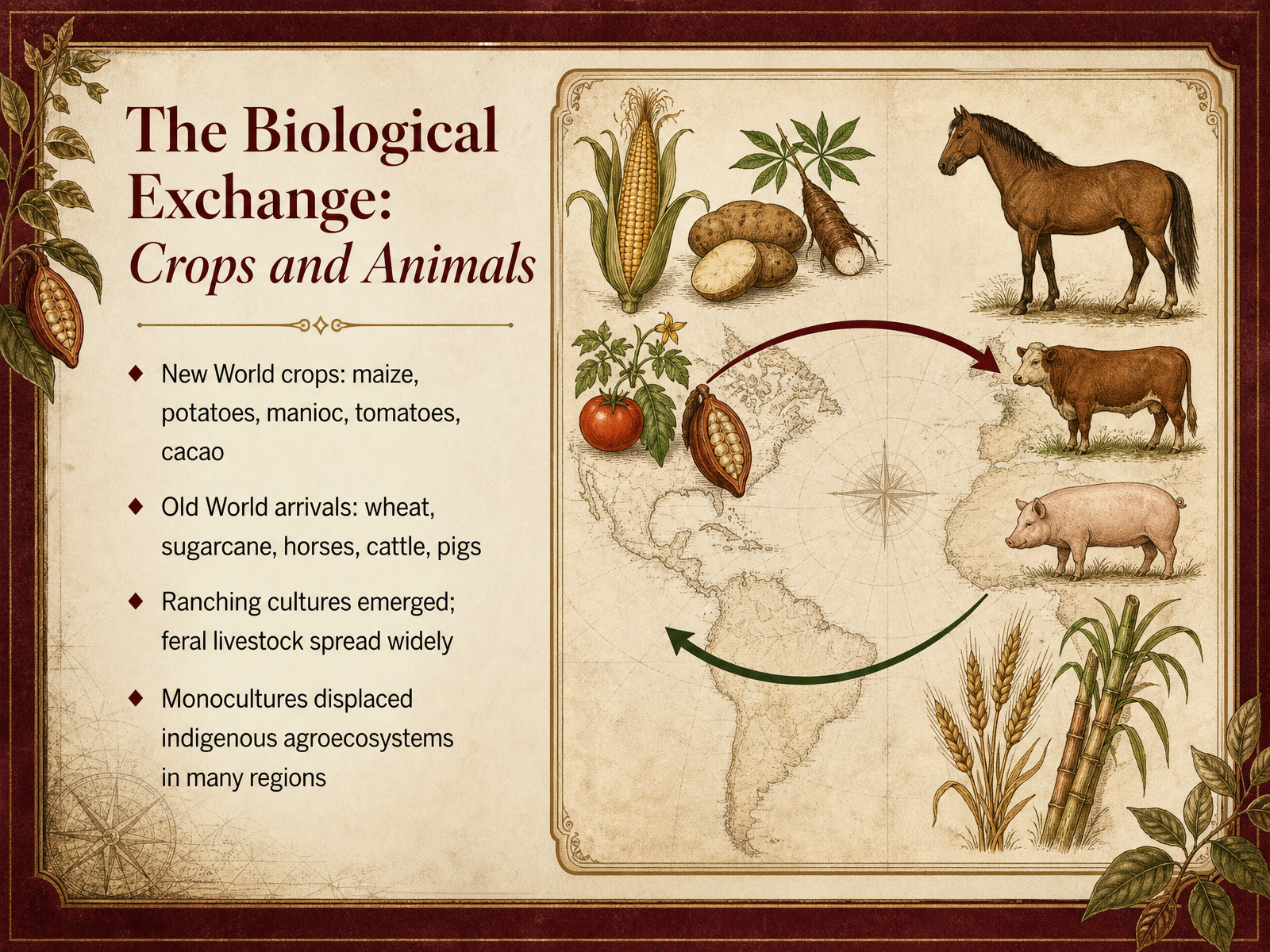
 - 04The Biological Exchange: Crops and AnimalsNow let's turn to the biological exchange itself, starting with the crops and animals that moved across the Atlantic. From the Americas came crops that would eventually reshape diets worldwide: maize, potatoes, manioc, tomatoes, and cacao. In the other direction, European arrivals brought wheat, sugarcane, and a host of domesticated animals, including horses, cattle, and pigs. The effects on landscapes were profound. Ranching cultures emerged across the Americas, and feral livestock, animals that escaped domestic control, spread widely into grasslands and forests. At the same time, the introduction of single-crop farming, or monoculture, often displaced indigenous agroecosystems, the diverse, interplanted fields that had long sustained local communities. This transformation was far more than a simple swap of species; it rewired agricultural life on both sides of the ocean. We will consider the next stage of this story, the spread of Old World pathogens, after this.
 britannica.comtaylorfrancis.comeinaudi.cornell.edu+21 min
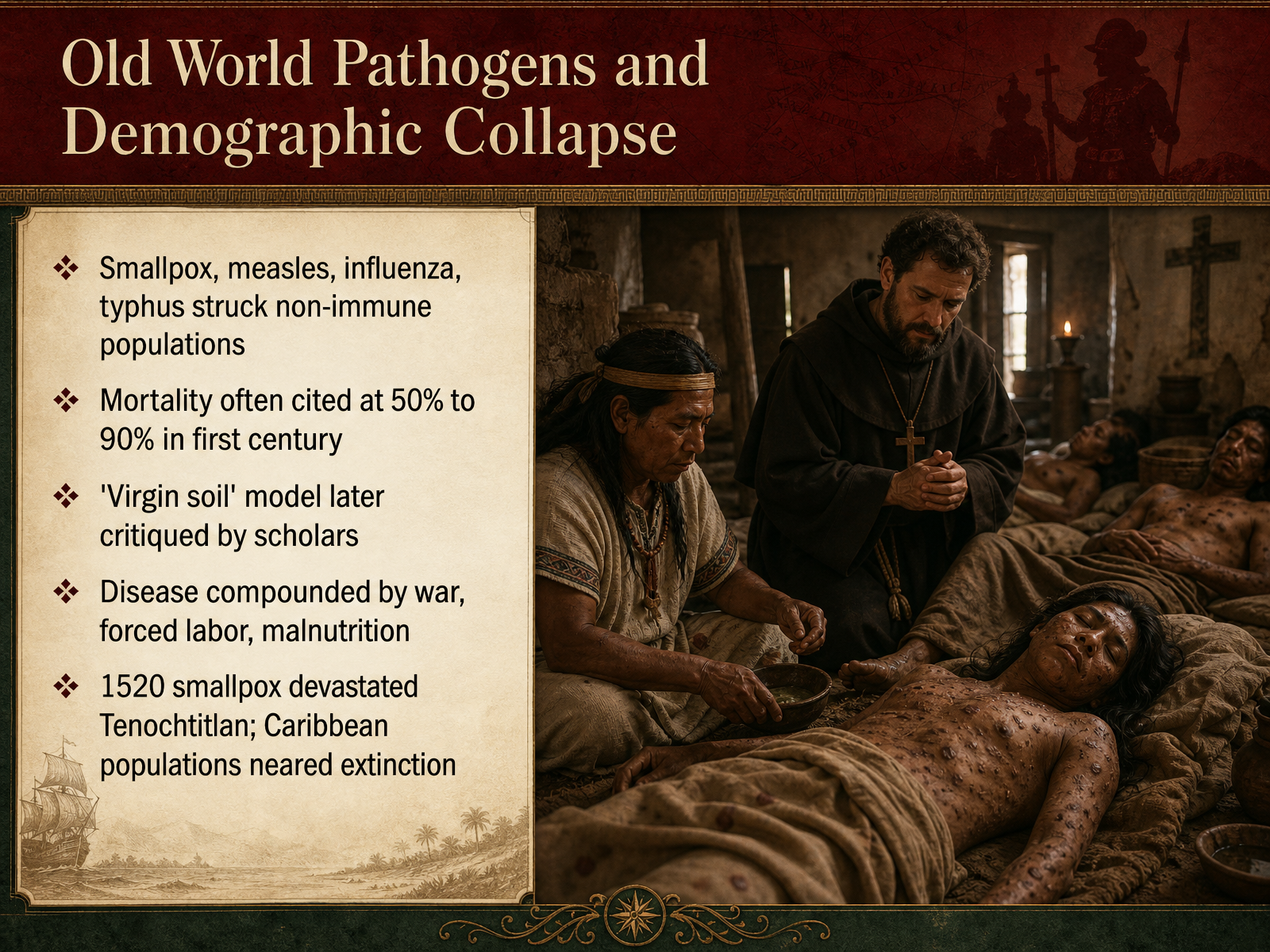
 - 05Old World Pathogens and Demographic CollapseNow we turn to the most devastating dimension of the exchange: the introduction of Old World pathogens. Diseases such as smallpox, measles, influenza, and typhus arrived in populations that had no prior exposure and therefore no acquired immunity. The resulting mortality was staggering, with many regions losing between fifty and ninety percent of their people within the first century of contact. Early scholars described these as virgin soil epidemics, imagining virgin populations with no defenses. Later work has complicated that model. Scholars now emphasize that disease rarely acted alone. Mortality was amplified by the disruptions of conquest. War, forced labor, and malnutrition weakened communities and made infection far more lethal. One of the earliest and most famous outbreaks struck Tenochtitlan in 1520, when smallpox helped to topple the Aztec capital before the final Spanish assault. In the Caribbean, indigenous populations were brought to the brink of extinction. This was not simply an ecological accident. It was a biological crisis made catastrophic by the conditions of colonial rule. Next, we will consider how forced migration and settlement reshaped the human landscape of the Americas.
 compass.onlinelibrary.wiley.comifch.unicamp.brannualreviews.org+21 min
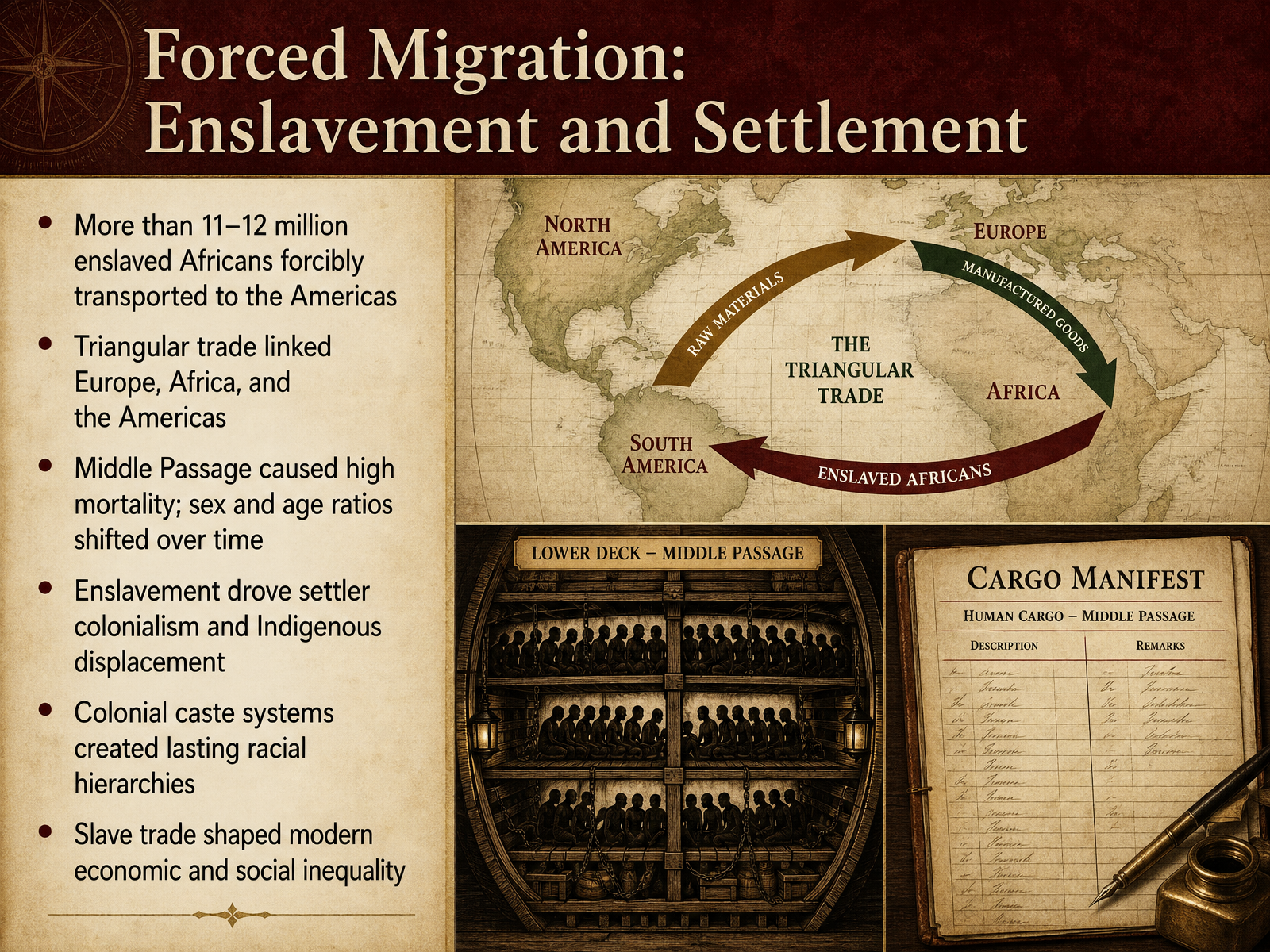
 - 06Forced Migration: Enslavement and SettlementForced migration forms another, much darker current of this transoceanic exchange. Between the sixteenth and nineteenth centuries, more than eleven million enslaved Africans were forcibly transported to the Americas. This movement was embedded in a triangular trade, linking European manufactured goods, African captives, and American plantation produce. The Middle Passage itself carried devastating mortality, and over time the sex and age ratios of the enslaved shifted, with greater proportions of men and children taken in later centuries. That human loss, we should remember, was not only demographic. It drove settler colonialism and accelerated Indigenous displacement across the Americas. In its wake, colonial caste systems hardened into racial hierarchies that long outlived the trade itself. The forced migration of millions also shaped modern patterns of economic and social inequality, across both the Atlantic world and within Africa. And that legacy carries directly into our next subject: silver, sugar, and the making of a global economy.
 cambridge.org1 min
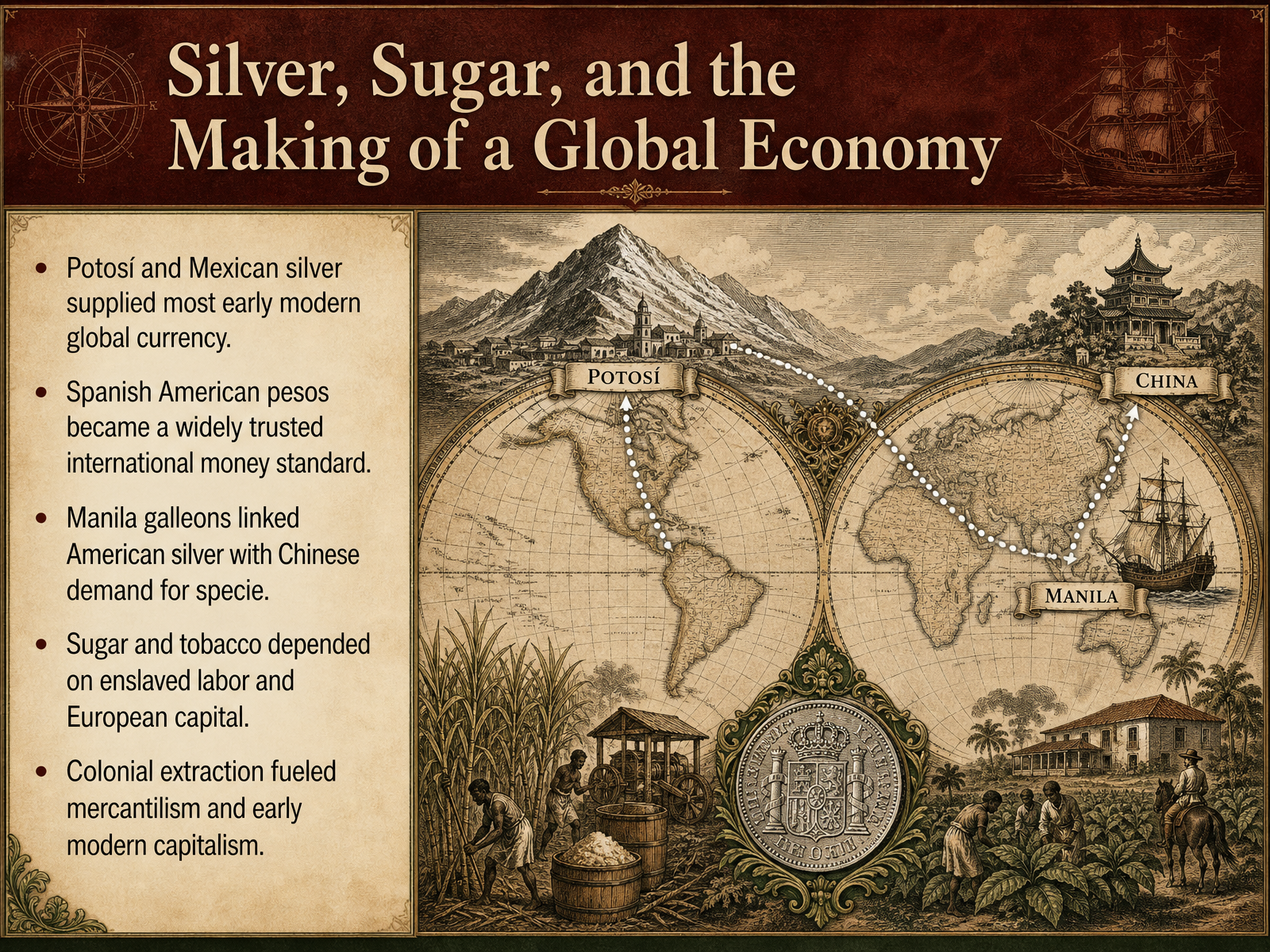
 - 07Silver, Sugar, and the Making of a Global EconomyWe turn now to the engine that powered so much of the early modern world: silver, sugar, and the forging of a global economy. In the sixteenth and seventeenth centuries, mines at Potosí, in present-day Bolivia, and across Mexico supplied the majority of the world's silver. That metal was minted into Spanish American pesos, a coin so consistent and widely accepted that it became a trusted international standard. The Manila galleons then carried American silver across the Pacific, linking its supply directly to China's powerful demand for specie. Meanwhile, sugar and tobacco were becoming Atlantic commodities of extraordinary value. Their profitability rested on enslaved labor and on European capital, binding the Caribbean and the Americas into a system of colonial extraction. These flows did more than enrich distant treasuries. They fueled the policies of mercantilism, and they laid important foundations for early modern capitalism. What began as the search for precious metals became a genuinely transoceanic economy, with consequences that reached every continent. In the next slide, we will consider how these same global circuits reshaped cultures and cuisines.
 2 min
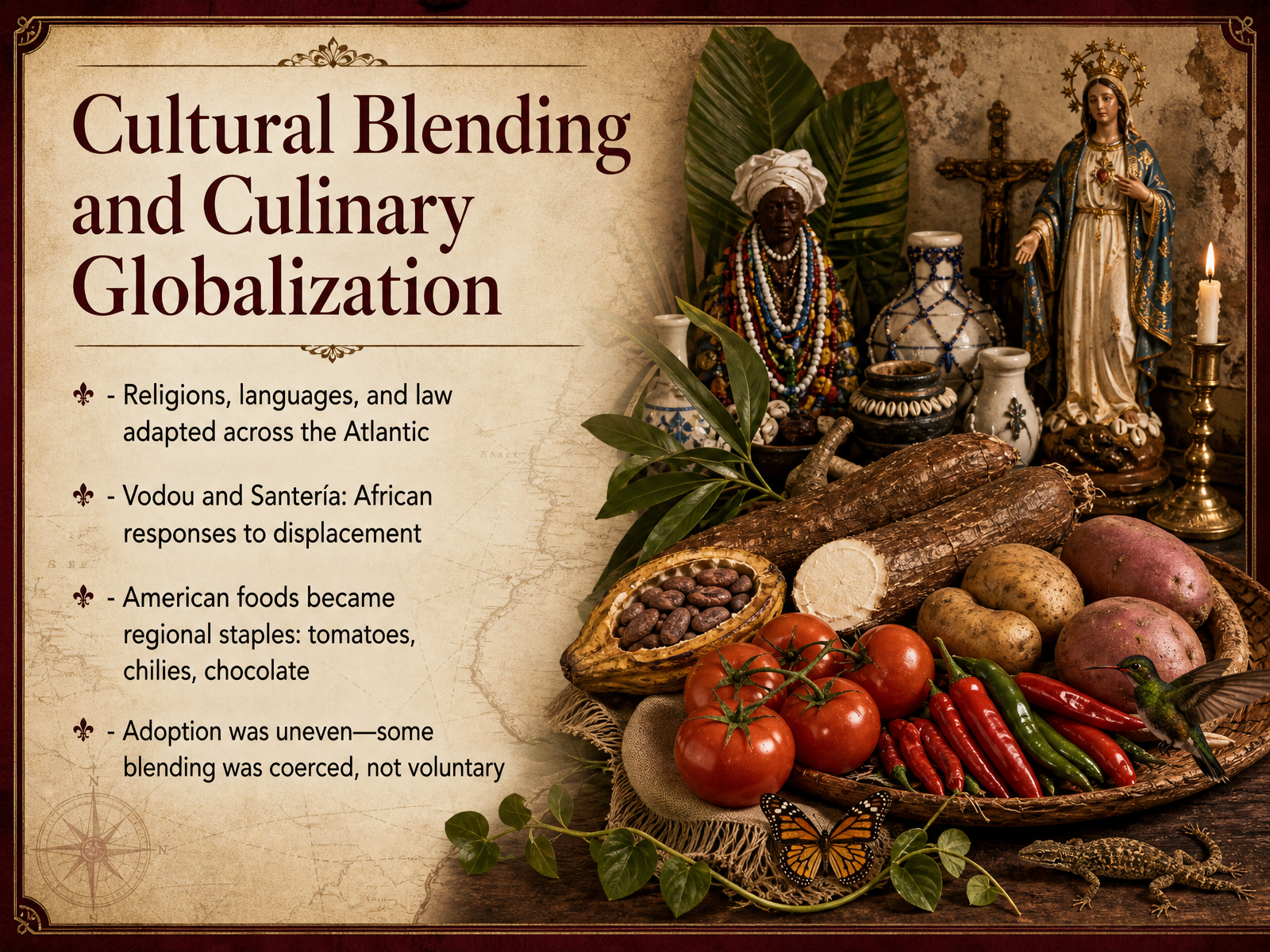
2 min - 08Cultural Blending and Culinary GlobalizationNow let’s turn to cultural blending and culinary globalization. The exchange was never only biological. Religions, languages, and legal systems also crossed the Atlantic, adapting to new conditions. In the Caribbean and Brazil, enslaved Africans transformed displacement into new spiritual traditions. Vodou and Santería are not simply mixtures; they are coherent responses to forced migration and cultural rupture. At the same time, American foods became embedded in regional diets far beyond the Americas. Tomatoes entered Mediterranean cooking. Chilies reshaped cuisines across Asia and Africa. Chocolate moved from an Indigenous American drink to a global commodity. But adoption was uneven. Some blending reflected genuine culinary curiosity. Much of it arose through coercion, plantation labor, and colonial power, not free choice. The flavors we now call regional often carry a history of violence and adaptation. Next, we will explore ecological imperialism and environmental transformation.
 taylorfrancis.com1 min
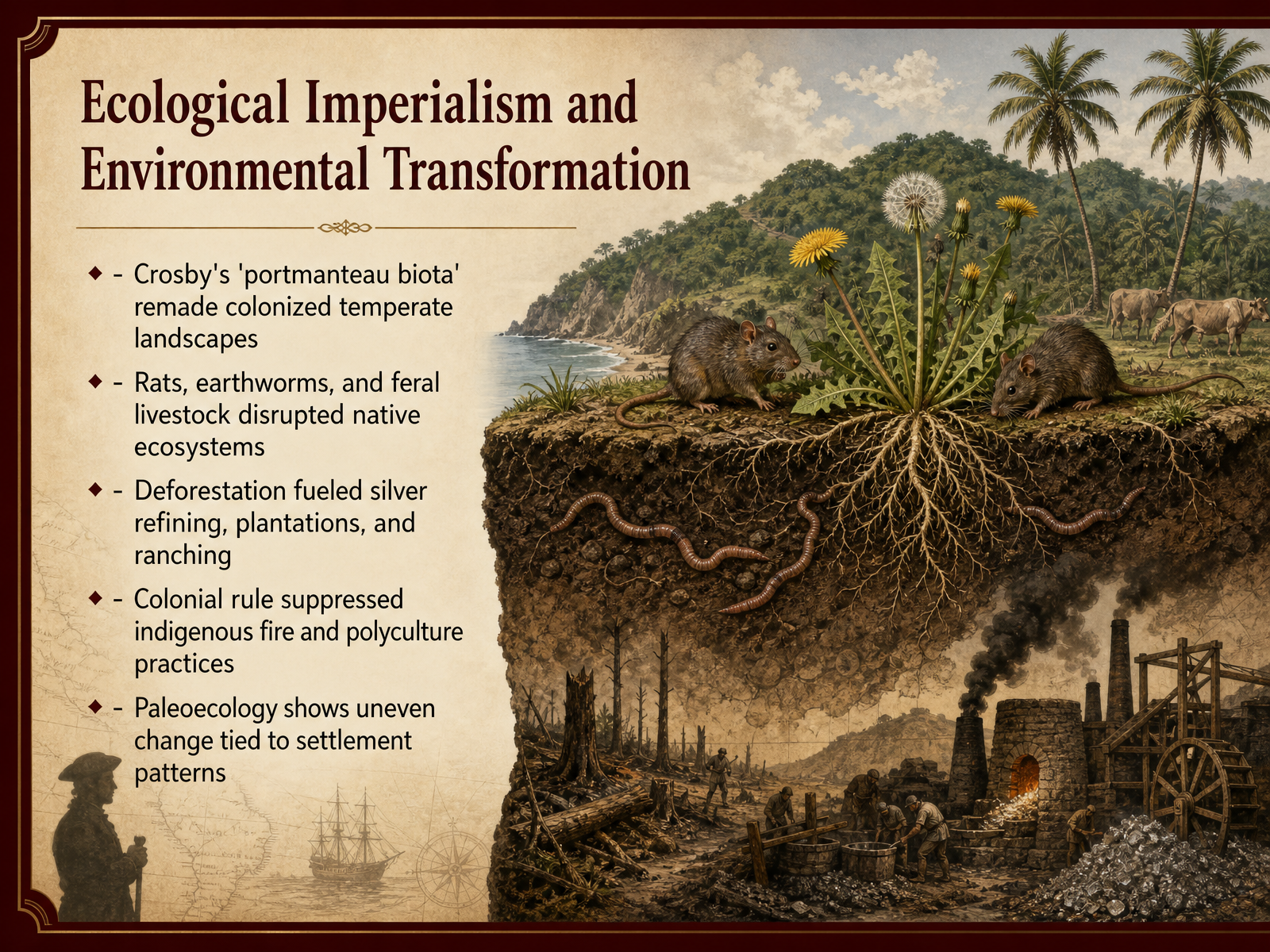
 - 09Ecological Imperialism and Environmental TransformationAlfred Crosby described the organisms that traveled with Europeans as a portmanteau biota, a kind of living luggage of plants, animals, and microbes. In temperate zones, this introduced community proved remarkably successful, remaking colonized landscapes from the ground up. Some arrivals worked quietly. Rats and earthworms altered soil chemistry and seed distribution. Others, like feral livestock, trampled native vegetation and competed with indigenous species. These ecological shifts did not happen in isolation. Deforestation supplied fuel for silver refining, opened land for plantations, and supported expanding ranching economies. Colonial rule also disrupted older land stewardship. Indigenous fire management and polyculture practices, systems refined over centuries, were often suppressed or replaced. Paleoecological evidence now shows this transformation was uneven, varying with settlement patterns, local ecologies, and the timing of colonial intrusion. The result was not one landscape, but many, each bearing a distinct signature of exchange and control. Up next, we turn to the debates that continue to shape how scholars reinterpret the exchange narrative.
 britannica.comtaylorfrancis.comeinaudi.cornell.edu+21 min
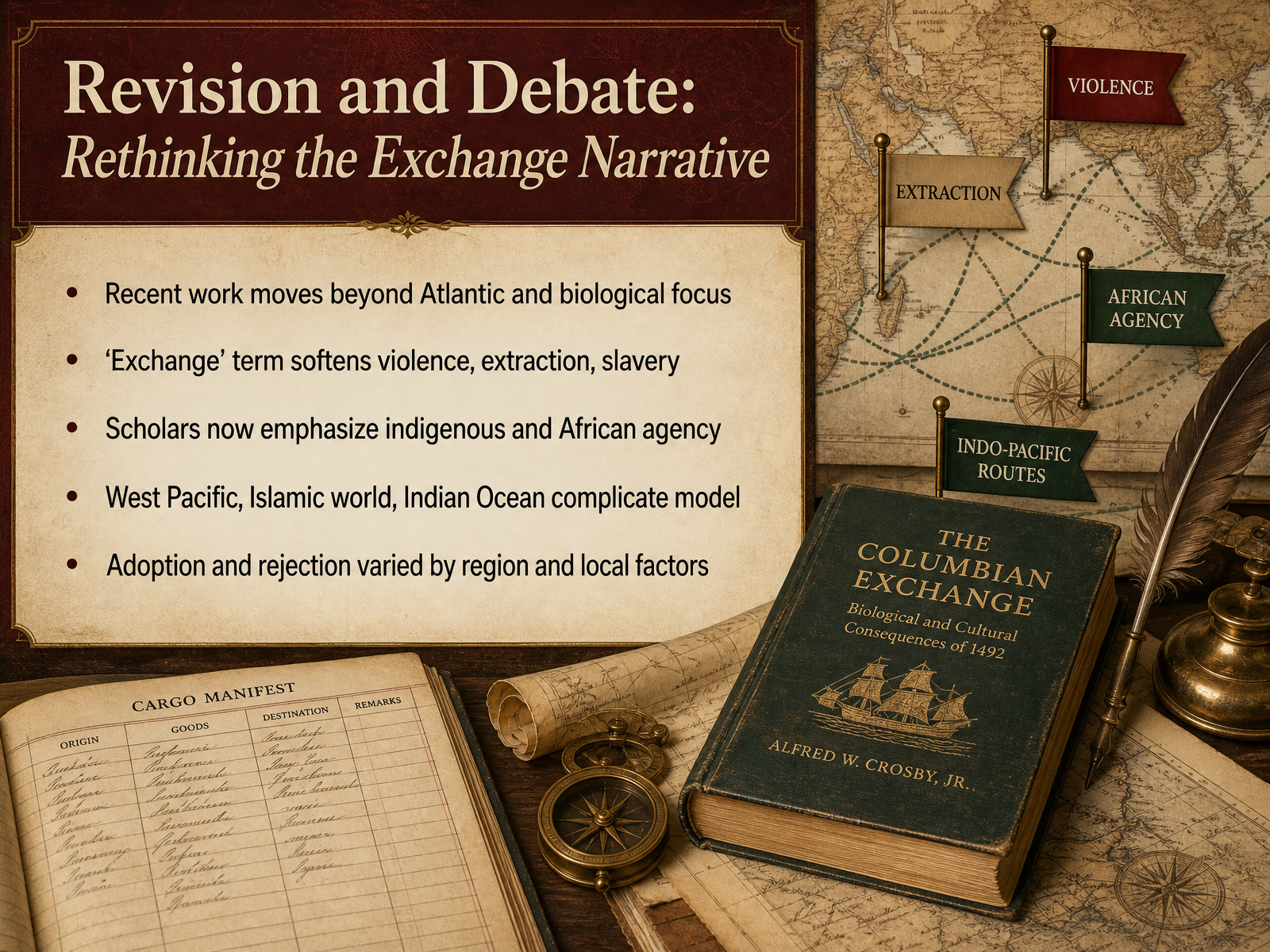
 - 10Revision and Debate: Rethinking the Exchange NarrativeRecent scholarship has begun to reshape how we understand the Columbian Exchange. The traditional model focused heavily on the Atlantic and on biological transfers, but new work is pushing those boundaries. At the same time, some historians argue that the word exchange itself is too gentle. It can soften the reality of violence, extraction, and slavery that accompanied these global connections. A growing emphasis now falls on indigenous and African agency, on the ways people resisted, adapted, and made choices within systems not of their making. Researchers are also looking beyond the Atlantic to other connected worlds. The West Pacific, the Islamic world, and the Indian Ocean all complicate the older narrative, showing that adoption and rejection varied greatly by region and by local factors. The result is a more layered, less singular picture of early modern globalization. Next, we turn to the lasting legacies of this history in food, health, and biodiversity.
 1 min
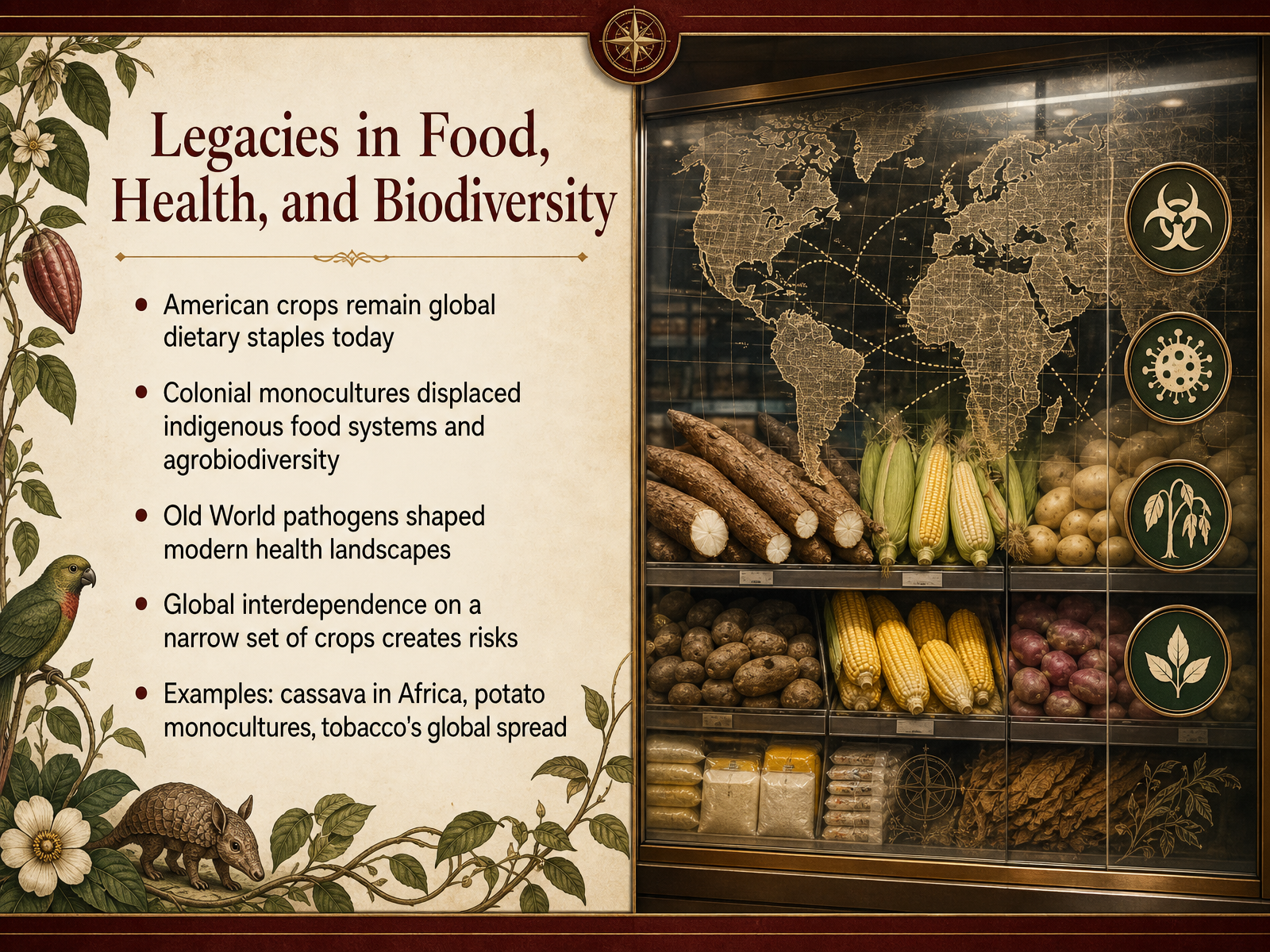
1 min - 11Legacies in Food, Health, and BiodiversityThe Columbian Exchange reshaped the pantry of the world in ways we still live with at every meal. Crops that originated in the Americas, including maize, potatoes, and cassava, have become everyday staples across Africa, Europe, and Asia. Yet this abundance came with a quieter cost. Colonial monocultures often displaced indigenous food systems and reduced agrobiodiversity, replacing diverse local fields with single crops grown for export or subsistence. The movement of Old World pathogens also shaped modern health landscapes, contributing to demographic collapse in the Americas and altering population patterns in ways that still echo today. Our global dependence on a narrow set of crops creates real risks. The Irish potato famine offers one stark historical example. More recently, cassava has become a critical food source in parts of Africa, while the global spread of tobacco introduced a product now linked to widespread preventable disease. The exchange made the world more connected, but also more interdependent, and that interdependence carries vulnerability alongside abundance. Next, we will turn to how the Columbian Exchange also shaped the deep patterns of global inequality.
 taylorfrancis.combritannica.comeinaudi.cornell.edu+22 min
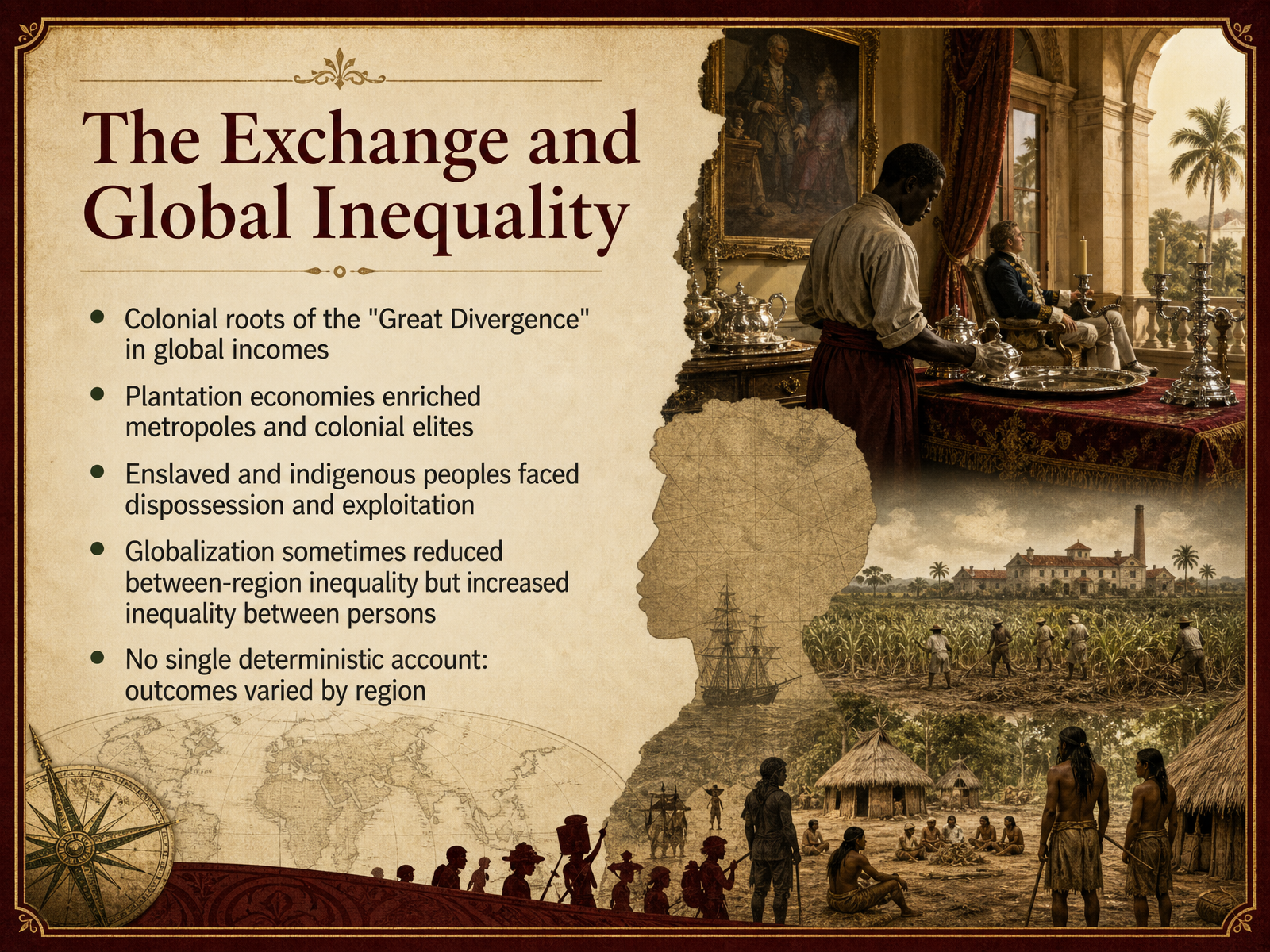
 - 12The Exchange and Global InequalityNow let's consider the longer-term economic consequences. Historians sometimes use the phrase the Great Divergence to describe the widening gap in incomes between western Europe and much of the rest of the world. The colonial systems that emerged from the Columbian Exchange played a significant part in that process. Plantation economies in the Americas generated enormous wealth, but it flowed mainly toward European metropoles and a narrow colonial elite. Enslaved Africans and indigenous peoples bore the human cost through dispossession and forced labor. The picture, however, is not uniform. Global trade could reduce inequality between regions, even as it concentrated wealth more sharply among individuals within those regions. Plantation owners in the American South and Java, for example, captured most of the gains from export crops. So there is no single deterministic account. Outcomes varied by region, by crop, and by social position. With that complexity in mind, our next slide considers how educators and cultural institutions can teach and present the Columbian Exchange.
 2 min
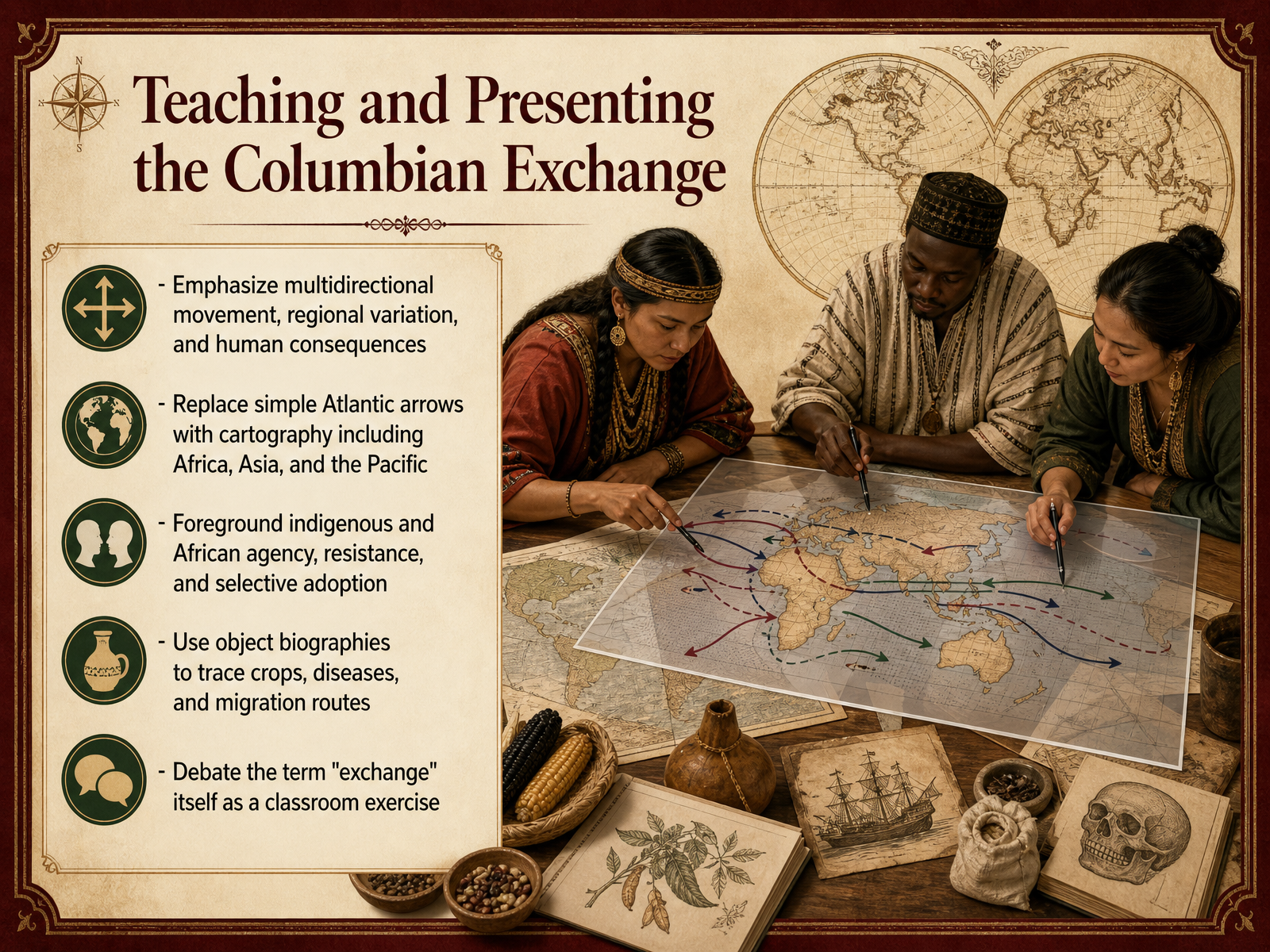
2 min - 13Teaching and Presenting the Columbian ExchangeWhen we teach or present this history, the framing shapes what learners actually see. Current scholarship encourages us to replace simple Atlantic arrows with cartography that includes Africa, Asia, and the Pacific. That broader map makes multidirectional movement and regional variation more visible. It also keeps human consequences in view. We can foreground indigenous and African agency, resistance, and selective adoption, rather than treating local peoples as passive recipients. Object biographies work well here. By tracing a single crop, a disease, or a migration route, students can see how global processes unfolded in particular places and sometimes failed to take hold. A recent study of the West Pacific shows that introduction is an event, while dispersal, adoption, and rejection are longer social processes. This is also a useful moment to debate the term exchange itself. The word can sound too neutral, too balanced. Asking whether reciprocity or coercion better describes these movements turns a familiar label into an analytical question. That debate opens directly into the larger question of how we understand the Columbian Exchange today, which is where we will go next.
 compass.onlinelibrary.wiley.comifch.unicamp.brannualreviews.org+22 min
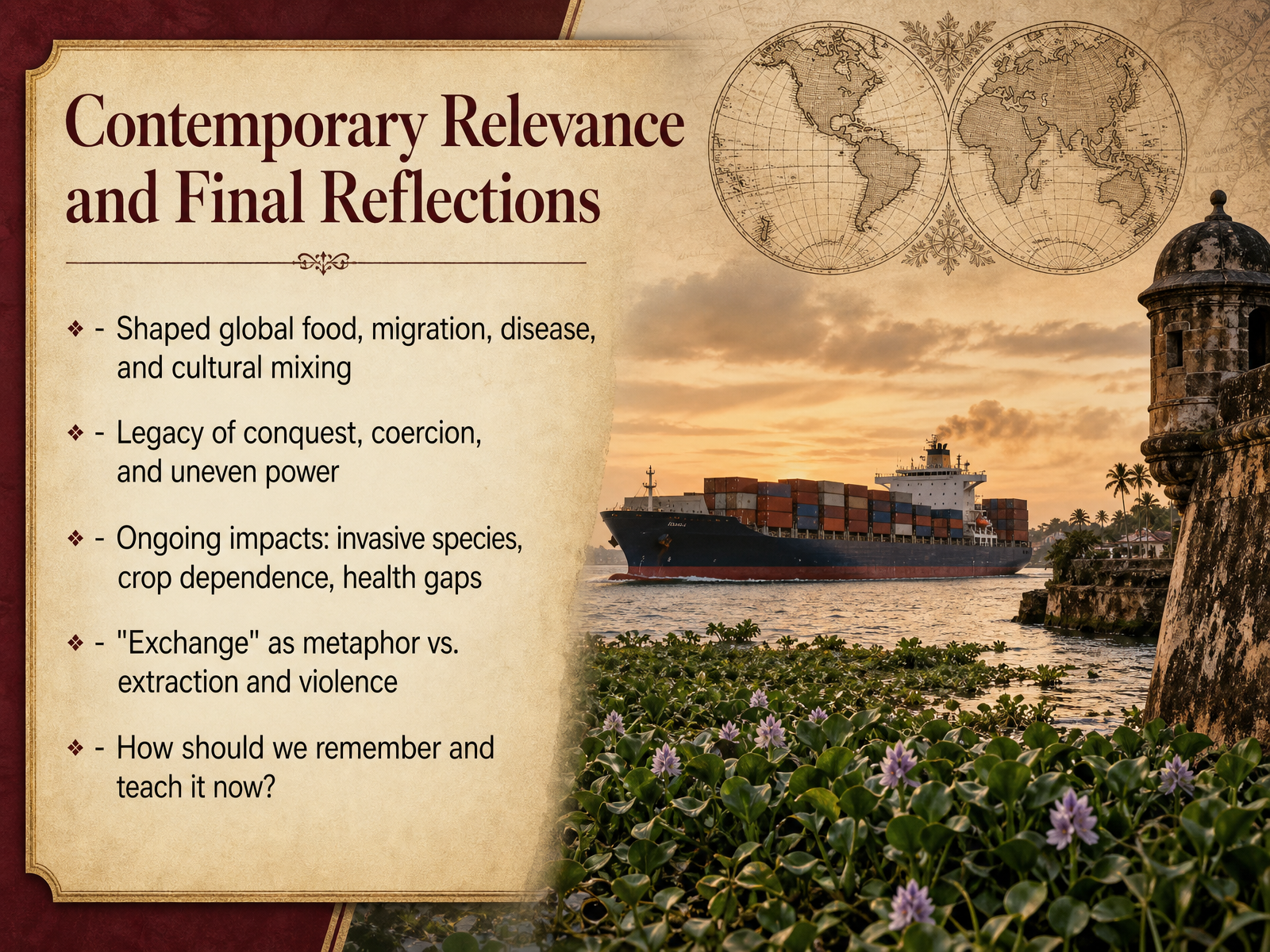
 - 14Contemporary Relevance and Final ReflectionsAs we close, it is worth remembering that the Columbian Exchange is not simply a chapter in environmental history. It shaped the foods we eat, the patterns of migration that built modern nations, the spread of disease, and the mixing of cultures across every hemisphere. Yet its legacy also includes conquest, coercion, and deeply uneven distributions of power. The word exchange can sound balanced, even benign. But for many scholars, the process was often closer to extraction, a transfer in which the costs were borne primarily by Indigenous communities and enslaved peoples. Those consequences did not end in the sixteenth century. Invasive species continue to reshape ecosystems. Global agriculture depends on a narrow set of transplanted crops. And health disparities rooted in colonial encounters persist in measurable ways. Recent scholarship has also widened the lens, examining how the exchange unfolded in Asia, the Pacific, and the Islamic world, sometimes through adoption, sometimes through rejection. That broader view reminds us that remembering this history is not a single story but an ongoing conversation about evidence, responsibility, and perspective. Thank you for engaging with this material. Carry forward the questions it raises about how we teach, commemorate, and learn from one of the most consequential transformations in human history.
 britannica.comen.wikipedia.orgenvironmentandsociety.org+22 min
Take the deck with you
Download this course as a file — free, no sign-up needed.
- PDF handoutEvery slide page, ready to print or share.15 pages · 7.2 MBDownload
- Narrated PowerPointThe deck that presents itself — every slide carries the digital human's narration video.15 pages · 19.2 MBDownload
- PowerPoint slidesThe full deck as a .pptx — open it in PowerPoint, Keynote, or Google Slides.15 pages · 7.2 MBDownload
Free to use in your own training — please keep the PersonWise credit page at the end.
Have your own deck? Turn it into a course
Sources consulted
Web sources consulted while building this course.
- Columbian Exchange | Diseases, Animals, & Plants | Britannica — britannica.com
- Columbian exchange — en.wikipedia.org
- Columbian Exchange | Environment & Society Portal — environmentandsociety.org
- How the Columbian Exchange Brought Globalization—And Disease | HISTORY — history.com
- The Columbian Exchange — en.wikipedia.org
- Persistent effects of pre-Columbian plant domestication on Amazonian forest composition | Science — science.org
- The Call of the Wild: Rethinking Food Production in Ancient Amazonia | Annual Reviews — annualreviews.org
- The origins of Amazonian landscapes: Plant cultivation, domestication and the spread of food production in tropical South America — sciencedirect.com
- Was there ever a Neolithic in the Neotropics? Plant familiarisation and biodiversity in the Amazon | Antiquity | Cambridge Core — cambridge.org
- Maize monoculture supported pre-Columbian urbanism in southwestern Amazonia | Nature — nature.com
- Agricultural Biodiversity and the Columbian Exchange — taylorfrancis.com
- Agriculture and Biodiversity in Latin America in Historical Perspective — einaudi.cornell.edu
- Non-uniform tropical forest responses to the ‘Columbian Exchange’ in the Neotropics and Asia-Pacific | Nature Ecology & Evolution — nature.com
- The ecological origins and consequences of cattle ranching in sixteenth-century New Spain — repository.lsu.edu
- Colonialism and Other Afflictions: Rethinking Native American ... — compass.onlinelibrary.wiley.com
- Virgin Soils Revisited Author(s): David S. Jones Source: The William and Mary Quarterly, Third Series, Vol. 60, No. 4 (Oct., 2003), pp. 703-742 Accessed: 08/08/2011 18:57 — ifch.unicamp.br
- Disease Transfer at Contact | Annual Reviews — annualreviews.org
- The Demographic Collapse of Native Peoples of the Americas, 1492-1650 — thebritishacademy.ac.uk
- New World Depopulation and the Case of Disease — journals.uchicago.edu
- The Atlantic Slave Trade — cambridge.org