Begin
14 pages · ~28 min
Cybersecurity Roadmap: Priorities & Milestones
This training helps security and IT leaders prioritize roadmap milestones and communicate cybersecurity plans effectively to stakeholders.
A digital instructor presents all 14 pages. Hold “Ask” at any point and ask out loud — the answer comes from this course. No sign-up needed.
What you’ll learn
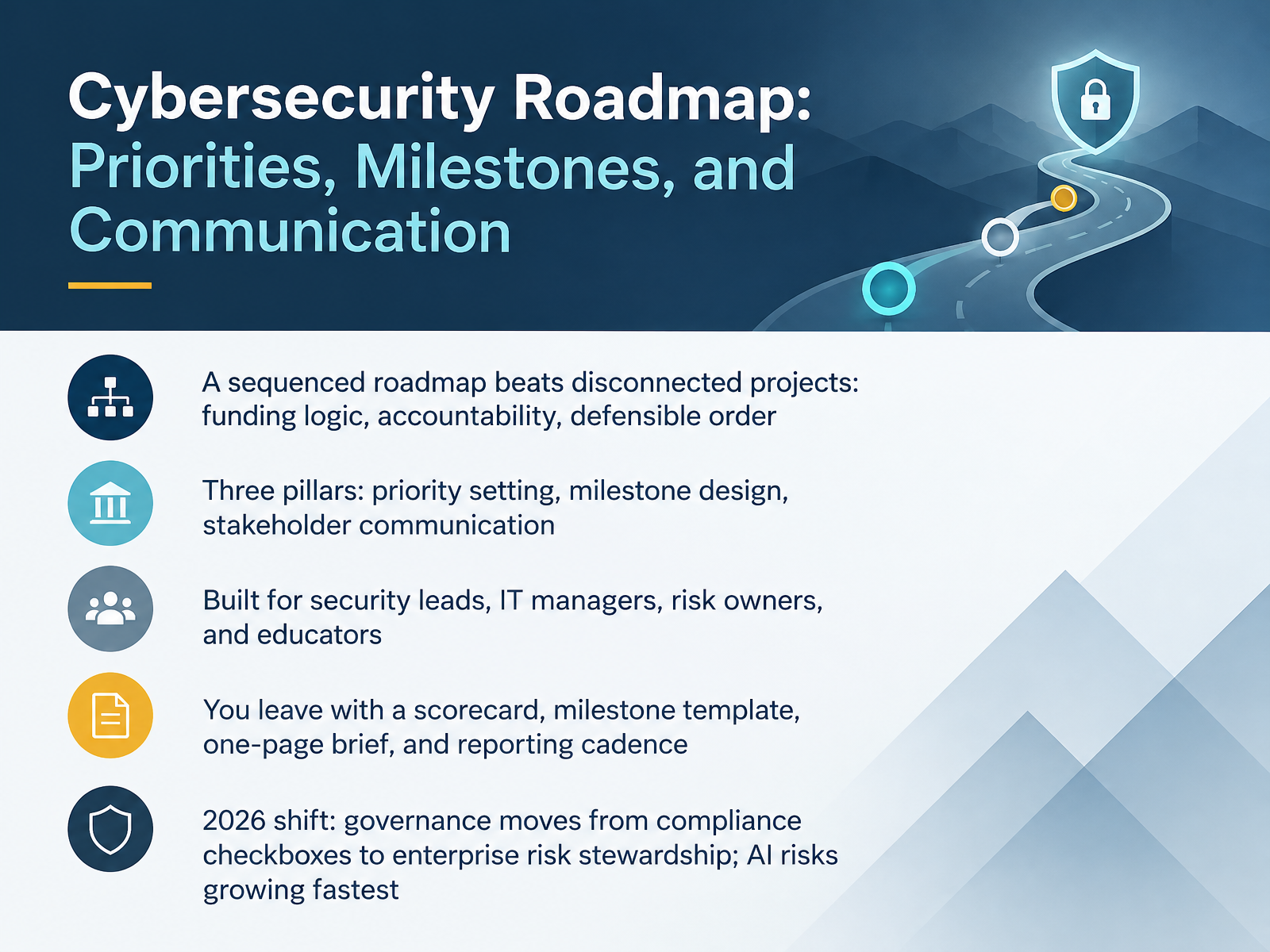
- 01Cybersecurity Roadmap: Priorities, Milestones, and CommunicationWelcome to Cybersecurity Roadmap: Priorities, Milestones, and Communication. This course is for security leads, IT managers, risk owners, and educators who own budgets and defend risk trade-offs. Here is the core argument. A sequenced roadmap beats a pile of disconnected projects, because it gives you funding logic, clear accountability, and a defensible order. We will work through three pillars: setting priorities, designing milestones, and communicating with stakeholders. You will leave with four practical tools: a scorecard, a milestone template, a one-page executive brief, and a reporting cadence you can adopt this quarter. One shift drives all of this. In 2026, governance moves from compliance checkboxes to enterprise risk stewardship, and AI risks are growing fastest. So decide now to fund sequence, not scattered activity. Next, we clear up a common confusion in Roadmap, Strategy, or Project Plan: Clearing the Definitional Fog.gartner.comemt.gartnerweb.comisaca.org+22 min
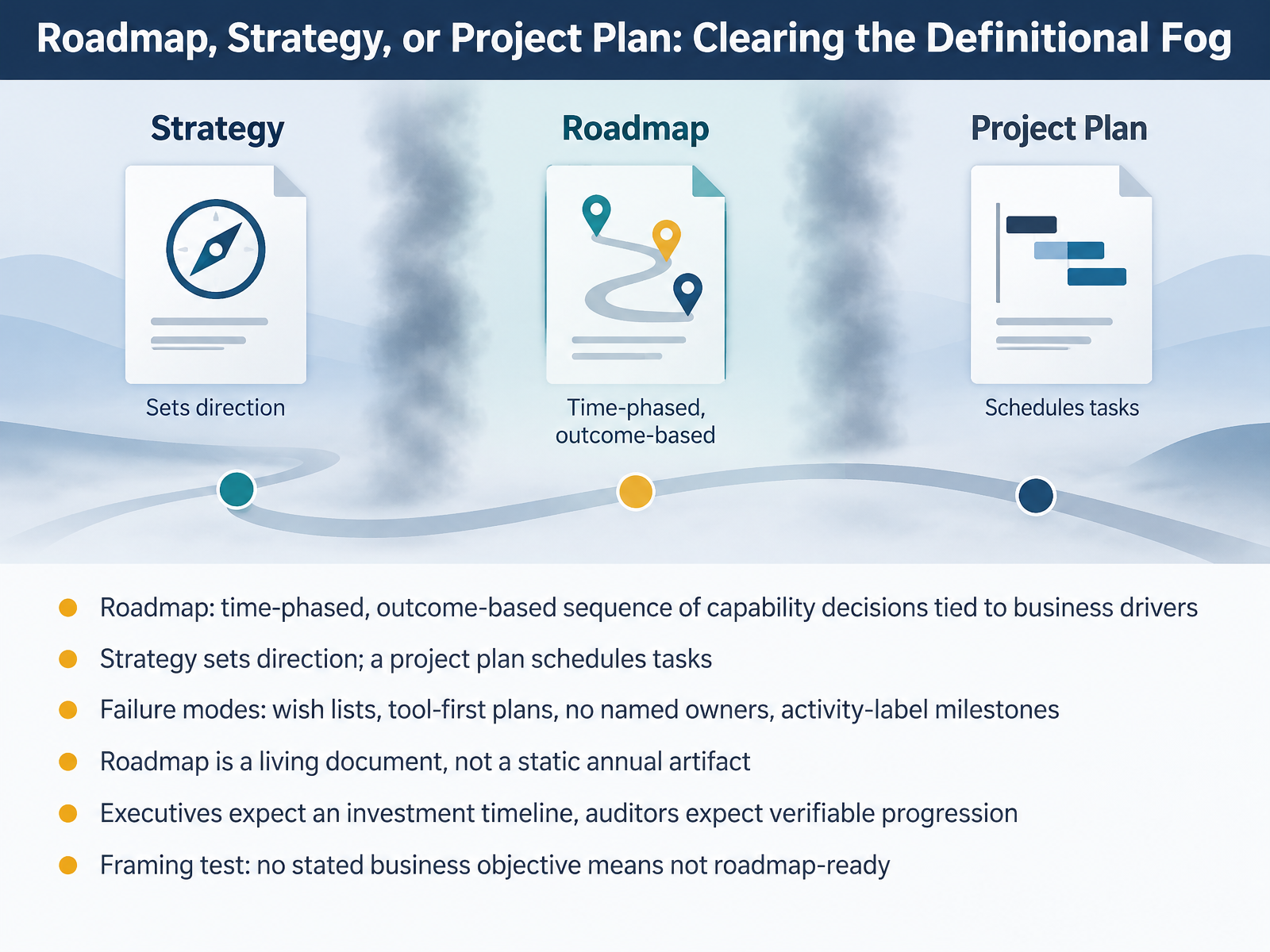
- 02Roadmap, Strategy, or Project Plan: Clearing the Definitional FogLet's clear up a definition that shapes every budget conversation you will have. A roadmap is a time-phased, outcome-based sequence of capability decisions, tied to business drivers. Strategy sets direction. A project plan schedules tasks. You need all three, and they are not interchangeable. Watch for the failure modes. Wish lists. Tool-first plans. No named owners. Milestones that describe activity instead of outcomes. Treat the roadmap as a living document, not a static annual artifact. Executives expect an investment timeline. Auditors expect verifiable progression. Apply one framing test before anything enters the roadmap. If no business objective is stated, it is not roadmap-ready. Make that test explicit with your team, and use it to reject items that cannot be defended. Now let's look at the inputs a credible roadmap cannot skip. That is our next topic, Planning Baseline: Inputs a Credible Roadmap Cannot Skip.
 gartner.comemt.gartnerweb.comisaca.org+22 min
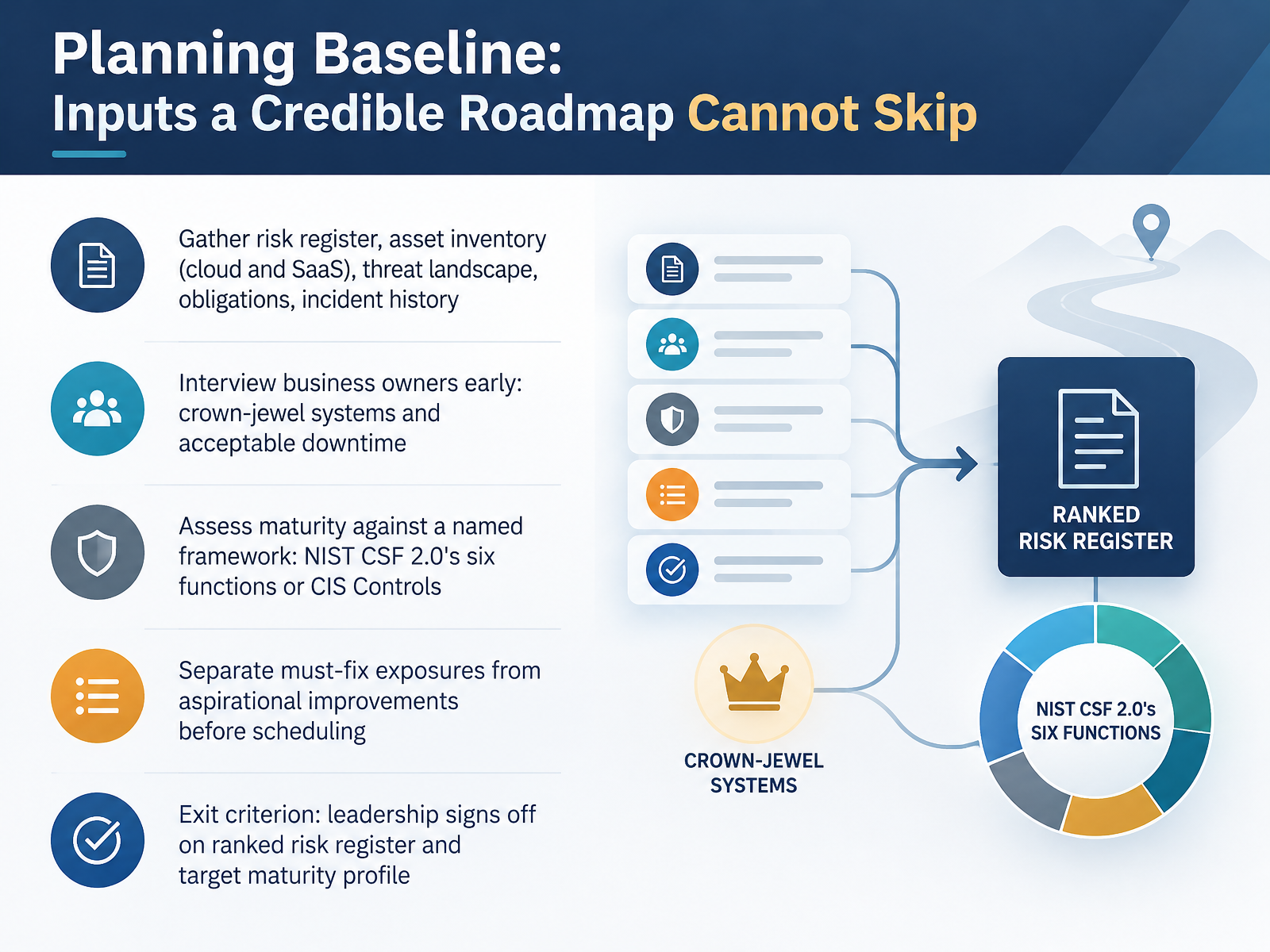
- 03Planning Baseline: Inputs a Credible Roadmap Cannot SkipLet's talk about the planning baseline. Every credible roadmap starts with real inputs, not assumptions. Gather your risk register, your asset inventory across cloud and SaaS, your threat landscape, your obligations, and your incident history. Then interview business owners early. Ask them which systems are crown jewels and how much downtime they can accept. Next, assess maturity against a named framework. Use the NIST Cybersecurity Framework 2.0 and its six functions, or the CIS Controls. Name it, so you can defend every score. Before you schedule anything, separate must-fix exposures from aspirational improvements. If staffing is flat, sequence the must-fix items first. Your exit criterion is simple. Leadership signs off on a ranked risk register and a target maturity profile. That signature is your mandate. Next, we move from the risk register to candidate initiatives.
 nist.govnvlpubs.nist.govnist.gov+21 min
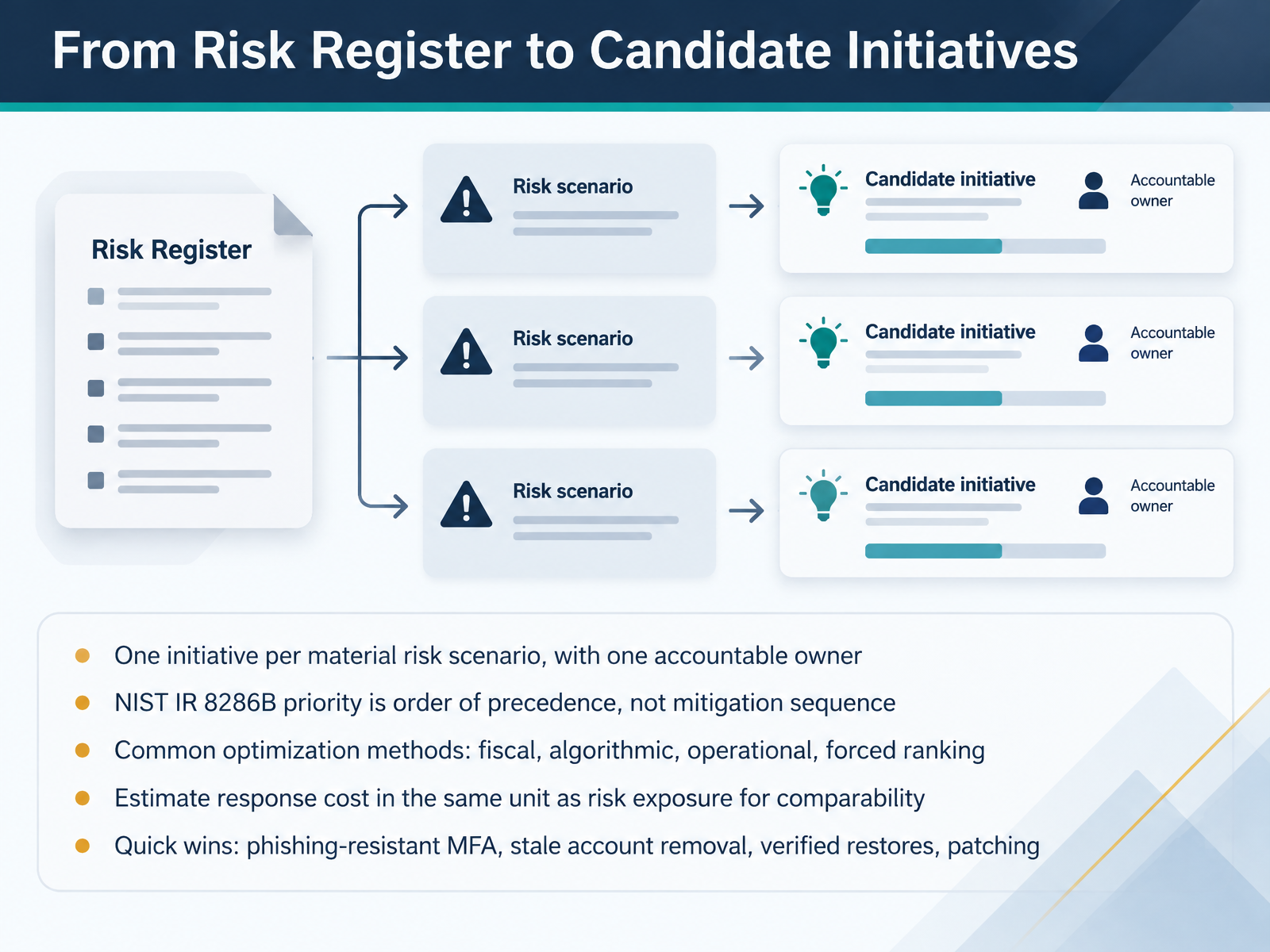
- 04From Risk Register to Candidate InitiativesNow let's turn the risk register into candidate initiatives you can fund and defend. Start with one initiative per material risk scenario, and name one accountable owner for each. Next, treat the NIST priority as order of precedence, not mitigation sequence. The highest-priority risk is not automatically the first one you fix. Then pick your optimization method deliberately: fiscal, algorithmic, operational, or forced ranking. Estimate response cost in the same unit as risk exposure, so cost and benefit compare directly. If your budget is flat, fund quick wins first: phishing-resistant MFA, stale account removal, verified restores, and patching. Takeaway for your team: every material scenario gets one initiative, one owner, and one comparable cost. Next, we look at priority-setting models that survive a funding review.
 enisa.europa.eunvlpubs.nist.govisaca.org+22 min
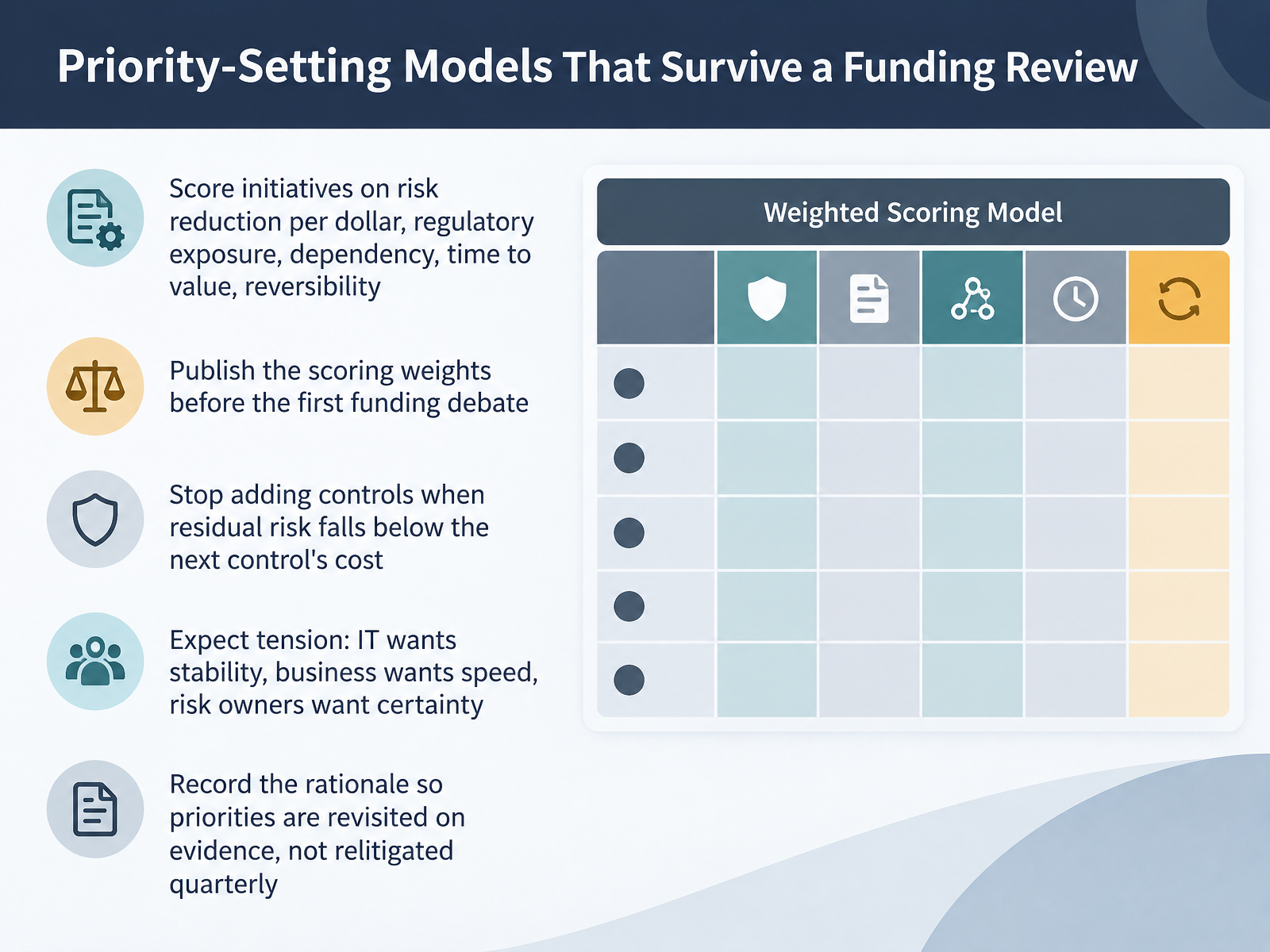
- 05Priority-Setting Models That Survive a Funding ReviewNow let's look at priority-setting models that survive a funding review. Start by scoring every initiative on five factors: risk reduction per dollar, regulatory exposure, dependencies, time to value, and reversibility. Publish the weights before the first funding debate. Do that, and the argument shifts from opinion to arithmetic. Next, stop adding controls when residual risk falls below the cost of the next control. Each control costs money to run, and returns diminish. Expect tension. IT wants stability, the business wants speed, and risk owners want certainty. Name that tension early, and you can negotiate trade-offs instead of refereeing disputes. Finally, record the rationale behind each priority. Then you revisit decisions on evidence, not relitigate them every quarter. Here is your takeaway: agree the weights first, document the logic, and priorities become defensible decisions. Next, we turn to writing milestones as verifiable outcomes.
 enisa.europa.eunvlpubs.nist.govisaca.org+22 min
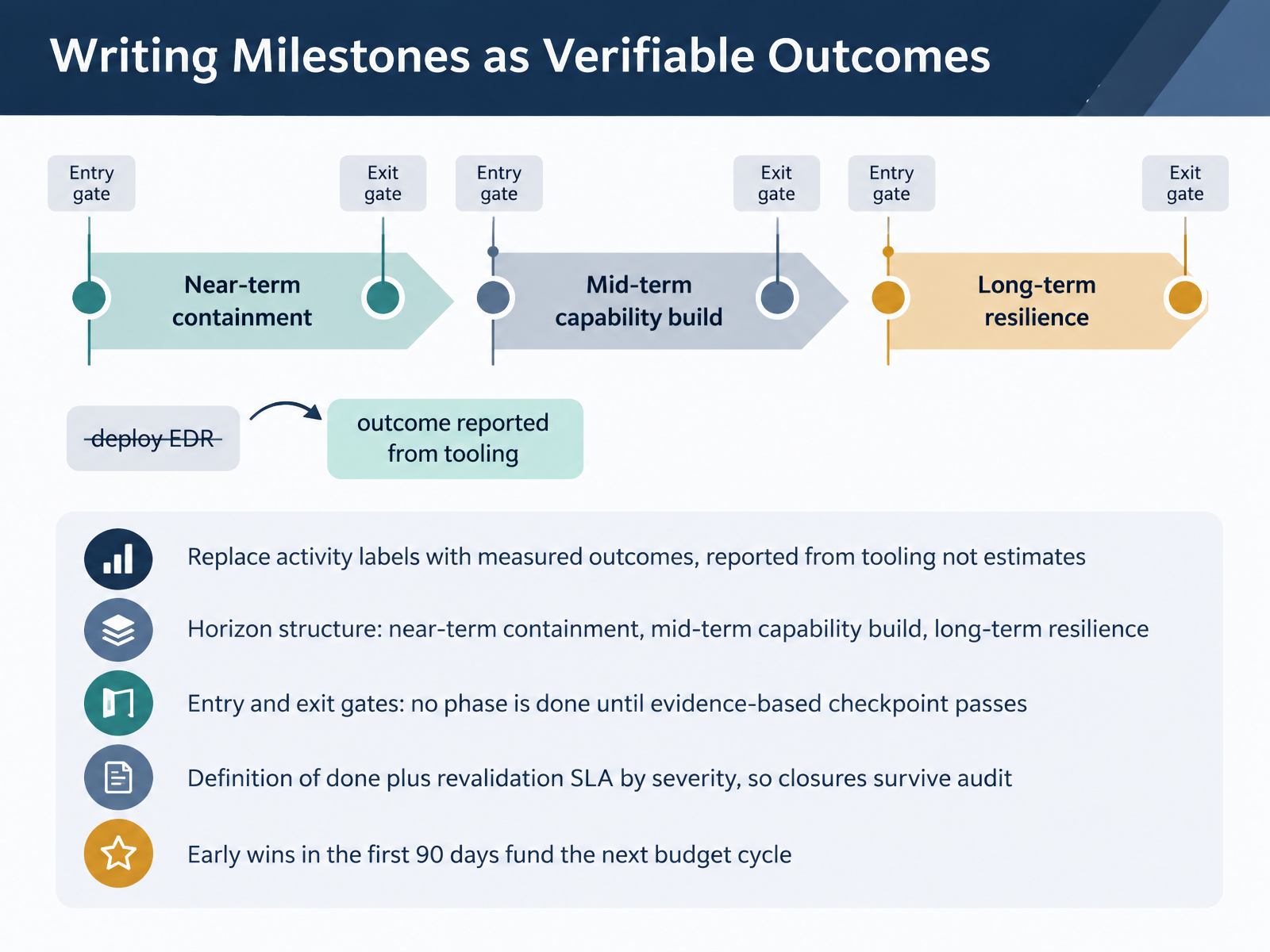
- 06Writing Milestones as Verifiable OutcomesNext, let's fix how you write milestones. Replace activity labels with measured outcomes, pulled from your tooling, not from estimates. Say endpoint coverage reached ninety-eight percent, reported monthly from the console. Structure the horizon in three parts: near-term containment, mid-term capability build, then long-term resilience. Put entry and exit gates on every phase. No phase is done until an evidence-based checkpoint passes. Define done for each control, plus a revalidation interval by severity, so closures survive audit. Critical items get revalidated in thirty days. Then claim early wins inside the first ninety days. Funded containment results make the next budget cycle an easier conversation. Takeaway: if you cannot measure it from a tool, it is not a milestone. Now we turn to resourcing, ownership, and funding under constraints.
 roadmap-creator.comclearedsystems.comgithub.com+22 min
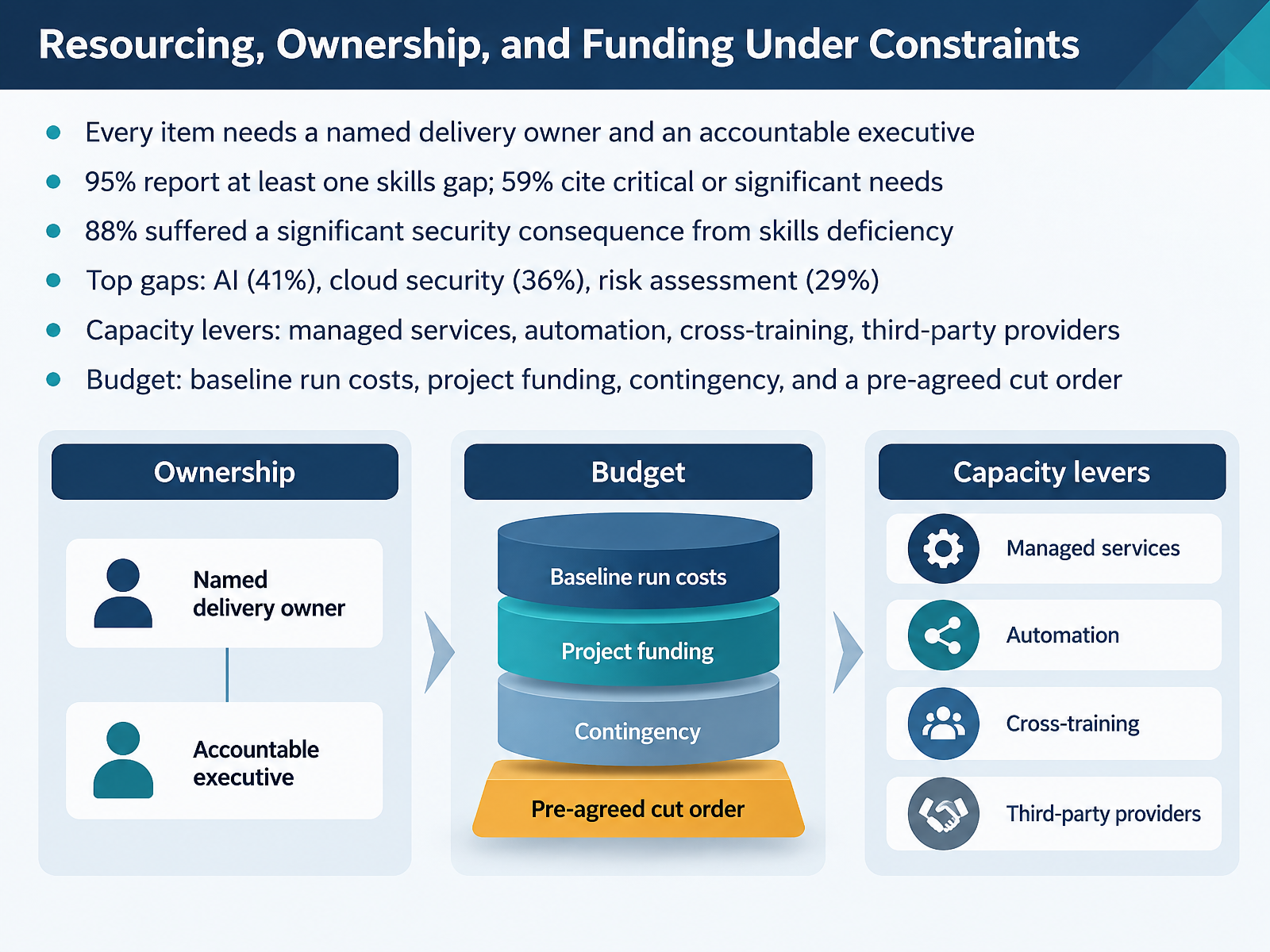
- 07Resourcing, Ownership, and Funding Under ConstraintsNext, let's talk about resourcing and ownership under constraints. Every item in your plan needs two names: a delivery owner who does the work, and an accountable executive who funds and defends it. Unnamed work does not get delivered. On skills, the data is blunt. Ninety-five percent of organizations report at least one skills gap, and fifty-nine percent cite critical or significant needs. Eighty-eight percent experienced a significant security consequence from a skills deficiency. The top gaps are AI at forty-one percent, cloud security at thirty-six percent, and risk assessment at twenty-nine percent. So decide which gaps you close and which you cover elsewhere. If staffing is flat, sequence managed services and automation before new hires. Then set your budget in four buckets: baseline run costs, project funding, contingency, and a cut order agreed before the cuts arrive. Name owners, target gaps, and pre-agree the cut order. Now let's move to the communication architecture: your stakeholder map and cadence.
 enisa.europa.eunvlpubs.nist.govisaca.org+22 min
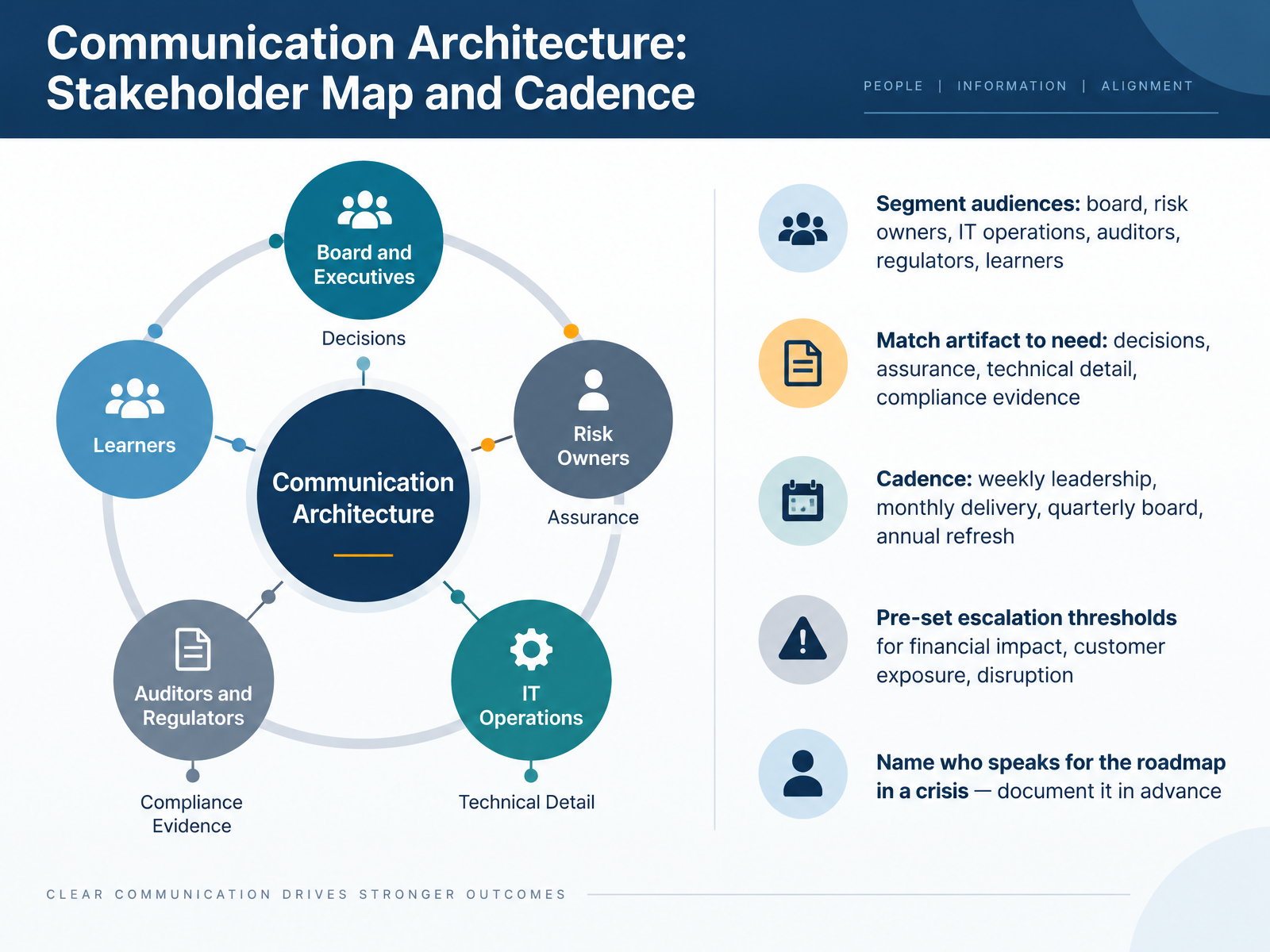
- 08Communication Architecture: Stakeholder Map and CadenceNow let's build the communication architecture. First, segment your audiences: the board, risk owners, IT operations, auditors, regulators, and learners. Each group needs a different message. Second, match the artifact to the need. Give the board decisions, give risk owners assurance, give operations technical detail, and give auditors compliance evidence. Third, set the cadence. Hold weekly leadership updates, monthly delivery reviews, quarterly board sessions, and an annual refresh. Fourth, pre-set escalation thresholds for financial impact, customer exposure, and disruption. Decide the numbers now, while you are calm, not during an incident. Fifth, name who speaks for the roadmap in a crisis, and document it in advance. That one name prevents conflicting messages when pressure is highest. Here is the takeaway: one audience, one artifact, one cadence, one voice. Next, we look at metrics and dashboards without the noise.
 gartner.comemt.gartnerweb.comisaca.org+22 min
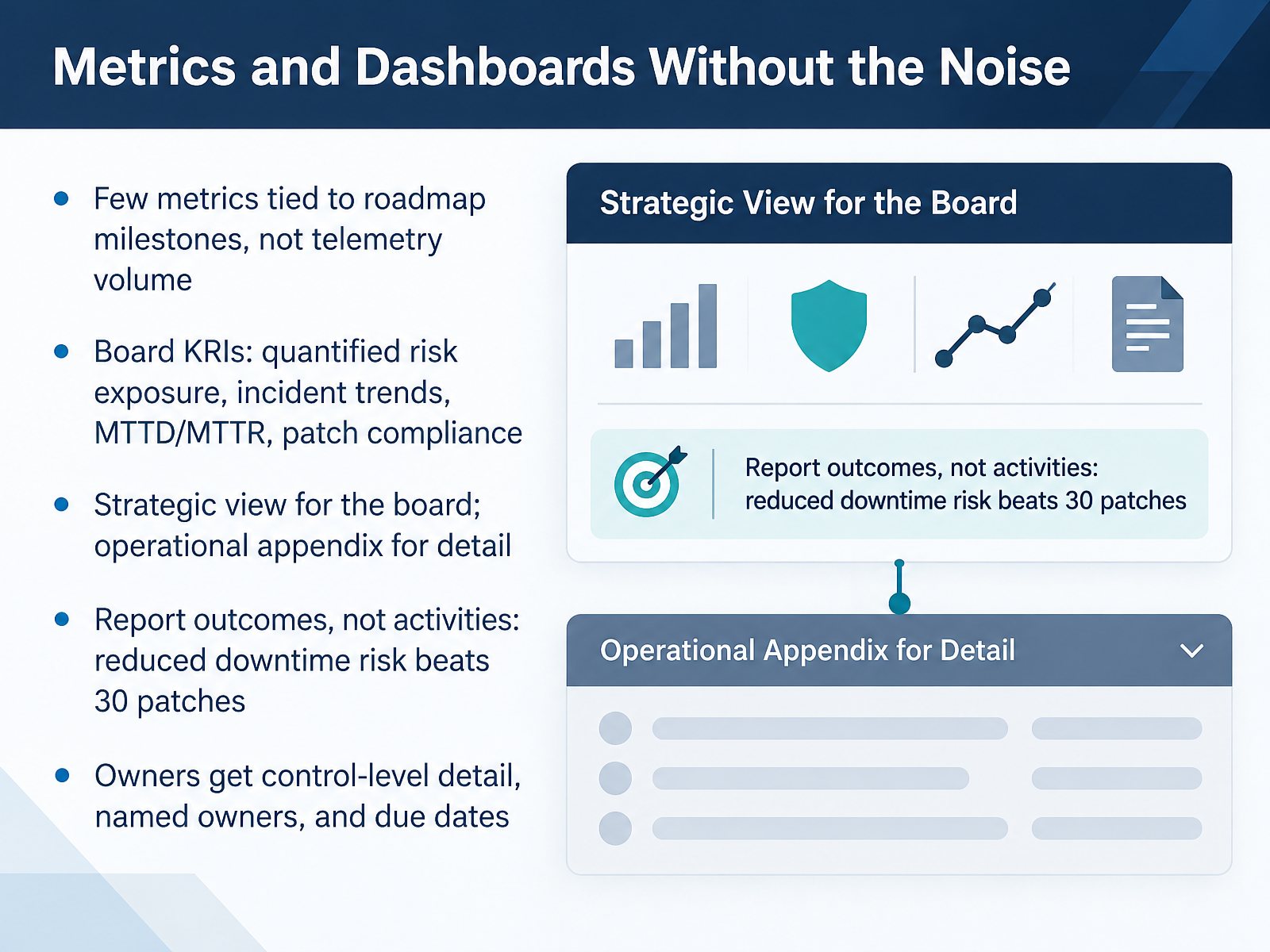
- 09Metrics and Dashboards Without the NoiseNext, let us cut the noise out of your metrics and dashboards. Tie only a few metrics to roadmap milestones, not to telemetry volume. Boards want key risk indicators they can act on: quantified risk exposure, incident trends, mean time to detect, mean time to respond, and patch compliance. Give the board a strategic view, and put the operational detail in an appendix. Report outcomes, not activities. Reduced downtime risk beats thirty patches, every time. Control owners get control-level detail, with a named owner and a due date. If your board pack is growing while decisions stall, cut the metric count and keep the ones that track milestones. Your takeaway: fewer metrics, tied to milestones, reported as outcomes. That sets up the next topic, communicating risk in business language.
 1 min
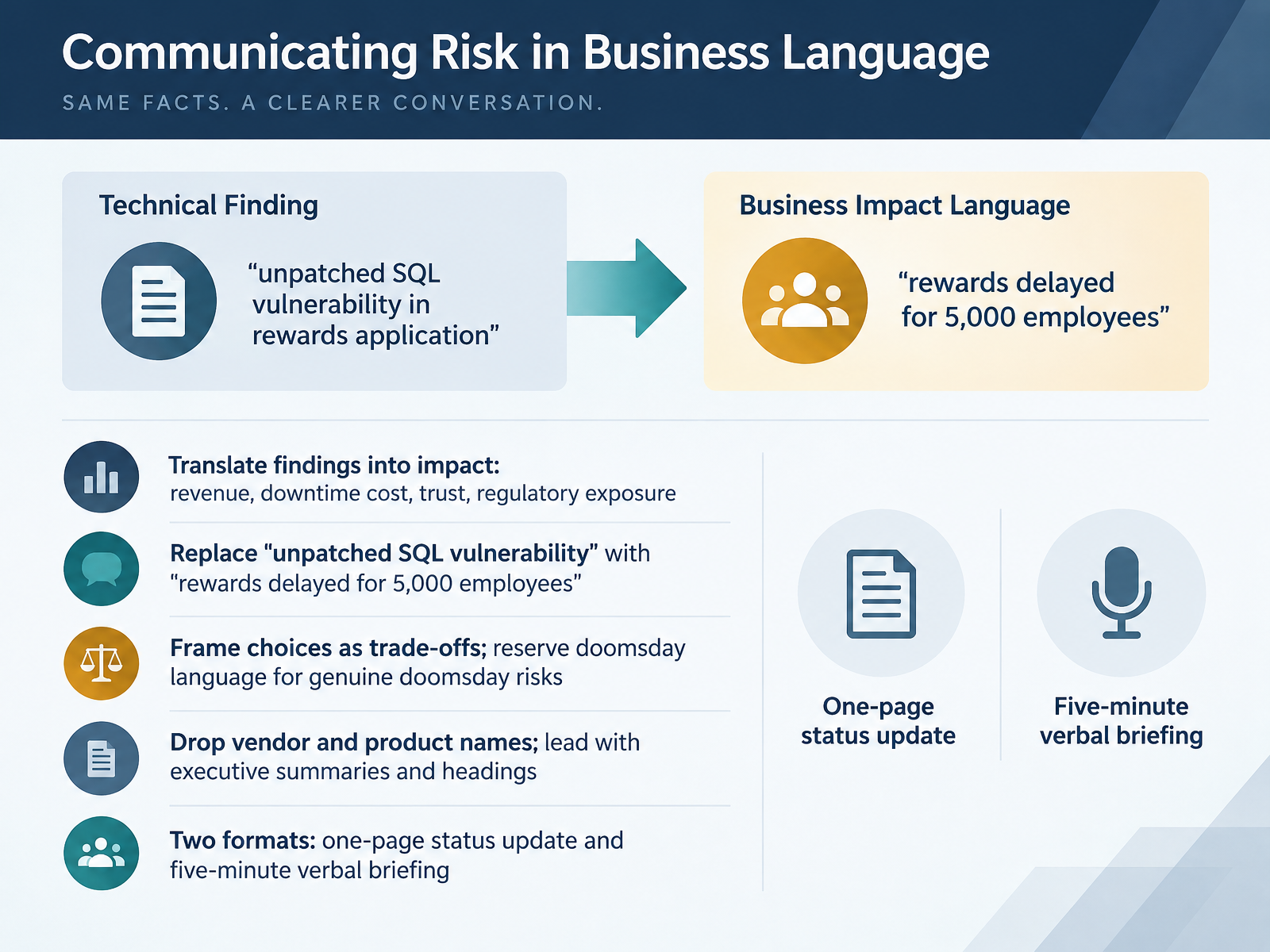
- 10Communicating Risk in Business LanguageNext, let's talk about communicating risk in business language. Start by translating findings into impact. Name the revenue at stake, the cost of downtime, the hit to trust, and the regulatory exposure. Then replace the phrase unpatched SQL vulnerability with something an executive can act on, like rewards delayed for five thousand employees. Frame your recommendations as trade-offs, and reserve doomsday language for genuine doomsday risks. Drop vendor and product names, and lead with executive summaries and clear headings. Two formats cover most needs. First, a one-page status update that states what changed, what is at risk, and what you recommend. Second, a five-minute verbal briefing for tight meetings. If your board slot is short, send the one-pager in advance and use the five minutes for decisions, not background. Here is your takeaway: describe risk as a business loss with a number, a timeframe, and a choice. That is the language your leadership already uses to approve budgets. Regulatory pressure is raising the stakes on how you disclose and document that communication, so let's look at that next, in Regulatory and Disclosure Pressure on the Communication Plan.
 enisa.europa.eunvlpubs.nist.govisaca.org+22 min
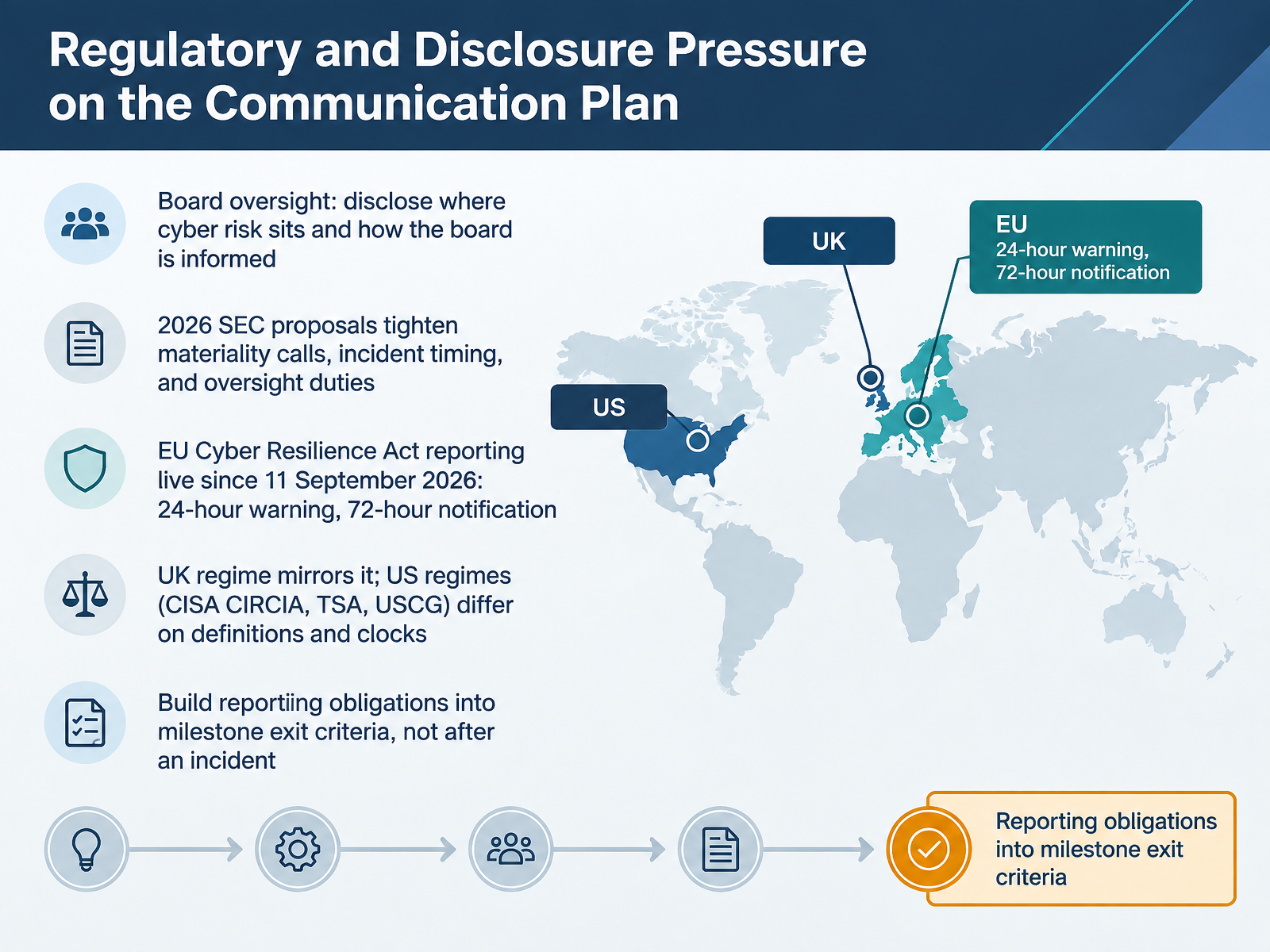
- 11Regulatory and Disclosure Pressure on the Communication PlanNow, let's talk about regulatory and disclosure pressure. Expect this to reshape your communication plan. First, board oversight. Disclose where cyber risk sits and how the board stays informed. Regulators now expect evidence of active oversight, not passive updates. Second, the 2026 SEC proposals tighten three things: materiality calls, incident timing, and oversight duties. Build your materiality test before an incident happens. Third, the EU Cyber Resilience Act reporting is live since 11 September 2026. Manufacturers must file an early warning within 24 hours and a full notification within 72 hours. Fourth, clocks differ across regimes. The UK regime mirrors the EU. US regimes, CISA CIRCIA, TSA, and USCG, differ on definitions and timelines. Map each obligation to each product and market. Fifth, build reporting obligations into milestone exit criteria, not after an incident. If staffing is flat, sequence regulatory readiness before tooling upgrades. The takeaway: treat reporting clocks as design requirements, not paperwork. Next, we look at keeping the roadmap current through triggers, governance, and version control.
 2 min
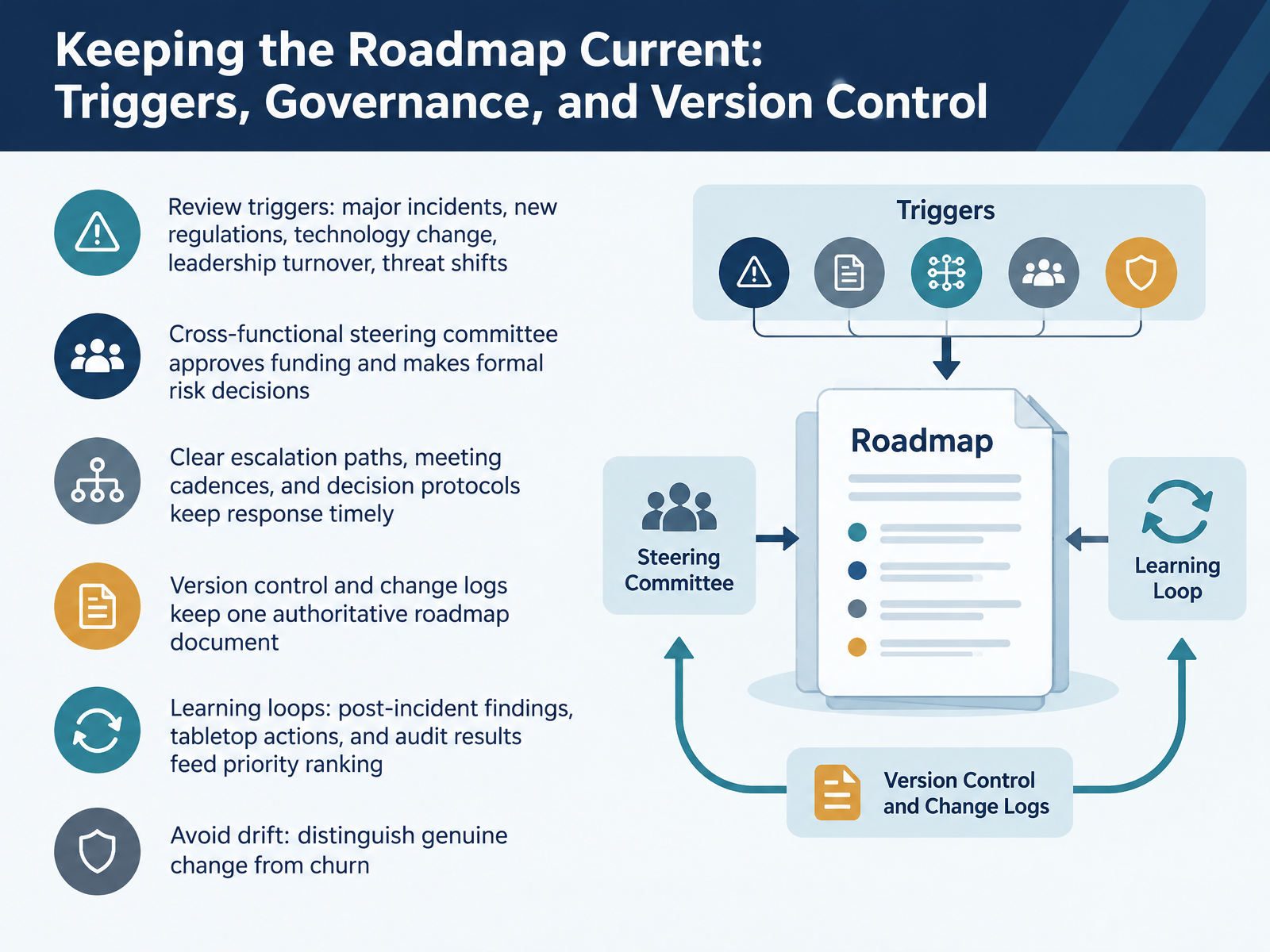
- 12Keeping the Roadmap Current: Triggers, Governance, and Version ControlNow let's keep the roadmap current, not just written. Define review triggers in advance: a major incident, a new regulation, a technology change, leadership turnover, or a shift in threats. If staffing is flat, sequence those reviews before adding new initiatives. A cross-functional steering committee approves funding and makes the formal risk decisions, so no one person owns the trade-offs. Publish clear escalation paths, meeting cadences, and decision protocols; a new reporting deadline like twenty-four hours demands a fast route to a decision. Keep one authoritative roadmap under version control with a change log, so nobody argues from an old copy. Close the loop: post-incident findings, tabletop actions, and audit results feed priority ranking. And avoid drift by separating genuine change from churn. If a request does not reduce risk or move a milestone, defer it. Your takeaway: keep one roadmap, governed by fixed triggers and a decision body, and change it on evidence. Next, we look at adapting for 2026: AI, supply chain, and resilience priorities.
 gartner.comemt.gartnerweb.comisaca.org+22 min
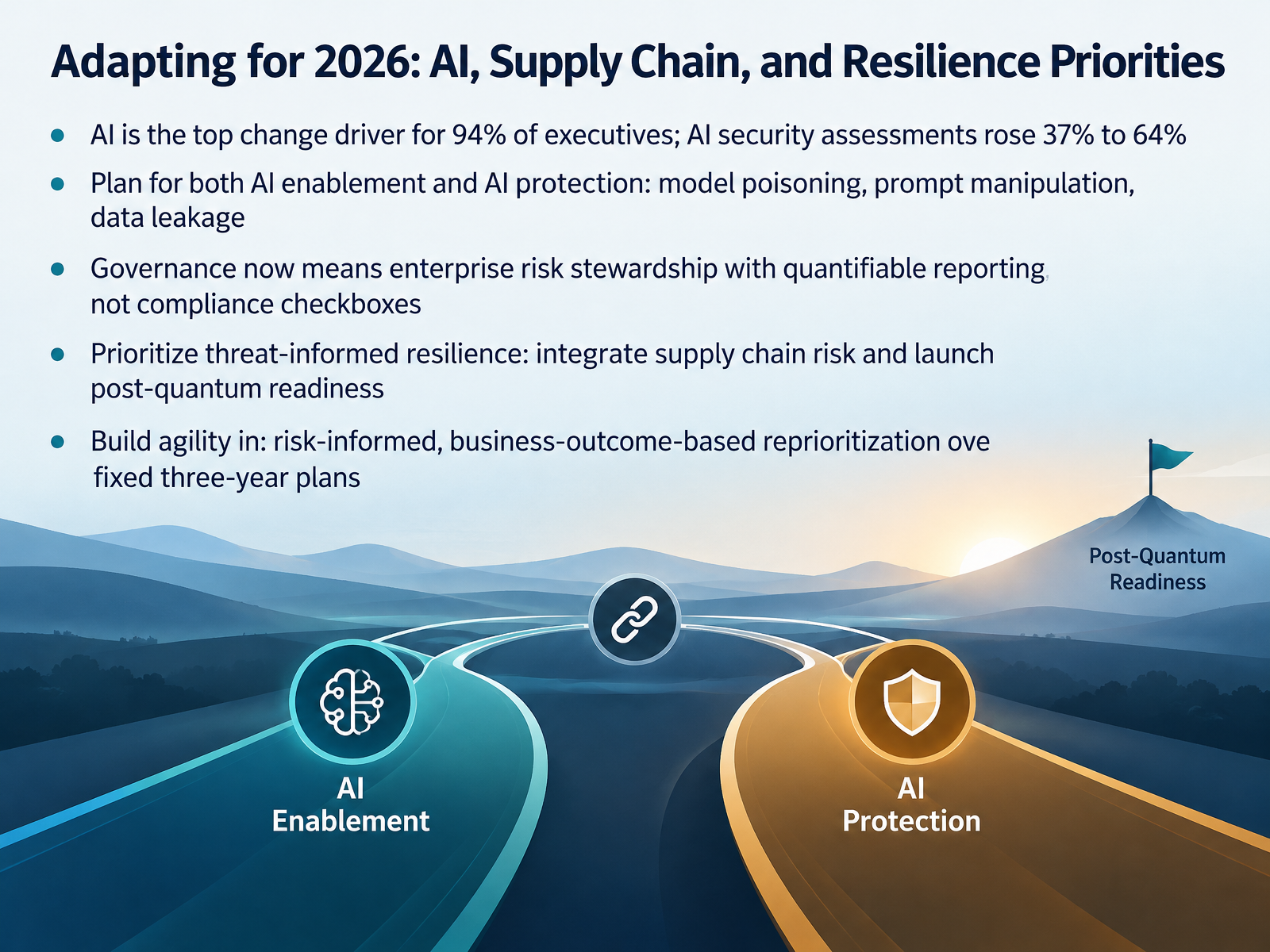
- 13Adapting for 2026: AI, Supply Chain, and Resilience PrioritiesNow, let's look ahead to twenty twenty-six. AI is the top change driver for ninety-four percent of executives, and AI security assessments rose from thirty-seven to sixty-four percent in one year. So plan for both sides: AI enablement and AI protection. Name the threats plainly: model poisoning, prompt manipulation, and data leakage. Next, redefine governance. It now means enterprise risk stewardship with quantifiable reporting, not compliance checkboxes. Then, prioritize threat-informed resilience. Integrate supply chain risk into your cyber-risk management, and launch a post-quantum readiness project now. Finally, build agility. Reprioritize based on risk and business outcomes, rather than locking a fixed three-year plan. If staffing is flat, sequence AI protection controls before new enablement pilots. Your takeaway: in twenty twenty-six, protect AI, quantify risk, and stay flexible. Next, we move into the workshop, where you will draft your twelve-month roadmap and one-page brief.
 gartner.comemt.gartnerweb.comisaca.org+22 min
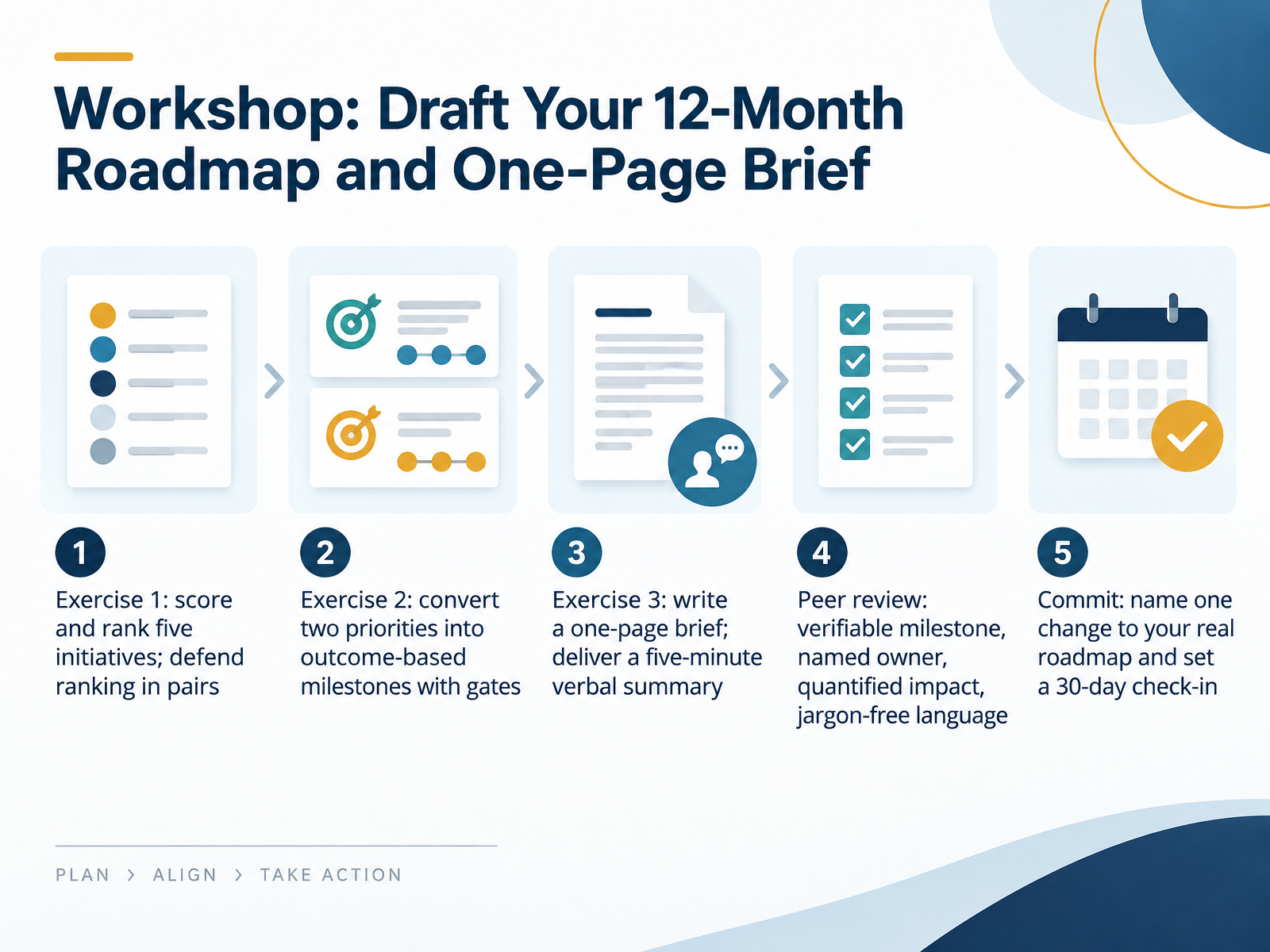
- 14Workshop: Draft Your 12-Month Roadmap and One-Page BriefNow let's put the roadmap into your hands. In Exercise 1, score and rank five initiatives, then defend that ranking with a partner. Rank by risk reduction and cost, not by vendor preference. In Exercise 2, convert two priorities into outcome-based milestones with gates. A gate is an evidence checkpoint, like full multi-factor authentication enrollment before the next phase starts. If your staffing is flat, sequence the highest-risk items first. In Exercise 3, write a one-page brief and deliver a five-minute verbal summary. Speak in plain business language and quantify impact in dollars or downtime, because that is what leaders fund. Then peer review against four checks: a verifiable milestone, a named owner, a quantified impact, and jargon-free language. Finally, commit to one change in your real roadmap and set a 30-day check-in. Your takeaway: a roadmap earns funding when every milestone is verifiable, owned, and measured in business terms. Thank you for your work today. You now have a practical method, so go draft it, defend it, and start the clock.
 roadmap-creator.comclearedsystems.comgithub.com+21 min
Take the deck with you
Download this course as a file — free, no sign-up needed.
- PDF handoutEvery slide page, ready to print or share.15 pages · 3.2 MBDownload
- Narrated PowerPointThe deck that presents itself — every slide carries the digital human's narration video.15 pages · 13.2 MBDownload
- PowerPoint slidesThe full deck as a .pptx — open it in PowerPoint, Keynote, or Google Slides.15 pages · 3.1 MBDownload
Free to use in your own training — please keep the PersonWise credit page at the end.
Have your own deck? Turn it into a course
Sources consulted
Web sources consulted while building this course.
- Cybersecurity Roadmap: The CISO’s Guide to Business Results — gartner.com
- 2026 Priorities for Cybersecurity Leaders — emt.gartnerweb.com
- ISACA Now Blog 2026 A Proven Seven Step Process to Accelerate Cybersecurity Transformation — isaca.org
- Cybersecurity Leadership Priorities for 2026 — gartner.com
- What’s important to the CISO in 2026: PwC — pwc.com
- Frequently Asked Questions | NIST — nist.gov
- The NIST Cybersecurity Framework (CSF) 2.0 — nvlpubs.nist.gov
- Celebrating Two Years of CSF 2.0! | NIST — nist.gov
- NIST Releases Two New CSF 2.0 Quick-Start Guides | CSRC — csrc.nist.gov
- NIST Cybersecurity Framework 2.0: Cybersecurity, Enterprise Risk Management, and Workforce Management Quick-Start Guide — nvlpubs.nist.gov
- Introduction to Return on Security Investment — enisa.europa.eu
- Prioritizing Cybersecurity Risk for Enterprise Risk Management — nvlpubs.nist.gov
- 2023 Volume 5 A Risk First Approach to Setting an Information Security Budget — isaca.org
- Improving Return on Security Investment: Threat Modeling & Open FAIR™ Risk Analysis - The Open Group Blog — blog.opengroup.org
- Making a Business Case for Security - 2023 Edition — cisa.gov
- Cybersecurity Roadmap Template: Phases, Workstreams and Example | Roadmap Creator — roadmap-creator.com
- How to Build a Security Roadmap That Satisfies Auditors and Executives Alike - Cleared Systems — clearedsystems.com
- samples/remediation-roadmap.md at main · Sushegaad/MCP-Server-for-ISO27001 — github.com
- Building a Security Program from Scratch: A CISO's First 90 Days - Encrytec Solutions — encrytec.com
- docs/compliance/plans/remediation-roadmap.md — github.com