Begin
14 pages · ~28 min
Public Speaking Platform Selection and Architecture
This training helps technical teams select and architect a public speaking platform, covering key tradeoffs to guide informed decisions.
A digital instructor presents all 14 pages. Hold “Ask” at any point and ask out loud — the answer comes from this course. No sign-up needed.
What you’ll learn
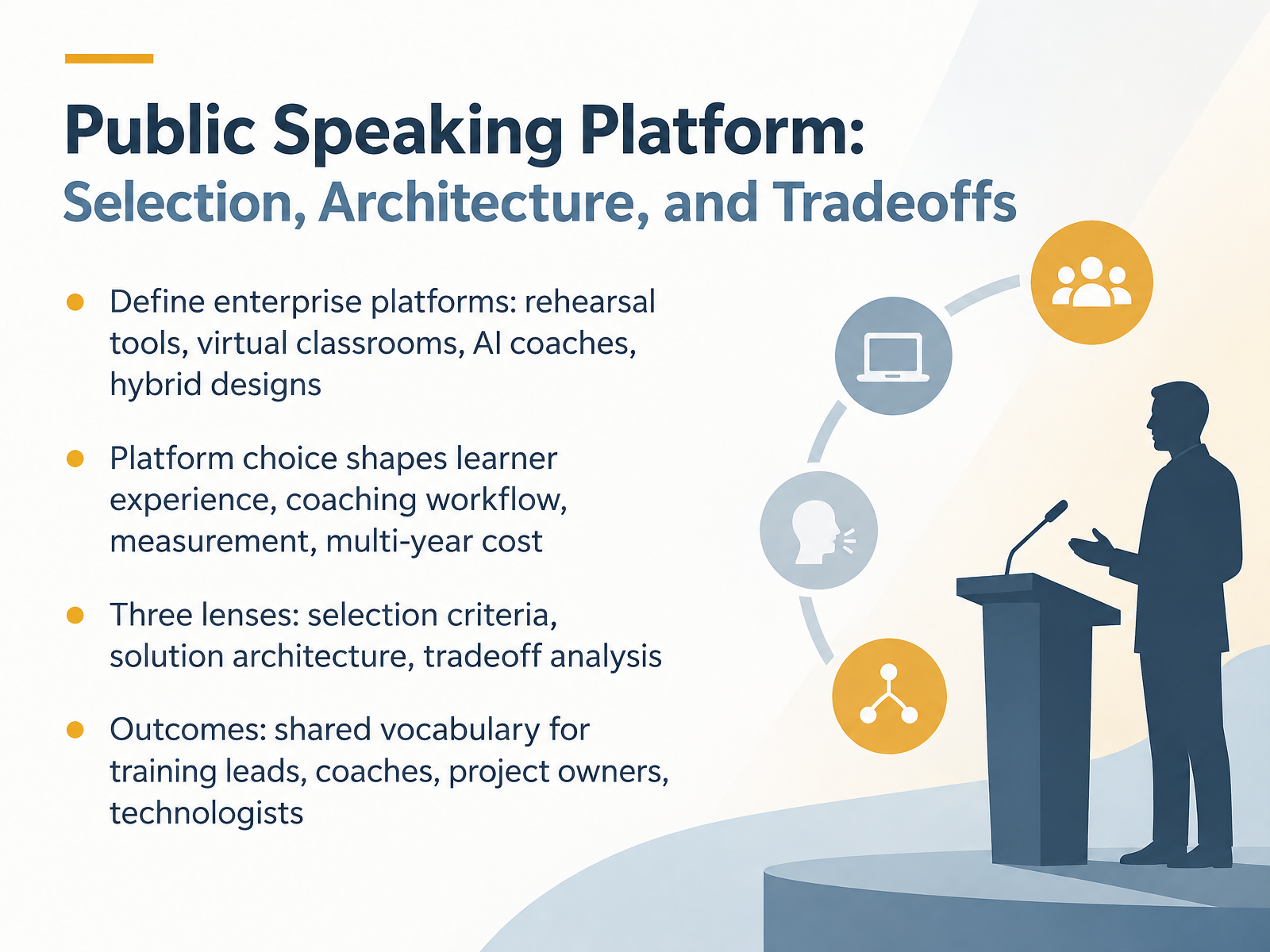
- 01Public Speaking Platform: Selection, Architecture, and TradeoffsWelcome. This session is about picking a public speaking platform, and getting the architecture and tradeoffs right before you commit. Let's set the frame. Enterprise platforms come in a few shapes: rehearsal tools, virtual classrooms, AI coaches, and hybrid designs. Your choice shapes the learner experience, your coaching workflow, how you measure progress, and your multi-year cost. We'll use three lenses: selection criteria, solution architecture, and tradeoff analysis. For example, a short rehearsal app gives fast delivery feedback on filler words and pace, while a virtual classroom fits live coaching at scale. Both are valid. They cost differently and measure differently. By the end, training leads, coaches, project owners, and technologists should share the same vocabulary for these decisions. Next, we'll look at the 2026 landscape in From Classroom to Platform.orai.comdisprz.aibestfor.ai+22 min
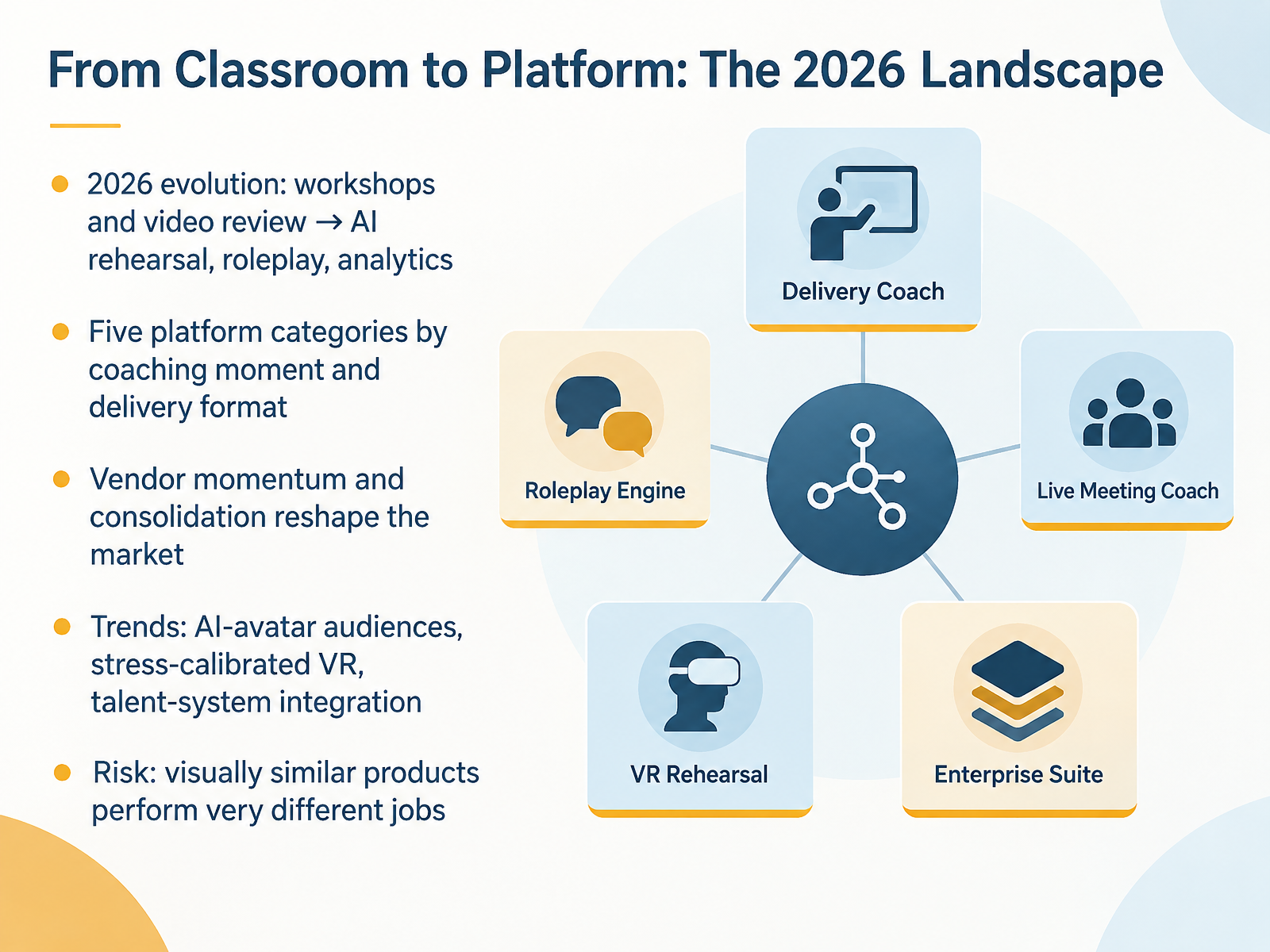
- 02From Classroom to Platform: The 2026 LandscapeLet's look at what changed in the market. In 2026, the old model of workshops plus video review is giving way to AI rehearsal, roleplay, and analytics. So when you compare vendors, sort them by coaching moment and delivery format. That produces five categories: post-practice feedback, live meeting support, simulated roleplay, structured daily exercises, and immersive browser or VR courses. Each does a different job, and the market is consolidating around enterprise roleplay. Watch three trends: AI-avatar audiences, stress-calibrated VR, and integration with your talent systems. Here is the risk. Two products can look identical in a demo yet perform very different jobs. Before you shortlist, ask where coaching happens, and what it is meant to change. From here, we move to requirements discovery, starting from program goals.
 orai.comptichi.comaitoolsbakery.com+21 min
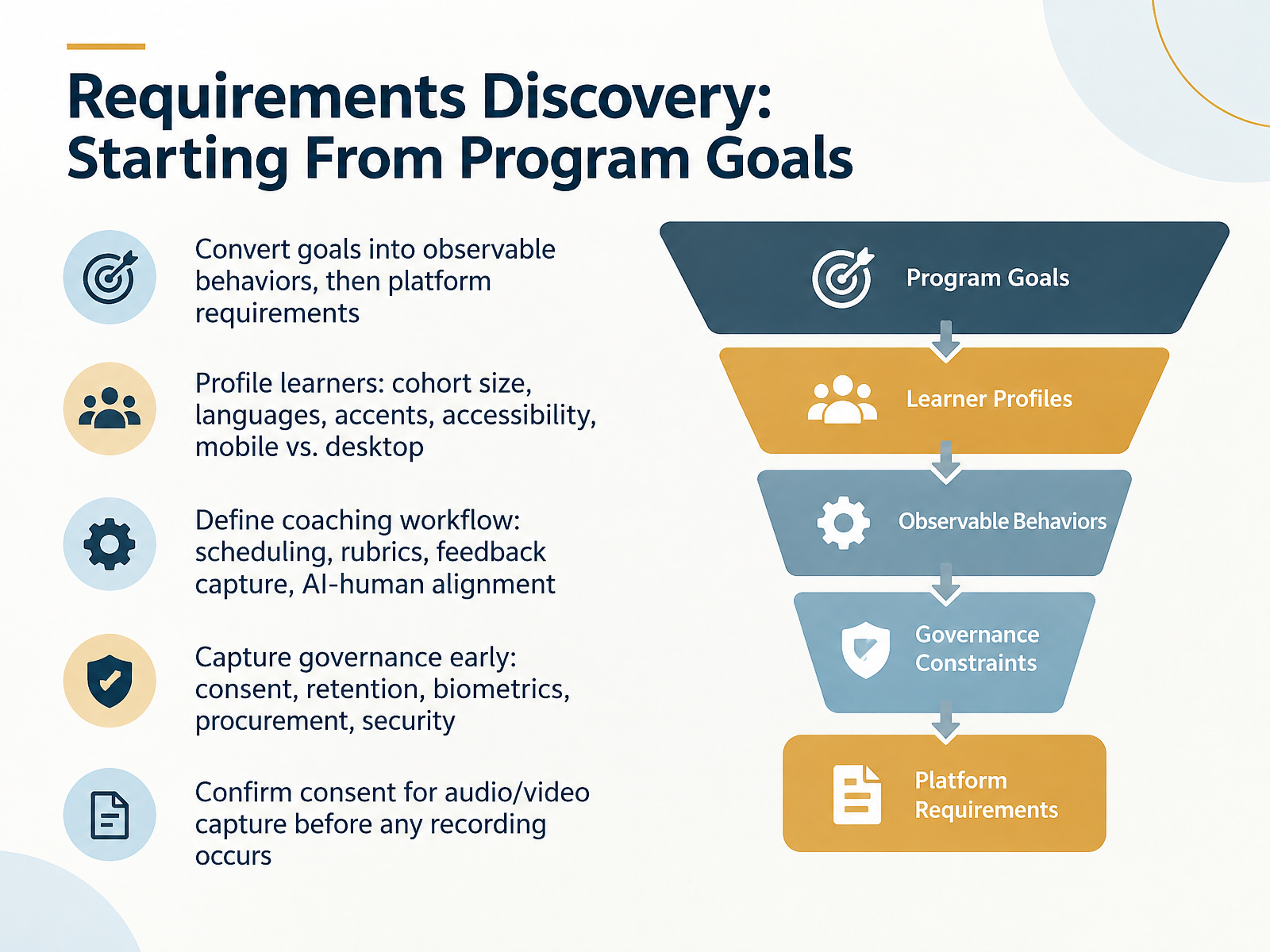
- 03Requirements Discovery: Starting From Program GoalsLet's start requirements discovery where it belongs: with your program goals, not a feature list. Convert each goal into an observable behavior, then into a platform requirement. If the goal is concise executive updates, the behavior is a 90 second update with a clear ask. Now you can ask vendors for timed recording, playback, and rubric scoring.
Next, profile your learners. Cohort size, languages, accents, accessibility needs, and mobile versus desktop use. A 300 person global cohort with mixed accents stresses transcription accuracy far more than a 20 person pilot.
Define the coaching workflow before you compare tools. Scheduling, rubrics, feedback capture, and how AI and human feedback align.
Capture governance early. Consent, retention, biometrics, procurement, and security. And confirm consent for audio and video capture before any recording occurs, not after.
That work gives you the criteria for the next slide, our evaluation scorecard.
 spokescoach.comdocs.trainar.aiblog.ukkera.com+22 min
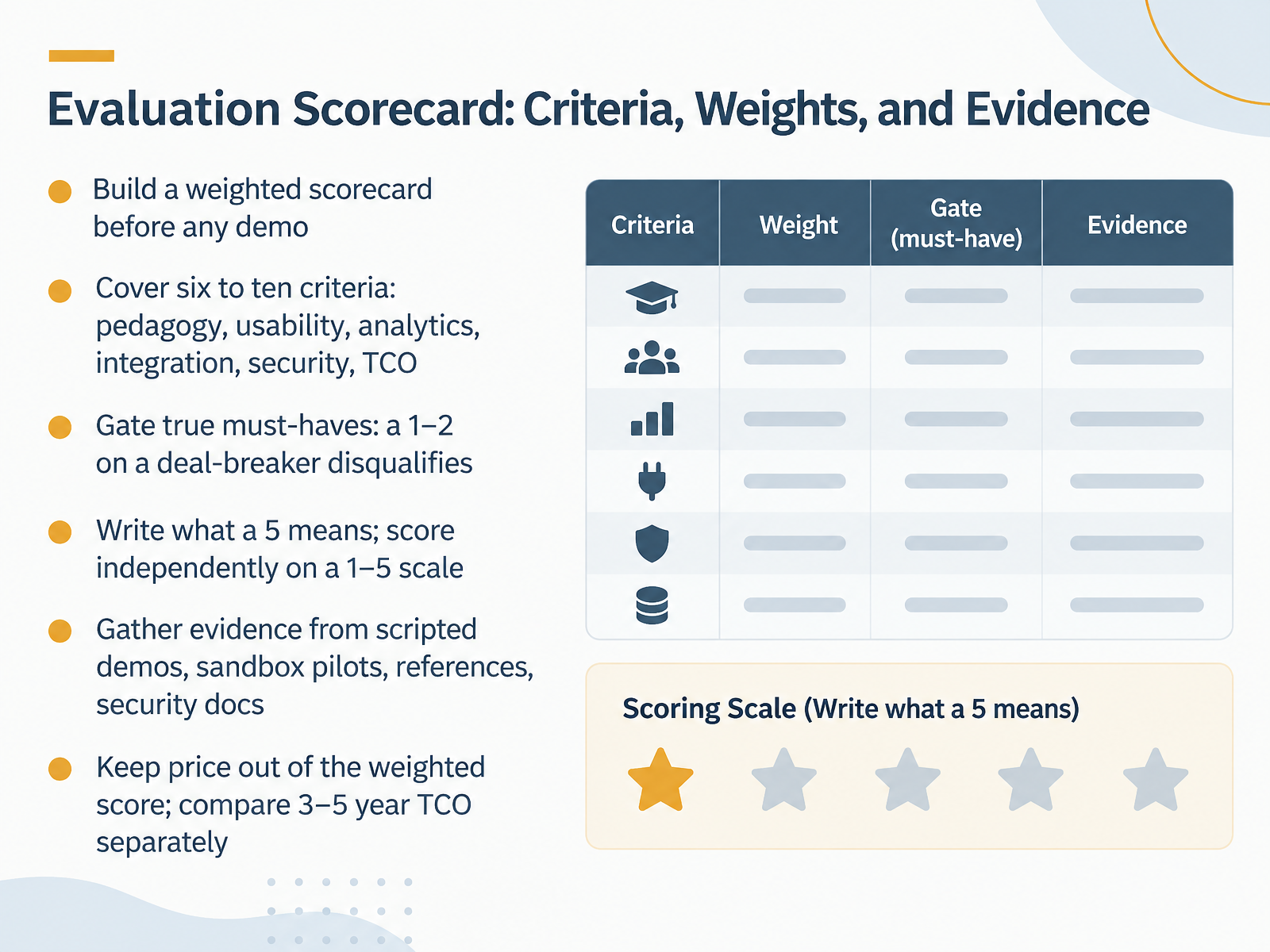
- 04Evaluation Scorecard: Criteria, Weights, and EvidenceSo let's look at how you turn that shortlist into a defensible decision. Build a weighted scorecard before any demo. Cover six to ten criteria, things like pedagogy, usability, analytics, integration, security, and total cost of ownership. Keep it tight. Thirty criteria dilute the signal and make every vendor look average. Next, gate your true must-haves. If a vendor scores a one or two on a deal-breaker, like a required integration or a compliance certification, they're out, regardless of their total. Then write down what a five actually means for each criterion. Have evaluators score independently on a one to five scale, so one person's generous five doesn't quietly become another's cautious three. Gather evidence from scripted demos, sandbox pilots, reference calls, and security documentation. Score only what was shown, not what was promised. And keep price out of the weighted score. Compare three to five year total cost of ownership separately, so a cheap tool can't hide a fatal gap. That gives you a ranking you can defend line by line. Next, let's look at the reference architecture for a speaking-skills platform.
 spotsaas.comaquilonlms.comlmspedia.org+22 min
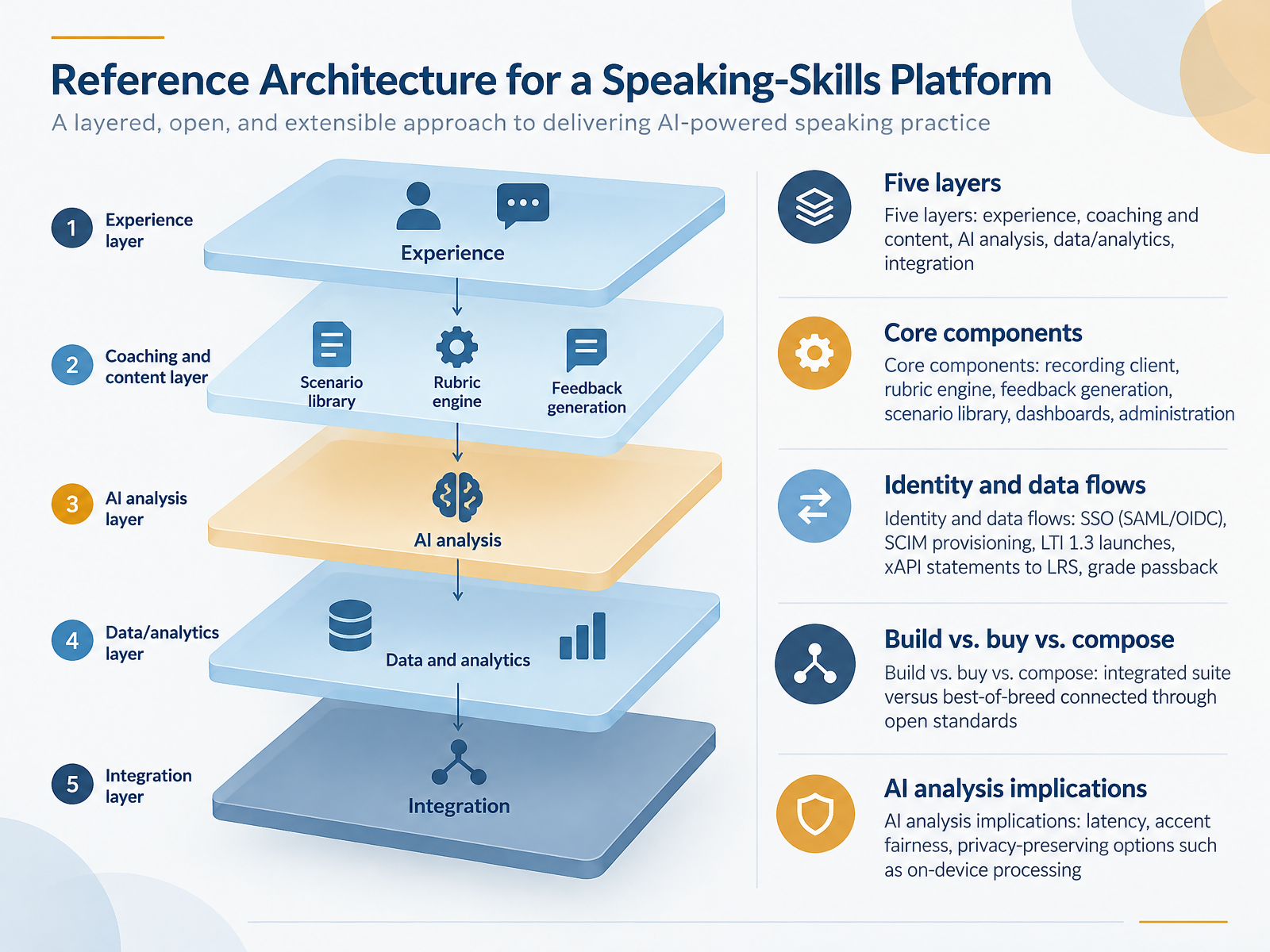
- 05Reference Architecture for a Speaking-Skills PlatformLet's look at the architecture behind the platform. Five layers: experience, coaching and content, AI analysis, data and analytics, and integration. Picture the core components sitting across them: the recording client, a rubric engine, feedback generation, a scenario library, dashboards, and administration. Your flows matter just as much. Single sign-on through SAML or OIDC, SCIM provisioning, LTI 1.3 launches, xAPI statements to a learning record store, and grade passback. Now the tradeoff. You can buy an integrated suite, or compose best-of-breed tools through open standards. The suite is simpler to run. The composed stack gives you depth, but you own the integration work. For AI analysis, weigh three things: latency, accent fairness, and privacy. On-device processing keeps audio local. Cloud analysis is faster but needs a clear data agreement. One lesson from coaching programs: insist on LTI 1.3, not just LTI, because the version number tells you what actually works. Next, we compare delivery models: live, asynchronous, AI-assisted, and hybrid.
 1edtech.orgspokescoach.comdocs.trainar.ai+22 min
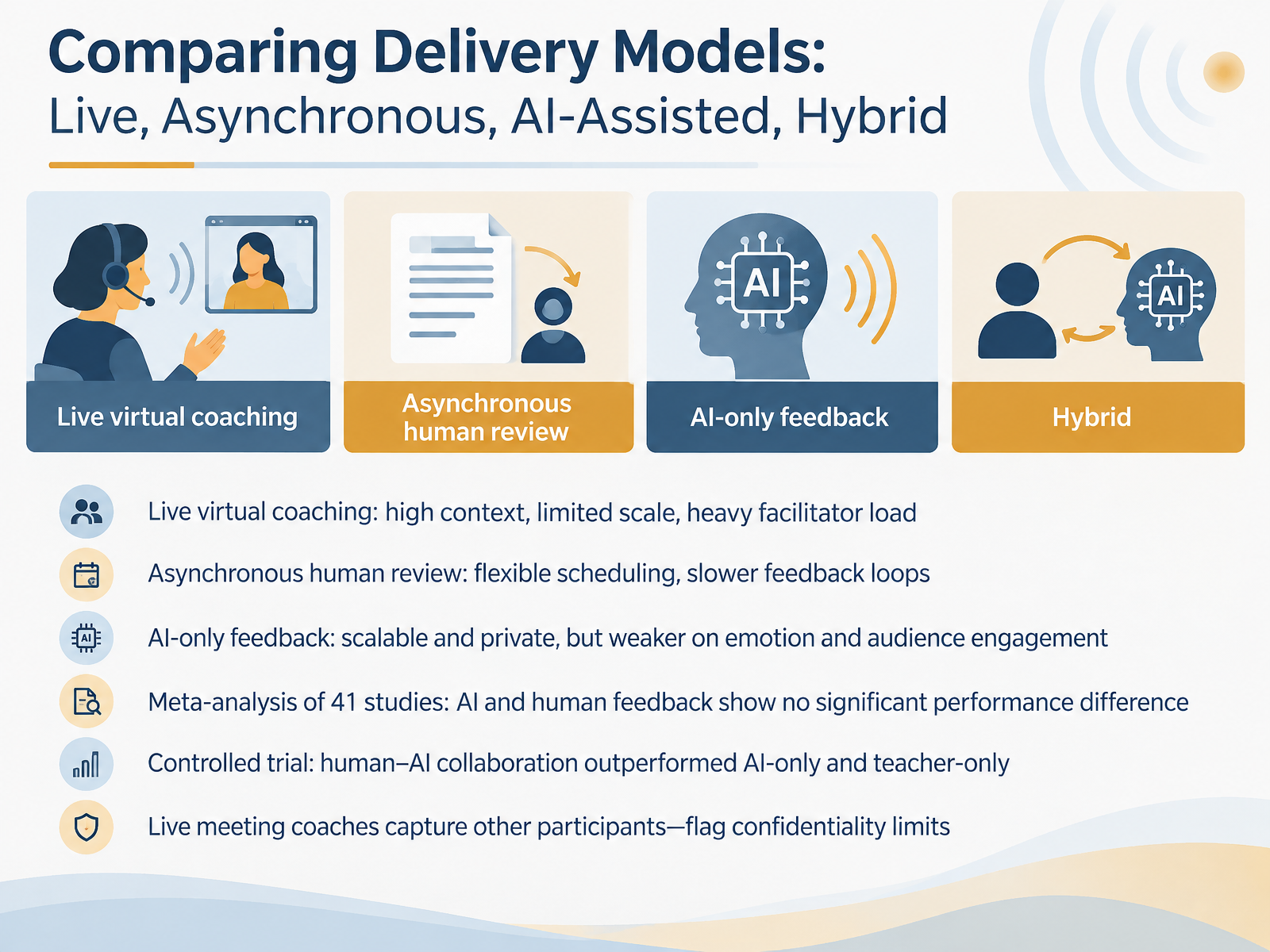
- 06Comparing Delivery Models: Live, Asynchronous, AI-Assisted, HybridLet's compare the four delivery models you'll actually choose between. Live virtual coaching gives the richest context, but it scales poorly and puts a heavy load on facilitators. Asynchronous human review buys you flexible scheduling, at the cost of slower feedback loops. AI-only feedback scales and stays private, but it's weaker on emotional expressiveness and audience engagement. Here's the nuance that changes the conversation. A meta-analysis of forty-one studies found no significant performance difference between AI and human feedback. But in a controlled trial, human and AI collaboration beat both AI-only and teacher-only groups. So the pairing matters more than the source. One practical flag: live meeting coaches capture other participants, so set confidentiality limits before you deploy.
 orai.comdisprz.aibestfor.ai+22 min
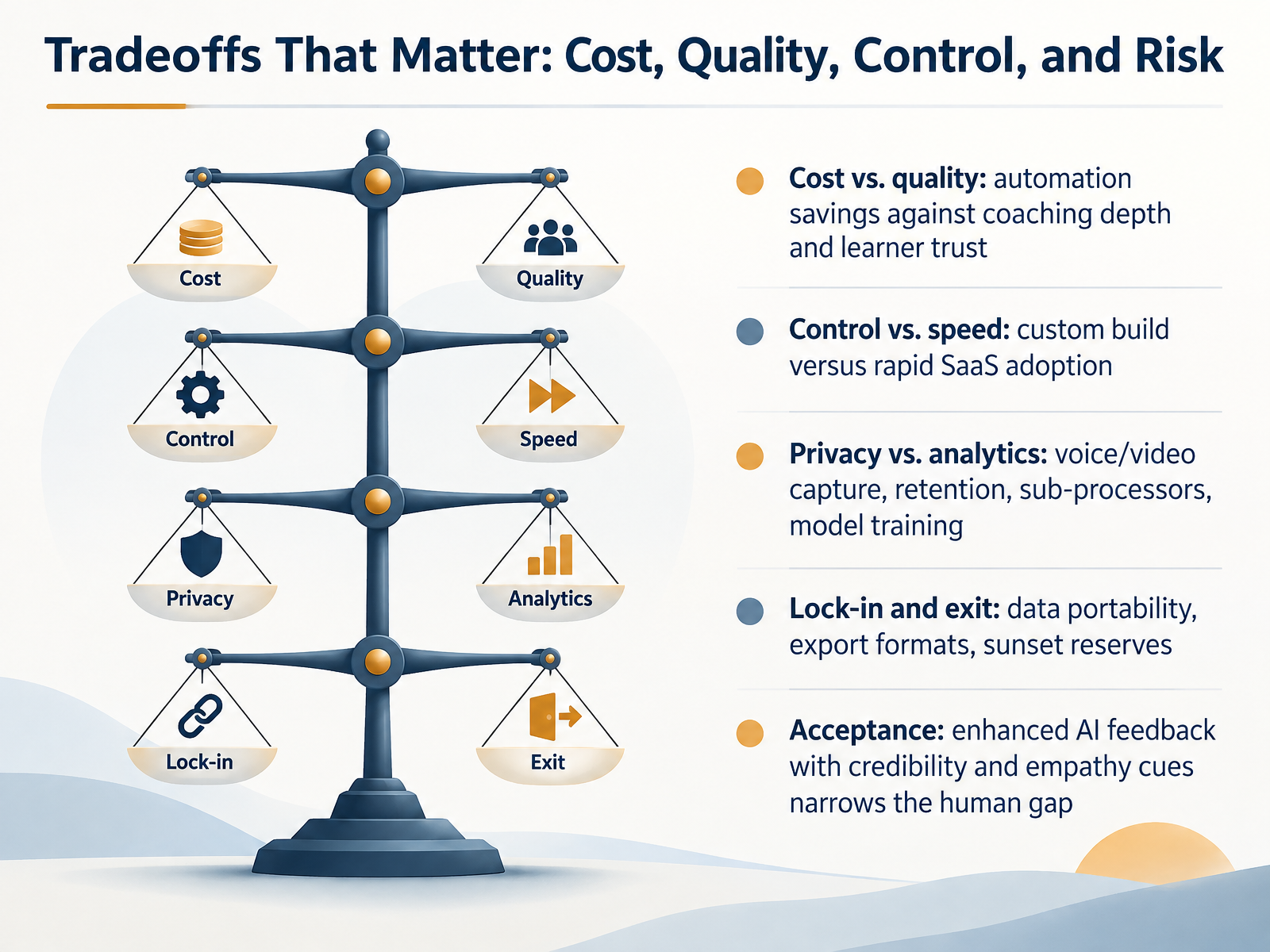
- 07Tradeoffs That Matter: Cost, Quality, Control, and RiskLet's walk through the tradeoffs that actually shape your platform choice. First, cost versus quality. Automation saves money, but coaching depth and learner trust carry real weight, and research shows trust drives adoption more than efficiency does. Second, control versus speed. A custom build gives you control; a SaaS product gets you live faster. Third, privacy versus analytics. Voice and video capture raise hard questions about retention, sub-processors, and whether recordings feed model training. Get those answers in writing before you pilot. Fourth, lock-in and exit. Insist on data portability, standard export formats, and a sunset reserve in your three-year total cost model. Fifth, acceptance. Evidence suggests AI feedback enriched with credibility and empathy cues narrows the gap with human feedback. Next, we'll look at solution patterns matched to different organizations.
 spokescoach.comdocs.trainar.aiblog.ukkera.com+22 min
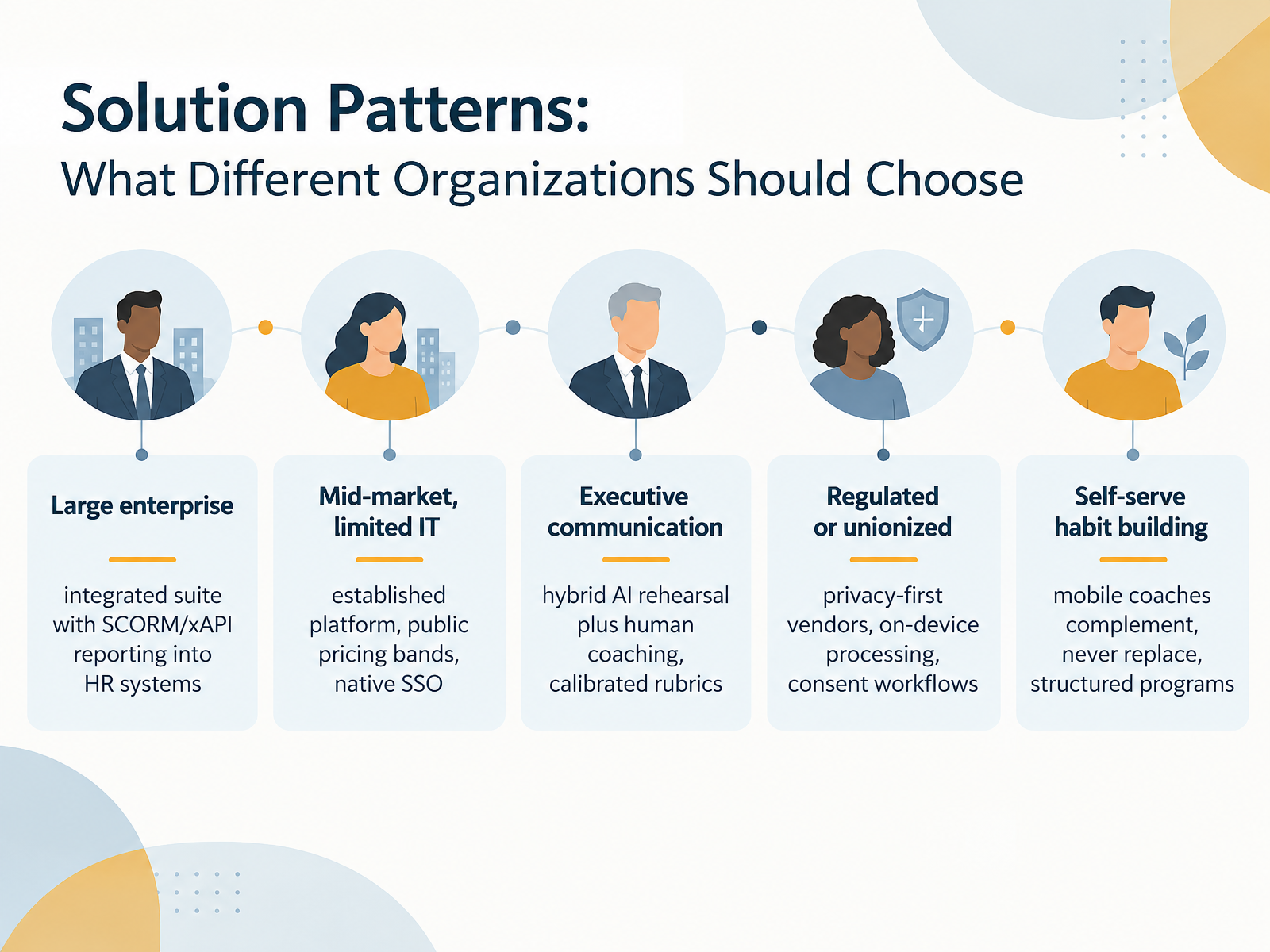
- 08Solution Patterns: What Different Organizations Should ChooseLet's map solution patterns to program types. Large enterprises usually need an integrated suite with SCORM or xAPI reporting into HR systems, so completion data lands where your LMS already lives. Mid-market teams with limited IT do better with an established platform, public pricing bands, and native SSO, which keeps procurement short and avoids custom builds. For executive communication, pair hybrid AI rehearsal with human coaching and calibrated rubrics, because your highest-stakes speakers need judgment, not just scores. Regulated or unionized settings demand privacy-first vendors, on-device processing, and consent workflows, since recorded speech can be sensitive material. For self-serve habit building, mobile coaches complement structured programs, never replace them. Choose the pattern before the product, so the tradeoffs are explicit.
 orai.comptichi.comaitoolsbakery.com+22 min
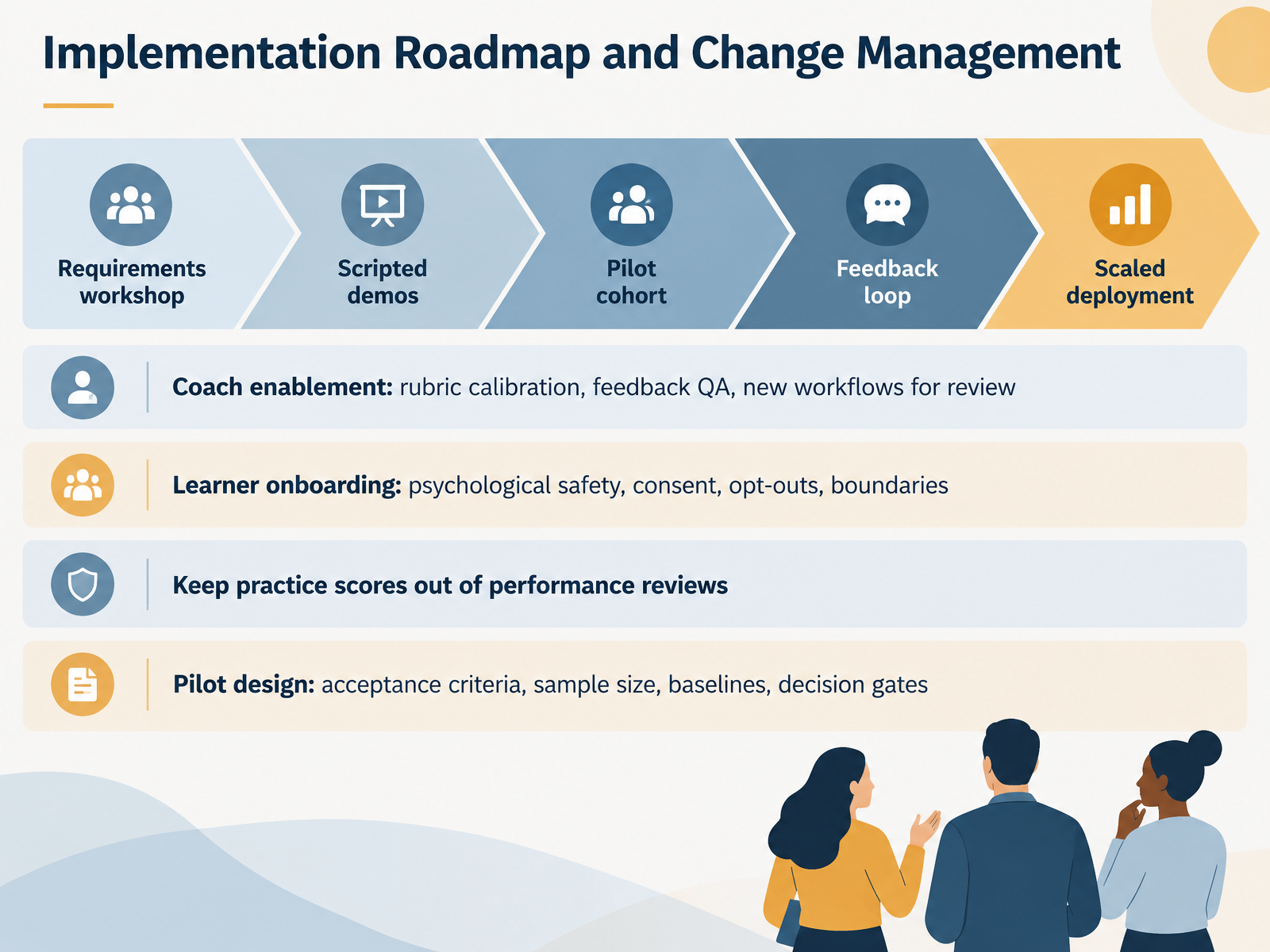
- 09Implementation Roadmap and Change ManagementLet's turn to rollout and change management. Sequence matters more than speed. Start with a requirements workshop, then scripted demos, then one pilot cohort, then a feedback loop before you scale. Run coach enablement in parallel: calibrate rubrics together, quality-check feedback samples, and define the new review workflow. For learners, set psychological safety first. Explain consent, offer opt-outs, and state boundaries in plain language. And keep practice scores out of performance reviews. Say it explicitly, in writing. People rehearse honestly when the score can't hurt them. Design the pilot with acceptance criteria, a sample size, baselines, and decision gates agreed before launch. If the gates aren't met, pause and fix the design rather than pushing ahead. Next, we look at measuring success: KPIs and the evidence chain.
 spokescoach.comdocs.trainar.aiblog.ukkera.com+22 min
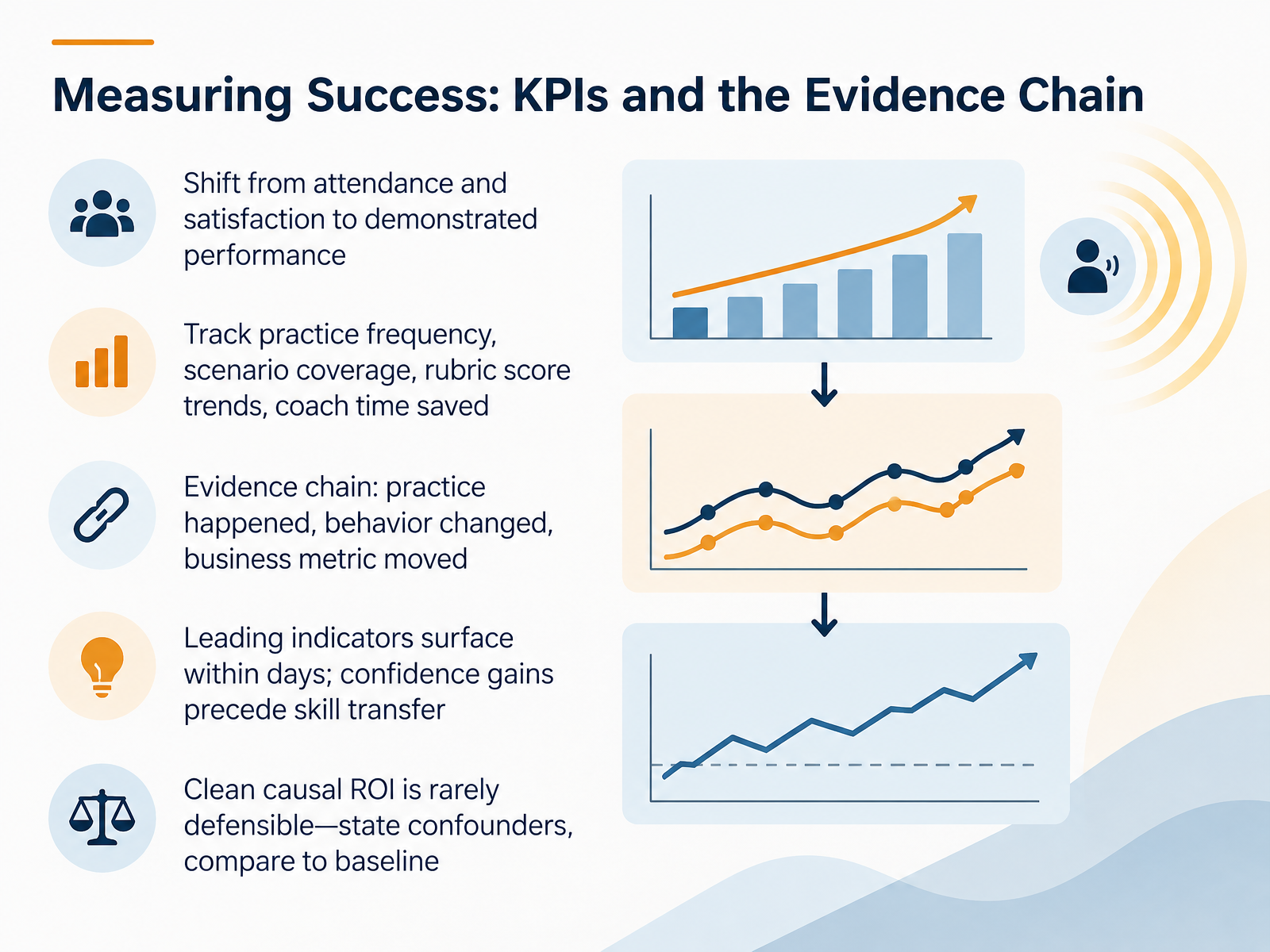
- 10Measuring Success: KPIs and the Evidence ChainNext, let's talk about measuring success, and building an evidence chain you can defend. Start by shifting the KPI conversation away from attendance and satisfaction. Those numbers are easy, but they tell you almost nothing. Track practice frequency, scenario coverage, rubric score trends, and coach time saved instead. Here's why this matters. People who run at least three practice reps show noticeably higher application rates in the first month. So volume and coverage are your leading indicators, and you can see them within days, while the program is still live. Confidence gains show up early, too, but remember that confidence precedes skill transfer, so don't stop there. Watch the scorecard on named behaviors hold up in harder scenarios, then confirm the same behaviors on the job through manager observation against the same rubric. That gives you the chain: practice happened, behavior changed, business metric moved. Be honest about causality. Clean return on investment is rarely defensible, so name your confounders and compare against a baseline. In the next segment, we'll put this into practice in a decision workshop on selecting your platform and architecture.
 2 min
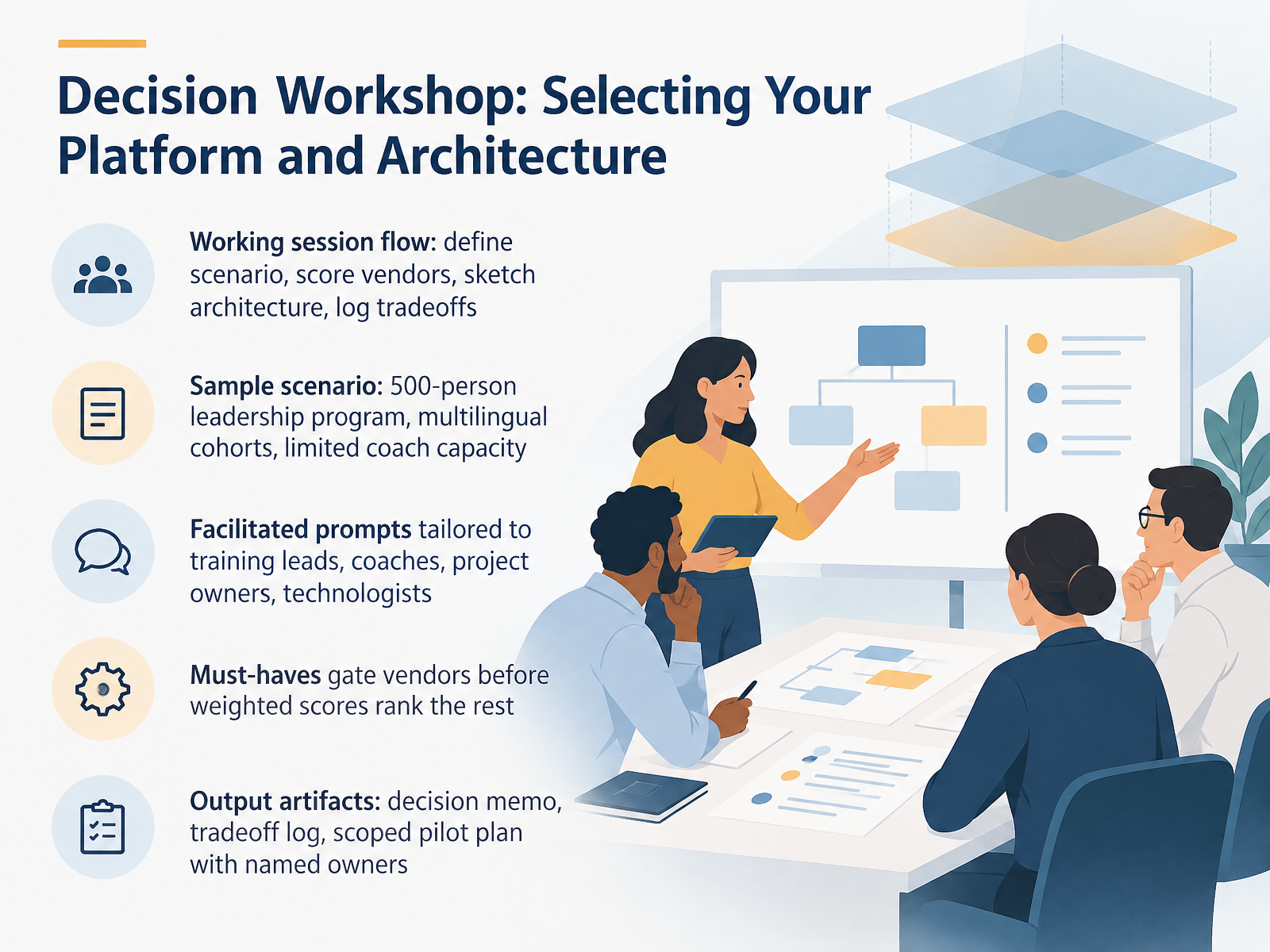
- 11Decision Workshop: Selecting Your Platform and ArchitectureNow let's turn the framework into a working session. The flow is simple: define your scenario, score vendors, sketch the architecture, then log the tradeoffs. Take a sample scenario. A five hundred person leadership program, multilingual cohorts, and limited coach capacity. That constraint shapes everything you evaluate. Facilitate with prompts tailored to each role, training leads, coaches, project owners, and technologists. A clean pattern is to treat must-haves as a gate first. If a vendor scores one or two on a deal-breaker, it is out, regardless of its total. Only then do weighted scores rank what clears the gate. Use a consistent one to five scale with written definitions, so a four means the same thing to every scorer. Capture three outputs: a decision memo, a tradeoff log, and a scoped pilot plan with named owners. That gives you a defensible decision. Next, questions to bring to vendors, IT, and security.
 spotsaas.comaquilonlms.comlmspedia.org+22 min
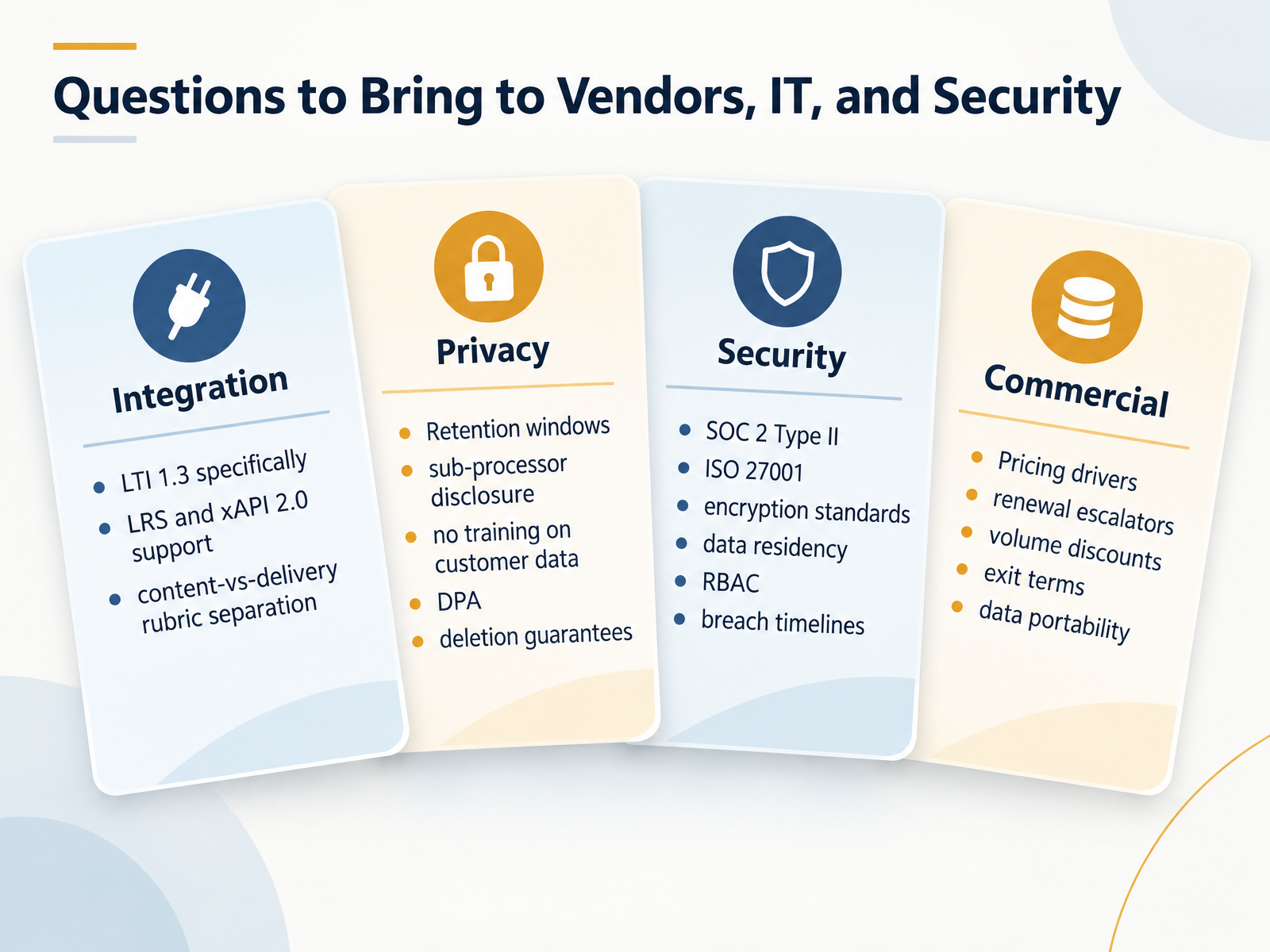
- 12Questions to Bring to Vendors, IT, and SecurityNow let's turn the selection criteria into questions you can actually put in front of vendors, IT, and security. Start with integration. Ask for LTI one point three specifically, not just the letters L T I. Unversioned answers usually mean one point one, and your security team may refuse it. Also ask whether they run their own learning record store, and which xAPI version they speak. And keep content separate from delivery when you build your rubric. Next, privacy. Pin down retention windows with a real number, name every sub-processor, and get an unqualified no on training models with your employee data. Ask for the data processing agreement and a deletion guarantee. Then security. Request the SOC two Type two report and ISO twenty-seven thousand and one certification. Confirm encryption in transit and at rest, data residency, role-based access, and the breach notification timeline in writing. Finally, commercial. Ask what drives pricing, what the renewal escalator is, where volume discounts start, what exit terms look like, and how you get your data out. Those four buckets give you a defensible scorecard. Let's look next at common failure patterns and how to avoid them.
 spokescoach.comdocs.trainar.aiblog.ukkera.com+22 min
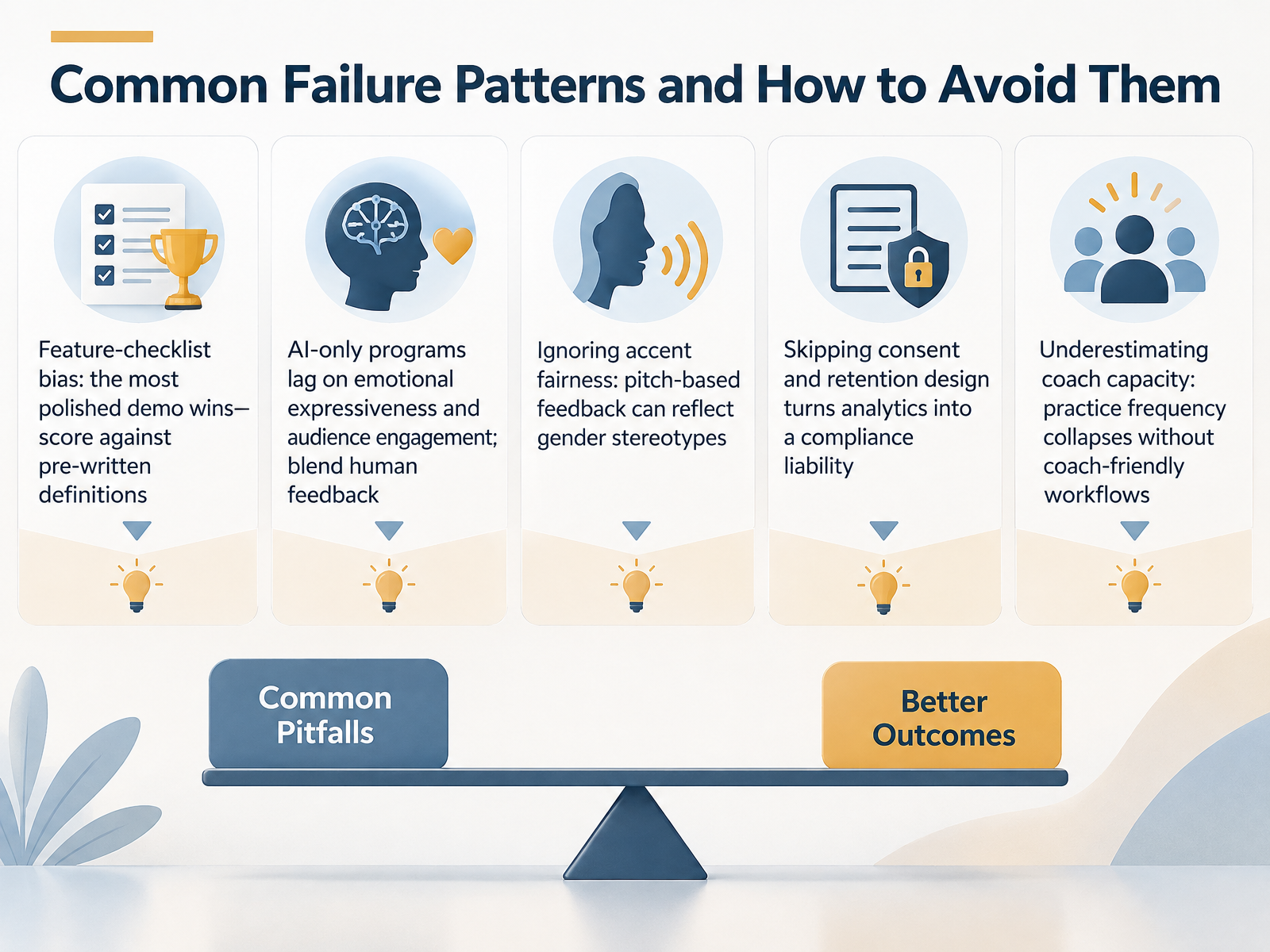
- 13Common Failure Patterns and How to Avoid ThemLet's look at the failure patterns that quietly sink platform rollouts, and how to avoid each one. First, feature-checklist bias. The most polished demo tends to win, so lock your scoring criteria and written definitions before you see any vendor. Score against those, not the show. Second, AI-only programs. Automated feedback alone lags on emotional expressiveness and audience engagement. Blend in human feedback, even a short coach debrief. Third, accent fairness. Pitch-based feedback can reflect gender stereotypes, so validate that dimension carefully or set it aside. Fourth, consent and retention. Skipping that design turns your analytics into a compliance liability. And fifth, coach capacity. Practice frequency collapses without coach-friendly workflows, so test scheduling and review time in the pilot. Score first, blend human judgment, and design consent before you scale. Next, we wrap up with key takeaways, resources, and next steps.
 spotsaas.comaquilonlms.comlmspedia.org+22 min
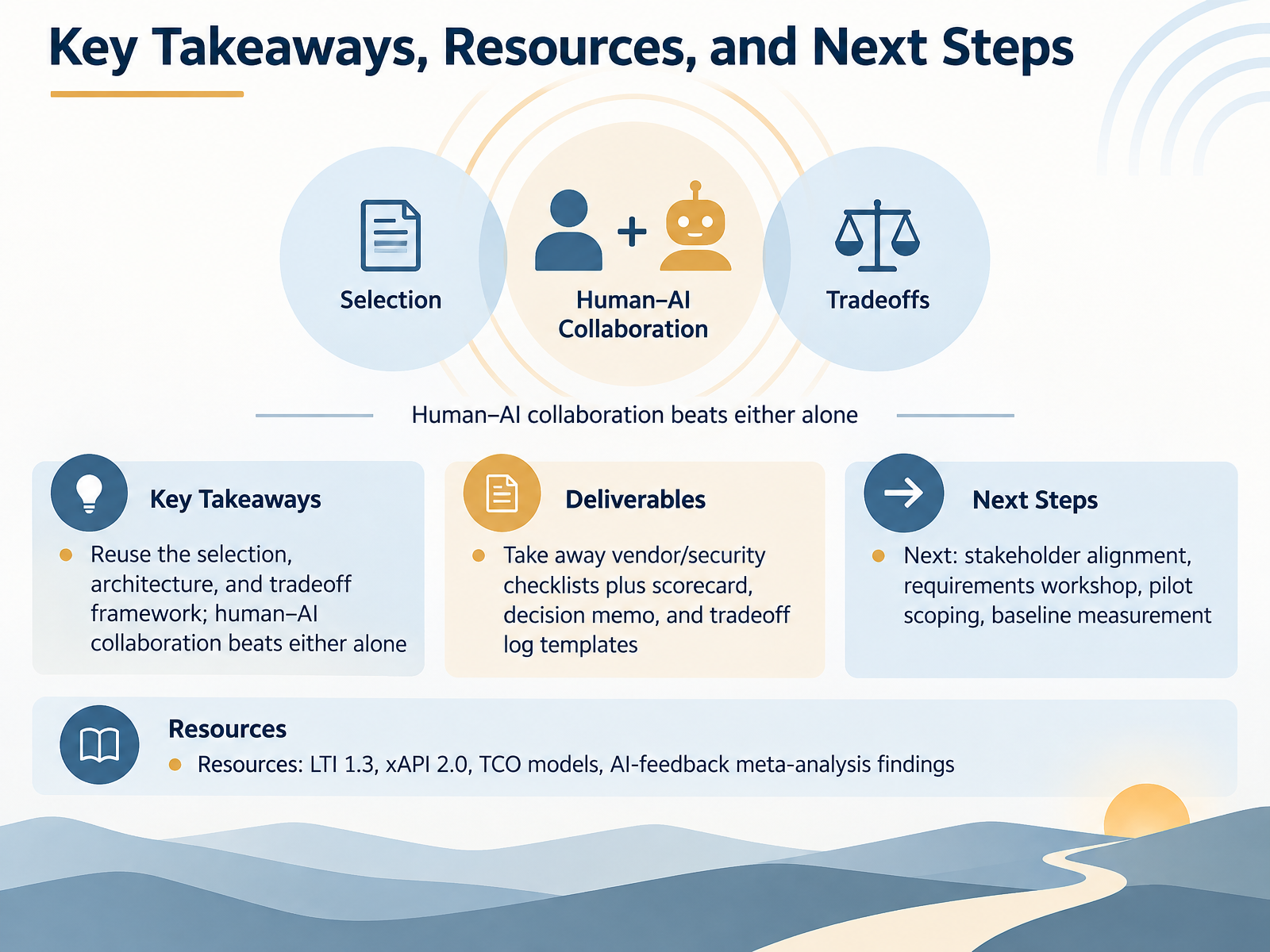
- 14Key Takeaways, Resources, and Next StepsLet's bring this together. Reuse the same framework you've built: selection, architecture, and tradeoffs. And hold onto one finding: human and AI collaboration beats either one alone. A meta-analysis of 41 studies found AI feedback roughly equal to human feedback on performance, and one collaborative study showed a normalized gain of 0.44, well above teacher-only or AI-only. So design for both. Your takeaway pack includes vendor and security checklists, plus a weighted scorecard, decision memo, and tradeoff log. On the scorecard, gate on must-haves first, then weight the rest. For next steps: align stakeholders, run a requirements workshop, scope your pilot, and take baseline measurements before launch. For resources, reference LTI 1.3, xAPI 2.0, total cost of ownership models, and the AI-feedback meta-analysis. Thank you for working through this with me. You now have a defensible path from framework to signed contract. Go apply it to your next platform decision, and keep the tradeoffs visible.
 spotsaas.comaquilonlms.comlmspedia.org+22 min
Take the deck with you
Download this course as a file — free, no sign-up needed.
- PDF handoutEvery slide page, ready to print or share.15 pages · 3.1 MBDownload
- Narrated PowerPointThe deck that presents itself — every slide carries the digital human's narration video.15 pages · 13.8 MBDownload
- PowerPoint slidesThe full deck as a .pptx — open it in PowerPoint, Keynote, or Google Slides.15 pages · 3.0 MBDownload
Free to use in your own training — please keep the PersonWise credit page at the end.
Have your own deck? Turn it into a course
Sources consulted
Web sources consulted while building this course.
- 6 Best AI Speech Coach Apps in 2026 | Orai — orai.com
- Best Communication Skills Training Software (2027): 8 Tools Compared | Disprz — disprz.ai
- 4 Best AI Tools for Public Speaking Training 2026: Compare Pricing & Features — bestfor.ai
- 8 Best AI Training Platforms for 2026 — virtualspeech.com
- Gestoa for Enterprise — AI Speaking Training at Scale — gestoa.com
- Voice and speech training in 2026: a product map, not a leaderboard · Ptichi — ptichi.com
- Best AI Public Speaking Coach Apps (2026): 7 Compared — aitoolsbakery.com
- Best AI Speech Coaching Apps in 2026: Researched & Ranked — itechguides.com
- What Is the Best AI Public Speaking Coach in 2026? — jenova.ai
- Data Processing Agreement · SpokesCoach — spokescoach.com
- Privacy & GDPR - TrainAR Docs — docs.trainar.ai
- Data Protection in Corporate Training: GDPR, Compliance, and Security — blog.ukkera.com
- AI Training Tools Data Privacy: Where Employee Data Goes — talaera.com
- Guidance and requirements when capturing personal data in audio and visual recordings — reading.ac.uk
- LMS Vendor Evaluation Scorecard — Free Template | Spotsaas — spotsaas.com
- An LMS Vendor Evaluation Scorecard You Can Actually Use — Aquilon LMS — aquilonlms.com
- Free LMS RFP Template & Questionnaire 2026 - LMSpedia — lmspedia.org
- How to Evaluate LMS Software: The Learning Platform Scorecard That Survives a CFO Review | TopickZ.com — topickz.com
- LMS Evaluation Scorecard Spreadsheet (Weighted) | Innovito — innovito.net
- Learning Tools Interoperability | 1EdTech — 1edtech.org