Buoyancy: Density & Displacement
Begin
14 pages · ~28 min
Buoyancy: Density & Displacement
This training explains the physics of floating objects, covering density, displacement, and buoyancy for students and science enthusiasts.
What you’ll learn
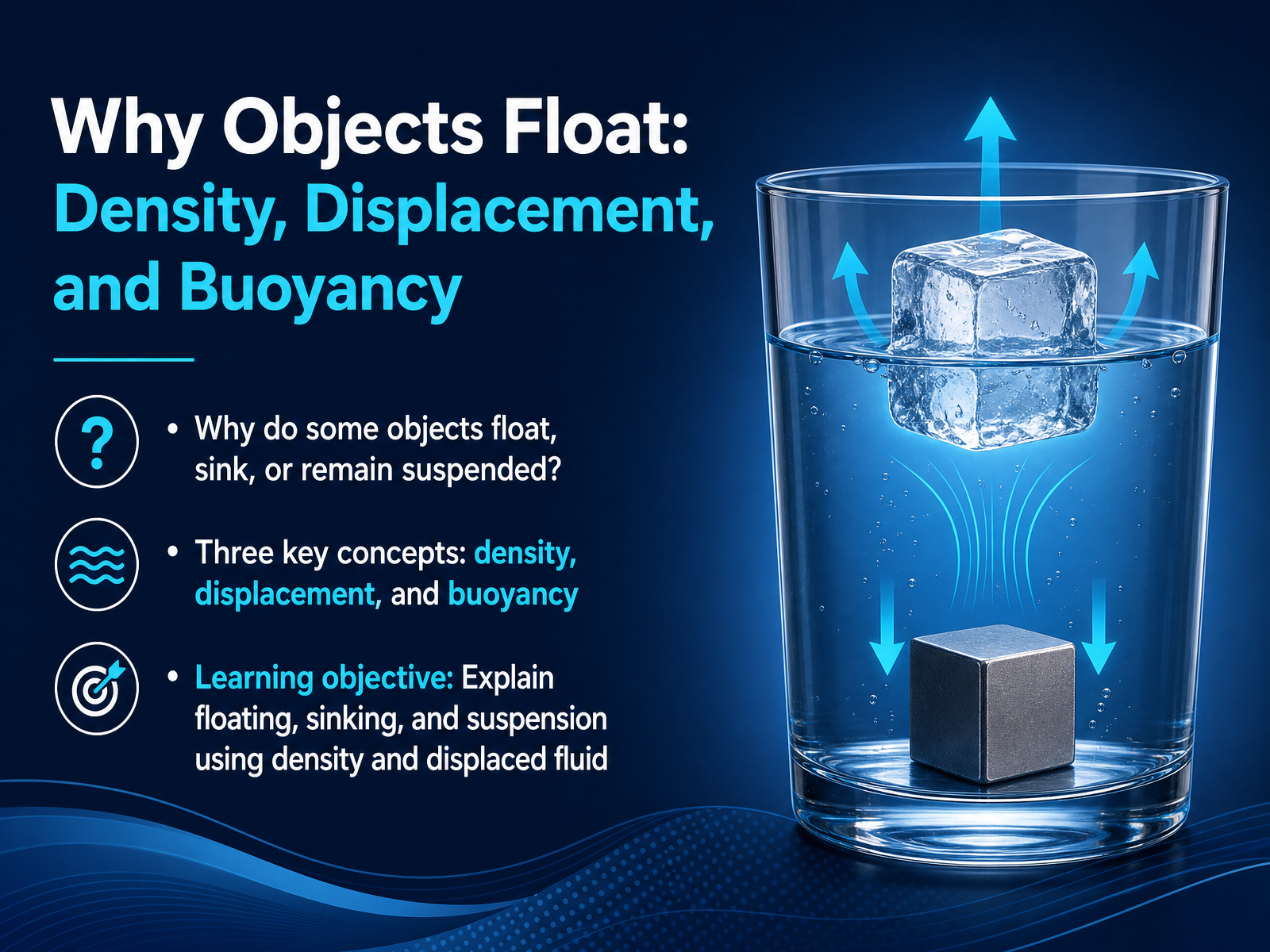
- 01Why Objects Float: Density, Displacement, and BuoyancyWelcome. In this lesson, you’ll use density and displaced fluid to explain why some objects float, some sink, and some hover suspended. Think of three everyday outcomes: a steel bolt drops to the bottom, a wooden block bobs at the surface, and a submarine can pause mid‑water. All three behaviors rest on three connected ideas—density, displacement, and buoyancy. By the end, you’ll be able to describe exactly what’s happening at the particle level and link those ideas into a clear cause‑and‑effect chain. Let’s begin by addressing a common mix‑up that many people run into. We’ll head next to “The Big Misconception: Weight versus Density.”engineeringtoolbox.comthoughtco.comdrill-hq.com+21 min
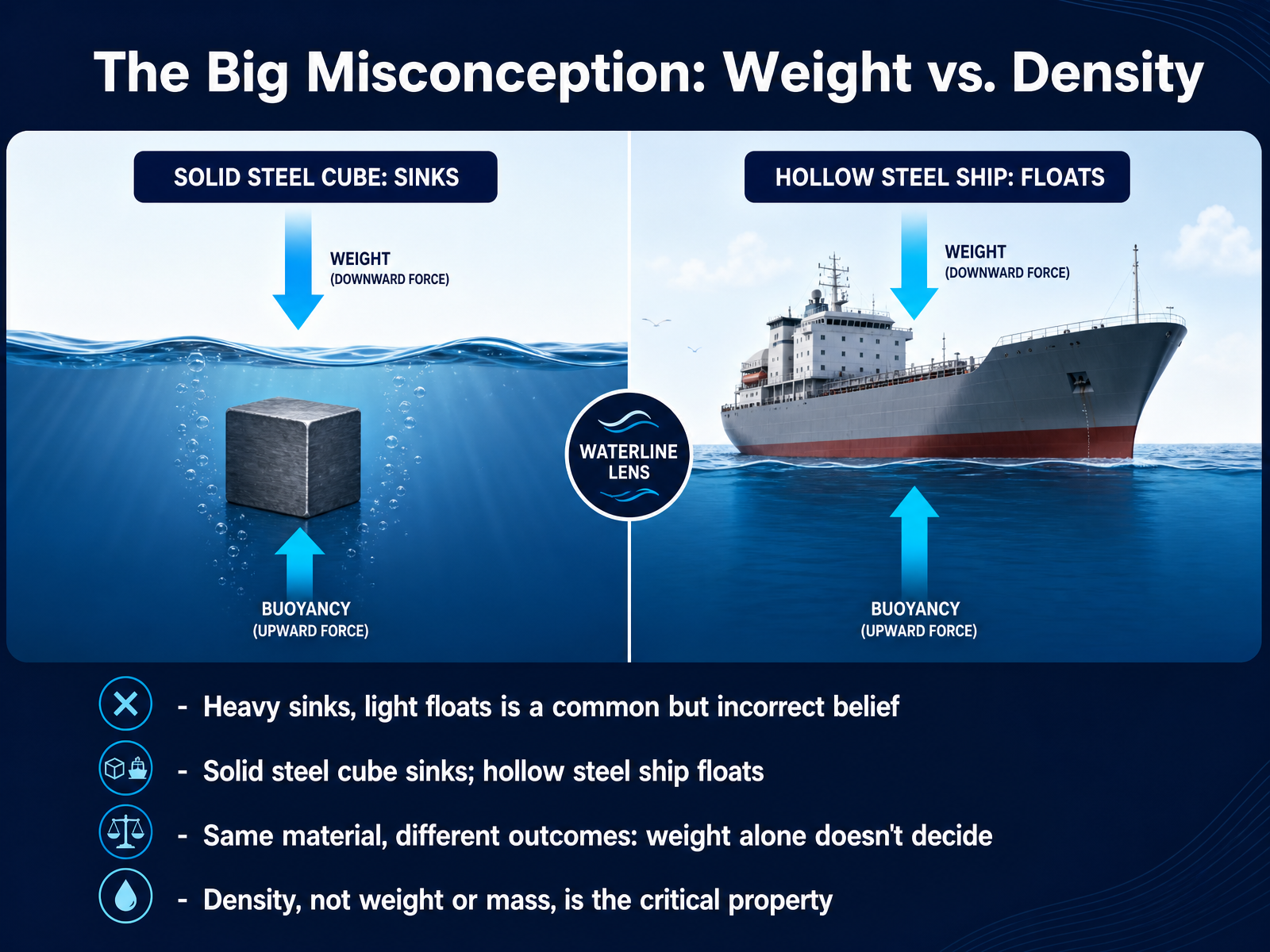
- 02The Big Misconception: Weight vs. DensityNow, let's tackle a very common belief, one you have probably heard many times: heavy things sink, and light things float. While this sounds logical on the surface, it is a misconception. To see why, picture a solid cube of steel. If you drop it in water, it will sink immediately. Now, imagine a massive ship, also made of steel. It floats. We have the exact same material, steel, producing two completely different results. This tells us something critical: an object's weight or mass alone does not decide its fate. The real decision-maker is a different property, and that property is density. Let's use this new lens as we move into a formal definition of density, looking at how mass, volume, and the identity of a material all fit together.
 1 min
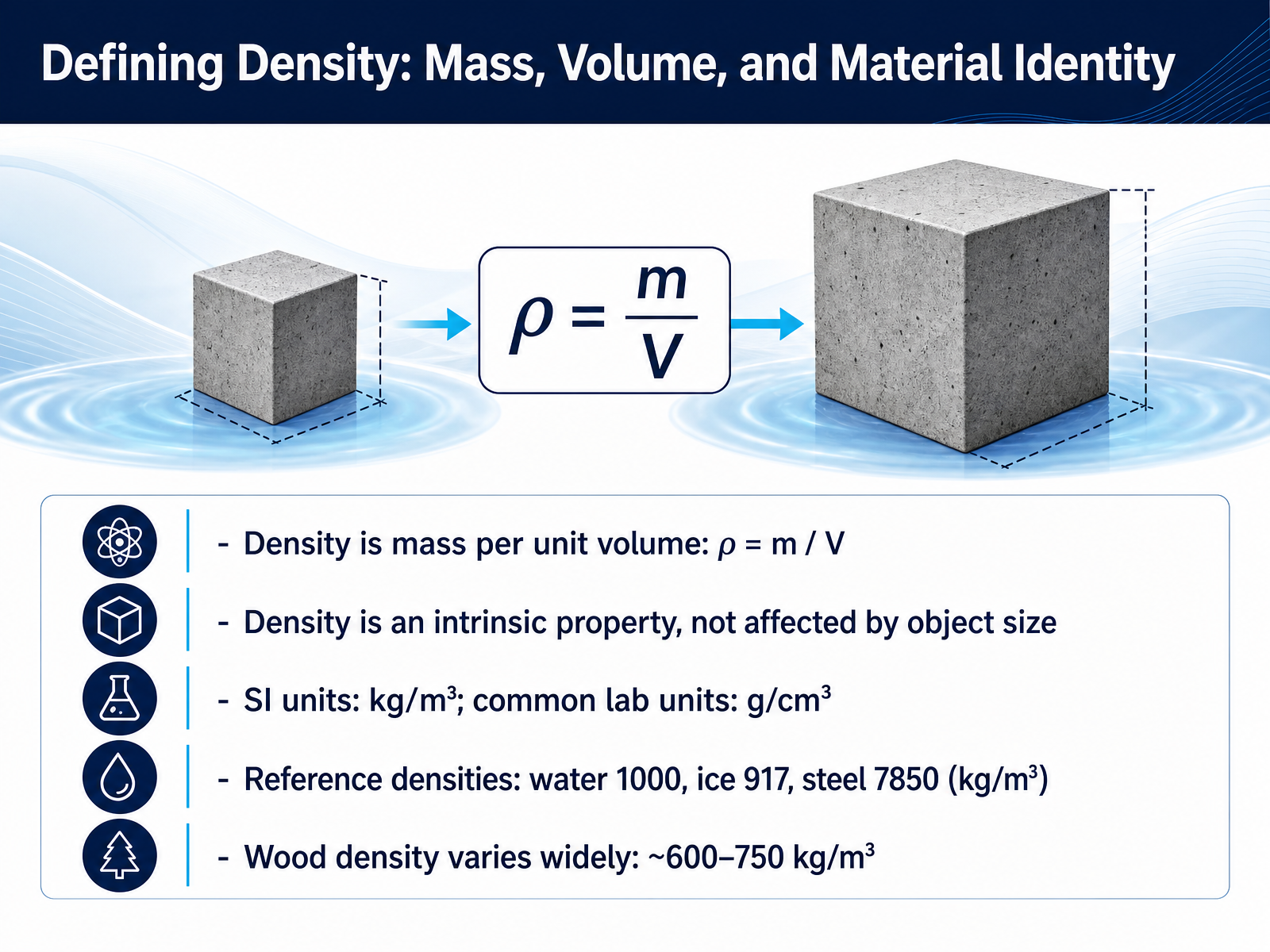
1 min - 03Defining Density: Mass, Volume, and Material IdentityNow let's define density more formally, because it's the first key to understanding why things float. Density is simply mass per unit volume. We write it as rho equals m divided by V. In plain terms, it tells you how much matter is packed into a given space. An important point: density is an intrinsic property. That means a small steel bolt and a large steel beam have exactly the same density. The size of the object doesn't change the material's identity. In SI units, we use kilograms per cubic meter. Water, for example, is one thousand kilograms per cubic meter. Ice is a bit less, around nine hundred seventeen, which is why ice floats on water. Steel is much denser, at about seven thousand eight hundred fifty kilograms per cubic meter. That's why steel sinks. Wood varies a lot, but many types fall between six hundred and seven hundred fifty kilograms per cubic meter, which is less than water, so wood often floats. So, notice: if an object's density is less than the fluid's density, it will float. This simple relationship sets up our next idea. But density alone doesn't explain the whole story of buoyancy. To complete the picture, we need to look at displacement, using Archimedes' Principle.
 2 min
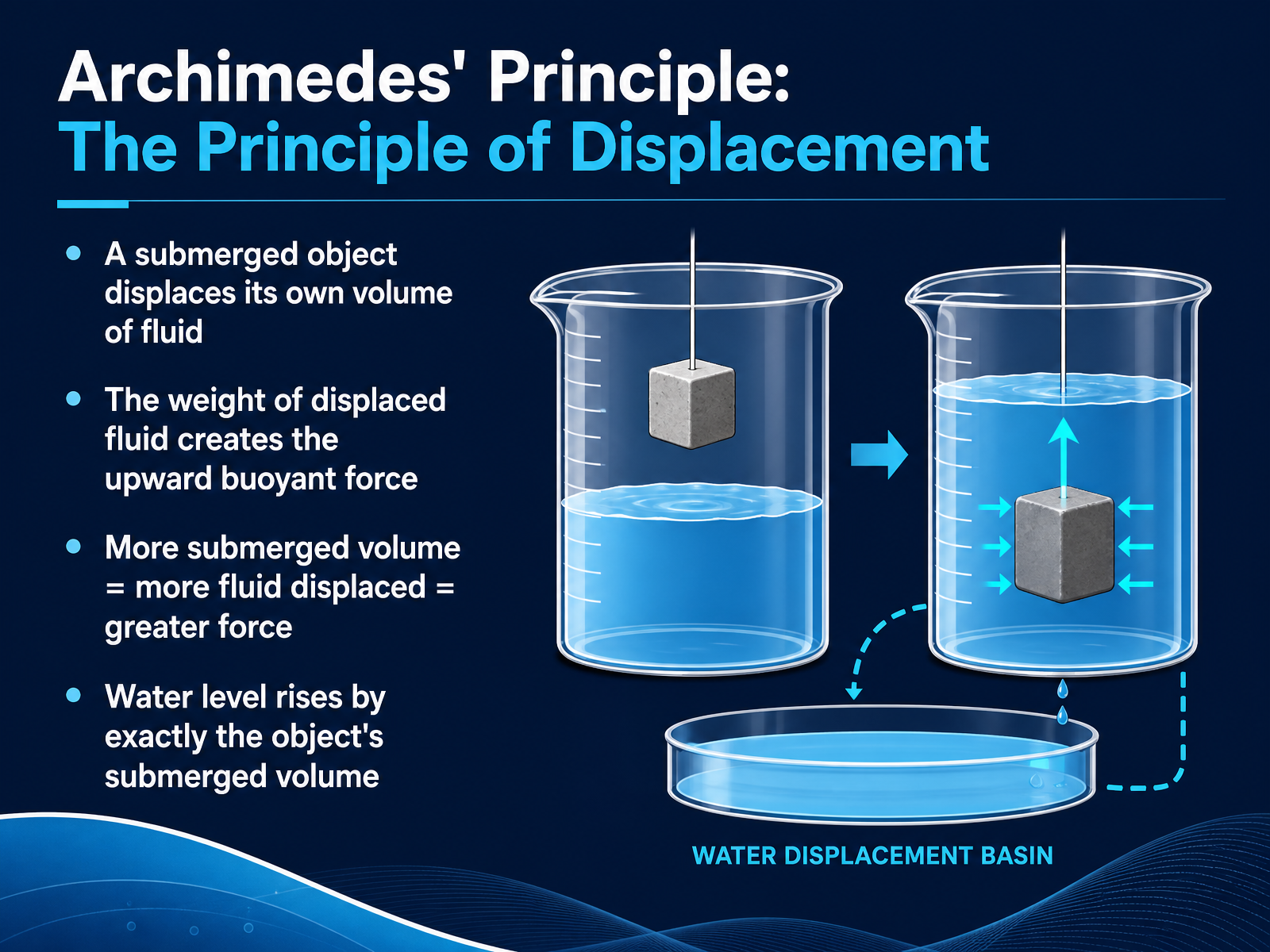
2 min - 04Archimedes' Principle: The Principle of DisplacementLet's move to a foundational idea in fluid mechanics: Archimedes' Principle. It states that when you submerge an object, it pushes aside, or displaces, a volume of fluid exactly equal to its own submerged volume. Notice the direct cause and effect here: the weight of that displaced fluid is what creates the upward buoyant force. So, if you push more of the object underwater, you displace more fluid. More fluid displaced means a greater weight of fluid is pushed aside, and that creates a stronger upward force. You can picture this clearly: the water level in a container rises by exactly the volume of the portion of the object that is underwater. Now, with this idea of displacement in mind, let's explore where that upward force actually comes from. We'll look at the origin of buoyant force through fluid pressure differences.
 1 min
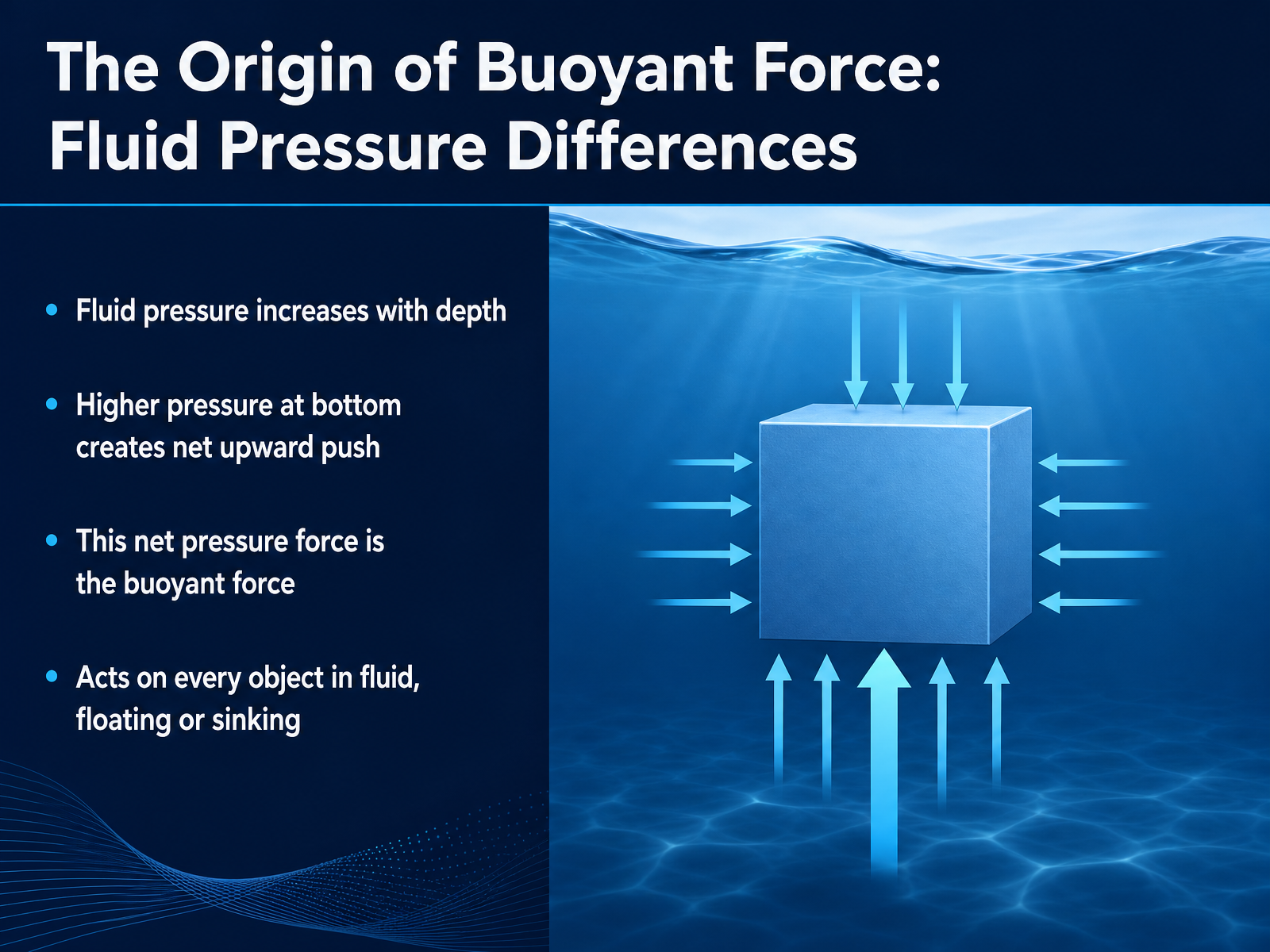
1 min - 05The Origin of Buoyant Force: Fluid Pressure DifferencesSo we know that density determines if an object floats or sinks. But what actually pushes it up? To understand that, we need to look at fluid pressure. Notice one key fact first: fluid pressure increases with depth. The deeper you go, the greater the pressure pushing in from all sides. Now, imagine a solid object completely submerged in this fluid. The bottom of the object is at a greater depth than the top. This means the upward pressure on the bottom surface is stronger than the downward pressure on the top surface. That difference creates a net upward push. This net pressure force is precisely what we call the buoyant force. It’s not a separate, magical push; it is simply the result of this pressure mismatch. Remember, this force acts on every object placed inside a fluid, whether it is floating, sinking, or just hanging suspended. The buoyant force is always there, pushing upward. Next, we will quantify this effect by examining the buoyant force equation.
 1 min
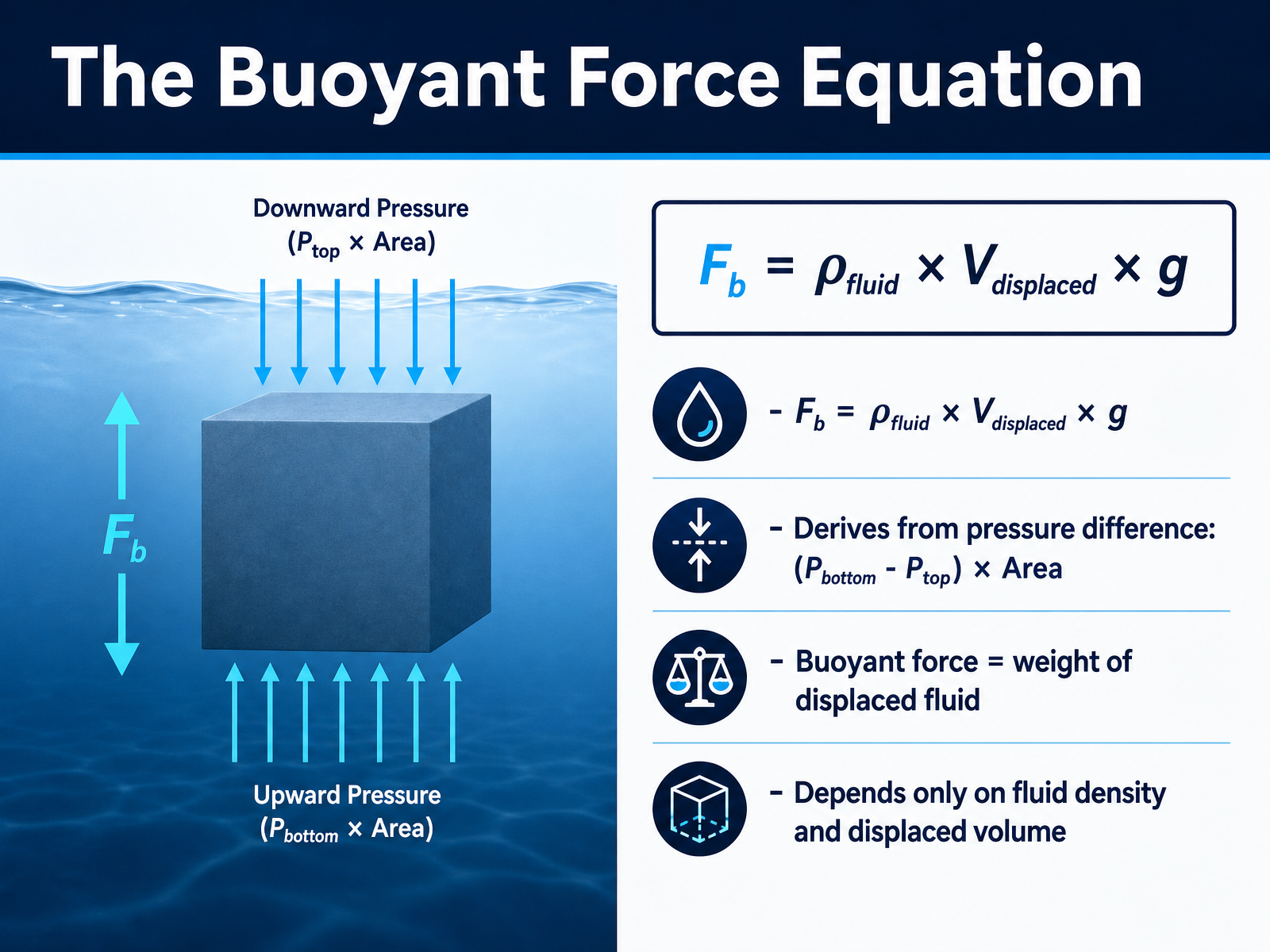
1 min - 06The Buoyant Force EquationNow let's put everything together into a single equation that gives us the buoyant force. We write it as F b equals the density of the fluid, times the volume of fluid displaced, times the acceleration due to gravity, g. This comes straight from the pressure difference we just looked at. The pressure pushing up on the bottom of an object is greater than the pressure pushing down on the top, because pressure increases with depth. When you multiply that difference in pressure by the bottom area of the object, you get the net upward force. Notice what this really means: the buoyant force is simply equal to the weight of the fluid that the object pushed aside. And here is the key takeaway. The buoyant force depends only on two things: the density of the fluid itself, and the volume of fluid that is displaced. The object's own material or weight does not appear in this equation at all. With this rule in mind, we are ready to directly compare an object to the fluid around it. That comparison leads us to the floating rule and how densities decide whether something sinks or floats.
 1 min
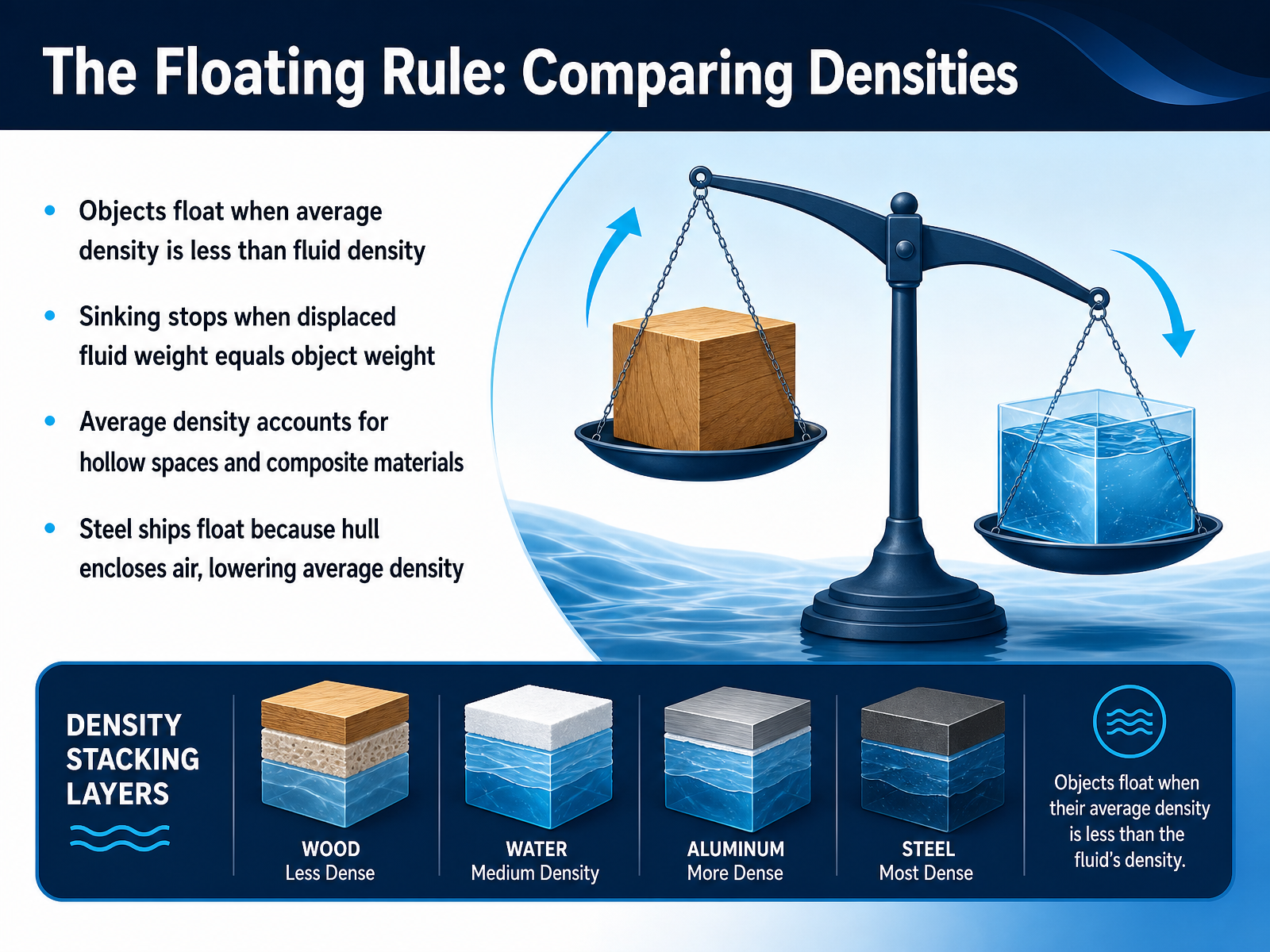
1 min - 07The Floating Rule: Comparing DensitiesNow let's bring everything together into one simple rule. An object floats when its average density is less than the density of the fluid around it. Think about that carefully. It is not just the material itself that matters, but the average density of the entire object, including any hollow spaces inside. This explains why a solid steel bar sinks instantly, yet a massive steel ship floats. The ship's hull encloses a huge volume of air, so when you calculate the average density of all that steel plus the air, the result is lower than the density of water. Here is another key point to remember about sinking. Even when an object is denser than the fluid and starts to sink, it does not necessarily drop forever. The sinking stops the moment the weight of the displaced fluid equals the object's weight. At that point, the forces balance. Next, we will look at what happens when densities are equal, leading to sinking, suspension, and neutral buoyancy.
 2 min
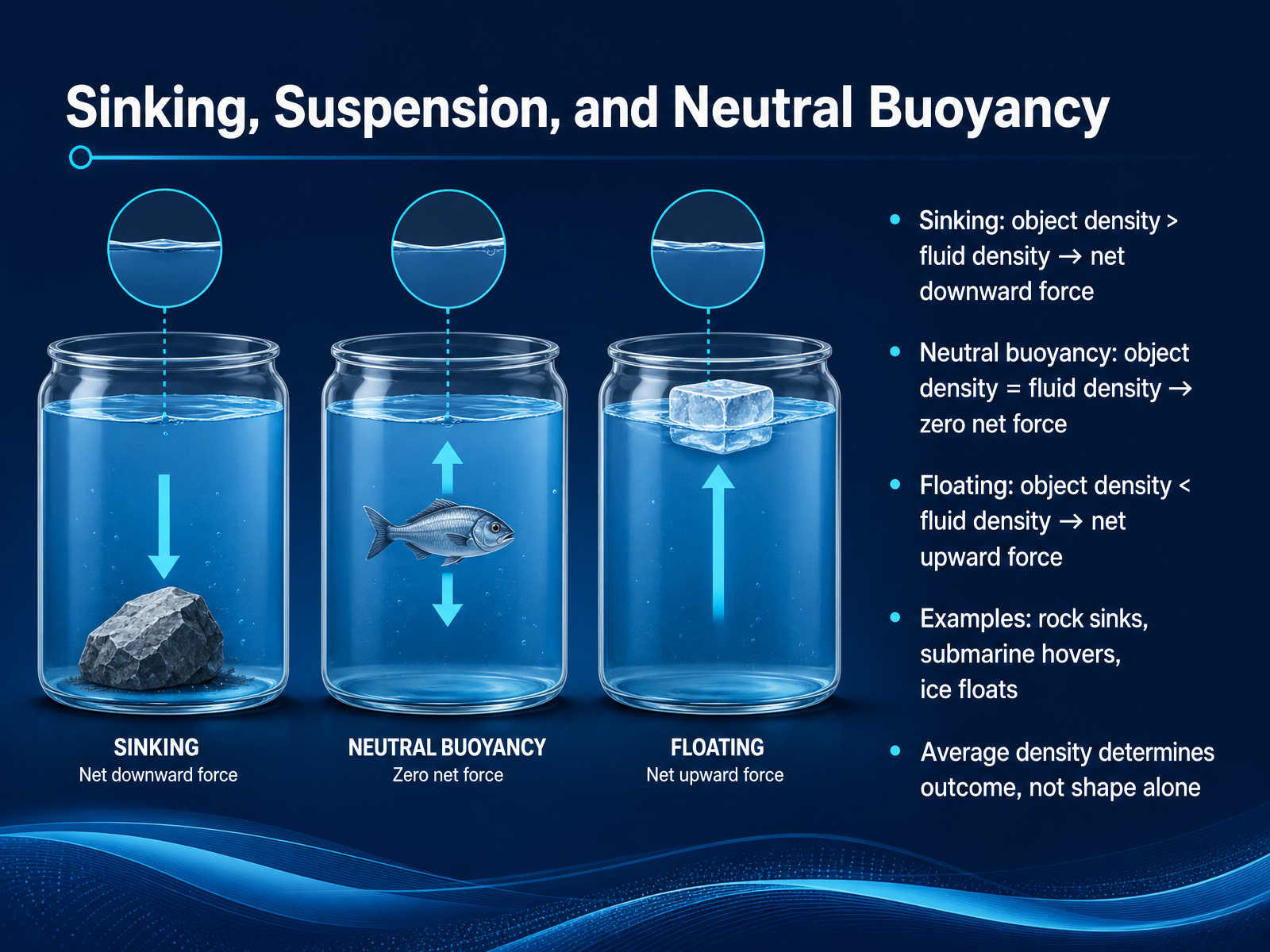
2 min - 08Sinking, Suspension, and Neutral BuoyancyNow let's organize these ideas into three clear outcomes. First, sinking happens when an object's average density is greater than the fluid density. The downward force of gravity wins, producing a net downward force. Think of a rock dropped into a pond—it plunges straight to the bottom. Second, we have neutral buoyancy. This occurs when the object's average density exactly equals the fluid density. The buoyant force balances the weight perfectly, so the net force is zero. The object doesn't sink or rise; it hovers at a constant depth. A submarine maintaining its cruising depth is a perfect example. Third, floating happens when the object's average density is less than the fluid density. The buoyant force is stronger than the weight, creating a net upward force that pushes the object to the surface. Ice cubes in a glass of water demonstrate this beautifully. Notice one critical point here: it's the average density of the whole object that determines the outcome, not its shape. A solid steel bar sinks, but by shaping that same steel into a hollow hull, you lower the average density enough to make a ship float. So whenever you analyze these situations, start by comparing average density to the fluid density. That comparison predicts sinking, hovering, or floating. Next, we'll explore a case study that puts these principles to work: how submarines actively control their buoyancy.
 usna.eduscience.howstuffworks.comen.wikipedia.org+21 min
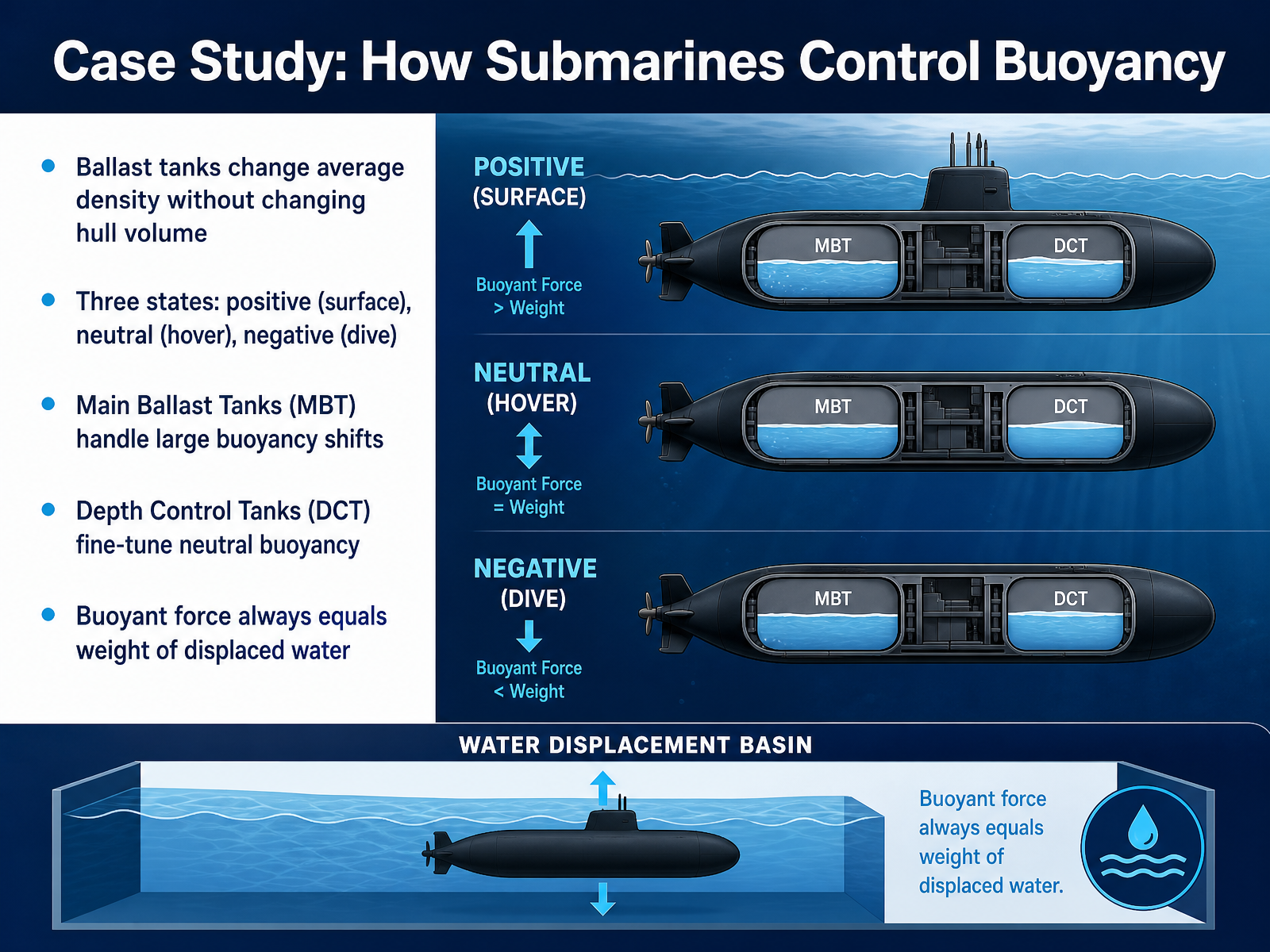
 - 09Case Study: How Submarines Control BuoyancyLet's apply what we've learned to a fascinating case study: the submarine. A submarine is a perfect example of controlling buoyancy on demand. It achieves this without changing the size of its hull. Instead, it changes its average density by managing its weight. It does this with ballast tanks. When a submarine wants to surface, it fills its ballast tanks with air, pushing water out. This lowers the overall weight and average density, creating a positive buoyant state. To dive, it fills the tanks with water, increasing the overall weight and average density. Now it has negative buoyancy and sinks. For a submarine to hover, it must perfectly balance its weight with the buoyant force. This is neutral buoyancy, a delicate state of equilibrium. The submarine uses two main systems for this. The Main Ballast Tanks, or MBTs, handle large buoyancy shifts for surfacing and diving. Once submerged, the smaller Depth Control Tanks, or DCTs, fine-tune the weight to achieve that precise neutral buoyancy needed to hover silently. Throughout all of this, one principle remains constant: the buoyant force always, always equals the weight of the water displaced by the submarine. Now, let's shift our focus from liquids to gases and see why balloons float.
 1 min
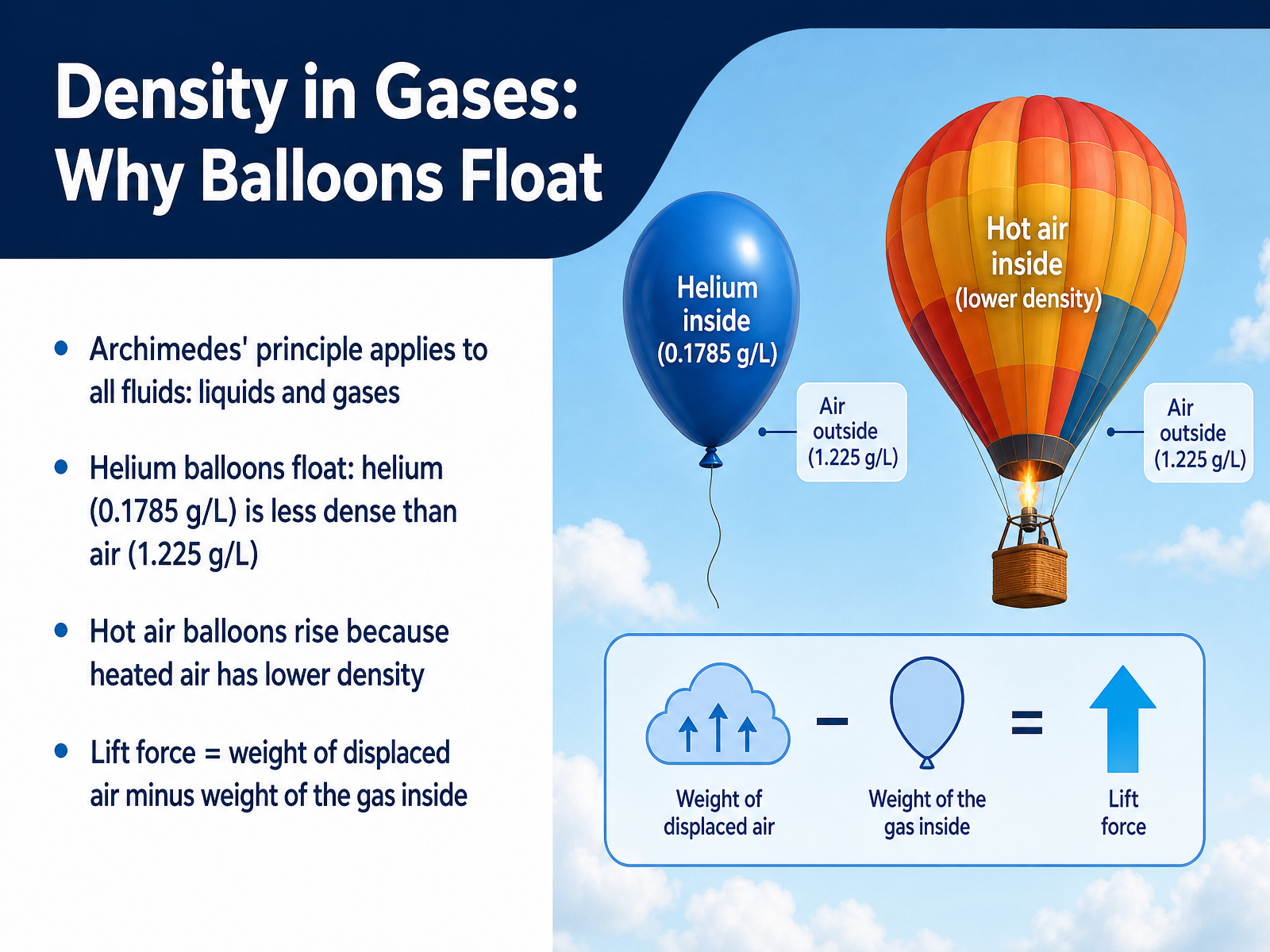
1 min - 10Density in Gases: Why Balloons FloatNow let's apply Archimedes' principle to gases. The same idea works for all fluids, not just liquids. So a balloon floats in air using the same physics as a boat floating on water. Notice what happens with a helium balloon. Helium has a density of about 0.1785 grams per liter, while air around us is about 1.225 grams per liter. Because helium is much less dense than air, the balloon displaces a volume of air that weighs more than the helium inside. The upward buoyant force exceeds the balloon's weight, and it rises. The same cause-and-effect explains hot air balloons. When air inside the balloon is heated, its density decreases. The balloon now contains a large volume of lower-density air. The surrounding cooler, denser air pushes upward with a lift force equal to the weight of the displaced air minus the weight of the hot air inside. This net upward force lifts the balloon off the ground. So whether in water or in air, an object floats when it is less dense than the fluid it displaces. Next, we will use these ideas to tackle practical problems and predict whether an object will float or sink.
 2 min
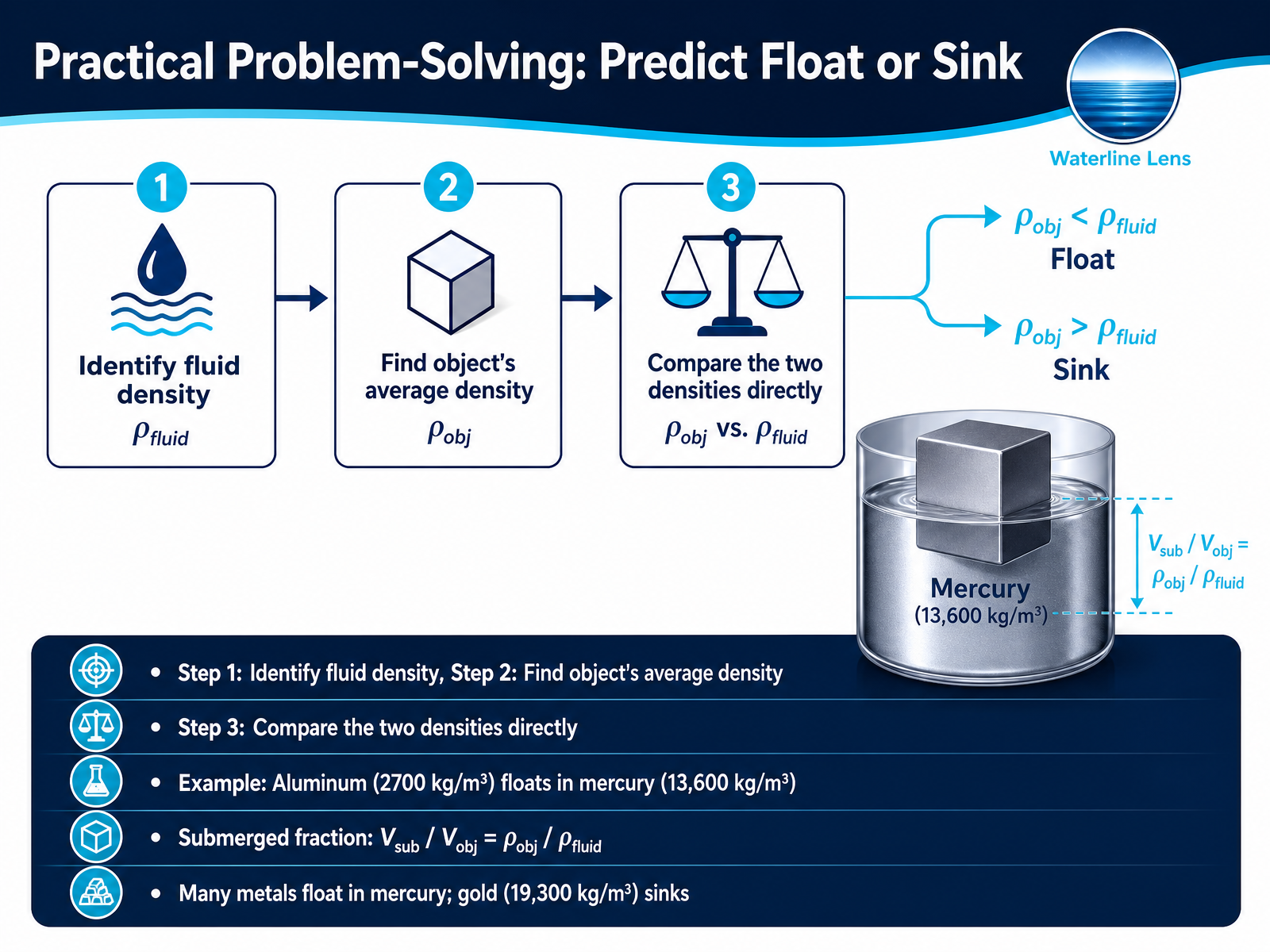
2 min - 11Practical Problem-Solving: Predict Float or SinkNow let's apply what we have learned to a practical problem. When you need to predict whether an object will float or sink, follow three clear steps. Step one: identify the density of the fluid. Step two: find the average density of the object. Step three: compare the two densities directly. If the object's density is lower than the fluid's density, it floats. If it is higher, it sinks. Take aluminum, which has a density of 2700 kilograms per cubic meter. If you place it in mercury, with a density of 13,600 kilograms per cubic meter, notice that the aluminum is much less dense. As a result, the aluminum floats on the mercury. In fact, many metals will float in mercury because mercury is so dense. Gold, however, has a density of 19,300 kilograms per cubic meter. That is greater than mercury's density, so a piece of gold will sink. You can even calculate how much of a floating object sits below the surface. The submerged fraction equals the object's density divided by the fluid's density. This gives you a precise way to describe the floating balance you observe. Next, let's address some common pitfalls and misconceptions.
 2 min
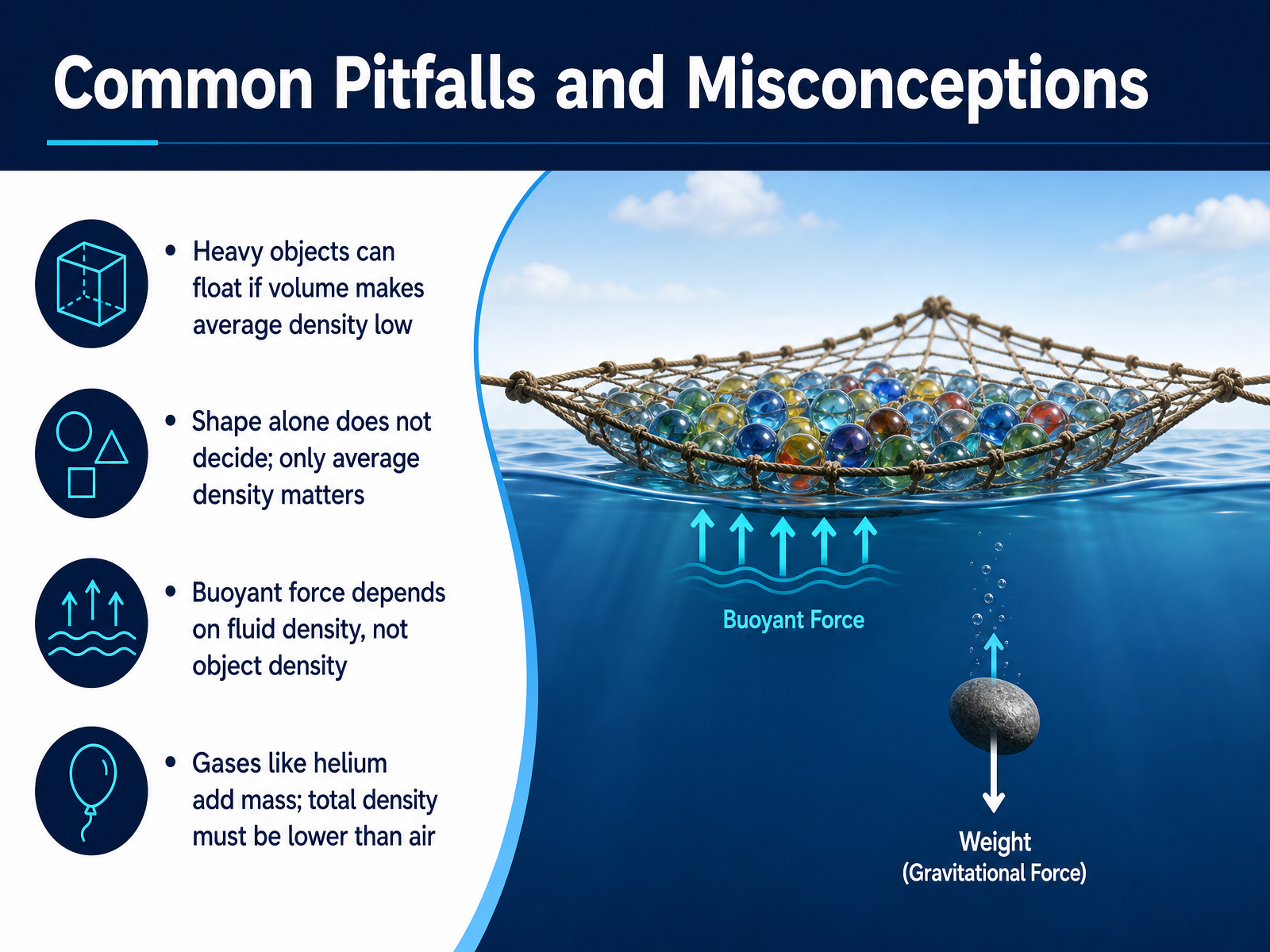
2 min - 12Common Pitfalls and MisconceptionsLet's clear up a few common misconceptions that often trip people up. First, you might think a heavy object, like a steel ship, should sink. But if its overall volume is large enough, its average density can be lower than water. That entire ship, including the hollow space inside, becomes the object we consider. Second, shape itself doesn't decide if something floats. A ball of clay sinks, and a boat shape of the same clay floats. Notice the real reason: the boat shape encloses air, which changes the average density of the whole object. Third, buoyant force depends on the fluid you're in, not the object's density. The same object will feel a stronger upward push in salt water than in fresh water because the fluid density is higher. Finally, think about helium balloons. You're not making the balloon massless; you're adding helium gas, which has much lower density than air. The total density of the balloon, rubber, string, and the helium inside must be less than the surrounding air for it to rise. In summary, always ask yourself: what is the total mass, the total volume, and the density of the fluid it's in? Let's take these principles and apply them to some everyday examples in the next slide.
 2 min
2 min - 13Applying Concepts to Everyday ExamplesNow let's apply these ideas to a few everyday examples. Think about an ice cube in a glass of water. Ice floats because it is less dense than liquid water. Even though they are the same substance, water expands when it freezes, taking up more volume for the same mass. That lower density is exactly why ice sits on top. Now consider a cork. You know it floats on water because cork is much less dense than water. But have you ever noticed that a cork sinks in air? That happens because cork is more dense than the air around it. The same logic explains oil. If you pour oil into water, the oil floats. It is less dense than water. But oil droplets in the air will sink for the same reason as the cork: oil is denser than air. Finally, picture a hot air balloon. When the air inside the balloon is heated, it expands and becomes less dense than the cooler air outside. That density difference creates an upward buoyant force. The balloon rises until its average density matches the density of the surrounding air, and then it floats at a steady height. In each case, you are watching the same cause-and-effect chain: compare densities, notice which fluid is displaced, and you can predict whether an object floats or sinks. Next, we will wrap everything up in our summary of the density-displacement-buoyancy chain.
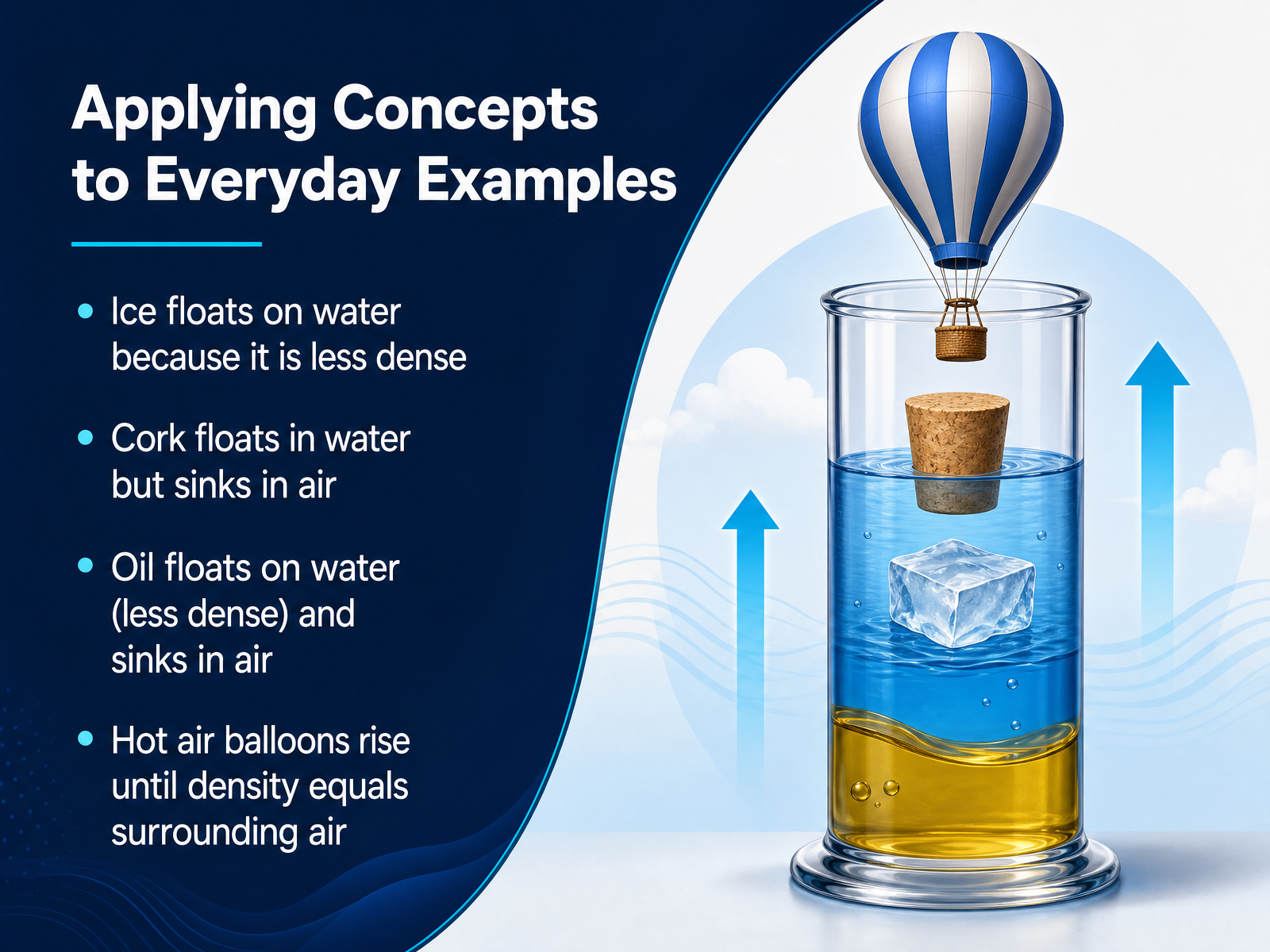 2 min
2 min - 14Summary: The Density-Displacement-Buoyancy ChainNow we arrive at the full chain. You can think of it like a logical story: density starts the process, displacement carries it forward, and the buoyant force is the final result. When you compare an object’s density to the fluid’s density, you predict what happens next. If the object is less dense than the fluid, it floats. Notice that the displaced fluid weighs more than the object, so the upward buoyant force wins. If the object is denser than the fluid, it sinks. Here, the buoyant force cannot fully balance the object’s weight. And when the two densities are exactly equal, the object suspends in neutral buoyancy, just like a submarine adjusting its trim tanks. You can test this yourself with items like ice, oil, cork, or metal objects in water. Identify their densities, compare them to water, and notice how the submerged fraction changes. This is the Density-Displacement-Buoyancy Chain working in the real world. Thank you for stepping through these principles with me today. You now have a powerful, cause-and-effect model to explain why objects float, sink, or hover. Keep observing, keep testing, and keep connecting everyday phenomena back to these core ideas.
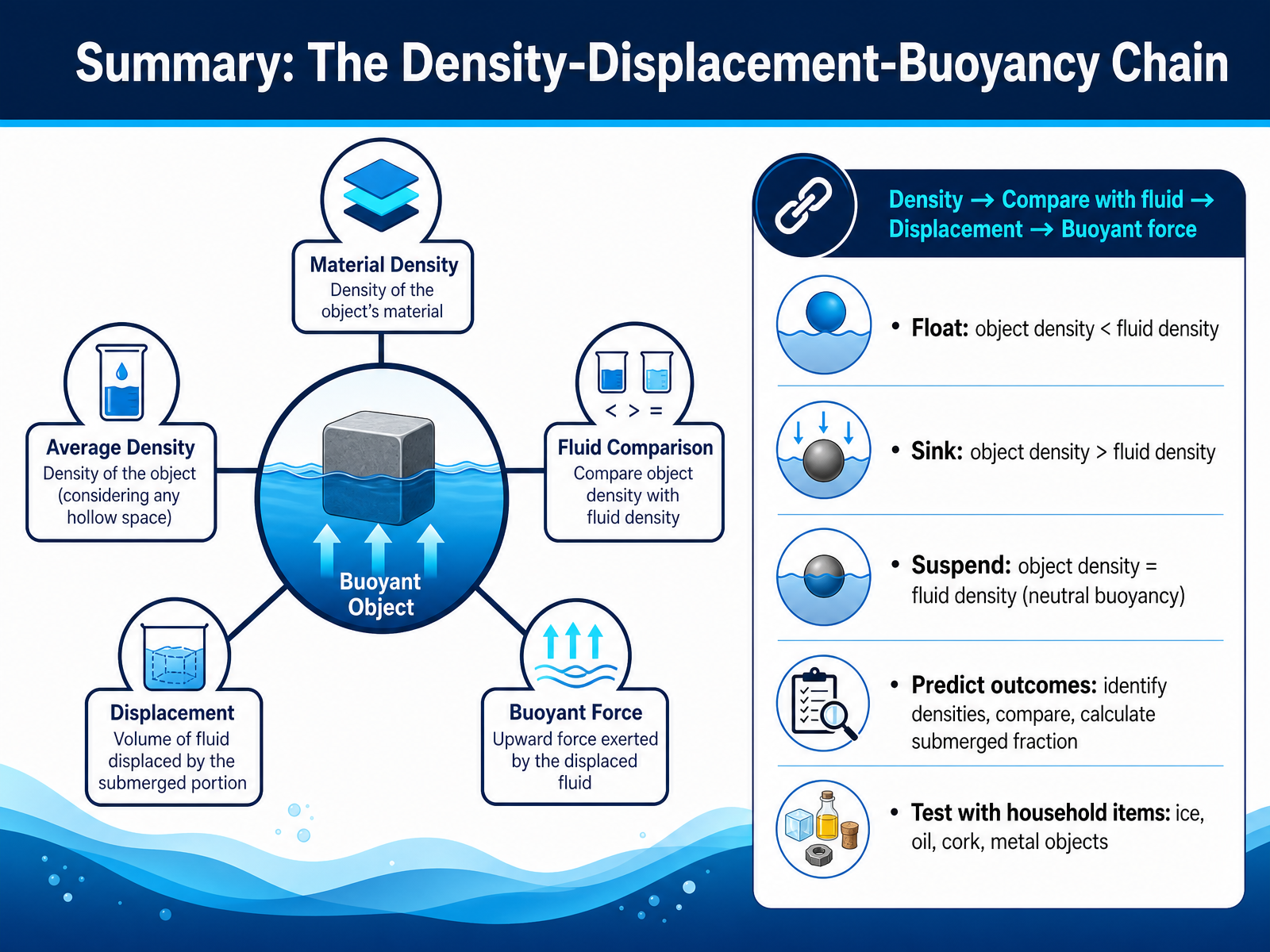 preview.physicsclassroom.comphysics.stackexchange.comphys.libretexts.org+22 min
Take the deck with you
Download this course as a file — free, no sign-up needed.
- PDF handoutEvery slide page, ready to print or share.15 pages · 3.7 MBDownload
- Narrated PowerPointThe deck that presents itself — every slide carries the digital human's narration video.15 pages · 26.6 MBDownload
- PowerPoint slidesThe full deck as a .pptx — open it in PowerPoint, Keynote, or Google Slides.15 pages · 3.6 MBDownload
Free to use in your own training — please keep the PersonWise credit page at the end.
Have your own deck? Turn it into a course
Sources consulted
Web sources consulted while building this course.
- Solids - Densities — engineeringtoolbox.com
- Table of Densities of Common Substances — thoughtco.com
- Densities of Common Materials — drill-hq.com
- Density Table for 232 Materials — densitycalculator.net
- Density Calculator — numerral.com
- EN200 – Principles of Ship Performance — usna.edu
- Diving and Surfacing - How Submarines Work — science.howstuffworks.com
- Variable-buoyancy pressure vessel — en.wikipedia.org
- https://www.marineinsight.com/submarine-design-unique-tanks-submarine/ — marineinsight.com
- How Do Submarines Submerge? The Science Behind Ballast Tanks — slashgear.com
- The Physics Classroom Tutorial — preview.physicsclassroom.com
- How to derive the formula of the buoyant force? — physics.stackexchange.com
- 27.6: Archimedes’ Principle - Buoyant Force - Physics LibreTexts — phys.libretexts.org
- Buoyant force (article) | Fluid statics — khanacademy.org
- Deriving buoyant force from first principles — physics.stackexchange.com