Begin
15 pages · ~30 min
DevOps Roadmap: Priorities & Milestones
This training guides DevOps teams in setting priorities, defining milestones, and communicating progress to align stakeholders and deliver roadmap goals effectively.
A digital instructor presents all 15 pages. Hold “Ask” at any point and ask out loud — the answer comes from this course. No sign-up needed.
What you’ll learn
- 01DevOps Roadmap: Priorities, Milestones, and CommunicationWelcome. Over the next fifteen slides, we will build a working DevOps roadmap you can defend to your executive team, quarter by quarter. The priorities come first, and that choice matters most. If you broaden capability everywhere at once, you delay every outcome and prove nothing. So we pick a narrow sequence, set milestones that make progress provable, and agree how we communicate when plans change. The evidence backs this sequencing. In platform engineering research, seventy-three percent of mature organizations say platform maturity drove their AI success, against forty-four percent of less mature ones. That gap is not tooling. It is order of operations. Organizations with standardized platforms report ninety-two percent confidence in AI outputs and fifty-two percent fully automated audit trails. So our method starts with a baseline assessment, converts each priority into a measurable checkpoint, then reports progress in business language. As we go, ask one question of every milestone: will this hold up in a quarterly review? Next, let us look at why sequencing matters more than tooling.puppet.comperforce.cominfoq.com+22 min
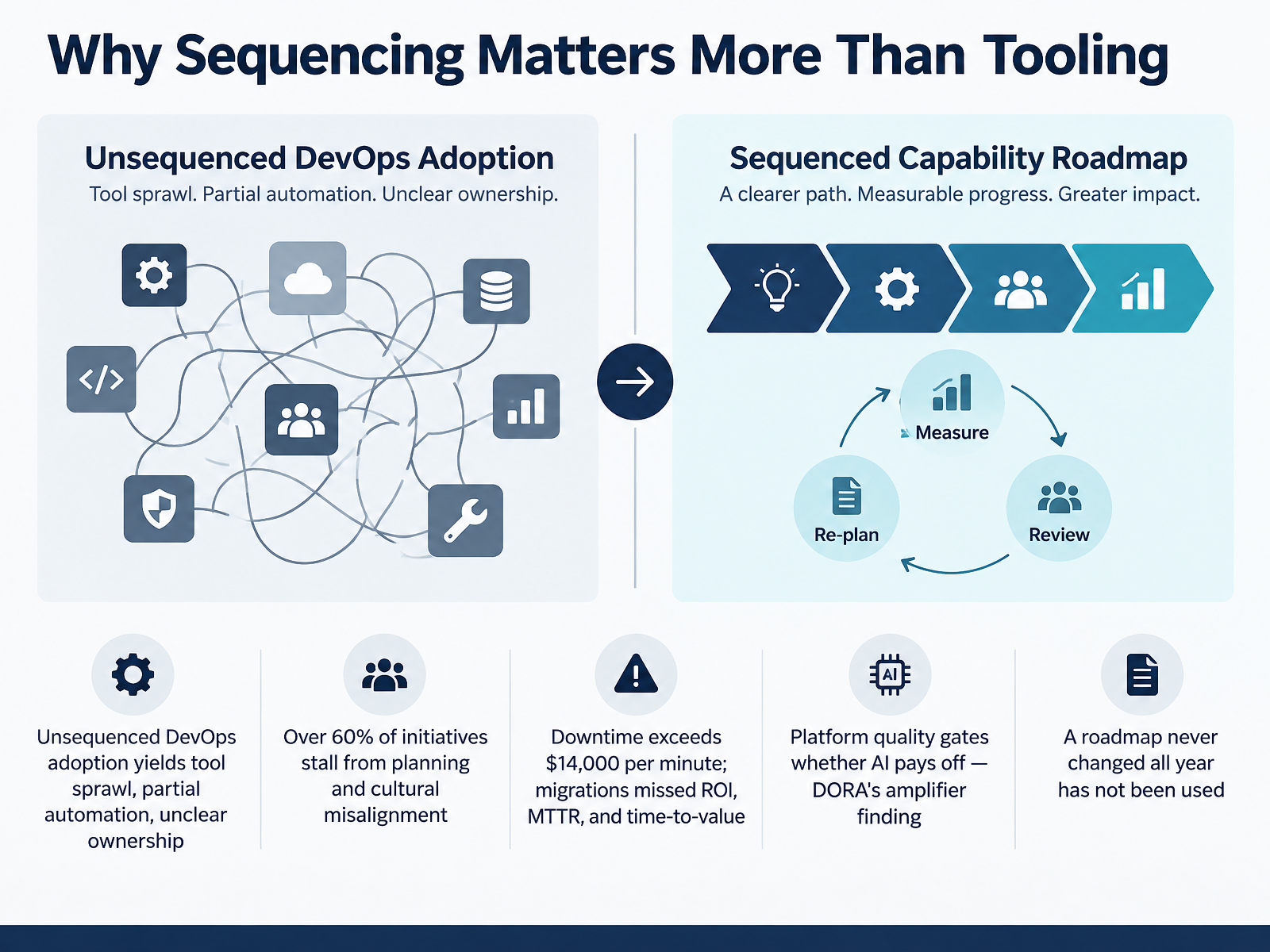
- 02Why Sequencing Matters More Than ToolingLet's talk about why sequencing matters more than tooling. Unsequenced adoption gives you tool sprawl, partial automation, and unclear ownership. Over sixty percent of initiatives stall from planning and cultural misalignment, not tooling gaps. The cost of getting this wrong is real: unplanned downtime exceeds fourteen thousand dollars per minute, and most platform migrations miss their ROI, MTTR, and time-to-value targets. Here is the finding that should change your sequencing: platform quality gates whether AI pays off at all. When platform quality is high, AI's effect on performance is strongly positive. When it is low, the effect is negligible. Your platform is the amplifier, and it amplifies whatever you already have, good or bad. So treat sequencing as a governance decision, not a technology decision. Name an owner for each milestone, tie funding to measurable outcomes, and review progress monthly. One last test: a roadmap that never changed all year has not been used. If nothing moved, you have a document, not a plan. Next, we move to baselining your delivery capability without assessment theater.
 puppet.complatformengineering.orgplatformengineering.org+22 min
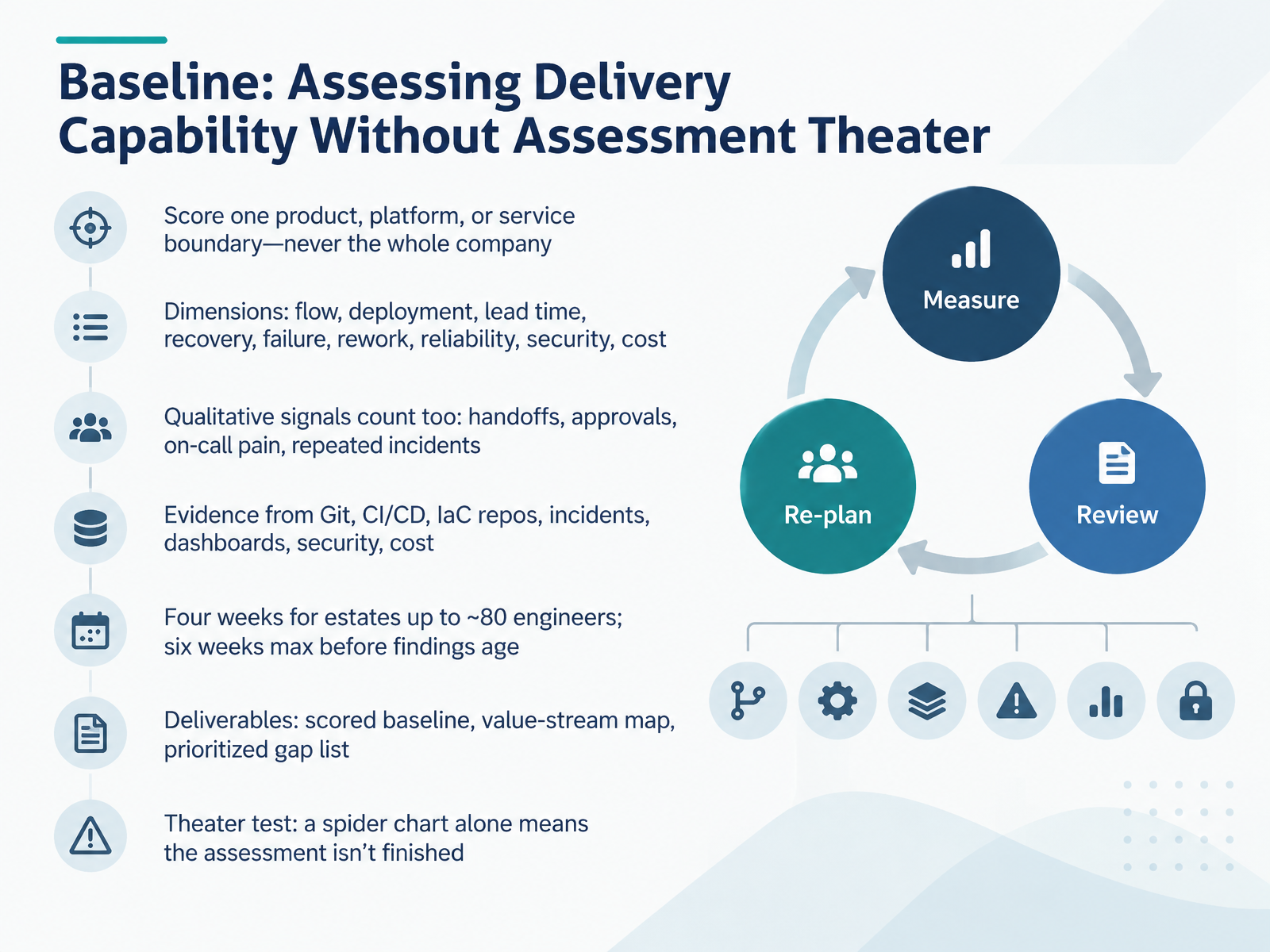
 - 03Baseline: Assessing Delivery Capability Without Assessment TheaterLet's talk about how you baseline delivery capability without turning it into assessment theater. The decision here is scope: score one product, platform, or service boundary, never the whole company. A company-wide score produces averages that hide your real bottlenecks and gives every owner an excuse to wait. With one boundary, you get findings you can act on this quarter. Measure eight dimensions: flow, deployment, lead time, recovery, failure, rework, reliability, security, and cost. Pull evidence from Git, CI/CD, infrastructure repositories, incident records, dashboards, security findings, and cost reports. Qualitative signals count too: handoffs, approvals, on-call pain, and repeated incidents. On timeline, four weeks covers estates up to roughly eighty engineers, and six weeks is the hard ceiling before findings age out. Here is the theater test. If your deliverable is a spider chart alone, the assessment is not finished. You need a scored baseline, a value-stream map, and a prioritized gap list. Next, we will look at reading the numbers: DORA, flow, and what they do not tell you.
 dora.devdora.devdora.dev+22 min
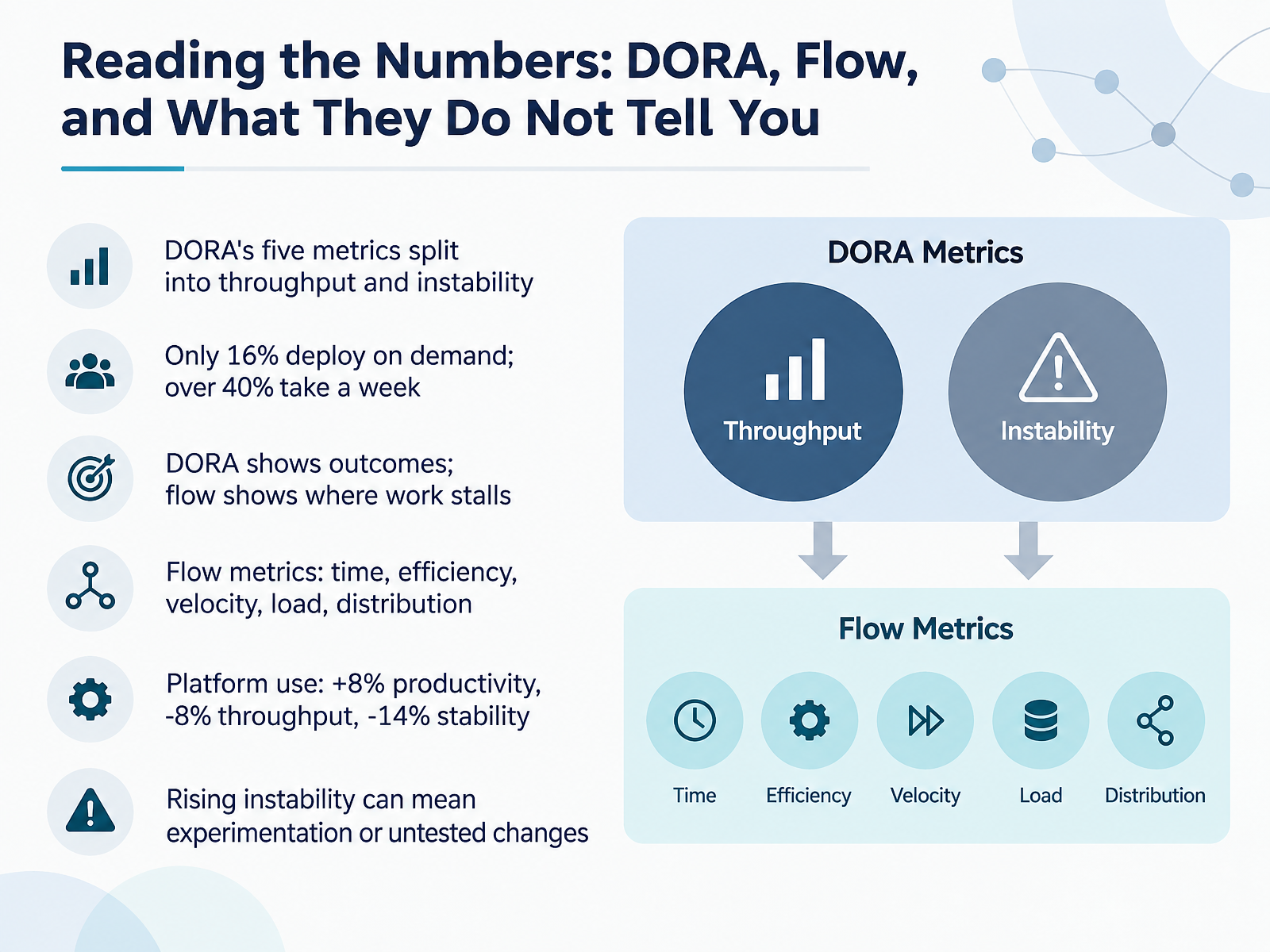
 - 04Reading the Numbers: DORA, Flow, and What They Do Not Tell YouLet us read the numbers properly. DORA's five metrics split into two groups: throughput, which covers change lead time, deployment frequency, and failed deployment recovery time, and instability, which covers change fail rate and deployment rework rate. Here is the constraint. Only sixteen percent of organizations deploy on demand, and over forty percent take more than a week to reach production. DORA shows you outcomes; it cannot show you where work stalls. For that, you need flow metrics: flow time, flow efficiency, flow velocity, flow load, and flow distribution. One caution before you act. Teams using a platform reported about eight percent higher productivity, but eight percent lower throughput and fourteen percent lower change stability. Rising instability is not automatically bad. It can mean healthy experimentation, or it can mean untested changes reaching customers. Check recovery time and user impact to tell the difference. Next, we move to the priority model, choosing what comes first.
 dora.devdora.devdora.dev+22 min
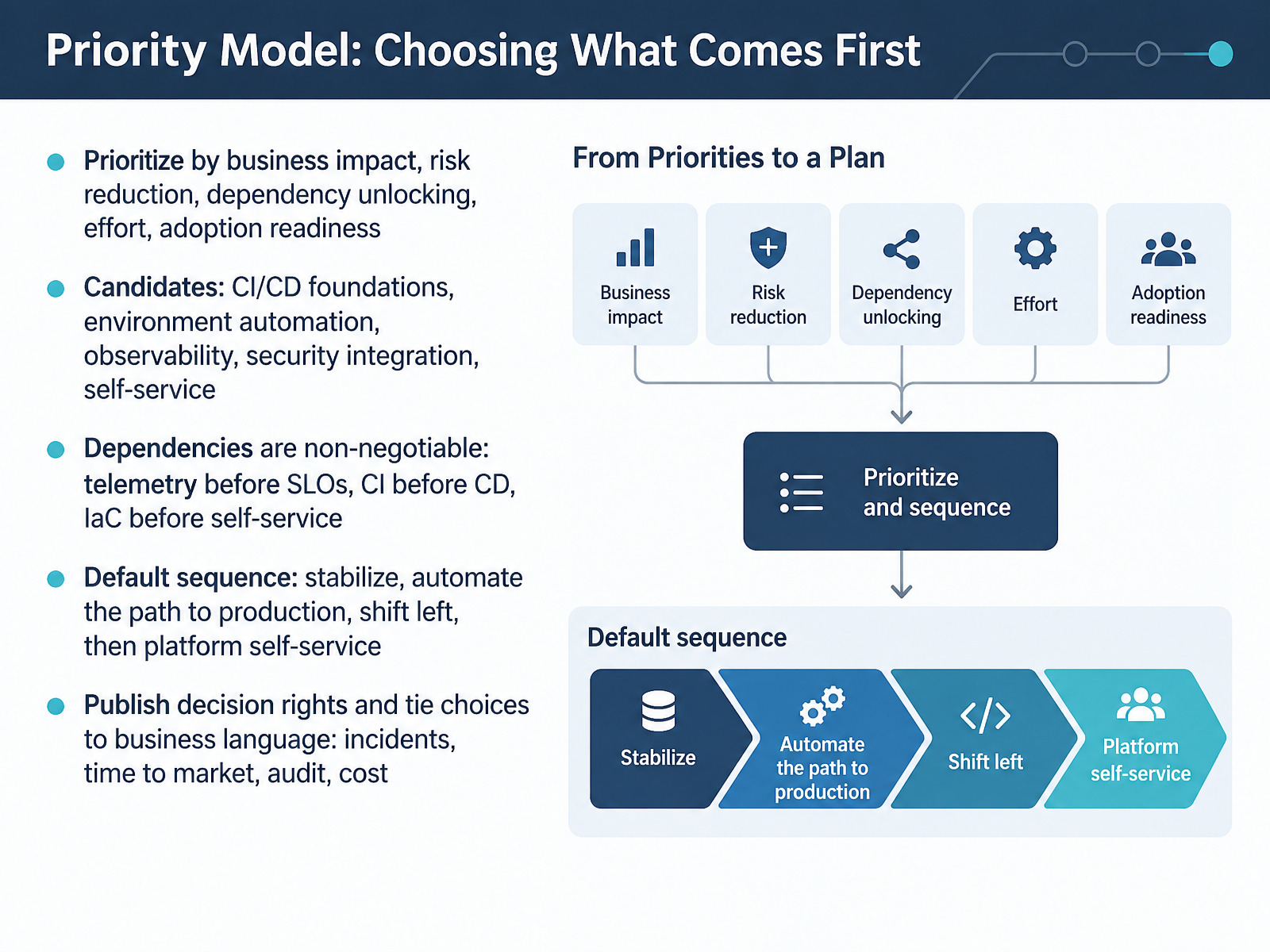
 - 05Priority Model: Choosing What Comes FirstLet us talk about how you choose what comes first. Priority goes to whatever moves business impact, reduces risk, unlocks dependencies, or proves adoption readiness. Your candidates are continuous integration and delivery foundations, environment automation, observability, security integration, and self-service. Dependencies are non-negotiable here. Telemetry must exist before service level objectives. Continuous integration must work before continuous delivery. Infrastructure as code must be in place before self-service makes sense. So the default sequence is stabilize, automate the path to production, shift left on quality and security, then open platform self-service. Publish who decides, and tie every choice to business language. Incidents, time to market, audit findings, and cost. That keeps priority debates about outcomes, not preferences. Milestone Design: Making Progress Provable.
 tag-app-delivery.cncf.iodevopsschool.orgdevopsbible.com+21 min
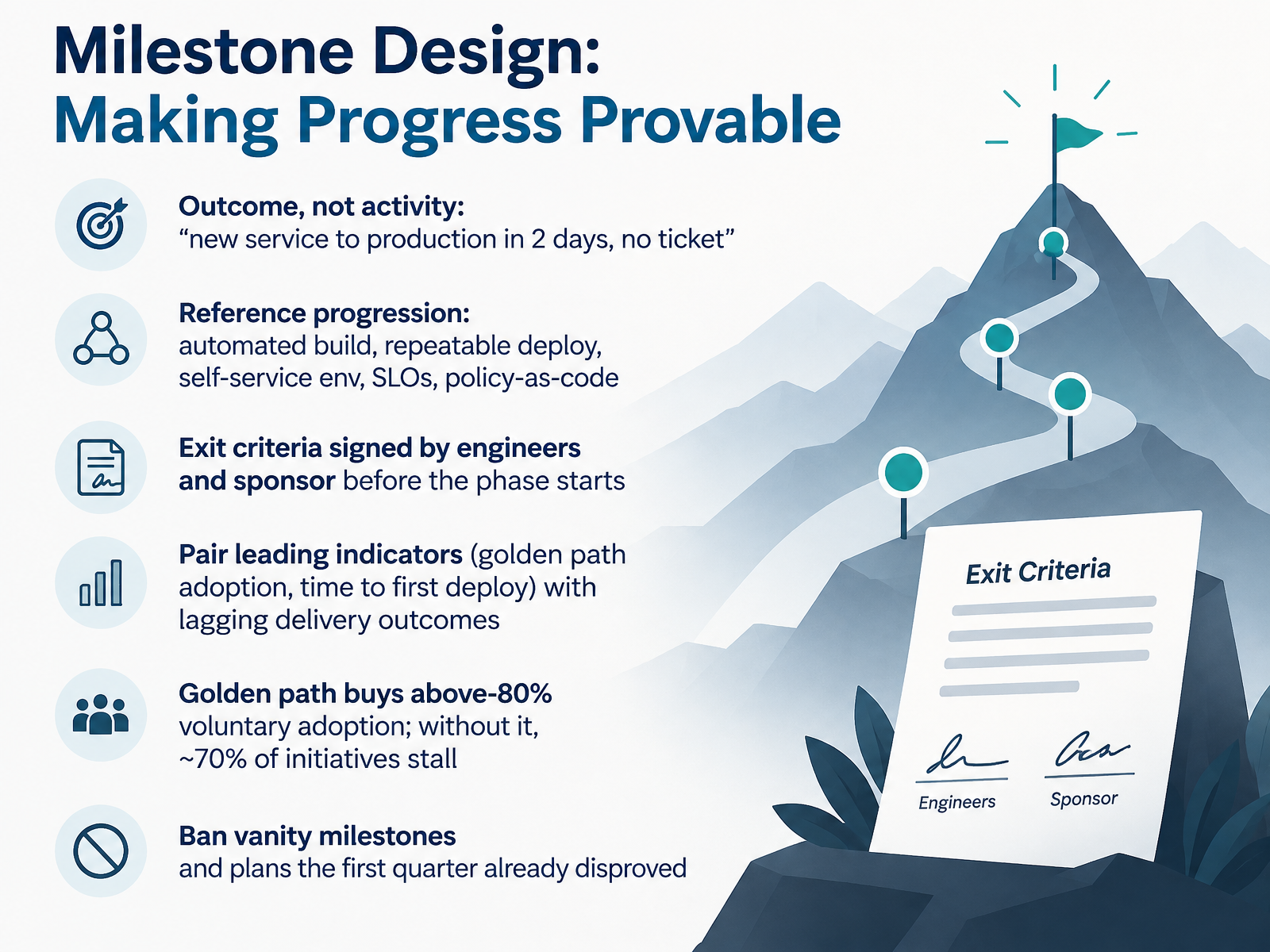
 - 06Milestone Design: Making Progress ProvableLet's talk about designing milestones that make progress provable. Milestones must be outcomes, not activities. Here is the standard you are aiming for: a new service reaches production in two days, with no ticket raised.
Build the sequence in a clear order. First, automated builds. Then repeatable deploys. Then self-service environments. Then service level objectives. Finally, policy as code. Each step earns its place before the next one starts.
Now the commitment that protects you: engineers and the executive sponsor sign the exit criteria before the phase begins, not after. Pair leading indicators, such as golden path adoption and time to first deploy, with lagging delivery outcomes, so you see movement early without waiting a quarter.
The evidence is blunt. A well-designed golden path buys voluntary adoption above eighty percent. Without one, roughly seventy percent of platform initiatives stall.
So ban vanity milestones, and ban any plan the first quarter has already disproved. If you cannot name the owner, the dependency, and the metric a milestone moves, do not fund it.
Next, we move into phasing the roadmap: from foundation to scale.
 tenhaw.comeficode.comstackguardian.io+22 min
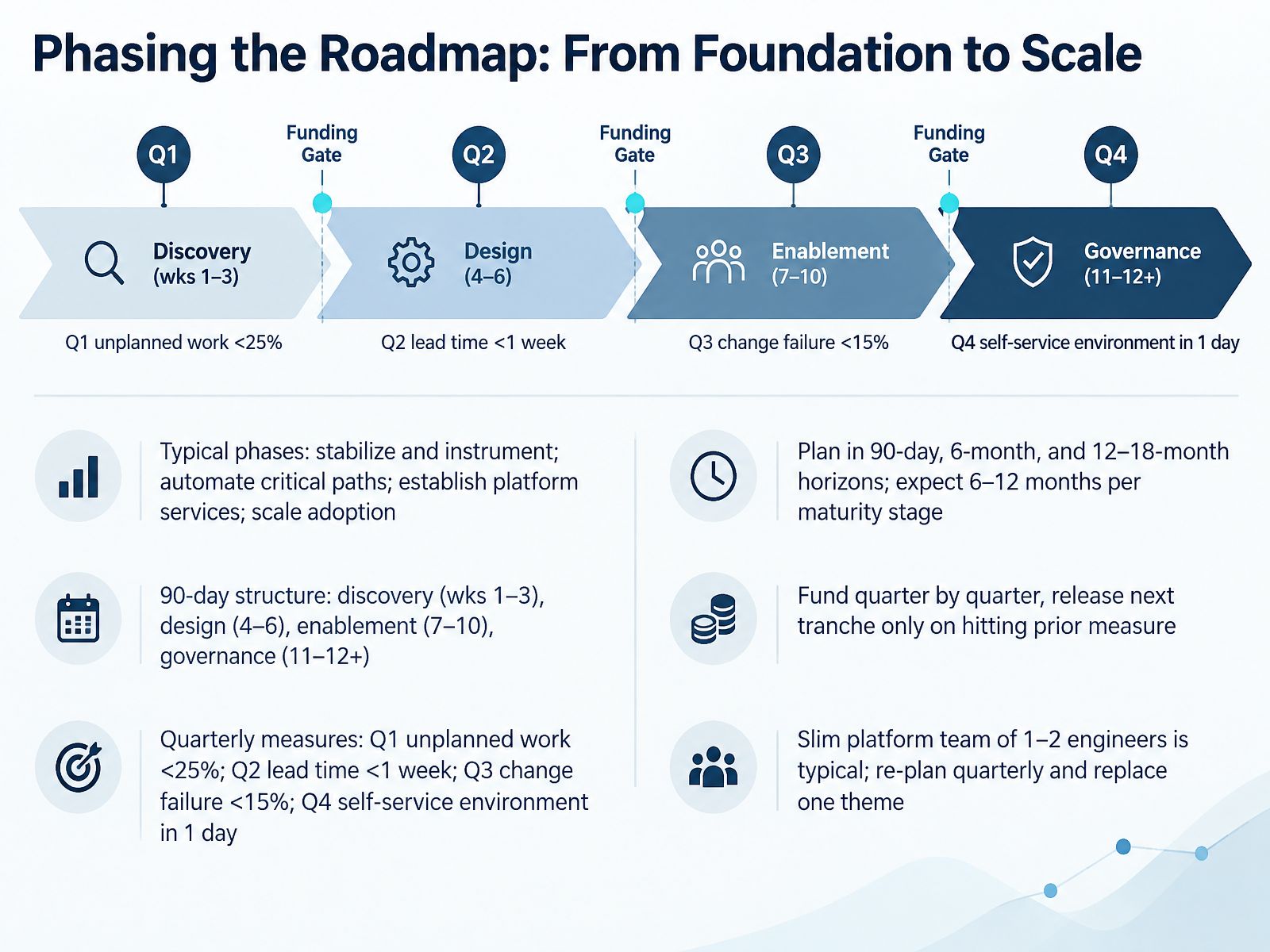
 - 07Phasing the Roadmap: From Foundation to ScaleLet's talk about phasing. Fund this quarter by quarter, and release the next tranche of money only when the previous quarter's measure is hit. That single funding rule keeps the roadmap honest and protects you from a twelve-month lump sum. Within each ninety days, run a fixed sequence: discovery in weeks one to three, design in weeks four to six, enablement in weeks seven to ten, then governance from week eleven onward. Expect six to twelve months per maturity stage, so plan across ninety-day, six-month, and twelve to eighteen-month horizons. Now the measures. Quarter one: unplanned work below twenty-five percent of capacity. Quarter two: lead time under one week. Quarter three: change failure rate under fifteen percent. Quarter four: a self-service environment provisioned unaided in one day. Agree these now, with named owners. Keep the platform team slim, one or two engineers is typical, and re-plan every quarter, replacing one theme as evidence changes. Next, we move to the operating model: teams, ownership, and decision rights.
 tag-app-delivery.cncf.iodevopsschool.orgdevopsbible.com+22 min
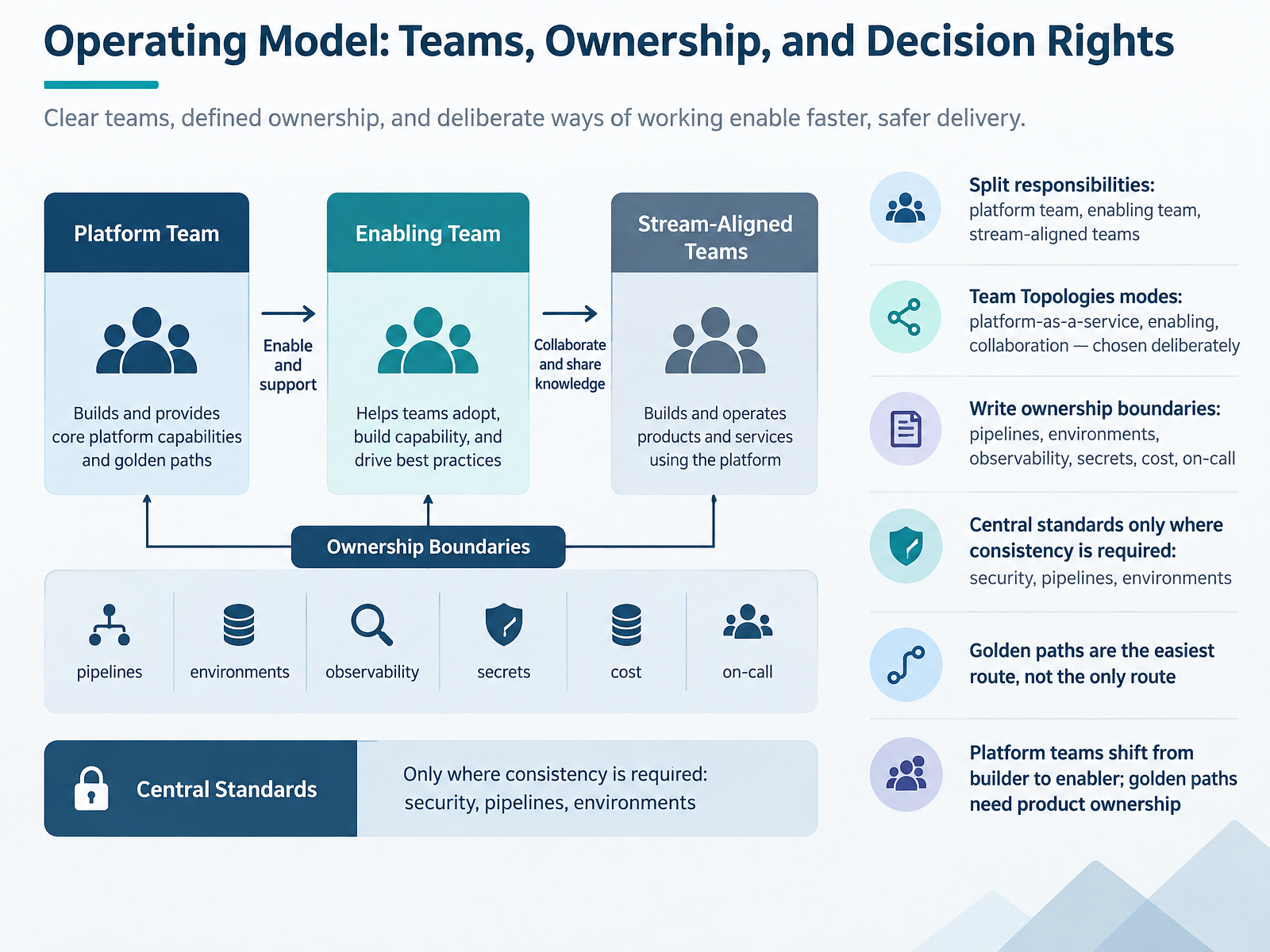
 - 08Operating Model: Teams, Ownership, and Decision RightsNow let's talk about the operating model, because structure decides whether your roadmap actually lands. Our recommendation is to split responsibilities deliberately across three team types: a platform team, an enabling team, and stream-aligned teams. You should choose the Team Topologies mode on purpose, whether that is platform-as-a-service, enabling, or collaboration, and write the rationale down so nobody argues about it later. Then define ownership boundaries in writing for pipelines, environments, observability, secrets, cost, and on-call. The sequencing matters here: keep central standards only where consistency is genuinely required, which in practice means security, pipelines, and environments. Everywhere else, let teams choose. Golden paths must be the easiest route to production, not the only route, so teams adopt them by choice rather than by mandate. That leads to the consequence you need to fund: platform teams shift from builder to enabler, and golden paths need real product ownership, with a named owner, a roadmap, and adoption metrics. Next, we turn to metrics and feedback loops for roadmap steering.
 tag-app-delivery.cncf.iodevopsschool.orgdevopsbible.com+22 min
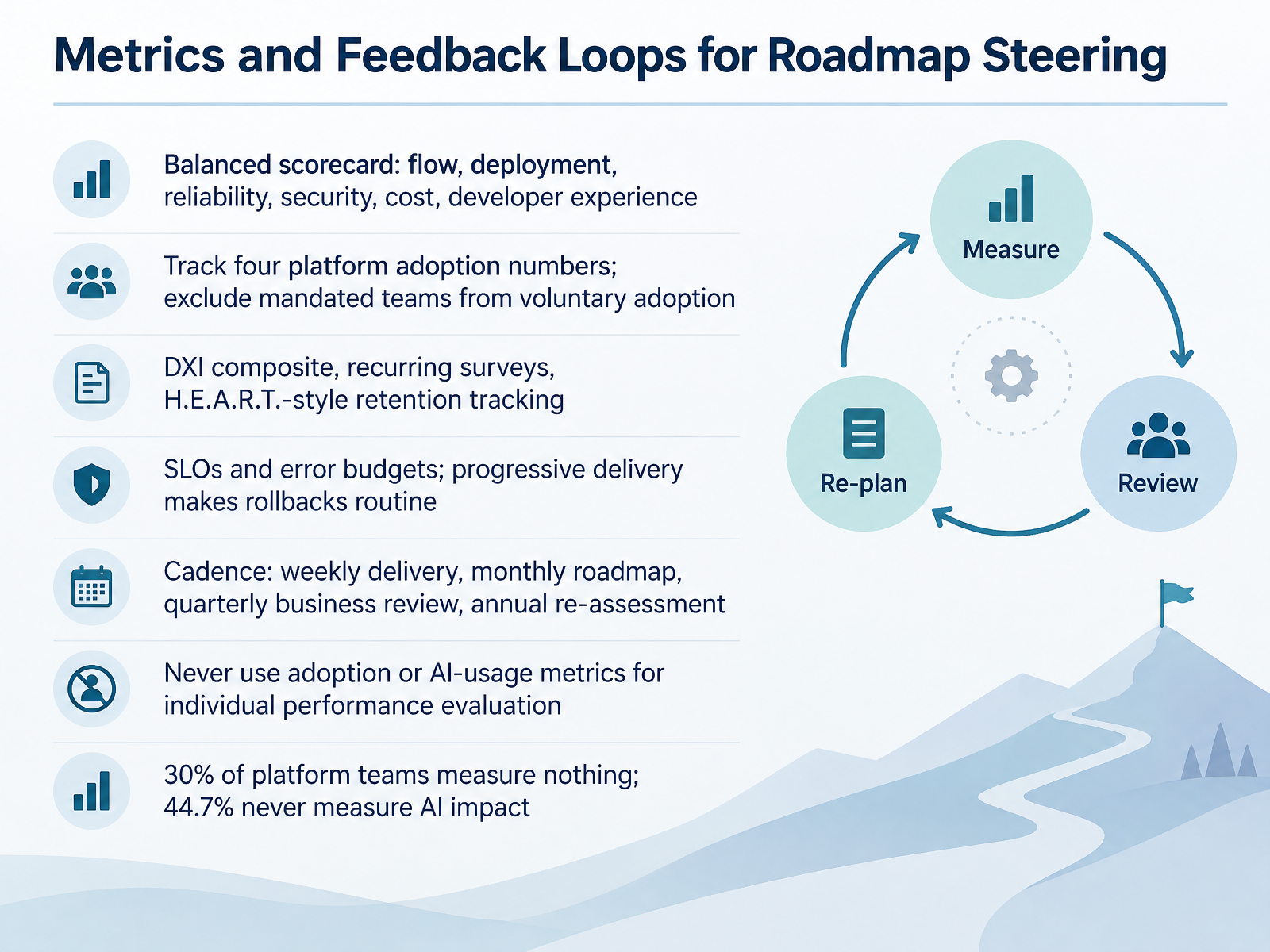
 - 09Metrics and Feedback Loops for Roadmap SteeringNow let's talk about how you steer the roadmap, using metrics and feedback loops. Pick one balanced scorecard and hold it steady: flow, deployment, reliability, security, cost, and developer experience. Track four platform adoption numbers, and exclude mandated teams from voluntary adoption, so the number reflects choice. Add a recurring survey index and retention tracking. Set service level objectives with error budgets, and use progressive delivery so rollbacks become routine. Agree one cadence: weekly delivery, monthly roadmap, quarterly business review, annual re-assessment. And one rule you must approve: never use adoption or AI-usage metrics for individual performance evaluation. Today, roughly thirty percent of platform teams measure nothing, and nearly forty-five percent never measure AI impact. So let's fix that gap, and move on to the communication strategy for each stakeholder group.
 dora.devdora.devdora.dev+21 min
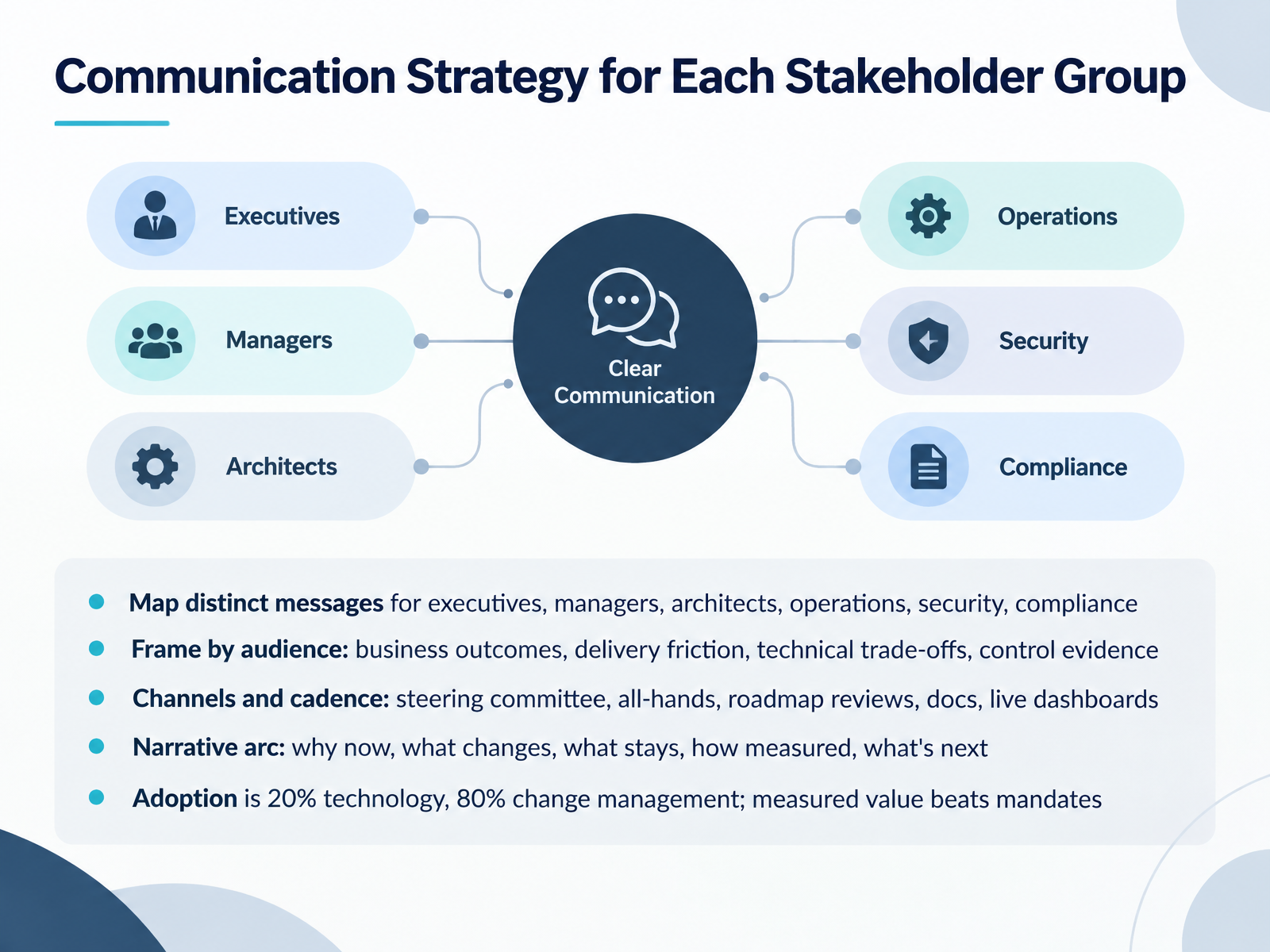
 - 10Communication Strategy for Each Stakeholder GroupSo let's talk communication. The decision here is this: one message does not fit every stakeholder, and trying to send one is how change programs stall. Executives, managers, architects, operations, security, and compliance each need a different frame, and you should approve those frames before rollout, not during it. Executives need business outcomes. Managers need delivery friction removed. Architects and operations need the technical trade-offs stated honestly. Security and compliance need control evidence, not reassurance. And by the way, platform adoption is twenty percent technology and eighty percent change management, so the plan you approve is a communication plan as much as a build. That said, don't confuse frequency with clarity. More updates will not fix a vague narrative. So use the channels you already have, the steering committee, the all hands, roadmap reviews, written docs, live dashboards, each with a named owner and a fixed cadence. Every message should follow one narrative arc: why now, what changes, what stays, how we measure it, and what comes next. And measured value beats mandates. If the numbers show less friction and fewer incidents, people follow. Otherwise you are just issuing orders. Next, we will look at the risk register and early warning indicators that tell you when this messaging, or the roadmap itself, is drifting off course.
 puppet.complatformengineering.orgplatformengineering.org+22 min
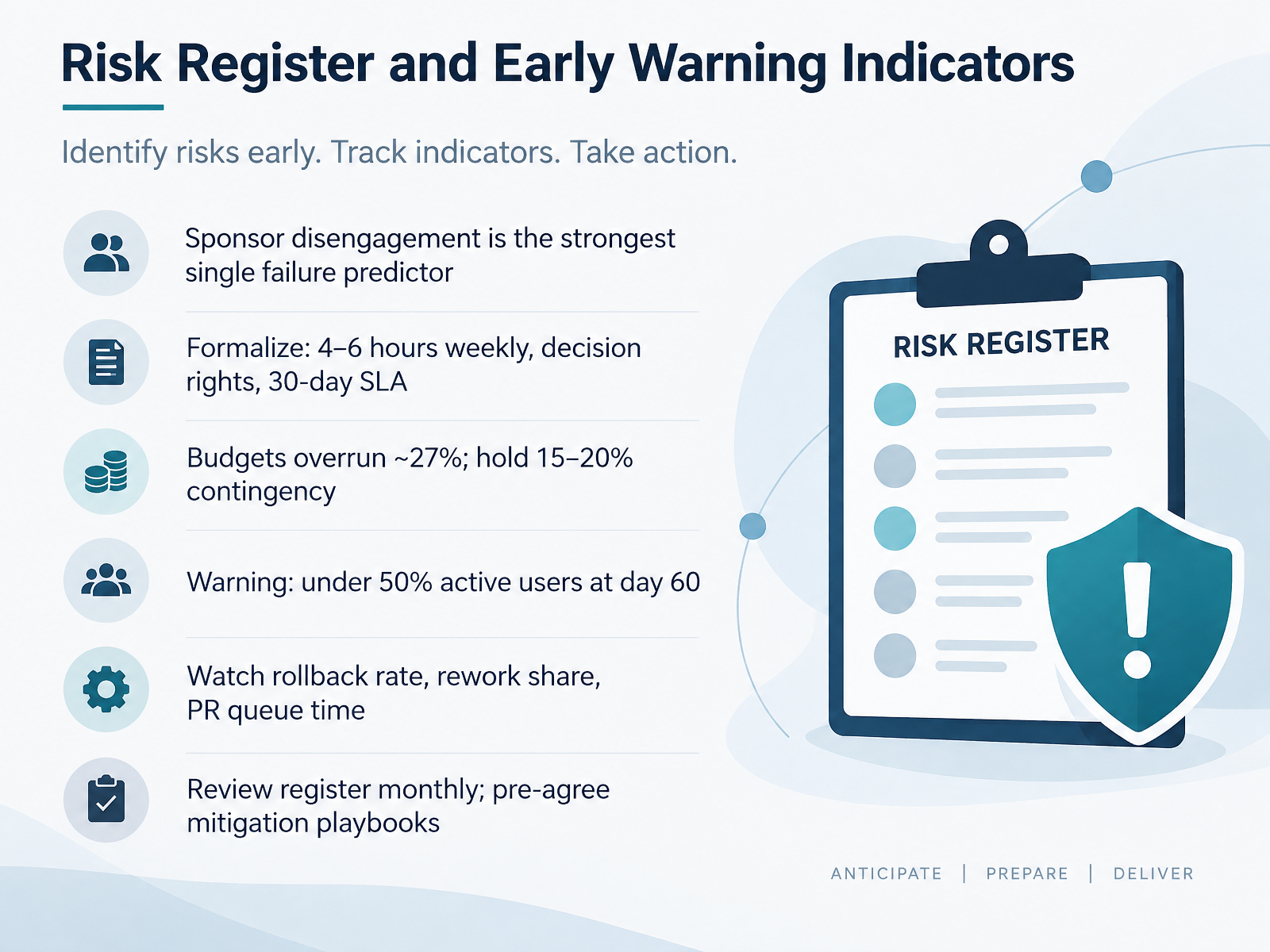
 - 11Risk Register and Early Warning IndicatorsLet's talk about the early warning system that separates a managed risk from a crisis. Sponsor disengagement is the strongest single predictor of transformation failure, so formalize that role. Ask for four to six hours a week, explicit decision rights, and a thirty-day conflict resolution service level agreement. Second, protect the budget. Programs overrun by roughly twenty-seven percent, so hold fifteen to twenty percent contingency with a defined access process. Then watch the leading indicators, not just the financials. If active users fall below fifty percent of licensed users at day sixty, trigger a root cause investigation within two weeks. Also track rollback rate, rework share, and pull request queue time, because those tell you where delivery is stalling. Finally, review the register monthly, and pre-agree mitigation playbooks before you need them. Next, we'll walk through a worked example of a twelve-month roadmap in practice.
 dora.devdora.devdora.dev+22 min
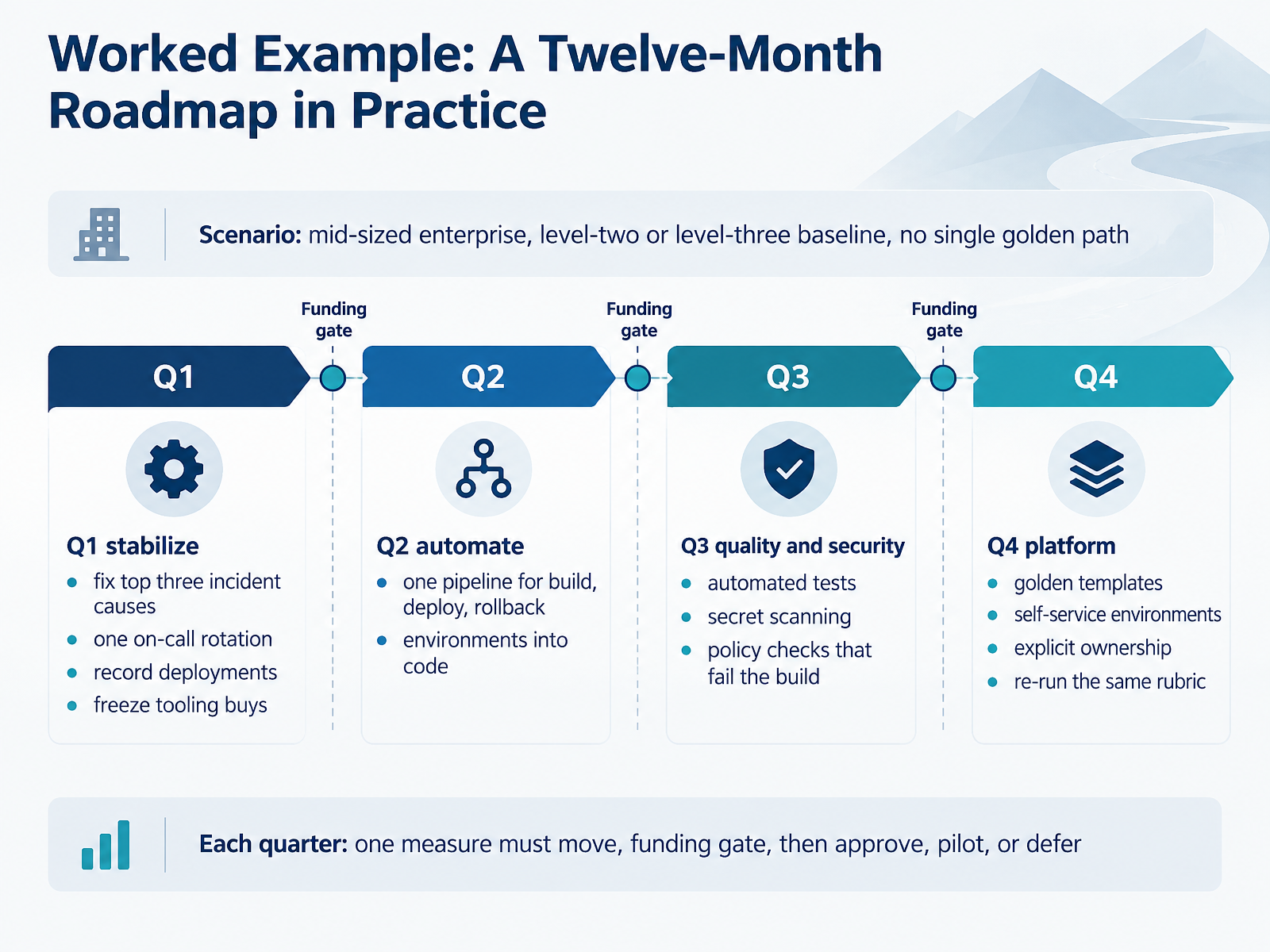
 - 12Worked Example: A Twelve-Month Roadmap in PracticeLet's look at what a twelve-month roadmap actually looks like in practice. Picture a mid-sized enterprise at a level-two or level-three baseline, with no single golden path. In quarter one, you stabilize: fix the top three incident causes, stand up one on-call rotation, start recording deployments, and freeze new tooling purchases. In quarter two, you automate: one pipeline for build, deploy, and rollback, with environments defined in code. In quarter three, you shift quality and security left: automated tests, secret scanning, and policy checks that fail the build. In quarter four, you build the platform: golden templates, self-service environments, and explicit ownership for every service, then re-run the same rubric. Each quarter, one measure must move, and funding is gated on it. You then approve, pilot, or defer the next phase. Now let's examine avoiding the predictable failure modes.
 tag-app-delivery.cncf.iodevopsschool.orgdevopsbible.com+21 min
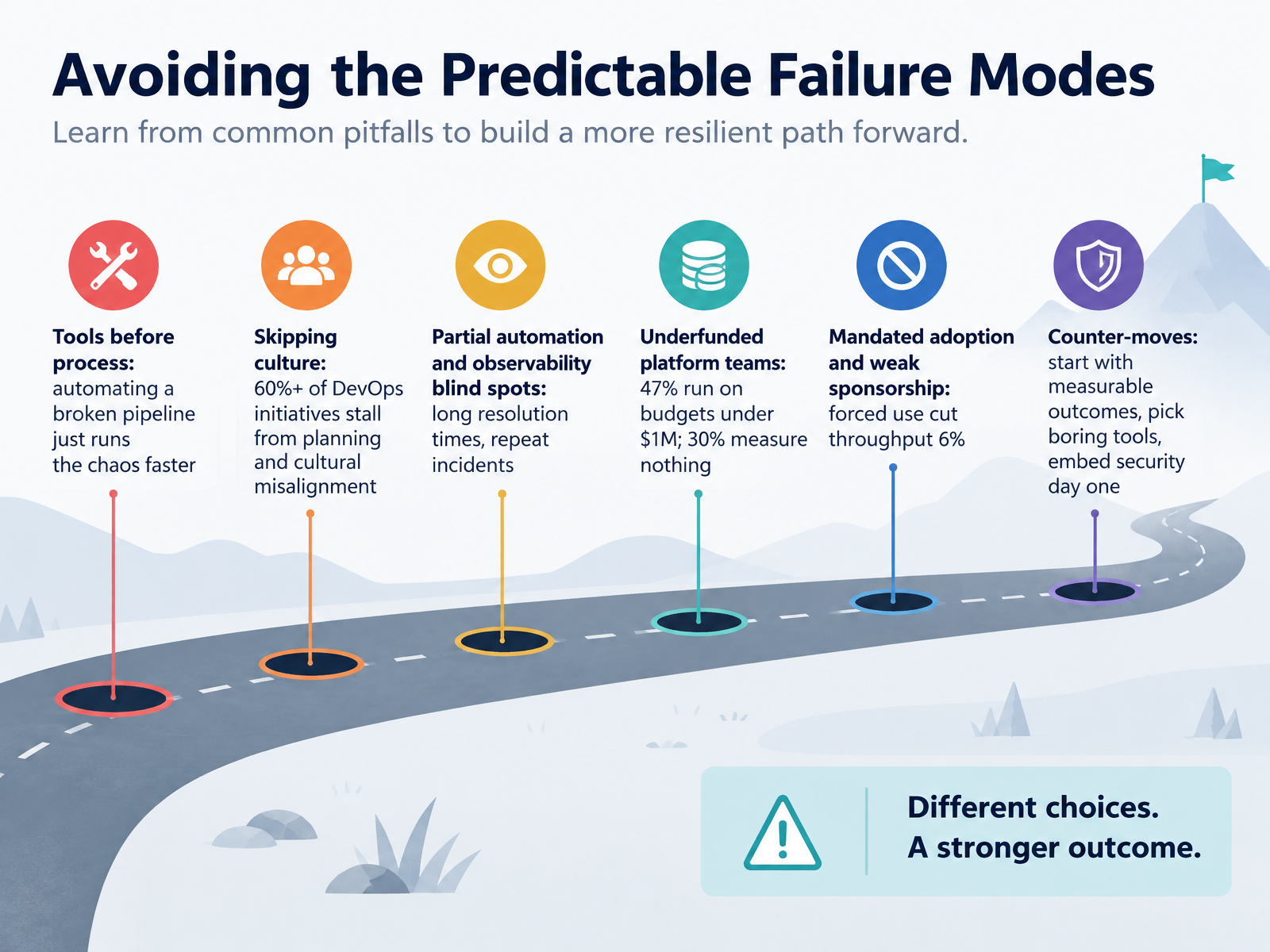
 - 13Avoiding the Predictable Failure ModesLet's talk about the failure modes we can predict, and therefore prevent. The most expensive mistake is buying tools before fixing process, because automating a broken pipeline just runs the chaos faster. The second is skipping culture. Over sixty percent of DevOps initiatives stall from poor planning and cultural misalignment, not from tooling gaps. Third, partial automation and observability blind spots. When you cannot see what changed or what broke, resolution times stretch and incidents repeat. Fourth, underfunded platform teams. Nearly half run on budgets under one million dollars, and about thirty percent measure nothing at all, so they cannot prove value or defend their funding. Fifth, mandated adoption with weak sponsorship. Forced use cut throughput by six percent in the data we reviewed. So here are the counter-moves we want you to approve. Start with measurable outcomes tied to DORA metrics. Choose boring, proven tools. Embed security from day one. And treat adoption as change management, roughly twenty percent technology and eighty percent people. Now let's turn those counter-moves into your first ninety days, in the next section: First 30/60/90-Day Actions for Your Own Organization.
 puppet.complatformengineering.orgplatformengineering.org+22 min
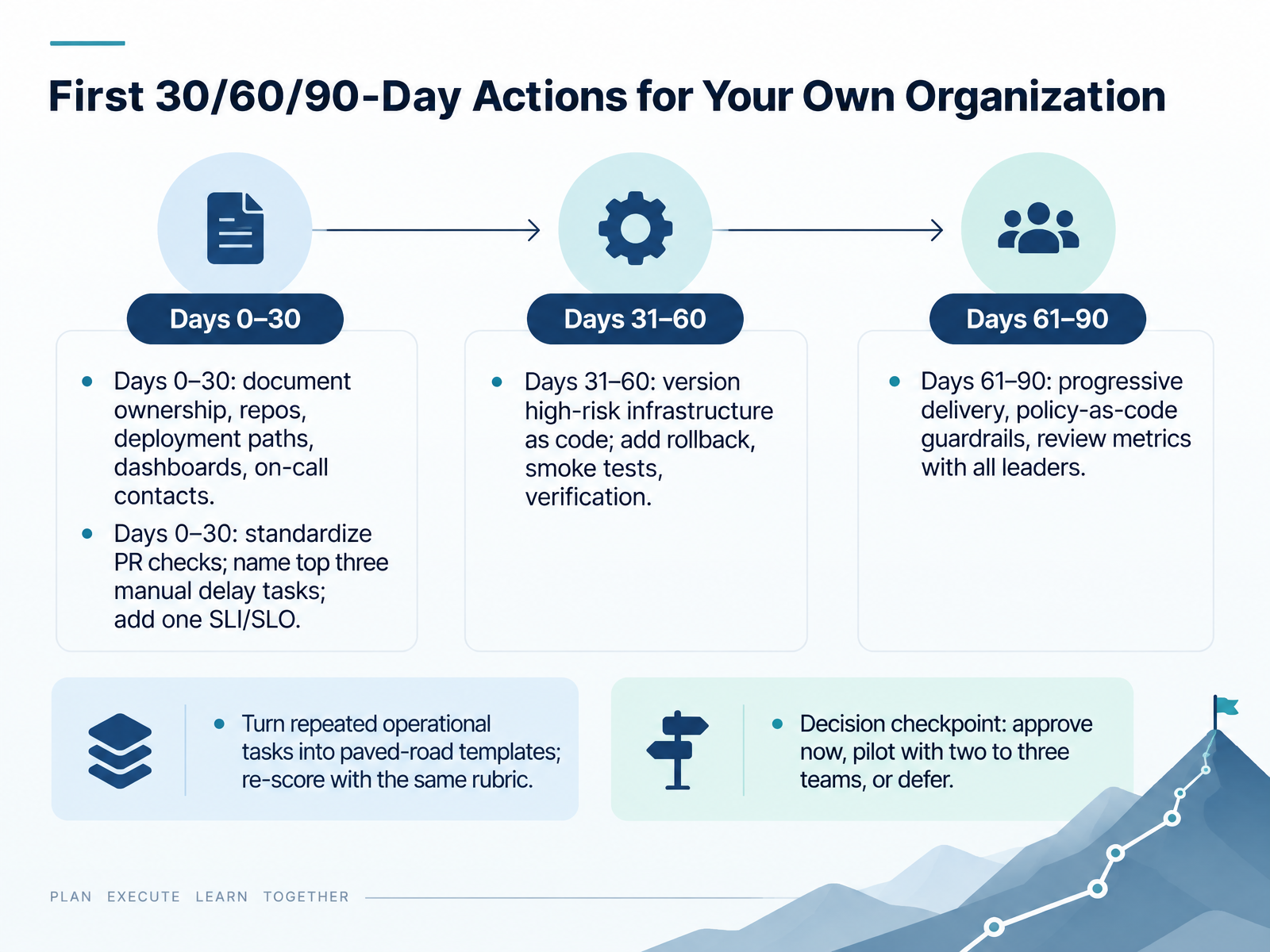
 - 14First 30/60/90-Day Actions for Your Own OrganizationNow let's make this concrete for your own organization. This is the decision in front of you: approve the first ninety days today, pilot it with two or three teams, or defer. If you approve, the first thirty days are about visibility, not tooling. You document ownership, repositories, deployment paths, dashboards, and on-call contacts, standardize pull request checks, name the top three manual tasks causing delay, and add one service level indicator with a target for a critical service. From day thirty-one to sixty, you move risk off manual hands. Version your highest-risk infrastructure changes as code, then add rollback steps, smoke tests, and post-deployment verification to those release workflows. From day sixty-one to ninety, you widen the impact. Introduce progressive delivery for high-impact services, add policy-as-code guardrails, and turn repeated operational tasks into paved-road templates. Then review change lead time, change failure rate, and adoption with product, security, and operations leaders, using the same rubric you started with so the delta is real rather than rhetorical. Next, Synthesis: One-Page Roadmap, Risks, and Next Steps.
 tag-app-delivery.cncf.iodevopsschool.orgdevopsbible.com+22 min
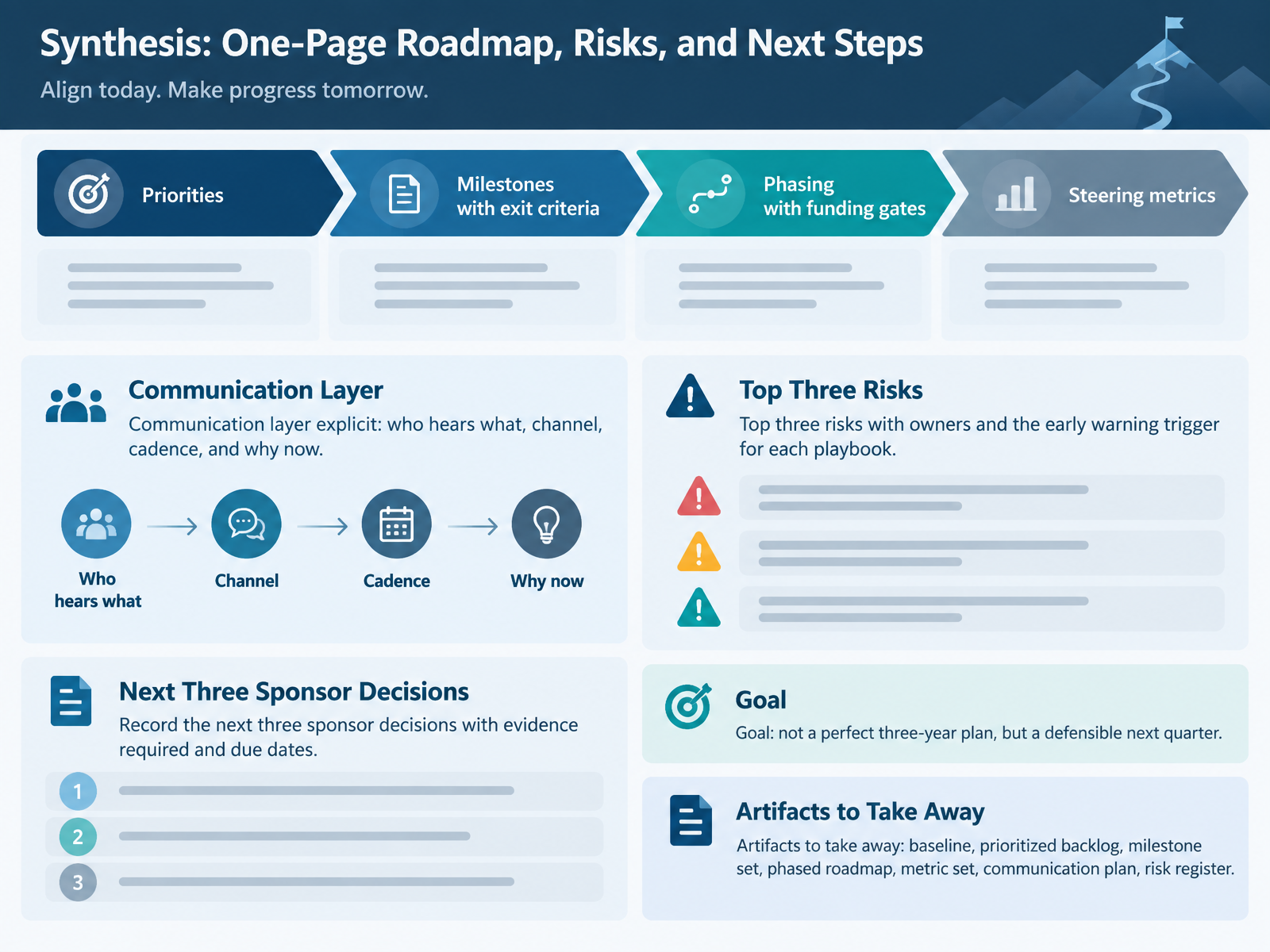
 - 15Synthesis: One-Page Roadmap, Risks, and Next StepsLet's land this. We are not chasing a perfect three-year plan. We are aiming for a defensible next quarter. Start your one-page roadmap with four bands: priorities, milestones with exit criteria, phasing with funding gates, and steering metrics. Then make the communication layer explicit. Write down who hears what, on which channel, at what cadence, and why now. Keep the top three risks visible, each with a named owner and an early warning trigger that activates a pre-agreed playbook. Finally, record the next three sponsor decisions, with the evidence required and the due date for each. Before you close the session, confirm your artifacts: a baseline, a prioritized backlog, a milestone set, a phased roadmap, a metric set, a communication plan, and a risk register. Fund the first quarter, and make the next release conditional on the first measure moving. That is how you keep this honest and affordable. Thank you for working through this roadmap with me. You now have the sequence, the gates, and the language to bring your sponsor along. Go make the next quarter defensible.
 tag-app-delivery.cncf.iodevopsschool.orgdevopsbible.com+22 min
Take the deck with you
Download this course as a file — free, no sign-up needed.
- PDF handoutEvery slide page, ready to print or share.16 pages · 3.4 MBDownload
- Narrated PowerPointThe deck that presents itself — every slide carries the digital human's narration video.16 pages · 28.8 MBDownload
- PowerPoint slidesThe full deck as a .pptx — open it in PowerPoint, Keynote, or Google Slides.16 pages · 3.4 MBDownload
Free to use in your own training — please keep the PersonWise credit page at the end.
Have your own deck? Turn it into a course
Sources consulted
Web sources consulted while building this course.
- State of DevOps Report: Platform Engineering Edition 2026 | Puppet — puppet.com
- Perforce’s 2026 Platform Engineering Report Finds Platform Engineering Maturity Separates AI Advantage from Instability | Perforce Software — perforce.com
- InfoQ Cloud and DevOps Trends Report - 2026 - InfoQ — infoq.com
- Introducing Platform Engineering 2.0: An evolution for the AI era — platformengineering.org
- State of platform engineering 2026 | Neojn — neojn.com
- The biggest challenges platform engineering teams are facing ... — platformengineering.org
- Announcing the State of Platform Engineering Report Vol 4 — platformengineering.org
- DORA's software delivery performance metrics — dora.dev
- Capabilities: Platform engineering - Dora.dev — dora.dev
- DORA Insights — dora.dev
- What Are DORA Metrics? | IBM — ibm.com
- Flow Metrics vs DORA Metrics: Which Should Your Engineering Team Actually Track? — Blog | DevStats — devstats.com
- Platform Engineering Maturity Model | CNCF TAG App Delivery — tag-app-delivery.cncf.io
- Platform Engineering 90-Day Learning Path | DevOpsSchool.org — devopsschool.org
- DevOps Maturity Model — devopsbible.com
- Understanding the Platform Engineering Maturity Model — jellyfish.co
- DevOps Maturity Assessment: Proven 12-Month Smart Roadmap — progressiverobot.com
- Anglo American: a £40bn hydrogen business case | Tenhaw — tenhaw.com
- Milestone's DevOps transformation with platform engineering — eficode.com
- How Outcome-Driven Approaches Redefine DevOps and ... — stackguardian.io