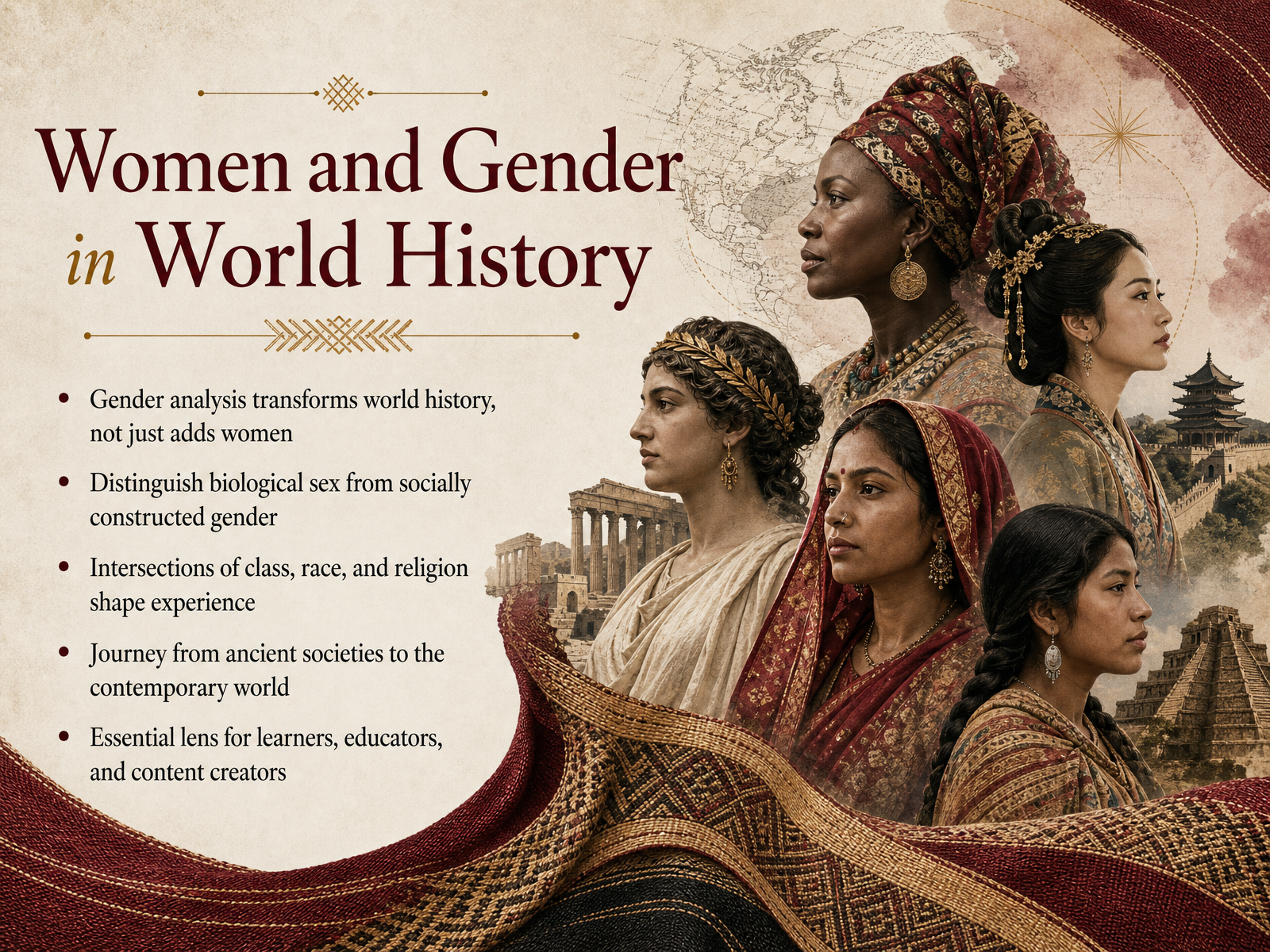
Women and Gender in World History
Begin
14 pages · ~28 min
Women and Gender in World History
Explore the roles, experiences, and contributions of women across global historical contexts, analyzing gender as a category of historical analysis. Designed for history students and educators seeking a deeper, inclusive understanding of world history.
What you’ll learn
- 01Women and Gender in World HistoryWelcome to Women and Gender in World History. In this course, we explore how gender analysis has transformed the study of the past. This is not simply about adding women to the existing story. It is about rethinking how we understand power and social organization altogether. We begin by distinguishing biological sex from gender. Gender refers to the cultural meanings and social roles that societies attach to perceived differences between the sexes. The historian Joan Scott famously argued that gender is also a primary way of signifying relationships of power. As we move from ancient societies to the contemporary world, we will examine how gender intersects with class, race, and religion to shape lived experience. This intersectional lens is essential for learners, educators, and content creators who wish to engage history critically. Let us begin with the foundational question: What is gender as a category of historical analysis?jstor.orgscienceopen.comnewuniversityinexileconsortium.org+22 min
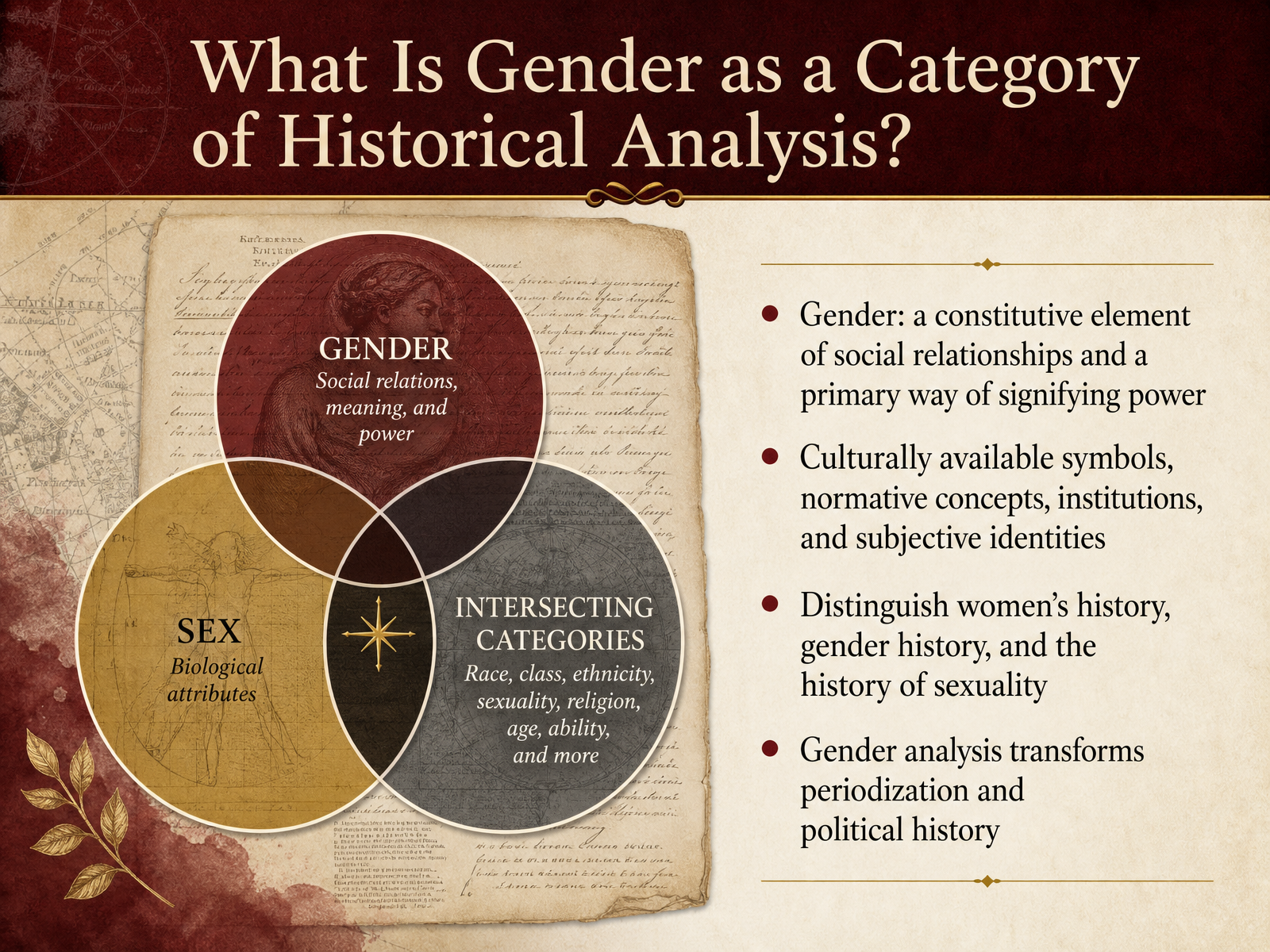
- 02What Is Gender as a Category of Historical Analysis?Let's begin by defining what we actually mean when we talk about gender as a tool for historical analysis. Rather than simply being a synonym for women, the historian Joan Scott famously defined gender as having two connected parts. First, it is a core element of social relationships, based on how societies perceive differences between the sexes. Second, it is a primary way of expressing and legitimizing power. To see how this works in practice, we look beyond just people and examine four connected areas. We look at culturally available symbols, which can often be contradictory. We also examine normative concepts, which are the rules and doctrines that try to set fixed meanings for those symbols. Then, we consider the role of institutions, such as the labor market or education systems. Finally, we touch upon subjective identity, meaning how individuals actually experience and internalize gender. It is also helpful to distinguish between women's history, which recovers women's experiences, and gender history, which analyzes the relationship between the sexes. Gender analysis also transforms how we periodize history and how we understand political power. Next, we will build on this foundation by looking at patriarchy, the divide between public and private life, and the concept of intersectionality.
 jstor.orgscienceopen.comnewuniversityinexileconsortium.org+21 min
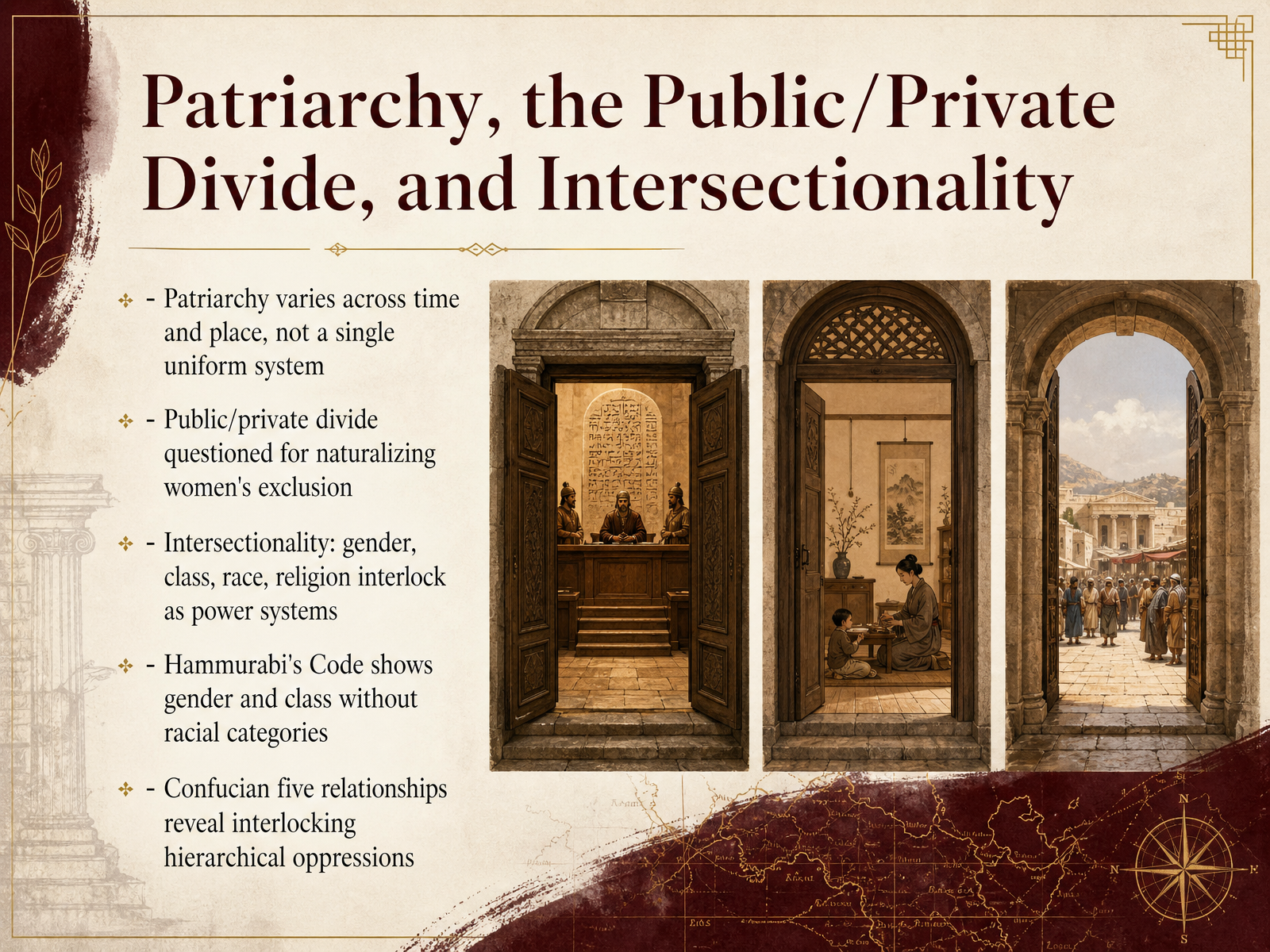
 - 03Patriarchy, the Public/Private Divide, and IntersectionalityIn this slide, we move from asking what patriarchy is to understanding how it actually operates in different contexts. The first key point is that patriarchy is not a single, uniform system. Its rules and effects vary depending on time and place. Historians also question the division between a public world, seen as male, and a private world, seen as female. This divide can make women's exclusion from areas like politics or the economy seem natural, when in fact it is produced by specific power structures. The concept of intersectionality helps us see this more clearly. It means that gender never exists alone. Gender interlocks with class, race, and religion to shape a person's experience of power. For example, Hammurabi's Code from ancient Babylon differentiates people by gender and social class, but it has no categories based on what we would call race. By contrast, the five relationships in Confucian thought show how hierarchies of ruler over subject, father over son, and husband over wife work together as a single system. This interlocking of unequal relationships is exactly what intersectionality asks us to examine. Next, we will explore how these dynamics played out in the economic lives of women and households in early agrarian societies.
 cambridge.orgjournals.uchicago.eduhistory21.com+21 min
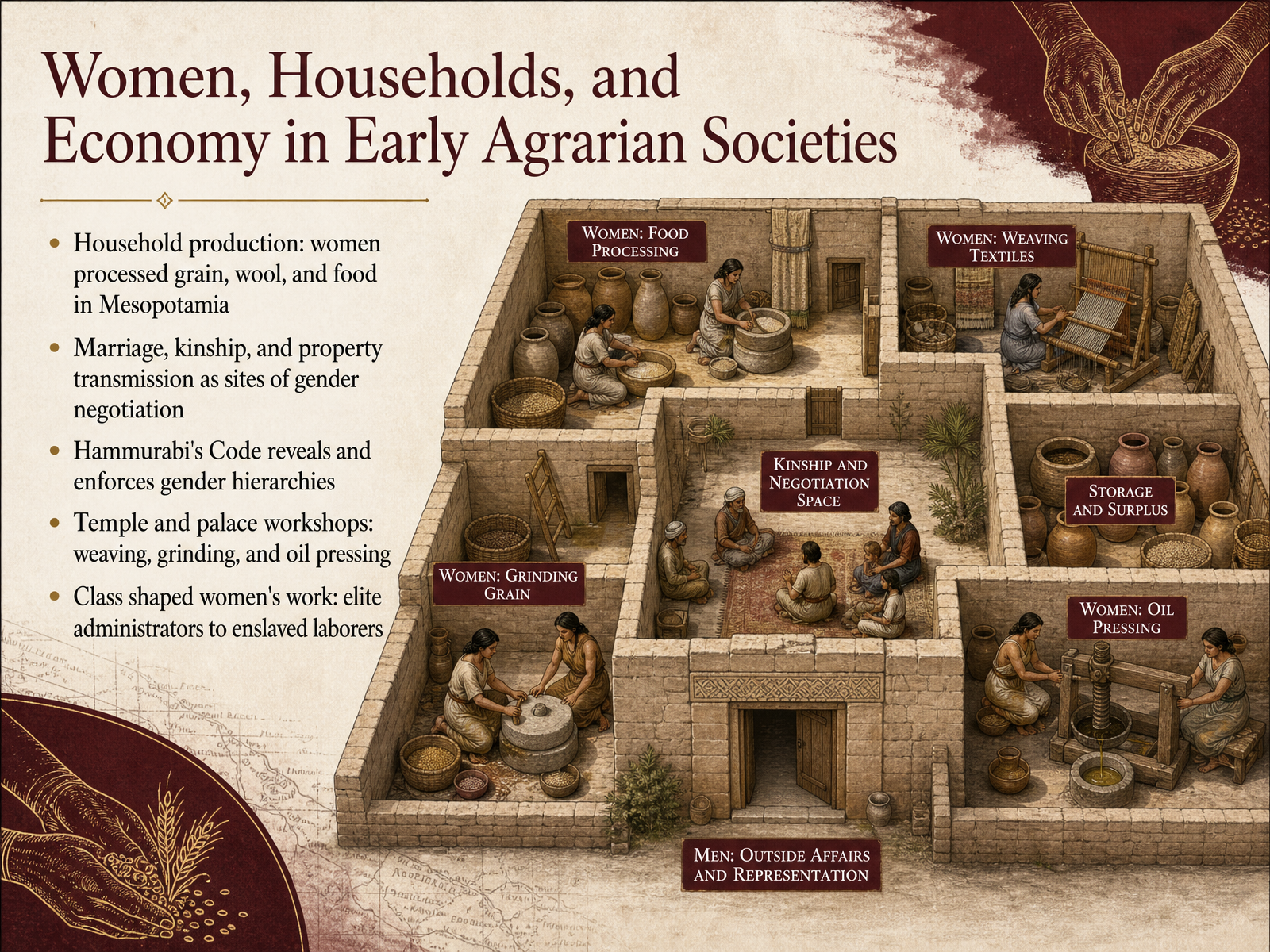
 - 04Women, Households, and Economy in Early Agrarian SocietiesNow let us look at the household itself, and the economic roles women carried out in early agrarian societies. In Mesopotamia, a man might supply raw grain and wool, but it was women who processed these materials through grinding, baking, spinning, and weaving. These tasks were essential for everyday survival. Marriage and kinship were also spaces where gender was negotiated, especially around property and inheritance. The law code of Hammurabi shows us how these hierarchies were formalized and enforced. Beyond the home, large temple and palace workshops relied heavily on female labor. Women wove cloth, ground flour, and pressed oil, sometimes receiving rations that were smaller than those given to men. Crucially, class shaped these experiences. Elite women could administer estates and manage trade, while enslaved women endured the most physically demanding labor. This economic foundation helps us understand the gender order we will examine next, in the context of religion and empire during the classical era.
 degruyter.comdegruyterbrill.comjstage.jst.go.jp+22 min
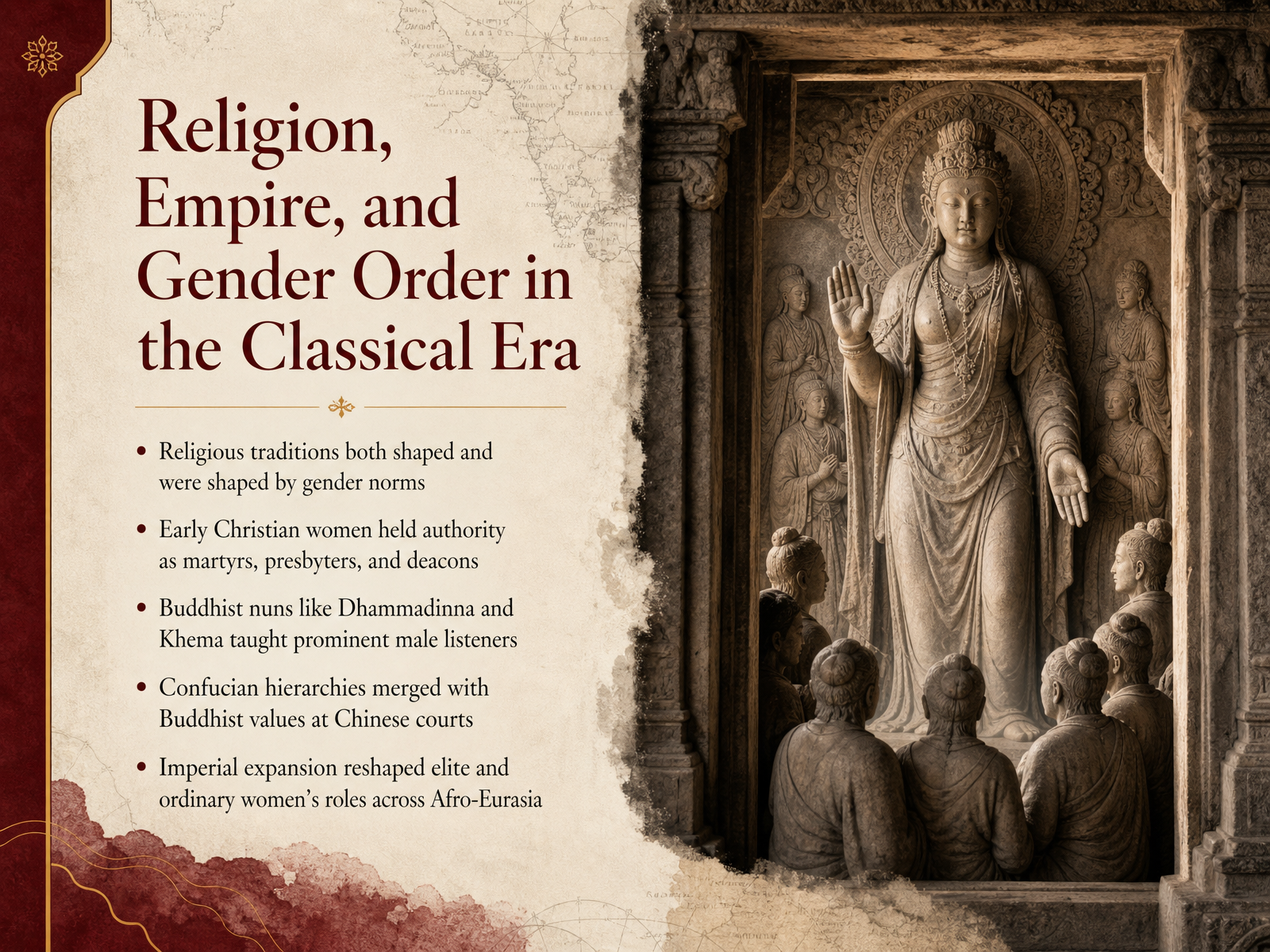
 - 05Religion, Empire, and Gender Order in the Classical EraNow let's consider how religion and empire together reordered gender in the classical era. Religious traditions both reflected and actively shaped the rules governing women's lives. Within early Christianity, women sometimes held real authority as martyrs, presbyters, and deacons, roles that later church structures would often erase or forget. In the Buddhist world, women like the nuns Dhammadinna and Khema were recorded as teachers of even prominent male disciples, which reminds us that early communities could be surprisingly open to female leadership. At Chinese courts, Confucian family hierarchies merged with Buddhist monastic values, creating new paths for elite women but also new forms of control. At the same time, imperial expansion across Afro-Eurasia transformed the daily roles of both ordinary and elite women, sometimes limiting their autonomy, sometimes creating fresh opportunities. In short, religion was never neutral about gender. It could justify hierarchy, but it could also authorize women's authority. In the next section, we will turn to the medieval world, where trade, faith, and gendered power moved even more visibly across regions.
 cambridge.orglink.springer.comcambridge.org+22 min
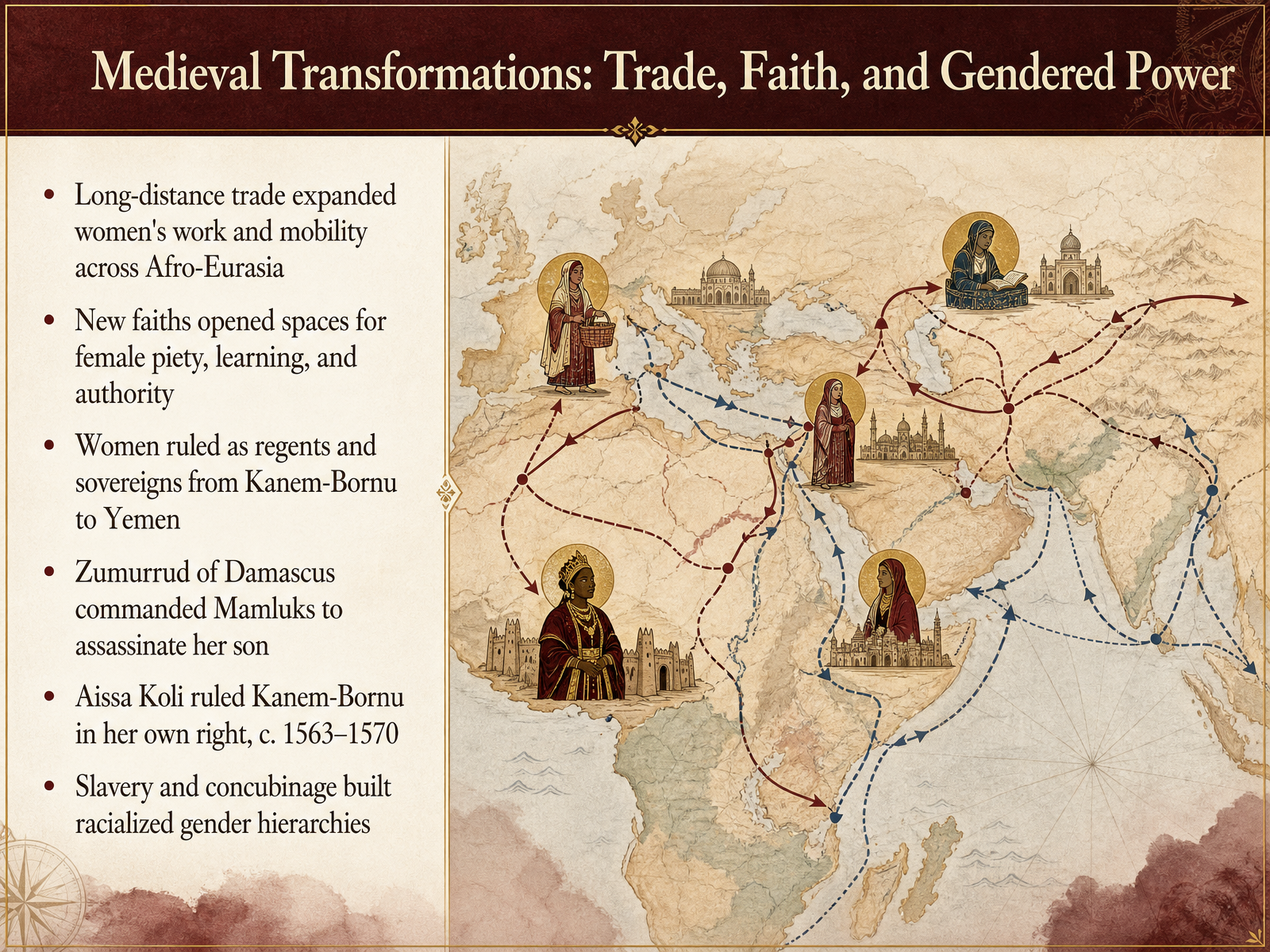
 - 06Medieval Transformations: Trade, Faith, and Gendered PowerThe medieval period brought major shifts in how women participated in long-distance trade across Afro-Eurasia, which expanded both their work and their mobility. At the same time, new religious movements created fresh spaces for female piety, learning, and authority. We shouldn't imagine this era as one in which women simply lacked power. Women ruled as regents and sovereigns in societies ranging from Kanem-Bornu in West Africa to Yemen. For example, Zumurrud of Damascus commanded Mamluks to assassinate her son, a violent but clear sign of the political authority she held. Aissa Koli ruled Kanem-Bornu in her own right around 1563 to 1570, and she remains celebrated in local oral tradition. Still, we have to be careful not to romanticize this picture. The same networks of trade and empire that opened opportunities for some women also depended on slavery and concubinage, which built racialized gender hierarchies. Let's now turn to the early modern world, where households, colonies, and global exchange reshaped these dynamics.
 1 min
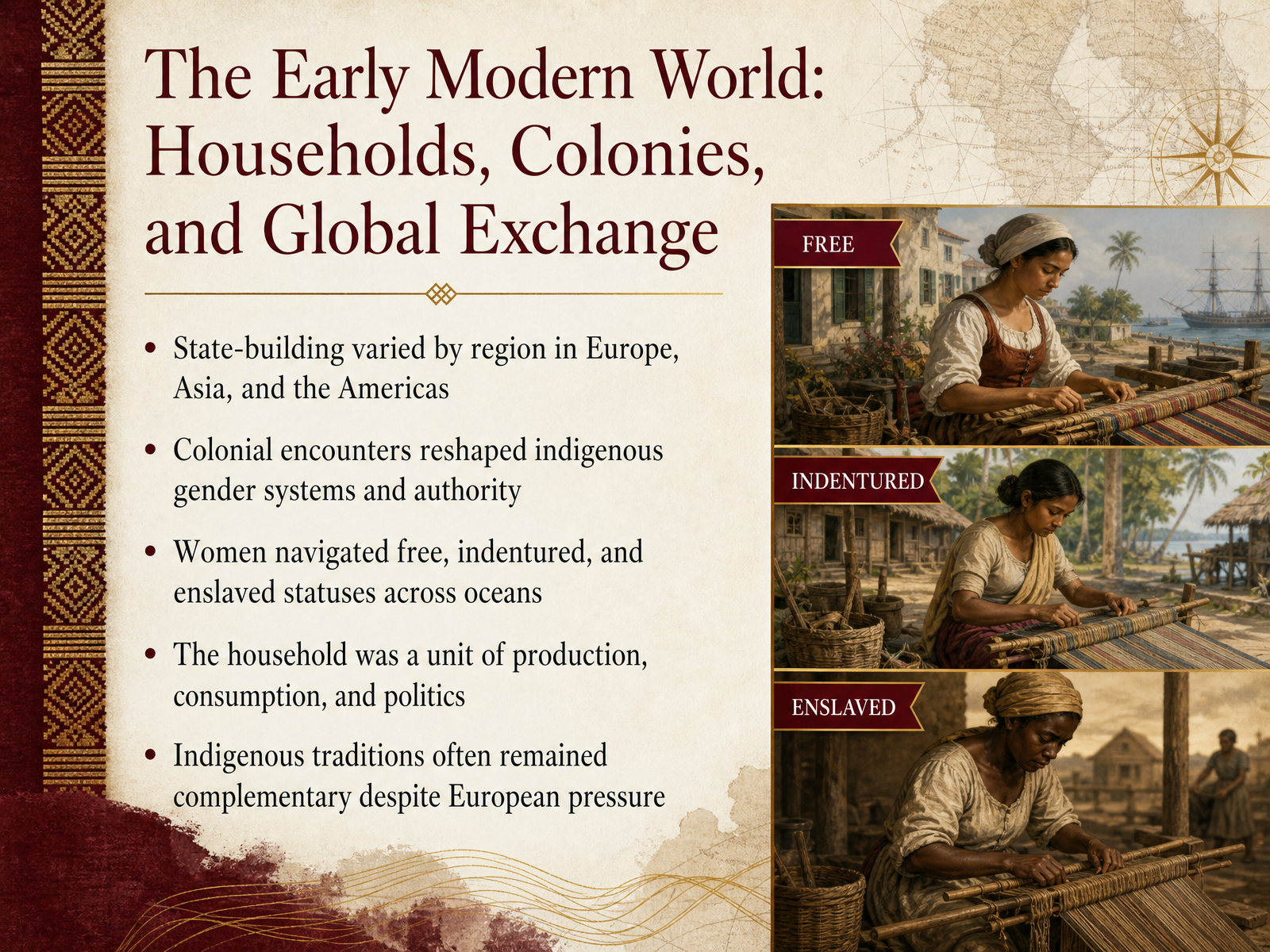
1 min - 07The Early Modern World: Households, Colonies, and Global ExchangeThe early modern world offers a striking view of how deeply gender was woven into household life, colonial power, and global connections. In many parts of Europe, Asia, and the Americas, the household was not just a home. It was a center of production, consumption, and even politics. As colonial encounters expanded, they reshaped indigenous gender systems in profound ways. Yet indigenous traditions often remained remarkably resilient. In highland Mexico, for example, Spanish pressure gradually introduced more patriarchal ideas. But many native women continued to hold complementary roles in their communities. Even in colonial Chiapas, women were elected as religious officers who managed funds and cared for community welfare. Across oceans, women navigated very different statuses, some free, some indentured, and others enslaved. Their labor and knowledge, especially in healing and trade, helped forge new colonial societies. Next, we will see how industrialization and modern imperialism remade gender on an even larger scale.
 2 min
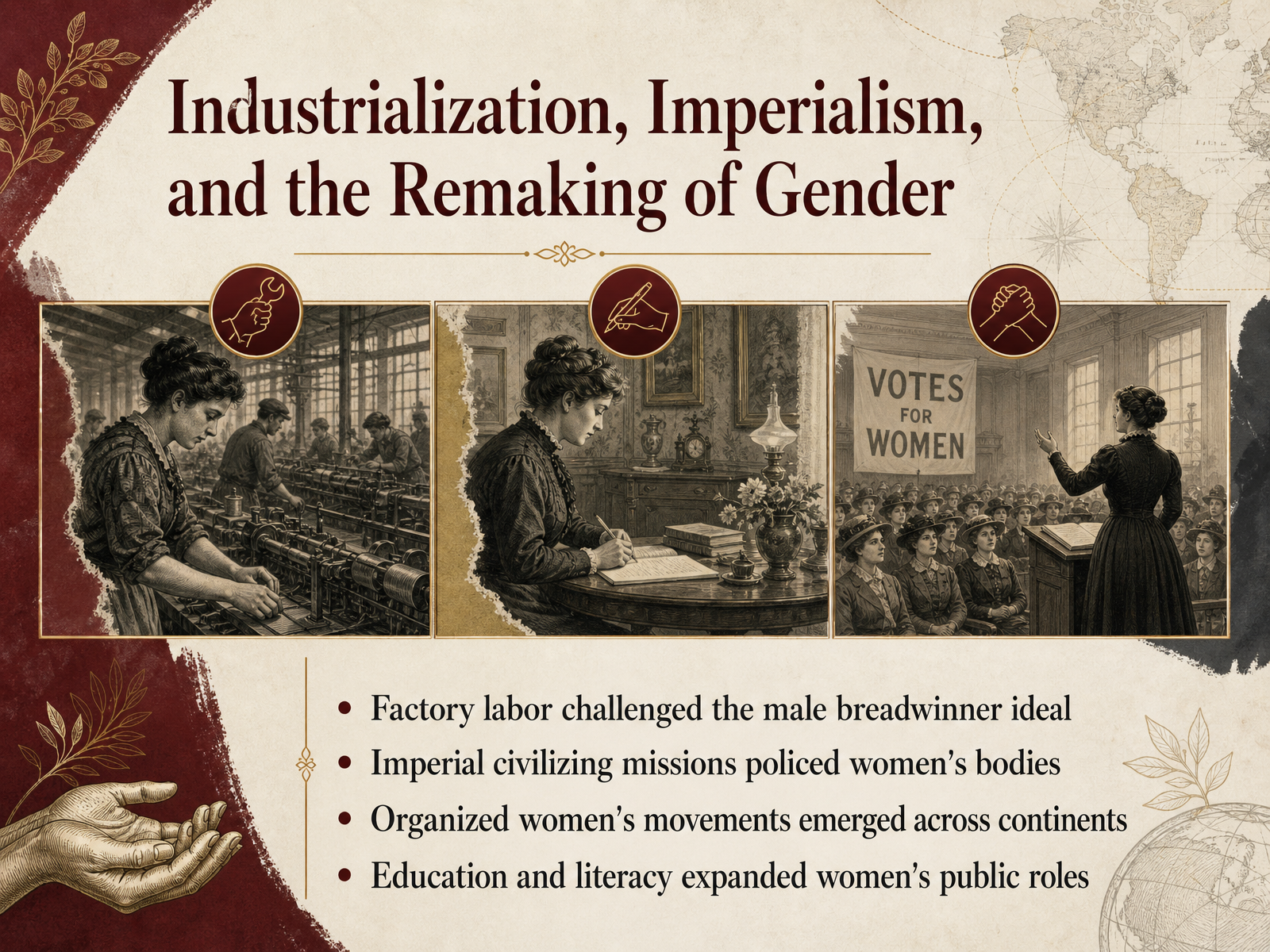
2 min - 08Industrialization, Imperialism, and the Remaking of GenderNow let’s look at how industrialization, imperialism, and expanding public life remade gender in the nineteenth and early twentieth centuries. Factory labor pulled many working-class women into paid production, which challenged the idea that men alone should be breadwinners. At the same time, imperial civilizing missions often claimed to protect or uplift women, but in practice they policed women’s bodies and imposed colonial moral standards. Out of these pressures, organized women’s movements emerged across continents. They did not follow one single path. In some places women campaigned for the vote, in others for labor protections, education, or legal status. Education and rising literacy also expanded women’s public roles, creating new spaces for women as writers, teachers, reformers, and political organizers. What is important here is that these changes were global, uneven, and shaped by empire and class. Next, we will examine suffrage and political citizenship in comparative perspective.
 1 min
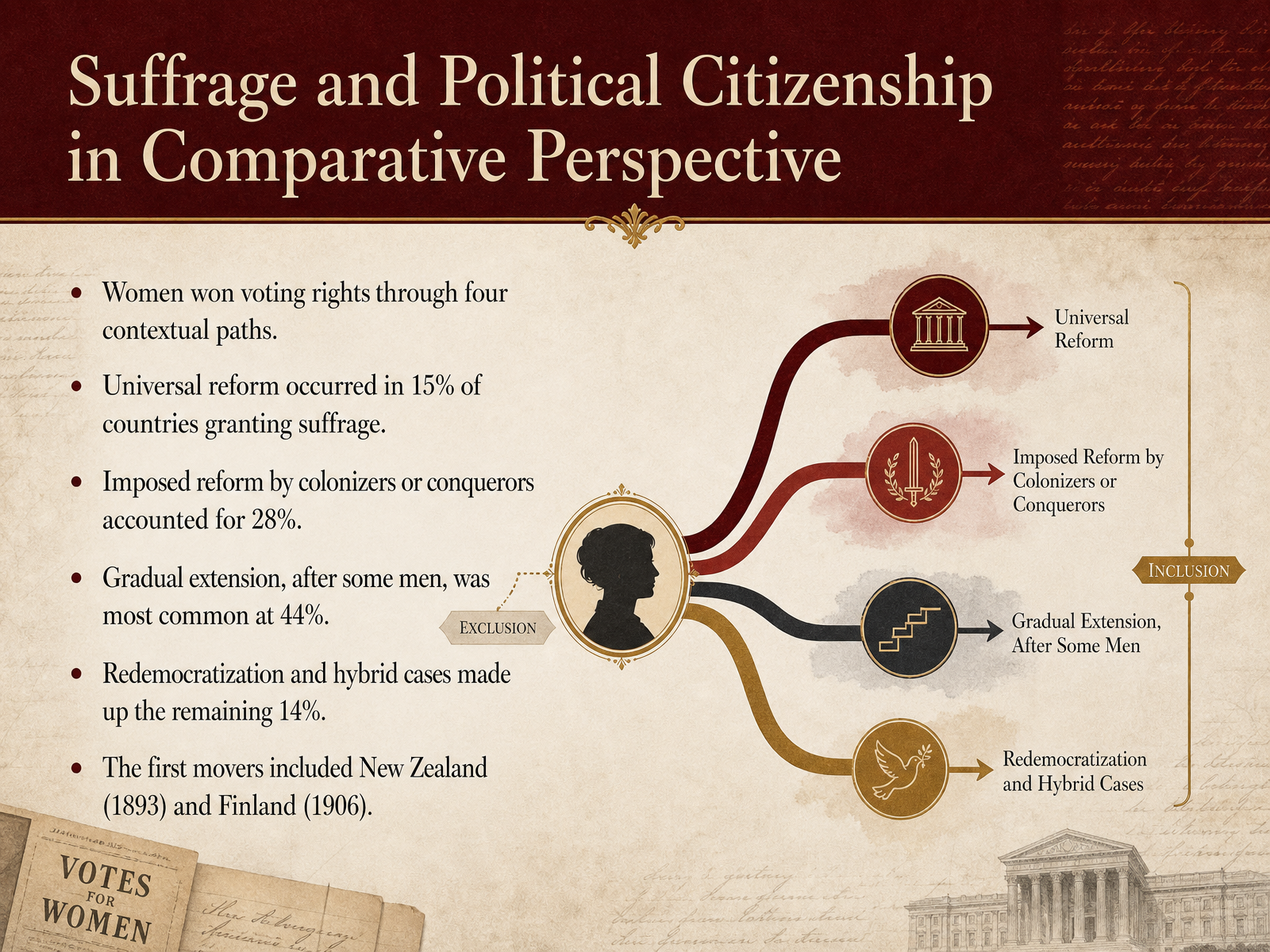
1 min - 09Suffrage and Political Citizenship in Comparative PerspectiveWhen we place different countries side by side, the path to political citizenship looks less like a single story and more like a set of distinct routes. Scholars identify four main contexts in which women won voting rights. The rarest was universal reform, where men and women were enfranchised at the same time from the very beginning. That accounts for about fifteen percent of the countries that granted suffrage. Imposed reform, where a colonial power or an occupying force introduced women's voting rights, explains roughly twenty-eight percent. The most common path, representing about forty-four percent, was gradual extension. Here some men could vote first, and women's inclusion came later, often through the work of national suffrage movements. The remaining fourteen percent fall into a hybrid category, usually tied to redemocratization after dictatorship or regime change. A few early movers help set the frame. New Zealand granted women the national vote in eighteen ninety-three, and Finland followed in nineteen six, becoming the first country to give all women and all men both the right to vote and the right to run for office. These cases remind us that citizenship was not simply given or withheld. It was shaped by empire, by political competition, and by organized demands. With that comparative map in mind, we can now turn to war, revolution, and state feminism in the twentieth century.
 2 min
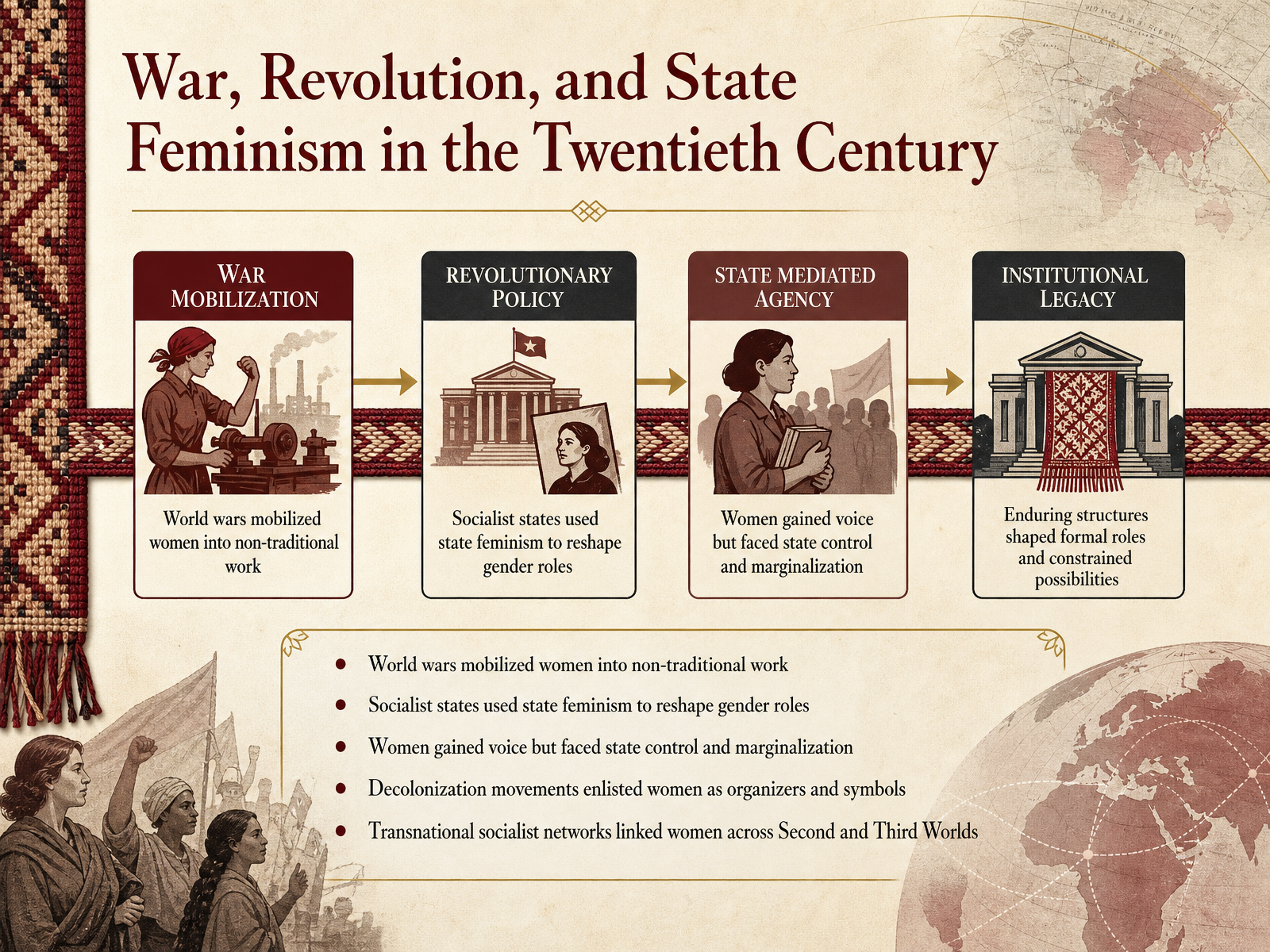
2 min - 10War, Revolution, and State Feminism in the Twentieth CenturyMoving into the twentieth century, war and revolution reshaped gender roles in dramatic and often contradictory ways. The two world wars pulled millions of women into factories, farms, and military support roles, work that had previously been defined as masculine. At the same time, socialist states introduced what scholars call state feminism. In the Soviet Union and China, governments promoted women's education, employment, and legal equality as proof of socialist progress. Women did gain real access to public life, but they also faced state control. Their organizations were often expected to serve party goals first, and women's own voices could be marginalized. Decolonization movements added another layer. Across Asia and Africa, women served as organizers, couriers, and public symbols of national liberation, yet after independence their contributions were frequently pushed aside. Transnational socialist networks, such as the Women's International Democratic Federation, connected women from Eastern Europe, Asia, and Africa. These alliances challenged Western leadership of global feminism and emphasized economic justice alongside gender equality. The legacy is complex, a mix of genuine advancement and persistent limitations. Next, we turn to contemporary gender issues in global perspective.
 2 min
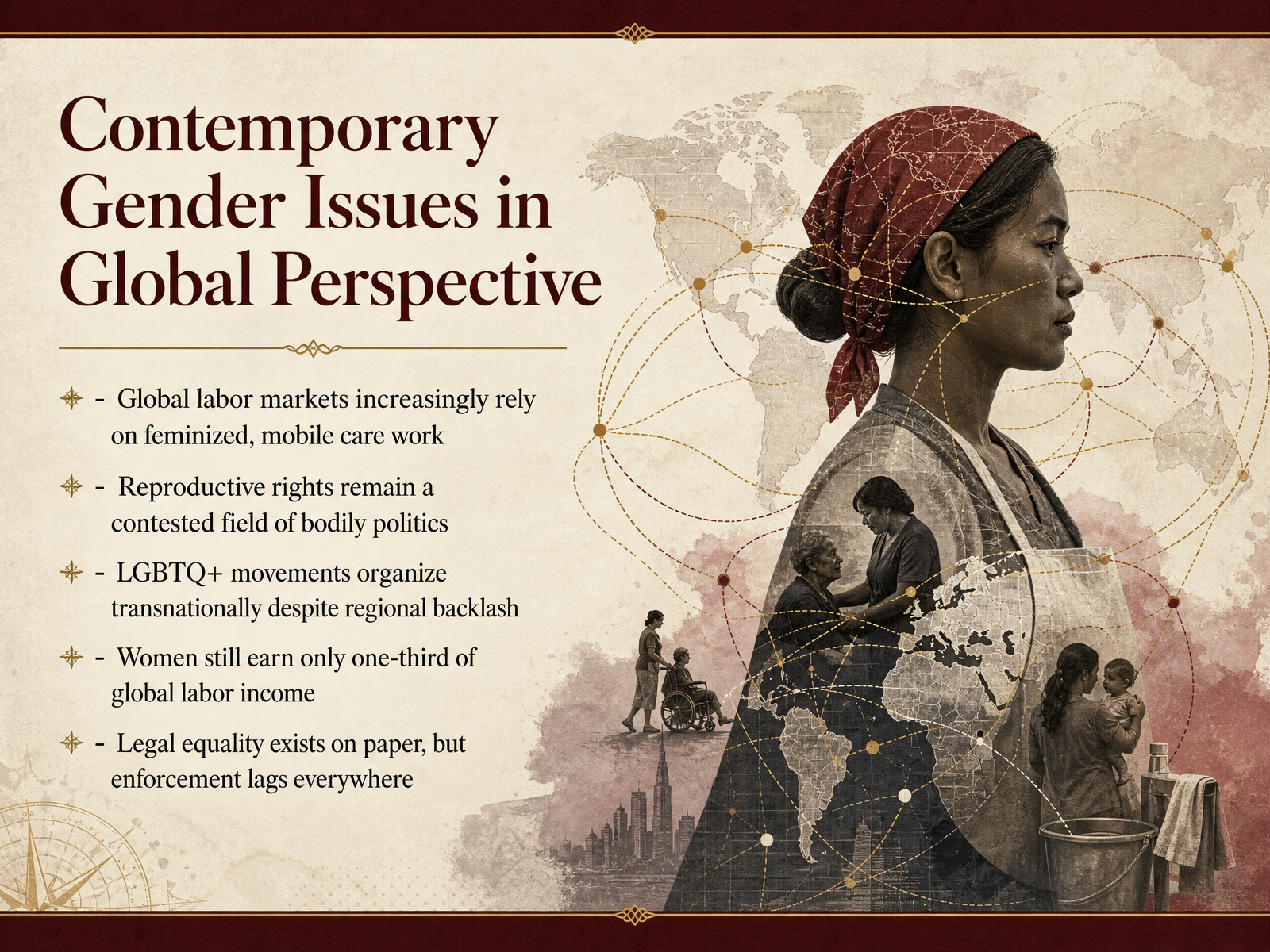
2 min - 11Contemporary Gender Issues in Global PerspectiveLet’s bring this long history into the present moment. The landscape of gender today is shaped by several interconnected forces. First, global labor markets increasingly depend on what scholars call feminized, mobile care work. This means domestic work, childcare, and nursing are often performed by women who migrate, frequently leaving their own families behind, and this labor remains undervalued and underprotected. Second, reproductive rights continue to be a deeply contested field of bodily politics, with legal access varying dramatically across and even within countries. Third, LGBTQ plus movements now organize transnationally, sharing strategies and solidarity across borders, even as they face regional backlash and restrictive laws. Economically, the picture remains stark. Women still earn only about one third of global labor income. And while legal equality exists on paper in many places, enforcement lags everywhere. According to recent data, fewer than half of the policies and institutions needed to make those rights effective are in place. This gap between law and lived reality reminds us that progress is not linear, and it is not guaranteed. Next, we will turn to gender analysis in practice, exploring the methods and sources historians and advocates use to investigate these patterns.
 2 min
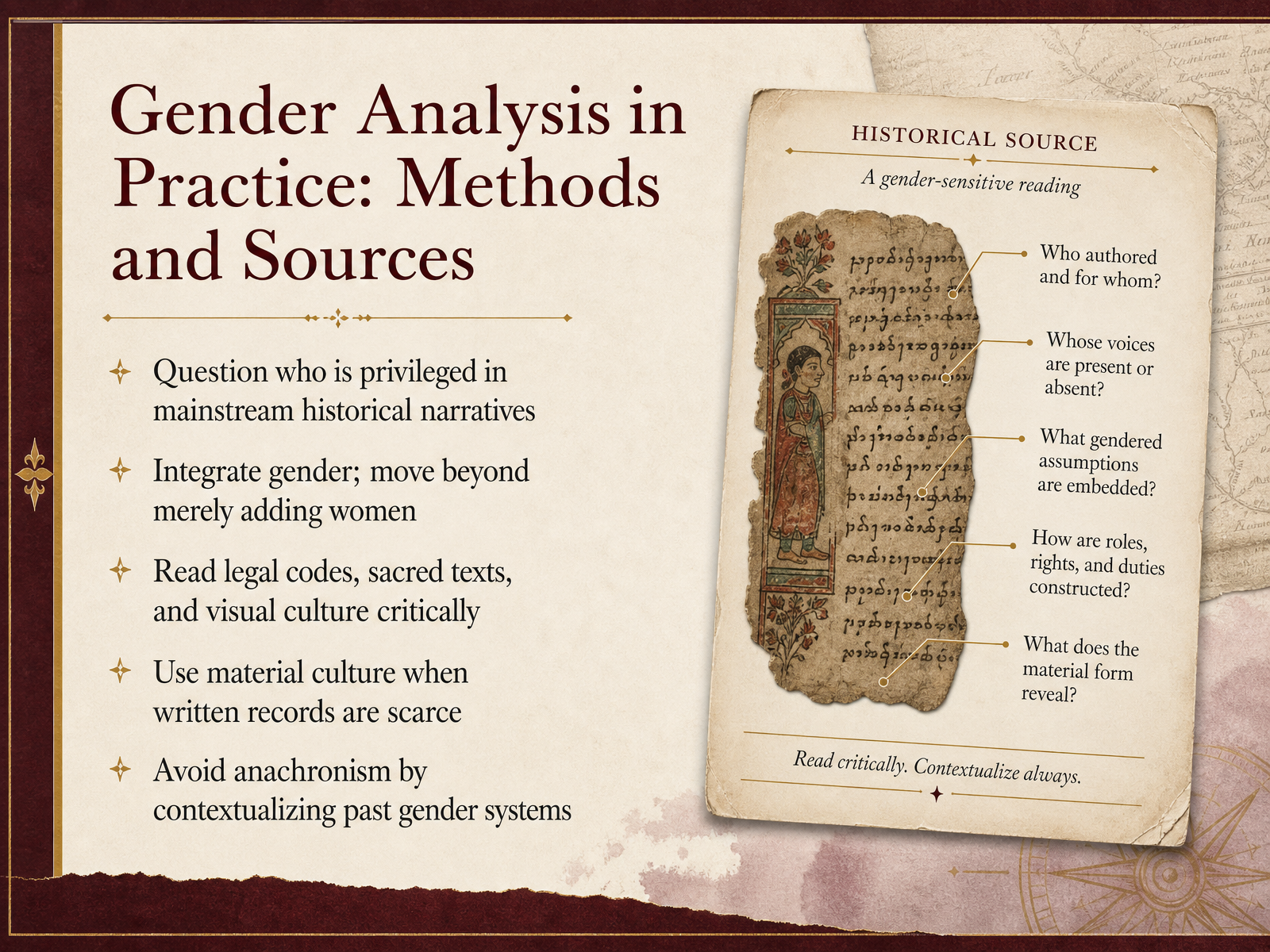
2 min - 12Gender Analysis in Practice: Methods and SourcesLet's move now from concept to practice. Gender analysis asks us to become more deliberate readers of the past. The first step is interrogating mainstream historical narratives, and asking a simple but powerful question: who is being privileged, and whose experiences are being centered? Scholars often describe this as moving beyond merely adding women to existing stories. The goal instead is to integrate gender as a category of analysis throughout the entire historical frame. That means reading legal codes, sacred texts, and visual culture critically, looking not only for what they say, but for what they assume about men, women, and other gendered identities. When written records are scarce or silent, material culture becomes essential. Objects like textiles, tools, pottery, and domestic spaces can reveal routines and status that documents overlook. Equally important is avoiding anachronism. We should try to understand past gender systems within their own cultural and temporal contexts, rather than projecting present assumptions backward. In our final section, we will turn to designing gender inclusive history for learners and audiences.
 2 min
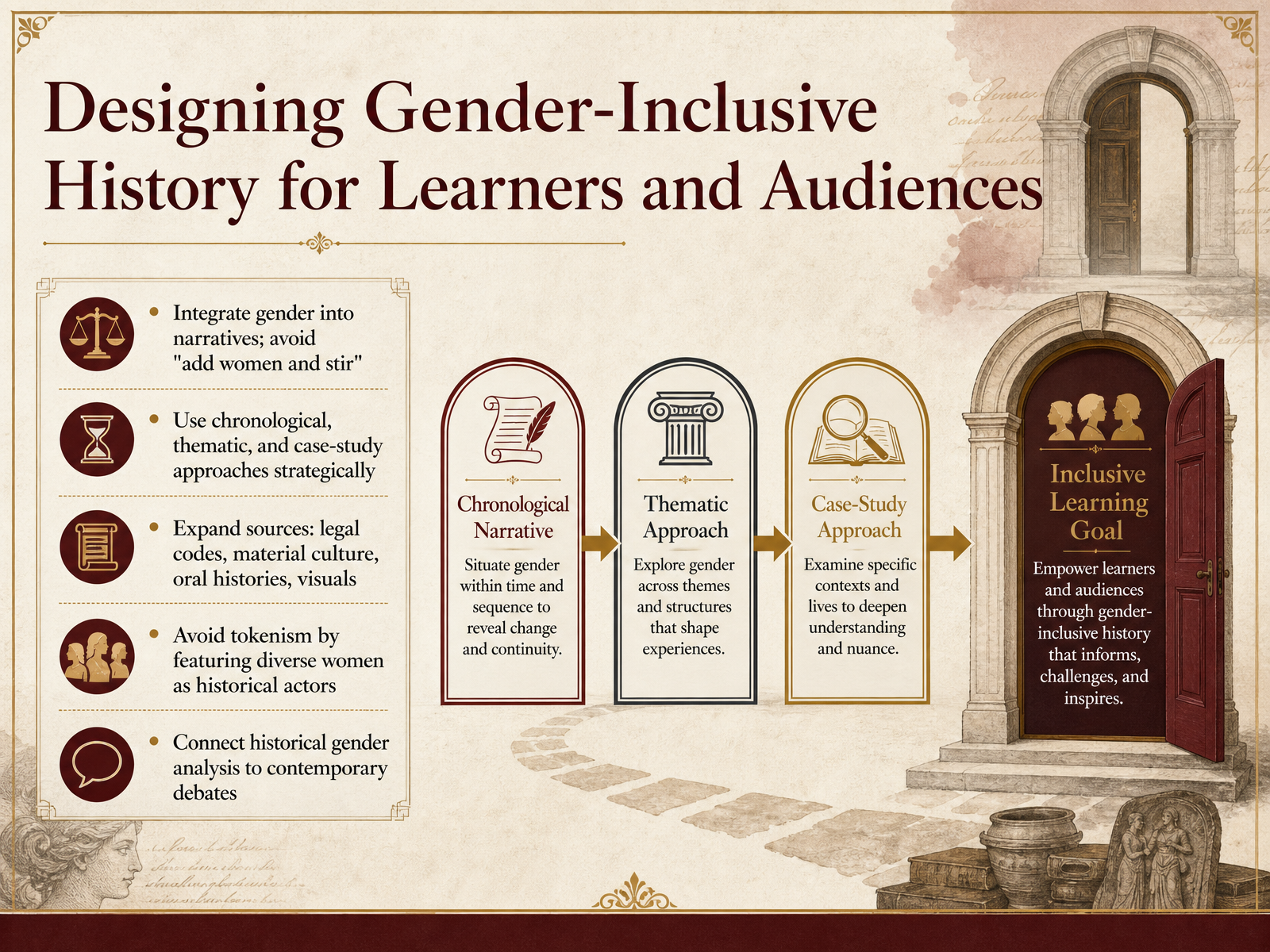
2 min - 13Designing Gender-Inclusive History for Learners and AudiencesNow let's turn to the practical work of designing gender-inclusive history for learners and audiences. The first principle is to integrate gender into your core narrative, not simply add women to an existing story and stir. Instead of a separate women's history box, ask how gender shaped every historical event, structure, and experience. Use chronological, thematic, and case-study approaches strategically. A chronological arc can show change over time, while a thematic or case-study approach can reveal deeper patterns and let you focus closely on particular lives or communities. Expand your sources well beyond traditional political records. Legal codes, material culture, oral histories, and visual sources all offer crucial evidence about how gender worked in daily life. Avoid tokenism by featuring women not as one exceptional figure, but as diverse historical actors whose experiences differed by class, race, region, religion, and sexuality. Finally, connect historical gender analysis to contemporary debates. When learners see how past struggles and systems still shape present questions, the material becomes urgent and meaningful. In our next slide, we'll pull together key takeaways and suggest ways to keep practicing gender history on your own.
 2 min
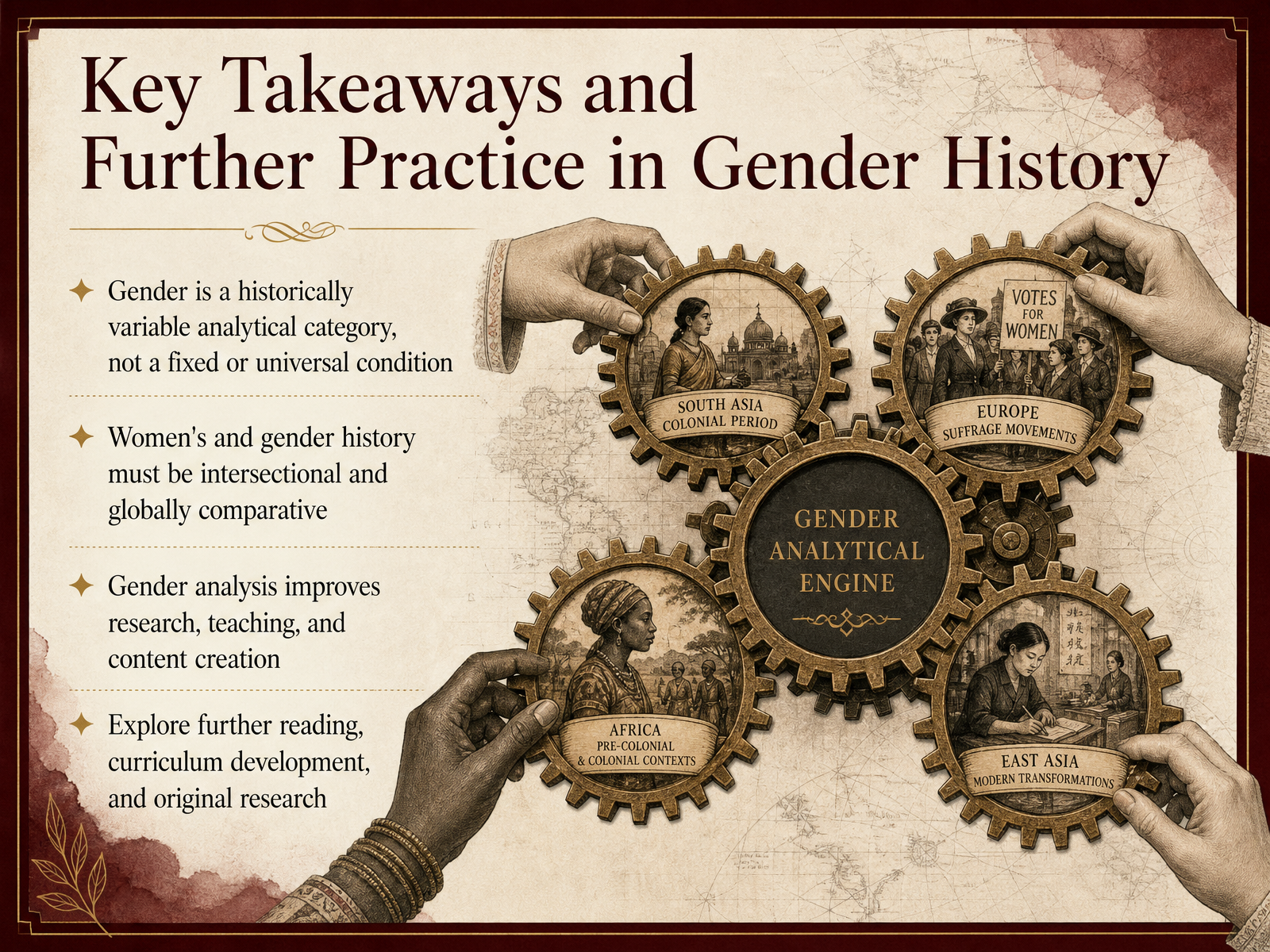
2 min - 14Key Takeaways and Further Practice in Gender HistoryAs we wrap up, let's return to the core ideas that can guide your continued work. First, remember that gender is a historically variable analytical category, not a fixed or universal condition. As historian Joan Scott argued, gender operates as a primary way of signifying relationships of power. Second, women's and gender history must be intersectional and globally comparative. We cannot separate gender from class, race, religion, or other forms of identity, and we must look beyond a single region to understand larger patterns. Third, gender analysis strengthens research, teaching, and content creation. It pushes us to ask better questions and to include voices that have often been marginalized. Finally, we invite you to take the next step: explore further reading, develop curricula that integrate gender thoughtfully, or pursue original research in your own community. Thank you for engaging with this material. The work of writing women and gender into world history is ongoing, and your curiosity is an essential part of it.
 jstor.orgscienceopen.comnewuniversityinexileconsortium.org+22 min
Take the deck with you
Download this course as a file — free, no sign-up needed.
- PDF handoutEvery slide page, ready to print or share.15 pages · 6.5 MBDownload
- Narrated PowerPointThe deck that presents itself — every slide carries the digital human's narration video.15 pages · 20.6 MBDownload
- PowerPoint slidesThe full deck as a .pptx — open it in PowerPoint, Keynote, or Google Slides.15 pages · 6.5 MBDownload
Free to use in your own training — please keep the PersonWise credit page at the end.
Have your own deck? Turn it into a course
Sources consulted
Web sources consulted while building this course.
- Gender: A Useful Category of Historical Analysis - jstor — jstor.org
- Gender: A Useful Category of Historical Analysis – ScienceOpen — scienceopen.com
- Gender: A Useful Category of — newuniversityinexileconsortium.org
- 2. Gender: A Useful Category of Historical Analysis — degruyterbrill.com
- Gender: A Useful Category of Historical Analysis - Wikipedia — en.wikipedia.org
- Gender, Intersectionality, and Global Social History — cambridge.org
- From Patriarchy to Intersectionality: A Transnational Feminist Assessment of How Far We've Really Come — journals.uchicago.edu
- One of the most fruitful concepts of social analysis developed over the last several decades has been that of intersectionality, the idea that major systems of oppression are interlocking and that no one identity—race, class, gender, religion, ability, sexual orientation, and so on—should be conside — history21.com
- INTERSECTIONALITY: Mapping the Movements of a Theory — pmc.ncbi.nlm.nih.gov
- Inter-imperiality: Vying Empires, Gendered Labor, and the Literary Arts of Alliance — dukeupress.edu
- https://www.degruyter.com/document/doi/10.1515/9781614512639-020/pdf?licenseType=open-access — degruyter.com
- The Role of Women in Work and Society in the Ancient Near... — degruyterbrill.com
- Male and Female Professions in Sumer at the End of the III Millennium BC — jstage.jst.go.jp
- The Nile and the Yellow River: Comparative Studies between Ancient Egypt and China — doi.org
- Mesopotamian Women (Chapter 2) - Women's Writing of Ancient Mesopotamia — cambridge.org
- The Role of Martyrdom and Persecution in Developing the Priestly Authority of Women in Early Christianity: A Case Study of Montanism — cambridge.org
- Mary and Early Christian Women: Hidden Leadership | Springer Nature Link — link.springer.com
- Widows, Bishops and the Struggle for Authority in the Didascalia Apostolorum | The Journal of Ecclesiastical History | Cambridge Core — cambridge.org
- On Women as Teachers in Early Buddhism: Dhammadinna and Khema | Buddhist Studies Review — journal.equinoxpub.com
- Narratives of Religious Landscape: Reading Gender and Chinese ... — mdpi.com