Immersive VR in Learning and Development
Begin
14 pages · ~28 min
Immersive VR in Learning and Development
This training introduces VR technology and its application in learning and development, equipping professionals with the skills to design immersive, effective virtual training experiences.
What you’ll learn
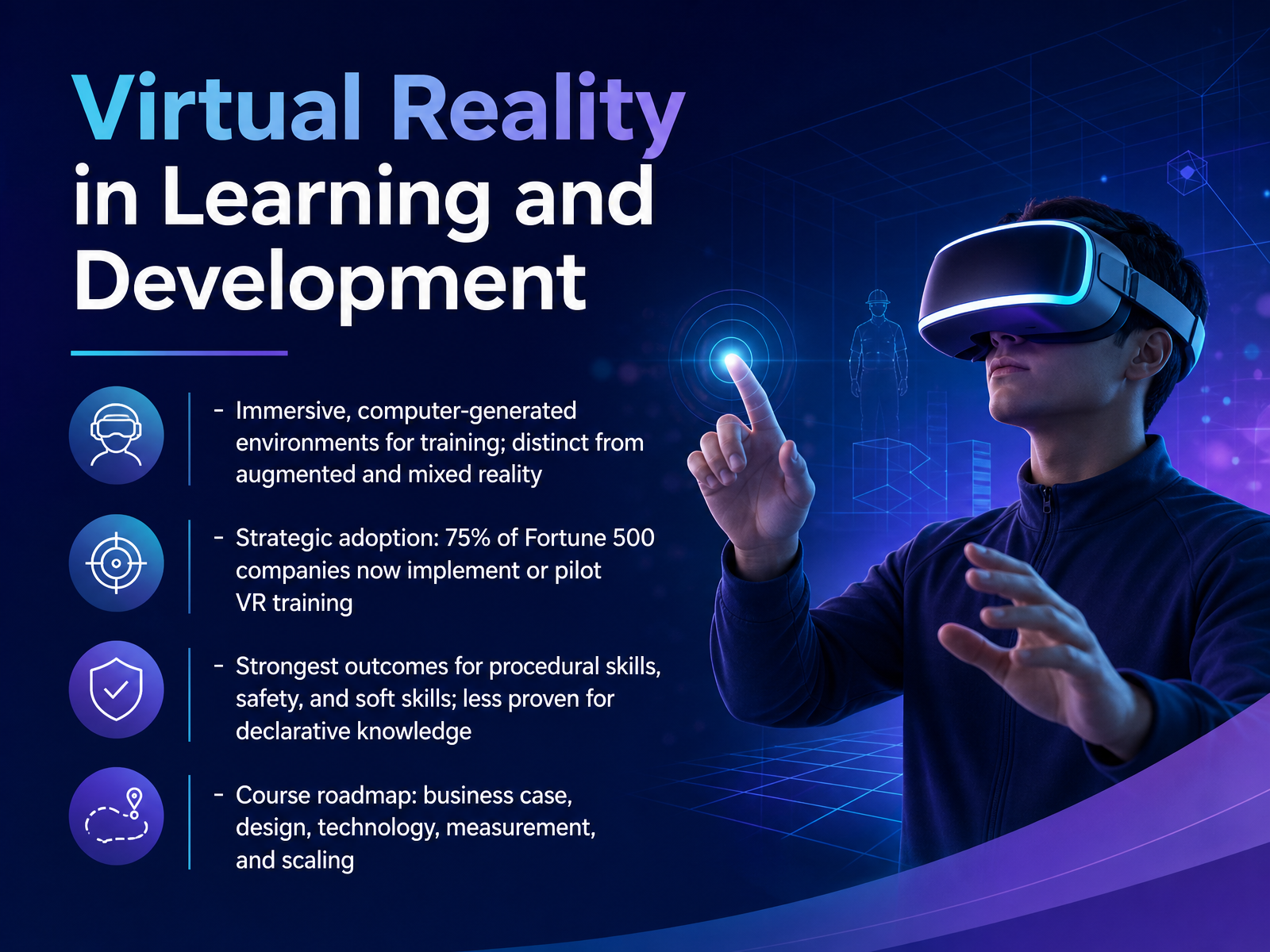
- 01Virtual Reality in Learning and DevelopmentWelcome, everyone. I’m glad you’re here. Today, we’re going to look at virtual reality as a practical, strategic tool for learning and development. Not as a novelty. But as a way to improve learner outcomes across your organization. So, what do we mean by VR? It’s a fully immersive, computer-generated environment that replaces the physical world for the learner. This is distinct from augmented reality, which layers digital content onto the real world, and mixed reality, which blends both. This distinction matters when you're choosing the right tool for the job. The evidence base is strong, and adoption has moved past the pilot phase. In fact, reports indicate that 75 percent of Fortune 500 companies are now implementing or piloting VR for training. But the outcomes are not uniform. VR delivers its strongest results for procedural skills, safety protocols, and soft skills practice where repetition and realism matter. Its role is less proven for straight declarative knowledge. Over this course, we’ll walk through the business case, instructional design principles, the technology stack, measurement, and how to scale successfully. Let’s start with the business case and current market landscape.sciencedirect.comsciencedirect.comlink.springer.com+22 min
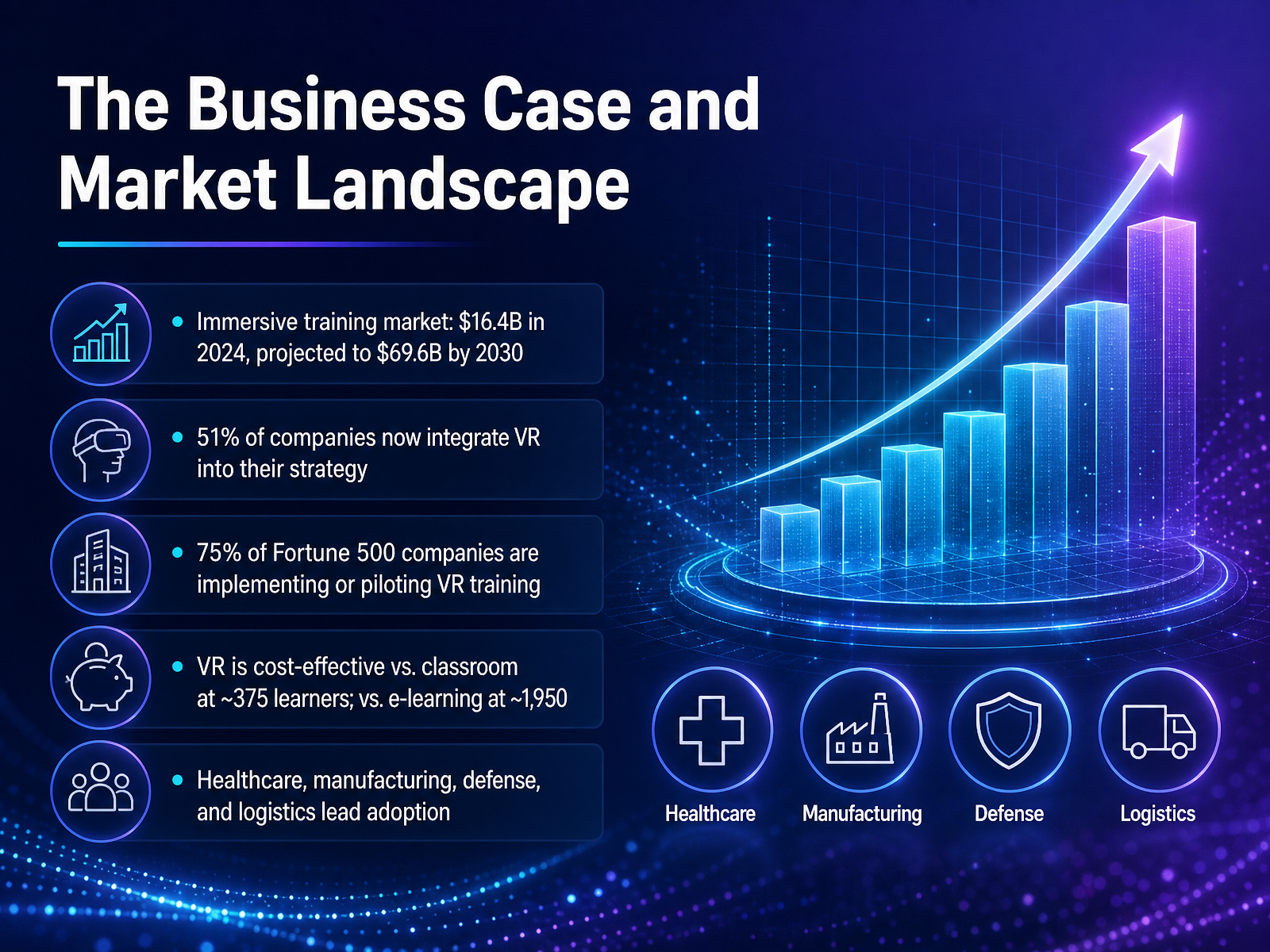
- 02The Business Case and Market LandscapeNow let’s look at the business case and the current market landscape, because the numbers here should change how we frame our proposals. The immersive training market was valued at sixteen point four billion dollars in twenty twenty-four, and it is projected to reach nearly seventy billion by twenty thirty. That is roughly a twenty-eight percent compound annual growth rate, which signals sustained enterprise investment, not a passing trend. Right now, fifty-one percent of companies report integrating VR into their learning strategy, and seventy-five percent of Fortune five hundred companies are either implementing or piloting VR training programs. When it comes to cost, VR reaches parity with classroom training at around three hundred seventy-five learners, and with e-learning at just under two thousand. That means the financial case strengthens as you scale, which is a critical point to make when stakeholders evaluate pilot results. The industries leading adoption are healthcare, manufacturing, defense, and logistics, all sectors where high-stakes, high-consequence tasks demand consistent skill transfer. So the market has matured, the cost structure is predictable, and the early adopters are already in production. Now let’s shift to why VR works so well from a learning perspective, starting with the underlying science of immersion.
 sciencedirect.comsciencedirect.comlink.springer.com+22 min
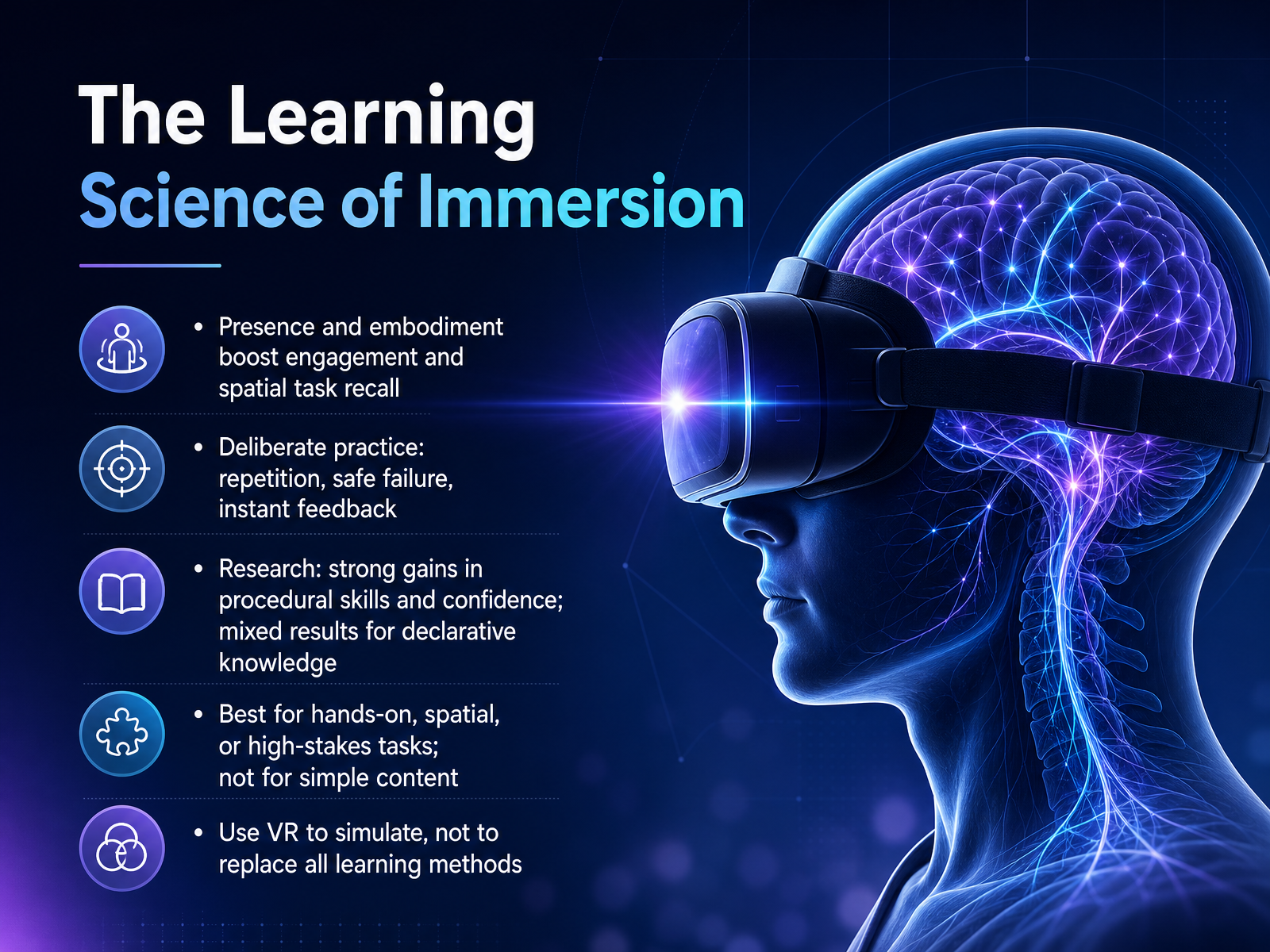
 - 03The Learning Science of ImmersionLet’s talk about why VR actually works. It comes down to the learning science of immersion. When learners feel a true sense of presence—and embodiment in a virtual space—their engagement rises, and their recall of spatial tasks improves. Think of a technician rehearsing a complex equipment layout. That spatial memory sticks because they’ve moved through the environment, not just read about it. VR also enables deliberate practice: repetition without real-world risk, the chance to fail safely, and instant, objective feedback. The research here is compelling but nuanced. Studies consistently show strong gains in procedural skills, and a significant boost in learner confidence. For example, a clinical trial found VR training for PPE procedures was as effective as face-to-face instruction, and clearly superior to video. However, for simple declarative knowledge, results are mixed. In some studies, learners report feeling they learned more in VR than objective tests confirm. This is a critical insight for us. So, the strategic takeaway? VR is best for hands-on, spatial, or high-stakes tasks—not for reciting facts. It’s a powerful tool to simulate what’s hard to stage in the real world, but it’s a complement to your existing methods, not a total replacement. With that fit in mind, let’s map out where it delivers the most value across the learning lifecycle.
 sciencedirect.comsciencedirect.comlink.springer.com+21 min
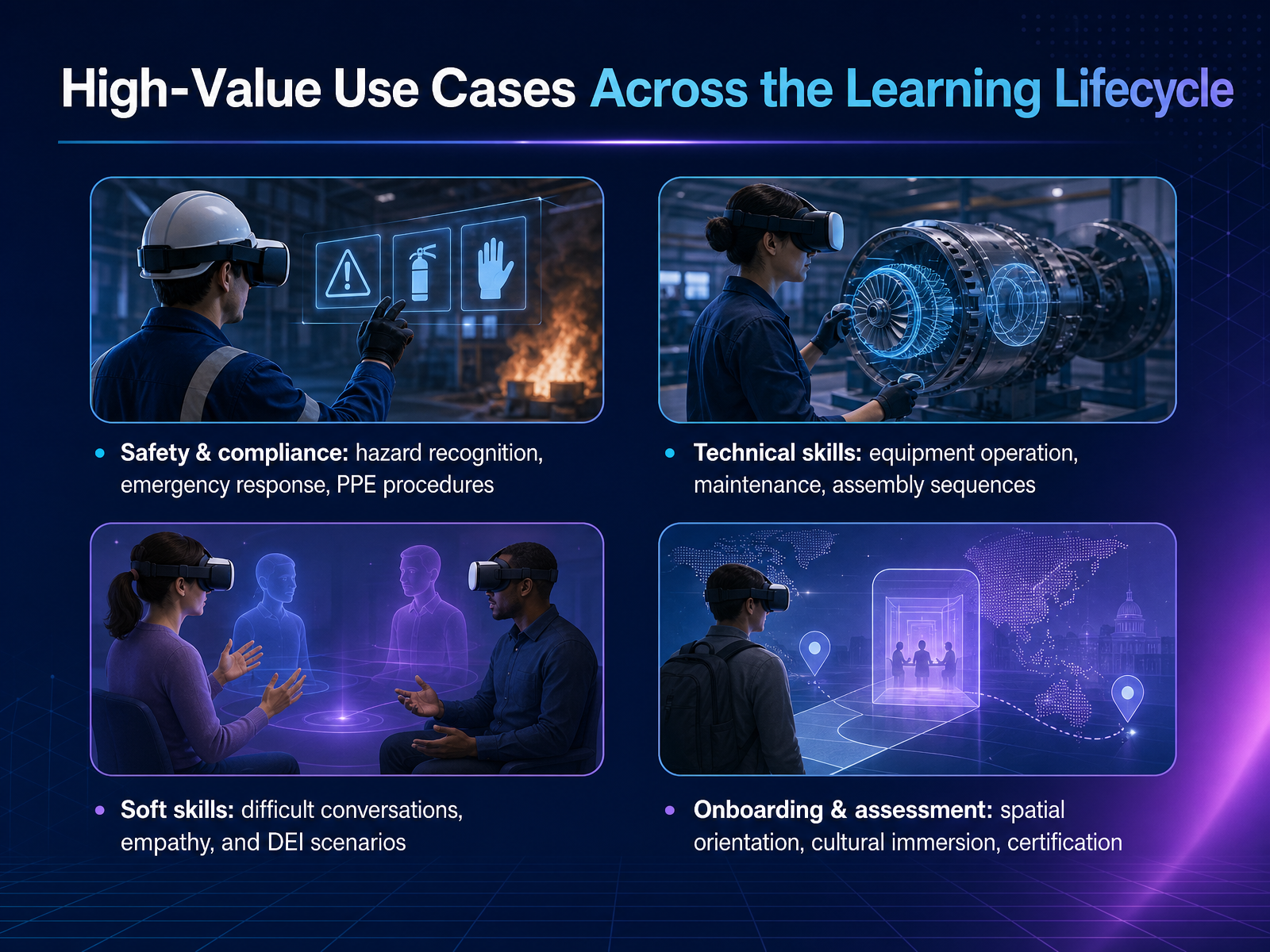
 - 04High-Value Use Cases Across the Learning LifecycleLet's look at where virtual reality delivers the most value across the learning lifecycle. In safety and compliance, VR lets employees recognize hazards and practice emergency response in a controlled, repeatable environment, including proper use of personal protective equipment. For technical skills, immersive simulation is ideal for mastering equipment operation, maintenance procedures, and complex assembly sequences. On the soft skills side, VR creates a safe space for practicing difficult conversations, building empathy, and working through diversity, equity, and inclusion scenarios. And for onboarding and assessment, it accelerates spatial orientation, cultural immersion, and even supports certification. The common thread is that VR shines when the cost or risk of real-world practice is high, giving learners the chance to build muscle memory and decision-making confidence before they face the real situation. Up next, we'll examine what successful deployments actually look like.
 humulo.comskillsive.comarborxr.com+22 min
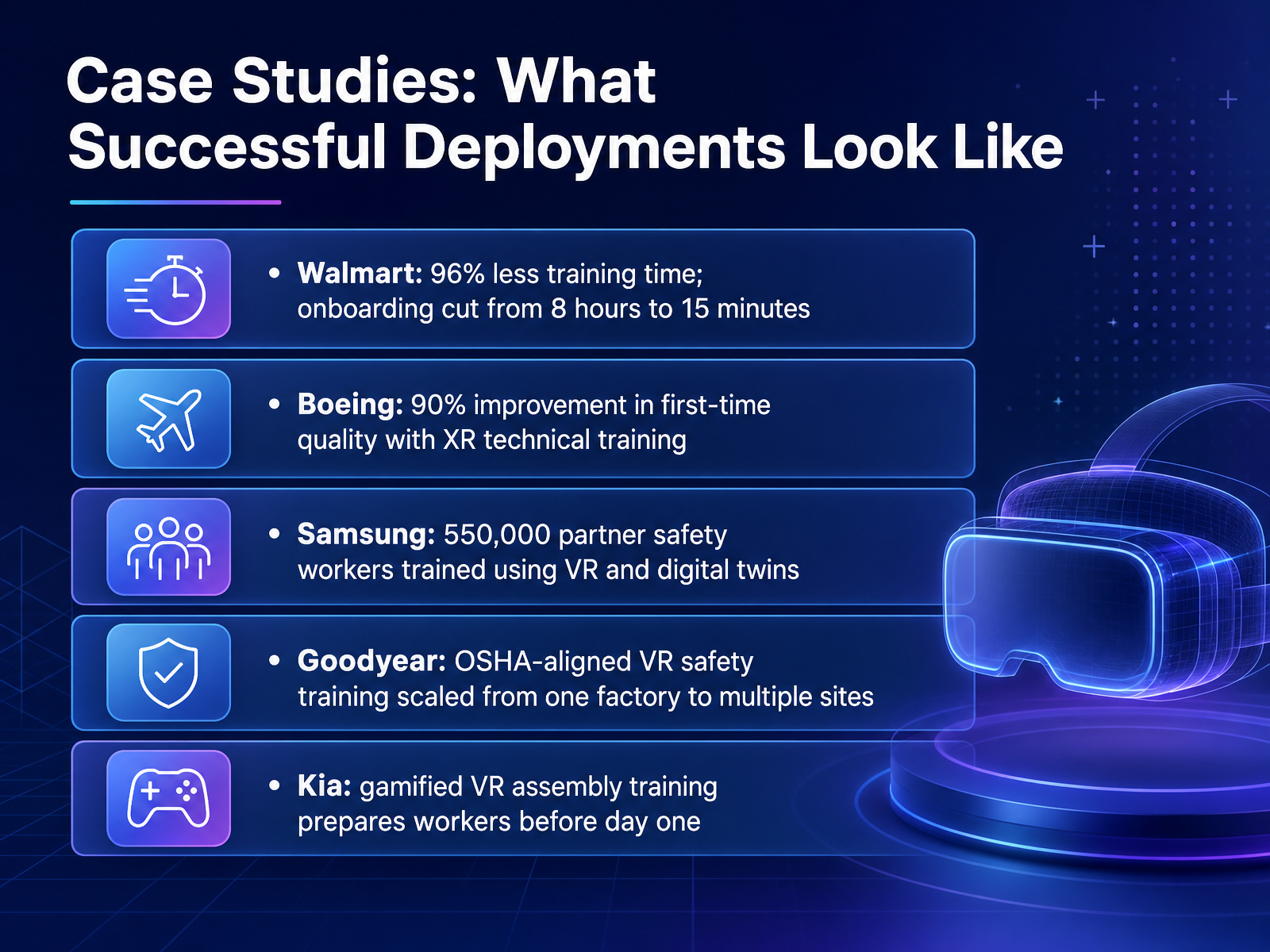
 - 05Case Studies: What Successful Deployments Look LikeLet’s shift from theory to proof. These are real deployments with numbers that should catch the attention of any learning leader. Walmart cut onboarding time for a major rollout from eight hours to fifteen minutes — a ninety-six percent reduction — across thousands of stores. Boeing reports a ninety percent improvement in first-time quality using extended reality for technical assembly. Samsung has trained over five hundred fifty thousand partner safety workers using VR and digital twins, recreating hazards so accurately that a wrong move triggers an immediate consequence. Goodyear started with OSHA-aligned VR safety training in one Houston factory, saw measurable gains, and scaled it to multiple plants. And Kia is using gamified VR so new hires practice door assembly before day one, mastering the pace of the line without halting production. What these share isn’t flashy tech. It is a strategic answer to a costly training problem. Now, let’s look at what makes these programs work — the design principles behind effective VR learning experiences.
 humulo.comchrp-india.comdemodern.de+22 min
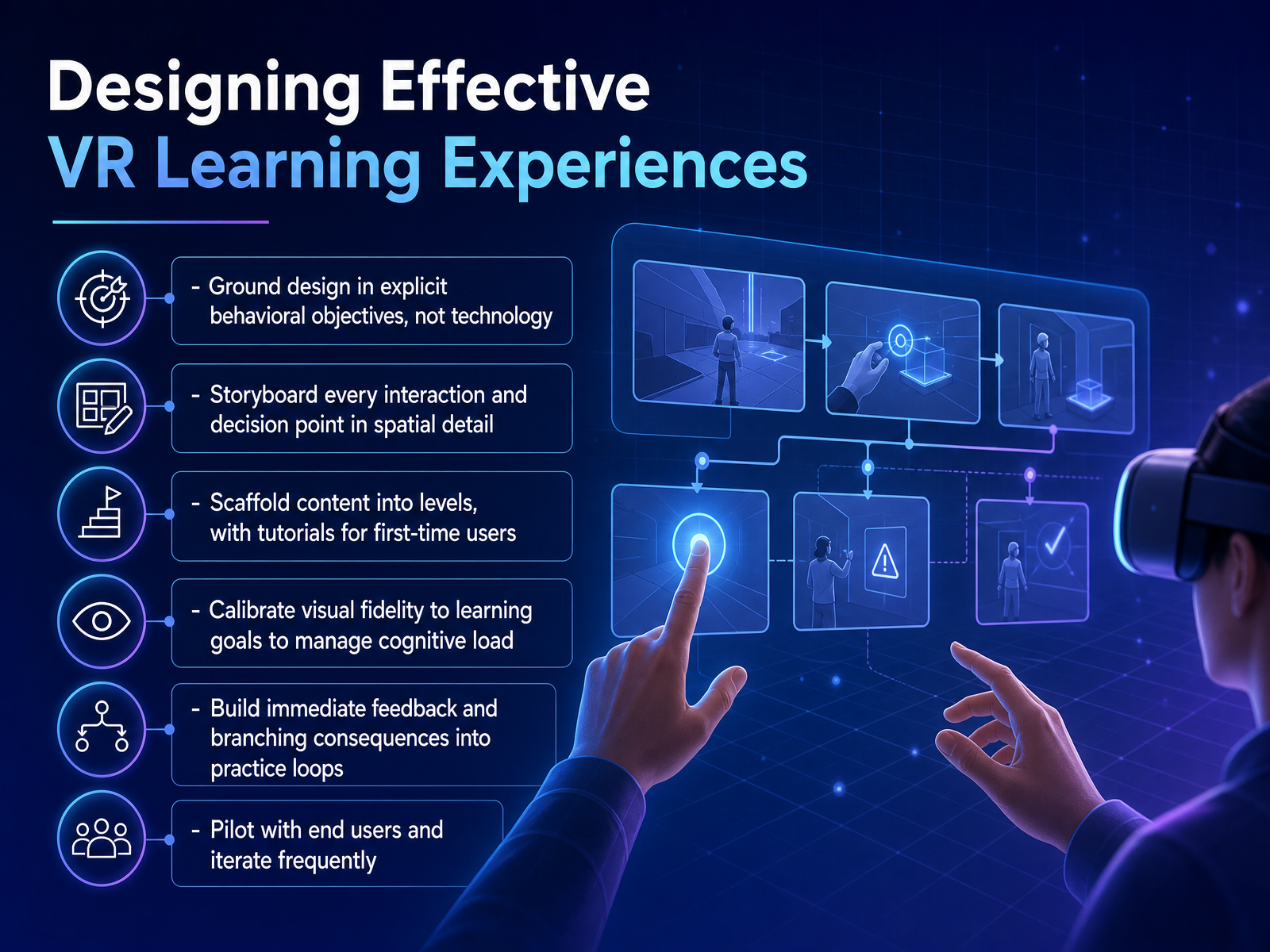
 - 06Designing Effective VR Learning ExperiencesNow let’s talk about designing VR learning experiences that actually change behavior. The principle to anchor everything else: start with the performance gap you need to close, not with the technology. A realistic simulation that asks the wrong questions won’t change behavior. A lower-fidelity one that asks the right questions, in the right sequence, will. Write the learning objective as a specific, observable behavior. One to three core objectives per module. Then storyboard every interaction and decision point — spatially. Map sightlines, reach zones, and what learners must notice. Scaffold the content: a short tutorial for controls, then levels that build on prior knowledge. This prevents cognitive overload, especially for first-time users. Calibrate visual fidelity to the learning goal. If it’s soft skills, simpler graphics work fine. If it’s hazard recognition, realism matters. Build immediate, corrective feedback into the practice loop — within two to three seconds, not in a follow-up quiz. Branching consequences and resets drive retention. Finally, pilot with end users early, often, and iterate from what you observe and from analytics. Design, measure, refine. That’s the cycle. Coming up we’ll look at the technology, platforms, and hardware that make this possible.
 peer.asee.orgmythyaverse.comarinsider.co+22 min
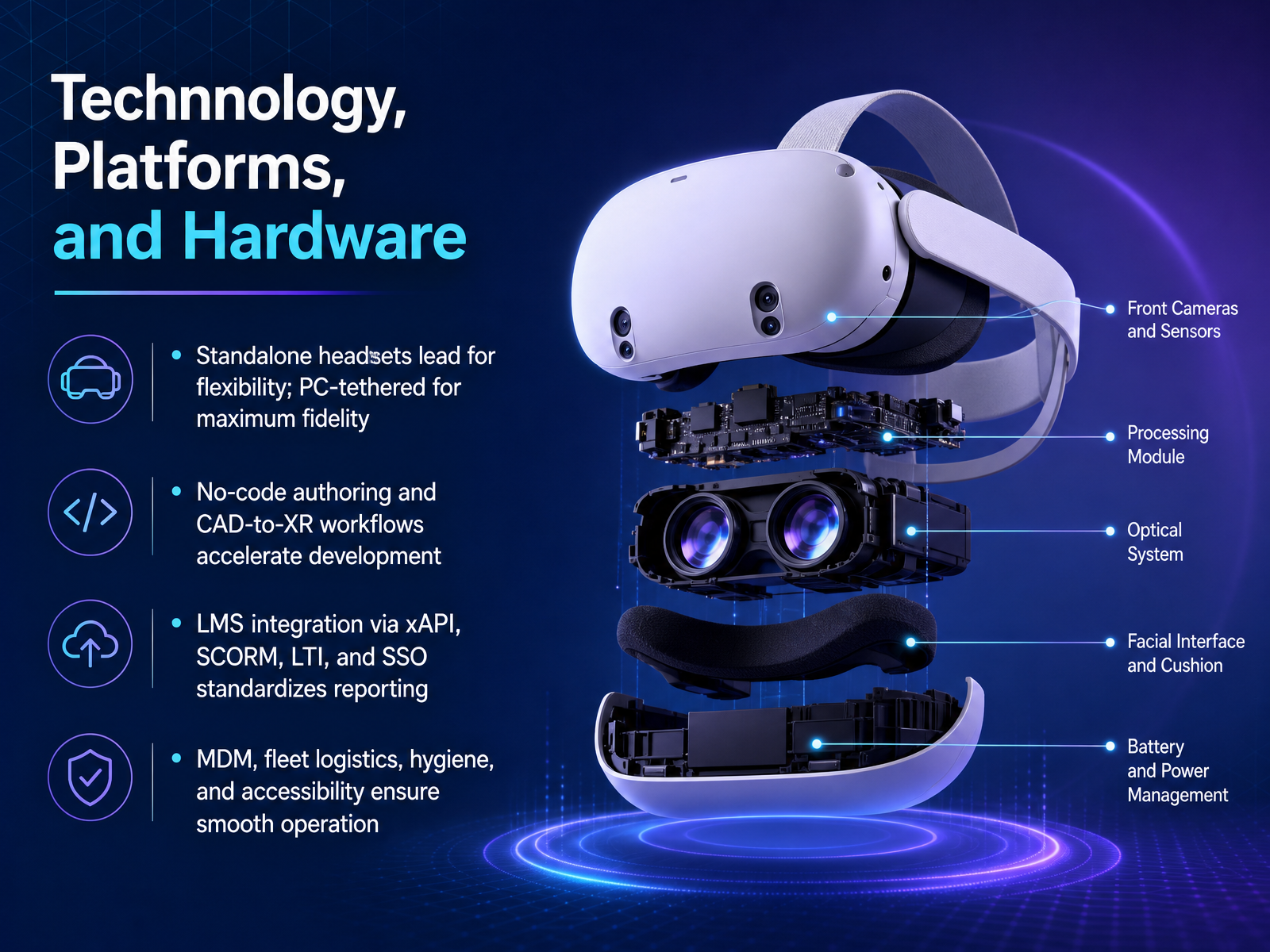
 - 07Technology, Platforms, and HardwareLet’s turn now to the practical layer—the technology, platforms, and hardware that make VR training run at enterprise scale. You have choices to make here, and they’re strategic ones. On hardware, standalone headsets lead for flexibility and ease of deployment, especially when you have learners across multiple sites. PC-tethered setups still deliver maximum visual fidelity, so they’re the right call for simulations where photorealistic detail genuinely affects the learning outcome—like hazard recognition or equipment inspection. Where fidelity isn't the driver, standalone devices save you significant logistics and cost. On the content side, no-code authoring tools and CAD-to-XR workflows are changing the development game. Your subject-matter experts can convert existing engineering models into interactive training in days, not months, which means your content can keep pace with changes on the shop floor. Now, none of this matters if the data doesn't flow. That's why LMS integration is non-negotiable. Standards like xAPI, SCORM, LTI, and SSO mean training records, completion rates, and performance scores land directly in the systems you already run. No silos, no manual exports, no extra reporting burden for your team. Finally, operational readiness is what separates pilots from programs. Mobile device management for your headset fleet, robust hygiene protocols, and built-in accessibility features ensure the hardware is simply another reliable tool your people use every day. When these layers are in place, VR isn’t a flashy demo; it’s a dependable training channel. Now, let’s look at how you measure whether that channel is delivering on its promise in terms of impact and return on investment.
 humulo.comskillsive.comarborxr.com+22 min
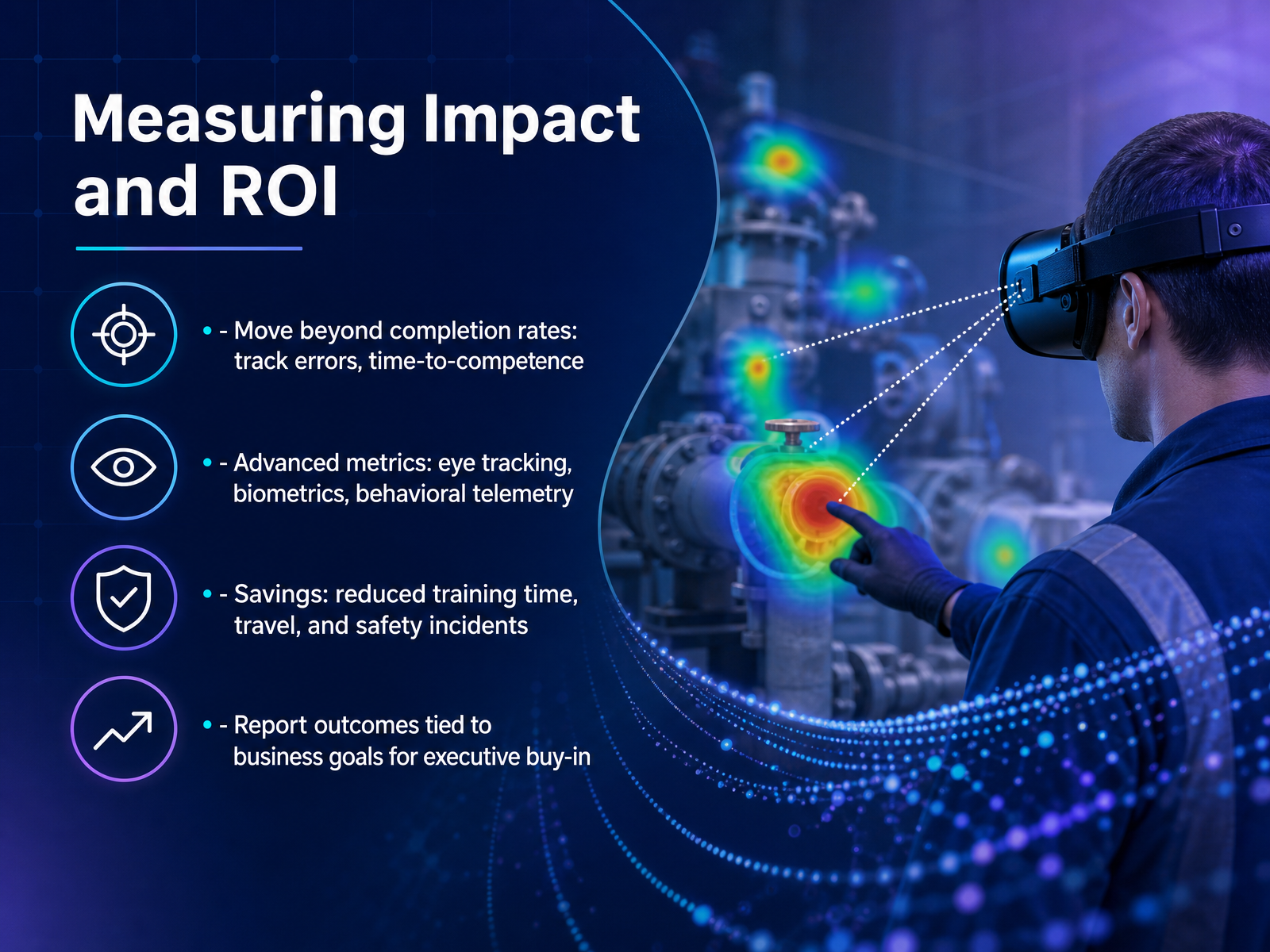
 - 08Measuring Impact and ROISo once the immersive experience is built, the next question is always the same: what did it actually deliver? That's where measuring impact and ROI comes in. And here's the thing — completion rates alone won't cut it anymore. We need to track what really matters: error rates, time to competence, and how quickly learners can apply skills on the job. VR gives us unprecedented visibility into performance. Eye tracking shows where attention goes. Biometrics capture stress and engagement. Behavioral telemetry records every decision a learner makes in the simulation. That data translates directly into business value. Think about what VR displaces: instructor travel, facility costs, equipment downtime, even safety incidents. At enterprise scale, these savings compound quickly. One study found a 219 percent return on investment with payback in under six months. Another showed a 300 percent ROI over five years. But to secure executive buy-in, you need to report outcomes tied to strategic goals — reduced time to proficiency, lower operational risk, faster onboarding. That's the language leadership understands. As we look ahead, let's talk about the human side of adoption — change management and learner readiness.
 humulo.comskillsive.comarborxr.com+21 min
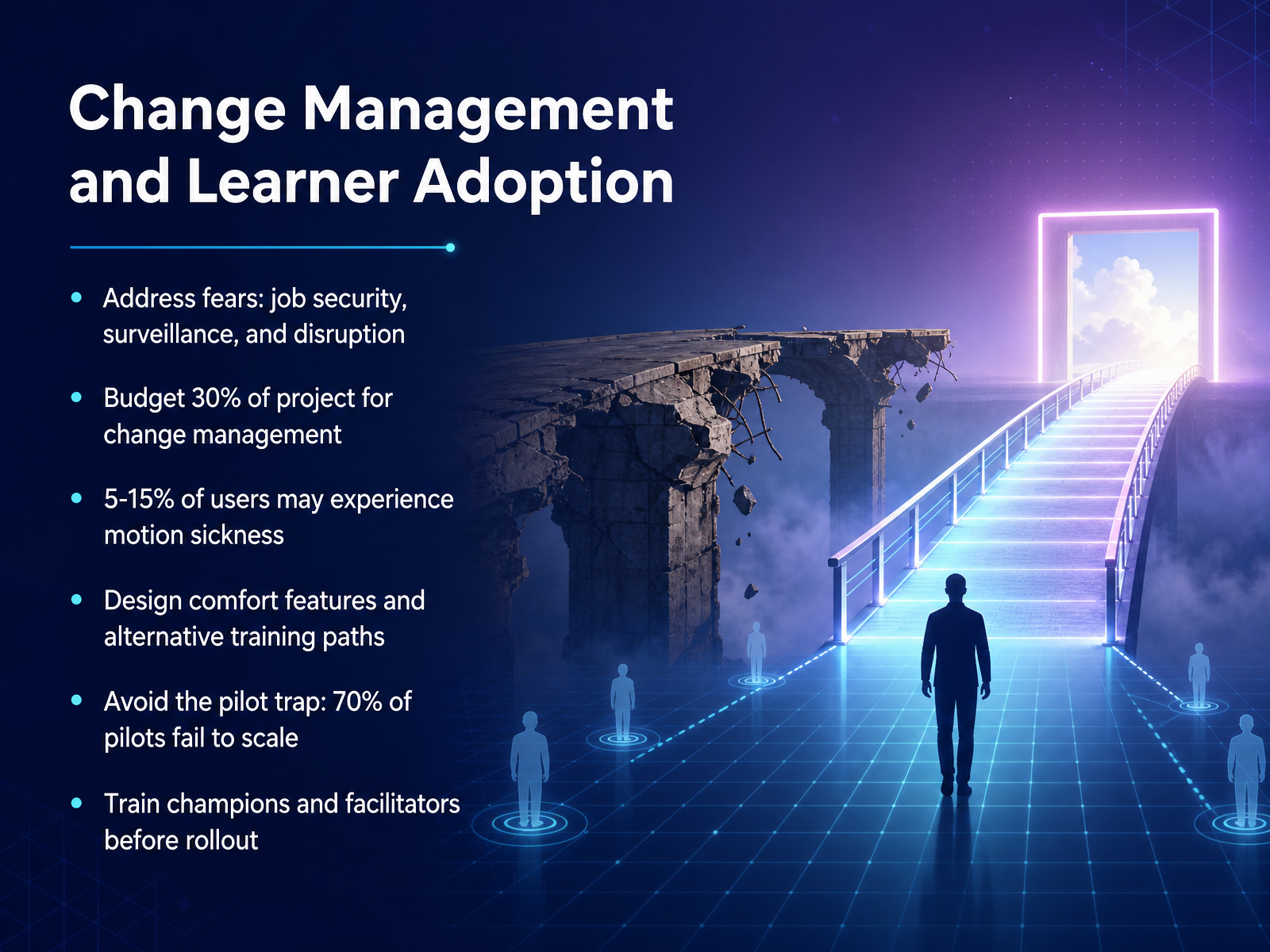
 - 09Change Management and Learner AdoptionLet's talk about the human side of the rollout, because that is where VR programs truly succeed or stall. The technology works. The real project is change management. Start by addressing the fears head-on: job security, surveillance, and disruption. Your trainers need to hear that VR amplifies their role, not replaces it. Your learners need to know their performance data is anonymized. This is why you should budget at least thirty percent of your project for this work. And remember, between five and fifteen percent of users may experience motion sickness. Design comfort features and always provide an alternative training path. Also, beware of the pilot trap. Seventy percent of pilots never scale because the change effort is underestimated. So train your champions and facilitators before you roll out. Get the supervisors and team leads using it first, and let them see the benefit: fewer mistakes from new hires and less burden on them. Do this, and you will move from a successful pilot to a sustainable program. Now, let's shift to the ethical and practical considerations you will need to navigate.
 1 min
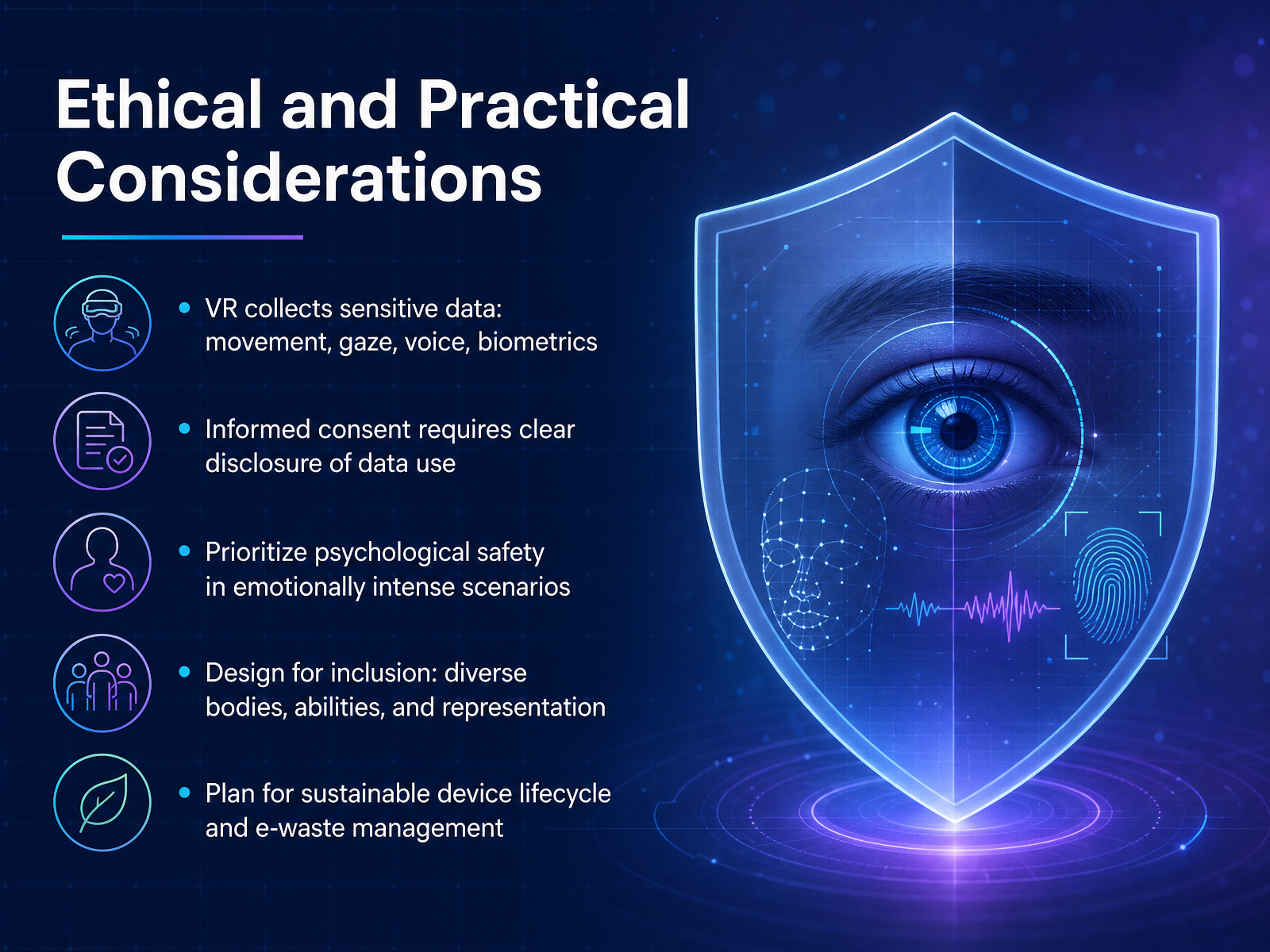
1 min - 10Ethical and Practical ConsiderationsNow for the ethical and practical considerations that should anchor your VR strategy. VR systems collect far more than click streams. They capture movement patterns, gaze direction, voice inflection, even subtle physiological responses. That data is uniquely personal and, in many regions, subject to strict regulation. So informed consent must be explicit, and you must disclose clearly what data is captured, how long you keep it, and whether it feeds algorithm training. Your learners need real control, and that includes straightforward opt-outs and a clean separation between training analytics and performance reviews. Also prioritize psychological safety. If your simulation involves high-stakes or stressful scenarios, build in clear entry points, a sense of presence that fades out gently, and structured debriefs so the experience supports growth rather than triggering distress. And design for inclusion. Test your modules with diverse bodies, cognitive styles, and needs from the start. That means considering physical accessibility and representation in the virtual world itself. Finally, plan for the device life cycle. headsets contain batteries and electronics, so map out reuse, responsible recycling, and e-waste handling now, not when units reach end of life. Get these foundations right, and your VR program earns lasting trust. Next, let's look at how to assess organizational readiness and move from pilot to scale.
 2 min
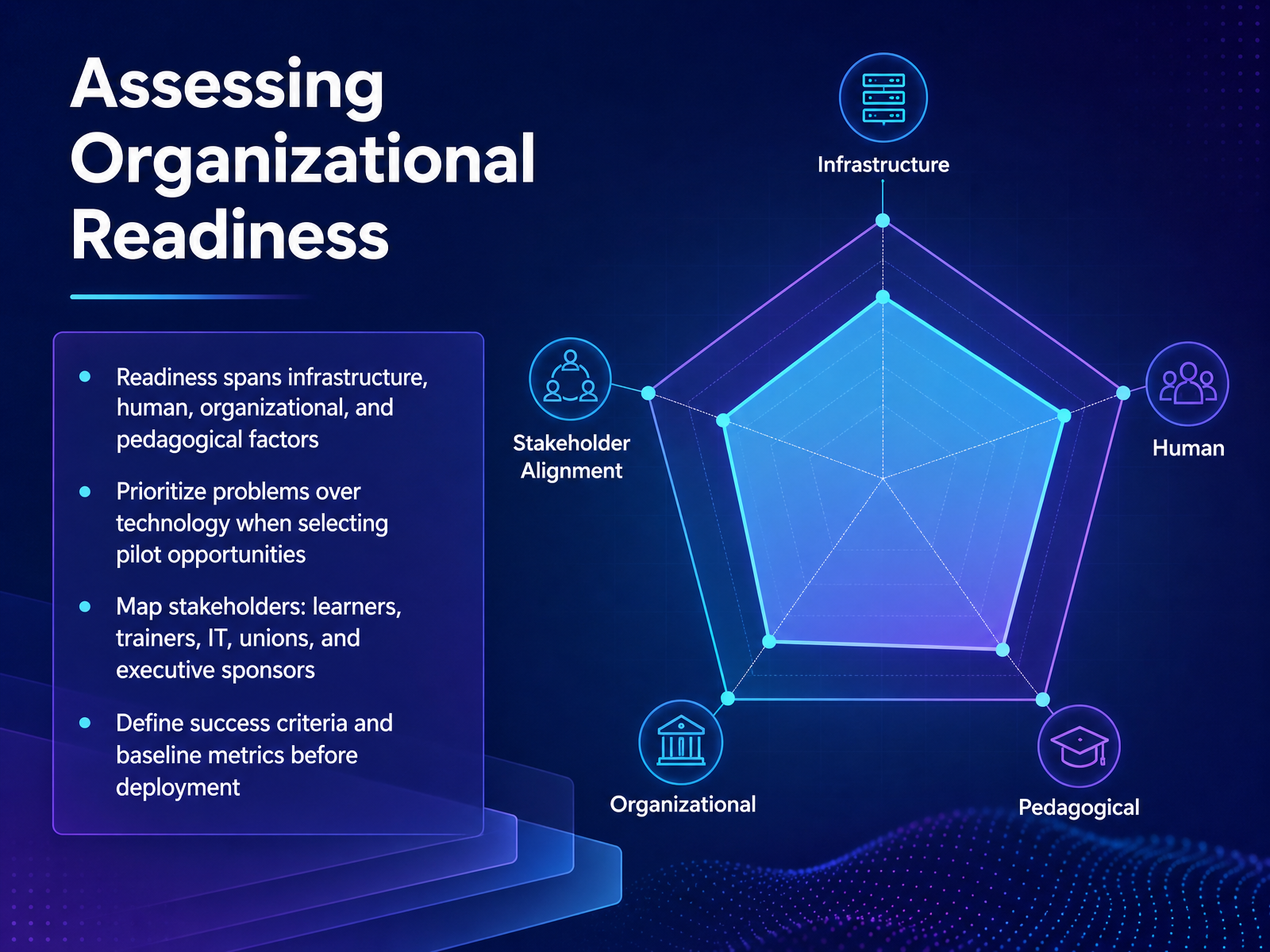
2 min - 11Assessing Organizational ReadinessSo how do you know if your organization is genuinely ready for VR? Start by broadening your definition of readiness. It is not just about bandwidth and headsets. Real readiness spans infrastructure, human factors, organizational support, and pedagogy. But resist the urge to start with the technology. Instead, prioritize the problem you are trying to solve. Choose pilot opportunities that address a clear performance gap, not ones that just look impressive in a demo. Once you have that, map your stakeholders. You need learners, trainers, IT, union representatives, and an executive sponsor all aligned early. Each group has different concerns, and your rollout plan must address them directly. Finally, and this is critical, define what success looks like before you deploy anything. Establish baseline metrics and measurable outcomes, not just completion rates, so you can prove impact when you report to leadership. Get this groundwork right, and you will avoid the pilot trap where a great prototype never scales. Now, let's look ahead at how to structure your full VR learning roadmap.
 peer.asee.orgmythyaverse.comarinsider.co+21 min
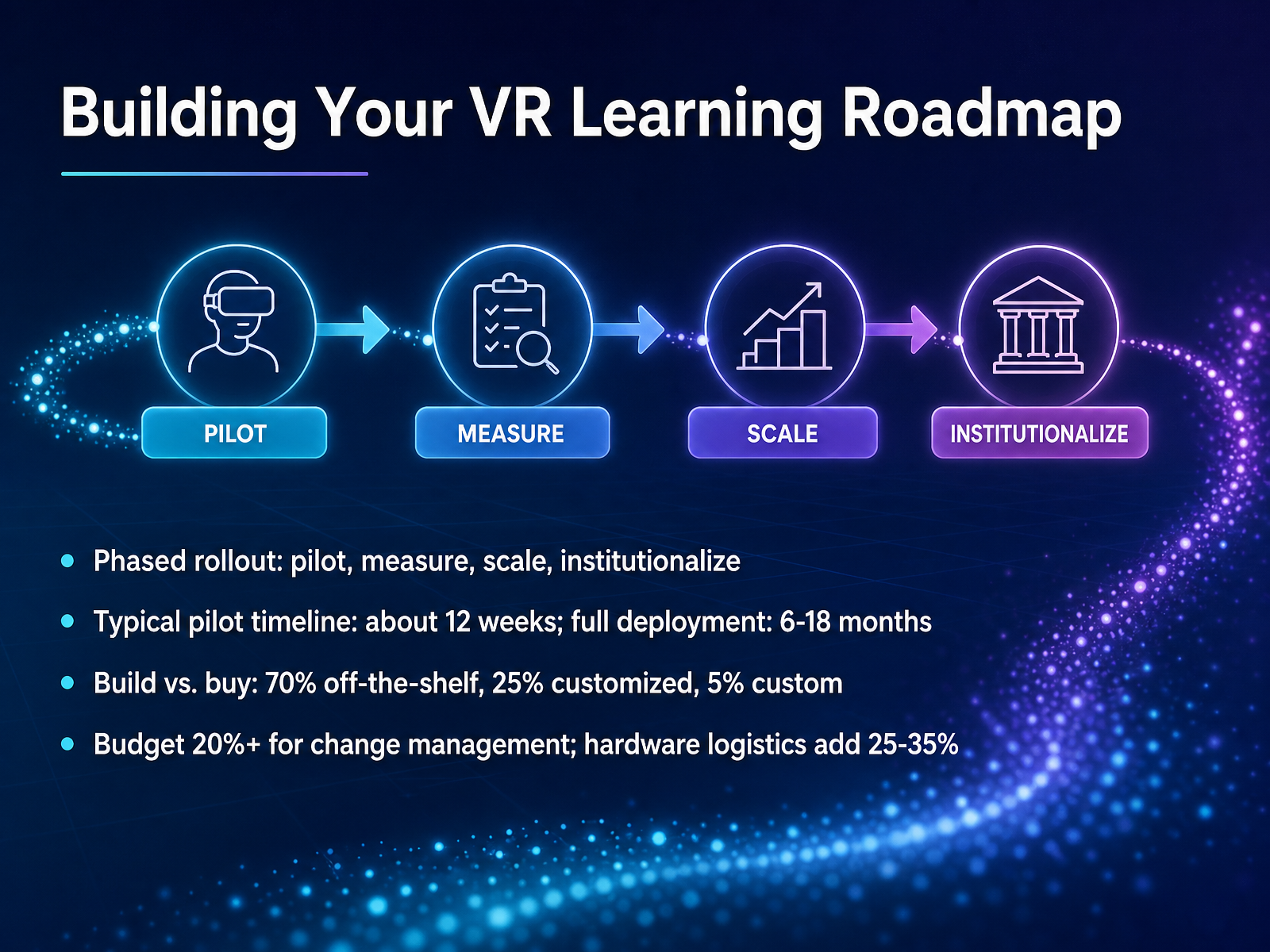
 - 12Building Your VR Learning RoadmapNow let's turn that readiness into a concrete roadmap. The pattern that works across sectors is a phased rollout: pilot, measure, scale, and institutionalize. Plan for roughly twelve weeks for a well-designed pilot. A full deployment typically takes six to eighteen months, depending on content complexity and the number of locations. When it comes to content, resist the temptation to build everything from scratch. The balanced approach is about seventy percent off-the-shelf, twenty-five percent customized to your context, and only about five percent fully custom development. This protects your timeline and your budget. Set aside at least twenty percent of the total budget for change management. Winning over frontline supervisors and trainers is where adoption is actually decided. And remember that hardware logistics are not a line item; they are a workstream. Charging carts, device management software, hygiene covers, and asset tracking typically add another twenty-five to thirty-five percent on top. Getting this mix right at the start is what separates a sustainable program from an expensive experiment. Next, let's look at the common pitfalls that derail these rollouts and how to avoid them.
 2 min
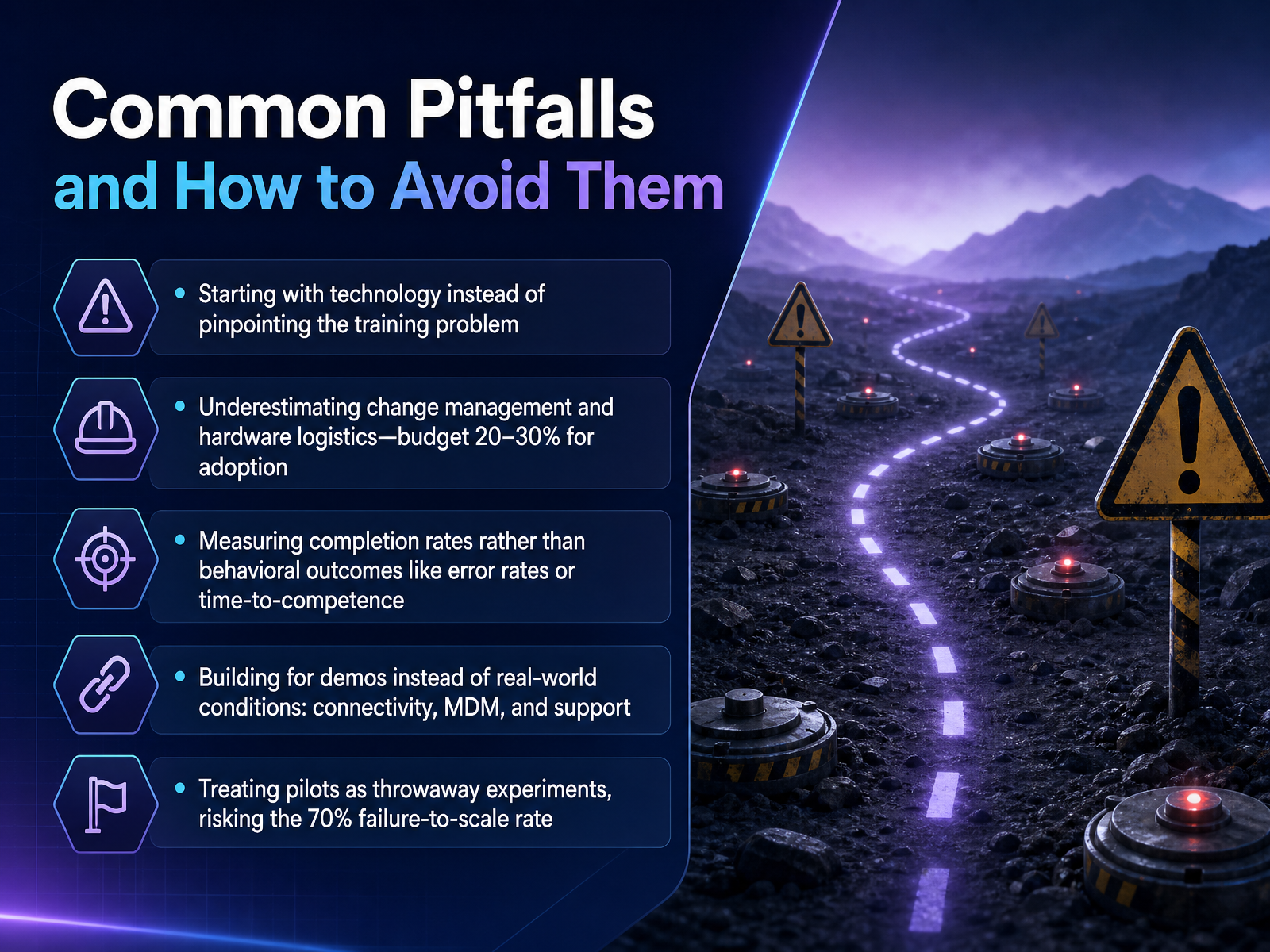
2 min - 13Common Pitfalls and How to Avoid ThemLet's talk about the pitfalls that keep VR programs from scaling. The most common one is starting with the technology instead of the training problem. You don't need VR; you need fewer safety incidents or faster onboarding. Start there. Next, budget for adoption. Set aside twenty to thirty percent of your total budget for change management and hardware logistics. Trust me, the headsets are the easy part. Also, measure behavioral outcomes, not completion rates. Track error rates or time-to-competence instead of how many people finished the module. And build for real-world conditions, not just demos. That means planning for connectivity, mobile device management, and ongoing support. Finally, treat pilots as the foundation for scale, not throwaway experiments. A staggering seventy percent of pilots fail to scale, and it's usually because of these very issues. Avoiding them is the path forward.
 peer.asee.orgmythyaverse.comarinsider.co+21 min
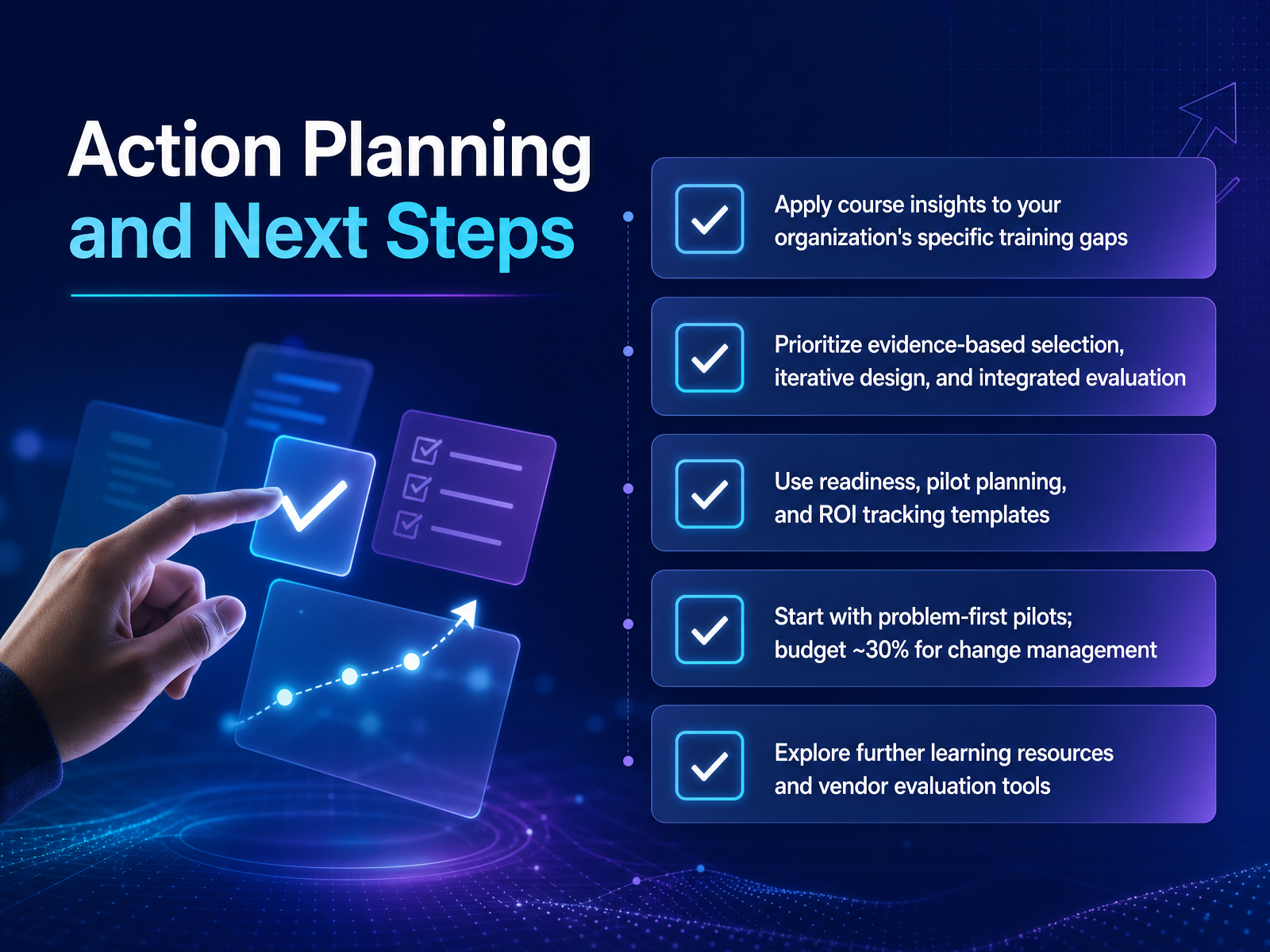
 - 14Action Planning and Next StepsSo as we wrap up, let's turn this insight into action. Start by mapping what you've learned to the specific training gaps you see in your organization. Approach each pilot with three priorities: evidence-based selection, iterative design, and integrated evaluation. Use the provided templates to assess readiness, plan your pilot, and track ROI from day one. And remember: begin with the problem, not the technology. A problem-first pilot will generate the data and stakeholder buy-in you need. Budget around thirty percent of your total project resources for change management. That is not overhead; it's the difference between a one-time demo and a sustainable program. Finally, explore the further learning resources and vendor evaluation tools—they will help you move forward with confidence. Thank you for your commitment to making learning more immersive, effective, and impactful. You now have the framework and the tools—your next step is what will make the difference.
 1 min
1 min
Take the deck with you
Download this course as a file — free, no sign-up needed.
- PDF handoutEvery slide page, ready to print or share.15 pages · 3.8 MBDownload
- Narrated PowerPointThe deck that presents itself — every slide carries the digital human's narration video.15 pages · 29.0 MBDownload
- PowerPoint slidesThe full deck as a .pptx — open it in PowerPoint, Keynote, or Google Slides.15 pages · 3.8 MBDownload
Free to use in your own training — please keep the PersonWise credit page at the end.
Have your own deck? Turn it into a course
Sources consulted
Web sources consulted while building this course.
- Measuring the effectiveness of virtual training: A systematic ... — sciencedirect.com
- How effective is immersive VR for vocational education? Analyzing knowledge gains and motivational effects — sciencedirect.com
- Dual empowerment in VR-based technical training: longitudinal evidence of developmental dynamics in learning outcomes and skill transfer | Educational technology research and development | Springer Nature Link — link.springer.com
- Effectiveness of Virtual Reality Training in Teaching Personal Protective Equipment Skills — doi.org
- The effectiveness of virtual reality training on knowledge, skills ... — pmc.ncbi.nlm.nih.gov
- Enterprise VR Safety Training for Business | Humulo — humulo.com
- VR training platform and LMS for companies | Skillsive — skillsive.com
- Insights — arborxr.com
- PIXO Control | VR Training Management & Analytics Dashboard — pixovr.com
- Enterprise VR Training Company | Proven with Banks & Rail — virtualverse.studio
- Goodyear VR Safety Training Case Study: Multi-Site Rollout | Humulo — humulo.com
- How CHRP-INDIA Enabled Vedanta to Transform Safety Training Using VR | CHRP-INDIA Client Case Study - CHRP-INDIA — chrp-india.com
- SKAN – VR Training for Pharma Isolators | Demodern | Demodern — demodern.de
- Samsung Trains 550,000 Safety Workers with Lifelike VR Technology - Seoul Economic Daily — en.sedaily.com
- VR Expert x Quality Executive Partners: Strengthening workforce capability in pharmaceutical manufacturing - VR Expert | Enterprise VR/AR Hardware Supplier — vr-expert.com
- Best Practices for Developing Virtual Reality Education Simulations — peer.asee.org
- VR Training Simulation Development: Practical Guide | MythyaVerse | MythyaVerse — mythyaverse.com
- 4 Best Practices to Design VR Training Experiences - AR Insider — arinsider.co
- Immersive Learning Design Today: Best Practices - eLearning Industry — elearningindustry.com
- Virtual Reality Learning Design Guide - Motive.io — motive.io