Begin
14 pages · ~28 min
ChurnZero Software Selection & Workflow
This training helps teams evaluate, select, and implement ChurnZero customer success software, covering requirements and workflow setup for effective adoption.
A digital instructor presents all 14 pages. Hold “Ask” at any point and ask out loud — the answer comes from this course. No sign-up needed.
What you’ll learn
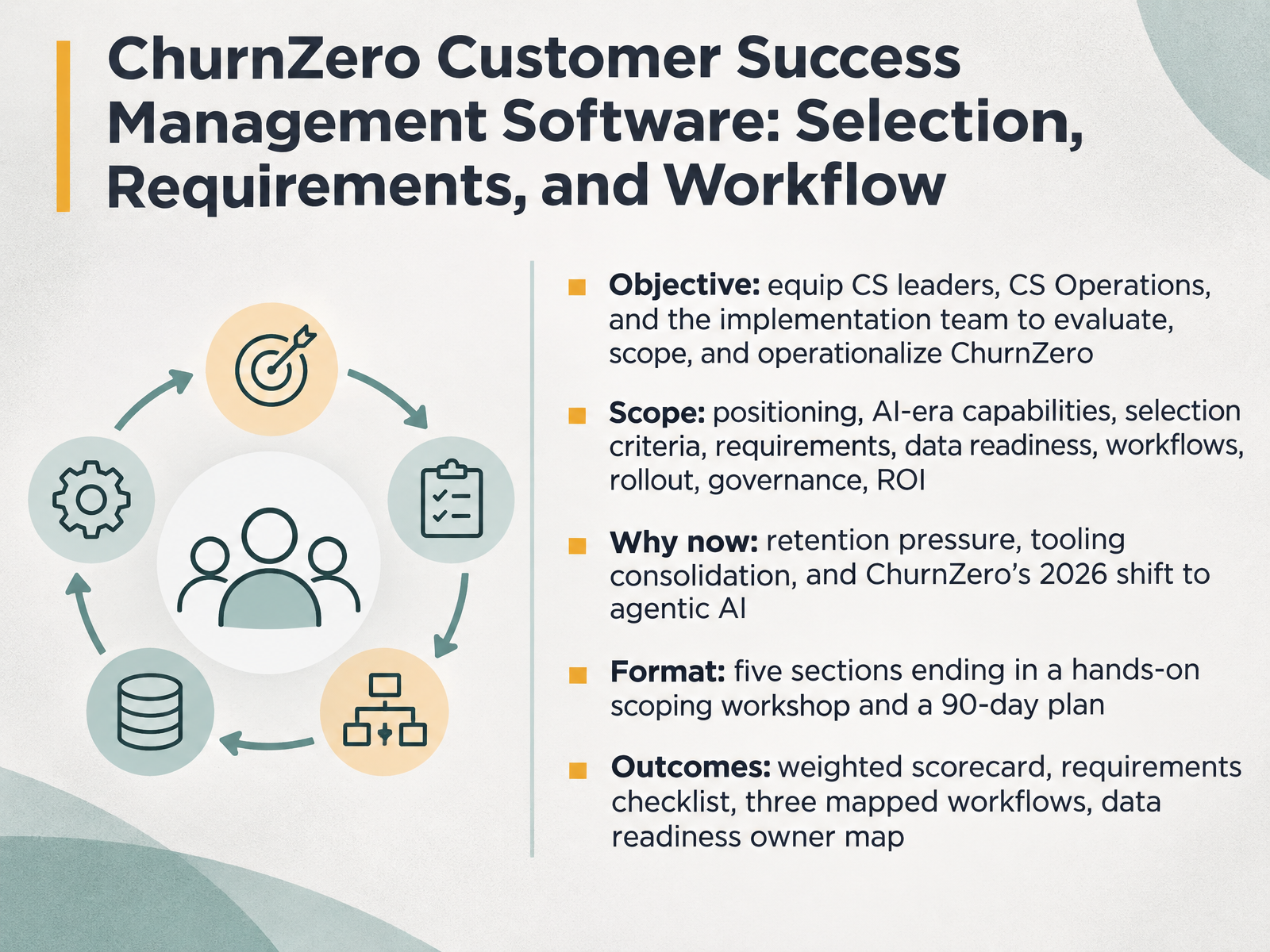
- 01ChurnZero Customer Success Management Software: Selection, Requirements, and WorkflowWelcome. Over the next five sections, we will work through selecting, scoping, and operationalizing ChurnZero. The goal is practical: by the end, your customer success leaders, CS Operations staff, and implementation team should be able to evaluate ChurnZero with evidence, define requirements precisely, and configure workflows with confidence. We will cover positioning, AI-era capabilities, selection criteria, requirements, data readiness, workflows, rollout, governance, and return on investment. Why this topic, and why now? Retention pressure is up, teams are consolidating tooling, and ChurnZero's 2026 shift to agentic AI changes how you plan configuration and controls. The format ends with a hands-on scoping workshop and a ninety-day plan. You will leave with four artifacts: a weighted scorecard, a requirements checklist, three mapped workflows, and a data readiness owner map. First, a quick framing point. A weighted scorecard is a scoring table where each criterion carries an agreed weight, so your decision is defensible. A requirements checklist is your written must-have list, and a workflow map is the trigger, action, and owner for each play. We will define the rest as we go. Before we move on, one instruction. Keep your current stack and your top three churn signals in front of you, because we will use them in every section. Next, let's look at why ChurnZero, and why now.churnzero.comchurnzero.comchurnzero.com+22 min
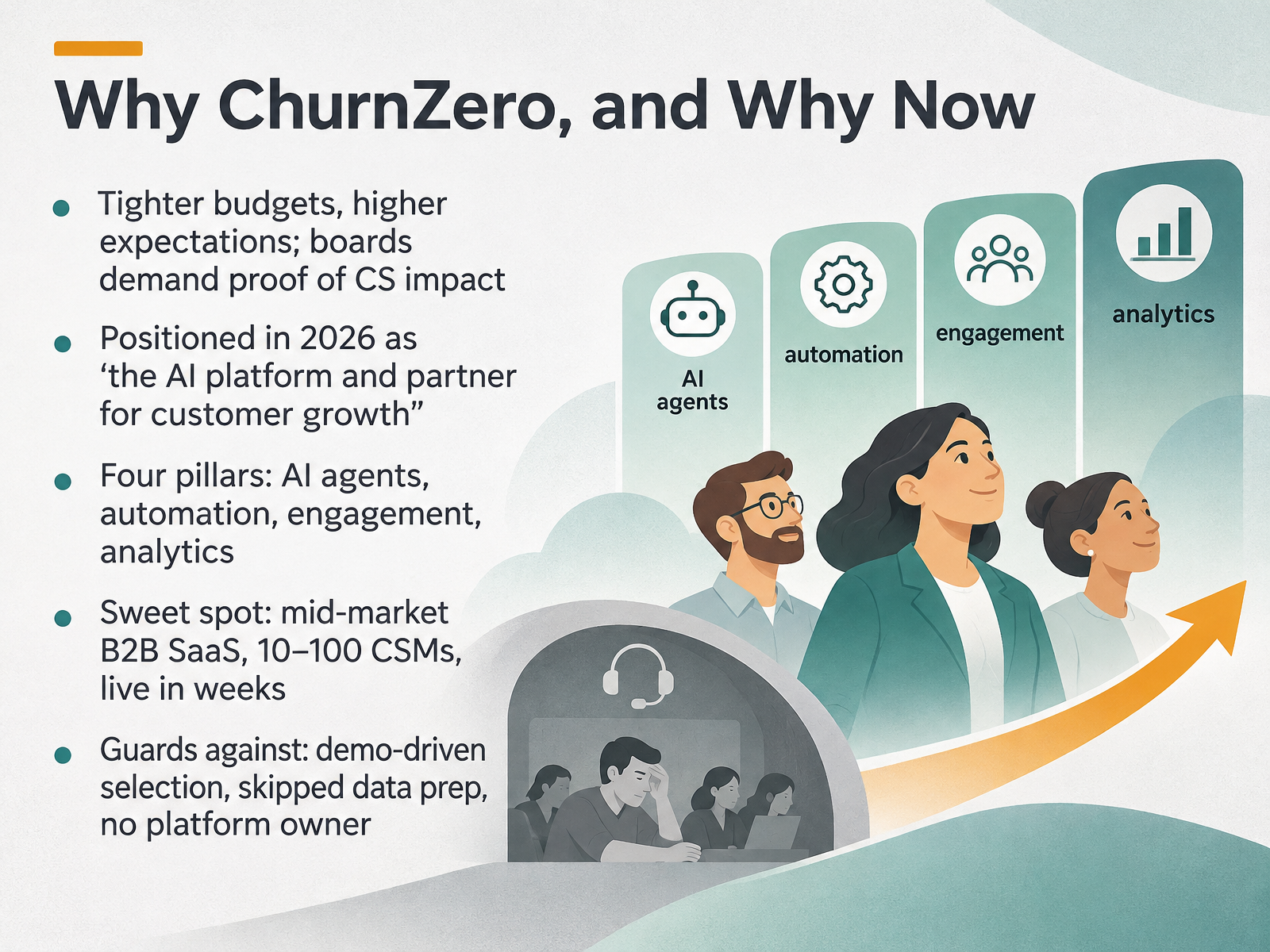
- 02Why ChurnZero, and Why NowLet's move into why ChurnZero, and why now. The pressure is real. Budgets are tighter, expectations are higher, and boards want proof that customer success actually moves revenue. ChurnZero positions itself in twenty twenty-six as the AI platform and partner for customer growth. Practically, that means four pillars: AI agents, automation, engagement, and analytics. The fit is mid-market B2B SaaS with roughly ten to one hundred CSMs, live in weeks rather than quarters. Now, three guardrails before you configure anything. First, avoid demo-driven selection. Write your requirements before the first call. Next, do not skip data prep. Health scores and playbooks run on clean CRM, product, and support data. Finally, name a platform owner. Without one, workflows decay after launch. Next, we will map the platform positioning and capability map.
 churnzero.comchurnzero.comchurnzero.com+22 min
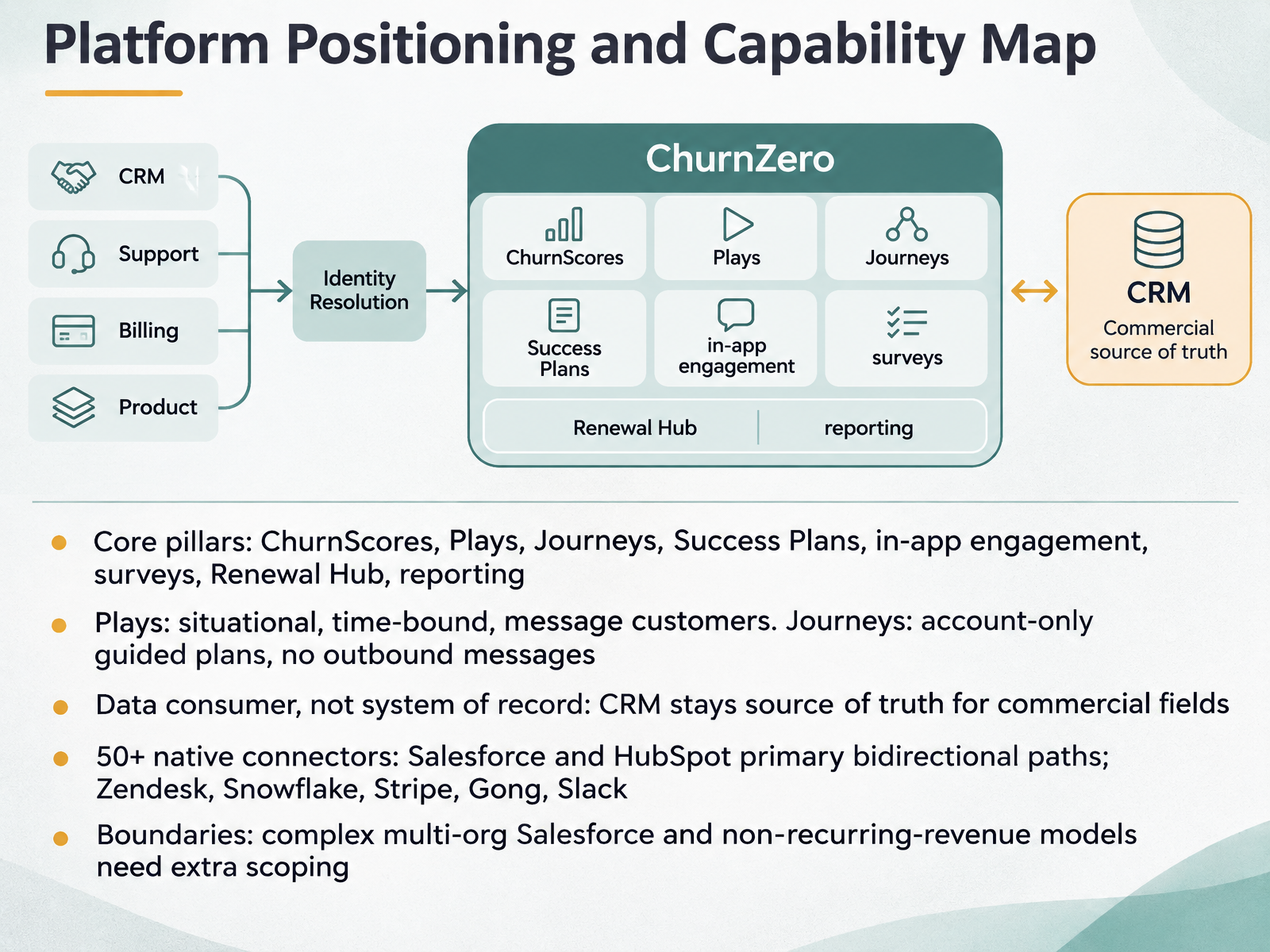
- 03Platform Positioning and Capability MapNext, let's map the platform so everyone shares the same mental model. ChurnZero's core pillars are ChurnScores, which are health scores built from your chosen signals; Plays and Journeys; Success Plans; in-app engagement; surveys; the Renewal Hub; and reporting. First, keep Plays and Journeys distinct. Plays are situational and time-bound, and they can message customers. Journeys guide accounts through a plan on a timeline and send no outbound messages. Next, treat ChurnZero as a data consumer, not your system of record. Your CRM stays the source of truth for commercial fields like deals and account ownership. There are more than fifty native connectors. Salesforce and HubSpot are the primary bidirectional CRM paths, with Zendesk, Snowflake, Stripe, Gong, and Slack feeding support, billing, usage, and communication context. Before you configure, scope the boundaries. Complex multi-org Salesforce setups and non-recurring-revenue models need extra discovery, because they fall outside the standard assumption of a recurring-revenue business tied to a single CRM hierarchy. That leads us into selection criteria and the competitive landscape.
 churnzero.comchurnzero.comg2.com+22 min
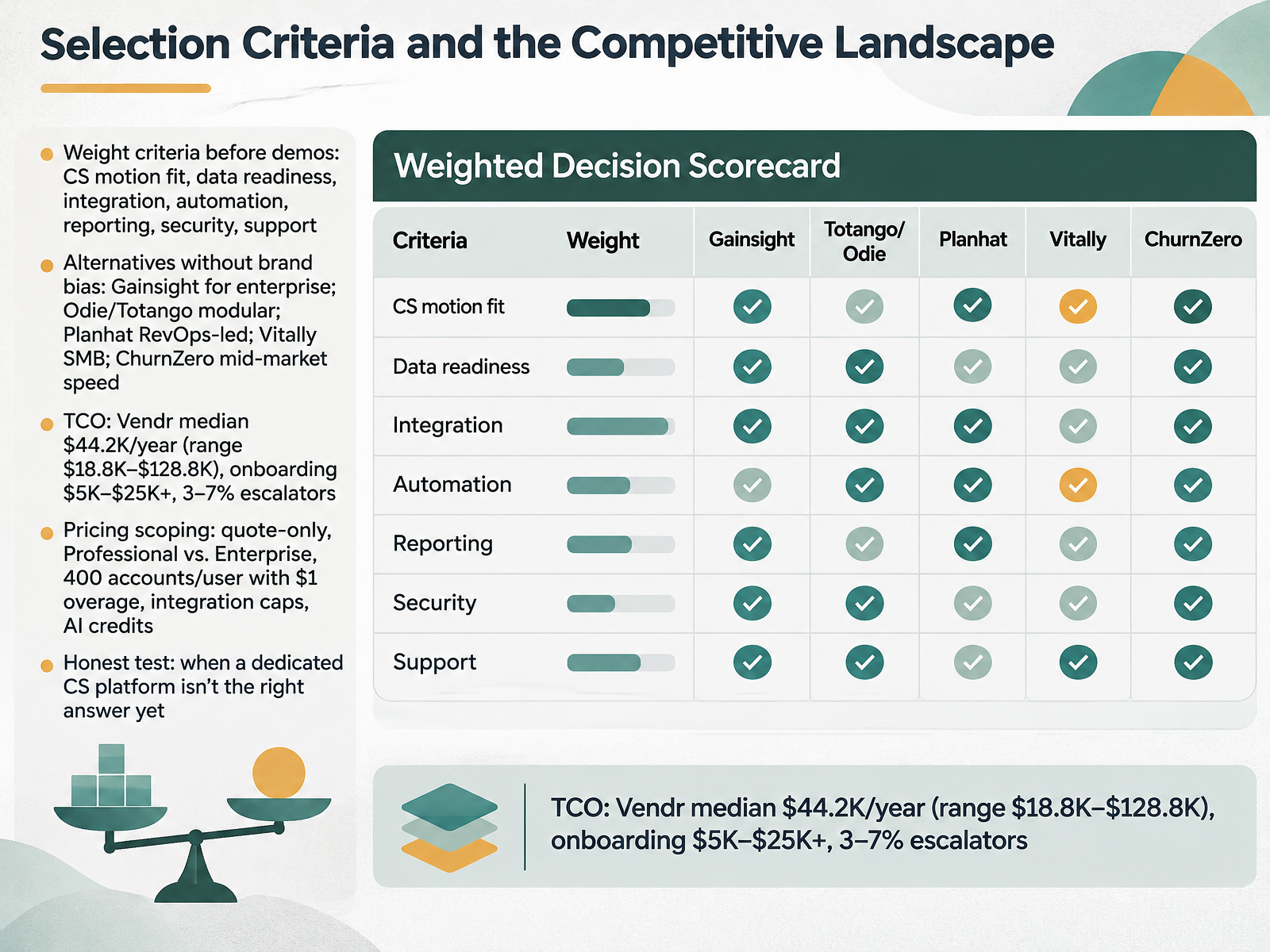
- 04Selection Criteria and the Competitive LandscapeNext, selection criteria. Before you sit through a single demo, weight the criteria: CS motion fit, data readiness, integration, automation, reporting, security, and support. Write the weights down, so the demo scores against them, not against the polish of the presenter. Compare alternatives without brand bias. Gainsight fits enterprise CS operations. Odie, formerly Totango, is modular through SuccessBlocks. Planhat suits RevOps-led teams, Vitally fits SMB, and ChurnZero fits mid-market speed. Then model total cost of ownership. Vendr's median ChurnZero contract is forty-four thousand two hundred dollars a year, ranging from about eighteen thousand eight hundred to one hundred twenty-eight thousand eight hundred. Onboarding runs five to twenty-five thousand or more, with annual escalators of three to seven percent. Scope pricing carefully. ChurnZero is quote-only, with Professional and Enterprise editions, four hundred accounts per user at one dollar per account overage, a five-integration cap on Professional, and AI credits to confirm. And ask the honest question: is a dedicated CS platform the right answer yet? If a small team has no automated health scores or playbook triggers, CRM tracking plus a workflow tool may serve you better for now. From CS Strategy to Functional Requirements.
 meetmycro.comcshub.stratapps.comsoftwaretrail.com+22 min
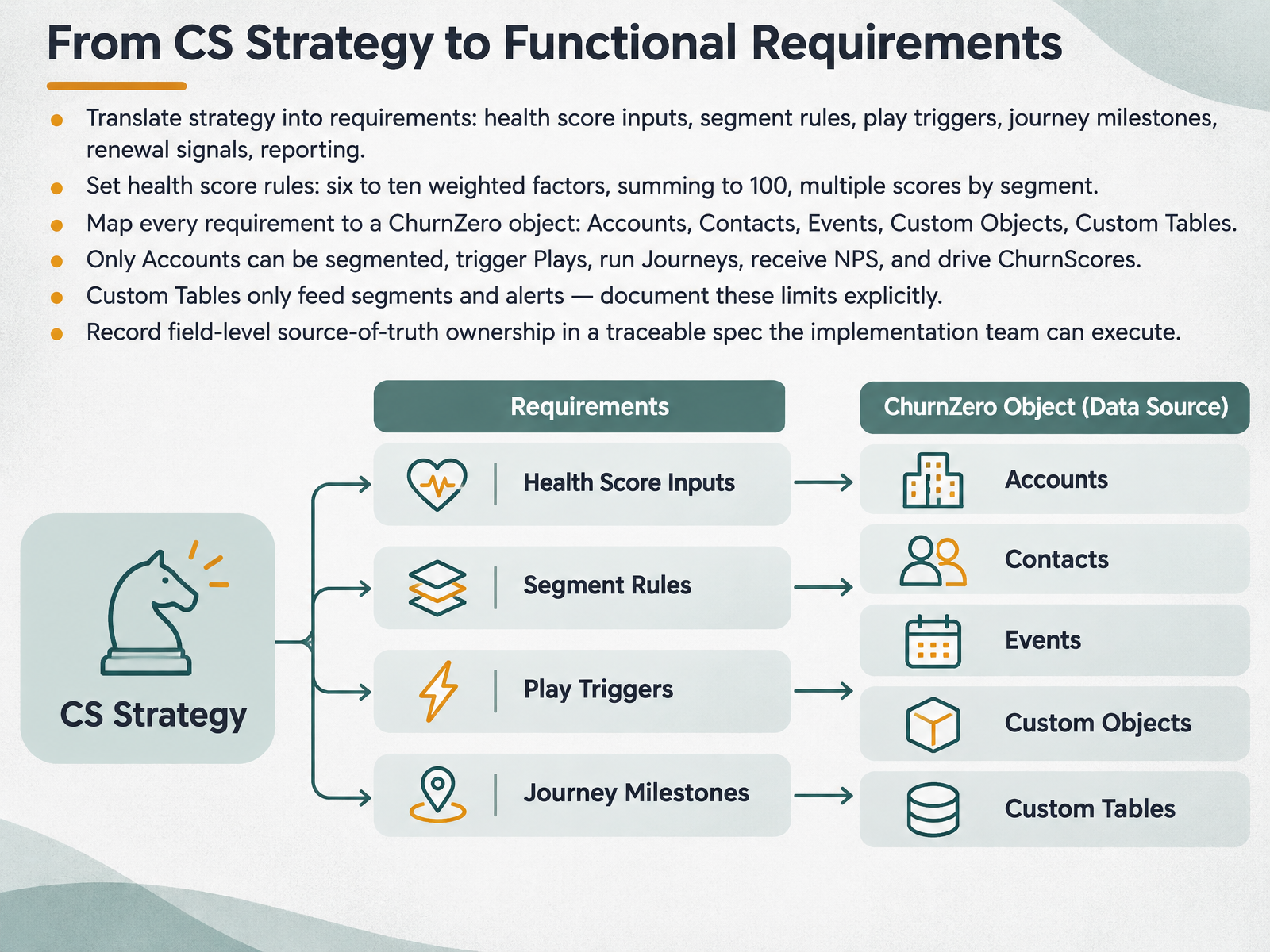
- 05From CS Strategy to Functional RequirementsNow let's move from CS strategy to functional requirements. Your job here is translation, not brainstorming. Take each strategic goal and turn it into a testable rule. Health score inputs, segment rules, play triggers, journey milestones, renewal signals, and reporting. For health scores, define six to ten weighted factors that sum to one hundred, and run separate scores by segment. Next, map every requirement to a ChurnZero object: Accounts, Contacts, Events, Custom Objects, or Custom Tables. Here is the constraint that shapes your spec. Only Accounts can be segmented, trigger Plays, run Journeys, receive NPS, and drive ChurnScores. Custom Tables only feed segments and alerts, so document that limit explicitly. For example, if a ticket attribute must trigger a play, it belongs on a Custom Object tied to the account, not a Custom Table. Finally, record field-level source-of-truth ownership in one traceable spec your implementation team can execute. Next, we'll cover Data Readiness and Non-Functional Requirements.
 app.churnzero.netsupport.churnzero.comsupport.churnzero.com+22 min
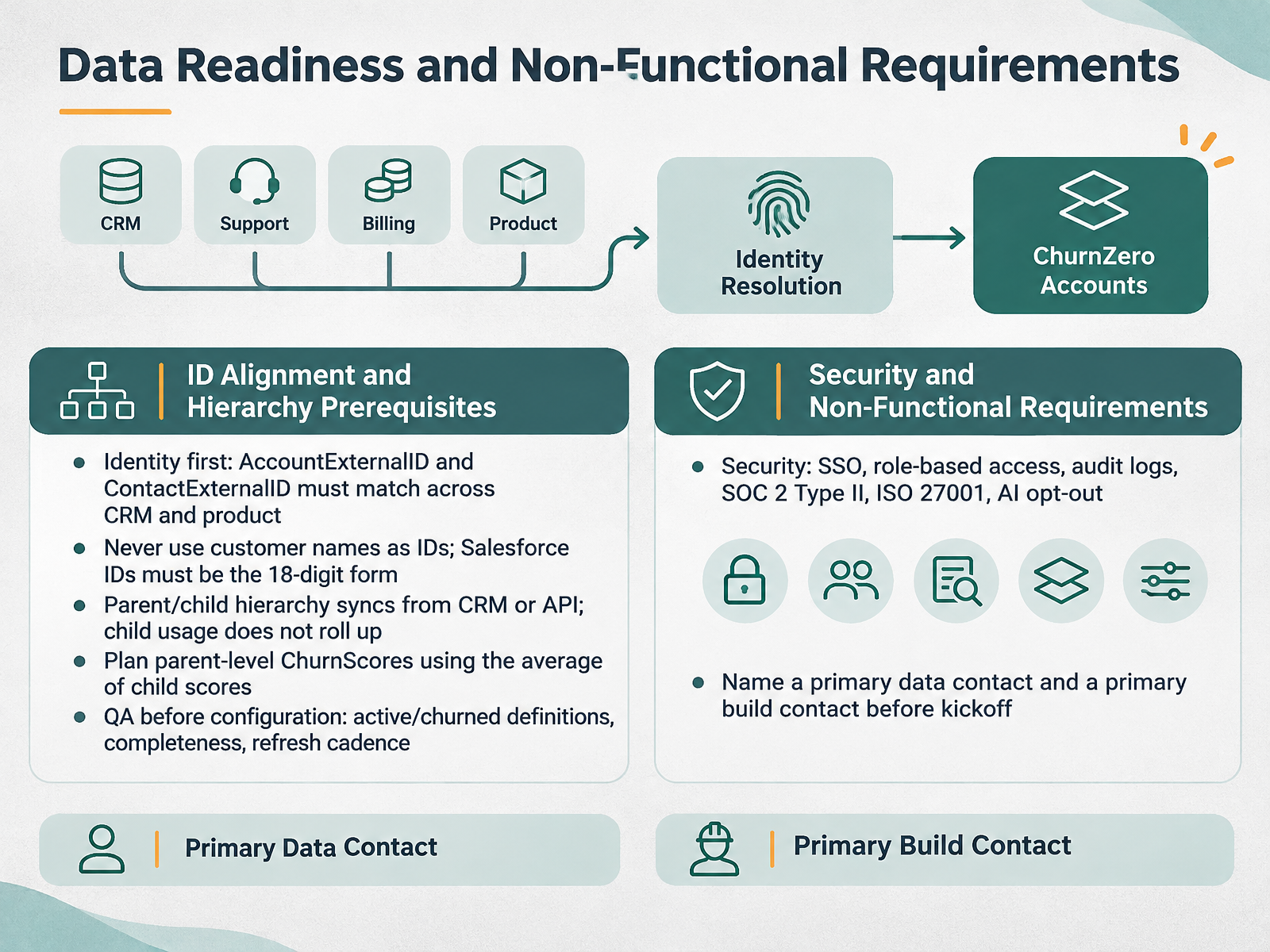
- 06Data Readiness and Non-Functional RequirementsNow let's talk about data readiness and the non-functional requirements that decide whether your ChurnZero configuration survives contact with reality. Identity comes first. AccountExternalID and ContactExternalID must match across your CRM and your product. Never use customer names as IDs, and if you use Salesforce IDs, use the eighteen-digit form, not fifteen, because the short form is only unique when treated as case sensitive. Next, parent and child hierarchy syncs from your CRM or through the API. Be aware that child usage does not roll up to the parent, so plan parent-level ChurnScores using the average of child scores. Before you configure anything, run QA on active and churned definitions, field completeness, and refresh cadence. Then confirm security: single sign-on, role-based access, audit logs, SOC two Type two, ISO twenty-seven thousand and one, and an AI opt-out. Finally, name a primary data contact and a primary build contact before kickoff. That decision prevents most implementation delays. Next, we move into Health Score Architecture in Practice.
 app.churnzero.netsupport.churnzero.comsupport.churnzero.com+22 min
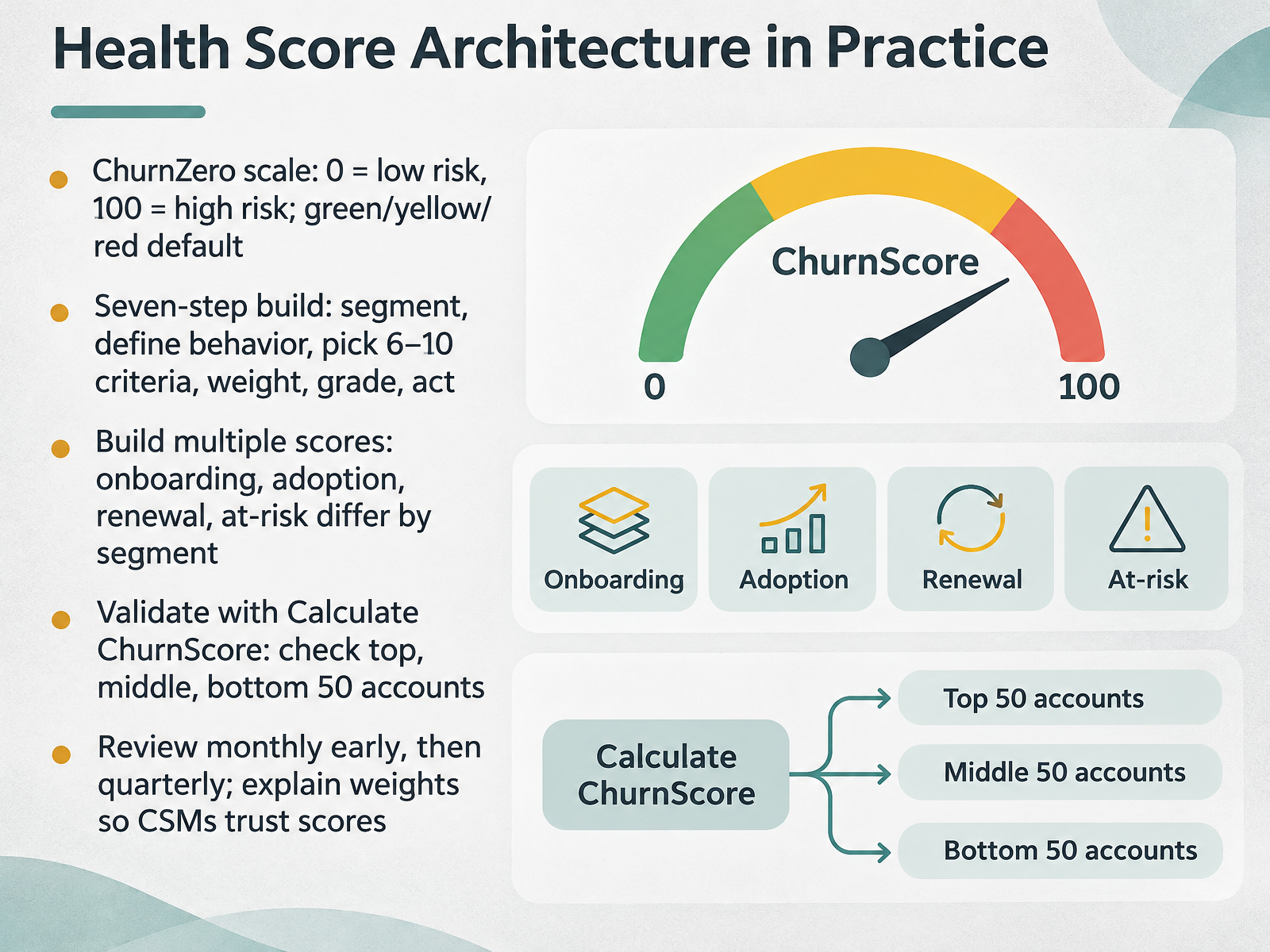
- 07Health Score Architecture in PracticeNow let's look at health score architecture in practice. In ChurnZero, the ChurnScore scale runs from zero to one hundred, where zero means low risk and one hundred means high risk. The default presentation is green, yellow, and red. Build the score in seven steps: segment your accounts, define the behavior you care about, pick six to ten criteria, assign weights, grade each account, and act on the result. Build multiple scores, because onboarding, adoption, renewal, and at-risk signals differ by segment. Before you trust a score, validate it with the Calculate ChurnScore function. Check your top, middle, and bottom fifty accounts. Review early scores monthly, then move to quarterly. And explain the weights to your CSMs, so they understand why an account is red and trust the score. Next, we move into workflow design: plays, journeys, and segmentation.
 2 min
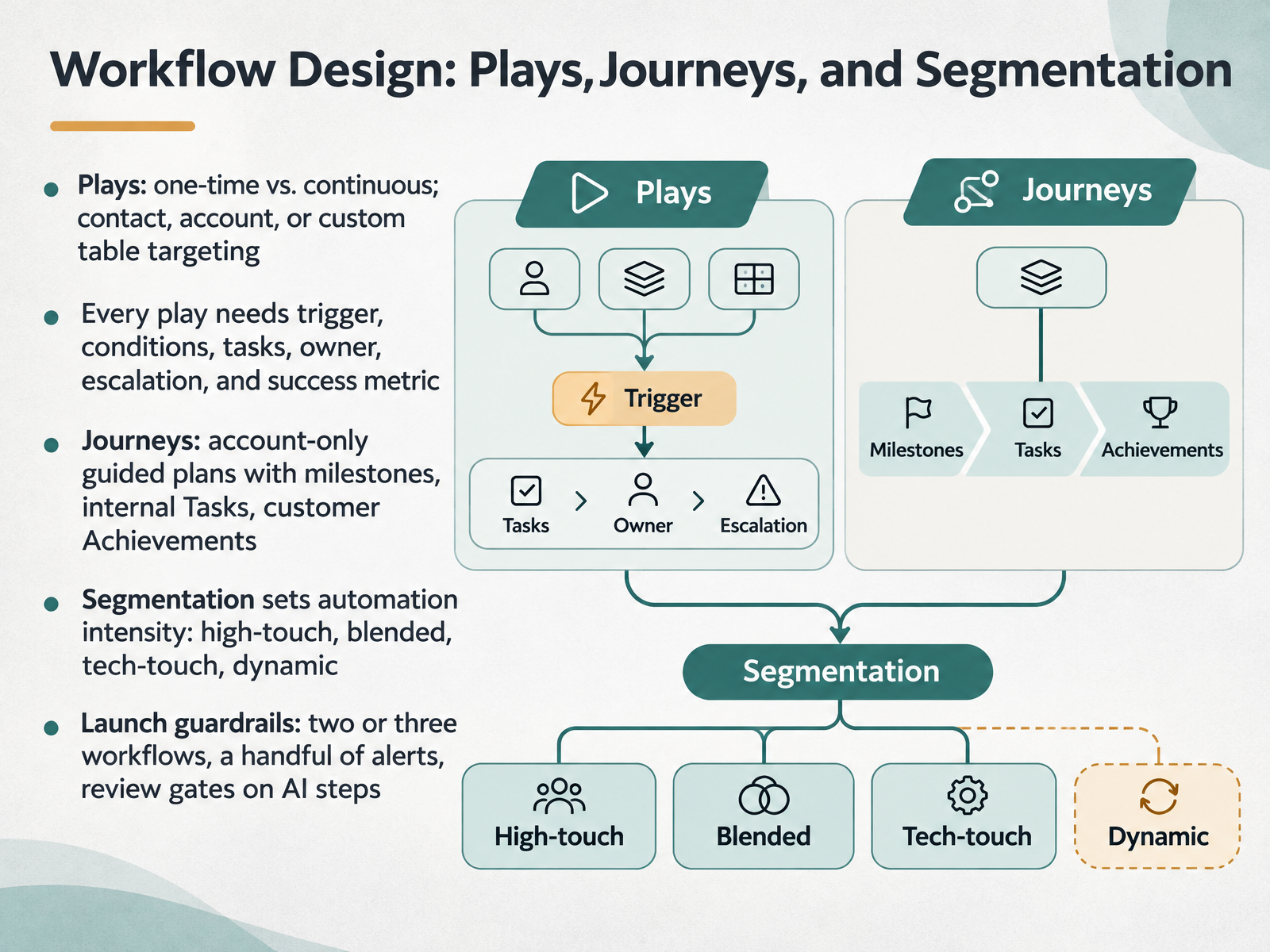
- 08Workflow Design: Plays, Journeys, and SegmentationNow let's move into workflow design, where plays, journeys, and segmentation come together. First, decide whether each play is one-time or continuous, and whether it targets a contact, an account, or a custom table. Every play needs six things: a trigger, conditions, tasks, an owner, an escalation path, and a success metric. Without all six, it will drift. Next, journeys are account-only guided plans built on milestones, internal tasks, and customer achievements. Think of a thirty-day onboarding journey with a milestone for kickoff complete. Then, segmentation sets automation intensity: high-touch, blended, tech-touch, or dynamic. Before you launch, apply guardrails. Start with two or three workflows and a handful of alerts. Put review gates on AI steps so a human approves before anything reaches a customer. Next, we will map the implementation roadmap and phased rollout.
 2 min
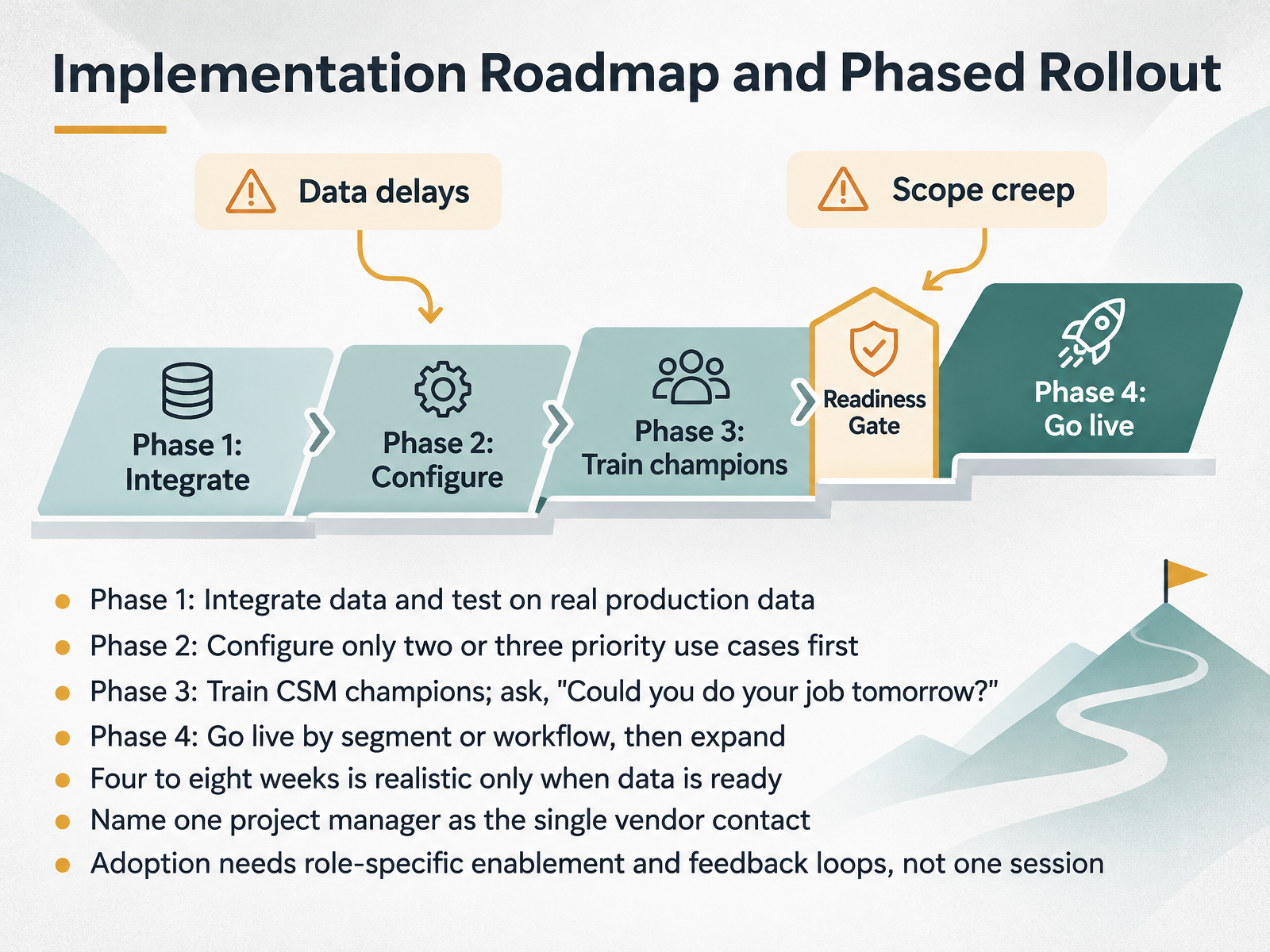
- 09Implementation Roadmap and Phased RolloutNow let's walk through the implementation roadmap. Treat this as a phased rollout, not a single launch event. First, integrate your data sources and test on a slice of real production data. Sample data hides misaligned account IDs and inconsistent field definitions, and those problems will corrupt health scores later. Next, configure only two or three priority use cases. Build renewal risk or onboarding milestones well before expanding scope. Then, train your CSM champions and ask them directly: could you do your job in this system tomorrow? If the answer is anything but a clear yes, fix those gaps before go live. Go live by segment or by workflow, then expand once the team trusts the data. Four to eight weeks is realistic only when your data is ready. Name one project manager as the single vendor contact, so every communication and due date has an owner. And remember, adoption needs role-specific enablement and feedback loops, not one training session. Teams that treat training as a one-time event usually revert to spreadsheets within a month. Next, we'll cover governance, administration, and ownership after go-live.
 info.churnzero.comchurnzero.com2 min
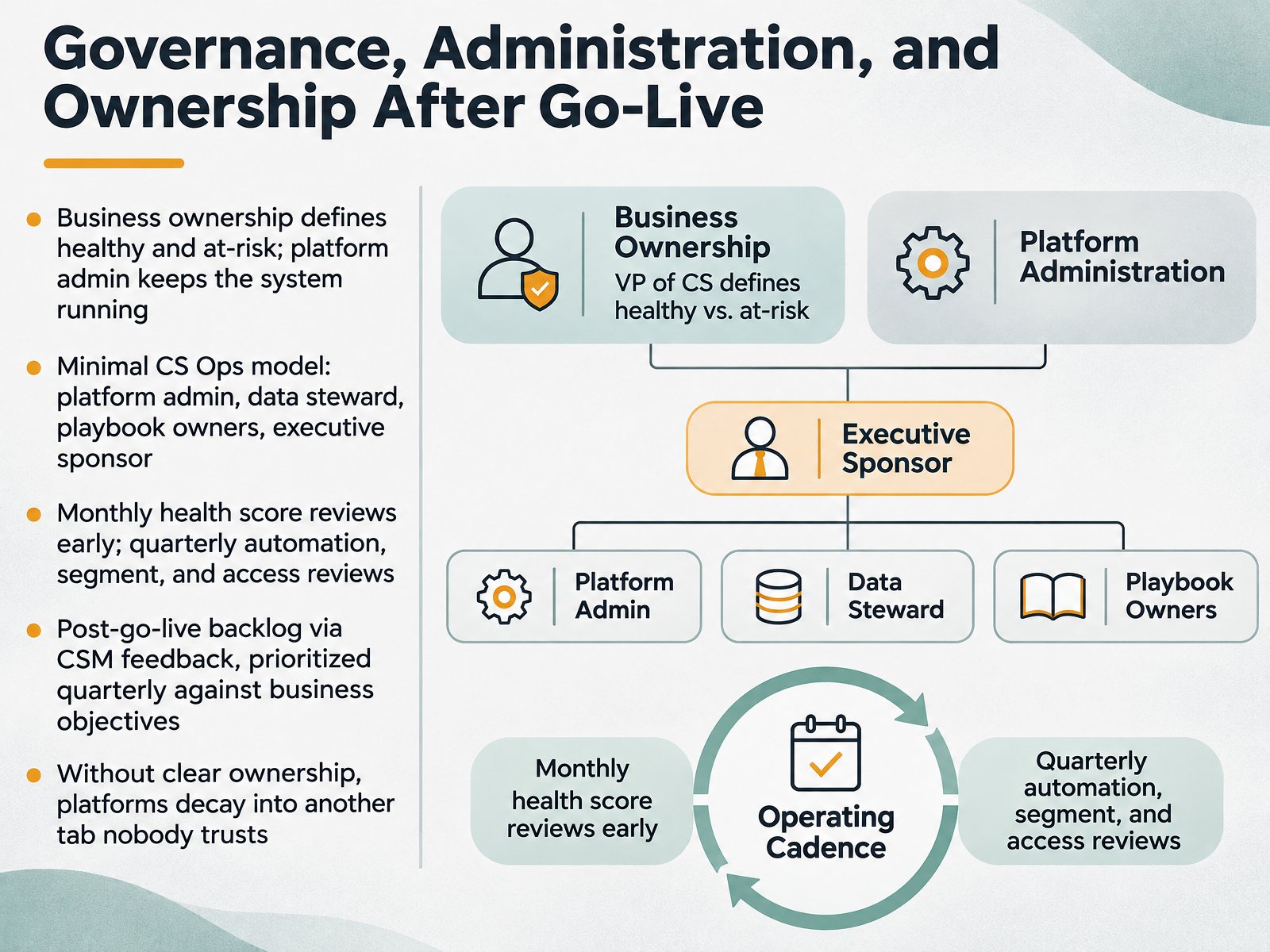
- 10Governance, Administration, and Ownership After Go-LiveNext, let's look at governance, administration, and ownership after go-live. Two roles must stay separate. Business ownership defines what healthy and at-risk mean. Platform administration keeps the system running. In a minimal CS Ops model, you need four owners: a platform admin, a data steward, playbook owners, and an executive sponsor. During the first months, review health scores monthly. Then move to quarterly reviews of automation, segments, and access. Build a post-go-live backlog from CSM feedback, and prioritize it quarterly against business objectives. Without clear ownership, platforms decay into another tab nobody trusts. With it, the system stays aligned to how your team actually works. That foundation is exactly what you need when you move into measuring value, which brings us to the next slide, Measuring Success and Building the ROI Case.
 churnzero.com1 min
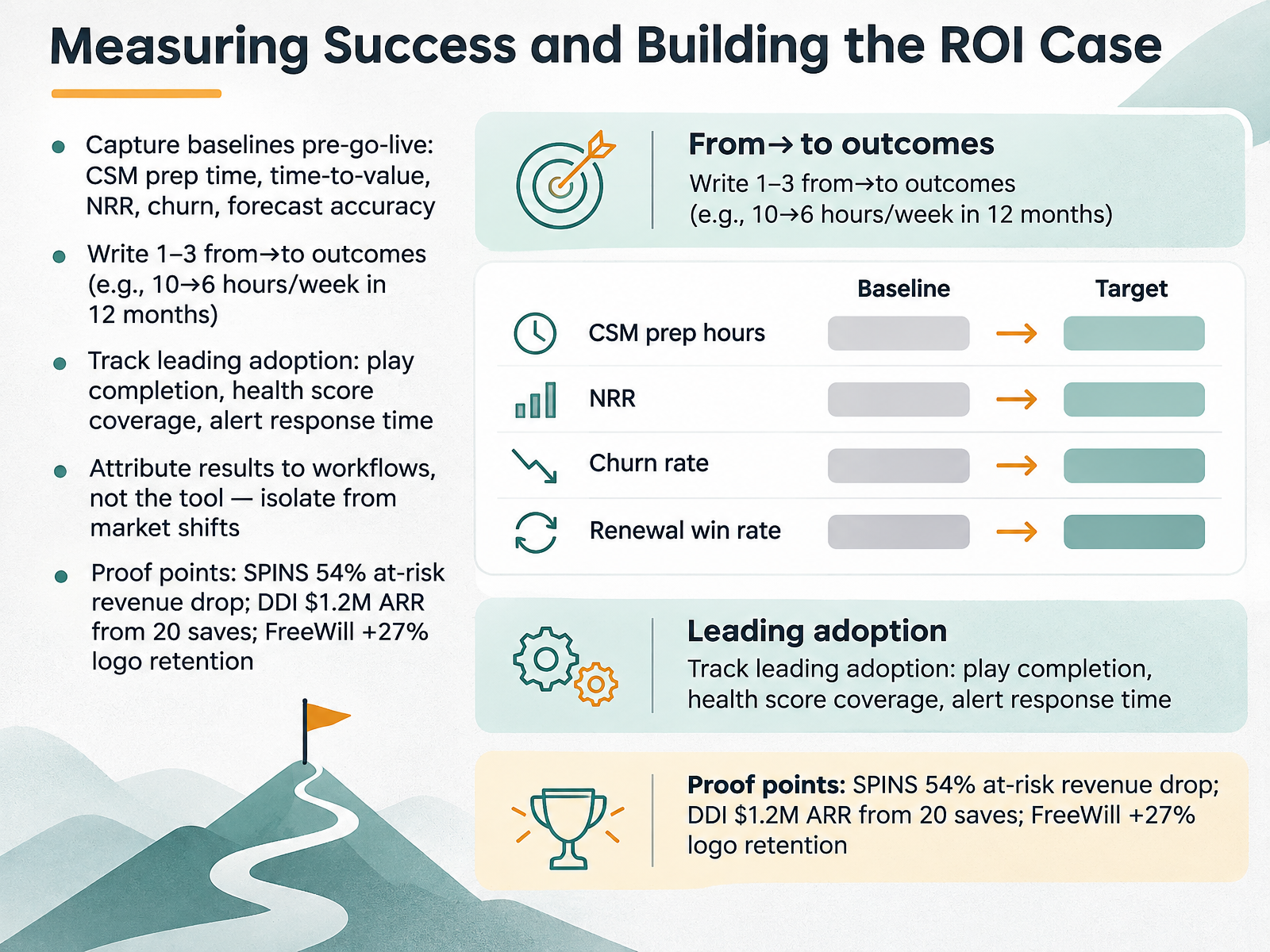
- 11Measuring Success and Building the ROI CaseNow let's talk about measuring success and building the ROI case. Before you configure anything, capture baselines. Record average prep time per CSM, time-to-value, net revenue retention, churn, and forecast accuracy. Next, write one to three from-to outcomes. For example: reduce CSM manual prep time from ten hours a week to six, within twelve months. Then track leading adoption signals: play completion rates, health score coverage, and alert response time. When you report results, attribute them to the workflows you built, not the tool itself. Isolate your impact from market shifts by comparing cohorts and timeframes. For proof points, cite real numbers. SPINS cut at-risk revenue by fifty-four percent. DDI preserved one point two million dollars in ARR from twenty targeted saves. And FreeWill raised logo retention by twenty-seven percent. Next, we'll move into the hands-on workshop, where you'll scope your own ChurnZero deployment.
 churnzero.com2 min
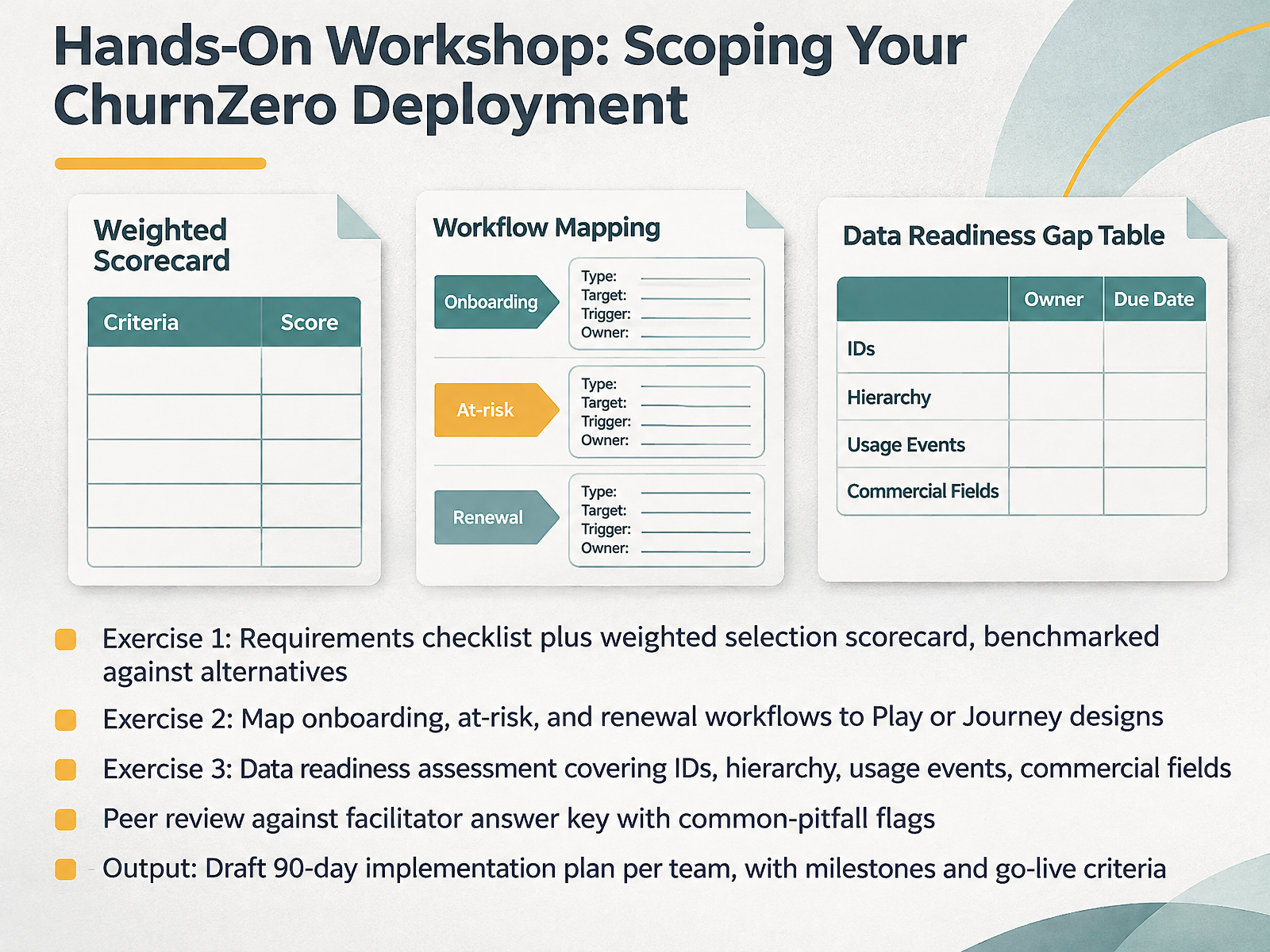
- 12Hands-On Workshop: Scoping Your ChurnZero DeploymentNow let's put that into practice with a hands-on workshop. You'll work through three exercises. First, build a requirements checklist and a weighted selection scorecard, and benchmark it against alternatives. Next, map your onboarding, at-risk, and renewal workflows to Play or Journey designs. A Journey is a map of a customer process with Milestones, Tasks, and Achievements. Then run a data readiness assessment covering IDs, hierarchy, usage events, and commercial fields. You'll peer review against a facilitator answer key with common-pitfall flags. The output is a draft 90-day implementation plan per team, with milestones and go-live criteria. Before you start, assign one project manager to own the plan and set due dates. Next, we'll cover common pitfalls and decision checkpoints.
 info.churnzero.comchurnzero.com2 min
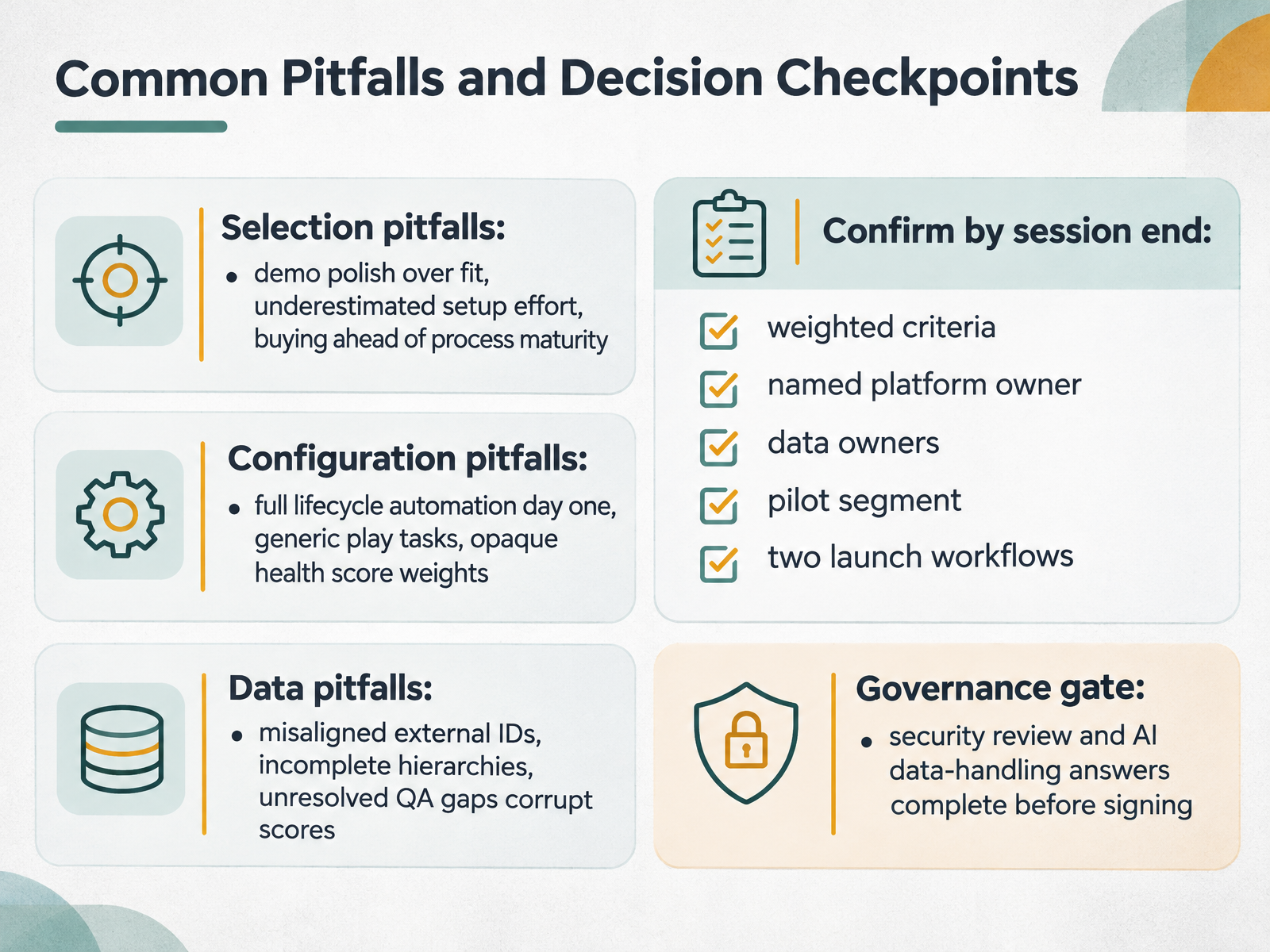
- 13Common Pitfalls and Decision CheckpointsLet's look at the pitfalls that derail implementations, and the checkpoints that prevent them. Selection first. Teams pick the demo that polished best, not the platform that fits. They underestimate setup effort, and they buy ahead of process maturity. Configuration next. Don't automate the full lifecycle on day one. Generic play tasks, meaning the templated to-dos inside playbooks, create busywork, and opaque health score weights, meaning unclear scoring formulas, destroy trust in the score. Then data. Misaligned external IDs across systems, incomplete parent-child account hierarchies, and QA gaps left open will corrupt health scores and misfire alerts. So confirm by session end: weighted selection criteria, a named platform owner, named data owners, one pilot segment, and two launch workflows. And treat the governance gate as a stop sign. Security review and clear answers on AI data handling must be complete before you sign, not after kickoff. Let's pull it together with key takeaways and next steps.
 info.churnzero.comchurnzero.com2 min
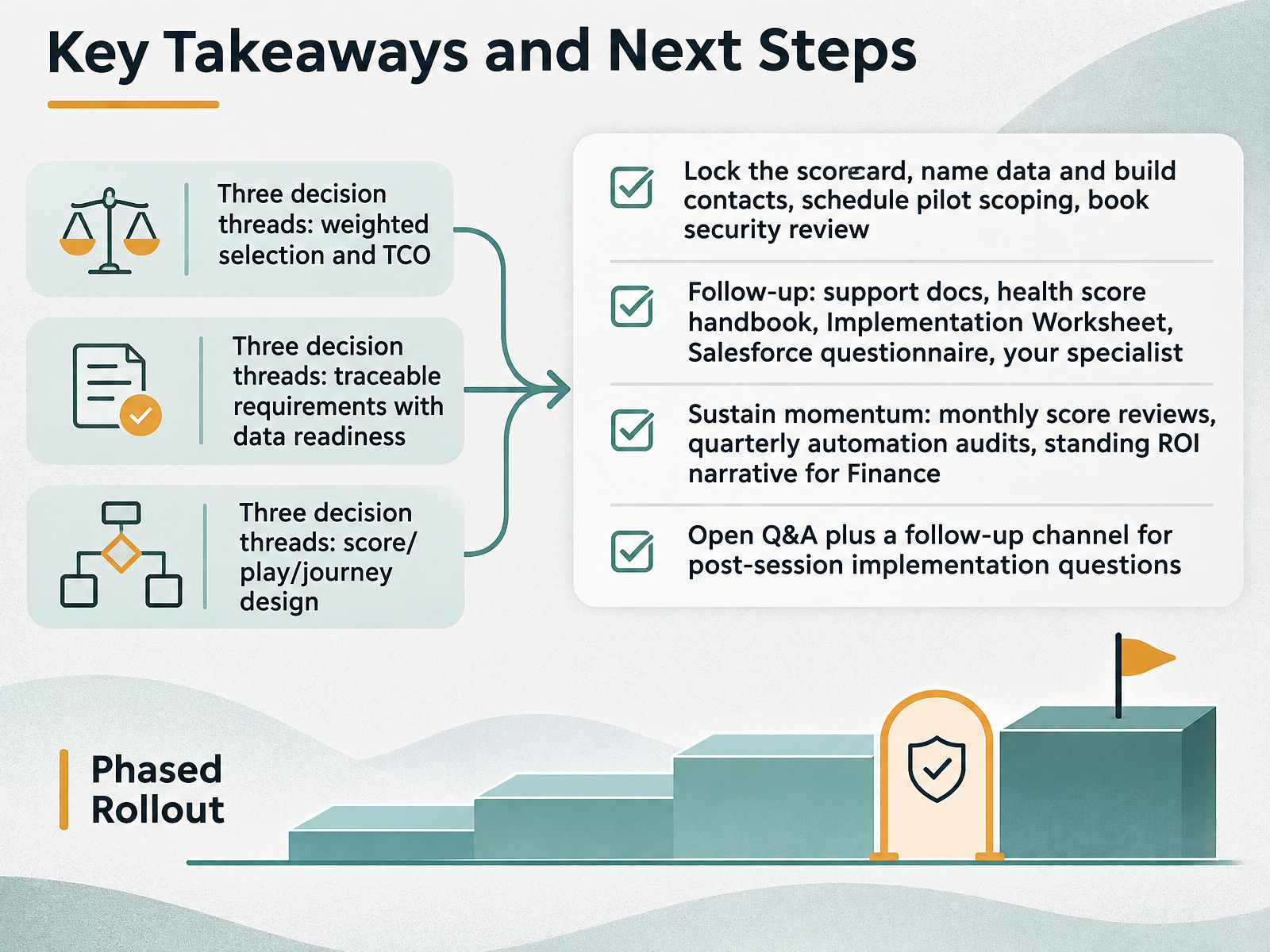
- 14Key Takeaways and Next StepsLet's close with what to carry forward. Three decision threads run through this course: a weighted selection model with total cost of ownership, requirements traced to your data readiness, and the design of scores, plays, and journeys. Your next actions are concrete. Lock the scorecard, name your data and build contacts, schedule pilot scoping, and book the security review before kickoff. Follow-up support covers the documentation, the health score handbook, the Implementation Worksheet, the Salesforce questionnaire, and your specialist. To sustain momentum, run monthly score reviews, quarterly automation audits, and keep a standing ROI narrative for Finance. We'll open the floor for questions now, and a follow-up channel stays open for implementation questions. Thank you for your attention and your engagement today. You now have a clear path from selection to a working system, so take these actions and build with confidence.
 churnzero.comapp.churnzero.netsupport.churnzero.com+22 min
Take the deck with you
Download this course as a file — free, no sign-up needed.
- PDF handoutEvery slide page, ready to print or share.15 pages · 4.3 MBDownload
- Narrated PowerPointThe deck that presents itself — every slide carries the digital human's narration video.15 pages · 15.3 MBDownload
- PowerPoint slidesThe full deck as a .pptx — open it in PowerPoint, Keynote, or Google Slides.15 pages · 4.3 MBDownload
Free to use in your own training — please keep the PersonWise credit page at the end.
Have your own deck? Turn it into a course
Sources consulted
Web sources consulted while building this course.
- Customer Success Management - ChurnZero — churnzero.com
- Customer Success Software for Customer Growth - ChurnZero — churnzero.com
- ChurnZero Product Release Notes: August 2026 - ChurnZero — churnzero.com
- About ChurnZero: Your platform and partner for customer success — churnzero.com
- ChurnZero charts the future of autonomous customer growth at ZERO-IN 2026 — prnewswire.com
- ChurnZero Native Integrations For Customer Success Teams — churnzero.com
- ChurnZero Reviews November 2026: Details, Pricing, & Features | G2 — g2.com
- ChurnZero Review: Pricing & Limitations — WeekCRM — weekcrm.com
- Gainsight vs Totango vs ChurnZero: How to Choose — MeetMyCRO — meetmycro.com
- Gainsight vs ChurnZero vs Totango: Which CSP Is Right for Your Business? — cshub.stratapps.com
- Gainsight vs ChurnZero vs Totango Comparison 2026 | Software Trail — softwaretrail.com
- Customer Success Software Pricing 2026: 6 Platforms Compared — aboutmartech.com
- Best Customer Success Platforms Compared (2026) | Brazebee — brazebee.com
- ChurnZero REST API Reference — app.churnzero.net
- Setting Parent/Child Relationships – ChurnZero — support.churnzero.com
- Core CRM: Salesforce – ChurnZero — support.churnzero.com
- Create a Parent/Child Segment – ChurnZero — support.churnzero.com
- ChurnZero Schema ERD | Table & Field Reference | Fivetran — fivetran.com
- Getting Started with ChurnZero Journeys — info.churnzero.com
- Best practices for your customer success platform - ChurnZero — churnzero.com