Begin
14 pages · ~28 min
Choosing the Right English Register
Learn to choose between formal and informal English registers for the right audience and context. Ideal for professionals and students seeking effective communication.
A digital instructor presents all 14 pages. Hold “Ask” at any point and ask out loud — the answer comes from this course. No sign-up needed.
What you’ll learn
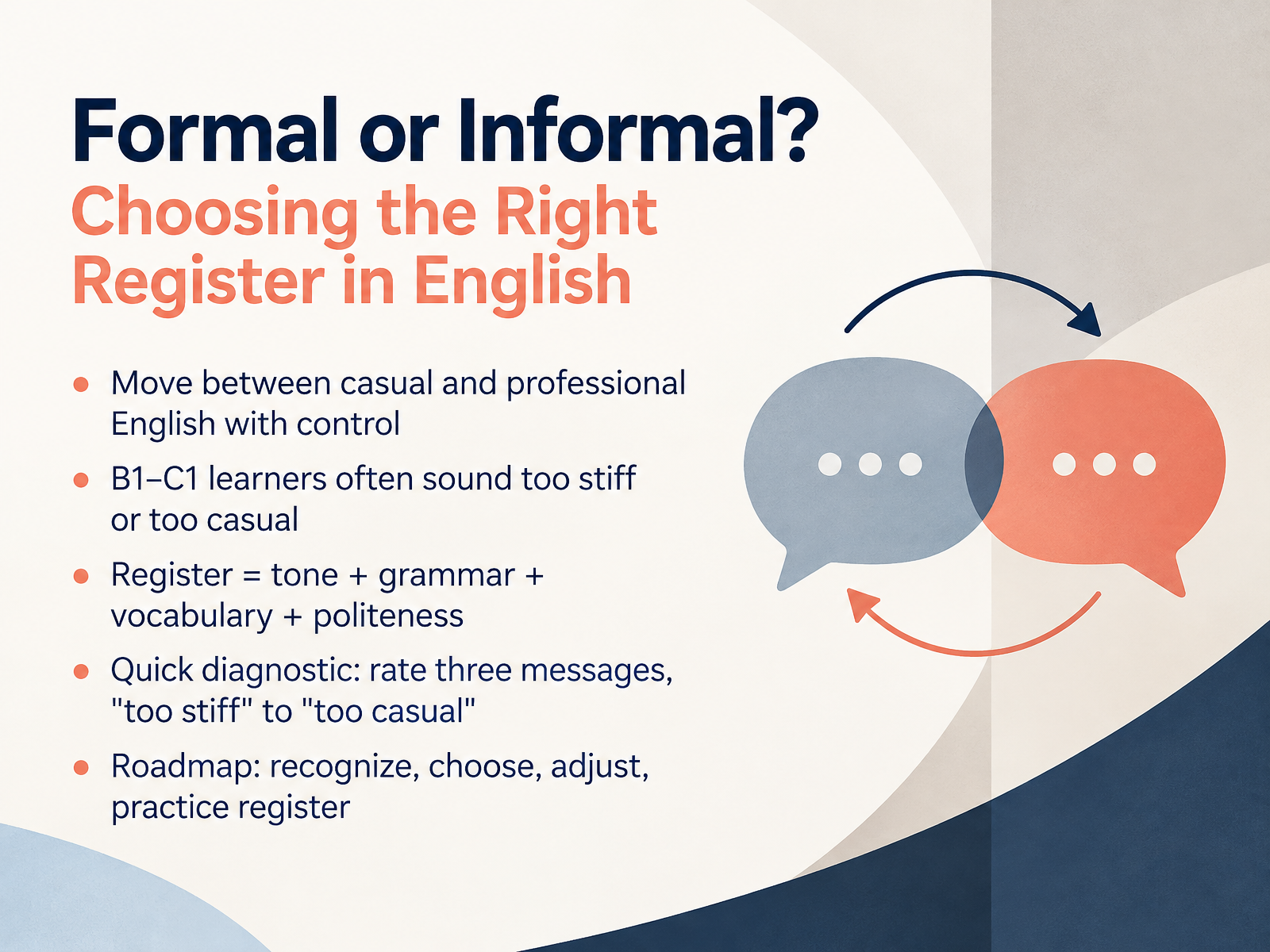
- 01Formal or Informal? Choosing the Right Register in EnglishWelcome. I'm glad you're here. Over the next few slides, we're going to work on something that matters in almost every conversation you have in English: register. That's the tone you choose, whether it's casual or professional, and how you adjust it to fit the moment.
Here's the goal. By the end, you'll move between casual and professional English with real control. Many learners at the B1 to C1 level sound too stiff with friends, or too casual at work. Both are register issues, and both are fixable.
So, what is register? Think of it as tone plus grammar, plus vocabulary, plus politeness. You'll rate three short messages on a scale from too stiff to too casual. Then we'll walk through a simple roadmap: recognize, choose, adjust, and practice.
Ready? Let's start with what register really means.languagecert.hueslpathway.comdownloads.bbc.co.uk+21 min
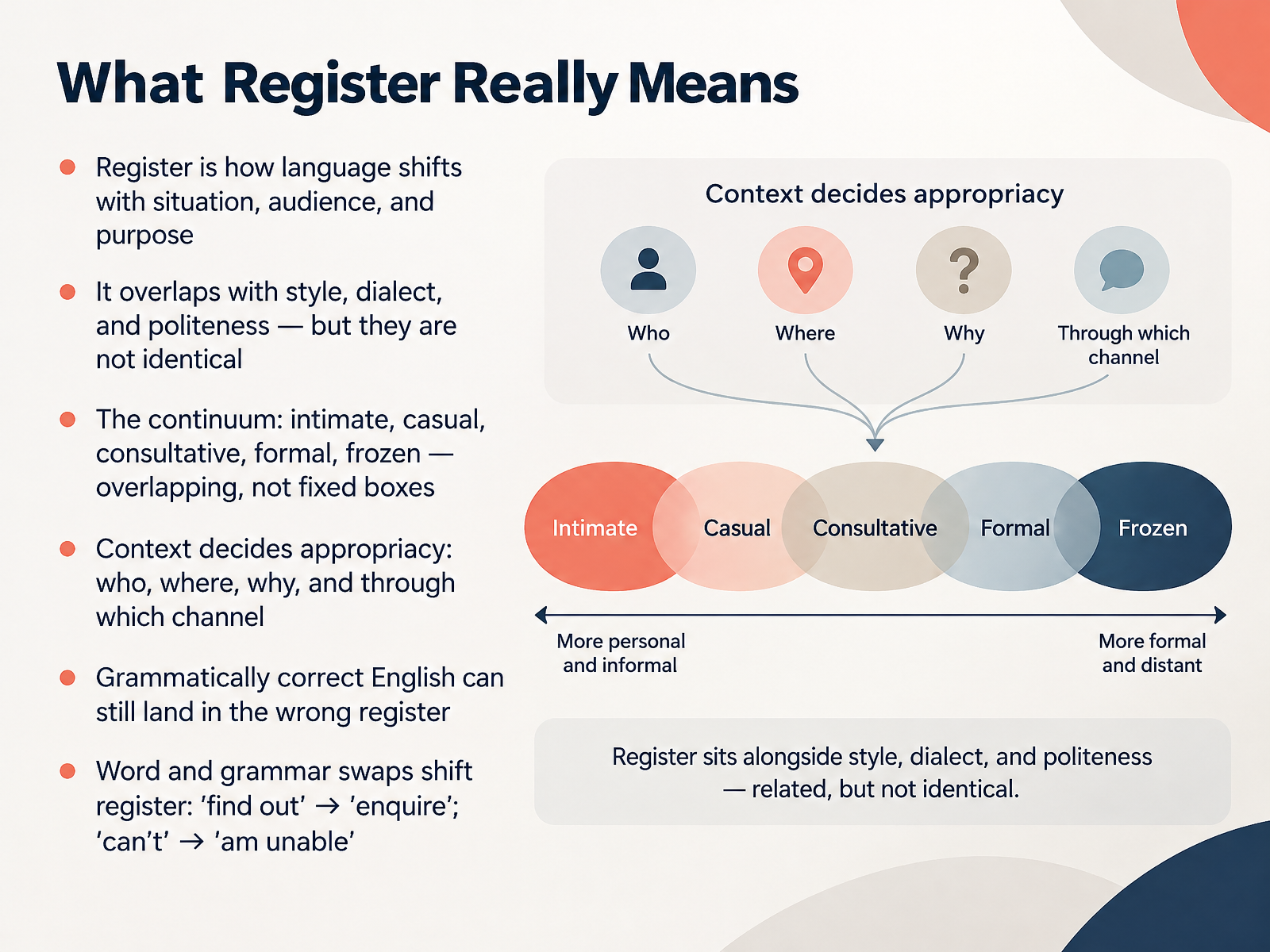
- 02What Register Really MeansSo, what does register really mean? At its core, register is how your language shifts depending on the situation, your audience, and your purpose. It overlaps with style and politeness, but it isn't the same thing. Think of it as a continuum: intimate, casual, consultative, formal, and frozen. These aren't fixed boxes. They overlap, and context decides what's appropriate. Who are you talking to? Where? Why? And through which channel, spoken or written? Here's the key point. Grammatically correct English can still land in the wrong register. Small swaps shift the tone. For example, find out becomes enquire. Can't becomes am unable. Little changes, big difference. As we go on, keep that continuum in mind. Next, we'll look at the signals that tell you which register you're in: Signals of Formality and Informality.
 eric.ed.govteachingenglish.org.ukdoi.org+21 min
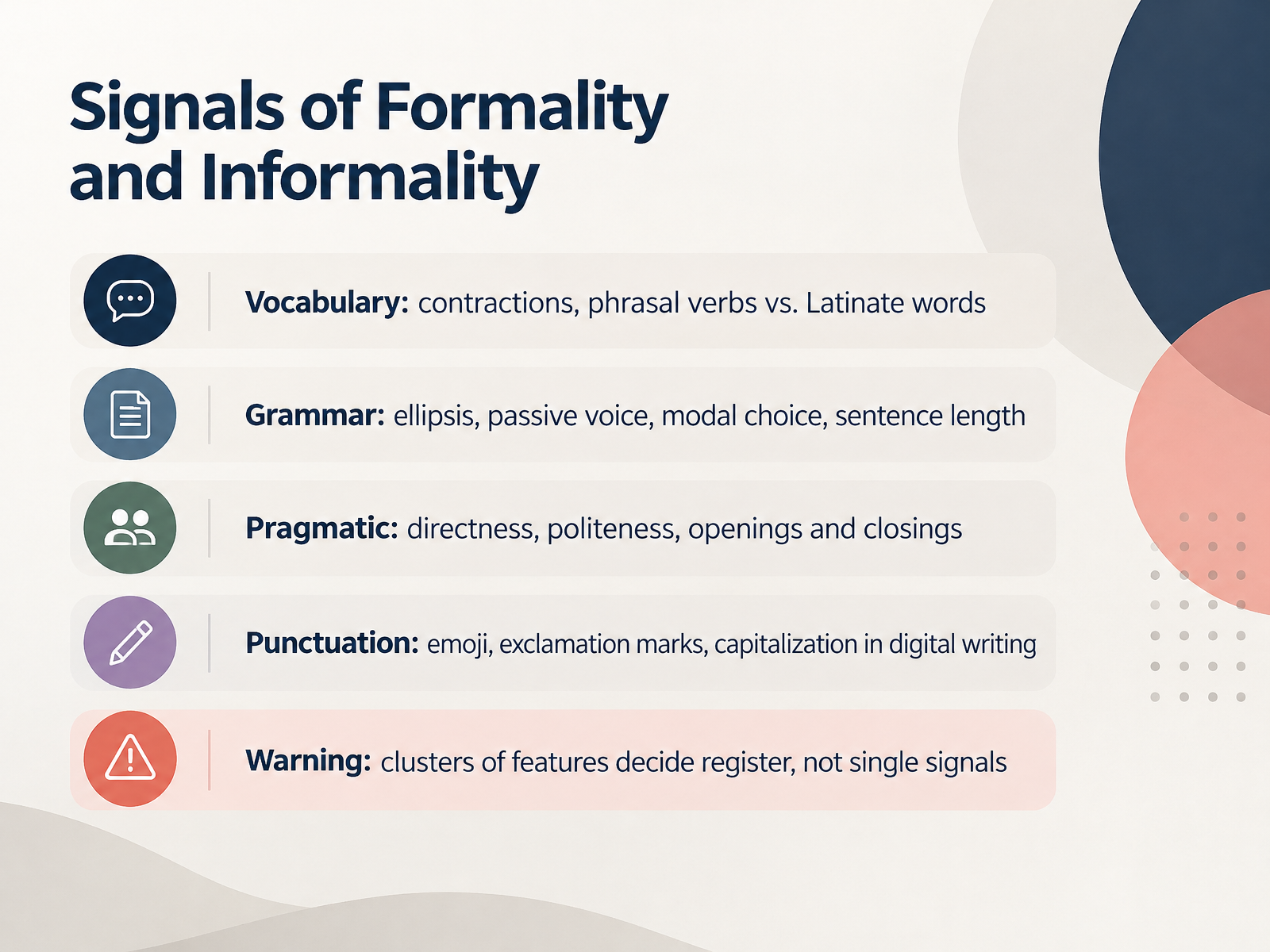
- 03Signals of Formality and InformalityLet's break down the signals that tell you which register you're in. First, vocabulary. Informal English loves contractions and phrasal verbs. So you'd say, I'll find out. Formal English tends to avoid contractions and reach for Latinate words. The same idea becomes, I will enquire. Second, grammar. Informal speech uses ellipsis, dropping words like the subject. Formal writing uses fuller sentences, more passive voice, and careful modal choices like would and could. Third, pragmatics. Directness, politeness, and how you open and close a message all shift with register. Hey, quick question lands very differently from I hope you don't mind me asking. Fourth, punctuation. Emoji, exclamation marks, and casual capitalization send informal signals, and they can undercut a serious message fast. Here's the key warning. No single feature decides register. It's the cluster that matters. One contraction in a formal email is fine. Five, plus emoji, plus lowercase, and you've gone casual. So don't judge by one signal. Weigh the whole pattern. Next, let's look at your own default register in Diagnosing Your Default Register.
 espressoenglish.netandymiles.comopen.edu+22 min
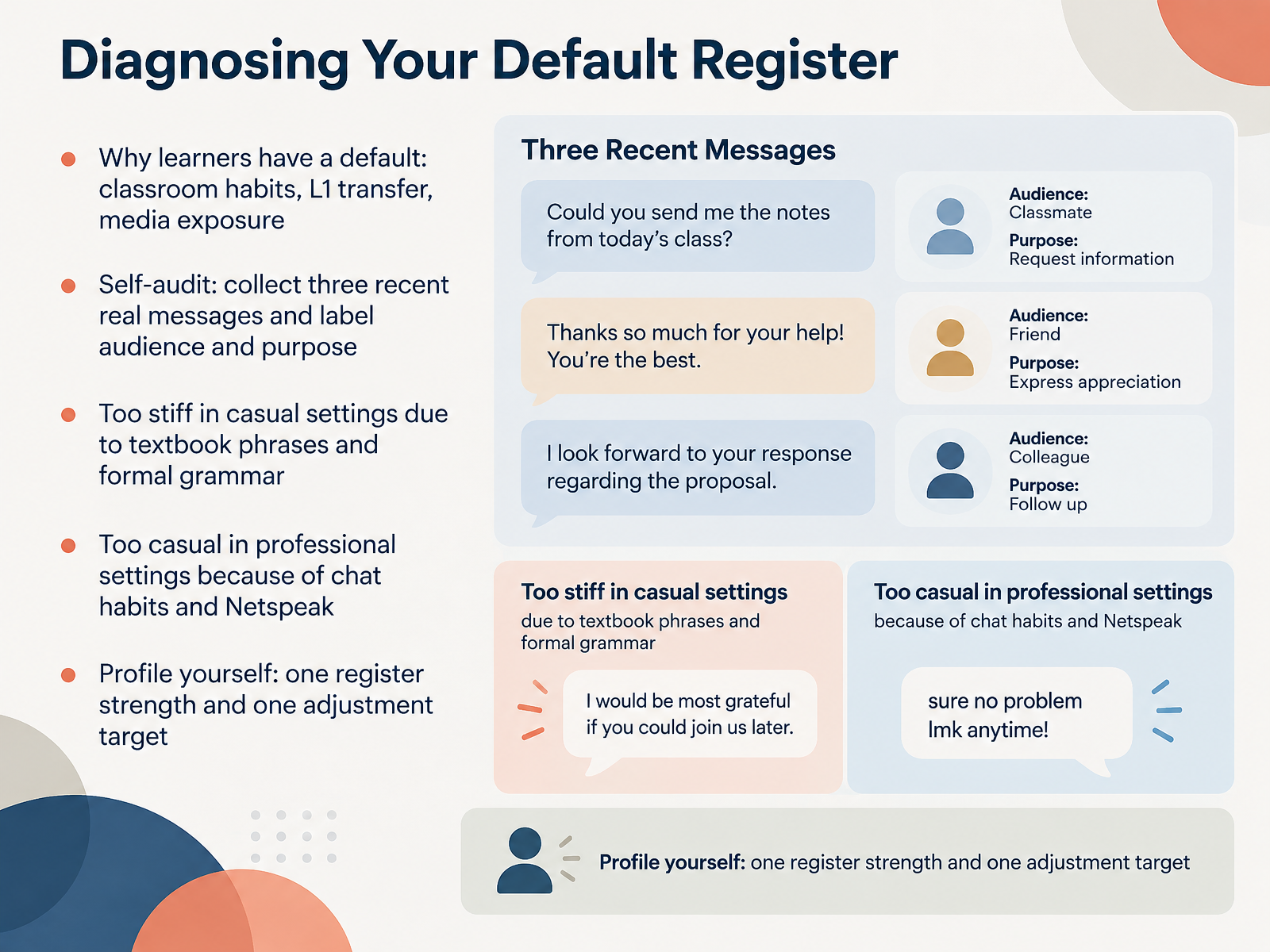
- 04Diagnosing Your Default RegisterNow let's figure out your default register. First, why do defaults even exist? A few reasons. Old classroom habits. Influence from your first language. And the media you watch and read. That mix shapes how you sound by default. Here's a simple self-audit. Collect three real messages you sent recently. An email, a text, a chat. Then label each one with two things: the audience and the purpose. That's it. As you review them, look for patterns. Do some messages feel too stiff, packed with textbook phrases and heavy grammar? Or too casual, with chat habits and netspeak sneaking into professional settings? Both are completely normal, and both are fixable. When you finish, build a quick profile. Name one register strength you already have. Then choose one adjustment target. Just one. For example, maybe your strength is clear business writing, and your target is relaxing your tone with friends. That small profile gives you a clear direction. Next, let's see how to apply this in real situations. Choosing Register in Real Situations.
 doi.orgdoi.orgfiles.eric.ed.gov+22 min
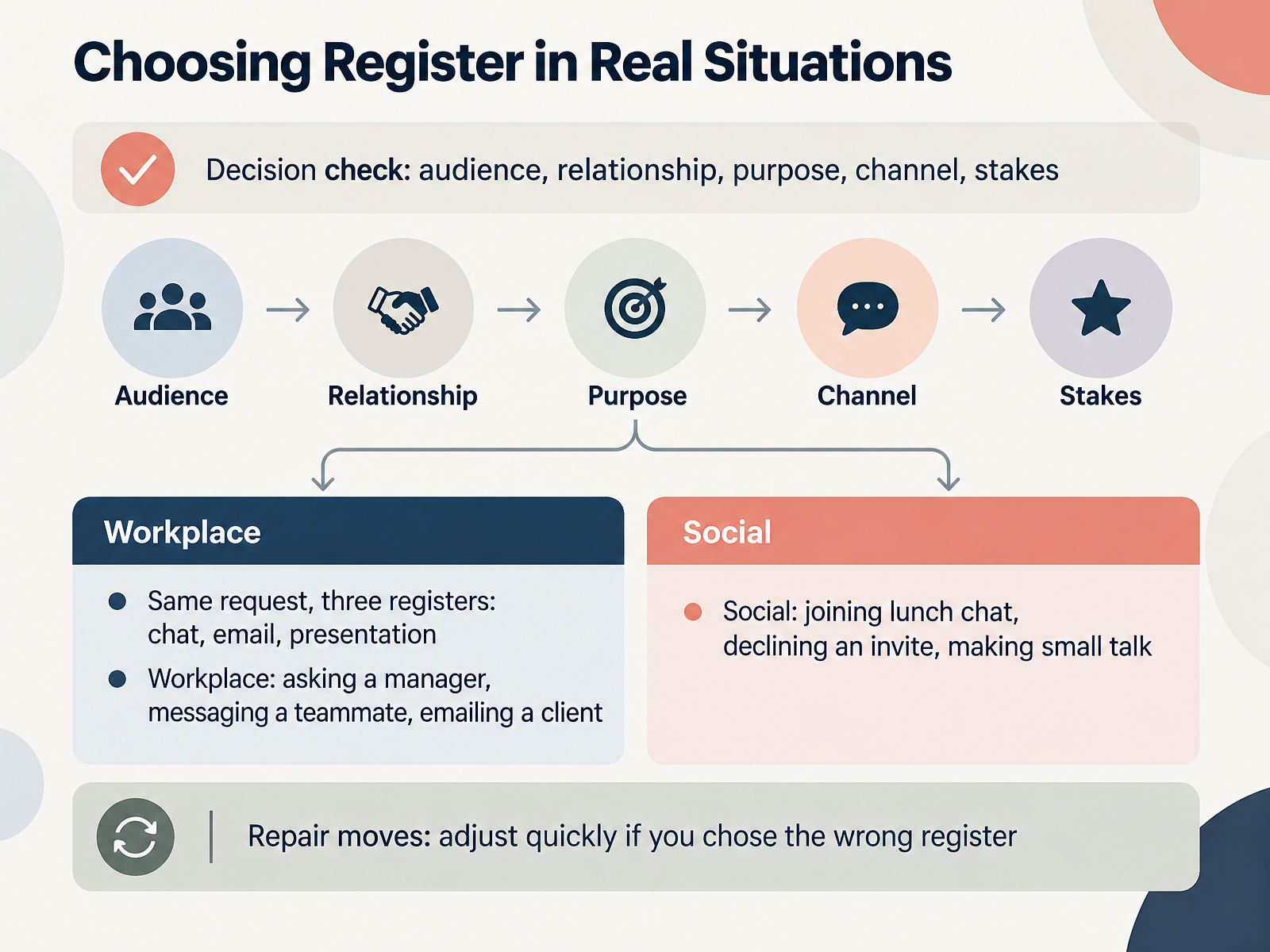
- 05Choosing Register in Real SituationsNow let's put this into practice. Choosing register in real situations comes down to one quick decision check. Ask yourself: who's my audience, what's our relationship, what's my purpose, which channel am I using, and what's at stake? Think about the same request in three registers. In a chat, you might write: Hey, can you send me that file? In an email: Could you send me the file when you have a moment? In a presentation: I'll be asking the team to share the latest figures by Friday. Same need, different tone. At work, you'd phrase things differently when asking a manager, messaging a teammate, or emailing a client. And socially, think about joining lunch chat, declining an invite, or making small talk. Here's the good news. If you choose the wrong register, you can repair it. Say something like: Sorry, that sounded too formal. What I meant was, and simply rephrase. So remember the check, match the register to the moment, and adjust quickly if you miss. Upgrading and Downgrading Your English.
 wgtn.ac.nzaula54.comeric.ed.gov+22 min
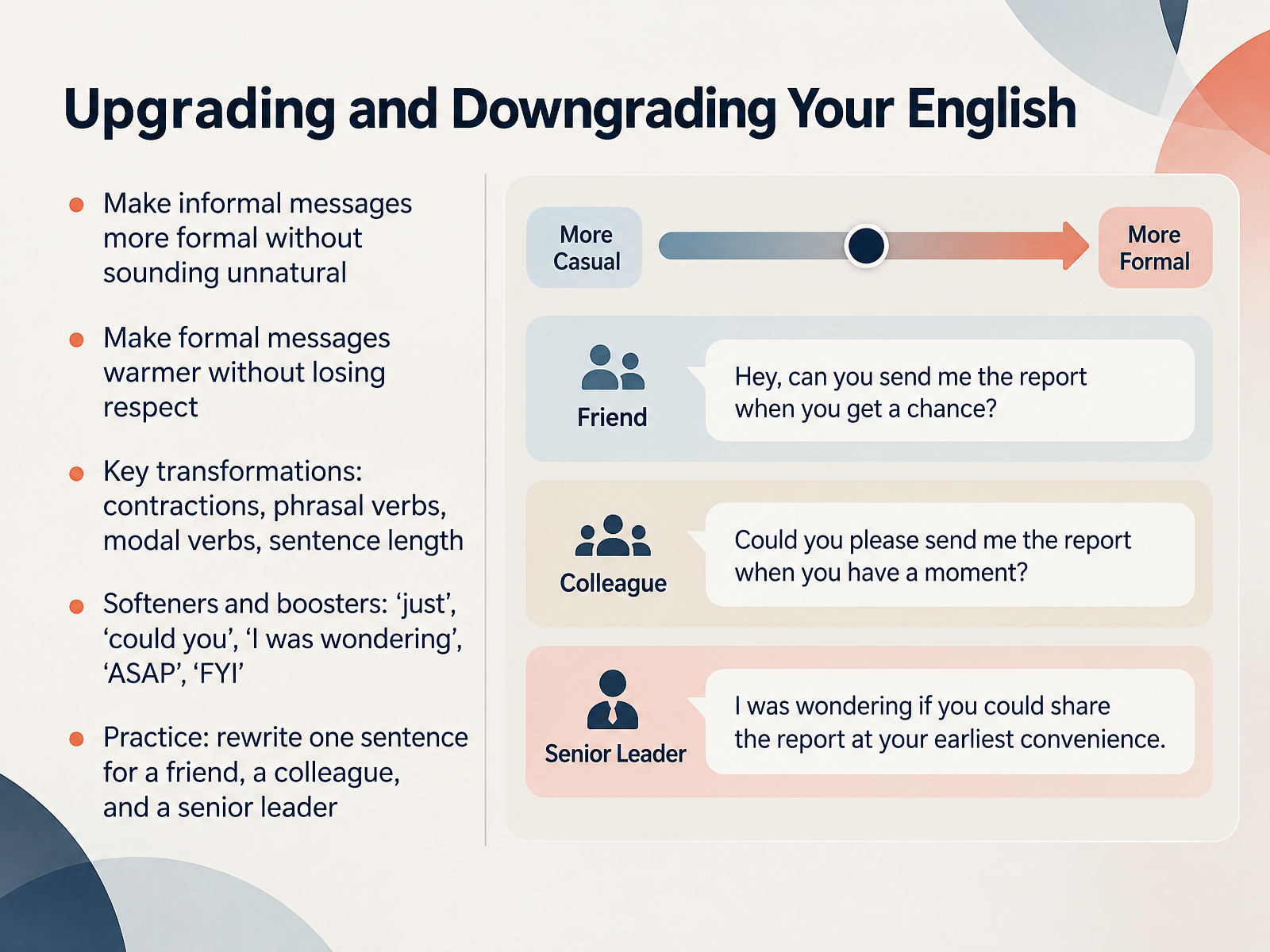
- 06Upgrading and Downgrading Your EnglishNow, register isn't just about spotting the difference. It's about moving between levels on purpose. So let's talk about upgrading and downgrading your English. First, upgrading. You take something informal and make it more formal without sounding stiff. For example, Can you send the file? becomes Could you send the file, please? Small shift, much more professional. Then downgrading. You take something formal and make it warmer without losing respect. I would like to request your feedback becomes, Could you take a look and let me know? Friendly, but still polite. The key transformations to watch are contractions, phrasal verbs, modal verbs, and sentence length. Formal English usually avoids contractions and uses longer, carefully linked sentences. Informal English embraces them. Then there are softeners and boosters. Words like just, could you, and I was wondering soften a request. But ASAP and FYI push toward efficiency and informality. Use them with care. Here's your practice. Take one sentence and rewrite it three ways. One for a friend, one for a colleague, and one for a senior leader. Notice how the same meaning shifts in tone. Next, we'll look at Cultural and Digital Register Shifts.
 espressoenglish.netandymiles.comopen.edu+22 min
- 07Cultural and Digital Register ShiftsNow let's talk about how register shifts across cultures and digital platforms.
Register expectations genuinely differ around the world. What reads as efficient and direct to one reader can come across as blunt or even rude to another. In many North American workplaces, getting straight to the request feels professional. But in some European and Asian contexts, that same directness can sound pushy. So directness itself isn't rude or polite. It depends on who's reading.
Platform matters just as much. Email, Slack, Teams, LinkedIn, and WhatsApp each carry their own norms. Email tends to be a record, so it stays a bit more structured. Slack and Teams are conversations, so shorter and more relaxed usually works. LinkedIn is semi-public and professional. WhatsApp sits closer to personal chat, even with colleagues.
And the small signals count. Emoji, punctuation, and how fast you reply all send a register message. A thumbs-up reaction might be perfectly normal on one team and dismissive on another.
So here's your practical move. Before you write, match the platform and the group norm first. Then let your personal style come through. Watch what others do, and follow the room.
Next, let's put this into practice with improving a stiff message.
 eric.ed.govteachingenglish.org.ukdoi.org+22 min
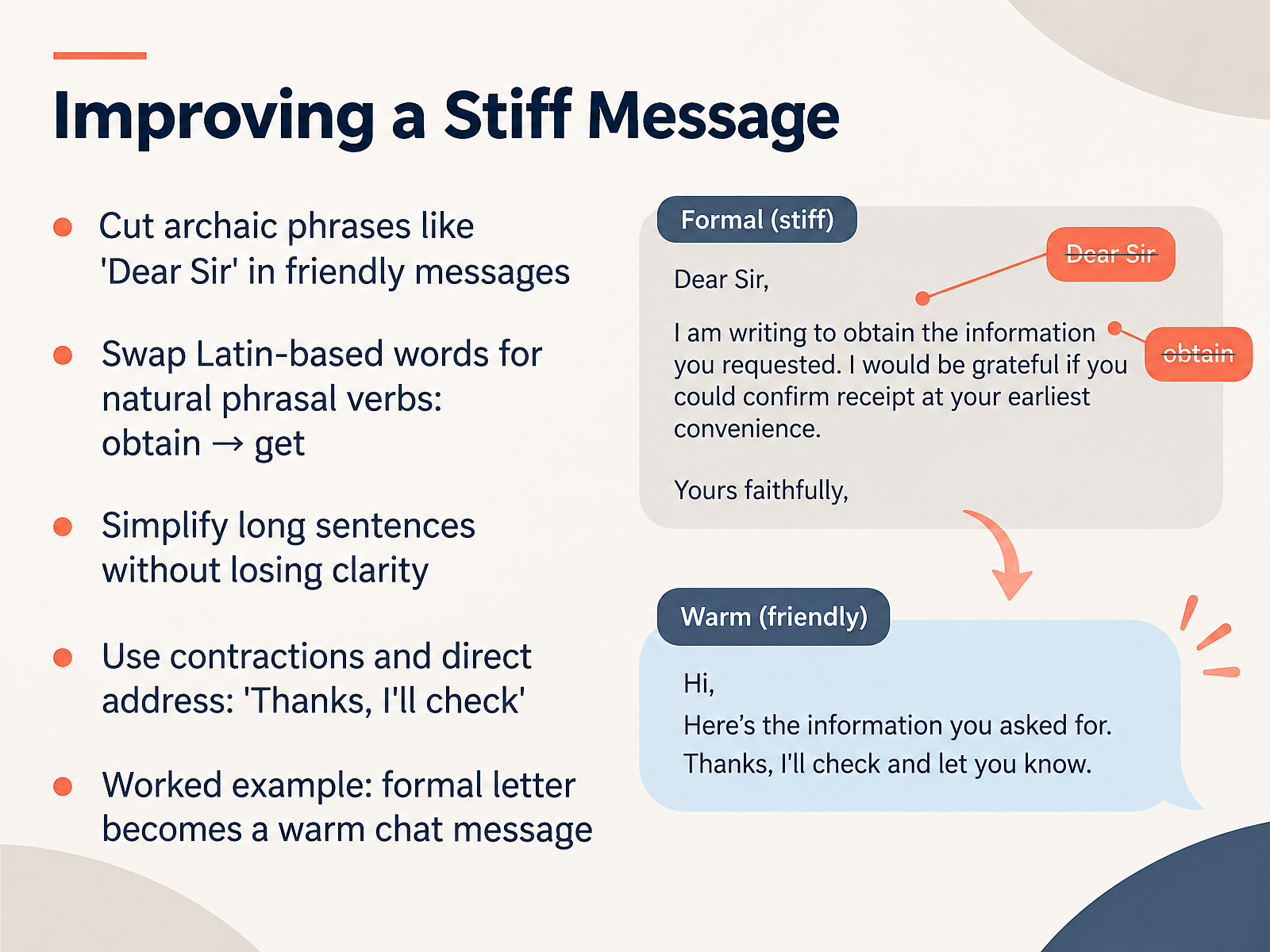
- 08Improving a Stiff MessageNow let's put this into practice and fix a stiff message. Start by cutting archaic openings. In a friendly message, Dear Sir sounds cold, so use Hi, or just the person's name. Next, swap Latin-based words for natural phrasal verbs. Instead of obtain, say get. Instead of commence, say start. Then simplify long sentences without losing clarity. One clear idea per sentence is plenty. Finally, add contractions and direct address. So not, I will investigate the matter, but, Thanks, I'll check. Here's a worked example. A formal letter says, I am writing to enquire whether you have obtained the documents. As a warm chat message, that becomes, Hi, just checking, did you get the documents? Same meaning. Much friendlier. The lesson is simple. Warmth comes from plain words, not long ones. Next, let's flip it and look at fixing an overly casual message.
 languagecert.hueslpathway.comdownloads.bbc.co.uk+21 min
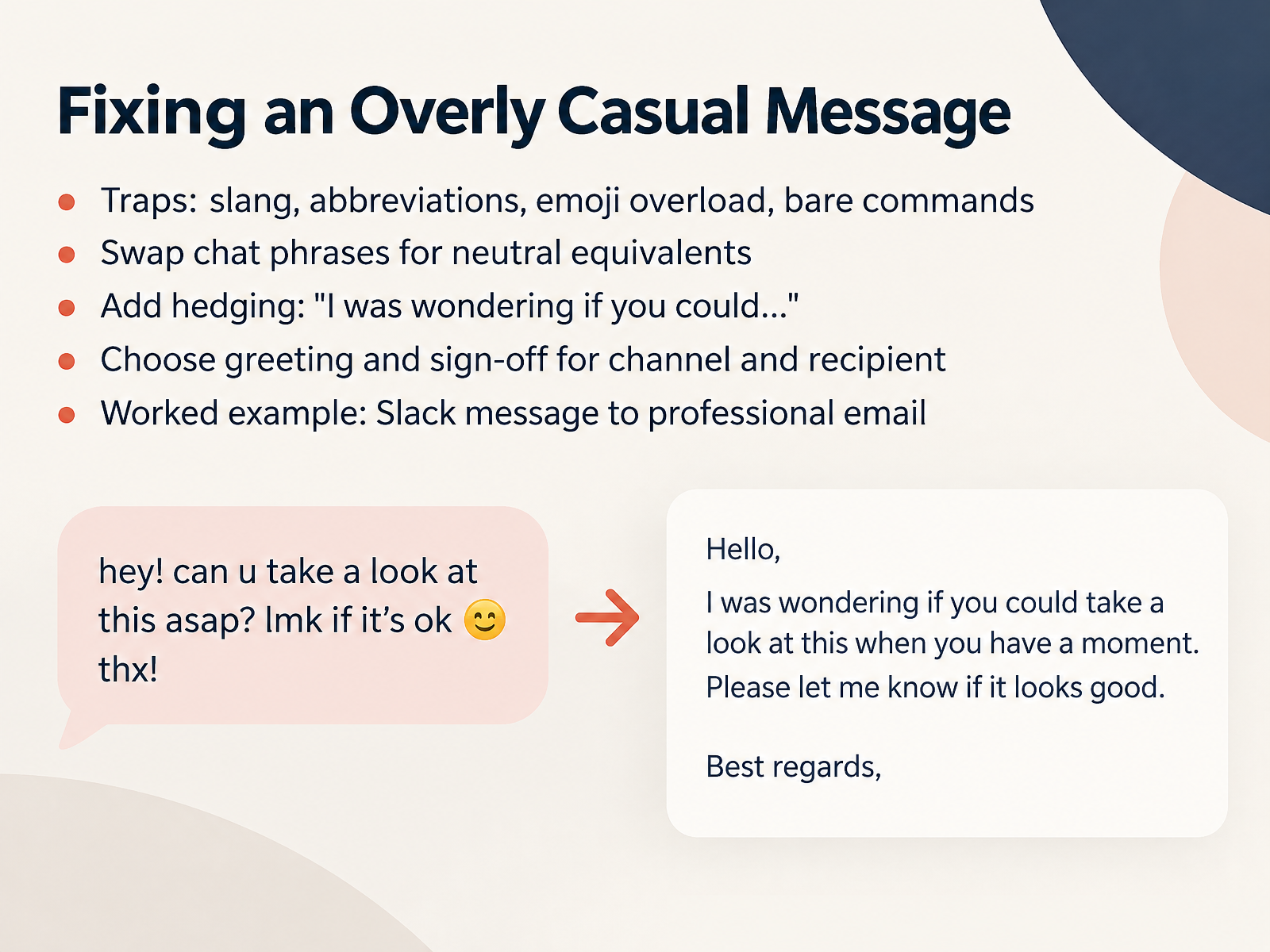
- 09Fixing an Overly Casual MessageLet's talk about fixing a message that's drifted too casual. Four traps to watch for: slang, heavy abbreviations, emoji overload, and bare commands. "Send me the file" reads like an order. A bare "ASAP" can feel pushy. So start by swapping chat phrases for neutral equivalents. "Hey, can you send the file" becomes "Hi, could you send me the file when you have a moment?" Second, add hedging to soften the request. "I was wondering if you could" is a classic, and it works because it lowers the pressure on the reader. Third, match your greeting and sign-off to the channel and to the person. "Hey" and "Cheers" suit a close teammate, while "Hi" and "Best regards" travel better with clients. Here's the worked example. A Slack message might read, "Hey Sam, send the Q3 numbers ASAP, thanks!" Turned into a professional email, it becomes: "Hi Sam, I was wondering if you could send me the Q3 numbers when you have a moment. Thanks for your help." Same ask, calmer tone. Your takeaway: strip the slang, soften the command, and let the channel guide your greeting, your sign-off, and your emoji. Next, let's look at how the channel itself shapes your register in Email, Chat, and Video: Channel Matters.
 wgtn.ac.nzaula54.comespressoenglish.net+22 min
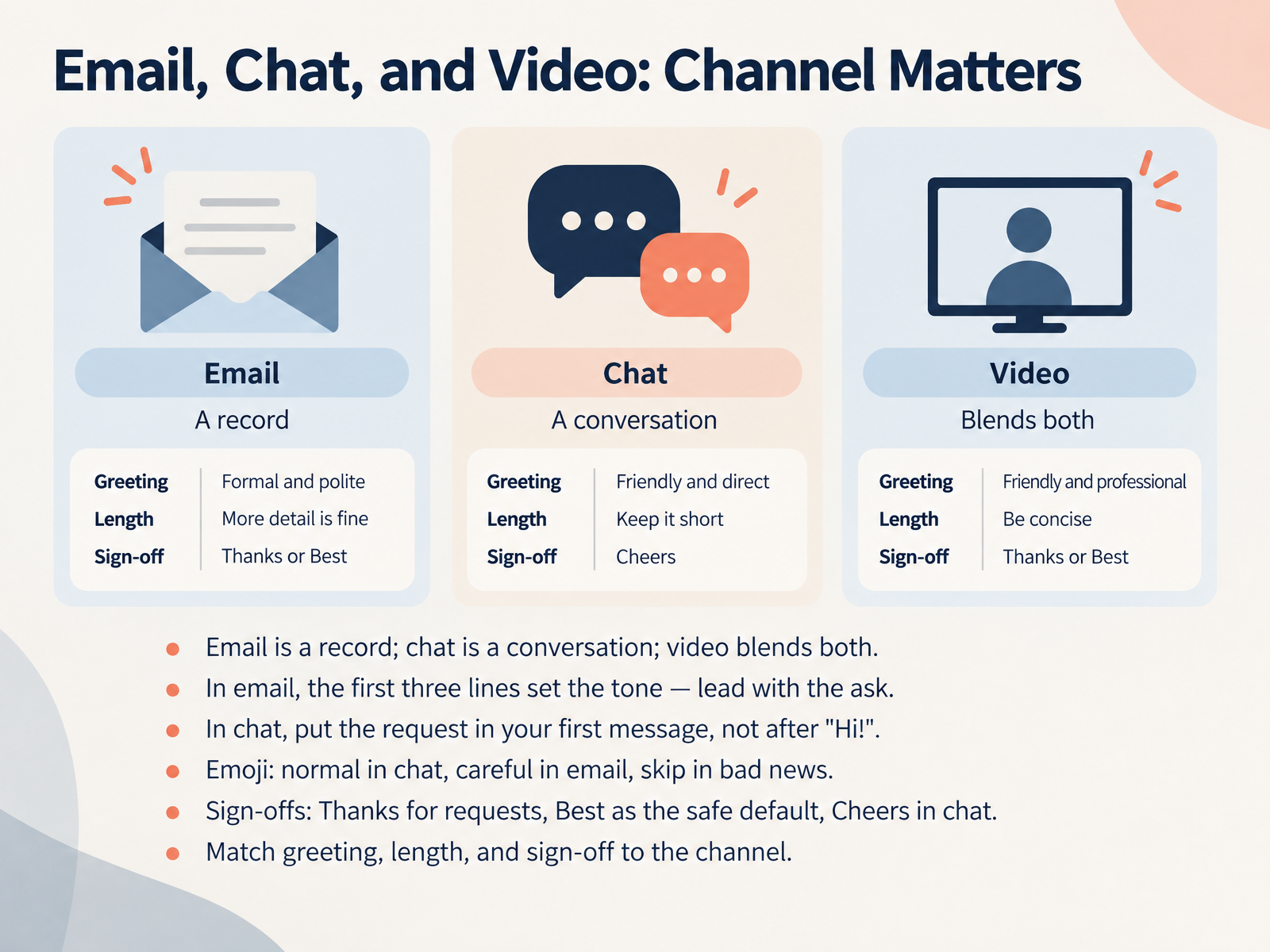
- 10Email, Chat, and Video: Channel MattersNow let's talk about something that trips up a lot of people. The channel itself changes the register. Email is a record. Chat is a conversation. Video blends the two. In email, the first three lines set the tone, so lead with your ask. Don't bury it under small talk. In chat, put the request in your first message. Sending just "Hi!" and waiting for a reply is a habit English-speaking workplaces really dislike. Say something like, "Hi, quick one. Do you know who owns the billing account now?" That one line lets them answer in a gap between meetings. Emoji follow the same logic. They're normal in chat. Be careful in email. And skip them completely when you're sharing bad news. Sign-offs matter too. Use "Thanks" when you've asked for something. "Best" is your safe default. "Cheers" works in chat. The simple rule here is to match your greeting, your length, and your sign-off to the channel. Next, let's look at politeness, power, and directness.
 wgtn.ac.nzaula54.com2 min
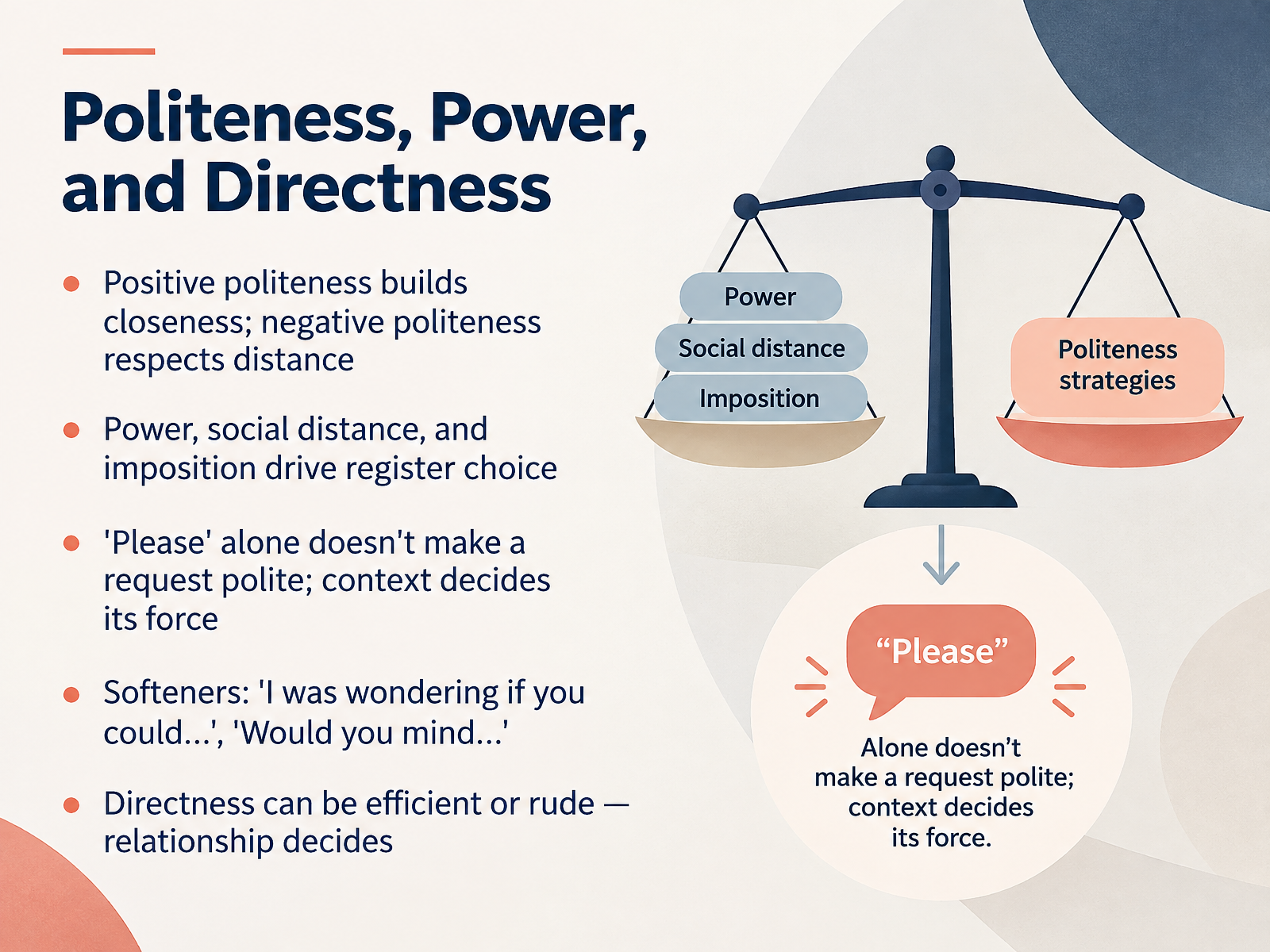
- 11Politeness, Power, and DirectnessLet's talk about politeness, power, and directness. Here's a key idea. There are two kinds of politeness. Positive politeness builds closeness. Think of a friendly, we're in this together tone. Negative politeness respects distance. It signals I value your time and your space. Neither one is better. The situation decides.
So what shapes your choice? Three things. Power, like the gap between you and your manager. Social distance, meaning how well you know each other. And imposition, or how big the ask really is. A small favor to a close colleague sounds very different from a big request to a senior leader.
Here's a myth worth clearing up. Please alone doesn't make a request polite. In fact, it can make it sound more like a command. Please send me the file can feel quite blunt. Context decides its force.
That's why softeners matter. Try, I was wondering if you could. Or, Would you mind. Same request, much warmer tone.
And directness? It can be efficient or rude. Your relationship decides. With a trusted teammate, just say it. With someone senior, soften it.
So read the room. Judge the power, the distance, and the size of the ask. Then choose your tone.
Now let's put this into practice, in the Practice Lab: Rewrite, Role-Play, Reflect.
 wgtn.ac.nzaula54.comeric.ed.gov+22 min
- 12Practice Lab: Rewrite, Role-Play, ReflectNow let's put everything into practice. This is your lab, so expect to do the work.
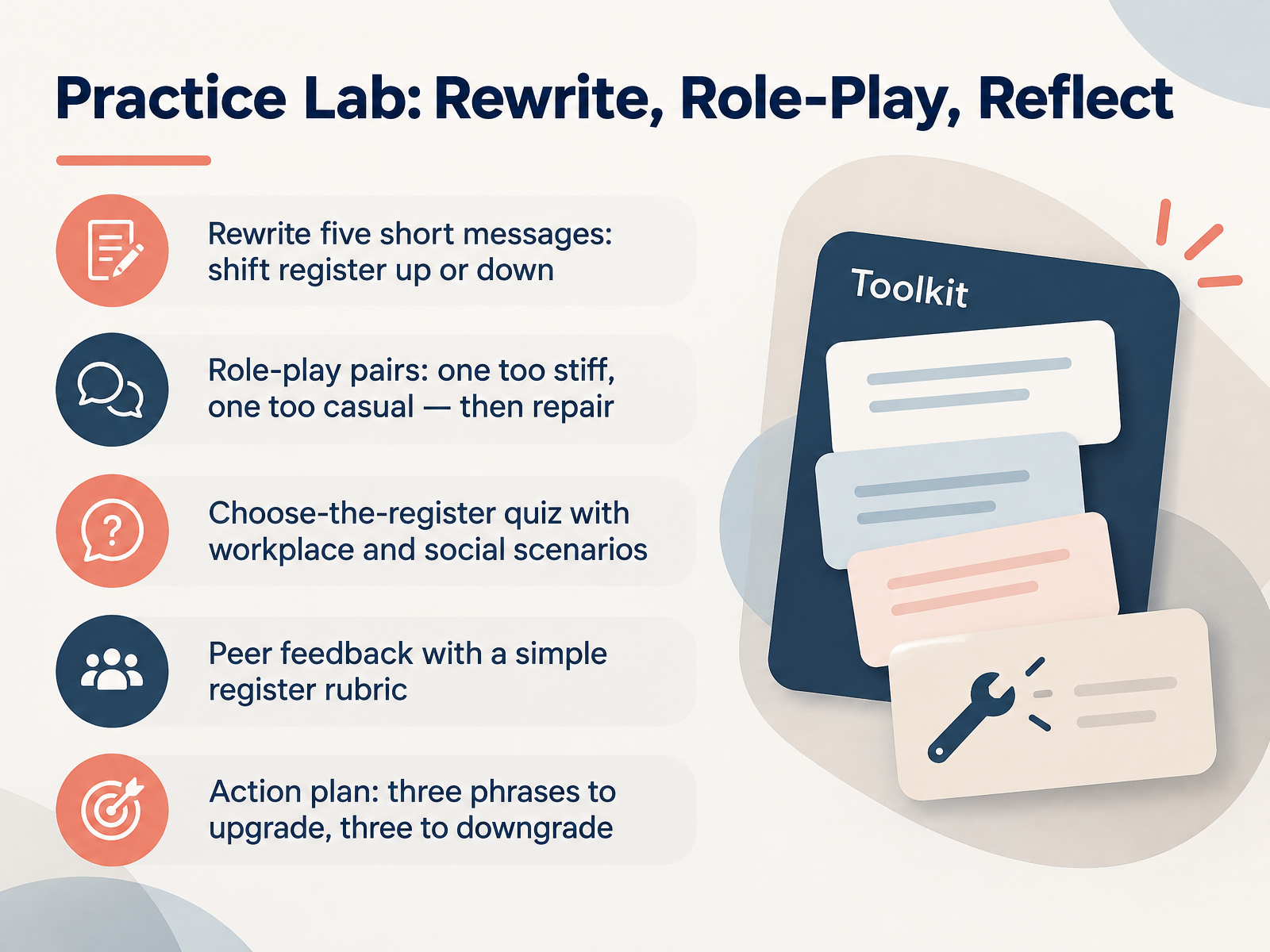
First, rewrite five short messages, shifting the register up or down. Take a casual note to a colleague and turn it into a formal email. Then flip it. Take a stiff line from a report and make it sound human.
Second, role-play in pairs. One of you plays too stiff, the other too casual, then repair the conversation together. You'll feel the difference fast.
Third, try a choose-the-register quiz with workplace and social scenarios. For example, is it "Sorry for the late reply" or "I apologise for the delay"? Context decides.
Then swap peer feedback using a simple register rubric. Keep it kind and specific.
Finally, build an action plan. Choose three phrases to upgrade and three to downgrade. Write them down and use them this week.
Next, let's look at common register mistakes and how to repair them.
 languagecert.hueslpathway.comdownloads.bbc.co.uk+22 min
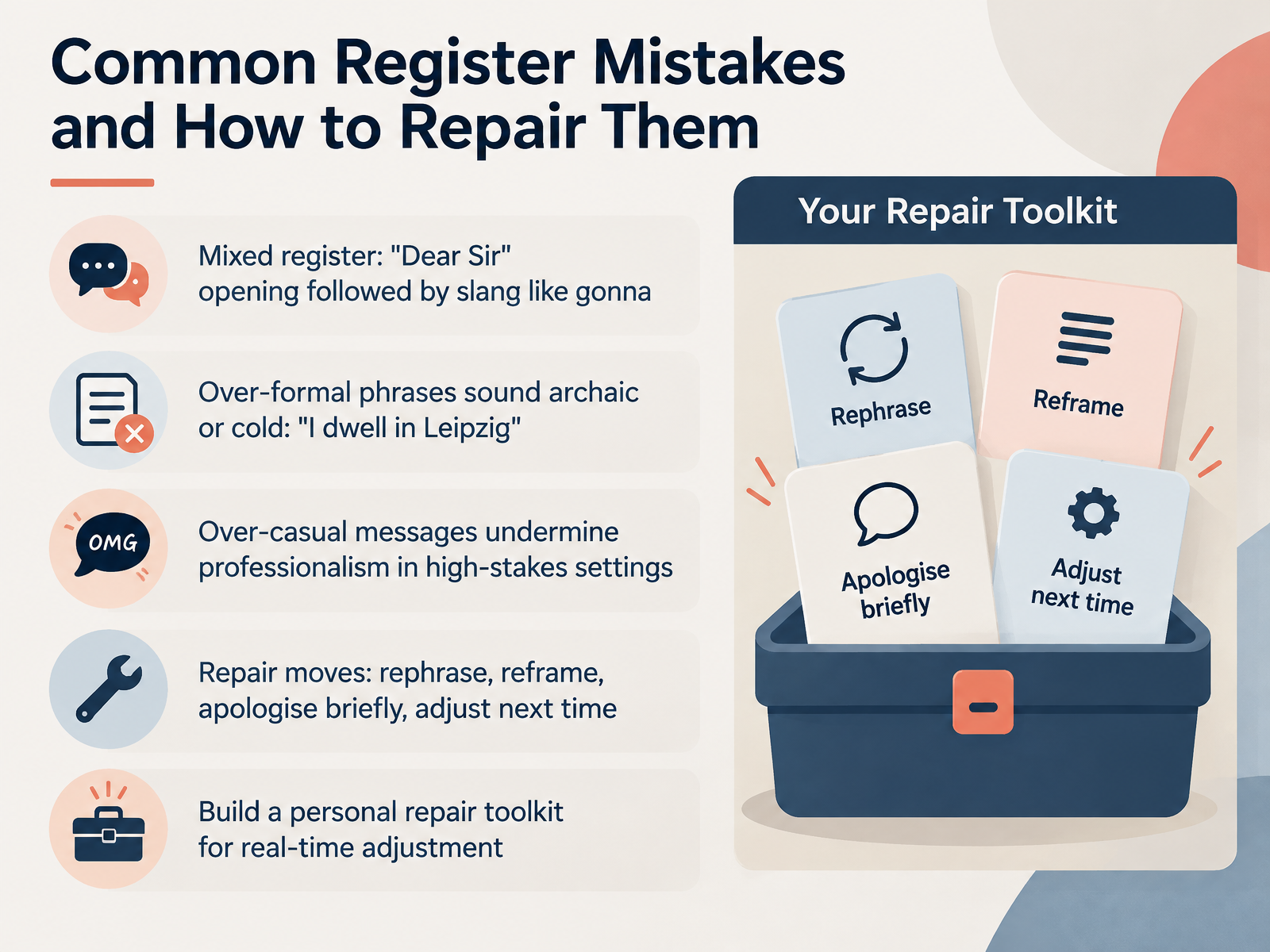
- 13Common Register Mistakes and How to Repair ThemNow let's look at the mistakes you're most likely to make, and how to fix them. First, mixed register. You start with Dear Sir, then slip into gonna. That clash is what listeners notice most. Keep the whole message consistent. Second, over-formal phrases that sound archaic or cold, like I dwell in Leipzig. The message works, but the word dwell sounds centuries old. Say I live in Leipzig. Third, over-casual messages in high-stakes settings. A quick gonna or wanna in a client email can quietly undermine your credibility, even if the rest is fine. So how do you repair these? Rephrase the sentence, reframe it more neutrally, apologise briefly if needed, and adjust next time. Keep those four moves handy, and you'll start building a personal repair toolkit you can use in real time.
 doi.orgdoi.orgfiles.eric.ed.gov+22 min
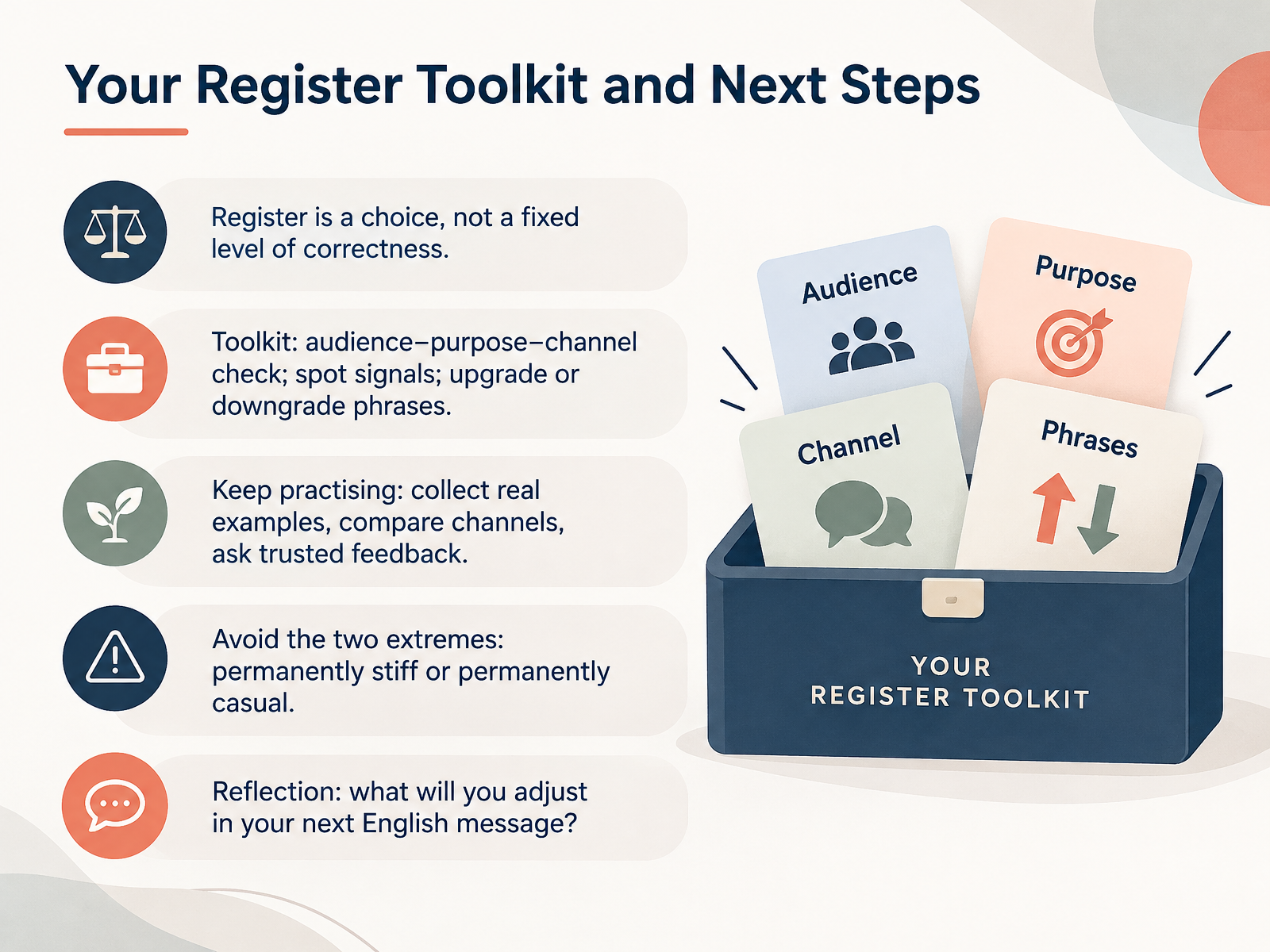
- 14Your Register Toolkit and Next StepsSo let's pull this all together. Register isn't about being correct or incorrect. It's a choice you make, again and again, depending on your audience, your purpose, and your channel. So keep a simple toolkit in mind. Start with the audience, purpose, and channel check. Then spot the signals in the message you're answering. Then decide whether to upgrade or downgrade your phrasing. Want to sound warmer? Say, sorry for the late reply, instead of, I apologize for the delay. Want to sound more professional? Flip it the other way. And keep practising. Collect real examples, compare how the same message sounds in different channels, and ask someone you trust for honest feedback. Just avoid the two extremes. You don't want to be permanently stiff, and you don't want to be permanently casual. So here's your reflection. What one thing will you adjust in your next English message? Thanks for sticking with me through this course. You've built real awareness here. Now go use it, one message at a time. You've got this.
 languagecert.hueslpathway.comdownloads.bbc.co.uk+22 min
Take the deck with you
Download this course as a file — free, no sign-up needed.
- PDF handoutEvery slide page, ready to print or share.15 pages · 3.2 MBDownload
- Narrated PowerPointThe deck that presents itself — every slide carries the digital human's narration video.15 pages · 15.4 MBDownload
- PowerPoint slidesThe full deck as a .pptx — open it in PowerPoint, Keynote, or Google Slides.15 pages · 3.1 MBDownload
Free to use in your own training — please keep the PersonWise credit page at the end.
Have your own deck? Turn it into a course
Sources consulted
Web sources consulted while building this course.
- WRITING SAMPLES FOR EACH TEXT TYPE (GENRE) — languagecert.hu
- Register & Formality Worksheets for ESL (B1–C2) · ESL Pathway — eslpathway.com
- Formal and informal English — downloads.bbc.co.uk
- Activities for Learners | Learning English | Cambridge English — cambridgeenglish.org
- classifying formal and informal b2 first emailing phrases — usingenglish.com
- ERIC - ED016684 - THE FIVE CLOCKS--A LINGUISTIC EXCURSION INTO THE FIVE STYLES OF ENGLISH USAGE., 1967 — eric.ed.gov
- Article: Register and degrees of formality — teachingenglish.org.uk
- Real People Don't Talk Like Book: Teaching Colloquial English — doi.org
- Teaching formal writing - Teaching English with Oxford — teachingenglishwithoxford.oup.com
- ERIC - EJ109521 - The Concept of Register and TESL, TESOL Quarterly, 1974 — eric.ed.gov
- 50 Formal English Phrases + 50 Informal English Phrases - Espresso English — espressoenglish.net
- A free booklet by Andrew D. Miles — andymiles.com
- 1.2 Formal and informal language — open.edu
- Examples of Less Formal & More Formal Expressions in English — espressoenglish.net
- Welcome to 500+ Real English Phrases! — espressoenglish.net
- Investigation of Register Errors in Iraqi EFL Students' Writings — doi.org
- Netspeak and a Breach of Formality: Informalization and Fossilization of Errors in Writing among ESL and EFL Learners — doi.org
- EFL Writers: Formality and Deference in Written — files.eric.ed.gov
- WORKPLACETALK IN ACTION — wgtn.ac.nz
- Making Polite Requests and Offers in the Workplace — aula54.com