Begin
14 pages · ~28 min
Scientific Revolution: Changing Ideas of Nature
This training explores how the Scientific Revolution transformed ideas about nature, helping learners understand the shift in scientific thought and its lasting impact.
A digital instructor presents all 14 pages. Hold “Ask” at any point and ask out loud — the answer comes from this course. No sign-up needed.
What you’ll learn
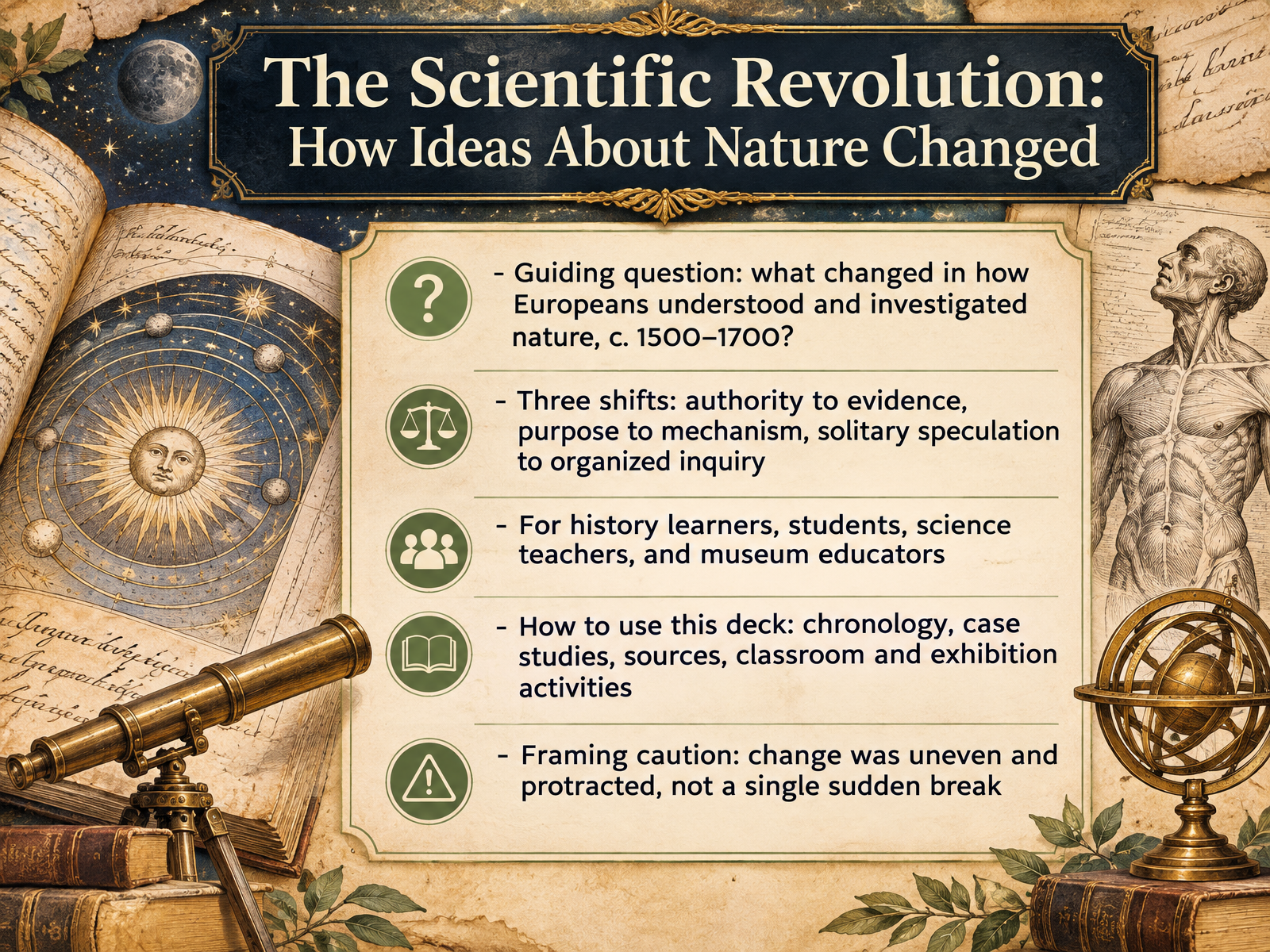
- 01The Scientific Revolution: How Ideas About Nature ChangedWelcome. Together, we'll explore the Scientific Revolution, and our guiding question is simple. Between about fifteen hundred and seventeen hundred, what actually changed in how Europeans understood and investigated nature? You may have heard this period described as a sudden break from the past. The evidence tells a more interesting story: change was uneven and protracted. We'll follow three shifts. First, from trusting authority to demanding evidence. Second, from asking what nature is for to asking how its mechanisms work. Third, from solitary speculation to organized inquiry, in academies and correspondence networks. Whether you teach history, study it, or design museum exhibits, this deck gives you a way in: chronology, case studies, primary sources, and classroom and exhibition activities. Keep that caution in mind as we go. Before the Revolution: Knowledge of Nature Around 1500.plato.stanford.edudoi.orgrepositorio.unesp.br+21 min
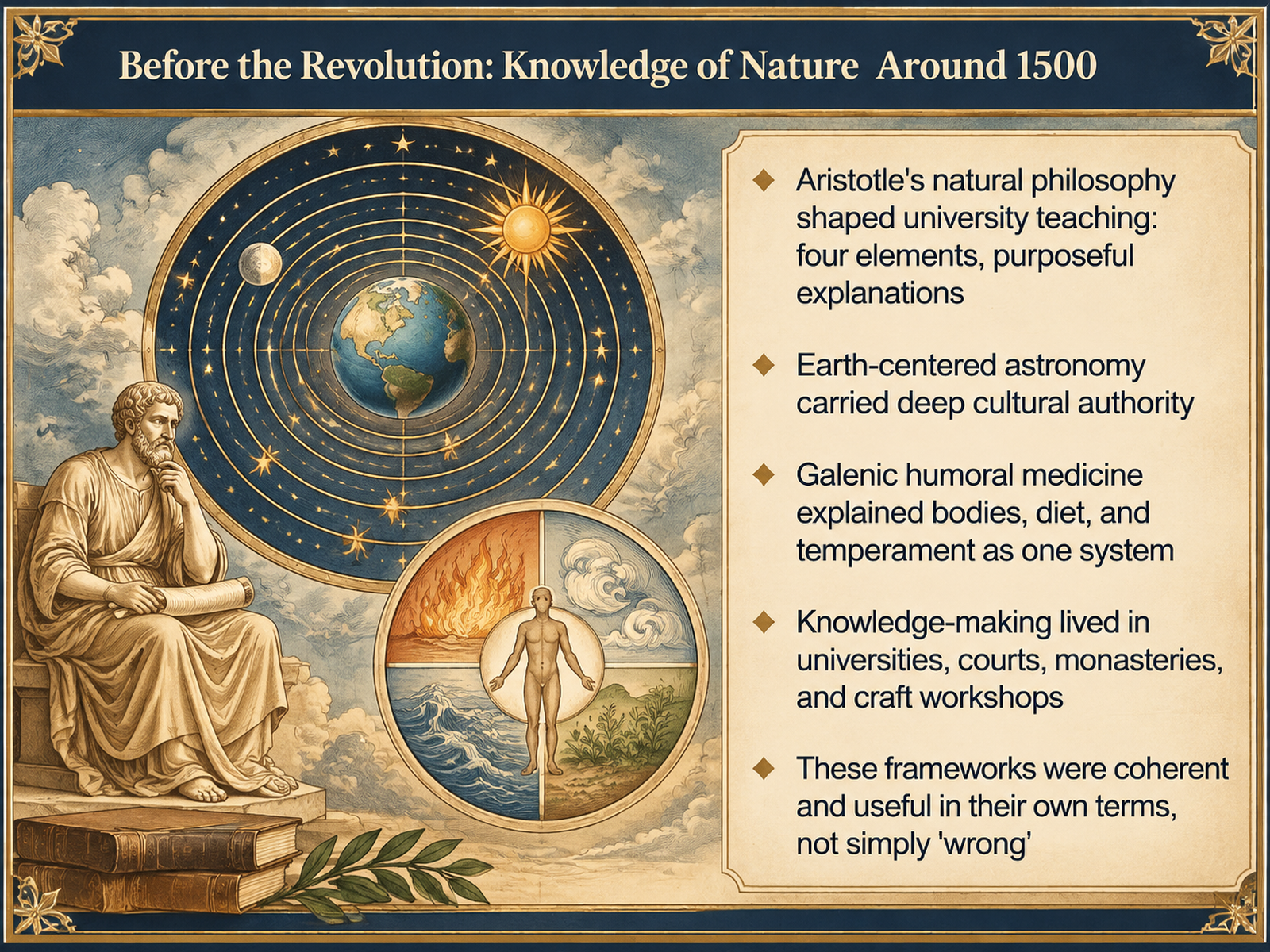
- 02Before the Revolution: Knowledge of Nature Around 1500Let's set the scene around the year fifteen hundred. Before the Scientific Revolution, what did educated Europeans actually believe about nature? At the center of university teaching stood Aristotle's natural philosophy. Matter was built from four elements: earth, water, air, and fire. And things were explained by purpose, not just by mechanical cause. The Earth sat motionless at the center of the cosmos, a view carried by deep cultural and religious authority. In medicine, Galen's humoral theory tied body, diet, and temperament into one system. Blood, phlegm, yellow bile, and black bile shaped both health and personality. Now, this knowledge wasn't produced in one place. It lived in universities, princely courts, monasteries, and craft workshops. And here's the key point. These frameworks were coherent and genuinely useful in their own terms. They were not simply wrong. They answered real questions and guided practice. So when new ideas arrived, they had to compete with a system that already worked. And that competition is exactly where our story turns next. New Skies: Copernicus, Brahe, and Kepler.
 rep.routledge.comdoi.orgplato.stanford.edu+22 min
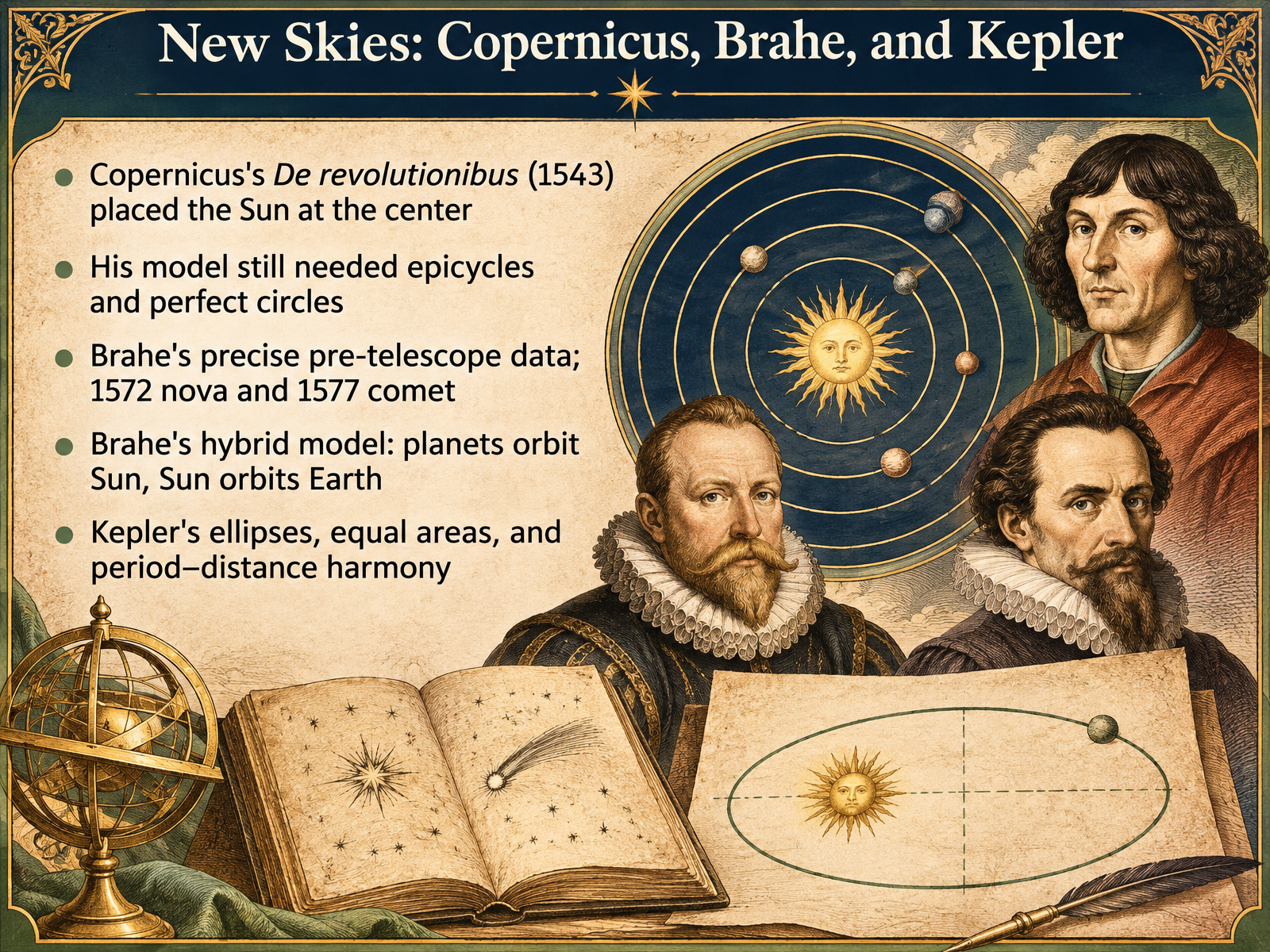
- 03New Skies: Copernicus, Brahe, and KeplerNow, here is a puzzle. If the Sun sits at the center, why did it take more than a century to get the orbits right? Copernicus published On the Revolutions in fifteen forty three. He placed the Sun at the center and made Earth a planet. But he kept perfect circles, so his model still needed epicycles, circles riding on circles. Tycho Brahe then gave astronomy something rarer than theory: precision. Working without a telescope, he recorded planetary positions for nearly twenty years. His new star of fifteen seventy two and comet of fifteen seventy seven showed that the heavens change. Brahe's own model was a hybrid. Planets orbit the Sun, while the Sun orbits Earth. Then Kepler, using Brahe's data, especially on Mars, found the breakthrough: orbits are ellipses. He added equal areas and a harmony linking period and distance. So the answer is data plus mathematics. Next, Instruments, Observation, and the New Evidence.
 loc.govatnf.csiro.auopenstax.org+22 min
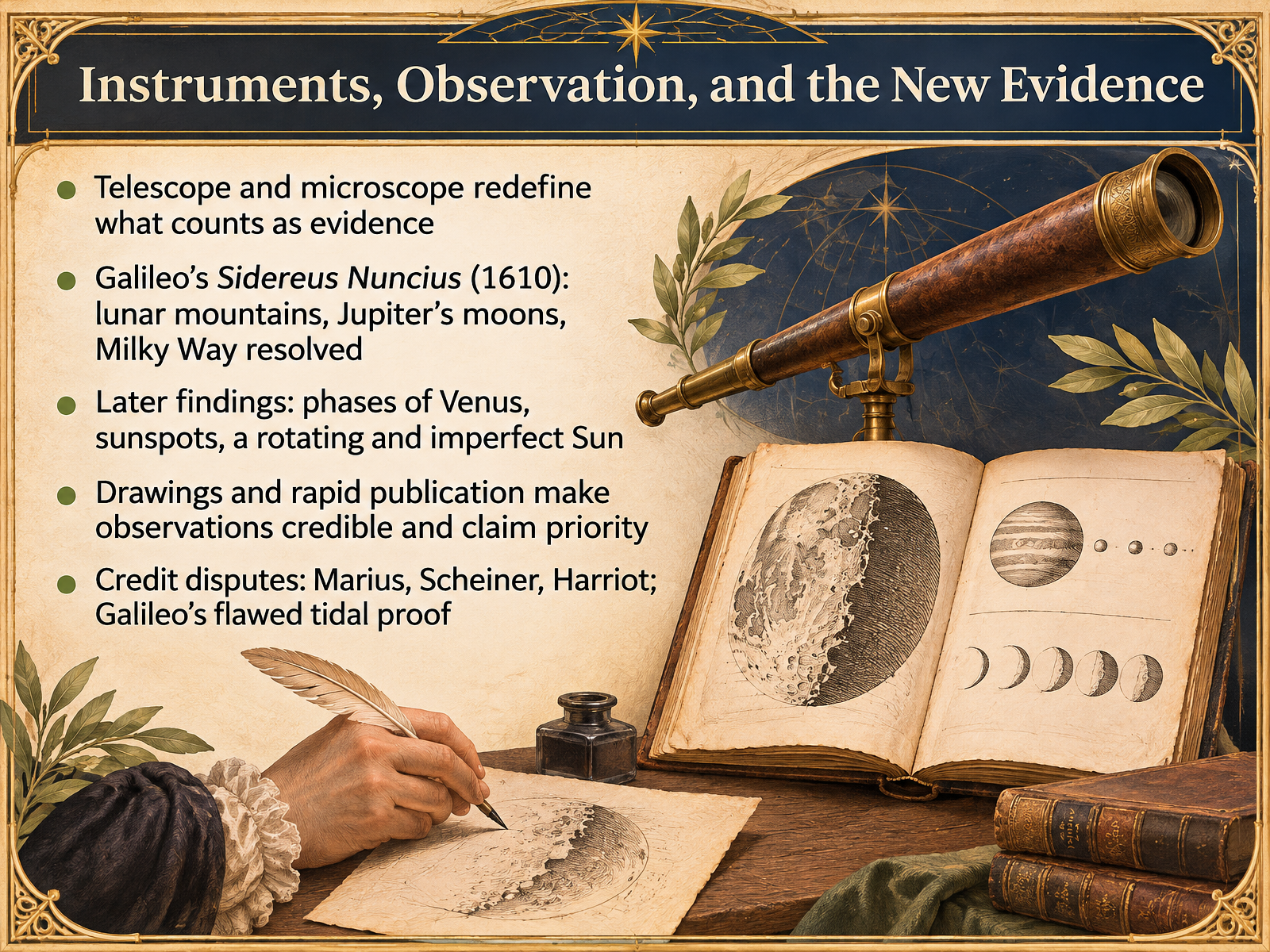
- 04Instruments, Observation, and the New EvidenceNow, how do we know any of this? Here's a question worth sitting with. What counts as evidence? In the early sixteen hundreds, the telescope and the microscope quietly changed the answer. Galileo's Starry Messenger, published in sixteen ten, reported lunar mountains, four moons circling Jupiter, and the Milky Way resolved into countless stars. Later came the phases of Venus, sunspots, and a rotating Sun that was clearly not perfect. Why did his claims stick? He made careful drawings and published fast. That let others check his work, and it staked his priority. But credit was contested. Simon Marius, Christoph Scheiner, and Thomas Harriot all made overlapping observations. And Galileo's tidal proof was flawed. The lesson? New instruments open new evidence, and evidence still needs witnesses, publication, and honest scrutiny. Matter in Motion: The Mechanical Philosophy.
 loc.govwww2.hao.ucar.edudoi.org+22 min
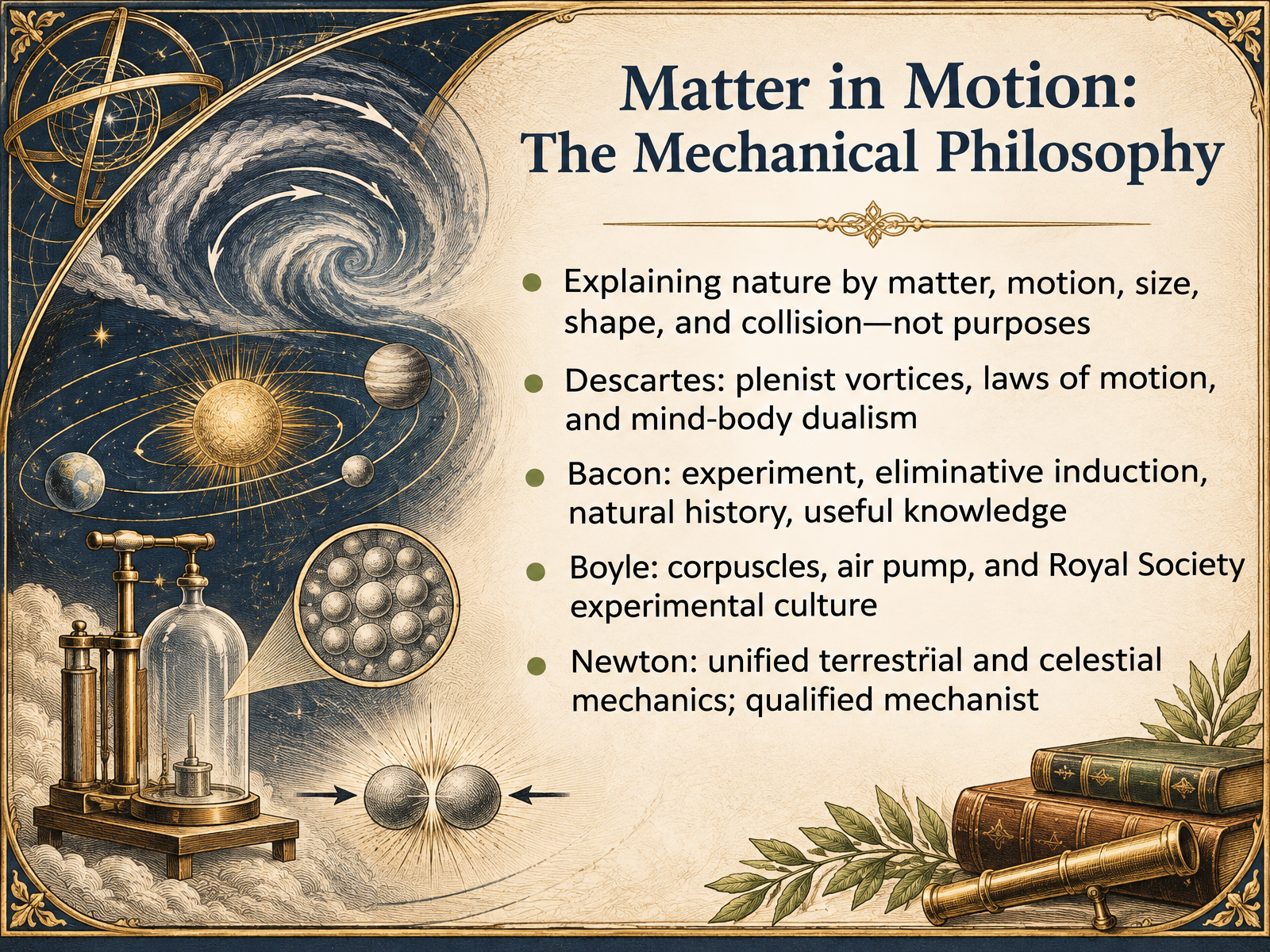
- 05Matter in Motion: The Mechanical PhilosophySo, how did nature come to look like a machine? The mechanical philosophy answered that by explaining things through matter and motion alone: size, shape, and collision. Not purposes, not hidden essences. Descartes pictured a universe packed full of matter, swirling in vortices, and he split mind sharply from body. Bacon pushed a different way: controlled experiment, careful natural history, and knowledge that should be useful. Boyle gave this a working culture. His corpuscles, tiny particles of matter, and his air pump turned experiments into public, repeatable events for the Royal Society. Newton then united earthly and heavenly motion under one set of laws, though his gravity, acting across empty space, made him only a qualified mechanist. The takeaway: nature now moved by laws, not intentions. Next, we turn to bodies and medicine, with Vesalius, Harvey, and the circulation of knowledge.
 2 min
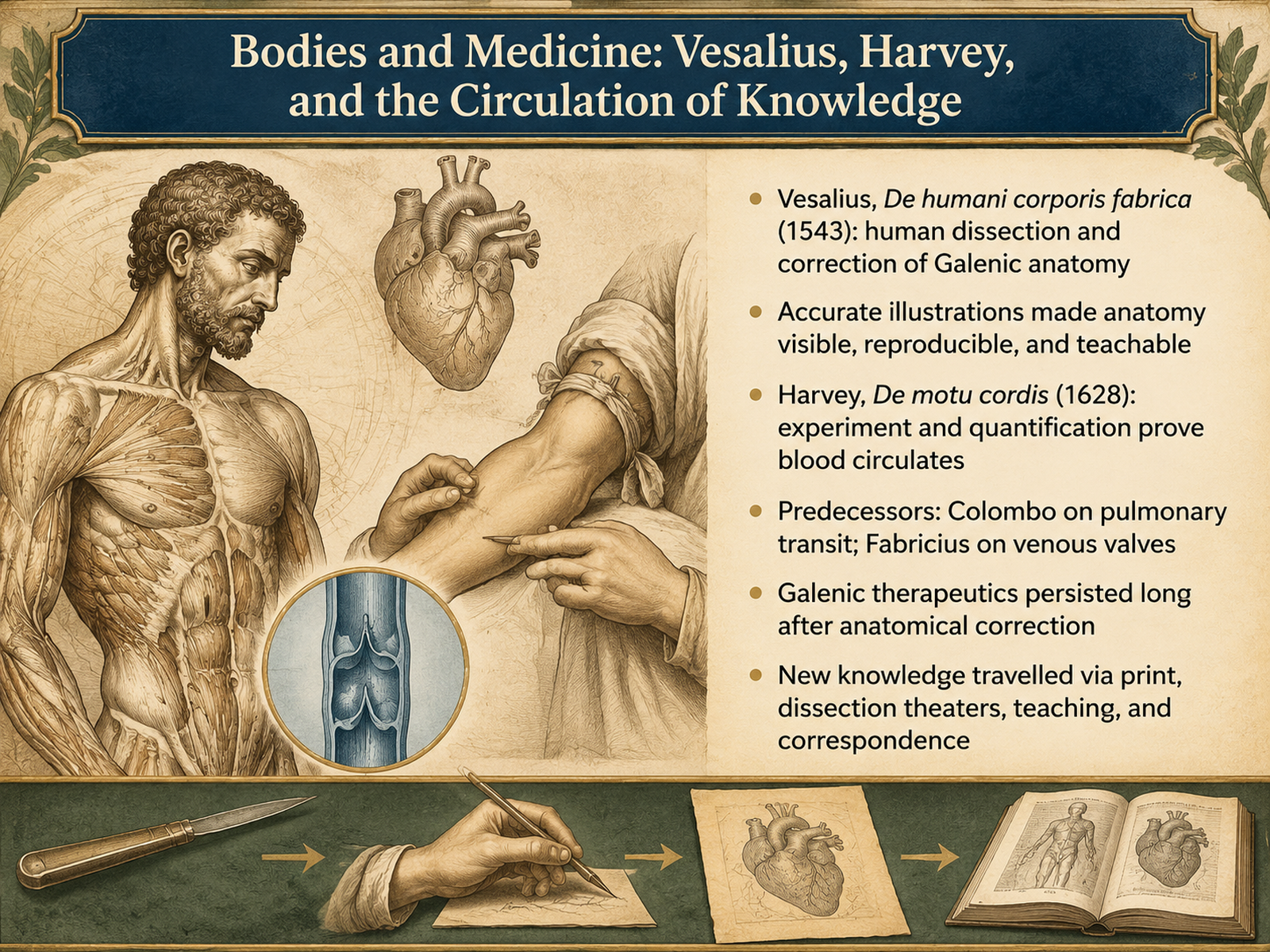
- 06Bodies and Medicine: Vesalius, Harvey, and the Circulation of KnowledgeNow let's turn to bodies and medicine. Here's a tension worth sitting with. If anatomists proved Galen wrong about the body, why did his treatments survive for so long? Start with Vesalius. In 1543 he published On the Fabric of the Human Body, based on his own dissections of human corpses. He corrected many Galenic errors, since Galen had mainly dissected animals. Accurate illustrations made anatomy visible, reproducible, and teachable. Then, in 1628, William Harvey published On the Motion of the Heart and Blood. Using experiment and measurement, he argued that blood circulates continuously, pumped by the heart. Harvey built on predecessors. Colombo described the blood's passage through the lungs, and Fabricius, Harvey's teacher, described valves in the veins. Yet Galenic therapeutics persisted long after the anatomy was corrected. Why? Because the system still seemed to explain illness and to guide treatment, and old cures had long records of apparent success. Meanwhile, new knowledge travelled through print, dissection theaters, teaching, and correspondence. Next, Institutions and Networks: The Social Life of Science.
 2 min
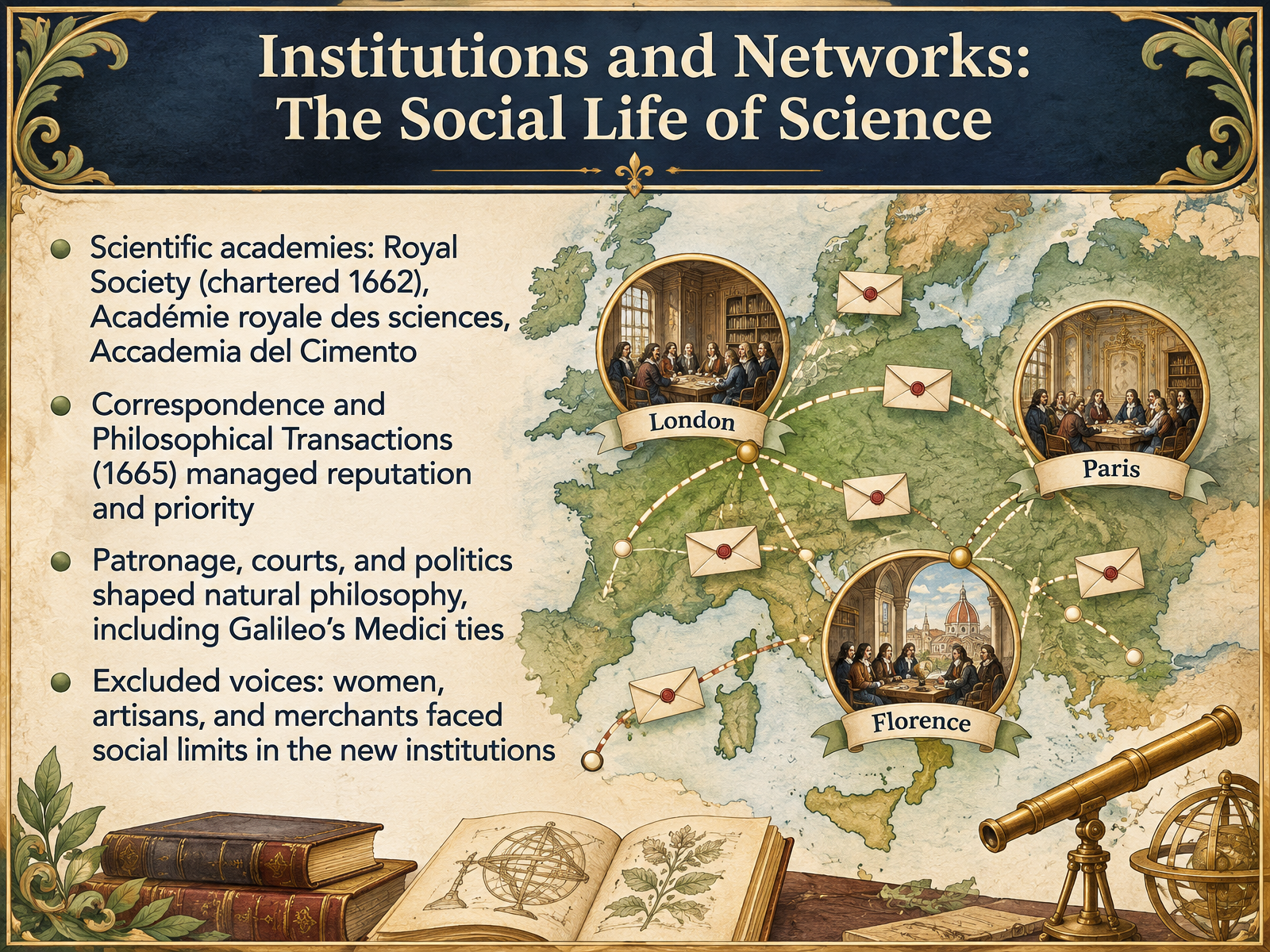
- 07Institutions and Networks: The Social Life of ScienceSo far we have followed the ideas. Now let us ask where those ideas were argued, and by whom. Why did science need institutions at all? Because reputation and priority had to be managed. The Royal Society, chartered in sixteen sixty two, grew from informal London meetings. It gathered knowledge by correspondence, and from sixteen sixty five Henry Oldenburg's Philosophical Transactions published results and staked claims. Similar academies appeared in Paris and Florence. But these institutions lived on patronage and politics. Galileo's ties to the Medici family helped him secure position, and also made his work vulnerable, as we will see later. And the doors were narrow. Women were largely shut out of formal membership, and artisans and merchants who supplied instruments and observations rarely entered the elite circle. So keep this in mind. New institutions gave science stability, but they also decided whose voices were heard. Next, we turn to the tensions between science and religion: conflict, accommodation, and reform.
 2 min
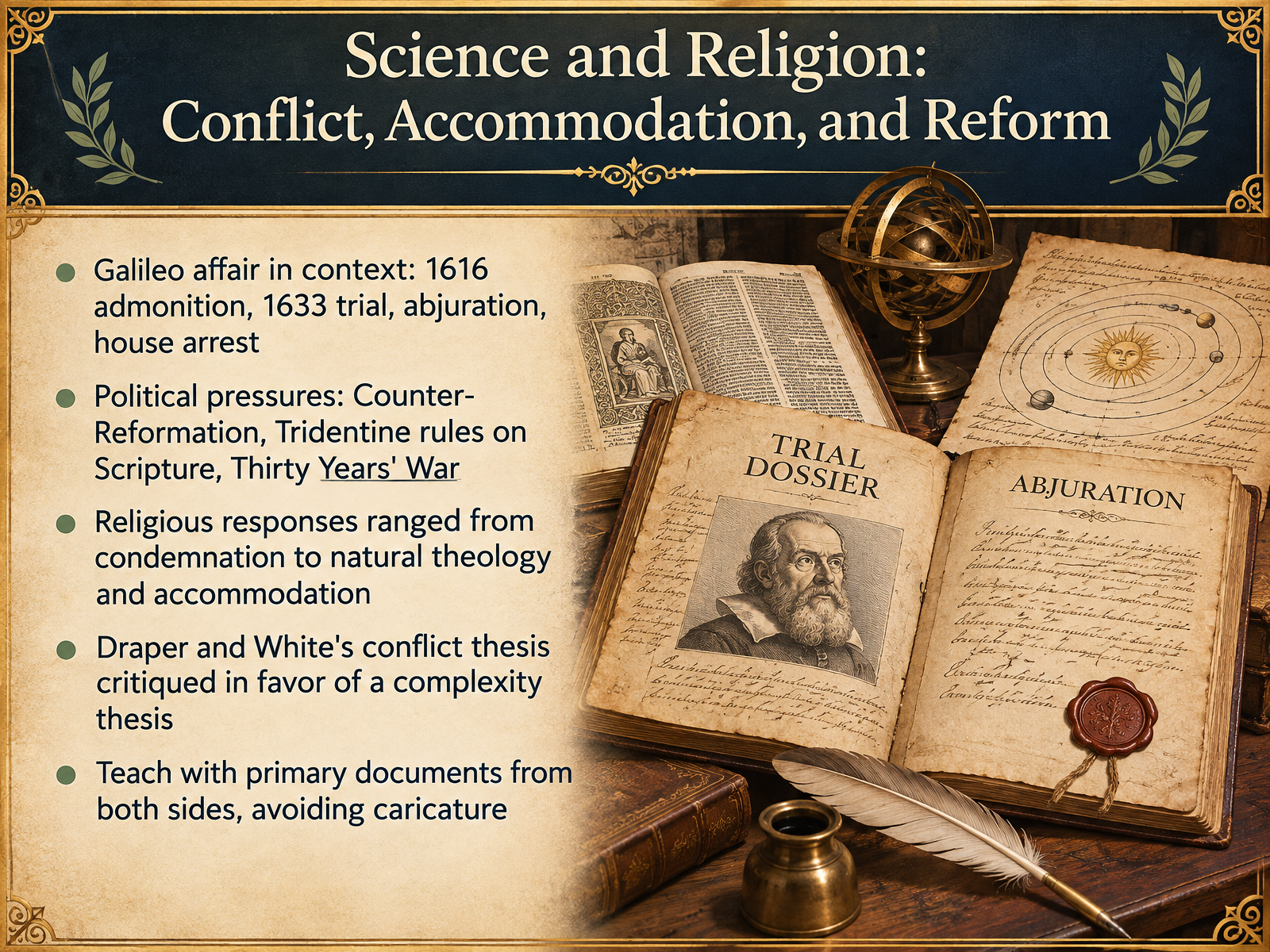
- 08Science and Religion: Conflict, Accommodation, and ReformNow let's ask a harder question. Was the Galileo affair really a simple war between science and religion? The details complicate that story. In sixteen sixteen, Galileo received a quiet admonition not to defend or hold Copernican ideas. In sixteen thirty three, after publishing his Dialogue, he was tried, forced to abjure, and sentenced to house arrest. It all unfolded amid Counter-Reformation anxiety, Tridentine rules on who may interpret Scripture, and the Thirty Years' War. Religious responses ranged from condemnation to natural theology and accommodation. Then in the nineteenth century, Draper and White popularized the conflict thesis, the claim that science and religion are inevitably at war. Modern historians instead favor a complexity thesis, because the relationship varied by context and was often collaborative. So teach with primary documents from both sides, and avoid caricature. The past was messier and more interesting than the warfare story suggests. Did Nature Really Change? Continuities and Global Exchanges.
 plato.stanford.edu2 min
- 09Did Nature Really Change? Continuities and Global ExchangesSo let's step back and ask a bigger question. Did nature itself really change? The honest answer is yes, but not all at once, and not everywhere. There were real changes in theory, in method, in instruments, and in organized inquiry. Yet historians now emphasize continuity too. Medieval thinkers laid groundwork, and the transformation was slow and uneven. Knowledge also moved globally. Translation, trade, and missions carried ideas across Eurasia and the Americas. So we should be cautious about Eurocentric, triumphalist master narratives. Instead, ask three framing questions. What changed, for whom, and where? Keep those in mind as we turn now to a source-based classroom activity called Interrogating Voices of the New Science.
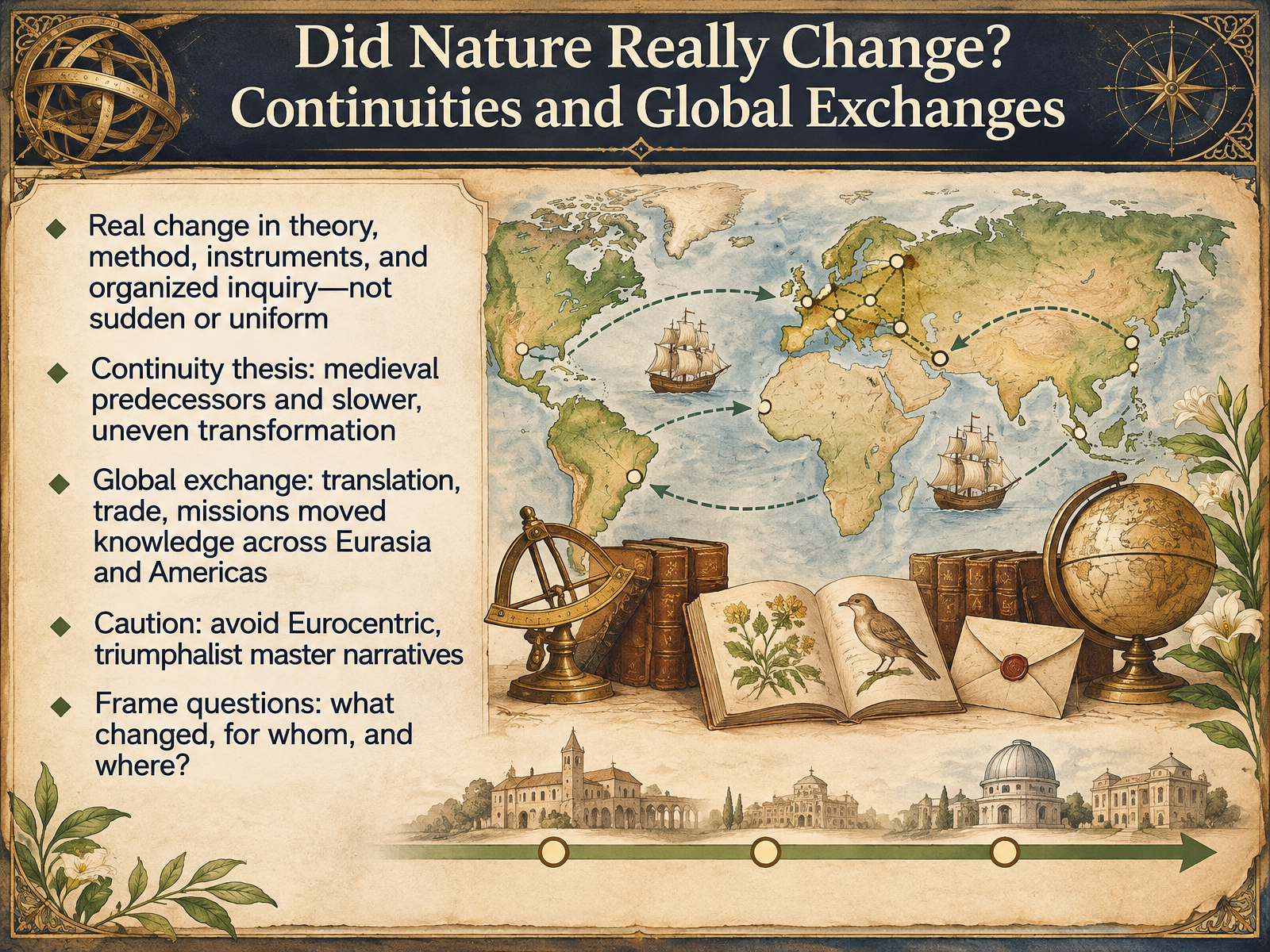 plato.stanford.edudoi.orgrepositorio.unesp.br+22 min
- 10Source-Based Classroom Activity: Interrogating Voices of the New ScienceNow let's put those skills into your own students' hands. This activity centers on three short excerpts: Copernicus's dedication to Pope Paul the Third, Galileo's Letter to the Grand Duchess Christina, and a passage from Newton's Principia. Students compare them using a document-analysis worksheet. They ask: who wrote this, for whom, why, and how reliable is it? Then comes the Hot Seat. One student defends a thinker's position, using only evidence from the source. If the answer isn't there, they say so honestly. That builds real discipline. Next, a class debate. Did the new science mainly challenge the Church, or did it mainly challenge ancient authorities like Aristotle? Push students to weigh both. Copernicus dedicated his book to a pope, yet Galileo was forced to abjure in sixteen thirty-three. Close with an exit ticket and a writing prompt tied to historical-thinking skills. The takeaway: let evidence, not assumption, drive the argument. Next, we move to Object-Based Activity: Reading Instruments and Illustrations.
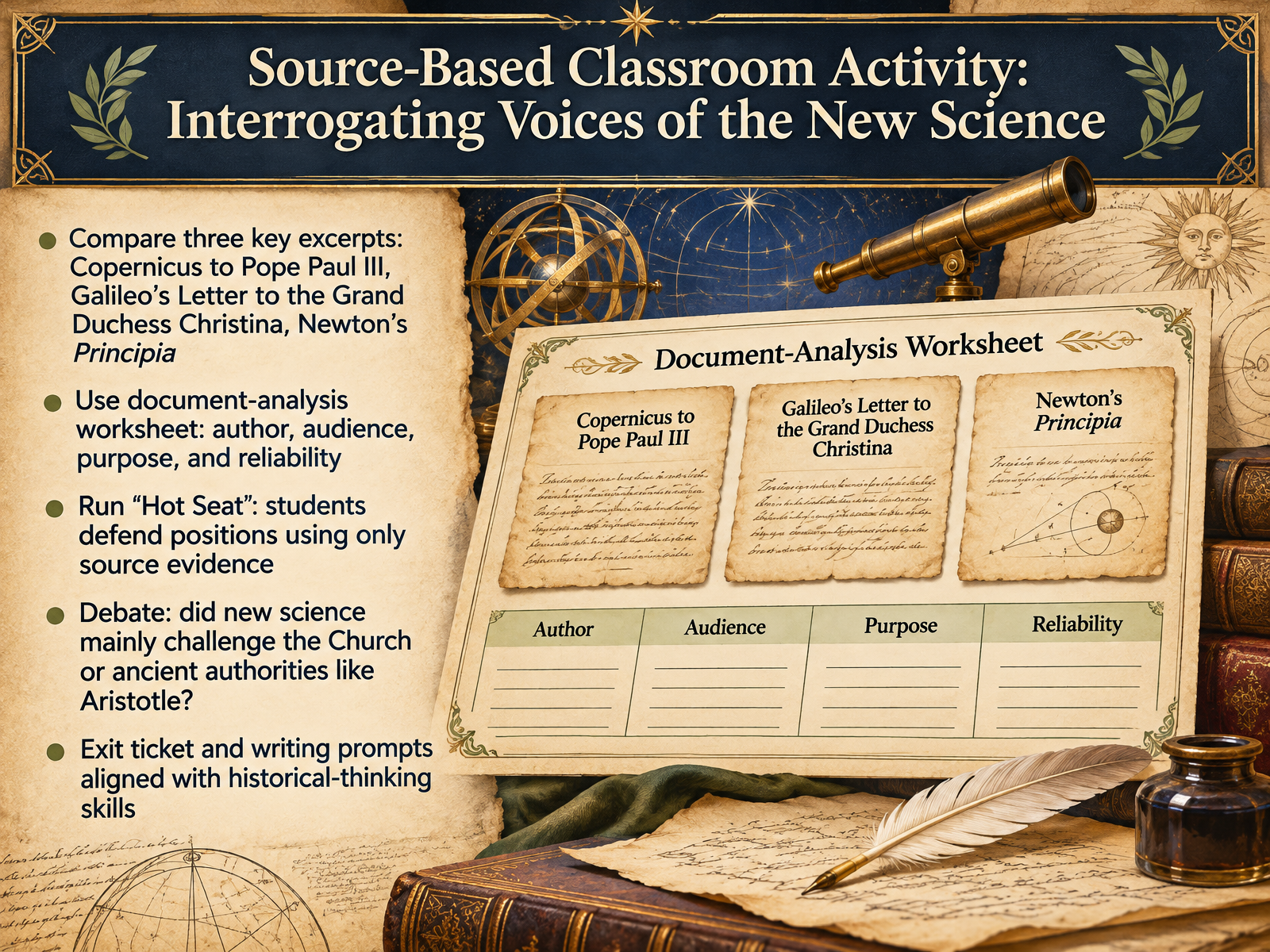 loc.govwww2.hao.ucar.edudoi.org+22 min
- 11Object-Based Activity: Reading Instruments and IllustrationsLet's put this into practice with objects. Treat instruments and illustrations as historical actors, not as icons of progress. Take Galileo's lunar etchings. His training in chiaroscuro, the art of shading light and dark, helped him read shadows near the moon's terminator as mountains and craters. He then drew and published those observations in the Starry Messenger in sixteen ten. Thomas Harriot observed the moon first, but Galileo printed and distributed his work, and that is what made his claims credible and claimed priority. Vesalius's anatomical plates work the same way. Careful observation, skilled artistry, and publication together made new evidence persuasive. So adapt your questions. Ask high school students what they notice. Ask university students who gets credit, and why. Ask museum visitors what today's instruments, like imaging or data displays, make visible or hide. The takeaway is simple. Evidence is made credible by tools, hands, and print. Next, we turn to museum and exhibition interpretation, principles for science educators.
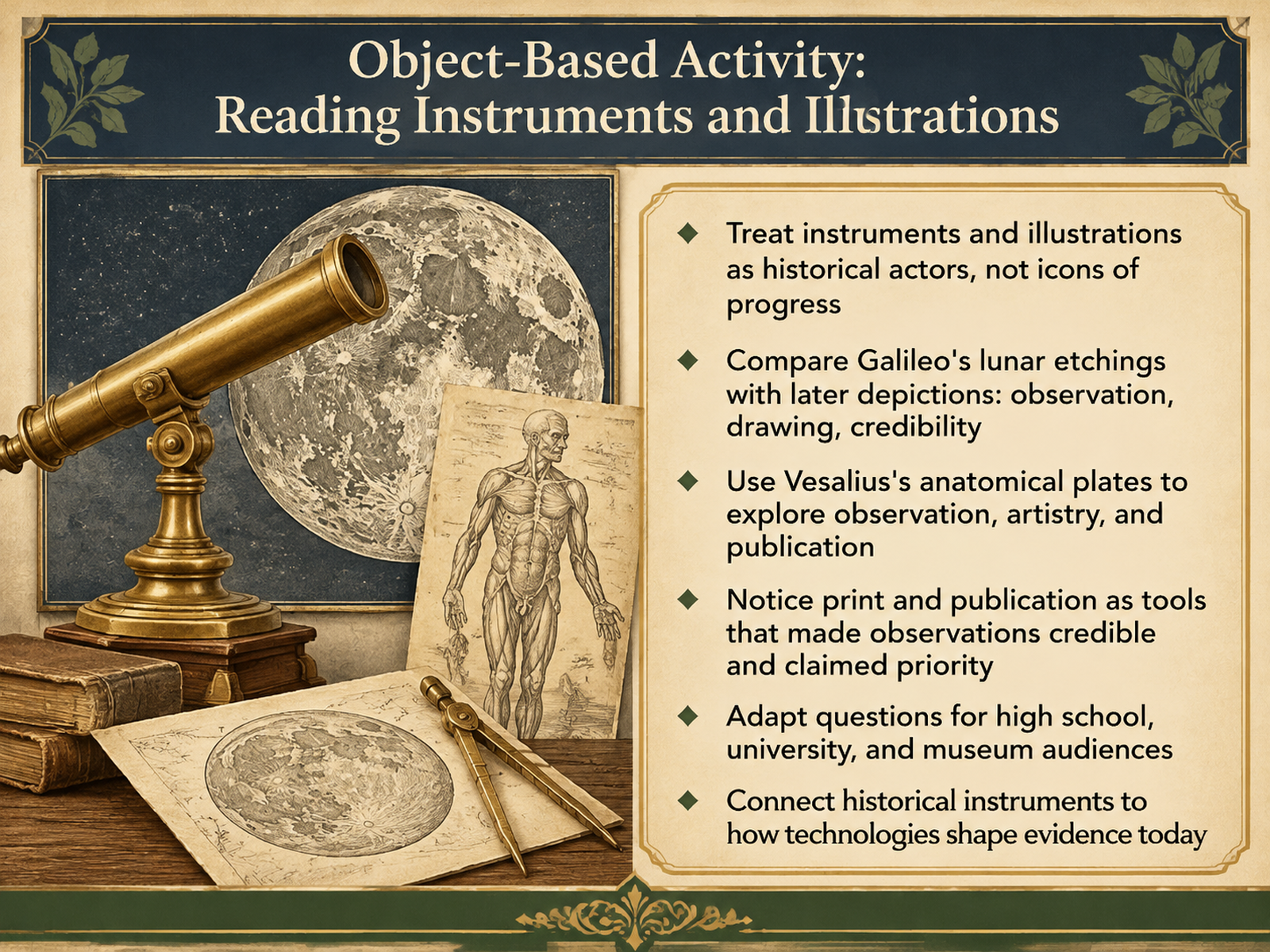 loc.govwww2.hao.ucar.edudoi.org+22 min
- 12Museum and Exhibition Interpretation: Principles for Science EducatorsNow let's move from the classroom into the museum. How do you turn centuries of scientific change into an exhibition that respects both the evidence and the visitor? Start with one big idea, then build a hierarchy: a few key messages, and the critical questions the exhibit should answer. Anchor the narrative in real artifacts and social context, not a technical chronology. The Science Museum's Information Age gallery did exactly this, placing eight hundred objects as actors in history rather than illustrations of progress. Layer information so visitors choose their own path, assembling meaning like readers of a hypertext. Write labels that admit complexity and uncertainty without overwhelming. And remember the four visitor preferences: ideas, people, objects, and physical interaction. A strong exhibition serves all four. That leads naturally to our next topic, Assessment Design: Measuring Historical Understanding.
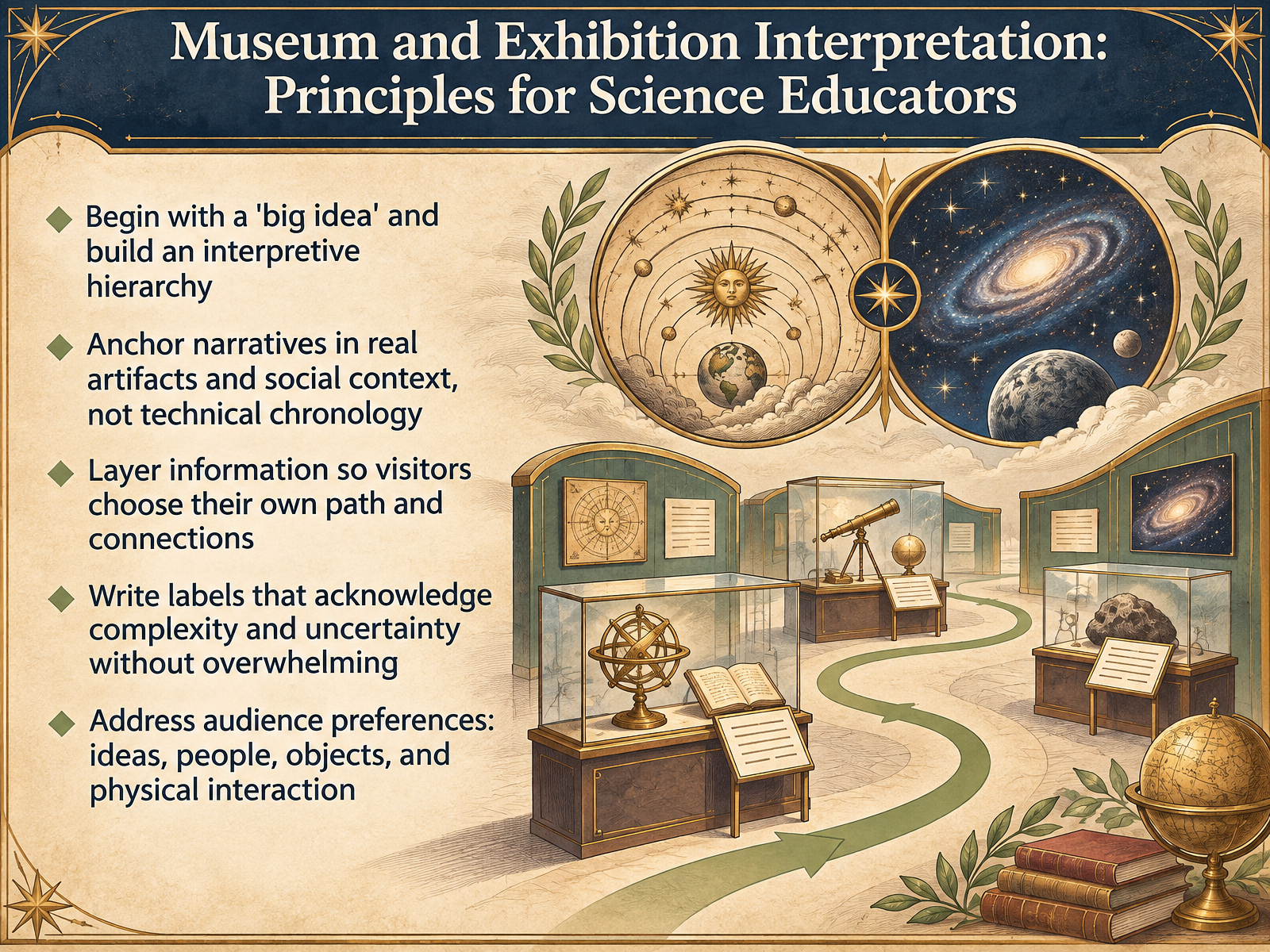 2 min
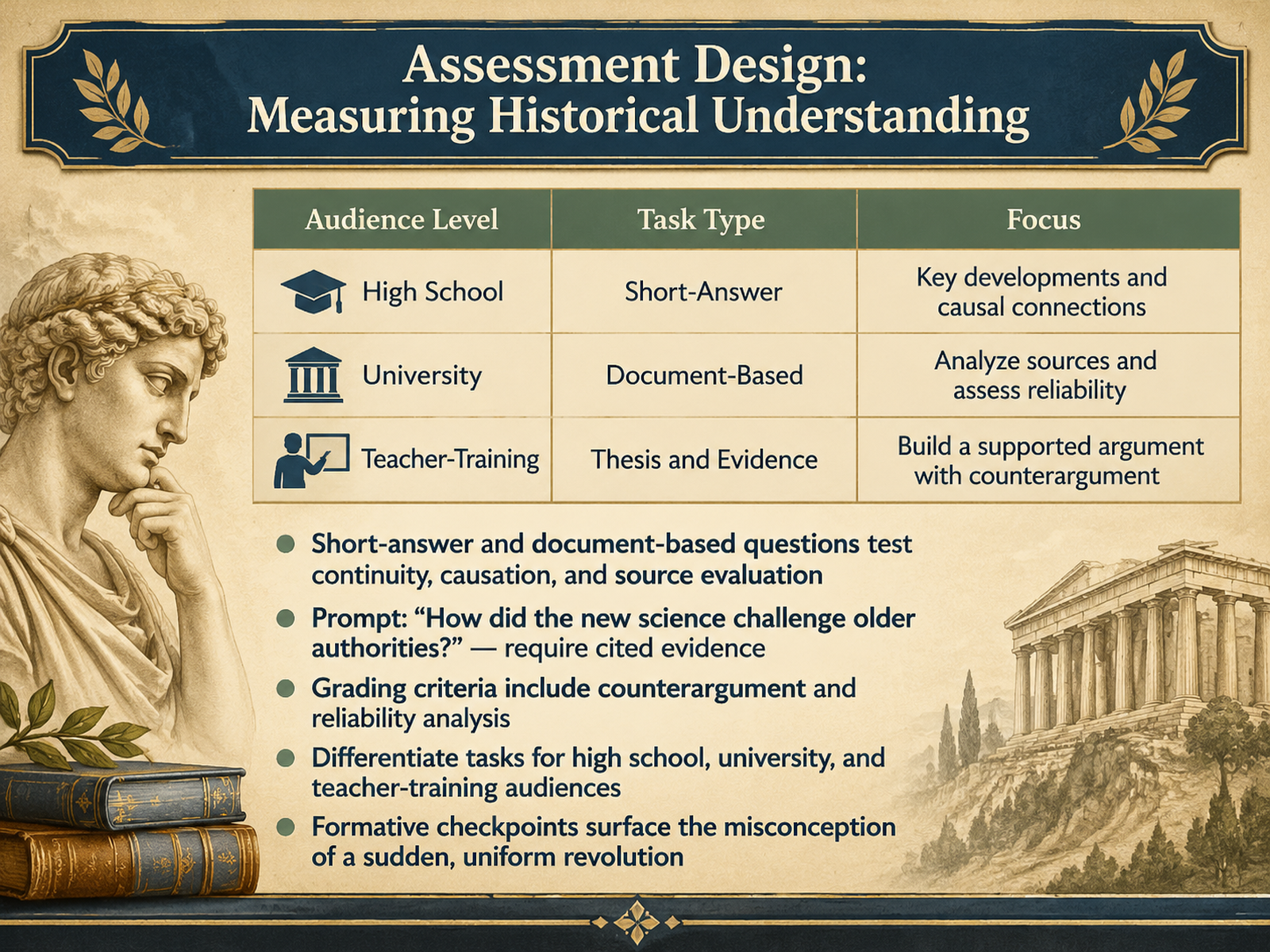
- 13Assessment Design: Measuring Historical UnderstandingSo how do we actually measure whether students understand this? Good assessment starts with good questions. Short-answer and document-based tasks let you test continuity, causation, and source evaluation all at once. Here is a strong prompt: How did the new science challenge older authorities? Require students to cite evidence from at least three sources, and grade them on how they explain reliability and respond to a counterargument. Then differentiate. High school students might analyze two sources closely. University students should weigh competing interpretations. Teacher-training groups can discuss how to scaffold the same task. And build in formative checkpoints, because they surface the most common misconception: that the revolution was sudden and uniform. It was not. Changes unfolded unevenly, across disciplines and decades. Let's pull these threads together next in our wrap-up and discussion.
 plato.stanford.edudoi.orgrepositorio.unesp.br+22 min
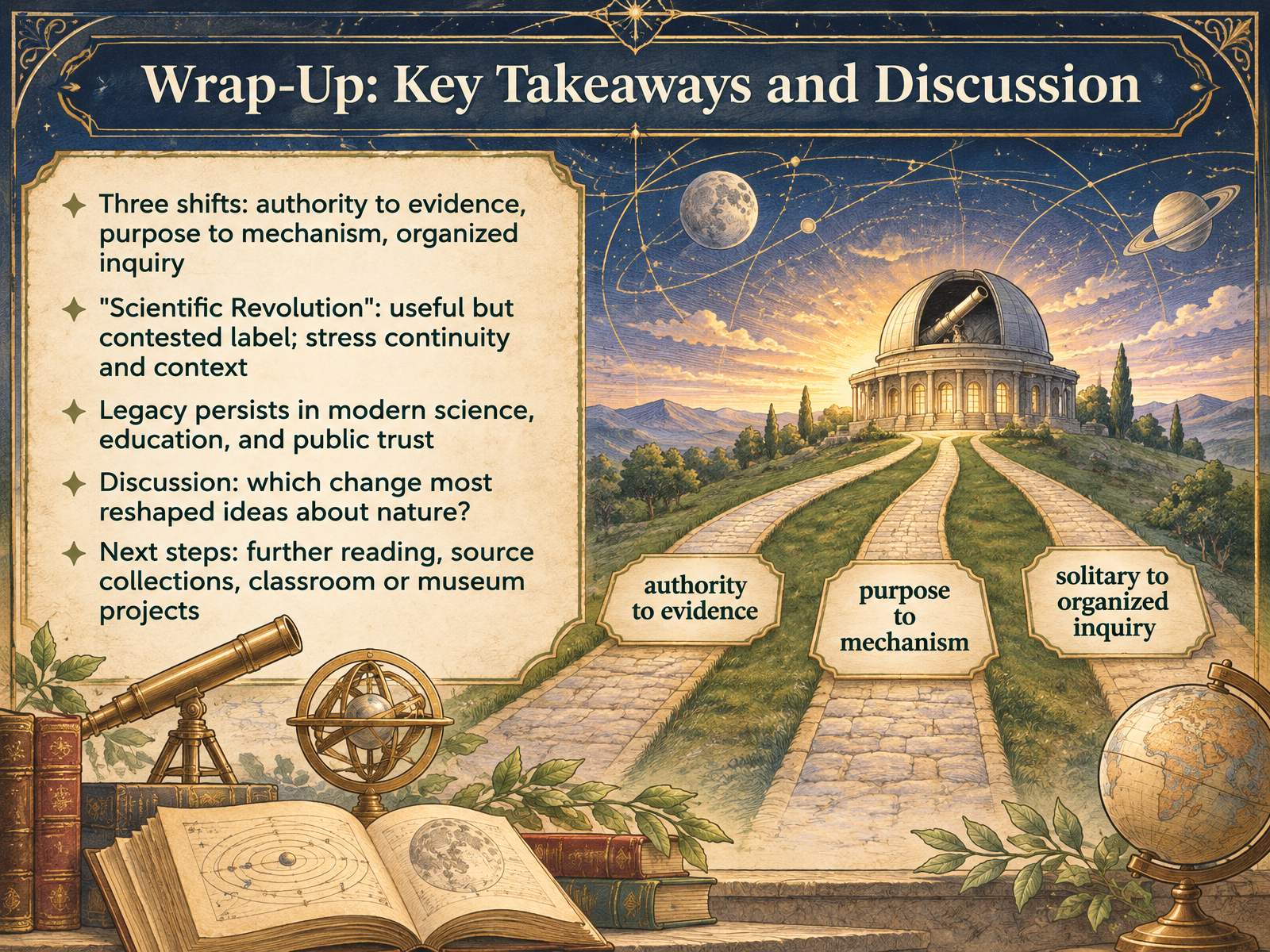
- 14Wrap-Up: Key Takeaways and DiscussionLet's bring the threads together. Three shifts matter most. First, authority gave way to evidence, as natural philosophers began trusting observation and experiment over inherited texts. Second, explanations moved from purpose to mechanism. Instead of asking why a stone falls, they asked how motion works. Third, inquiry became organized through academies, journals, and correspondence networks. Now, the label Scientific Revolution is useful but contested. Historians like Steven Shapin remind us there was no single event, and continuity with medieval and global traditions runs deep. Yet the changes were real, and their legacy persists in modern science, education, and public trust. So here is a question to discuss: which of those three shifts most reshaped ideas about nature? For next steps, explore further readings and source collections, and try a classroom or museum project. Thank you for joining this journey. Stay curious, and keep questioning the past.
 plato.stanford.edudoi.orgrepositorio.unesp.br+22 min
Take the deck with you
Download this course as a file — free, no sign-up needed.
- PDF handoutEvery slide page, ready to print or share.15 pages · 7.7 MBDownload
- Narrated PowerPointThe deck that presents itself — every slide carries the digital human's narration video.15 pages · 19.6 MBDownload
- PowerPoint slidesThe full deck as a .pptx — open it in PowerPoint, Keynote, or Google Slides.15 pages · 7.7 MBDownload
Free to use in your own training — please keep the PersonWise credit page at the end.
Have your own deck? Turn it into a course
Sources consulted
Web sources consulted while building this course.
- Scientific Revolutions (Stanford Encyclopedia of Philosophy) — plato.stanford.edu
- Two New Conceptions of the Scientific Revolution Compared — doi.org
- Sobre o nascimento da ciência moderna: a perspectiva continuísta de Edward Grant — repositorio.unesp.br
- Science and the Scientific Revolution | Encyclopedia.com — encyclopedia.com
- The Scientific Revolution: Second Edition — press.uchicago.edu
- Natural philosophy, medieval - Routledge Encyclopedia of Philosophy — rep.routledge.com
- Natural philosophy — doi.org
- Medieval Philosophy (Stanford Encyclopedia of Philosophy) — plato.stanford.edu
- Natural Philosophy after the Translations: Its Role and Place in the Late Middle Ages — doi.org
- Medieval philosophy - Routledge Encyclopedia of Philosophy — rep.routledge.com
- Whose Revolution? Copernicus, Brahe & Kepler | Modeling the Cosmos | Articles and Essays | Finding Our Place in the Cosmos: From Galileo to Sagan and Beyond | Digital Collections | Library of Congress — loc.gov
- Medieval & Renaissance Astronomy - Australia Telescope National Facility — atnf.csiro.au
- 2.4 The Birth of Modern Astronomy - Astronomy 2e | OpenStax — openstax.org
- Astronomy Review - Renaissance Astronomy — phy.olemiss.edu
- 3.1 The Laws of Planetary Motion - Astronomy 2e | OpenStax — openstax.org
- Galileo and the Telescope | Modeling the Cosmos | Articles and Essays | Finding Our Place in the Cosmos: From Galileo to Sagan and Beyond | Digital Collections | Library of Congress — loc.gov
- Galileo Galilei (1564–1642) | High Altitude Observatory — www2.hao.ucar.edu
- In retrospect: The celestial message — doi.org
- Galileo Galilei (Stanford Encyclopedia of Philosophy) — plato.stanford.edu
- Galileo’s Sidereus Nuncius and Its Reception — doi.org