Begin
14 pages · ~28 min
Sidereal vs Solar Time and Precession
This training teaches learners how sidereal and solar days differ and how precession affects sky time, designed for astronomy students and enthusiasts.
A digital instructor presents all 14 pages. Hold “Ask” at any point and ask out loud — the answer comes from this course. No sign-up needed.
What you’ll learn
- 01Sky Time: Sidereal Days, Solar Days, and PrecessionWelcome. Have you ever noticed that a star rises a little earlier each night, and wondered why our clocks and the sky disagree? That small mismatch is our topic. In this course we'll connect three ideas: the difference between a sidereal day and a solar day, the equation of time, and precession. Here's the key fact. A sidereal day, measured against the stars, lasts twenty-three hours, fifty-six minutes, and about four seconds. A solar day is twenty-four hours by definition. Precession slowly moves the celestial pole, completing a cycle in about twenty-five thousand eight hundred years. By the end, you'll define both day types, explain that roughly four-minute offset, and describe long-term drift in the sky. Think of star trails, or the fact that Polaris has not always been our pole star. Now let's begin with Two Kinds of Day: Observing the Sky from a Moving Earth.ssd.jpl.nasa.govbritastro.orgen.wikipedia.org+22 min
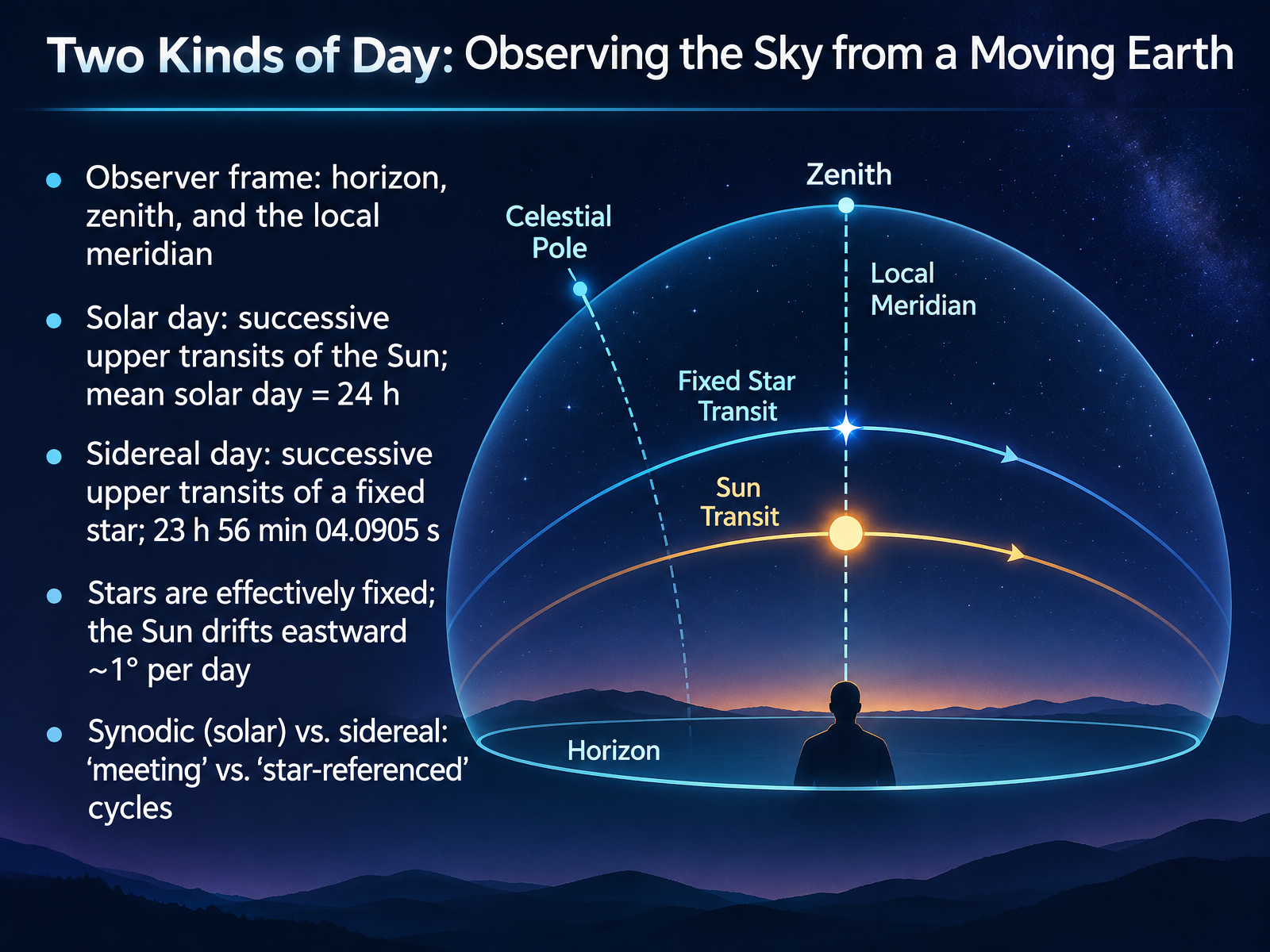
- 02Two Kinds of Day: Observing the Sky from a Moving EarthNow let's set up our observing frame. Picture yourself standing under the sky. You have a horizon all around you, a zenith directly overhead, and a local meridian, the north-south line that passes through your zenith. When a star crosses that line high overhead, we call it an upper transit. Here's the key point. A solar day is the time between successive upper transits of the Sun, and the mean solar day is twenty four hours. A sidereal day is the time between successive upper transits of a fixed star, and it lasts twenty three hours, fifty six minutes, and about four point one seconds. Why the difference? The stars are effectively fixed, but the Sun drifts eastward by roughly one degree each day. That extra bit of rotation takes about four minutes. So a synodic, or solar, day is a meeting cycle with the Sun, while a sidereal day is referenced to the stars. Now, why the solar day is longer. Let's look at the geometry of one extra turn.
 ssd.jpl.nasa.govbritastro.orgen.wikipedia.org+22 min
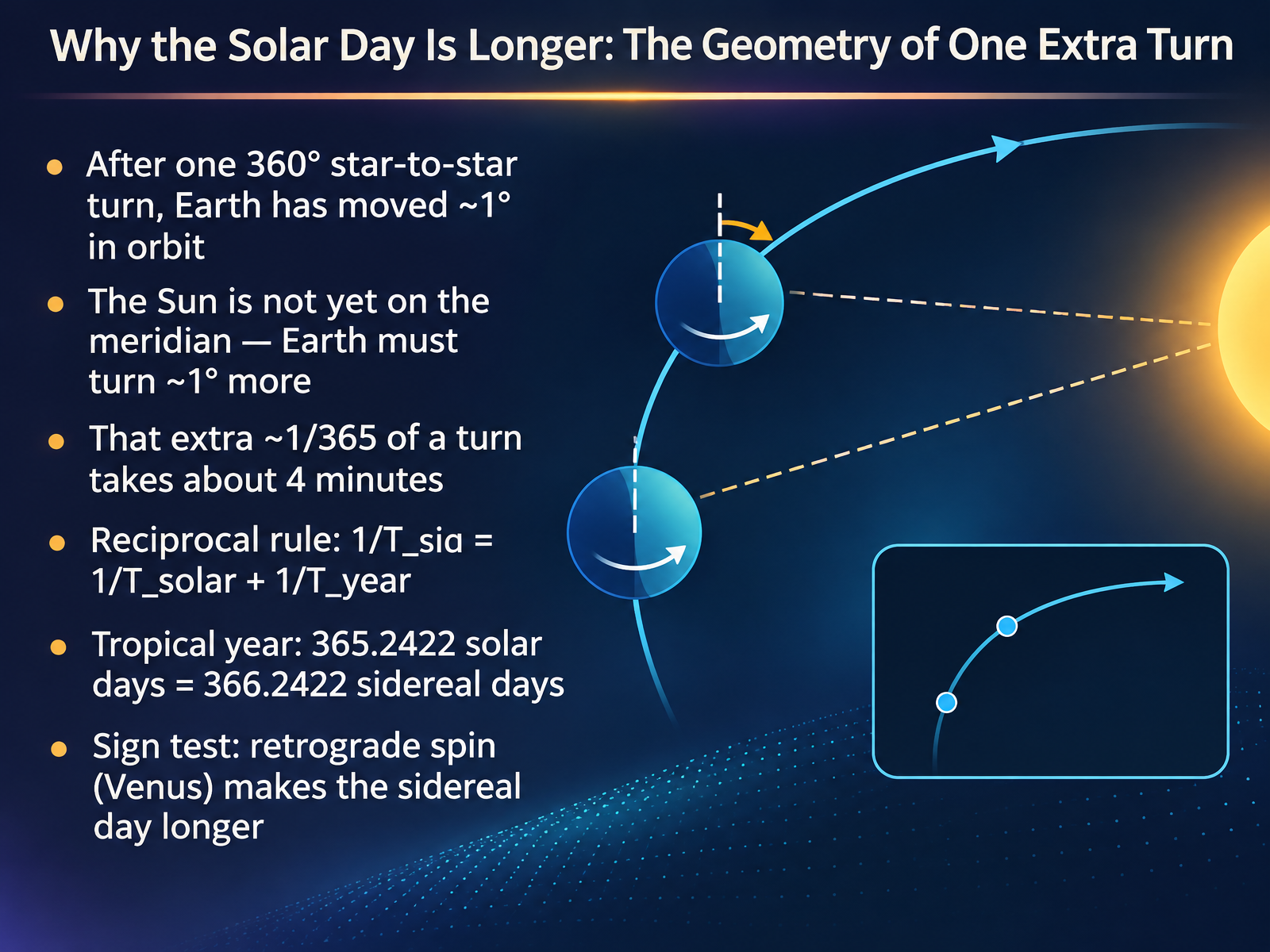
- 03Why the Solar Day Is Longer: The Geometry of One Extra TurnNow let's see exactly why the solar day is longer. Picture Earth from above, and an observer with a star directly overhead. After one full turn, three hundred sixty degrees, that star is back overhead. But here's the difference. Earth has also moved about one degree along its orbit. So the Sun is not yet on the meridian. Earth must turn roughly one degree more. That extra bit is about one part in three hundred sixty five of a turn, and it takes about four minutes. That gives a neat reciprocal rule. One divided by the sidereal day equals one divided by the solar day plus one divided by the year. And it explains why a tropical year holds three hundred sixty five point two four two two solar days, but three hundred sixty six point two four two two sidereal days. Always one extra turn. As a sign test, imagine Earth spinning backward, like Venus. Then the sidereal day becomes the longer one. Next, let's see how that four minute offset accumulates.
 openstax.orgastronomy-celestial-mechanics.comastrolab.awh.durham.ac.uk+22 min
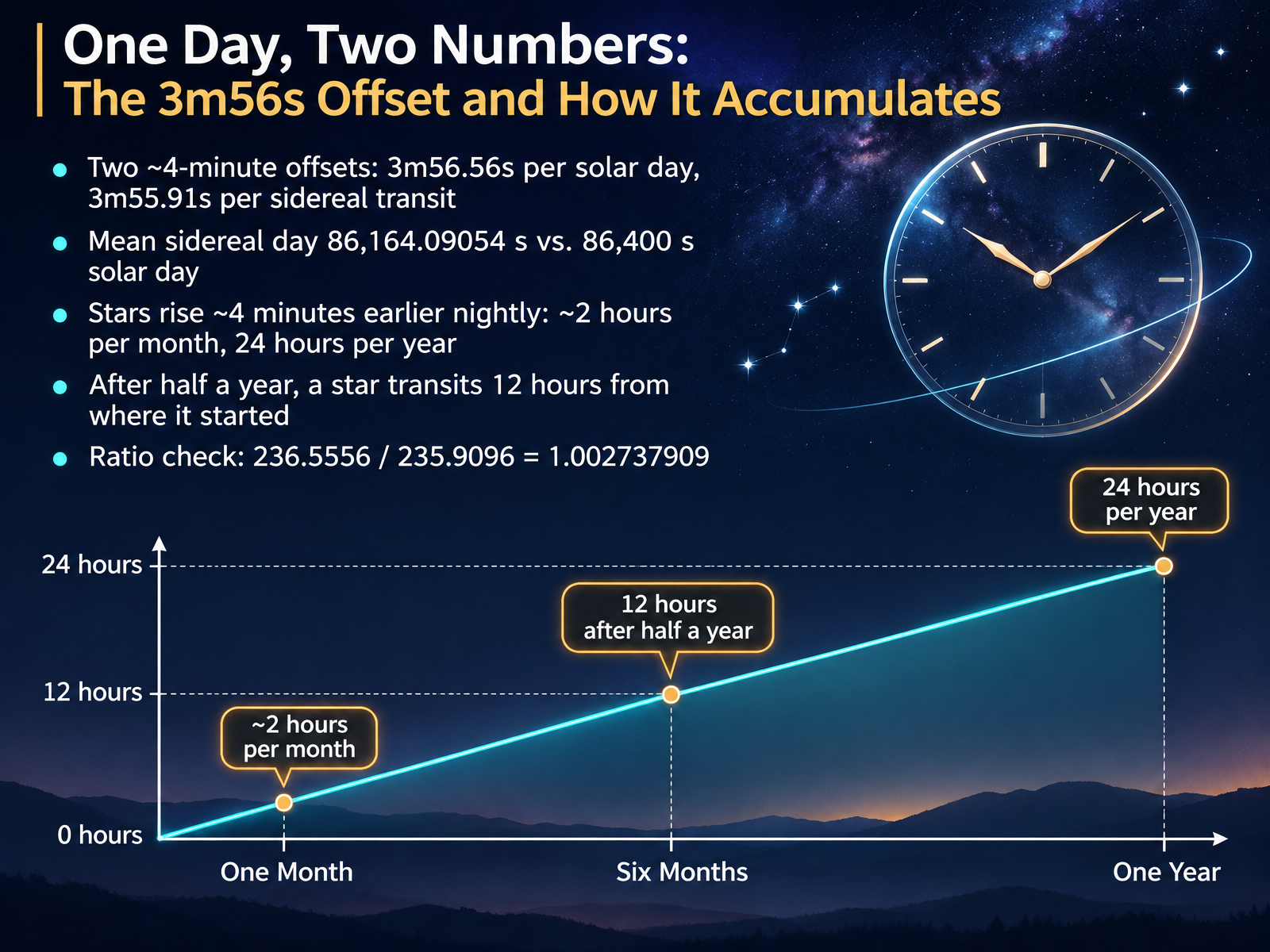
- 04One Day, Two Numbers: The 3m56s Offset and How It AccumulatesNow let's put two numbers on that offset. A star crosses the meridian three minutes fifty-five point nine one seconds earlier each sidereal transit. Against your civil clock, the same star slips three minutes fifty-six point five six seconds per solar day. Here's the key distinction. The mean sidereal day is eighty-six thousand one hundred sixty-four point zero nine zero five four seconds, while the solar day is exactly eighty-six thousand four hundred seconds. Notice what accumulates. Stars rise about four minutes earlier each night, which is roughly two hours per month, and twenty-four hours per year. After half a year, a star transits twelve hours from where it started. That is why constellations belong to seasons. The two offsets stay in the same proportion as the two days, one point zero zero two seven three seven nine zero nine. Next, we'll see how this becomes practical: sidereal time in practice, local sidereal time, hour angle, and right ascension.
 openstax.orgastronomy-celestial-mechanics.comastrolab.awh.durham.ac.uk+22 min
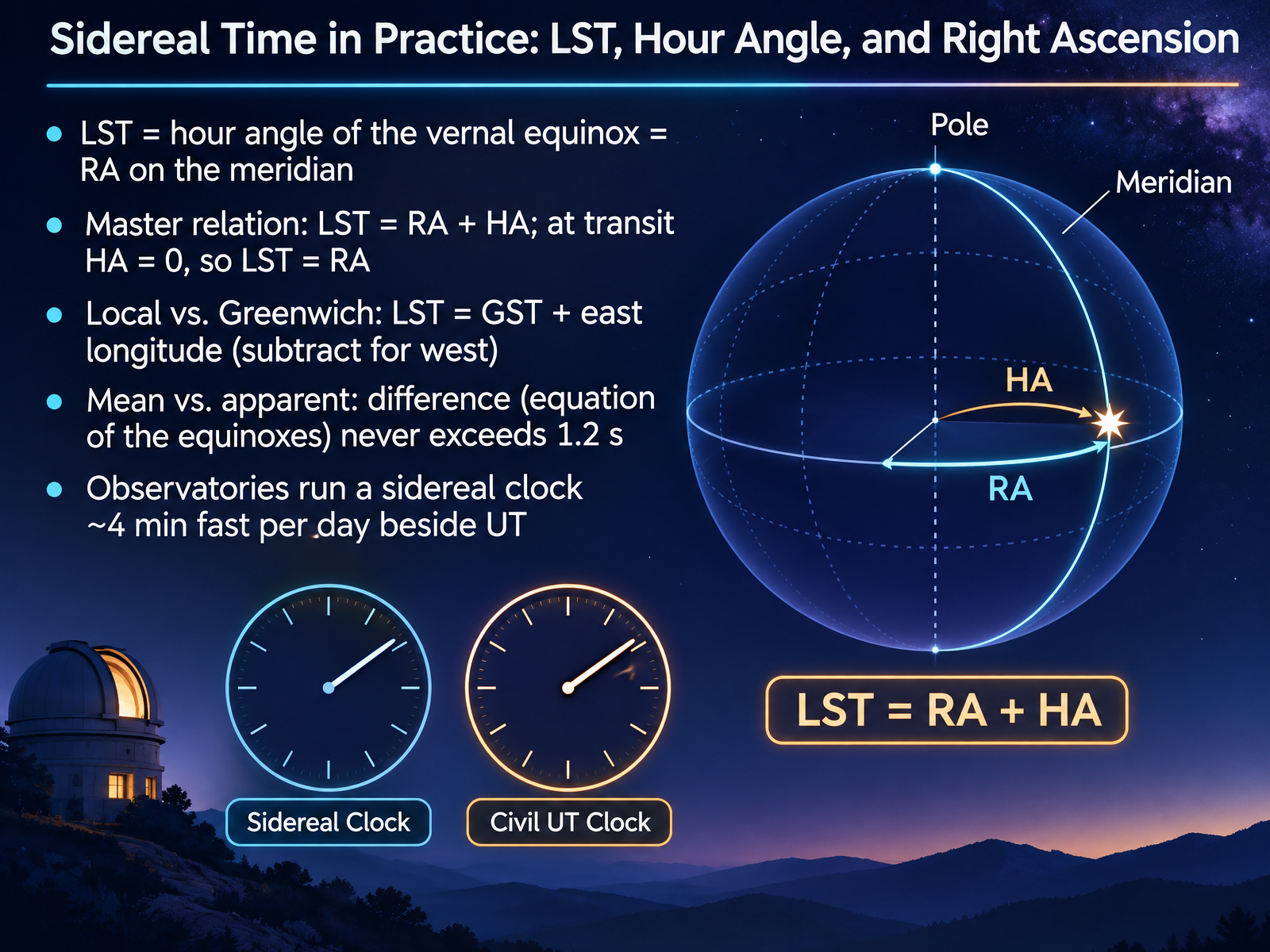
- 05Sidereal Time in Practice: LST, Hour Angle, and Right AscensionNow let's put sidereal time to work. Picture an observatory dome, and imagine a star crossing the meridian, the north-south line through your zenith. Local sidereal time is simply the right ascension of whatever is crossing that line at that moment. Better still, one relation covers everything: local sidereal time equals right ascension plus hour angle. When a star transits, its hour angle is zero, so the sidereal time equals its right ascension. Here's the difference for location: local sidereal time equals Greenwich sidereal time plus your east longitude. Subtract instead if you are west of Greenwich. And mean versus apparent? The gap, called the equation of the equinoxes, never exceeds one point two seconds. That is why observatories keep a sidereal clock running about four minutes fast each day beside universal time. From night to night: seasonal star visibility and the calendar.
 phys.libretexts.orgaa.usno.navy.milaa.usno.navy.mil+21 min
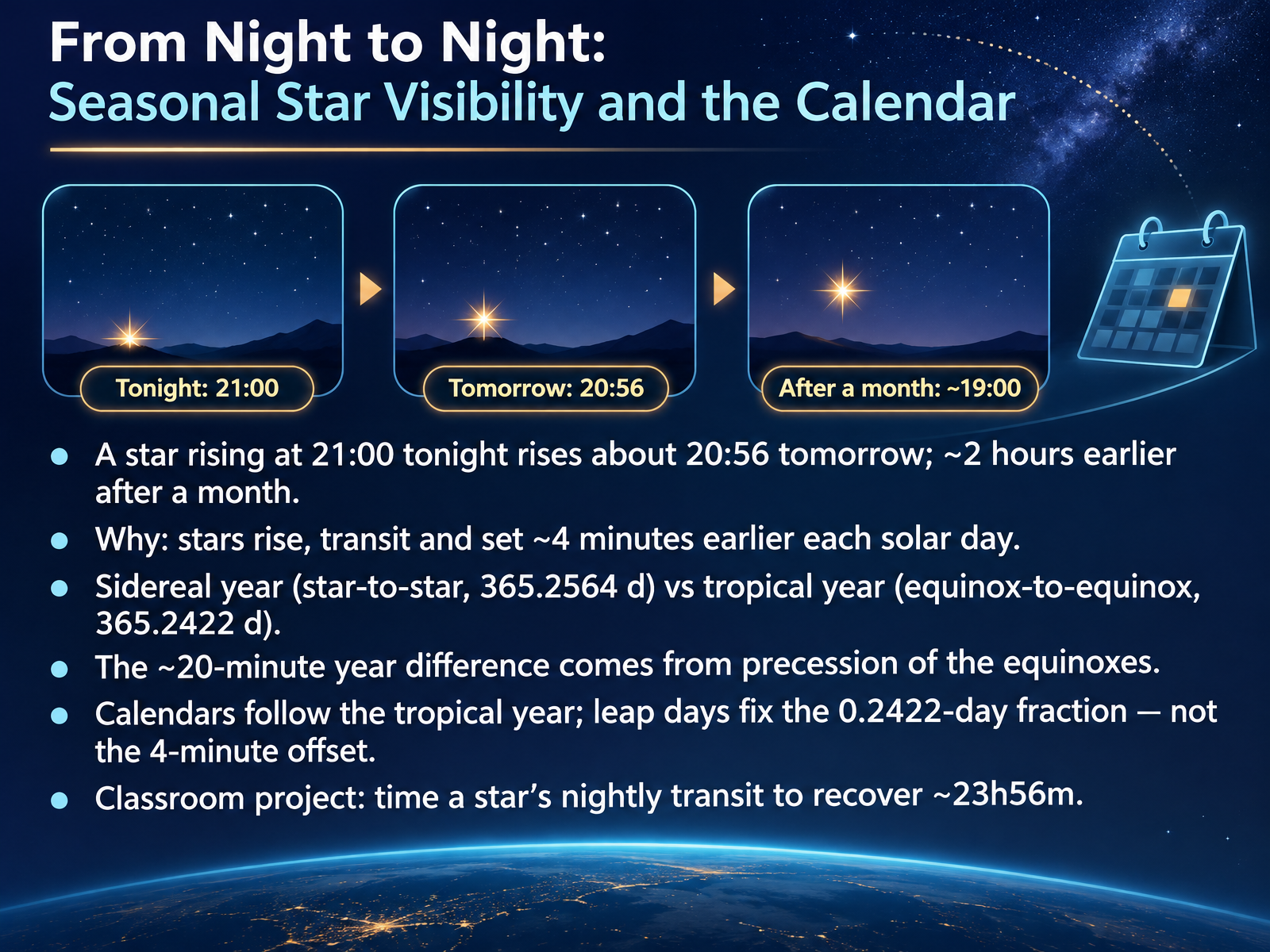
- 06From Night to Night: Seasonal Star Visibility and the CalendarNow let's connect that four minute shift to the seasons. Picture this. A star rises at nine tonight. Tomorrow it rises at about eight fifty six. After a month, roughly two hours earlier. Here's the difference. The stars keep sidereal time, gaining about four minutes each solar day. But Earth's axis slowly wobbles, a motion called precession. That shifts the equinoxes westward, so the star to star year, the sidereal year, lasts three hundred sixty five point two five six four days. The equinox to equinox year, the tropical year, is about twenty minutes shorter. Calendars follow the tropical year. Leap days fix that point two four two two day fraction, not the four minute offset. For a classroom project, time a star's nightly transit and you'll recover twenty three hours fifty six minutes. Next, the solar day is not constant, the equation of time.
 phys.libretexts.orgaa.usno.navy.milaa.usno.navy.mil+22 min
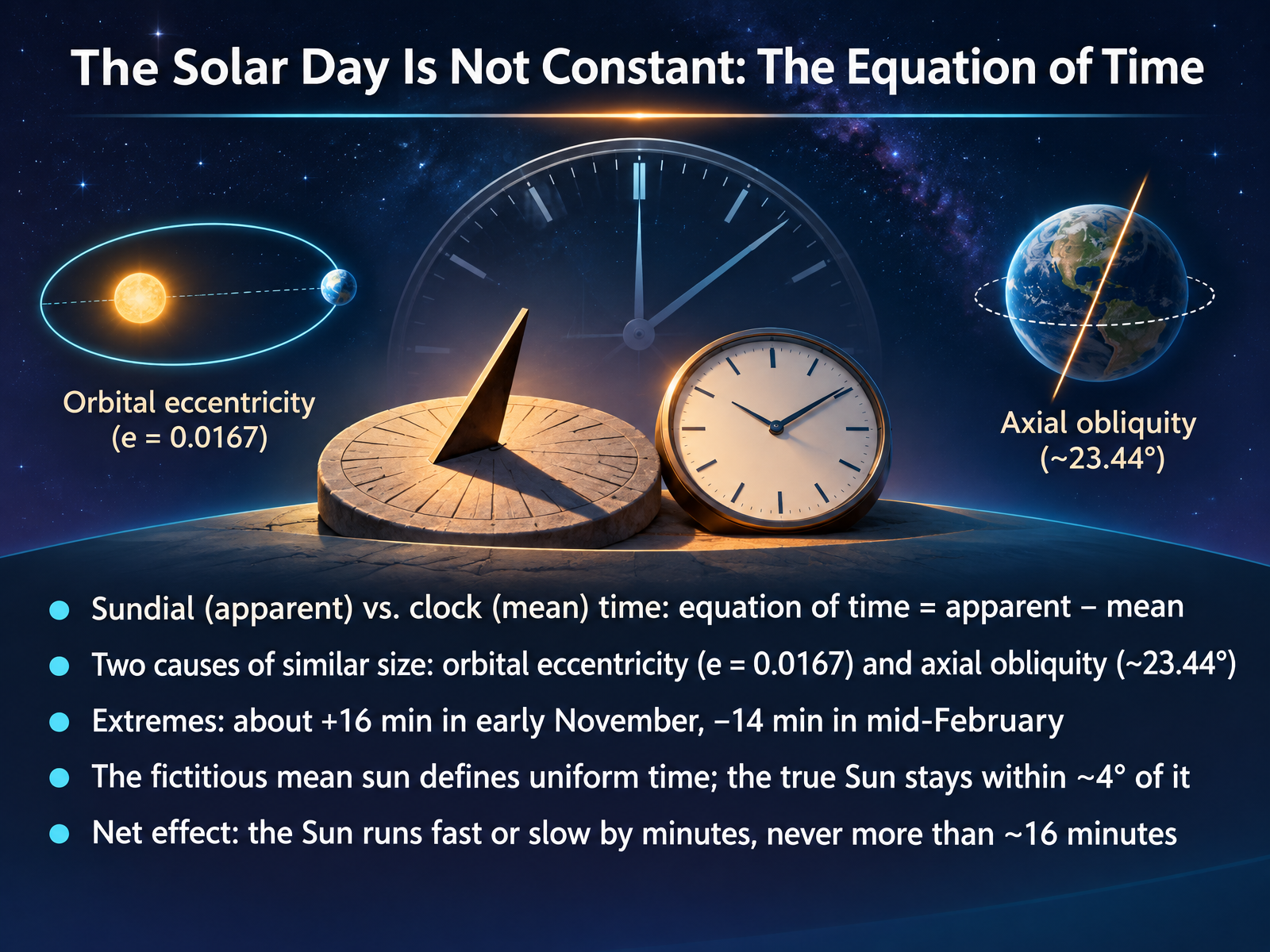
- 07The Solar Day Is Not Constant: The Equation of TimeNow here's a puzzle you can check with your own eyes. A sundial and a clock rarely agree exactly. The gap can reach about sixteen minutes. So what causes it? The equation of time is simply apparent solar time minus mean solar time. Apparent time is what the sundial reads. Mean time is the steady clock, defined by the fictitious mean sun, an imaginary Sun that moves at a constant rate. Picture it this way: the true Sun never strays more than about four degrees from that imaginary point. Two causes work together, and they are similar in size. First, Earth's orbit is slightly elliptical, with an eccentricity of about zero point zero one six seven, so our planet speeds up near perihelion. Second, Earth's axis is tilted about twenty three point four four degrees. The Sun therefore runs fast or slow by a few minutes, never more than roughly sixteen. The extremes are about plus sixteen minutes in early November and minus fourteen minutes in mid-February. Next, we'll put that whole year of wandering noon Suns into a single image. The Analemma: A Year of Noon Suns in One Image.
 aa.usno.navy.milen.wikipedia.organalemma.org+22 min
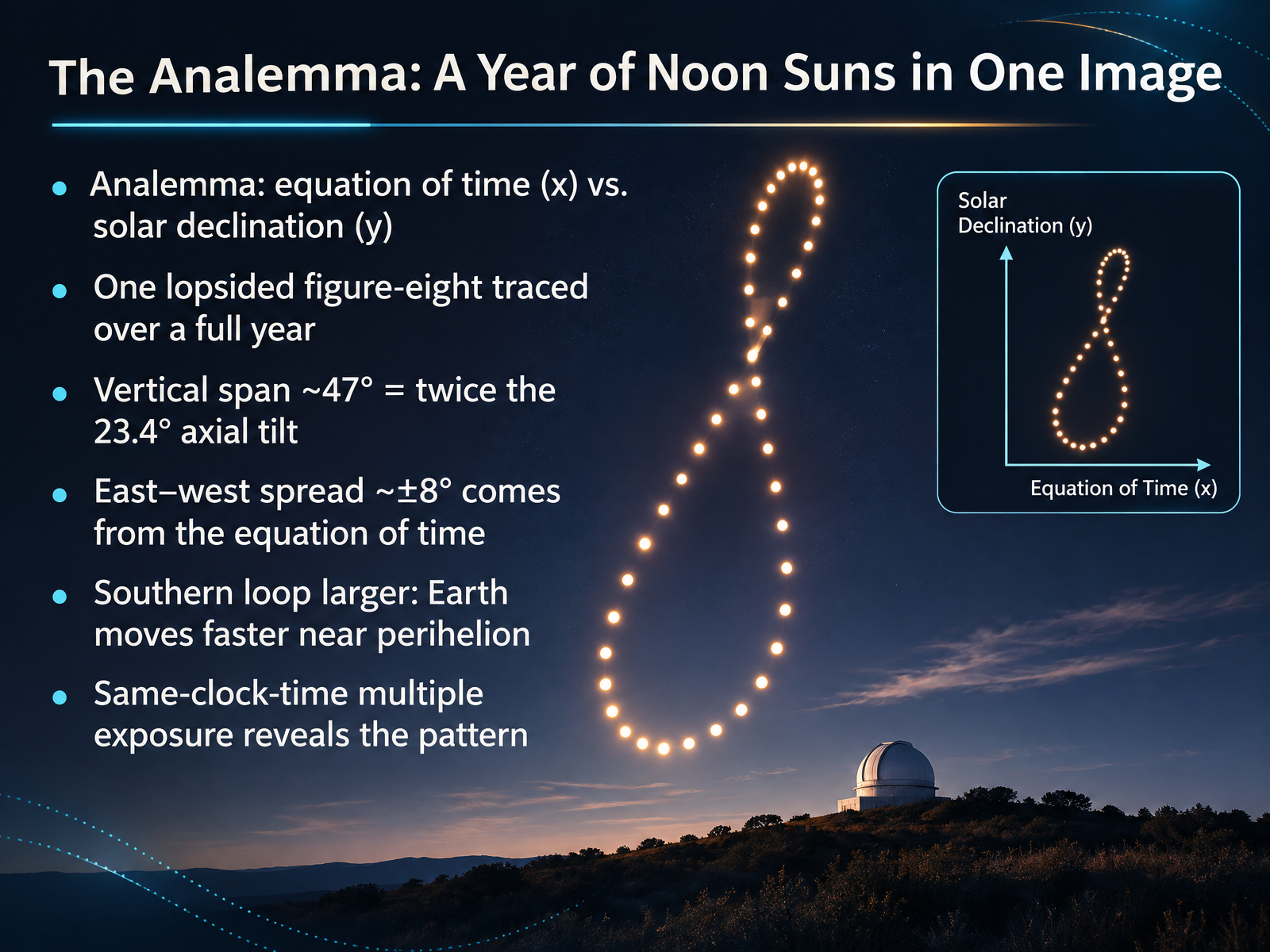
- 08The Analemma: A Year of Noon Suns in One ImageNow picture this. Set a camera in one spot, and photograph the Sun at the same clock time every clear day for a full year. Stack the images, and the Sun does not stay put. It traces one lopsided figure eight. We call that curve the analemma. Two axes make it. Across, left to right, we plot the equation of time, meaning how far the real Sun runs ahead of or behind clock time. Up and down, we plot the Sun's declination, its height above or below the celestial equator. Here's the difference between those axes. The vertical span is about forty seven degrees, twice the twenty three point four degree tilt of Earth's axis. That gives the analemma its height. The east and west spread is only about eight degrees either way, and that comes from the equation of time, which gives the figure eight its shape. Now watch what happens to the loops. The southern loop is larger, because Earth moves faster in its orbit near perihelion in early January. So the same clock time gives you extra drift, and the figure eight becomes lopsided. Next, we follow that tilt much further back in time, with precession, the slow wobble of Earth's axis.
 aa.usno.navy.milen.wikipedia.organalemma.org+22 min
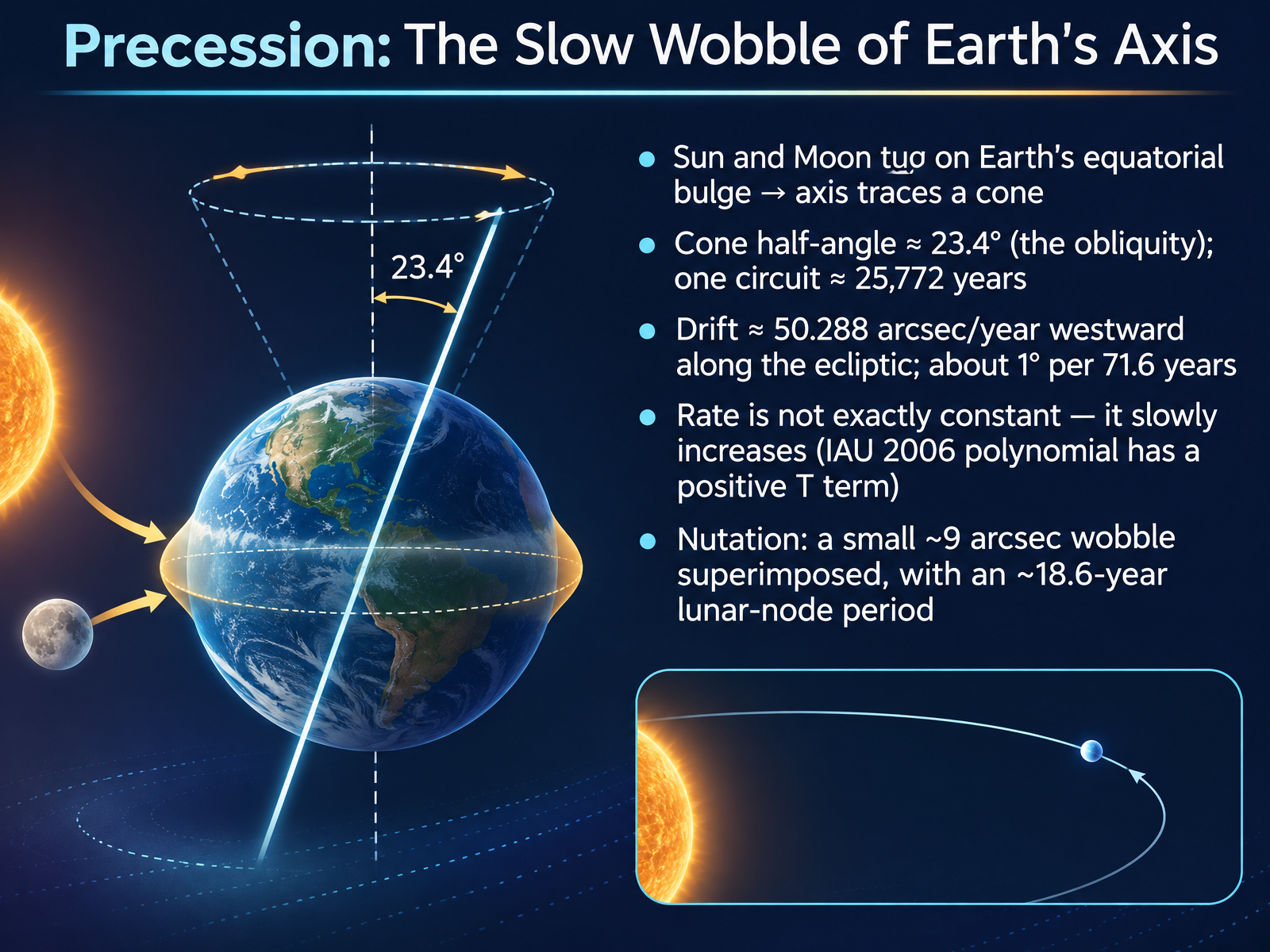
- 09Precession: The Slow Wobble of Earth's AxisNow let's look at the slowest motion in the sky: precession. Picture a spinning top. As it spins, its axis leans and slowly traces a circle. Earth does something very similar. The Sun and the Moon tug gently on Earth's equatorial bulge, and over time our axis traces a cone. Here's the scale of it. The cone's half angle is about twenty three point four degrees, which equals the tilt of our axis. One full circuit takes approximately twenty five thousand seven hundred seventy two years. That works out to a drift of about fifty point three arcseconds per year westward along the ecliptic, or roughly one degree every seventy one point six years. Now, one subtlety. That rate is not exactly constant. It is slowly increasing, which the IAU 2006 polynomial captures with a positive term. And riding on top of this smooth wobble is a tiny extra jiggle called nutation, about nine arcseconds in size, with an eighteen point six year rhythm tied to the lunar nodes. Next, we'll see how this moving grid, precession of the equinoxes, shifts our coordinates.
 en.wikipedia.orgssd.jpl.nasa.gov2 min
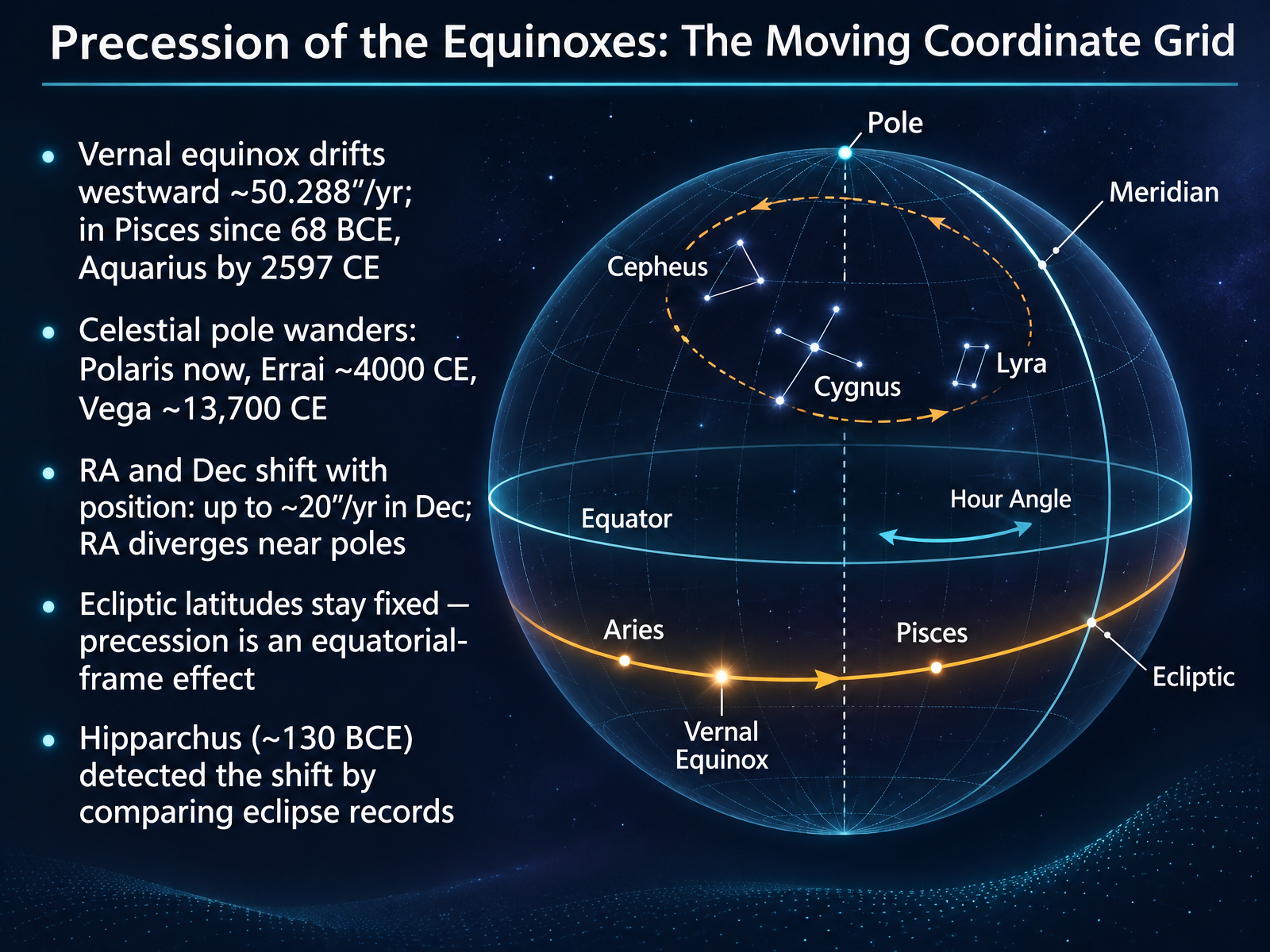
- 10Precession of the Equinoxes: The Moving Coordinate GridNow picture the whole coordinate grid slowly turning beneath the stars. This is the precession of the equinoxes. The vernal equinox drifts westward by about 50.288 arcseconds each year. It has been in Pisces since 68 BCE and will cross into Aquarius in 2597. The celestial pole wanders too. Polaris is our pole star now, Errai takes over around 4000, and Vega around 13,700. Here's the difference for coordinates: right ascension and declination shift with position, up to about 20 arcseconds per year in declination, and right ascension diverges near the poles. Ecliptic latitudes, however, stay fixed. Precession is an equatorial-frame effect. Hipparchus detected the shift around 130 BCE by comparing old eclipse records. Next, we look at epochs, ICRS, and the tropical versus sidereal zodiac.
 en.wikipedia.orgssd.jpl.nasa.goven.wikipedia.org+12 min
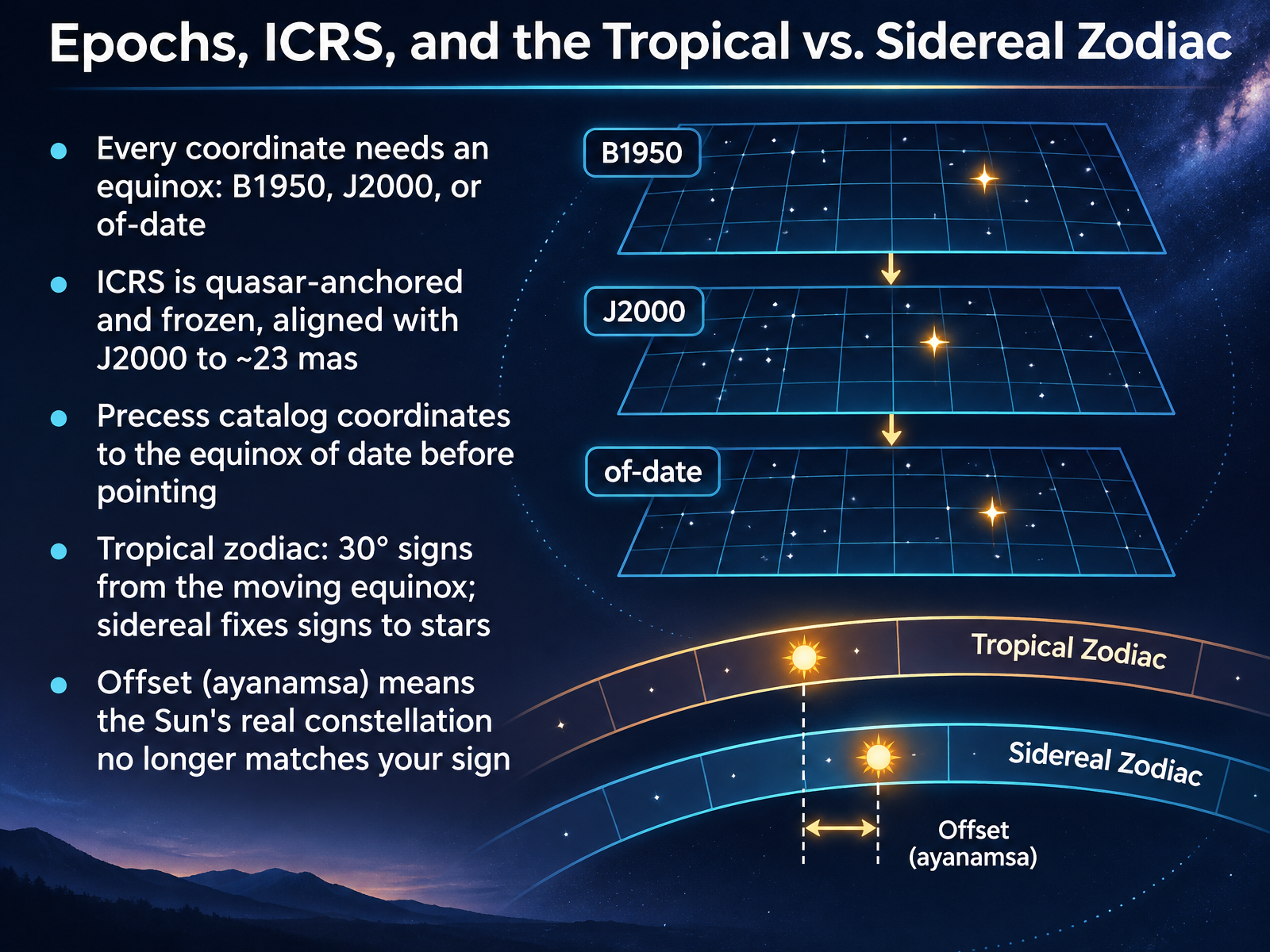
- 11Epochs, ICRS, and the Tropical vs. Sidereal ZodiacNow let's tie precession to the catalogs and calendars you actually use. Every set of coordinates needs a stated equinox, such as B1950, J2000, or the equinox of date. Here's why. Because the celestial equator and equinox keep moving, a position without a date is incomplete. Today's reference frame is the ICRS. It is anchored to distant quasars and permanently frozen, aligned with J2000 to about twenty-three milliarcseconds. That means there will never be a J2050. But before you point a telescope, you still precess catalog coordinates to the equinox of date. Now the zodiac. The tropical zodiac builds thirty-degree signs from the moving equinox. The sidereal zodiac fixes its signs to the stars. That growing gap, called the ayanamsa, is why the Sun's real constellation no longer matches your sign. Next, we'll work through three calculations. Quantitative Walkthrough: Three Worked Calculations.
 en.wikipedia.orgaa.usno.navy.mil2 min
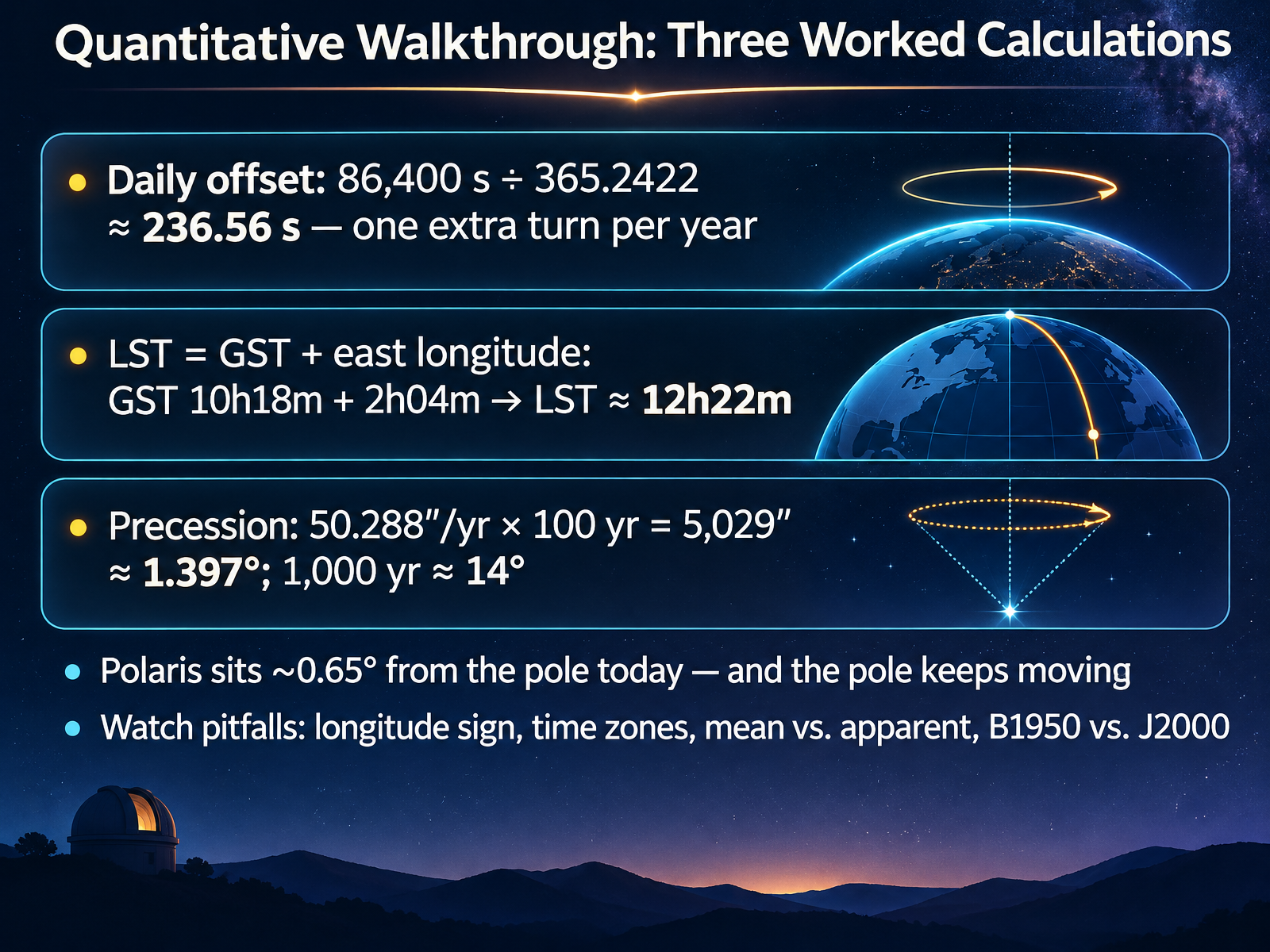
- 12Quantitative Walkthrough: Three Worked CalculationsNow let's put numbers to these ideas with three worked calculations. First, the daily offset. There are 86,400 seconds in a solar day. Divide that by 365.2422 days in the year, and you get approximately 236.56 seconds. That's about three minutes and fifty-seven seconds, the one extra turn the stars make each year. Second, local sidereal time. Here's the rule: local sidereal time equals Greenwich sidereal time plus your east longitude. So if GST is 10 hours 18 minutes, and you are 2 hours 4 minutes east, your LST is approximately 12 hours 22 minutes. Third, precession. The equinox drifts about 50.288 arcseconds per year. Over one hundred years, that's roughly 5,029 arcseconds, or about 1.4 degrees. Over a thousand years, about 14 degrees. This is why Polaris sits about 0.65 degrees from the pole today, and why the pole keeps moving. Watch these pitfalls: longitude sign, time zones, mean versus apparent, and B1950 versus J2000. Next, we'll bring this into the classroom with demonstrations that make the invisible visible.
 en.wikipedia.orgaa.usno.navy.milphys.libretexts.org+22 min
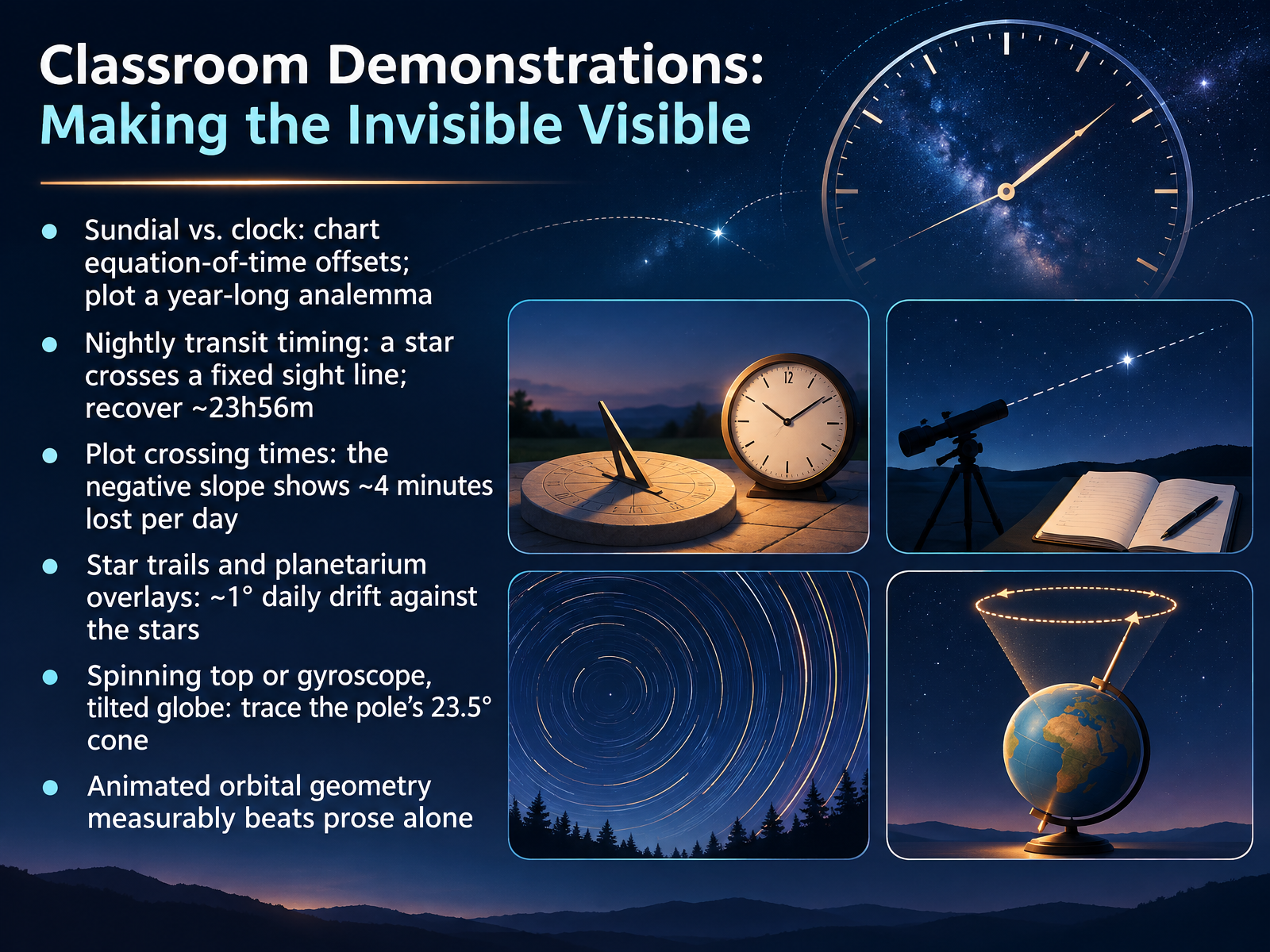
- 13Classroom Demonstrations: Making the Invisible VisibleLet's turn these ideas into demonstrations your students can actually see. First, compare a sundial with a clock, and chart the offsets across the year. That plot is an analemma, a picture of the equation of time. Next, have students time a star crossing a fixed sight line each night. They will recover roughly twenty-three hours and fifty-six minutes. Now here's the difference: plot those crossing times against the date. The negative slope shows about four minutes lost per day. Star trails and planetarium overlays reveal the same drift, roughly one degree per day against the stars. For precession, spin a tilted globe or a gyroscope, and trace the pole's twenty-three point five degree cone. Animated orbital geometry measurably beats prose alone, so let the motion do the teaching. Next, we will address misconceptions, assessment, and wrap up.
 en.wikipedia.orgssd.jpl.nasa.gov2 min
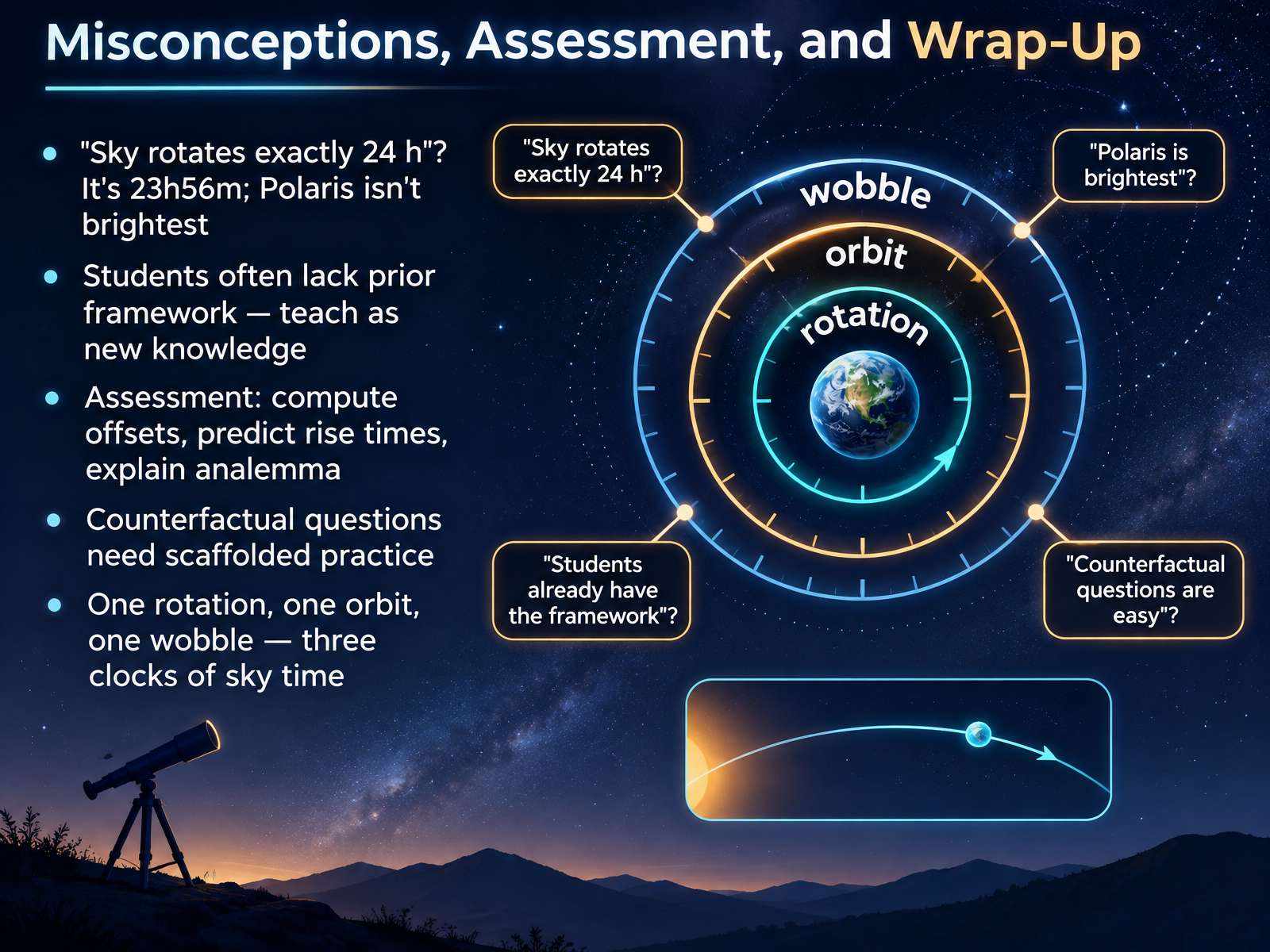
- 14Misconceptions, Assessment, and Wrap-UpLet's clear up a few stubborn myths before we wrap up. Does the sky rotate exactly twenty four hours? No. One full turn takes about twenty three hours and fifty six minutes. And Polaris is not the brightest star. It is simply useful because it sits near the pole. Now, here's something for teachers. Students often have no prior framework here at all, so teach this as brand new knowledge rather than correcting old ideas. For assessment, ask students to compute offsets, predict rise times, and explain the analemma. Counterfactual questions need scaffolded practice. And remember the big picture. One rotation, one orbit, one wobble. Three clocks of sky time. You've done well to follow all three, so keep looking up, and keep asking how the sky keeps time.
 aa.usno.navy.milen.wikipedia.organalemma.org+22 min
Take the deck with you
Download this course as a file — free, no sign-up needed.
- PDF handoutEvery slide page, ready to print or share.15 pages · 4.3 MBDownload
- Narrated PowerPointThe deck that presents itself — every slide carries the digital human's narration video.15 pages · 25.0 MBDownload
- PowerPoint slidesThe full deck as a .pptx — open it in PowerPoint, Keynote, or Google Slides.15 pages · 4.3 MBDownload
Free to use in your own training — please keep the PersonWise credit page at the end.
Have your own deck? Turn it into a course
Sources consulted
Web sources consulted while building this course.
- Astrodynamic Parameters — ssd.jpl.nasa.gov
- Astronomical and Physical Constants — britastro.org
- Sidereal time — en.wikipedia.org
- Sidereal vs. Synodic - Motions of the Sun - NAAP — astro.unl.edu
- https://portal.iho.int/iho-ohi/S32/engView.php?hname=engViewGrid_definition_handler_list&pk0=1253 — portal.iho.int
- 4.3 Keeping Time - Astronomy 2e | OpenStax — openstax.org
- The day that is four minutes short · Astronomy & Celestial Mechanics — astronomy-celestial-mechanics.com
- https://astrolab.awh.durham.ac.uk/solsid.html — astrolab.awh.durham.ac.uk
- Solar vs. Sidereal Day — gb.nrao.edu
- 6.3: Equatorial Coordinates — phys.libretexts.org
- Sidereal Time — aa.usno.navy.mil
- Computing Altitude and Azimuth from Greenwich Apparent Sidereal Time — aa.usno.navy.mil
- HRANG: converts between right ascension and hour angle — doi.org
- https://epgp.inflibnet.ac.in/epgpdata/uploads/epgp_content/S000028PS/P001824/M029036/ET/1523529577Module02Text.pdf — epgp.inflibnet.ac.in
- The Equation of Time — aa.usno.navy.mil
- Equation of time — en.wikipedia.org
- What is an Analemma? — analemma.org
- INCLINATION OF THE ECLIPTIC — cso.caltech.edu
- On ships, trains, and the equation of time - Physics Today — physicstoday.aip.org
- Axial precession — en.wikipedia.org