Begin
13 pages · ~26 min
Email Marketing Examples: Patterns & Pitfalls
This training helps marketers analyze real email marketing examples to recognize effective patterns, strengths, and common pitfalls. It is ideal for professionals seeking to improve campaign design and results.
A digital instructor presents all 13 pages. Hold “Ask” at any point and ask out loud — the answer comes from this course. No sign-up needed.
What you’ll learn
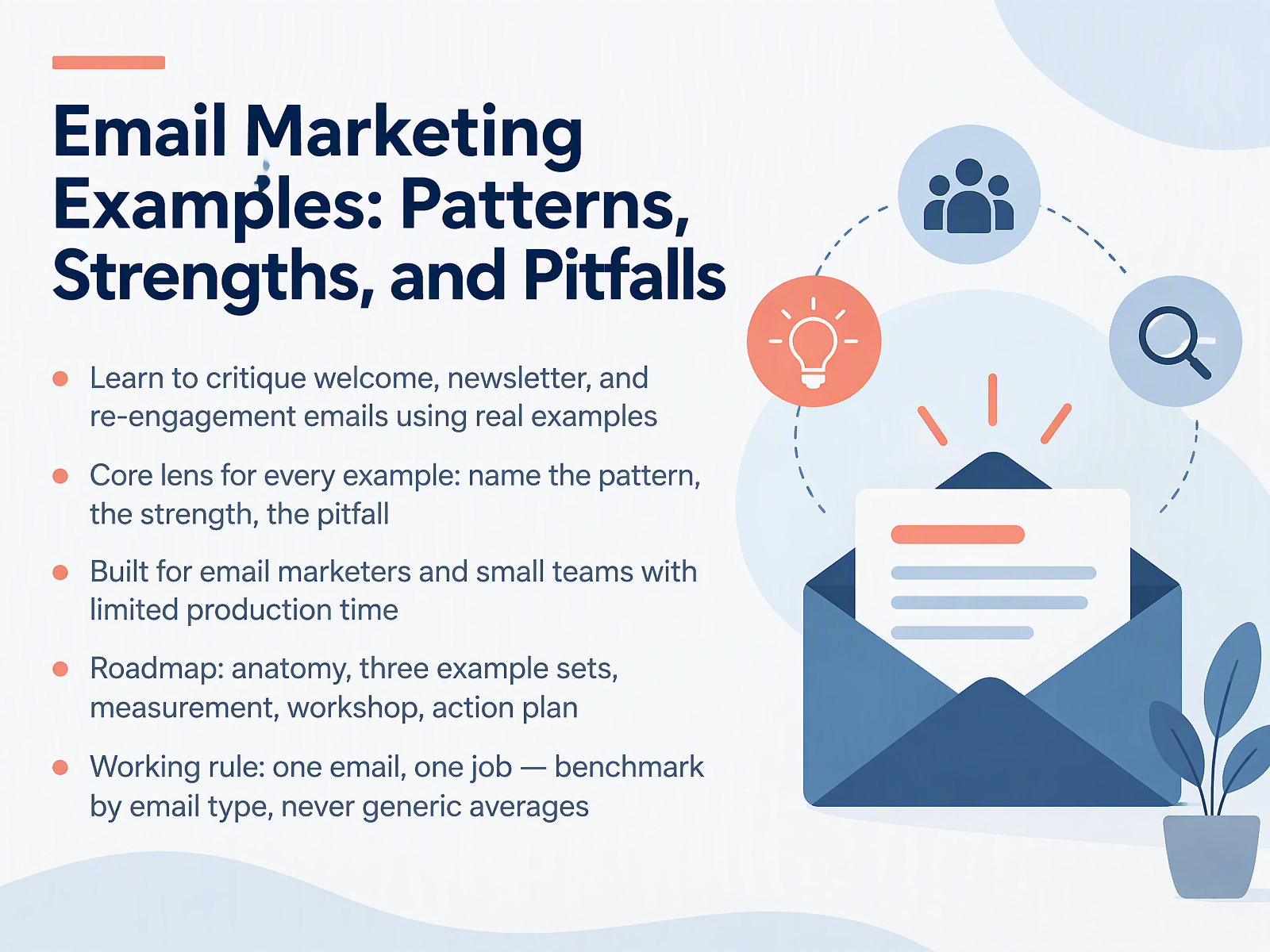
- 01Email Marketing Examples: Patterns, Strengths, and PitfallsWelcome. This course is about critiquing real inbox emails so your team can improve its own sends. We will look at welcome, newsletter, and re-engagement emails, and each time we will name the pattern, the strength, and the pitfall. That lens keeps feedback specific and fair, especially for small teams with limited production time. The roadmap covers email anatomy, three example sets, measurement, a workshop, and an action plan. One working rule for the whole course: one email, one job. And benchmark by email type, never against a generic average. Comparing a welcome email to a newsletter average will mislead you, because those sends do different jobs. So listen for patterns you can apply, not verdicts on brands. Next, we set the baseline with benchmarks for three email types.emailcalculator.comvisionary-marketing.co.ukklaviyo.com+21 min
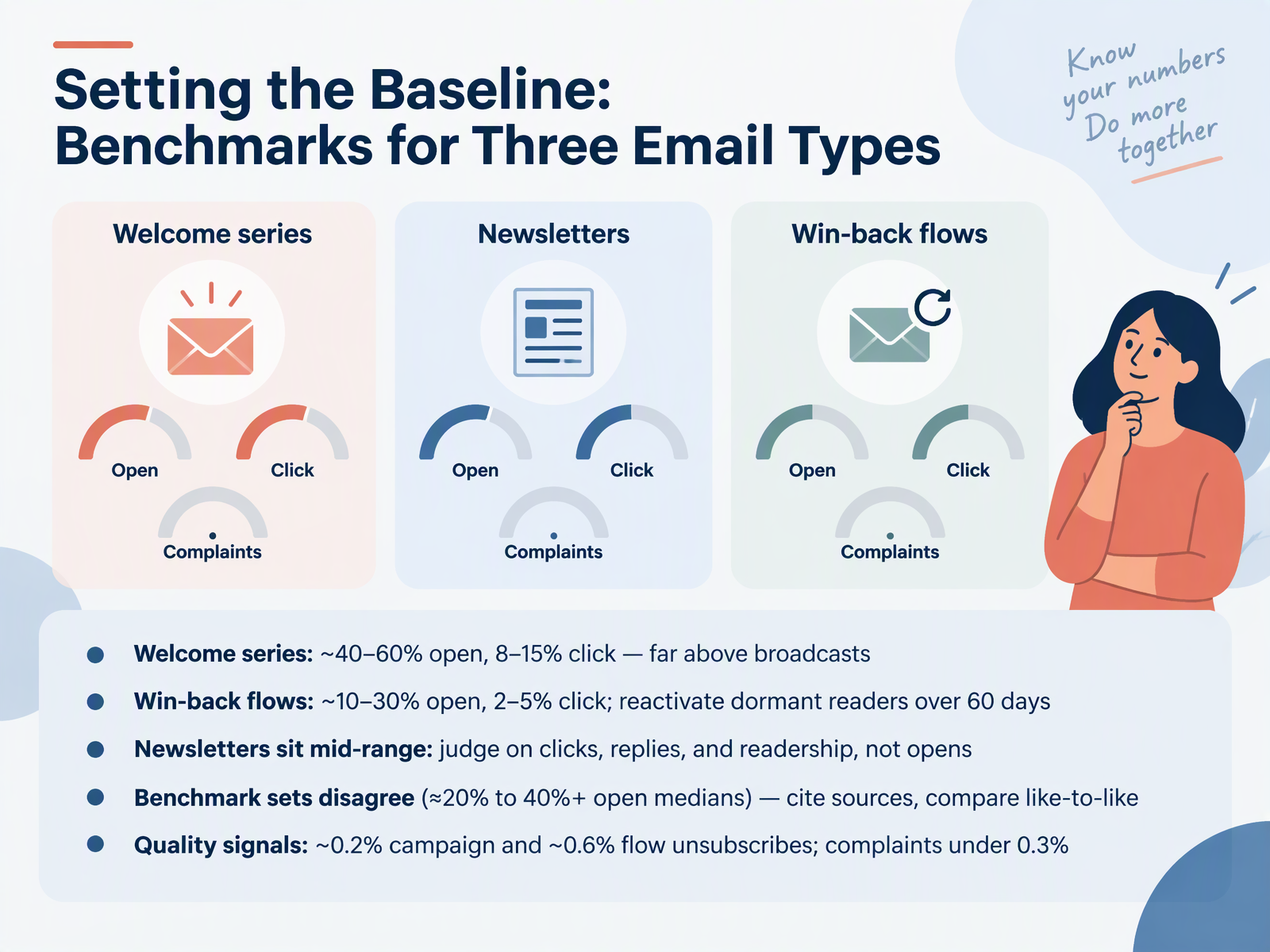
- 02Setting the Baseline: Benchmarks for Three Email TypesBefore we critique any individual email, let's set our baseline. You need a rough sense of what normal looks like, so you can tell a real problem from ordinary variation. Welcome series tend to land around forty to sixty percent opens and eight to fifteen percent clicks, far above a typical broadcast. Win-back flows are quieter, roughly ten to thirty percent opens and two to five percent clicks, and you should judge them on reactivation over about sixty days, not week one. Newsletters sit in the middle, so judge those on clicks, replies, and readership rather than opens. One honest tradeoff, benchmark sets disagree, with open medians ranging from about twenty to over forty percent. Cite your source and compare like to like. On quality, watch unsubscribes near zero point two percent for campaigns and zero point six percent for flows, with complaints under zero point three percent. Takeaway: pick one benchmark source and judge each email type against its own standard. Next, we'll look at how to critique an email with a practical anatomy.
 2 min
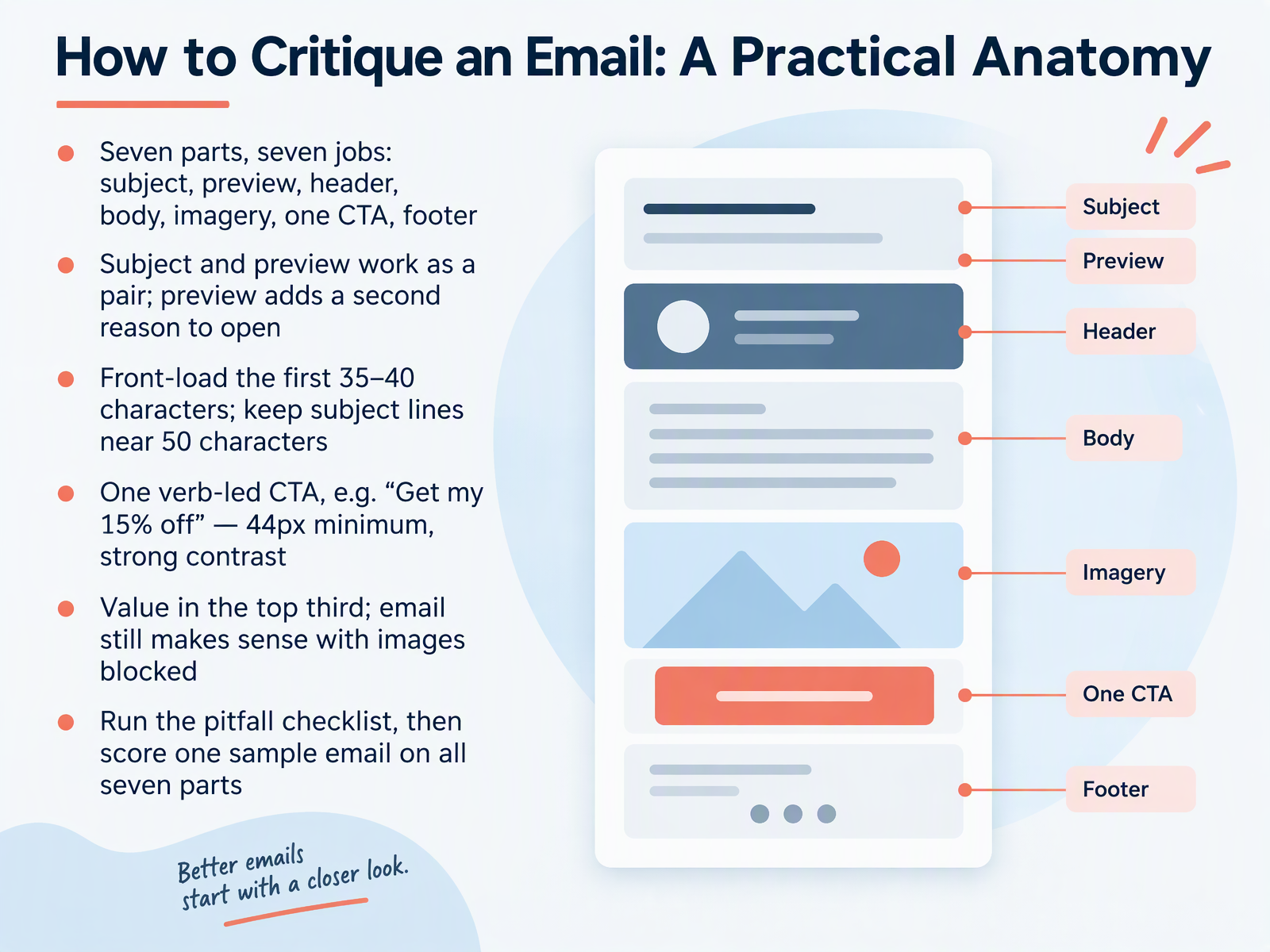
- 03How to Critique an Email: A Practical AnatomyNext, let's give the critique a framework. Seven parts, seven jobs: subject, preview, header, body, imagery, one call to action, and footer. When you review a sample email, check each part against its job, because a strong email is not one clever line. It is seven pieces working together.
The subject and preview work as a pair. Front-load the first thirty-five to forty characters of the subject, keep it near fifty characters, and use the preview to add a second reason to open, not to repeat the subject.
Then look inside. Value should sit in the top third. One verb-led button, like "Get my fifteen percent off," should stand out, with a minimum tap size of forty-four pixels and strong contrast. Block the images for a moment. If the email still makes sense, the copy is carrying its weight.
Run the pitfall checklist, then score one sample email across all seven parts. Your takeaway: critique the whole anatomy, not just the subject line. That habit turns opinions into a shared standard.
Compliance and Deliverability: The Critique Floor.
 litmus.comblog.hubspot.comconstantcontact.com+22 min
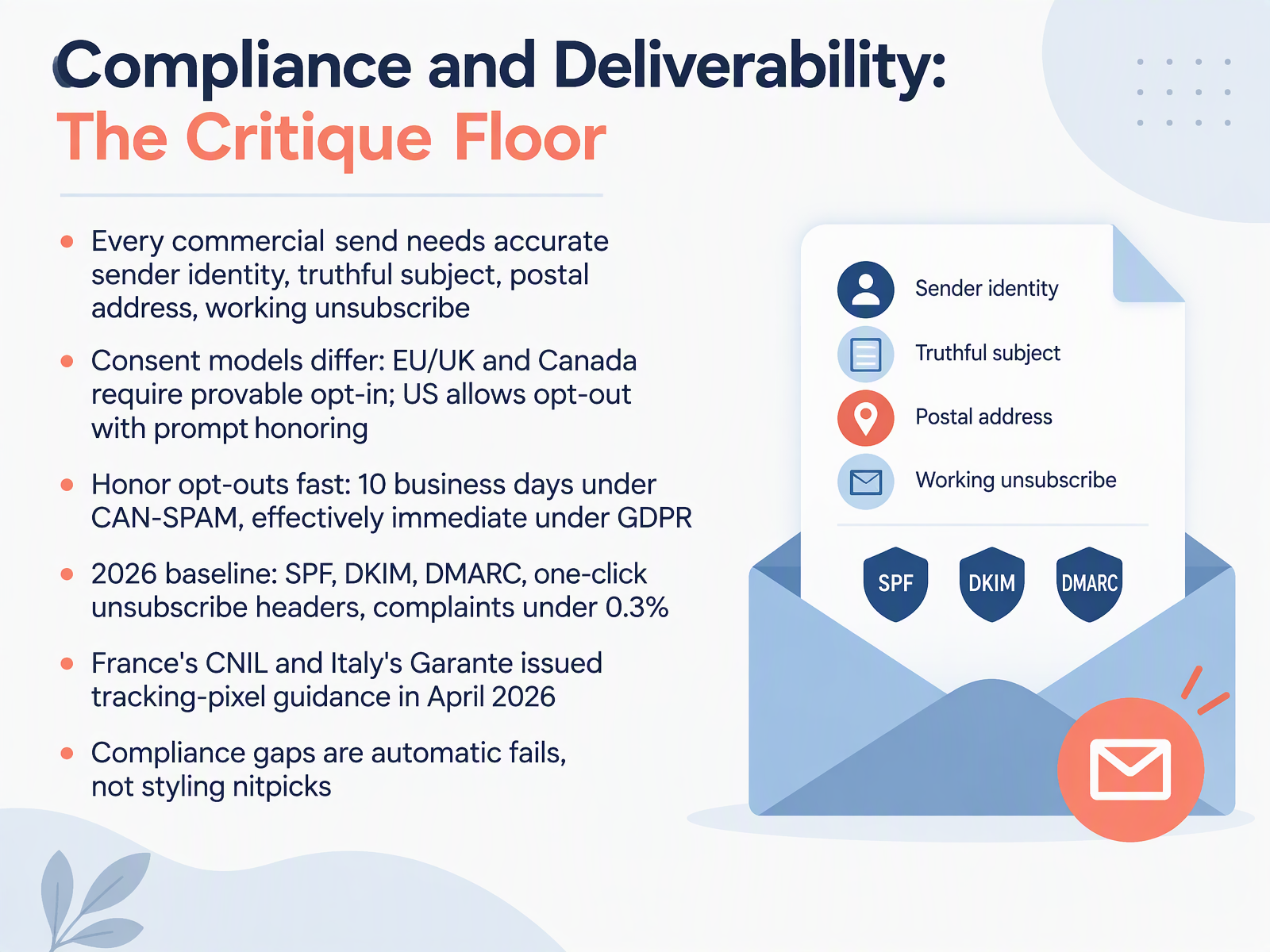
- 04Compliance and Deliverability: The Critique FloorNext, let's set the critique floor. Compliance and deliverability, because gaps here are automatic fails, not styling nitpicks.
Start with the basics every commercial send needs: an accurate sender identity, a truthful subject line, a valid postal address, and a working unsubscribe. Those are not optional extras. Missing one is a defect you fix before anything else.
Consent is where teams get tripped up. In the EU, the UK, and Canada, you need provable opt-in. In the US, opt-out is enough, provided you honor it. And you honor opt-outs fast. Ten business days is the outer limit under CAN-SPAM. Under GDPR, treat it as immediate.
The 2026 sending baseline is practical too. Set up SPF, DKIM, and DMARC. Support one-click unsubscribe headers. Keep complaint rates under zero point three percent. Also note that France's CNIL and Italy's Garante issued tracking-pixel guidance in April 2026, so know where your open tracking sits.
Takeaway: build a compliance checklist into your critique, and run it before you comment on wording. Now let's look at welcome emails, starting with first-impression patterns.
 ftc.govico.org.ukdocumentation.onesignal.com+22 min
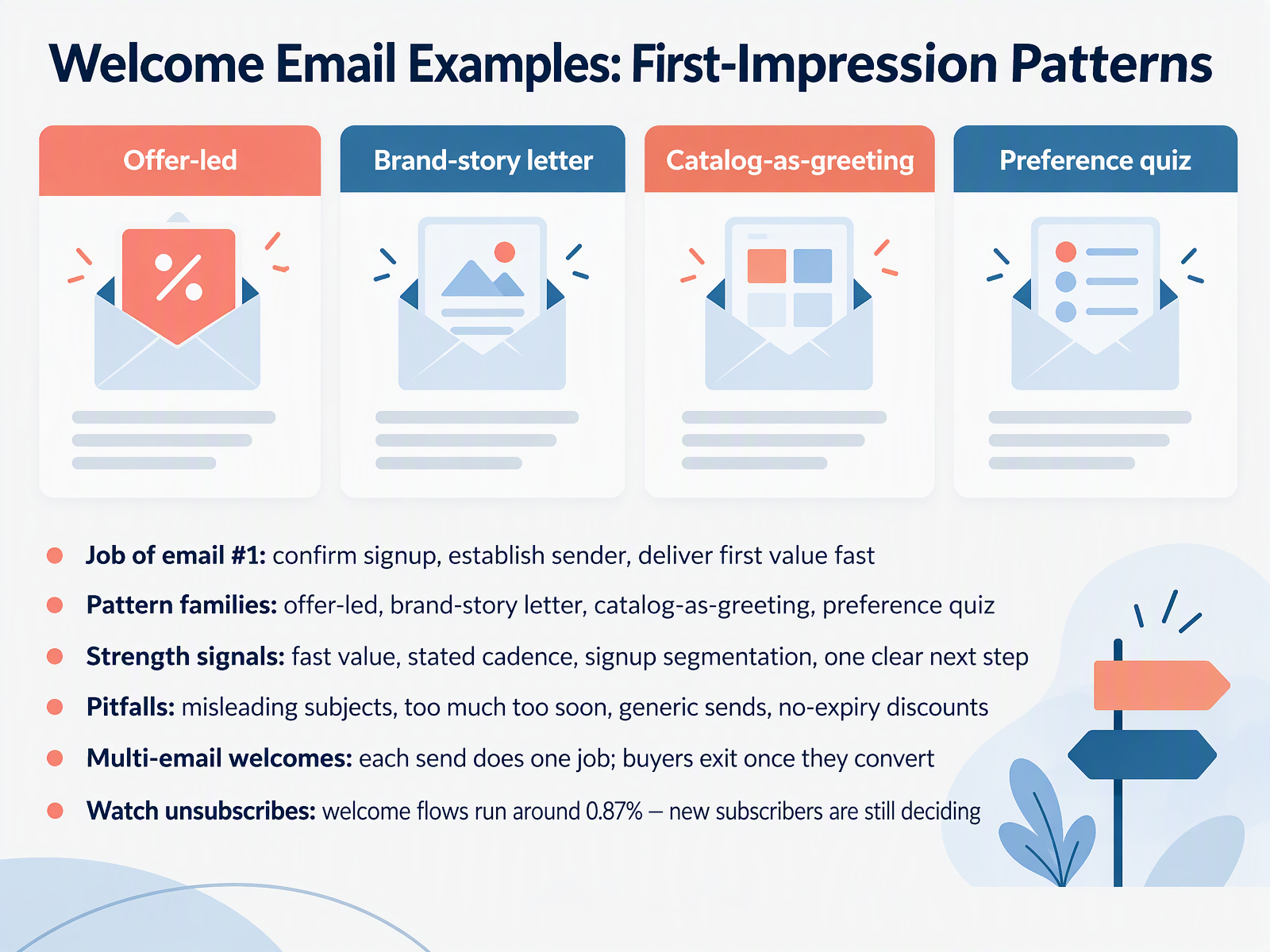
- 05Welcome Email Examples: First-Impression PatternsNow let's look at welcome emails, where first impressions get made. The first email has one job: confirm the signup, establish who the sender is, and deliver value fast. In practice, you'll see a few pattern families. Offer-led, like Bombas with its twenty percent off subject line. A brand-story letter, like ROKA's first send, which has no shop button at all. A catalog-as-greeting, like TUSHY opening the whole store. Or a preference quiz that segments new subscribers from the start. Strength signals are easy to spot: value arrives quickly, the sending cadence is stated, segmentation happens at signup, and there's one clear next step. The pitfalls are just as visible. A subject line that overpromises what's inside. Too much too soon. A generic send that could come from anyone. And discounts with no expiry, which give no reason to act. On multi-email welcomes, each send should do one job. Buyers exit the flow once they convert. And watch unsubscribes, because welcome flows run around zero point eight seven percent. New subscribers are still deciding whether you belong in their inbox. Next, we'll look at newsletters and what makes them consistent.
 mailpotion.commailbakery.comknock.app+22 min
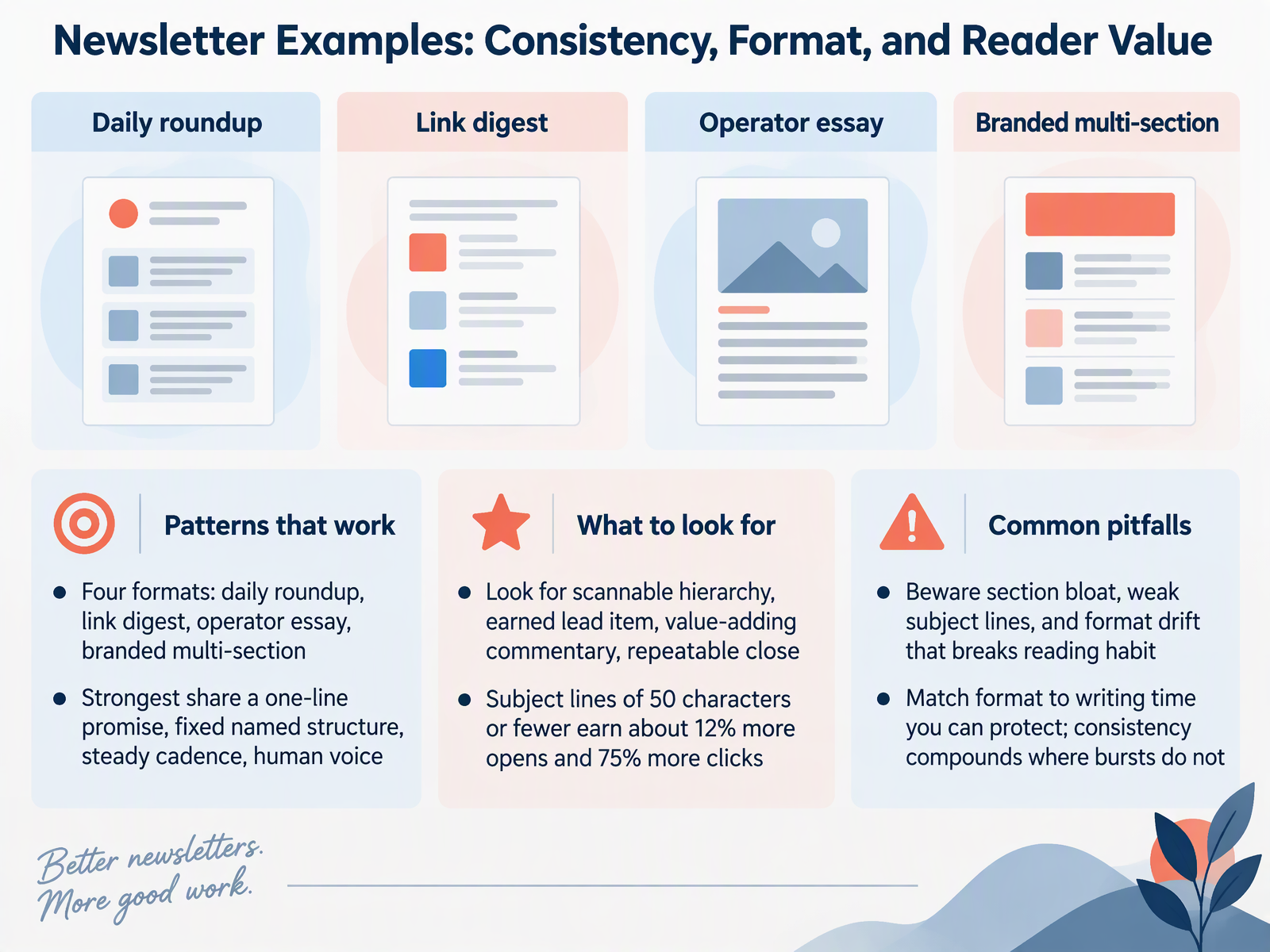
- 06Newsletter Examples: Consistency, Format, and Reader ValueLet's move from welcome emails to newsletters, and look at four common formats. The daily roundup, the link digest, the operator essay, and the branded multi-section send. The strongest examples in any of these formats share the same four habits. A one-line promise. A fixed, named structure. A steady cadence. And a human voice you would recognize without the logo. When you critique a send, check three things. Is the hierarchy scannable? Is the lead item genuinely earned? Does the commentary add value the link alone doesn't? And does the close repeat, so it becomes a ritual? Then watch for the pitfalls. Section bloat, weak subject lines, and format drift that breaks the reading habit. On subject lines, the data is blunt. Fifty characters or fewer earns about twelve percent more opens and seventy-five percent more clicks. So match the format to the writing time you can actually protect. Consistency compounds. Bursts do not. Next, we look at re-engagement examples and winning back quiet subscribers.
 2 min
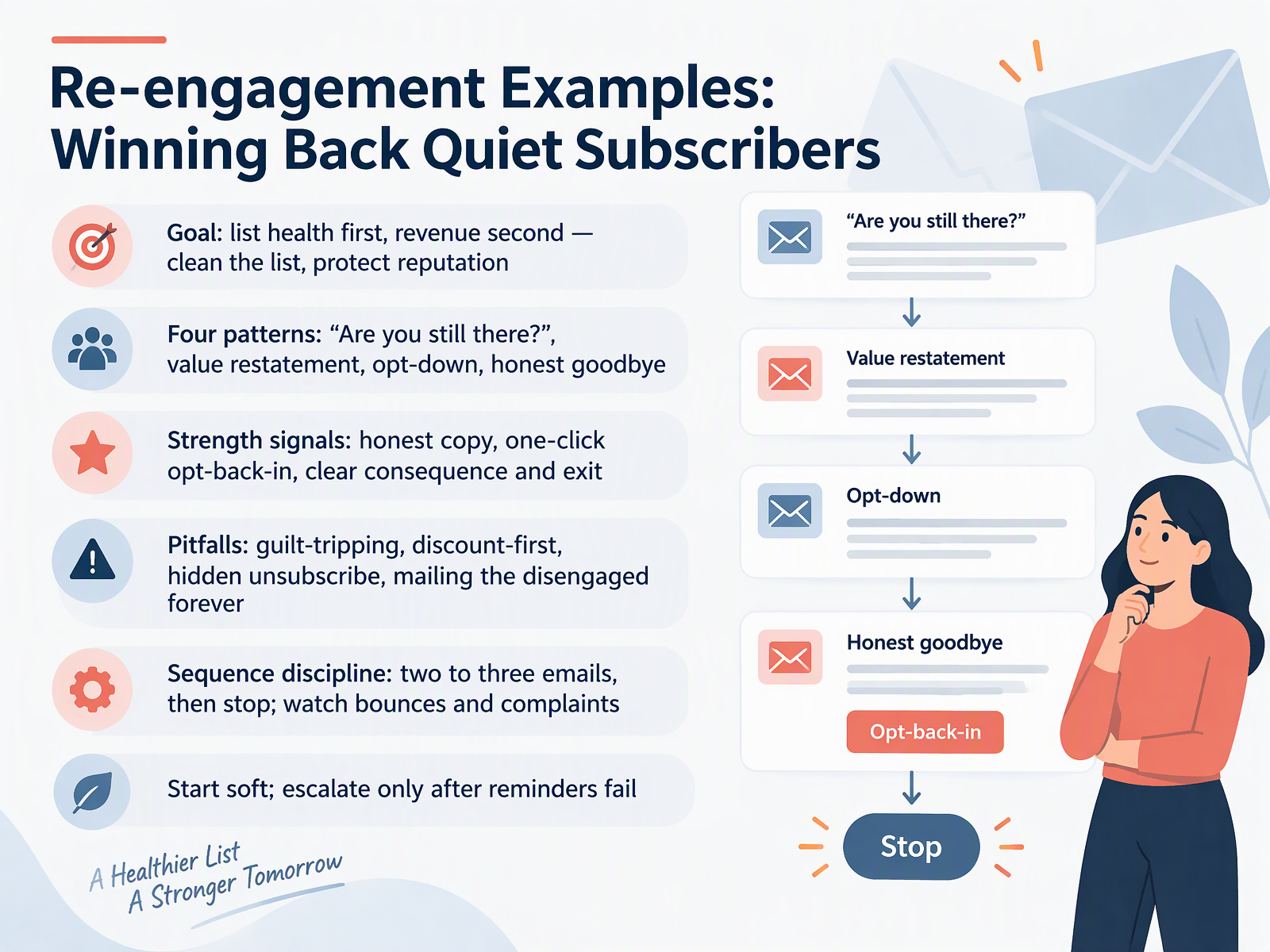
- 07Re-engagement Examples: Winning Back Quiet SubscribersLet's look at re-engagement, where the quiet subscribers live. Set the goal first: list health before revenue. You're cleaning the list and protecting sender reputation, not just chasing one last sale. There are four common patterns to study: the plain "Are you still there?" check-in, a restatement of your value, an opt-down to fewer emails, and the honest goodbye. A strong version has honest copy, a one-click opt-back-in, and a clear consequence if nobody responds. The pitfalls are easy to spot too: guilt-tripping, leading with a discount, hiding the unsubscribe link, and mailing disengaged people forever. On sequencing, stay disciplined. Two to three emails, then stop, and watch bounces and complaints as your early signal. Start soft, and escalate only after the reminders fail. For your own sends, write the exit as clearly as the invitation. Next, we'll look at how to decide when the relationship ends, in Sunset Policy: Deciding When the Relationship Ends.
 2 min
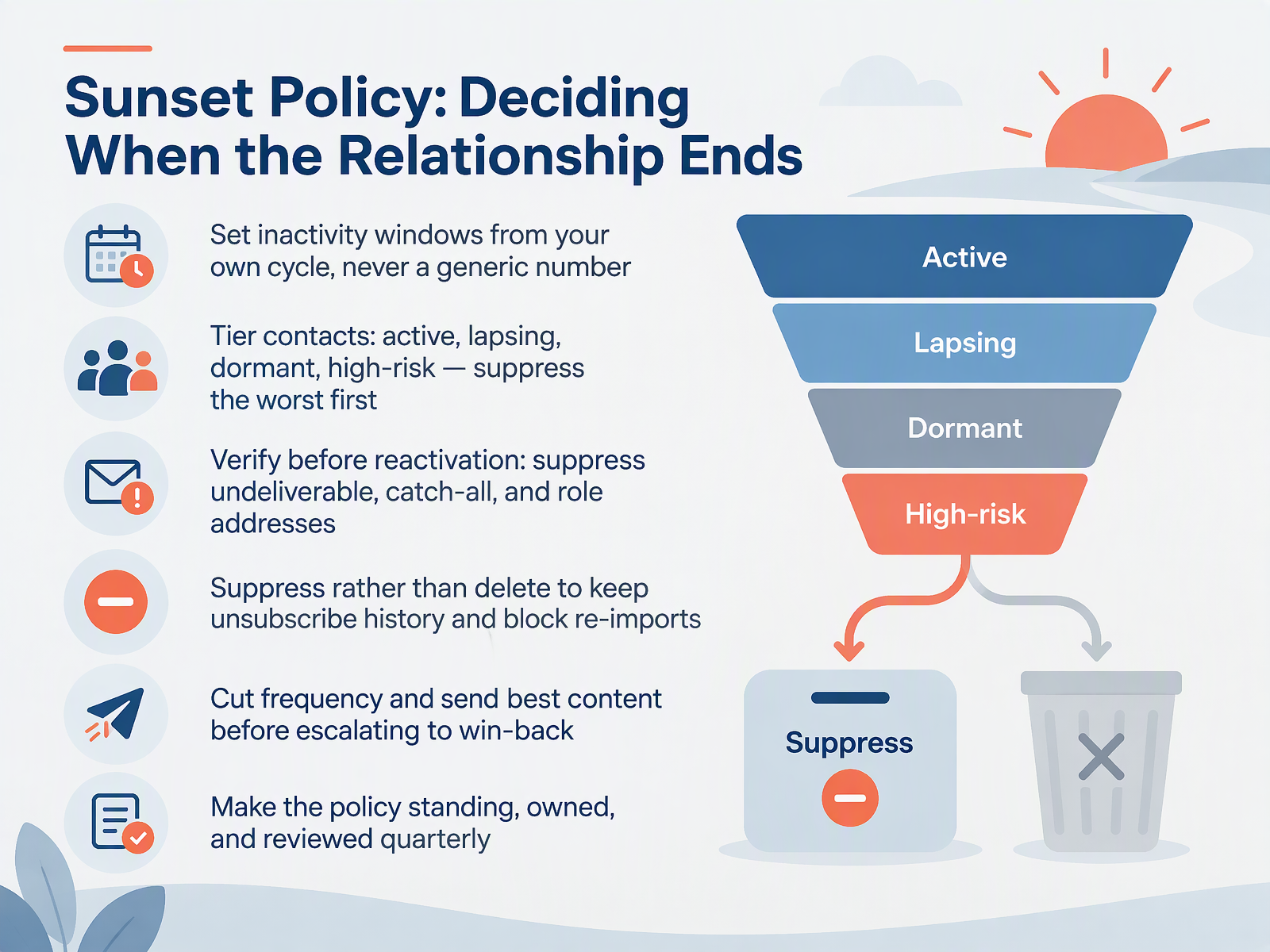
- 08Sunset Policy: Deciding When the Relationship EndsNext, let's talk about when the relationship ends. A sunset policy is a standing rule, not a one-time cleanup. Set your inactivity window from your own sending cycle. If you email daily, silence for ninety days is a strong signal. If you send monthly, that same window is too aggressive. Then tier contacts into active, lapsing, dormant, and high-risk, and suppress the worst first. Before any reactivation campaign, verify the segment and suppress undeliverable, catch-all, and role addresses. Here's the tradeoff: suppress rather than delete. You keep unsubscribe history and block accidental re-imports. And before you escalate to win-back, cut frequency and send only your best content. Make the policy standing, give it an owner, and review it quarterly. Now let's move on to reading the numbers, the metrics that reveal the pattern.
 2 min
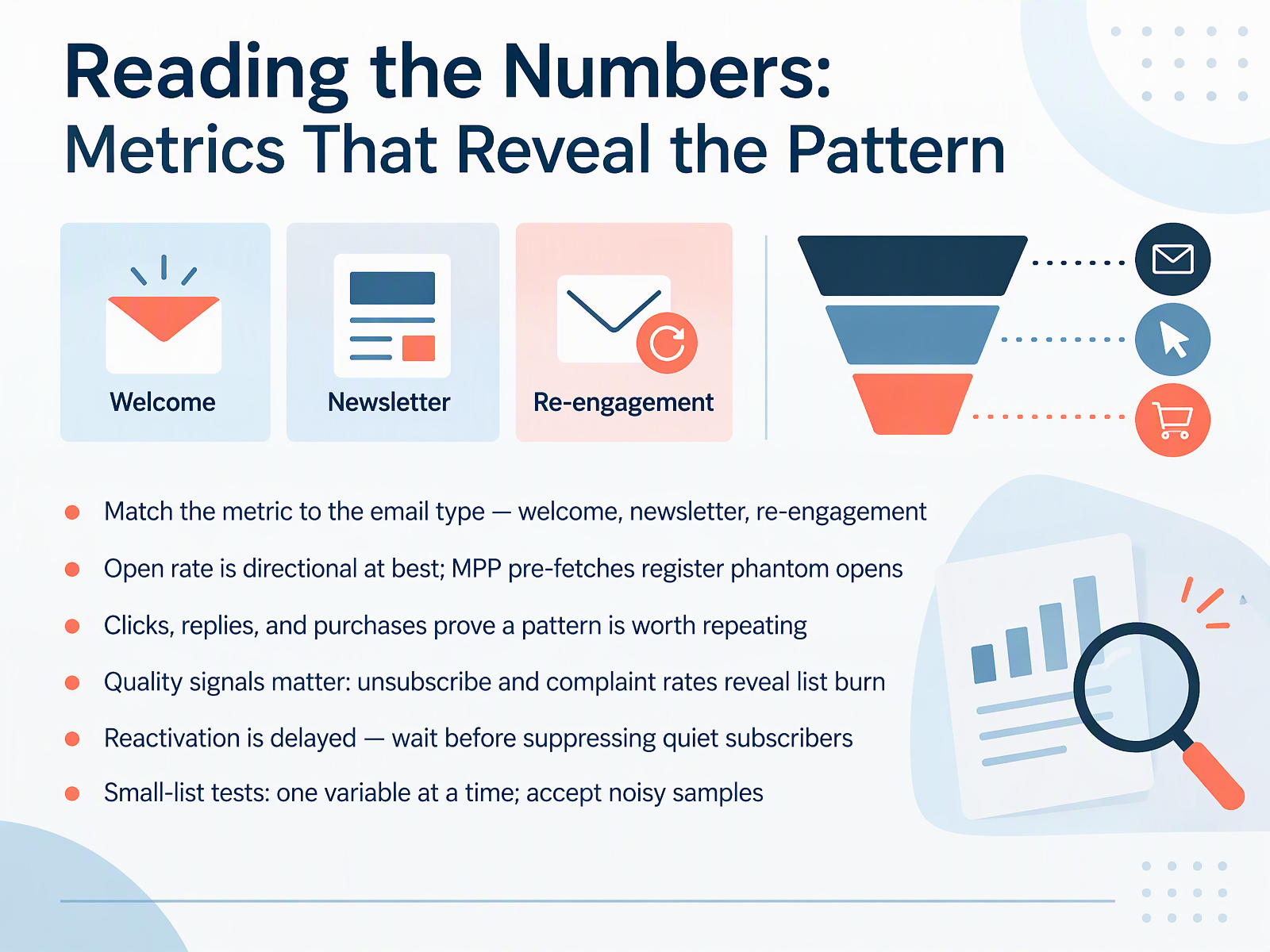
- 09Reading the Numbers: Metrics That Reveal the PatternNow let's talk about which numbers actually reveal the pattern. Start by matching the metric to the email type. A welcome email and a re-engagement email should not share one target. Open rate is directional at best, because Apple's mail privacy protection pre-fetches messages and registers opens nobody made. One large benchmark put the honest open rate near twenty one percent and the inflated figure near thirty four. That gap is why you lean on clicks and replies and purchases to prove a pattern is worth repeating. Watch quality signals too. Unsubscribe and complaint rates reveal list burn, and even small complaint counts can hurt delivery. And remember that reactivation is delayed, so wait before you suppress quiet subscribers. On small lists, test one variable at a time and accept that the sample is noisy. So treat opens as a hint, clicks and quality signals as evidence, then next we'll put these habits to work in the critique workshop. Critique Workshop: Compare, Score, and Improve.
 omnisend.com2 min
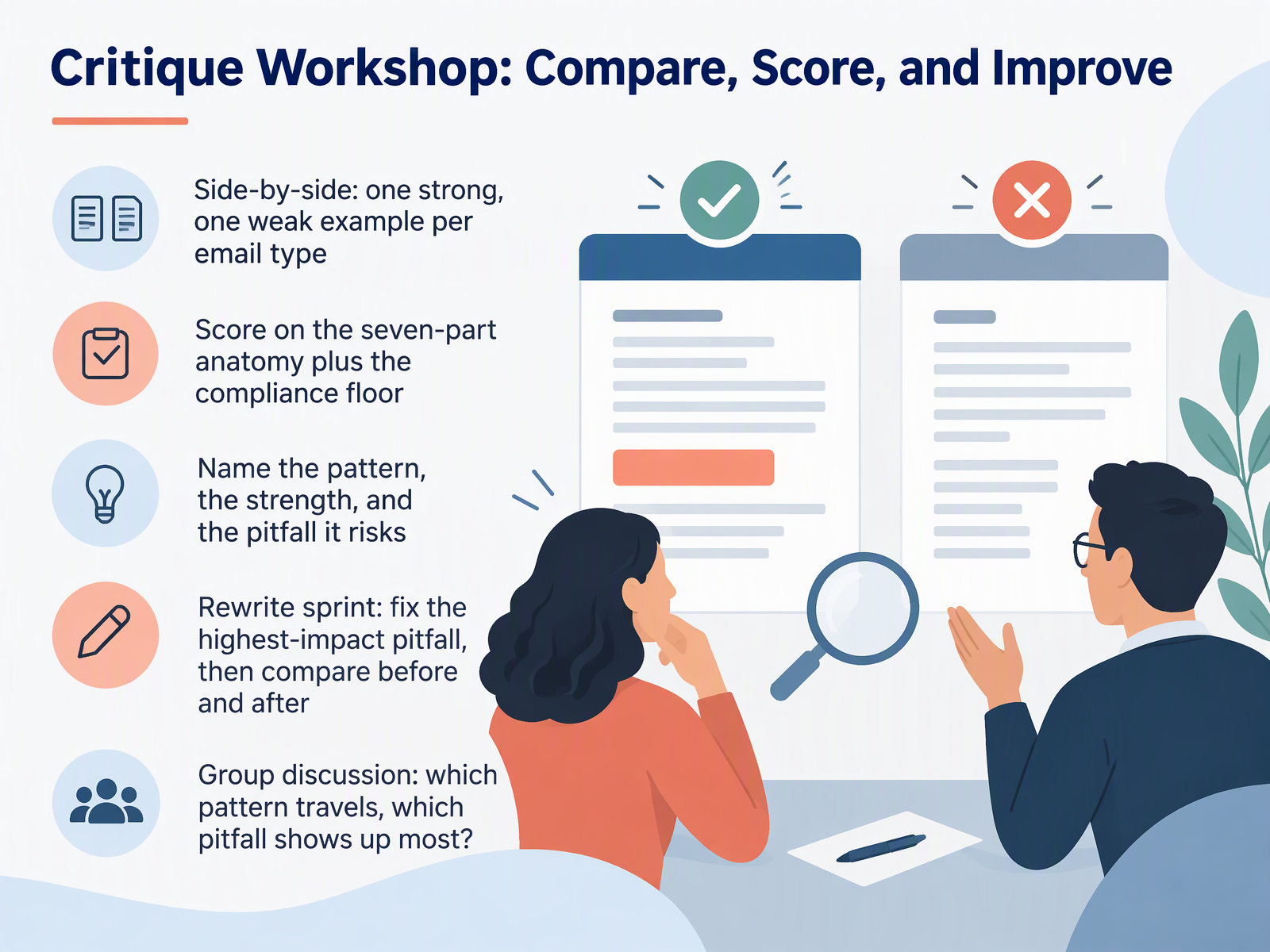
- 10Critique Workshop: Compare, Score, and ImproveNow let's put the critique into practice. For this workshop, you compare a strong and a weak example side by side for each email type: welcome, newsletter, and re-engagement. Score both against the seven-part anatomy and the compliance floor. Then name the pattern, the strength, and the pitfall it risks. For instance, a welcome email that promises twenty percent off but never shows the code is a strong pattern with a real pitfall: subscribers may not trust the offer. Next comes a rewrite sprint. Fix the highest-impact pitfall first, then compare before and after. For a re-engagement send, that might mean replacing a vague 'we miss you' with one clear next step and an easy way out. Close with a group discussion: which pattern travels across all three email types, and which pitfall shows up most in your own inbox? Write those answers down. They become your checks for the next round. Let's move on to the pitfall clinic.
 mailpotion.commailbakery.comknock.app+21 min
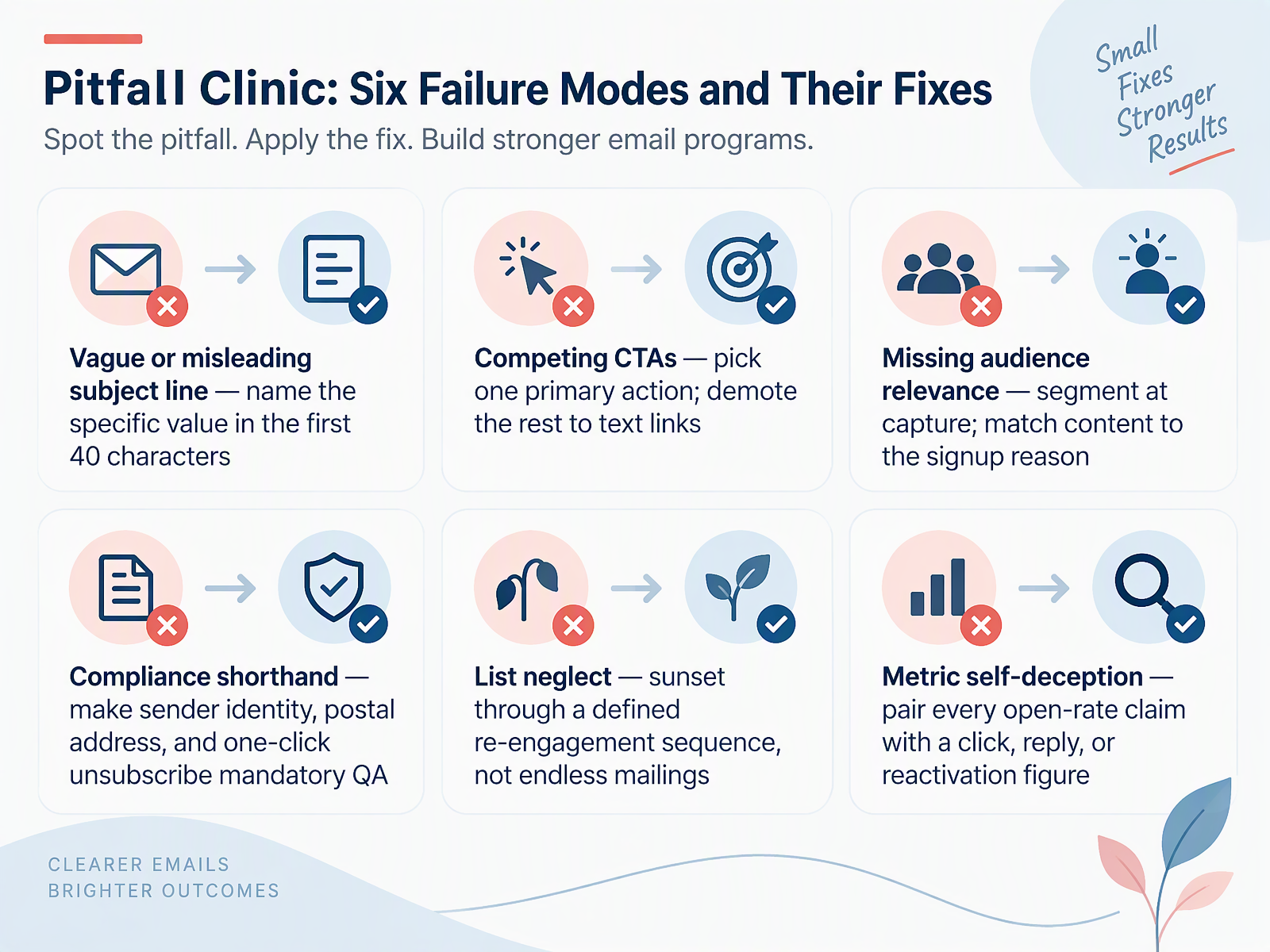
- 11Pitfall Clinic: Six Failure Modes and Their FixesNow let's run through a quick pitfall clinic. Six failure modes, and the fix for each. First, vague subject lines. Name the specific value in the first forty characters, because mobile cuts the rest. Next, competing calls to action. Pick one primary action, and demote the rest to text links. Third, missing relevance. Segment at capture, then match content to why someone signed up. Fourth, compliance shorthand. Make sender identity, postal address, and one click unsubscribe a mandatory quality check before every send. Fifth, list neglect. Sunset quiet subscribers through a defined re-engagement sequence, not endless mailings. And sixth, metric self-deception. Pair every open-rate claim with a click, reply, or reactivation figure. Fix these six and your sends get clearer, safer, and easier to judge honestly. Bringing It Back to Your Team: One Pattern, One Pitfall, One Metric.
 litmus.comblog.hubspot.comconstantcontact.com+22 min
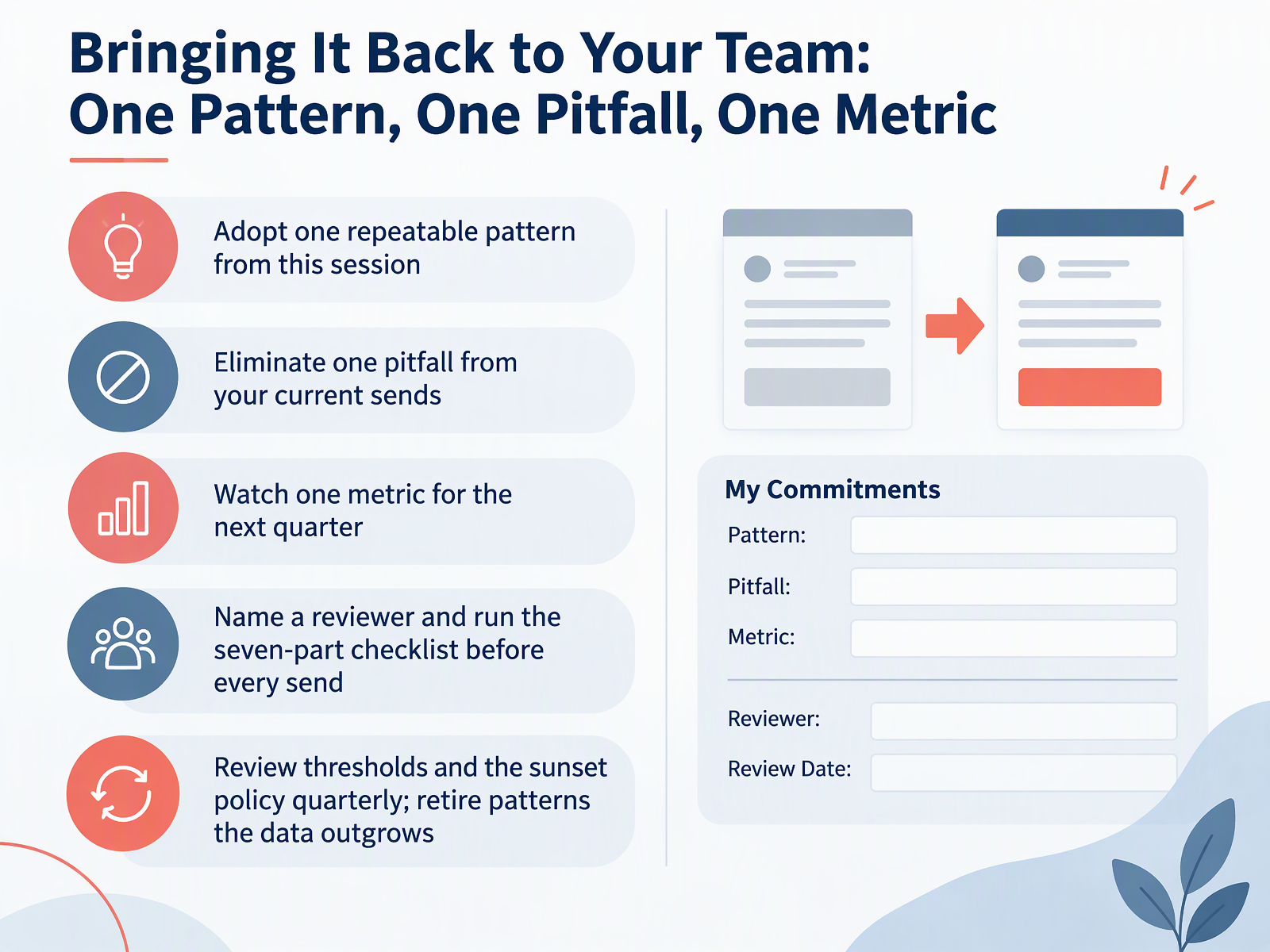
- 12Bringing It Back to Your Team: One Pattern, One Pitfall, One MetricSo let's bring this back to your team. Pick one repeatable pattern from this session and write it into your workflow. Then eliminate one pitfall from your current sends, even if it is small, like removing a vague subject line or fixing a messy footer. Next, choose one metric to watch for the next quarter. Be honest about which number actually tells you something, whether that is click rate on your welcome email, complaints on win-backs, or how many people stay subscribed after a re-engagement series. Name a reviewer who runs the seven-part checklist before every send. That single habit prevents most inbox problems. One tradeoff to name: a checklist slows sends down slightly, and that is the point. Finally, review your thresholds and sunset policy quarterly, and retire patterns the data outgrows. A daily sender needs shorter inactivity windows than a monthly newsletter, so revisit the numbers as your cadence changes. Keep the rule standing rather than treating it as a one-time cleanup. Now let's turn to the review and self-check, using the critique framework recap.
 2 min
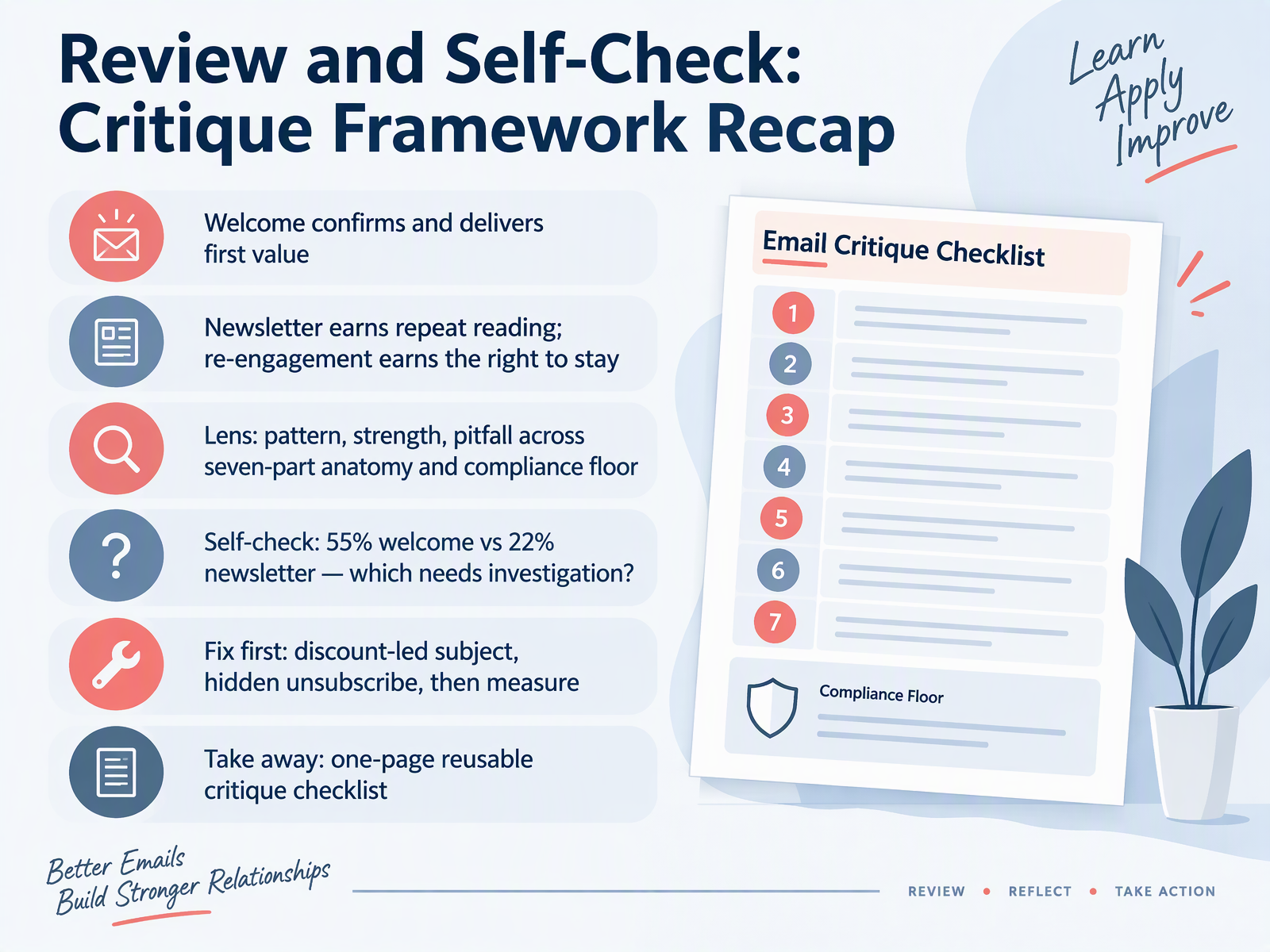
- 13Review and Self-Check: Critique Framework RecapLet's pull the whole framework into one page you can reuse. A welcome email has one job: confirm the signup and deliver first value, fast. The newsletter earns repeat reading, send after send. Re-engagement earns the right to stay on the list, and honestly, sometimes the right answer is to let people go. Our lens stays the same across all three: name the pattern, name one strength or pitfall, and check it against the seven-part anatomy and the compliance floor. Here's the self-check that matters. If your welcome opens at fifty-five percent and your newsletter at twenty-two percent, which needs investigation? The newsletter. Welcome is expected to land high, so look at the newsletter first. Then fix in order: the discount-led subject line, the hidden unsubscribe link, and only after that, re-measure. Thanks for working through this with me. You now have a critique habit you can run on any send. Build the one-page checklist, share it with your team, and go review your next email with confidence.
 emailcalculator.comvisionary-marketing.co.ukklaviyo.com+22 min
Take the deck with you
Download this course as a file — free, no sign-up needed.
- PDF handoutEvery slide page, ready to print or share.14 pages · 3.0 MBDownload
- Narrated PowerPointThe deck that presents itself — every slide carries the digital human's narration video.14 pages · 12.2 MBDownload
- PowerPoint slidesThe full deck as a .pptx — open it in PowerPoint, Keynote, or Google Slides.14 pages · 2.9 MBDownload
Free to use in your own training — please keep the PersonWise credit page at the end.
Have your own deck? Turn it into a course
Sources consulted
Web sources consulted while building this course.
- Email Marketing Benchmarks — Rates by Industry & Campaign Type | Email Calculator — emailcalculator.com
- Email Marketing Benchmarks by Industry 2026: 32M Sends Across 38 Sectors — visionary-marketing.co.uk
- Email marketing benchmarks 2026: open rates, click ... — klaviyo.com
- Email Marketing Benchmarks for Ecommerce: Flow-Level Data That Actually Matters in 2026 — darkroomagency.com
- Email marketing benchmarks: What good looks like in 2026 — omnisend.com
- The Anatomy of a Good Email - Litmus — litmus.com
- Newsletter Marketing: How to Create an Email Newsletter People Actually Read — blog.hubspot.com
- How to Write a Newsletter Email | Constant Contact — constantcontact.com
- Email Content: Types, Examples & Best Practices (2026) — sender.net
- Email Copywriting Guide | EmailCloud | EmailCloud — emailcloud.com
- CAN-SPAM Act: A Compliance Guide for Business | Federal Trade Commission — ftc.gov
- Electronic mail marketing | ICO — ico.org.uk
- Email regulatory compliance - OneSignal — documentation.onesignal.com
- Guidance on direct marketing using electronic mail | ICO — ico.org.uk
- Navigating Email Compliance: A Marketer's Guide | Mailchimp — mailchimp.com
- Welcome Email #1 at Five DTC Brands, Compared | Mailpotion — mailpotion.com
- 150+ Welcome Email Examples to Inspire Your First Impression — mailbakery.com
- 16 examples of effective SaaS welcome emails in 2026 — knock.app
- 7 of the Best Welcome Emails We’ve Seen (And Why They Work) — drip.com
- The Best 1840 Welcome Email Examples (2026) — emaillove.com