Why World History Matters
Begin
14 pages · ~28 min
Why World History Matters
This training explains why world history matters, helping learners understand its relevance to global perspectives and informed citizenship.
What you’ll learn
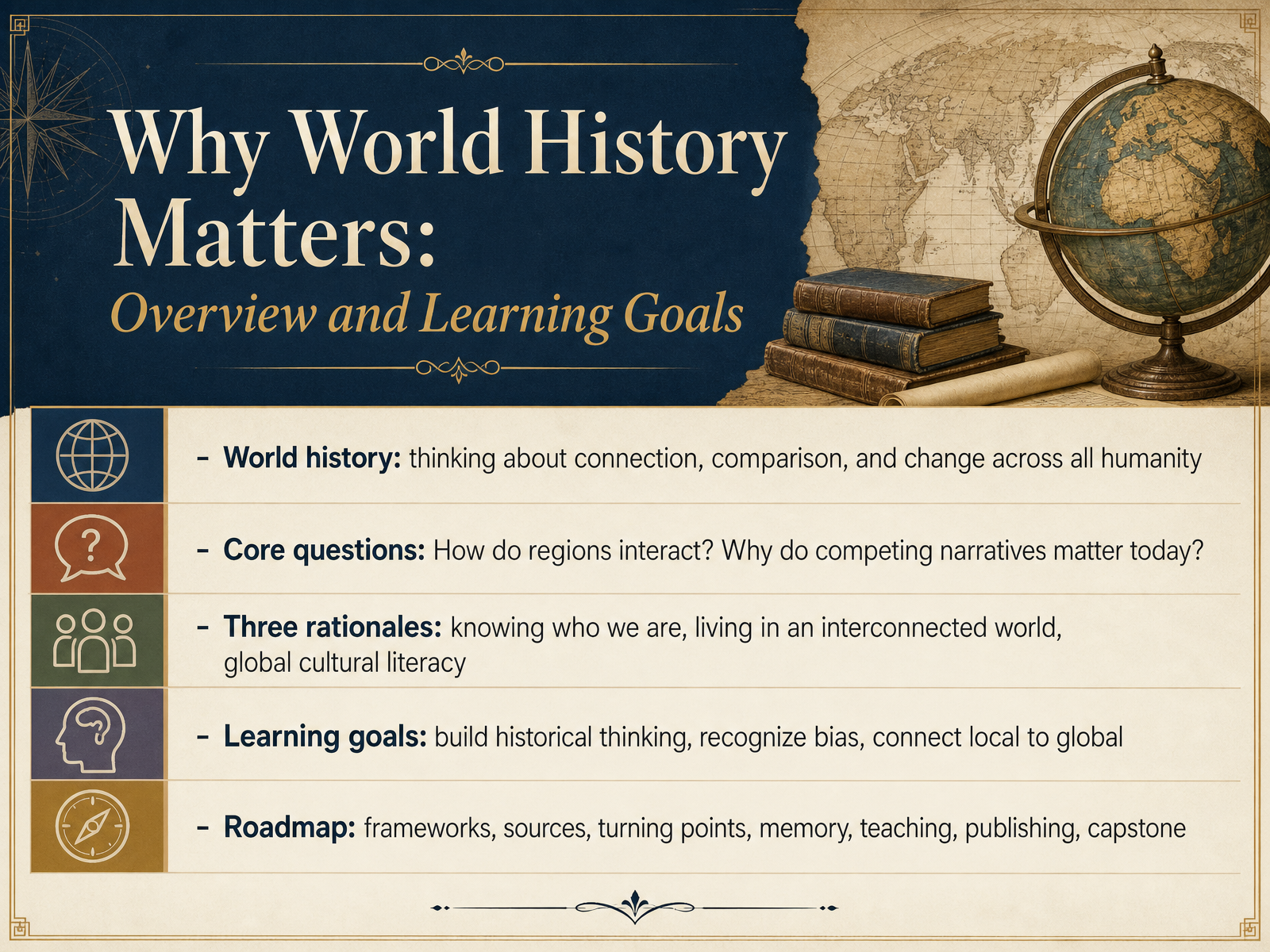
- 01Why World History Matters: Overview and Learning GoalsWelcome. I am glad you are here. Over the next fourteen slides, we will explore why world history matters for students, teachers, and anyone who wants to understand our shared world. World history is not just a list of dates and names. It is a way of thinking about connection, comparison, and change across all humanity. We will ask two core questions. How do regions interact with one another? And why do competing narratives about the past matter today? We will consider three rationales. First, world history helps us know who we are. Second, it prepares us to live in an interconnected world. Third, it builds global cultural literacy. Along the way, we will work toward clear learning goals. You will practice historical thinking, learn to recognize bias, and connect local events to global patterns. Our roadmap covers key frameworks, the use of sources, major turning points, the role of memory, and practical ideas for teaching and publishing, ending with a capstone project. Let us begin with the first question. What World History Is and Is Not.worldhistoryforusall.ss.ucla.edujournals.gmu.edujournals.gmu.edu+22 min
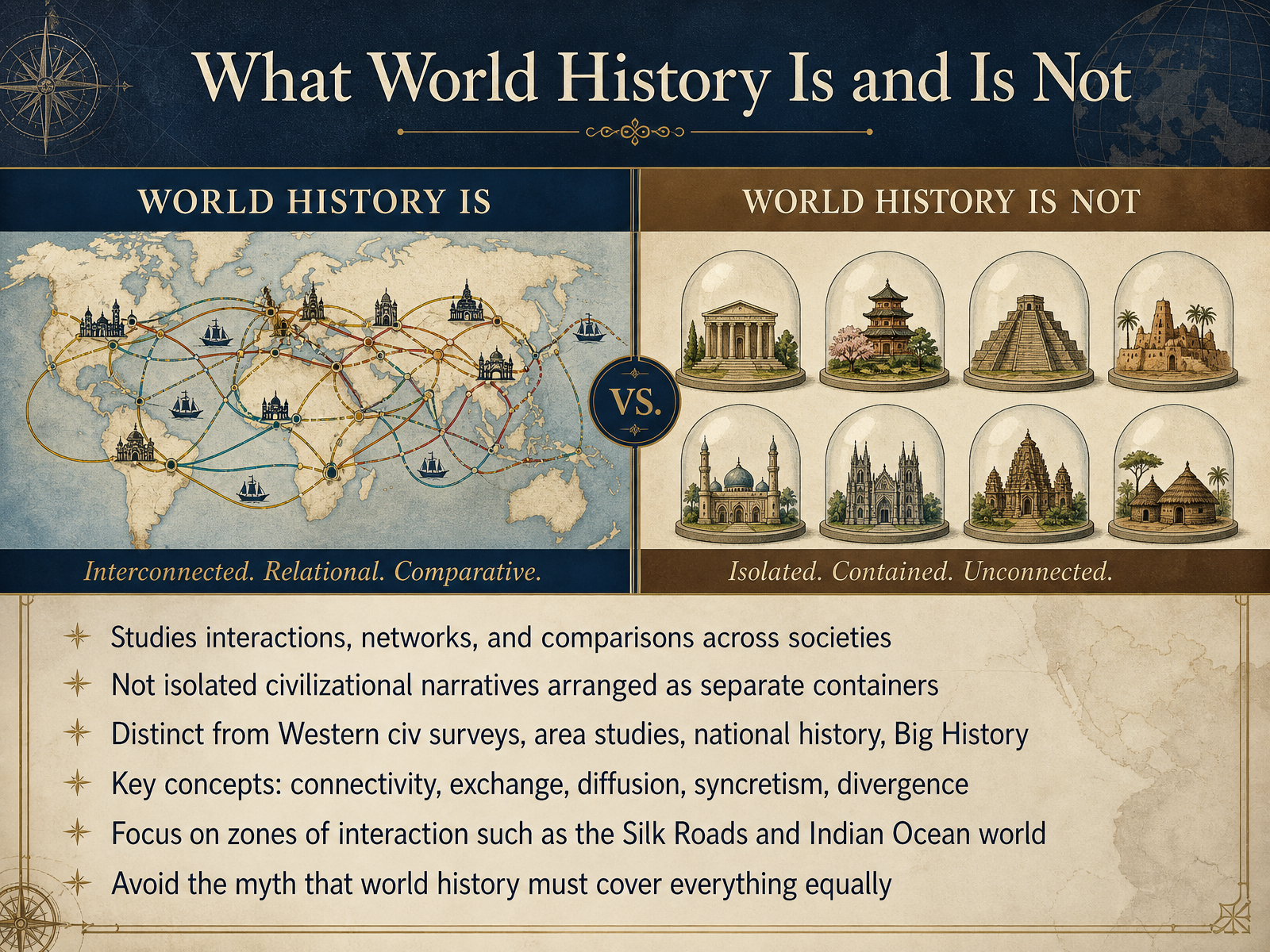
- 02What World History Is and Is NotLet us make a key distinction. World history is not a parade of civilizations, each sealed in its own container. It is the study of interactions, networks, and comparisons across societies. That means historians look at connectivity, exchange, diffusion, syncretism, and divergence, often within zones of interaction such as the Silk Roads or the Indian Ocean world. It also differs from Western civilization surveys, area studies, national history, and Big History, even when they overlap. One common myth is that world history must cover everything equally. It should not. Like any field, it selects. So the takeaway is simple. World history is defined less by total coverage and more by the questions it asks about connections across time and space. Next, we turn to historical thinking skills that transfer.
 doi.orgdoi.orglink.springer.com+21 min
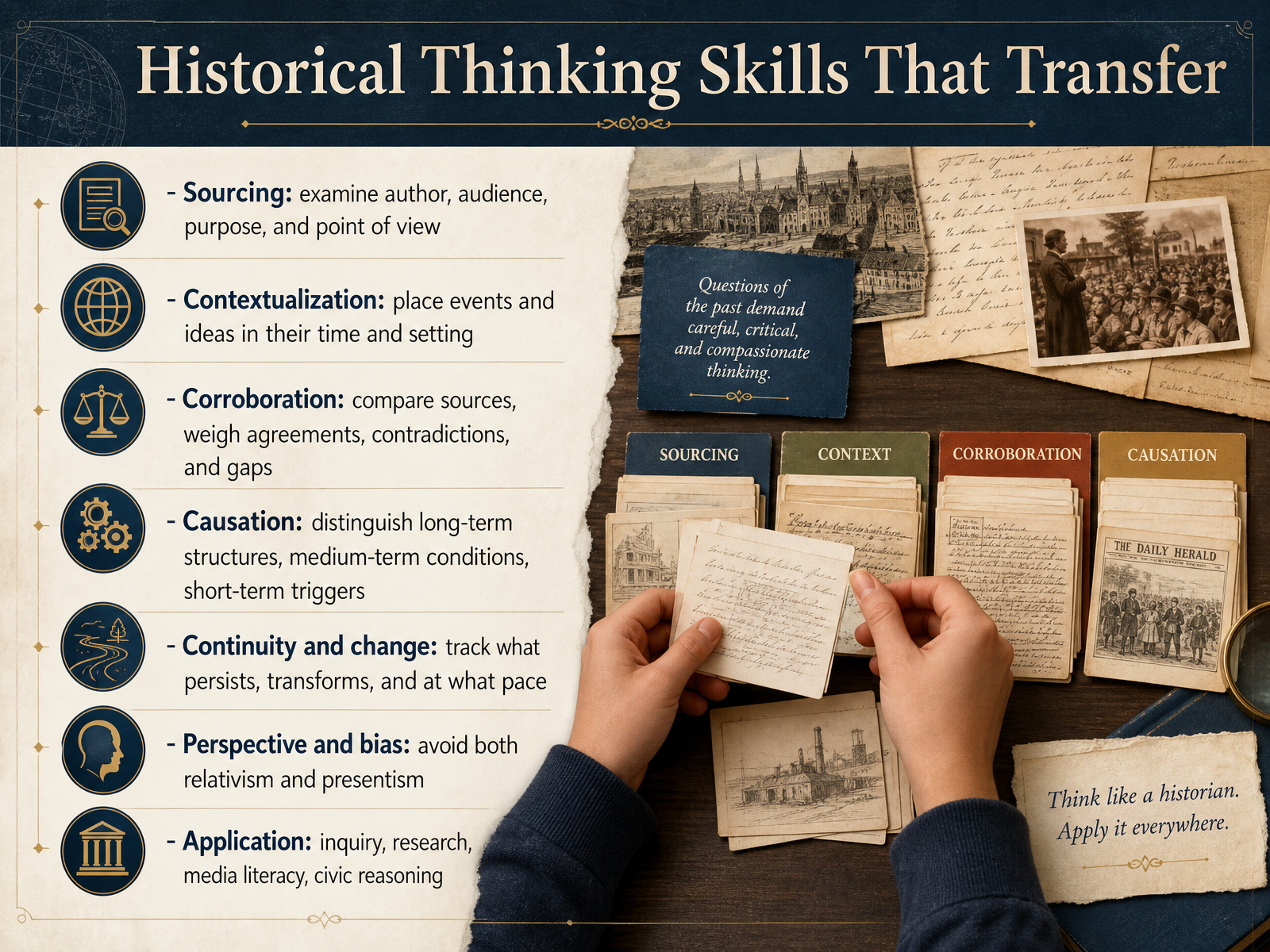
 - 03Historical Thinking Skills That TransferLet's look at the thinking skills that world history builds, because these skills travel well beyond the history classroom. First, sourcing. When you meet a document, ask who made it, who it was for, why it was made, and what point of view it reflects. Second, contextualization. Place every event or idea in its own time and setting before judging it. Third, corroboration. Compare sources, note where they agree, where they contradict, and where they stay silent. Fourth, causation. Distinguish long-term structures, medium-term conditions, and short-term triggers, so a single event is not mistaken for the whole cause. Fifth, continuity and change. Track what persists, what transforms, and how fast. Sixth, perspective and bias. Aim to avoid two extremes: relativism, which refuses all judgment, and presentism, which judges the past only by today's standards. Finally, application. These same habits support inquiry, research, media literacy, and civic reasoning. In short, historical thinking is transferable thinking. Next, we turn to frameworks and periodization for global history.
 worldhistoryforusall.ss.ucla.edujournals.gmu.edujournals.gmu.edu+22 min
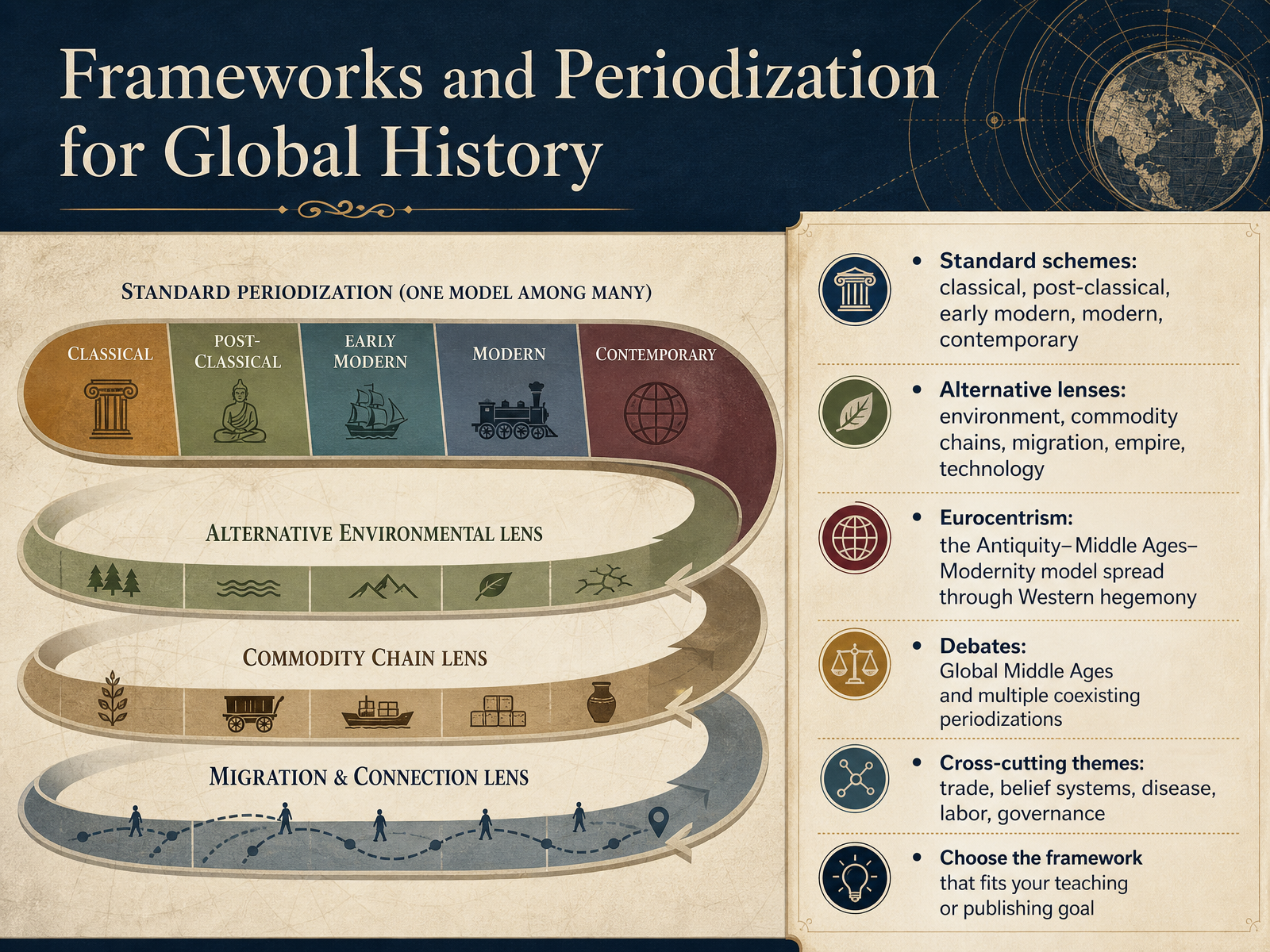
 - 04Frameworks and Periodization for Global HistoryLet's turn now to frameworks and periodization for global history. The standard scheme many textbooks use is familiar: classical, post-classical, early modern, modern, and contemporary. It's useful, but it's not the only option. Alternative lenses include environment, commodity chains, migration, empire, and technology. These let you organize the past around processes rather than fixed eras. It's also worth naming a problem. The Antiquity, Middle Ages, Modernity model is deeply Eurocentric. It spread largely through Western hegemony and colonization, and it doesn't fit every region equally well. That's why scholars debate ideas like the Global Middle Ages and argue that multiple periodizations can coexist. Across these frameworks, several cross-cutting themes keep returning: trade, belief systems, disease, labor, and governance. So the practical takeaway is this. No single framework is neutral or complete. Choose the one that fits your teaching or publishing goal, and be explicit about what it highlights and what it leaves out. Next, we'll look at evidence, sources, and perspective.
 policypress.universitypressscholarship.comcambridge.orgbrill.com+22 min
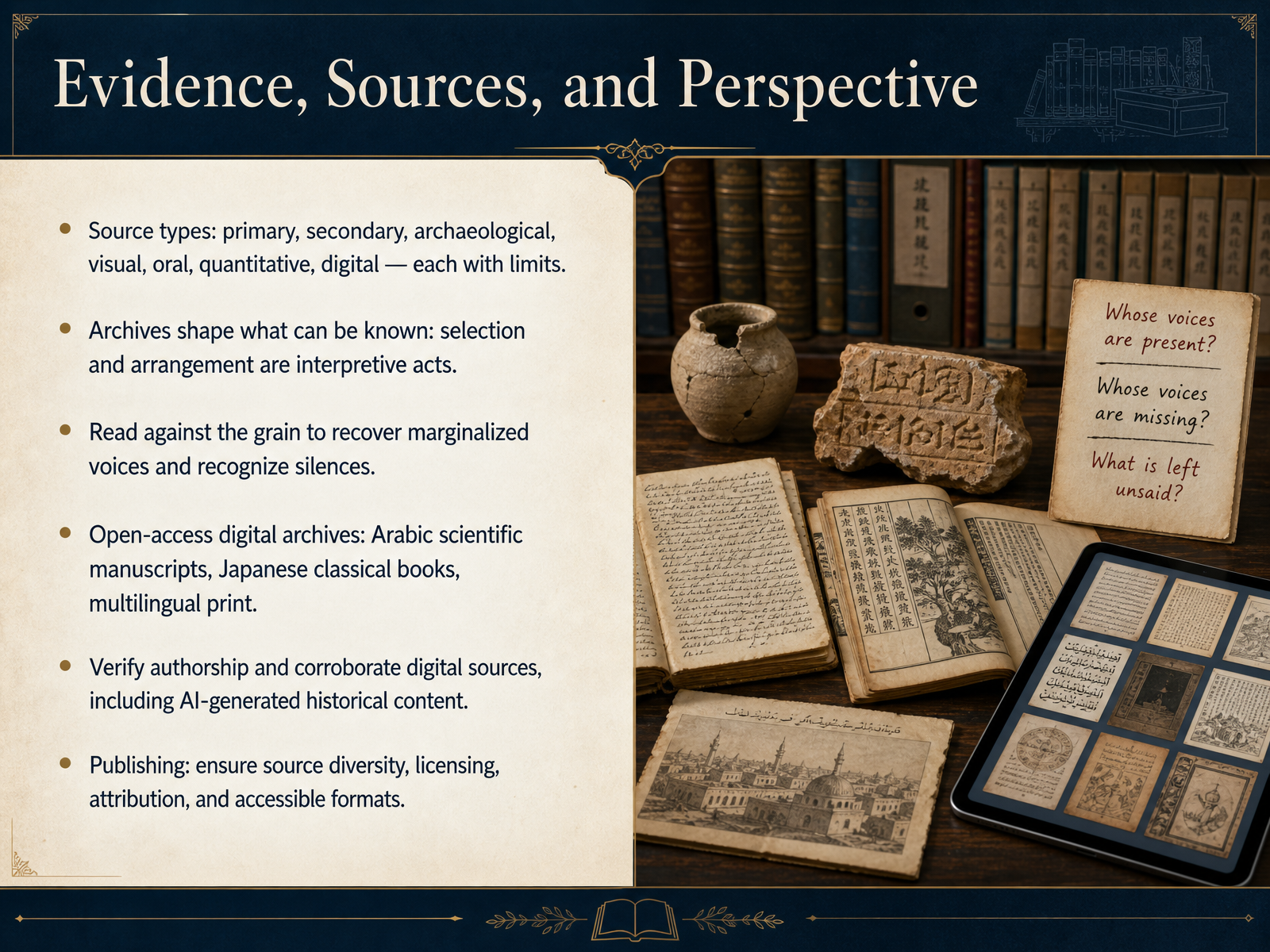
 - 05Evidence, Sources, and PerspectiveLet's turn to evidence, sources, and perspective. Historians don't work with a single kind of source. Primary sources come from the time and place under study, while secondary sources interpret them later. We also rely on archaeological finds, visual material, oral testimony, quantitative data, and now digital archives. Each type has limits. Archives also shape what can be known, because selecting and arranging documents is itself an interpretive act. So historians read against the grain, looking for marginalized voices and noting silences. Open-access collections make this work richer. For example, digitized Arabic scientific manuscripts, Japanese classical books, and multilingual printed documents are increasingly available online. But with digital material, verify authorship and corroborate claims, especially AI-generated historical content. If you publish or teach with sources, ensure diversity, respect licensing and attribution, and use accessible formats. The key takeaway: every source has a perspective, and careful historians ask who made it, why, and who is missing. Next, we examine global turning points and interconnections.
 worldhistorycommons.orghistory.genie.stanford.eduseshat-db.com+22 min
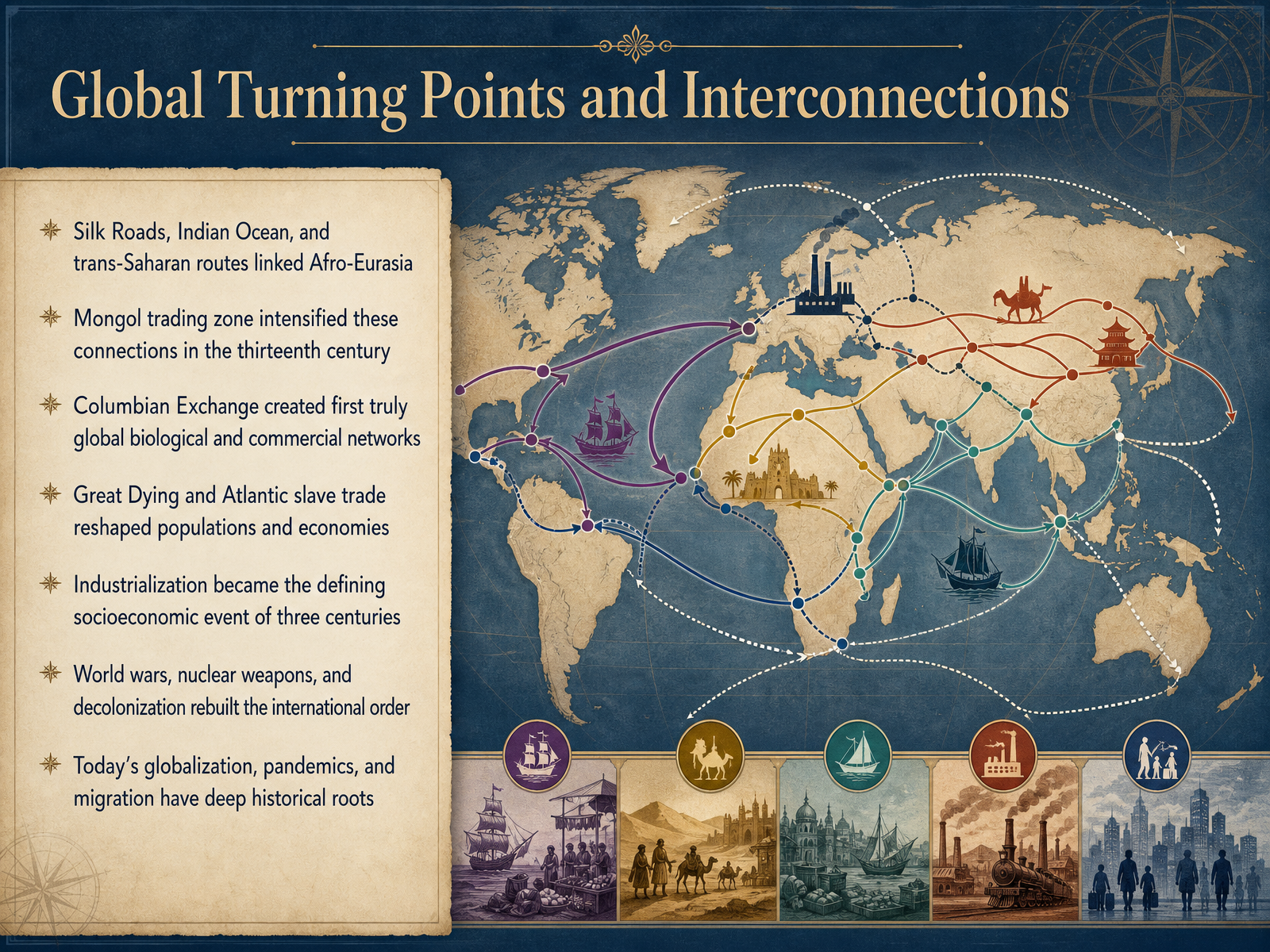
 - 06Global Turning Points and InterconnectionsLet's turn now to global turning points and interconnections. For most of history, regions developed largely on their own. But trade routes such as the Silk Roads, the Indian Ocean, and trans-Saharan networks linked Afro-Eurasia long before modern times. In the thirteenth century, the Mongol trading zone intensified these connections, moving goods, ideas, and unfortunately, disease. Then came the Columbian Exchange, which created the first truly global biological and commercial networks. Crops, animals, and germs crossed oceans in both directions. The consequences were immense. The Great Dying devastated Indigenous populations in the Americas, while the Atlantic slave trade forcibly reshaped economies and societies. Later, industrialization became the defining socioeconomic event of three centuries, spreading factories, cities, and new inequalities. World wars, nuclear weapons, and decolonization then rebuilt the international order. And today's globalization, pandemics, and migration all have deep historical roots. The key takeaway is this. Interconnection is not new. It has shaped our world for centuries, carrying both opportunity and profound human cost. Next, we explore history, memory, and public life.
 2 min
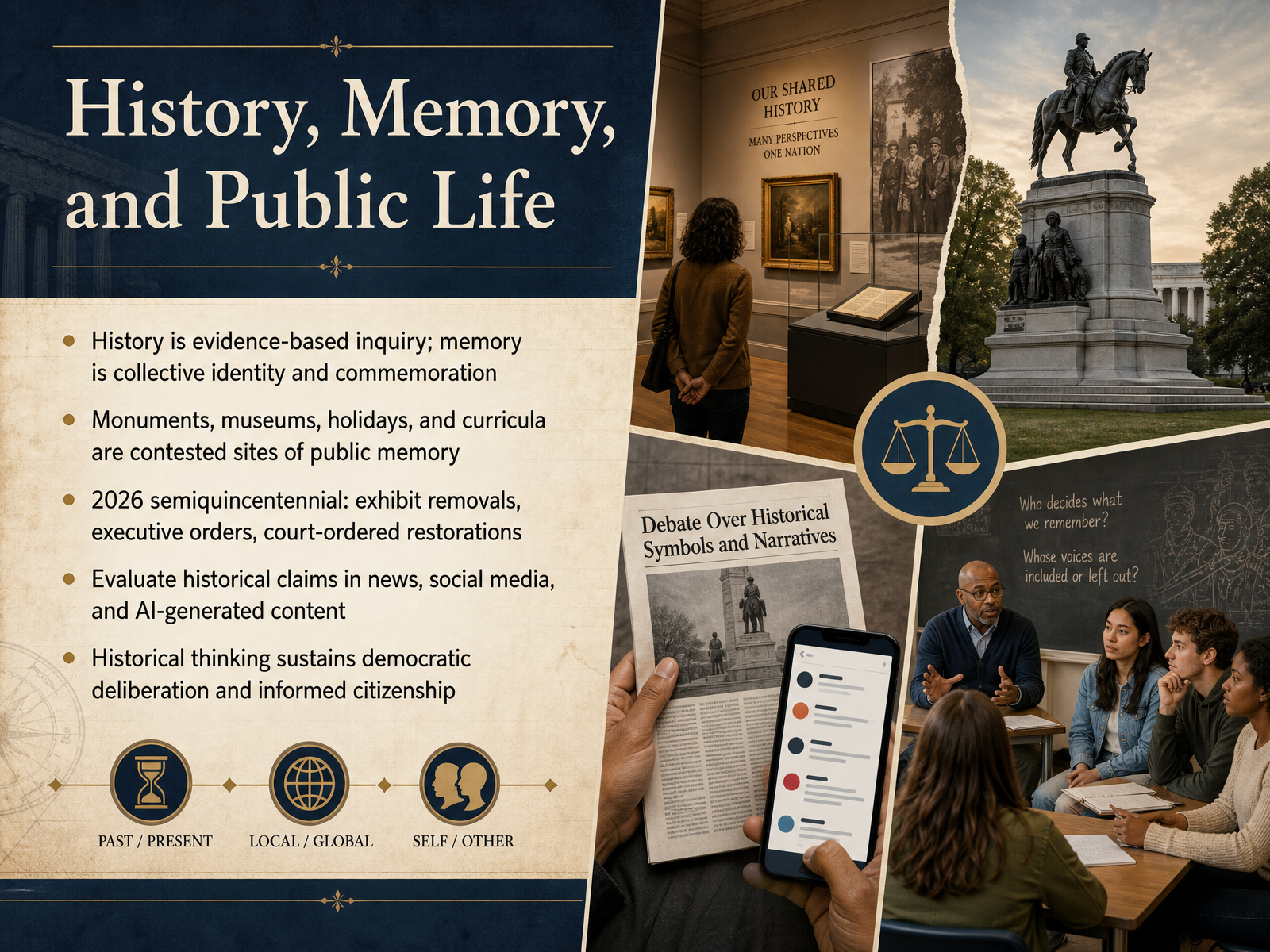
2 min - 07History, Memory, and Public LifeLet's turn now to history, memory, and public life. These are related, but they are not the same thing. History is evidence-based inquiry. It asks what we can support with sources. Memory is collective identity and commemoration. It asks what a community chooses to honor. Monuments, museums, holidays, and school curricula are all sites of public memory, and they are often contested. Consider the two thousand twenty-six semiquincentennial, the two hundred fiftieth anniversary of the Declaration of Independence. In the lead-up, federal exhibits were removed, executive orders reshaped interpretation at national sites, and courts ordered some materials restored. So how should you respond? Evaluate historical claims carefully, whether they appear in news, on social media, or in AI-generated content, which can sound confident and still be wrong. Historical thinking is not a luxury. Comparing evidence and weighing interpretation sustains democratic deliberation and informed citizenship. Next, we look at teaching and learning world history.
 2 min
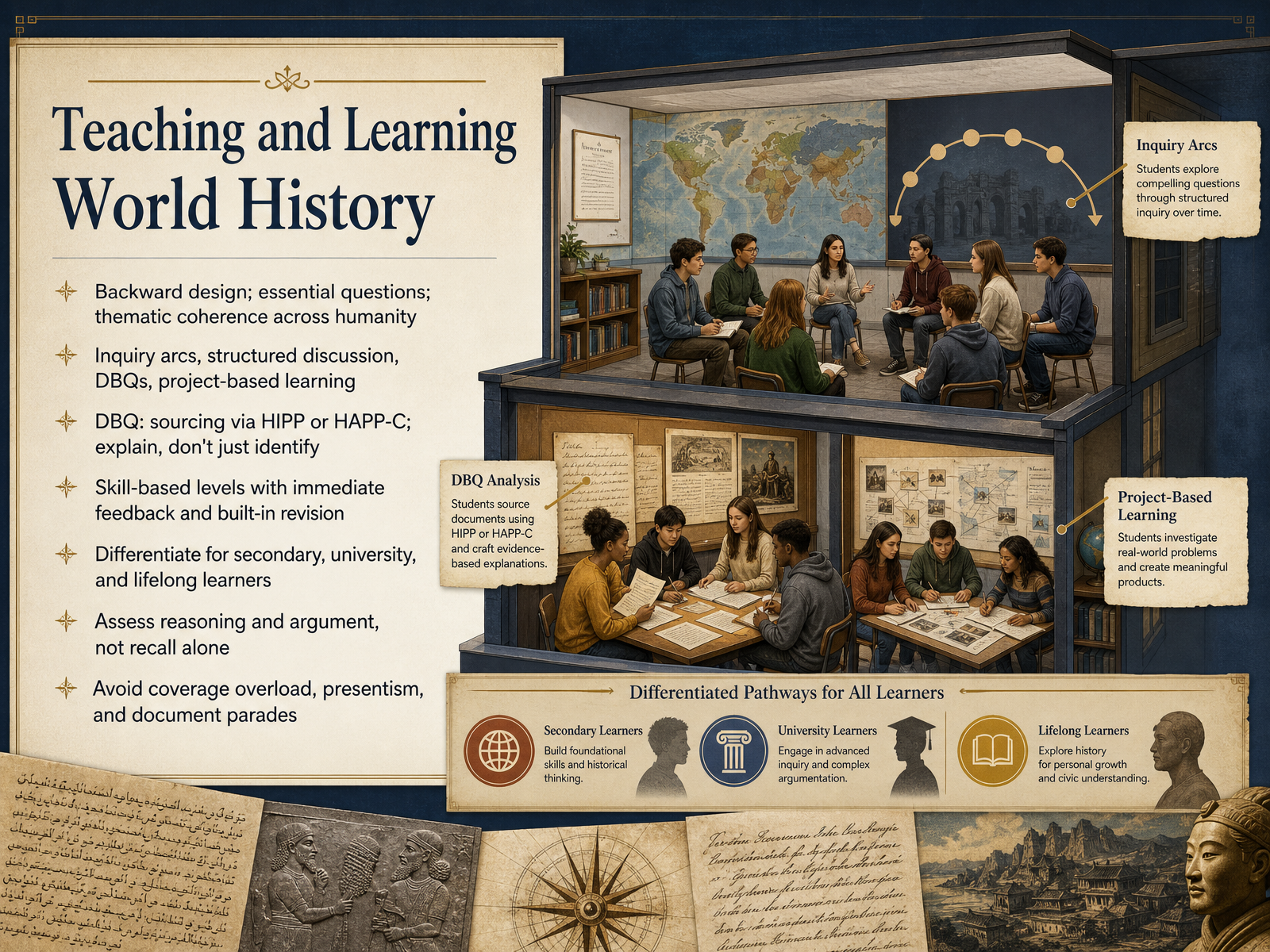
2 min - 08Teaching and Learning World HistoryLet's turn now from why world history matters to how we actually teach and learn it. The strongest courses begin with backward design. Start from what you want students to understand, then build essential questions and themes that connect human societies across time. From there, design inquiry arcs: structured discussion, document-based questions, and project-based learning. In a D B Q, students analyze sources, but sourcing is more than naming the author. Using H I P P or H A P P C, they should explain how perspective, purpose, or audience shapes a document, not just identify it. Skill-based levels with quick feedback and revision make this growth visible. Differentiate for secondary students, university learners, and lifelong learners. Assess reasoning and argument, not recall alone. And avoid coverage overload, presentism, and document parades. That leads us to curriculum frameworks and standards today.
 1 min
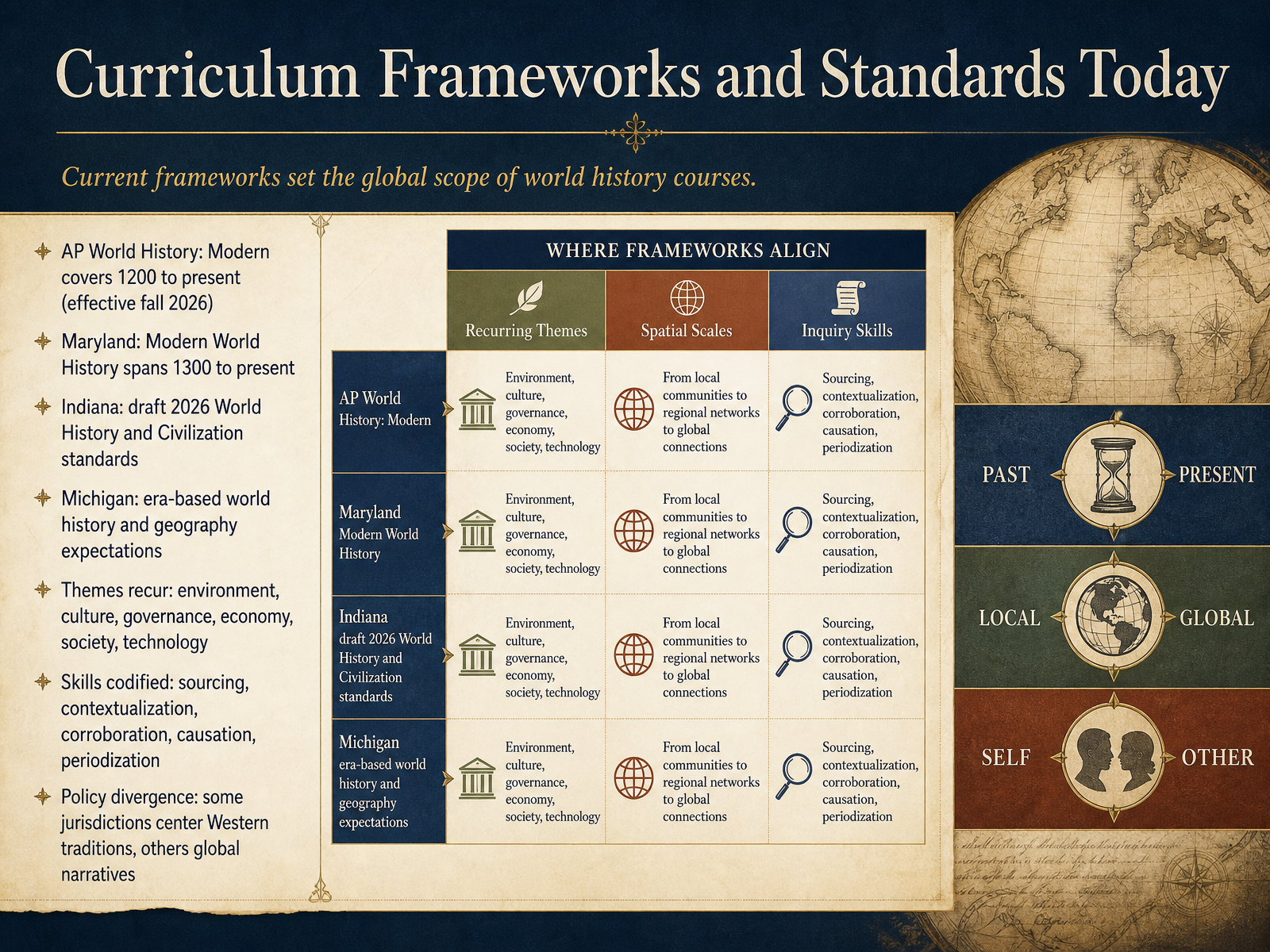
1 min - 09Curriculum Frameworks and Standards TodayNow let's look at curriculum frameworks and standards today. These frameworks define the global scope of world history courses. Consider Advanced Placement World History: Modern, which covers twelve hundred to the present, effective in fall twenty twenty-six. Maryland's Modern World History spans thirteen hundred to the present. Indiana has draft twenty twenty-six standards for World History and Civilization, and Michigan uses era-based world history and geography expectations. Across these documents, several themes recur: environment, culture, governance, economy, society, and technology. Skills are also codified, including sourcing, contextualization, corroboration, causation, and periodization. Yet policy diverges. Some jurisdictions center Western traditions, while others emphasize global narratives. That divergence matters for how courses are designed and taught. Next, we turn to publishing, editorial, and assessment design.
 1 min
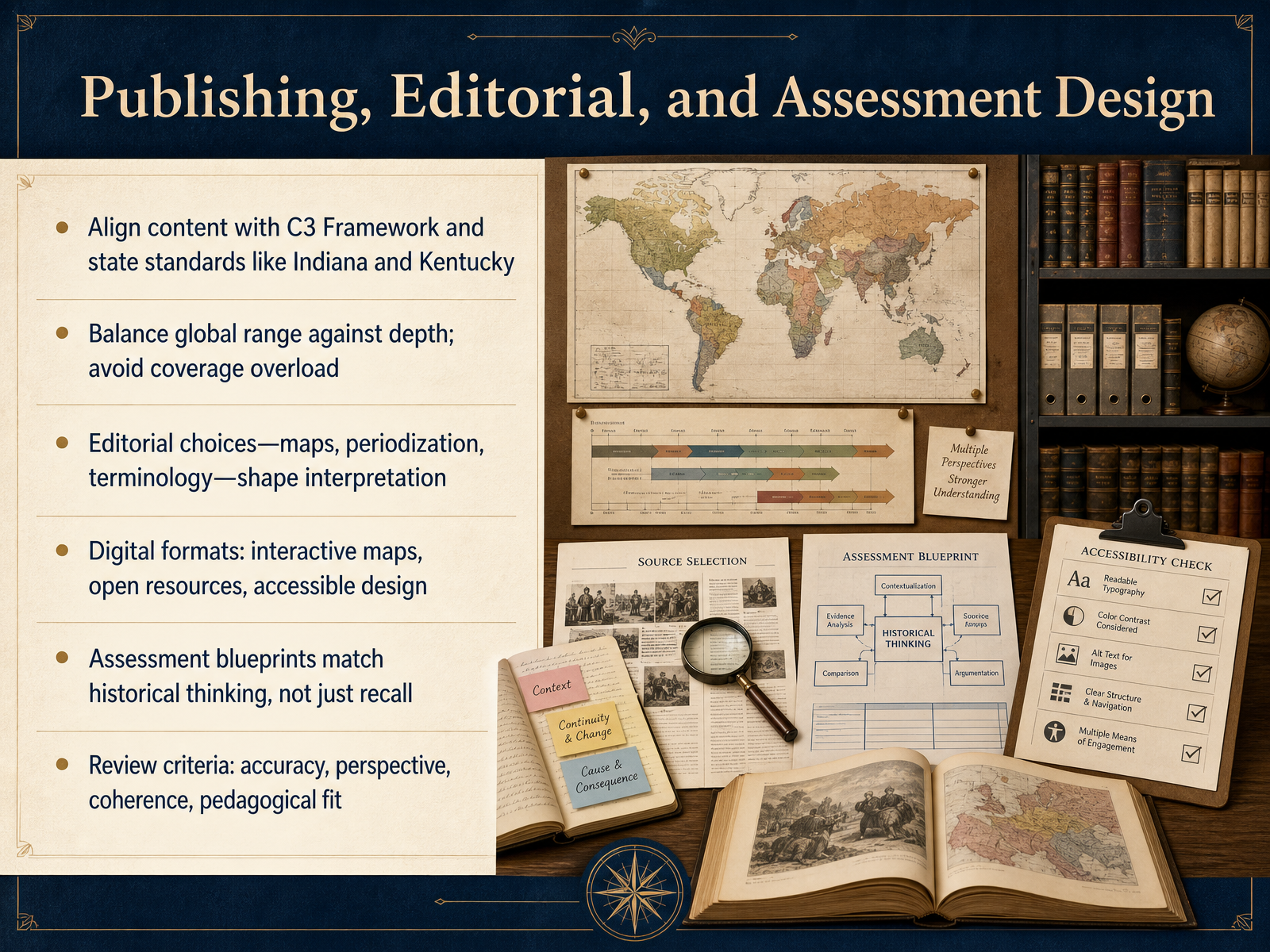
1 min - 10Publishing, Editorial, and Assessment DesignNow let's turn to the production side: publishing, editorial, and assessment design. If you create materials for world history, these choices decide what students actually experience. First, align content with established frameworks. The C3 Framework, and state standards like Indiana and Kentucky, emphasize inquiry, evidence, and historical thinking. Then resolve the central tension: global range versus depth. Covering every region sounds fair, but coverage overload leaves students with names and dates, not understanding. So editorial decisions matter. Maps, periodization, and terminology are not neutral. For example, calling an era the Age of Discovery, rather than the Age of Exploration, changes whose perspective leads the story. In digital formats, interactive maps and open resources can widen access, but only with accessible design, like captions and screen-reader support. Finally, build assessment blueprints that match historical thinking, not just recall. Review criteria should check accuracy, perspective, coherence, and pedagogical fit. The takeaway is simple: every editorial choice shapes interpretation. Next, we bring these ideas together in our case study, analyzing migration through a world history lens.
 2 min
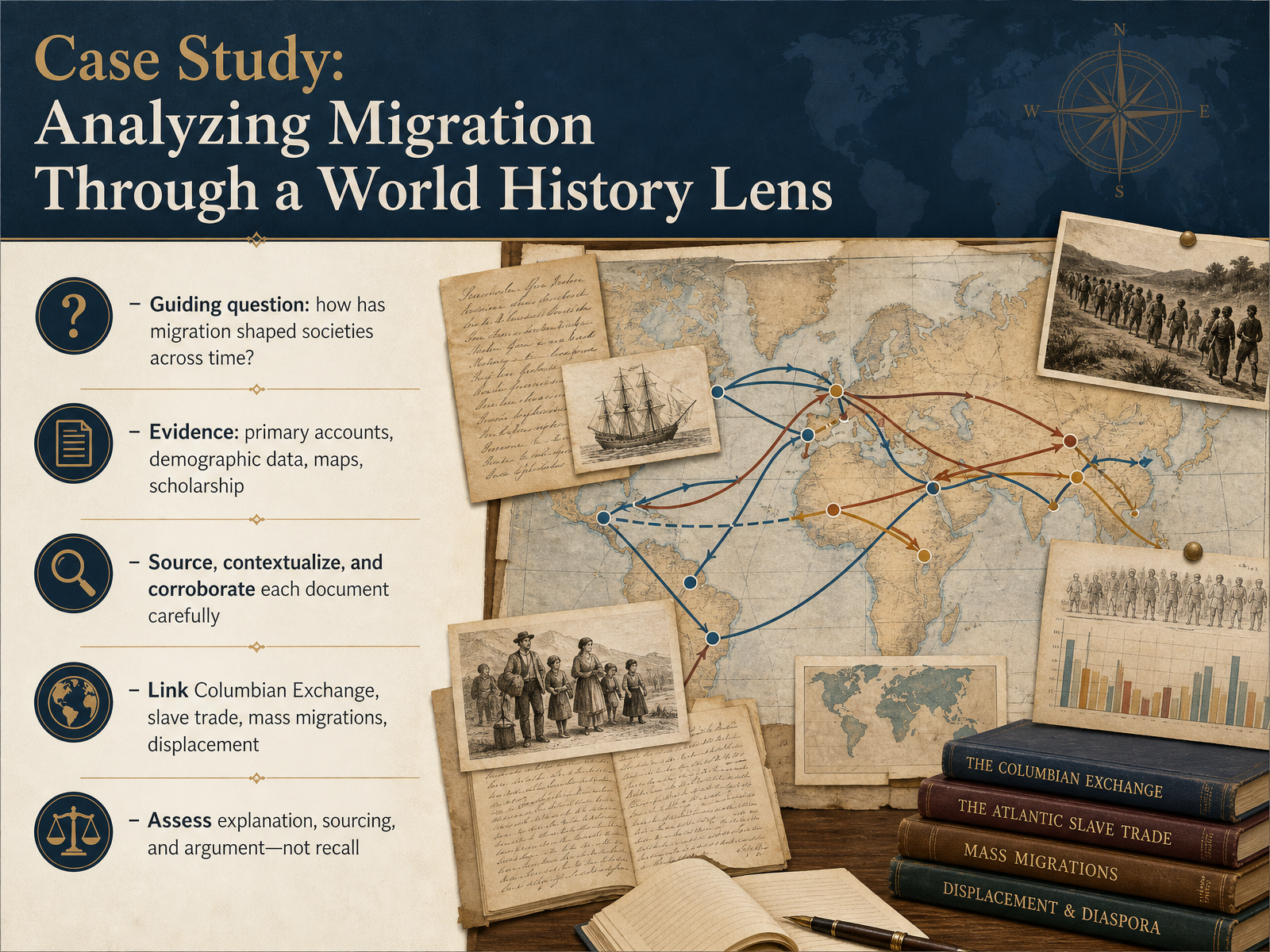
2 min - 11Case Study: Analyzing Migration Through a World History LensLet us turn now to a case study. How has migration shaped societies across time? Migration means the movement of people from one place to another, often across regions or borders. This question invites students to trace connection and change rather than memorize dates. To answer it well, we bring in evidence. Primary accounts from travelers and migrants. Demographic data on population movement. Maps that show routes and settlement. And scholarship that interprets it all. The key skill is source work. For each document, ask who made it, when, and why. Then contextualize it in its era, and corroborate it with other sources. These habits build historical thinking. They also connect big themes. The Columbian Exchange, the slave trade, mass migrations, and forced displacement. Notice how each one reshapes economies, cultures, and identities. When we assess student work, we look at explanation, sourcing, and argument, not simple recall. So the takeaway is this. Migration is a thread that runs through world history, and careful analysis helps us see how it changed societies. Next, we examine industrialization and its global consequences.
 2 min
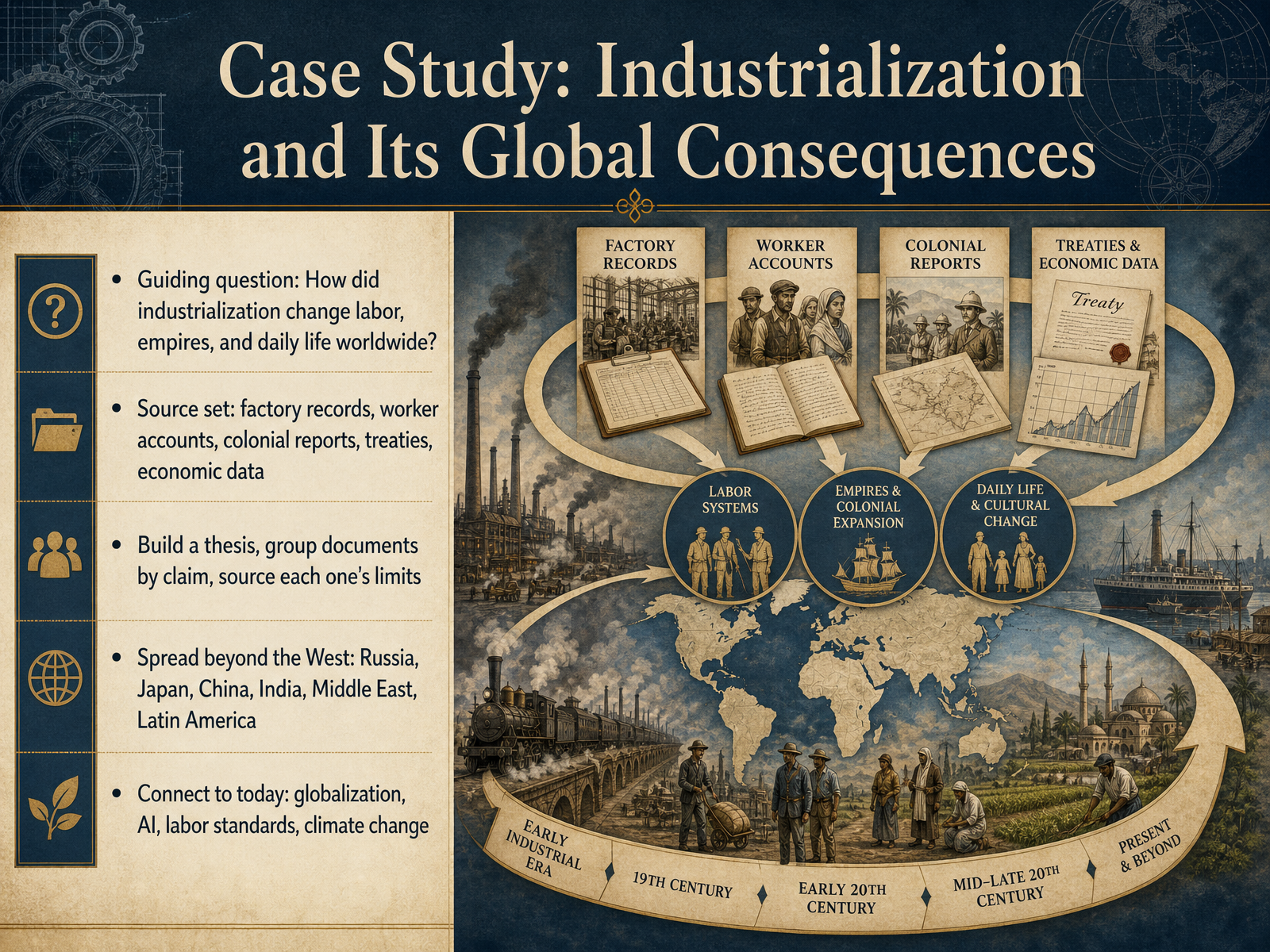
2 min - 12Case Study: Industrialization and Its Global ConsequencesNow let's put those skills to work in a case study: industrialization and its global consequences. Our guiding question is this. How did industrialization change labor, empires, and daily life worldwide? Notice the scope. It was not only a Western story. Industrial growth spread to Russia, Japan, China, India, the Middle East, and Latin America, often under pressure from imperial powers. To investigate, we build a thesis, then group documents by the claim each one supports. The source set might include factory records, worker accounts, colonial reports, treaties, and economic data. For every document, we ask about its limits. Who created it, and who or what is missing? That sourcing step turns evidence into a defensible argument. Finally, we connect this history to today. Globalization, artificial intelligence, labor standards, and climate change all raise questions that industrialization first made urgent. So the takeaway is this. Industrialization is a global turning point, and careful sourcing lets us explain its causes, changes, and lasting relevance. Next, we'll look at professional resources and communities of practice.
 2 min
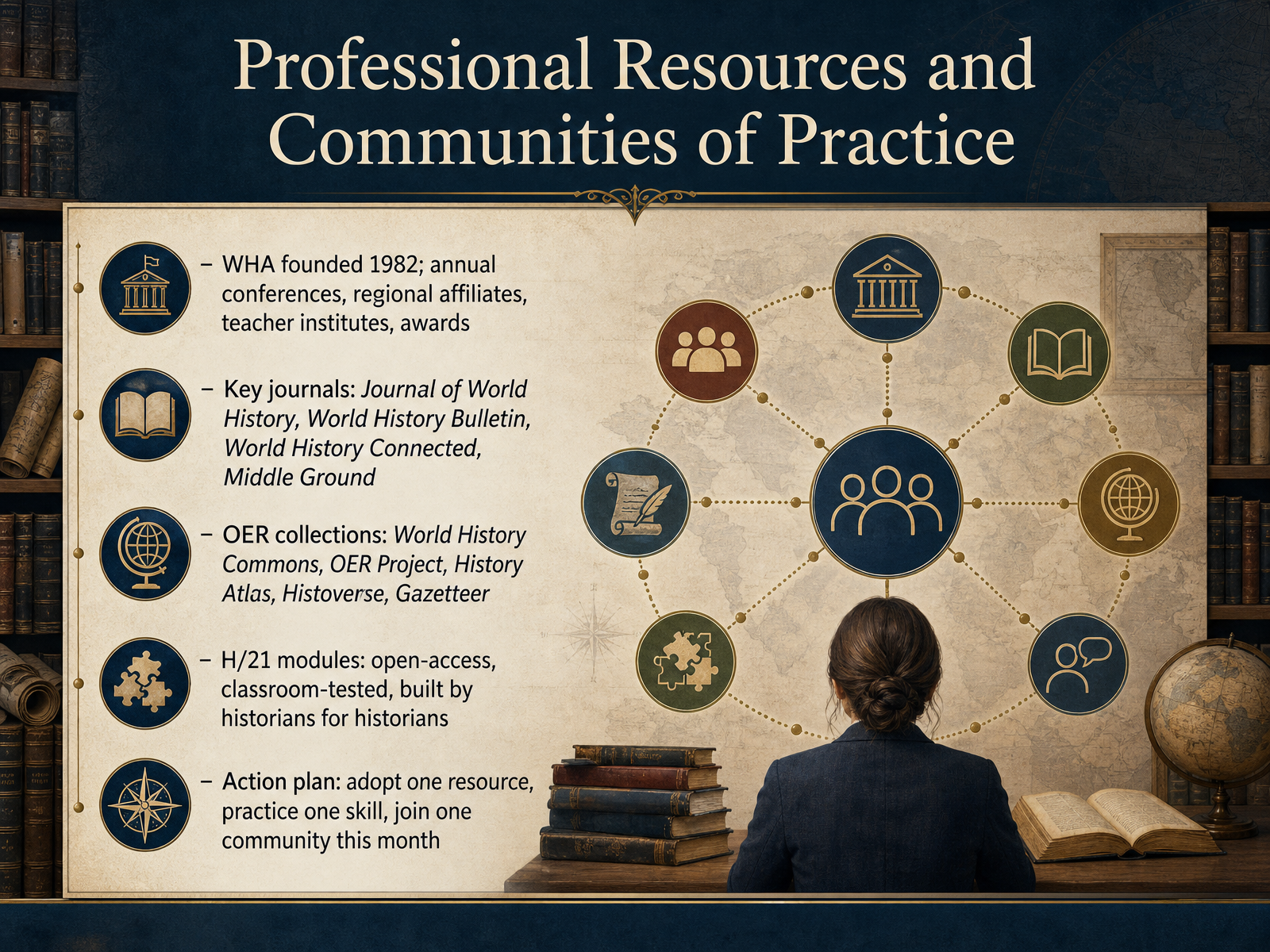
2 min - 13Professional Resources and Communities of PracticeLet's turn to the professional resources and communities that can support your work. The World History Association was founded in 1982. It offers annual conferences, regional affiliates, teacher institutes, and awards. These are practical ways to connect with other educators and scholars. The WHA also supports key journals. The Journal of World History publishes scholarly research. The World History Bulletin offers short essays. World History Connected focuses on teaching. And Middle Ground serves as a bridge between K through 12 and college classrooms. There are also open educational resource collections, including World History Commons, the OER Project, History Atlas, Histoverse, and Gazetteer. For classroom-ready lessons, look at the H 21 modules. They are open access, classroom tested, and built by historians for historians. So here is a concrete action plan. This month, adopt one resource, practice one skill, and join one community. Next, we will bring these ideas together in Capstone: Applying World History Reasoning.
 1 min
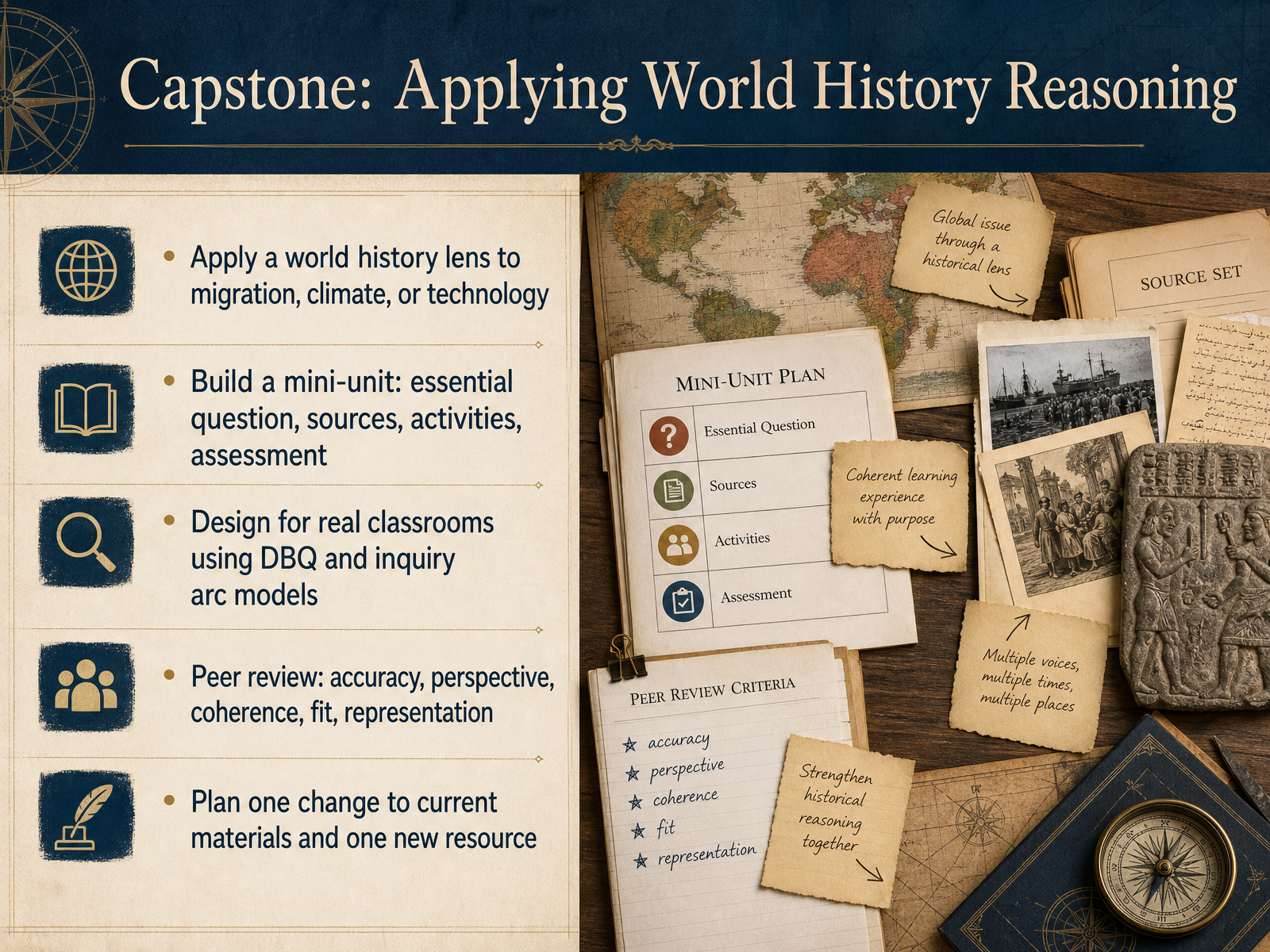
1 min - 14Capstone: Applying World History ReasoningLet's bring everything together. On this final slide, your task is to apply a world history lens to migration, climate, or technology. Pick one, then build a mini-unit around it. Start with an essential question, choose a small set of sources, design two or three activities, and decide how you will assess understanding. Use familiar models, like document-based questions and the inquiry arc. Then, plan for peer review. Ask reviewers to check accuracy, perspective, coherence, fit, and representation. Finally, commit to two concrete steps. One change to your current materials, and one new resource you will add. Remember, world history matters because it helps students reason about a connected world. So take one idea from this course and try it in your classroom. Thank you for learning with me, and I wish you success as you put these ideas into practice.
 worldhistoryforusall.ss.ucla.edujournals.gmu.edujournals.gmu.edu+21 min
Take the deck with you
Download this course as a file — free, no sign-up needed.
- PDF handoutEvery slide page, ready to print or share.15 pages · 6.4 MBDownload
- Narrated PowerPointThe deck that presents itself — every slide carries the digital human's narration video.15 pages · 18.0 MBDownload
- PowerPoint slidesThe full deck as a .pptx — open it in PowerPoint, Keynote, or Google Slides.15 pages · 6.4 MBDownload
Free to use in your own training — please keep the PersonWise credit page at the end.
Have your own deck? Turn it into a course
Sources consulted
Web sources consulted while building this course.
- Why Learn World History — worldhistoryforusall.ss.ucla.edu
- 06 WHC 20.3 Forum Article Szoztak Why Teach World History — journals.gmu.edu
- World History Connected | Vol. 5 No. 1 | Jerry H. Bentley: Why Study World History? — journals.gmu.edu
- Exploring 21st Century Global Historical Thinking — worldhistoryconnected.org
- World History (1): Why You Need to Know — hauensteincenter.org
- World History, Global History, Big History — doi.org
- 2. Global History, World History, and Wallerstein’s World-Systems Theory as Definitional Caesuras — doi.org
- Terms | Springer Nature Link — link.springer.com
- World history (field) — en.wikipedia.org
- ComparingGlobalHistory toWorldHistory — culturahistorica.org
- Periodization in Global History: The Productive Power of Comparing — policypress.universitypressscholarship.com
- Long-term and decentred trajectories of doing history from a global perspective: institutionalization, postcolonial critique, and empiricist approaches, before and after the 1970s — cambridge.org
- Teleology, Discontinuity and World History: Periodization and Some Creation — brill.com
- CROSS-CULTURAL INTERACTION AND PERIODIZATION IN WORLD HIS... — degruyterbrill.com
- Time (Chapter 3) - Rethinking Global History — cambridge.org
- World History Commons — worldhistorycommons.org
- History Genie — history.genie.stanford.edu
- Seshat — seshat-db.com
- History Atlas — The Interactive Atlas of World History — historyatlas.com
- HISTOVERSE | Human Histories — humanhistories.org