Begin
13 pages · ~26 min
Documenting Decisions in Customer Service
This training teaches customer service professionals how to accurately document decisions, ensuring clear records and consistent service.
A digital instructor presents all 13 pages. Hold “Ask” at any point and ask out loud — the answer comes from this course. No sign-up needed.
What you’ll learn
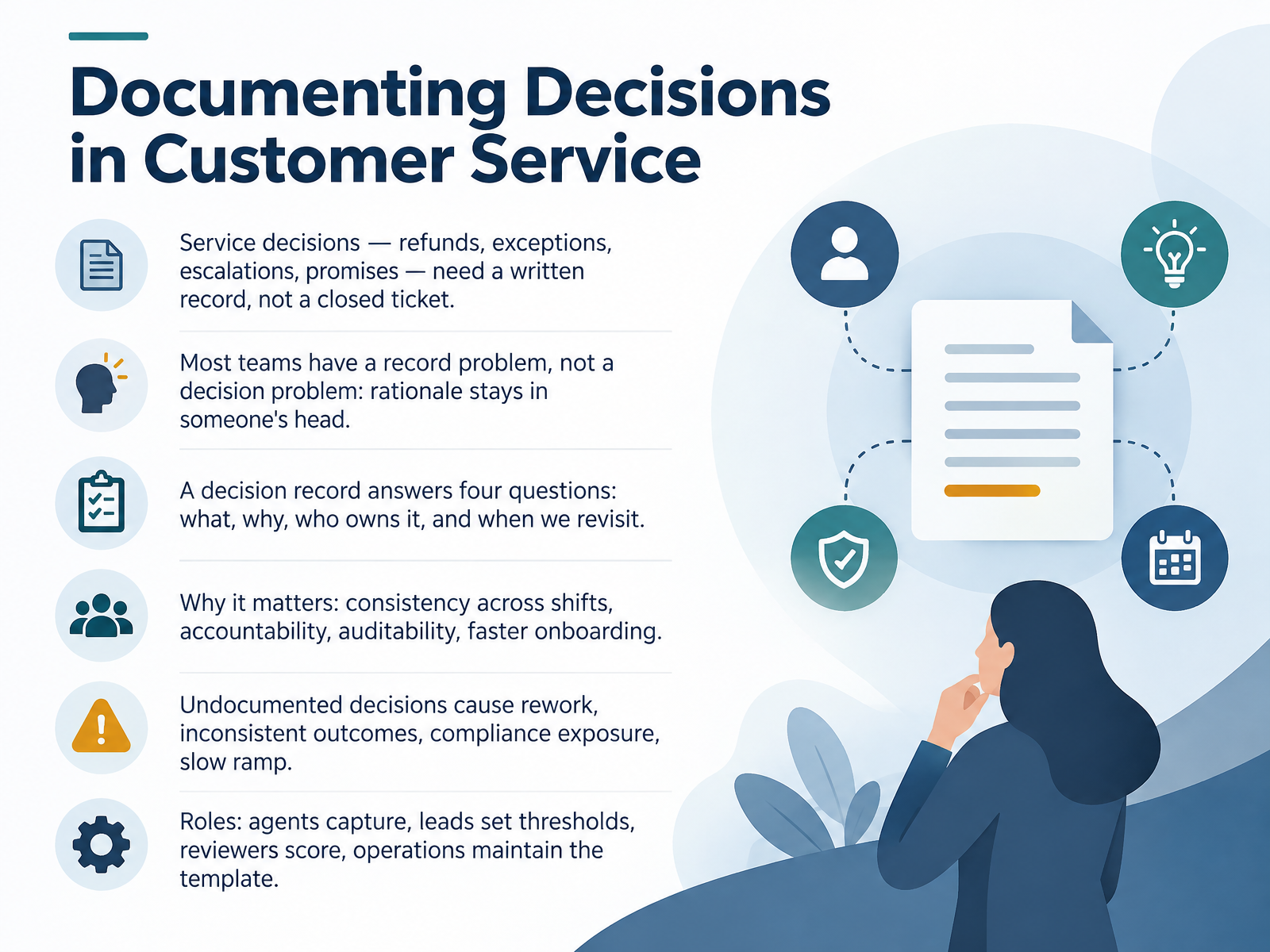
- 01Documenting Decisions in Customer ServiceWelcome. This course is about documenting decisions in customer service. Refunds, exceptions, escalations, promises. Each one deserves a written record, not just a closed ticket. Most teams don't have a decision problem. They have a record problem. The rationale stays in someone's head. A decision record answers four simple questions. What did we decide? Why? Who owns it? And when will we revisit it? That record matters. It gives you consistency across shifts, clear accountability, and a faster path for new hires. Skip it, and you invite rework, inconsistent outcomes, compliance exposure, and a slow ramp. Roles are straightforward. Agents capture the decision. Team leads set the thresholds. Reviewers score the quality. And operations maintain the template. When we get this right, documentation stops feeling like a burden. It becomes part of the work itself. Next, we'll look at what actually counts as a service decision record.clickup.comjamy.aiblog.workhint.com+21 min
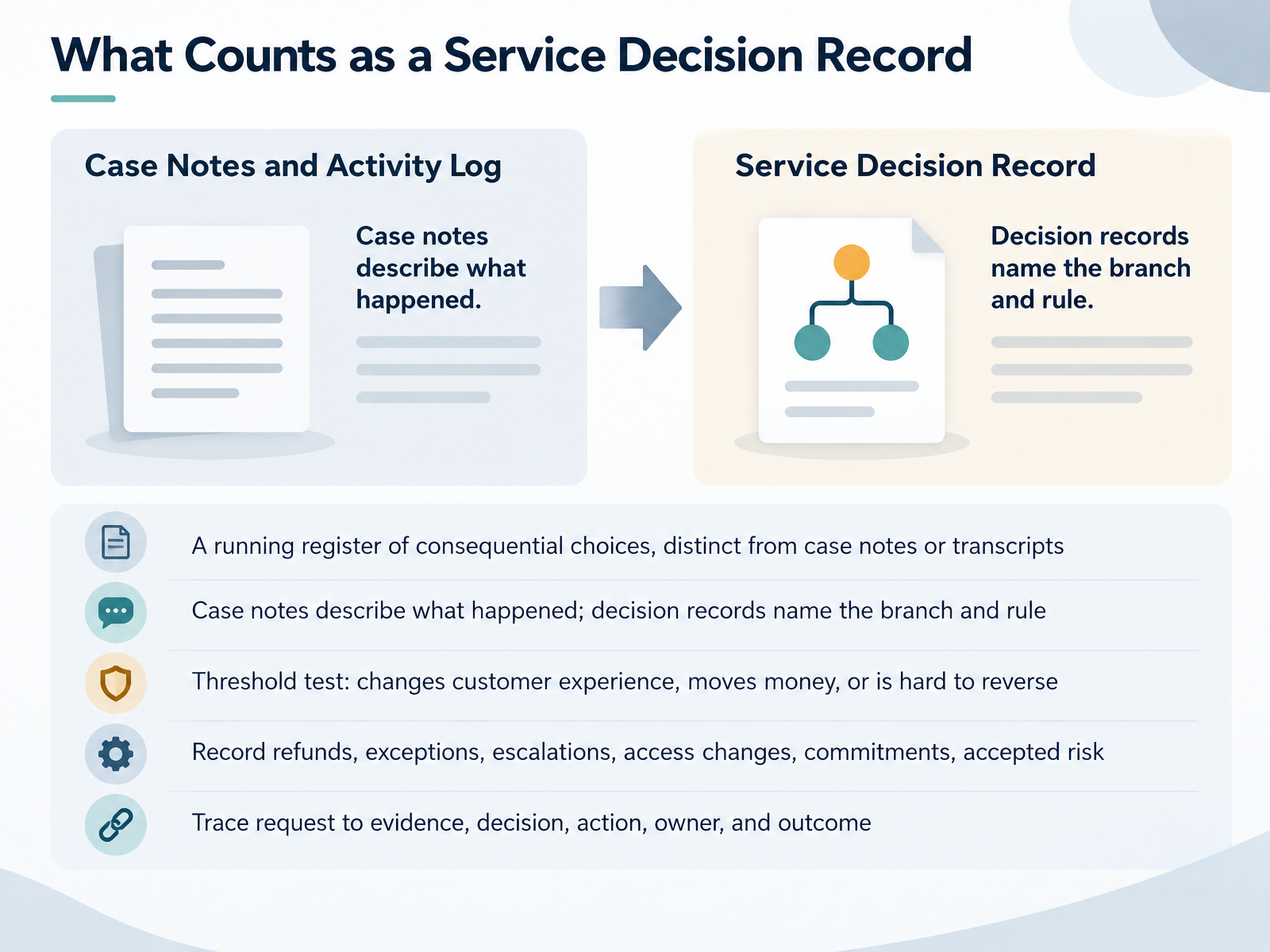
- 02What Counts as a Service Decision RecordLet us define what actually counts as a service decision record. Think of it as a running register of consequential choices. It is not the same as case notes or a call transcript. Case notes describe what happened. A decision record names the branch you took, and the rule behind it. So how do you decide what belongs in the register? Apply a simple threshold test. Does the choice change the customer experience, move money, or prove hard to reverse? If yes, record it. In practice, that includes refunds, policy exceptions, escalations, access changes, commitments you make to a customer, and any risk you knowingly accept. For each entry, keep the trace clear. Reference the request, the evidence, the decision itself, the action taken, the owner, and the outcome. That chain is what lets a colleague pick up the case and understand your reasoning without asking you. As we move on, let us look at the anatomy of a complete decision record.
 1 min
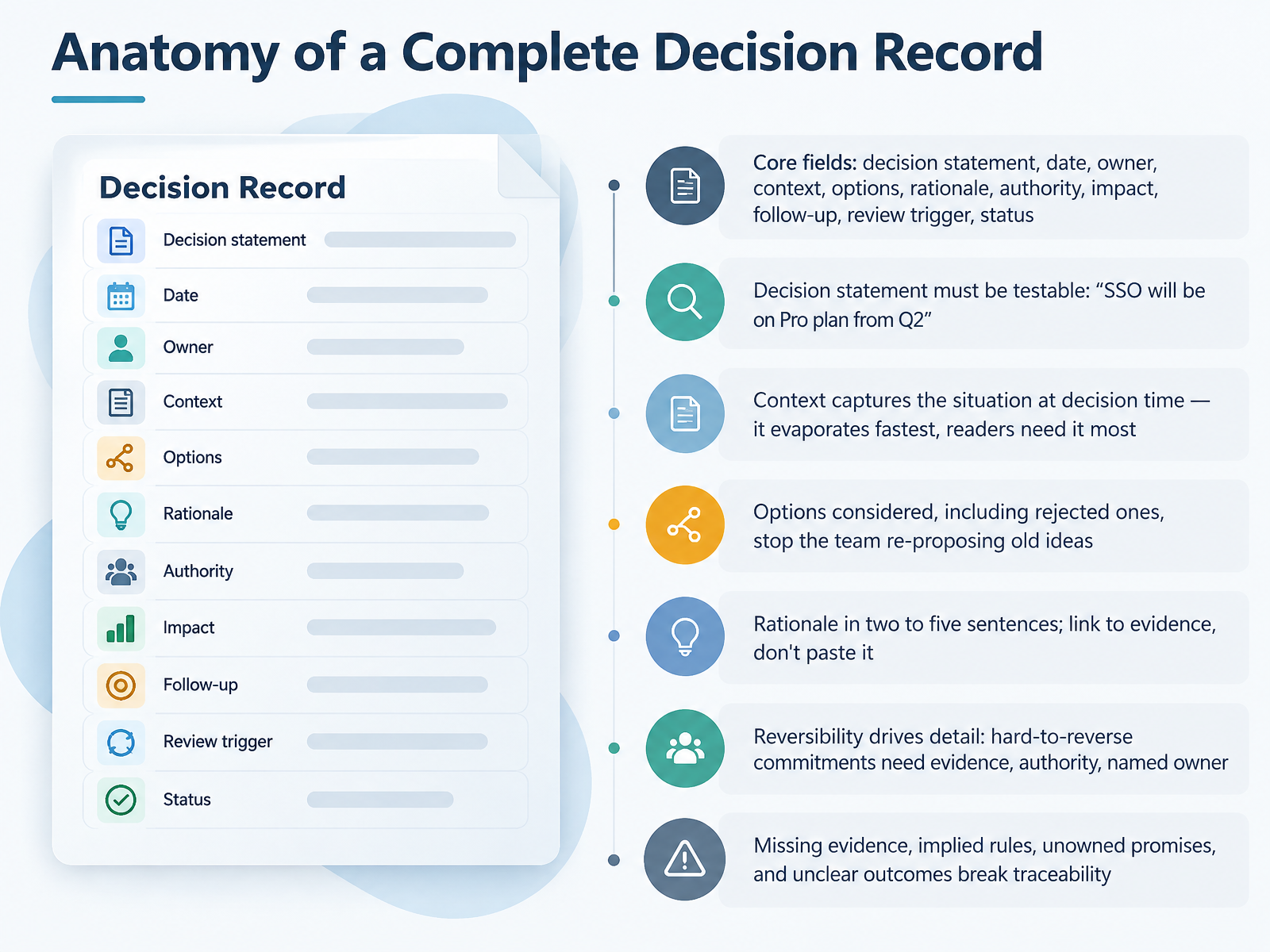
- 03Anatomy of a Complete Decision RecordLet's break down the anatomy of a complete decision record. Every record needs a core set of fields: the decision statement, date, owner, context, options, rationale, authority, impact, follow-up, review trigger, and status.
Start with the decision statement. It must be testable. For example: SSO will be on the Pro plan from Q2. That sentence gives you a clear target to verify later.
Next, context. Capture the situation as it was at decision time. Context evaporates fastest, and readers need it most.
Then, options. Record what you considered, including the ones you rejected. This stops the team from re-proposing old ideas.
Rationale should run two to five sentences. Link to evidence, don't paste it into the record.
Reversibility drives detail. Hard-to-reverse commitments need evidence, authority, and a named owner.
Watch for these failures: missing evidence, implied rules, unowned promises, and unclear outcomes. Any of them breaks traceability.
Now let's look at the minimum viable record by risk level.
 1 min
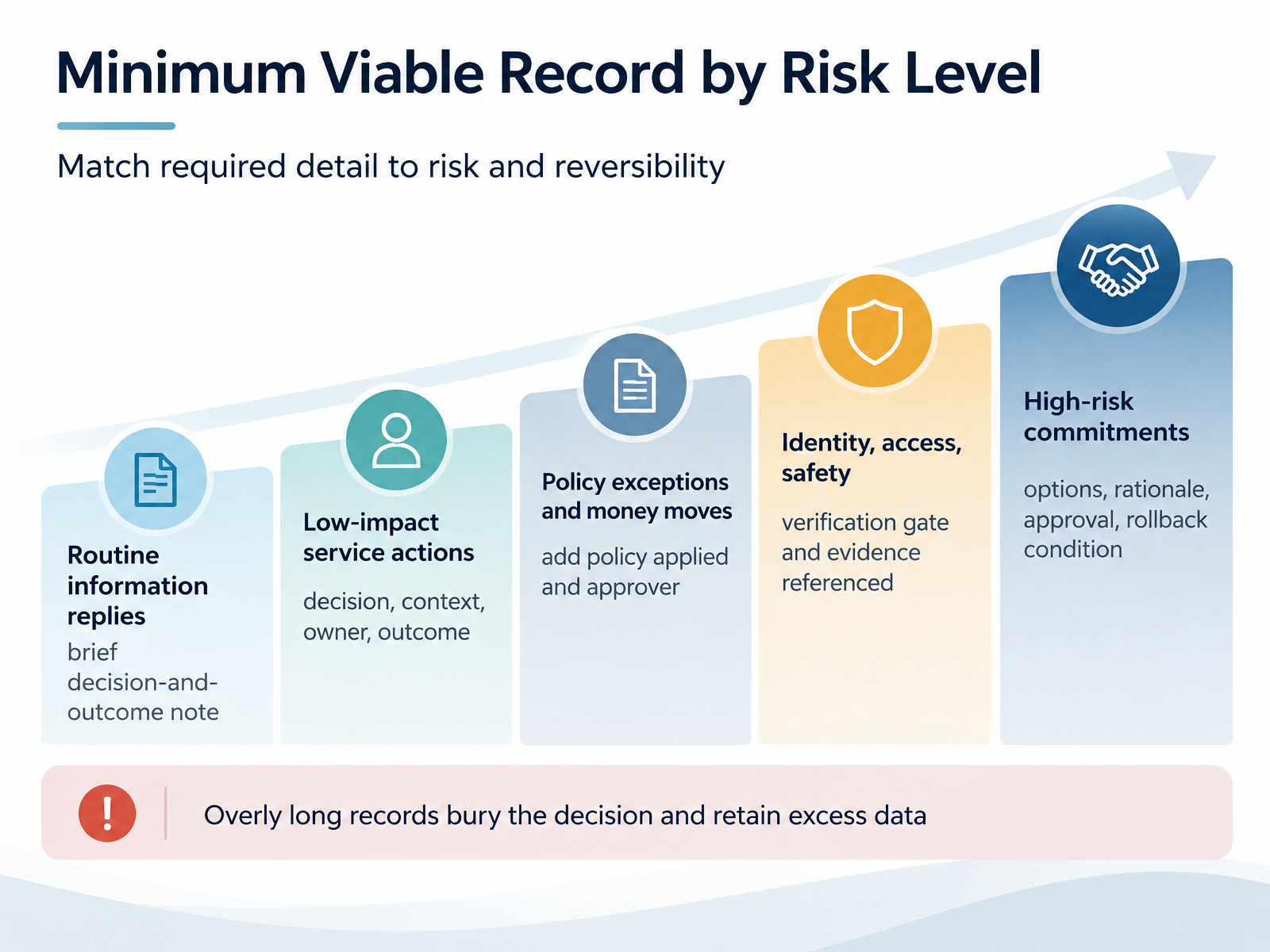
- 04Minimum Viable Record by Risk LevelLet's talk about matching the record to the risk. Not every decision needs the same level of detail. For routine information replies, keep it brief. Note the decision and the outcome. For low-impact service actions, add context, the owner, and the outcome. When you make a policy exception or move money, also record the policy applied and who approved it. For identity, access, or safety matters, document the verification gate and the evidence you referenced. For high-risk commitments, capture the options considered, your rationale, the approval, and the rollback condition. A useful test is simple. Could a colleague pick up this case without calling you? If yes, you likely have enough. If no, add what is missing. Just remember, overly long records bury the decision and retain excess data. The goal is a minimum viable record that is clear, traceable, and right-sized. Next, we'll look at capture triggers, when a record is required.
 1 min
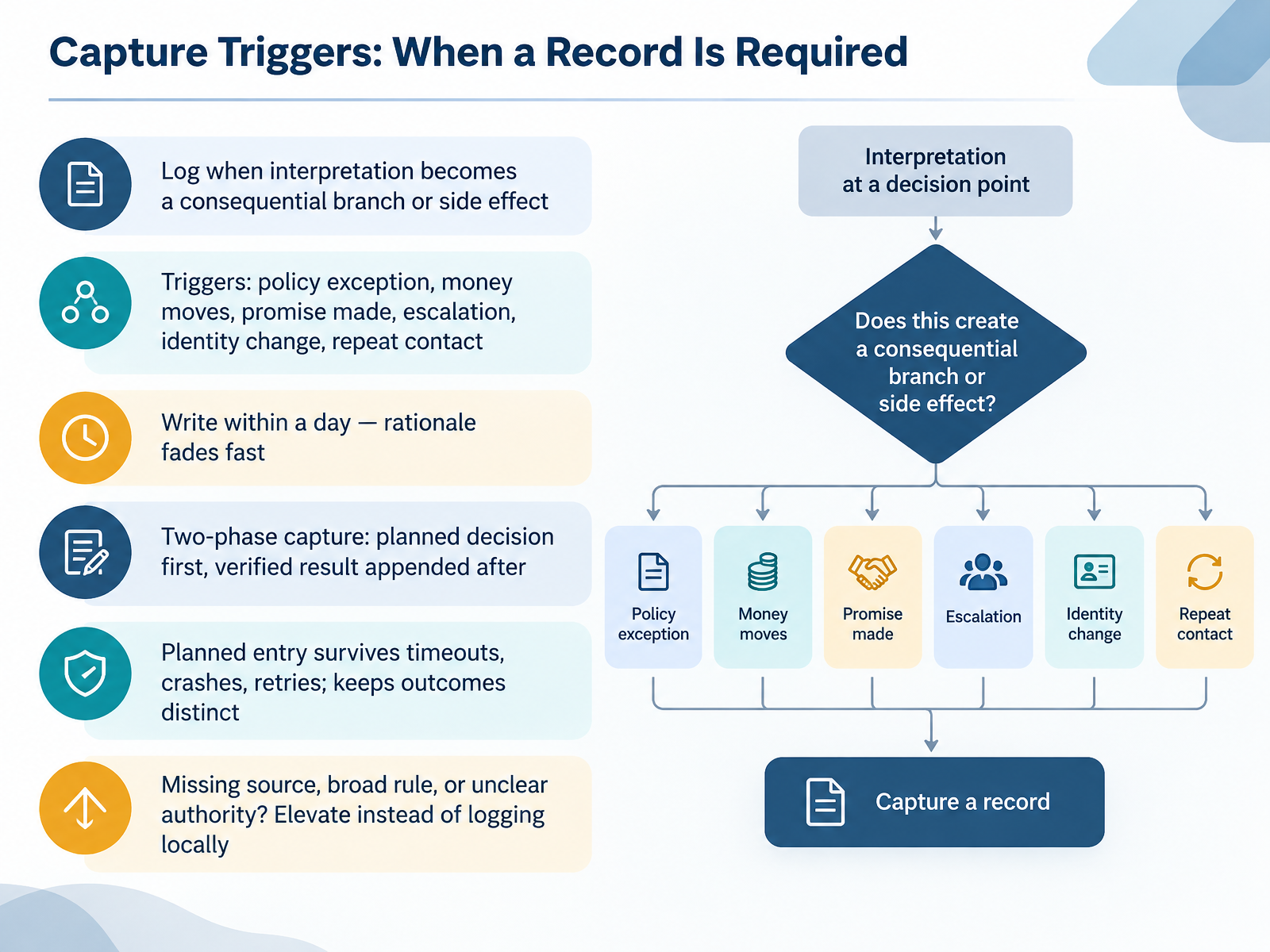
- 05Capture Triggers: When a Record Is RequiredLet's look at when a decision actually needs a record. Not every interaction does. You log when your interpretation becomes a consequential branch or a side effect. In plain terms, when the path forward changes because of what you decided. Common triggers include a policy exception, money moving, a promise you make to the customer, an escalation, a change in identity details, or a repeat contact on the same issue. When one of these appears, write it down within a day. Rationale fades fast, and tomorrow you may not recall why you chose that route. Use two phase capture. First, record the planned decision before you act. Then append the verified result once it is confirmed. That planned entry survives timeouts, crashes, and retries, and it keeps your original intent separate from the final outcome. If a source is missing, a rule is too broad, or the authority is unclear, do not log locally. Elevate it instead. Next, we will focus on writing clearly under time pressure.
 2 min
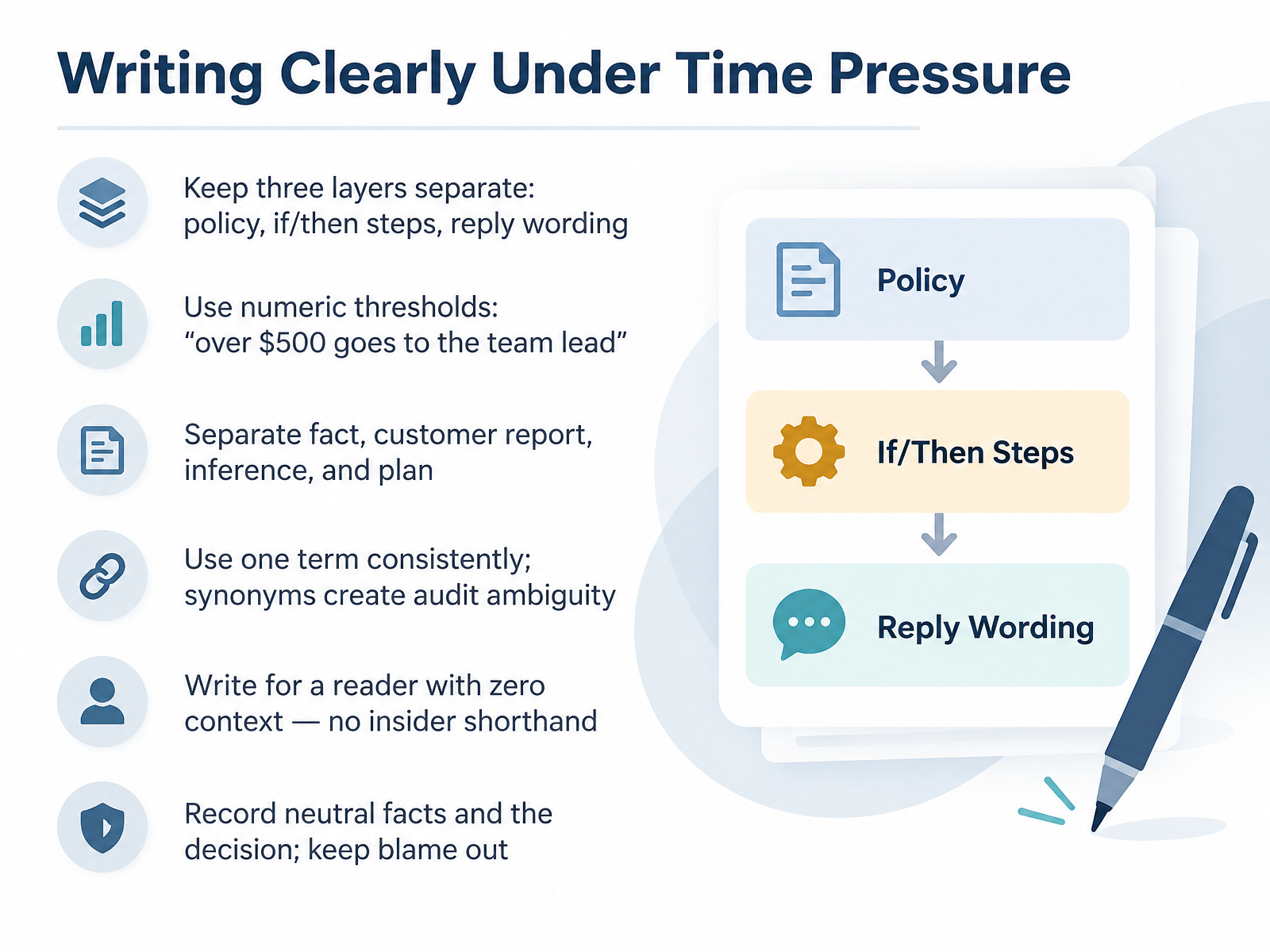
- 06Writing Clearly Under Time PressureLet's look at how to write clearly when you're under time pressure. The key is structure. First, keep three layers separate: the policy, the if then steps, and the wording you send to the customer. Second, use numeric thresholds so there is no judgment call. For example, write "over five hundred dollars goes to the team lead," not "large refunds go to the team lead." Third, separate fact, customer report, inference, and plan. Each one goes in its own sentence. Fourth, use one term consistently. Synonyms create audit ambiguity, so pick a word and stay with it. Fifth, write for a reader with zero context. No insider shorthand, no abbreviations only your team understands. Finally, record neutral facts and the decision. Keep blame out of the notes. A clear record protects the customer, the agent, and the organization. Next, we will examine policy, authority, and exceptions.
 clickup.comjamy.aiblog.workhint.com+21 min
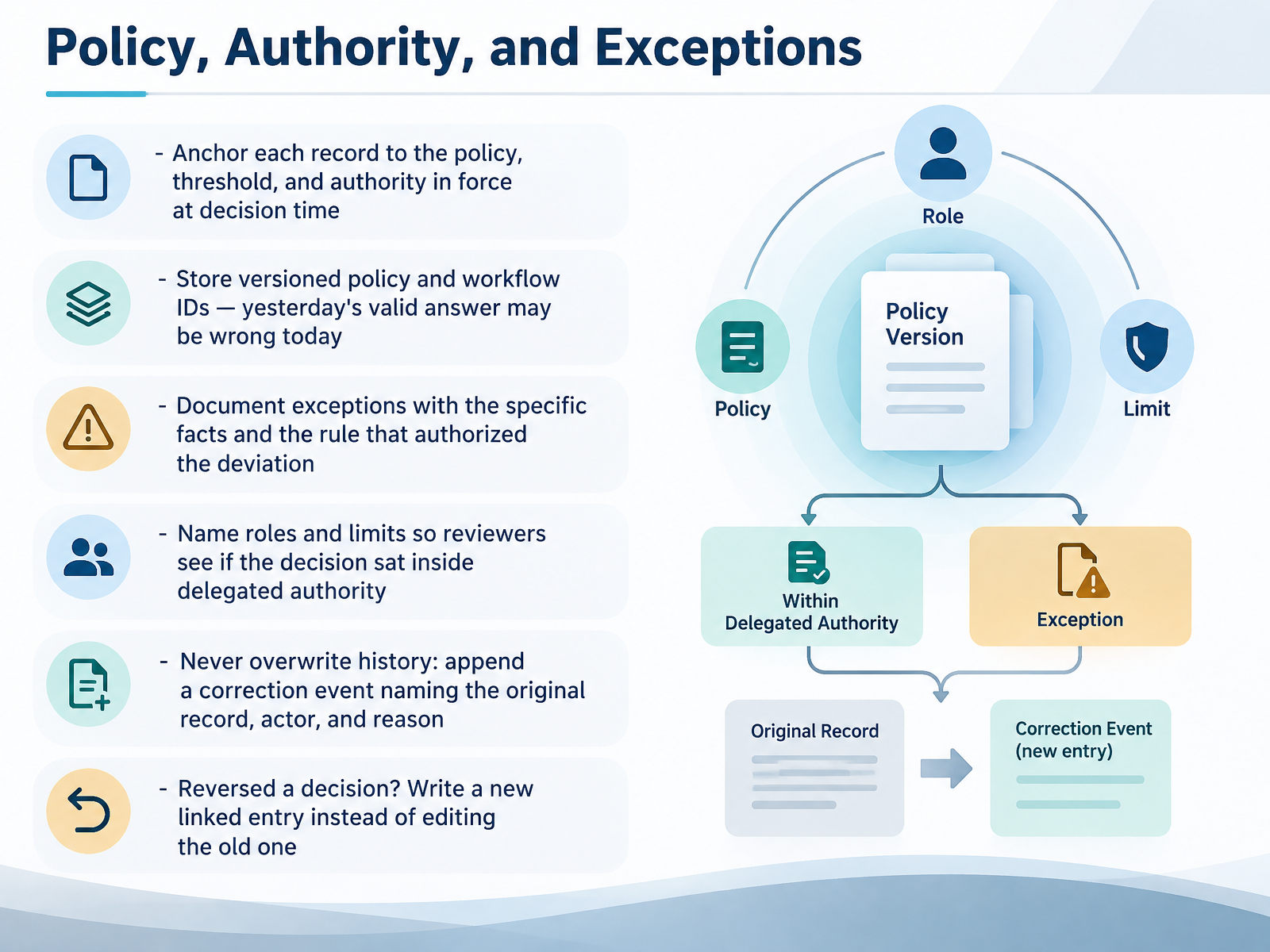
- 07Policy, Authority, and ExceptionsLet's talk about policy, authority, and exceptions. Every decision record should be anchored to the policy, threshold, and authority that were in force at that moment. Store versioned policy and workflow identifiers, because yesterday's valid answer may be wrong today. When you make an exception, document the specific facts and name the rule that authorized the deviation. For example, a refund above the standard limit should cite the approval clause and the approver's role. Name roles and their limits so reviewers can see whether the decision sat inside delegated authority. One more practice: never overwrite history. Append a correction event that names the original record, the actor, and the reason. If a decision is reversed, write a new linked entry instead of editing the old one. That keeps the trail honest, clear, and defensible. Next, we'll look at privacy, retention, and compliance requirements.
 1 min
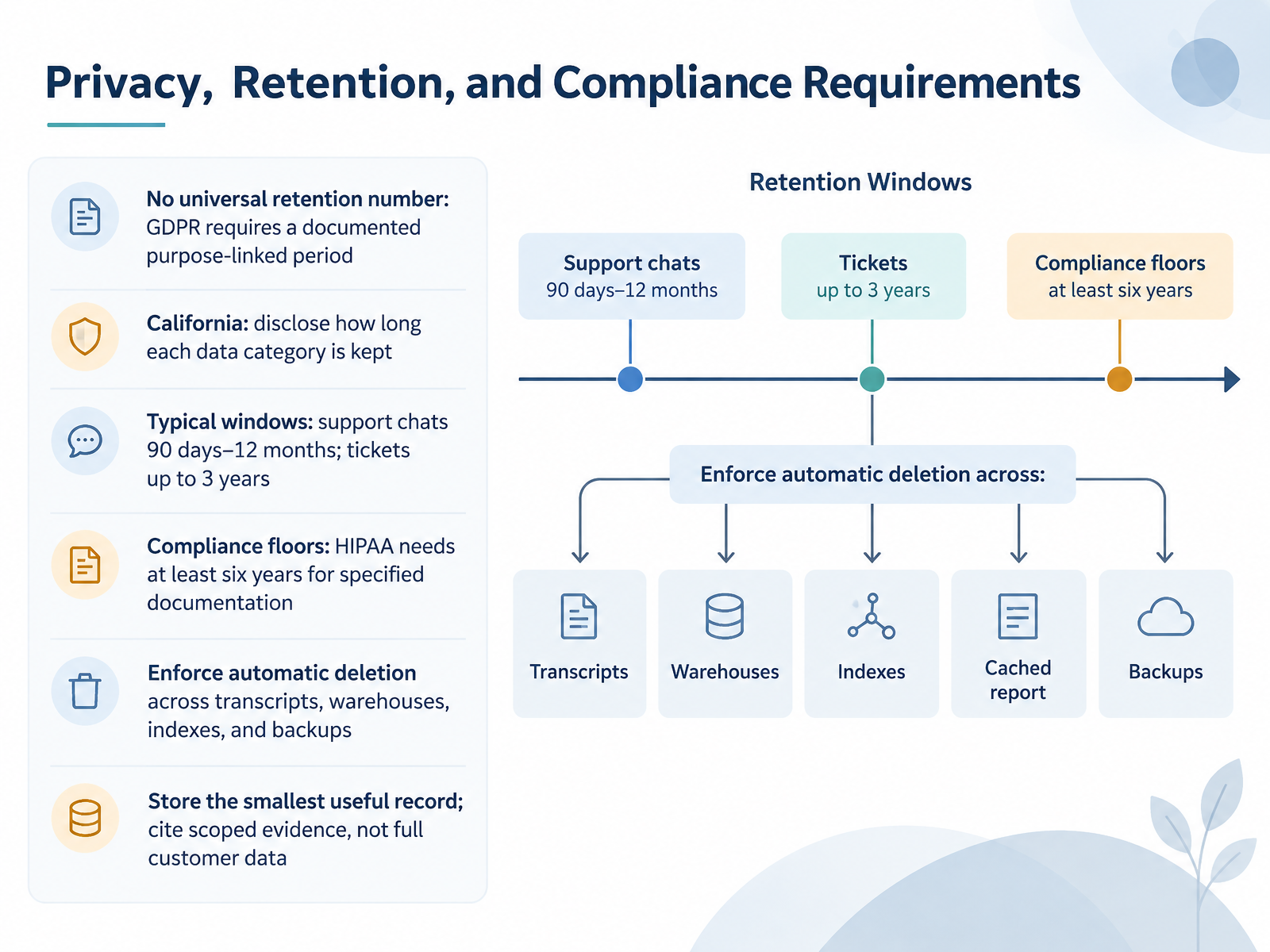
- 08Privacy, Retention, and Compliance RequirementsNow let's cover privacy, retention, and compliance requirements. There is no universal retention number. Under GDPR, you must define a documented retention period tied to a specific purpose. In California, you need to disclose how long each data category is kept. Typical windows vary. Support chats often range from ninety days to twelve months, while tickets may be kept for up to three years. Some rules set compliance floors. HIPAA requires at least six years for specified documentation. The key is to enforce automatic deletion across transcripts, warehouses, indexes, and backups. Store the smallest useful record. Cite scoped evidence, not full customer data. This keeps service records defensible and respectful. Next, let's look at tools, templates, and systems of record.
 2 min
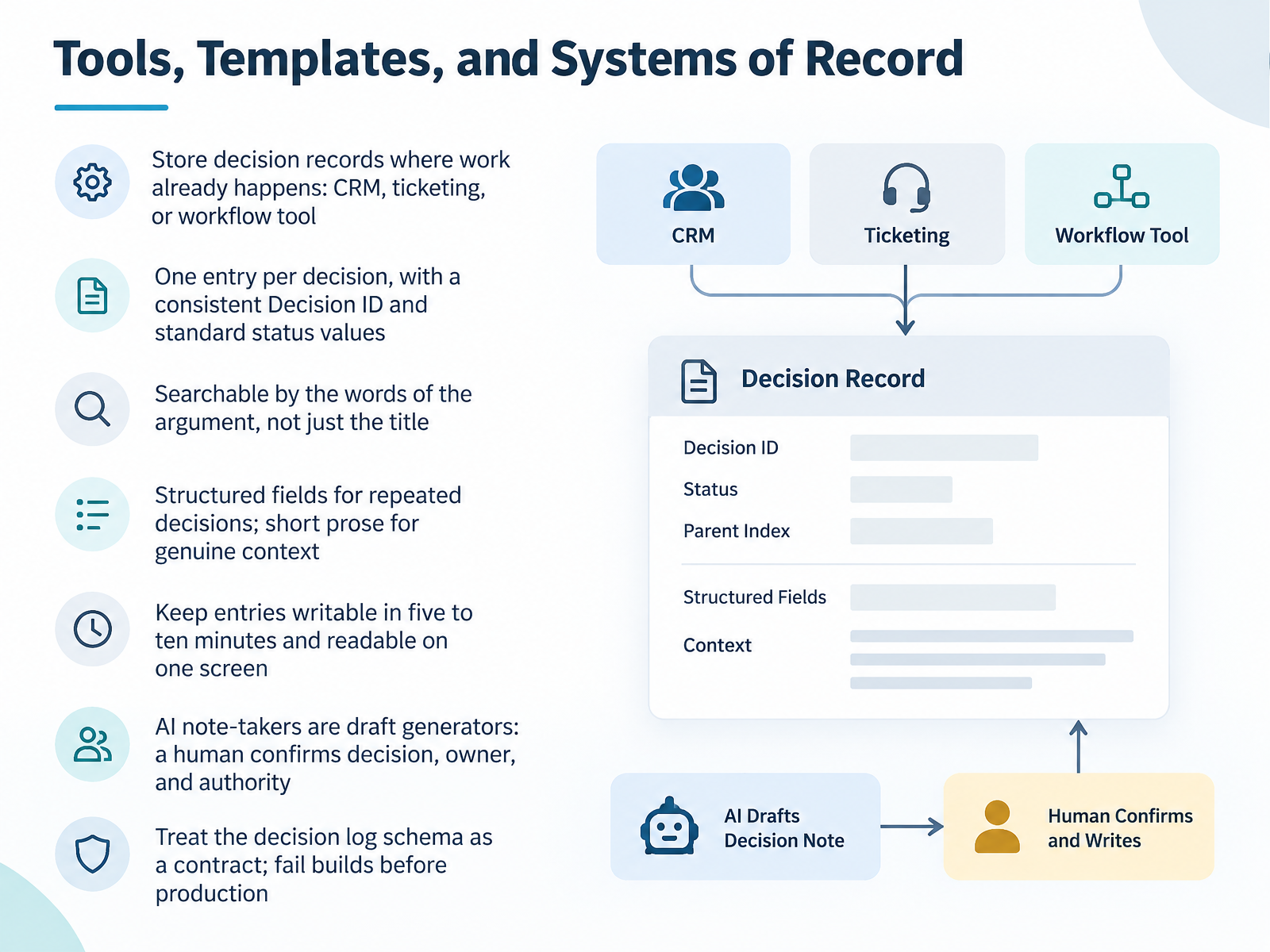
- 09Tools, Templates, and Systems of RecordNow let's look at where all of this actually lives, and what it should look like.
First, store decision records where the work already happens. That means your CRM, your ticketing tool, or your workflow system. One entry per decision, with a consistent Decision ID and standard status values, so filtering and searching actually work.
Make entries searchable by the words of the argument, not just the title. Months later, you will remember the reason, not the label.
Use structured fields for repeated decisions, and short prose for genuine context. Keep each entry writable in five to ten minutes and readable on one screen.
If you use AI note-takers, treat them as draft generators. A human still confirms the decision, the owner, and the authority behind it.
Finally, treat the decision log schema as a contract. If a release changes a field or a status value, let the build fail before it reaches production. That keeps your records trustworthy.
Next, we will turn to reviewing and auditing decision records.
 clickup.comjamy.aiblog.workhint.com+21 min
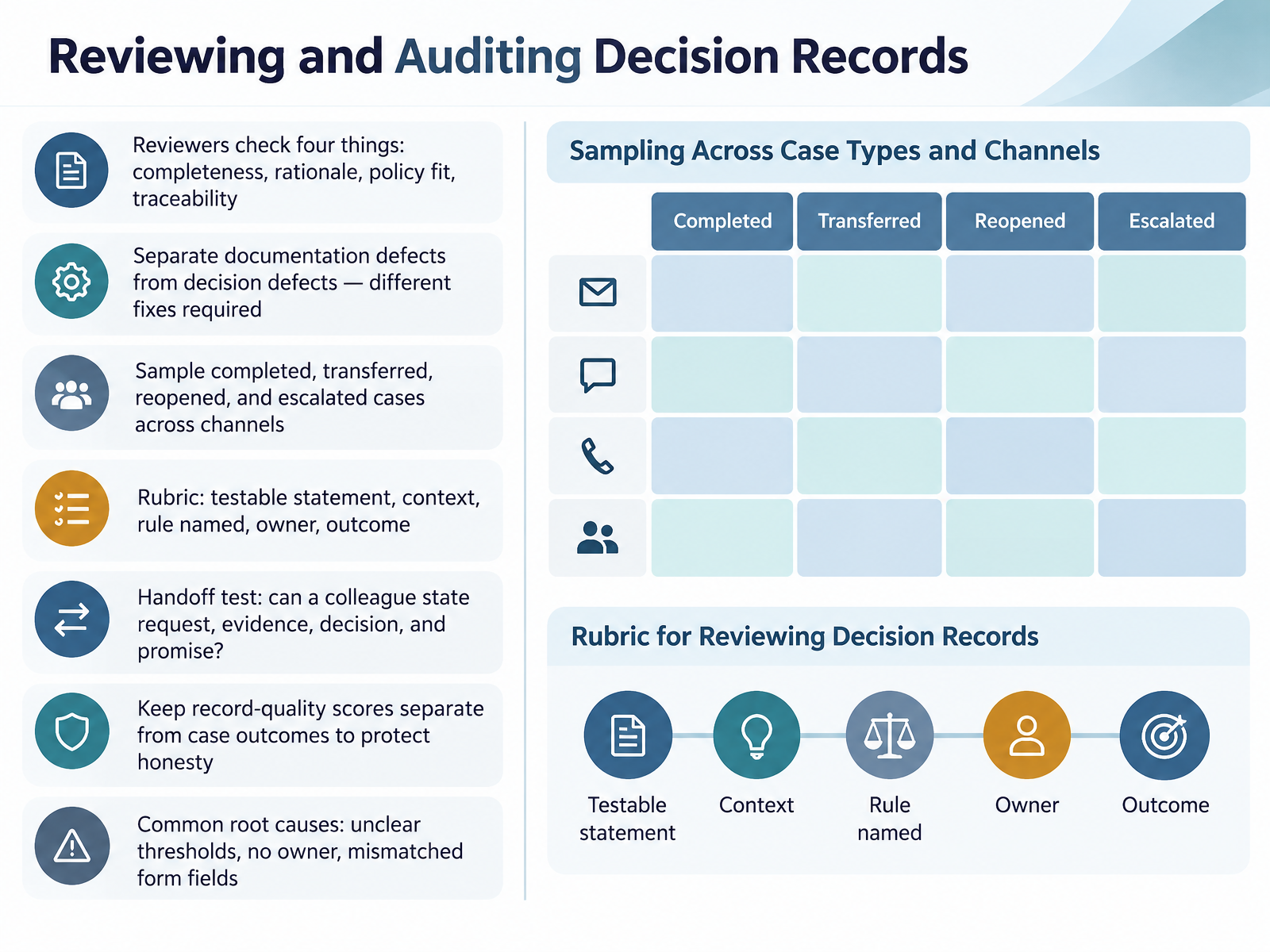
- 10Reviewing and Auditing Decision RecordsNow let's focus on how decision records are reviewed and audited. When reviewers examine a record, they check four things. Completeness. Is anything missing? Rationale. Is the reasoning clear? Policy fit. Does the decision follow our rules? And traceability. Can we follow the path from request to outcome? A useful distinction is between documentation defects and decision defects. A documentation defect means the decision was sound, but the record does not show it. A decision defect means the choice itself was wrong. Because the fixes differ, label them separately. In practice, sample completed, transferred, reopened, and escalated cases across all channels. Use a simple rubric. Does the record include a testable statement, enough context, the rule that was named, the owner, and the outcome? Then apply the handoff test. Can a colleague read the record and clearly state the request, the evidence, the decision, and the promise made to the customer? Keep record-quality scores separate from case outcomes. Otherwise, reviewers may hide weak documentation to protect a good result, or punish a strong decision because the notes were rushed. Finally, watch for common root causes. Unclear thresholds, no assigned owner, and form fields that do not match the decision being made. Those patterns point to process fixes, not individual blame. With that review lens in place, let's move on to measuring documentation quality and impact.
 2 min
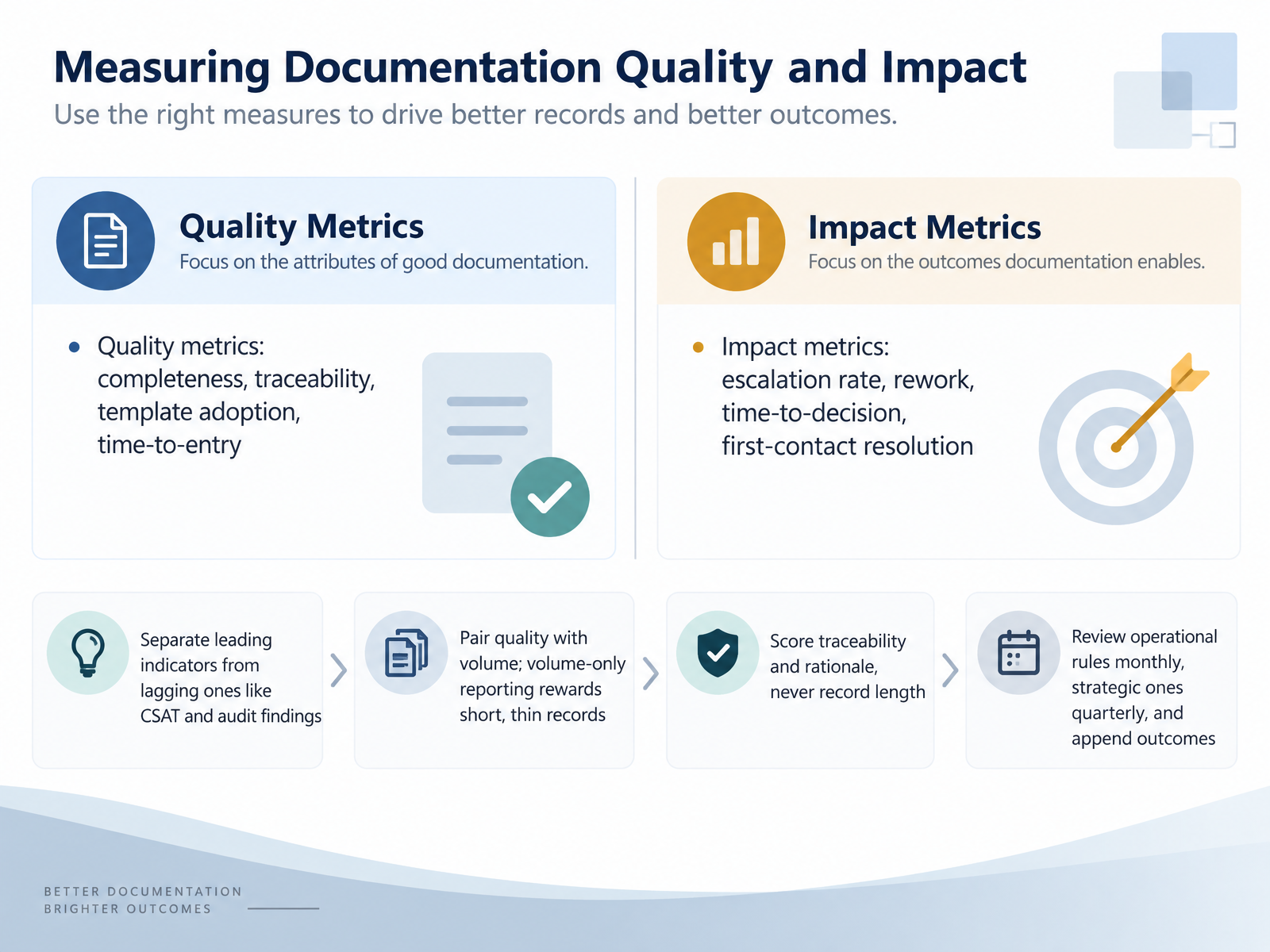
- 11Measuring Documentation Quality and ImpactNext, let's look at how we measure documentation quality and its impact. Start with quality metrics: completeness, traceability, template adoption, and time-to-entry. Then track impact metrics: escalation rate, rework, time-to-decision, and first-contact resolution. Keep leading indicators separate from lagging ones, like customer satisfaction and audit findings. Here is a practical example. If first-contact resolution improves after agents record clear rationale, that is a leading signal. A later audit finding is a lagging result. Always pair quality with volume. Volume-only reporting rewards short, thin records that close fast but explain nothing. Score traceability and rationale, never record length. Review operational rules monthly and strategic ones quarterly, and append outcomes as they emerge. In short, measure what makes a record useful, not just how many you produce. That sets up our next topic: coaching and embedding the practice.
 1 min
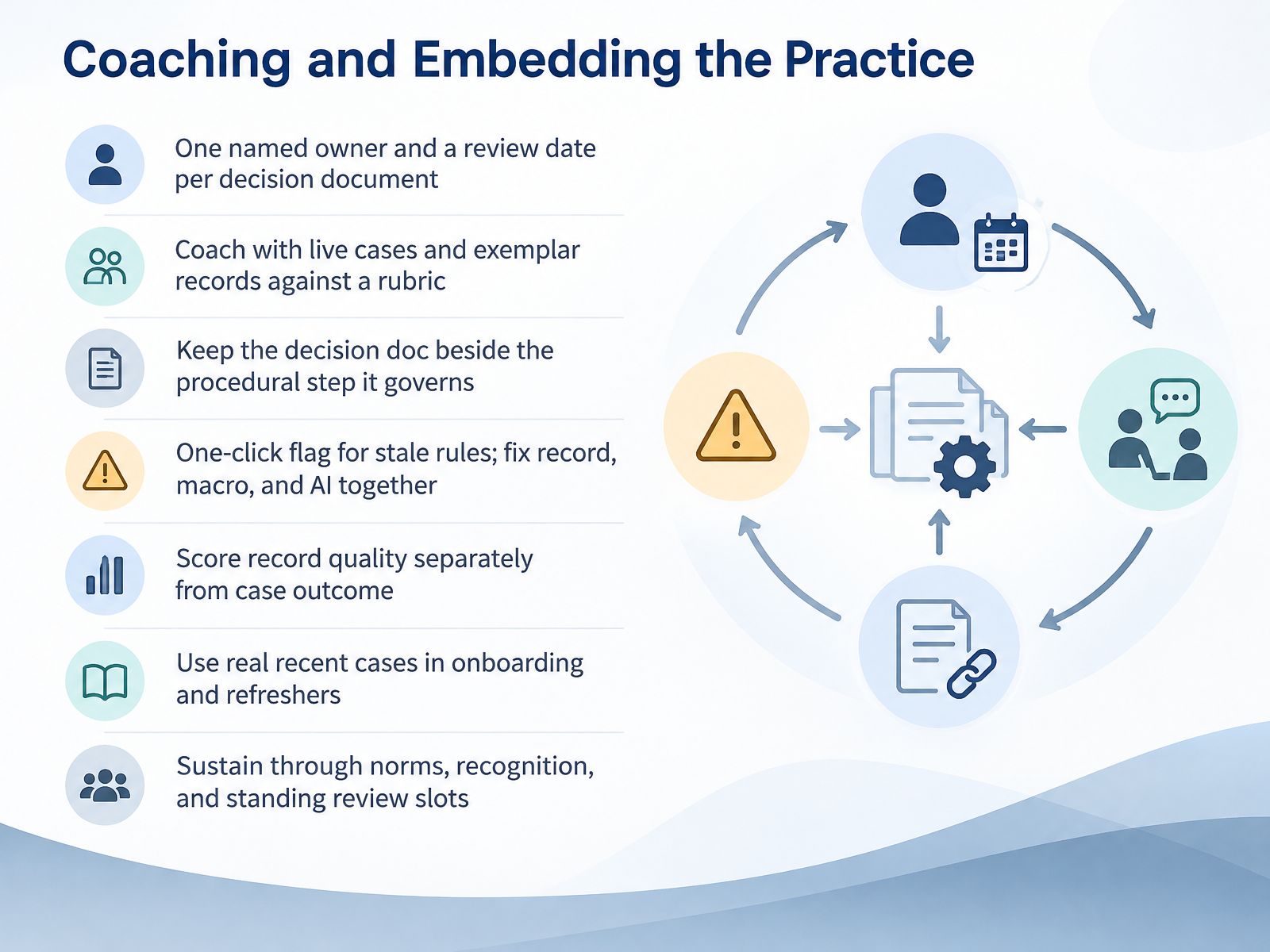
- 12Coaching and Embedding the PracticeLet's talk about how we make this practice stick. Start with ownership. Every decision document should have one named owner and a review date. If no one owns it, it goes stale.
Coach with live cases and exemplar records. Sit down with an agent, open a real case, and compare the record against a short rubric. Note what is clear and what is missing.
Keep the decision doc beside the procedural step it governs. When the step changes, the record changes with it. Add a one-click flag for stale rules, and fix the record, the macro, and the AI guidance together.
Score record quality separately from case outcome. A good outcome can still hide a weak record. Use real recent cases in onboarding and refreshers, so new agents see the standard in action.
Sustain the practice through team norms, recognition, and standing review slots in your regular meetings. Consistency comes from routine, not reminders. Next, we will work through practice scenarios and an action plan.
 1 min
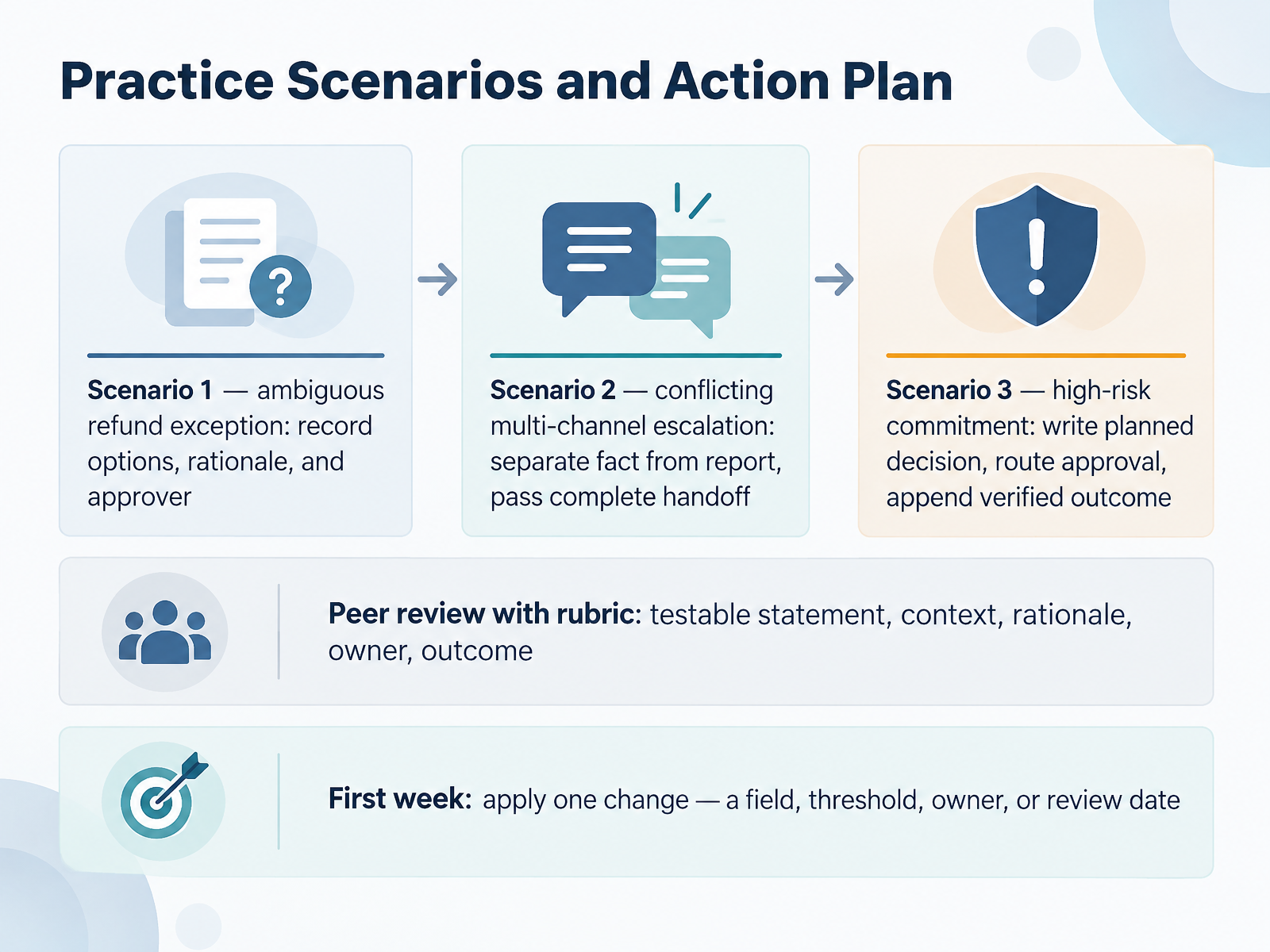
- 13Practice Scenarios and Action PlanLet's close with practice and one small commitment. Take three scenarios and run them through the same habit. Scenario one, an ambiguous refund exception. Record the options you considered, the rationale, and the approver, so the decision is testable later. Scenario two, a conflicting multi-channel escalation. Separate fact from report. Note what you verified, what the customer stated, and who said what, then pass a complete handoff. Scenario three, a high-risk commitment. Write the planned decision before you act, route it for approval, then append the verified outcome, so attempted and confirmed stay distinct. Then bring an entry to peer review with the rubric. Check for a testable statement, context, rationale, owner, and outcome. In your first week, apply one change. Add a field, set a threshold, name an owner, or set a review date. Documentation is part of the service, not a burden. Thank you for your attention, and go make one record better this week.
 clickup.comjamy.aiblog.workhint.com+21 min
Take the deck with you
Download this course as a file — free, no sign-up needed.
- PDF handoutEvery slide page, ready to print or share.14 pages · 2.8 MBDownload
- Narrated PowerPointThe deck that presents itself — every slide carries the digital human's narration video.14 pages · 11.9 MBDownload
- PowerPoint slidesThe full deck as a .pptx — open it in PowerPoint, Keynote, or Google Slides.14 pages · 2.7 MBDownload
Free to use in your own training — please keep the PersonWise credit page at the end.
Have your own deck? Turn it into a course
Sources consulted
Web sources consulted while building this course.
- CRM Call Logging Template | Template by ClickUp™ — clickup.com
- Decision Log Template: Track Meeting Decisions, Rationale, and Follow-Ups - Jamy AI — jamy.ai
- Decision Log Template For Better Team Decisions - The Workhint Blog — blog.workhint.com
- Decision Log Template | Elium — elium.com
- AI Agent Decision Logs: Record Evidence Without Storing Chain of Thought — dev.to