Begin
14 pages · ~28 min
Cellular Respiration: Releasing Cellular Energy
This training explains how cells release energy through cellular respiration, helping learners understand the core process of energy production in living organisms.
A digital instructor presents all 14 pages. Hold “Ask” at any point and ask out loud — the answer comes from this course. No sign-up needed.
What you’ll learn
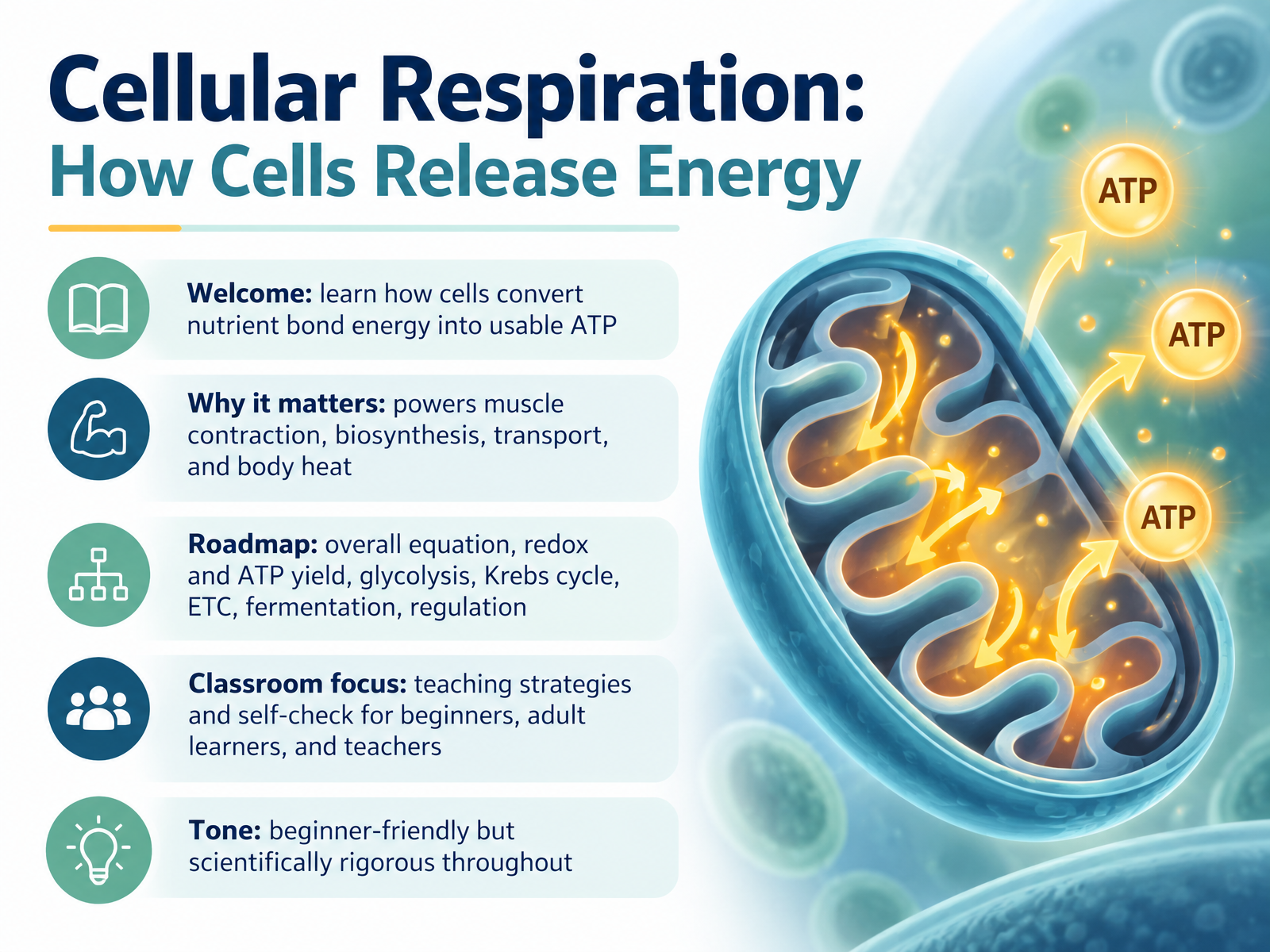
- 01Cellular Respiration: How Cells Release EnergyWelcome to Cellular Respiration: How Cells Release Energy. In this course, we'll follow how cells convert the bond energy in nutrients, most often glucose, into ATP, the molecule that powers cellular work. Why does this matter? ATP drives muscle contraction, biosynthesis, and active transport, and some energy is released as body heat. Here's our roadmap. We'll start with the overall equation, then redox reactions and ATP yield, then walk through glycolysis, the Krebs cycle, the electron transport chain, and fermentation, and finish with regulation. Mixed audience note. If you're a student or adult learner, focus on the location, inputs, and outputs of each stage. If you're a teacher, also note the teaching strategies and the self-check questions. Throughout, we'll stay beginner-friendly but scientifically rigorous. Quick takeaway for this slide. Cellular respiration is how cells harvest usable energy from food bonds, one controlled step at a time. Up next, Starting Misconceptions: Clearing the Ground Early.monash.eduinfo.mheducation.compremiermcatprep.com+22 min
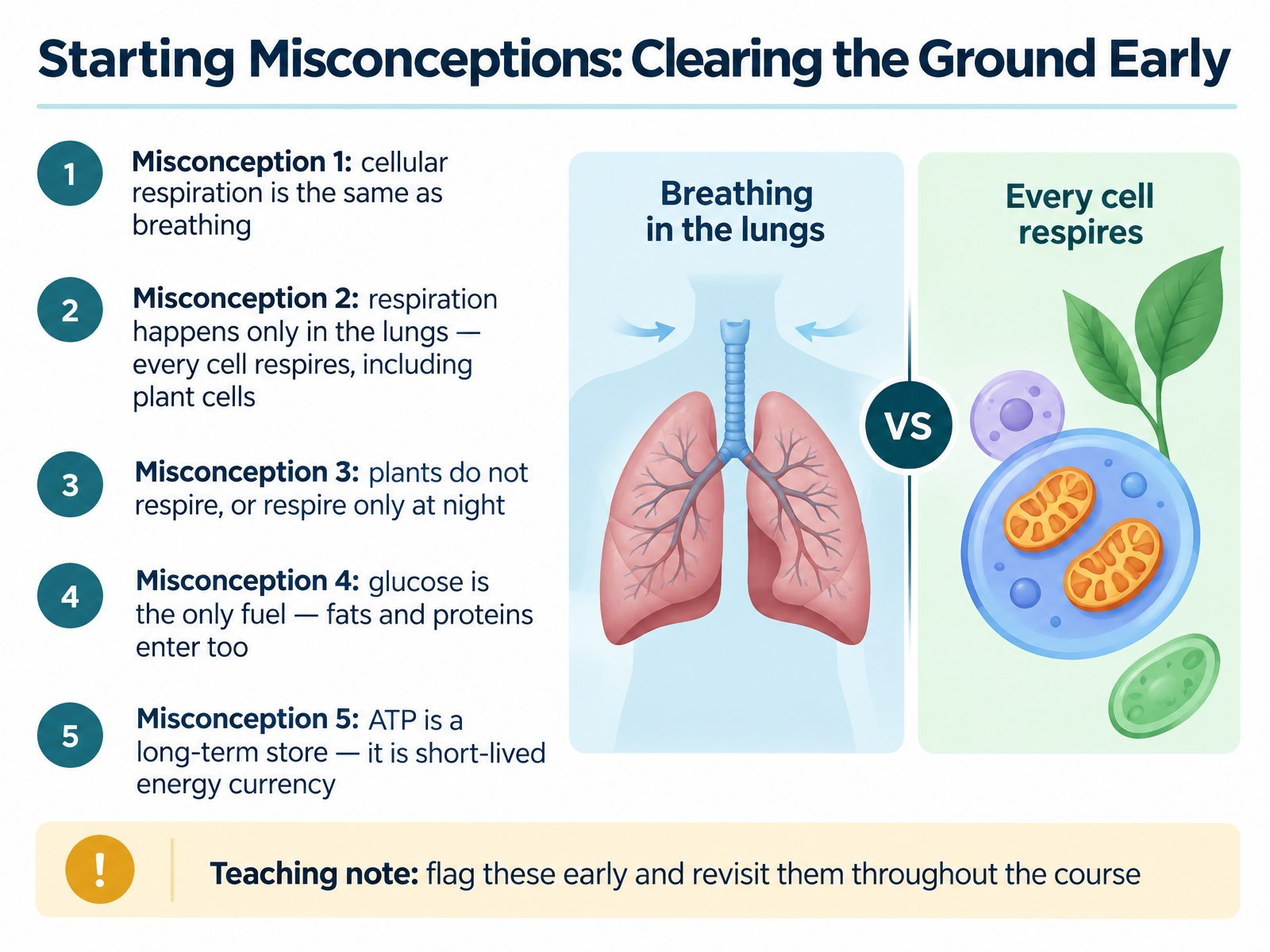
- 02Starting Misconceptions: Clearing the Ground EarlyBefore we look at the pathways, let's clear the ground. Five misconceptions follow students into this topic, and research shows they persist even after good instruction. So we name them early and revisit them often. First, cellular respiration is not breathing. Breathing moves air; respiration is chemistry inside cells. Second, respiration happens in every cell, including plant cells, not only in the lungs. Third, plants do respire, day and night. They simply release carbon dioxide quietly during daylight while photosynthesis takes it up. Fourth, glucose is the main fuel, but not the only one. Fats and proteins also enter these pathways. Fifth, ATP is not a long-term store. It is short-lived energy currency, spent and rebuilt continuously. One practical note for teachers: flag each misconception now and return to it after every major stage. Takeaway: respiration is cellular, universal, and fuel-flexible. Next, let's see the overall equation and how energy flows through these steps.
 iubmb.onlinelibrary.wiley.compmc.ncbi.nlm.nih.goviubmb.onlinelibrary.wiley.com+22 min
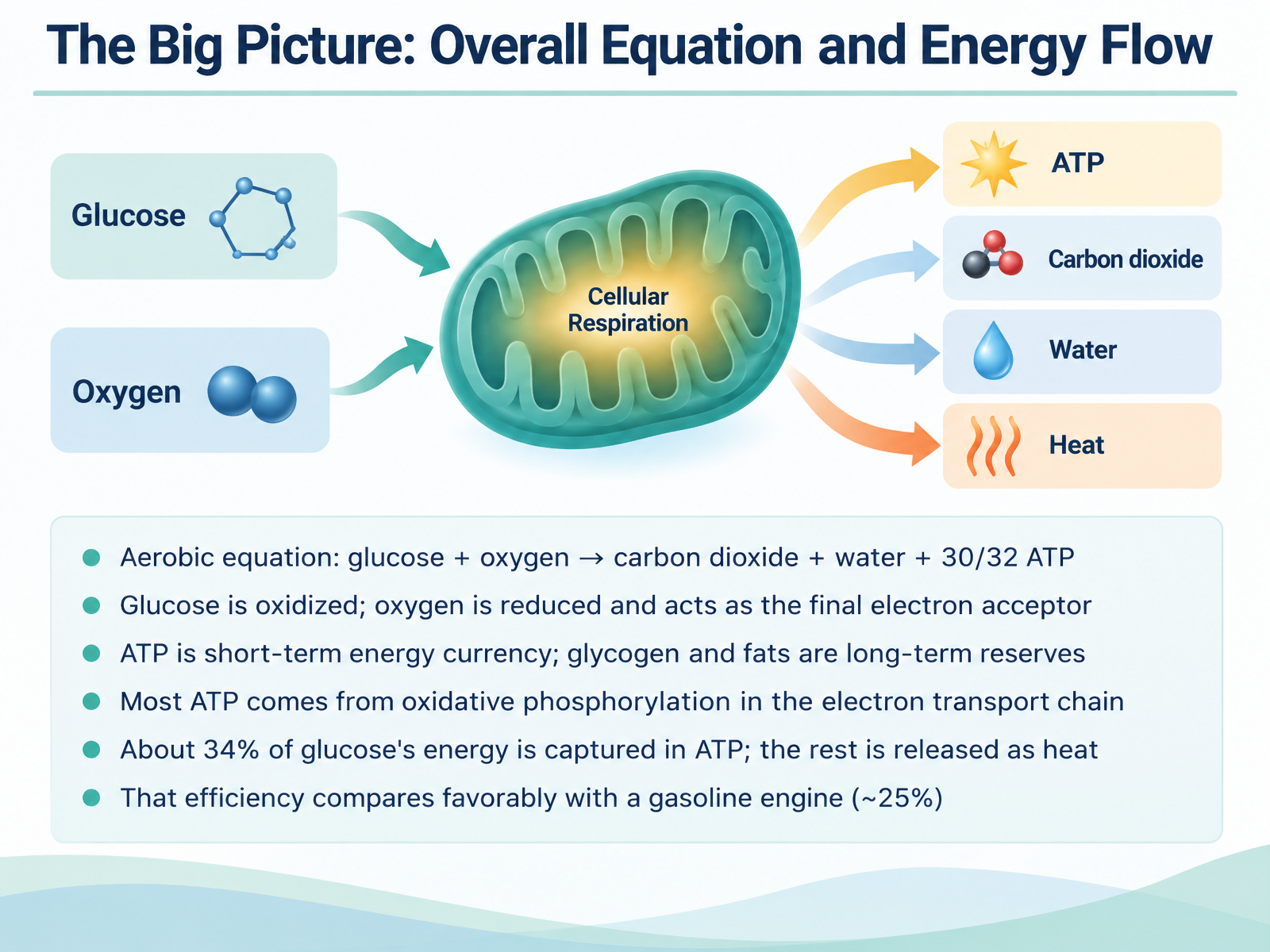
- 03The Big Picture: Overall Equation and Energy FlowNow let's zoom out and look at the whole picture. The overall equation for aerobic respiration is: glucose plus oxygen yields carbon dioxide, water, and about thirty to thirty-two A T P. In this reaction, glucose is oxidized, meaning it loses electrons, while oxygen is reduced, meaning it gains electrons, and serves as the final electron acceptor. Think of A T P as the cell's short-term energy currency, while glycogen and fats are long-term reserves. Now, here's the key point: most of that A T P, around twenty-six to twenty-eight molecules, comes from oxidative phosphorylation in the electron transport chain. The efficiency is impressive: about thirty-four percent of glucose's energy is captured in A T P, and the rest is released as heat. That may not sound high, but it beats a gasoline engine, which operates at around twenty-five percent. For teachers, emphasize that this efficiency comparison helps students appreciate the energy dynamics. For students, the core takeaway is that respiration is a controlled, stepwise release of energy. Let's move on to why textbooks say thirty to thirty-two A T P instead of thirty-six to thirty-eight.
 monash.eduinfo.mheducation.compremiermcatprep.com+22 min
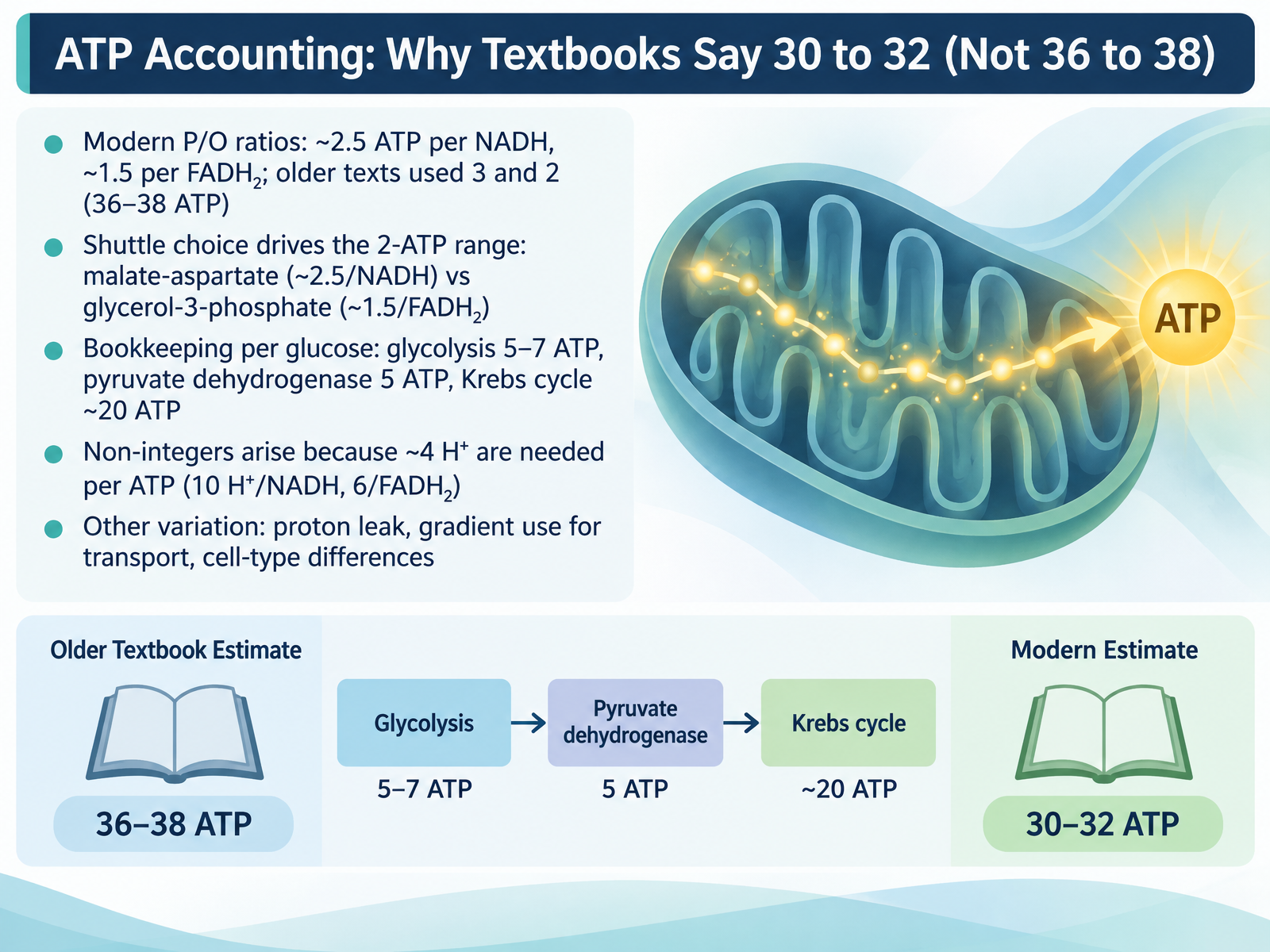
- 04ATP Accounting: Why Textbooks Say 30 to 32 (Not 36 to 38)Next, let's look at ATP accounting, and why textbooks now say thirty to thirty-two, not thirty-six to thirty-eight. Modern values are about two point five ATP per NADH and one point five per FADH two. Older texts used three and two. The two-ATP range comes from the shuttle that carries glycolysis NADH into the mitochondrion. The malate-aspartate shuttle delivers it as NADH, at about two point five ATP. The glycerol three phosphate shuttle delivers it as FADH two, at about one point five. By the bookkeeping: glycolysis gives five to seven ATP, pyruvate dehydrogenase gives five, and the Krebs cycle gives about twenty. Non-integers arise because roughly four protons are needed per ATP, with ten protons per NADH and six per FADH two. Proton leak and gradients used for transport add variation. For students, remember thirty to thirty-two. For teachers, the proton count is the key detail. Quick takeaway: the range is real, and it comes from protons and shuttles. Now, Glycolysis: Splitting Glucose in the Cytoplasm.
 monash.eduinfo.mheducation.compremiermcatprep.com+22 min
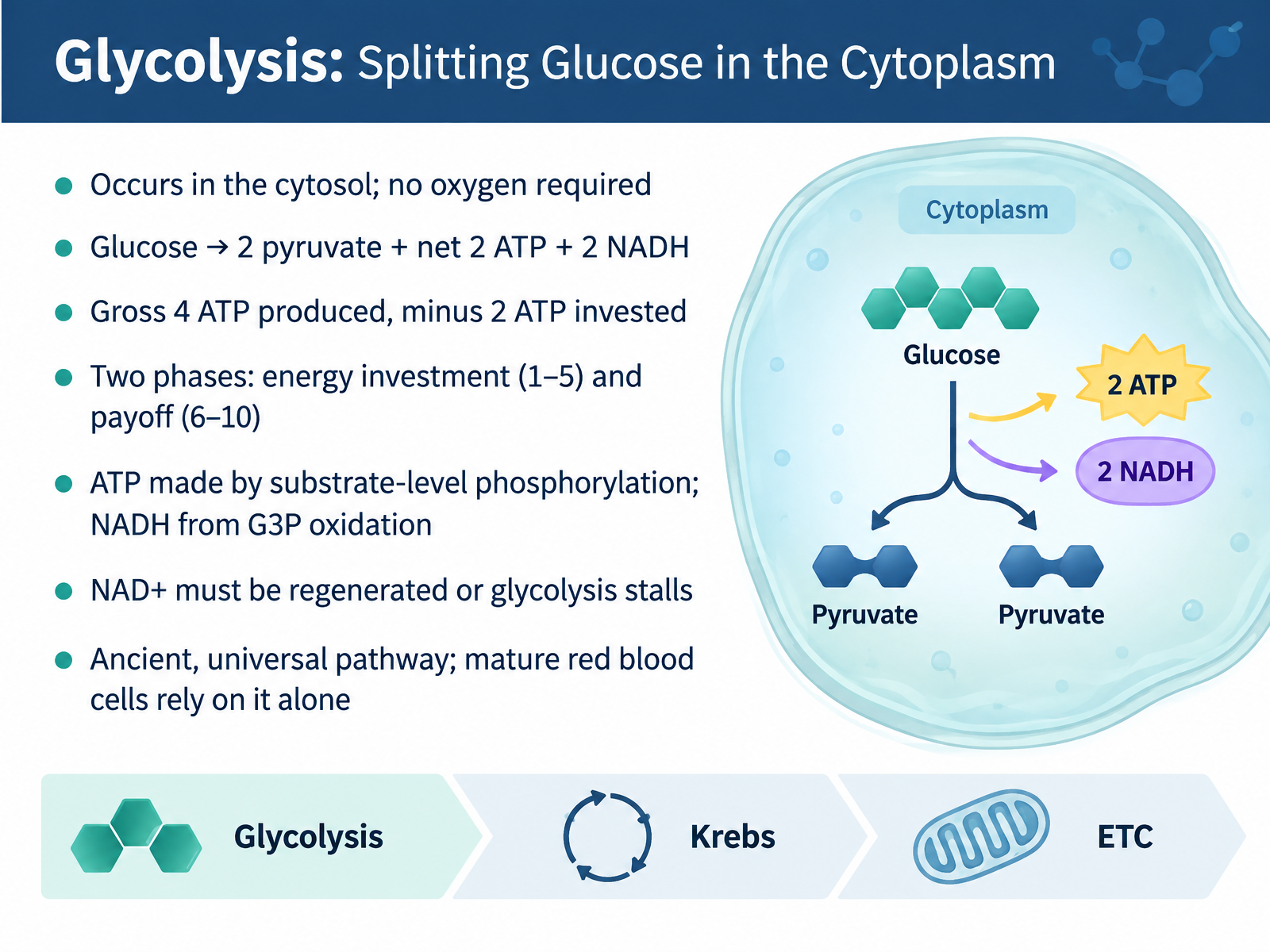
- 05Glycolysis: Splitting Glucose in the CytoplasmNow let's follow glucose into the cytosol, where glycolysis takes place without any need for oxygen. One glucose molecule, a six-carbon sugar, is converted into two molecules of pyruvate, each with three carbons, plus a net gain of two ATP and two NADH. Here is the accounting that matters most for students. Glycolysis produces four ATP, but invests two ATP early on, so the net yield is two. Notice the two phases. In reactions one through five, the energy investment phase, the cell spends two ATP to prepare glucose for splitting. In reactions six through ten, the payoff phase, energy is recovered. ATP here is made by substrate-level phosphorylation, meaning a phosphate group is transferred directly to ADP. The NADH comes from oxidizing glyceraldehyde-3-phosphate, often called G3P, in step six. And remember, NAD plus must be regenerated, or glycolysis stalls, because step six depends on it. For teachers, this pathway is ancient and universal, and mature red blood cells, which lack mitochondria, rely on glycolysis alone to make ATP. So, the takeaway to restate: glycolysis splits one glucose in the cytosol, nets two ATP and two NADH, and needs no oxygen. Next, we look at where glycolysis is controlled: the committed step, regulating glycolysis at phosphofructokinase.
 openstax.orgpmc.ncbi.nlm.nih.govpearson.com+22 min
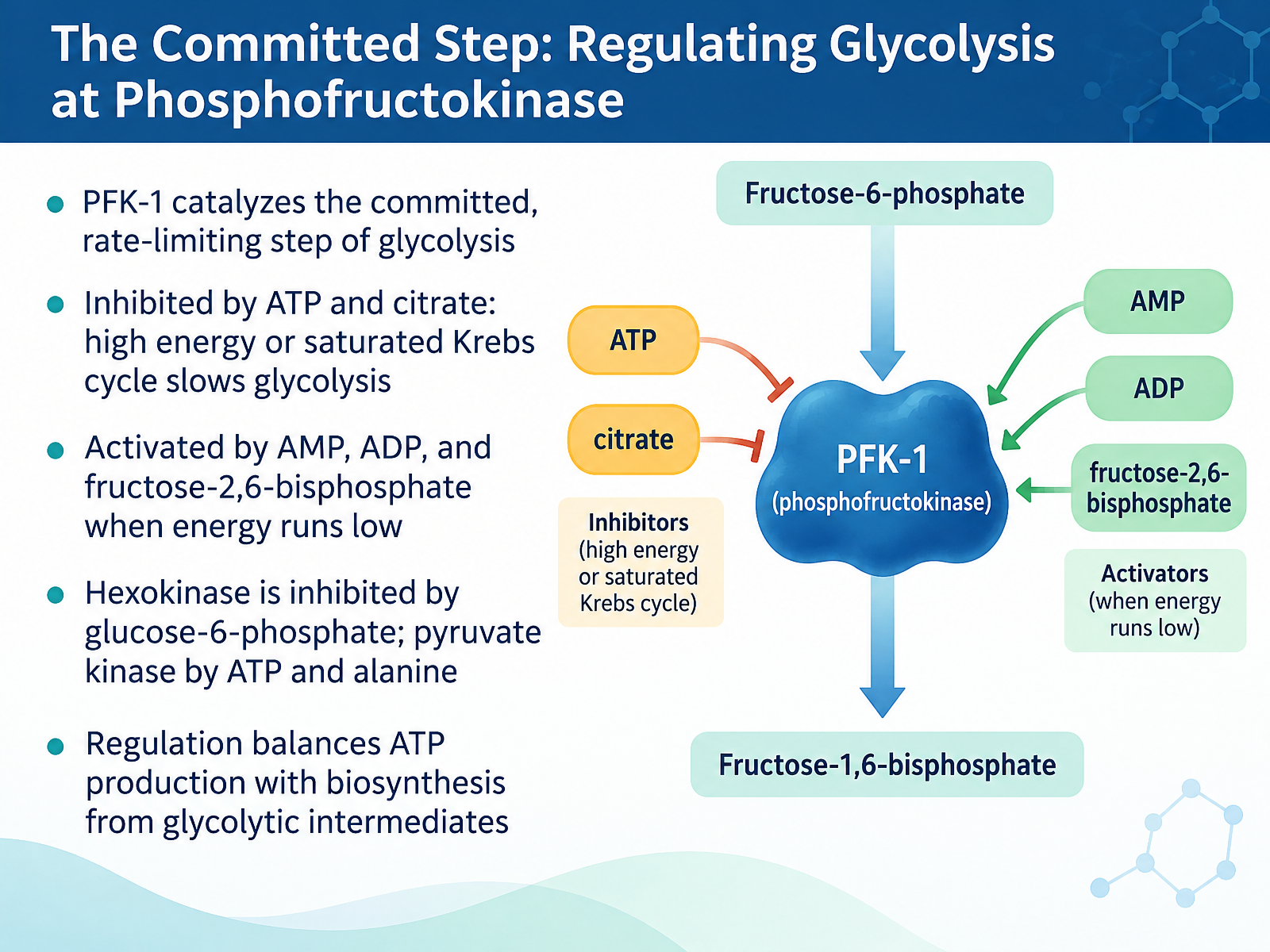
- 06The Committed Step: Regulating Glycolysis at PhosphofructokinaseNow let's look at the control point of glycolysis. The enzyme phosphofructokinase, or P F K one, catalyzes the committed, rate-limiting step. That means once this reaction happens, the sugar is committed to glycolysis. P F K one is allosterically inhibited by A T P and by citrate. When energy is plentiful, or when the Krebs cycle is saturated, glycolysis slows down. It is activated by A M P, A D P, and fructose two, six bisphosphate when energy runs low. The other regulated steps matter too. Hexokinase is inhibited by glucose six phosphate, and pyruvate kinase is inhibited by A T P and by alanine. For teachers, emphasize that this regulation balances A T P production with biosynthesis from glycolytic intermediates. Your takeaway: P F K one senses the cell's energy state and decides the pace of glycolysis. Next, we move to pyruvate oxidation and the Krebs cycle.
 openstax.orgpmc.ncbi.nlm.nih.govpearson.com+21 min
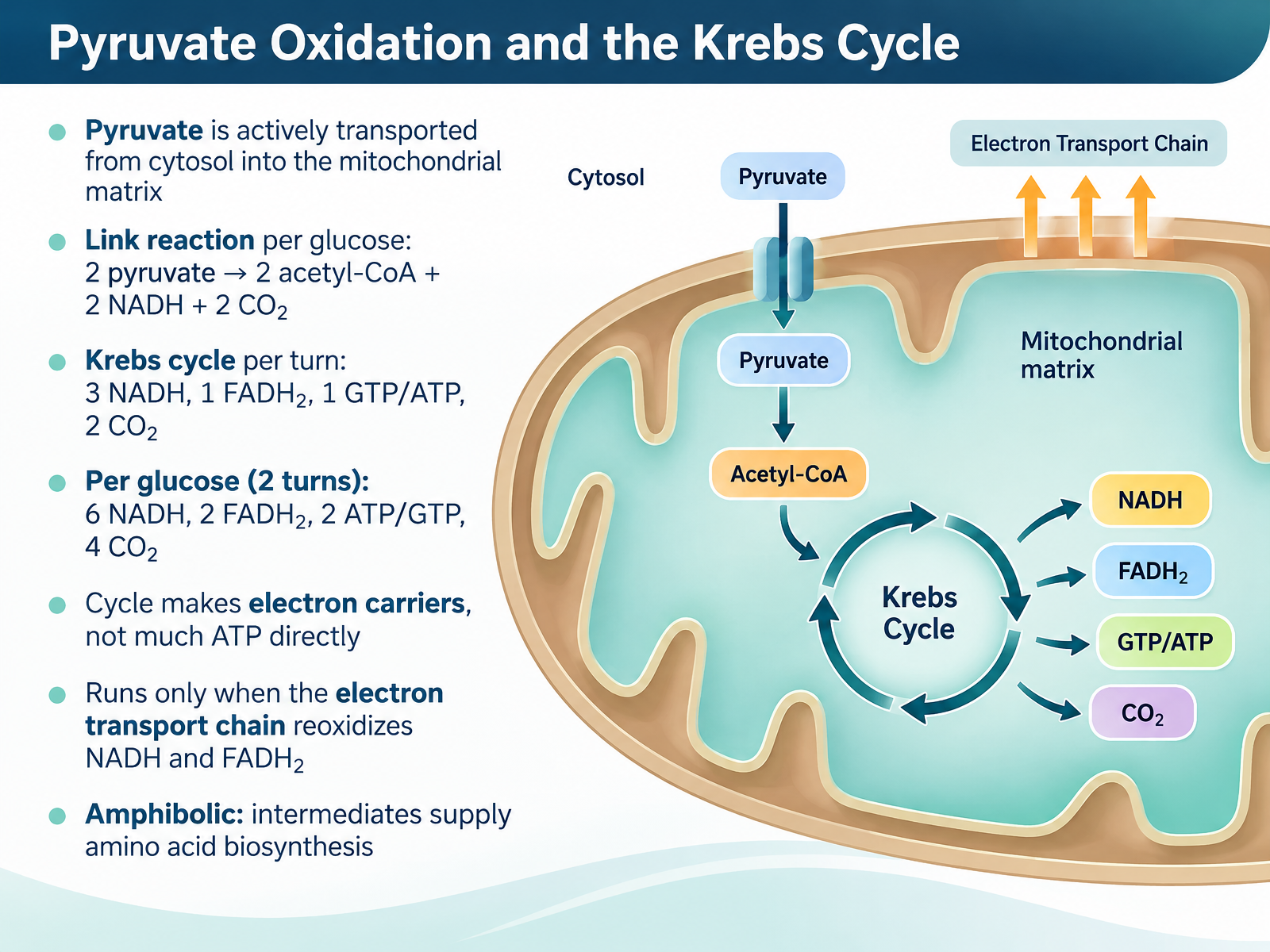
- 07Pyruvate Oxidation and the Krebs CycleNow that glycolysis has ended, we follow pyruvate into the mitochondrion. Pyruvate is actively transported from the cytosol into the mitochondrial matrix. There, in the link reaction, each pyruvate loses a carbon as carbon dioxide and is oxidized to form acetyl-CoA. Per glucose, that means two pyruvate become two acetyl-CoA, releasing two carbon dioxide and two NADH. Next, the Krebs cycle. In one turn, acetyl-CoA enters, and the cycle produces three NADH, one FADH2, one GTP or ATP, and two carbon dioxide. Because one glucose yields two acetyl-CoA, we get two turns. So per glucose, the total is six NADH, two FADH2, two ATP or GTP, and four carbon dioxide. Notice the cycle makes electron carriers, not much ATP directly. For students, that balance is the core takeaway. And it runs only when the electron transport chain reoxidizes NADH and FADH2. For teachers, flag that the cycle is amphibolic. Its intermediates supply amino acid biosynthesis, which links respiration to other pathways. In your own words, this stage mainly harvests electrons as NADH and FADH2 and releases carbon dioxide. Next, we follow those electrons into the electron transport chain and chemiosmosis.
 vcell.ndsu.nodak.edukhanacademy.orgen.wikipedia.org+22 min
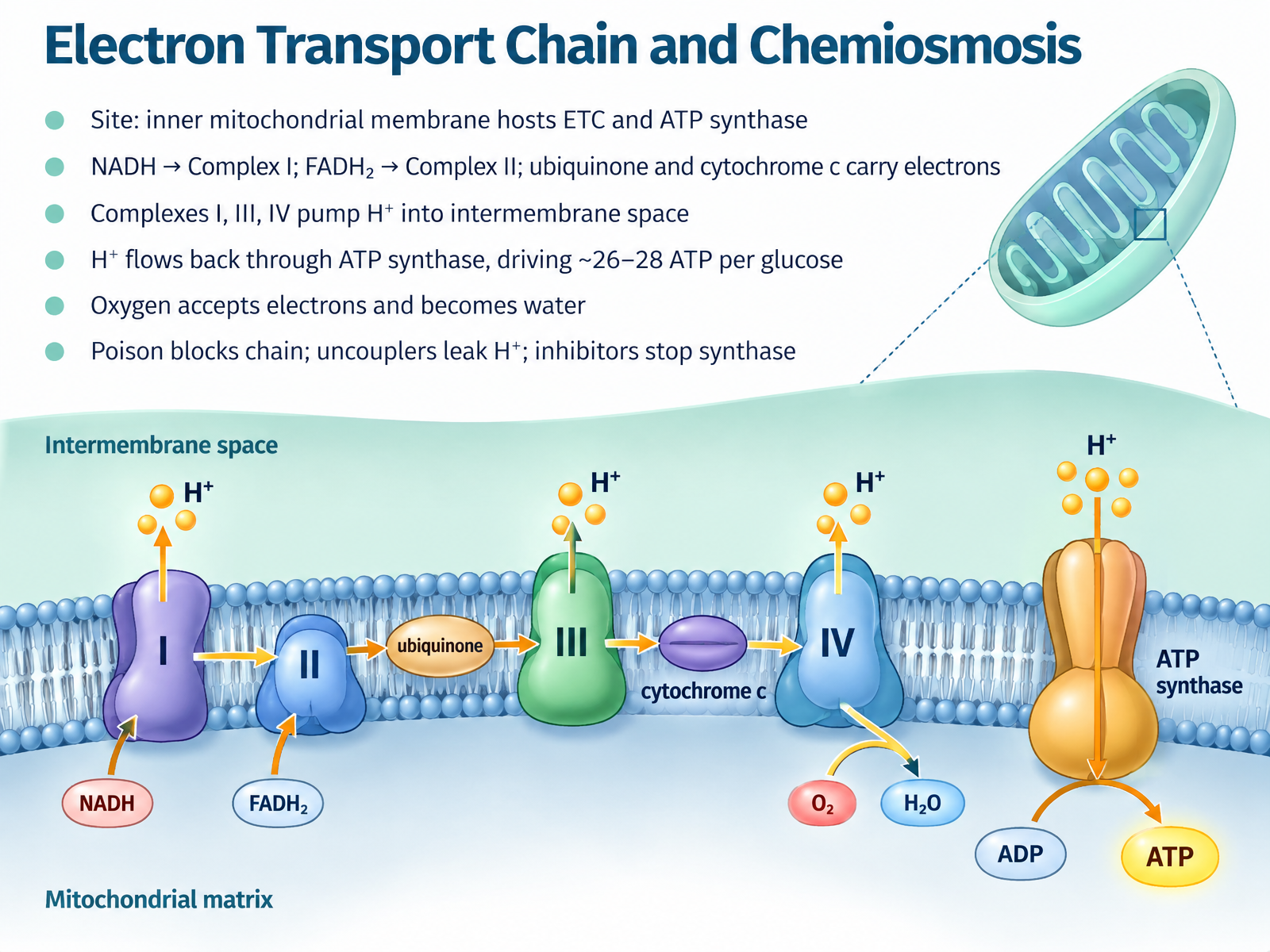
- 08Electron Transport Chain and ChemiosmosisNow we reach the stage that makes most of the ATP. The machinery sits in the inner mitochondrial membrane. NADH delivers electrons to Complex One, and FADH two delivers them to Complex Two. Two mobile carriers, ubiquinone and cytochrome c, shuttle those electrons onward. As electrons pass through Complexes One, Three, and Four, energy is used to pump hydrogen ions, also called protons, into the intermembrane space. That builds a gradient. The protons flow back through ATP synthase, which spins like a turbine and makes ATP. Per glucose, this stage yields about twenty six to twenty eight ATP. Oxygen accepts the spent electrons and becomes water. Teachers, note the three failure modes: poisons block the chain, uncouplers leak protons across the membrane, and inhibitors stop ATP synthase. Here is your takeaway: electrons power proton pumping, and the returning protons power ATP synthase. Next, we look at what happens when oxygen runs short, in anaerobic pathways, fermentation and oxygen limits.
 monash.eduinfo.mheducation.compremiermcatprep.com+22 min
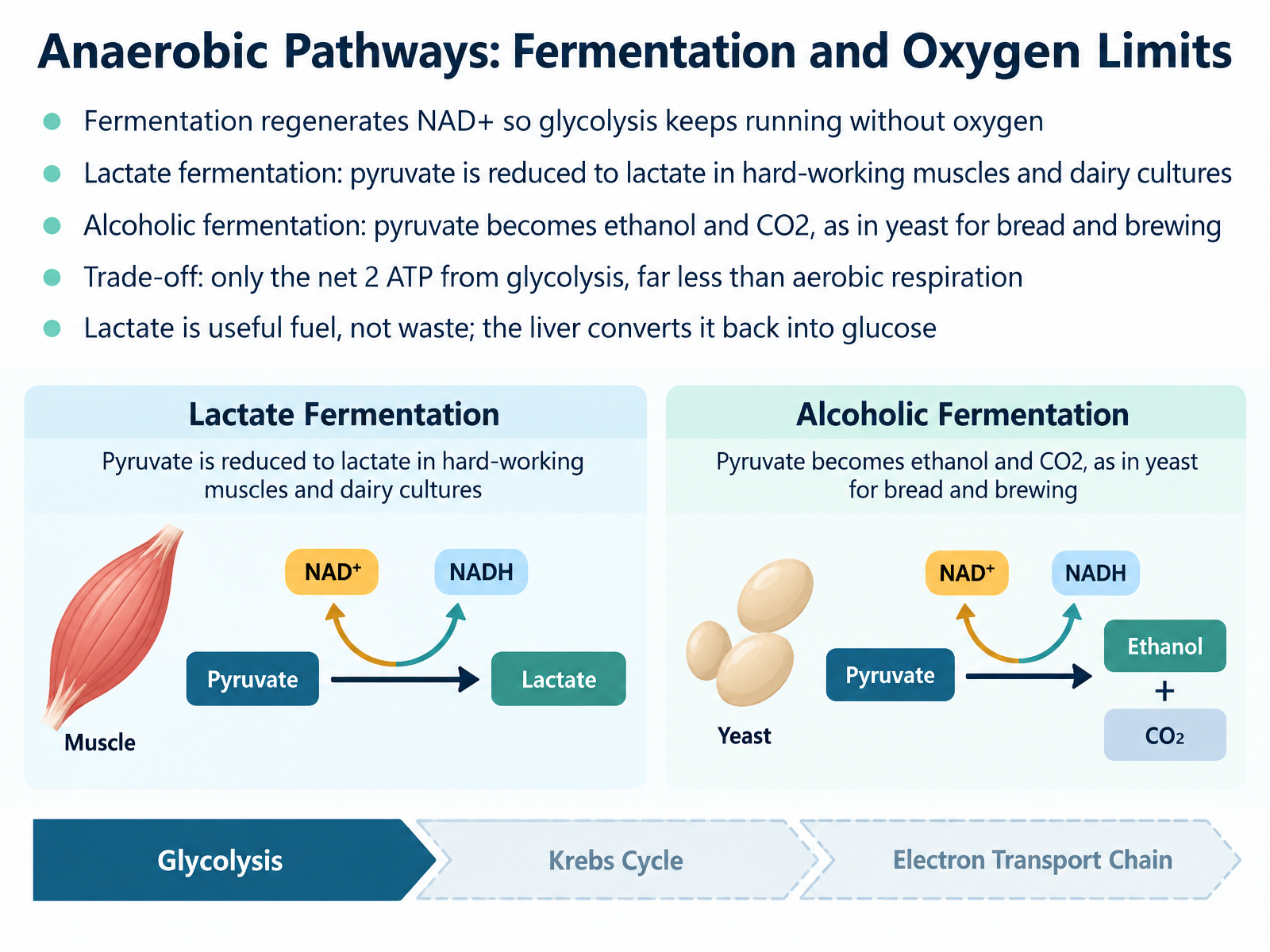
- 09Anaerobic Pathways: Fermentation and Oxygen LimitsNow let's look at what happens when oxygen runs short. Fermentation is the backup plan. Its job is to regenerate NAD plus, the oxidized electron carrier, so that glycolysis can keep running. Without oxygen, the electron transport chain cannot do that job, so fermentation takes over.
In hard-working muscles, and in dairy cultures, pyruvate is reduced to lactate. That single step converts NADH back into NAD plus. In yeast, pyruvate becomes ethanol and carbon dioxide, which is how bread rises and how brewing works.
Here is the trade-off. Fermentation yields only the net two ATP from glycolysis, far less than aerobic respiration. But that energy can be produced without oxygen, and quickly.
One important correction for students and teachers alike. Lactate is not waste. It is a useful fuel. The liver takes it up and converts it back into glucose.
So the takeaway is this. Fermentation buys time by recycling NAD plus, giving you two ATP per glucose, and lactate is a recyclable fuel.
Next, we clear up the lactate myth.
 openstax.orgpmc.ncbi.nlm.nih.govpearson.com+22 min
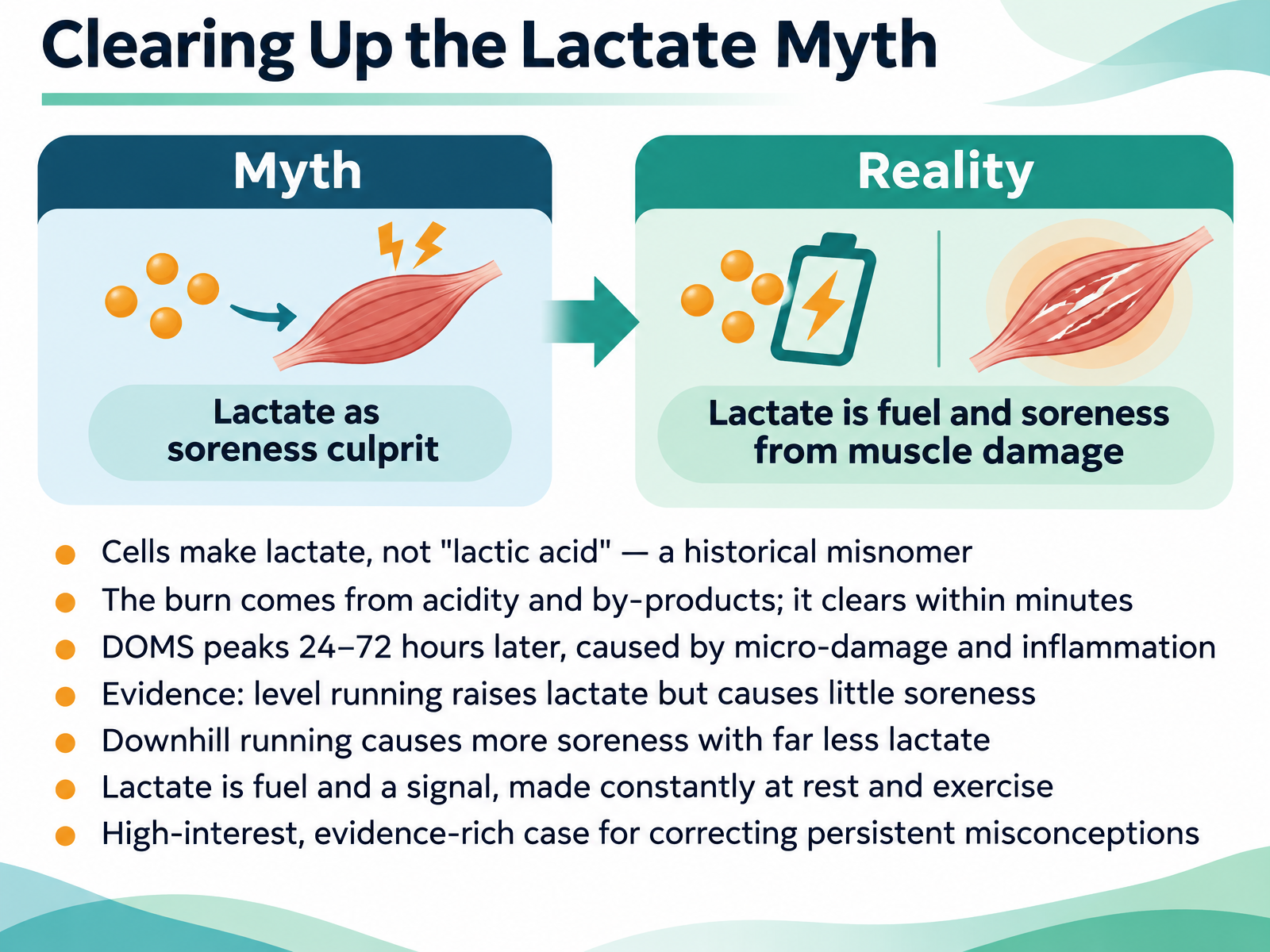
- 10Clearing Up the Lactate MythNow let's clear up one stubborn myth about lactate. Cells make lactate, not lactic acid. The name is a historical misnomer. Early researchers found lactate and acid together in working muscle, and lactate got blamed by association. The burn you feel during hard effort comes from acidity and other by-products, and it clears within minutes. Soreness two days later is different. That is delayed onset muscle soreness, or DOMS, peaking twenty four to seventy two hours out, caused by microscopic muscle damage and inflammation. The evidence is clean. Level running raises lactate but causes little soreness. Downhill running causes more soreness with far less lactate. And lactate itself is fuel and a signal, made constantly at rest and during exercise. Teachers, hold this as a model correction of a persistent misconception. Students, the takeaway is simple. The burn fades fast. The ache is damage. Lactate is fuel. Next, we look at integration and regulation of energy metabolism.
 2 min
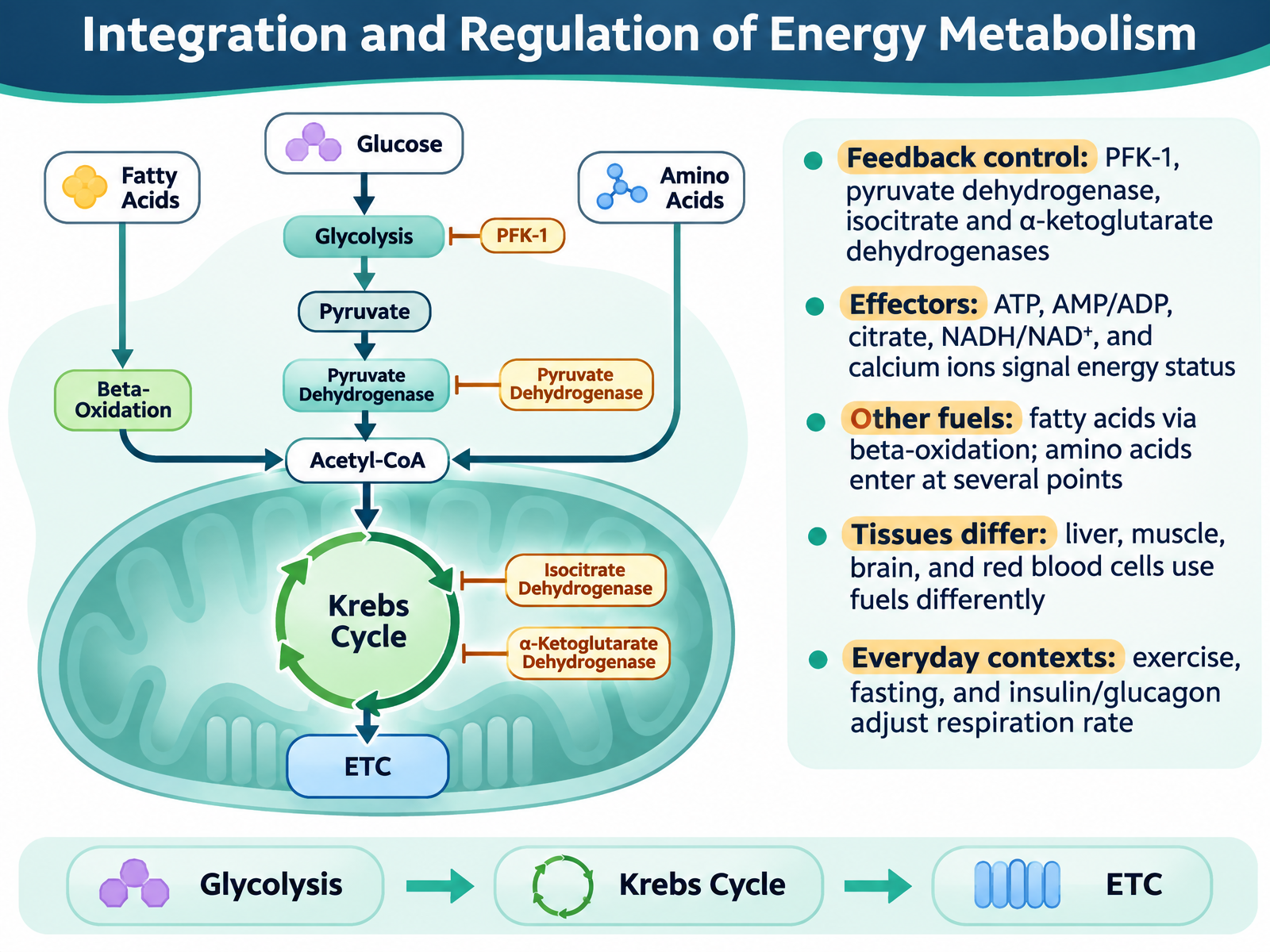
- 11Integration and Regulation of Energy MetabolismNow let's see how all of these pathways are coordinated. Regulation happens mainly through feedback control at a few key enzymes. Phosphofructokinase, or PFK-1, gates glycolysis. Pyruvate dehydrogenase gates entry into the citric acid cycle. And two citric acid cycle enzymes, isocitrate dehydrogenase and alpha-ketoglutarate dehydrogenase, control flux through the cycle. Effector molecules signal energy status. High ATP and citrate inhibit PFK-1, while AMP and ADP activate it. High NADH relative to NAD plus signals plenty of electrons and slows the cycle, and calcium ions activate key dehydrogenases, linking respiration to muscle contraction. Cells also burn other fuels. Fatty acids enter through beta-oxidation as acetyl CoA, and amino acids feed in at several points. Tissues differ: the liver buffers blood glucose, muscle uses its own glycogen, the brain depends heavily on glucose, and red blood cells rely on glycolysis alone. So during exercise, fasting, or an insulin and glucagon shift, respiration rate adjusts to match demand. In short, respiration is tuned by energy charge, electron carrier ratios, and tissue-specific fuel use. Next, let's move from concept to classroom, exploring teaching strategies that work.
 vcell.ndsu.nodak.edukhanacademy.orgen.wikipedia.org+22 min
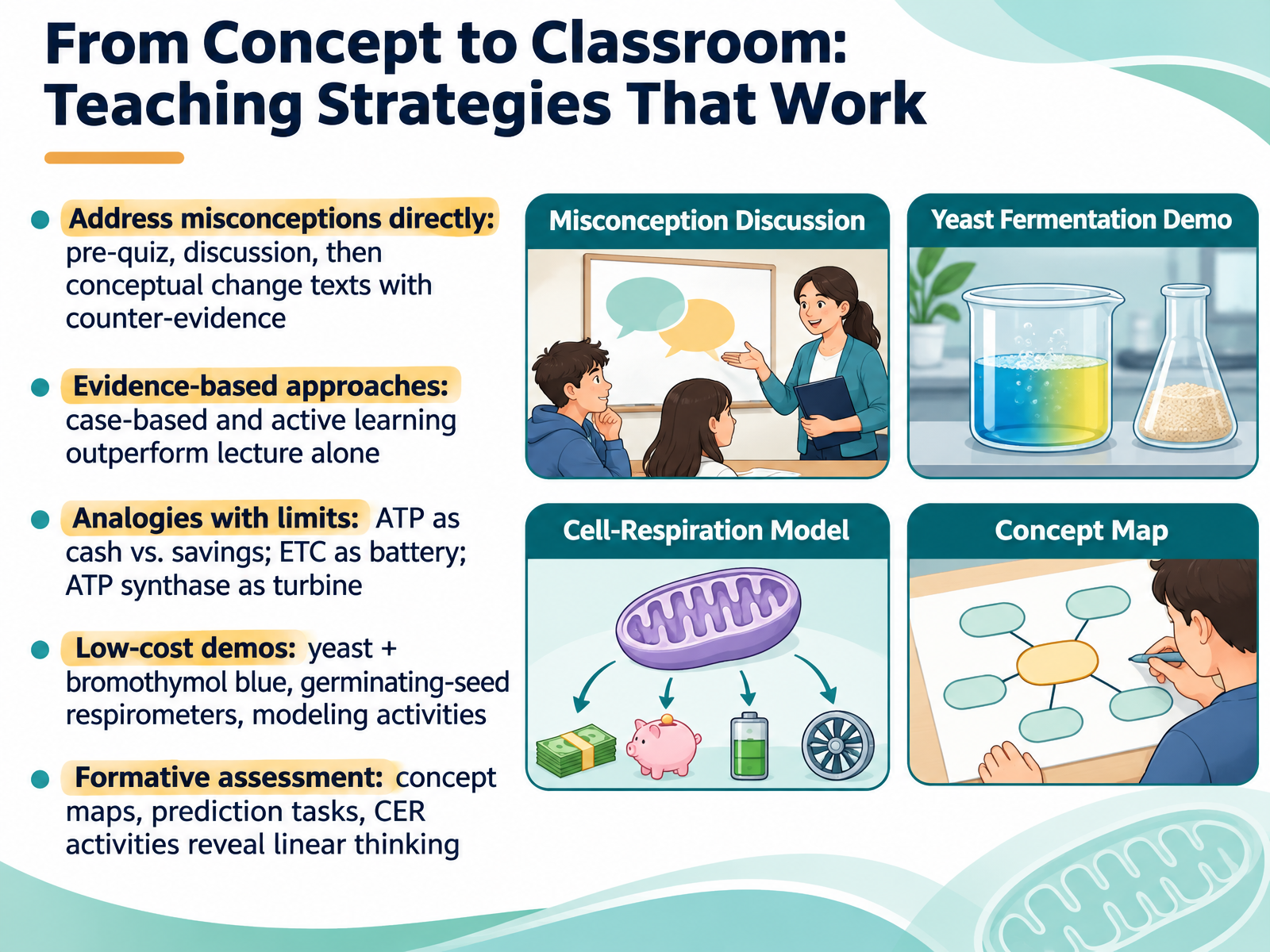
- 12From Concept to Classroom: Teaching Strategies That WorkNow let's move from the science to the teaching. Start by addressing misconceptions directly. Give a short pre-quiz, discuss the results, then use conceptual change texts that present the common misconception alongside counter-evidence and the correct explanation. Research shows this works better than lecture alone. Case-based and active learning also outperform straight lecture, though a case study may reduce a misconception without fully eliminating it. Analogies help, but name their limits: ATP as cash versus savings, the electron transport chain as a battery, and ATP synthase as a turbine. Low-cost demos include yeast with bromothymol blue, germinating-seed respirometers, and modeling activities. For formative assessment, use concept maps, prediction tasks, and claim, evidence, reasoning activities. They reveal linear thinking, a pattern researchers find even in advanced students. So the takeaway: teach against misconceptions, use evidence-based active strategies, and keep checking understanding. Next, we'll practice with Check Your Understanding: Practice and Answer Rationales.
 iubmb.onlinelibrary.wiley.compmc.ncbi.nlm.nih.goviubmb.onlinelibrary.wiley.com+22 min
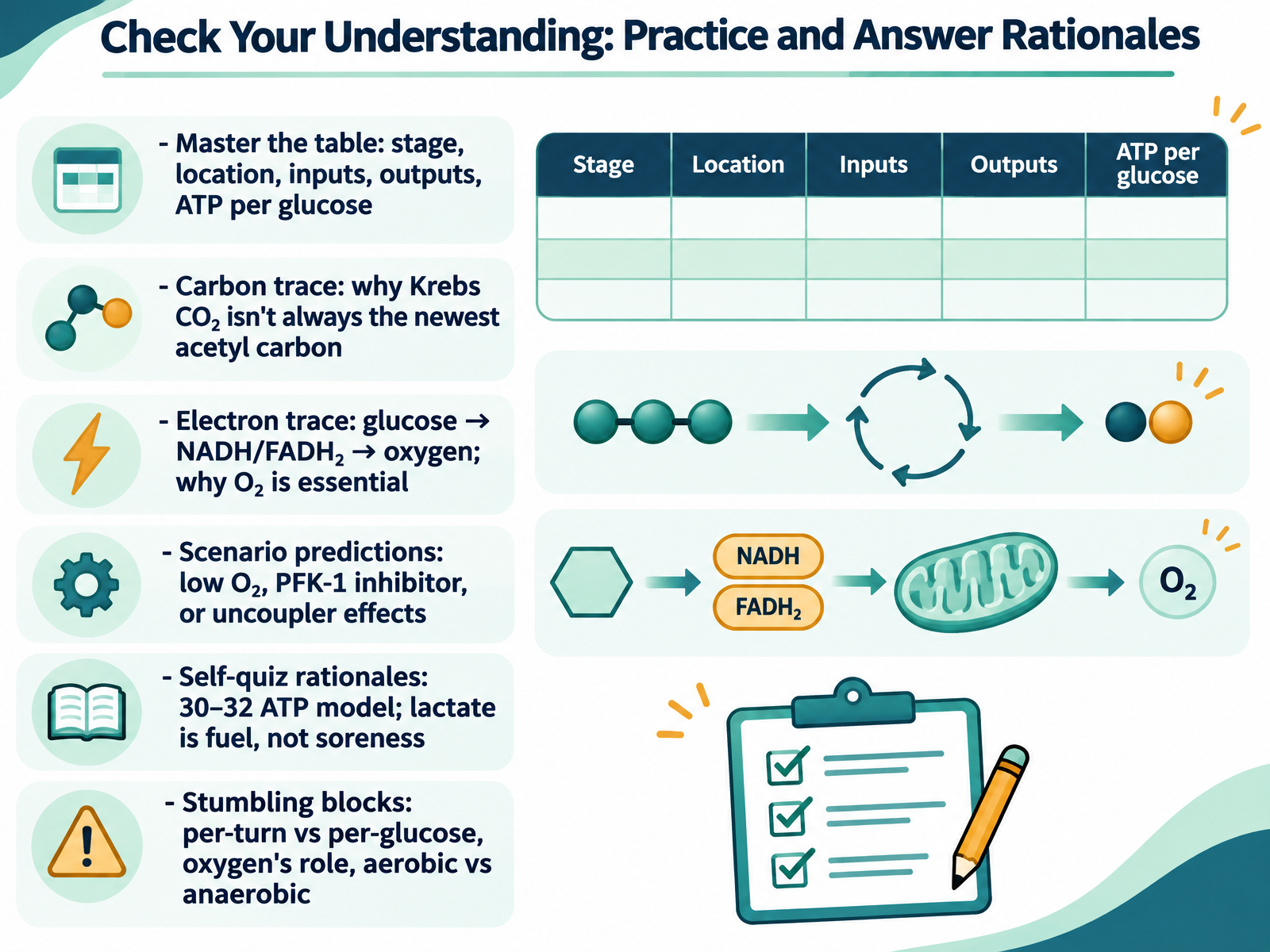
- 13Check Your Understanding: Practice and Answer RationalesLet's put your understanding to the test. First, master the summary table: for each stage, know the location, the inputs, the outputs, and the ATP per glucose. Remember that Krebs cycle products double, because one glucose gives two turns. Second, trace the carbons. The carbon dioxide released in a given turn of the Krebs cycle does not necessarily come from the acetyl group that just entered. Those acetyl carbons are released on later turns. Third, trace the electrons: from glucose to NADH and FADH two, then to oxygen, which is essential as the final electron acceptor. Without oxygen, electron transport stops. Now try scenario predictions. Low oxygen, a PFK one inhibitor, or an uncoupler each changes the outcome in a predictable way. Finally, check the rationales for the thirty to thirty two ATP model, and remember that lactate is a fuel, not the cause of soreness. Teachers, note the common stumbling blocks: per turn versus per glucose, oxygen's role, and aerobic versus anaerobic. Here's your takeaway: if you can trace carbons and electrons and predict each scenario, you understand respiration. Next, let's move to key takeaways and resources for further learning.
 monash.eduinfo.mheducation.compremiermcatprep.com+22 min
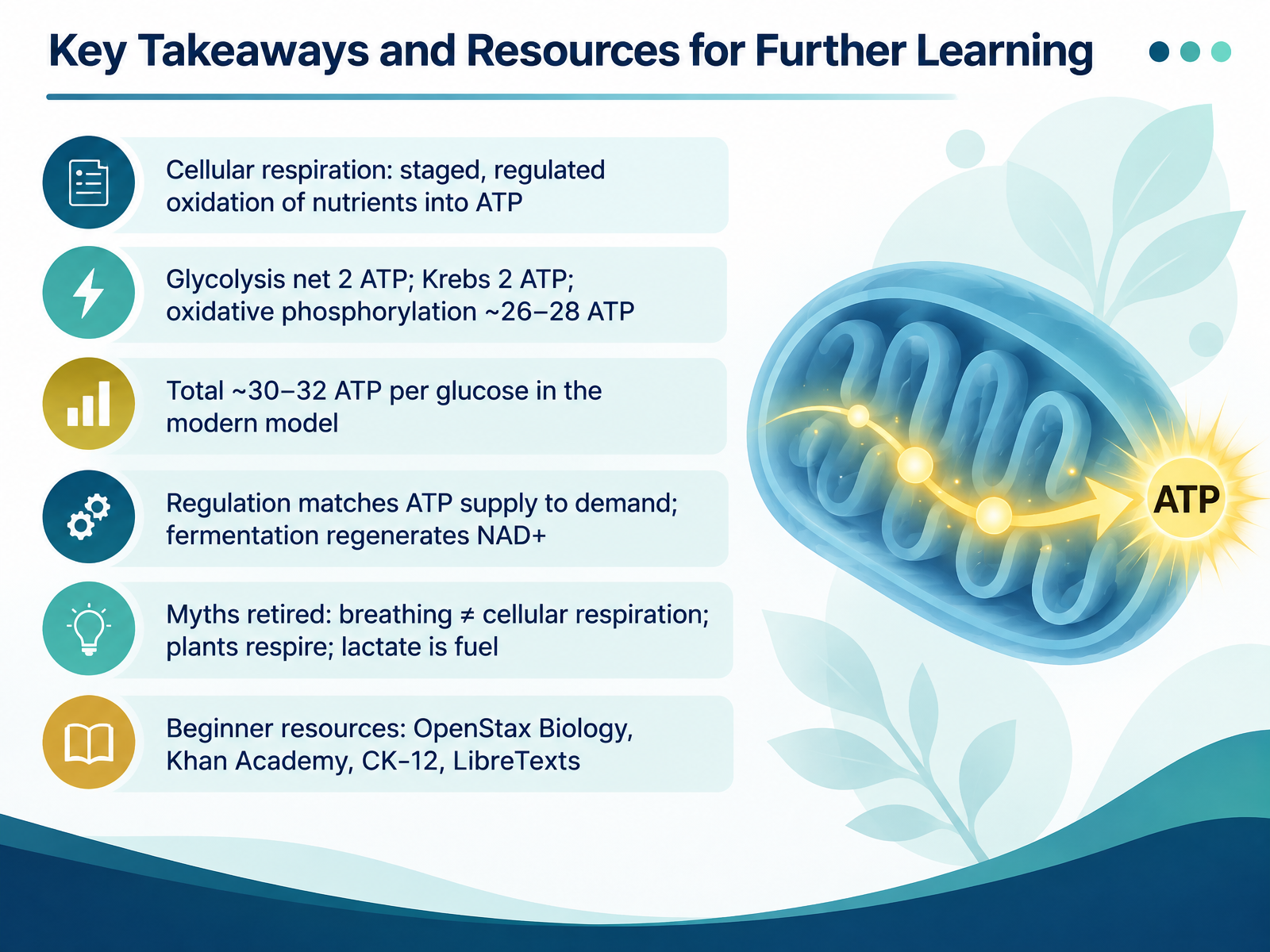
- 14Key Takeaways and Resources for Further LearningLet's close by pulling the whole picture together. Cellular respiration is a staged, regulated oxidation of nutrients into ATP. Per glucose in the modern model, glycolysis nets two ATP, the Krebs cycle adds two, and oxidative phosphorylation contributes roughly twenty-six to twenty-eight, for a total of about thirty to thirty-two. Regulation matches ATP supply to demand, and fermentation regenerates NAD plus so glycolysis can continue without oxygen. Four myths to retire: breathing is not cellular respiration; plants do respire; and lactate is fuel, not the cause of muscle soreness. For students, the core is the three stages and their ATP totals. For teachers, emphasize the proton gradient and the electron shuttles, since those explain the range. For further learning, OpenStax Biology, Khan Academy, CK-12, and LibreTexts are all solid, free resources. Thank you for learning with me. Restate these takeaways in your own words, then keep exploring. You are more than ready.
 monash.eduinfo.mheducation.compremiermcatprep.com+22 min
Take the deck with you
Download this course as a file — free, no sign-up needed.
- PDF handoutEvery slide page, ready to print or share.15 pages · 3.8 MBDownload
- Narrated PowerPointThe deck that presents itself — every slide carries the digital human's narration video.15 pages · 16.0 MBDownload
- PowerPoint slidesThe full deck as a .pptx — open it in PowerPoint, Keynote, or Google Slides.15 pages · 3.7 MBDownload
Free to use in your own training — please keep the PersonWise credit page at the end.
Have your own deck? Turn it into a course
Sources consulted
Web sources consulted while building this course.
- The process of aerobic respiration — monash.edu
- CHAPTER 7 — info.mheducation.com
- ATP Yield - MCAT Biochemistry | Premier MCAT Prep — premiermcatprep.com
- How many ATP are produced when glucose is oxidized to pyruvate - Frost 4th Edition Ch 8 Problem 89 — pearson.com
- ATP Calculator | Cellular Respiration Energy Yield by Stage & Pathway — pearson.com
- Effectiveness of conceptual change text-oriented instruction on students' understanding of cellular respiration concepts — iubmb.onlinelibrary.wiley.com
- Investigation of a Stand-Alone Online Learning Module for Cellular Respiration Instruction — pmc.ncbi.nlm.nih.gov
- A case-based approach increases student learning outcomes and comprehension of cellular respiration concepts — iubmb.onlinelibrary.wiley.com
- Recontextualising Cellular Respiration in Upper Secondary Biology Education. Characteristics and Pra — research-portal.uu.nl
- Understanding cellular respiration: An analysis of conceptual change in college biology — onlinelibrary.wiley.com
- 7.2 Glycolysis - Biology 2e | OpenStax — openstax.org
- Glycolysis - PMC — pmc.ncbi.nlm.nih.gov
- Biochemistry Glycolysis Study Guide: Key Pathways & Regulation | Notes — pearson.com
- Lecture 27: Metabolic Pathways Part I: Glycolysis — andrew.cmu.edu
- Biological Chemistry I: Overview of Glycolysis — ocw.mit.edu
- VCAC: Cellular Processes: The Citric Acid Cycle - The Reactions: The Movie -- Narrative — vcell.ndsu.nodak.edu
- The citric acid cycle | Cellular respiration (article) — khanacademy.org
- Citric acid cycle — en.wikipedia.org
- 4.3 Citric Acid Cycle and Oxidative Phosphorylation - Concepts of Biology | OpenStax — openstax.org
- The Krebs Cycle (Citric Acid Cycle) | Varsity Tutors — varsitytutors.com