CRO Step-by-Step Review Checklist
Begin
13 pages · ~26 min
CRO Step-by-Step Review Checklist
A step-by-step review of best practices for analyzing and improving website conversion rates, designed for marketers and web professionals seeking to optimize performance.
What you’ll learn
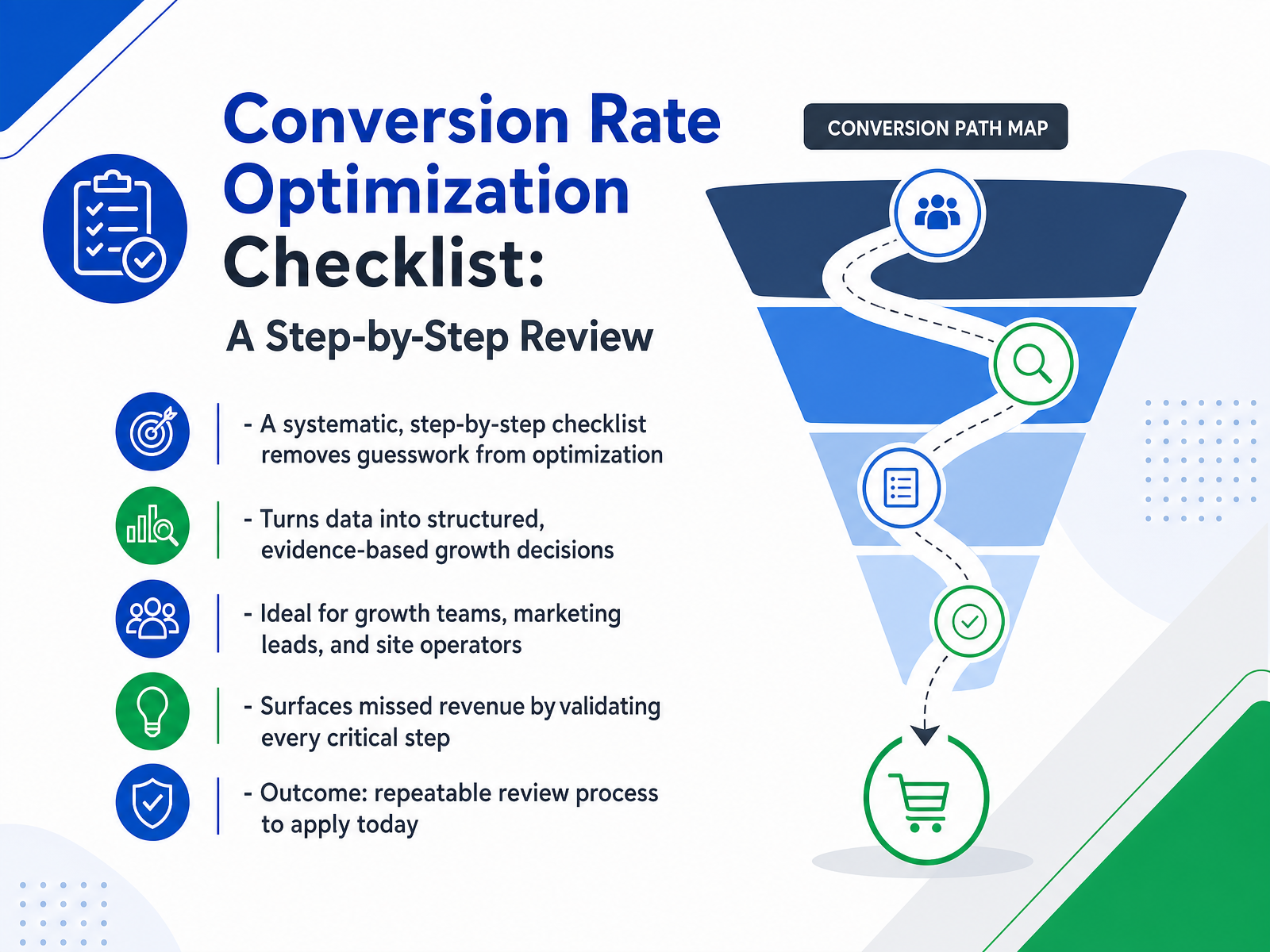
- 01Conversion Rate Optimization Checklist: A Step-by-Step ReviewWelcome. If you are leading growth, marketing, or site operations, you already know the pressure: traffic is expensive, and every visitor who leaves without converting is revenue walking out the door. This course gives you a systematic, step-by-step conversion rate optimization checklist that removes the guesswork. We will turn your data into structured, evidence-based decisions. We will validate every critical step so you surface missed revenue you did not even know was there. You will walk away with a repeatable review process you can apply today. Here is the honest truth: most teams jump straight to testing button colors. That is where momentum dies. A proper checklist forces you to check the fundamentals first, compare your funnel against real benchmarks, and prioritize what actually moves the metric. By the end of this session, you will have that exact framework. Let us start by looking at why most optimization efforts miss the mark entirely.sitegrade.iosentinu.comjustanalytics.app+21 min
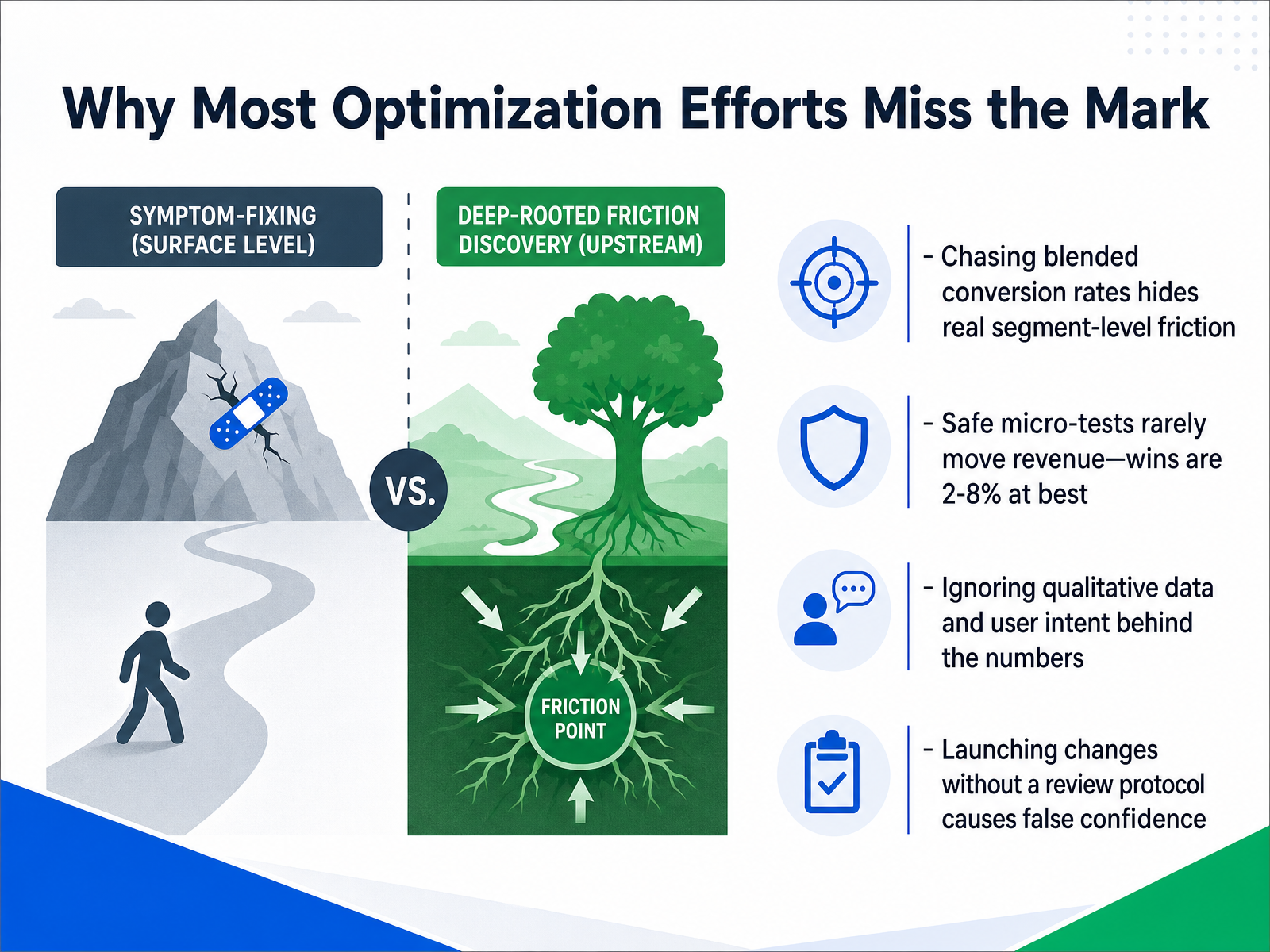
- 02Why Most Optimization Efforts Miss the MarkLet's talk about why most optimization efforts miss the mark. The first mistake is chasing blended conversion rates. When you look at one overall number, you hide real segment-level friction. Mobile users might drop off due to vague buttons, while desktop users struggle with clutter. You fix the average, but you don't fix the actual problem. Second, safe micro-tests rarely move revenue. Changing button color or tweaking headline copy typically delivers wins of two to eight percent at best. That's not growth; that's noise. Third, ignoring qualitative data and user intent. The numbers tell you where people leave, but not why. Without session replays or heatmaps, you're guessing at the friction instead of seeing it. Finally, launching changes without a review protocol creates false confidence. If you don't have a structured process, you end up with scattered efforts and inconclusive results. You think you're optimizing, but you're really just spinning. The takeaway? Check your segments first, prioritize structural fixes, and build a system before you run another test. That mindset leads us directly to adopting a diagnostic review approach.
 convertcart.comeshoppick.comelsner.com+22 min
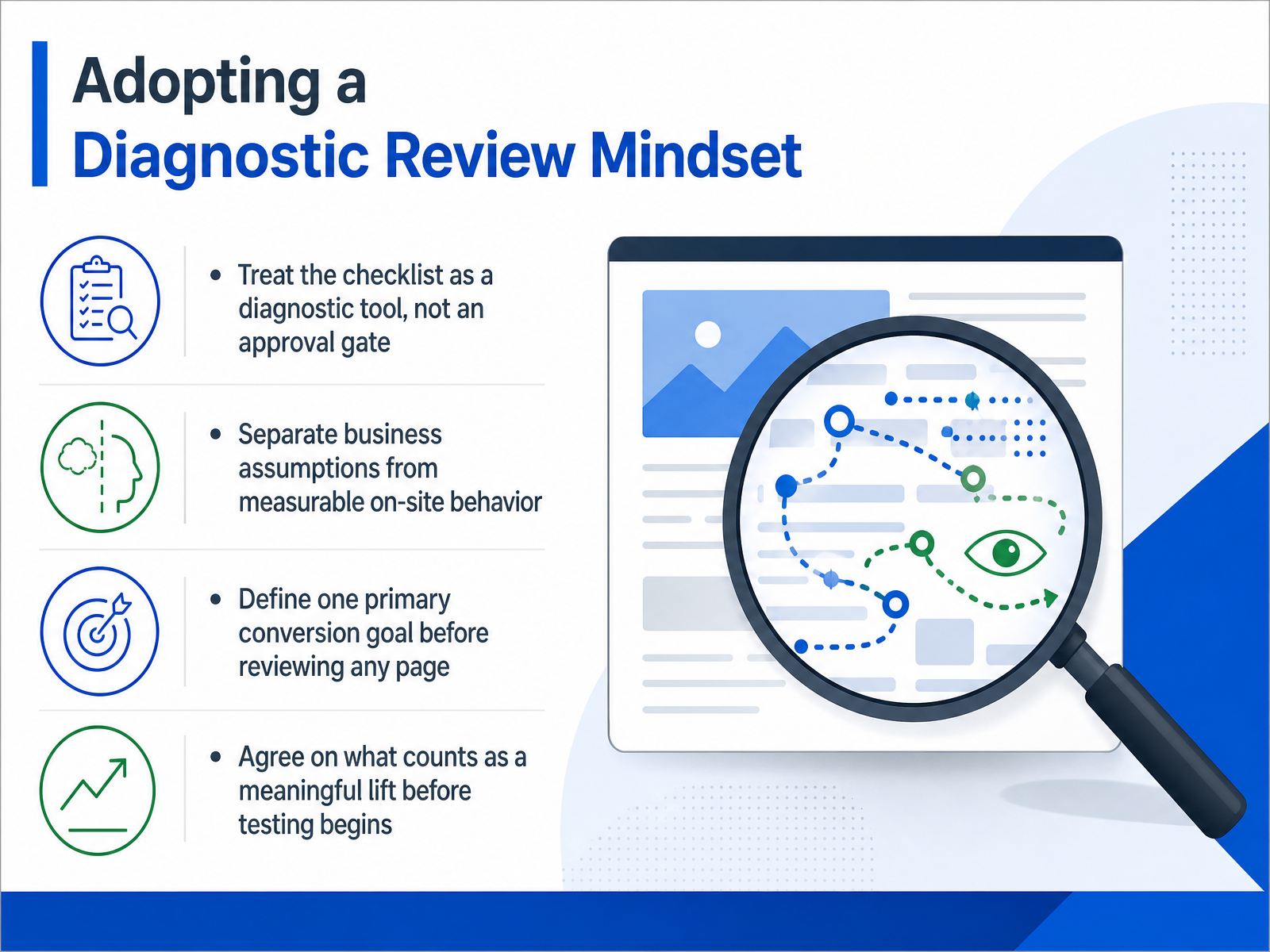
 - 03Adopting a Diagnostic Review MindsetNow, before we touch a single page, we need to adopt a diagnostic review mindset. This checklist is not an approval gate where everything just gets a tick. It is a diagnostic tool. Use it to find friction, not to rubber-stamp a redesign. So, let's set the ground rules. First, separate your business assumptions from what visitors actually do. You may believe the pricing page is clear. The data may say otherwise. The page behavior always wins the argument. Second, define one primary conversion goal before you review anything. If you don't decide whether this page drives demo requests or newsletter signups, you can't review it effectively. Agree on that single action up front. Finally, agree on what counts as a meaningful lift before you test. Is a five percent lift worth rolling out? Maybe not. But a fifteen percent lift on a core pricing page? That matters. Get that alignment now. If you skip it, you'll waste time debating results later. So, once we have that baseline, we can move into the practical work: mapping the core conversion path.
 piperocket.digitalblog.hubspot.comrobpalmer.com+21 min
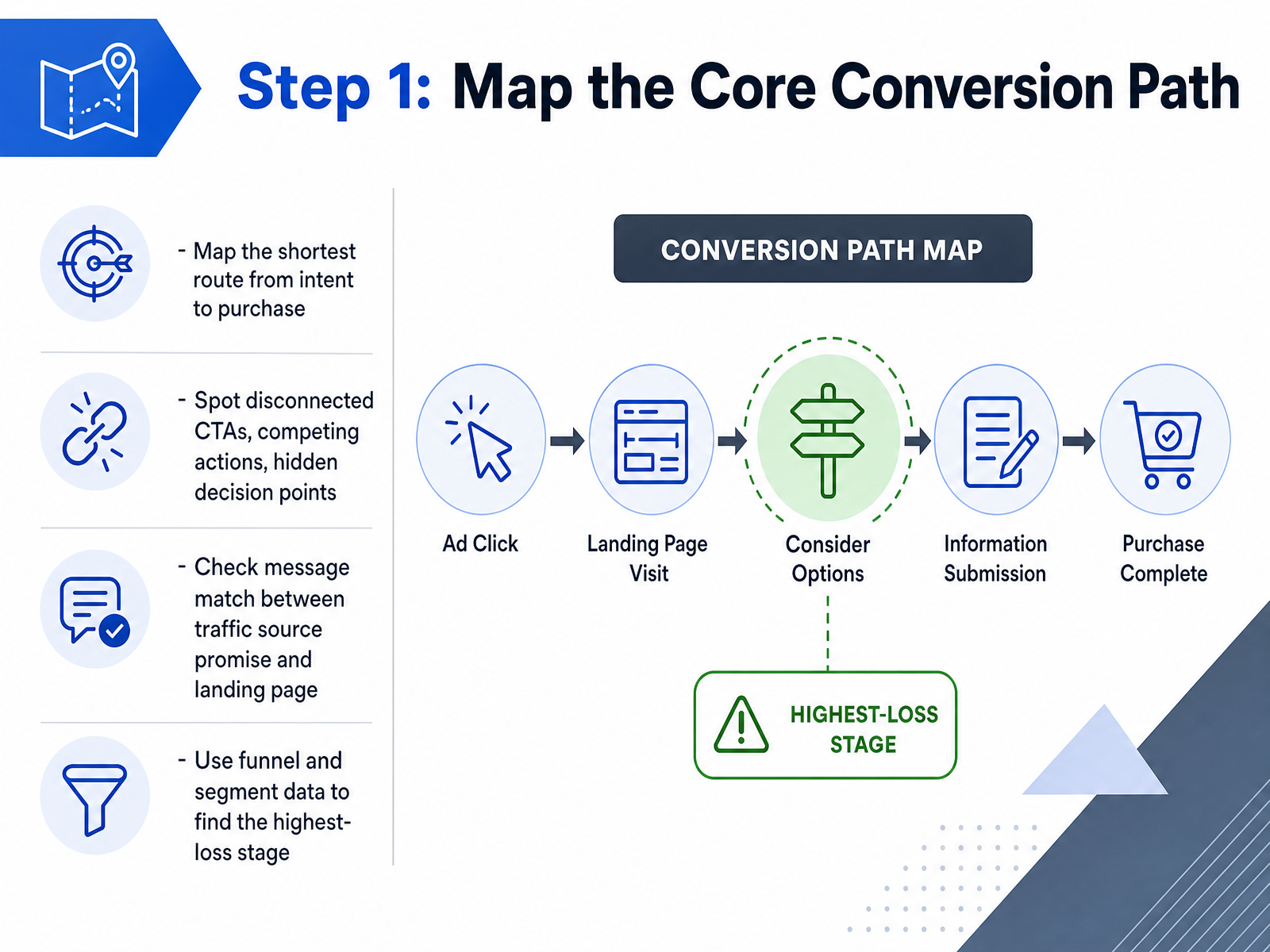
 - 04Step 1: Map the Core Conversion PathNow, let's get practical. Step one is mapping the core conversion path. Don't start optimizing yet. First, trace the shortest, cleanest route from intent to purchase. Pull up your funnel and map every step. Then check each one for friction. Look for disconnected CTAs, competing actions, and hidden decision points that stall momentum. A common pattern we see is vague CTAs like 'Continue' that give zero direction, or shipping costs that only appear at the final checkout step. Both are silent conversion killers. Next, verify the message match. Does the promise in your ad or traffic source actually match the headline on your landing page? If not, you're losing qualified visitors immediately. Finally, use your funnel and segment data to find the single highest-loss stage. Is it the product page, the cart, or the checkout? Focus your energy there first. Find the biggest leak, and plug it before anything else. That's your map. Once you know the path and where it breaks, we can start refining the page itself. Next, we'll audit on-page persuasion and messaging.
 convertcart.comeshoppick.comelsner.com+22 min
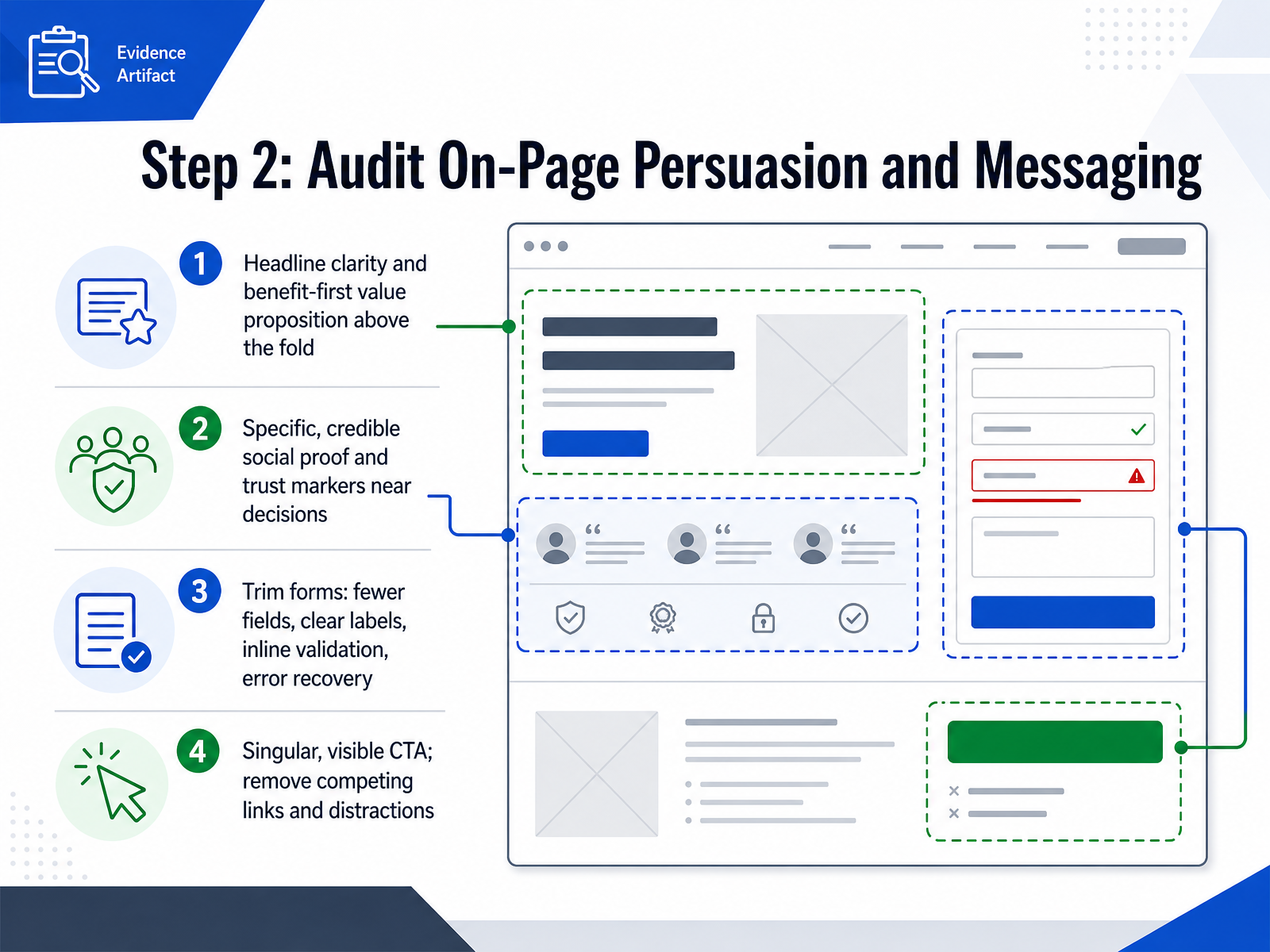
 - 05Step 2: Audit On-Page Persuasion and MessagingNow, let's audit on-page persuasion and messaging. This is where copy changes routinely outperform design tweaks by five to ten times. Start with the headline and value proposition. A visitor should understand what you offer and why it matters within five seconds. If your headline is clever but unclear, it is costing you conversions. Test a specific, benefit-first headline against your current one; specificity beats cleverness every time. Next, audit your social proof. Vague praise is not proof. Compare a testimonial that says 'great product' with one that says 'we increased demo conversions by one hundred and eighty three percent in sixty days.' Specific numbers, named customers, and real outcomes build credibility. Place that proof right next to your call to action, at the moment of decision. Now, look at your forms. Every unnecessary field costs you completions. Check each one and ask if it is truly essential. Use clear labels, logical order, and inline validation so users catch errors as they type. And if users abandon midway, make error recovery painless; never let them start over from scratch. Finally, the call to action. You need one primary, visible CTA per page. Remove competing links, navigation menus, or other distractions that pull attention away. The CTA copy should use a specific action verb that describes the value received, like 'Get my free conversion checklist,' not a generic 'Submit.' After you tighten the messaging, we'll move to reducing friction in the forms and checkout themselves.
 piperocket.digitalblog.hubspot.comrobpalmer.com+22 min
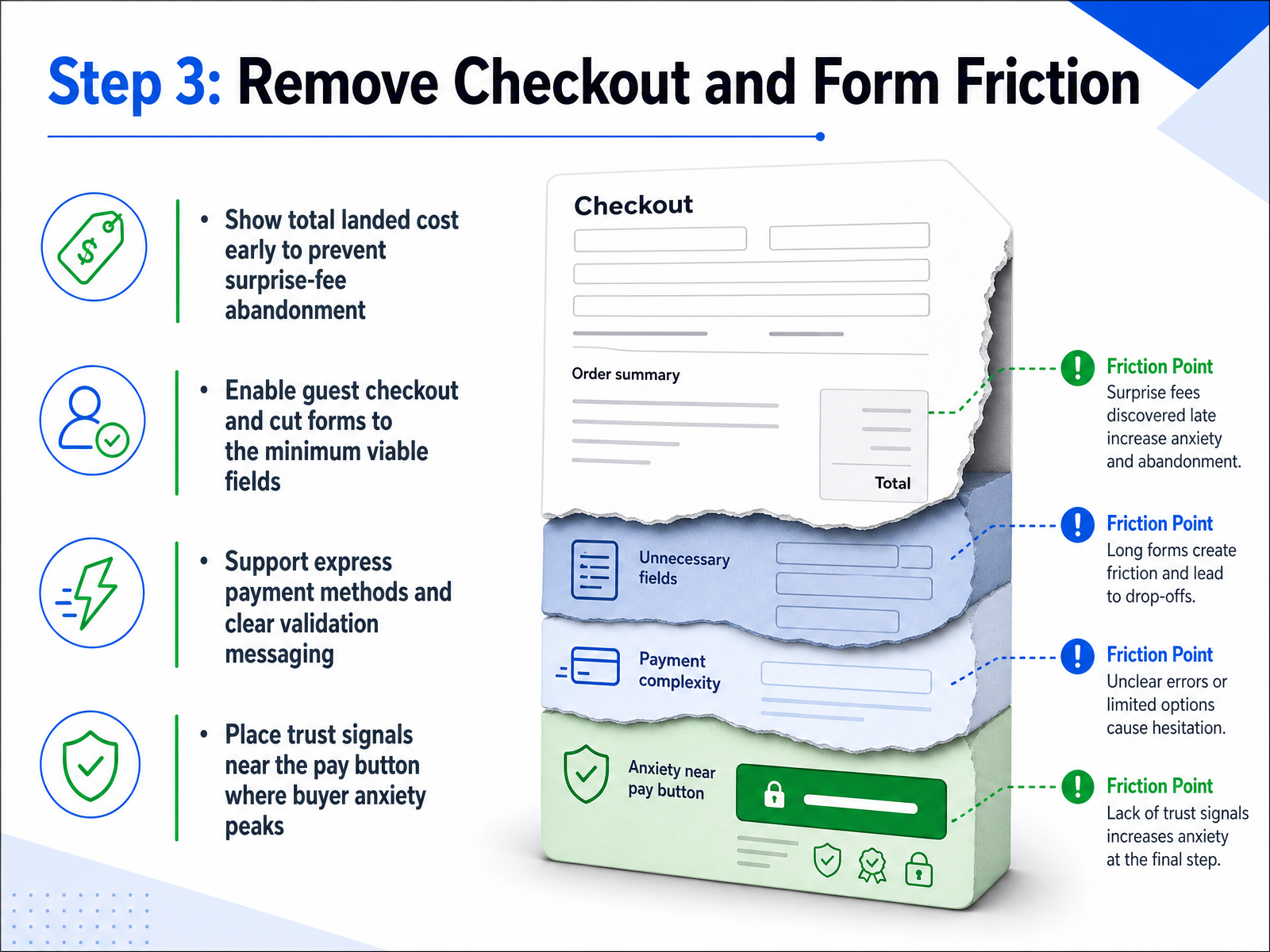
 - 06Step 3: Remove Checkout and Form FrictionNow we move to step three: remove checkout and form friction. This is where most revenue leaks. Start with total landed cost. Show shipping, taxes, and surcharges on the cart page, not at the final step. Surprise fees are the number one abandonment driver. Next, enable guest checkout by default. Forced account creation pushes away roughly one in four shoppers. Ask for the email, complete the order, then offer account creation on the thank-you page. Now trim your forms. The benchmark is six to eight fields. Most stores ship with eleven or more. Cut the phone number for digital products, the company name for B2C, and anything with a high skip rate. Add autofill and inline validation so users recover from errors quickly. Then add express payment options like Apple Pay, Google Pay, and PayPal. Stores without them leak a significant share of mobile revenue. Finally, place trust signals right next to the pay button. That is where anxiety peaks. Show recognizable payment logos, a return policy snippet, and a real support contact. Generic badges from unknown vendors actually lower trust. Fix these four areas, and you can recover a meaningful share of lost orders within a quarter. That covers step three. Next, we move to step four: evaluate speed, accessibility, and device experience.
 convertcart.comeshoppick.comelsner.com+22 min
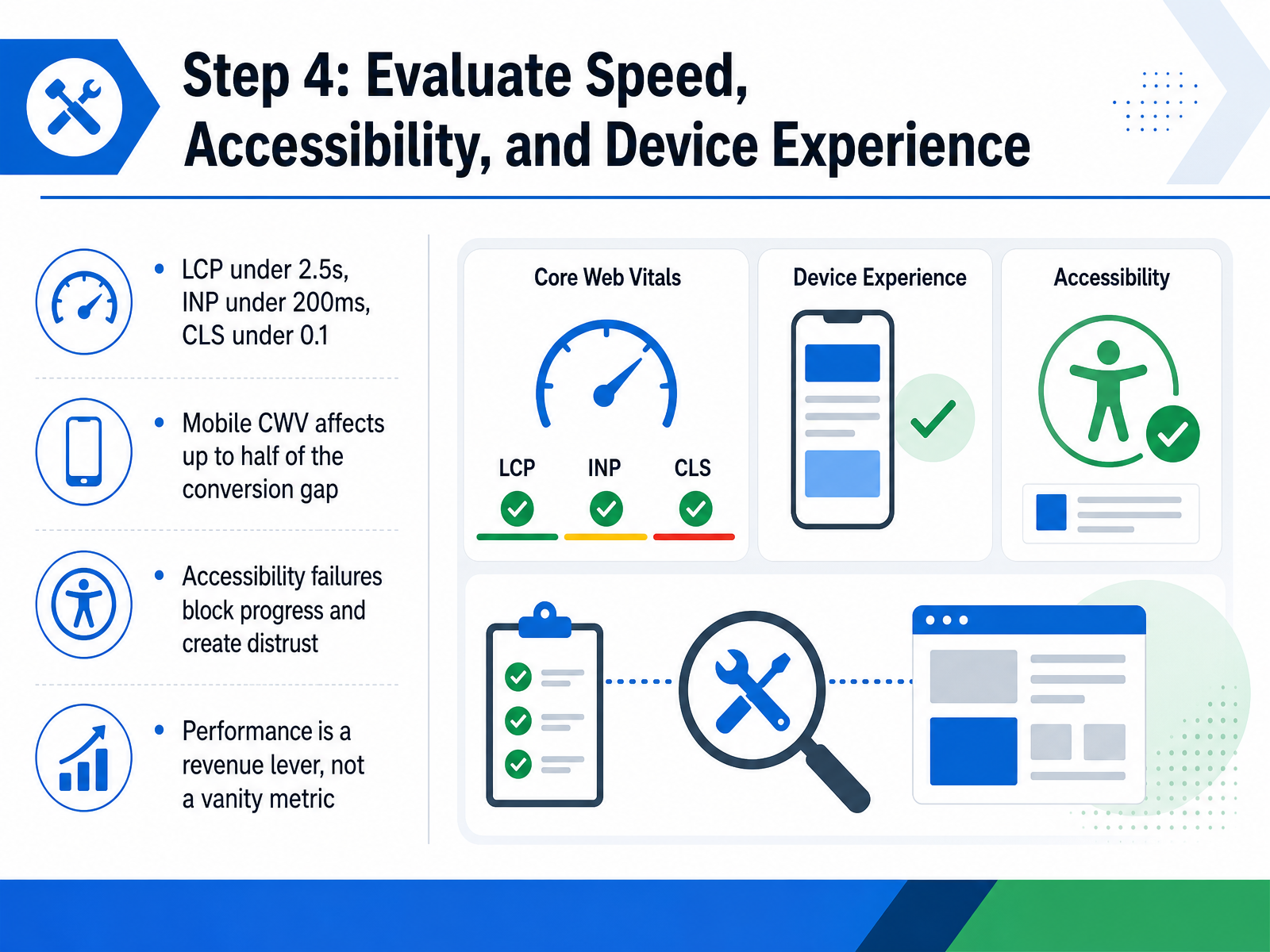
 - 07Step 4: Evaluate Speed, Accessibility, and Device ExperienceStep 4 is where we separate intention from impact. Check these three thresholds against your field data in Google Search Console, not your local test environment. LCP under 2.5 seconds, INP under 200 milliseconds, and CLS under 0.1. If you are in the red on any of these, you have a quantified revenue leak. Here is the number that should get your attention: mobile Core Web Vitals can explain up to half of the mobile conversion gap versus desktop. That is not screen-size friction. That is speed. Verify your mobile field data first, because that is where the bleed concentrates. Next, run an accessibility audit. Failures here do not just block users; they block progress through the checkout and create distrust. Fix the contrast, the form labels, and the tap targets before you spend another dollar on traffic. The takeaway is direct: performance is a revenue lever, not a vanity metric. A one-second LCP delay correlates with a seven percent conversion drop. Prioritize speed and accessibility as seriously as your offer. Once the numbers are green, Step 5 is where you confirm the why with qualitative feedback.
 sitegrade.iosentinu.comjustanalytics.app+22 min
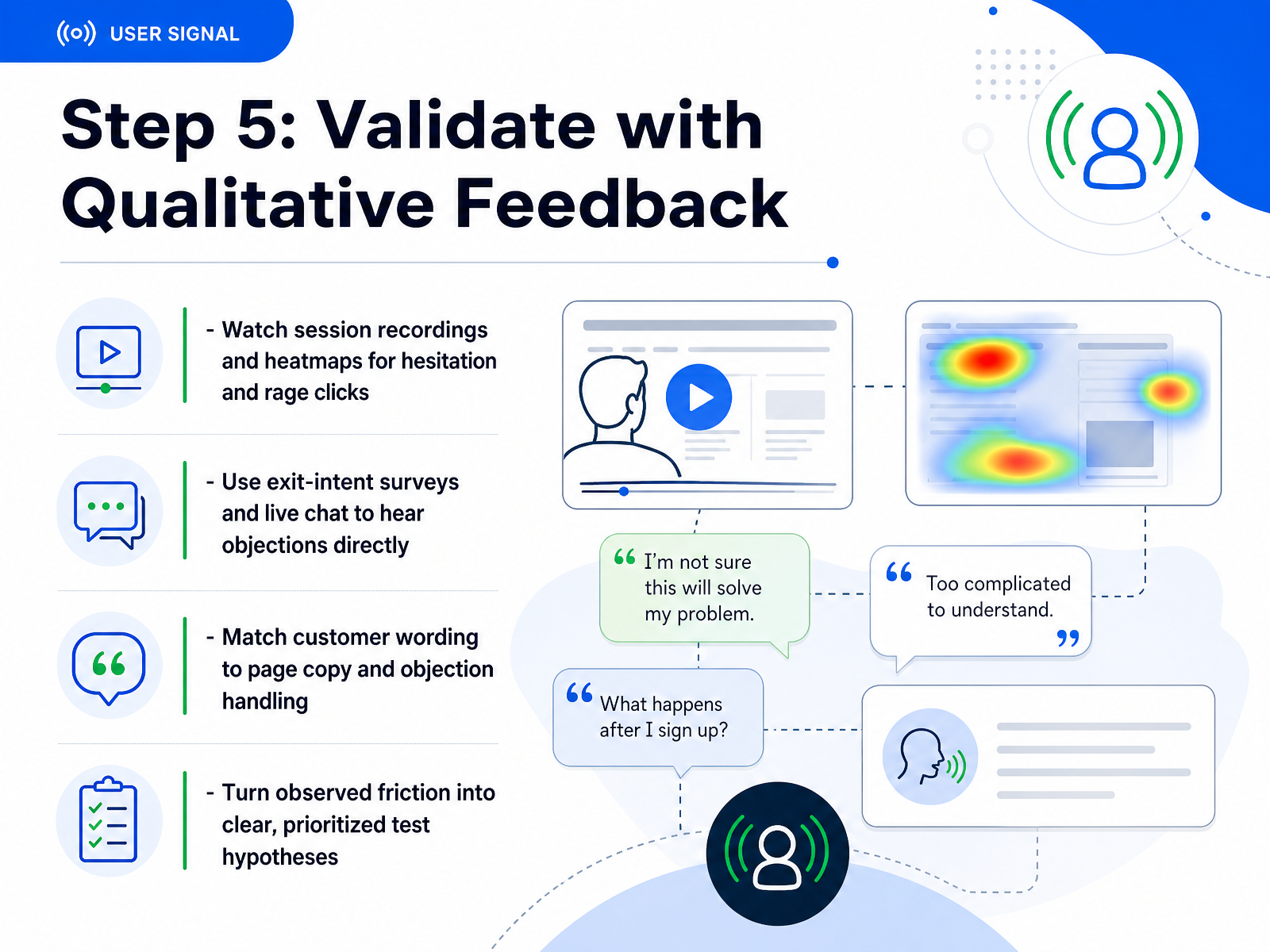
 - 08Step 5: Validate with Qualitative FeedbackNow we validate what the numbers can't tell us. Pull up session recordings and heatmaps on your highest-traffic pages. Watch for hesitation, mouse hovering, and rage clicks. Those are the visible signs of friction. Next, run exit-intent surveys and monitor live chat. You want to hear objections in the customer's own words. When you see the same phrase come up repeatedly, that wording belongs on your page. Match your copy and objection handling to how they actually talk, not how you describe your product. Then turn each observed friction point into a clear, prioritized test hypothesis. Name the change, the expected effect, and the friction it removes. For example, if users hesitate on shipping costs, test surfacing them earlier. This step moves you from guessing to evidence-based action. From here, we'll score those hypotheses and pick what to test first.
 convertcart.comeshoppick.comelsner.com+21 min
 - 09Step 6: Prioritize Changes with a Scoring ModelThis is where we turn a long list of ideas into a plan you can actually ship. Use a scoring model like ICE, which stands for Impact, Confidence, and Ease. Score every opportunity on a scale of one to ten, add up the total, and sort by what wins. The point is not perfect math. It is forcing an honest conversation about expected value before anyone burns engineering hours. And be strict here. Do not test everything at once, and do not hide behind safe micro-tests like button color. Those rarely move revenue. Instead, build a short backlog that matches your business priorities and traffic volume. A high-impact test on a high-traffic page beats a brilliant idea on a page nobody visits. For every item that makes the cut, write down the score, the reasoning, and the evidence supporting it. That documentation is what protects the roadmap when a new stakeholder arrives with a pet idea. If it does not clear the bar, it waits. Now, once you have your prioritized backlog, the next step is making sure the tests themselves are built properly, which brings us to Step seven: Check Test Quality Before Launch.
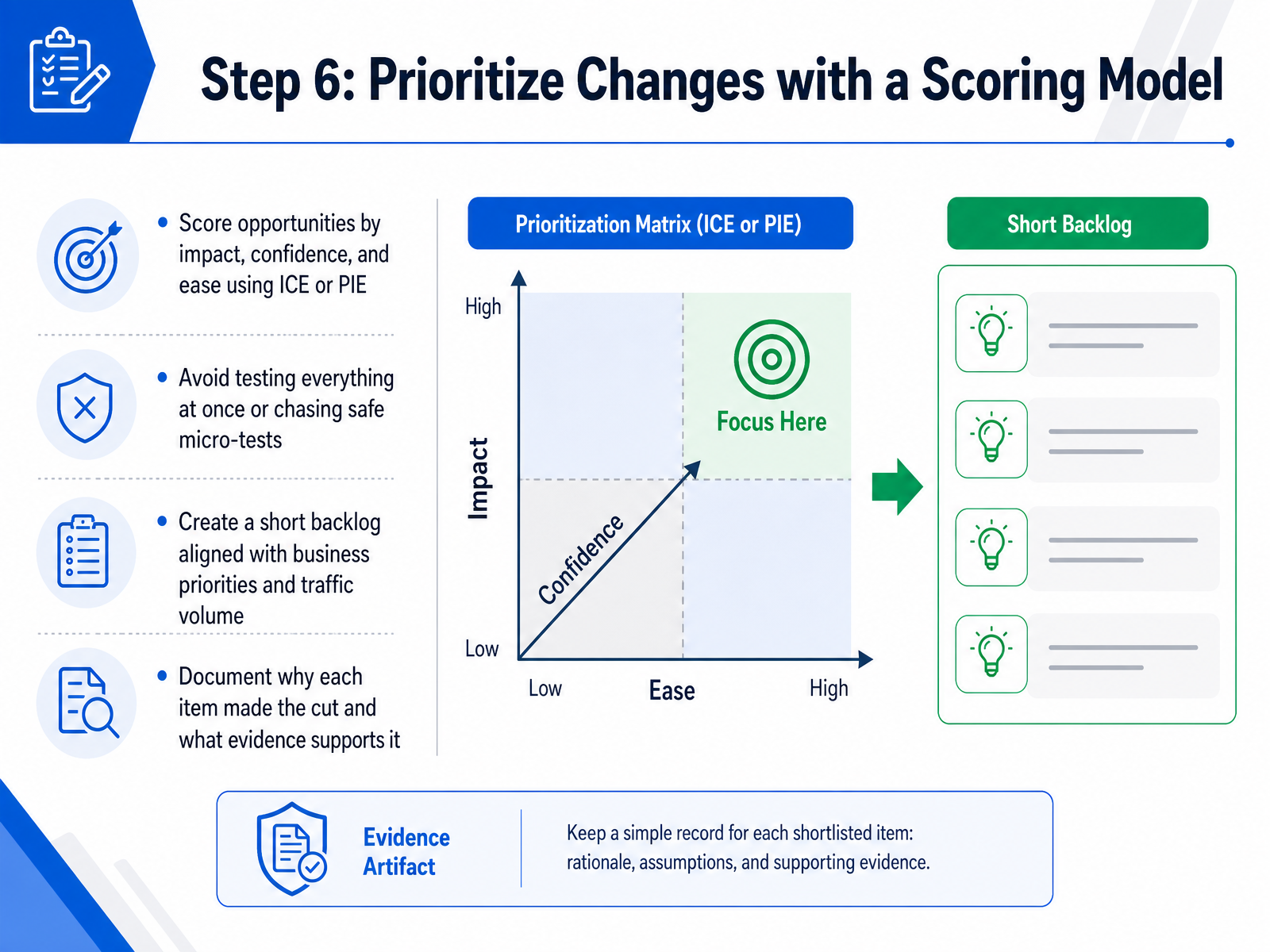 convertcart.comeshoppick.comelsner.com+22 min
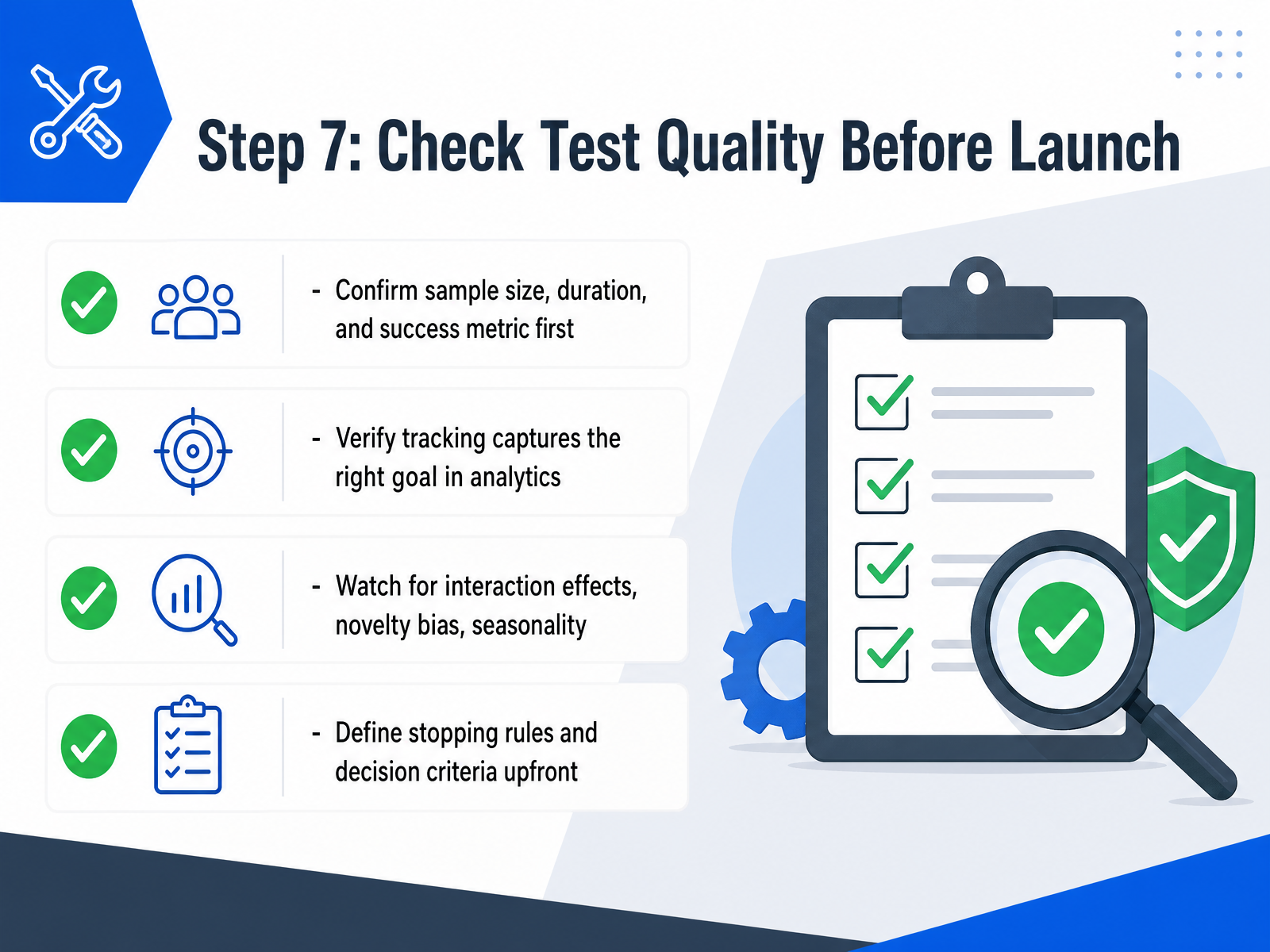
 - 10Step 7: Check Test Quality Before LaunchStep seven: check test quality before launch. This is where we stop good tests from becoming garbage data. First, confirm the sample size, duration, and success metric before you set anything live. If you don’t know the numbers up front, you can’t trust the result. Next, verify that your analytics actually capture the right goal. A test tracked against the wrong event is a test that never really ran. Watch for interaction effects, especially if you’re running parallel experiments. And account for novelty bias and seasonality—what converts this week may not convert next month. Finally, define your stopping rules and decision criteria before you see any data. Decide now what counts as a winner, a loser, or a flat test. This keeps you honest when the numbers get noisy. Get this right, and every test you run gives you a clean, defensible answer. That’s how you turn a single result into something you can act on. Which brings us to what comes after the test ends.
 sitegrade.iosentinu.comjustanalytics.app+21 min
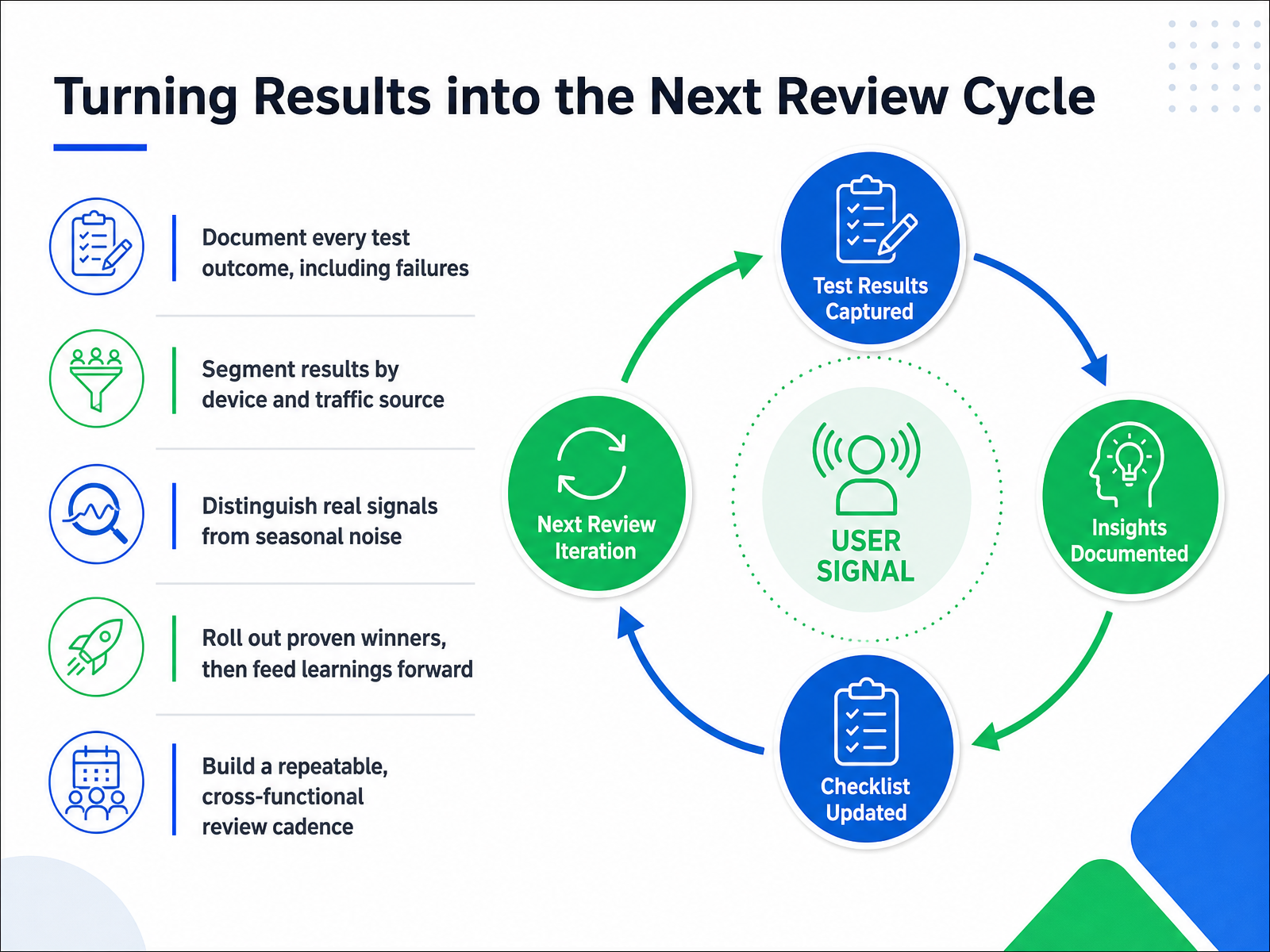
 - 11Turning Results into the Next Review CycleThis is where the process pays off. Turning results into the next review cycle means closing the loop with discipline. Document every test outcome, including the failures. A losing test is a cheap lesson about your customers. Bank it. Segment results by device and traffic source before you roll anything out. A flat result overall might be a clear win on mobile and a loss on desktop. You need to know which. Distinguish real signals from seasonal noise. Compare against your own past trend, not a blended average or a holiday spike. That comparison protects you from shipping a false positive. Then roll out the proven winners and feed the learnings forward into your next hypothesis. This is how small wins compound. Finally, build a repeatable, cross-functional review cadence. Get your growth, marketing, and product teams in the same room on a regular schedule. That consistency turns scattered experiments into a system that actually learns. Remember, the goal is compounding revenue growth, not a one-time project. Next, let's cover the common pitfalls and how the checklist prevents them.
 convertcart.comeshoppick.comelsner.com+22 min
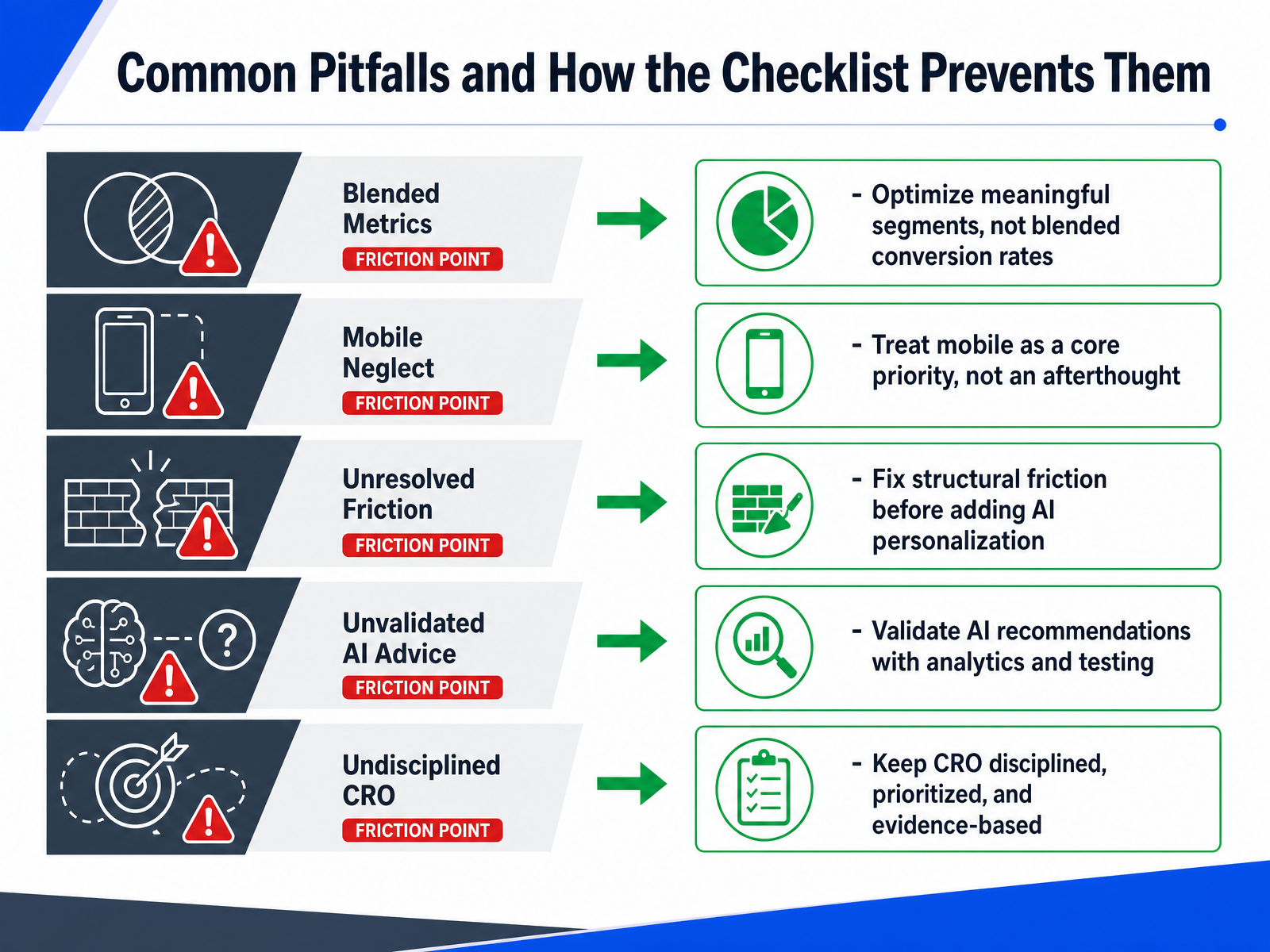
 - 12Common Pitfalls and How the Checklist Prevents ThemLet's look at the common pitfalls we see in CRO reviews, and how this checklist keeps you out of them. First, stop optimizing for the blended conversion rate. It hides what's really happening. Segment by device, source, and new versus returning users. Mobile might convert at half the desktop rate. If you only look at the average, you'll miss the leak. Second, treat mobile as a core priority, not an afterthought. Over sixty percent of traffic is mobile, but it often converts lowest. Check tap targets, form fields, and page speed on a real phone. Third, fix structural friction before adding AI personalization. A smart recommendation widget won't fix a broken checkout. Remove the friction first, then layer on the intelligence. Fourth, validate AI recommendations with analytics and testing. AI can generate hypotheses fast, but it's not the final truth. Confirm the issue in session data, prioritize by impact, and run controlled tests. Finally, keep CRO disciplined, prioritized, and evidence-based. Random experiments waste time. Use a framework like ICE to score ideas, and only ship proven winners. This checklist enforces that discipline. Next, we'll turn this into an action plan for your first structured review.
 convertcart.comeshoppick.comelsner.com+22 min
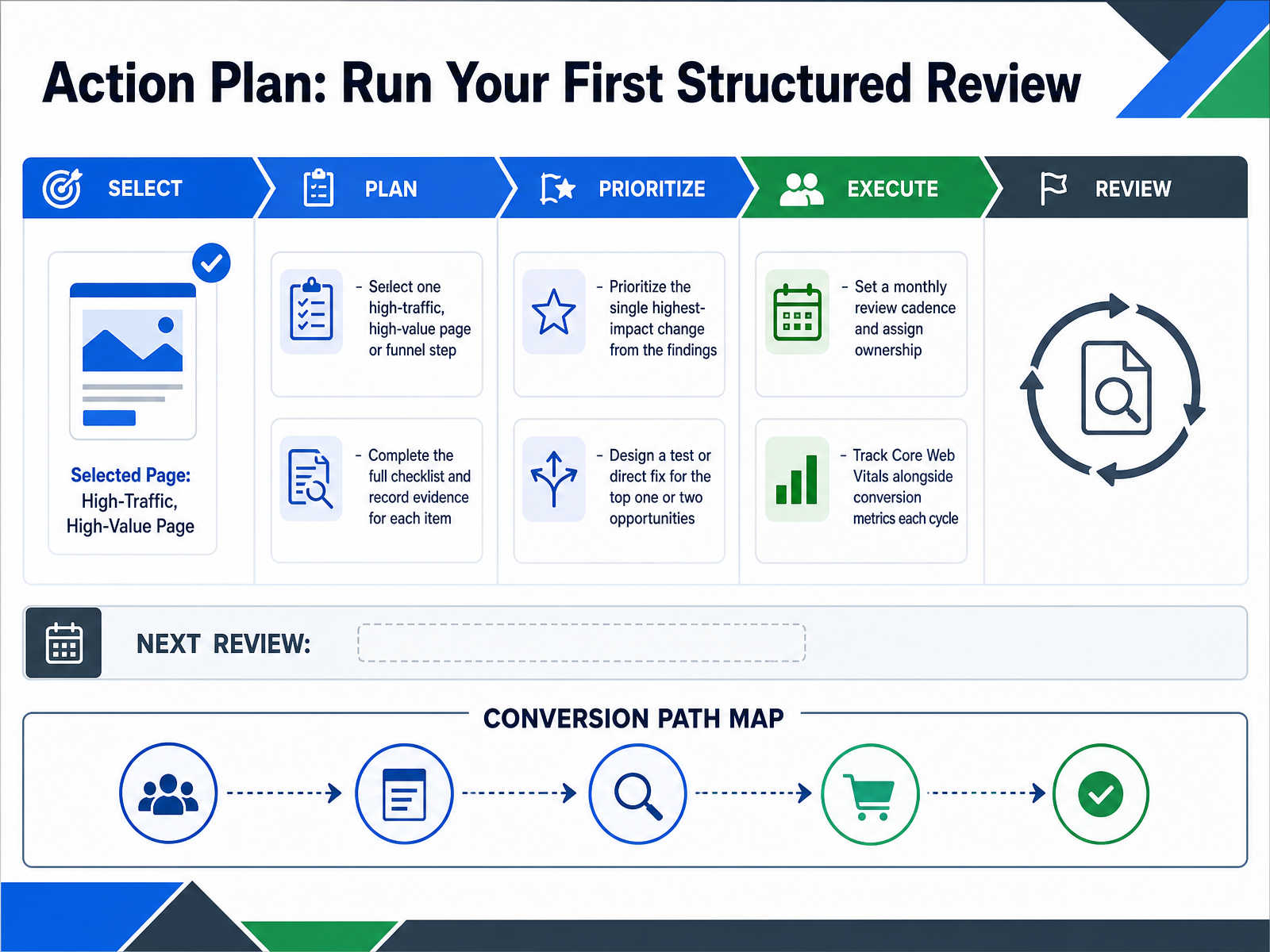
 - 13Action Plan: Run Your First Structured ReviewHere is where the checklist becomes action. Do not try to optimize everything at once. Pick one high-traffic, high-value page or funnel step. Complete the full review on that page and record evidence for every item. Then choose the single highest-impact change from your findings. Design a test or a direct fix for the top one or two opportunities. Set a monthly review cadence and assign clear ownership so this does not slip. Each cycle, track Core Web Vitals alongside your conversion metrics. Remember, a one-second delay in load time can cost you seven percent of conversions. Speed and conversion are the same conversation. Start with one page, run the loop, and let the data compound. This is how structured review becomes steady growth. Thanks for your time, and go find that first win.
 sitegrade.iosentinu.comjustanalytics.app+21 min
Take the deck with you
Download this course as a file — free, no sign-up needed.
- PDF handoutEvery slide page, ready to print or share.14 pages · 3.2 MBDownload
- Narrated PowerPointThe deck that presents itself — every slide carries the digital human's narration video.14 pages · 13.6 MBDownload
- PowerPoint slidesThe full deck as a .pptx — open it in PowerPoint, Keynote, or Google Slides.14 pages · 3.0 MBDownload
Free to use in your own training — please keep the PersonWise credit page at the end.
Have your own deck? Turn it into a course
Sources consulted
Web sources consulted while building this course.
- Core Web Vitals Conversion Impact: Data | SiteGrade — sitegrade.io
- Core Web Vitals and Conversion: The Ecommerce Data Nobody Wants to Hear | Sentinu Solutions — sentinu.com
- Core Web Vitals Statistics 2026: Pass Rates, Framework Scores, and Business Impact | JustAnalytics — justanalytics.app
- Web Performance Report 2026 — Free Report — EGGKNITE — eggknite.com
- Mapping Core Web Vitals to Conversion Rates | RUM·CWV — rum-core-web-vitals.com
- eCommerce CRO Mistakes: 8 We Find During Every High-Traffic Audit — convertcart.com
- Ecommerce Conversion Rate Optimization (CRO) 2026: What's Good, How to Test, What to Fix First · EshopPick — eshoppick.com
- Ecommerce CRO: Complete Framework to Turn Traffic Into Sales — elsner.com
- Ecommerce Conversion Rate Optimization: A Complete Guide for 2026 : FullSession — fullsession.io
- Ecommerce Checkout Optimization: 9 Fixes (2026 Guide) — gatilab.com
- The CRO Checklist for 2026 (Download PDF + Excel) — piperocket.digital
- Conversion rate optimization (CRO) strategy for 2026 — blog.hubspot.com
- The Conversion Rate Optimization Checklist: 37 Copy and UX Fixes That Actually Move the Needle | Rob Palmer — robpalmer.com
- CRO Best Practices: 16 Techniques That Convert (2026) — omniconvert.com
- CRO Audit Checklist: 50-Point Conversion Rate Optimization Review — redclawey.com