Begin
14 pages · ~28 min
English Fluency Development
This training helps non-native English speakers build fluency and confidence in spoken English for everyday and professional communication.
A digital instructor presents all 14 pages. Hold “Ask” at any point and ask out loud — the answer comes from this course. No sign-up needed.
What you’ll learn
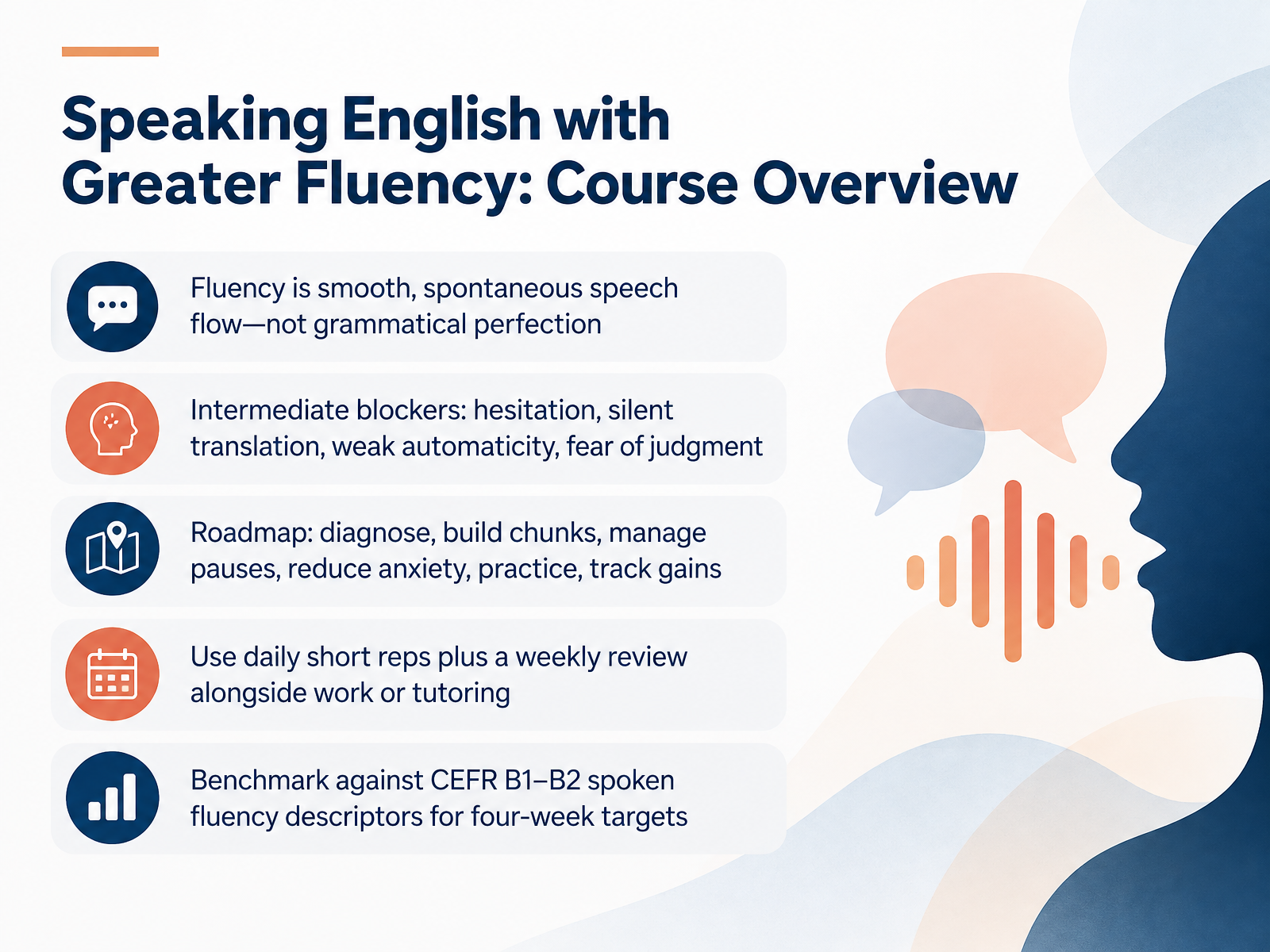
- 01Speaking English with Greater Fluency: Course OverviewWelcome. I'm really glad you're here. So, this course is about speaking English with greater fluency. And let's be clear from the start: fluency means smooth, spontaneous speech flow. It is not grammatical perfection. Every speaker hesitates sometimes, myself included. So if you pause or make a mistake, that's completely normal. It is part of speaking, not a sign of failure. Now, what gets in the way for intermediate learners? Usually four things: hesitation, silent translation in your head, weak automaticity, and fear of judgment. Can you recognise any of those in yourself? Maybe just nod. Or say one out loud right now. Our roadmap moves through six steps: diagnose where you are, build useful language chunks, manage your pauses, reduce anxiety, practice consistently, and track your gains. The plan is simple. Short daily reps, around five to ten minutes, combined with one weekly review. Fit that alongside your work, your tutoring, or your classes. We'll benchmark your progress against the Common European Framework spoken fluency descriptors, at levels B1 to B2, with four-week targets. So, here's your takeaway for today. Fluency grows through small, regular attempts, not perfect preparation. Ready to look at what fluency actually means in practice? Let's move on to the next part: What Fluency Actually Means: Speed, Breakdown, and Repair.cefrhub.aicentresofexcellencenb.carm.coe.int+22 min
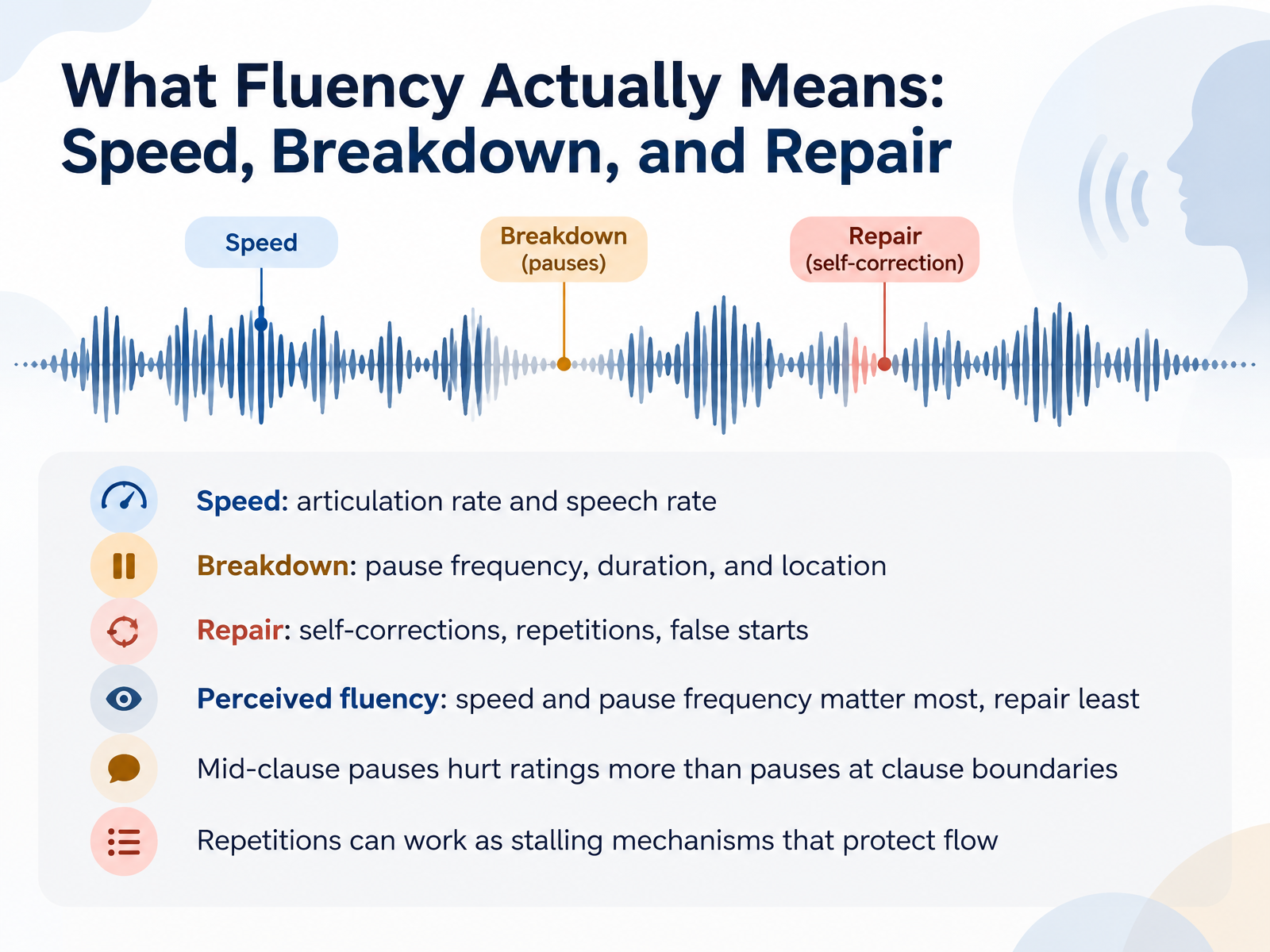
- 02What Fluency Actually Means: Speed, Breakdown, and RepairLet's look at what fluency actually means in practice, because it's not one single thing. Researchers often break it into three parts: speed, breakdown, and repair. Speed is your pace, like articulation rate, which is syllables per minute without the pauses. Breakdown is your pausing: how often you pause, how long, and where. Repair is the self-corrections, repetitions, and false starts we all produce. Here's the key finding: listeners judge fluency mostly by speed and pause frequency, and only weakly by repair. So a few repetitions won't hurt you much. Also, pausing mid-clause sounds less fluent than pausing at a clause boundary. And here's a useful reframe: repetitions can actually work as stalling mechanisms that protect your flow while you plan. So next time you catch yourself repeating a word, don't panic. Keep going. That's a real fluency skill. Coming up next, we'll separate some common myths from reality in Myths and Realities About Fluency.
 exa.aiexa.aijournals.sagepub.com+22 min
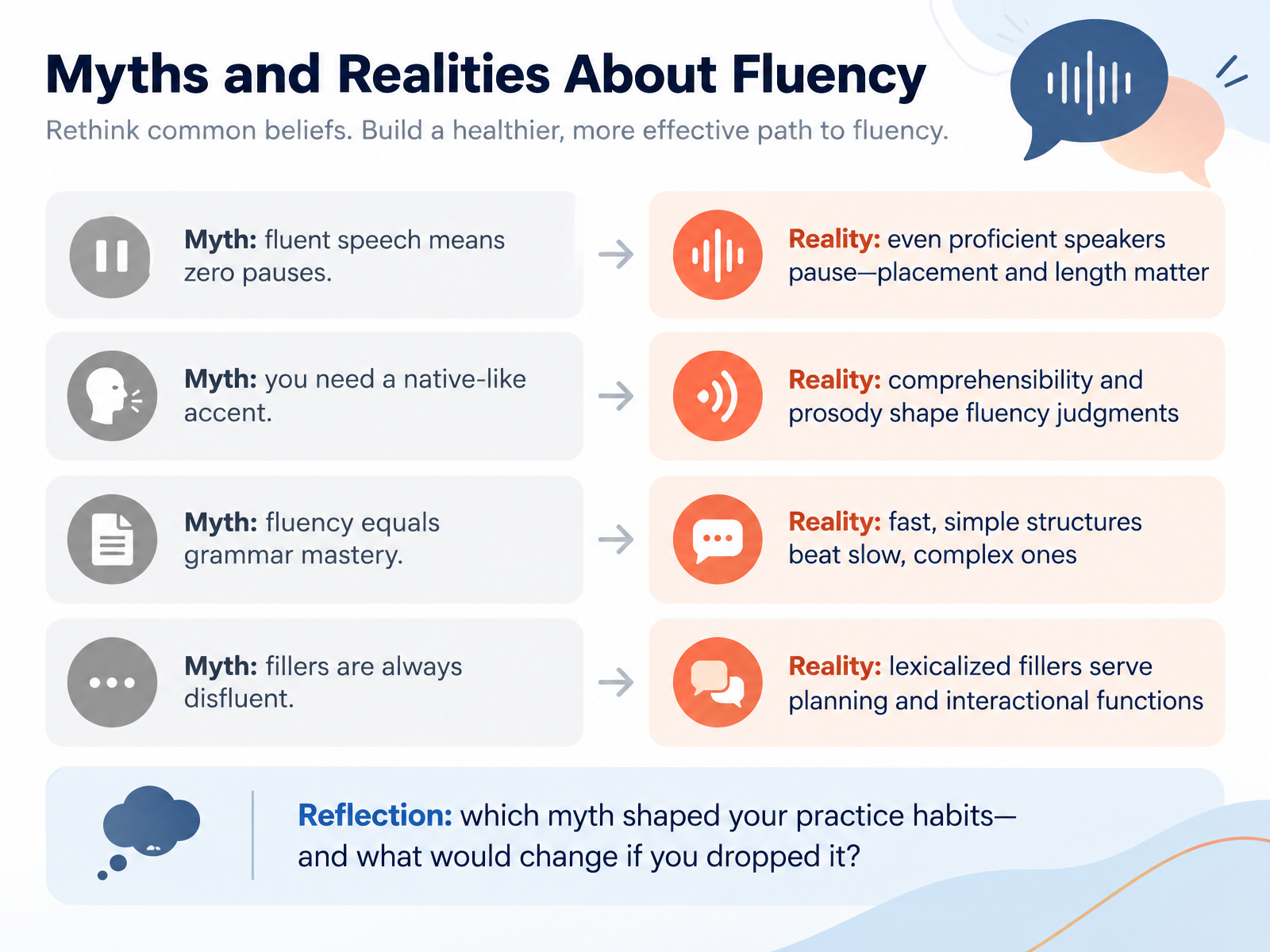
 - 03Myths and Realities About FluencyNow let's tackle some myths about fluency. Myth one: fluent speech means zero pauses. It doesn't. Even proficient speakers pause. What matters is where you pause and how long. A short pause at a clause boundary sounds thoughtful. A long pause mid-clause sounds like trouble. Myth two: you need a native-like accent. Not true. Listeners care about comprehensibility and prosody, your rhythm and intonation. Myth three: fluency equals grammar mastery. Actually, fast, simple structures beat slow, complex ones. So say, I sent the report yesterday, not a perfect but hesitant construction. And myth four: fillers are always disfluent. They're not. Lexicalized fillers like well, you know, actually help you plan and keep the interaction going. So here's your reflection. Which myth shaped your practice habits? And what would change if you dropped it? Take ten seconds and say your answer out loud. Next, we'll look at how chunking and formulaic sequences can make your speech smoother.
 jfs.ulis.vnu.edu.vnexa.aisage.cnpereading.com+22 min
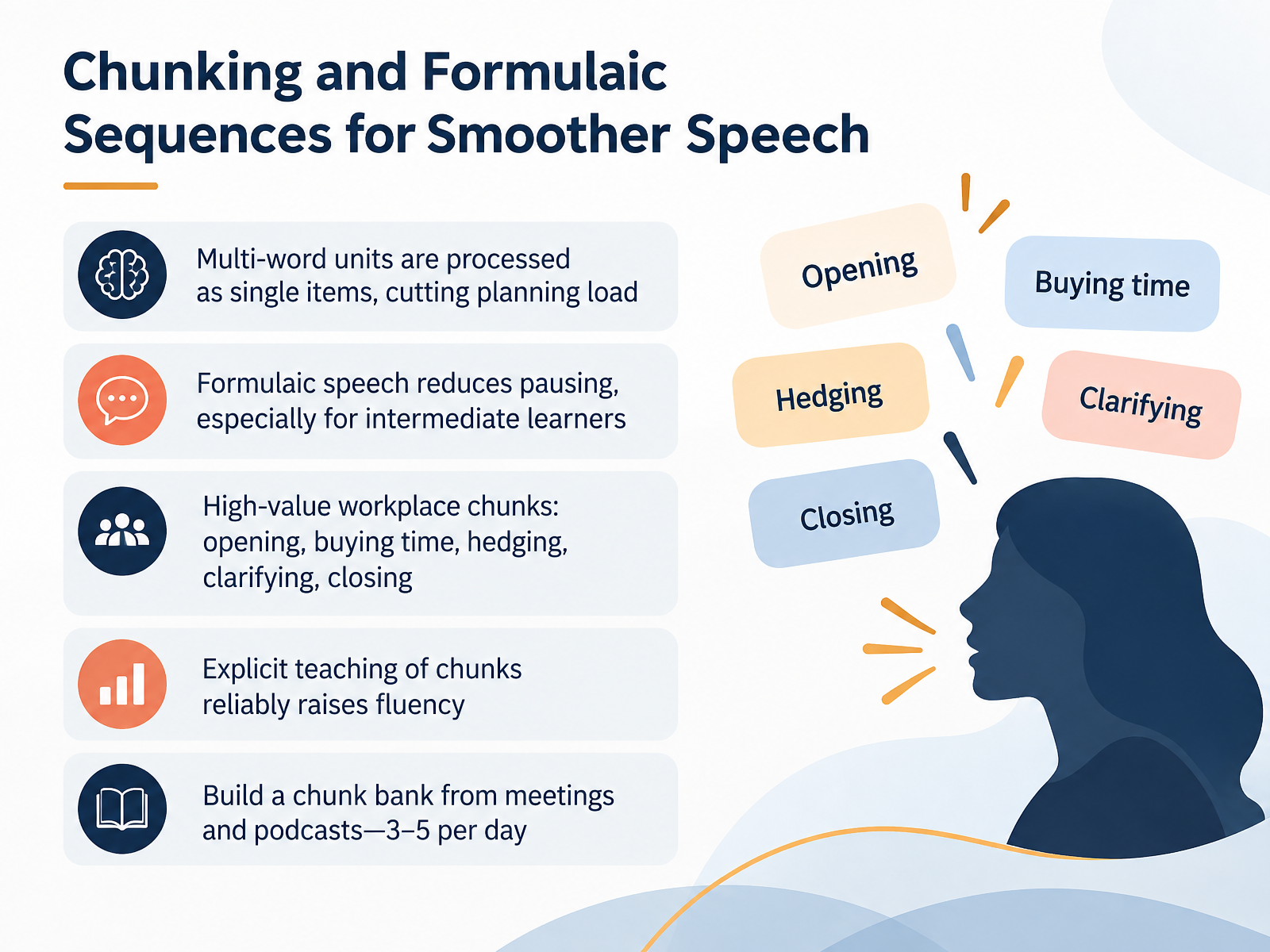
 - 04Chunking and Formulaic Sequences for Smoother SpeechLet's talk about chunking. A chunk is a group of words your brain stores as one item, like "to be honest" or "I'll get back to you." You don't build it word by word. You just grab it. And that cuts your planning load, because you're choosing one thing instead of five.
Have you noticed how pausing drops when you use these phrases? That's not a coincidence. Research shows formulaic sequences reduce pausing, especially for intermediate speakers. So here's your target list for work: openers, buying time, hedging, clarifying, and closing. For example, "Can I add something?" to open. "That's a good question" to buy time. "I might be wrong, but" to hedge. "So what you're saying is" to clarify. And "Let's circle back" to close.
Explicit teaching of chunks reliably raises fluency, so build your own bank. Pull three to five chunks a day from meetings or podcasts. Three to five. That's it.
Now, how do you move these from recognition into automatic production? Let's look at that next.
 journals.lib.unb.caexa.aidspace.uni.lodz.pl+22 min
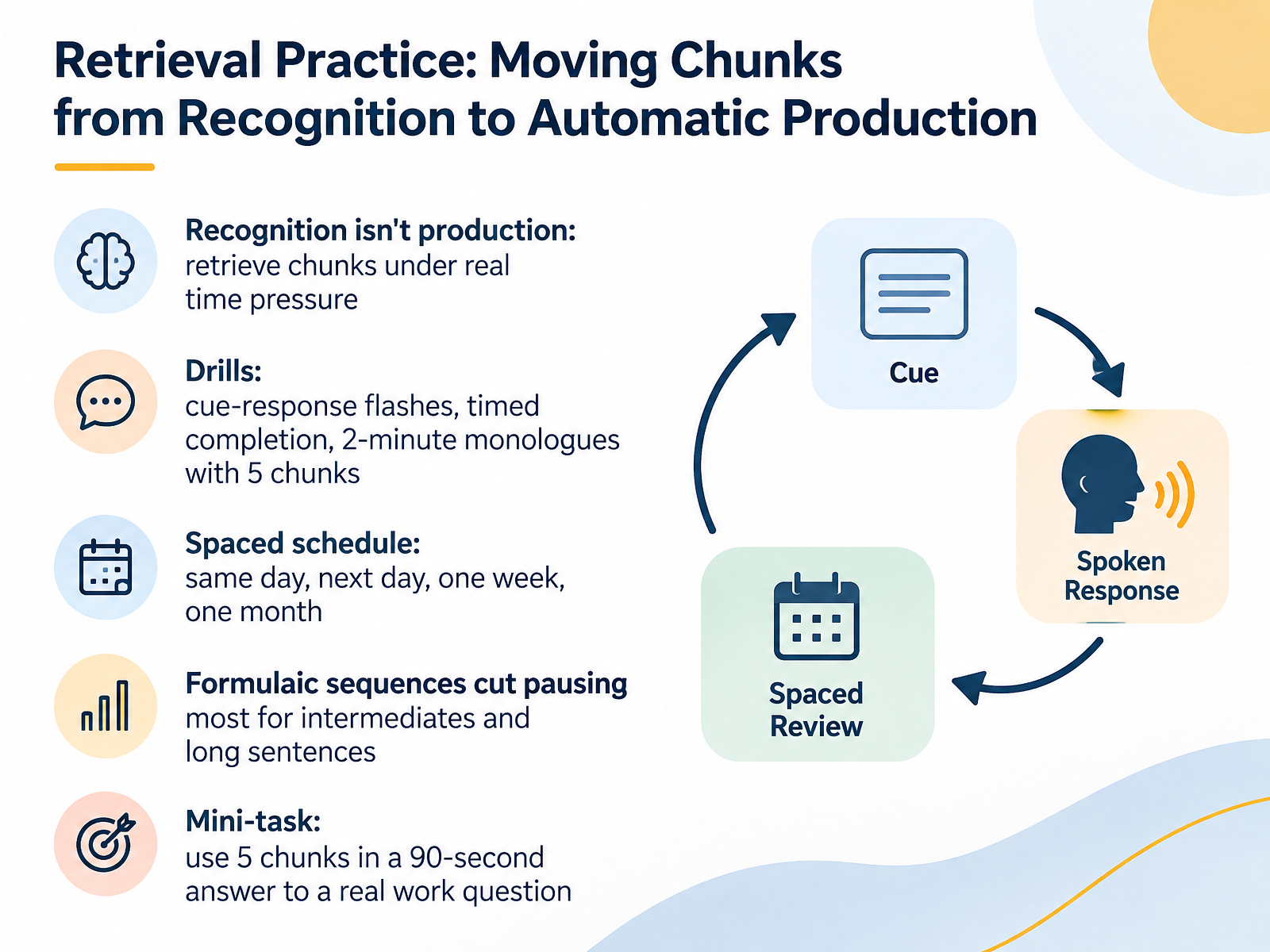
 - 05Retrieval Practice: Moving Chunks from Recognition to Automatic ProductionNow, here's the shift that changes everything. Recognizing a chunk is not the same as producing it. You might understand "as far as I know" when you hear it, but under time pressure, does it come out? That's what retrieval practice is for.
So try this. Cue-response flashes. You hear "deadline," you say "meet the deadline." Timed completion, where you finish a sentence before the timer runs out. And two-minute monologues, where you deliberately drop in five chunks you've been practicing.
Then space it out. Same day, next day, one week later, one month later. The research is clear here: formulaic sequences cut your pausing the most, especially for intermediate speakers and in longer sentences. Notice, that's pausing, not speed. So don't rush. Just reduce the stops.
Here's your mini-task. Answer a real work question for ninety seconds, and use five chunks. Something like, "As far as I know, the project is on track." Go ahead and try one now. Ready?
Next, let's look at grammar and vocabulary access under time pressure.
 journals.lib.unb.caexa.aidspace.uni.lodz.pl+22 min
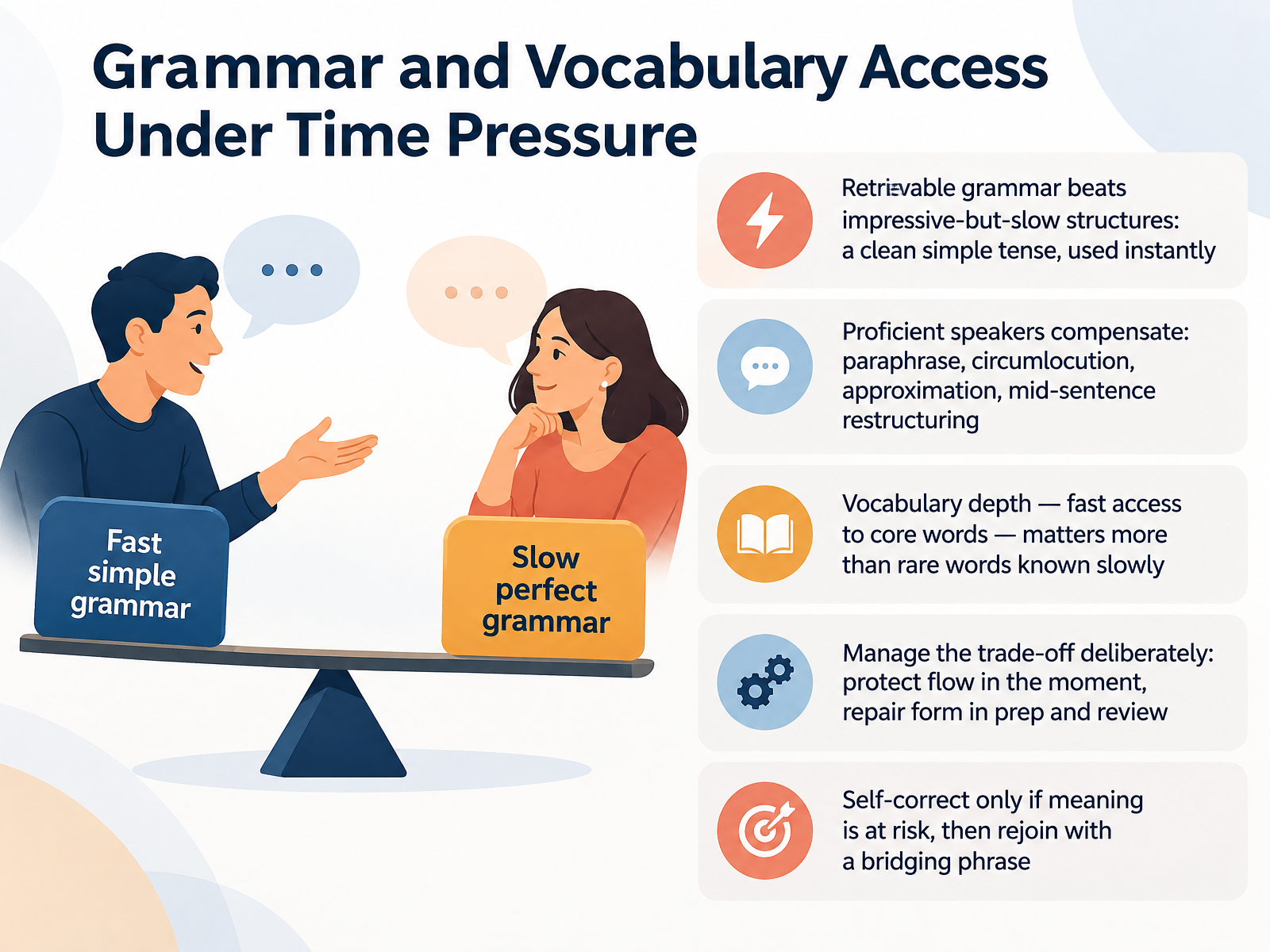
 - 06Grammar and Vocabulary Access Under Time PressureLet's talk about what happens when you're under time pressure. Here's the key idea. Retrievable grammar beats impressive but slow structures. A clean simple tense, used instantly, sounds far more fluent than a perfect conditional that takes three seconds to assemble. So if you feel the past perfect coming, and it's not there yet, just say it happened yesterday. Done. Proficient speakers also compensate. They paraphrase, they talk around a word, they approximate, and they restructure mid-sentence. And notice this. Fast access to core everyday words matters more than rare words you know slowly. So manage the trade-off deliberately. Protect your flow in the moment, then repair the form later, in preparation and review. And self-correct only when meaning is actually at risk. Then rejoin with a bridging phrase, like, sorry, what I mean is, or, let me put that another way. Quick question for you. Think of a word you often reach for at work. Now say a slower, simpler version out loud that keeps the sentence moving. Go ahead. Next, let's look at reducing hesitation with pausing, fillers, and thinking time.
 exa.aiexa.aijournals.sagepub.com+22 min
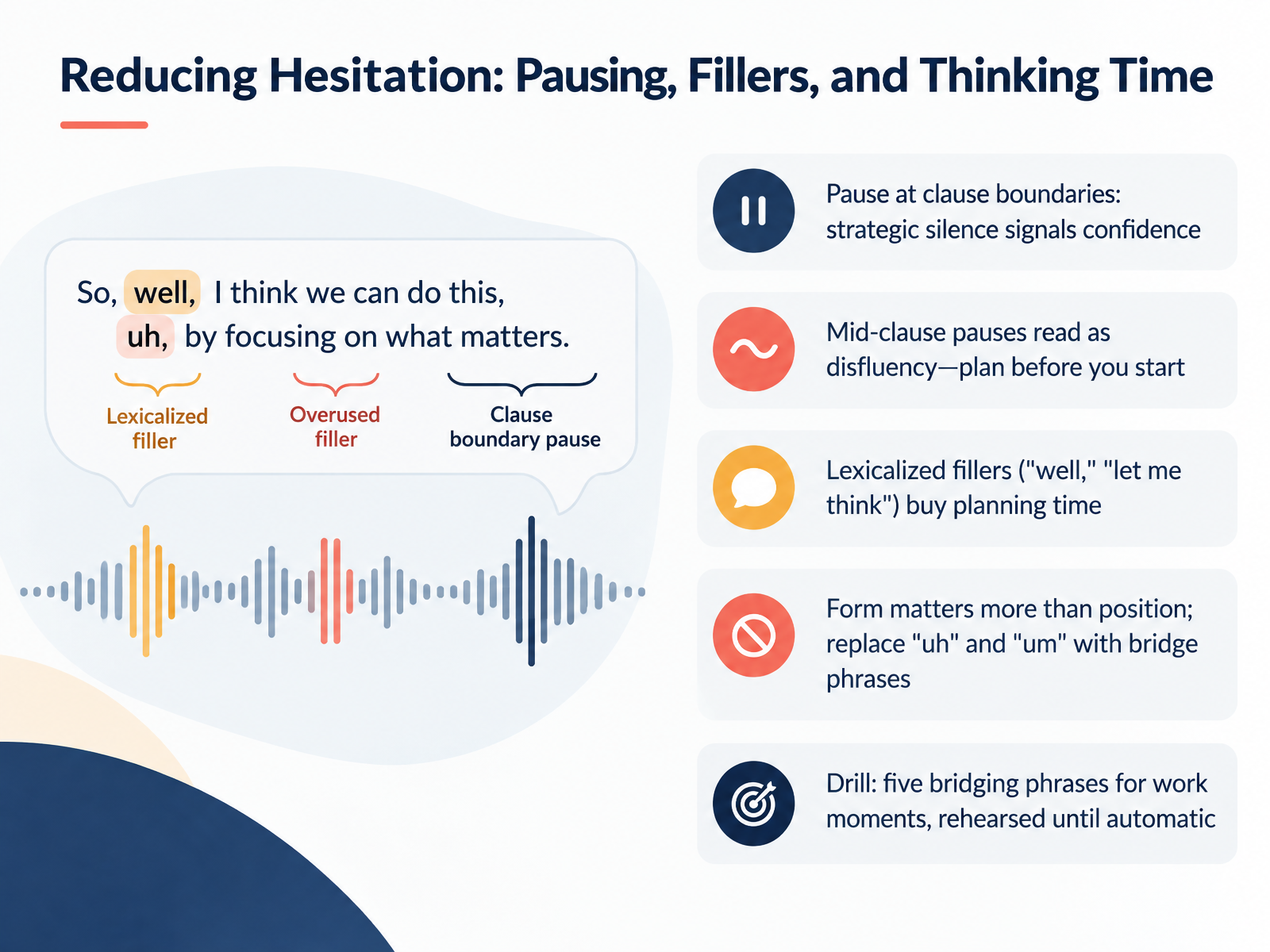
 - 07Reducing Hesitation: Pausing, Fillers, and Thinking TimeLet's talk about hesitation. Here's the good news: pausing is not the enemy. Where you pause matters more. A pause at a clause boundary, like "When the client calls, I'll send the update," sounds confident. A pause in the middle of a clause sounds like you're searching. So plan before you start, and let the silence sit at natural breaks. Now, instead of "uh" or "um," try bridge phrases.
Five to practice: "Well," "Let me think," "That's a good question," "So, here's the thing," and "Let me put it this way." Notice how these buy you planning time and still sound fluent. Research backs this up: the form of the filler matters more than where it sits. Lexicalized fillers like "well" and "let me think" signal confidence, while "uh" and "um" can read as disfluency.
So here's your drill: pick three of those phrases, and rehearse them until they're automatic. Try one now. You're in a meeting, and someone asks about a deadline you're not sure of. What do you say? Pause, then use a bridge. "Let me think. I'll confirm by end of day." That's fluent. That's confident. Next, we'll look at interrupting the translation loop.
 jfs.ulis.vnu.edu.vnexa.aisage.cnpereading.com+22 min
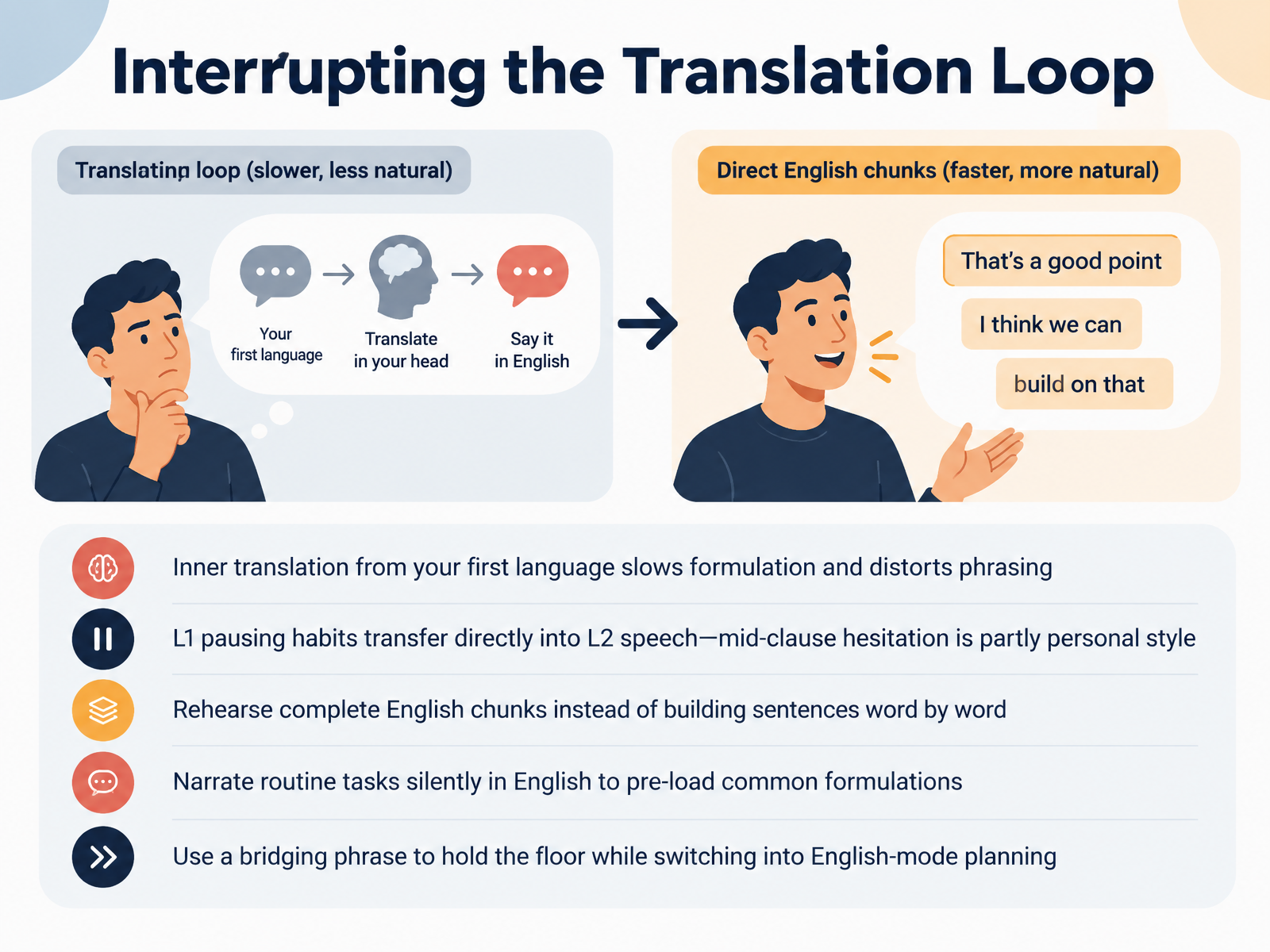
 - 08Interrupting the Translation LoopNow let's look at something that trips up a lot of capable speakers. The translation loop. If you're quietly building each sentence in your first language, then pushing it into English, everything slows down. And the phrasing often comes out a little off. Here's the interesting part. Research on fluency shows that your pausing habits from your first language carry straight over into your second. So that mid-clause hesitation? Part of it is just your personal speaking style. Not a failure. And that's good news, because it means we can work with it. Instead of assembling sentences word by word, rehearse complete English chunks. For example, grab a phrase like, I'll look into that and get back to you. Learn it whole. Then it comes out as one piece, not five decisions. You can also narrate routine tasks silently in English. Making coffee, opening your laptop, replying to email. That pre-loads the common formulations, so they're ready when you need them. And when you feel the translation starting, use a bridging phrase to hold the floor. Something like, that's a good question, or, let me think about that for a second. That buys you time to plan in English mode, and it sounds completely natural. So, pick one bridging phrase this week and practice it out loud until it's automatic. Next, we'll work on rhythm, with Listening, Shadowing, and Prosody for Fluent Rhythm.
 exa.aiexa.aijournals.sagepub.com+22 min
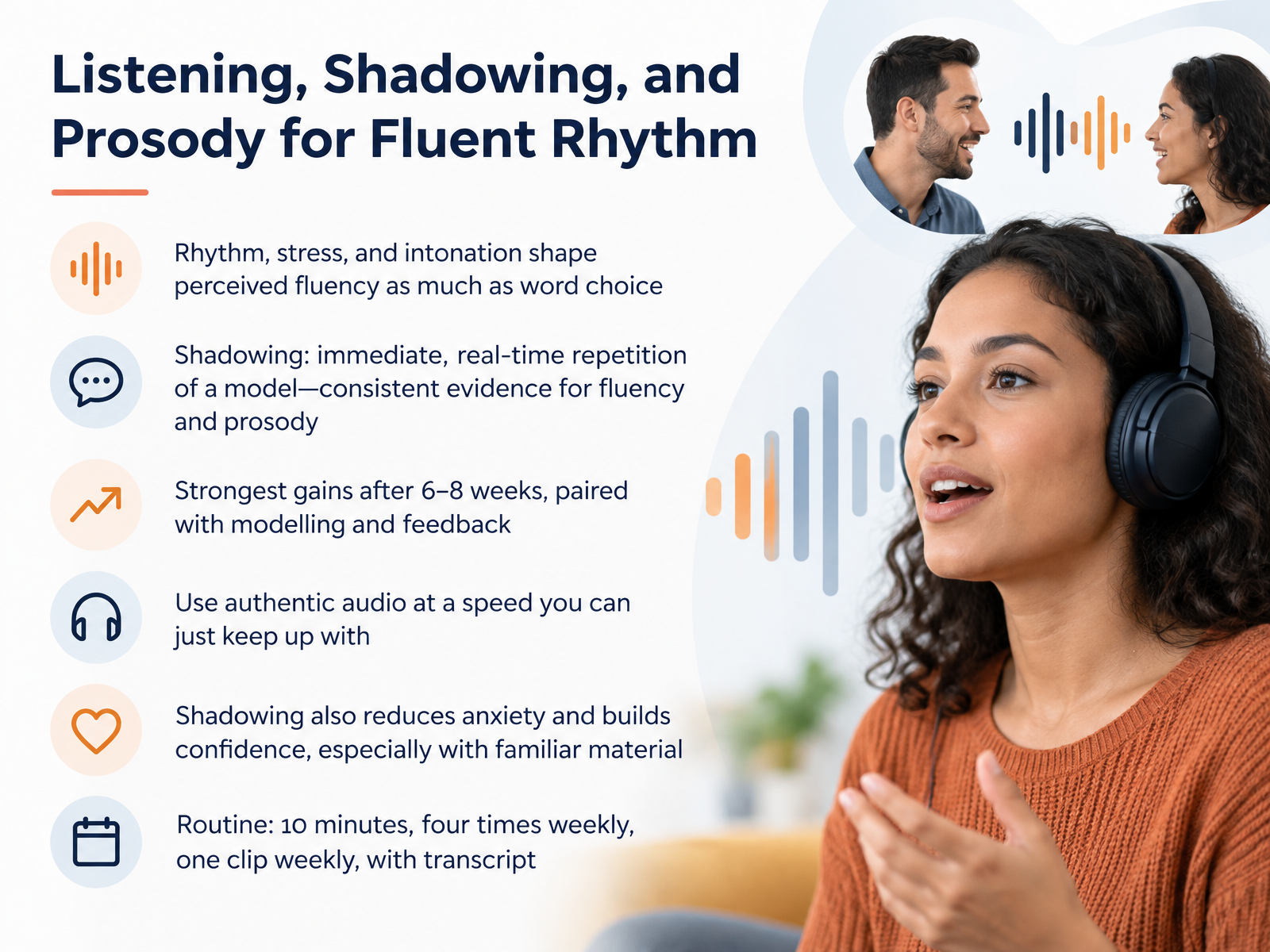
 - 09Listening, Shadowing, and Prosody for Fluent RhythmOkay, let's talk about rhythm. Here's the thing: rhythm, stress, and intonation shape how fluent you sound just as much as the words you choose. So how do you train that? Shadowing. That's immediate, real-time repetition of a model. You hear it, and you say it right along with the speaker. The research is consistent here: strong gains in fluency and prosody show up after six to eight weeks, especially when shadowing is paired with modelling and feedback. Pick authentic audio at a speed you can just keep up with. Not comfortable, but not overwhelming. A routine that works: ten minutes, four times a week, one clip per week, with the transcript nearby. And here's a bonus. Shadowing also reduces anxiety and builds confidence, especially with familiar material. So before we move on, try one clip. Press play, and speak right with it. Next, we look at managing speed, and when slowing down actually sounds more fluent.
 2 min
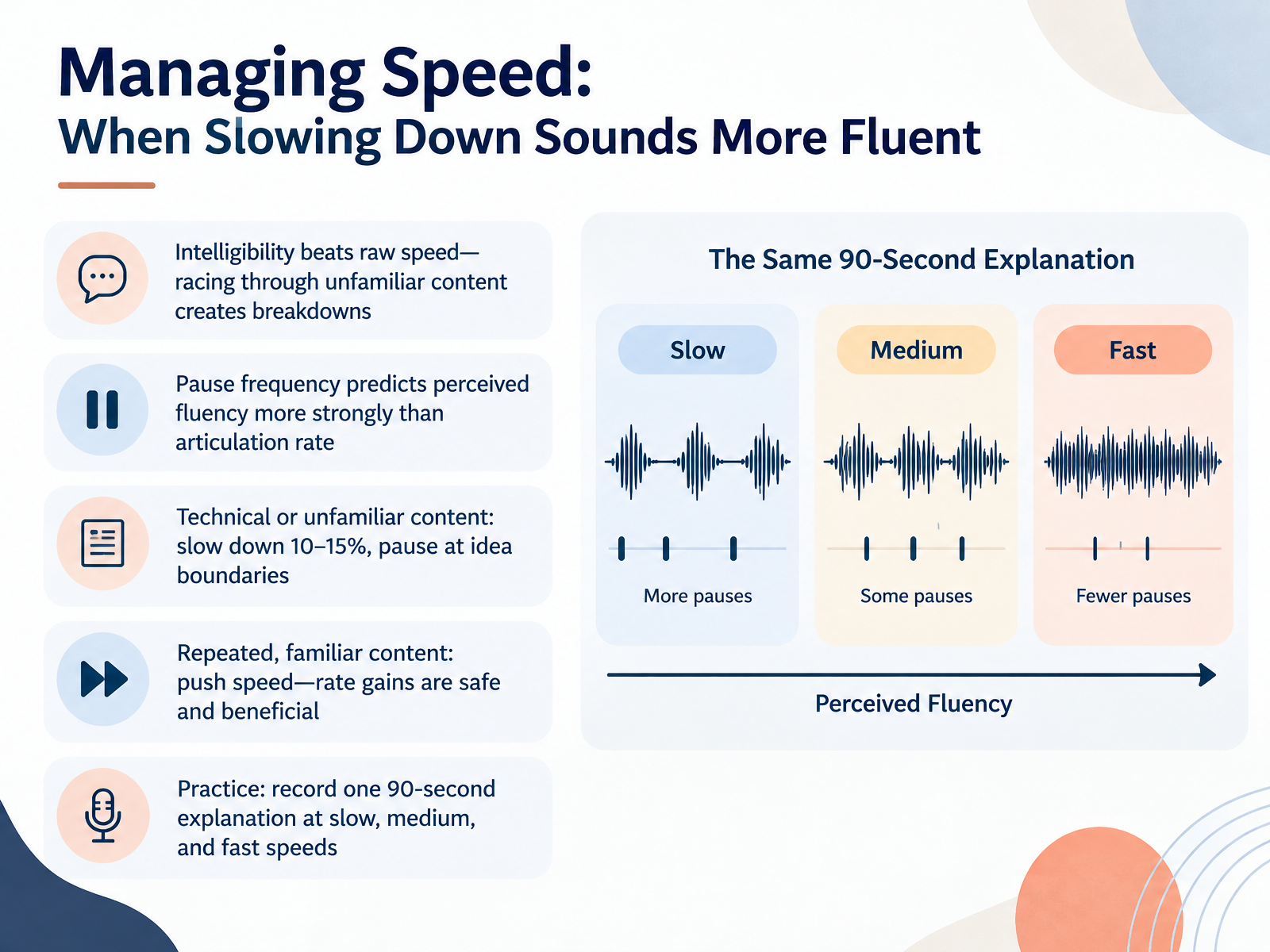
2 min - 10Managing Speed: When Slowing Down Sounds More FluentLet's talk about managing speed. Here's the counterintuitive part. Slowing down often sounds more fluent, not less. When you race through unfamiliar or technical content, listeners lose the thread, and that's where breakdowns happen. Research on perceived fluency shows that pause frequency predicts how fluent you sound more strongly than raw articulation rate. So pausing well matters more than talking fast. For technical or unfamiliar content, slow down by roughly ten to fifteen percent, and pause at idea boundaries, like between steps or after a key number. For repeated, familiar content, go ahead and push your speed. Rate gains there are safe and actually helpful. Now here's your practice. Record one ninety-second explanation at slow, medium, and fast speeds. Listen back, and ask yourself: where did meaning stay clear, and where did it slip? You might be surprised which version sounds the most fluent. Next, we'll look at speaking anxiety, confidence, and willingness to communicate.
 exa.aiexa.aijournals.sagepub.com+22 min
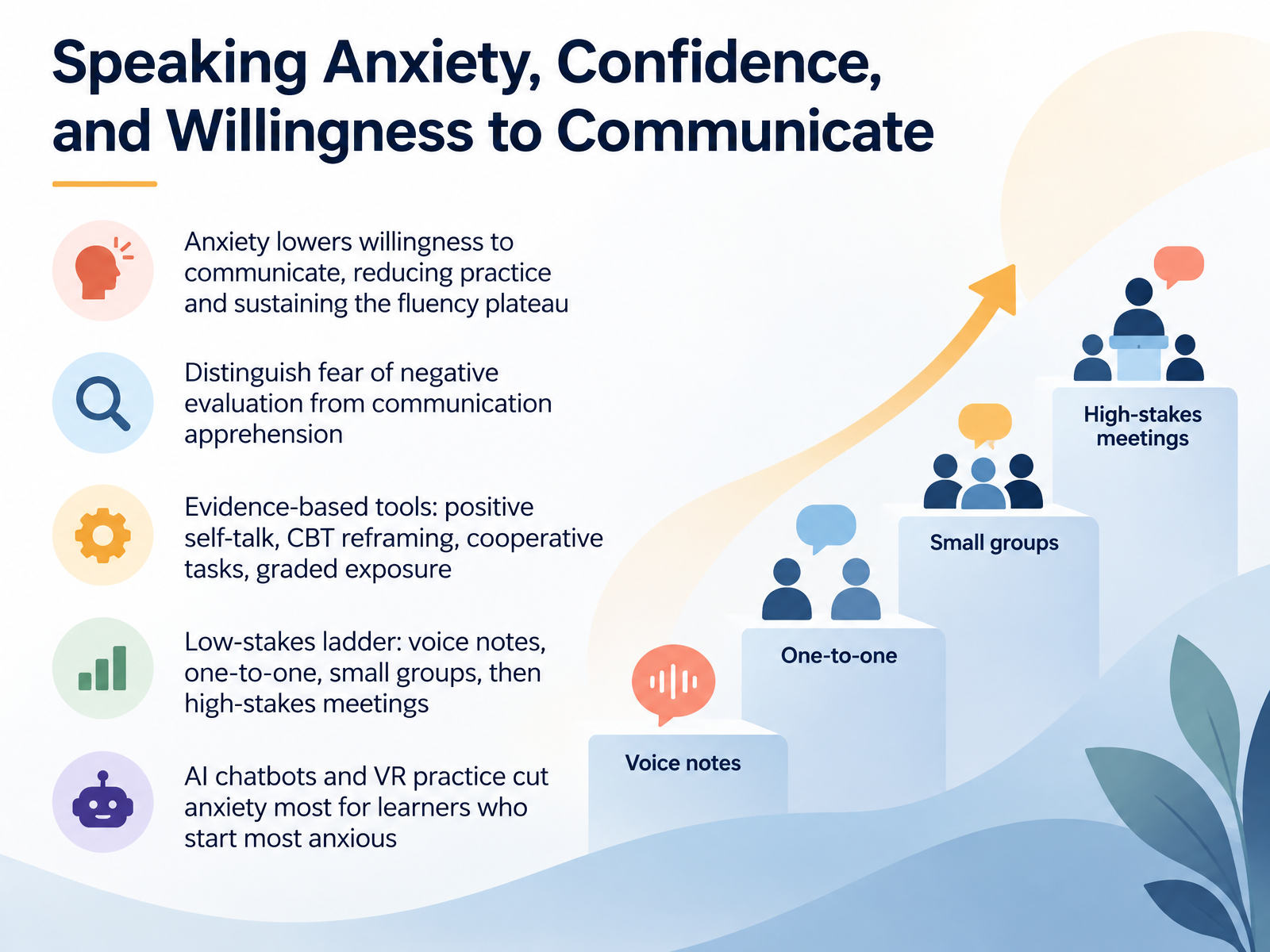
 - 11Speaking Anxiety, Confidence, and Willingness to CommunicateNow let's talk about speaking anxiety, confidence, and your willingness to communicate. Here's the pattern. When anxiety goes up, your willingness to speak goes down. Less speaking means less practice. And less practice keeps you stuck on that fluency plateau. So, quick check. When you imagine speaking English at work tomorrow, what happens in your body? Do you hesitate? Do you go quiet? Just notice that for a second. Now, two things often get mixed together. Fear of negative evaluation is worrying that people will judge you. Communication apprehension is the physical tension you feel when you actually speak. You might have one, or both. A few tools have real evidence behind them. Positive self-talk. Cognitive behavioural therapy style reframing, where you catch a thought like I will sound stupid and replace it with this is practice. Cooperative tasks. And graded exposure. Think of a low-stakes ladder. Start with voice notes to yourself. Then one-to-one conversations. Then small groups. Then high-stakes meetings. And interestingly, AI chatbots and virtual reality practice tend to cut anxiety most for learners who start the most anxious. Let's move on to practice that transfers, using the four-three-two technique and task repetition.
 2 min
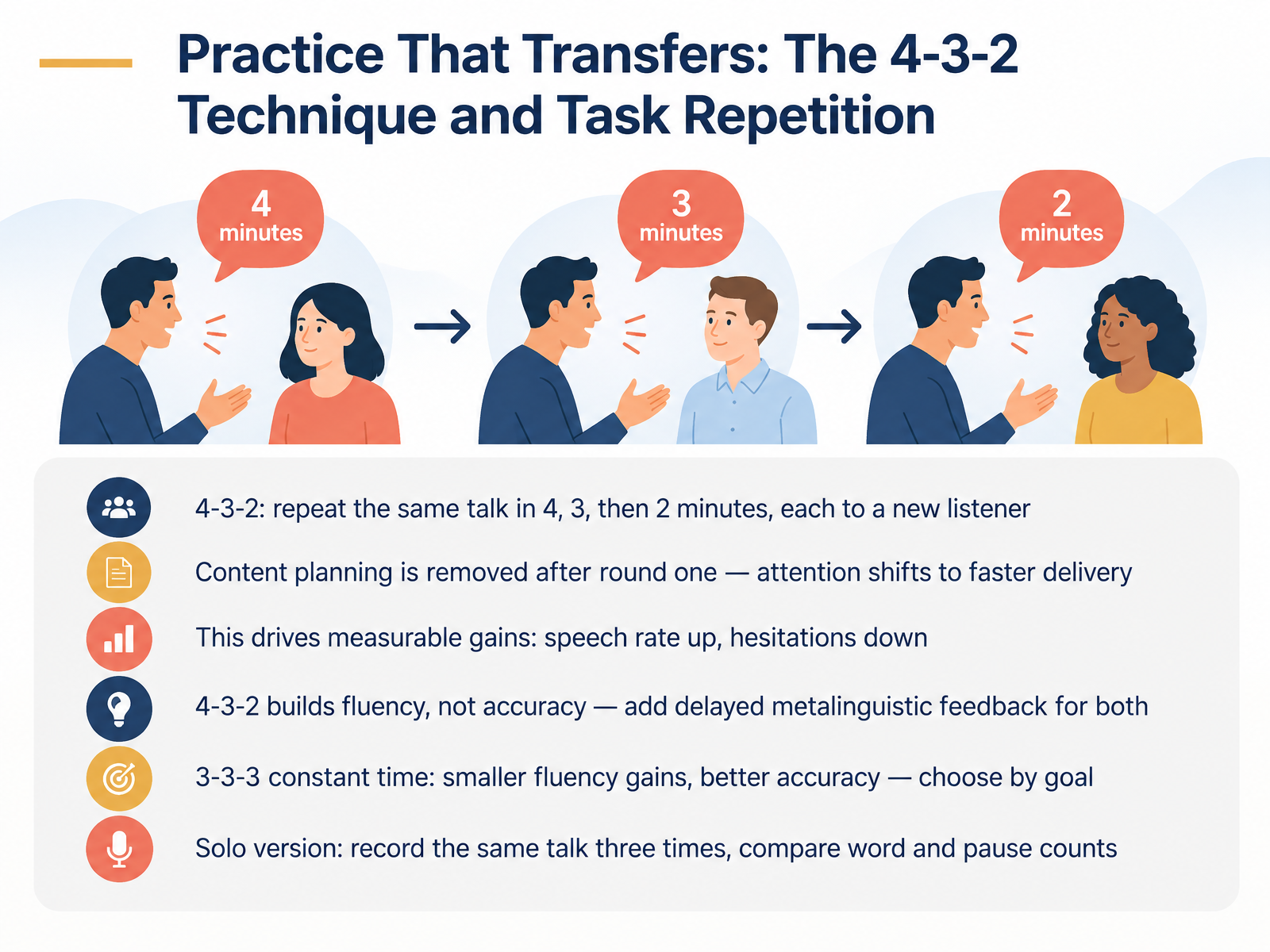
2 min - 12Practice That Transfers: The 4-3-2 Technique and Task RepetitionNow let's look at practice that actually transfers into real conversations. The four three two technique is simple. You give the same short talk three times, first in four minutes, then three, then two, each time to a new listener. That change of listener keeps it genuine, and it stops you from quietly rewriting your content. Here's the important part. After round one, planning is basically done. Your attention shifts to delivery, so you speak faster, with fewer hesitations. The research shows exactly that. Speech rate goes up, hesitations go down. One caution though. Four three two builds fluency, not accuracy. So add delayed metalinguistic feedback afterward, a quick look at the language you used, and you get both. A constant three three three version gives smaller fluency gains but better accuracy. Choose by your goal. No partner? Record the same talk three times, then compare word counts and pause counts. Turning routine work interactions into fluency practice.
 2 min
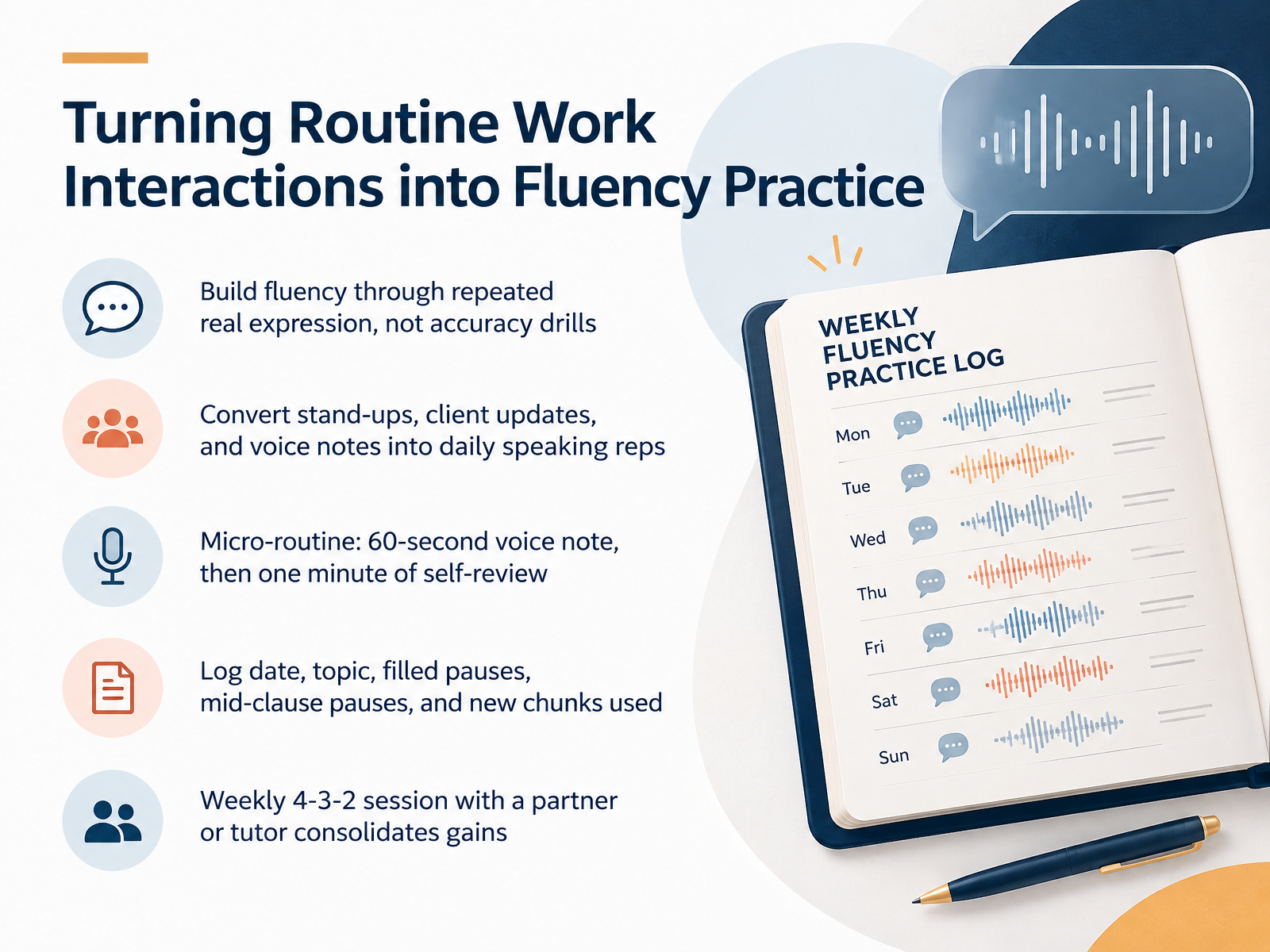
2 min - 13Turning Routine Work Interactions into Fluency PracticeSo let's bring fluency practice into your everyday work. The key idea here is repetition of real expression, not accuracy drills. You get fluent by saying the same true thing again and again, faster and cleaner each time. Take things you already do, like stand-ups, client updates, and voice notes, and turn them into daily speaking reps. Here's a simple micro-routine. Record a sixty-second voice note. Then spend one minute reviewing it. In a log, write the date, the topic, your filled pauses, like um and uh, your mid-clause pauses, and any new chunks you used, such as to be honest or just to follow up. Once a week, do a four-three-two session with a partner or tutor. You talk about a familiar topic for four minutes, then again for three, then again for two, each time to a fresh listener. It feels tight at first, and that's the point. The squeeze pushes your speed up and your hesitations down. So here's your takeaway. Pick one routine interaction today, record it, review it, and log it. That's one real rep toward fluency. Next, let's look at facilitating fluency in classrooms and tutoring sessions.
 journals.lib.unb.caexa.aidspace.uni.lodz.pl+22 min
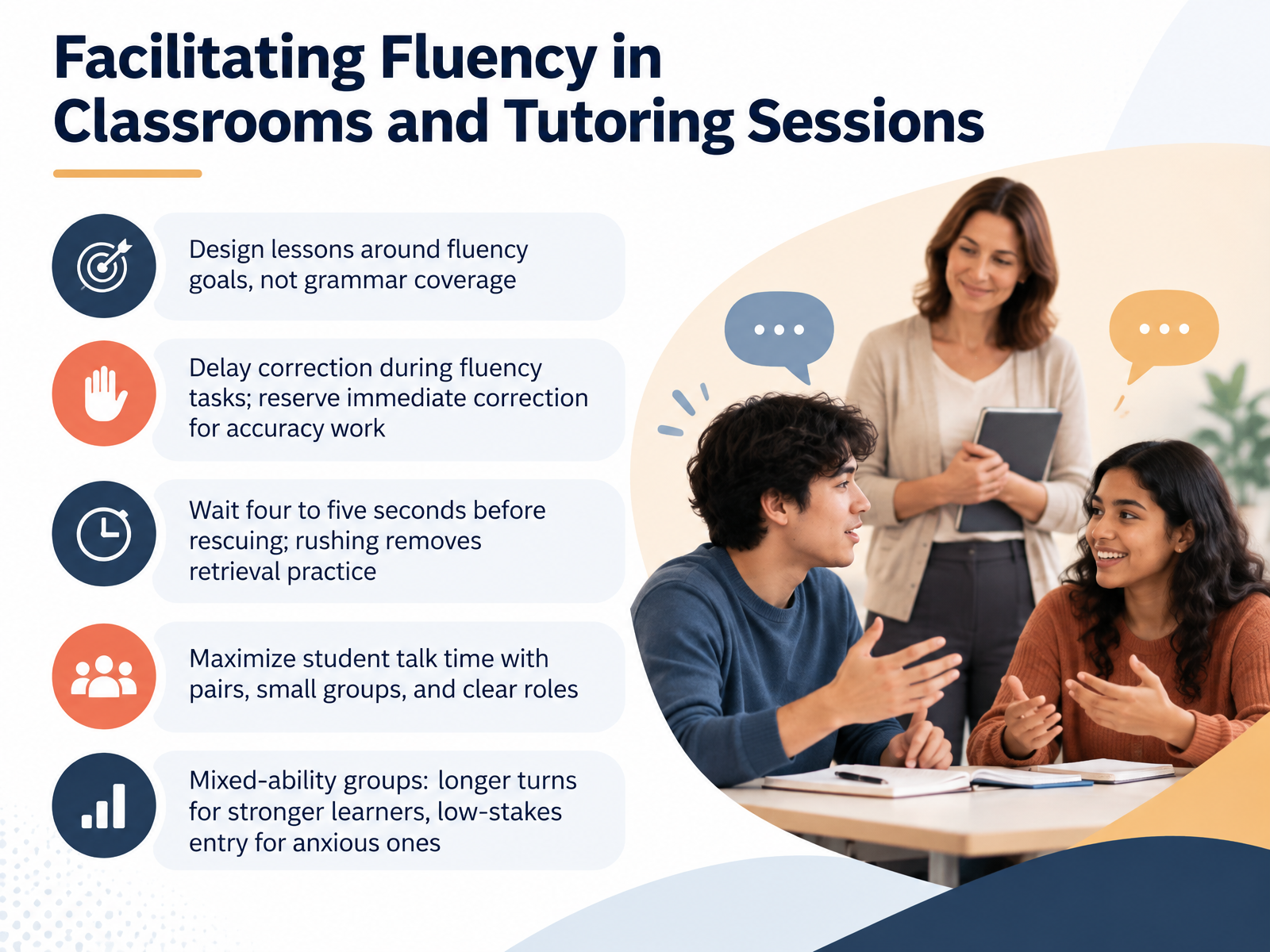
 - 14Facilitating Fluency in Classrooms and Tutoring SessionsSo, let's bring this all together. Facilitating fluency in your classroom or tutoring sessions comes down to a few deliberate choices. First, design your lessons around fluency goals, not grammar coverage. Ask yourself, what do I want them to actually do with the language? Second, delay correction during fluency tasks. Save the immediate correction for accuracy work. Third, and this one is hard, wait four to five seconds before rescuing a learner. I know that silence feels long. But rushing in removes the retrieval practice they need. Fourth, maximize student talk time with pairs, small groups, and clear roles. And fifth, in mixed-ability groups, give stronger learners longer turns, and offer low-stakes entry points for anxious ones. Here's your takeaway: fluency grows when learners speak more and you intervene less. You are capable teachers and tutors. Trust the process, trust your learners, and keep them talking. Thank you so much for joining me. You've got this.
 2 min
2 min
Take the deck with you
Download this course as a file — free, no sign-up needed.
- PDF handoutEvery slide page, ready to print or share.15 pages · 3.3 MBDownload
- Narrated PowerPointThe deck that presents itself — every slide carries the digital human's narration video.15 pages · 13.8 MBDownload
- PowerPoint slidesThe full deck as a .pptx — open it in PowerPoint, Keynote, or Google Slides.15 pages · 3.2 MBDownload
Free to use in your own training — please keep the PersonWise credit page at the end.
Have your own deck? Turn it into a course
Sources consulted
Web sources consulted while building this course.
- Oral Production B1–B2: CEFR Descriptors | CEFRhub — cefrhub.ai
- https://centresofexcellencenb.ca/languagelearning/wp-content/uploads/sites/16/2024/01/Global-CEFR-Oral-Proficiency-Descriptors-2.pdf — centresofexcellencenb.ca
- THE CEFR ILLUSTRATIVE DESCRIPTOR SCALES: COMMUNICATIVE LANGUAGE COMPETENCES — rm.coe.int
- Common European Framework of Reference for Languages: Learning, Teaching, Assessment — rm.coe.int
- Common European Framework of Reference for Languages (CEFR) — coe.int
- Patterns in Second Language Utterance Fluency: An Exploratory Meta-analysis of Correlational Research — exa.ai
- How does learners’ L2 utterance fluency relate to their L1? A meta‐analysis — exa.ai
- Speed, breakdown, and repair: An investigation of fluency in long-term second-language speakers of English — journals.sagepub.com
- The Relationship Between Utterance and Perceived Fluency: A Meta-Analysis of Correlational Studies — onlinelibrary.wiley.com
- What makes speech sound fluent? The contributions of pauses,speed and repairs — sage.cnpereading.com
- INVESTIGATING THE EFFECTS OF FILLERS IN SPONTANEOUS SPEECH ON FLUENCY PERCEPTION | VNU Journal of Foreign Studies — jfs.ulis.vnu.edu.vn
- The role of pragmatic markers in perceptions of L2 fluency in dialogue — exa.ai
- The use of discourse markers across pragmatic performance levels and task types — sage.cnpereading.com
- The relationship between use of discourse markers and L2 spoken ability across proficiency levels | John Benjamins — jbe-platform.com
- Filler Use in EFL Speaking: A Cognitive and Communicative Analysis of English Club Interactions | Jo-ELT (Journal of English Language Teaching) Fakultas Pendidikan Bahasa & Seni Prodi Pendidikan Bahasa Inggris IKIP — e-journal.undikma.ac.id
- Effects of focused instruction of formulaic sequences on fluent expression in second language narratives: A case study — journals.lib.unb.ca
- Unpacking the Relationship Between Formulaic Sequences and Speech Fluency on Elicited Imitation Tasks: Proficiency Level, Sentence Length, and Fluency Dimensions — exa.ai
- REFINING THE METHODOLOGY FOR INVESTIGATING THE RELATIONSHIP BETWEEN FLUENCY AND THE USE OF FORMULAIC LANGUAGE IN LEARNER SPEECH — dspace.uni.lodz.pl
- Can explicit instruction of formulaic sequences enhance L2 oral fluency? — exa.ai
- Teaching Formulaic Sequences in the Classroom: Effects on Spoken Fluency — teslcanadajournal.ca