Begin
15 pages · ~30 min
Expanding Universe Exploration
An overview of the expanding universe, covering key concepts and evidence for learners seeking to understand cosmic expansion and its implications.
A digital instructor presents all 15 pages. Hold “Ask” at any point and ask out loud — the answer comes from this course. No sign-up needed.
What you’ll learn
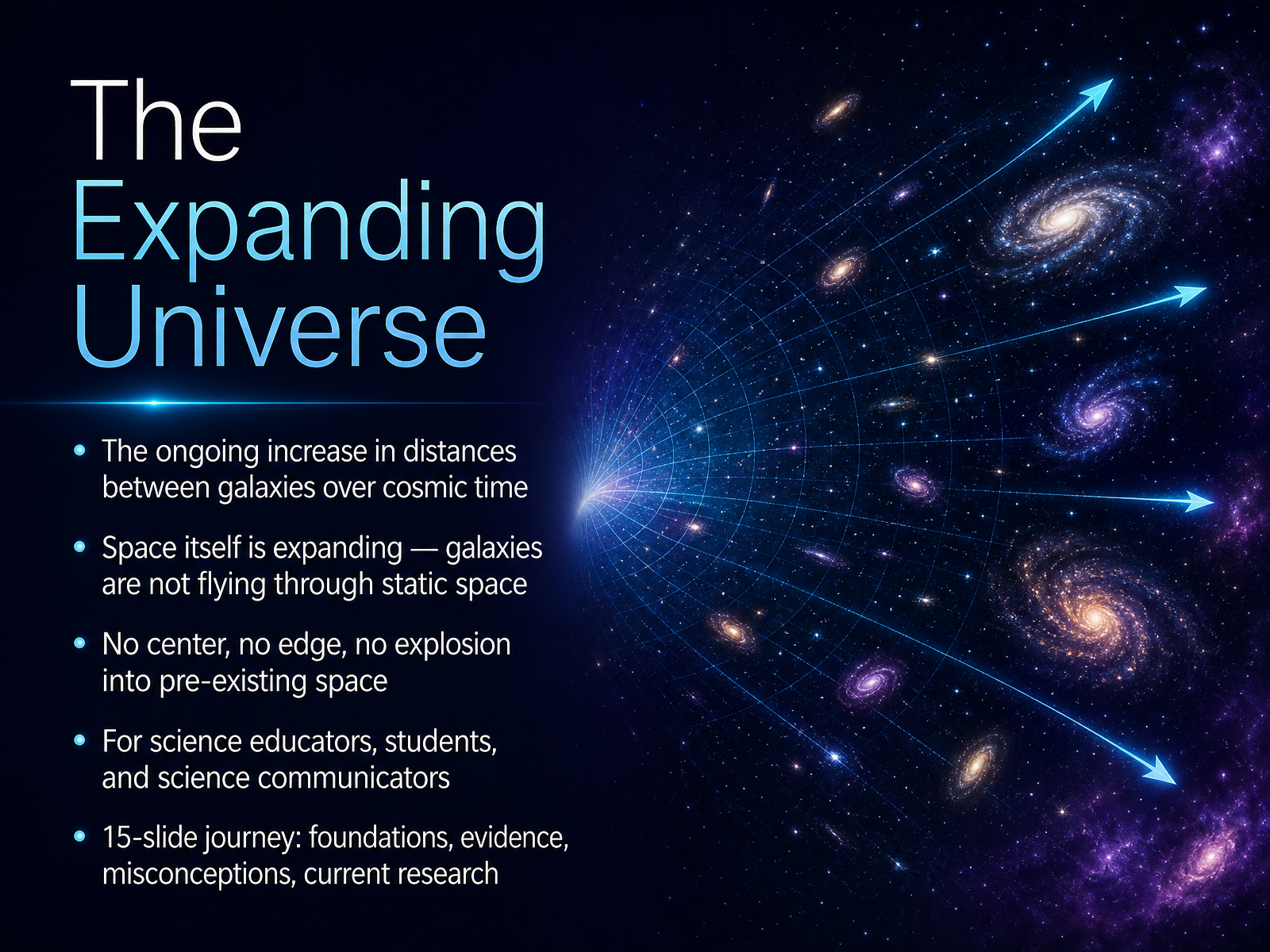
- 01The Expanding UniverseHello, and welcome. Whether you teach science, study it, or translate it for the public, you know that few ideas stretch our imagination quite like the expanding universe. That phrase might bring to mind fireworks or an explosion, but here’s the twist: it’s not an explosion into space. Space itself is doing the expanding. Galaxies aren’t flying through a static, empty void — they are being carried along as the very fabric of spacetime stretches. And no, there is no center to this expansion, and no edge, and no outside to spill into. Those are the kinds of claims that make cosmology so fascinating and so easy to misunderstand. Over the next fifteen slides, we’ll build this picture step by step: the evidence, the common misconceptions, and the current research that keeps cosmologists up at night. Together, we’ll find clear, honest ways to share these ideas. Let’s begin by looking at what expansion actually means.rubinobservatory.orgbeta.iopscience.iop.orgscientificamerican.com+21 min
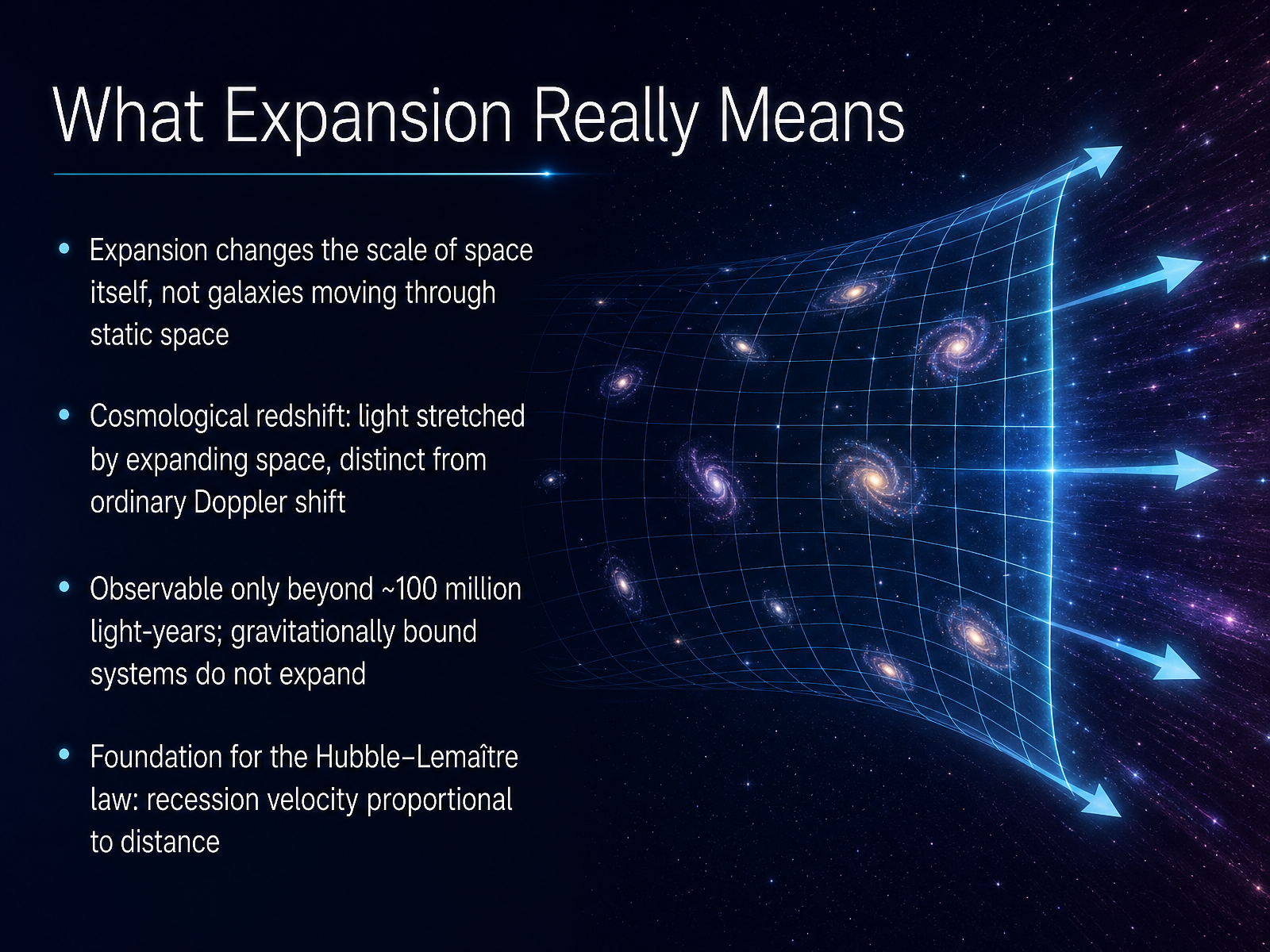
- 02What Expansion Really MeansLet's clear up one of the most common confusions in cosmology. When we say the universe is expanding, what do we actually mean? It's not that galaxies are flying outward through a fixed, empty space, like fragments from an explosion. Instead, the scale of space itself is changing. The distance between things grows because space stretches. A useful way to picture this is to think of a balloon being inflated. Dots drawn on its surface don't move across the rubber; they spread apart as the rubber itself expands. Now, this expansion has a visible signature: light. As space stretches, it stretches the light waves traveling through it, making them longer and redder. This is the cosmological redshift. It is distinct from the everyday Doppler shift you hear when a siren passes by. Cosmological redshift is not the galaxy moving through space; it's the space itself growing while the light is on its way. There's an important catch though. This stretching is only noticeable on enormous scales, beyond about a hundred million light-years. Within our local group, gravity holds galaxies together. Andromeda, for instance, is actually moving toward us, not away. So expansion does not pull apart everything. It operates on the vast, intergalactic stage. And this insight leads us to a powerful pattern: the Hubble-Lemaître law, where the recession speed of a distant galaxy is proportional to its distance. This relationship is the foundation of modern cosmology, and it's what we'll build on next as we explore redshift and that law in more depth.
 rubinobservatory.orgbeta.iopscience.iop.orgscientificamerican.com+22 min
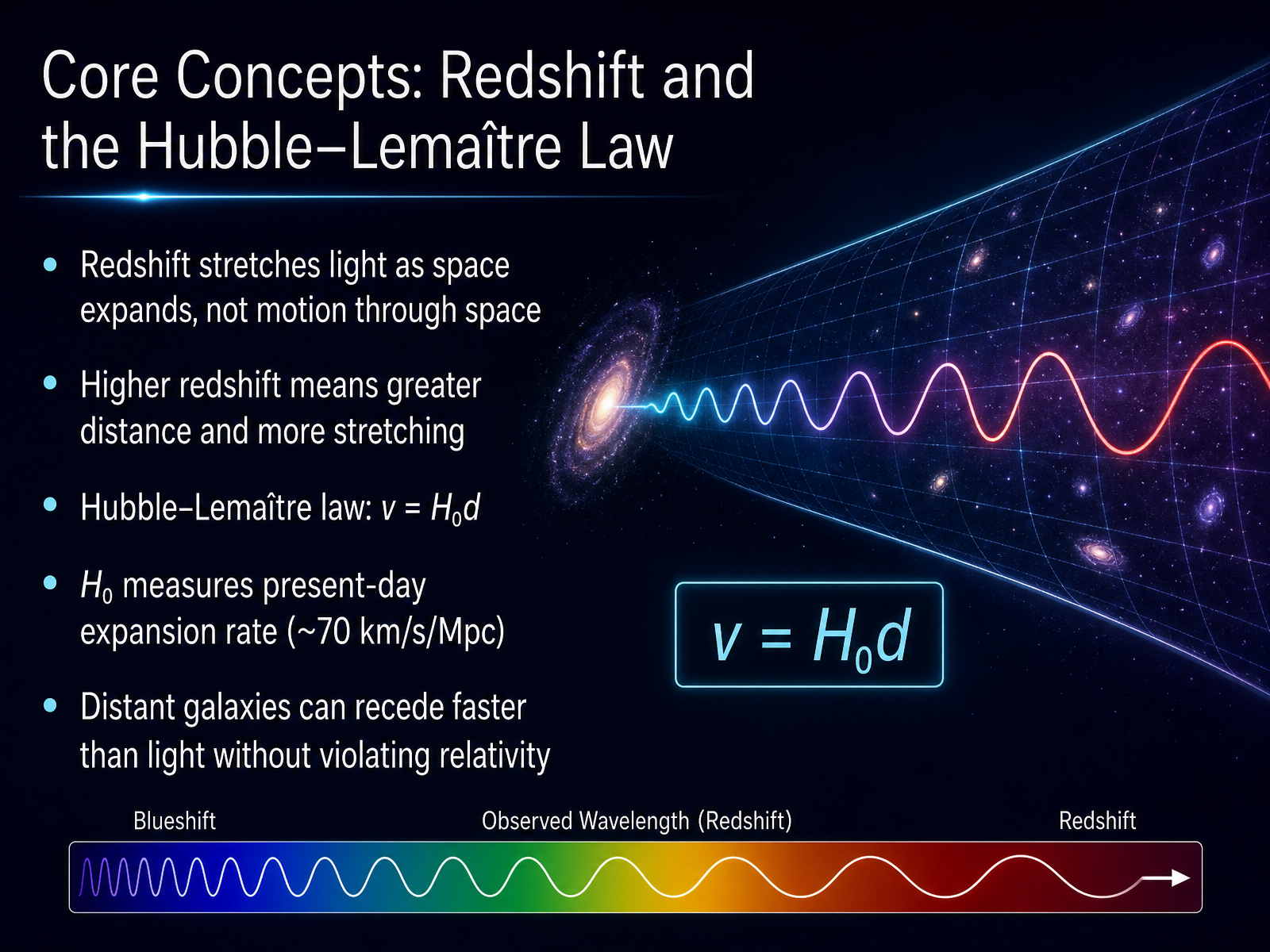
 - 03Core Concepts: Redshift and the Hubble–Lemaître LawNow let’s get to the heart of cosmic expansion: redshift and the Hubble–Lemaître law. Here’s a key idea to hold onto. Redshift isn’t caused by galaxies racing through space. It happens because space itself is stretching, and that stretch lengthens the light waves traveling through it. Think of drawing dots on a balloon and inflating it—the dots move apart, but they’re not moving across the rubber; the rubber is expanding beneath them. The same is true for galaxies and light. The more the universe has expanded while the light was in transit, the more its wavelength is stretched toward the red end of the spectrum. And here’s the powerful part: the higher the redshift, the greater the distance, and the further back in time we’re seeing. This relationship is captured in a simple equation: velocity equals the Hubble constant times distance. That constant, H-nought, is about seventy kilometers per second per megaparsec. So a galaxy one megaparsec away recedes at about seventy kilometers per second; one ten megaparsecs away recedes ten times faster. Now, a fascinating consequence: very distant galaxies can appear to recede faster than light. But that doesn’t violate relativity, because they aren’t moving through space—space itself is carrying them along. For educators, this is a beautiful teaching moment: it shifts how we think about motion and about the universe itself. Next, we’ll look at the discovery timeline, from Einstein’s relativity to Hubble’s observations.
 science.nasa.govstarchild.gsfc.nasa.govnewscientist.com+22 min
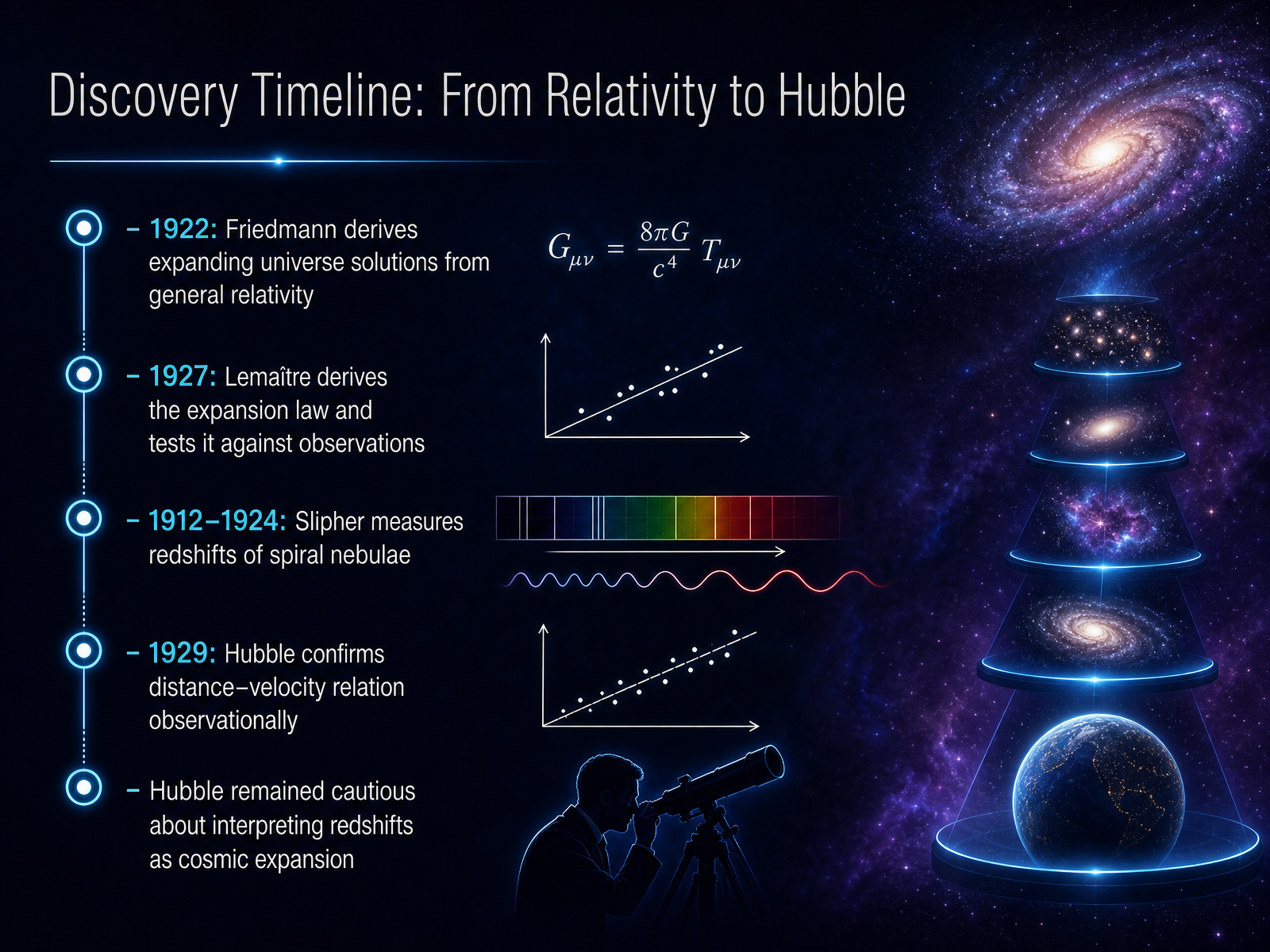
 - 04Discovery Timeline: From Relativity to HubbleNow, let's walk through the timeline that led to one of the most profound shifts in how we see the cosmos. It starts in 1922, when Alexander Friedmann found that Einstein's equations of general relativity could describe a universe that expands. It was a mathematical possibility, not yet a confirmed reality. Five years later, in 1927, Georges Lemaître went further. He not only rediscovered that solution, but he derived the relationship between a galaxy's distance and its recessional speed — and he tested it against real data. Meanwhile, Vesto Slipher had been quietly measuring the redshifts of spiral nebulae since 1912, and by 1924 he had shown that most of them are moving away from us. Then came 1929. Edwin Hubble, using Slipher's velocities and his own distance measurements, confirmed that the farther a galaxy is, the faster it recedes. But here's the nuance for educators: Hubble himself remained cautious. He was comfortable with the observational relation that now bears his name, but he was never fully convinced that it proved the expansion of space itself. That leap of interpretation belongs to Lemaître. So when you teach this story, it's a wonderful reminder that discovery is rarely a single eureka moment — it's a collaborative, layered process of theory, observation, and cautious interpretation. Next, we'll explore what that expanding universe implies about its hot, dense beginnings: the Big Bang framework.
 mdpi.comphysicstoday.aip.orgjournals.sagepub.com+22 min
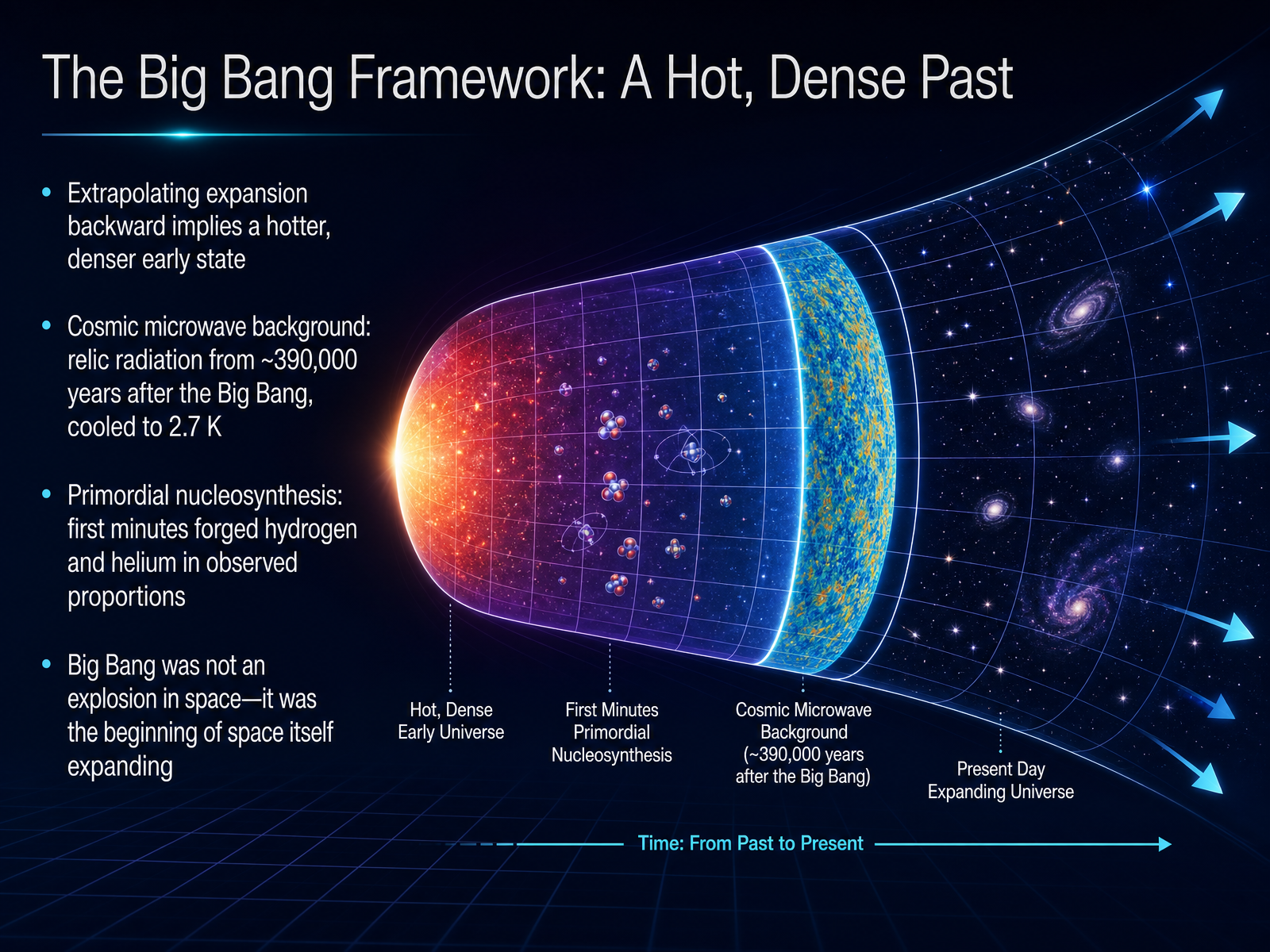
 - 05The Big Bang Framework: A Hot, Dense PastSo if the universe is expanding today, what happens when we run the clock backward? We arrive at a state that is hotter and denser, the very foundation of the Big Bang framework. Now, this is a crucial point for anyone teaching this: the Big Bang was not an explosion in space. It was the beginning of space itself expanding. Think of it not as a bomb going off in a room, but as the room itself stretching into existence. We have remarkable evidence for this hot, dense past. First, the cosmic microwave background. This is relic radiation from about three hundred ninety thousand years after the Big Bang, which has cooled to just under three degrees Kelvin. It is the faint afterglow of that early fireball, still washing over us today. Second, primordial nucleosynthesis. In the first few minutes, the universe was a fusion factory, forging hydrogen and helium in the exact proportions we observe today. This isn't just a story; these are measurable fingerprints. Together, these observations confirm a universe that began hot, dense, and expanding. And this leads us to a startling question: if expansion began with a bang, what is driving it now? Let's explore the accelerating expansion and dark energy.
 annualreviews.orglink.springer.compdg.lbl.gov+22 min
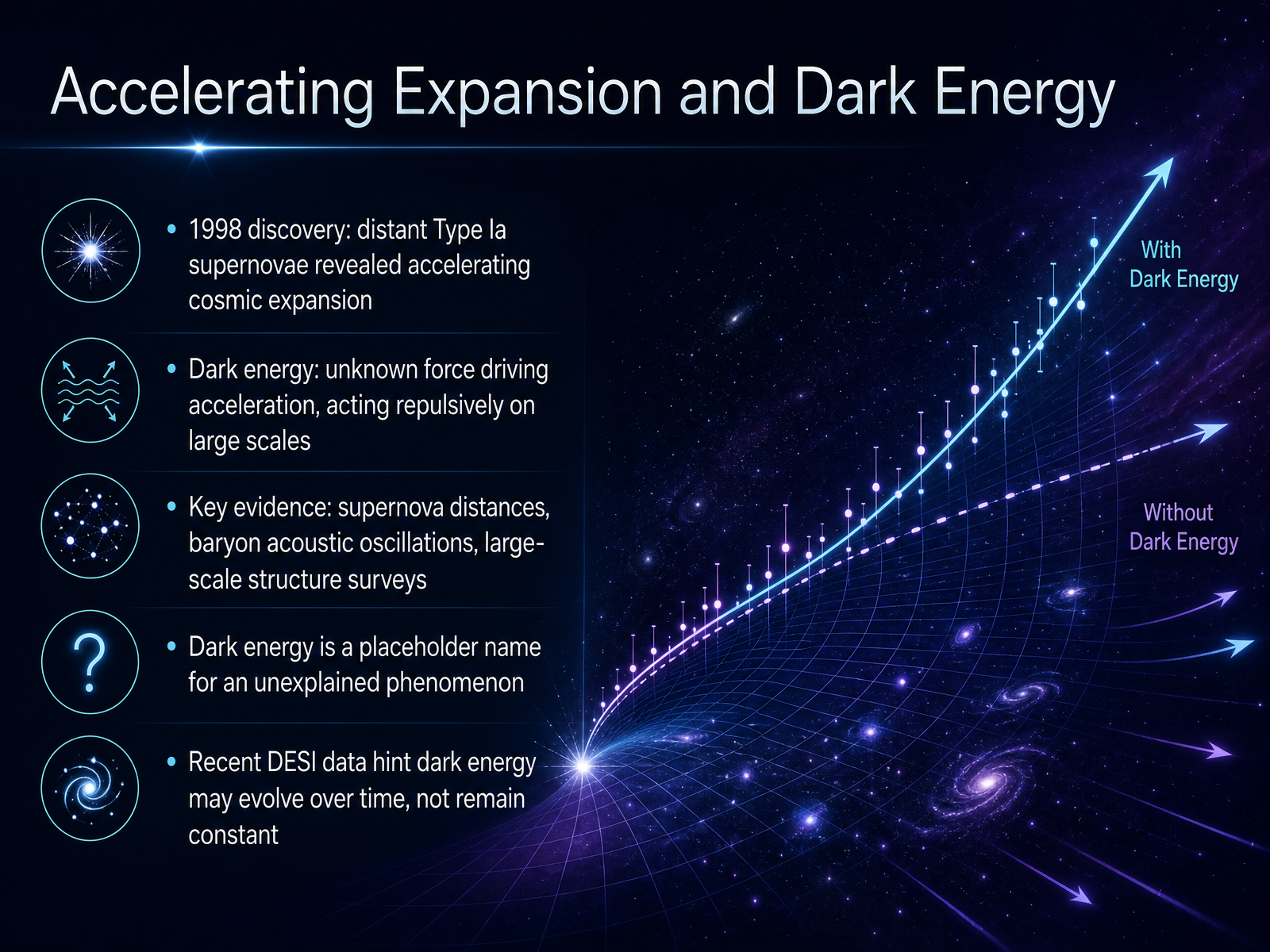
 - 06Accelerating Expansion and Dark EnergyNow let's take the story a step further. In 1998, astronomers made a shocking discovery using distant Type Ia supernovae. They expected cosmic expansion to be slowing down under gravity. Instead, they found it was speeding up. Something is pushing the universe apart. We call it dark energy, and I want to be clear: that's a placeholder name, not an explanation. It's a label for the unknown force driving this acceleration, acting repulsively on the largest scales. We confirm it through multiple lines of evidence. Supernova distances show it. Baryon acoustic oscillations, the large scale ripples in galaxy distribution, show it. And surveys of cosmic structure agree. But here's where it gets really interesting for you as educators. Recent data from DESI, the Dark Energy Spectroscopic Instrument, along with new supernova compilations, hint that dark energy might not be constant. It may be evolving over time. This doesn't mean the mystery is solved. It means we're peeling back another layer, and that's an exciting narrative for your students. The key takeaway? Dark energy is a real phenomenon, but its nature is open territory. Next, let's look at how gravitational waves and multi-messenger astronomy are giving us a new window into these cosmic questions.
 2 min
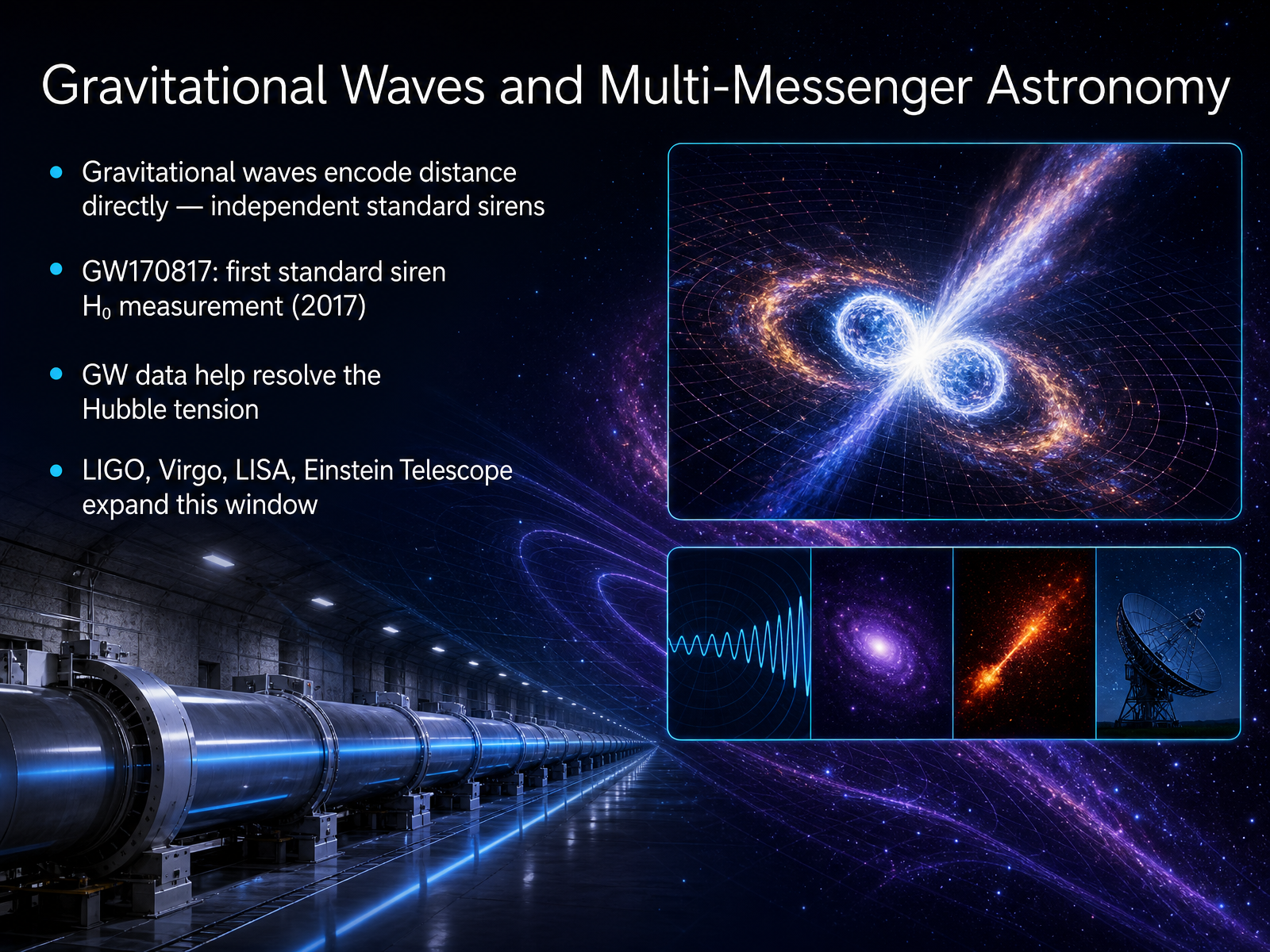
2 min - 07Gravitational Waves and Multi-Messenger AstronomyNow let's turn to a completely different way of measuring the universe, one that doesn't rely on light at all. Gravitational waves are ripples in spacetime itself, and they carry a remarkable piece of information: the distance to their source, encoded directly in the signal. This is why we call them standard sirens. Unlike standard candles, which need a cosmic distance ladder, standard sirens give us distance on their own. When we can also identify the host galaxy and its redshift, we get a clean measurement of the expansion rate. The breakthrough came in 2017 with an event called GW170817, a neutron star merger that produced both gravitational waves and light. It gave us the first independent Hubble constant from a siren. Now, with more events, standard sirens are helping us address the Hubble tension, the disagreement between early and late universe measurements. A recent combined analysis using 47 sirens alongside galaxy surveys and supernovae found a Hubble constant of about 74.8, much closer to the local distance ladder value. And the future is bright. LIGO and Virgo are upgrading, LISA will observe from space, and the Einstein Telescope is on the horizon. Each new detector widens this window, letting us measure the universe's expansion with increasing precision, free from the assumptions of light-based methods. Let's next bring these threads together in the observational pillars of expansion.
 2 min
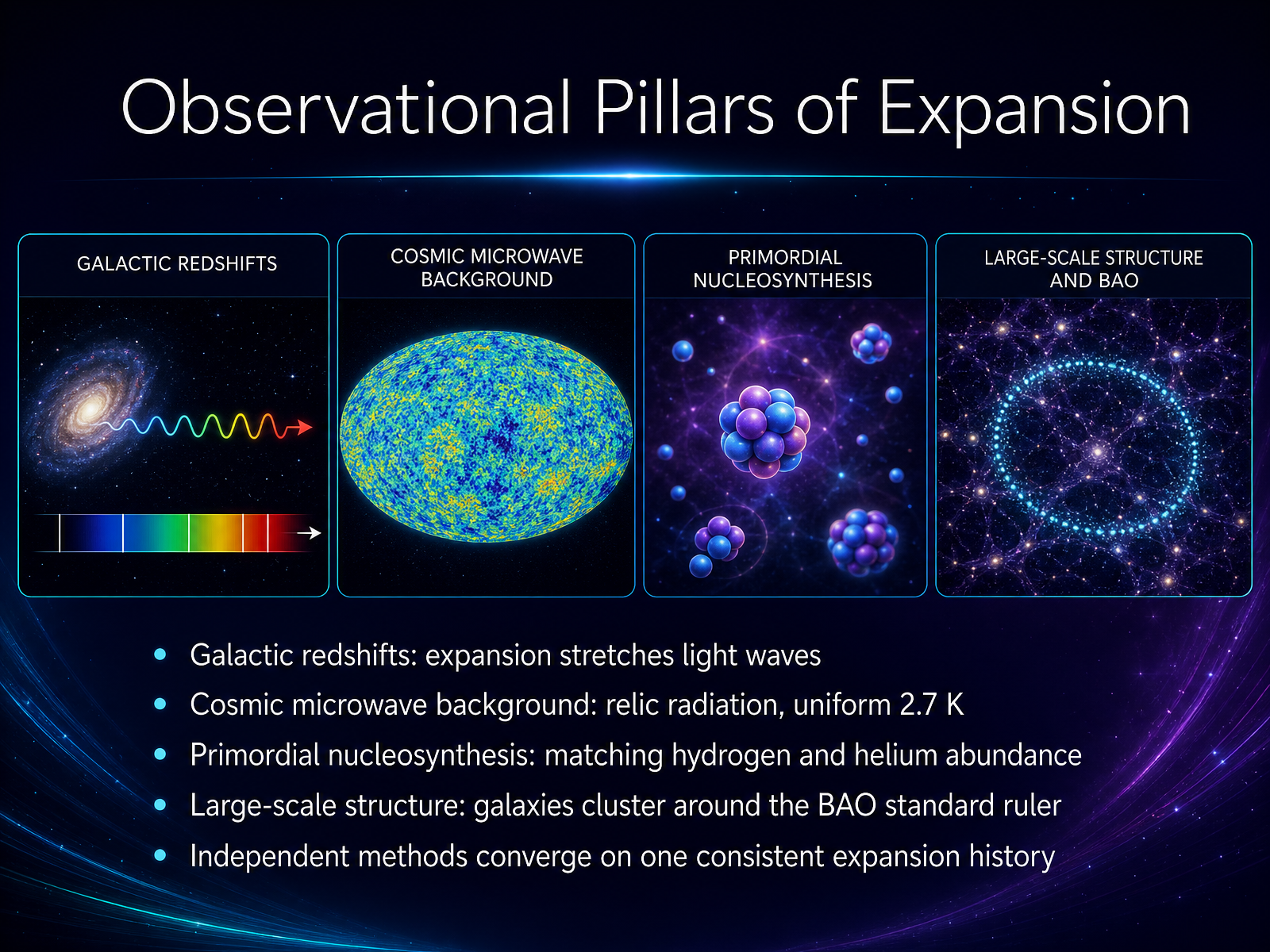
2 min - 08Observational Pillars of ExpansionSo how do we know the universe is truly expanding? It comes down to four independent lines of evidence that all point to the same story. First, galactic redshifts. When light travels through expanding space, its wavelength gets stretched, shifting toward the red end of the spectrum. We see this in virtually every distant galaxy. Second, the cosmic microwave background. This relic radiation from the infant universe is remarkably uniform, sitting at about 2.7 degrees above absolute zero, and it matches predictions precisely. Third, primordial nucleosynthesis. The observed mix of hydrogen and helium in the cosmos matches what we expect from the hot, dense early universe. Finally, large-scale structure. Galaxies cluster in a pattern that echoes the standard ruler of baryon acoustic oscillations, leftover ripples from the early universe. None of these alone would be conclusive, but when independent methods converge on one consistent expansion history, you have a very robust picture. That convergence is the real strength of modern cosmology. Now, this evidence is solid, but it naturally leads to a few common misconceptions worth clearing up. Let's explore those next.
 2 min
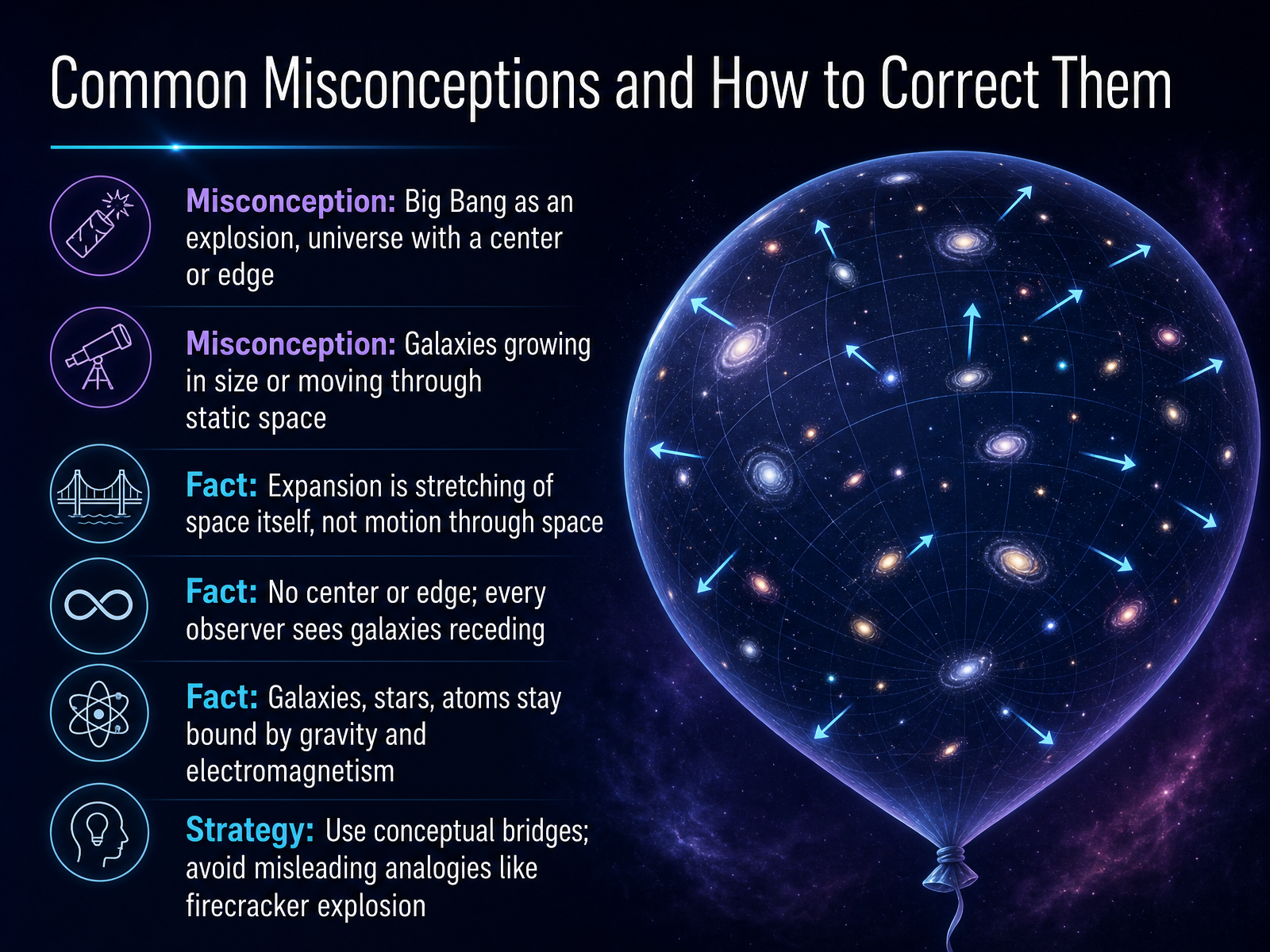
2 min - 09Common Misconceptions and How to Correct ThemLet’s clear up a few common misconceptions about the expanding universe. First, the Big Bang was not an explosion in space. It was the beginning of space itself expanding. There’s no center and no edge. Every observer, anywhere in the universe, would see galaxies rushing away from them. So no location is special. Second, galaxies aren’t moving through static space like shrapnel from a bomb. Instead, the space between them is stretching. And that stretching doesn’t tear apart galaxies, stars, or even atoms. Gravity and electromagnetism hold these structures together. So when we talk about cosmic expansion, we’re talking about the vast spaces between galaxy clusters, not the distances within your own body. Now, a helpful strategy: build conceptual bridges. Avoid analogies like a firecracker explosion, because they mislead. Instead, use models where space itself expands, like the raisin bread dough. The raisins don’t move through the dough; they just get farther apart as the dough rises. This helps learners grasp the real picture. Remember, it’s not about motion through space; it’s about space itself growing. Next, let’s look at some effective analogies and activities to bring this idea to life.
 rubinobservatory.orgbeta.iopscience.iop.orgscientificamerican.com+21 min
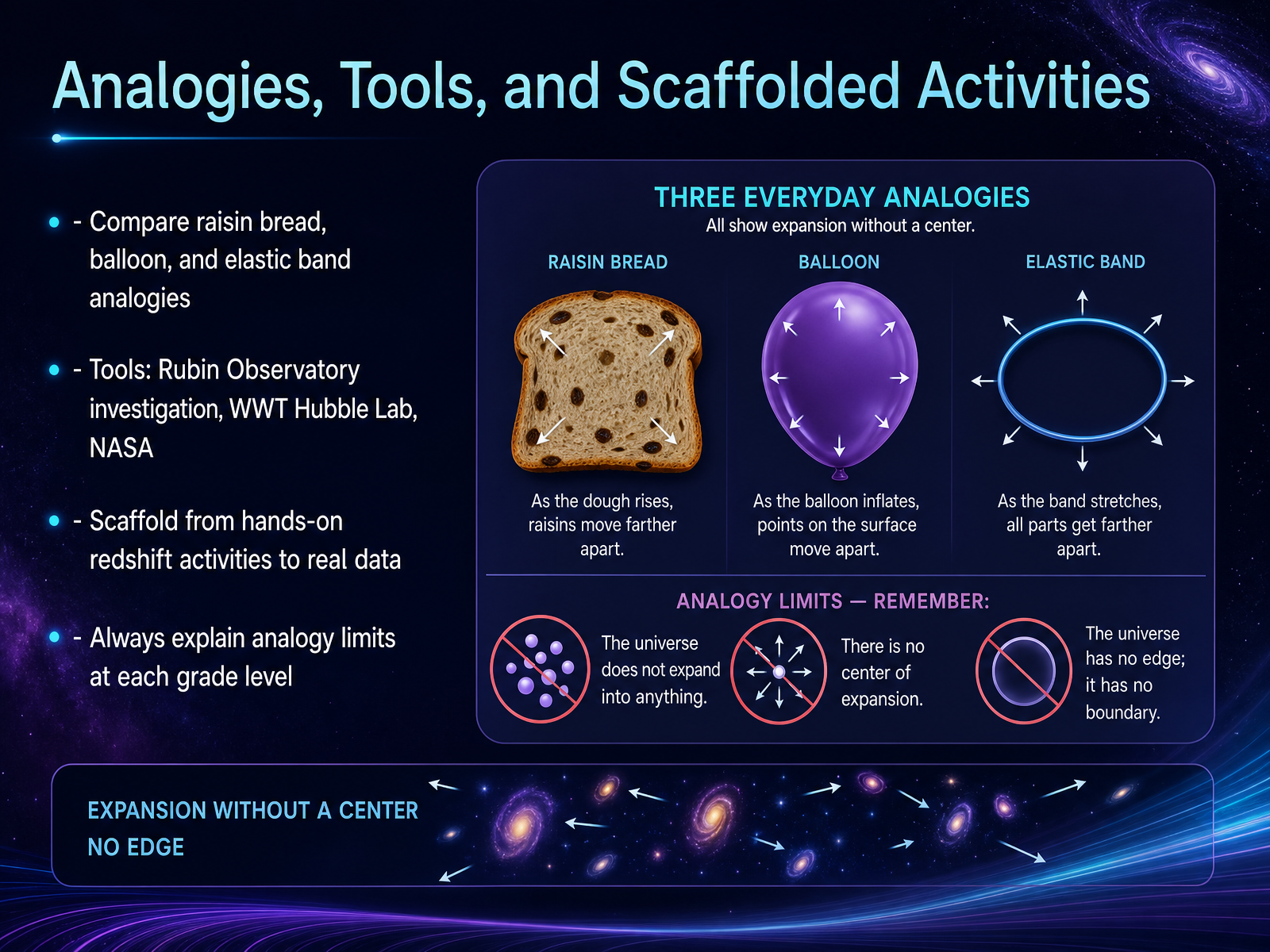
 - 10Analogies, Tools, and Scaffolded ActivitiesWhen it comes to teaching the expanding universe, analogies are our first stepping stones. The raisin bread, the balloon, the elastic band—each one helps students feel how space itself stretches. But every analogy has its limits, and that's where the real learning begins. Make sure you explain what each model gets right, and what it gets wrong, at every grade level. Then, bring in the tools that make the universe tangible. The Rubin Observatory offers a full investigation where students plot real galaxy and supernova data. The WorldWide Telescope Hubble Lab blends hands-on activities with authentic Hubble measurements. And for a quicker start, interactive simulators let students watch redshift happen in real time. The key is to scaffold. Begin with simple, tactile demonstrations of light shifting toward the red. Then, move step by step into real astronomical data. Let students see the pattern for themselves. The evidence is out there, waiting for them to uncover it. Next, we will look at a genuine tension in cosmology—one that has scientists rethinking what we know.
 2 min
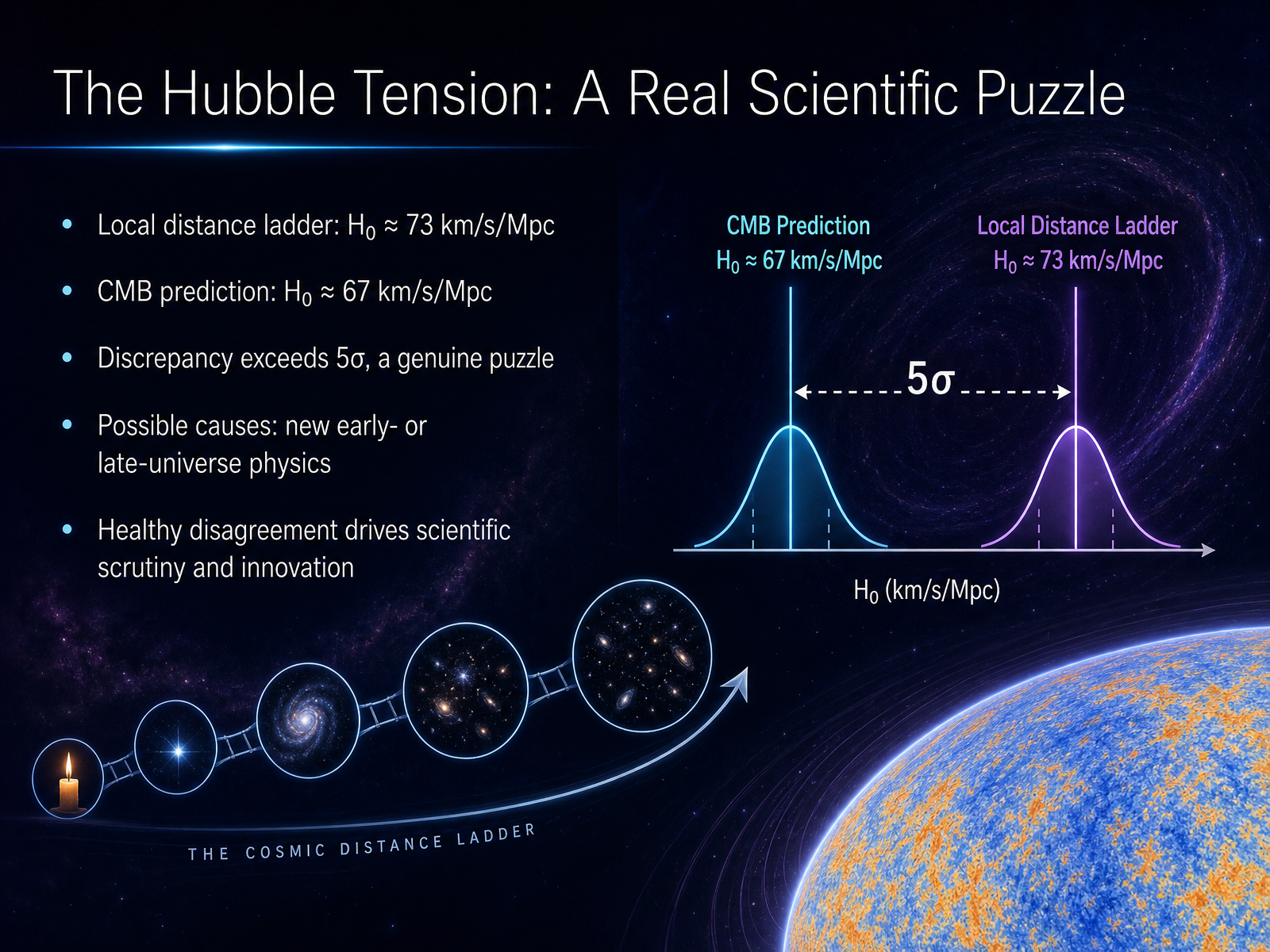
2 min - 11The Hubble Tension: A Real Scientific PuzzleNow, here is where the story gets truly fascinating. The Hubble Tension is not a mistake; it is a genuine scientific puzzle. Two sets of measurements, both meticulously performed, refuse to agree. The first, using the cosmic distance ladder of variable stars and supernovae, pegs the expansion rate at about seventy-three kilometers per second per megaparsec. The second, reading the ancient light of the cosmic microwave background, predicts a slower expansion of about sixty-seven. That discrepancy is huge, well beyond the five-sigma threshold that physicists use to declare a discovery. This means we are not looking at a statistical fluke. Something is missing from our picture of the universe. The possible causes are tantalizing. Perhaps there is new physics in the early universe, like a brief pulse of dark energy. Or perhaps the rules change in the late universe, affecting how galaxies move and cluster. For educators and content creators, this is a gift. It shows science as a living process, not a finished textbook. We can teach that healthy disagreement is not a weakness, but a driver of scrutiny and innovation. It is the engine that will refine our models and sharpen our next generation of telescopes. So as we look at upcoming surveys, keep this tension in mind, because it is the question they are all designed to answer.
 2 min
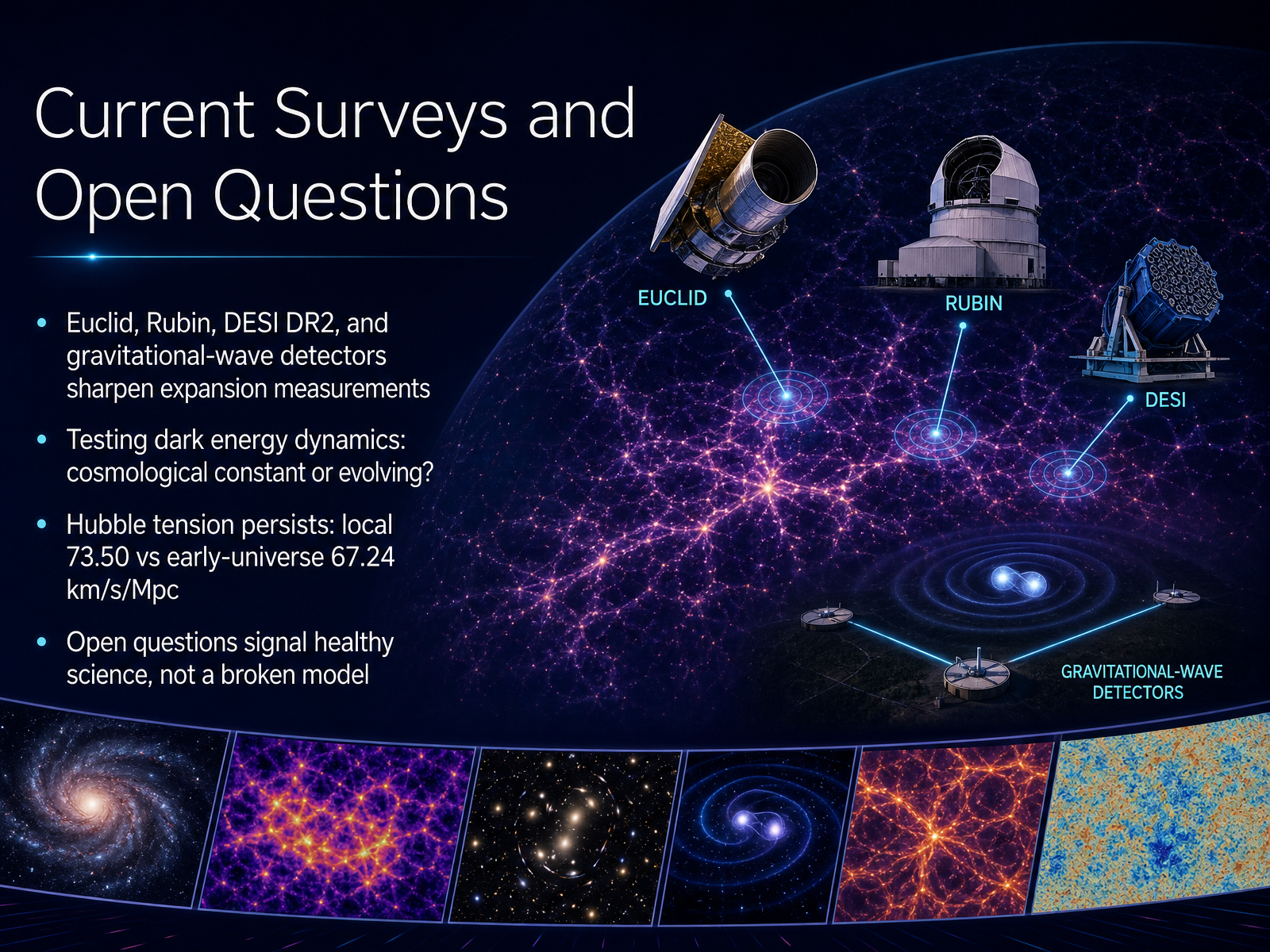
2 min - 12Current Surveys and Open QuestionsSo where does this leave us? Current surveys like Euclid, Rubin, and DESI are sharpening our measurements of cosmic expansion. Gravitational-wave detectors add another independent ear to the conversation. The big question now is whether dark energy is truly constant, a simple cosmological constant, or whether it evolves over cosmic time. The evidence is starting to hint at dynamics, but it is far from settled. And then there is the Hubble tension: local measurements give 73.5 kilometers per second per megaparsec, while early-universe predictions sit at 67.2. That gap has persisted for a decade and now stands at over seven sigma of significance. Some might call that a crisis. But here is the thing. These open questions are not a sign of a broken model. They are a sign of healthy science at work. The model is being stress-tested from every angle, and it is holding up remarkably well, even as the cracks reveal where new physics might hide. For educators, this is a golden opportunity. You can show your students that science is not about having all the answers, it is about asking better questions and building better tools to answer them. Next, let us turn to how you can bring this excitement into the classroom and model cosmic expansion with your own students.
 2 min
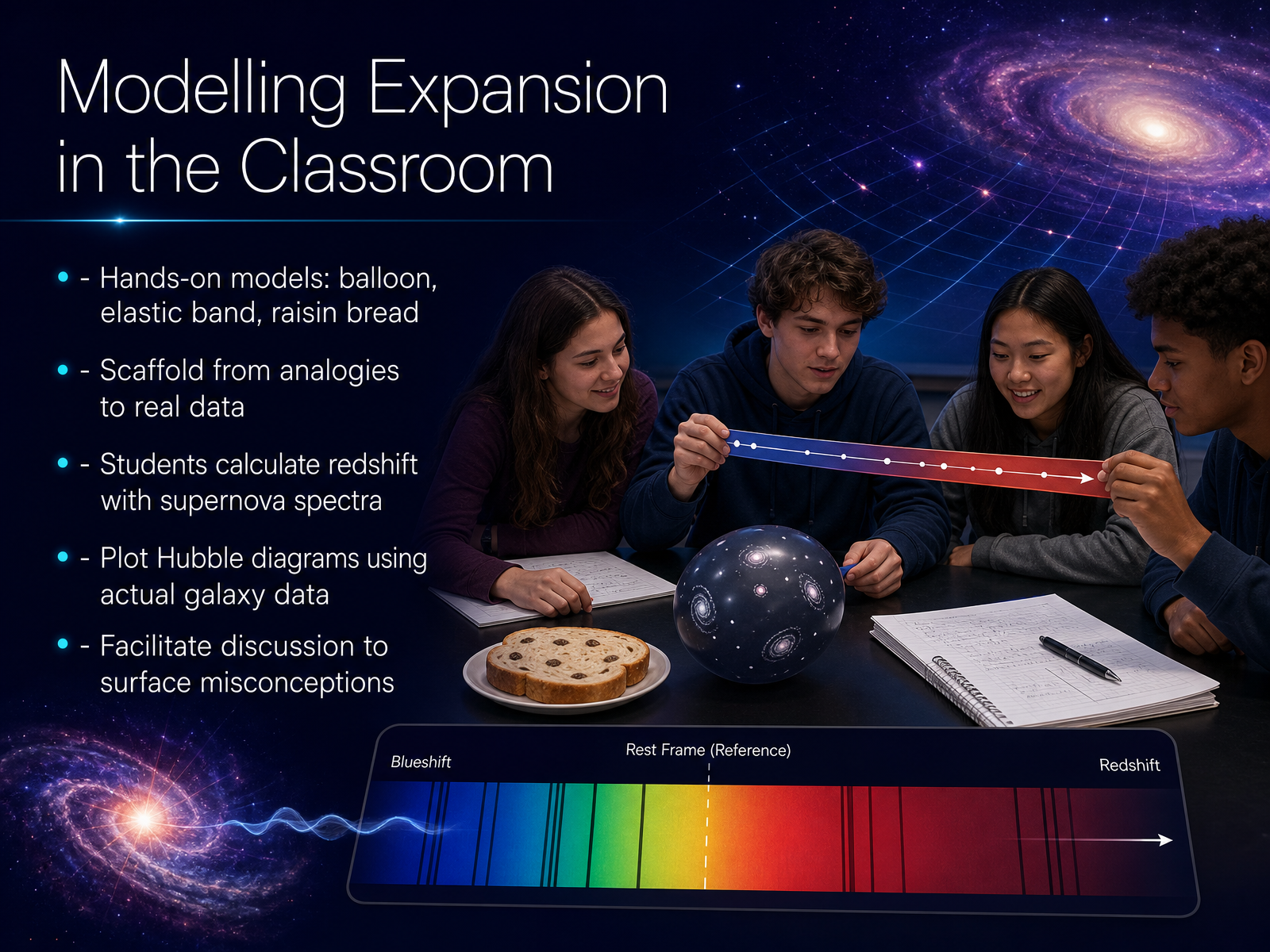
2 min - 13Modelling Expansion in the ClassroomNow let's talk about bringing this into the classroom. The balloon model is a classic for a reason. As you blow it up, dots on the surface move apart, and the ones farther away move faster. That's the essence of the Hubble–Lemaître Law. But don't stop there. Elastic bands give a similar feel, and raisin bread demonstrates it deliciously. The key is to scaffold. Start with these tactile analogies, then move toward the real thing. Have students calculate redshift using actual supernova spectra. Let them see the absorption lines shifted, and do the math. Then, they can plot a Hubble diagram using real galaxy data. This is where the pattern clicks. The line emerges from the points they plotted themselves. Finally, facilitate discussion to surface misconceptions. The galaxies aren't moving through space; space itself is expanding. Remind them that there is no center. Every galaxy sees the same expansion. These models build intuition, but the data builds understanding. Now, let's wrap up with the key ideas for science communication.
 science.nasa.govstarchild.gsfc.nasa.govnewscientist.com+22 min
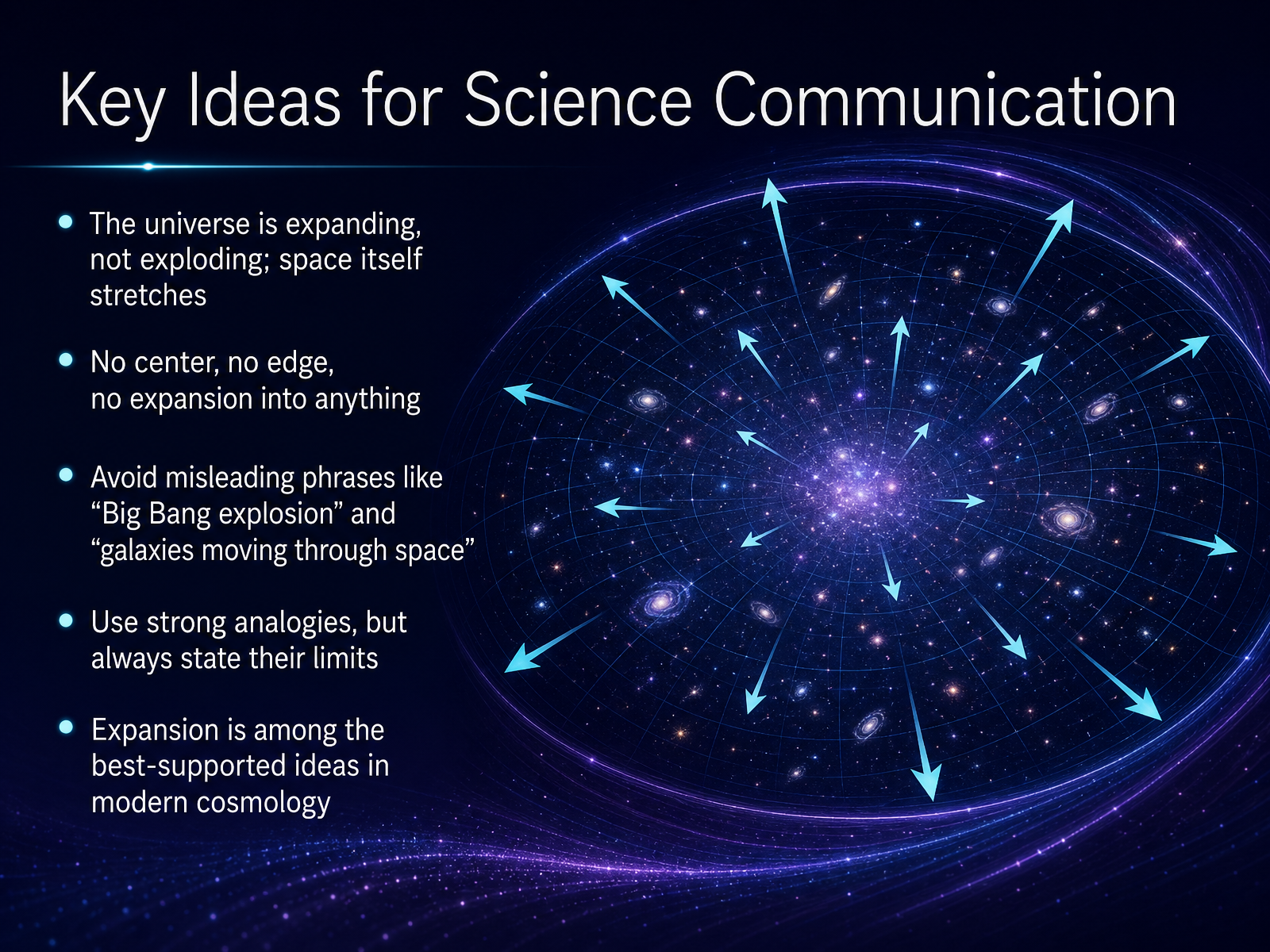
 - 14Key Ideas for Science CommunicationSo let's turn these insights into a practical toolkit for science communication. First, the universe is expanding, not exploding. Space itself is stretching, like dough rising with raisins in it. The raisins—the galaxies—aren't moving through the dough; the dough is expanding, carrying them along. Second, there's no center and no edge. Every observer anywhere sees the same pattern: galaxies moving away from them. That means no location is special. Third, choose your words carefully. Avoid saying 'Big Bang explosion' or 'galaxies moving through space.' These phrases conjure the wrong picture, one that's very hard for learners to unsee. Fourth, analogies are powerful, but every analogy has limits. The balloon, the rubber band, the raisin bread—all break down somewhere. State those limits openly. That honesty builds trust and deepens understanding. And finally, remember this: cosmic expansion is among the best-supported ideas in modern cosmology. You're not teaching a guess; you're teaching a discovery, built on a century of observations. Speak with confidence, and your learners will feel that confidence too. Now, let's bring all of this together in our summary and action plan.
 rubinobservatory.orgbeta.iopscience.iop.orgscientificamerican.com+22 min
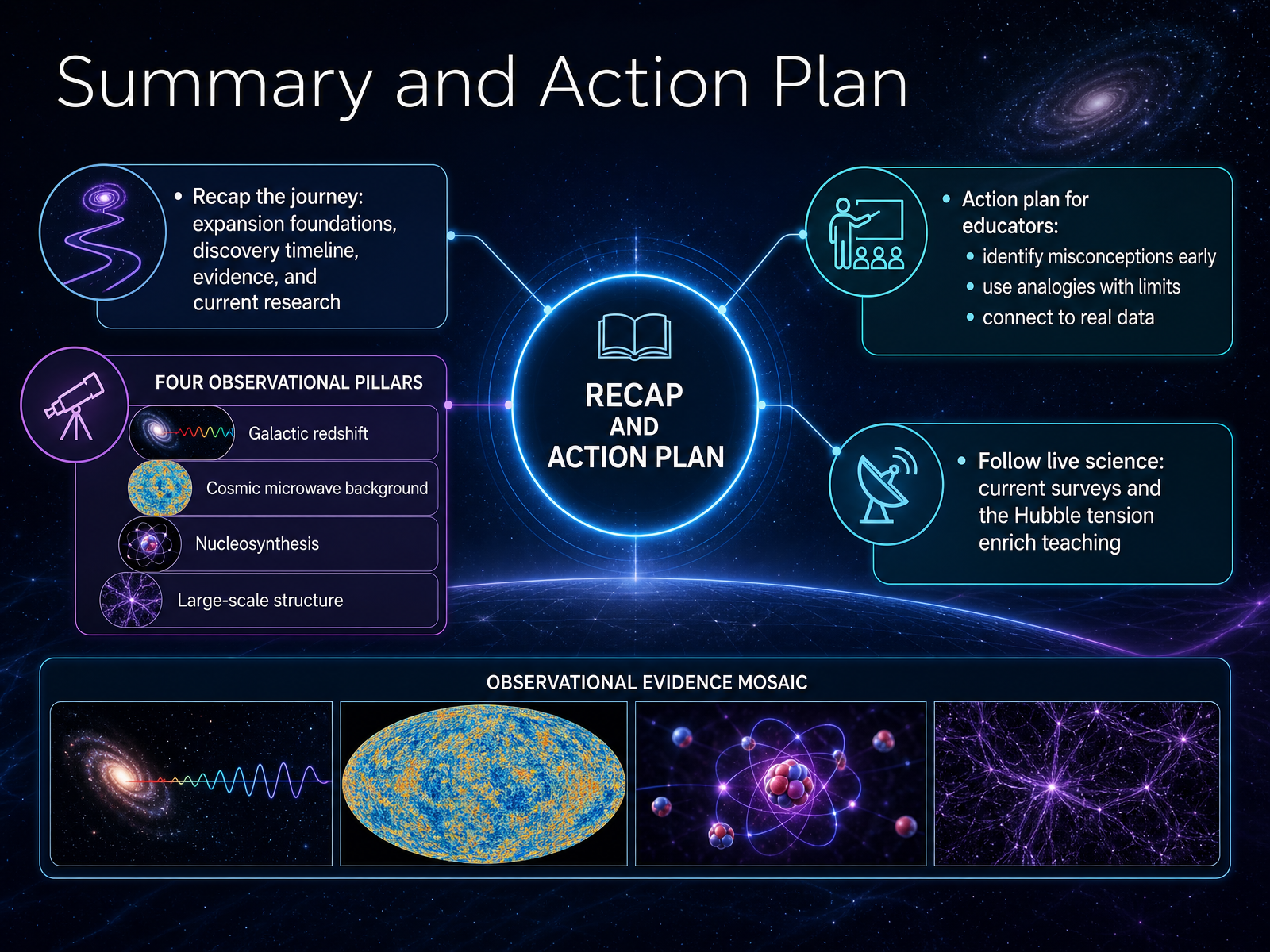
 - 15Summary and Action PlanWe have traveled a remarkable distance together, and here we are at our final stop. Let us take a moment to look back at the journey we have shared. We began with the foundations of expansion, traced the timeline of discovery, examined the evidence, and explored the frontiers of current research. Our story rests on four observational pillars: the redshift of galaxies, the cosmic microwave background, the primordial nucleosynthesis, and the large-scale structure of the universe. These are the threads that weave the tapestry of modern cosmology. As educators, your action plan is clear. First, identify misconceptions early. Students often think galaxies move through space like shrapnel, or that the universe expands into something. Gently guide them toward the idea that the scale of space itself is changing. Second, use analogies with caution. The balloon and the raisin bread are helpful, but always state their limits. And third, connect your lessons to real data whenever you can. Let students feel the thrill of interpreting actual measurements. And finally, follow live science. The current surveys and the ongoing conversation around the Hubble tension are not just footnotes. They are rich, living opportunities to show your students science in action. This is your invitation to keep exploring, keep questioning, and keep sharing that wonder. Thank you for your dedication, and enjoy the journey ahead.
 rubinobservatory.orgbeta.iopscience.iop.orgscientificamerican.com+22 min
Take the deck with you
Download this course as a file — free, no sign-up needed.
- PDF handoutEvery slide page, ready to print or share.16 pages · 5.0 MBDownload
- Narrated PowerPointThe deck that presents itself — every slide carries the digital human's narration video.16 pages · 21.4 MBDownload
- PowerPoint slidesThe full deck as a .pptx — open it in PowerPoint, Keynote, or Google Slides.16 pages · 4.9 MBDownload
Free to use in your own training — please keep the PersonWise credit page at the end.
Have your own deck? Turn it into a course
Sources consulted
Web sources consulted while building this course.
- Student Ideas and Questions | Rubin Observatory — rubinobservatory.org
- Interpretations of cosmic expansion: anchoring conceptions and misconceptions - IOPscience — beta.iopscience.iop.org
- Misconceptions about the Big Bang | Scientific American — scientificamerican.com
- Expanding Confusion: Common Misconceptions of Cosmological Horizons and the Superluminal Expansion of the Universe | Publications of the Astronomical Society of Australia | Cambridge Core — cambridge.org
- Clarifying some common misconceptions about the expansion of the universe - IOPscience — iopscience.iop.org
- Hubble Cosmological Redshift - NASA Science — science.nasa.gov
- Redshift and Hubble's Law — starchild.gsfc.nasa.gov
- Why it's taking a century to pin down the speed of the universe | New Scientist — newscientist.com
- Exploring cosmology: a simple experiment to illustrate the cosmological principle and the Hubble–Lemaître Law - IOPscience — beta.iopscience.iop.org
- Math of the Expanding Universe – Science Lesson | NASA JPL Education — jpl.nasa.gov
- The Discovery of the Expansion of the Universe — mdpi.com
- Historical notes on the expanding universe - Physics Today — physicstoday.aip.org
- Who Discovered the Expanding Universe? — journals.sagepub.com
- [1106.3928v2] A Hubble Eclipse: Lemaitre and Censorship — arxiv.org
- Centre for Theoretical Cosmology: The Origins of the Universe: A history of ideas — ctc.cam.ac.uk
- Primordial Nucleosynthesis in the Precision Cosmology Era — annualreviews.org
- Precision cosmology with the lightest elements | Astrophysics and Space Science | Springer Nature Link — link.springer.com
- 24. Big Bang Nucleosynthesis — pdg.lbl.gov
- Rev. Mod. Phys. 88, 015004 (2016) - Big bang nucleosynthesis: Present status — journals.aps.org
- Primordial Nucleosynthesis - IOPscience - Institute of Physics — iopscience.iop.org