SQL Database Encryption Practices
Begin
14 pages · ~28 min
SQL Database Encryption Practices
Learn essential SQL database encryption practices including data-at-rest and in-transit protection to safeguard sensitive information from unauthorized access.
What you’ll learn
- 01SQL Database Encryption PracticesWelcome. If you're responsible for keeping database contents safe, this course is built for you. Over the next few sessions, we're going to treat encryption as what it really is: a critical layer in your defense-in-depth strategy, not a silver bullet. We'll cover the full landscape. That means data at rest on disk, data in transit across the network, data in use during processing, and the often-overlooked backbone of it all, key management. For database administrators, backend engineers, and security practitioners, the goal here is practical fluency. You'll walk away knowing how to assess real threats, map encryption choices to compliance obligations, implement the right protection at the right layer, and handle keys with the discipline they demand. So get ready to shift from theory to concrete configuration. Let's start by answering the question that drives every decision in this space: why encrypt databases at all?1 min
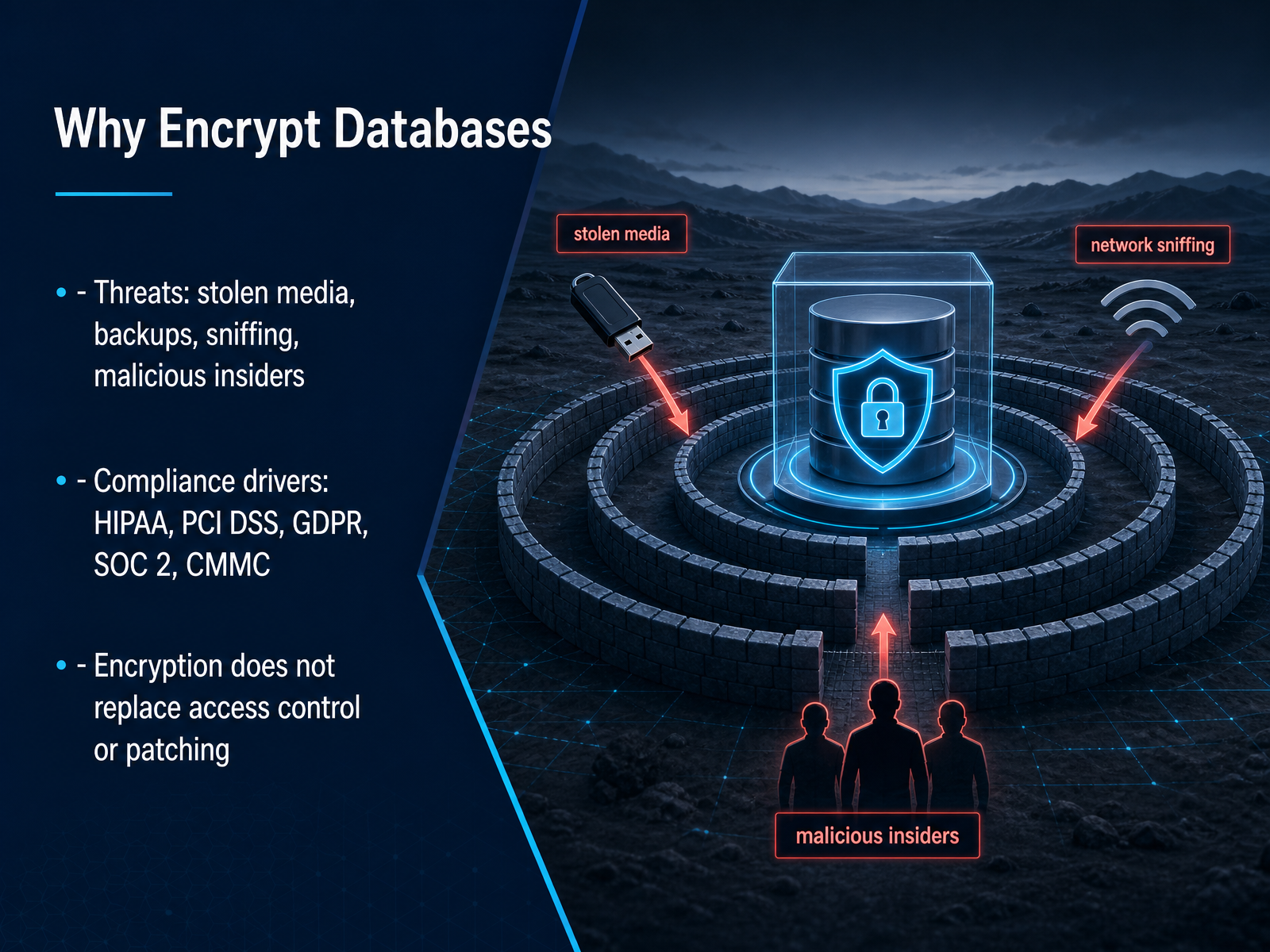
- 02Why Encrypt DatabasesLet’s talk about why encrypting your databases matters, not just as a checkbox, but as a real layer of defense. Your threats are concrete: someone walks off with a backup tape, a storage array is decommissioned and resold, a network sniffer picks up traffic, or a disgruntled insider with database access exfiltrates data outside your application layer. In all those cases, encryption is the last line of defense that keeps the data unreadable. Then there are the compliance drivers — HIPAA, PCI DSS, GDPR, SOC 2, and CMMC — each with explicit or implicit requirements for protecting data at rest. Encryption helps you satisfy those auditors, but here’s the key point: encryption does not replace access control, nor does it excuse you from patching vulnerabilities. It protects data if those other controls fail. So, when you design your strategy, think of encryption as a safety net, not a silver bullet. With that mindset, we’ll move into the threat model and compliance drivers for encryption at rest.
 1 min
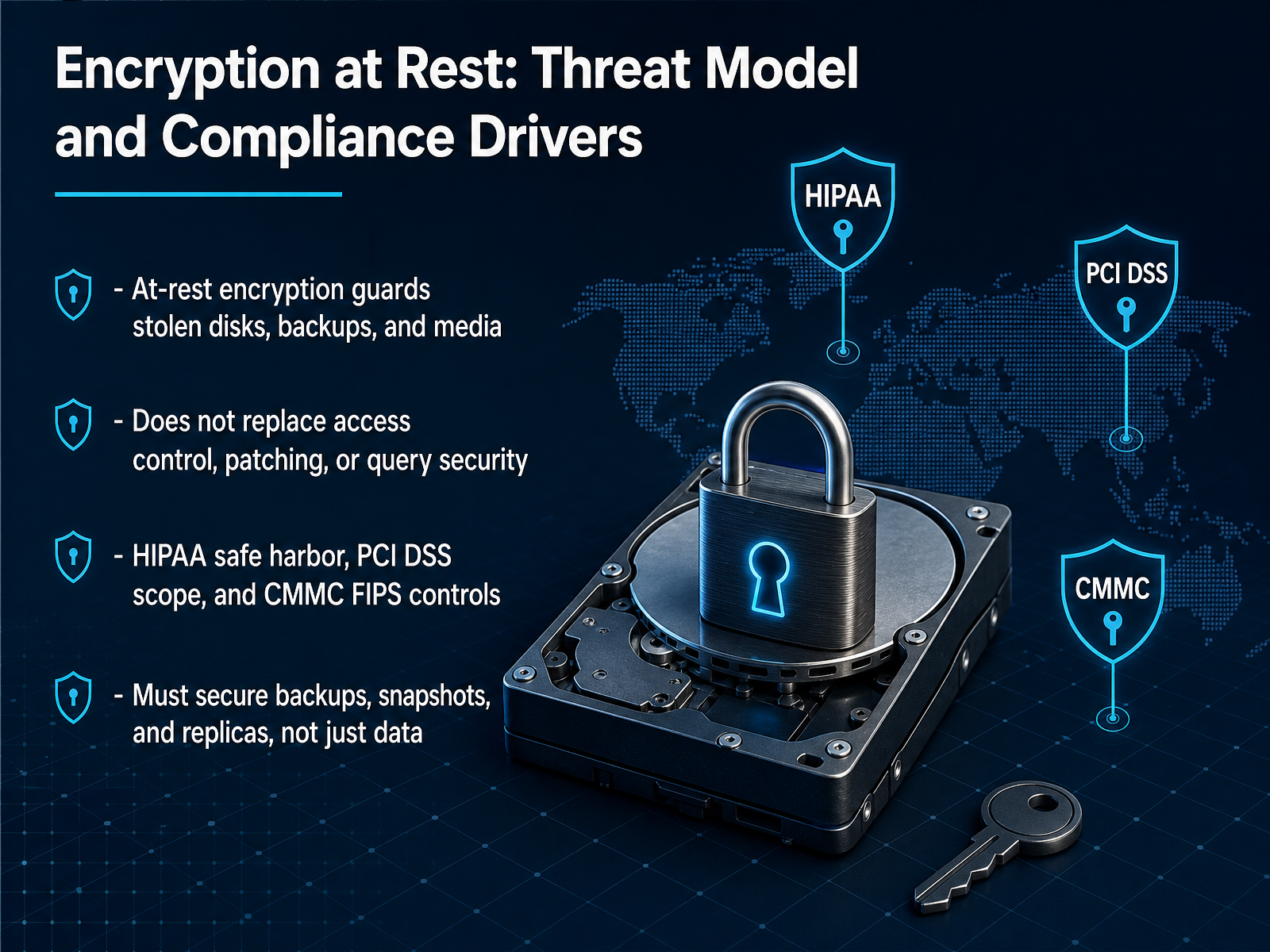
1 min - 03Encryption at Rest: Threat Model and Compliance DriversNow let's frame what encryption at rest actually defends against. The core threat is physical: a stolen disk, an exfiltrated backup tape, or a discarded SSD that still holds data remnants. Encryption at rest renders that data unreadable without the proper keys. That's your primary protection. But be clear on its limits. It does not replace access control, query security, or patching. If an attacker compromises your application and runs SELECT statements as a privileged user, encryption at rest will not stop them. It protects the bytes on the media, not the logical layer above it. From a compliance standpoint, this is where the drivers kick in. Under HIPAA, encryption is a safe harbor for breach notification, meaning if your data is encrypted and compromised, you may avoid the public breach reporting burden. For PCI DSS, encryption reduces the scope of systems that must be hardened and audited. And for CMMC, which governs defense contractors, you're looking at FIPS-validated cryptographic modules. Here's the operational catch that teams often miss: you must encrypt more than just the primary database file. Backups, snapshots, and replicas are frequently stored unencrypted, and that's exactly where data leaks happen. So as you plan your strategy, treat every copy of the data as part of the attack surface. Up next, we'll walk through the technologies available, from Transparent Data Encryption to column-level approaches, and how to choose between them.
 1 min
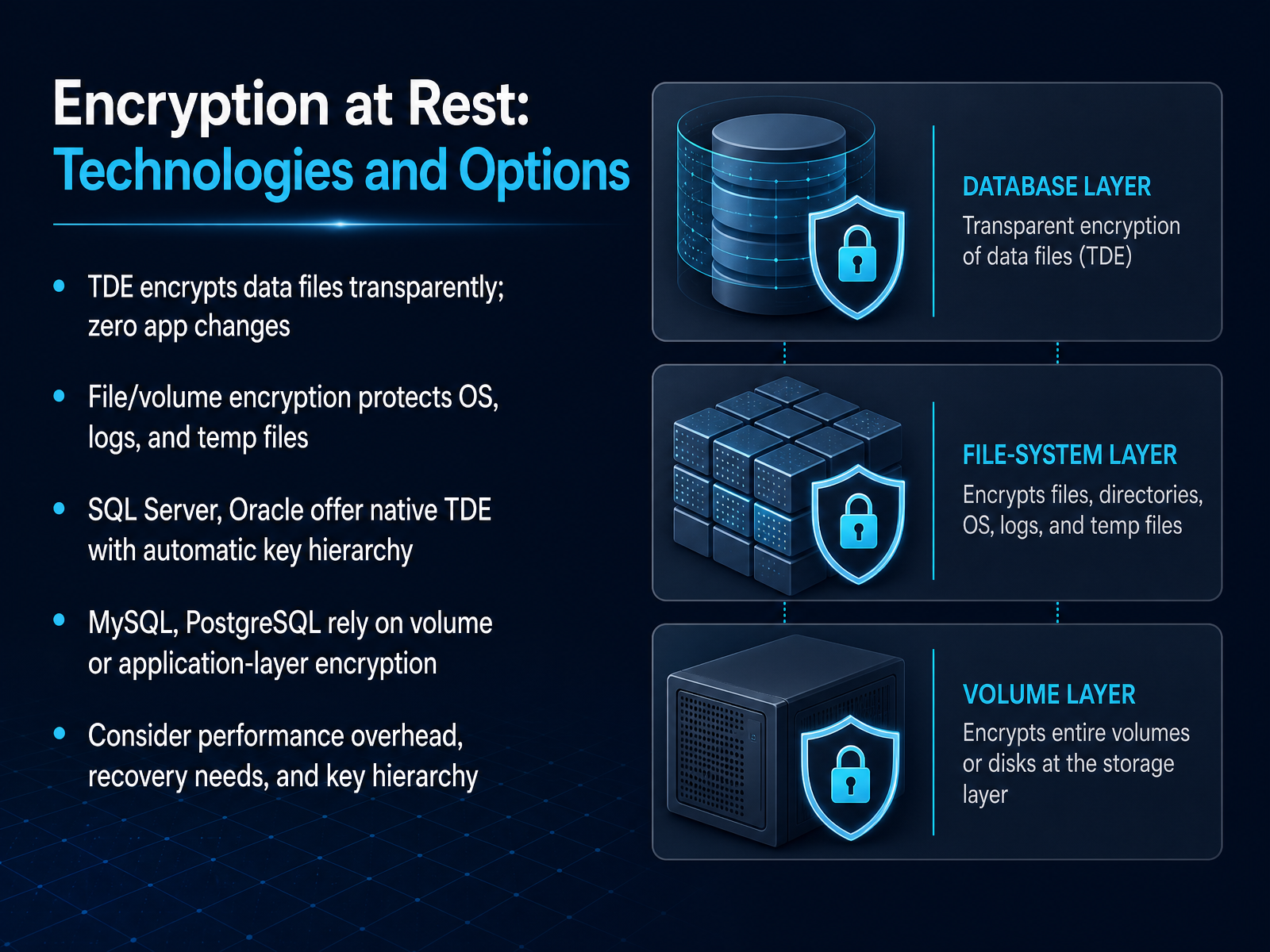
1 min - 04Encryption at Rest: Technologies and OptionsNow let's talk about the main encryption at rest options you'll encounter. TDE, or Transparent Data Encryption, is the go-to for SQL Server and Oracle because it encrypts the actual data files without any application changes. The database engine handles decryption for authorized queries, so your code stays untouched. However, MySQL and PostgreSQL don't offer native TDE, so you'll typically fall back to volume-level encryption or application-layer encryption. Volume encryption is great for protecting the entire disk, including logs and temp files, but it won't help if an attacker gets direct file access while the server is running. When choosing an approach, weigh three things: the performance overhead, which is often one to five percent; your recovery needs, such as whether you can restore a backup independently of the original key; and the key hierarchy, meaning who holds the master key and how you rotate it. A practical example: if you're securing a customer database with compliance requirements, native TDE gives you the simplest path. Your key management strategy is what really determines your risk exposure. Next, we'll dig into the implementation best practices for encryption at rest.
 2 min
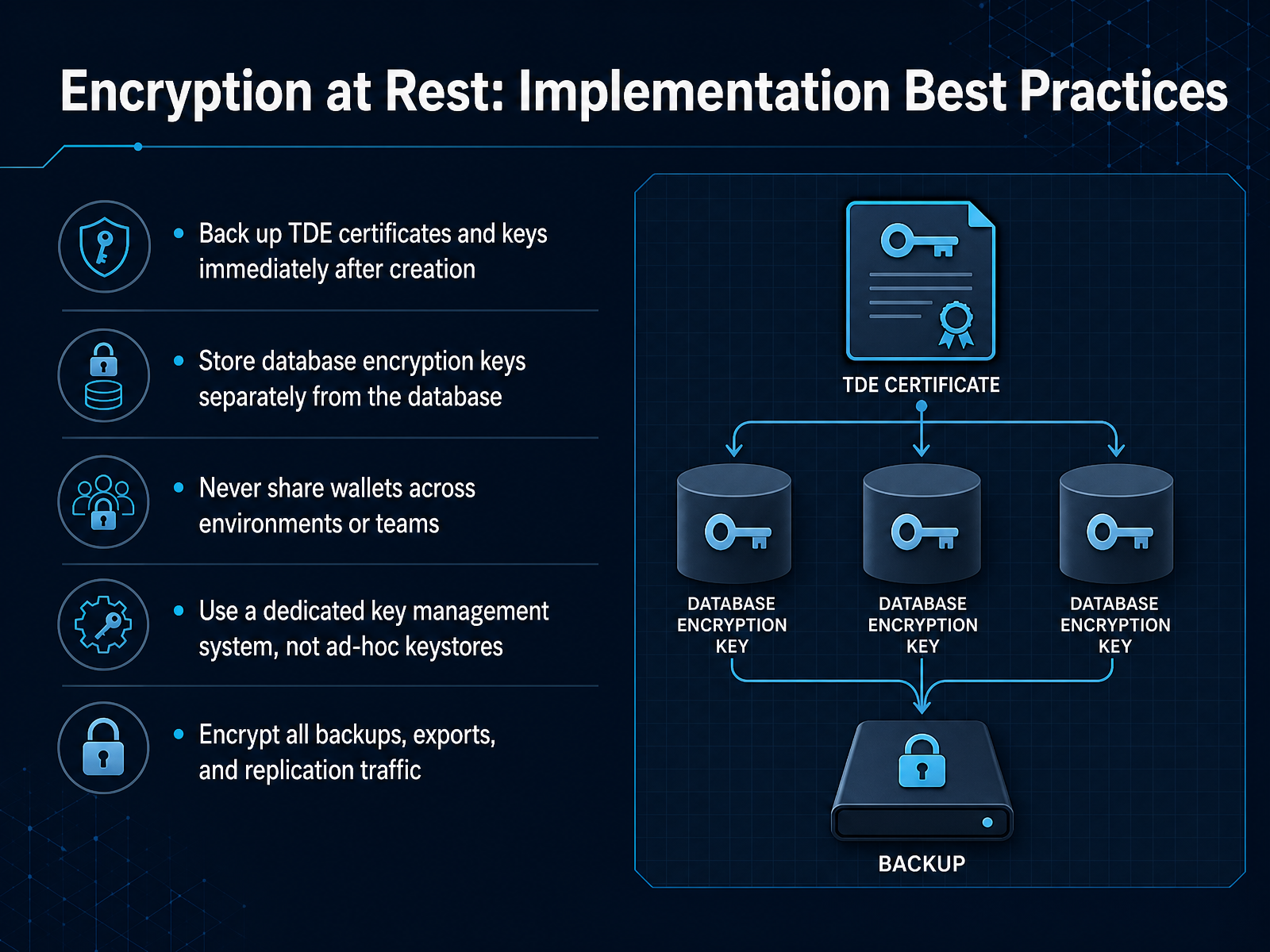
2 min - 05Encryption at Rest: Implementation Best PracticesNow let’s talk about implementation best practices for encryption at rest, because the technology only protects you if you deploy it correctly. First, back up your TDE certificates and keys immediately after creation. If you lose those, your data is permanently unreadable, no matter how healthy your database looks. Second, store your database encryption keys separately from the database itself. That separation is your core defense — if someone steals the database files but not the keys, they walk away with nothing but ciphertext. Third, never share wallets across environments or teams. A staging key that leaks into production blurs your audit trail and undermines your whole trust model. Instead, use a dedicated key management system rather than ad-hoc keystores. A proper kms gives you rotation, revocation, and access logging that spreadsheets and flat files simply cannot match. And finally, encrypt all backups, exports, and replication traffic, not just the primary data files. Backup tapes, export dumps, and replica streams are frequent leak points because teams often treat them as secondary. Set the policy now so every copy of your data carries the same protection. In short, the strength of encryption at rest is only as good as your key lifecycle and your full data copy discipline. Now, let’s shift to a related concern — protecting data as it moves between systems, with encryption in transit and TLS configuration.
 2 min
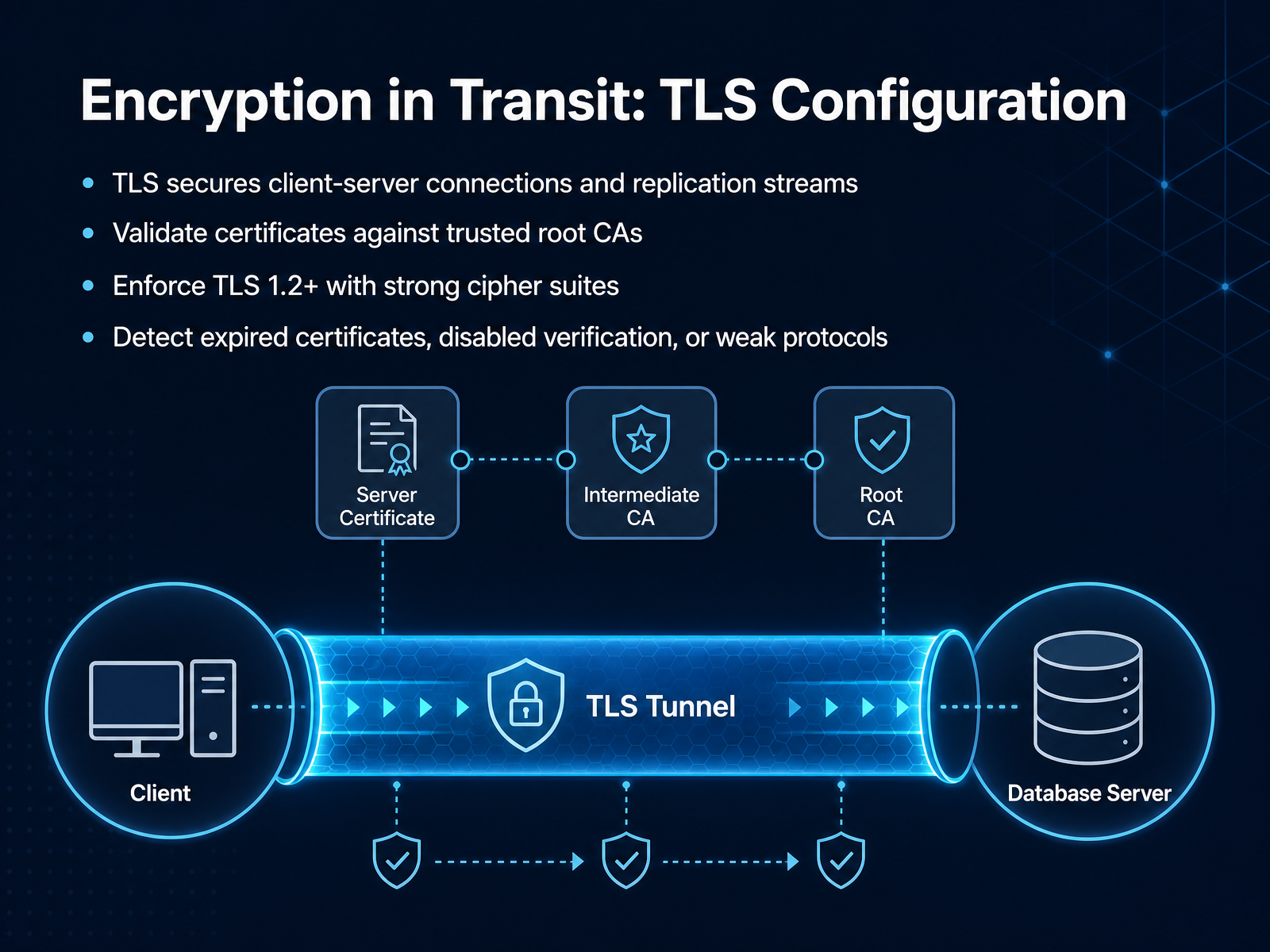
2 min - 06Encryption in Transit: TLS ConfigurationNow let's shift focus to data moving between your database and its clients. Encryption in transit is non-negotiable for production, but it's only as strong as your configuration. First, make sure TLS certificates are validated against a trusted root CA. If you skip this, you're vulnerable to man-in-the-middle attacks, even with TLS enabled. You'll also want to enforce TLS 1.2 or higher, and select cipher suites that prioritize forward secrecy, like ECDHE-based ones. Avoid older ciphers like RC4 or CBC modes if possible. A common oversight is certificate expiration. Set up monitoring to alert your team before certificates lapse. Also, regularly audit your database settings to ensure nobody has disabled certificate verification or downgraded the protocol. For example, in PostgreSQL, you'd check sslmode and ssl_min_protocol_version. In MySQL, it's ssl_ca and tls_version. These parameters are your first line of defense for replication streams too, so don't limit your TLS policy to client connections only. A quick win is to centralize certificate lifecycle management with your existing PKI, or public key infrastructure, and rotate certificates on a schedule. Track expired certs, weak protocols, and any verification gaps as part of your routine security review. That way, encryption in transit becomes a reliable control rather than a checkbox. Next, we'll look at mTLS and platform-level patterns to extend this trust model even further.
 2 min
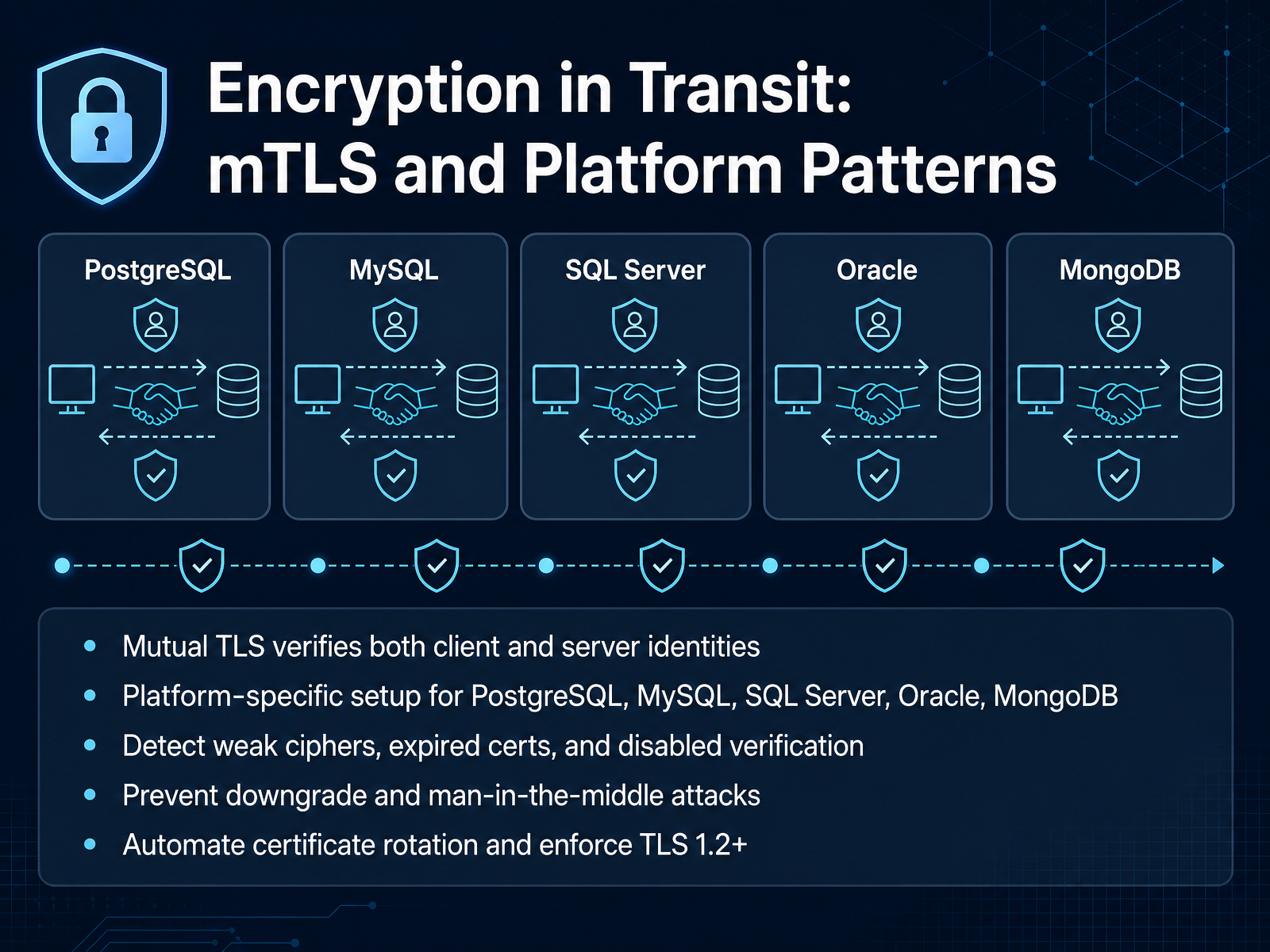
2 min - 07Encryption in Transit: mTLS and Platform PatternsNow let’s turn our attention to encryption in transit. This is where mutual TLS, or mTLS, becomes your primary defense. Unlike standard TLS, which only verifies the server, mTLS verifies both client and server identities. That means every connection is authenticated from both directions, closing a significant blind spot. You'll configure this differently depending on your platform. PostgreSQL, MySQL, SQL Server, Oracle, and MongoDB each have their own certificate and verification settings. The key is to know where those settings live. Once you're in, you need to audit. Look for weak ciphers, expired certificates, or any place where certificate verification has been disabled. Those are the gaps that enable downgrade attacks and man-in-the-middle interception. Automate your certificate rotation and enforce TLS 1.2 or higher at the server level. If you leave it manual, it will lapse. So, the takeaway is simple. Encryption at rest is worthless if the data is exposed while moving between services. Lock down the channel and verify both ends. Up next, we’ll shift from the wire to the application layer with column-level and application-layer encryption.
 1 min
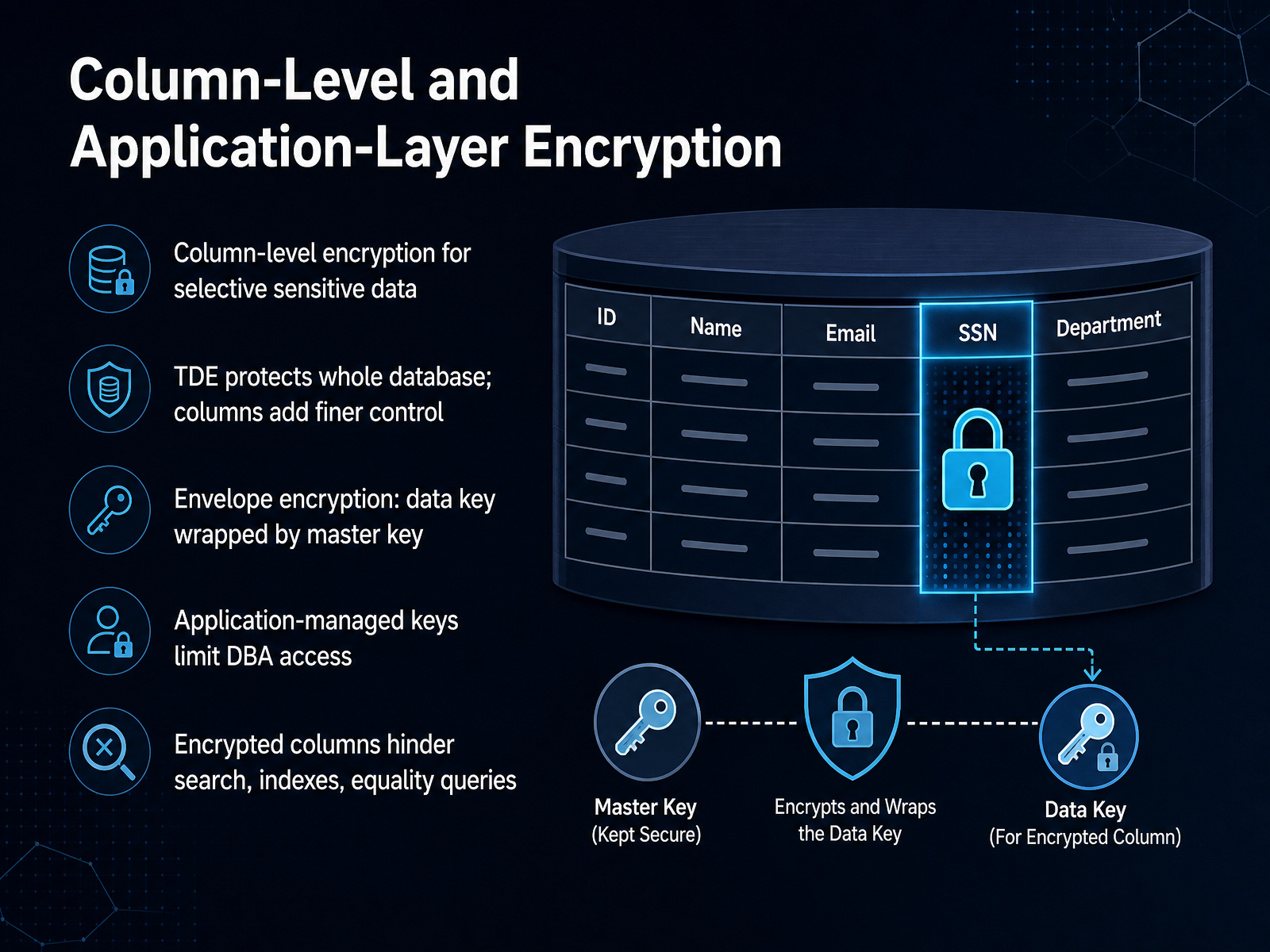
1 min - 08Column-Level and Application-Layer EncryptionLet's zoom in on column-level and application-layer encryption. While TDE protects the whole database at rest, columns give you finer control, so you only encrypt the truly sensitive fields. Think social security numbers, payment tokens, or clinical records. The standard approach here is envelope encryption: you encrypt the column data with a data encryption key, then wrap that key with a separate master key, often held outside the database. And that's a critical point. When your application manages the keys, database administrators no longer have blanket access to plaintext values. You effectively shrink the insider threat surface. But you need to be honest about the trade-offs. Encrypting a column breaks traditional b-tree indexing, which blocks equality searches, range scans, and joins on that field. You can work around it with deterministic encryption or application-side hashing for lookups, but that adds design complexity and reduces cryptographic strength. So before you encrypt a column, ask yourself: does this value really need that protection, or can I tokenize it instead? Get the scope right, and you keep performance, compliance, and security in balance. Next, let's look at key management lifecycle and architecture, because your keys are only as strong as the way you handle them.
 2 min
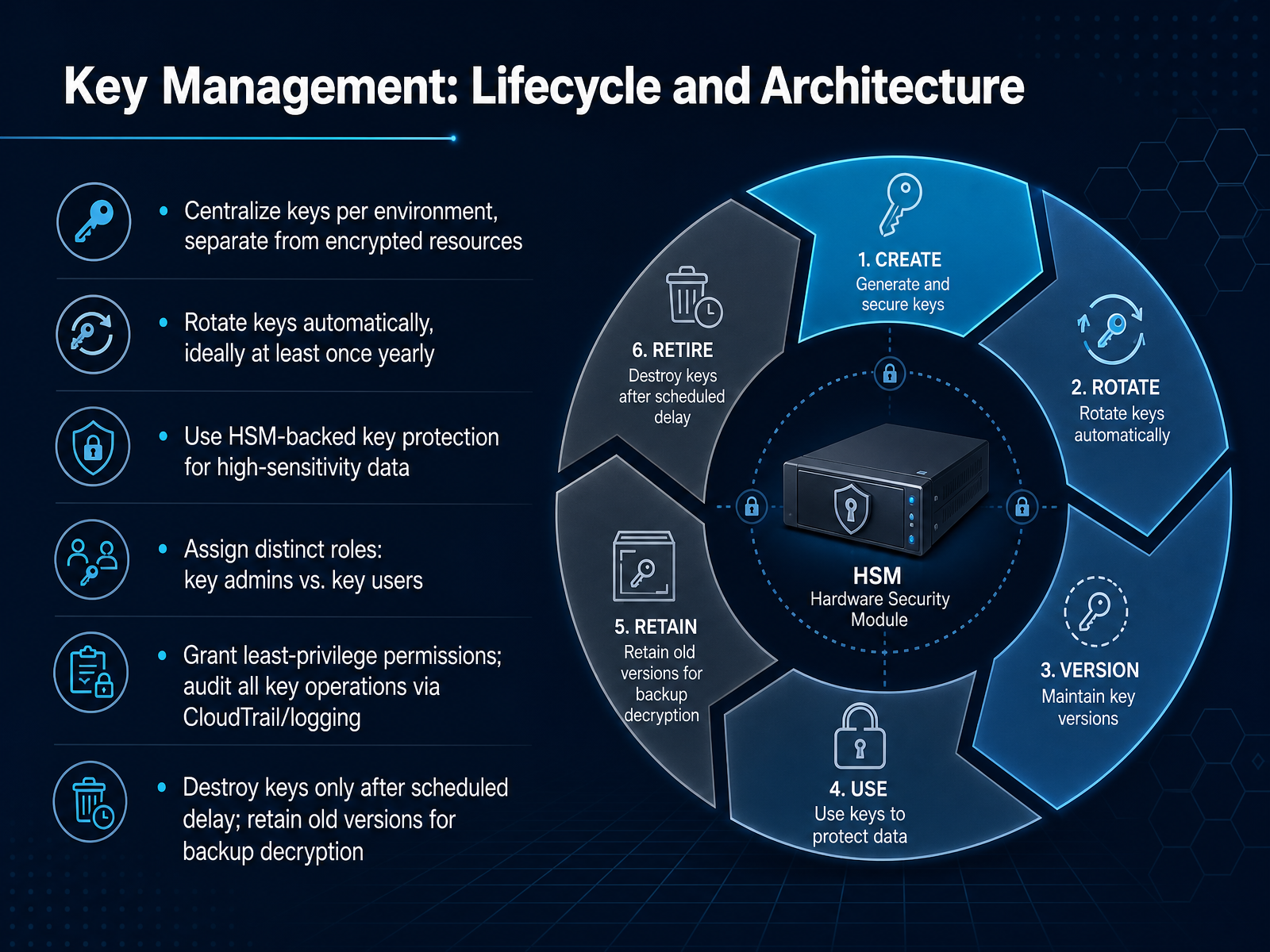
2 min - 09Key Management: Lifecycle and ArchitectureNow let's talk about the lifecycle and architecture of your encryption keys. Centralize keys for each environment, but keep them separate from the encrypted resources themselves. You don't want a database breach to expose the key that could unlock it. Rotate keys automatically, ideally at least once a year, and more frequently for sensitive workloads. For high-sensitivity data, use HSM-backed protection, meaning the key material lives in a hardware security module. Next, separate duties clearly: key admins create and manage keys, while key users only encrypt and decrypt. This prevents one person from having both control and access. Apply least-privilege permissions and audit every key operation through logs like CloudTrail. Finally, when you must retire a key, destroy it only after a scheduled delay, and retain old key versions long enough to decrypt historical backups. Striking that balance protects availability without sacrificing security. Up next, we'll look at cloud KMS and emergency scenarios.
 docs.cloud.google.comdocs.aws.amazon.comdocs.aws.amazon.com+21 min
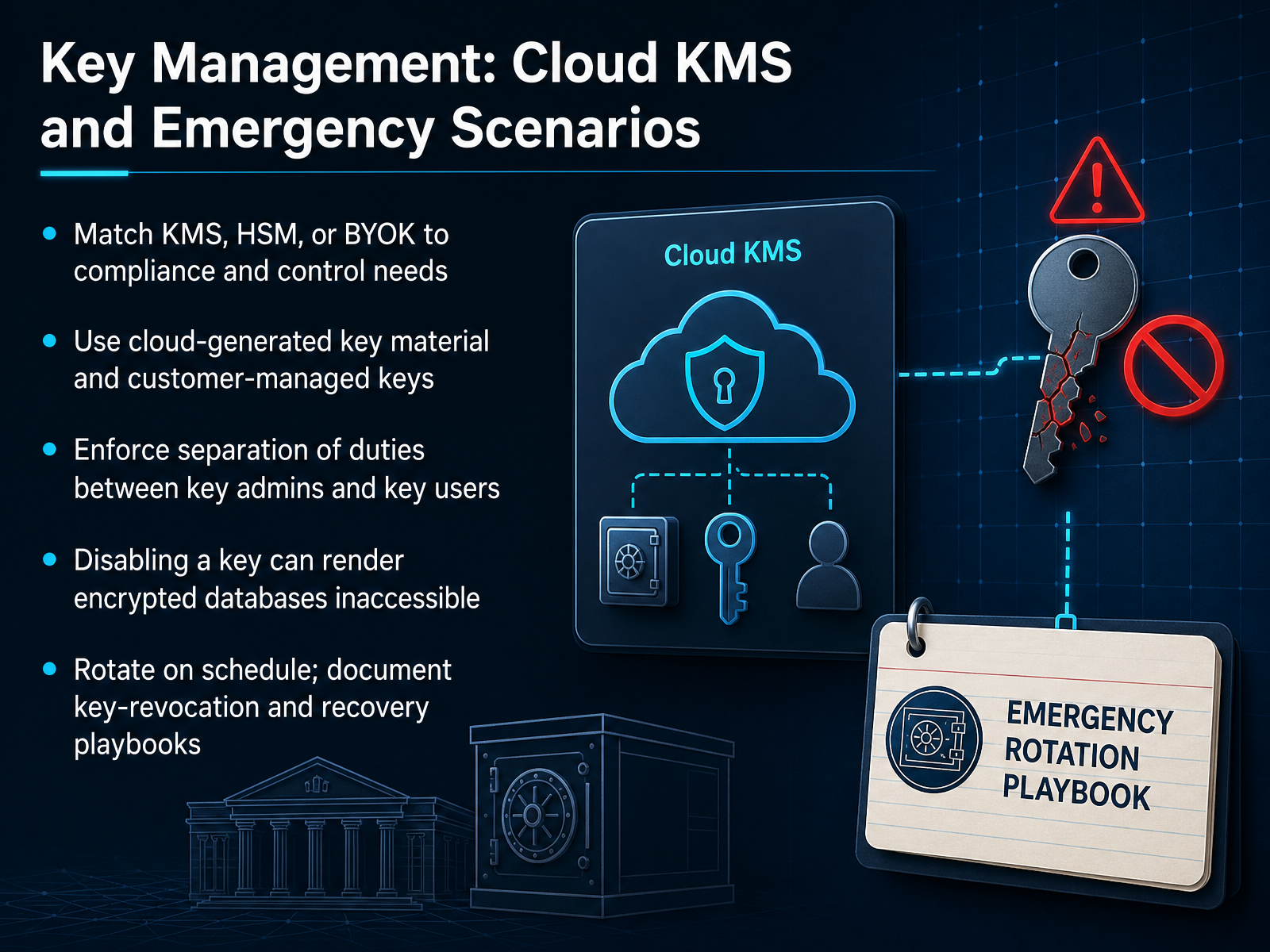
 - 10Key Management: Cloud KMS and Emergency ScenariosNow let's talk about key management in the cloud, and the emergency scenarios you need to plan for. Your choice of key management service, hardware security module, or bring-your-own-key approach should align with your compliance and control needs. For most workloads, cloud-generated key material with customer-managed keys gives you the right balance of control and operational simplicity. But remember, with that control comes responsibility. Enforce separation of duties between key administrators and key users. The people who create and disable keys should not be the same ones who use them for encryption or decryption. This is a fundamental security control that prevents a single compromised account from taking down your encrypted databases. And here's a critical point: disabling a key can render encrypted databases inaccessible. In AWS, for example, if your RDS instance loses access to its KMS key, it enters a recoverable state for seven days. Beyond that, it becomes terminally inaccessible, forcing a restore from backup. So rotate keys on a schedule, but document your key revocation and recovery playbooks thoroughly. Test them regularly. Disabling a key is an operational decision with real availability impact. Make sure you know exactly how to recover before you ever need to. Now let's look at the performance and operational impact of these encryption choices.
 docs.cloud.google.comdocs.aws.amazon.comdocs.aws.amazon.com+21 min
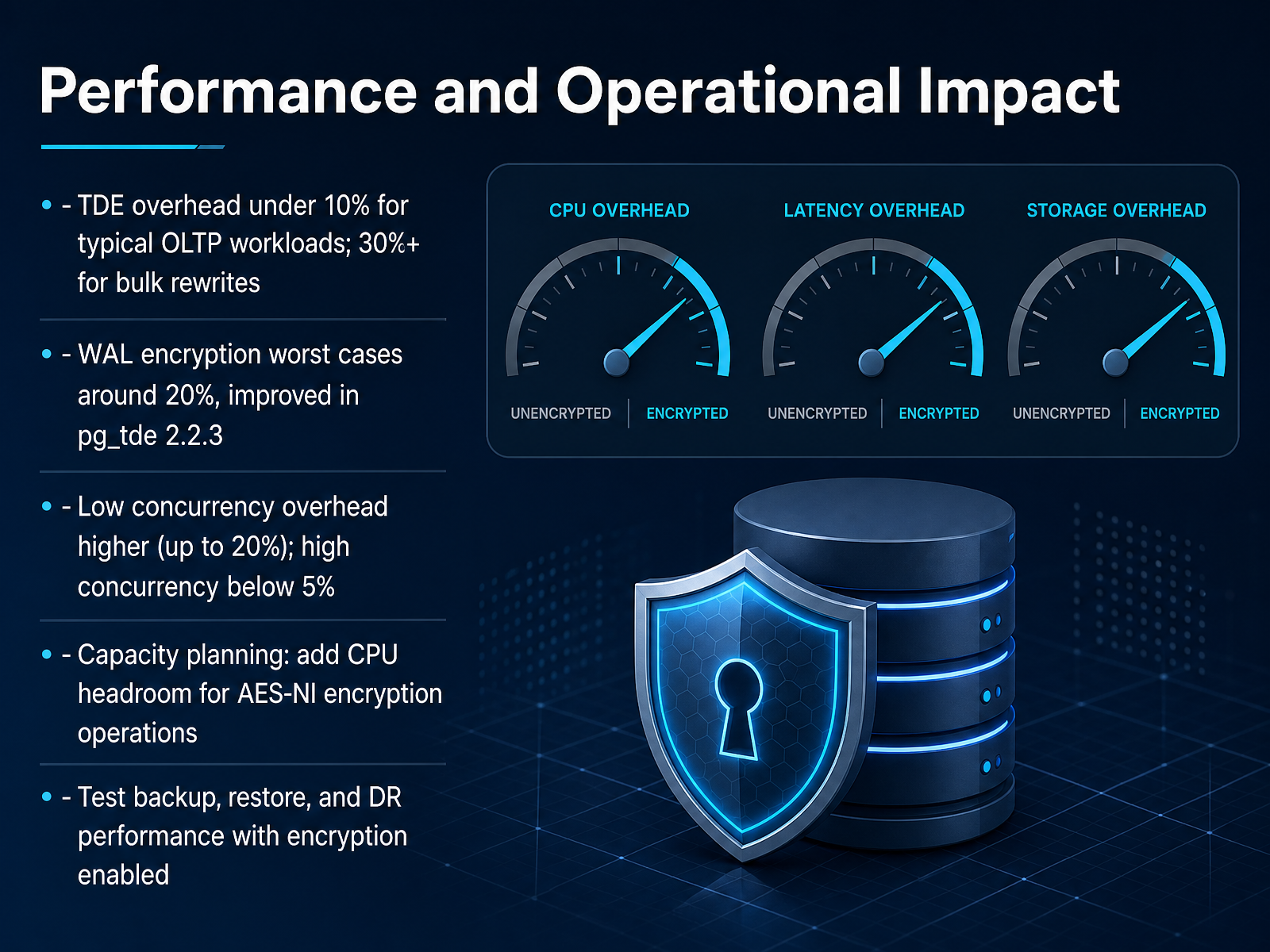
 - 11Performance and Operational ImpactLet's shift gears and talk about what encryption actually costs you in production, because the numbers matter when you're planning capacity. For typical OLTP workloads, Transparent Data Encryption overhead stays under ten percent. But if you're doing bulk operations like table rewrites or a full vacuum, expect that to jump to thirty percent or more. The write-ahead log, or WAL, is where things get interesting. In worst-case scenarios, WAL encryption can cost you around twenty percent, though the latest pg_tde 2.2.3 release has improved that significantly. Here's a key pattern to remember: low concurrency workloads actually see higher overhead, up to twenty percent, while high concurrency drops it below five percent. That's because encryption operations get amortized across more parallel work. Your capacity planning should include extra CPU headroom for AES-NI operations, since hardware acceleration is your friend here. Before you finalize anything, test your backup, restore, and disaster recovery performance with encryption enabled. That's where the hidden costs in your operational runbooks will surface. So, the takeaway is simple: choose your benchmark workloads carefully, and validate against your own infrastructure. Now, let's look at how you'll verify all of this with proper testing and auditing of your encryption controls.
 mdpi.comlearn.percona.compercona.community+22 min
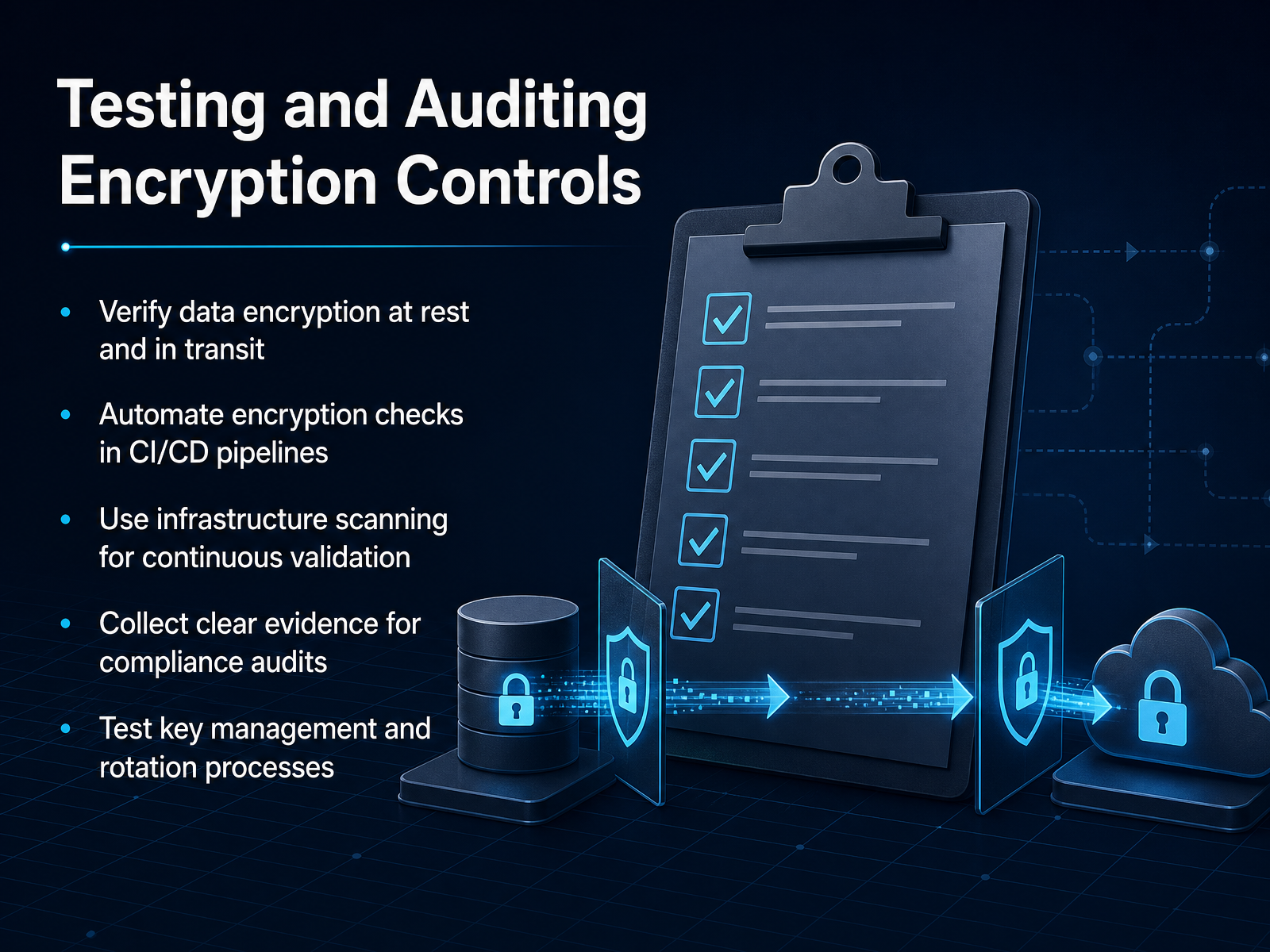
 - 12Testing and Auditing Encryption ControlsNow let's talk about testing and auditing your encryption controls, because good encryption is only as strong as your verification. You'll want to confirm that data is encrypted both at rest and in transit—check your storage volumes and your network traffic. A simple query against your database metadata can show you which tables are using Transparent Data Encryption, but for in-transit, you might need to inspect connection strings and TLS policies. Next, automate those checks in your CI/CD pipeline. For example, you can add a step that fails a build if a new table is created without encryption. Pair that with infrastructure scanning tools that continuously validate your cloud resource configurations. These scans catch drift quickly. And when auditors ask for evidence, you need something clear—export scan logs and show them that encryption is enforced by policy, not just by hope. Finally, test your key management and rotation processes. Don't wait for a real incident. Simulate a key rotation in a staging environment and confirm that your application still accesses data correctly. That rehearsal saves you from panic later. Remember, auditing isn't a one-time event; it's a habit. Now, let's look at some common pitfalls and real-world incidents that highlight what can go wrong.
 1 min
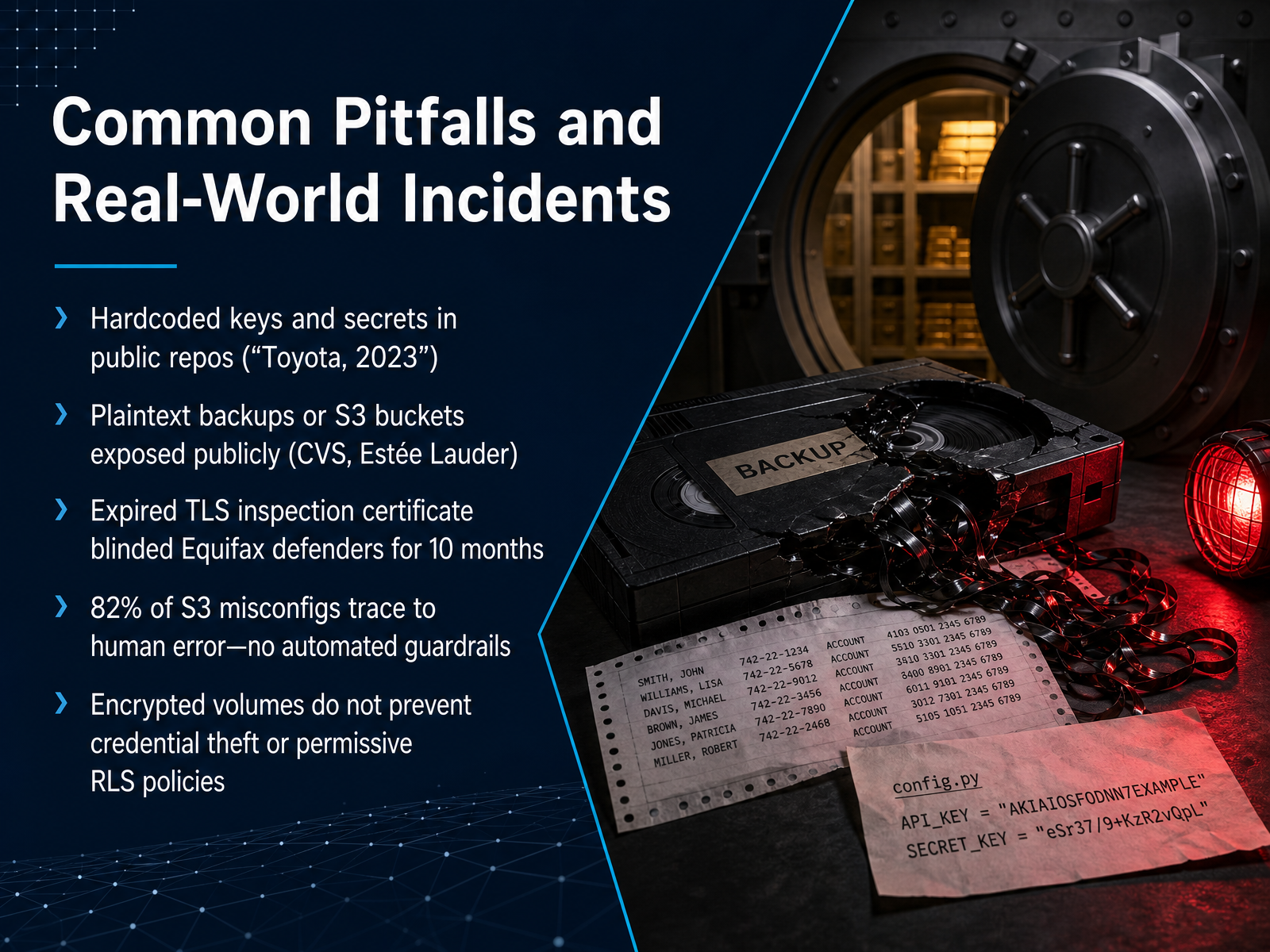
1 min - 13Common Pitfalls and Real-World IncidentsLet's talk about where encryption efforts go wrong. Hardcoded keys and secrets in public repos are still a leading cause of exposure—Toyota left an access key in GitHub source code for nearly five years, affecting over 296,000 customers. Then there are plaintext backups and misconfigured cloud storage. CVS and Estée Lauder both exposed unencrypted records in the hundreds of millions because buckets were left public. And remember Equifax? An expired TLS inspection certificate blinded their defenders for ten months while attackers quietly exfiltrated data over encrypted connections. Here's a telling stat: 82% of S3 misconfigurations trace back to human error. No automated guardrails, no continuous scanning. Even if you encrypt your volumes, that doesn't stop credential theft or overly permissive row-level security policies—one misconfigured policy can expose everything. The pattern is clear: encryption is only one layer, and it fails without enforcement, monitoring, and least-privilege access. Make sure your key rotation schedule is real, your CI/CD pipeline scans for secrets, and your compliance checks run continuously, not just annually. Next, we'll look at a practical implementation roadmap to tie all this together.
 safeguard.shcloudsecurityalliance.orgjohal.in+21 min
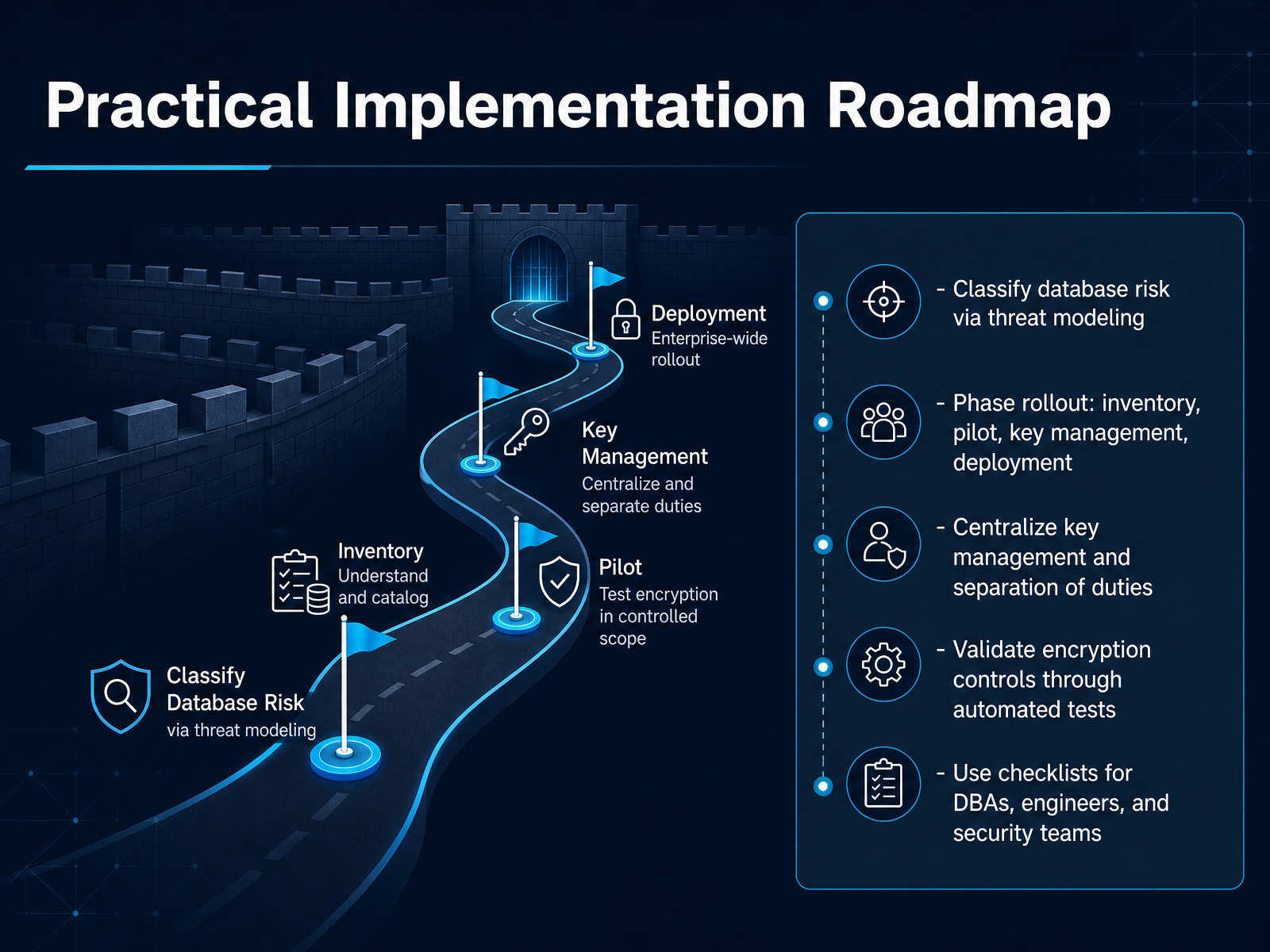
 - 14Practical Implementation RoadmapWe've covered a lot of ground, so let's bring it together with a practical roadmap. First, classify your database risk through threat modeling to know exactly what you're protecting. Then, phase your rollout: start with an inventory, run a pilot, establish key management, and finish with full deployment. Centralize your key management and enforce separation of duties so no single person holds all the power. Validate your encryption controls with automated tests, not just manual spot checks, to catch regressions early. Finally, arm your DBAs, engineers, and security teams with clear checklists that map directly to your compliance obligations. This roadmap turns encryption from a feature into a discipline. Thank you for your time and attention. You have the tools and the plan, so go implement it with confidence. Good luck out there.
 2 min
2 min
Take the deck with you
Download this course as a file — free, no sign-up needed.
- PDF handoutEvery slide page, ready to print or share.15 pages · 3.7 MBDownload
- Narrated PowerPointThe deck that presents itself — every slide carries the digital human's narration video.15 pages · 16.1 MBDownload
- PowerPoint slidesThe full deck as a .pptx — open it in PowerPoint, Keynote, or Google Slides.15 pages · 3.7 MBDownload
Free to use in your own training — please keep the PersonWise credit page at the end.
Have your own deck? Turn it into a course
Sources consulted
Web sources consulted while building this course.
- Best practices for using CMEKs | Cloud Key Management Service | Google Cloud Documentation — docs.cloud.google.com
- https://docs.aws.amazon.com/prescriptive-guidance/latest/aws-kms-best-practices/data-protection-encryption.html — docs.aws.amazon.com
- Encryption best practices for Amazon RDS - AWS Prescriptive Guidance — docs.aws.amazon.com
- AWS Prescriptive Guidance - AWS Key Management Service best practices — docs.aws.amazon.com
- Architecting for database encryption on Google Cloud — cloud.google.com
- Evaluation of the Impact of AES Encryption on Query Read ... — mdpi.com
- THE PERFORMANCE COST OF TRANSPARENT DATA ENCRYPTION IN POSTGRESQL — learn.percona.com
- TDE performance in PostgreSQL | Percona Community — percona.community
- Performance testing reports of the Always confidential database feature-ApsaraDB RDS(RDS)-阿里云帮助中心 — help.aliyun.com
- Transparent data encryption (TDE) performance - ApsaraDB RDS - Alibaba Cloud Documentation Center — alibabacloud.com
- Missing Encryption of Sensitive Data: CWE-311 Explained — safeguard.sh
- Inadequate Database Security: A Darkbeam Case Study | CSA — cloudsecurityalliance.org
- Postmortem: How a Vault 1.15 Secret Leak Exposed Our Kubernetes 1.31 Persistent Volume Encryption Keys — johal.in — johal.in
- Postmortem: Multiple Failures Behind the Equifax Breach - BankInfoSecurity — bankinfosecurity.com
- Postmortem: Database Incident (September 14–18, 2025) - Clerk — clerk.com