Begin
14 pages · ~28 min
Cybersecurity Skills Assessment
This training assesses cybersecurity knowledge and skills, helping organizations evaluate and strengthen their teams' ability to identify and respond to security threats.
A digital instructor presents all 14 pages. Hold “Ask” at any point and ask out loud — the answer comes from this course. No sign-up needed.
What you’ll learn
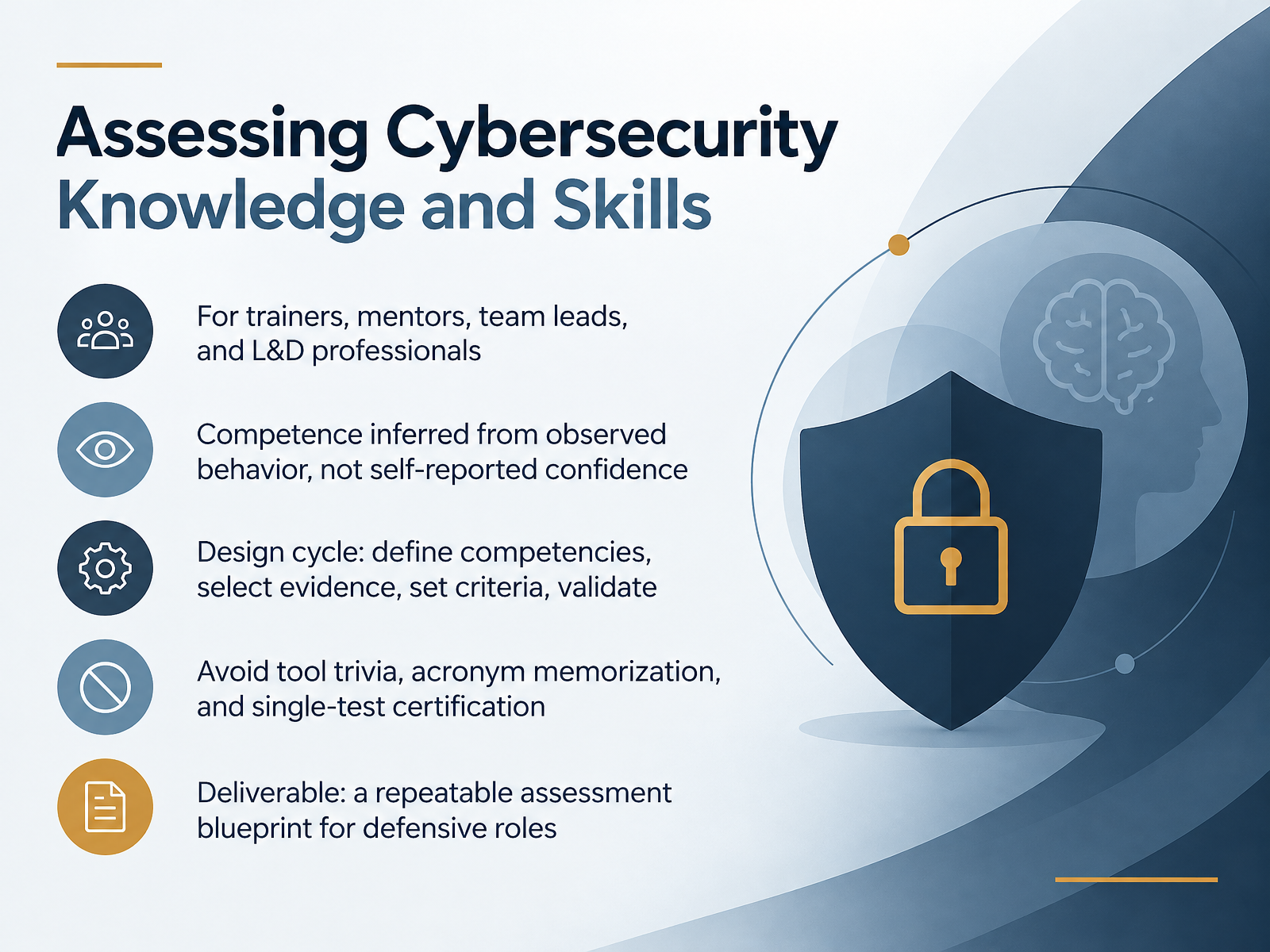
- 01Assessing Cybersecurity Knowledge and SkillsWelcome. If you design or lead defensive cybersecurity training, this session is for you. Our goal is a repeatable assessment blueprint for defensive roles, one that holds up under real constraints like limited time and mixed learner experience. Here is the core principle. Competence is inferred from observed behavior, not self-reported confidence. A learner may rate themselves highly on intrusion detection, yet struggle to triage a live alert. So design backward from what people must do. Define the competencies, select the evidence that actually demonstrates them, set criteria you can defend to a skeptical reviewer, then validate the assessment against real performance. Treat that as a cycle, not a checklist, because criteria drift as roles and threats change. Two traps to avoid. Tool trivia and acronym memorization measure recall, not defensive judgment. And a single certification test rarely tells you whether someone can detect, contain, and document an incident under pressure. You may want to mirror the NICE structure of Task, Knowledge, and Skill statements and anchor scoring to observable task performance. But adapt it to your context. Coming up next, why defensive competence is so hard to measure.nist.govnist.govnist.gov+22 min
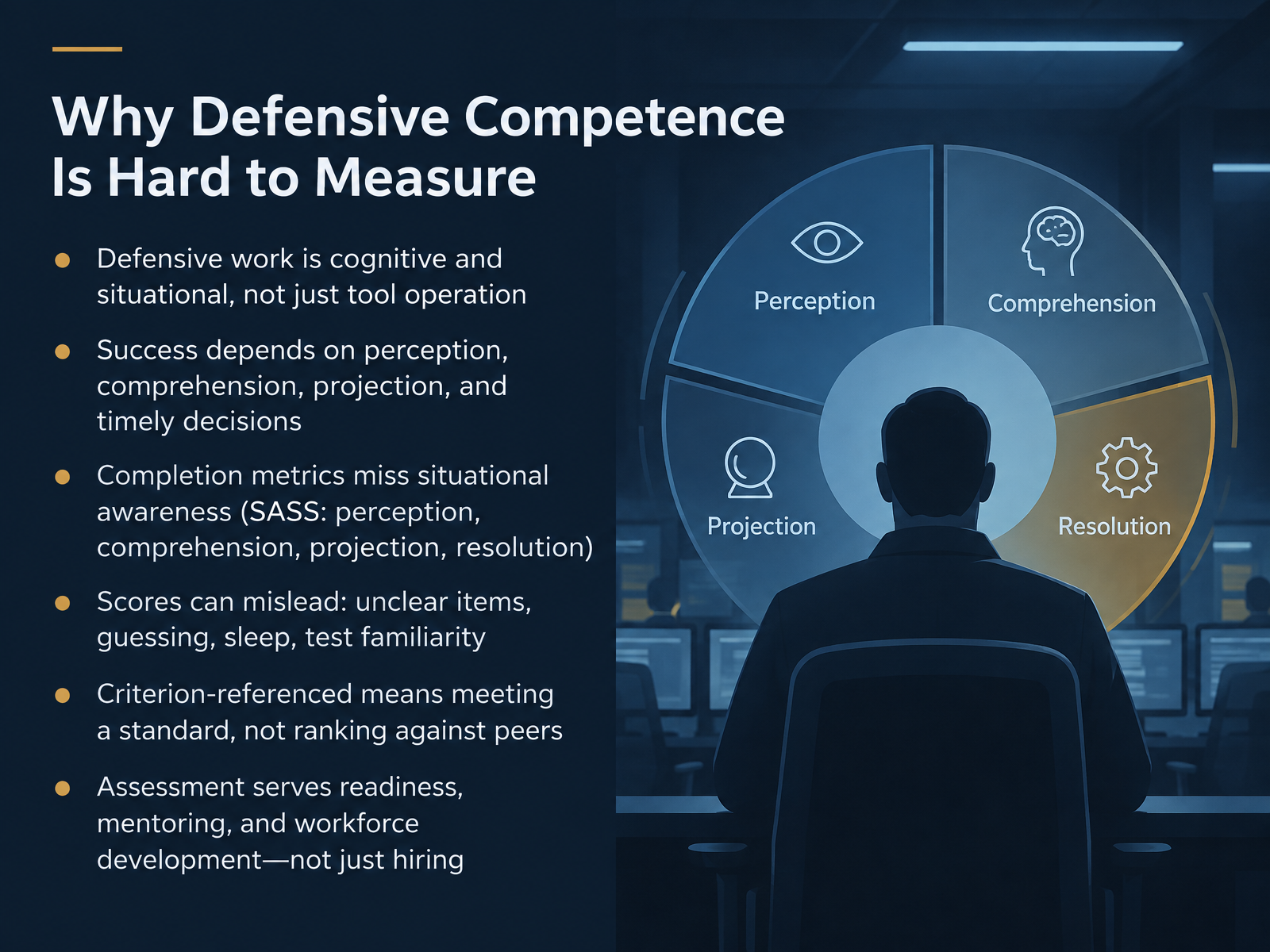
- 02Why Defensive Competence Is Hard to MeasureNow, why is defensive competence so hard to measure? Defensive work is cognitive and situational, not just tool operation. Success depends on perception, comprehension, projection, and timely decisions. That is why completion metrics miss situational awareness, or SASS, which breaks down into perception, comprehension, projection, and resolution. You see this in practice: a learner finishes every task yet never notices the early indicator of lateral movement.
Scores can also mislead. Unclear items, guessing, sleep, and test familiarity all add noise. So when you build or select an assessment, decide up front what the score is meant to support. Criterion referenced scoring means meeting a standard, not ranking against peers. And assessment serves readiness, mentoring, and workforce development, not just hiring.
Next, let's connect this to the underlying building blocks: Knowledge, Skill, Ability, and Behavior.
 vtechworks.lib.vt.edupmc.ncbi.nlm.nih.govexa.ai+22 min
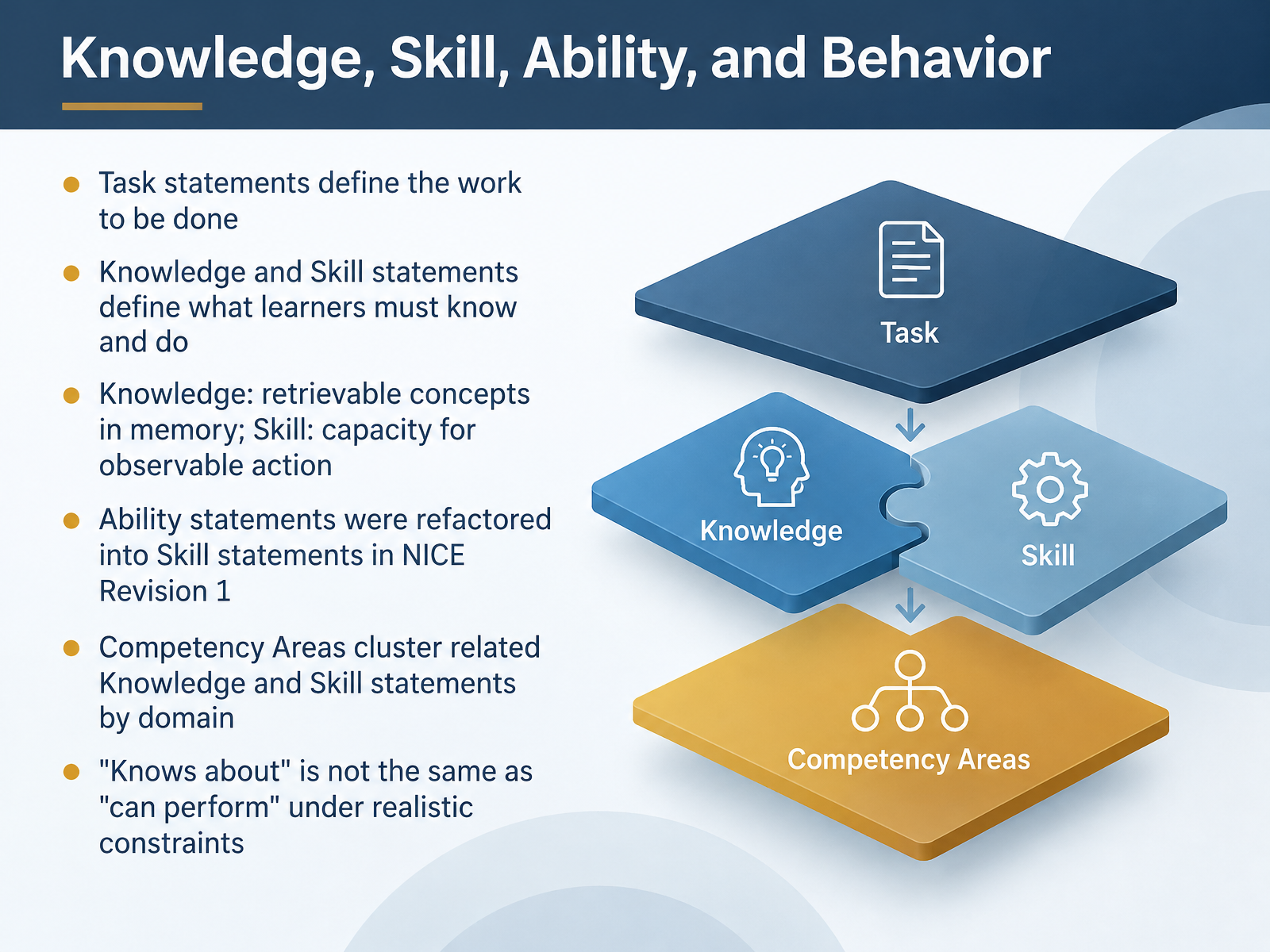
- 03Knowledge, Skill, Ability, and BehaviorLet's clarify the building blocks you'll actually be assessing. Task statements define the work to be done. Knowledge and Skill statements define what learners must know and be able to do to complete that work. Knowledge is a retrievable set of concepts in memory. Skill is the capacity to perform an observable action. In NICE Revision 1, Ability statements were refactored into Skill statements, shifting the focus onto observable action. Competency Areas then cluster related Knowledge and Skill statements by domain, which gives you a defensible unit for scoring. So decide deliberately: are you testing whether someone knows about intrusion detection, or whether they can triage an alert under time pressure with incomplete data? Under realistic constraints, those are different claims, and your evidence has to match the claim. With that distinction in hand, let's move from role expectations to assessable competency targets.
 nist.govnist.govnist.gov+21 min
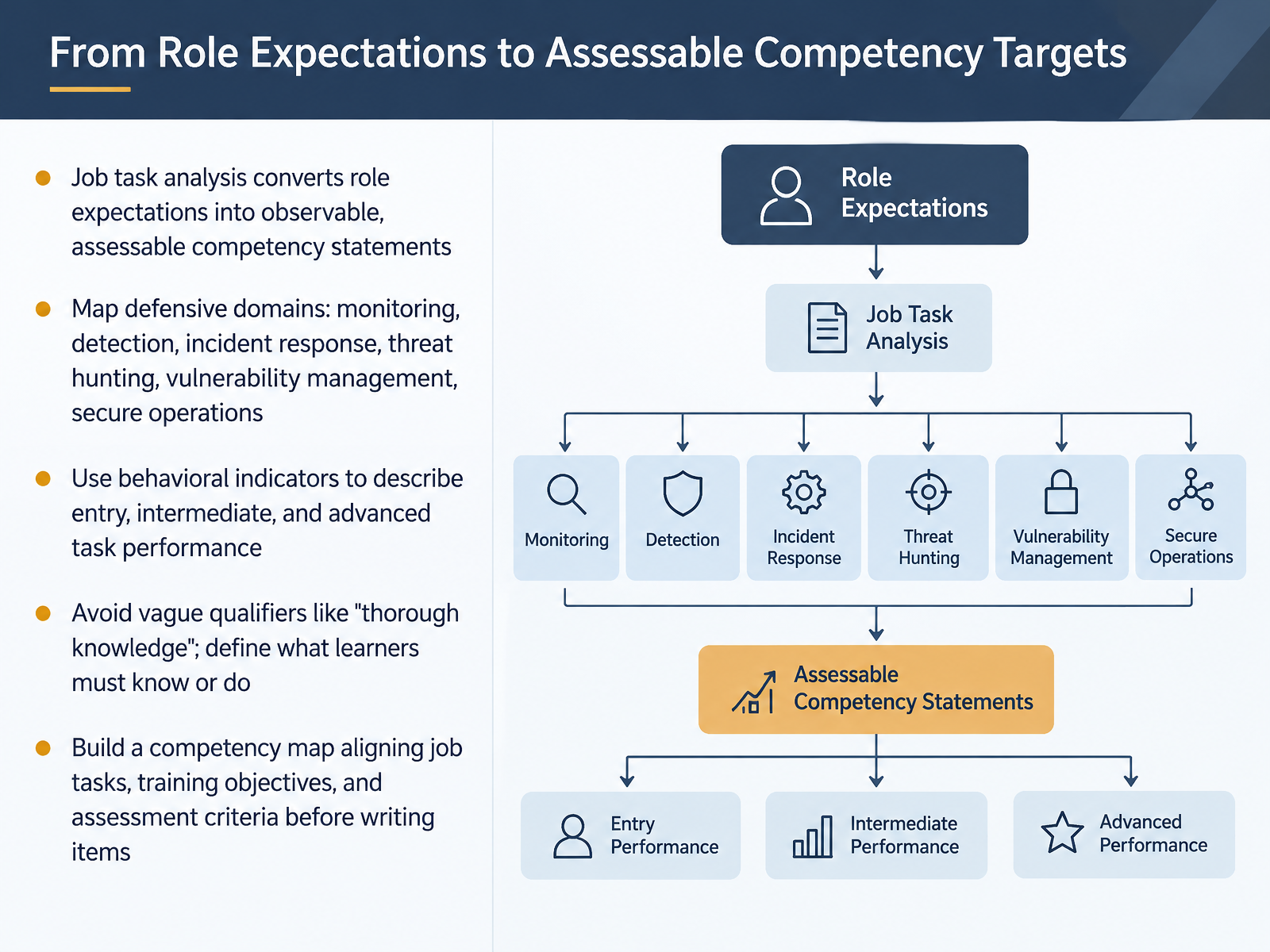
- 04From Role Expectations to Assessable Competency TargetsNow let's turn role expectations into assessable competency targets. Job task analysis is your first move. It converts a role like defensive analyst into observable statements of what someone must actually do, not just what the title implies. From there, map the defensive domains you care about: monitoring, detection, incident response, threat hunting, vulnerability management, and secure operations. For each domain, write behavioral indicators at entry, intermediate, and advanced levels. Entry might read: identify alerts from a provided detection rule. Advanced might read: tune rules and reduce false positives across a production environment. Notice how specific that is. Drop vague qualifiers like thorough knowledge. They can't be scored. Instead, name the task, the context, and the evidence you'll accept. Then build one competency map that links job tasks, training objectives, and assessment criteria before you write a single item. That sequencing protects your scoring defensibility, even under limited time and with learners at mixed experience levels. Next, we look at choosing the right proficiency scale.
 nist.govnist.govnist.gov+22 min
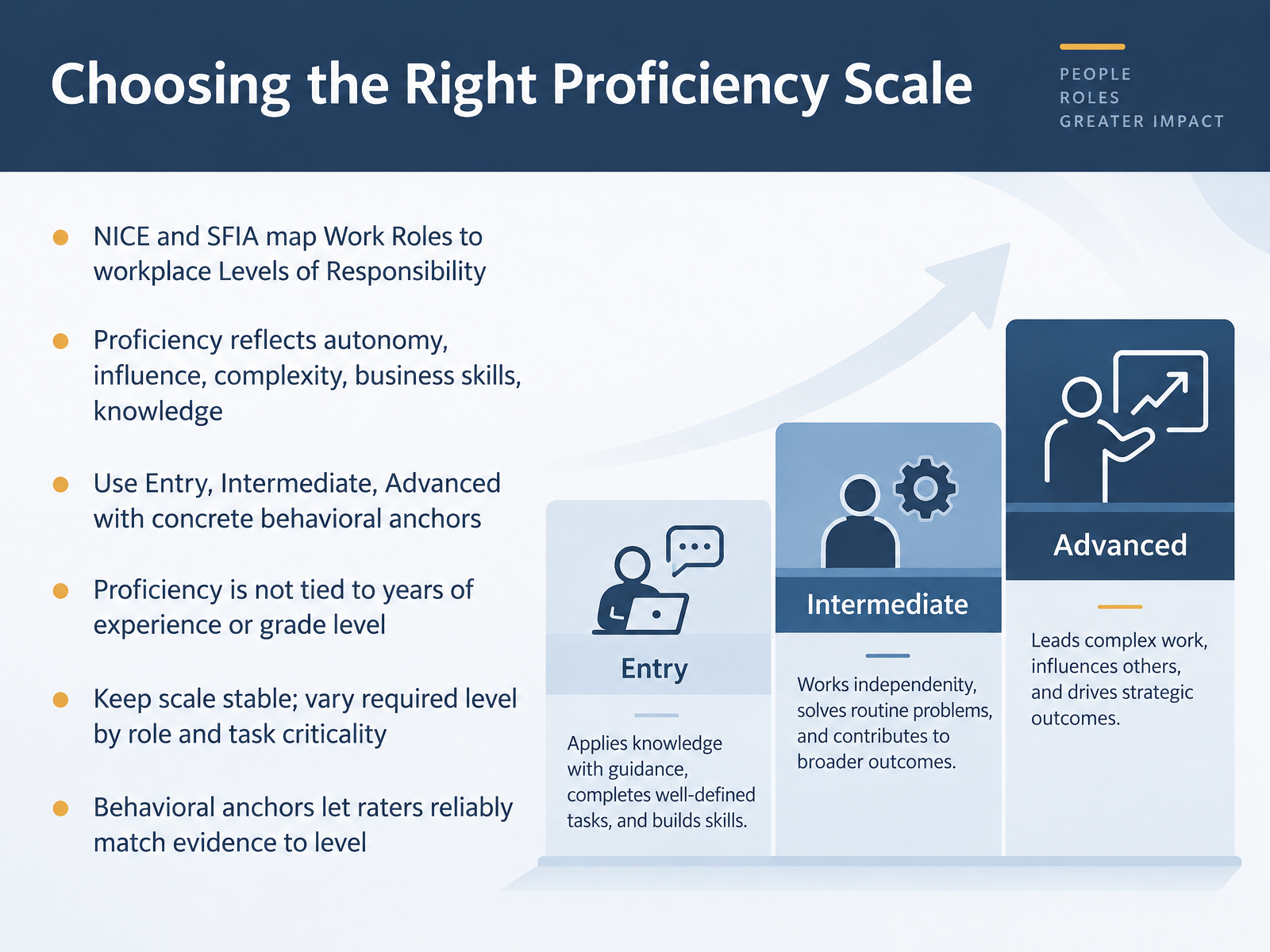
- 05Choosing the Right Proficiency ScaleLet's talk about how you build a proficiency scale that actually holds up under scoring. NICE and the Skills Framework for the Information Age, or SFIA, map Work Roles to workplace Levels of Responsibility, so proficiency is defined by autonomy, influence, complexity, business skills, and knowledge, not by a job title. That distinction matters when you're judging a defensive analyst who works independently on routine triage but escalates novel intrusions. A common approach is three levels: Entry, Intermediate, and Advanced, each with concrete behavioral anchors. Entry might mean applying basic concepts with guidance, Intermediate means working independently in most situations, and Advanced means handling complex incidents and advising others. Here's the tradeoff: anchors take real effort to write and validate, but they let raters reliably match evidence to a level. And keep proficiency separate from years of experience or grade level. Someone with two years can be Intermediate. Once your scale is stable, vary the required level by role and task criticality instead. That gives you defensible scoring under limited time and across mixed learner experience. Next, we move into Building the Assessment Blueprint.
 nist.govnist.govnist.gov+21 min
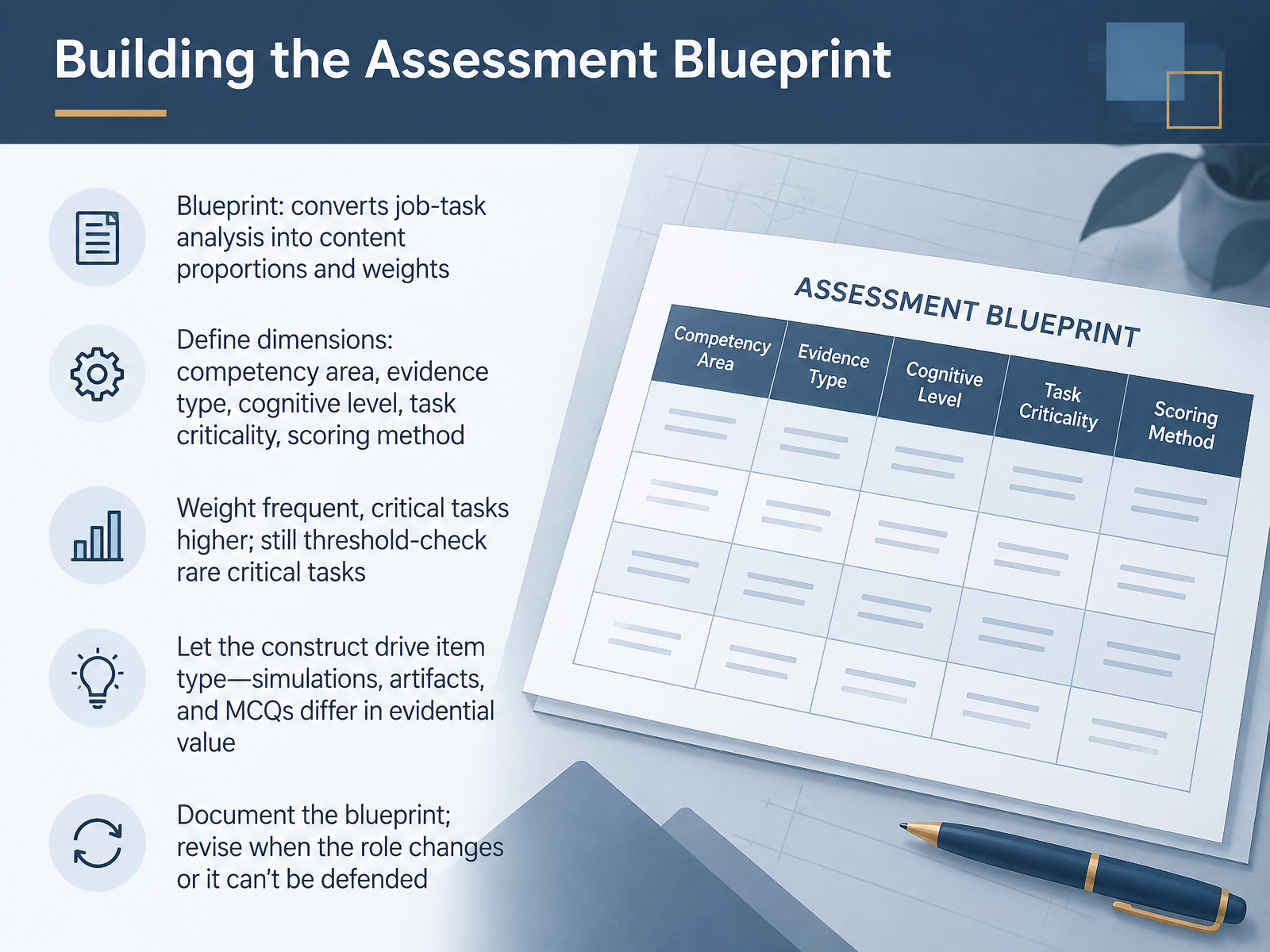
- 06Building the Assessment BlueprintNow let's build the assessment blueprint. Think of it as the document that converts your job-task analysis into content proportions and weights, so every item you write has a defensible reason to exist. Start by defining your dimensions: competency area, evidence type, cognitive level, task criticality, and scoring method. When you set weights, lean toward the tasks people perform often and that carry real consequence. But still threshold-check the rare critical tasks, the ones that almost never surface yet can cause serious harm. Next, let the construct drive the item type. A simulation, a work artifact, and a multiple-choice question carry very different evidential value, so choose deliberately rather than by habit. Finally, document the blueprint and revisit it when the role changes, or when you can no longer defend a weighting under scrutiny. Next, we move into evidence types and item design principles.
 nist.govnist.govnist.gov+21 min
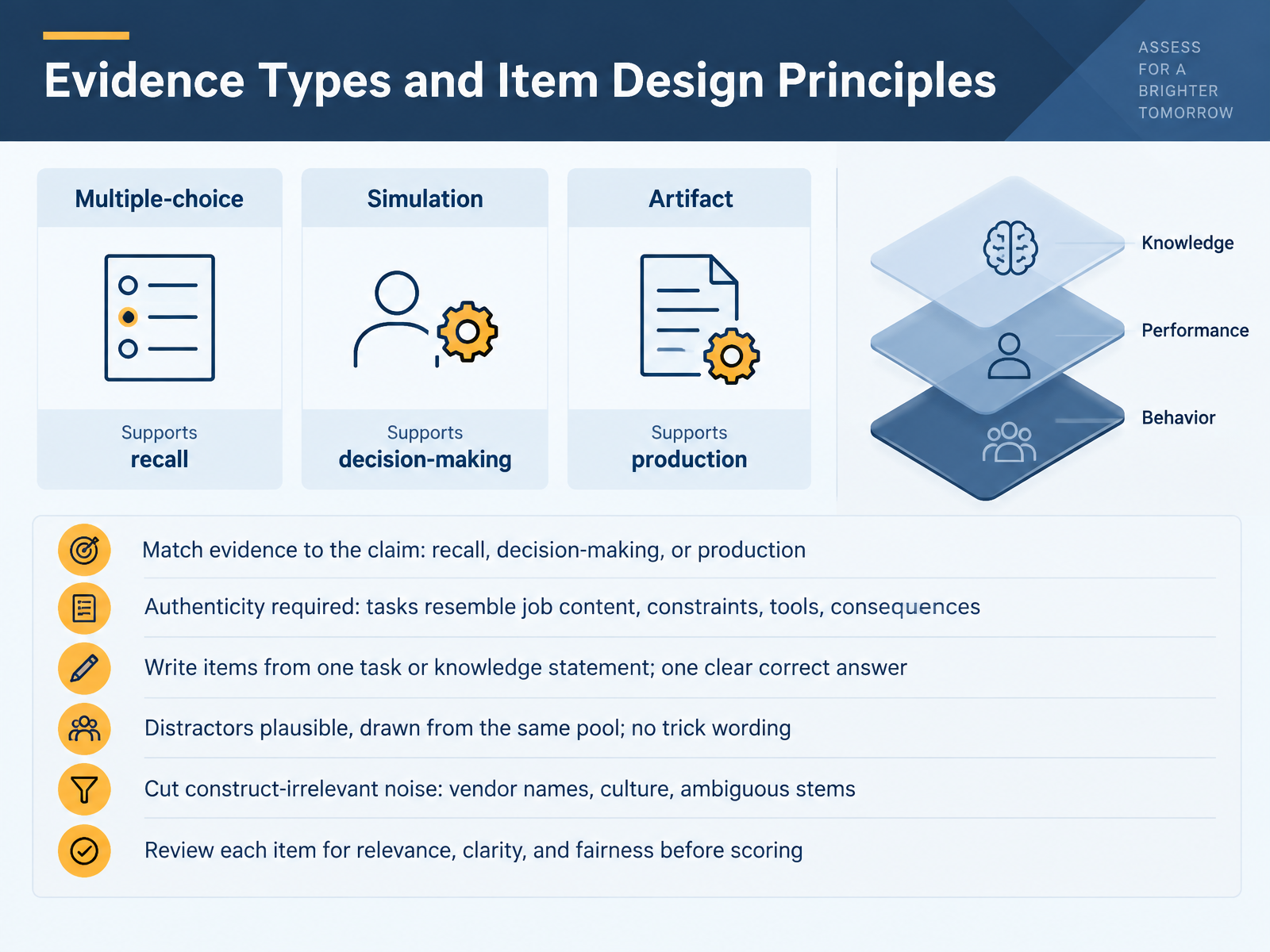
- 07Evidence Types and Item Design PrinciplesLet's walk through evidence types and the principles that keep your items defensible. Start by matching evidence to the claim you're making. If you're claiming recall, ask for a definition or a fact. If you're claiming decision-making, give them a scenario with a right and wrong path. If you're claiming production, they need to build, configure, or write something. The evidence has to match the claim, or your scores won't support the inference you're drawing. Next, authenticity. The task should resemble job content, constraints, tools, and consequences. A help desk candidate triaging a real ticket in a simulated queue tells you more than twenty recall questions. When you write items, anchor each one to a single task or knowledge statement, and make sure there is one clear correct answer. Distractors should be plausible, drawn from the same pool of options, with no trick wording and no clang associations that give away the key. Cut construct-irrelevant noise. Vendor names, cultural references, and ambiguous stems add error, not information. Finally, review every item for relevance, clarity, and fairness before it goes anywhere near scoring. That review is what keeps your evidence trustworthy and your cut scores defensible. Let's turn now to scoring guides and rubric design.
 nist.govnist.govnist.gov+22 min
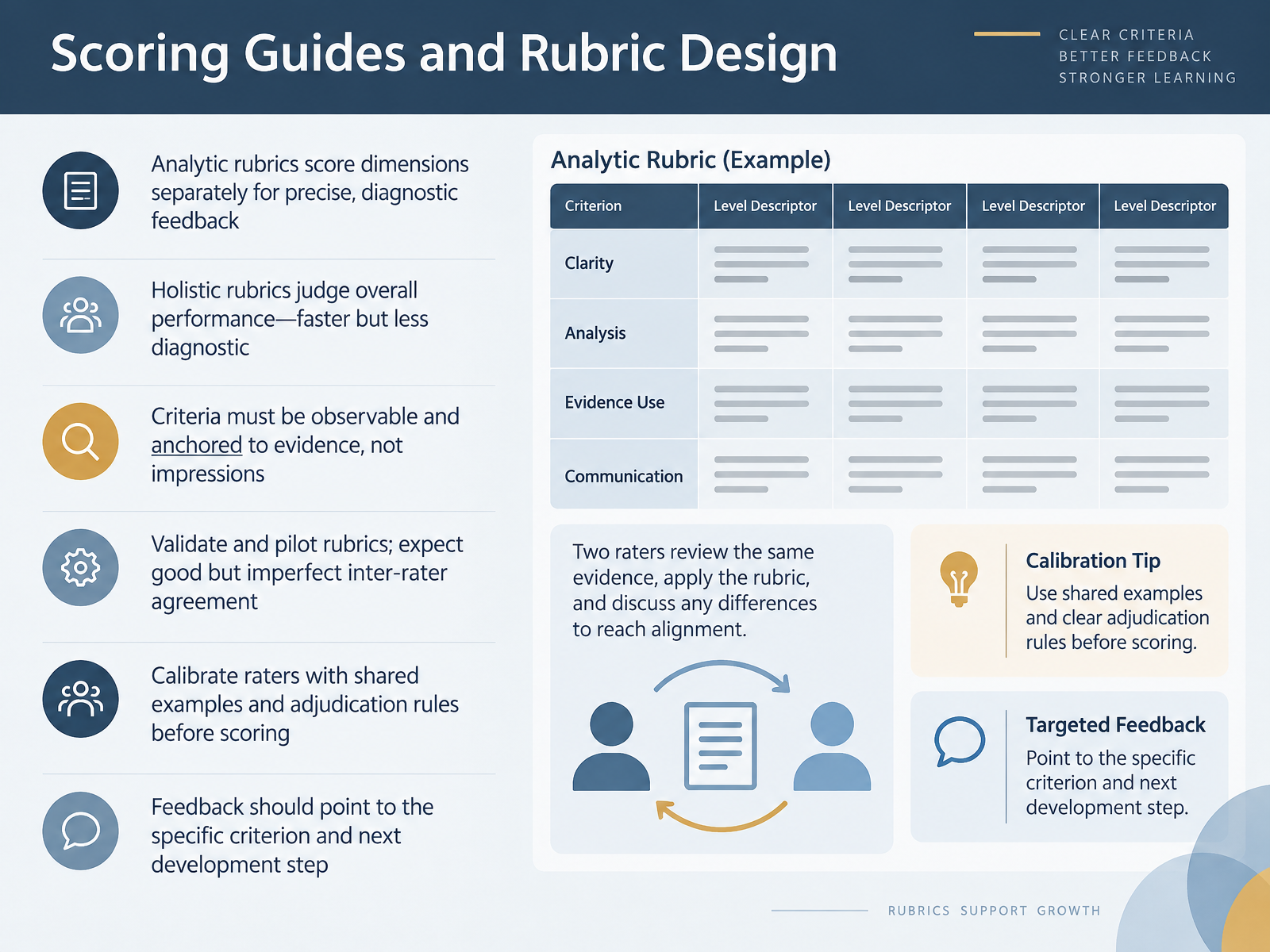
- 08Scoring Guides and Rubric DesignNow let's get concrete about scoring. Rubrics come in two shapes, and the tradeoff is precision versus speed. Analytic rubrics score dimensions separately, so you can tell a learner exactly where the gap is, say detection versus reporting. Holistic rubrics judge the overall performance in one pass. Faster to apply, less diagnostic, so reserve them for lower-stakes checks. Whatever shape you pick, every criterion needs to be observable and anchored to evidence, not impressions. If two raters can't point to the same artifact and agree, the criterion isn't ready. So validate and pilot your rubric before it counts. Expect good but imperfect inter-rater agreement, and treat low agreement as a rubric problem first, a rater problem second. Before scoring, calibrate raters on shared examples and adjudication rules. Then make feedback point to the specific criterion and the next development step. Next, we move to knowledge testing and cognitive assessment.
 csrc.nist.govassets.contentstack.iolakeridge.io+22 min
- 09Knowledge Testing and Cognitive AssessmentLet's move on to knowledge testing and cognitive assessment. Knowledge tests work well for foundational concepts, terminology, procedures, and the reasoning prerequisites that later performance depends on. For defensible scoring, stick to formats you can justify: multiple-choice, scenario-based multiple-choice, short answer, and structured oral questioning. When you write items, keep stems positive, concise, and focused on one concept, then build plausible distractors from the misunderstandings you actually see in your learners. After piloting, check item difficulty, discrimination, reliability, and distractor distribution, because a distractor nobody picks is dead weight. One practical caution: if your pilot shows an item performing poorly, resist the urge to just delete it. First ask whether the flaw is in the item or in what you assumed learners already knew. Watch validity threats like memorization, test-taking skill, teaching to the test, and overclaiming, especially when time is tight and your group has mixed experience. One useful tactic is to pair every knowledge score with at least one observation of the same concept in practice, so the test result and the demonstrated skill can confirm or challenge each other. The takeaway: knowledge tests are precise and efficient for verifying prerequisites, but they are a floor, not a ceiling. Next, we look at hands-on labs, simulations, and cyber ranges.
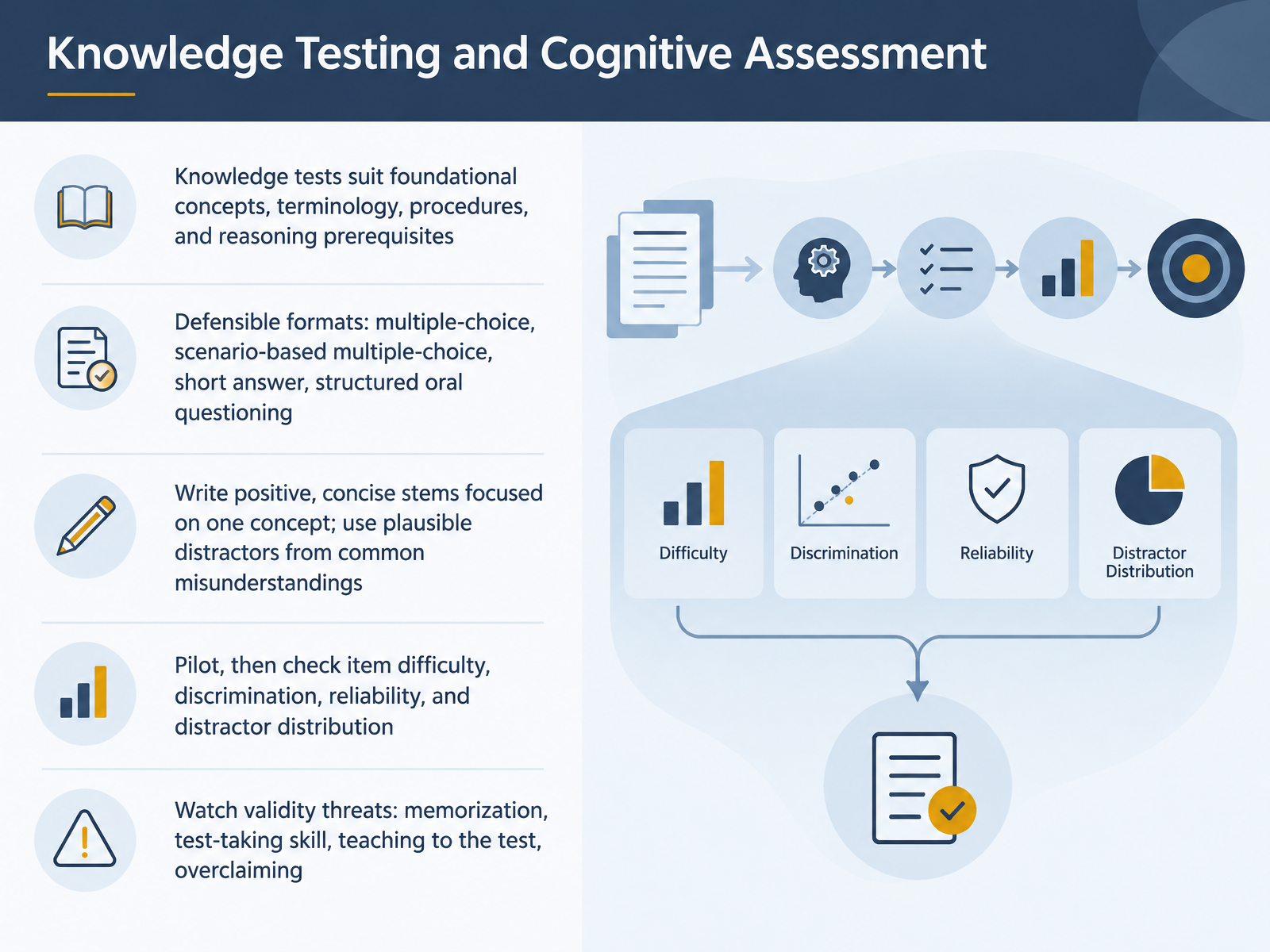 comptia.orgisaca.orgpsiexams.com+22 min
- 10Hands-On Labs, Simulations, and Cyber RangesNext, let's look at hands-on labs, simulations, and cyber ranges. The practical question here is what your tasks actually observe. Build them on realistic network, endpoint, log, and alert conditions, so trainees face the noise that real detection work brings. Scenarios should assess triage, incident handling, mitigation decisions, and escalation under constraints. That means time pressure, incomplete evidence, and mixed learner experience all in play.
Now, capture more than the final answer. Reasoning, timing, tool use, hint requests, communication, and documentation are all scoreable signals. Score task completion with process evidence, because completion alone misses situational awareness. A trainee can close every ticket and still perceive the wrong event.
Automated scoring scales across large cohorts, but keep human review for reasoning and failure analysis. Use it to check why someone failed, not just that they did. With limited time, a defensible approach is to automate what you can and reserve expert review for the decisions that carry weight.
Measuring Judgment, Behavior, and Communication.
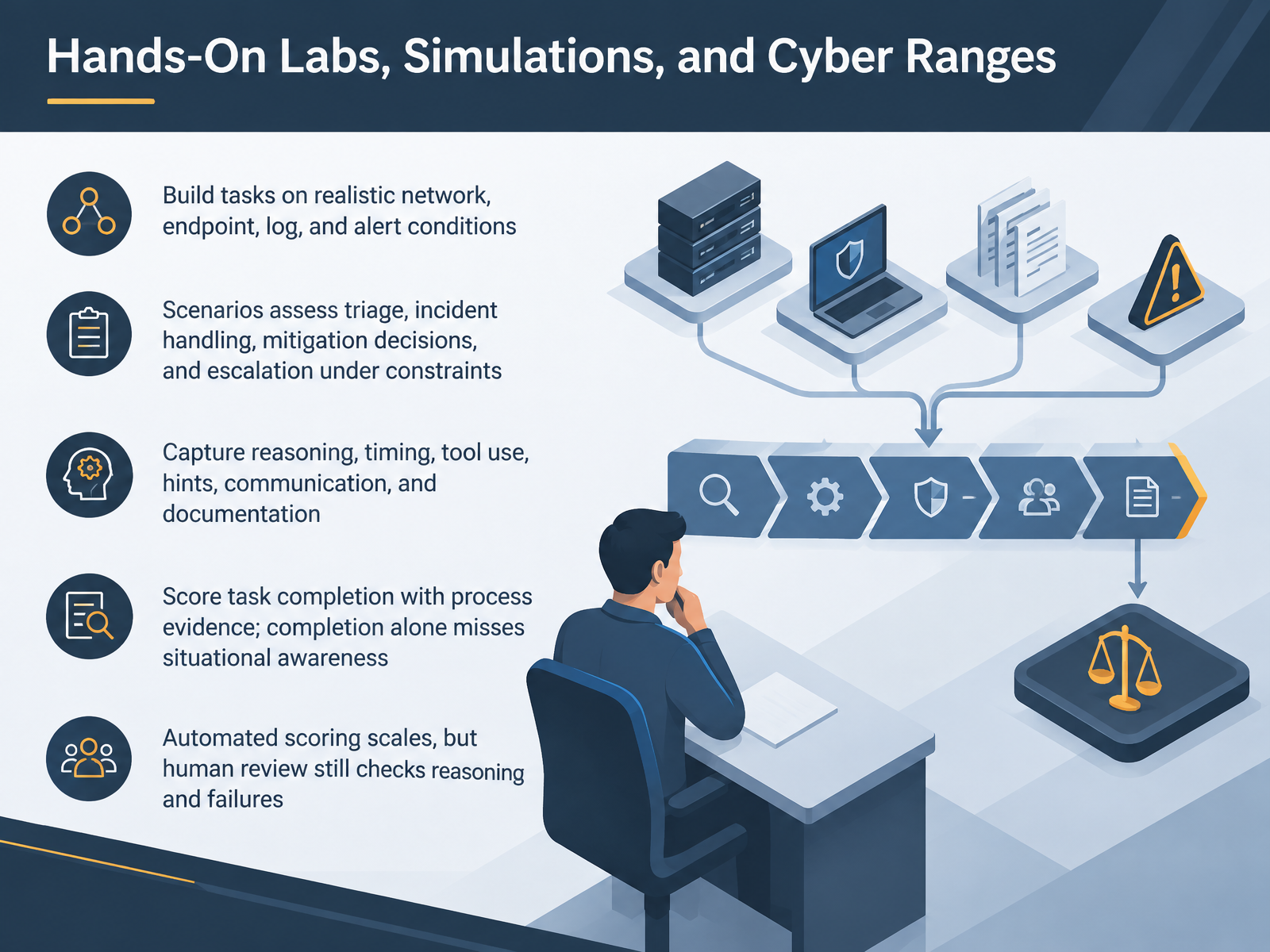 link.springer.comvtechworks.lib.vt.edupmc.ncbi.nlm.nih.gov+21 min
- 11Measuring Judgment, Behavior, and CommunicationNow let's look at how you capture judgment, behavior, and communication without turning every assessment into a full simulation. Situational judgment tests are your low-fidelity option. You present a realistic incident scenario with a handful of response choices. They are quick to run and score, and their criterion-related validity is moderate, not exceptional, so treat them as one signal rather than a verdict. For depth, pair them with behavioral interviews anchored to competency statements and a rating scale. Then widen the lens: handoff quality, escalation decisions, and shared situational awareness are team-level evidence you can actually observe. Work products count too. Incident reports, tickets, timelines, and remediation plans show reasoning in a durable form. To keep scoring defensible with limited time and mixed learner experience, use multiple observers, predefined anchors, and short calibration sessions before you rate. That combination reduces subjectivity more than any single tool. Next, we move into Data Collection, Scoring Operations, and Interpretation.
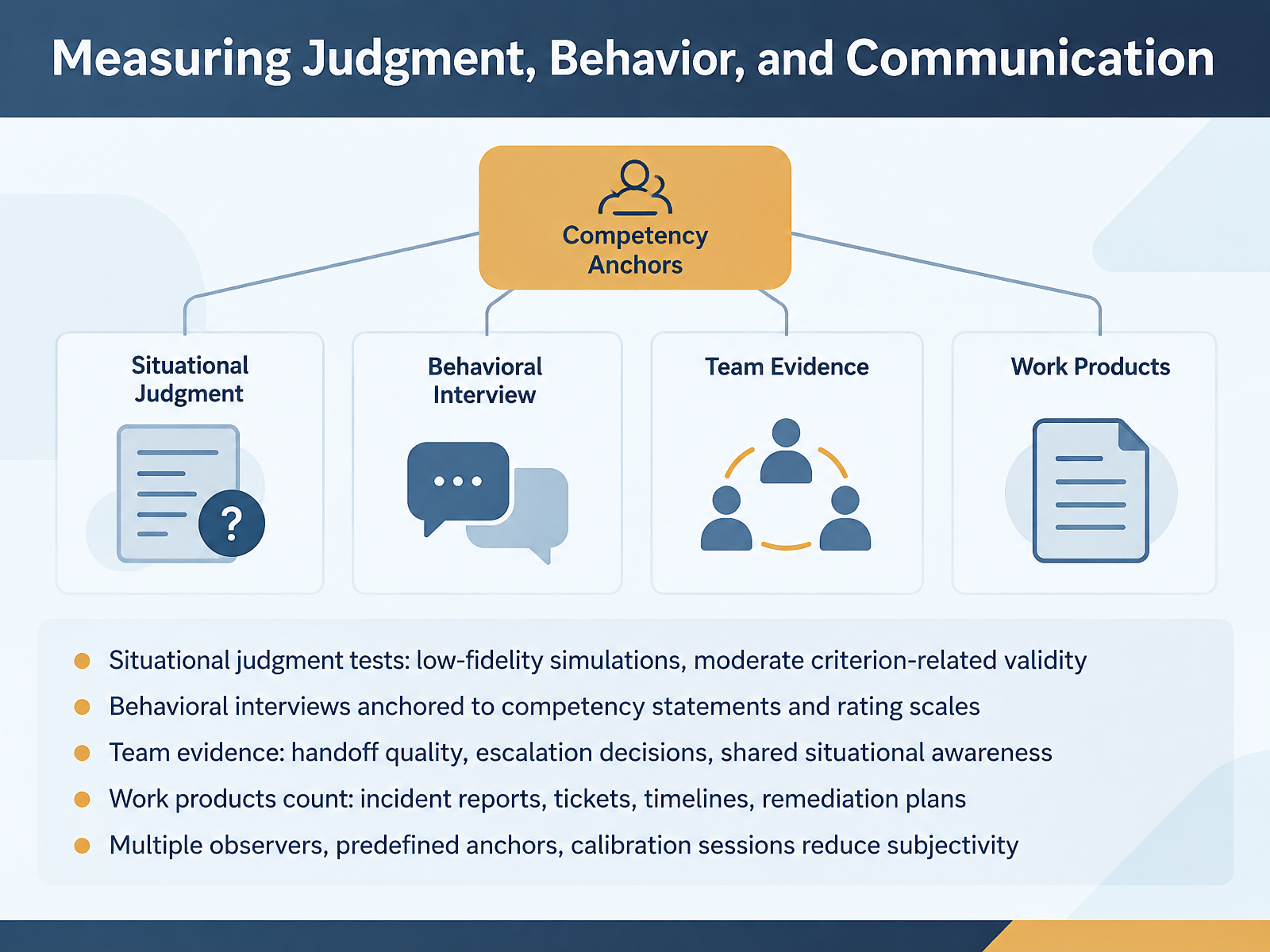 exa.ai2 min
- 12Data Collection, Scoring Operations, and InterpretationNow let's look at what happens once the assessment is designed and learners actually sit it. Collection and scoring decisions can quietly undermine an otherwise strong instrument. Standardize administration first. Same instructions, same time limits, same tools, same rules on assistance, whether that is no help at all or a defined set of allowed references. Then define the scoring workflow before anyone scores a single submission. Map the rubric to observable indicators, decide which checks are automated, and plan double scoring for judgment-heavy items with adjudication when raters disagree. When you interpret results, be cautious. Report individual and team views, use confidence intervals, and resist overclaims from small samples. Feedback should be specific and actionable, linked to a mentoring conversation, a lab exercise, or a targeted module, not just a number. And use the data ethically. Informed consent, privacy protection, and explicitly no punitive reuse. If you take one thing from this slide, make it this. Comparability depends on consistency, and defensibility depends on disciplined interpretation. Next, we look at validation, program integration, and continuous improvement.
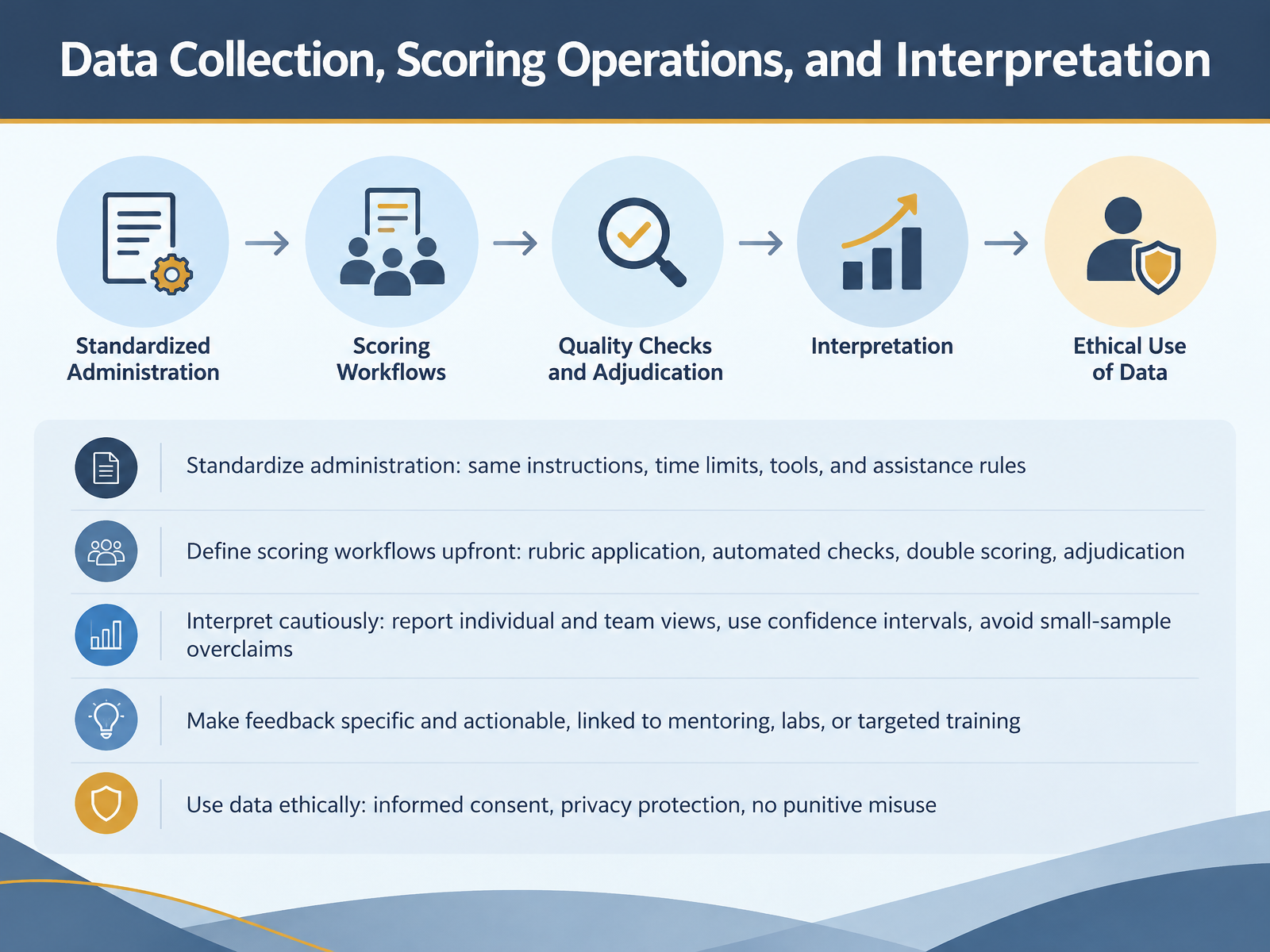 csrc.nist.govassets.contentstack.iolakeridge.io+22 min
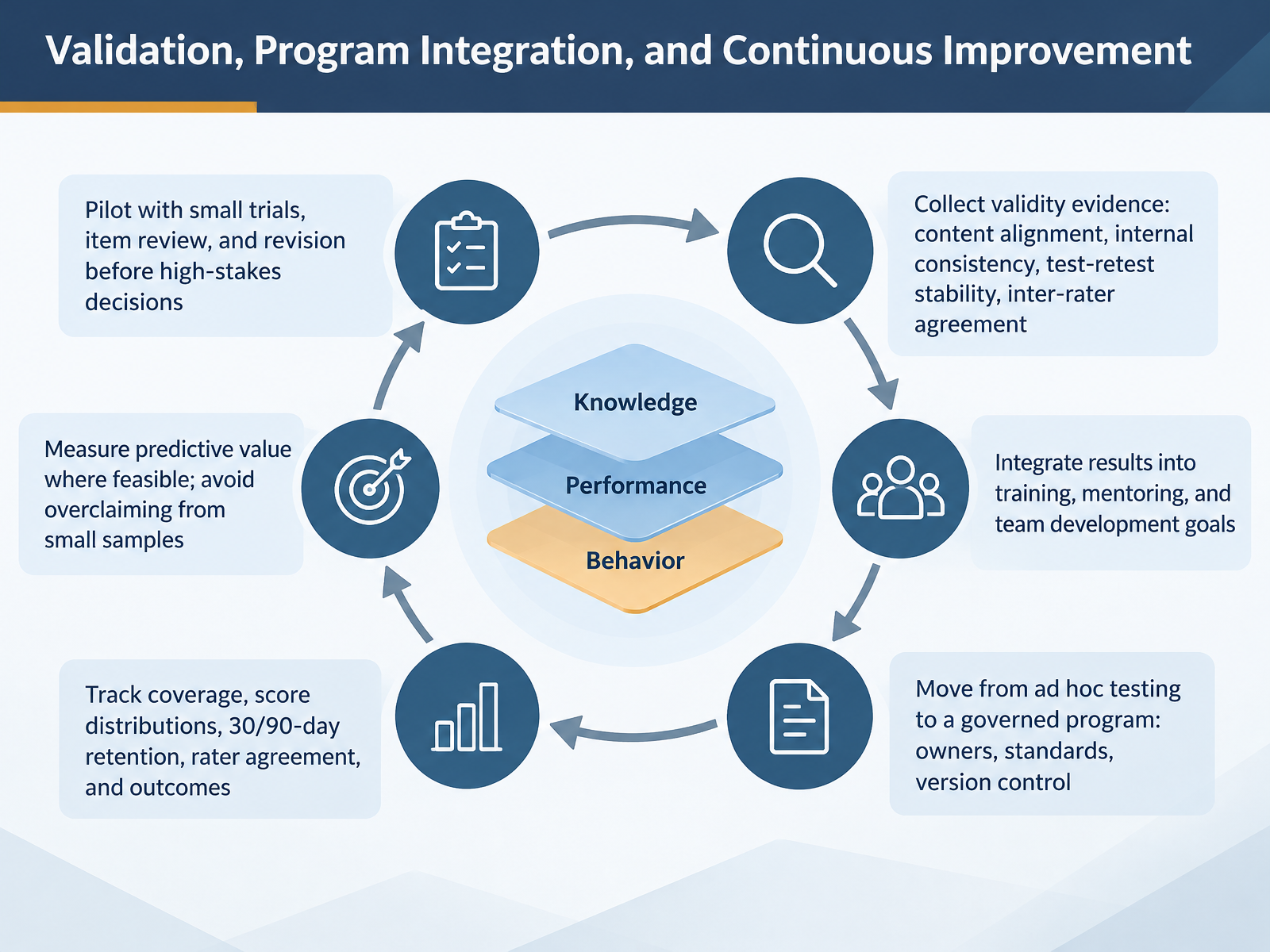
- 13Validation, Program Integration, and Continuous ImprovementLet's close the loop on validation and program integration. Before you attach high-stakes consequences to any score, pilot it with small trials, review the items, and revise. Then collect validity evidence deliberately: content alignment, internal consistency, test-retest stability, inter-rater agreement. Where you can, measure predictive value, but avoid overclaiming from small samples; a moderate correlation in a pilot is a hypothesis, not a guarantee. From there, integrate results into training, mentoring, and team development goals so assessment actually shapes what people do next. And move from ad hoc testing to a governed program: named owners, written standards, version control. Track coverage, score distributions, thirty and ninety day retention, rater agreement, and outcomes. For example, if retention drops at ninety days for a specific skill, that tells you exactly where to reinvest. Next, we'll put all of this together in a case practice: a defensive skills assessment blueprint.
 vtechworks.lib.vt.edupmc.ncbi.nlm.nih.govexa.ai+22 min
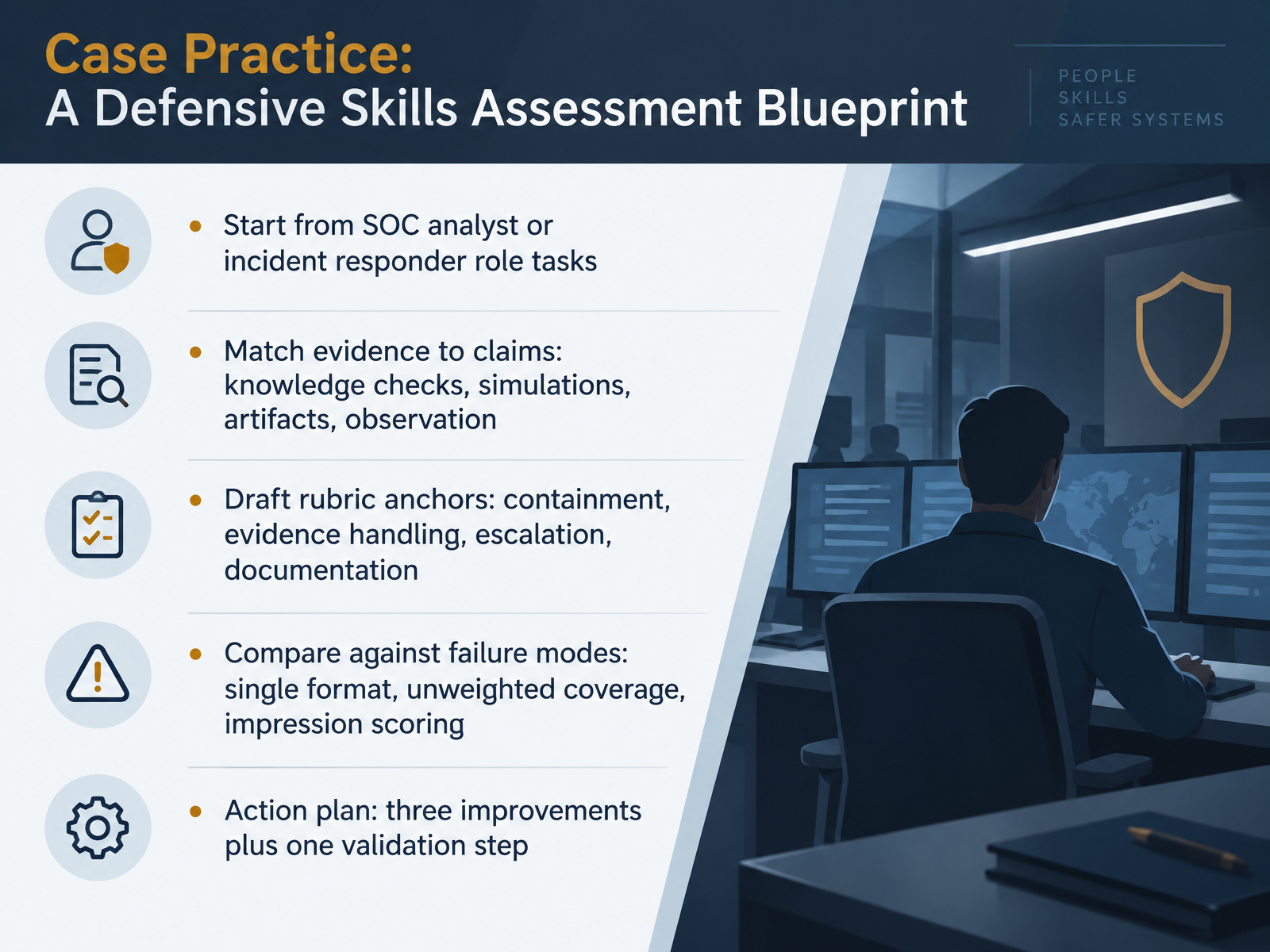
- 14Case Practice: A Defensive Skills Assessment BlueprintLet's put everything together into a working blueprint. Start with real role tasks, the actual work a SOC analyst or incident responder performs daily, not a generic topic list. Then match each claim to its evidence. Knowledge checks support conceptual understanding. Simulations show applied decisions. Artifacts reveal documentation quality. Observation captures escalation judgment and evidence handling under time pressure. When you draft rubric anchors, name observable behaviors for containment, evidence handling, escalation, and documentation, so two reviewers can score the same performance consistently. Now compare against common failure modes. A single format under-samples skill. Unweighted coverage treats critical actions the same as routine ones. Impression scoring drifts without anchors. Your action plan: choose three improvements, for instance adding a simulation, weighting critical criteria, and building an inter-rater calibration step. Add one validation step, such as comparing rubric scores against independent expert judgment or checking whether they discriminate across experience levels. That closes the loop between what you assess and what the role actually demands. Thank you for working through this blueprint with me. You now have a practical, defensible starting point. Pick one improvement this week and test it.
 vtechworks.lib.vt.edupmc.ncbi.nlm.nih.govexa.ai+22 min
Take the deck with you
Download this course as a file — free, no sign-up needed.
- PDF handoutEvery slide page, ready to print or share.15 pages · 3.2 MBDownload
- Narrated PowerPointThe deck that presents itself — every slide carries the digital human's narration video.15 pages · 14.2 MBDownload
- PowerPoint slidesThe full deck as a .pptx — open it in PowerPoint, Keynote, or Google Slides.15 pages · 3.1 MBDownload
Free to use in your own training — please keep the PersonWise credit page at the end.
Have your own deck? Turn it into a course
Sources consulted
Web sources consulted while building this course.
- NICE Releases NICE Framework Components v2.2.0 | NIST — nist.gov
- Measuring Proficiency: NICE Framework Work Role Levels of Responsibility | NIST — nist.gov
- Identifying Proficiency: NICE Framework Work Roles & Levels of Responsibility | NIST — nist.gov
- The Landscape of Performance-Based Assessments in Cybersecurity Green Paper — nist.gov
- Workforce Framework for Cybersecurity (NICE Framework) — nvlpubs.nist.gov
- Efficiency and Equity in Screening for Participants in Representative Cybersecurity Studies — vtechworks.lib.vt.edu
- Validation of Cyber Test for Future Soldiers : A Test Battery for the Selection of Cyber Soldiers — pmc.ncbi.nlm.nih.gov
- PENGEMBANGAN PERFORMANCE ASSESSMENT BERBASIS KKNI UNTUK MEMPERKUAT AKURASI PENILAIAN KOMPETENSI KEAMANAN SIBER — exa.ai
- Development of a Cybersecurity Skills Index: A Scenarios-Based, Hands-On Measure of Non-IT Professionals' Cybersecurity Skills — exa.ai
- Measuring the unseen: a situational awareness scoring framework for cyber range training | International Journal of Information Security | Springer Nature Link — link.springer.com
- SP 800-50 Rev. 1, Building a Cybersecurity and Privacy Learning Program | CSRC — csrc.nist.gov
- SANS Security Awareness — assets.contentstack.io
- AT.L2-3.2.2: Measure Training Effectiveness - LakeRidge — lakeridge.io
- Managing Human Risk — assets.contentstack.io
- A framework for designing and certifying ECSF-aligned cybersecurity training through cyber ranges and virtual learning environments | International Journal of Information Security | Springer Nature Link — link.springer.com
- Exam Development | CompTIA IT Certifications Global — comptia.org
- ITEM DEVELOPMENT GUIDE — isaca.org
- Item Writing and Exam Assembly in Credentialing: Importance and Best Practices | PSI Services — psiexams.com
- Technical Guidelines for the Construction of Multiple-Choice Questions — tpcb.org
- CCE Exam Evaluation Standards | ISFCE — isfce.com