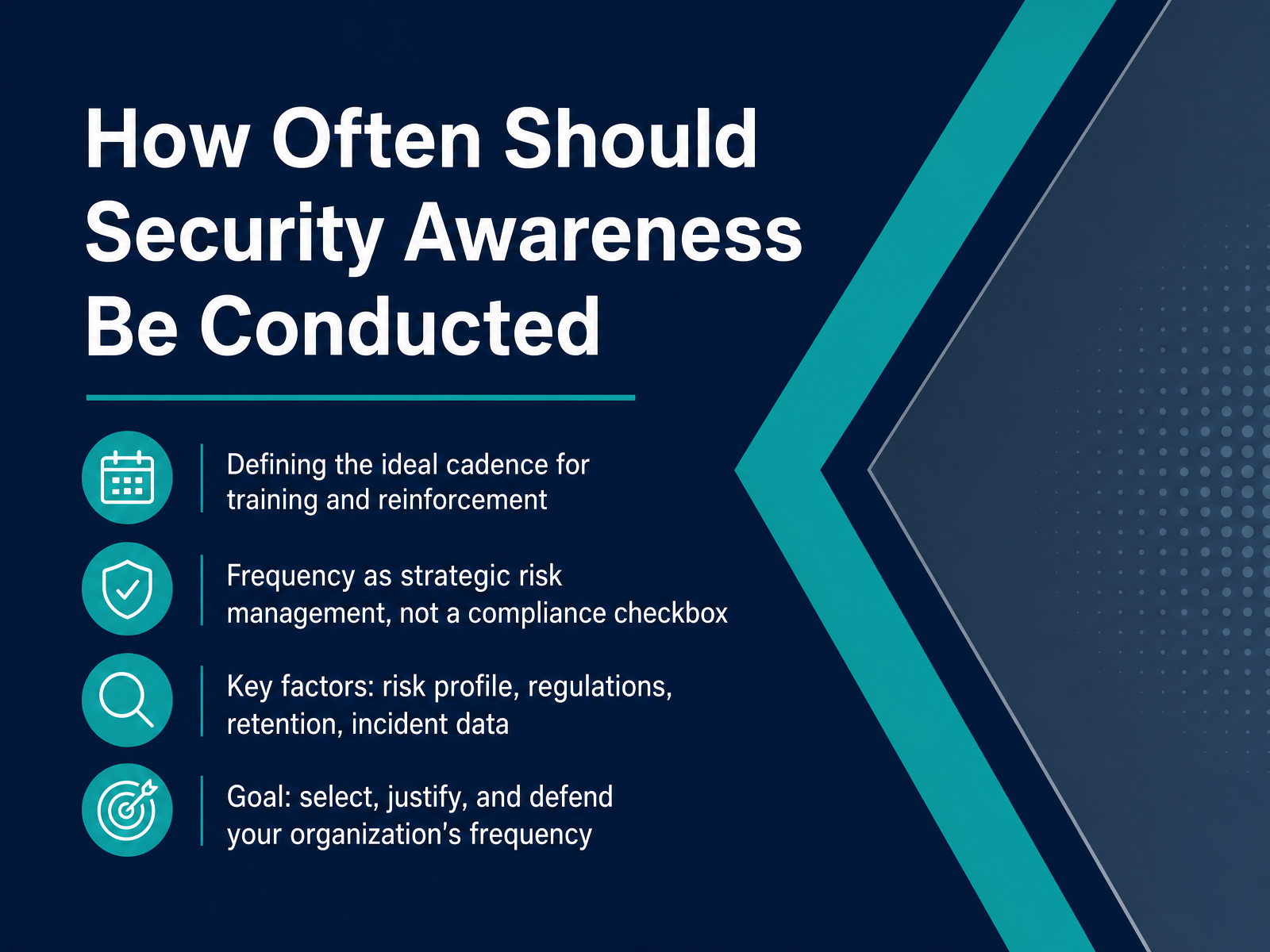
Security Awareness Training Frequency
Begin
14 pages · ~28 min
Security Awareness Training Frequency
This training explains how often security awareness activities should be conducted. It helps organizations and employees schedule regular sessions to reinforce safe security practices.
What you’ll learn
- 01How Often Should Security Awareness Be ConductedWelcome. Over the next fourteen slides, we'll answer a question every program owner gets asked: how often should security awareness training actually run? Let's be clear at the start. Annual training is the compliance floor, not the target. Most auditors will accept it, but behavior tells a different story. Research shows phishing detection skills fade after about four months without reinforcement. So for most regulated organizations, the practical cadence is onboarding, annual formal training, and quarterly microlearning, with phishing simulations every month or quarter depending on risk. Your cadence changes based on four factors. Risk profile, since finance and admin roles warrant a higher frequency. Regulatory requirements, like the payment card industry standard, which now mandates simulations. Retention data, because if click rates drift back up, you're overdue. And incident history, which should trigger targeted retraining. Your first step is simple. Pull last year's completion logs and simulation results, then pick one cadence tier and write it into your calendar this week. That gives you something defensible to show auditors, insurers, and leadership. Let's start with why this decision carries so much weight.goleadingit.commydatapath.comadaptivesecurity.com+22 min
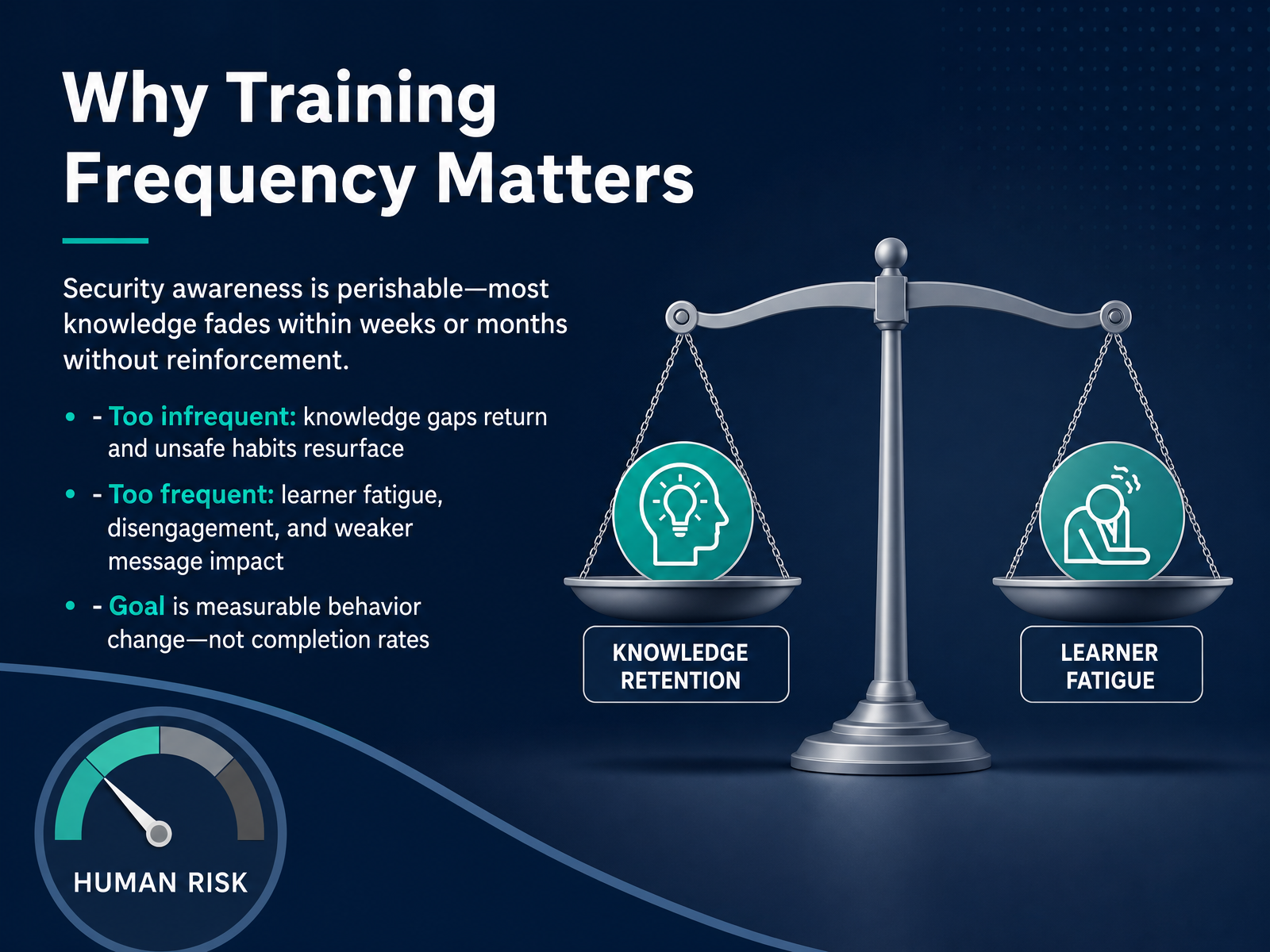
- 02Why Training Frequency MattersLet's look at why frequency matters. Security awareness is perishable. Research on knowledge retention shows most training knowledge decays within weeks, not quarters. One study found technical knowledge gone in about fifteen days, and application knowledge, like spotting phishing, fades within thirty. So the trade-off is real. Train too infrequently, and you get knowledge gaps, unsafe habits, and audit findings. Train too often, and you trigger phishing-simulation fatigue, disengagement, and weaker message impact. Your goal is measurable behavior change, not completion rates. Here's your first step. Before you set any cadence, define two or three behavior metrics you can review, like click rates, report rates, or policy exceptions. Schedule that review now, and hold the next cadence decision to that data. The Forgetting Curve and Security Retention.
 commons.erau.edudigitalcommons.kennesaw.edudoi.org+21 min
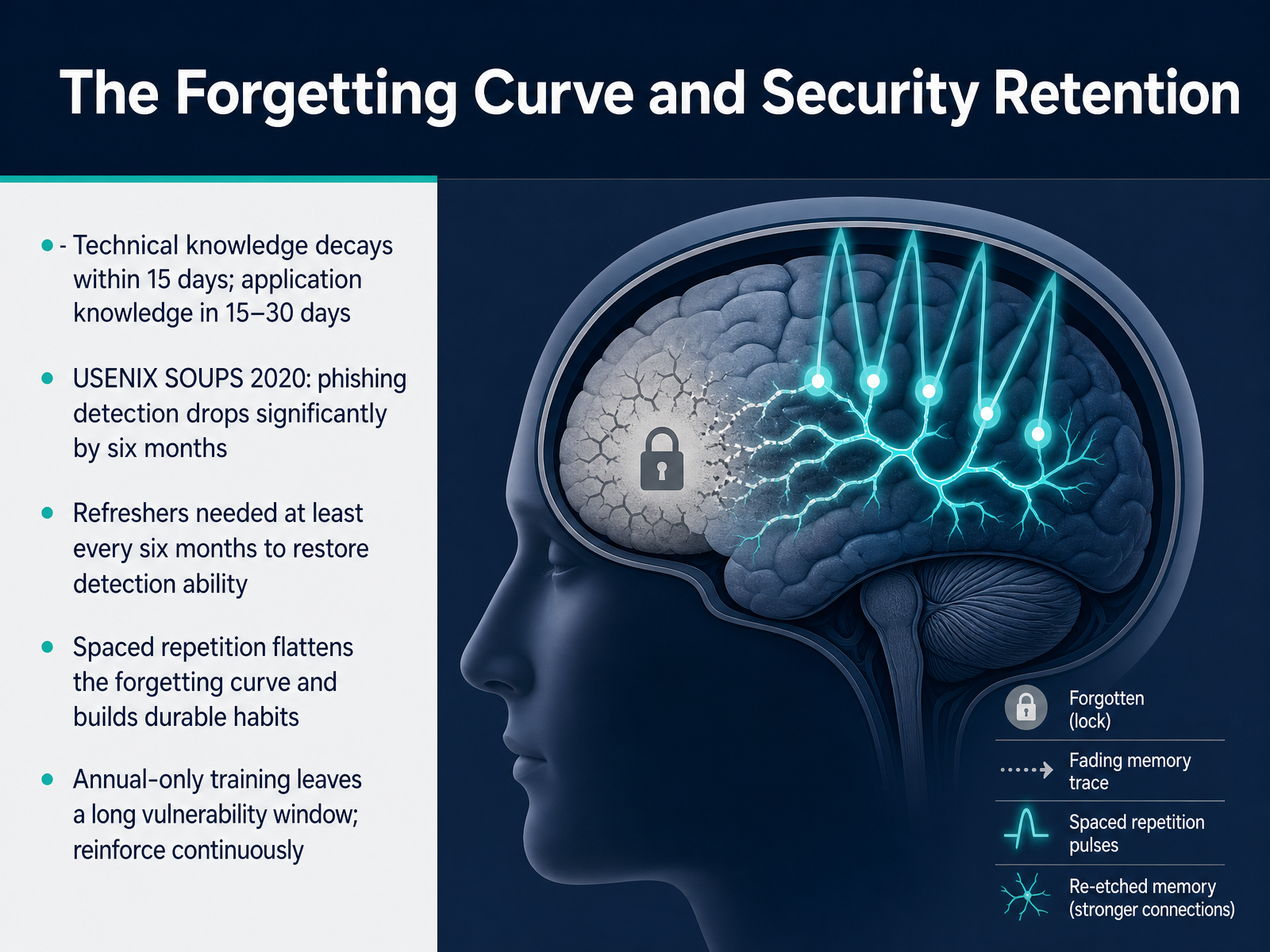
 - 03The Forgetting Curve and Security RetentionLet's talk about why cadence matters, starting with the forgetting curve. Technical knowledge decays within fifteen days. Application knowledge, the kind people use to spot a phishing email, holds for fifteen to thirty days. So your annual-only training leaves a long vulnerability window. Here's the operational takeaway. Schedule a refresher at least every six months, and build it as spaced repetition, short and frequent, not one long session. The USENIX SOUPS study from twenty twenty found phishing detection held for four months, then dropped sharply by six, confirming that half-year mark. Two implementation steps. First, add a recurring calendar block every six months for your highest-risk roles, and quarterly for privileged access groups. Second, rotate the content format, video and interactive examples retain best, so alternate them. That spacing flattens the forgetting curve and builds durable habits. Now let's look at compliance minimums, which are the floor, not the ceiling.
 commons.erau.edudigitalcommons.kennesaw.edudoi.org+21 min
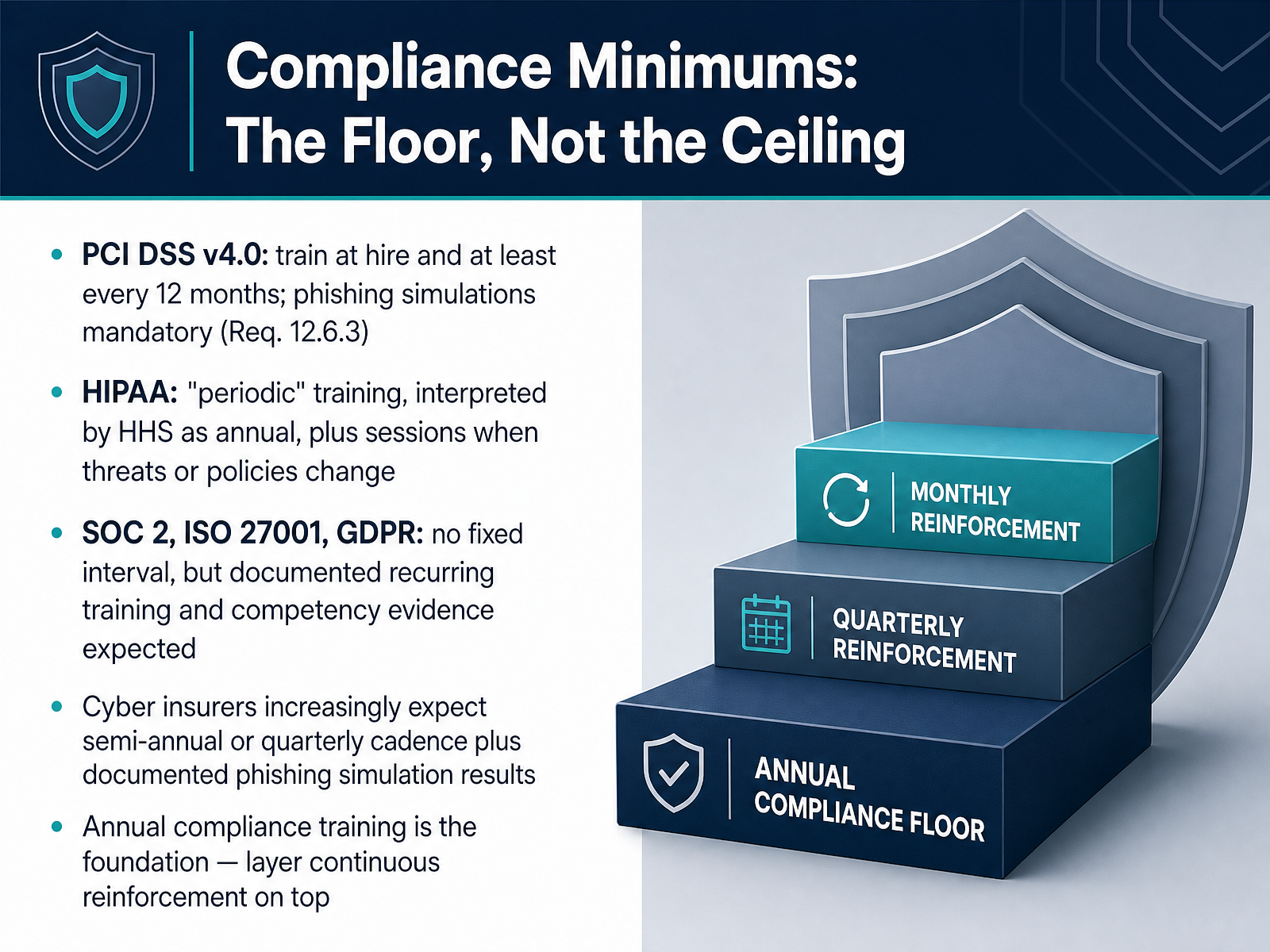
 - 04Compliance Minimums: The Floor, Not the CeilingNow let's talk compliance minimums, because these set your floor, not your ceiling. Under PCI DSS version four point oh, train everyone at hire and at least every twelve months, and remember that phishing simulations are mandatory under Requirement twelve point six point three, with frequency driven by your targeted risk analysis. HIPAA says periodic, which Health and Human Services interprets as annual, plus refreshers whenever threats or policies change. Frameworks like SOC two, ISO twenty-seven thousand one, and GDPR don't fix an interval, but auditors expect documented recurring training and competency evidence. And cyber insurers increasingly want semi-annual or quarterly cadence with documented phishing simulation results. Here's your first step: pull your latest audit and insurance renewal requirements, and map them against your current training calendar. That tells you your true minimum. And that leads naturally into our next topic, Risk-Based Cadence Decisions.
 goleadingit.compoliwriter.comkindssecurity.com+22 min
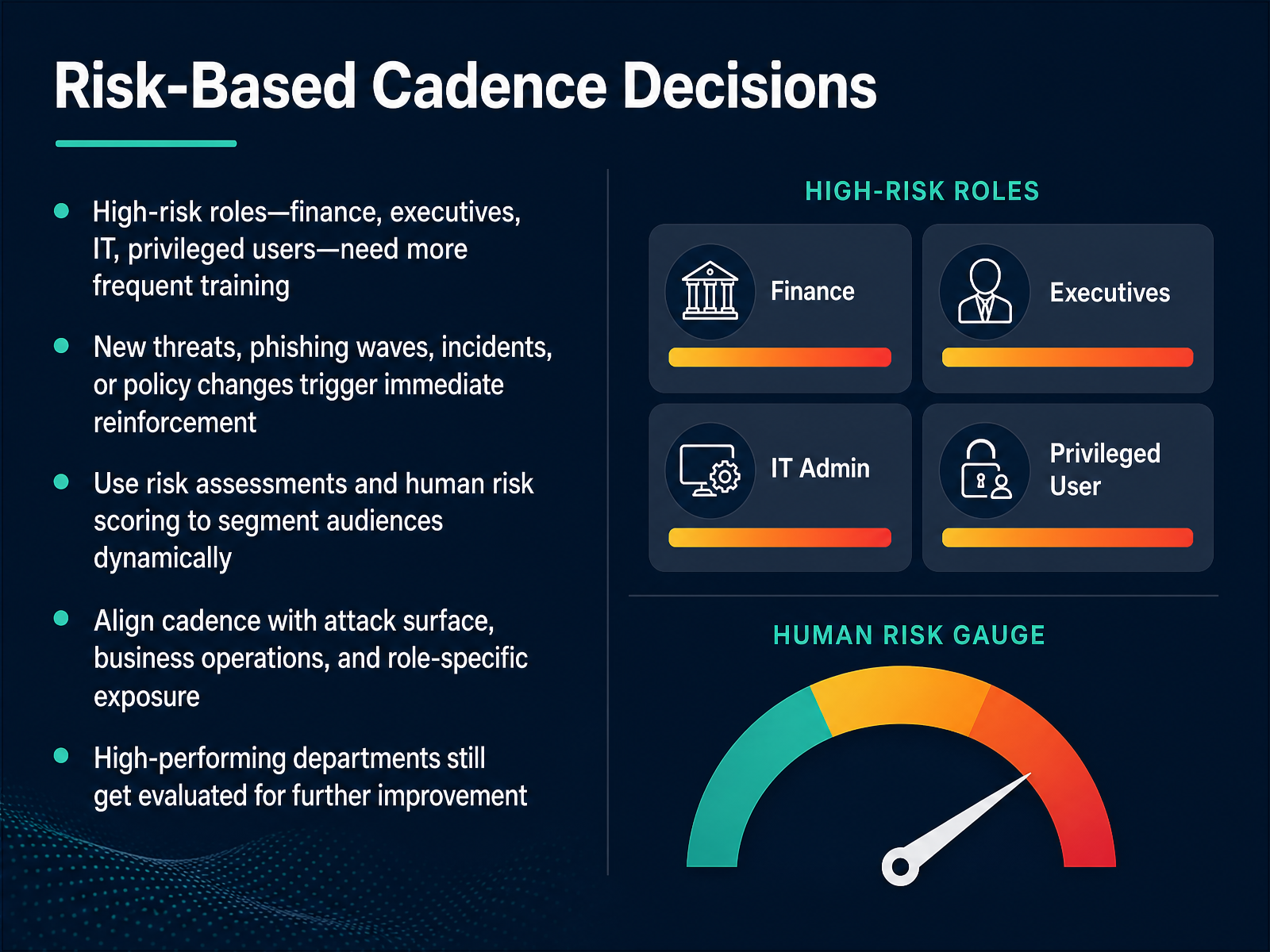
 - 05Risk-Based Cadence DecisionsNow let's move to risk-based cadence decisions. The short answer: one cadence for everyone will not survive your next audit or your next phishing wave. Start by tiering your population. High-risk roles, meaning finance, executives, information technology, and privileged users, should get quarterly training at minimum, and monthly phishing simulations. Everyone else can run on onboarding plus annual training, with quarterly reinforcement. Then define your triggers. A new threat, a phishing wave, a real incident, or a policy change should immediately trigger targeted reinforcement for the affected groups, not a company-wide reset. Use your risk assessments and human risk scoring to segment audiences dynamically, so cadence aligns with attack surface, business operations, and role-specific exposure. One honest caveat: even your high-performing departments should still be evaluated for further improvement. Do not let a low click rate become an excuse to stop measuring. Your first step this week is simple. Assign one owner to build a three-tier cadence map, map each role into a tier, then schedule the next quarter of simulations against it. Next, we will compare continuous versus periodic training models and when each one actually fits.
 adaptivesecurity.comdoi.orgadaptivesecurity.com+22 min
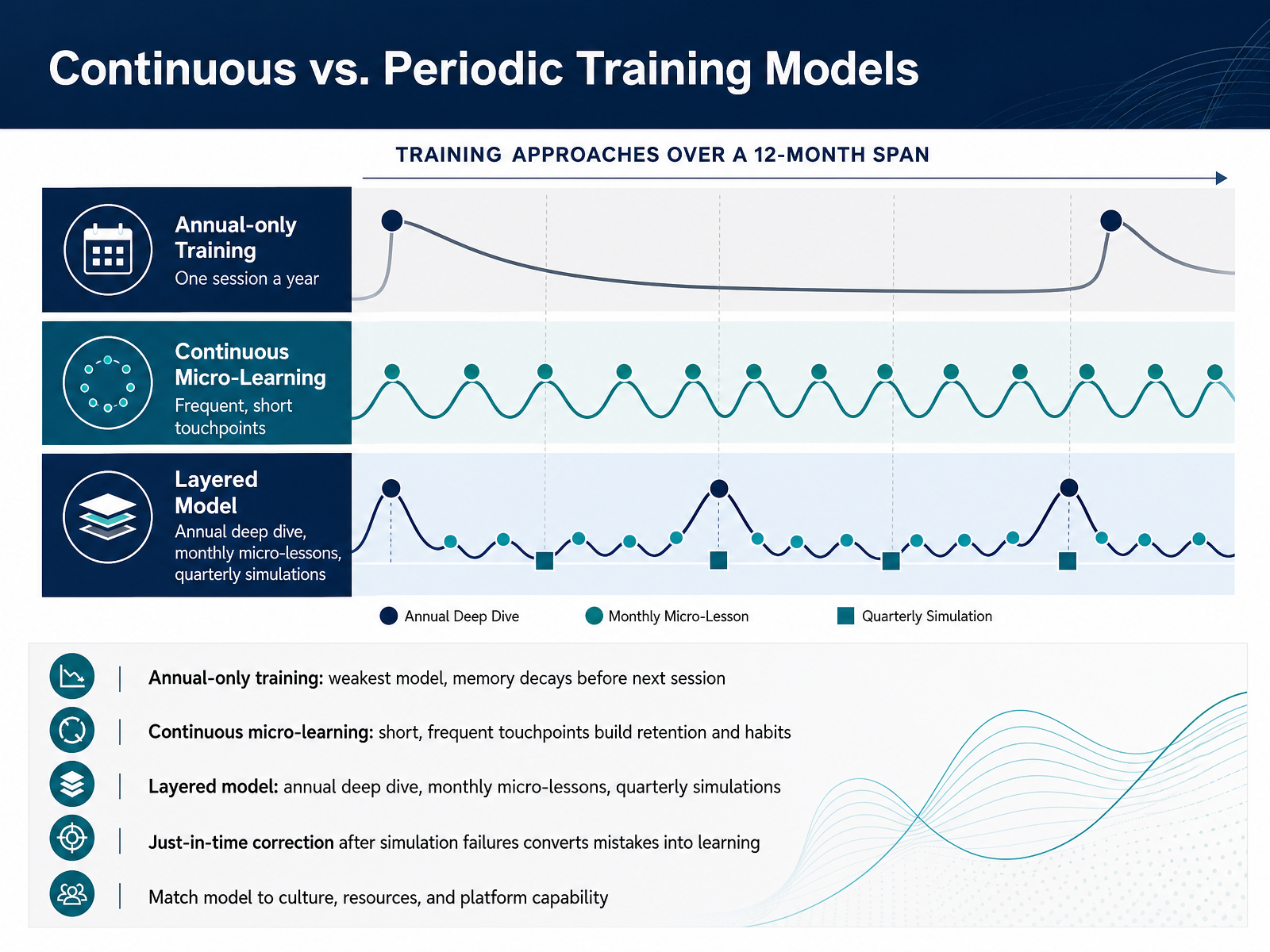
 - 06Continuous vs. Periodic Training ModelsLet's compare the training models you can actually run. Annual-only training is the weakest option: memory decays long before the next session, so employees face most of the year unprotected. Continuous micro-learning works better, because short, frequent touchpoints build retention and habits, and research shows weekly or bi-weekly modules at five to ten minutes outperform long annual sessions. The strongest approach is layered: an annual deep dive, monthly micro-lessons, and quarterly simulations. Then add just-in-time correction. When someone fails a simulation, deliver a targeted two-minute module within hours, not at the next quarterly window. That timing converts the mistake into durable learning. Finally, match the model to your culture, resources, and platform capability. Not every organization can run full automation on day one, so pick a cadence you can sustain and measure, then scale. Next, let's look at the recommended cadence by audience and role.
 journal.idscipub.com2 min
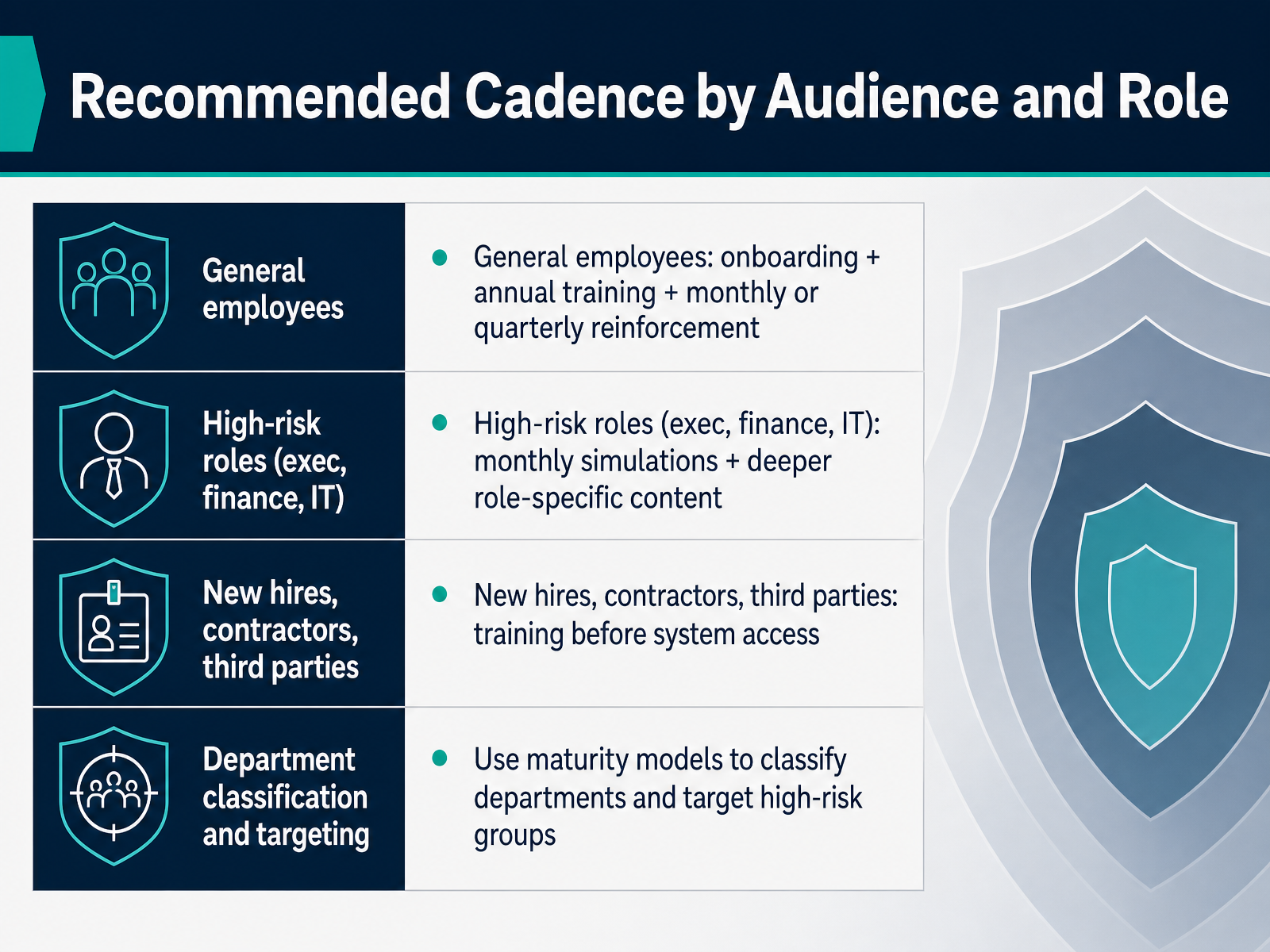
 - 07Recommended Cadence by Audience and RoleLet's talk cadence by audience and role. For general employees, train at onboarding, repeat annually, then reinforce monthly or quarterly. Monthly microlearning works best because it protects retention without overwhelming your schedule. The condition that changes it is your audit calendar. If a regulator expects documented proof of regular training, shift from quarterly to monthly contact. Your first step is to assign one owner for the general-employee track. High-risk roles need more: monthly simulations plus deeper, role-specific content. Finance, IT, and executives face different attacks, so generic modules won't cut it. If phishing-simulation fatigue shows up, vary the scenarios instead of dropping the cadence. New hires, contractors, and third parties must finish training before system access. Build that gate into your onboarding workflow so it isn't a manual chase. Finally, use a maturity model to classify departments. Target high-risk groups with extra depth. Next, we look at measuring what frequency achieves.
 compliquest.comdoi.org1 min
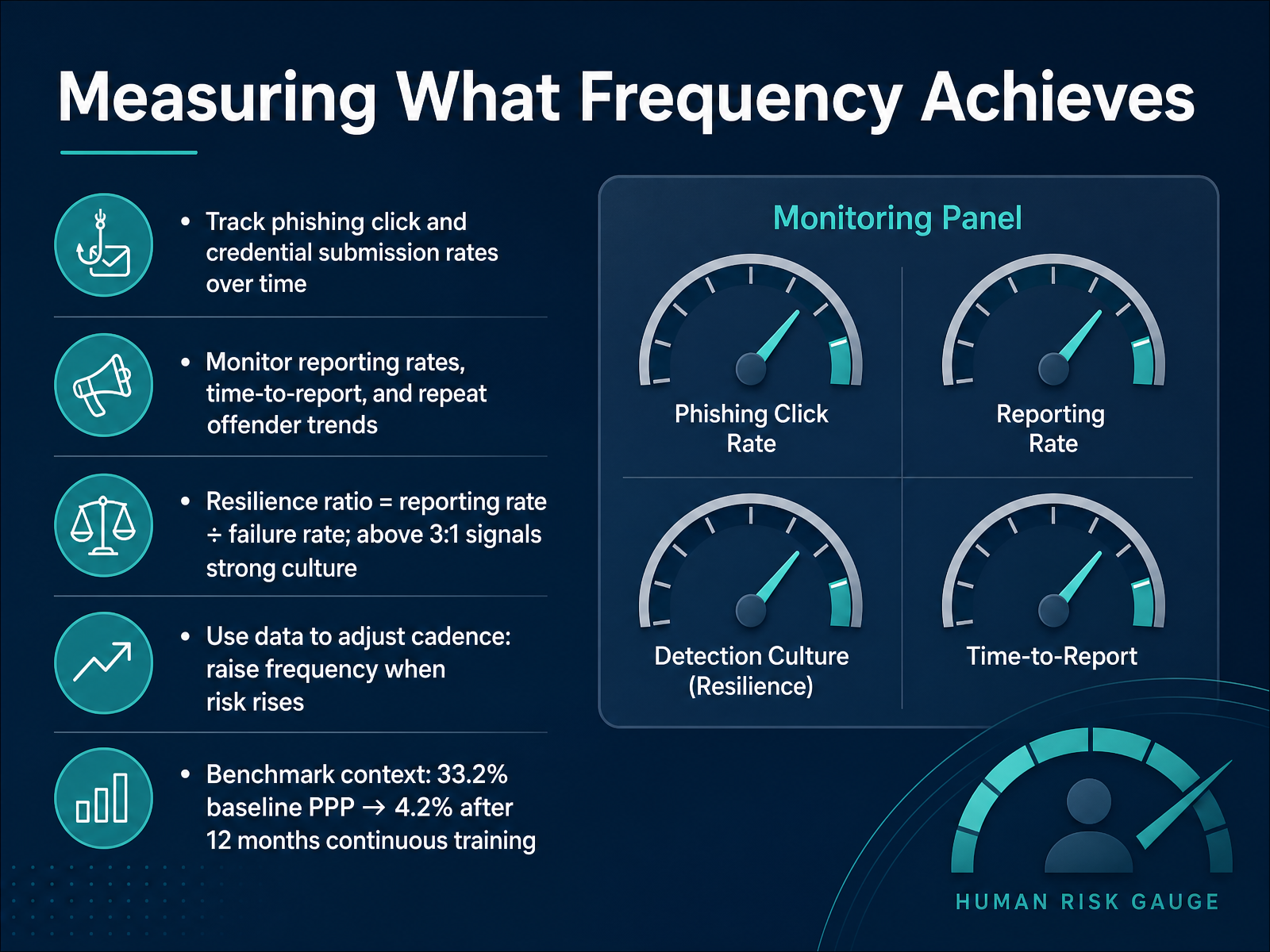
 - 08Measuring What Frequency AchievesNow let's measure what your frequency actually achieves. Track four things: click rate, credential submission rate, report rate, and time-to-report. Watch the trend line, not a single campaign. Repeat offenders matter too, so flag anyone who fails three or more times. Then calculate your resilience ratio. That's report rate divided by failure rate. Above three to one signals a strong security culture, and below one means most users still fail silently. Use this data to set cadence. When risk rises, tighten frequency for the affected group. For context, the global baseline phish-prone percentage is thirty-three point two percent. After twelve months of continuous training, it falls to four point two percent. Most of that gain lands between month three and month twelve, which is your argument for sustained cadence over one-off campaigns. So this week, pull your last three campaigns, compute the resilience ratio, and assign one owner to review it monthly. Next, let's look at common metrics and benchmark pitfalls.
 2 min
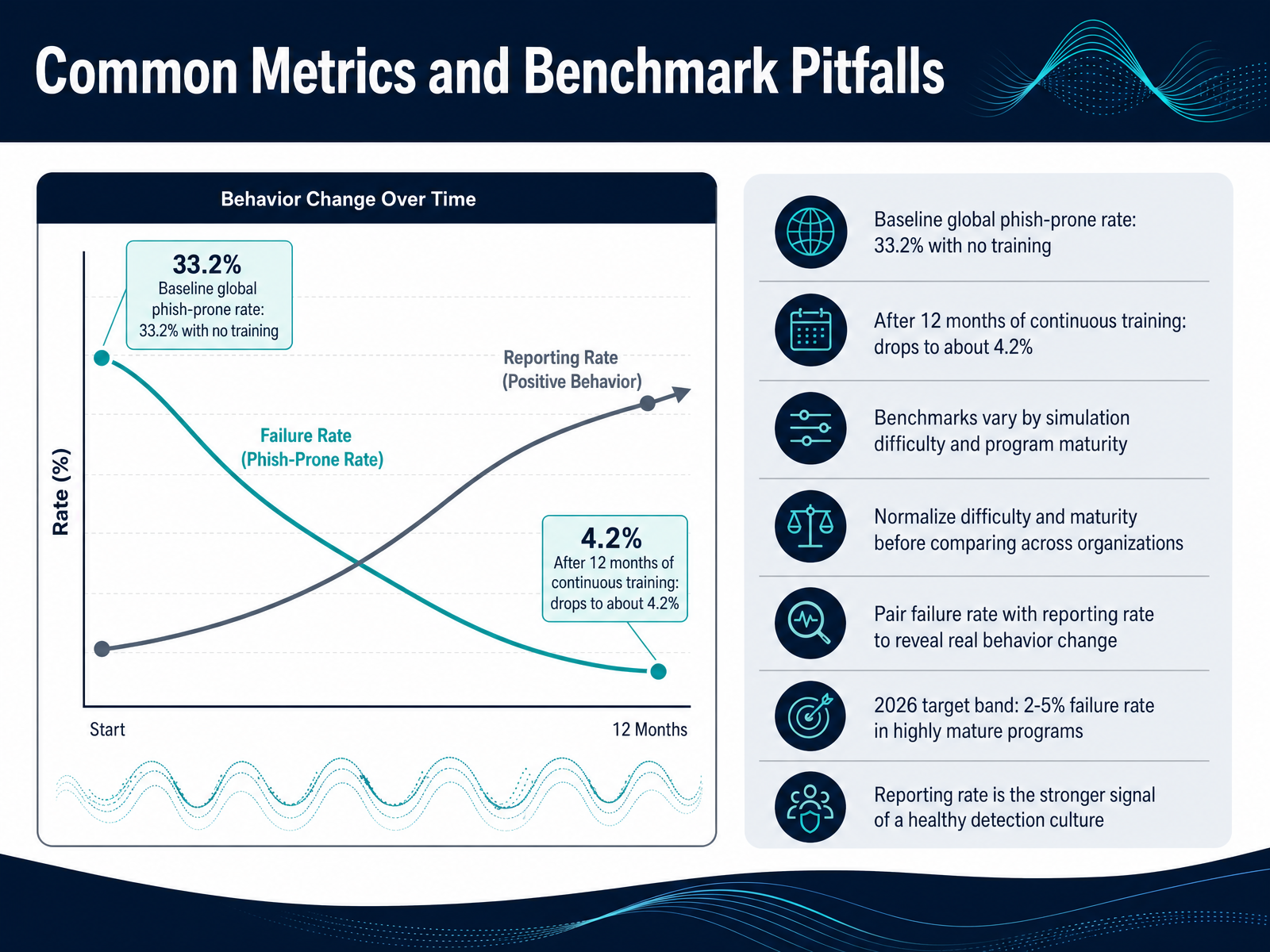
2 min - 09Common Metrics and Benchmark PitfallsLet's look at the metrics, and the traps in benchmarking them. Here's your anchor: the global phish-prone rate sits at thirty-three point two percent with no training, and drops to about four point two percent after twelve months of continuous training. But before you benchmark against peers, normalize two things: simulation difficulty and program maturity. A two percent failure rate on easy templates is not better than eight percent on realistic ones. So pair failure rate with reporting rate, because reporting is the stronger signal of a healthy detection culture. For twenty twenty-six, target two to five percent failure in highly mature programs, with reporting rate climbing alongside it. Your first step: pull your last four campaigns, tag them by difficulty, and document your maturity level before any cross-organization comparison. That makes your numbers defensible in an audit. Next, let's tackle avoiding fatigue and over-training.
 2 min
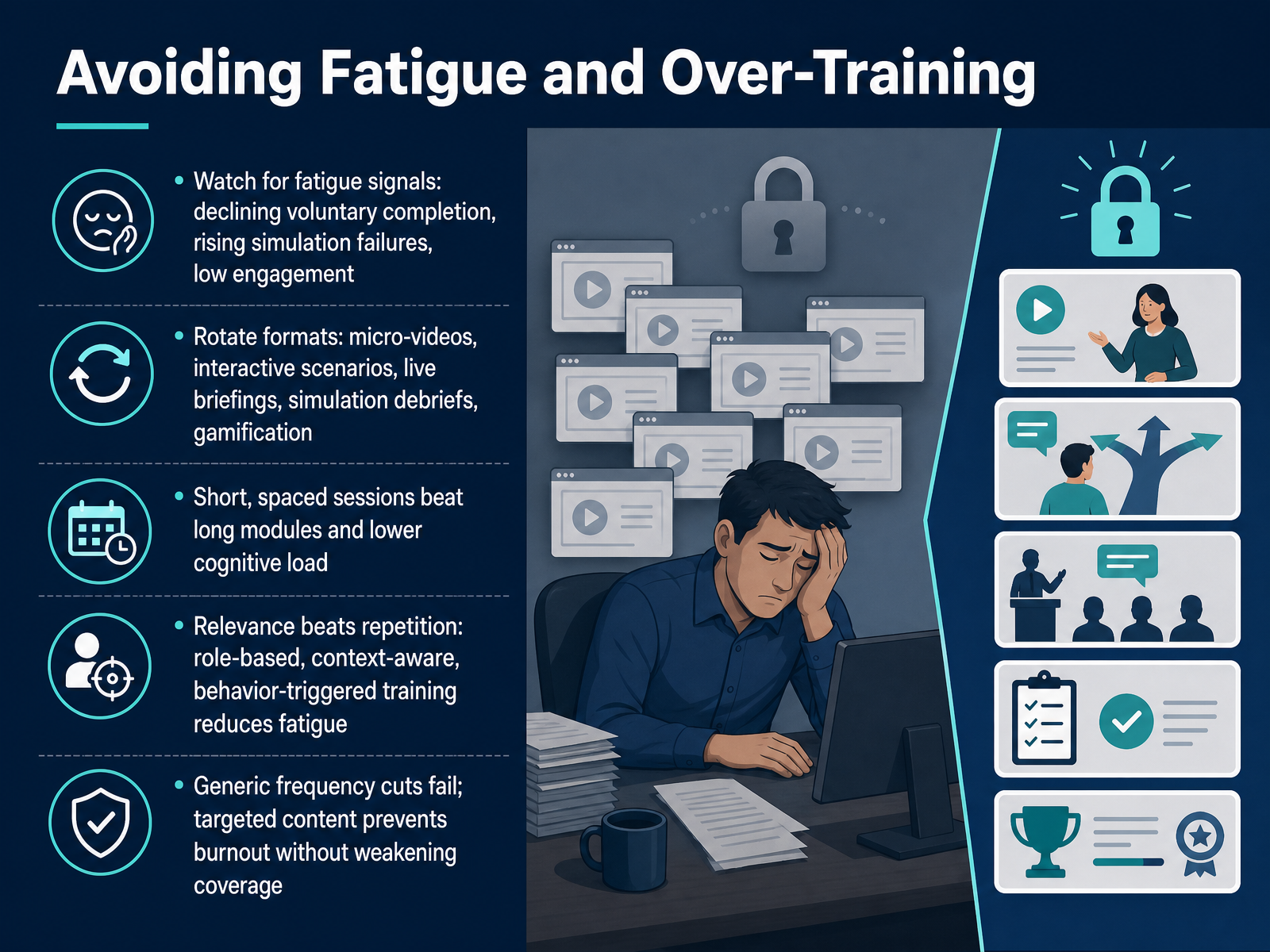
2 min - 10Avoiding Fatigue and Over-TrainingLet's talk about avoiding fatigue and over-training, because more is not automatically better. Start by watching the signals: declining voluntary completion, rising simulation failures, and low engagement. If you see those, pause and fix the content before you add another campaign. Then rotate formats, including micro-videos, interactive scenarios, live briefings, simulation debriefs, and gamification, so no single format wears out. Keep sessions short and spaced. That beats long modules and lowers cognitive load. And make it relevant: role-based, context-aware, behavior-triggered training reduces fatigue far more than repetition does. One caution: generic frequency cuts fail. Targeted content prevents burnout without weakening coverage. So your next action is to review your last two quarters of engagement and simulation data, then pilot one behavior-triggered micro-module for a high-risk group. Next, let's look at designing the training cadence.
 2 min
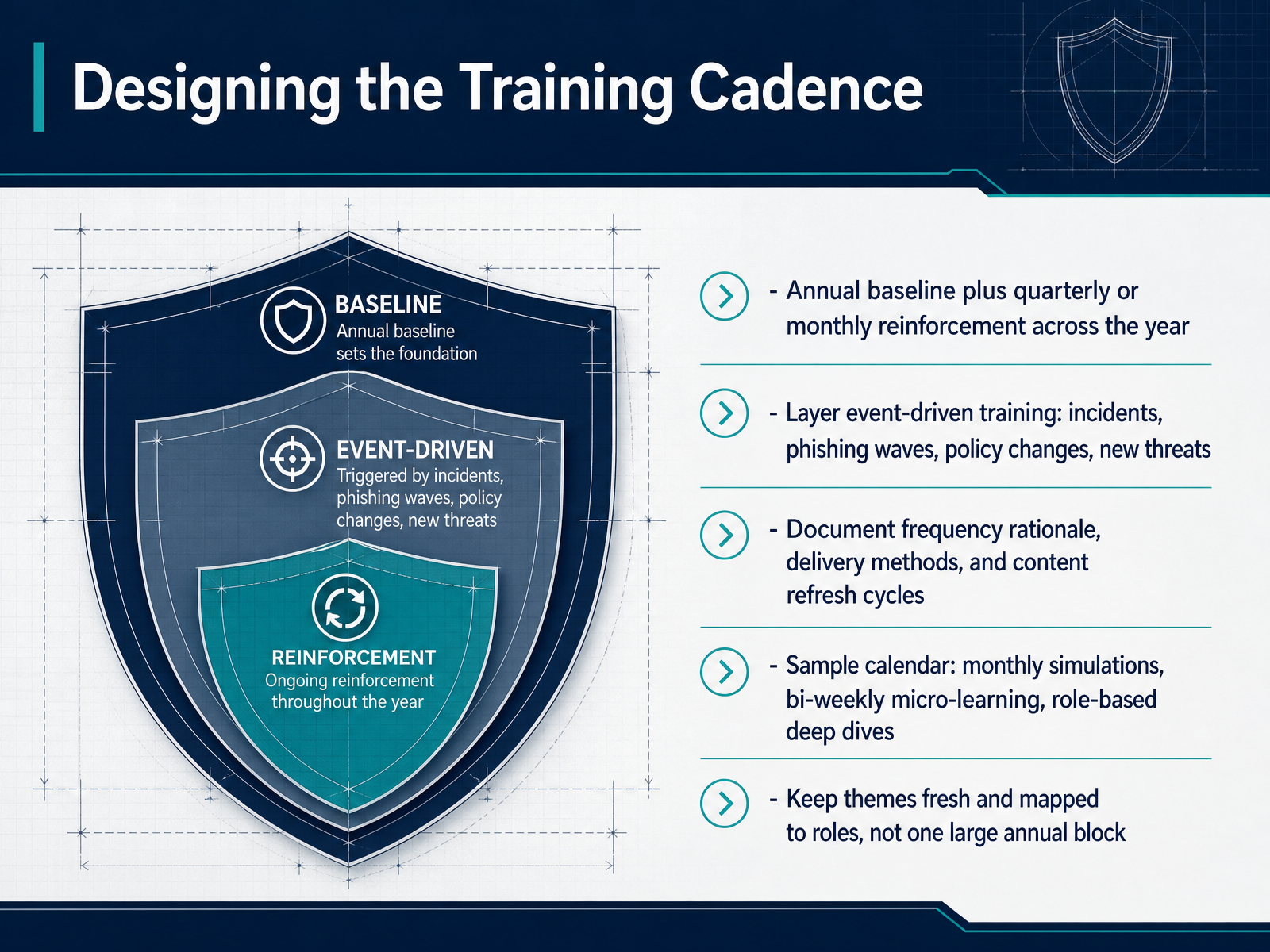
2 min - 11Designing the Training CadenceLet's move on to designing the training cadence. Start with an annual baseline, then reinforce quarterly or monthly across the year. The reinforcement interval should tighten with your risk level and regulatory requirements. If you are in a regulated or high-risk role, go monthly. Otherwise, quarterly is a defensible floor. Then layer event-driven training on top. A real incident, a phishing wave, a policy change, or a new threat should each trigger a short, targeted module within days, not weeks. Document the why. Record your frequency rationale, delivery methods, and content refresh cycles, because auditors will ask for it. A sample calendar many teams use is monthly simulations, bi-weekly micro-learning, and role-based deep dives. Keep themes fresh and mapped to roles instead of one large annual block. Your first action: draft that twelve-month calendar this week and assign each theme an owner. Building a Defensible Training Calendar.
 2 min
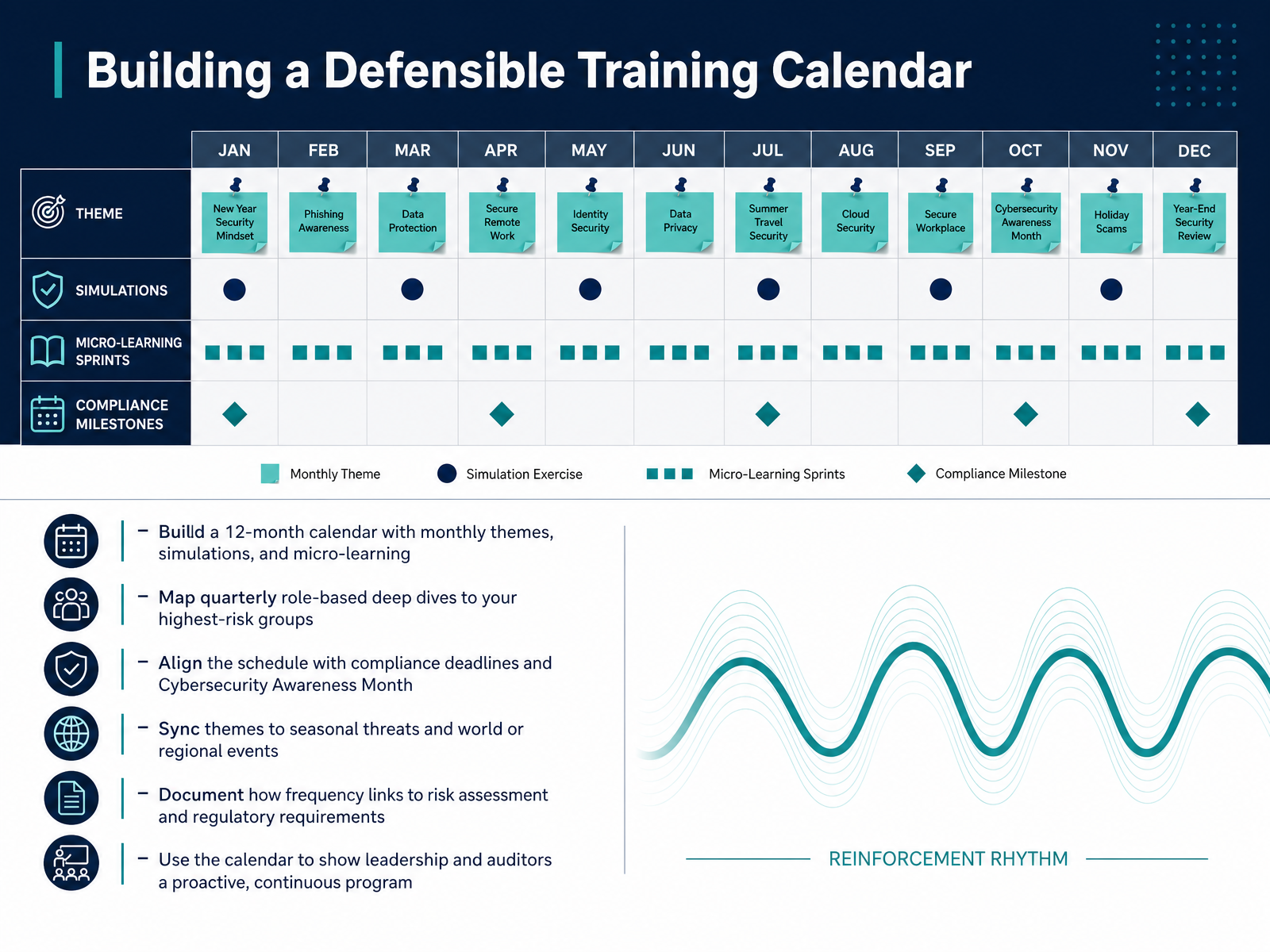
2 min - 12Building a Defensible Training CalendarNow let's make this defensible in practice. Build a twelve-month calendar with a monthly theme, one simulation, and short micro-learning pieces. Then map quarterly role-based deep dives to your highest-risk groups, because finance and engineering need different depth. Align the schedule with your compliance deadlines and Cybersecurity Awareness Month, and sync themes to seasonal threats and world or regional events. Document how frequency links to your risk assessment and regulatory requirements. That documentation is exactly what auditors and leadership need to see. Keep it simple: create the calendar, assign an owner per quarter, and schedule a monthly review. Next, let's look at the decision framework for choosing the right frequency.
 1 min
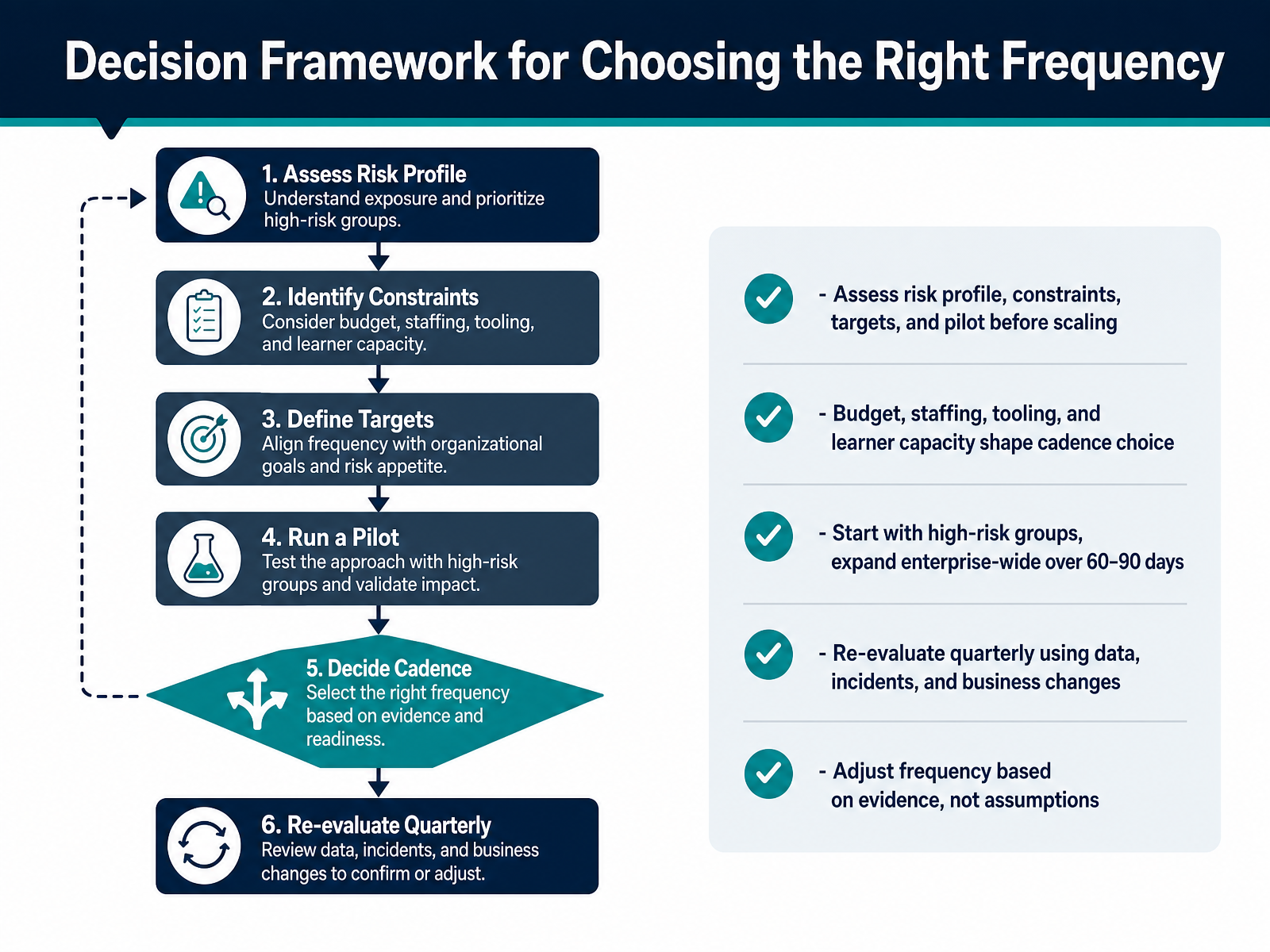
1 min - 13Decision Framework for Choosing the Right FrequencyLet's put cadence decisions into a repeatable framework you can apply this quarter.
Assess four inputs first: risk profile, operating constraints, target populations, and a pilot. Then let budget, staffing, tooling, and learner capacity shape the actual cadence you commit to. Pause here and assign an owner to each input, because assumptions without owners stall fast.
Sequence matters. Start with high-risk groups, like finance and privileged administrators, and expand enterprise-wide over sixty to ninety days. That protects your audit timeline without overloading phishing-simulation capacity.
Re-evaluate quarterly using completion data, incident trends, and business changes. Adjust frequency based on evidence, not assumptions. Your next action: schedule a quarterly review and log the one metric that would change your cadence.
Coming up, your Action Plan and Continuous Improvement.
 doi.orgadaptivesecurity.comkindssecurity.com1 min
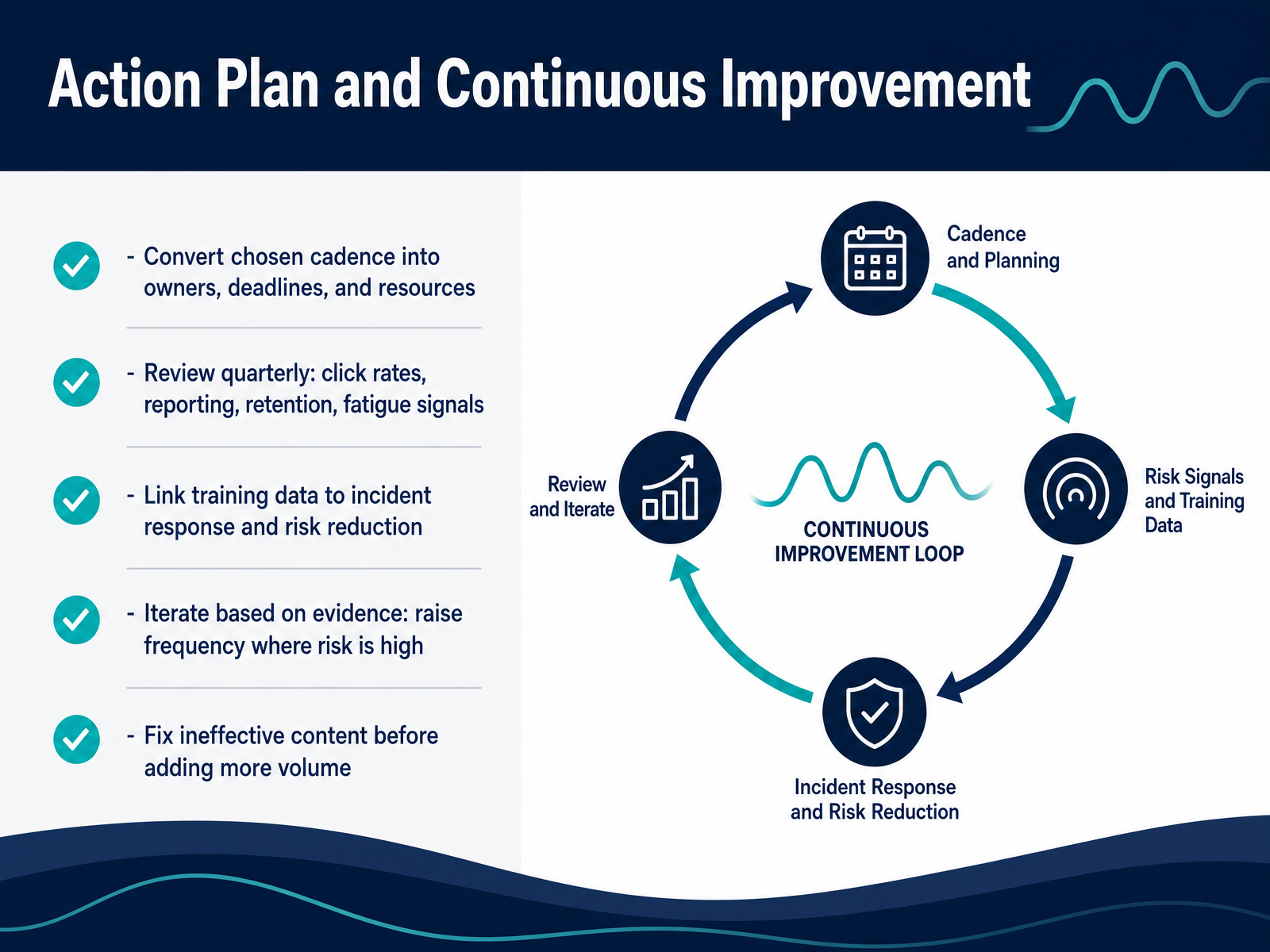
 - 14Action Plan and Continuous ImprovementLet's close with your action plan. First, convert your chosen cadence into named owners, deadlines, and resources. Then review quarterly, tracking click rates, reporting rates, retention, and fatigue signals such as declining voluntary completion or flat engagement. Link that training data directly to incident response and measured risk reduction, and iterate on the evidence: raise frequency where risk is high, and fix ineffective content before you add more volume. In heavily targeted roles, biweekly simulations are reasonable; elsewhere, monthly plus quarterly role-based modules usually holds. So this week, assign one owner, one deadline, and one metric. Pick the cadence, set the review date, and let the evidence guide the rest. Thank you for your attention today. You now have a practical cadence framework you can defend to auditors and adapt as your risk picture changes. Keep it proportionate, keep it measured, and keep improving. You've got this.
 2 min
2 min
Take the deck with you
Download this course as a file — free, no sign-up needed.
- PDF handoutEvery slide page, ready to print or share.15 pages · 3.6 MBDownload
- Narrated PowerPointThe deck that presents itself — every slide carries the digital human's narration video.15 pages · 24.6 MBDownload
- PowerPoint slidesThe full deck as a .pptx — open it in PowerPoint, Keynote, or Google Slides.15 pages · 3.5 MBDownload
Free to use in your own training — please keep the PersonWise credit page at the end.
Have your own deck? Turn it into a course
Sources consulted
Web sources consulted while building this course.
- How Often Is Security Awareness Training Required? HIPAA, PCI DSS, FTC Safeguards, and Cyber Insurance Answered - LeadingIT — goleadingit.com
- How Often Should Employees Complete Security Awareness Training? | Datapath — mydatapath.com
- Essential Security Awareness Training for Employees Guide | Adaptive Security — adaptivesecurity.com
- Cybersecurity Awareness Training Compliance: 2026 Guide | Adaptive Security — adaptivesecurity.com
- Building a cybersecurity and privacy learning program — doi.org
- Knowledge Expiration in Security Awareness Training — commons.erau.edu
- How Effective are SETA Programs Anyway: Learning and Forgetting in Security Awareness Training — digitalcommons.kennesaw.edu
- A Systematic Review of Residual Risk in Cybersecurity Awareness Training — doi.org
- How Effective are SETA Programs Anyway: Learning and Forgetting in Security Awareness Training — files.eric.ed.gov
- An investigation of phishing awareness and education over time: When and how to best remind users — usenix.org
- Compliance Training Requirements Across Frameworks: HIPAA, GDPR, SOC 2, ISO 27001 & PCI DSS | PoliWriter — poliwriter.com
- Security awareness training requirements by compliance framework — kindssecurity.com
- PCI DSS Security Awareness Training Requirements — coggno.com
- Security Awareness Training Requirements by Framework - LegalClarity — legalclarity.org
- Risk-Based Security Awareness Training: A Complete Guide — adaptivesecurity.com
- Adaptive Phishing Simulation and Longitudinal Employee Security Behavior: Evidence from a Global Enterprise — doi.org
- Role-Based Security Awareness Training: A Complete Guide | Adaptive Security — adaptivesecurity.com
- Cybersecurity Awareness Training Guide — compliquest.com
- AT.L2-3.2.3: Build a Step-by-Step Security Awareness Training Program - LakeRidge — lakeridge.io
- Improving Organizational Resilience to Phishing: A Cluster Randomized Field Experiment with Embedded Microlearning | Data : Journal of Information Systems and Management — journal.idscipub.com