Data Engineering Process and Roles
Begin
13 pages · ~26 min
Data Engineering Process and Roles
This training covers the data engineering process, including its stages, roles, and deliverables, for aspiring or practicing data engineers seeking a structured workflow overview.
What you’ll learn
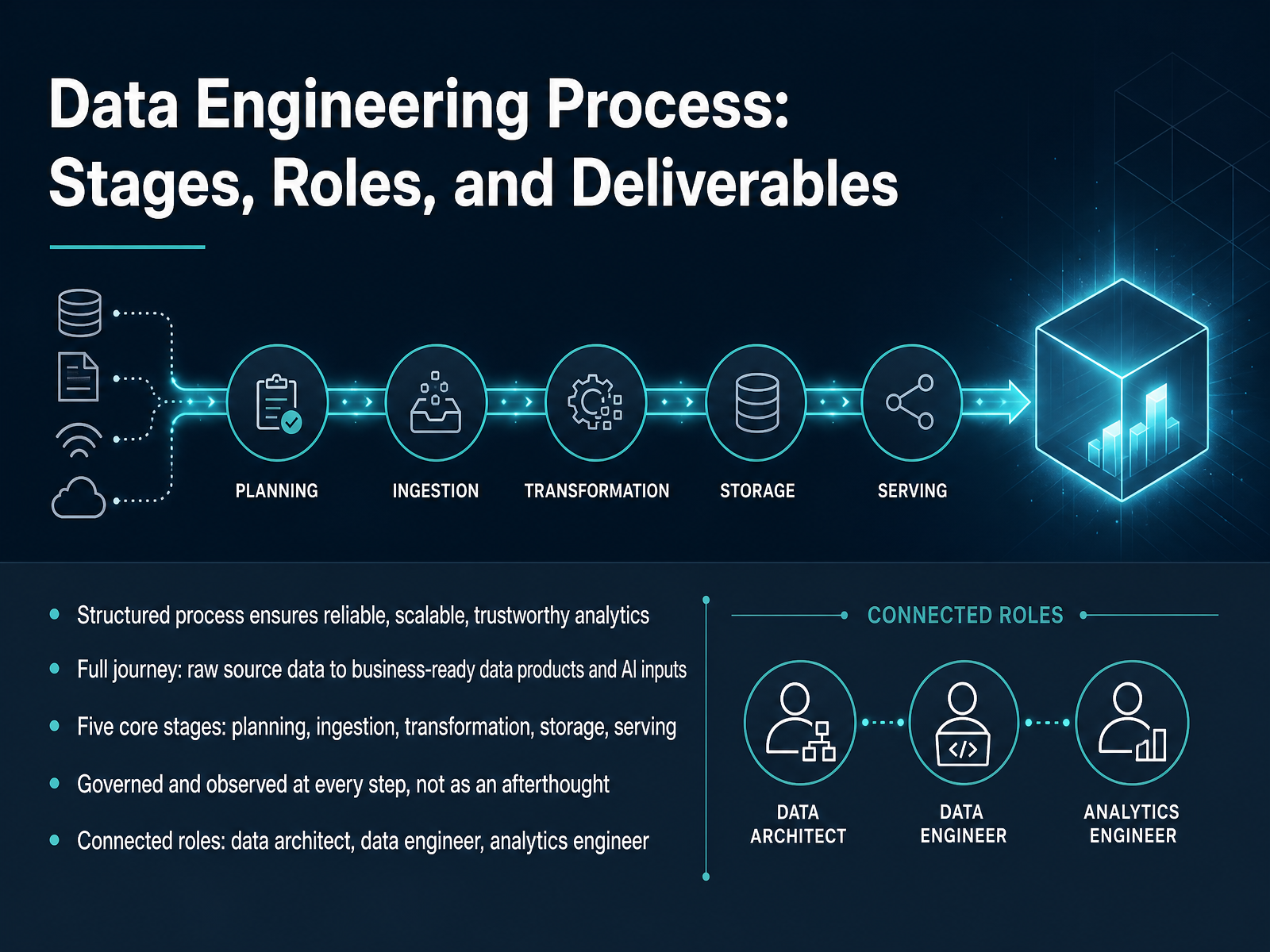
- 01Data Engineering Process: Stages, Roles, and DeliverablesWelcome. If you're responsible for turning raw data into trusted analytics or AI inputs, this course is for you. We're going to walk through the data engineering process as a structured, end-to-end journey. The goal is to give you and your team a clear operating picture: five core stages, the roles that drive them, and the deliverables that define success at every handoff. We'll cover planning, ingestion, transformation, storage, and serving. And we'll make the case that governance and observability aren't afterthoughts—they're built into every step. Finally, we'll connect the roles: the data architect who designs the blueprint, the data engineer who builds and runs the pipelines, and the analytics engineer who turns transformed data into business-ready products. By the end, you'll have a framework you can apply directly to your own stack. Let's start by understanding why getting this process right is a strategic advantage for your organization.coursera.orgdeha-global.comiabac.org+21 min
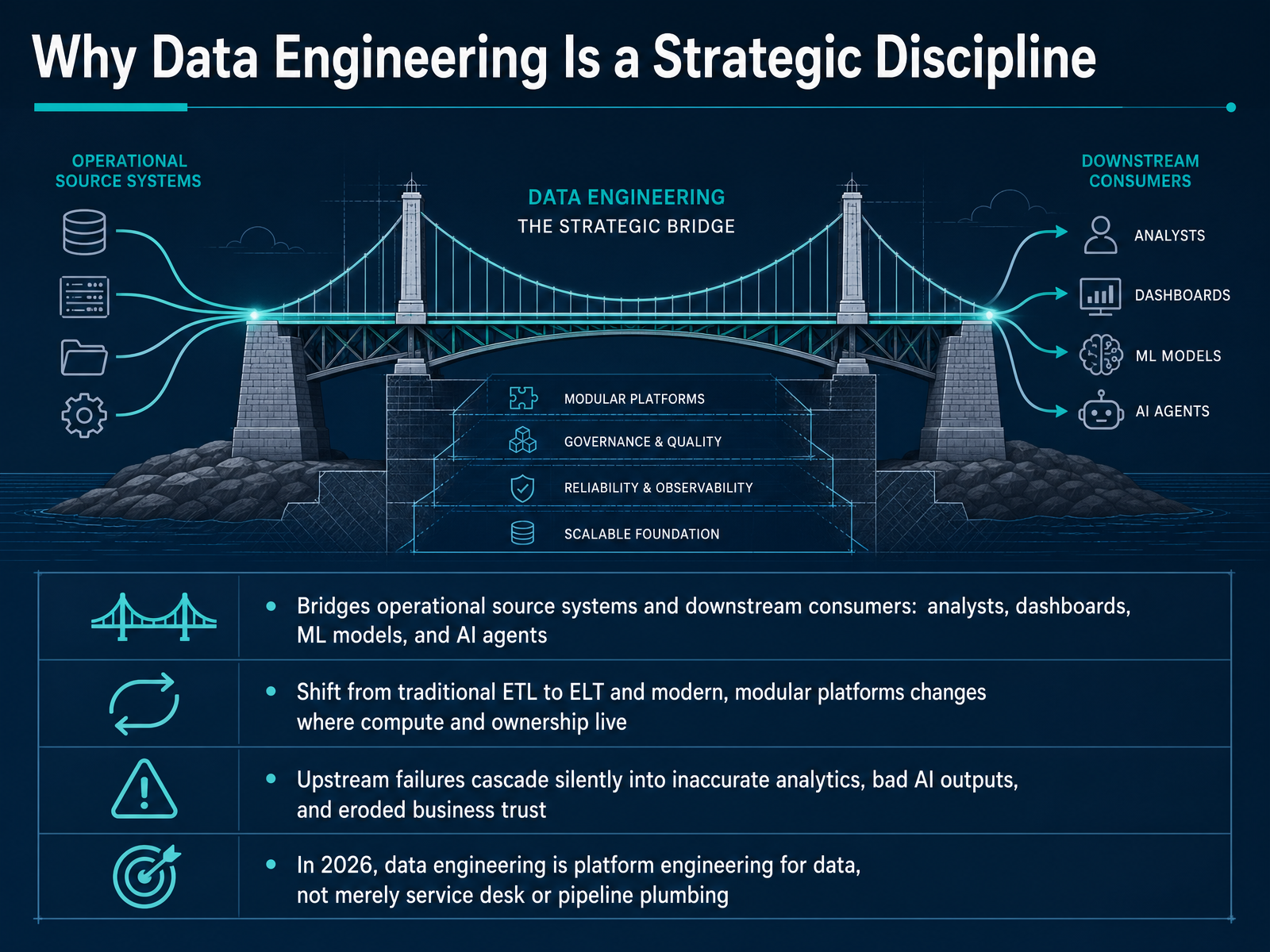
- 02Why Data Engineering Is a Strategic DisciplineLet’s set the frame for why this discipline matters. Data engineering sits between operational source systems and every downstream consumer you care about—analysts, dashboards, machine learning models, and increasingly, AI agents. The shift from traditional ETL to ELT isn’t just a letter swap; it changes where compute and ownership live. In 2026, that means data engineering is effectively platform engineering for data, not service-desk pipeline plumbing. And the stakes are real: upstream failures cascade silently into inaccurate analytics, bad AI outputs, and eroded business trust across your entire org. So as we walk through the lifecycle stages, keep that strategic lens in mind—every pipeline decision you make either strengthens or weakens that trust. Next, we’ll map the five-stage lifecycle at a glance.
 modern-datatools.commdpi.comtechtarget.com+21 min
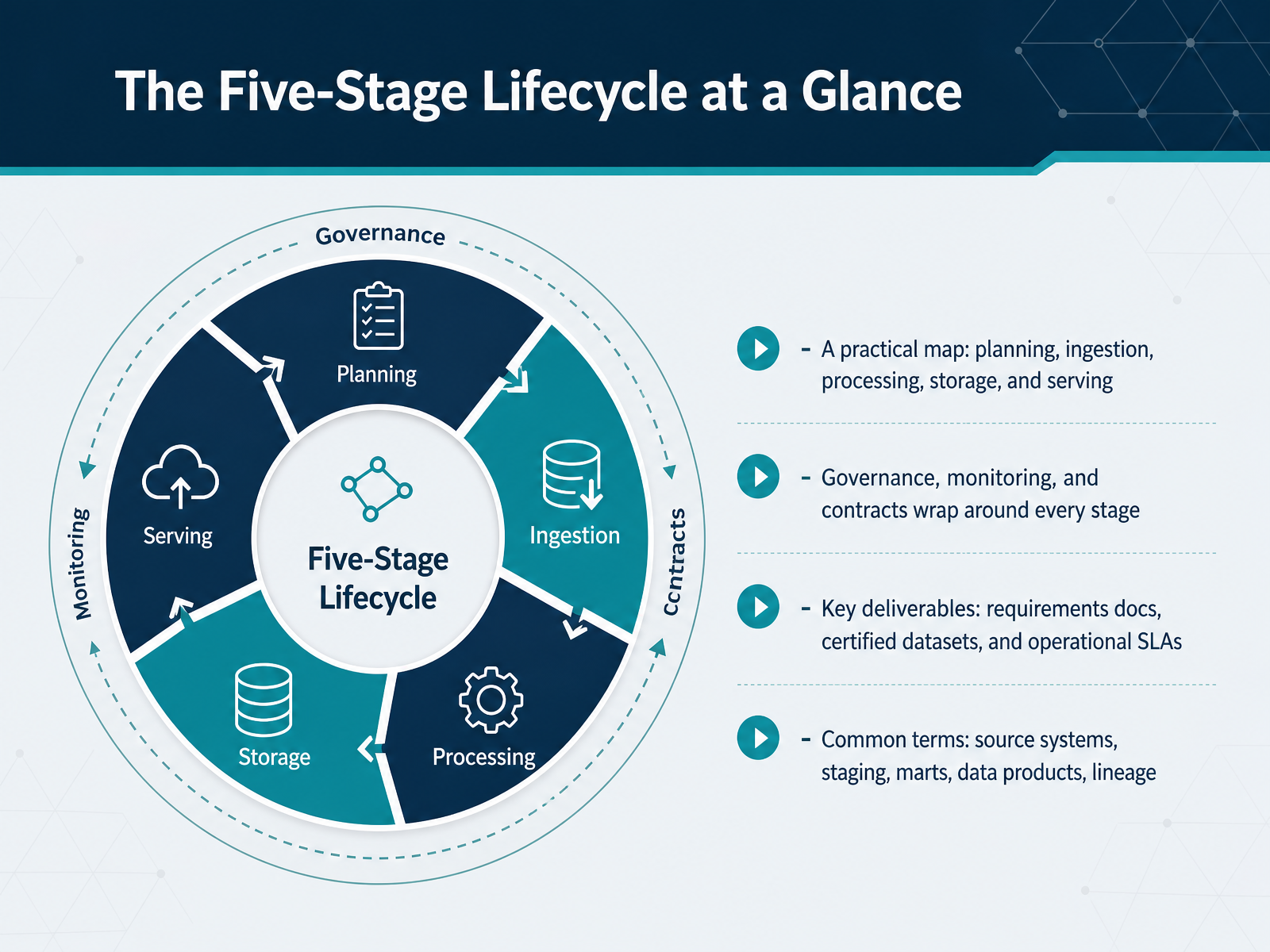
 - 03The Five-Stage Lifecycle at a GlanceLet's take a step back and look at the whole map before we dive into each stage. The data engineering lifecycle breaks down into five practical stages, five stages that move data from chaos to clarity. Planning, ingestion, processing, storage, and serving. Ingestion brings raw data in. Processing shapes it. Storage gives it a durable home, and serving gets it into the hands of consumers. Now wrap around every stage, you have governance, monitoring, and data contracts. These aren't bolt-ons, they're the guardrails that keep the pipeline trustworthy. The key deliverables you produce are requirements docs, certified datasets, and clearly defined operational SLAs. You'll hear common terms throughout this course, like source systems, staging, marts, data products, and lineage. As we walk through each stage, keep these terms in mind. They anchor your architecture decisions. Let's start with Stage 1, Planning and Requirements.
 coursera.orgdeha-global.comiabac.org+22 min
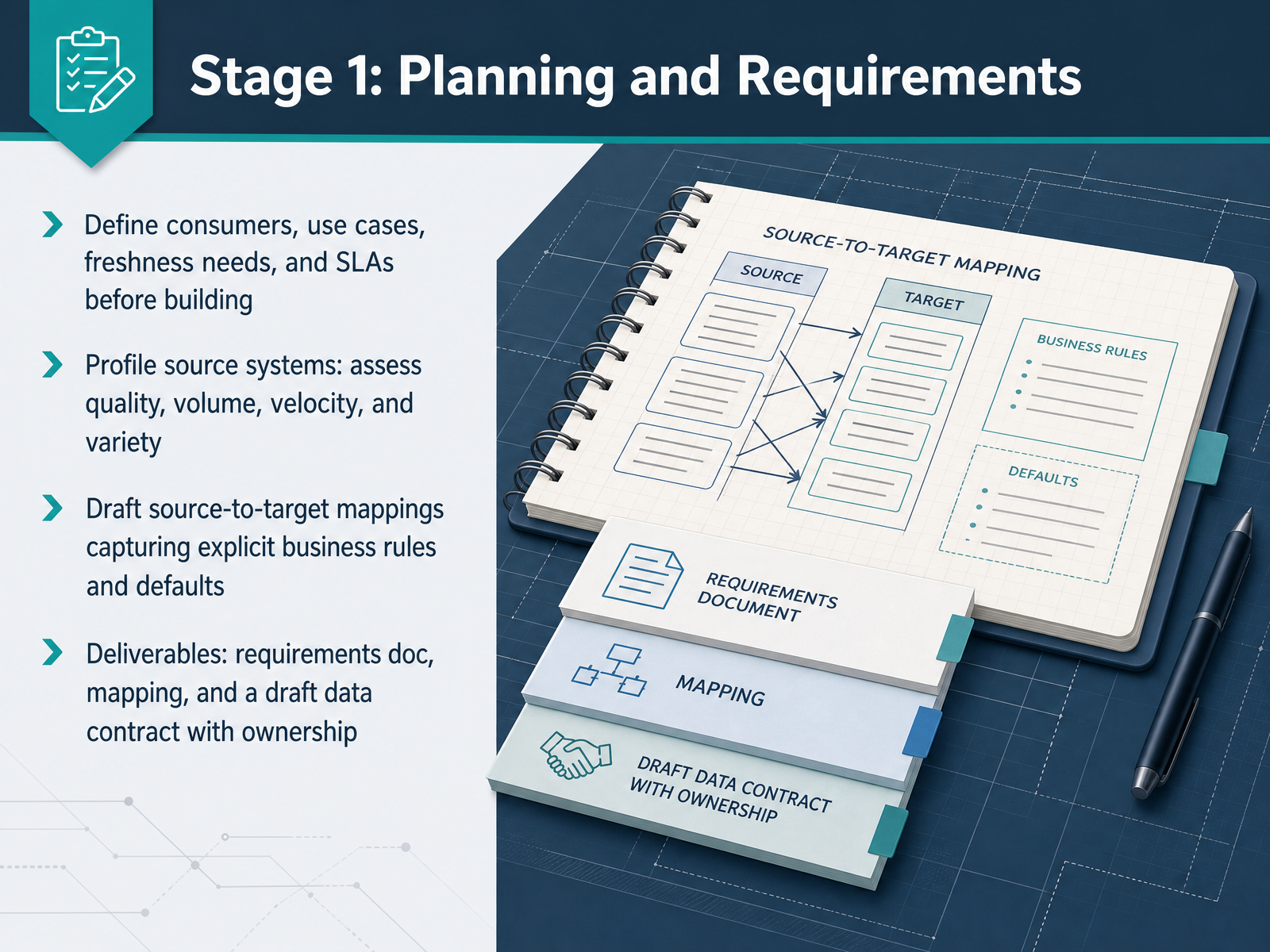
 - 04Stage 1: Planning and RequirementsNow let's move to the stage where all the architecture gets locked in: planning and requirements. Before a single line of pipeline code is written, your team needs to define who consumes the data, what use cases it serves, and how fresh it must be. That last part is a freshness SLA, not just a preference. If finance needs daily reconciliations and your marketing team needs real-time events, those are different pipeline designs entirely. So nail those requirements first. Next, profile your source systems. You are assessing volume, velocity, variety, and most importantly, quality. Are there duplicate records? Is the source clock reliable? Do fields have consistent values? This is where silent data corruption gets discovered. Then draft the source-to-target mapping. This is an engineering contract, not a spreadsheet exercise. It must capture explicit business rules, defaults, conditional logic, and transformation rules in plain language that any engineer can read without tracing your code. The deliverables here are threefold: a requirements document that defines the what and why, the mapping that defines the how, and a draft data contract that assigns ownership and sets schema and quality expectations. That contract is critical, because it shifts accountability upstream to the producer. With planning locked, you can move to Stage Two, ingestion and integration.
 dataladder.comblog.n8n.iomydbsync.com+22 min
 - 05Stage 2: Ingestion and IntegrationNow let's talk about ingestion and integration. This is where you match the delivery mechanism to the source behavior and your freshness SLAs. Batch works for scheduled loads and historical snapshots. Streaming handles real-time events from Kafka or Kinesis. Micro-batch sits in between, giving you near-real-time freshness with batch-style control. And CDC, change data capture, is your low-latency choice for transactional databases, capturing inserts, updates, and deletes from the transaction log. Your integration pattern matters too. Pull-based gives you control over scheduling and retries. Push-based, like webhooks or message queues, reduces source load but demands robust consumer handling. By design, you must handle schema drift, late data, and backfills. And build idempotency in from day one, because retries are normal. Your deliverables here are solid: reliable pipelines, raw landing zones, runbooks that actually help in an incident, and quality gates close to the source. That's ingestion. Next, we move to processing and transformation, where raw data gets shaped into analytics-ready models.
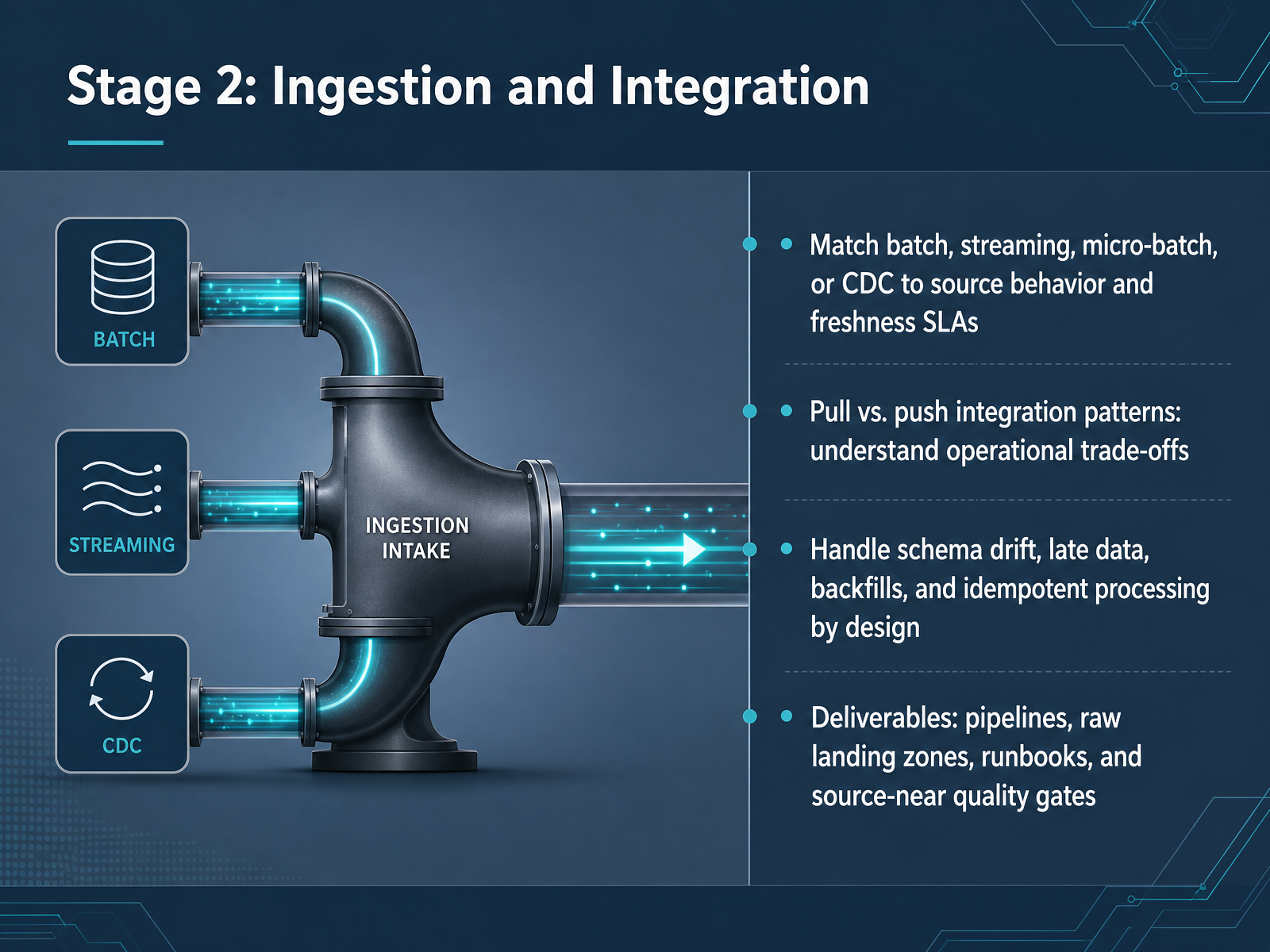 databricks.comintegrate.iotechtarget.com+21 min
 - 06Stage 3: Processing and TransformationNow let's walk through Stage 3: Processing and Transformation. This is where raw data becomes analytical assets. Your first move should be cleaning, standardizing, deduplicating, and enriching raw data into source-aligned staging models. Think of these as your atoms—small, tested building blocks that rename fields, fix types, and establish one consistent convention across your project. The next key decision is separating source-centric from business-centric transformations. Source-centric work adapts to what external systems give you. Business-centric transforms encode your team's definitions of concepts like revenue or active customer. Keep them in distinct layers to reduce rework when either side changes. Be deliberate about incremental versus full-refresh strategies. Full refreshes are expensive; incremental loads need explicit backfill and replay plans so you can safely reprocess history. Make your pipelines idempotent—rerunning them must never duplicate records. And finally, the deliverables. You're shipping transformed datasets, and with them, a suite of tests—at minimum primary key uniqueness and non-null checks on every model—plus documented lineage so anyone can trace a number back to its source. This is the contract your downstream consumers depend on. Next, we'll look at how testing, quality, and lineage hold up across the processing stage.
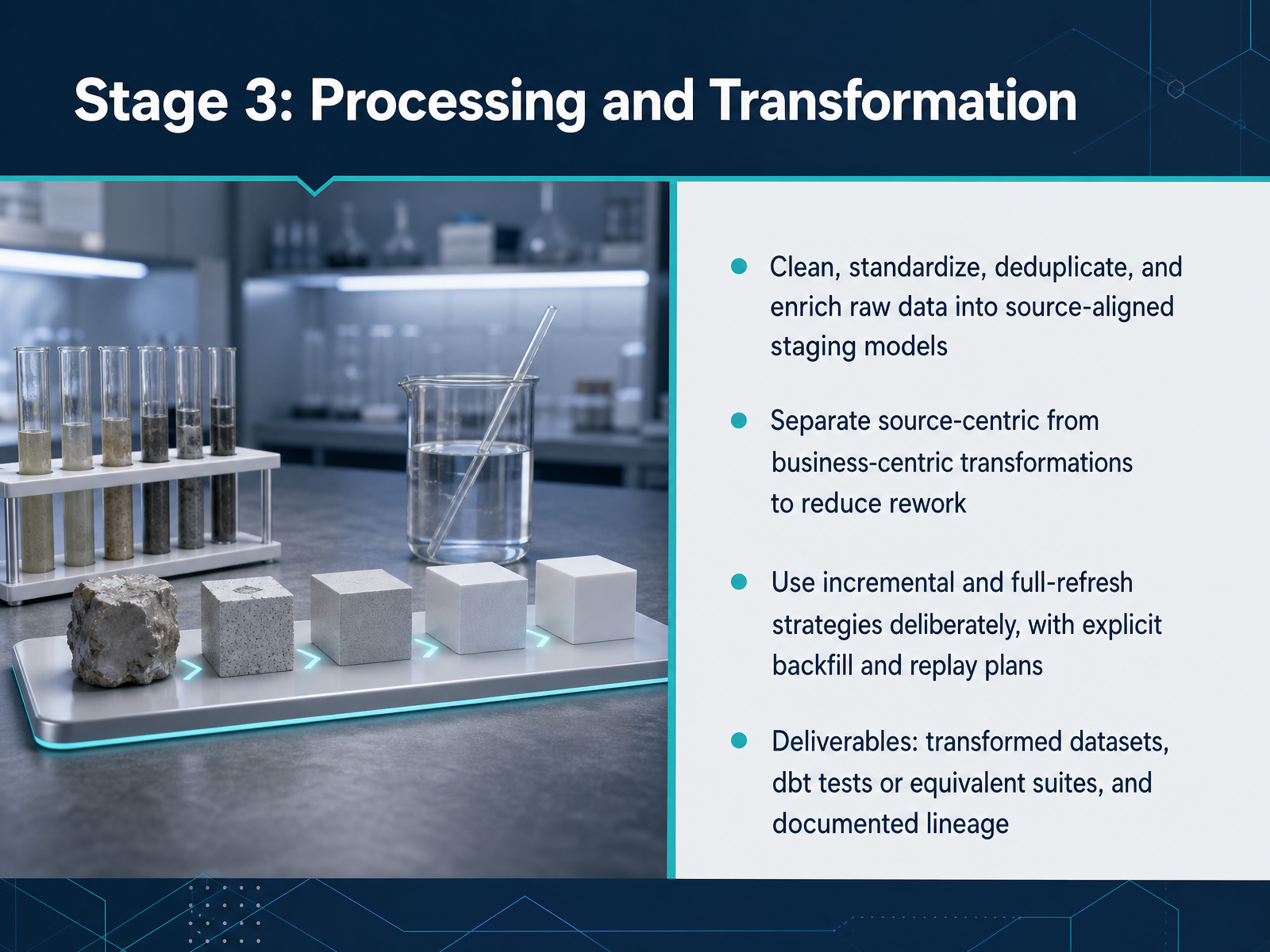 docs.getdbt.commodern-datatools.commdpi.com+22 min
 - 07Testing, Quality, and Lineage in ProcessingLet’s dig into the quality layer, because this is where pipelines either earn trust or lose it. Treat your transformations like production software: version control, peer review, and automated tests in CI. On the data side, start with the non-negotiables: primary keys tested for uniqueness and nulls, referential integrity on foreign keys, accepted values on enums, and freshness on your sources. For complex logic, unit-test with static inputs before you materialize anything—catch the bug in development, not at three a.m. Lineage gives you the map: when something breaks, walk upstream from a bad output to the exact model or source, and before you change a column, check the downstream blast radius. Finally, observability. Track volume, schema, and value distributions automatically. A row-count drop or a schema drift alert catches the failures you didn’t think to write a test for. Stack these together: contracts, tests, and observability—and you shift from detecting breakage to preventing it. That brings us to stage four: storage and modeling, where we lock in that structure.
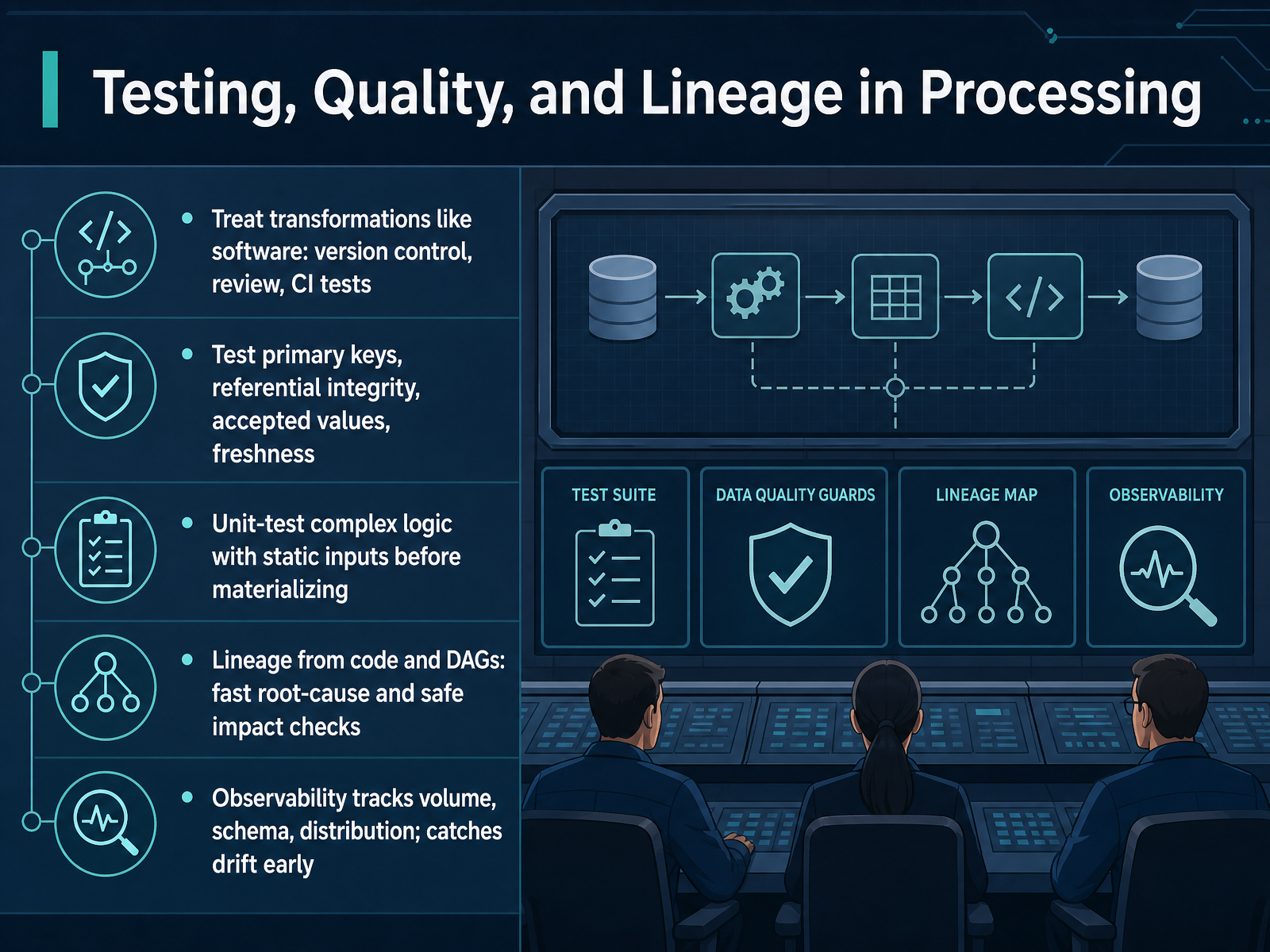 docs.getdbt.comaddepto.com1 min
 - 08Stage 4: Storage and ModelingNow let's talk about storage and modeling, where architecture decisions start to shape everything downstream. At this stage, your choice of platform is a strategic one. Use a warehouse for governed BI, where structured data and predictable query performance matter. Choose a lake when you need raw, diverse data at low cost—logs, images, sensor data, anything—but remember, governance is what keeps a lake from becoming a swamp. And go with a lakehouse when you need both BI and machine learning on the same data, using open formats like Iceberg or Delta Lake to get warehouse reliability on lake storage. Once you've chosen the platform, modeling follows query patterns. Dimensional schemas work well for BI, Data Vault suits audit-heavy enterprise needs, and wide tables serve ML features. Design partitioning and clustering with cost in mind—bad partitioning can cost more than the warehouse ever would. Your deliverables here are certified datasets, documented models, access policies, and retention rules. These are what downstream teams depend on, so get them right. That wraps up storage and modeling. Next, we'll weigh the trade-offs of modern storage architectures.
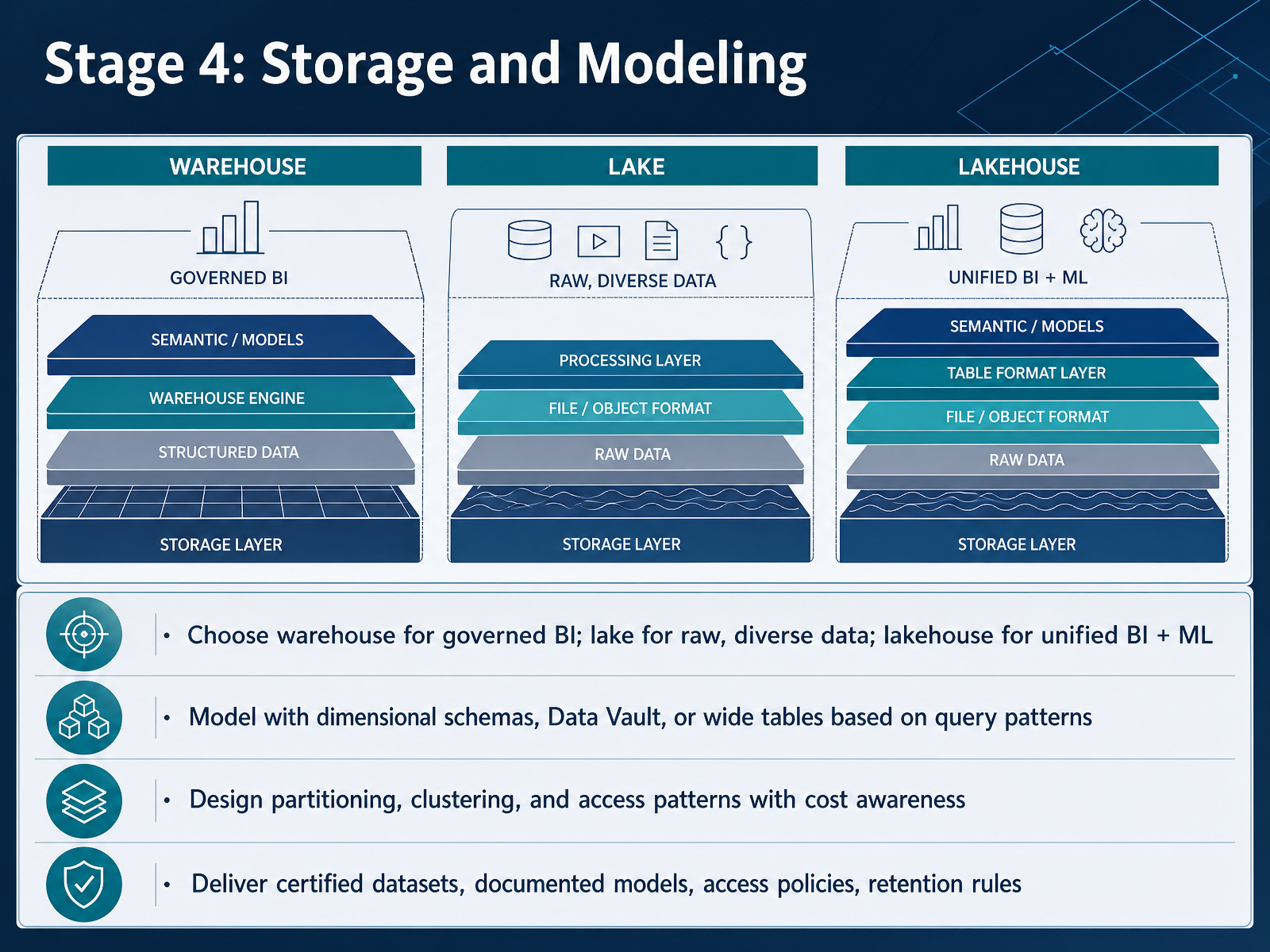 modern-datatools.commdpi.comtechtarget.com+22 min
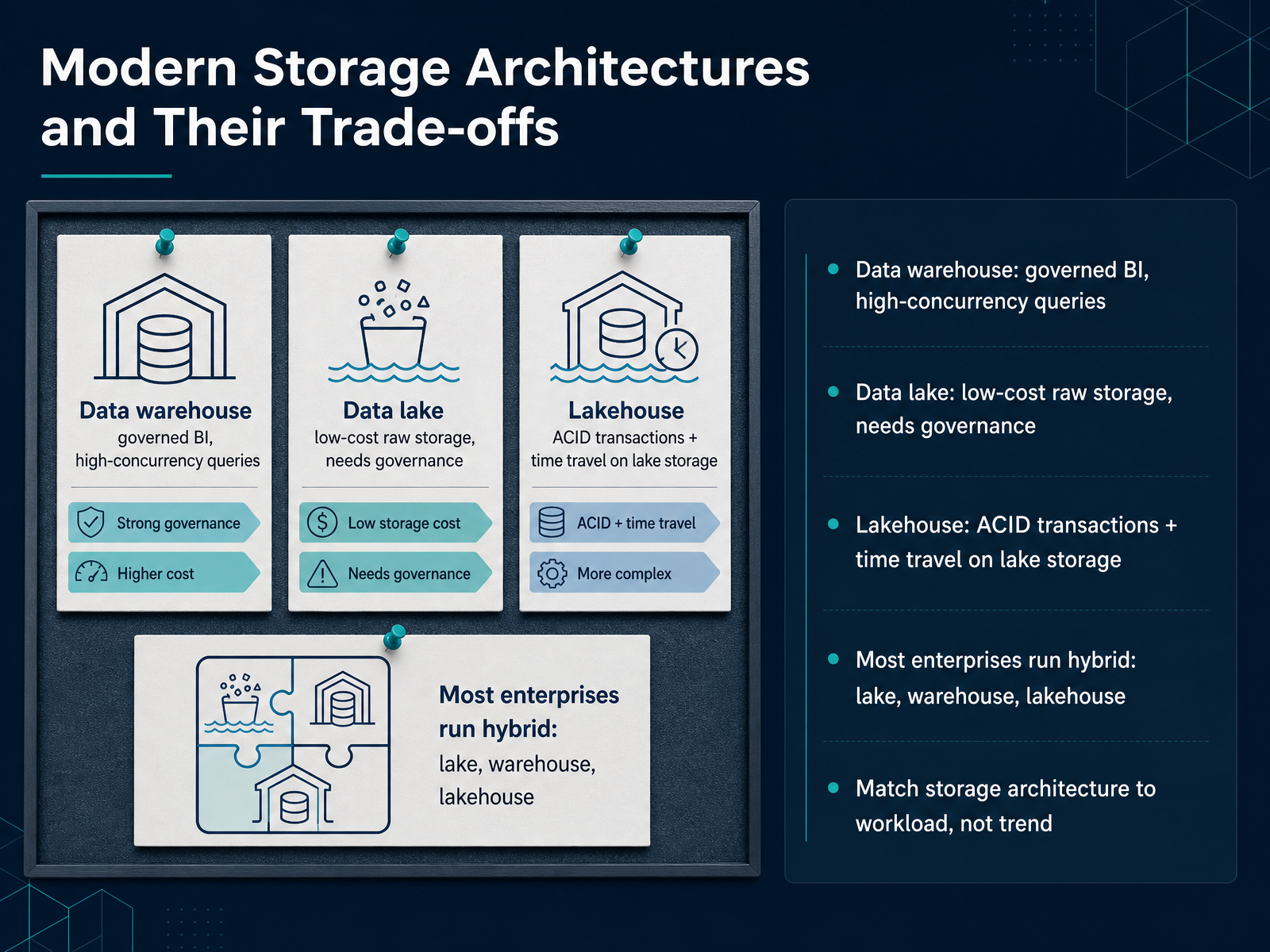
 - 09Modern Storage Architectures and Their Trade-offsLet's talk about storage. The warehouse, the lake, and the lakehouse aren't competing religions—they're tools with different strengths. Use a warehouse when you need governed BI, high concurrency, and predictable sub-second queries for dashboards. It's schema-on-write, structured, and pricier per terabyte. Use a lake when you need low-cost raw storage for diverse data types, ML, or archival. But remember, without strong governance, a lake becomes a swamp. The lakehouse brings ACID transactions, time travel, and schema enforcement to lake storage via open table formats like Delta Lake or Iceberg, so you can serve both BI and ML from one copy. Most enterprises run a hybrid: a lake for raw and archive, a warehouse for governed BI, and lakehouse tech to bridge them. Match the architecture to the workload, not the trend. Now, once your data is stored, you need to think about how it gets served and consumed—that's our next stage.
 modern-datatools.commdpi.comtechtarget.com+21 min
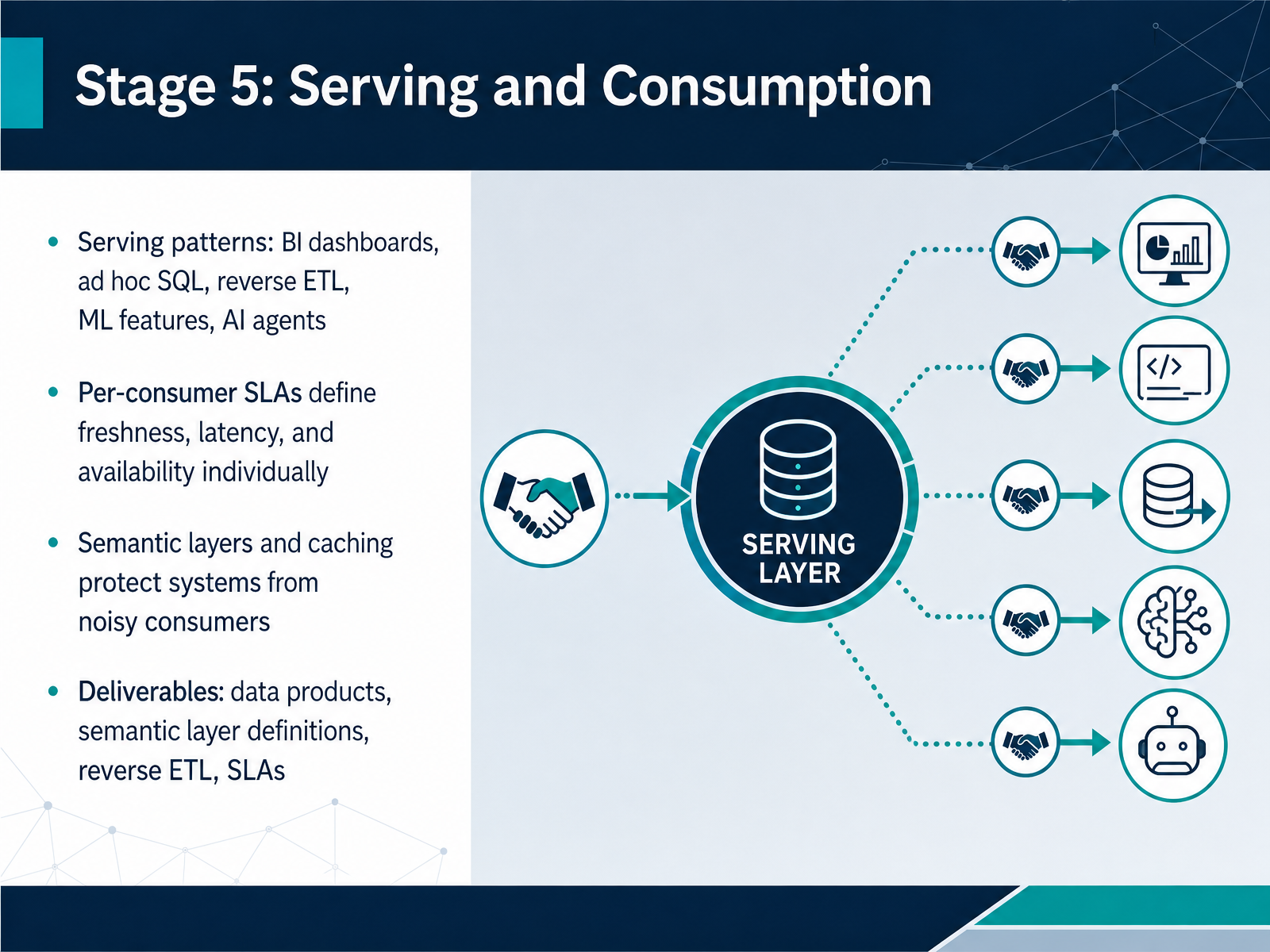
 - 10Stage 5: Serving and ConsumptionLet's look at Stage five: Serving and Consumption. This is where your pipeline work becomes measurable. The serving patterns are no longer just BI dashboards and ad hoc SQL, though those remain. Reverse ETL pushes warehouse-computed insights back into operational tools like CRMs, and now AI agents consume that data directly for autonomous decisions. Here is the critical shift. You cannot set one SLA for everyone. A daily dashboard refresh is fine for finance, but an AI agent making decisions in a customer interaction needs sub-hour freshness. Define per-consumer SLAs individually. This is where semantic layers become your circuit breaker. They define governed metrics once, so every consumer—dashboards, agents, operational tools—gets consistent answers instead of each one inventing its own SQL. Caching in the semantic layer protects your warehouse from noisy consumers and runaway agent queries. Your deliverables here are concrete: data products with defined contracts, semantic layer definitions with access rules, reverse ETL pipelines with idempotent, destination-shaped models, and explicit SLAs per consumer. At this stage, your role is shifting from builder to operator. Now let's talk about who owns what across that lifecycle.
 modern-datatools.commdpi.comtechtarget.com+22 min
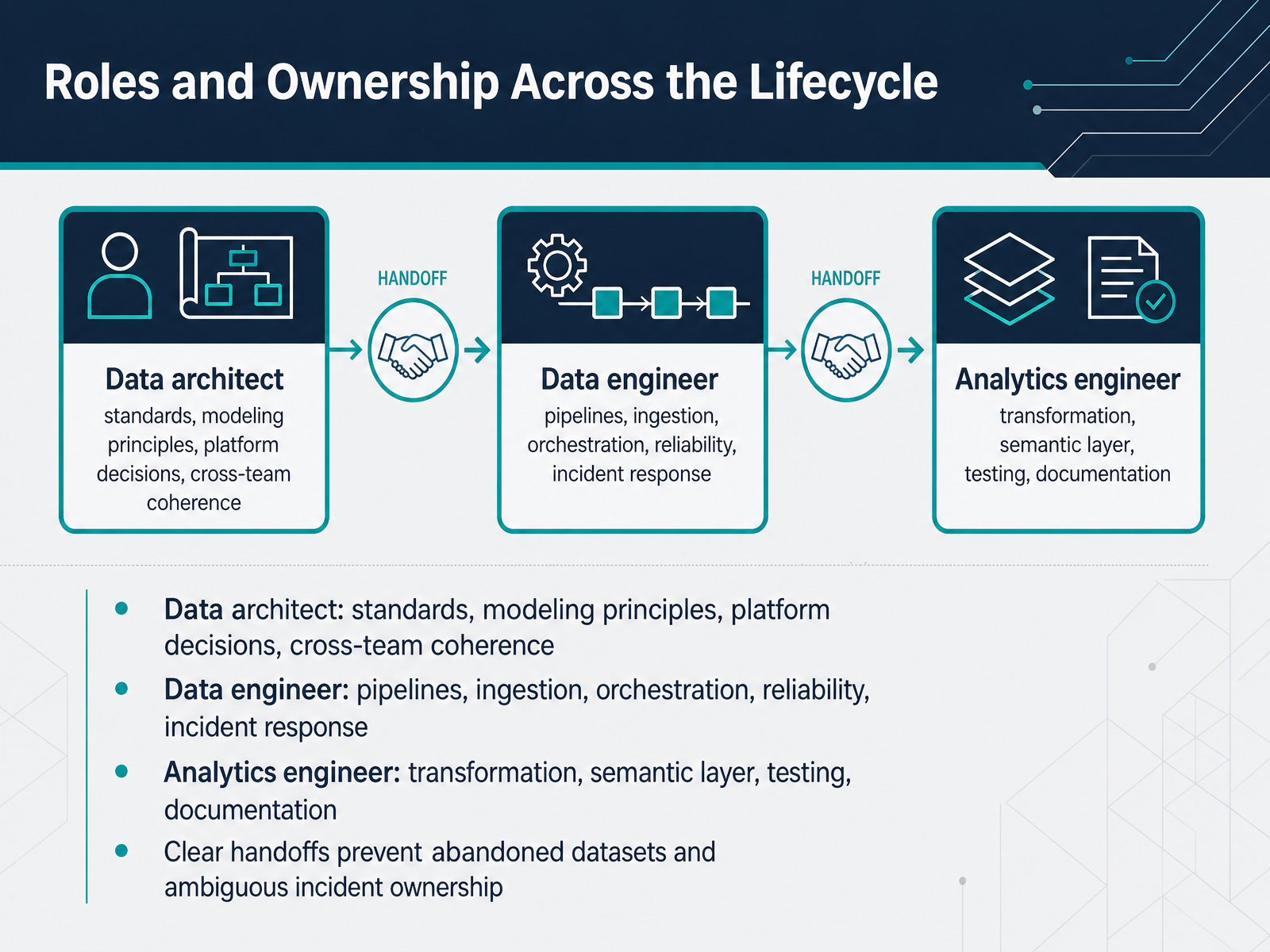
 - 11Roles and Ownership Across the LifecycleNow let's map these roles to ownership across the lifecycle. The data architect sets the standards, modeling principles, and platform decisions that keep the whole system coherent. The data engineer owns the pipelines—ingestion, orchestration, reliability, and the 3 a.m. incident response. The analytics engineer owns the transformation layer: the semantic models, testing, and documentation that make data trustworthy downstream. Here's the catch. Clear handoffs aren't just nice to have—they prevent abandoned datasets and ambiguous incident ownership. If a pipeline breaks and nobody knows whose pager it is, that's an ownership failure. When you're designing your team, make sure every stage has a named owner. That's what separates a healthy data platform from one held together by tribal knowledge. Next, let's look at the concrete artifacts that keep these roles aligned.
 coursera.orgdeha-global.comiabac.org+21 min
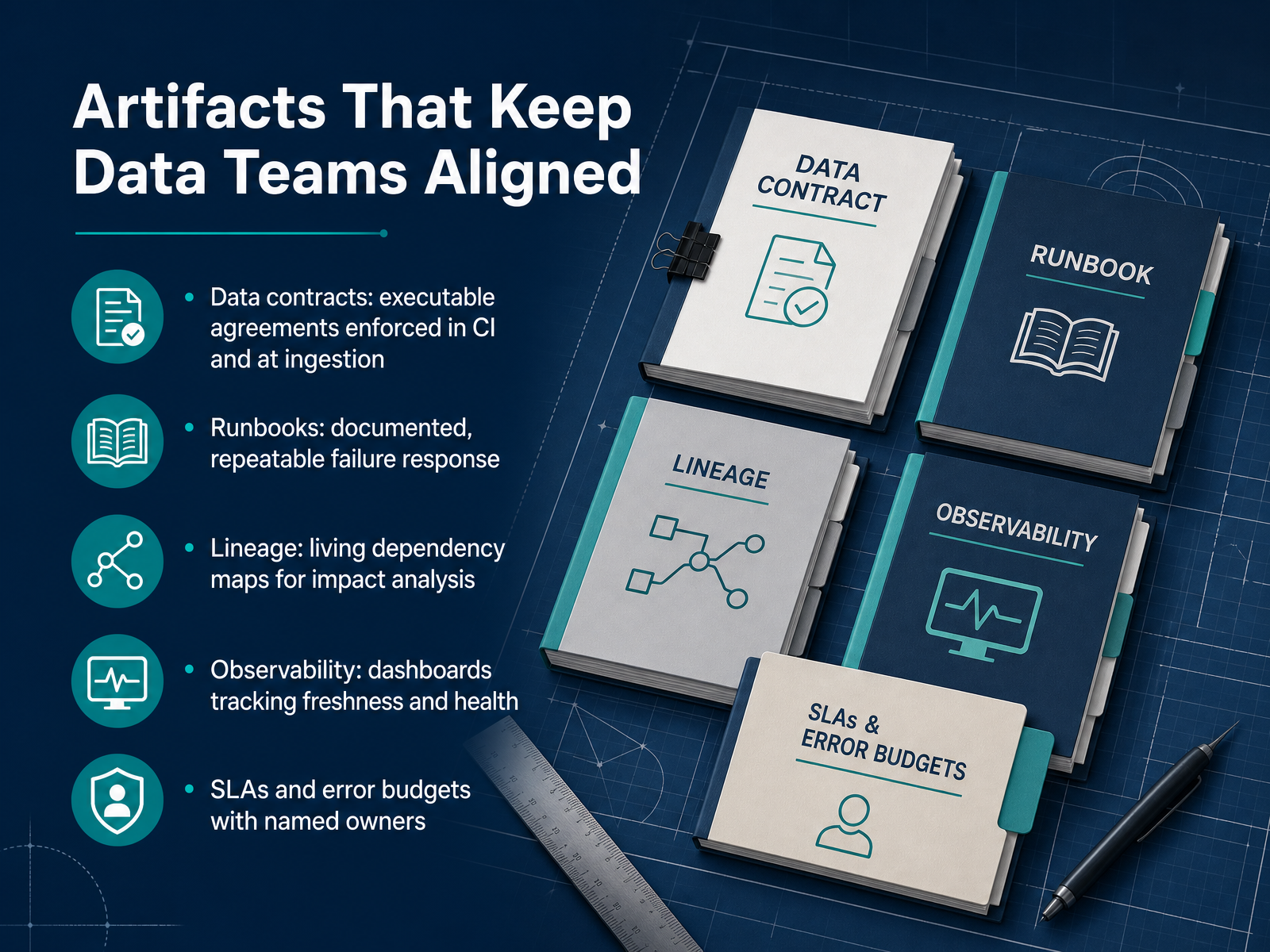
 - 12Artifacts That Keep Data Teams AlignedNow let's talk about the artifacts that keep your data team aligned. These aren't deliverables for their own sake—they're the operating system for collaboration. First, data contracts. Think of these as executable agreements between producers and consumers, enforced in CI and at ingestion. When a schema changes, the contract fails the build before it breaks a downstream dashboard. Next, runbooks: documented, repeatable failure responses. No more tribal knowledge at 2 AM. If the pipeline dies, someone follows the script and either fixes it or escalates with context. Lineage is your living dependency map. When you change a column, lineage shows the blast radius—every model, dashboard, and job that depends on it. Stale lineage is worse than none, so treat it as derived data, regenerated on every commit. Observability ties it together: dashboards tracking freshness, volume, and schema drift. You want to catch the anomaly before a stakeholder does. Finally, SLAs and error budgets must have named owners. If nobody is accountable for freshness, freshness doesn't exist. That ownership is what turns these artifacts from documentation into governance. Next, we'll look at common failure patterns and where you get the highest return on improvement.
 addepto.comdataladder.comblog.n8n.io+22 min
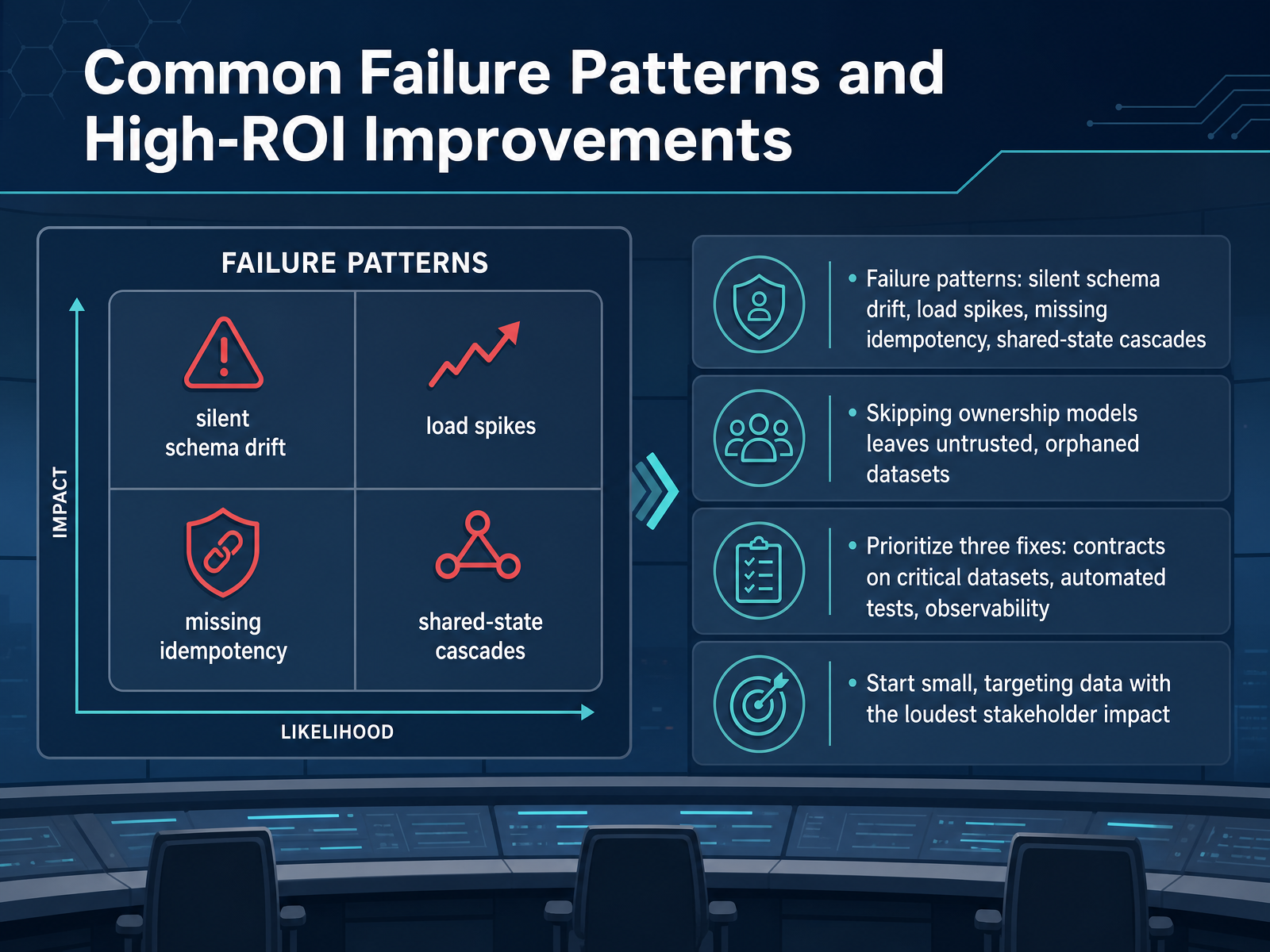
 - 13Common Failure Patterns and High-ROI ImprovementsLet's close by looking at where this process actually breaks, and where your fixes return the most value. Reviewing fifty public postmortems from top engineering teams, four failure patterns dominate. Silent schema drift, where data looks valid but its meaning has changed. Load spikes that pipelines can't shed. Missing idempotency, turning retries into duplicates. And cascade failures from shared state you didn't know you were sharing. The common thread is design hygiene, not exotic infrastructure. Skipping explicit ownership models creates untrusted, orphaned datasets that consume your team's time. So here's your high return on investment checklist. First, enforce contracts on your critical datasets. Make schema mismatches loud at the pipeline boundary, not silent. Second, automate data quality tests. Volume, freshness, and key integrity checks catch what job completion metrics miss. Third, invest in observability that tracks data health, not just system health. But start small. Pick the dataset with the loudest stakeholder impact if it breaks, and protect that one first. You don't need to boil the ocean. Move the moment of detection from a stakeholder noticing wrong numbers to your pipeline noticing before anyone looks. That single shift changes how the entire organization trusts your team. Thanks for taking this journey through the data engineering process with me. You have the stages, the roles, the deliverables, and now the failure patterns to anticipate. Go protect that first dataset. You know which one it is.
 addepto.comdatabricks.comintegrate.io+22 min
Take the deck with you
Download this course as a file — free, no sign-up needed.
- PDF handoutEvery slide page, ready to print or share.14 pages · 3.5 MBDownload
- Narrated PowerPointThe deck that presents itself — every slide carries the digital human's narration video.14 pages · 15.1 MBDownload
- PowerPoint slidesThe full deck as a .pptx — open it in PowerPoint, Keynote, or Google Slides.14 pages · 3.4 MBDownload
Free to use in your own training — please keep the PersonWise credit page at the end.
Have your own deck? Turn it into a course
Sources consulted
Web sources consulted while building this course.
- The Data Engineering Lifecycle: From Raw Data to ... — coursera.org
- Data Engineering: A Complete Guide For 2026 — deha-global.com
- What Is the Data Engineering Lifecycle? — iabac.org
- What is a Data Engineering Pipeline? Types, Tools & Best Practices (2026) | Addepto — addepto.com
- Modern data engineering playbook — thoughtworks.com
- ETL vs ELT: What's the Difference? Complete Guide (2026) | Modern DataTools — modern-datatools.com
- From ETL to Modern Data Stack: A Systematic Review and Strategic ... — mdpi.com
- AI pressures expose outdated data pipeline architecture | TechTarget — techtarget.com
- Modern Data Stack 2026: Complete Guide to Tools & Architecture | Modern DataTools — modern-datatools.com
- TDWI Top Trends | Modernizing Data Pipelines | TDWI — tdwi.org
- Source-to-Target Mapping Best Practices ... — dataladder.com
- Data Mapping Best Practices for Cross-System Integration – n8n Blog — blog.n8n.io
- What Is Data Mapping? Types, Process & Best Practices | DBSync — mydbsync.com
- Practical Data Mapping in ETL: Source-to-Target Guide — etl-tools.com
- What is Source to Target Mapping? 9 Easy Steps — hevodata.com
- Data Ingestion Reference Architecture | Databricks — databricks.com
- Multi-Source Data Ingestion in 2026: A Reference Guide for 100+ Client Sources | Integrate.io — integrate.io
- Change data capture: implementation strategies | Data Warehouse Info — datawarehouseinfo.com
- Data Ingestion Patterns - Unidata.pro — unidata.pro
- Add data tests to your DAG | dbt Developer Hub — docs.getdbt.com