Begin
14 pages · ~28 min
Cloud Computing Roadmap Strategy
This training helps IT and cloud teams prioritize initiatives, define milestones, and communicate cloud adoption progress clearly to stakeholders.
A digital instructor presents all 14 pages. Hold “Ask” at any point and ask out loud — the answer comes from this course. No sign-up needed.
What you’ll learn
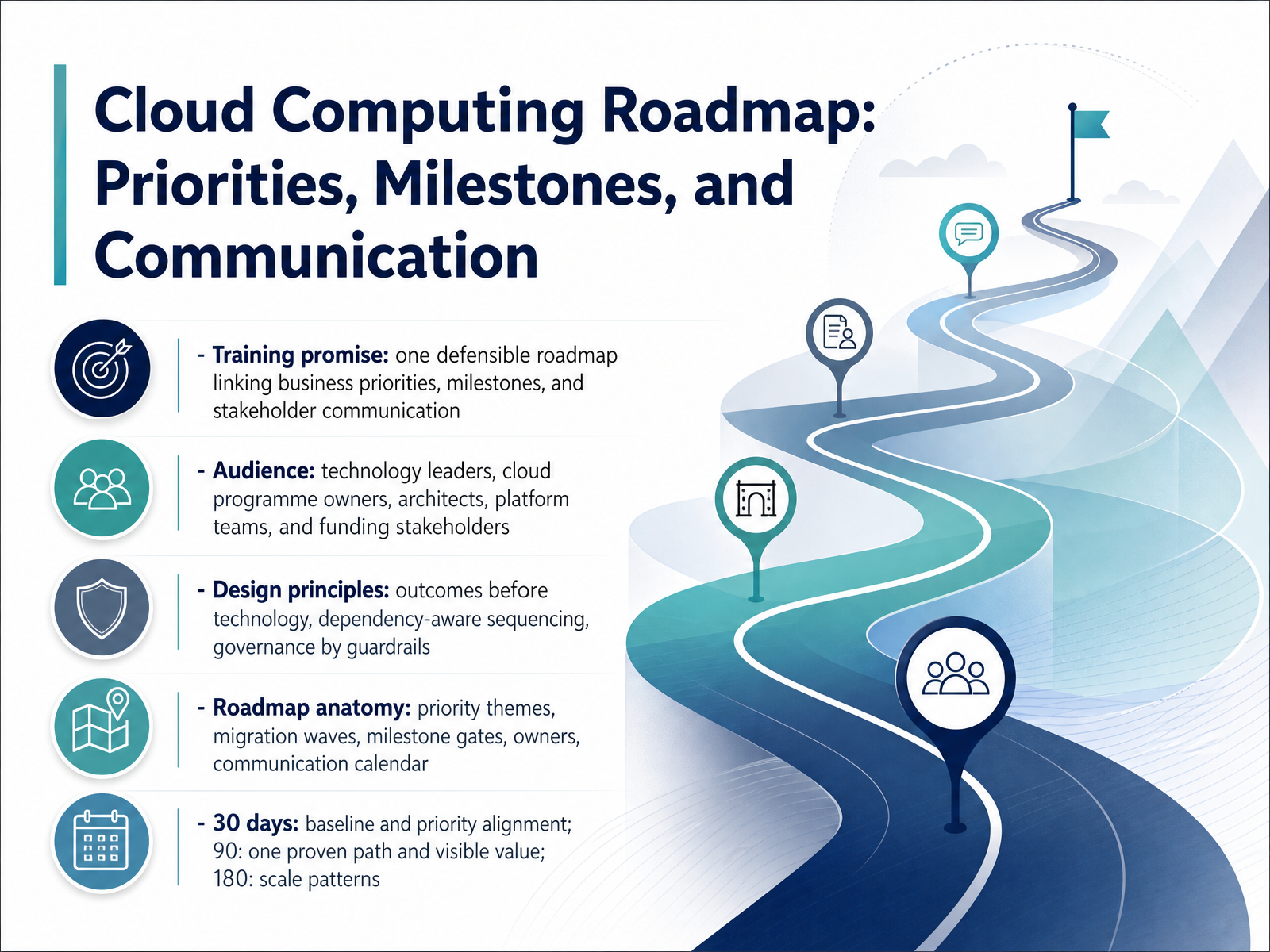
- 01Cloud Computing Roadmap: Priorities, Milestones, and CommunicationWelcome. This session is for technology leaders, cloud programme owners, architects, platform teams, and funding stakeholders. Our goal is one defensible roadmap. One that links business priorities, milestones, and stakeholder communication. We will design it on four principles. Outcomes before technology. Sequencing that respects dependencies. Governance by guardrails, not gatekeeping. And a roadmap anatomy we can reuse: priority themes, migration waves, milestone gates, named owners, and a communication calendar. Here is the shape of it. In the first thirty days, baseline your estate and align on priorities. By ninety days, prove one path and make the value visible. By one hundred eighty days, scale the patterns that worked. We will be honest about constraints. Legacy systems, budget cycles, and competing priorities are real. So we plan around them, not against them. As a first action, note the one business outcome your roadmap must serve. Keep it in front of you. Now, let us look at why cloud roadmaps stall.gartner.commarqi.cloudforrester.com+21 min
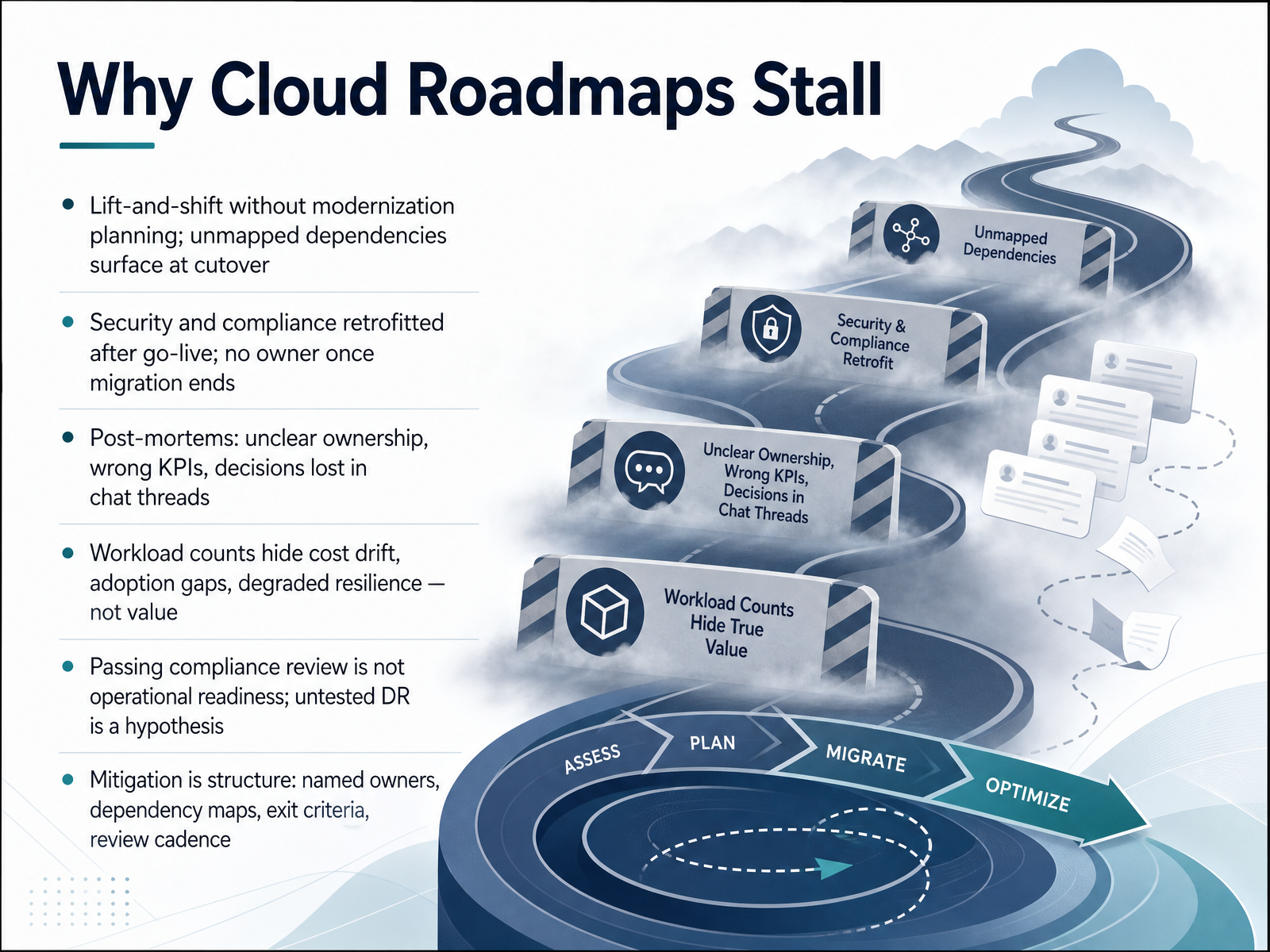
- 02Why Cloud Roadmaps StallSo why do cloud roadmaps stall? Almost never because the technology is too hard. It is a sequence-of-decisions problem, and the decisions get baked in early. Here is what we see. Lift and shift without modernization planning, so unmapped dependencies surface at cutover. Security and compliance retrofitted after go-live, with no owner once migration ends. Post-mortems that keep repeating the same findings: unclear ownership, wrong KPIs, decisions lost in chat threads. Workload counts hide cost drift, adoption gaps, and degraded resilience. They do not show value. And passing a compliance review is not operational readiness. An untested disaster recovery plan is a hypothesis, nothing more. The mitigation is structure. Named owners. Dependency maps. Exit criteria for every wave. A review cadence that holds. So the checkpoint for this slide is simple: before your next funding gate, confirm each of those four is written down, and that a person, not a team name, owns it. From Business Strategy to Cloud Priority Themes.
 cbtw.technabeil.comkansoftware.com+22 min
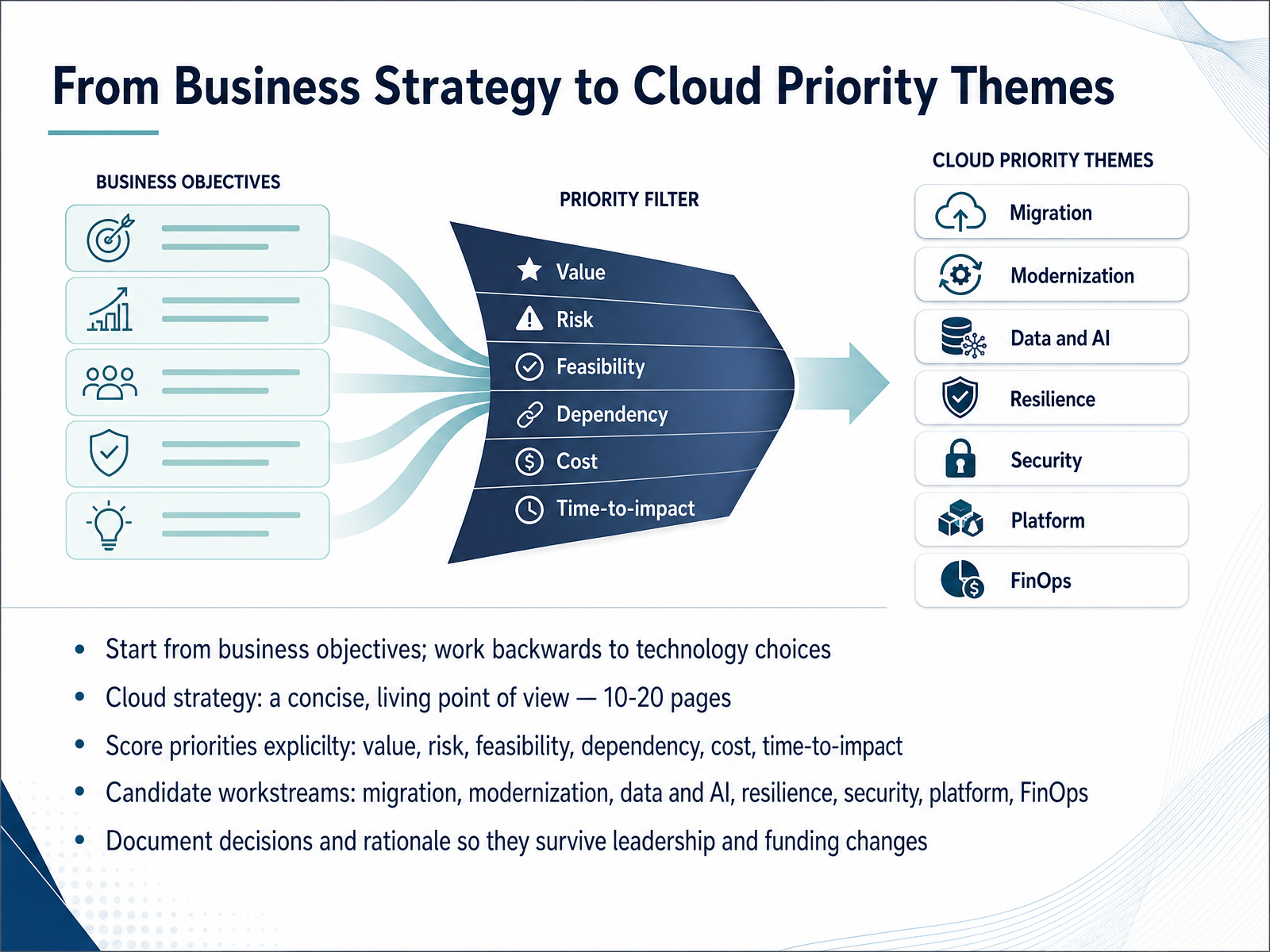
- 03From Business Strategy to Cloud Priority ThemesLet's talk about turning business strategy into cloud priority themes. Start with business objectives, then work backwards to technology choices. Not the other way around. Your cloud strategy should be a concise, living point of view. Ten to twenty pages is enough. It is not a shelf document. Next, score priorities explicitly. Value, risk, feasibility, dependency, cost, and time to impact. If you cannot rank a workstream on those six, you cannot defend it at a funding gate. Candidate workstreams include migration, modernization, data and AI, resilience, security, platform, and FinOps. Most programmes cannot fund all of them at once. That is normal. Finally, document your decisions and the rationale behind them. Leadership changes, budget cycles shift, and competing priorities emerge. Written rationale keeps the programme stable when people rotate. Next, we look at the Cloud Operating Model, Governance, and Decision Rights.
 docs.aws.amazon.comdocs.aws.amazon.comaws.amazon.com+22 min
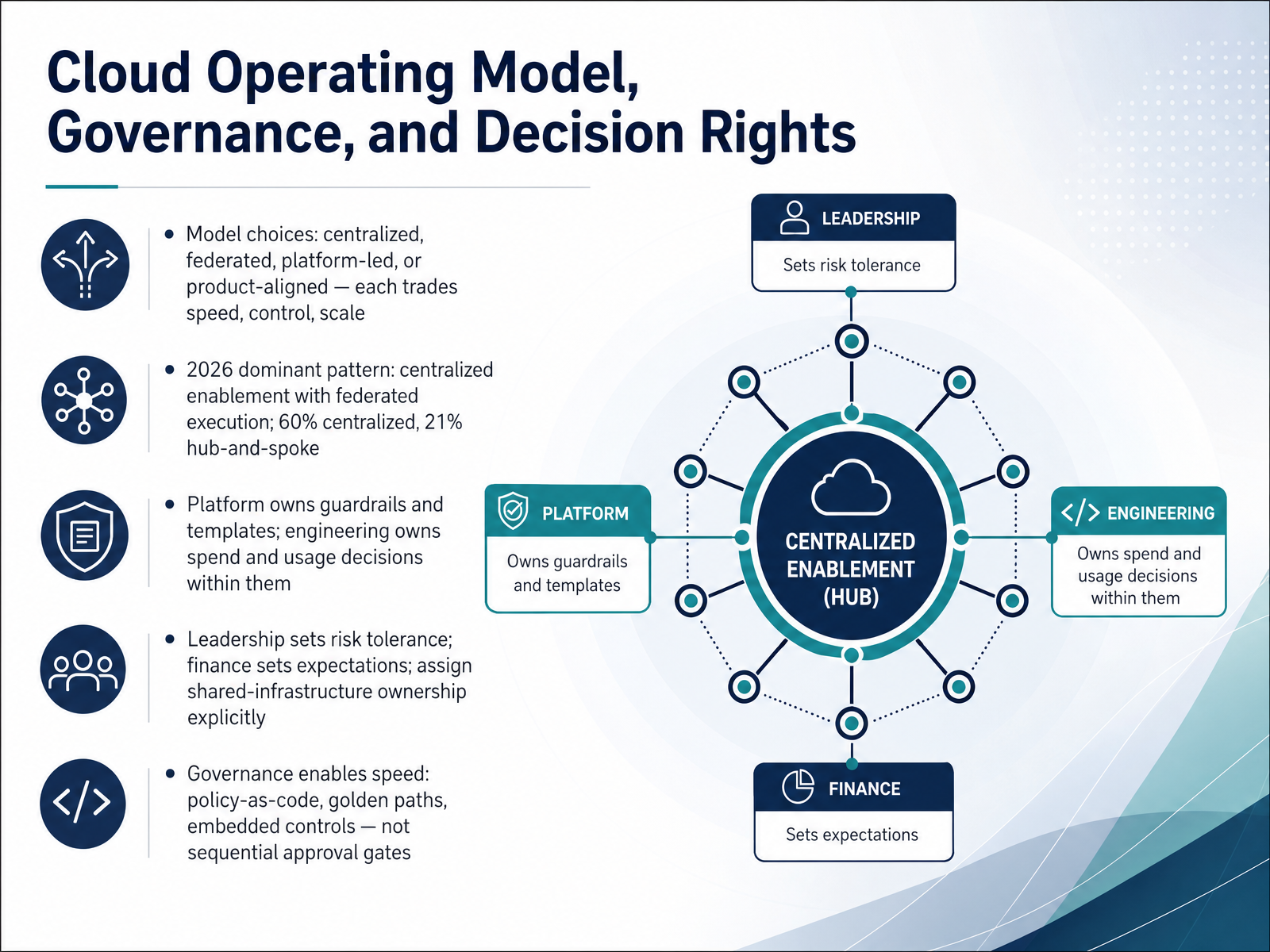
- 04Cloud Operating Model, Governance, and Decision RightsLet's talk about the operating model, because governance decides whether your cloud program moves or stalls. You have four model choices: centralized, federated, platform-led, or product-aligned. Each one trades speed, control, and scale differently. In 2026, the dominant pattern is centralized enablement with federated execution. Sixty percent of organizations run it, and twenty-one percent run hub-and-spoke. The division of labor is straightforward. Platform owns the guardrails and templates. Engineering owns spend and usage decisions inside them. Leadership sets risk tolerance. Finance sets expectations. And assign shared-infrastructure ownership explicitly, because networking and shared clusters are where accountability quietly disappears. Here is the key point. Governance should enable speed, not block it. Use policy-as-code, golden paths, and embedded controls instead of sequential approval gates. So before the next checkpoint, confirm your model, and name an owner for shared infrastructure. Next, we look at phases, waves, and migration approach selection.
 finops.orgdata.finops.orgvirtasant.com+22 min
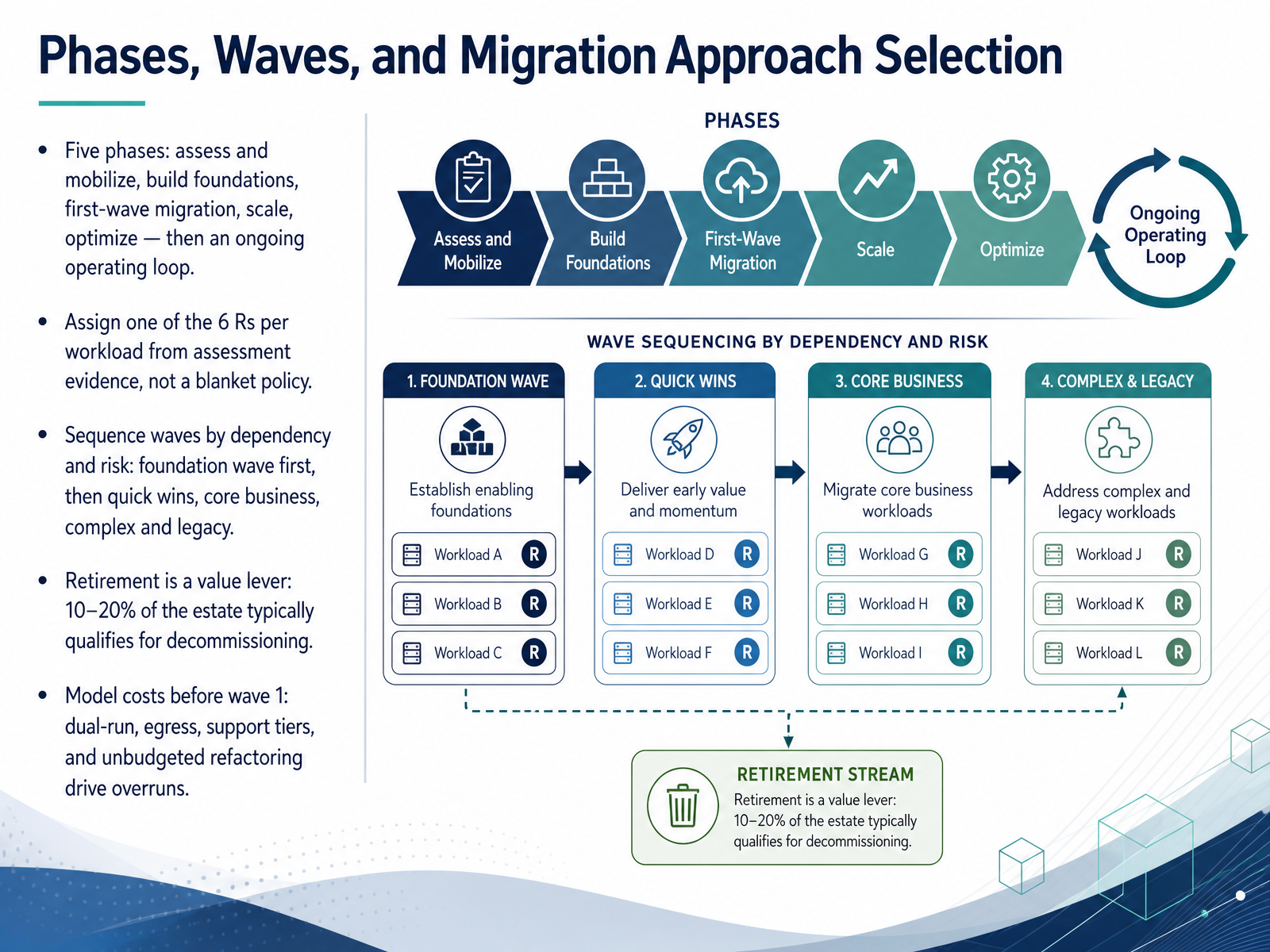
- 05Phases, Waves, and Migration Approach SelectionLet's talk sequencing, because the order of your migration determines whether you build momentum or burn it. We run five phases: assess and mobilize, build foundations, first-wave migration, scale, optimize. Then you stay in an ongoing operating loop. Next, assign one of the six Rs per workload, using assessment evidence, not a blanket policy. Some workloads rehost. Some refactor. Some retire. Now sequence your waves by dependency and risk. Foundation wave first. Then quick wins. Then core business. Then complex and legacy workloads. Treat retirement as a value lever, not a footnote. Ten to twenty percent of the estate typically qualifies for decommissioning. Finally, model costs before wave one. Dual-run, egress, support tiers, and unbudgeted refactoring drive overruns. Next, we look at Milestone Gates and Exit Criteria.
 docs.aws.amazon.comdocs.aws.amazon.comaws.amazon.com+21 min
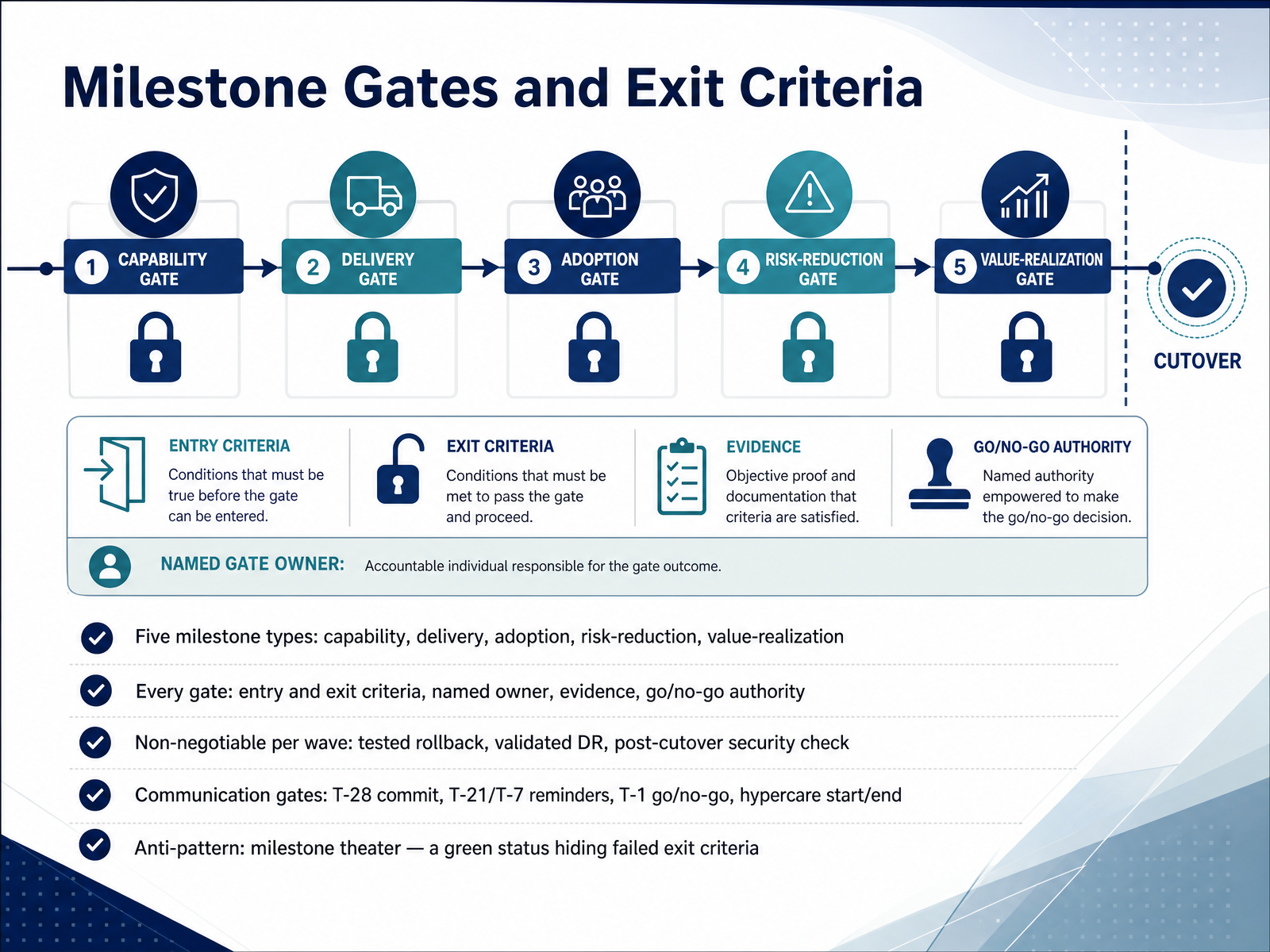
- 06Milestone Gates and Exit CriteriaNow let's talk about milestone gates and exit criteria. We use five milestone types: capability, delivery, adoption, risk reduction, and value realization. Every gate needs four things: entry and exit criteria, a named owner, evidence, and a go or no-go authority. If any of those is missing, you do not have a gate. You have a status update. And three controls are non-negotiable in every wave: a tested rollback, validated disaster recovery, and a post-cutover security check. No exceptions, no deferrals. On communication, we run a fixed cadence. T minus twenty-eight is the commit. T minus twenty-one and T minus seven are reminders. T minus one is the go or no-go. Then hypercare start and end, with a defined exit condition. Watch for the anti-pattern we call milestone theater. That is a green status hiding failed exit criteria. When a checklist item fails, the milestone stays blocked. Delaying a wave is cheaper than forcing a cutover. So before the next review, confirm one thing: that your gates have owners and evidence, not optimism. That foundation leads directly into our next topic, Platform Foundations and Golden Paths.
 docs.aws.amazon.com1 min
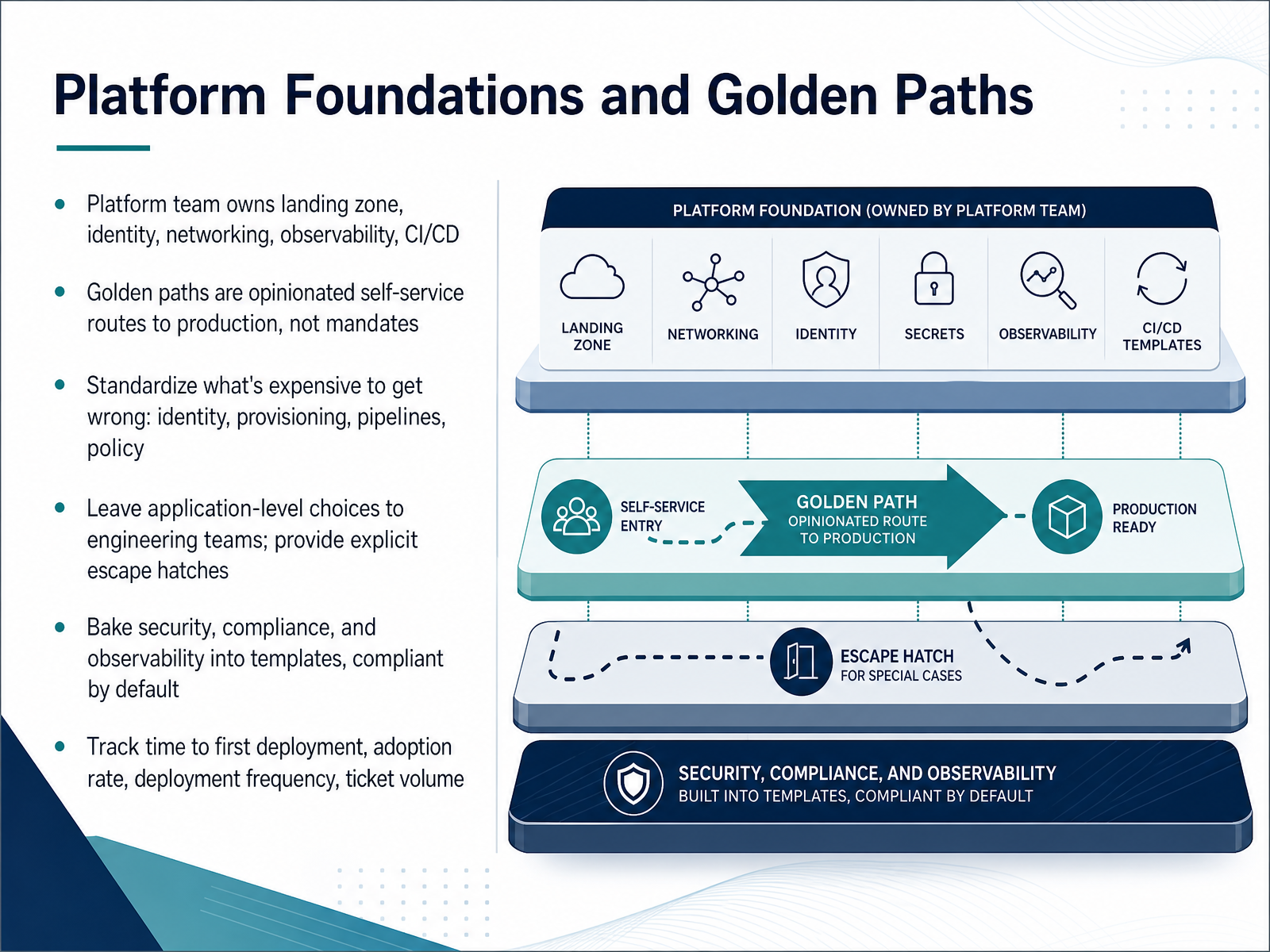
- 07Platform Foundations and Golden PathsNow let's talk about platform foundations and golden paths. The platform team owns the landing zone, identity, networking, observability, and the CI and CD pipelines. Those are the layers where inconsistency gets expensive fast. Golden paths are opinionated, self-service routes to production. They are not mandates. Standardize what is expensive to get wrong: identity, provisioning, pipelines, and policy. Leave application-level choices to engineering teams, and give them explicit escape hatches. Bake security, compliance, and observability into your templates so services are compliant by default. Then measure four things: time to first deployment, golden path adoption rate, deployment frequency, and platform ticket volume. If adoption sits below seventy percent, the path is not the problem to ignore. Fix the friction before you build another one. Your checkpoint this quarter: pick one high-frequency service type and ship one working golden path end to end. Next, we move into FinOps and Financial Controls Across the Roadmap.
 finops.orgdata.finops.orgvirtasant.com+22 min
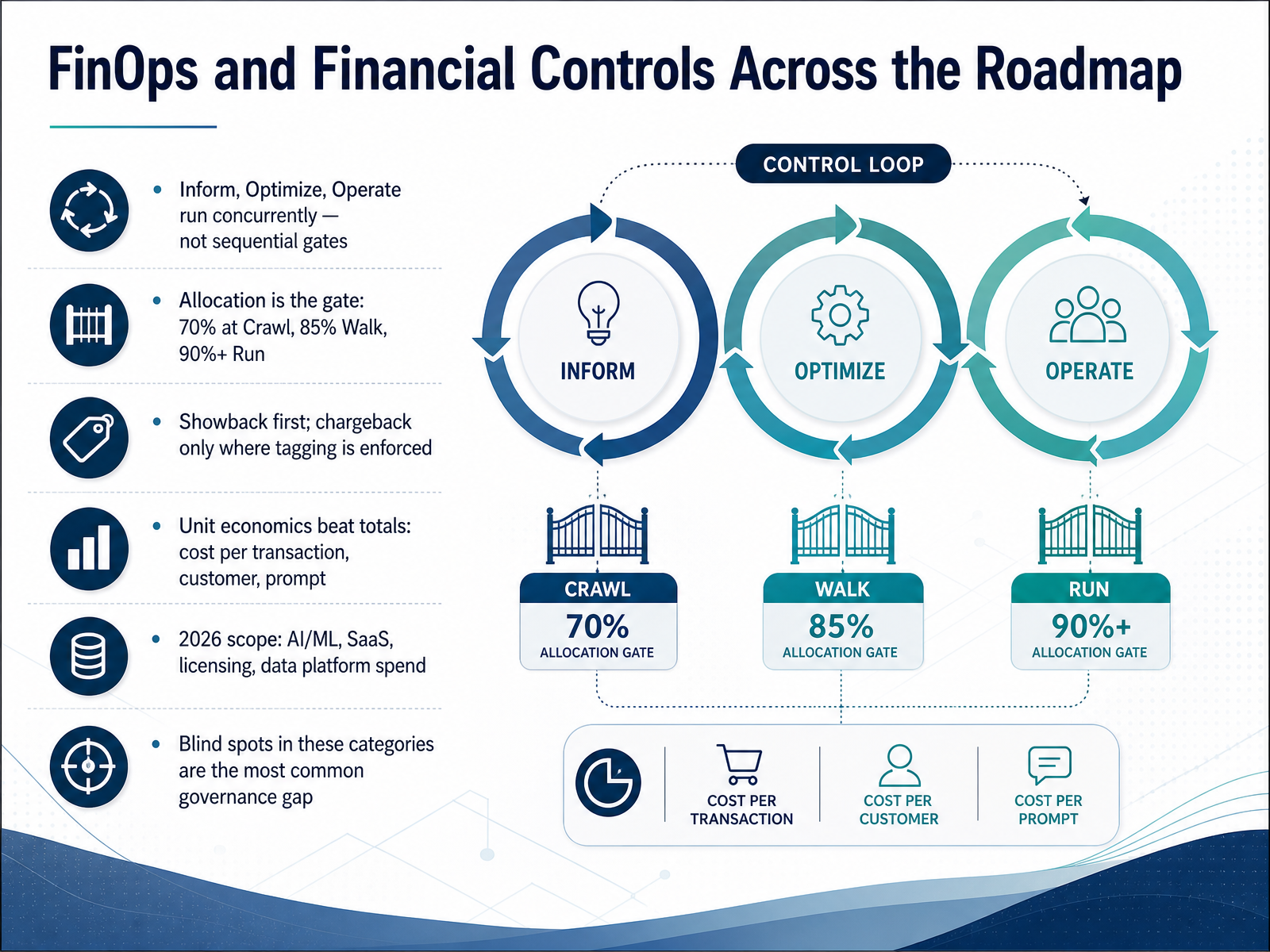
- 08FinOps and Financial Controls Across the RoadmapNow let's talk about FinOps and financial controls. Inform, Optimize, and Operate run concurrently. They are not sequential gates. Treat them as a continuous loop, and you will avoid spending a year building dashboards nobody opens. Allocation is the gate for everything else. Target seventy percent allocation at Crawl, eighty-five percent at Walk, and over ninety percent at Run. Start with showback. Move to chargeback only where tagging is enforced and the allocation is defensible. Introducing chargeback too early turns cost control into billing disputes. Then shift the conversation from totals to unit economics. Cost per transaction, per customer, per prompt. Leadership does not care about instance costs. They care about cost per feature, and the margin impact. For twenty twenty-six, bring AI and M L, SaaS, licensing, and data platform spend into scope. These categories are the most common governance blind spots, and the risk grows as AI investment diversifies. Next, we cover risk, resilience, and cost authority balance.
 finops.orgdata.finops.orgvirtasant.com+22 min
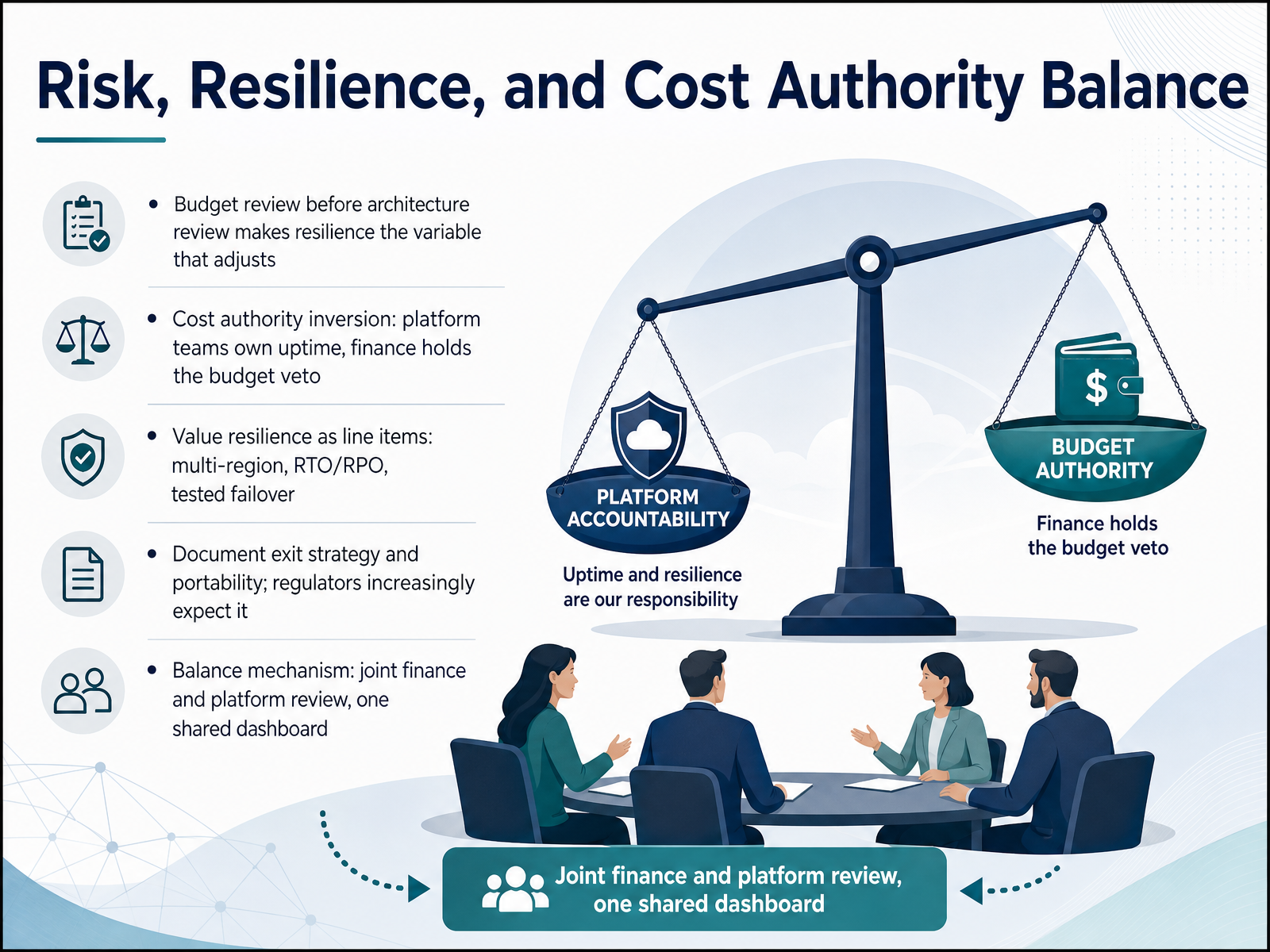
- 09Risk, Resilience, and Cost Authority BalanceLet's talk about the balance between risk, resilience, and cost authority. Here's the pattern we see. When budget review happens before architecture review, resilience quietly becomes the variable that adjusts. In practice, that means cost constraints dictate design, and uptime gets negotiated later. That's a cost authority inversion. Platform teams own uptime, but finance holds the budget veto. The problem: platform carries responsibility for reliability without authority over the decisions that deliver it. So treat resilience as line items you can fund and defend. Multi-region deployment. Recovery time and recovery point objectives. Tested failover, not just documented. Also document your exit strategy and portability. Regulators increasingly expect it, and it protects you at renewal time. The balance mechanism is joint review. Finance and platform in the same room, looking at one shared dashboard. No more discovering outcomes in a quarterly report. Define that review cadence now, and agree who owns each resilience line item. That is your checkpoint before the next wave. Next, we'll look at stakeholder mapping and message architecture.
 finops.orgdata.finops.orgvirtasant.com+22 min
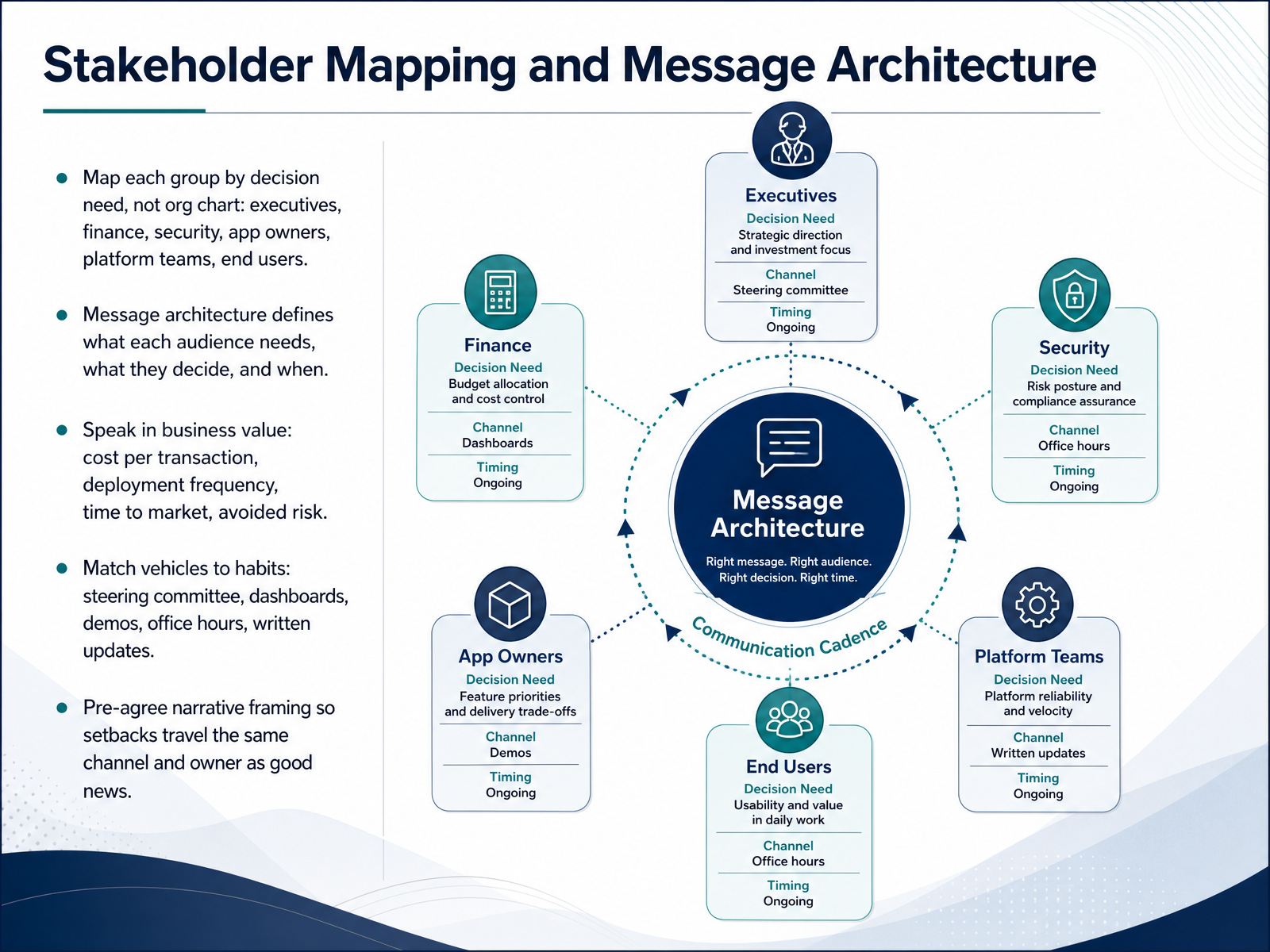
- 10Stakeholder Mapping and Message ArchitectureLet's talk about how you map stakeholders and structure the messages you send them. Map each group by decision need, not by org chart. That means executives, finance, security, application owners, platform teams, and end users. Your message architecture defines what each audience needs, what they decide, and when. Speak in business value, not technology. Cost per transaction. Deployment frequency. Time to market. Avoided risk. Then match the vehicle to the group's habits. A steering committee, a dashboard, a demo, office hours, or a written update. None of these is universally right. One more thing. Pre-agree the narrative framing up front. That way, setbacks travel the same channel and the same owner as good news. No surprises, no side conversations. As your next checkpoint, confirm one decision owner and one channel per stakeholder group before the next steering review. That sets up our next topic, communication cadence and reporting rhythm.
 docs.aws.amazon.com1 min
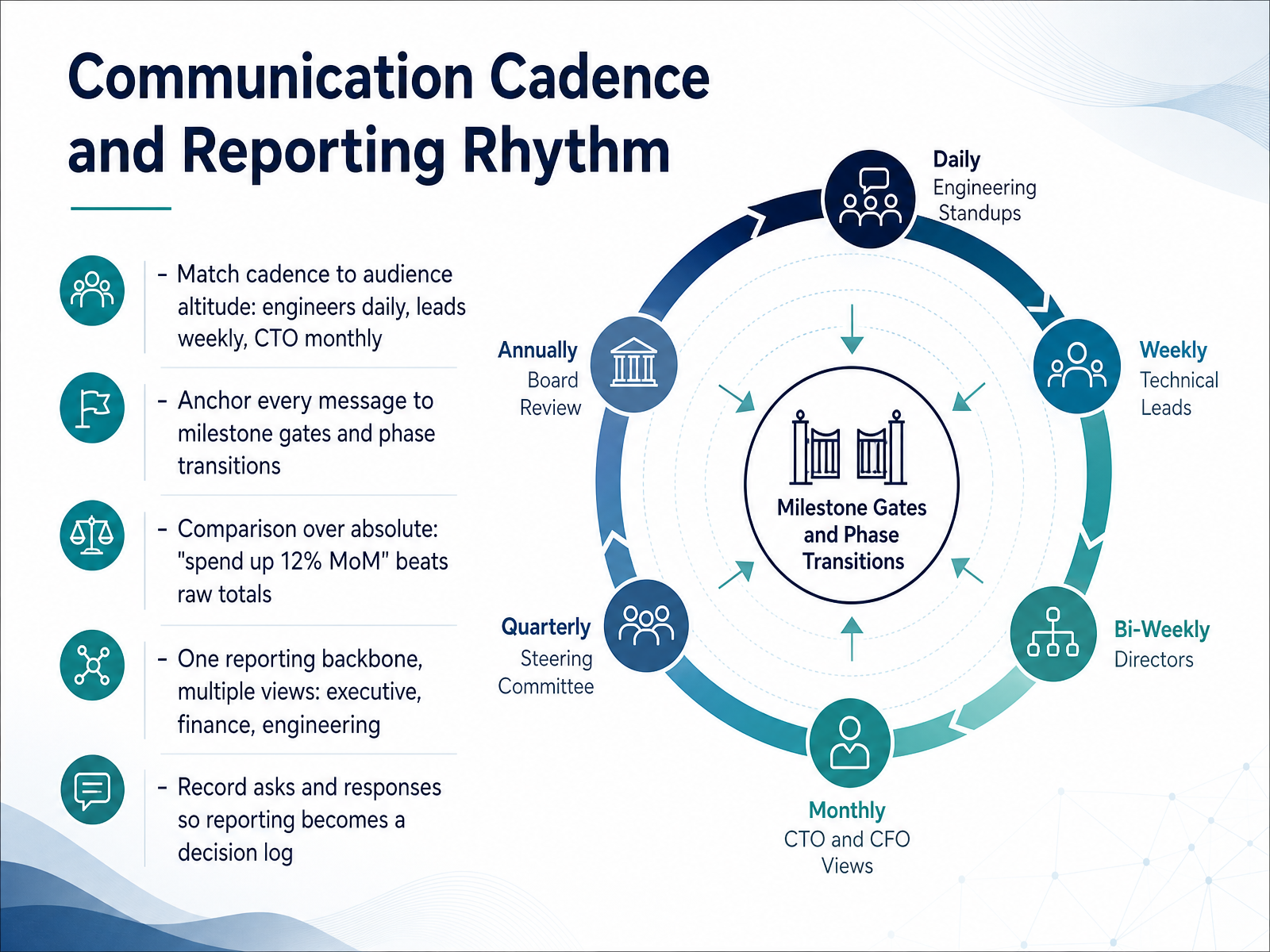
- 11Communication Cadence and Reporting RhythmLet's talk about communication cadence and reporting rhythm. Cadence should match audience altitude. Engineers get daily updates. Team leads get a weekly sync. Your CTO gets a monthly briefing. Sending the same report to all three guarantees nobody reads it.
Anchor every message to a milestone gate or a phase transition. That is when decisions actually happen and when attention is highest.
Compare rather than report absolutes. "Spend is up twelve percent month over month" tells a leader more than a raw total ever will. Raw totals invite questions. Trends invite action.
Run one reporting backbone with multiple views. Executive, finance, and engineering all draw from the same data, shaped for their decisions. One source of truth, three lenses.
Finally, record asks and responses. Every report should show what was requested, what changed, and who owns it. That turns reporting into a decision log instead of a status ritual.
One next action. Assign a single named owner for the reporting process, and agree the cadence with your stakeholders at the next review. Next, we will look at measuring progress with a balanced cloud scorecard.
 docs.aws.amazon.com2 min
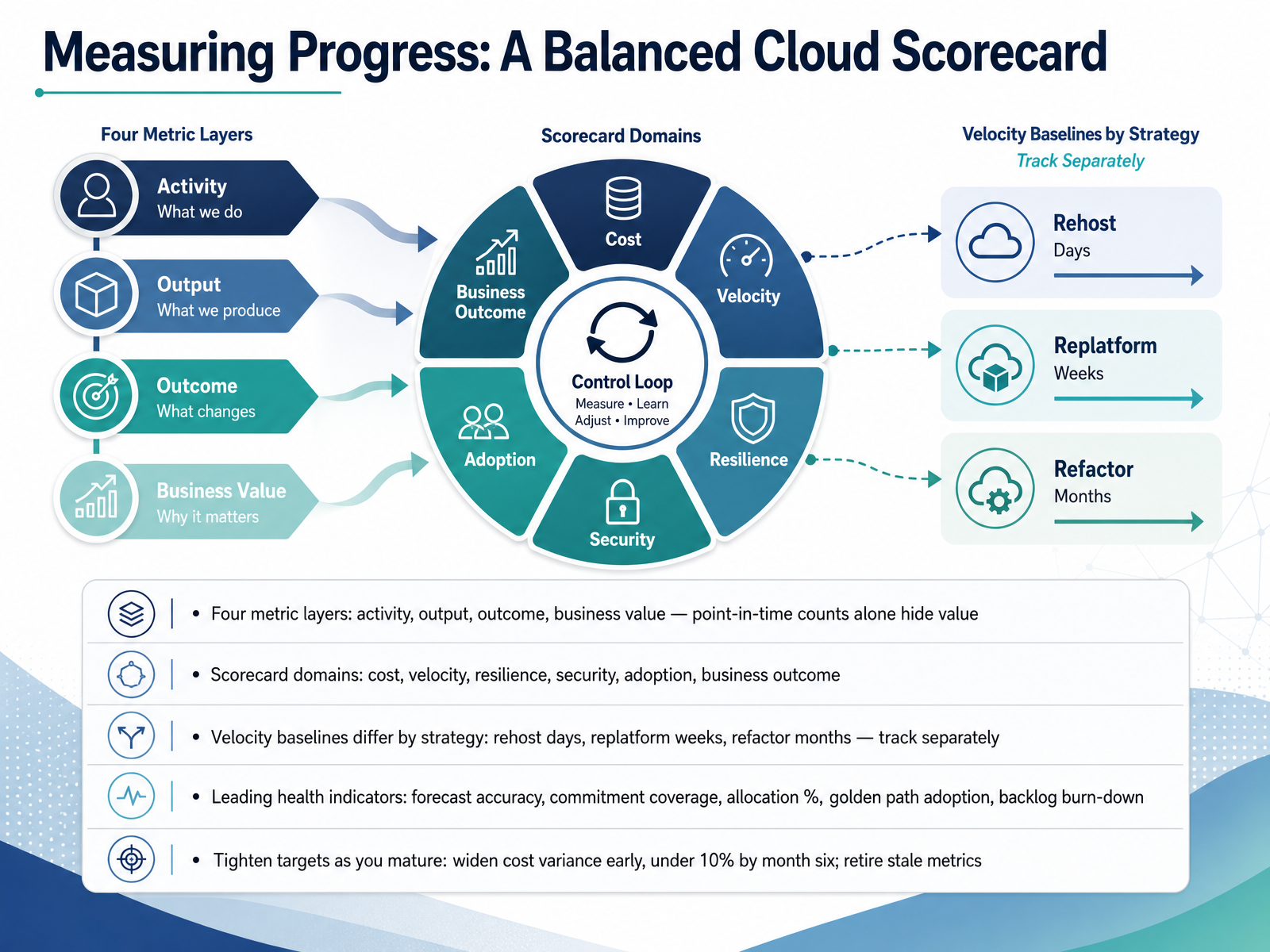
- 12Measuring Progress: A Balanced Cloud ScorecardLet's talk about measuring progress with a balanced cloud scorecard. Point-in-time counts alone hide value. Four metric layers matter: activity, output, outcome, and business value. A migration count is activity. Reduced cost per transaction is business value. Your scorecard should cover six domains: cost, velocity, resilience, security, adoption, and business outcome. Velocity baselines differ by strategy. Rehost takes days. Replatform takes weeks. Refactor takes months. Track each separately, or a slow refactor wave will hide behind fast rehosts. Watch leading health indicators: forecast accuracy, commitment coverage, allocation percentage, golden path adoption, and backlog burn-down. Finally, tighten targets as you mature. Allow wide cost variance early, then target under ten percent by month six. Retire stale metrics. Next, we look at adapting the roadmap through review mechanics and course correction.
 docs.aws.amazon.comdocs.aws.amazon.comaws.amazon.com+22 min
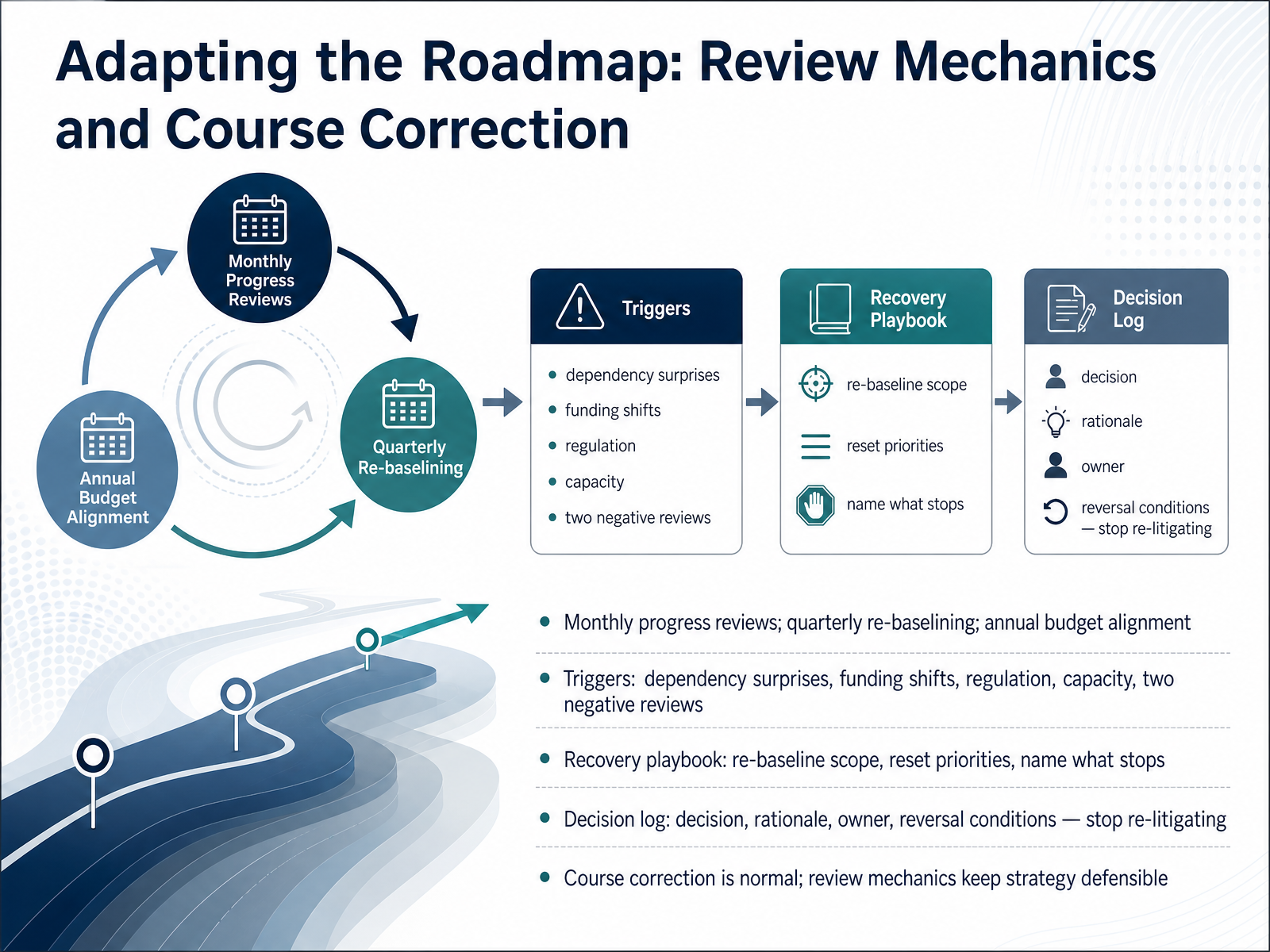
- 13Adapting the Roadmap: Review Mechanics and Course CorrectionLet's talk about how we keep the roadmap honest. Course correction is normal. What is not normal is re-litigating the same decision every month. So we run three review rhythms. Monthly progress reviews, quarterly re-baselining, and annual budget alignment. Monthly reviews are about execution. Quarterly reviews are where we reset scope and priorities. Annual alignment ties the roadmap to the funding cycle, because money is the constraint that decides what actually moves. Now the triggers. Dependency surprises, funding shifts, new regulation, capacity gaps, or two consecutive negative reviews. Any one of those should force a conversation, not a quiet extension of the timeline. When that happens, we use a recovery playbook. Re-baseline scope. Reset priorities. And name what stops. Explicitly, in writing, with an owner. Then log the decision. Decision, rationale, owner, and reversal conditions. That last field matters. It tells everyone when we would revisit the call, so we stop reopening it. A tested disaster recovery plan is still a hypothesis until you run it, and a roadmap without review mechanics is the same thing. So here is your checkpoint before the next review. Confirm your decision log is current, and that every entry names an owner and reversal condition. Next, we will build your one-page roadmap in the Action Planning Workshop: Your One-Page Cloud Roadmap.
 cbtw.technabeil.comkansoftware.com+22 min
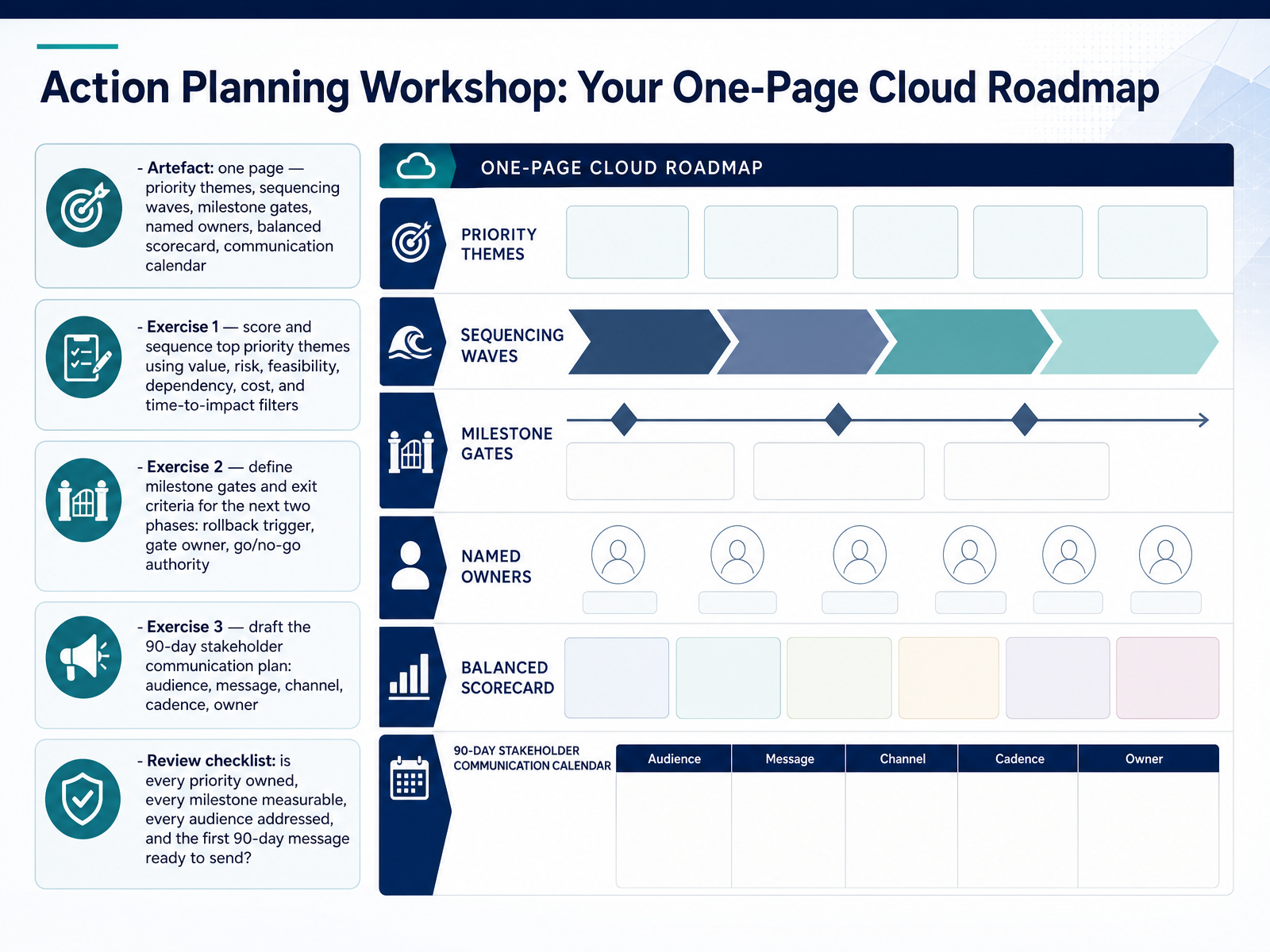
- 14Action Planning Workshop: Your One-Page Cloud RoadmapLet us close by turning the framework into something you can use tomorrow. Your deliverable is one page. Priority themes, sequencing waves, milestone gates, named owners, a balanced scorecard, and a communication calendar. That is the artefact. Exercise one: score and sequence your top priority themes. Use six filters. Value, risk, feasibility, dependency, cost, and time to impact. Exercise two: define milestone gates and exit criteria for the next two phases. Name the rollback trigger, the gate owner, and who holds go or no-go authority. Exercise three: draft your ninety-day stakeholder communication plan. For each audience, specify the message, the channel, the cadence, and the owner. Then run the review checklist. Is every priority owned? Is every milestone measurable? Is every audience addressed? And is your first ninety-day message ready to send? Here is the takeaway. A roadmap is a commitment device, not a diagram. We have covered a lot across this session. Thank you for your engagement. Take the one page, fill it in with your team this week, and start with the first message. You have the structure. Now make it real.
 docs.aws.amazon.comdocs.aws.amazon.comaws.amazon.com+22 min
Take the deck with you
Download this course as a file — free, no sign-up needed.
- PDF handoutEvery slide page, ready to print or share.15 pages · 4.0 MBDownload
- Narrated PowerPointThe deck that presents itself — every slide carries the digital human's narration video.15 pages · 16.3 MBDownload
- PowerPoint slidesThe full deck as a .pptx — open it in PowerPoint, Keynote, or Google Slides.15 pages · 3.9 MBDownload
Free to use in your own training — please keep the PersonWise credit page at the end.
Have your own deck? Turn it into a course
Sources consulted
Web sources consulted while building this course.
- Transform IT Value with a Cloud Strategy Roadmap — gartner.com
- Cloud Strategy for Enterprise IT in 2026: Complete Guide — marqi.cloud
- The Top 10 Trends In Cloud, 2026 | Forrester — forrester.com
- Microsoft CAF for Azure: Cloud Adoption Guide | Milestone — milestone.tech
- How to Create a Cloud Strategy Roadmap — buchanan.com
- Cloud Migration Change Management: The Root Causes of Failure - Americas - CBTW — cbtw.tech
- Your Cloud Implementation Went Bust. Here's Why - NABEIL SARHAN — nabeil.com
- Why Most Cloud Migrations Fail: The Pattern Behind It — kansoftware.com
- Why Cloud Transformation Stalls (and It’s Not a Technology Problem) - Full Scale — fullscale.io
- Enterprise Cloud Migration at Scale: Frameworks and Practices for Legacy-to-GCP Transformation — doi.org
- Measure progress - AWS Prescriptive Guidance — docs.aws.amazon.com
- AWS Prescriptive Guidance - Evaluating migration readiness — docs.aws.amazon.com
- Measure Transformation through the Cloud Adoption lens — aws.amazon.com
- AWS Prescriptive Guidance - Accelerating your cloud ROI by adopting a strategic transformation and change methodology — docs.aws.amazon.com
- The Google Cloud Adoption Framework — services.google.com
- FinOps Framework Overview — finops.org
- State of FinOps 2026 Report — data.finops.org
- The FinOps Foundation’s 2026 Framework: What Changes and What It Means | Virtasant — virtasant.com
- FinOps Governance Framework for Enterprise Cloud | env zero — envzero.com
- What is FinOps? A complete guide to the practice, the framework, and what it looks like when it works - Obsium — obsium.io