Begin
15 pages · ~30 min
Customer Success Software Selection and Workflow
This training guides customer success teams through selecting the right software, defining requirements, and building efficient workflows.
A digital instructor presents all 15 pages. Hold “Ask” at any point and ask out loud — the answer comes from this course. No sign-up needed.
What you’ll learn
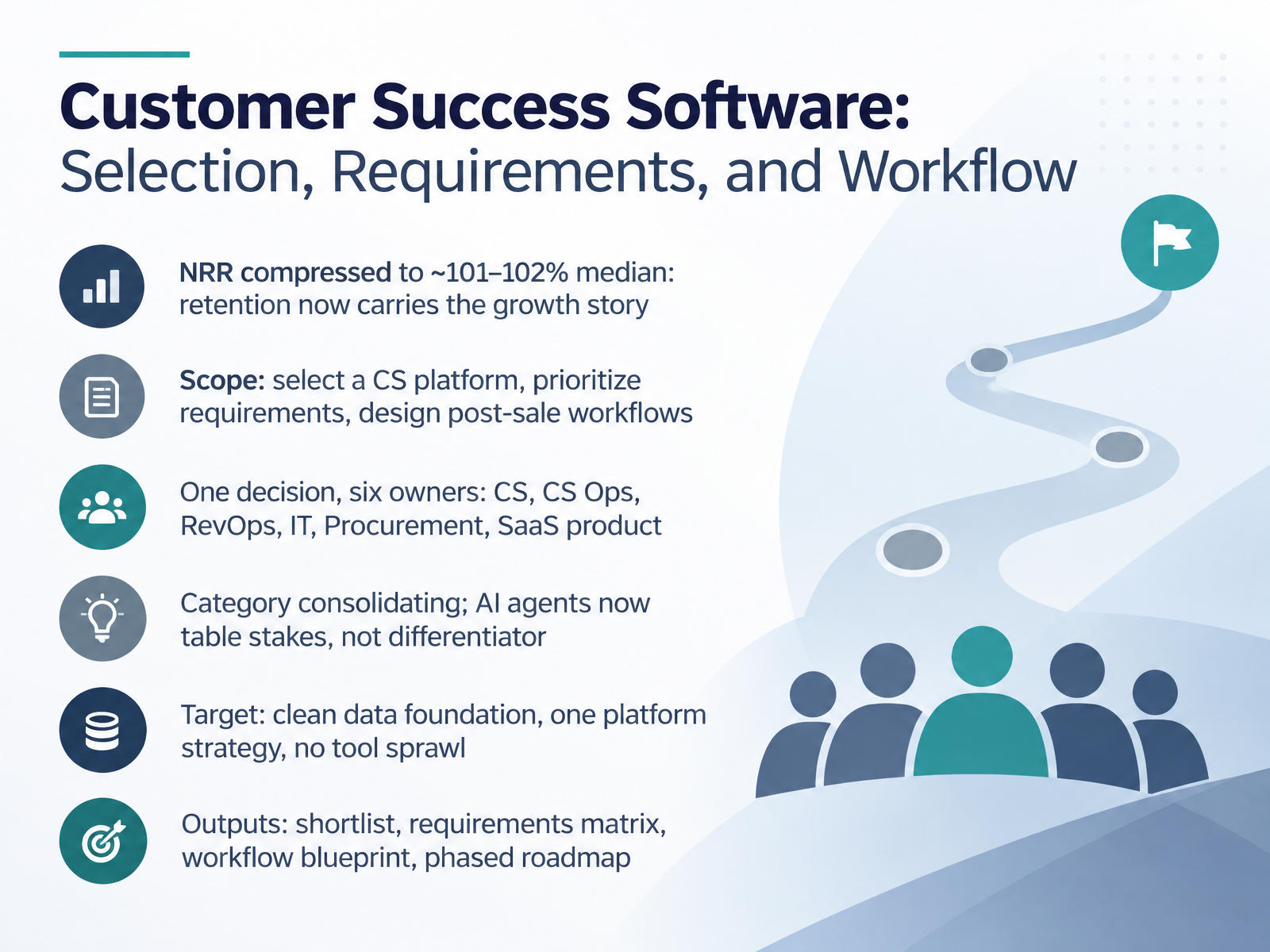
- 01Customer Success Software: Selection, Requirements, and WorkflowWelcome. Over the next fifteen slides, we'll work through one decision with real consequences: selecting customer success software, prioritizing requirements, and designing the post-sale workflows that run on it.
Let's start with why this matters now. Net revenue retention has compressed to a median of roughly one hundred and one to one hundred and two percent. Expansion is no longer carrying growth. Retention is. That changes what you buy and who owns it.
This is one decision with six owners: CS, CS Ops, RevOps, IT, Procurement, and your SaaS product team. Each has a stake. Each can stall the process. Name the decision owner on day one.
Two market realities. First, the category is consolidating. Point solutions are being absorbed, so weigh vendor stability, not just features. Second, AI agents are now table stakes, not a differentiator. Do not pay a premium for them.
Your target state is narrow: a clean data foundation, one platform strategy, no tool sprawl. Adding a twelfth tool rarely moves retention. Operationalizing the first seven always does.
By the end, you'll have four outputs: a shortlist, a requirements matrix, a workflow blueprint, and a phased roadmap.
The Retention Economics That Justify the Investment.forrester.comgartner.comreports.letaido.it+22 min
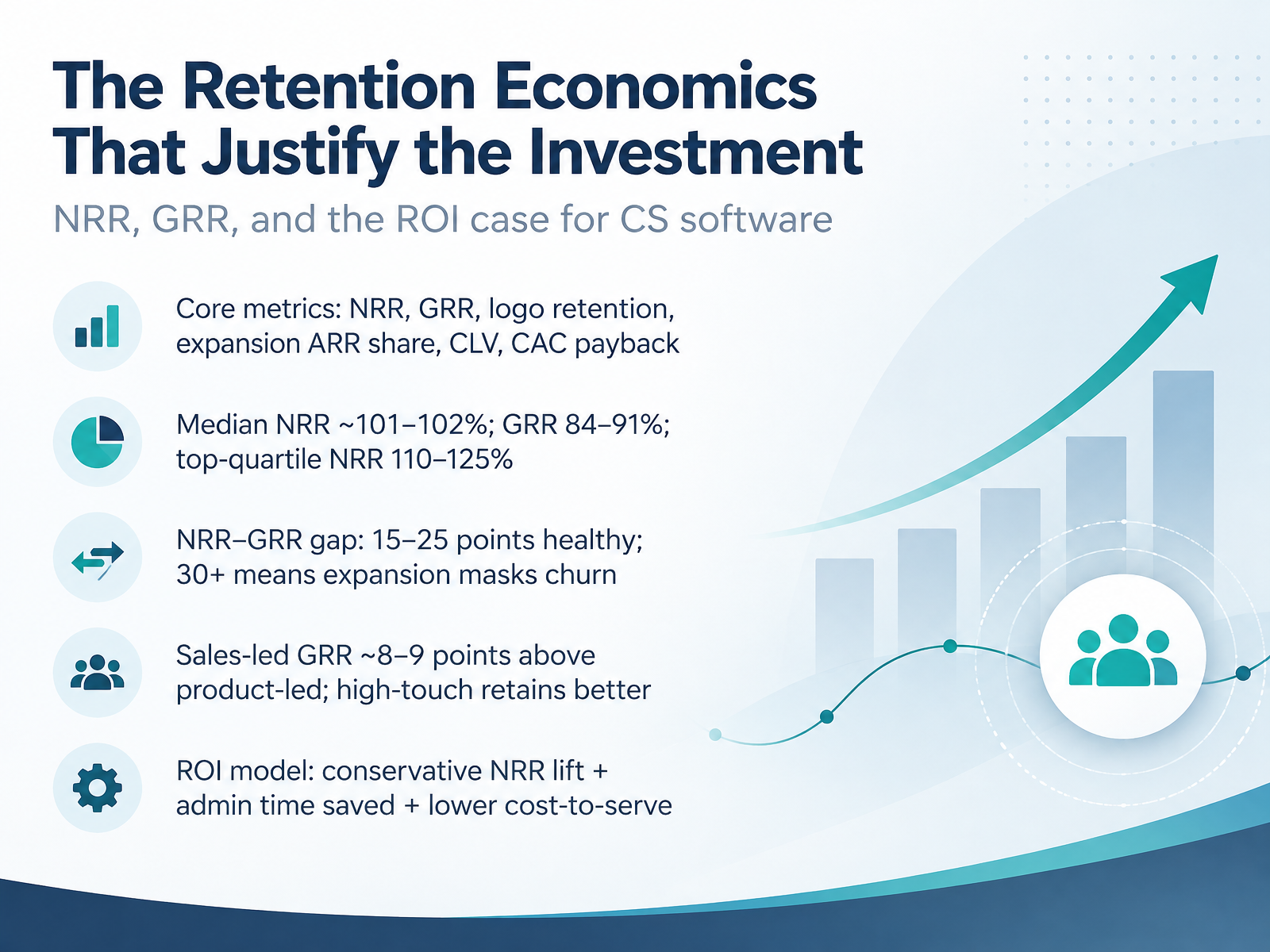
- 02The Retention Economics That Justify the InvestmentLet's build the business case. Start with two numbers, always reported together. Net revenue retention includes expansion. Gross revenue retention strips it out. Across private B2B SaaS, median NRR sits around one hundred and one to one hundred and two percent, and median GRR ranges from eighty-four to ninety-one percent. Top quartile NRR runs one hundred and ten to one hundred twenty-five percent. Treat those as your benchmark, not the one hundred twenty percent stories from twenty twenty-one. Now watch the gap. A spread of fifteen to twenty-five points is healthy. Thirty points or more means expansion is masking churn. That is a leaky bucket, and it will catch up. One more cut. Sales-led motions retain eight to nine points higher GRR than product-led, because named sponsors and business reviews hold revenue. So build your ROI model on three lines the CFO will accept: a conservative NRR lift, admin time saved, and lower cost-to-serve. Then decide who owns each one. Next, CS Operations, RevOps, and Who Owns What.
 cust.cogrowthspreeofficial.comb2bcentr.com+22 min
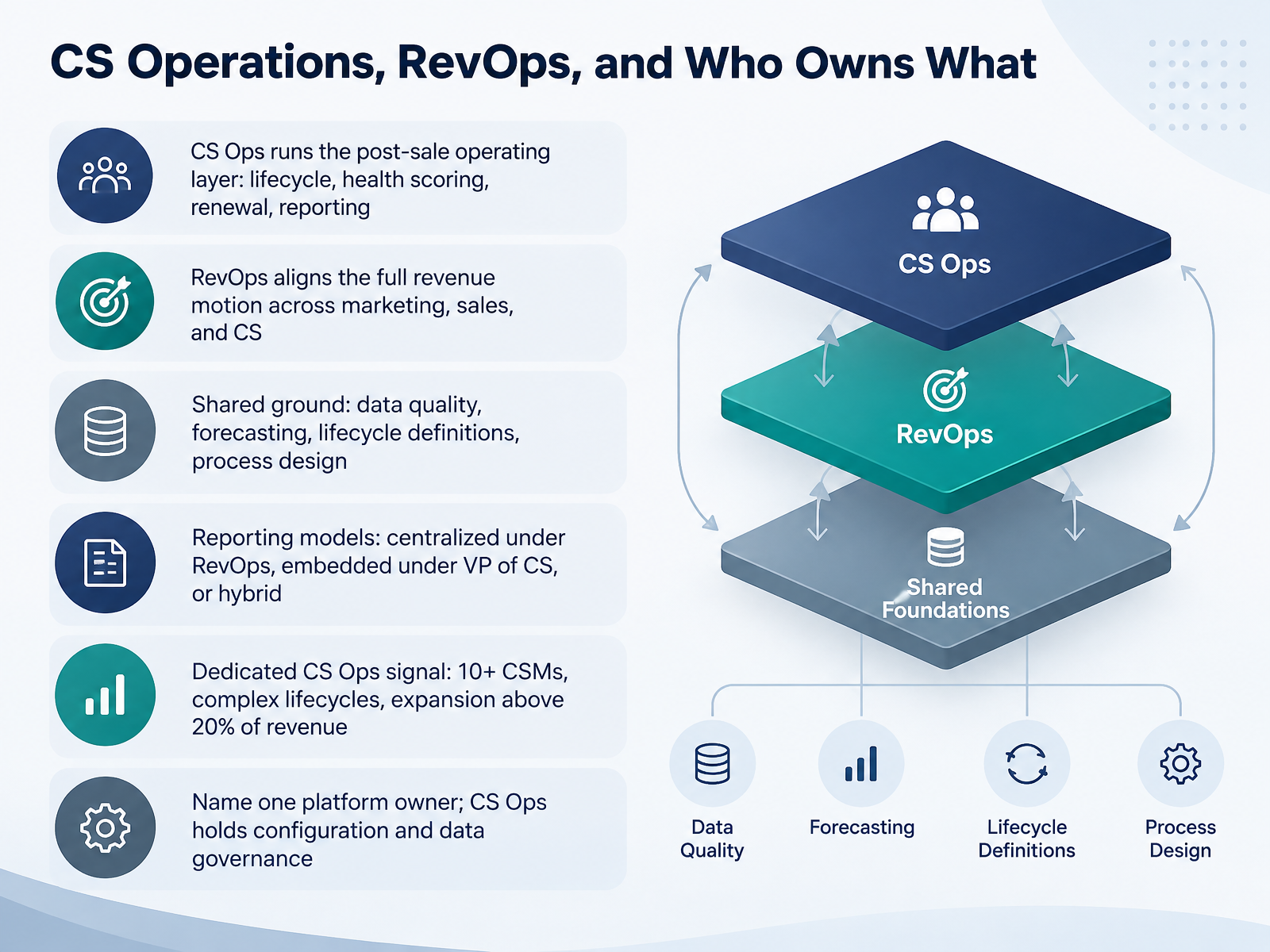
- 03CS Operations, RevOps, and Who Owns WhatLet's talk about ownership, because unclear ownership is where CS software projects fail. CS Ops runs the post-sale operating layer: lifecycle design, health scoring, renewal workflows, and CS reporting. RevOps owns the full revenue motion across marketing, sales, and CS. They share real ground: data quality, forecasting, lifecycle definitions, and process design. So where should CS Ops report? You have three models. Centralized under RevOps gives cross-functional alignment, but CS priorities can get deprioritized. Embedded under the VP of CS gives speed and depth, but risks siloed data and duplicate tooling. Hybrid is most common between twenty and fifty million ARR, and it works only when leaders communicate. When do you need dedicated CS Ops? Three signals: more than ten CSMs, a complex lifecycle, or expansion above twenty percent of revenue. If two or more apply, make the hire. Finally, name one platform owner. CS Ops holds configuration and data governance so CSMs never maintain their own spreadsheets. Next, let's map what a CS platform actually does.
 landandexpand.academygetfairview.comrevsearch.io+21 min
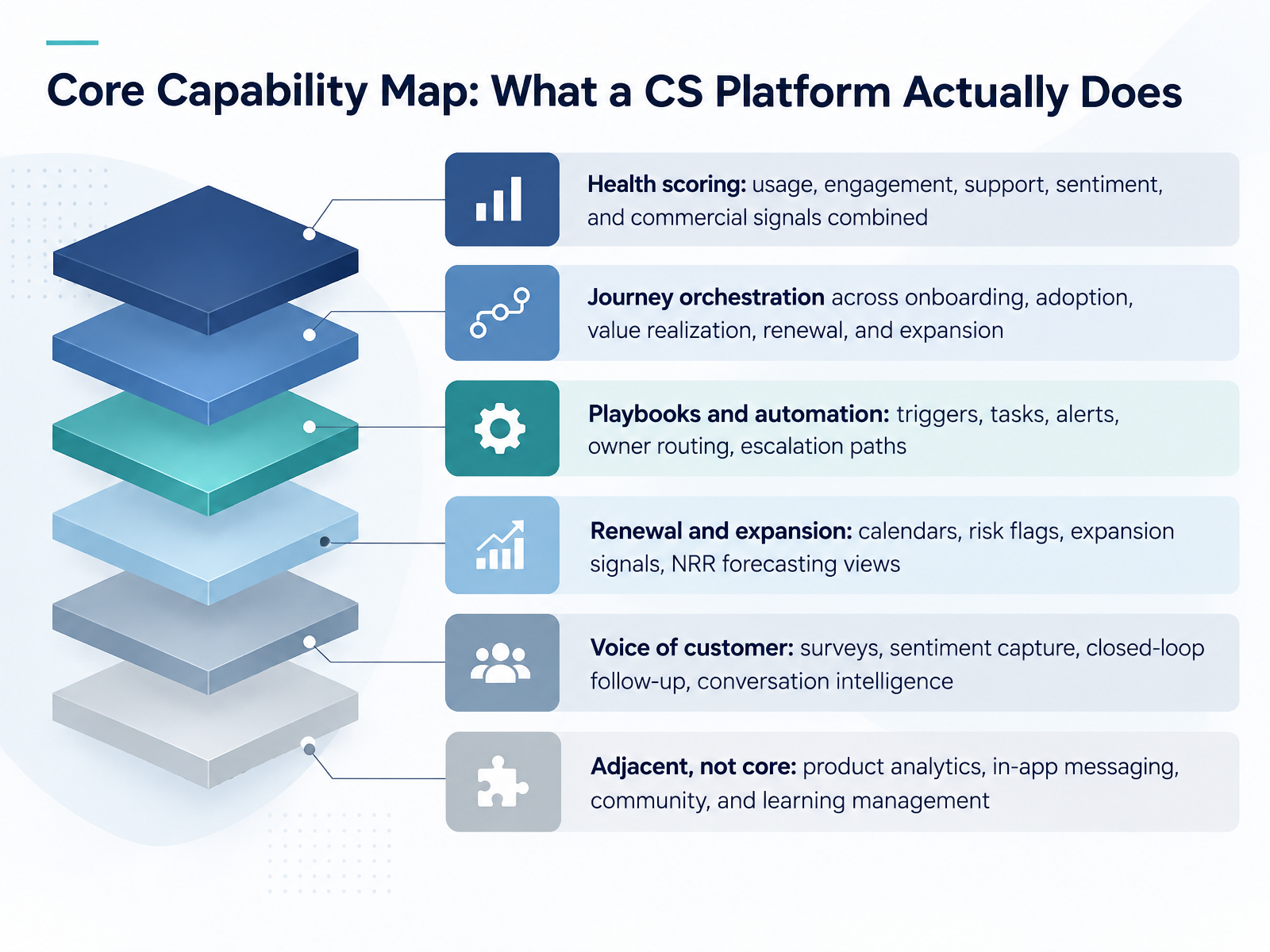
- 04Core Capability Map: What a CS Platform Actually DoesNow let's map the core capabilities, so you can separate what you're actually buying from what you're assembling. Health scoring comes first. Usage, engagement, support tickets, sentiment, and commercial signals combined into one score. If any of those inputs is missing, your score will mislead you. Next, journey orchestration across onboarding, adoption, value realization, renewal, and expansion. Then playbooks and automation: triggers, tasks, alerts, owner routing, and escalation paths. Assign a single owner for each playbook, or nothing fires. Renewal and expansion follows. Calendars, risk flags, expansion signals, and NRR forecasting views. Your finance and RevOps teams will live here. Voice of customer covers surveys, sentiment capture, closed-loop follow-up, and conversation intelligence. And know the boundary. Product analytics, in-app messaging, community, and learning management are adjacent, not core. Buy them only where the platform proves depth. Next, we go deeper on health scoring and the data foundation it requires.
 forrester.comgartner.comreports.letaido.it+22 min
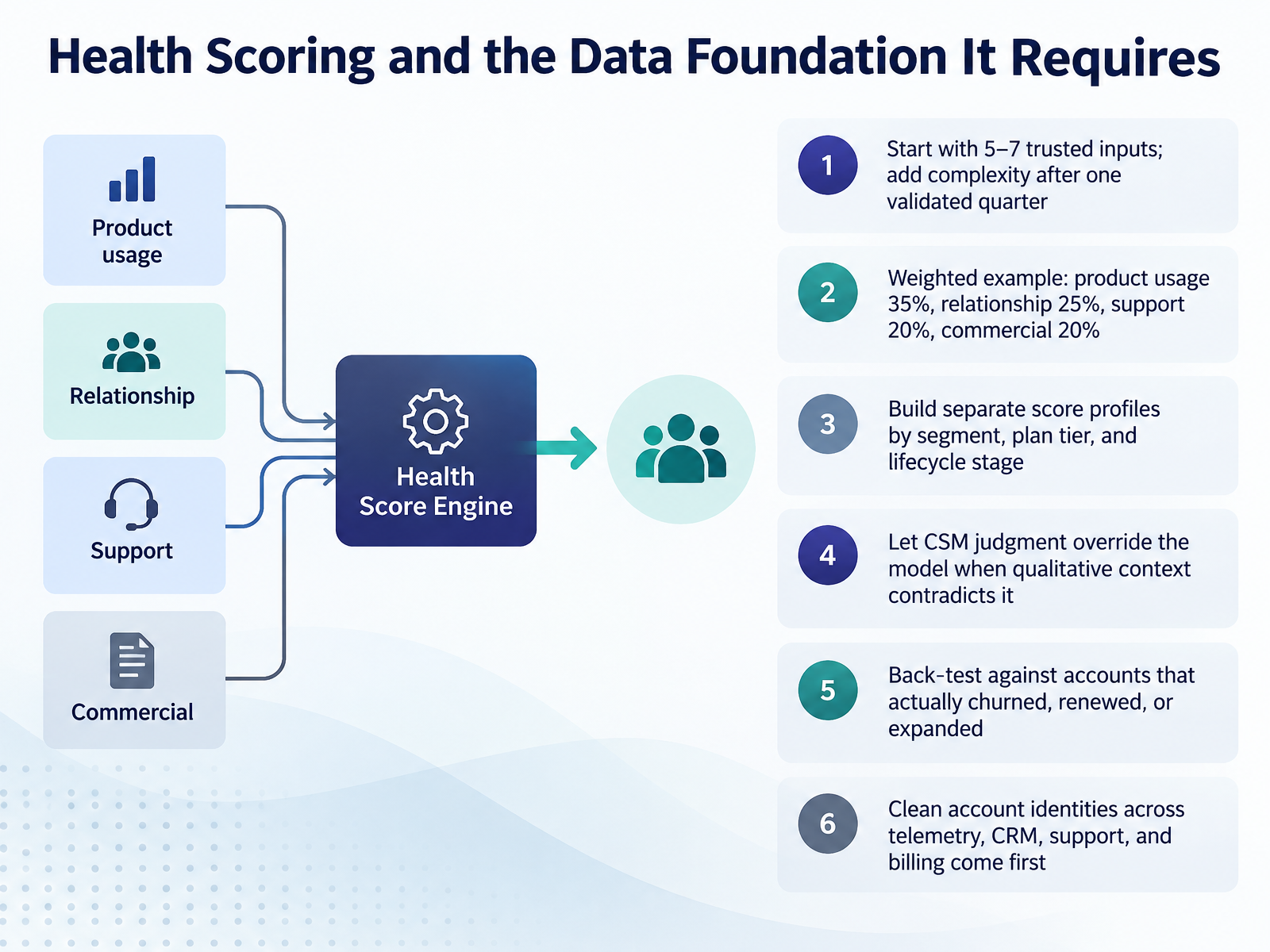
- 05Health Scoring and the Data Foundation It RequiresLet's talk about health scoring, and the data foundation it actually requires. Start small. Build five to seven trusted inputs first, then add complexity after one validated quarter. A weighted model often looks like this. Product usage, thirty five percent. Relationship signals, twenty five percent. Support, twenty percent. Commercial, twenty percent. Next, build separate score profiles by segment, plan tier, and lifecycle stage. What counts as healthy for a startup should not be applied to an enterprise account. Then, let CSM judgment override the model when qualitative context contradicts it. The score advises. The CSM decides. Back test your model against accounts that actually churned, renewed, or expanded. If it cannot separate those groups, it is not predictive yet. And one prerequisite sits above all of this. Clean account identities across telemetry, CRM, support, and billing come first. Assign that ownership to CS Operations before you configure a single weight. From Business Outcomes to a Requirements Matrix.
 zapier.comthecroreport.comlearn.g2.com+22 min
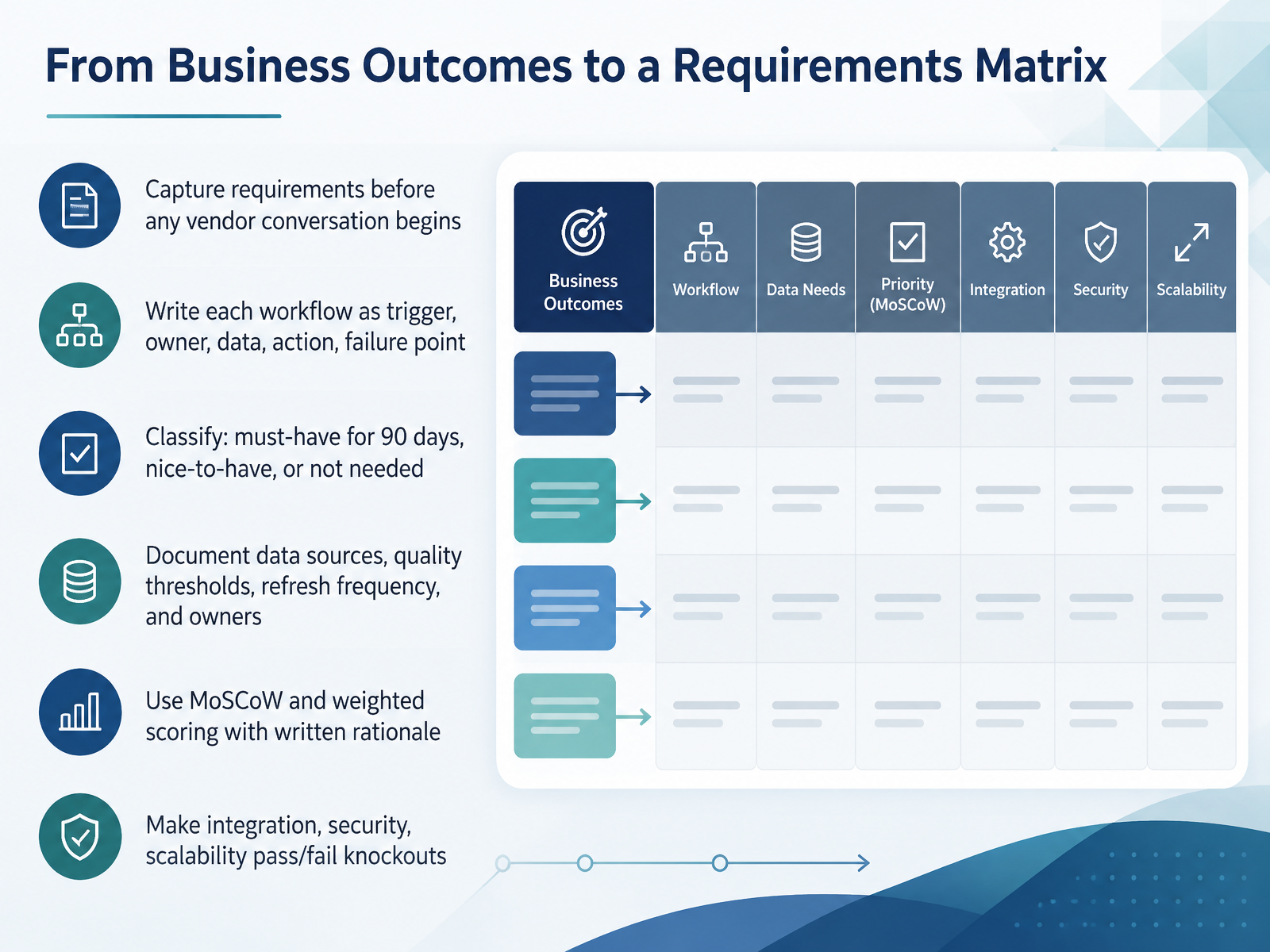
- 06From Business Outcomes to a Requirements MatrixNow let's turn those outcomes into a requirements matrix. Write your requirements before any vendor conversation begins. That keeps the vendor from framing the problem for you. Document each recurring workflow in five fields: trigger, owner, data, action, and failure point. Take the low-adoption alert. Trigger is a weekly usage drop. Owner is the CSM. Data is product events and seat count. Action is an outreach task. The failure point today is noisy alerts. Then classify each requirement: must-have for the first ninety days, nice-to-have, or not needed. Next, document your data sources. For each one, name the quality threshold, the refresh frequency, and the owner. Then score vendors with MoSCoW and a weighted matrix, and write down your rationale for every score, because that is what your CFO will question. Finally, integration, security, and scalability are pass or fail. Not weighted. A vendor that misses one is out. Next, Market Landscape: Vendor Segments and Positioning.
 2 min
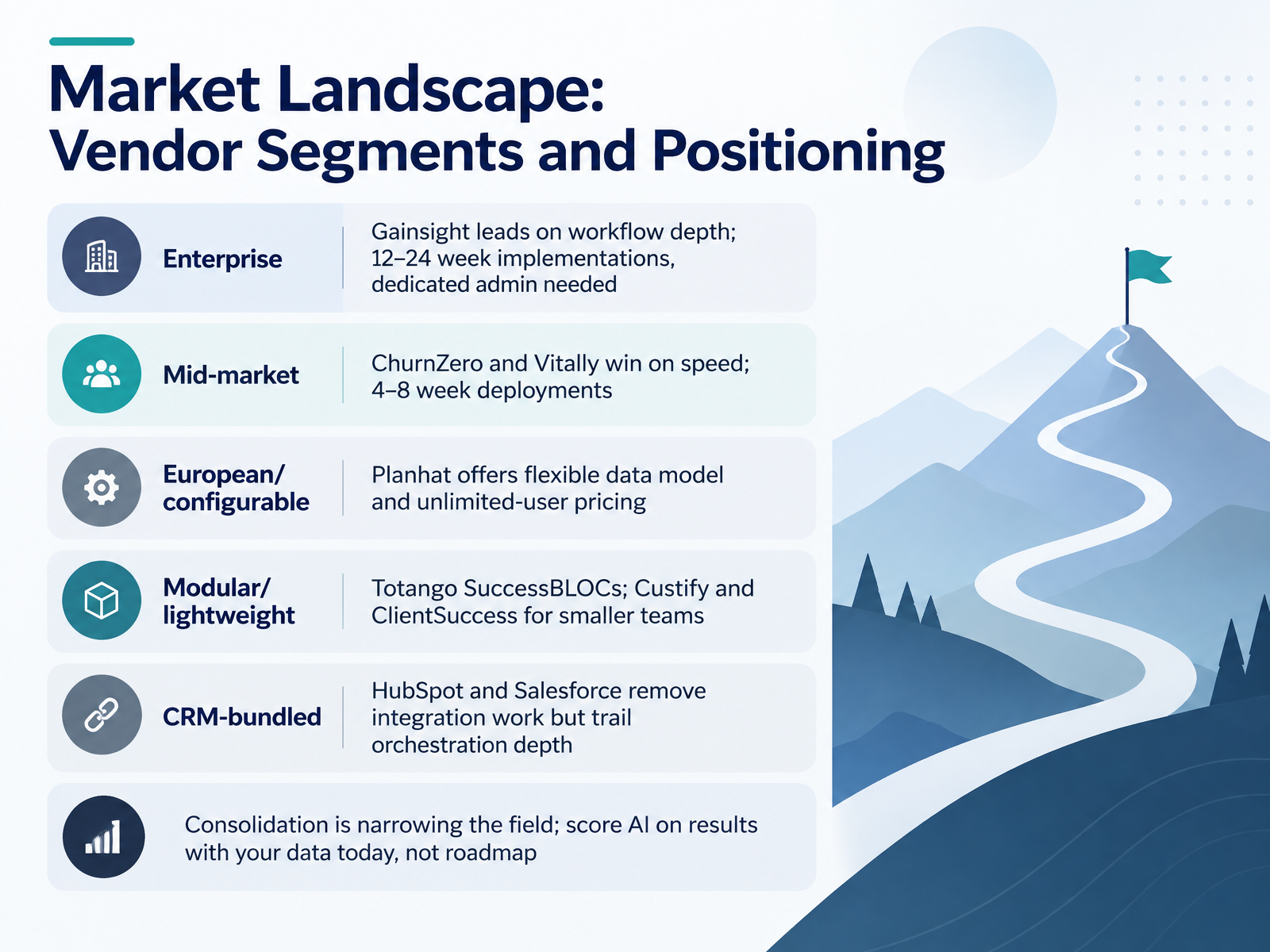
- 07Market Landscape: Vendor Segments and PositioningLet's map the vendor landscape by segment. Enterprise: Gainsight leads on workflow depth. Plan on twelve to twenty four week implementations, and a dedicated admin on staff. If you cannot fund that admin, its depth becomes a liability.
Mid-market: ChurnZero and Vitally win on speed, with deployments in four to eight weeks. Recommend them for teams of roughly three to fifteen CSMs.
European or highly configurable: Planhat offers a flexible data model and unlimited-user pricing. For a twenty-person team, that seat model can save tens of thousands a year.
Modular or lightweight: Totango SuccessBLOCs, plus Custify and ClientSuccess for smaller teams and faster time to value.
CRM-bundled: HubSpot and Salesforce remove integration work, but trail standalone platforms on orchestration depth.
One caution: consolidation is narrowing the field. Score AI on results with your data today, not roadmap. Next, we build the weighted scorecard, demo script, and proof-of-concept design.
 forrester.comgartner.comreports.letaido.it+22 min
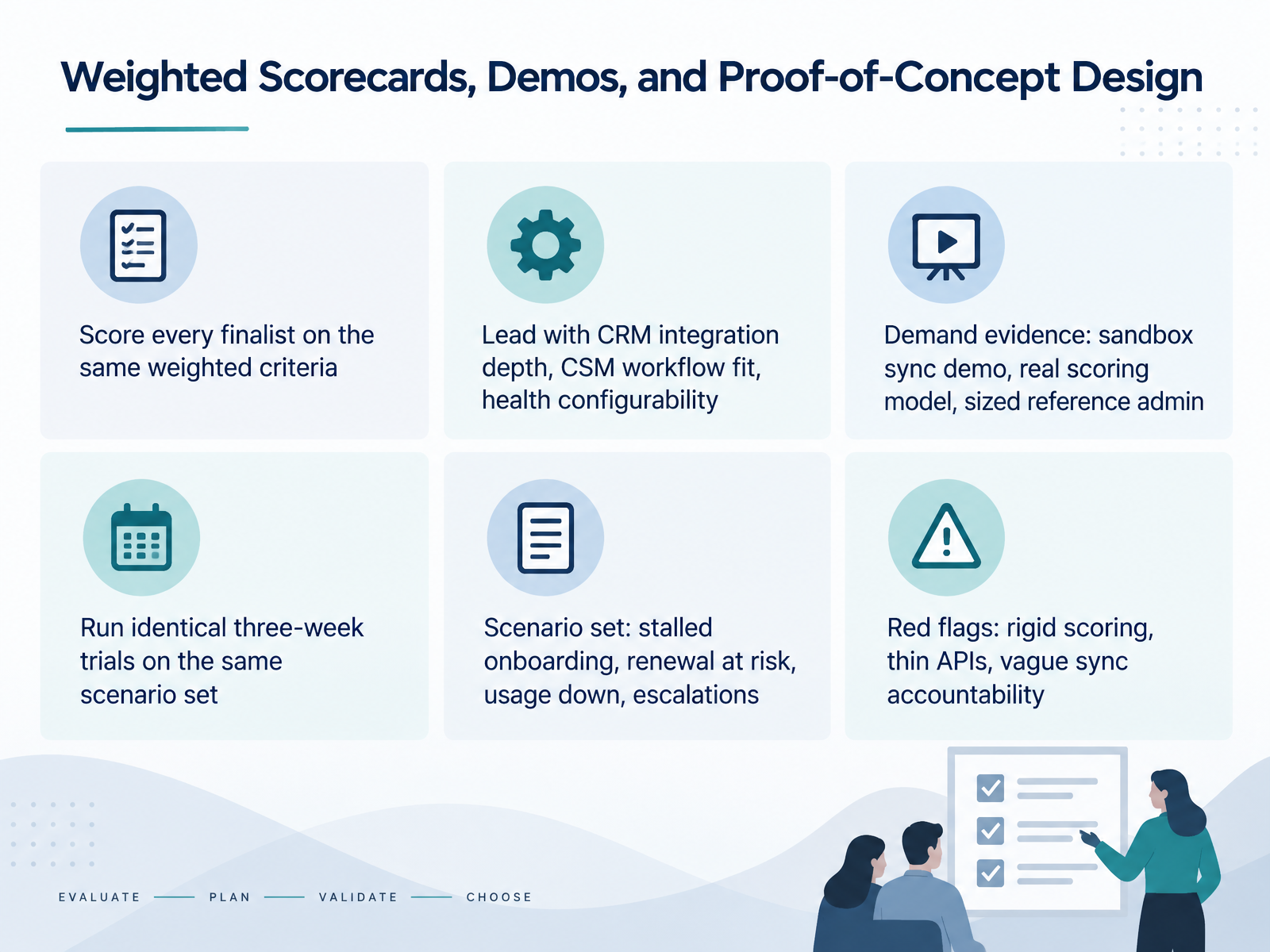
- 08Weighted Scorecards, Demos, and Proof-of-Concept DesignNow let's talk about how you actually separate the finalists. Three things: a weighted scorecard, evidence-based demos, and a real proof of concept. First, score every finalist on the same weighted criteria. Don't let each vendor set the agenda. Weight the criteria by what breaks deals after signature, not what dazzles in the demo. Lead with CRM integration depth, CSM daily workflow fit, and health score configurability. Second, demand evidence. Ask for a live sandbox sync demo, not a slide. Ask to see a real scoring model from a live customer. And ask for a reference admin at a company your size. Then run identical three-week trials on the same scenario set. Give every vendor the same scripts: stalled onboarding, renewal at risk, usage down, and open escalations. Write the test yourself; don't let the vendor write it. Watch for red flags. Rigid scoring you can't configure. Thin APIs. And vague answers about who owns sync failures. If a vendor won't run a real trial on your data, that's your answer. Next, we'll look at total cost of ownership and commercial terms.
 zapier.comthecroreport.comlearn.g2.com+22 min
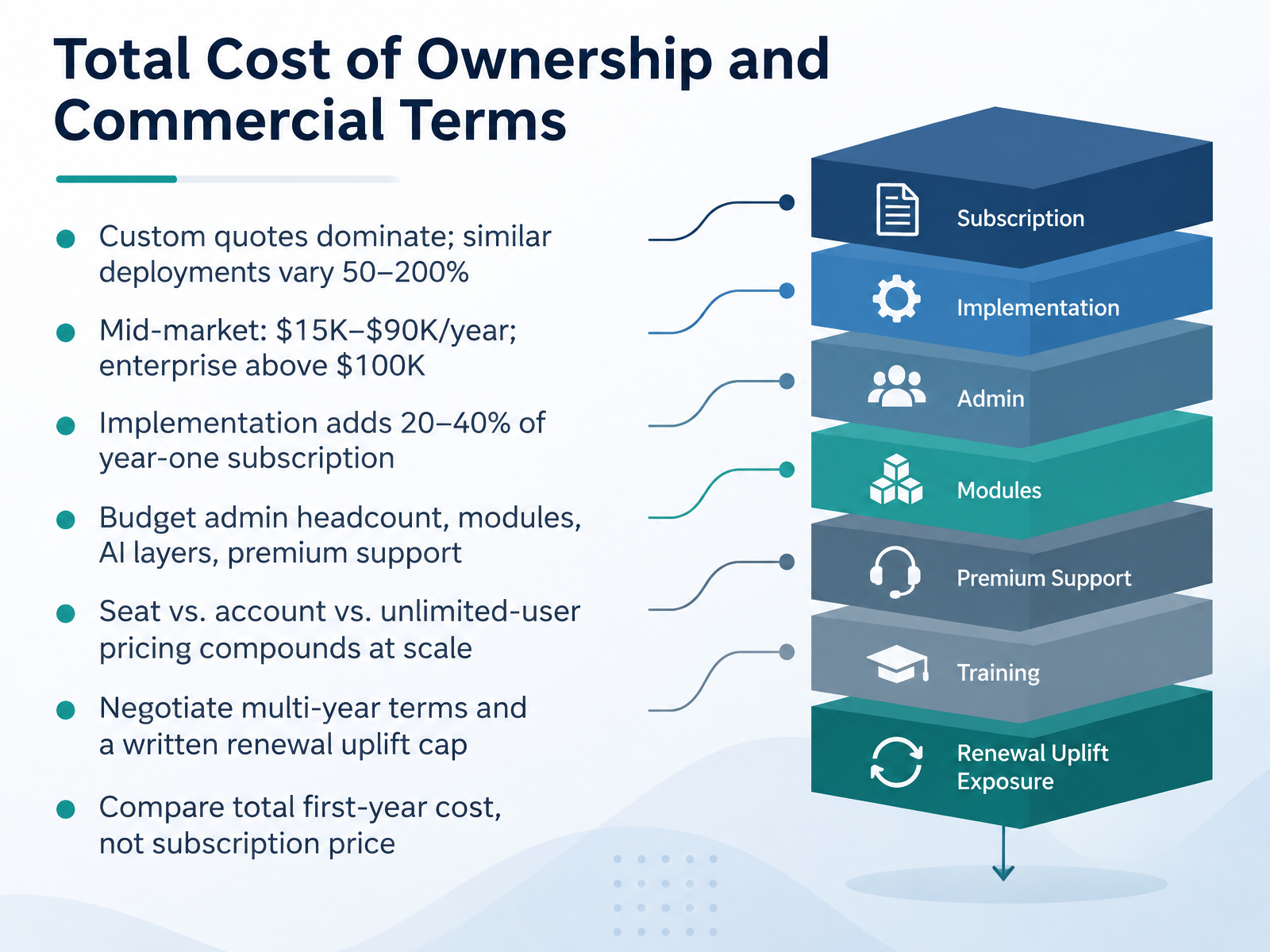
- 09Total Cost of Ownership and Commercial TermsNow let's talk about cost. Treat this as a negotiating slide, not a pricing slide. Custom quotes dominate, so two similar deployments can vary by fifty to two hundred percent. For planning, mid-market usually lands between fifteen thousand and ninety thousand dollars a year. Enterprise sits above one hundred thousand. And implementation adds twenty to forty percent of your year-one subscription. So budget the full first year, not the license. That includes admin headcount, add-on modules, AI layers, and premium support. Pricing model also compounds at scale. Seat-based, account-based, and unlimited-user models grow very differently as your book grows. Your move: negotiate multi-year terms and get a written renewal uplift cap. Then compare total first-year cost, never subscription price alone. Next, we move into workflow design and the operating model.
 zapier.comthecroreport.comlearn.g2.com+21 min
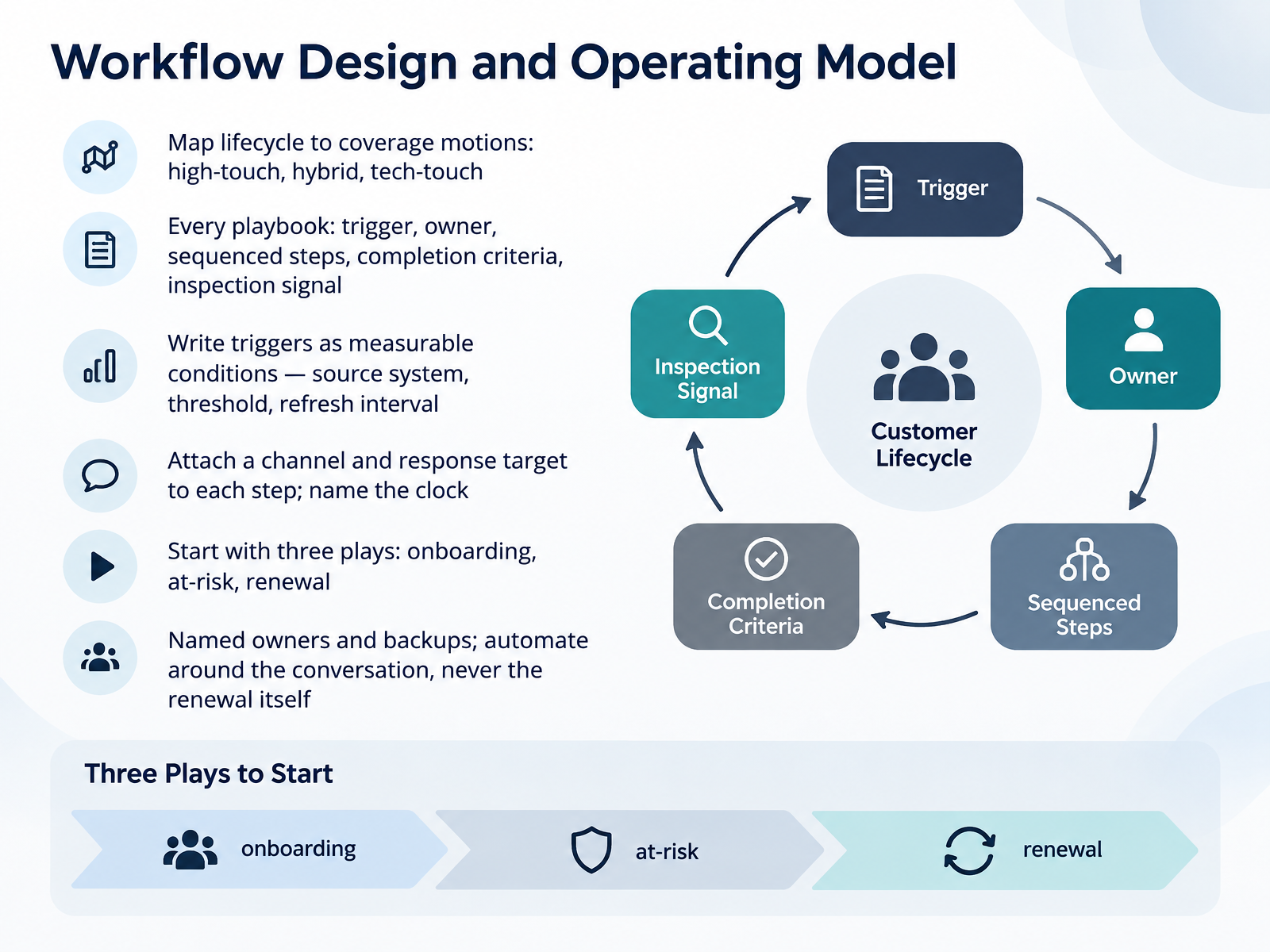
- 10Workflow Design and Operating ModelLet's turn the design into an operating model. First, map your lifecycle to coverage motions. High-touch, hybrid, tech-touch. A fifty-thousand-dollar account and a five-thousand-dollar account should not run the same play. Every playbook needs five parts: trigger, owner, sequenced steps, completion criteria, and an inspection signal. Write triggers as measurable conditions. Name the source system, the threshold, and the refresh interval. Not customer seems unhappy. Instead, weekly active users drop fifteen percent below the ninety-day baseline, pulled from product analytics, refreshed daily. Then attach a channel and a response target to each step. Name the clock. Day one, email from the shared CS mailbox, reply within four business hours. Start with three plays: onboarding, at-risk, and renewal. Do not build thirty. Name one owner and one backup per play. Shared ownership means no ownership. And automate around the conversation, never the renewal itself. Next, metrics, dashboards, and operating cadence.
 landandexpand.academygetfairview.comrevsearch.io+22 min
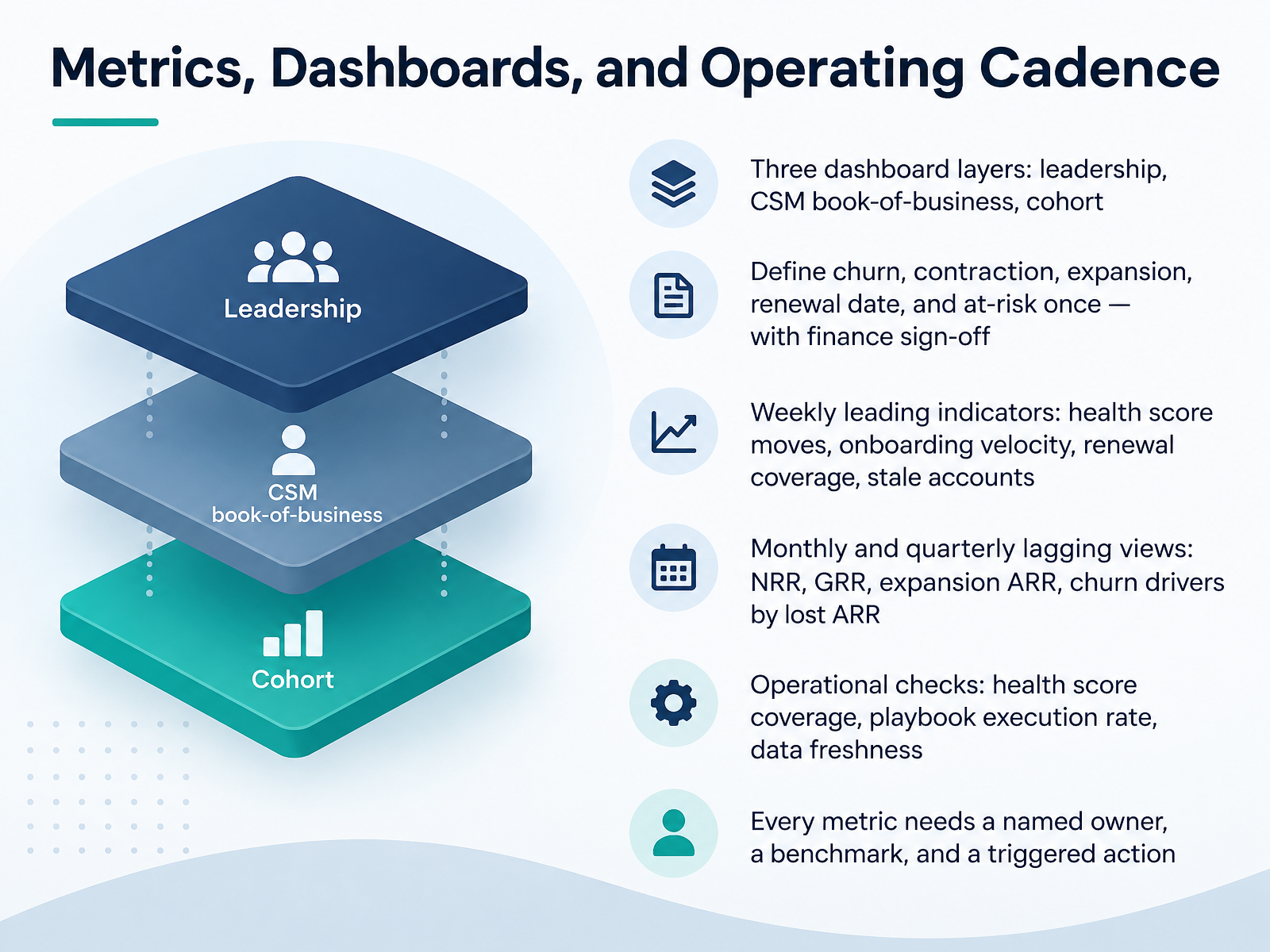
- 11Metrics, Dashboards, and Operating CadenceNow let's talk about the metrics, dashboards, and operating cadence that keep this system honest. Build three dashboard layers. Leadership sees net revenue retention, gross revenue retention, churn, and expansion. The CSM layer is a filterable book of business. The cohort layer is for exploration. Then define churn, contraction, expansion, renewal date, and at-risk once, in one place, with finance sign-off. If CS and finance disagree on what counts as churn, every downstream number is wrong. Weekly, review leading indicators: health score moves, onboarding velocity, renewal coverage, and stale accounts. Monthly and quarterly, review NRR, GRR, expansion ARR, and churn drivers ranked by lost ARR. Add three operational checks: health score coverage, playbook execution rate, and data freshness. And here is the discipline that matters most. Every metric needs a named owner, a benchmark, and a triggered action. If a number has no owner and no action, take it off the dashboard. Next, the implementation roadmap and sequencing.
 getfairview.comlandandexpand.academyrevsearch.io+22 min
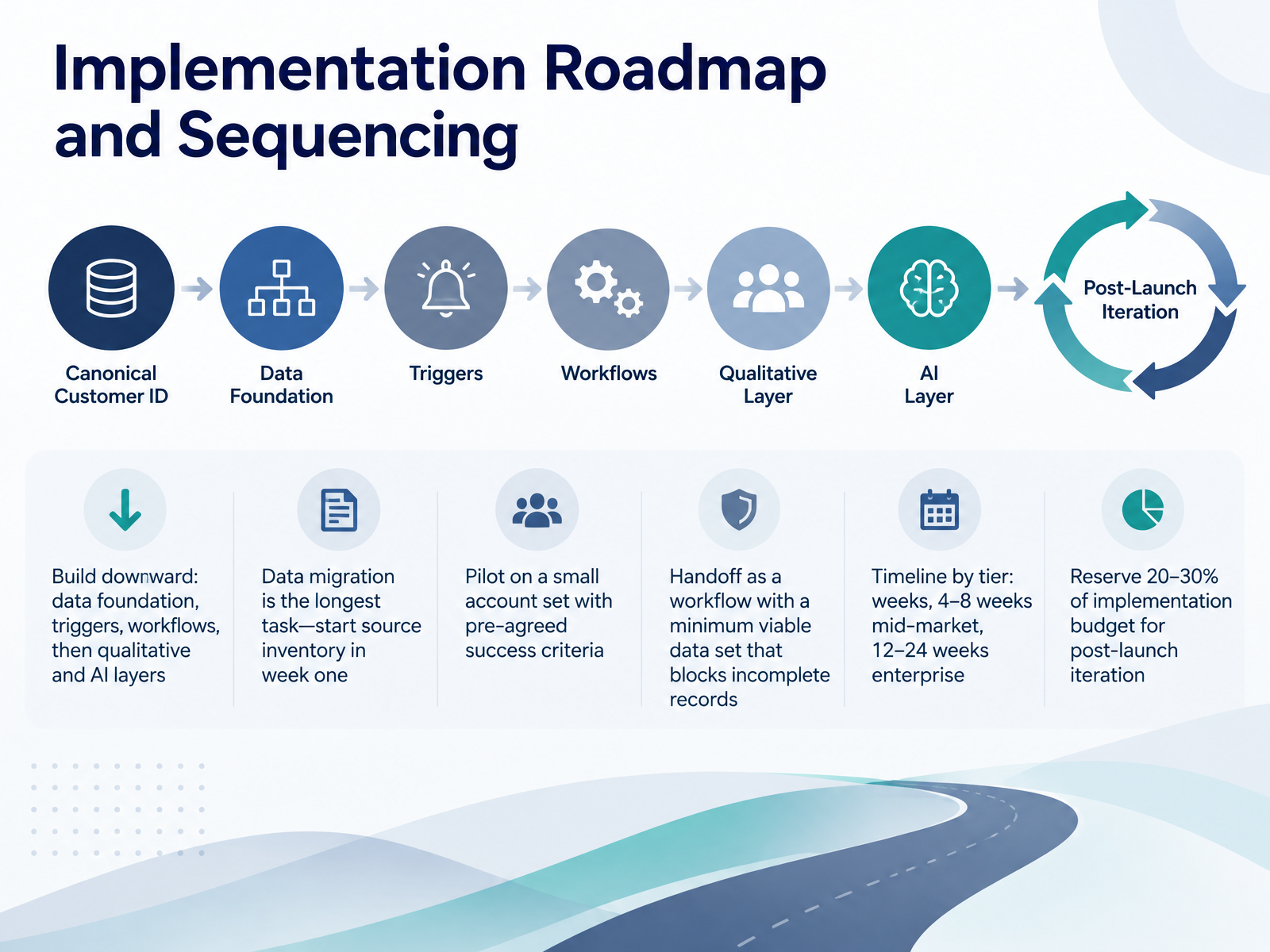
- 12Implementation Roadmap and SequencingLet's talk sequencing, because order decides whether you finish. Build downward. Data foundation first. Then triggers. Then workflows. Then the qualitative and AI layers on top. Each layer depends on the one below it, so if you build upward, every layer above inherits the mess.
Data migration is the longest task in any implementation. Start your source inventory in week one, not week twelve. That means every source system, every duplicate, every missing field. Fail early on bad data, not the day before go-live.
Pilot on a small account set with success criteria you agree on before you start. Pick accounts with high visibility and high change readiness, so the first phase wins.
Treat handoff as a workflow, not an email. Define your minimum viable data set, and block incomplete records from advancing. If the reason for purchase or the success criteria is missing, the handoff stops there. Your CSM should enter kickoff with a pre-populated plan, not a blank notebook.
Timelines vary by tier. Small teams, a few weeks. Mid-market, four to eight weeks. Enterprise, twelve to twenty-four weeks.
Last, reserve twenty to thirty percent of your implementation budget for post-launch iteration. That's where the real return lives.
Next, we cover Change Management, Enablement, and Adoption.
 2 min
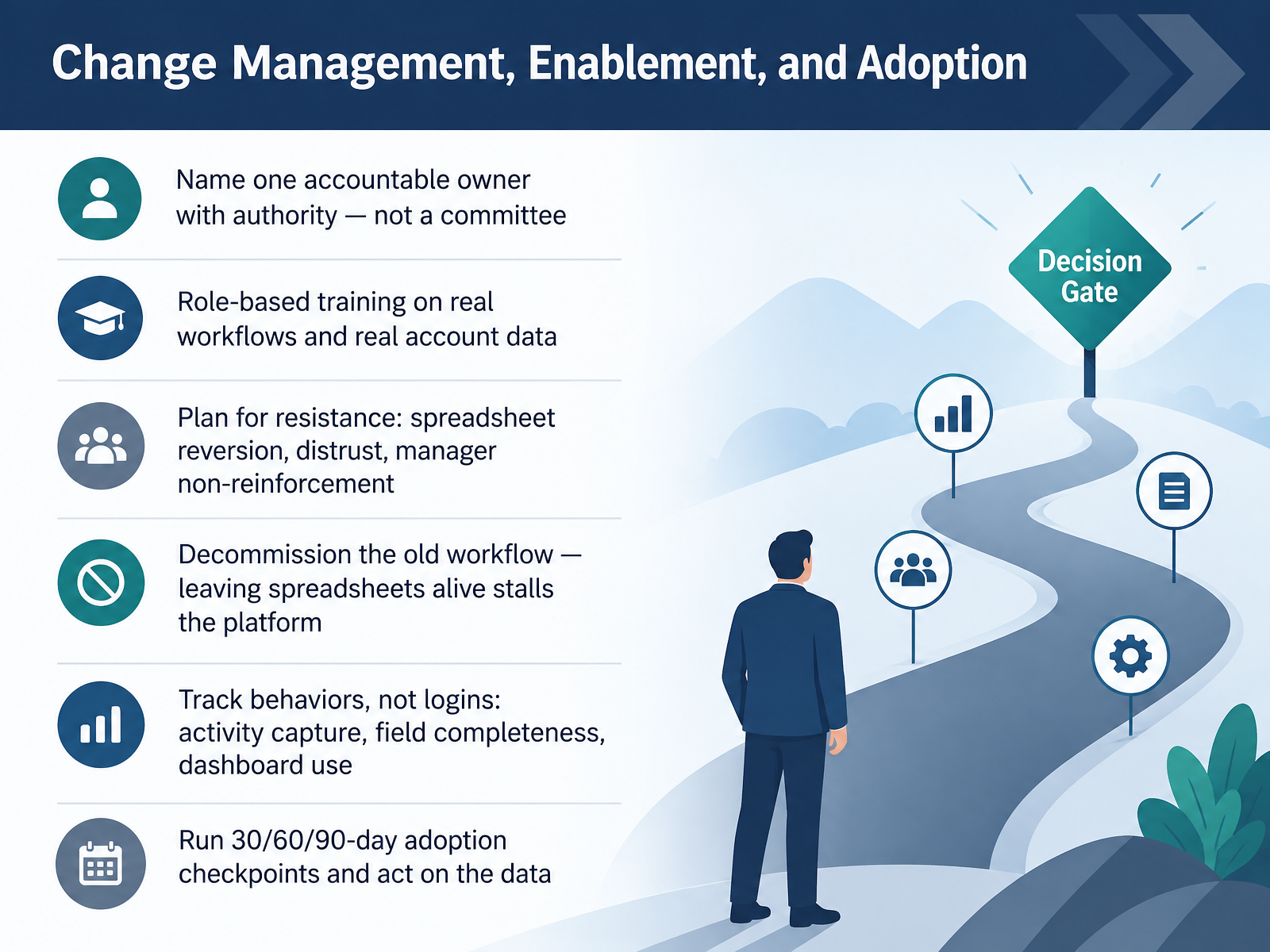
- 13Change Management, Enablement, and AdoptionNow let's talk about making the platform actually stick: change management, enablement, and adoption. Name one accountable owner with real decision authority. Not a committee. When teams disagree, that person decides. Train by role, on real workflows and real account data. A CSM should practice an actual renewal review, not a generic tour. Now plan for resistance, because it is predictable. Watch for spreadsheet reversion, quiet distrust of the data, and managers who do not reinforce system use. Then decommission the old workflow. If the spreadsheet stays alive, the platform stalls, so remove access and migrate the data. Track behaviors, not logins. Look at activity capture, field completeness, and whether managers actually use the dashboards. Finally, run thirty, sixty, and ninety day adoption checkpoints, and act on what the data shows. Fix the gap, do not move the goalpost. Next, procurement, security, and vendor management.
 2 min
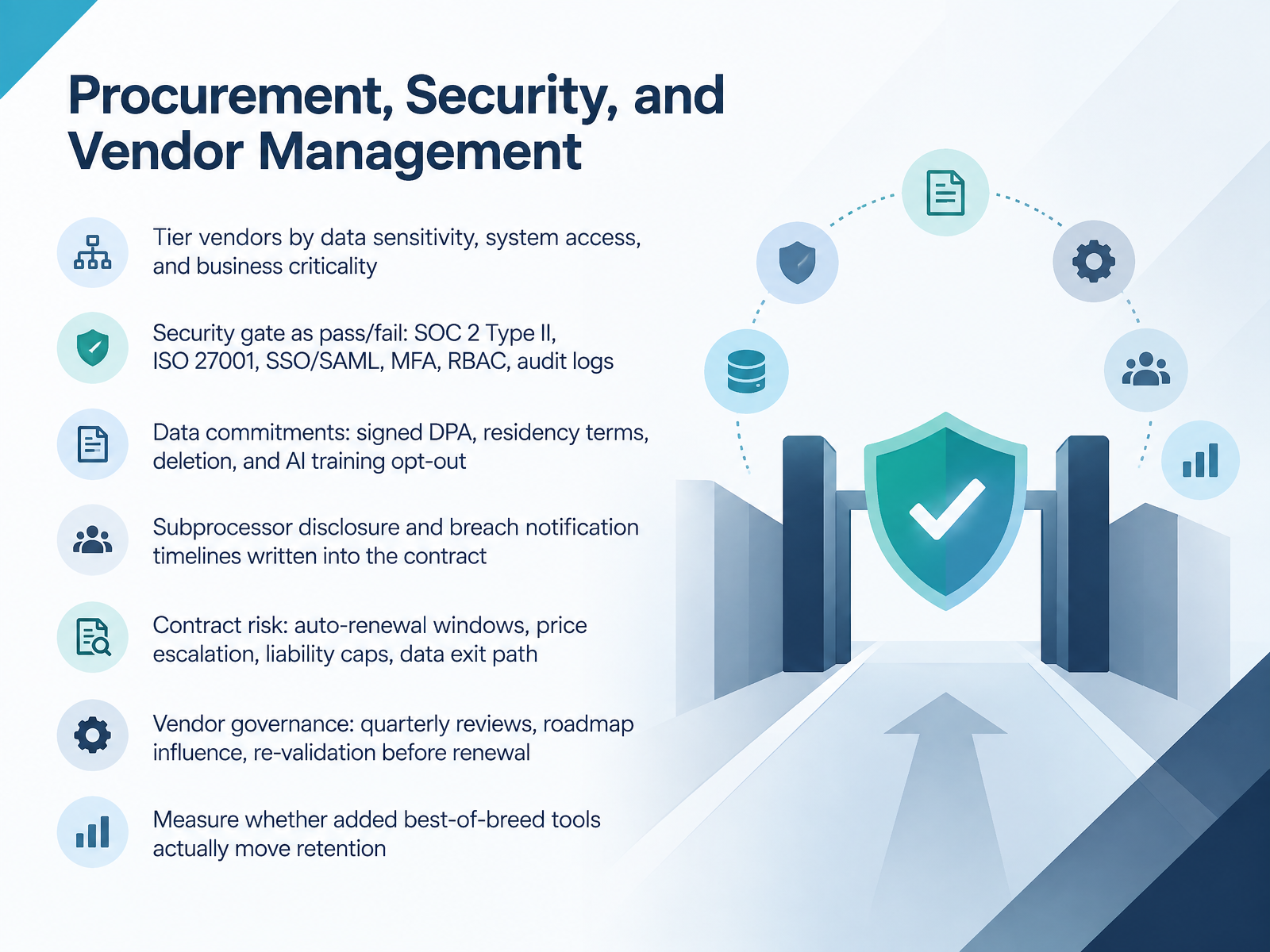
- 14Procurement, Security, and Vendor ManagementLet's turn to procurement, security, and vendor management. This is where deals stall, so front-load the evidence. First, tier your vendors by data sensitivity, system access, and business criticality. A read-only tool gets a light check. Anything touching customer PII, billing, or production systems gets deep diligence. Security is a pass or fail gate, not a score. Require a current SOC 2 Type II, and read the exceptions. ISO 27001 if you sell into regulated markets. Plus SSO with SAML, enforced MFA, role-based access control, and audit logs. Miss any one, and you stop. Next, data commitments. Get a signed DPA, written residency terms, a deletion path, and an AI training opt-out. Confirm the subprocessor list, and write breach notification timelines into the contract. On contract risk, check auto-renewal windows, price escalation caps, liability limits, and your data exit path. Miss the renewal notice window, and you own another year. For governance, assign one owner. Run quarterly reviews, use roadmap influence while you still have leverage, and re-validate certifications before every renewal. And measure whether each best-of-breed tool actually moves retention. If it doesn't, cut it. Next, we'll build your 90-Day Action Plan and Executive Readiness.
 2 min
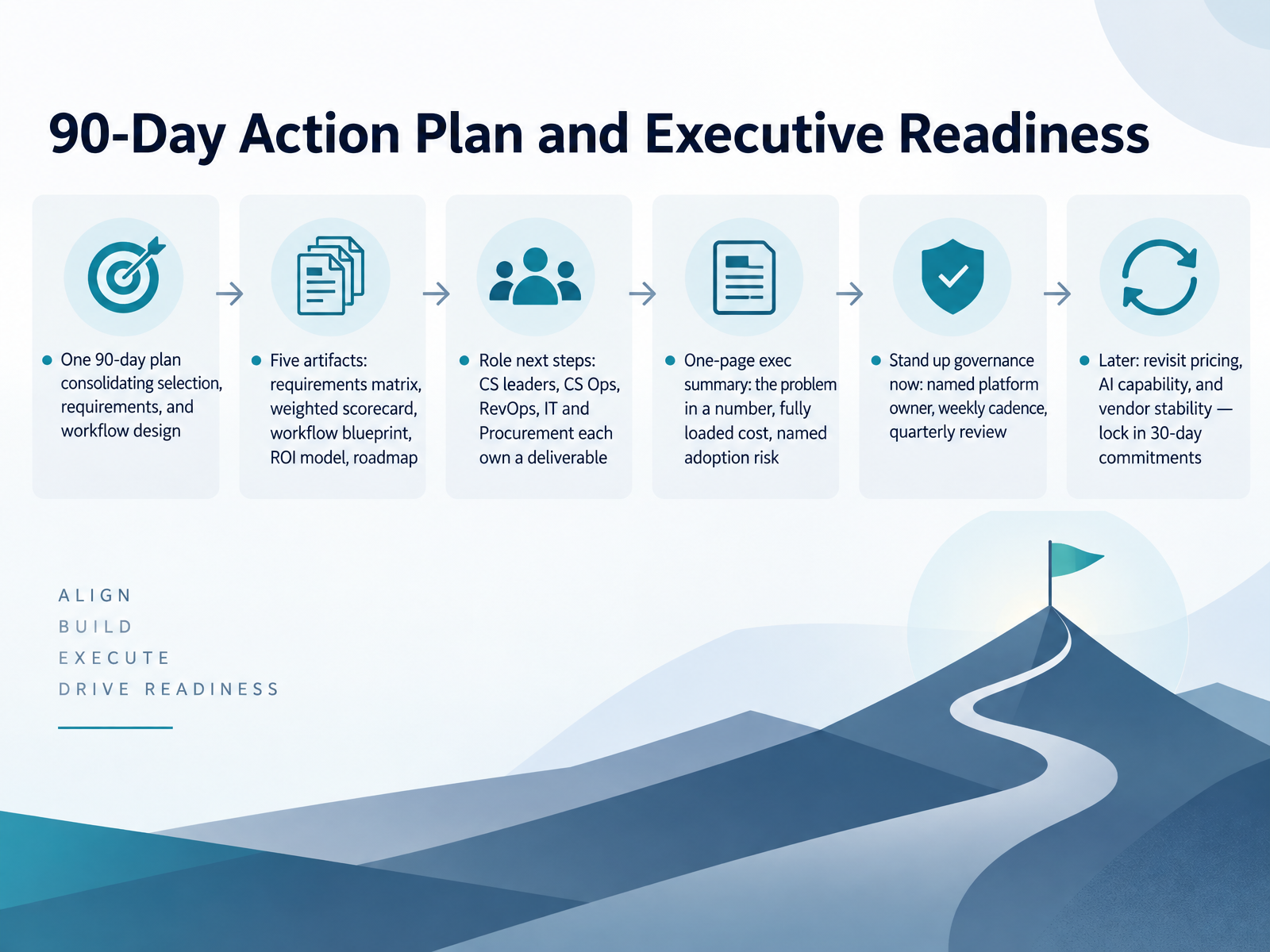
- 1590-Day Action Plan and Executive ReadinessLet's close with the plan that turns this evaluation into a decision. One 90-day plan consolidates selection, requirements, and workflow design. Five artifacts come out of it: the requirements matrix, the weighted scorecard, the workflow blueprint, the ROI model, and the roadmap. Each role owns a deliverable. CS leaders own the requirements matrix. CS Ops owns the workflow blueprint. RevOps builds the weighted scorecard. IT and Procurement run the security gate and the vendor terms. For the executive summary, keep it to one page. The problem in a number, the fully loaded cost, and the adoption risk named out loud. One example: our NRR is ninety-eight percent, and CSMs lose a third of their day to admin. A platform at eighty thousand a year becomes two hundred and fifty thousand fully loaded once you add implementation and admin headcount. Stand up governance now. A named platform owner, a weekly cadence, and a quarterly review. Later, revisit pricing, AI capability, and vendor stability, but lock in 30-day commitments so you keep leverage. Remember, roughly half of platform implementations miss their original goals, so treat adoption as a deliverable, not an afterthought. Thank you for working through this course. You now have the framework, the artifacts, and the owners. Next step: put your plan on one page and get the decision this quarter. You are ready.
 getfairview.com2 min
Take the deck with you
Download this course as a file — free, no sign-up needed.
- PDF handoutEvery slide page, ready to print or share.16 pages · 3.2 MBDownload
- Narrated PowerPointThe deck that presents itself — every slide carries the digital human's narration video.16 pages · 15.2 MBDownload
- PowerPoint slidesThe full deck as a .pptx — open it in PowerPoint, Keynote, or Google Slides.16 pages · 3.2 MBDownload
Free to use in your own training — please keep the PersonWise credit page at the end.
Have your own deck? Turn it into a course
Sources consulted
Web sources consulted while building this course.
- The Forrester Wave™: Customer Success Platforms, Q4 2025 | Forrester — forrester.com
- Best Customer Success Management Platforms Reviews ... — gartner.com
- Customer Success Platforms: Competitive Intelligence Report | March 2026 — reports.letaido.it
- Customer Success Enters The Agentic Era — forrester.com
- The Customer Service Solutions For B2B Landscape, Q3 2026 | Forrester — forrester.com
- 2026 State of Customer Success - SaaS retention benchmarks | Cust — cust.co
- B2B SaaS NRR and GRR Benchmarks 2026 — growthspreeofficial.com
- 2026 SaaS NRR Report: The Median Is 101%, Not 120% — b2bcentr.com
- The 2026 SaaS Benchmarks Report - saasrise.com — saasrise.com
- Gross revenue retention (GRR) benchmarks (2026) — getaleph.com
- Customer Success Operations vs. Revenue Operations — landandexpand.academy — landandexpand.academy
- What Is Customer Success Operations? Role and Metrics — Fairview — getfairview.com
- Customer Success Ops: The Hire That Compounds NRR | RevSearch — revsearch.io
- What Is Customer Success Operations: Proven CS Ops | Inveo — inveo.io
- Customer Success Operations: The Executive Guide to Building CS Ops That Drives Retention and Revenue - RevenueTools Blog | RevenueTools — revenuetools.io
- 8 best customer success tools in 2026 — zapier.com
- Best Customer Success Platforms (2026) | The CRO Report — thecroreport.com
- 9 Best Customer Success Software I'd Pick to Stop Churn — learn.g2.com
- Best Customer Success Software 2026 — clientsuccess.com
- Best Customer Success Platforms in 2026 | Trending Platforms | PickMySoft — pickmysoft.com