Begin
14 pages · ~28 min
Astronomical Distance Measurement Techniques
Learn how astronomers measure cosmic distances, from parallax to redshift, in this concise guide for astronomy enthusiasts and students.
A digital instructor presents all 14 pages. Hold “Ask” at any point and ask out loud — the answer comes from this course. No sign-up needed.
What you’ll learn
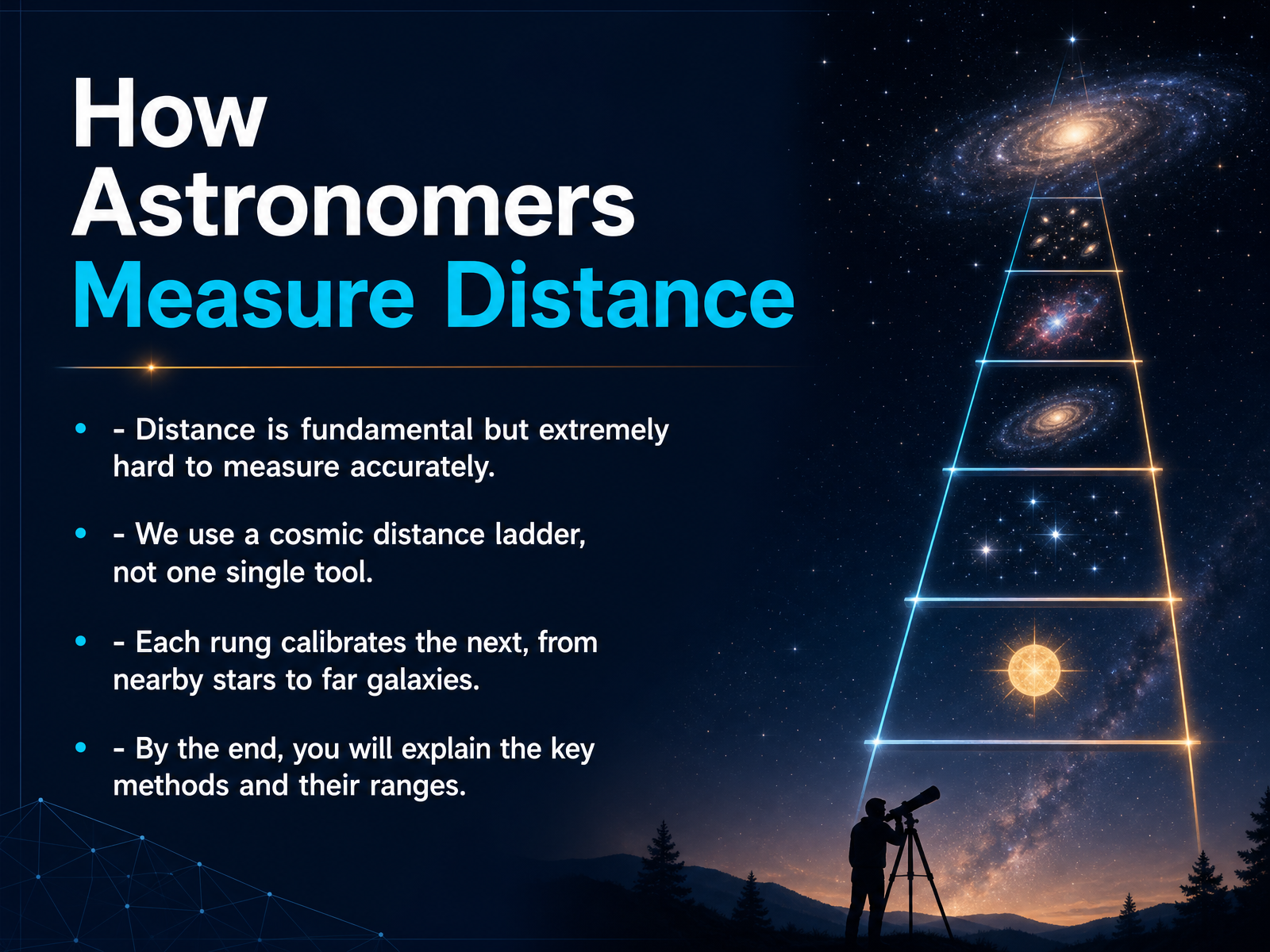
- 01How Astronomers Measure DistanceWelcome! If you have ever looked up at the night sky and wondered just how far away those stars really are, you are in the right place. That simple question is one of the most fundamental challenges in all of science because space is unimaginably vast. We cannot use a physical ruler or a radar gun to measure across billions of light years. So how do we do it? Astronomers use what we call a cosmic distance ladder. This is not a single tool, but a series of overlapping methods. Think of it like climbing a staircase, where each step relies on the one below it. We start with techniques that work for our closest neighbors, and then use that knowledge to calibrate the next step, reaching out to faraway galaxies. By the end of this lesson, you will be able to explain the key methods we use and understand the ranges where they work. Now, let's start at the beginning and figure out why measuring distance is such a difficult problem to solve.en.wikipedia.orguwa.edu.auastronomy.com+21 min
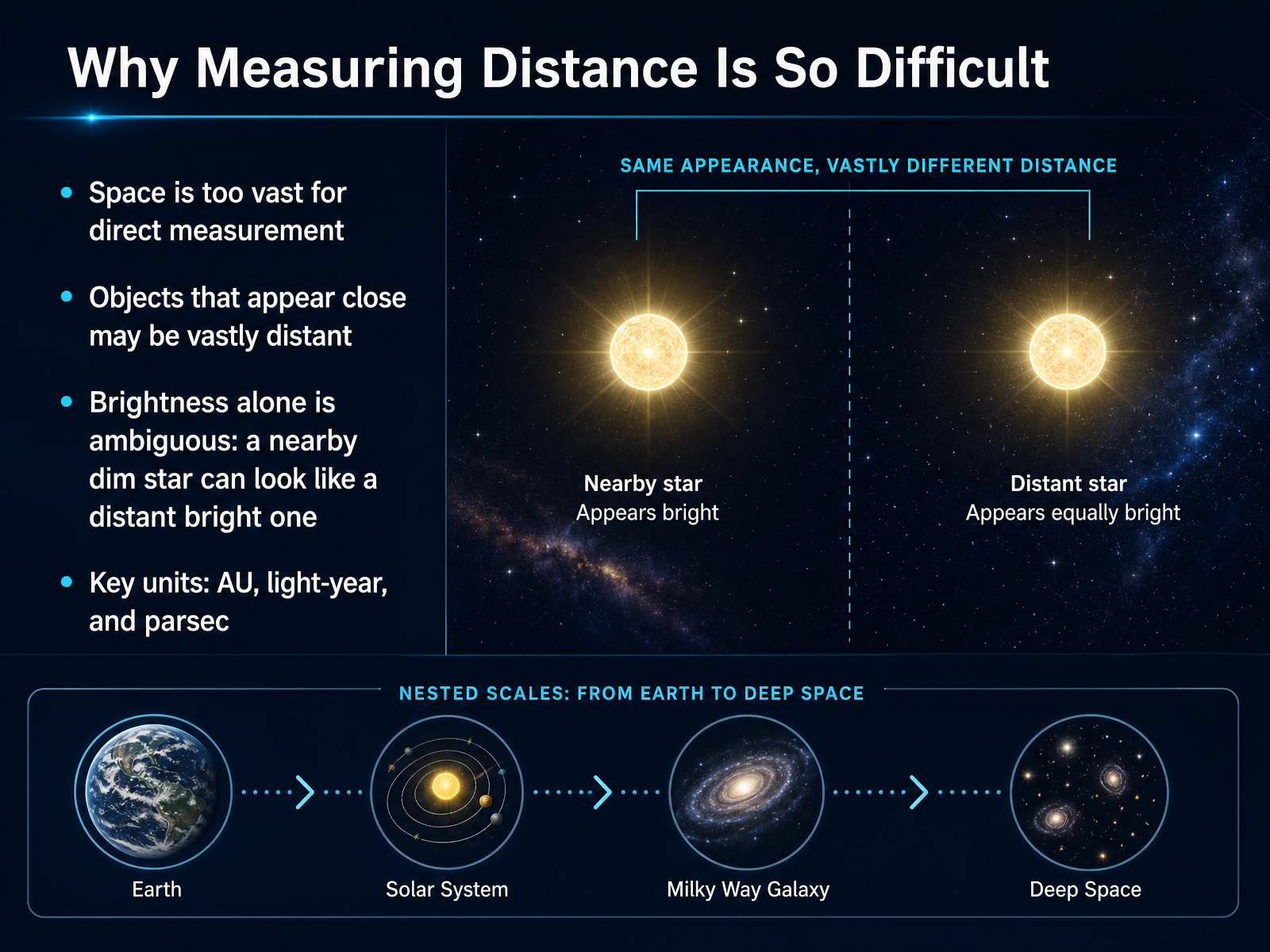
- 02Why Measuring Distance Is So DifficultSo why is measuring distance in space so difficult? First, we cannot simply stretch out a tape measure. Space is far too vast for any direct measurement. Even our nearest star is trillions of kilometers away. Second, what we see can be misleading. Two points of light that appear side by side in the sky may actually be at completely different distances. One could be relatively close, while the other is unimaginably far. Brightness alone cannot tell us how far away something is, because a nearby dim star can look just like a distant bright one. It is like seeing two lights on a dark road at night. A small flashlight nearby can look the same as a powerful searchlight far away. To handle these huge distances, astronomers use special units. An astronomical unit, or AU, is the average distance from Earth to the Sun. A light-year is the distance light travels in one year, about nine point five trillion kilometers. And a parsec is about three point two six light-years. These units give us a common language for cosmic distances. But to use them well, we need a system. Next, let us explore the cosmic distance ladder, a series of overlapping rungs that takes us step by step into deep space.
 en.wikipedia.orguwa.edu.auastronomy.com+22 min
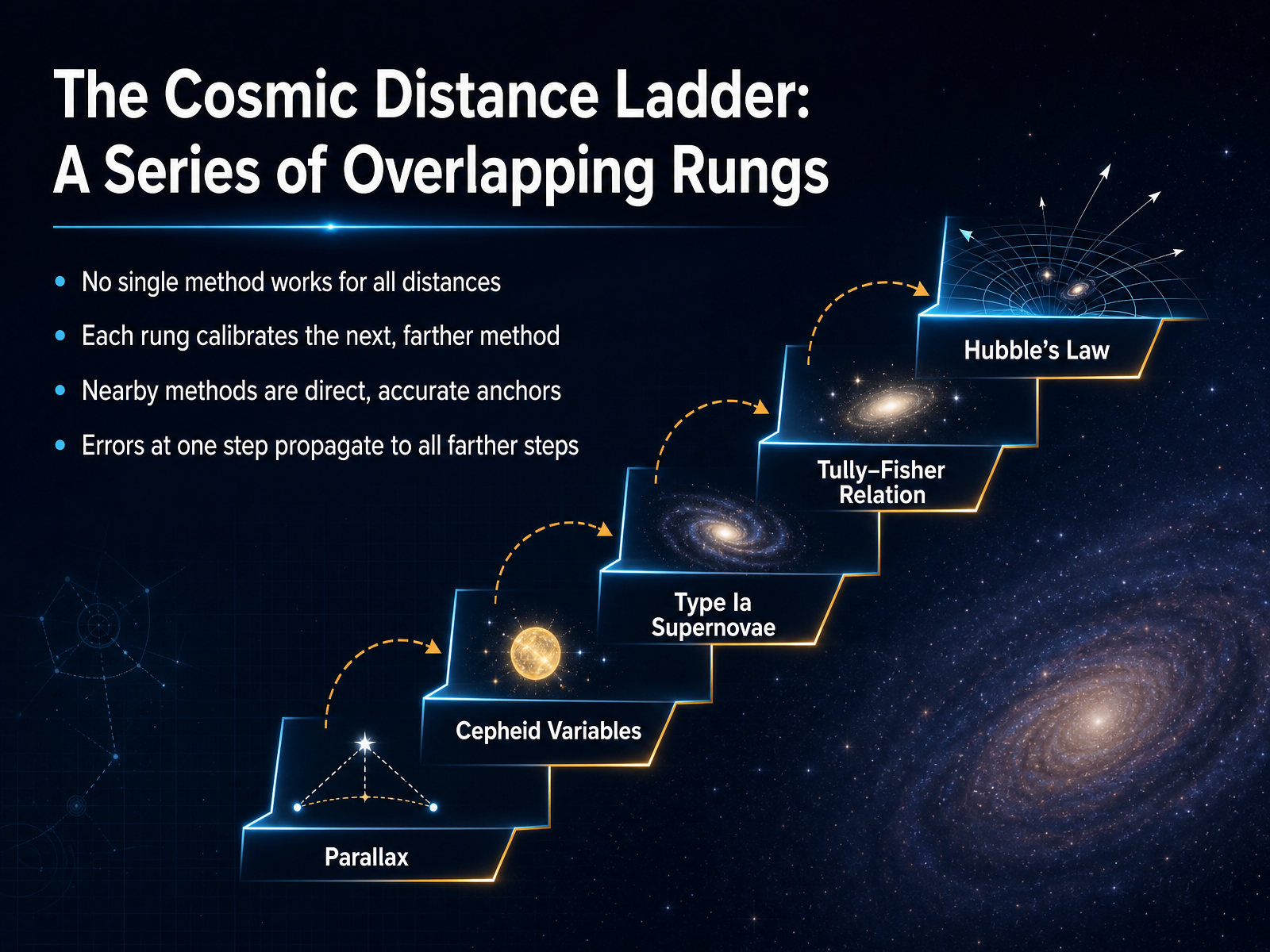
 - 03The Cosmic Distance Ladder: A Series of Overlapping RungsThe cosmic distance ladder sounds like a physical structure, but it is really a chain of reasoning. No single tool can measure every distance in the universe. A method that works perfectly for a nearby star falls apart completely when we point it at a distant galaxy. So astronomers rely on a series of overlapping techniques, and each technique is a rung on this ladder. The clever part is how each rung calibrates the next one. We use direct, accurate measurements for nearby objects to anchor the system. Then, we apply what we learned there to interpret signals from objects much farther away. But this also means the ladder is only as strong as its weakest step. If we have a slight error in a nearby measurement, that error does not stay put. It propagates upward, affecting every distance we calculate beyond it. This is why astronomers are obsessed with checking and rechecking the first few rungs. Next, we will start at the very bottom of the ladder with the most direct tool we have: parallax, the gold standard for nearby stars.
 en.wikipedia.orguwa.edu.auastronomy.com+21 min
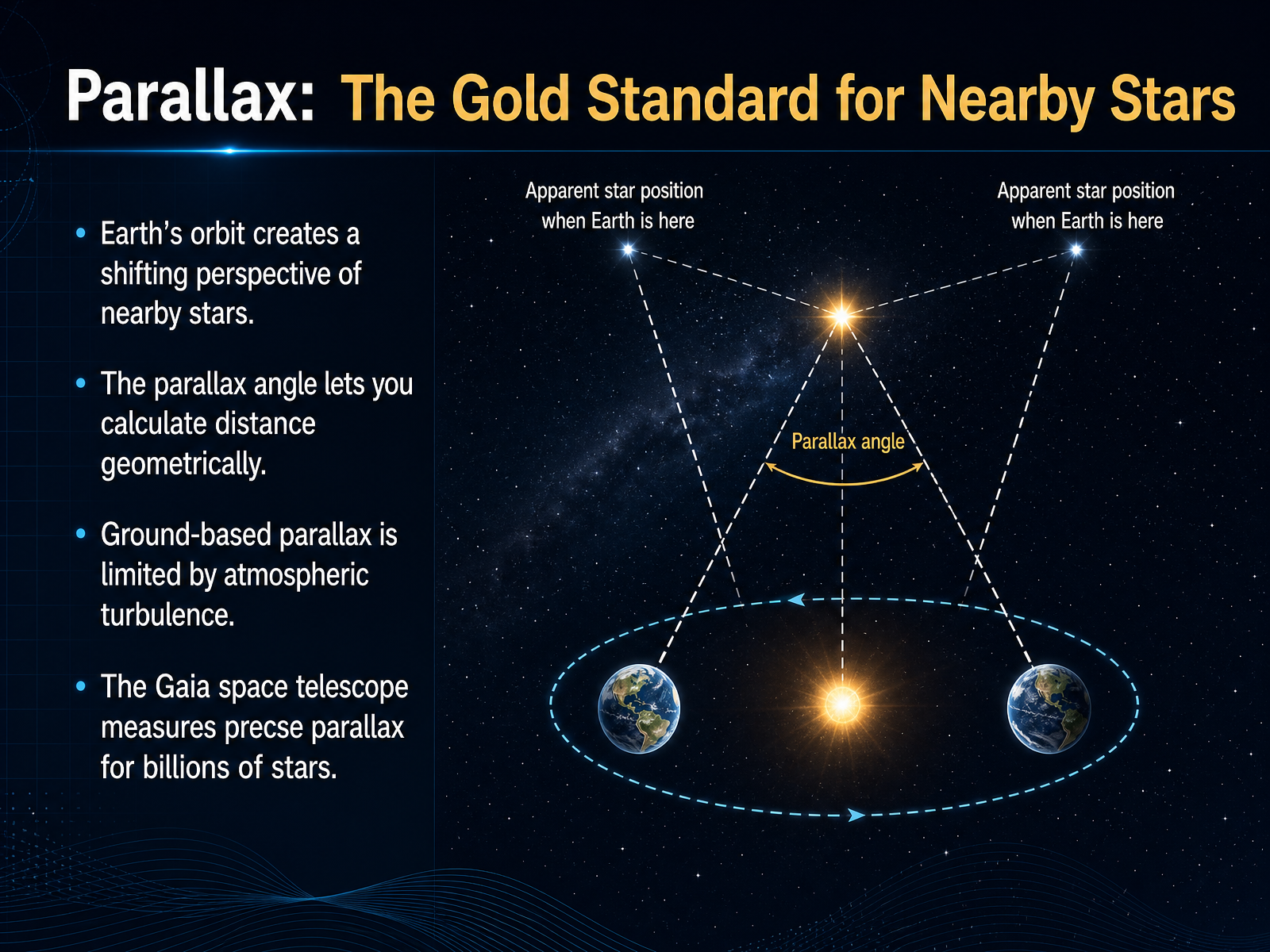
 - 04Parallax: The Gold Standard for Nearby StarsNow, when we need very precise distances to nearby stars, astronomers turn to parallax. Think of it this way. Hold a finger close to your face and close one eye, then the other. Your finger seems to jump against the background. That is parallax. Earth does the same thing as it orbits the Sun, shifting our view of nearby stars against the more distant ones. By measuring that tiny shift, called the parallax angle, we can calculate distance using simple geometry. From the ground, though, our atmosphere blurs things, like looking up through rippling water. That limits how small a shift we can detect. So ESA launched the Gaia space telescope. Orbiting high above the atmosphere, Gaia measures these shifts with astonishing precision, mapping parallaxes for roughly one and a half billion stars. Next, we will move beyond our local neighborhood and meet the standard candles, objects with known brightness that let us measure much greater distances.
 cosmos.esa.intcosmos.esa.intaanda.org+21 min
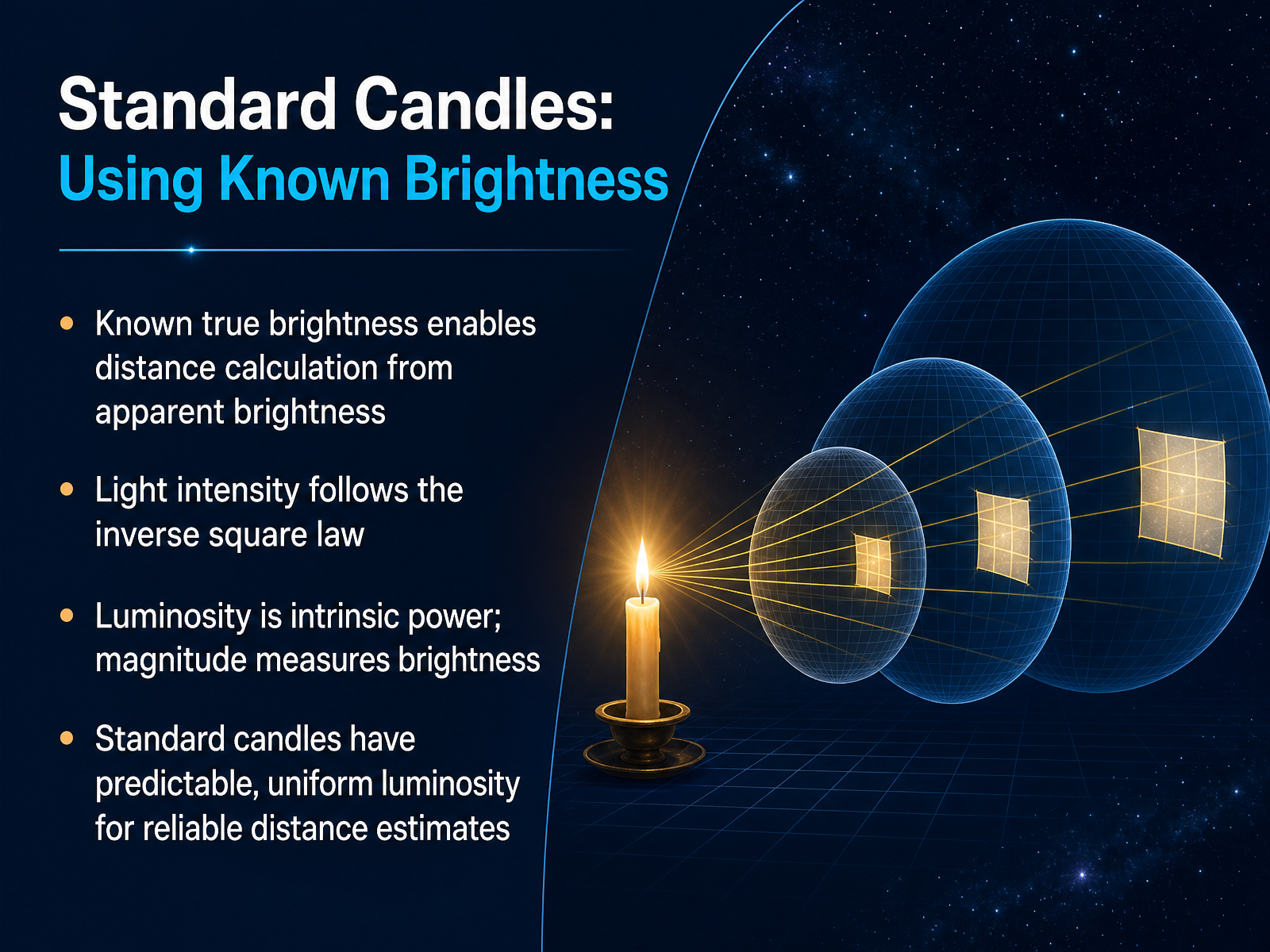
 - 05Standard Candles: Using Known BrightnessNow, let's move from geometry to light. What if we could find objects in space whose true brightness we already know? We call these standard candles. Think of it this way: if you know exactly how bright a light bulb is, you can tell how far away it is by how dim it appears. The same principle works in space. We compare an object's known true brightness, called its luminosity, with how bright it looks from Earth. The dimmer it appears, the farther away it is. This follows a simple rule called the inverse square law. If you double the distance, the light spreads out over a square area, making it four times dimmer. Astronomers measure that apparent brightness using a scale called magnitude. The real power of standard candles is that they have predictable, uniform luminosity. So a supernova in a distant galaxy can act like a cosmic lighthouse, with the same wattage as one nearby. By measuring how faint it looks, we can calculate its distance with remarkable confidence. Next, we will focus on a special type of standard candle: Cepheid variable stars and their period-luminosity relation.
 en.wikipedia.orguwa.edu.auastronomy.com+21 min
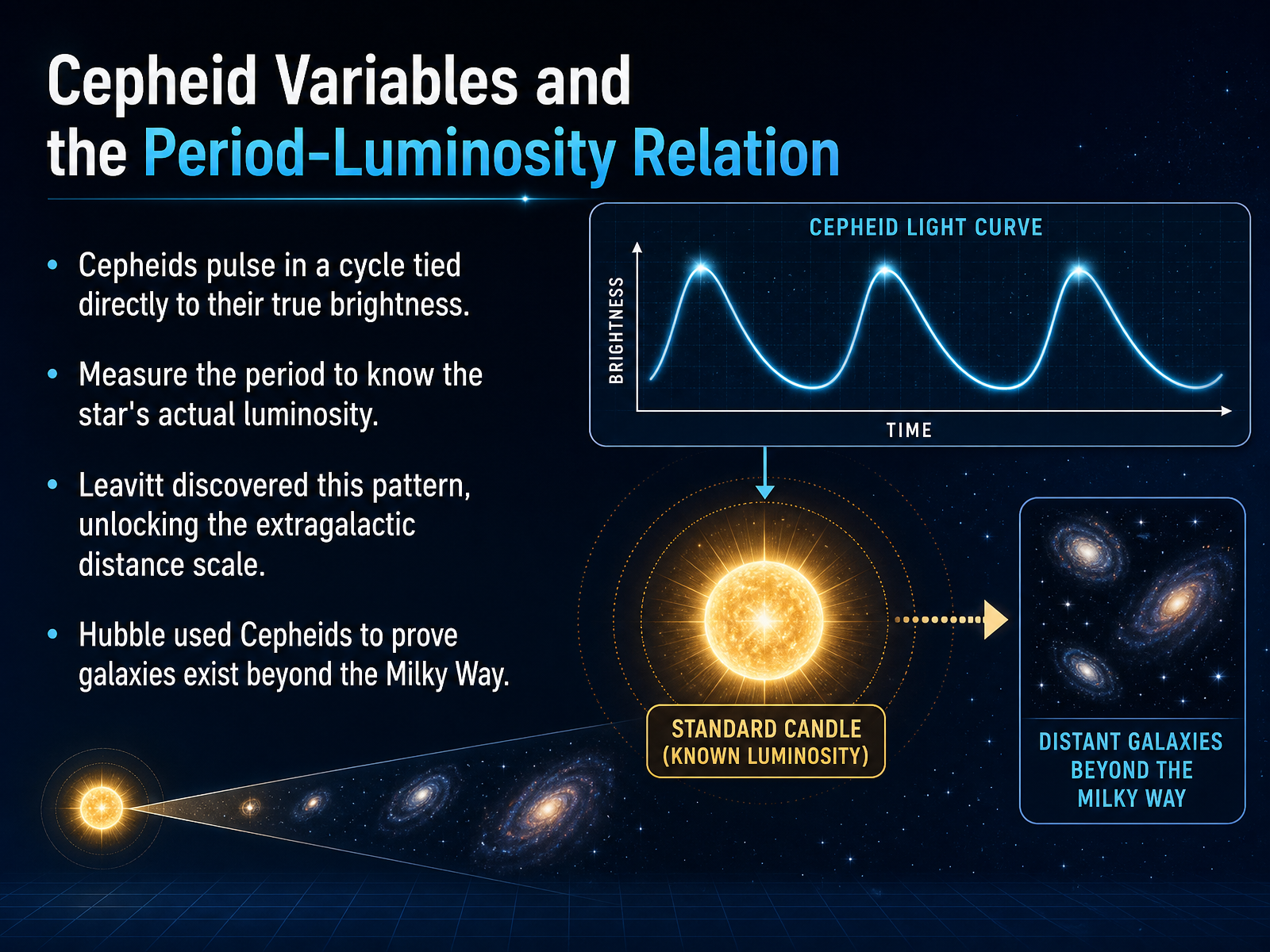
 - 06Cepheid Variables and the Period-Luminosity RelationNow, we come to a real breakthrough in measuring vast distances: Cepheid variable stars. Imagine a lighthouse that pulses, and each pulse tells you exactly how bright the lamp truly is. That is what a Cepheid does. These stars expand and contract in a steady rhythm, and the length of that cycle, its period, is directly linked to its true luminosity. So by simply timing how fast a Cepheid pulses, we know its actual wattage. Then we compare that to how bright it appears to us, and the difference gives us its distance. This remarkable pattern was discovered by astronomer Henrietta Leavitt. Her insight created a reliable yardstick that finally unlocked the scale of galaxies far beyond our own. Edwin Hubble used these very stars to prove that other galaxies existed outside the Milky Way. Next, we will explore the brightest standard candles of all: Type Ia supernovae.
 iopscience.iop.orgarxiv.orgiopscience.iop.org+21 min
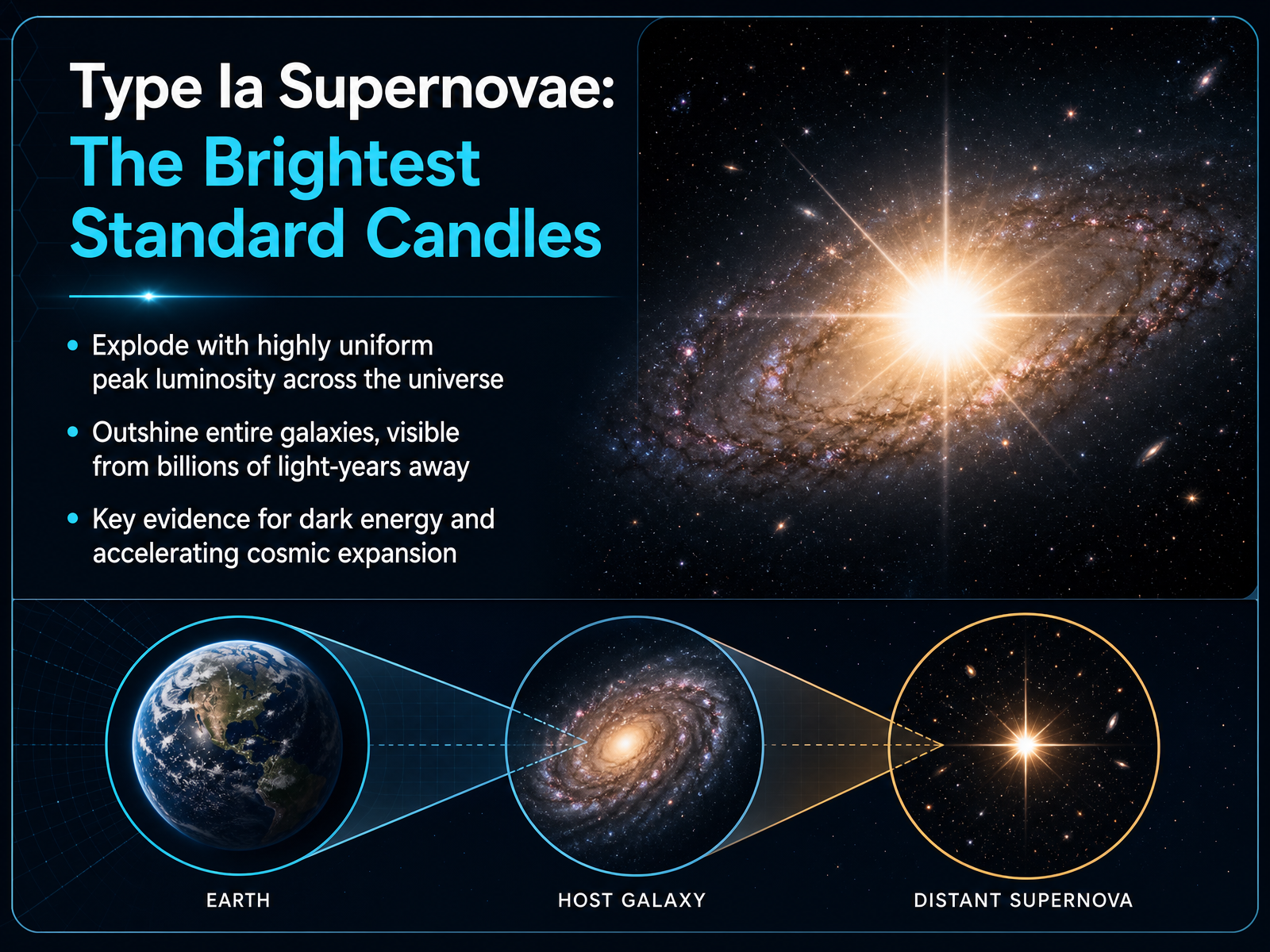
 - 07Type Ia Supernovae: The Brightest Standard CandlesNow we come to a truly spectacular tool for measuring the farthest reaches of the universe. These are Type Ia supernovae, the brightest standard candles we know of. Think of a standard candle as a light bulb with a known wattage. If you know how bright it truly is, you can tell how far away it is by how faint it appears. Type Ia supernovae are special because they explode with almost exactly the same peak brightness, no matter where they are in the cosmos. And they are incredibly luminous. A single one can briefly outshine its entire home galaxy, which means we can see them from billions of light-years away. This incredible power made them the key evidence for one of the biggest surprises in modern science: dark energy. By watching these distant explosions, astronomers discovered that the expansion of the universe is actually speeding up. These brilliant beacons let us measure that acceleration across vast cosmic distances. Now that we can measure out to the very edge of the observable universe, how do we relate that distance to the light we see? Let's look at redshift and Hubble's Law for the farthest galaxies.
 iopscience.iop.orgiopscience.iop.orgiopscience.iop.org+22 min
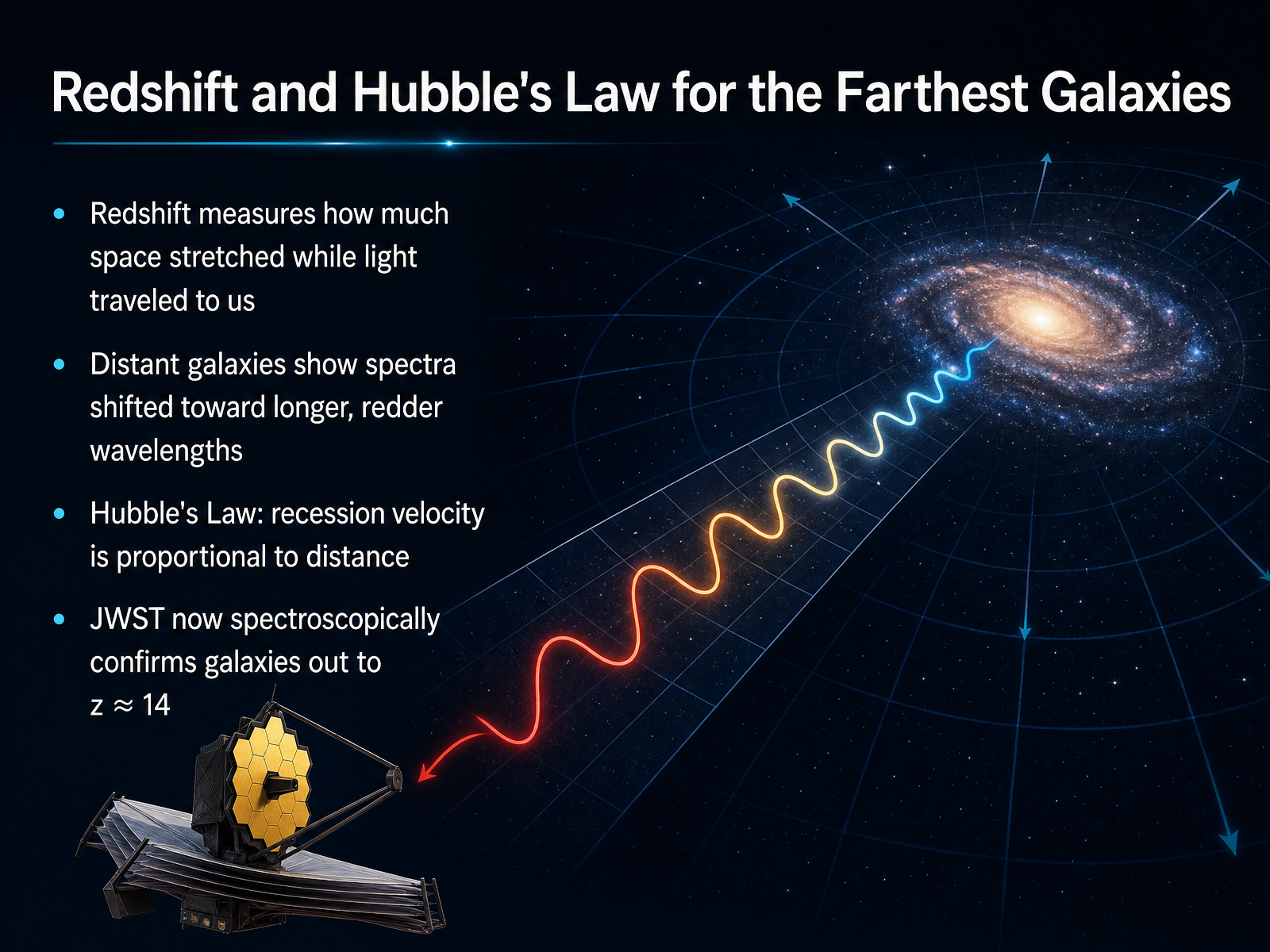
 - 08Redshift and Hubble's Law for the Farthest GalaxiesNow, for the most distant galaxies, our usual yardsticks fade out of view, so we turn to a different clue: the light itself. When we split a galaxy's light into a spectrum, we see familiar chemical fingerprints, like those from hydrogen. In faraway galaxies, these fingerprints appear shifted toward longer, redder wavelengths. We call that redshift. It happens because space itself has been stretching while the light traveled to us. The farther light travels, the more space stretches, and the more the light is redshifted. Edwin Hubble found a simple pattern: a galaxy's recession velocity is proportional to its distance. The faster it's moving away, the farther it is. Today, the James Webb Space Telescope uses this principle to explore the early universe. It has now spectroscopically confirmed galaxies out to redshift fourteen, meaning we're seeing them as they were only about three hundred million years after the Big Bang. Next, we'll tie all these methods together to see the distance ladder in action.
 en.wikipedia.orguwa.edu.auastronomy.com+22 min
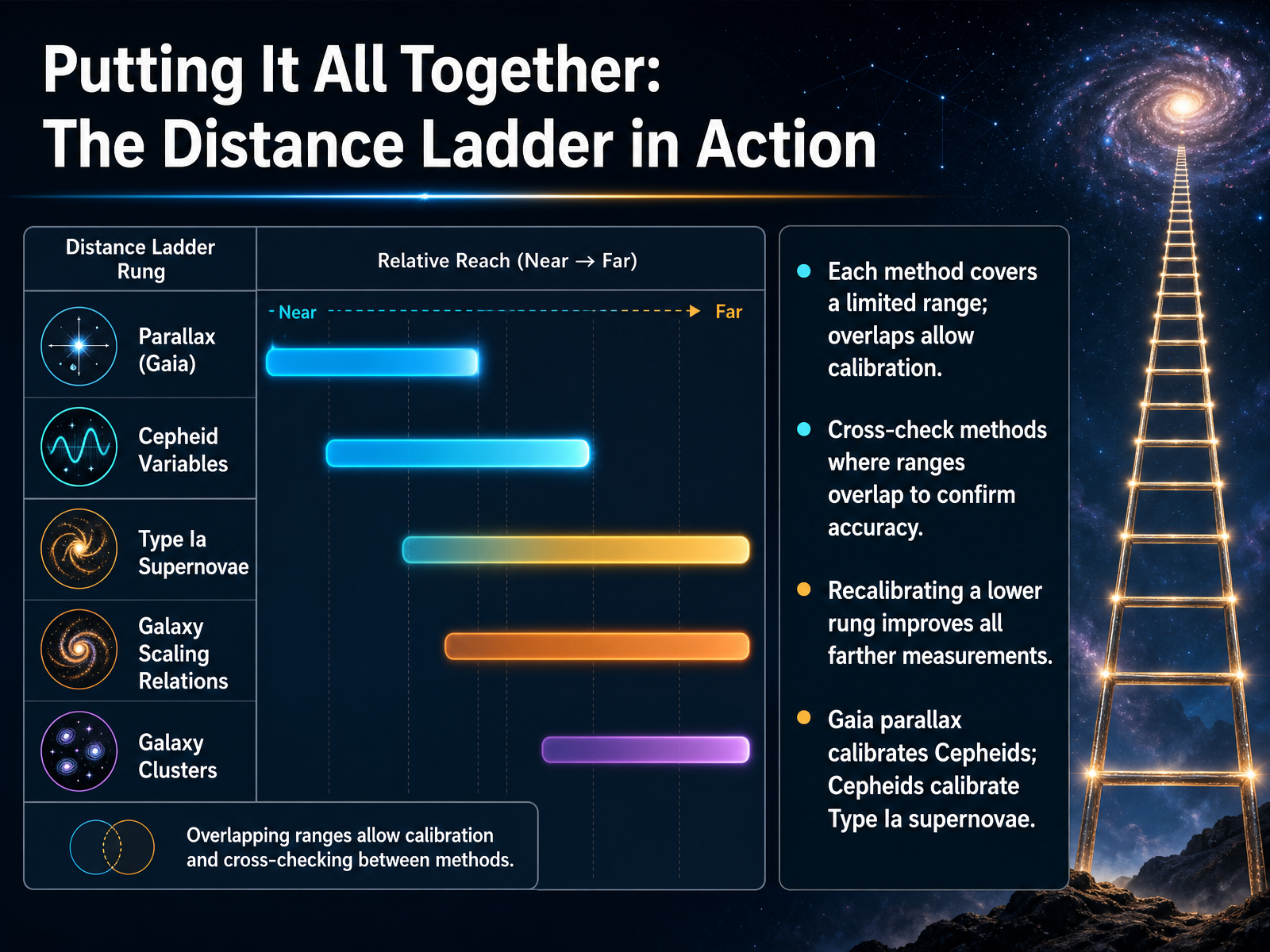
 - 09Putting It All Together: The Distance Ladder in ActionNow, here is where the real power of the distance ladder shows up. No single method can measure everything on its own. Each one works best over a certain range, like the rungs of a ladder. But the magic happens because those rungs overlap. In the overlap zones, astronomers can cross-check two different methods against the same object. If they agree, our confidence in the whole system goes up. And here is the most important part. Fixing any lower rung sharpens every rung above it. For example, the Gaia space telescope measures parallax distances to nearby Cepheid variable stars. That calibrates how bright Cepheids truly are. Those calibrated Cepheids then let us find the true brightness of Type Ia supernovae in distant galaxies. One correction at the bottom ripples all the way up the ladder. It is a beautiful chain of trust, built one careful step at a time. Up next, we will look at a modern puzzle that is testing that chain, which researchers call the Hubble tension.
 en.wikipedia.orguwa.edu.auastronomy.com+21 min
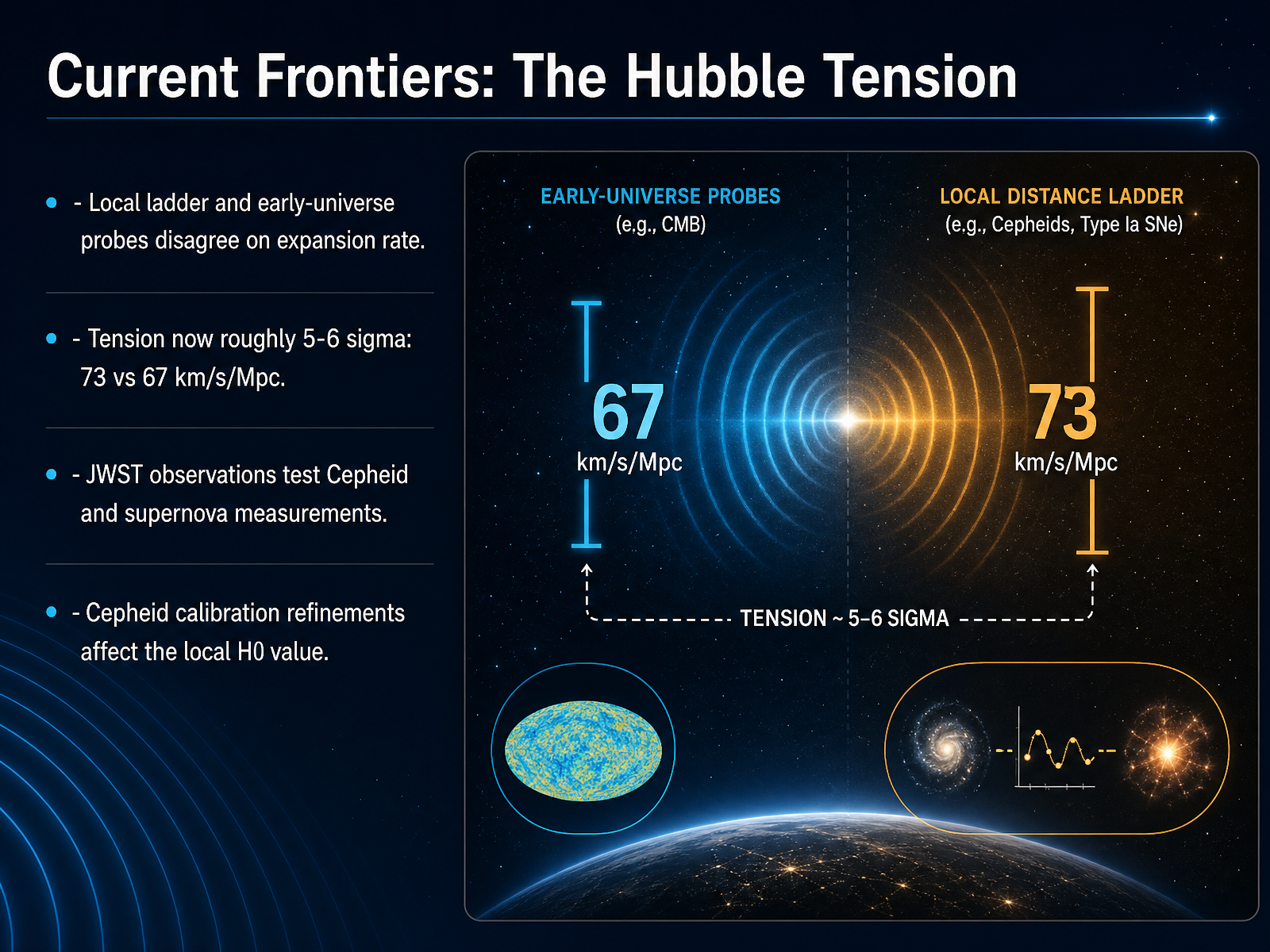
 - 10Current Frontiers: The Hubble TensionNow we arrive at a truly intriguing puzzle: the Hubble Tension. When we use the local distance ladder to measure how fast the universe is expanding, we get a higher rate, around 73 kilometers per second per megaparsec. But if we look back at the early universe, using data from the cosmic microwave background, the calculation gives us a lower number, about 67. Think of it like two very precise clocks that should tell the same time but are mysteriously out of sync. The disagreement is now so strong that scientists consider it a major clue. Are we making a mistake in our measurements, or is our understanding of the cosmos incomplete? To find out, the James Webb Space Telescope is testing our measurements of Cepheid stars and supernovae. For example, a recent study from 2026 found that small errors in our parallax measurements for Cepheids could be skewing our local results. One thing is clear: the simple story of our standard candle might need a more detailed chapter. This search for answers has led astronomers to explore completely different ways of measuring distance, using ripples in spacetime itself. Let's look at that next.
 iopscience.iop.orgarxiv.orgiopscience.iop.org+22 min
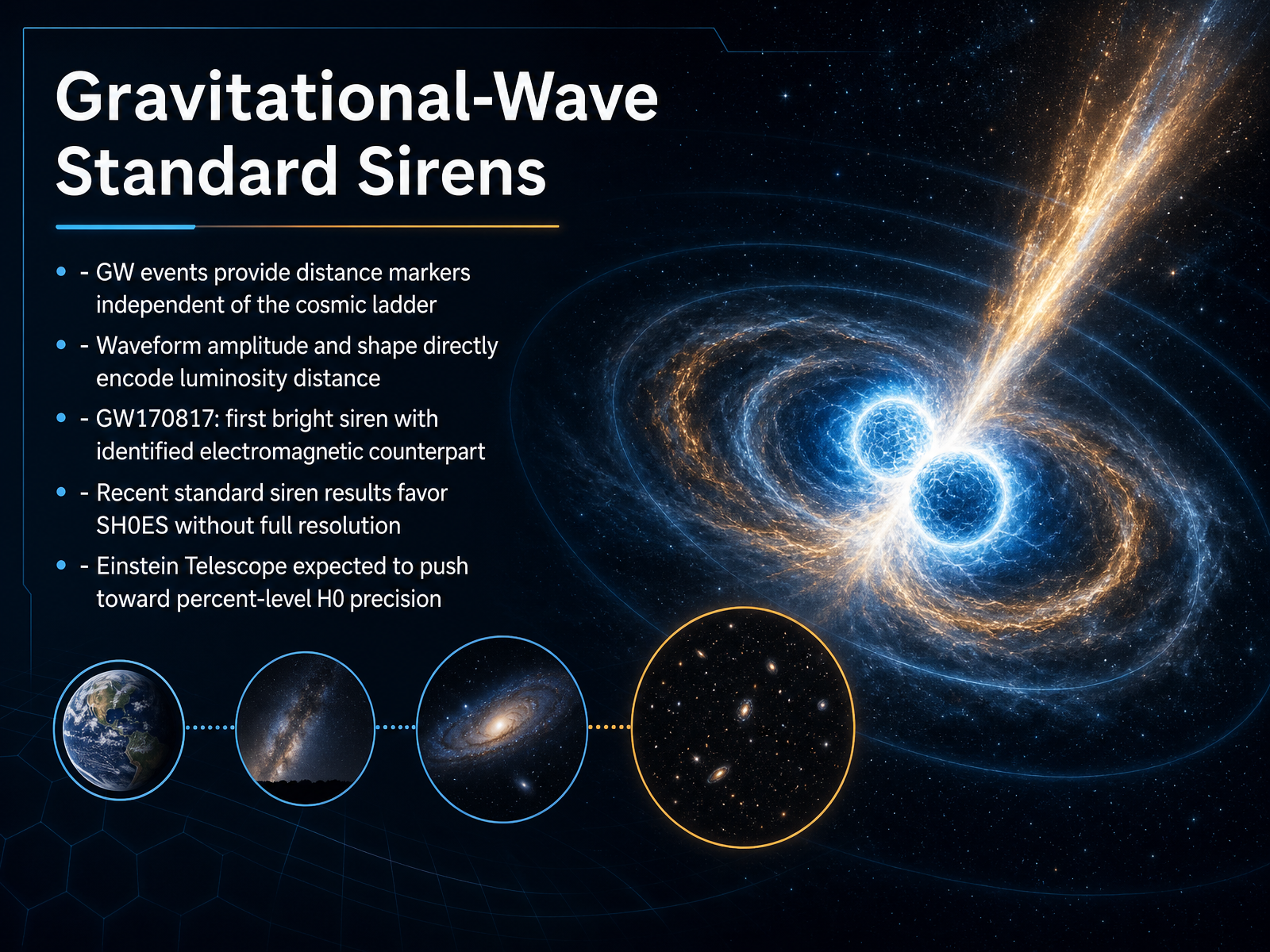
 - 11Gravitational-Wave Standard SirensLet us now turn to a tool that sidesteps the entire distance ladder. Gravitational wave standard sirens. When two neutron stars or black holes spiral together, the pattern of the ripple they send through space encodes how far away they are. Louder waves mean closer events, and subtler details in the wave shape fill in the rest. No calibration steps, no intermediate stars. The distance is written directly inside the signal. The first clear example came in twenty seventeen, when the event known as GW one seven zero eight one seven was matched with an ordinary flash of light. That pairing gave us an independent way to attach a redshift to the distance. More recent standard siren studies lean toward the same higher expansion rate seen by the SHOWS team, though the uncertainty is still too large to settle the debate. That could soon change. The planned Einstein Telescope is designed to reach the kind of precision we need, perhaps down to the percent level. Up next, we will look at recent advances and the next generation tools that may finally resolve the Hubble tension.
 1 min
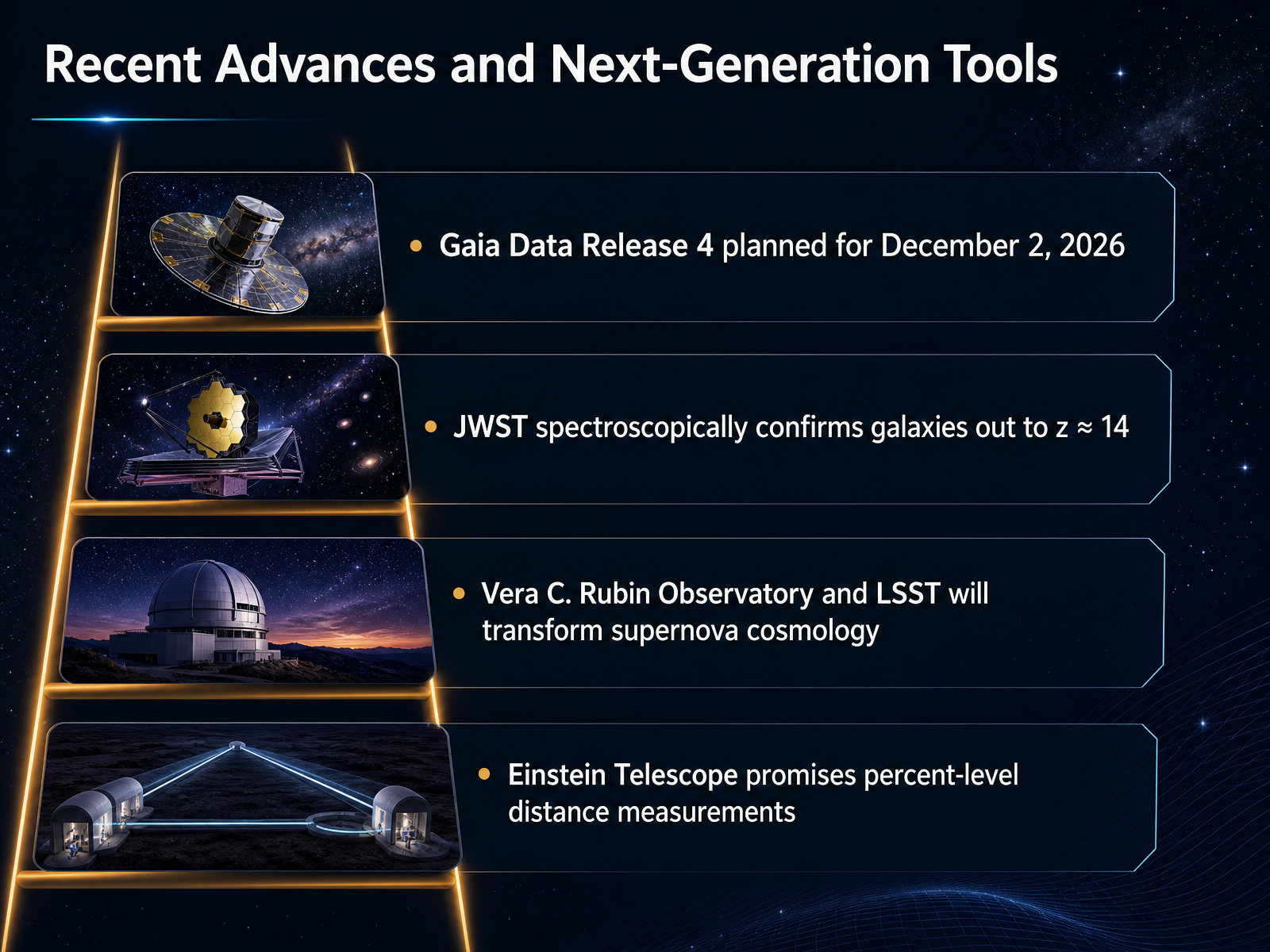
1 min - 12Recent Advances and Next-Generation ToolsNow let’s look at how these distance tools are changing. The Gaia satellite is preparing its fourth major data release, planned for December second, twenty twenty six. This will expand the already enormous map of over one and a half billion stars, sharpening our sense of scale across the Milky Way. Meanwhile, the James Webb Space Telescope is reaching even deeper. It has spectroscopically confirmed galaxies whose light left them when the universe was just a few hundred million years old. That means we are seeing them at redshifts of around fourteen. And two ground based projects are about to change the field. The Vera C. Rubin Observatory will launch its Legacy Survey of Space and Time, discovering millions of supernovae. With so many standard candles, cosmologists hope to pin down the behavior of dark energy with far greater precision. And the proposed Einstein Telescope could measure gravitational wave events so cleanly that we might soon know some cosmic distances down to the level of a few percent. In the next slide, we will gather these ideas into the key takeaways and practical skills you will want to carry forward.
 cosmos.esa.intcosmos.esa.intaanda.org+22 min
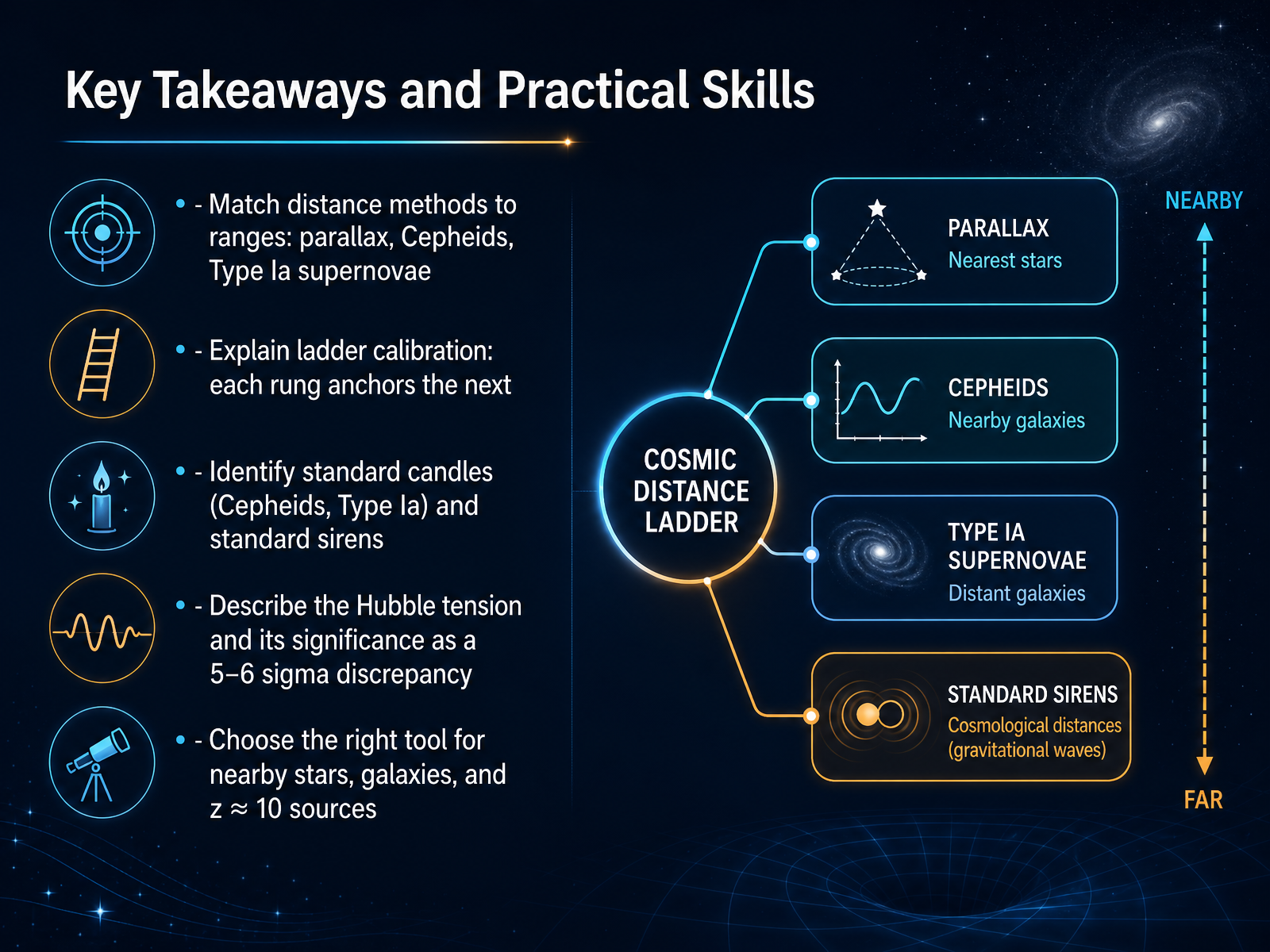
 - 13Key Takeaways and Practical SkillsSo, let's pull all of these cosmic measuring tools together. The big skill here is matching the method to the distance. Use parallax for nearby stars, Cepheid variables for galaxies a bit further out, and Type Ia supernovae for truly vast cosmic distances. Remember the ladder itself. Each rung must be calibrated by the one below it. That is how a measurement near Earth anchors a measurement across the universe. Keep an eye out for our standard candles, like Cepheids and Type Ia supernovae, and our standard sirens. These are the objects with known brightness that let us judge how far away they are. This careful work has even revealed a puzzle we call the Hubble tension. It is a roughly five to six sigma discrepancy between different ways of measuring cosmic expansion. That is a technical way of saying our two best methods do not quite agree. Choosing the right tool for each object is what turns all this theory into a practical skill. That is our toolkit for navigating the universe. Next, we will open things up for discussion and further exploration.
 en.wikipedia.orguwa.edu.auastronomy.com+22 min
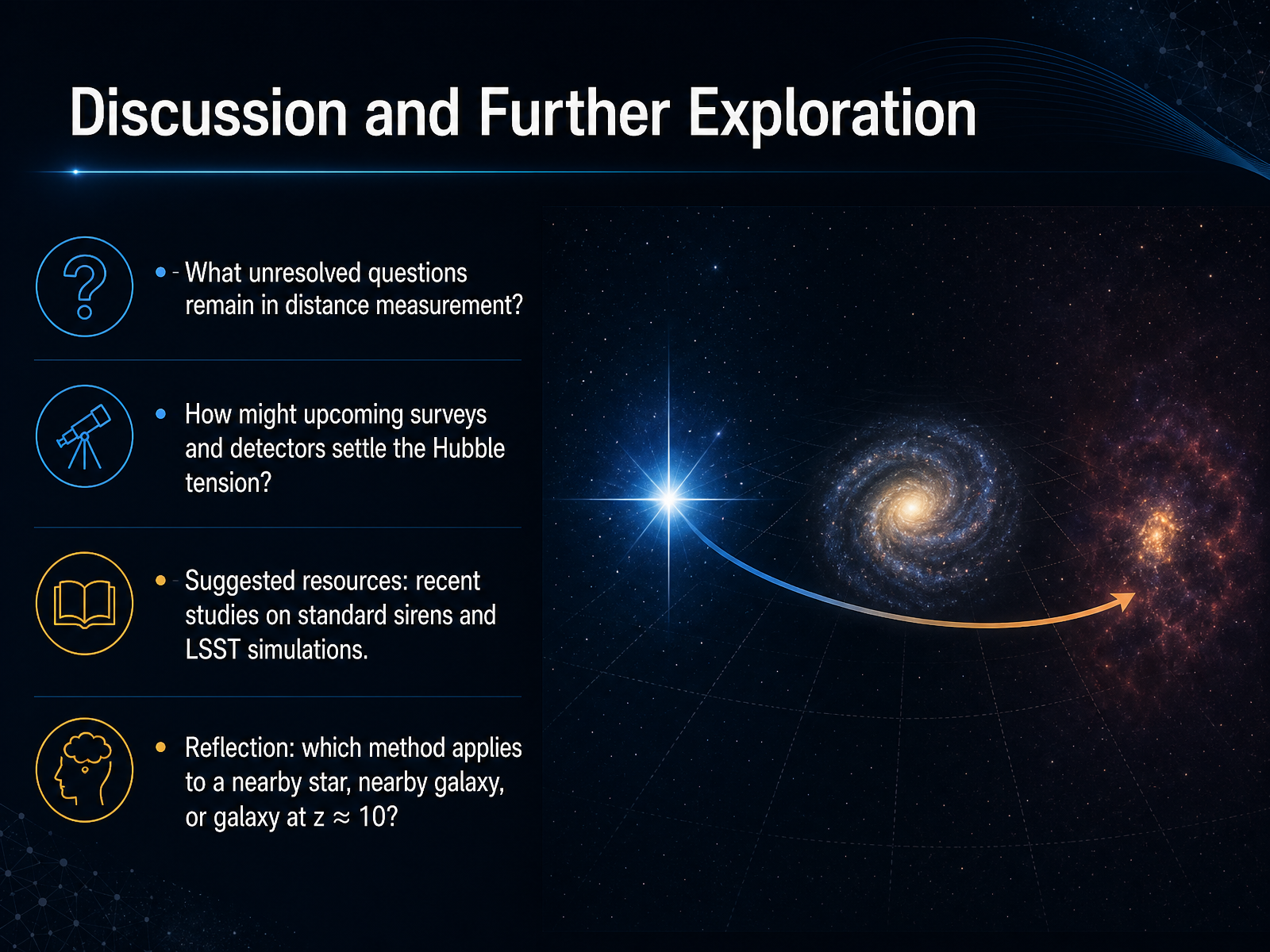
 - 14Discussion and Further ExplorationLet us bring all of this together. Across this course, we have moved step by step up the cosmic distance ladder, from the parallax of nearby stars, to variable stars and supernovae, to gravitational wave sirens that can speak to us across truly vast distances. And yet, as we close, a few open questions remain. What still bothers astronomers about measuring distance? One big one is the Hubble tension. We are still not sure why our local measurements of the expansion rate disagree with the one inferred from the early universe. Upcoming surveys and detectors may help settle this. The Vera Rubin Observatory and its Legacy Survey of Space and Time should give us far better supernova samples, while gravitational wave observatories will keep adding new standard sirens. Before you go, try one small reflection. Which measuring method would you choose for a star in our own neighborhood? What about a galaxy a bit farther out, and one at a redshift of ten? Think about which rungs of the ladder, and which sirens, fit each case. That mental check is the best way to make this material your own. Thank you for exploring with me, and keep measuring.
 iopscience.iop.orgiopscience.iop.orgiopscience.iop.org+22 min
Take the deck with you
Download this course as a file — free, no sign-up needed.
- PDF handoutEvery slide page, ready to print or share.15 pages · 4.1 MBDownload
- Narrated PowerPointThe deck that presents itself — every slide carries the digital human's narration video.15 pages · 13.9 MBDownload
- PowerPoint slidesThe full deck as a .pptx — open it in PowerPoint, Keynote, or Google Slides.15 pages · 4.0 MBDownload
Free to use in your own training — please keep the PersonWise credit page at the end.
Have your own deck? Turn it into a course
Sources consulted
Web sources consulted while building this course.
- Cosmic distance ladder — en.wikipedia.org
- background sheet — uwa.edu.au
- Astronomy 101: Astronomical distances | Astronomy.com — astronomy.com
- The cosmos is vast, so how do we measure it? | New Scientist — newscientist.com
- 6.4: The Cosmic Distance Ladder - Physics LibreTexts — phys.libretexts.org
- COSMOS Gaia DR4 content - Gaia - Cosmos — cosmos.esa.int
- Gaia Data Release 3 (Gaia DR3) - ESA Cosmos — cosmos.esa.int
- Gaia Data Release 3 - Summary of the content and survey properties | Astronomy & Astrophysics (A&A) — aanda.org
- COSMOS Gaia Mission News - Gaia - Cosmos — cosmos.esa.int
- Catalogue sizes — cdn.gea.esac.esa.int
- Revising the Milky Way Cepheid Calibration: Quantifying and Correcting for Previously Undetected Distance Modulus Errors in the Gaia-based Multiwavelength Period–Luminosity Relations - IOPscience — iopscience.iop.org
- [2603.09880v2] Forward-modelling Milky Way Cepheids: selection effects and physical priors in the Gaia-HST calibration — arxiv.org
- Converging on the Cepheid Metallicity Dependence: Implications of Nonstandard Gaia Parallax Recalibration on Distance Measures - IOPscience — iopscience.iop.org
- Chicago–Carnegie Hubble Program: A Multiwavelength Search for the Effects of Metallicity on the Cepheid Distance Scale. I. Empirical Evidence - IOPscience — iopscience.iop.org
- Crowded No More: The Accuracy of the Hubble Constant Tested with High-resolution Observations of Cepheids by JWST - IOPscience — iopscience.iop.org
- A Fully Photometric Approach to Type Ia Supernova Cosmology in the LSST Era: Host-galaxy Redshifts and Supernova Classification - IOPscience — iopscience.iop.org
- The Complete Sample of Available SNe Ia Luminosity Calibrations from the TRGB Observed with either HST or JWST - IOPscience — iopscience.iop.org
- Probing Physics beyond the Standard Model through Combined Analyses of Next-generation Type Ia Supernova, Cosmic Microwave Background, and Baryon Acoustic Oscillation Surveys - IOPscience — iopscience.iop.org
- The Hubble Constant from Blue Type Ia Supernovae - IOPscience — iopscience.iop.org
- “Supernovae Ia Twins” in the Hubble Flow, and the Determination of H0 - IOPscience — iopscience.iop.org