Begin
14 pages · ~28 min
DOL AI Literacy Framework: Components & Application
This training explains the Department of Labor's AI Literacy Framework and how to apply its components, helping workforce professionals and employers build foundational AI literacy.
A digital instructor presents all 14 pages. Hold “Ask” at any point and ask out loud — the answer comes from this course. No sign-up needed.
What you’ll learn
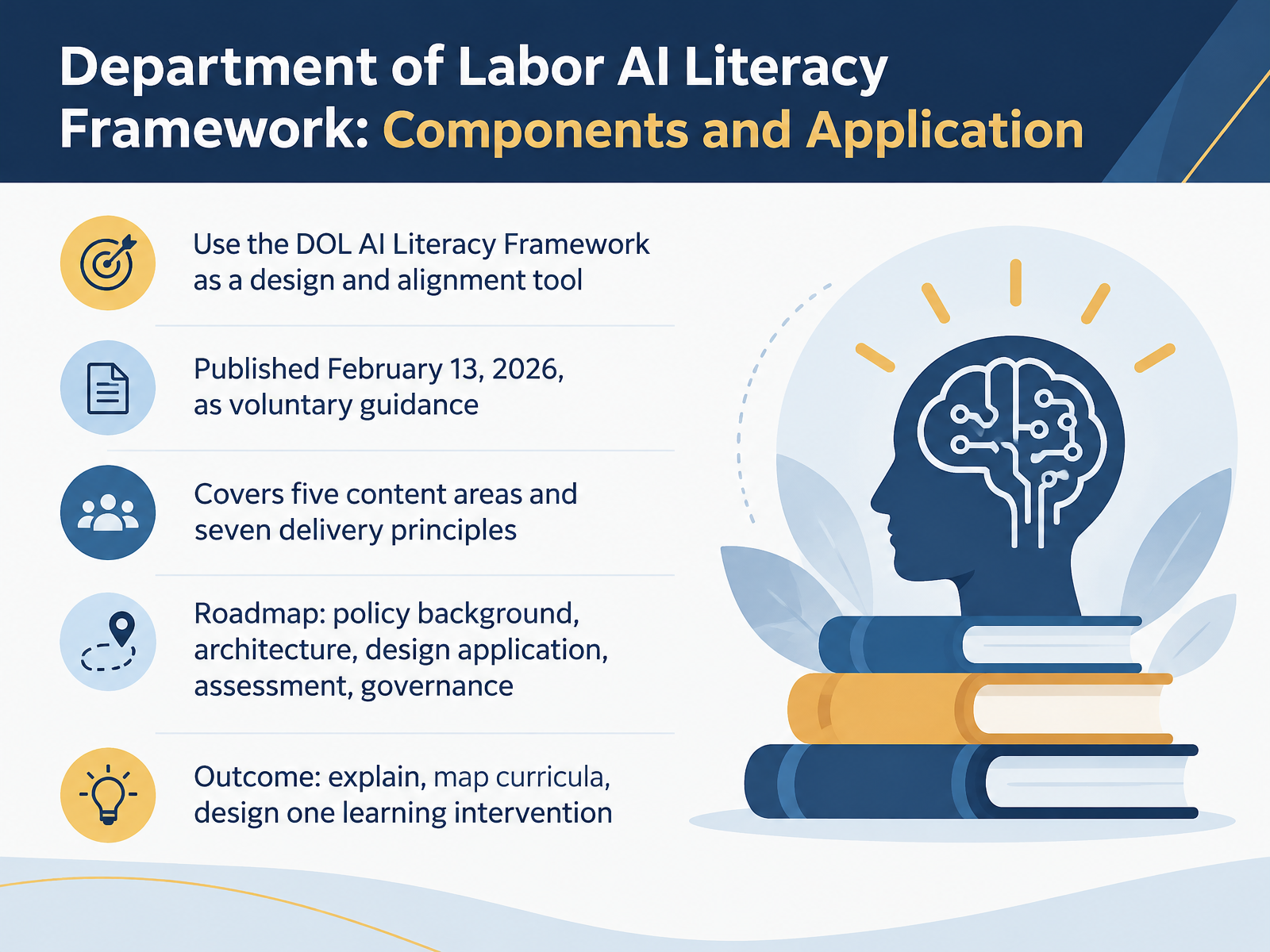
- 01Department of Labor AI Literacy Framework: Components and ApplicationWelcome. This session is about the Department of Labor's AI Literacy Framework, and we'll treat it as what it is: a practical design and alignment tool for your programs. The department published it on February thirteenth, twenty twenty-six, as voluntary guidance. It's not a mandate. It covers five content areas and seven delivery principles. Here's our roadmap. We'll start with the policy background, then walk through the framework's architecture, apply it to program design, connect it to assessment, and close on governance. By the end, you'll be able to explain the framework in plain language, map it to curricula you already run, and design one learning intervention you can pilot. Think of it as a reference point for decisions you're already making, especially during needs analysis and curriculum mapping. First, let's look at why the framework exists.dol.govdol.govcontent.govdelivery.com+22 min
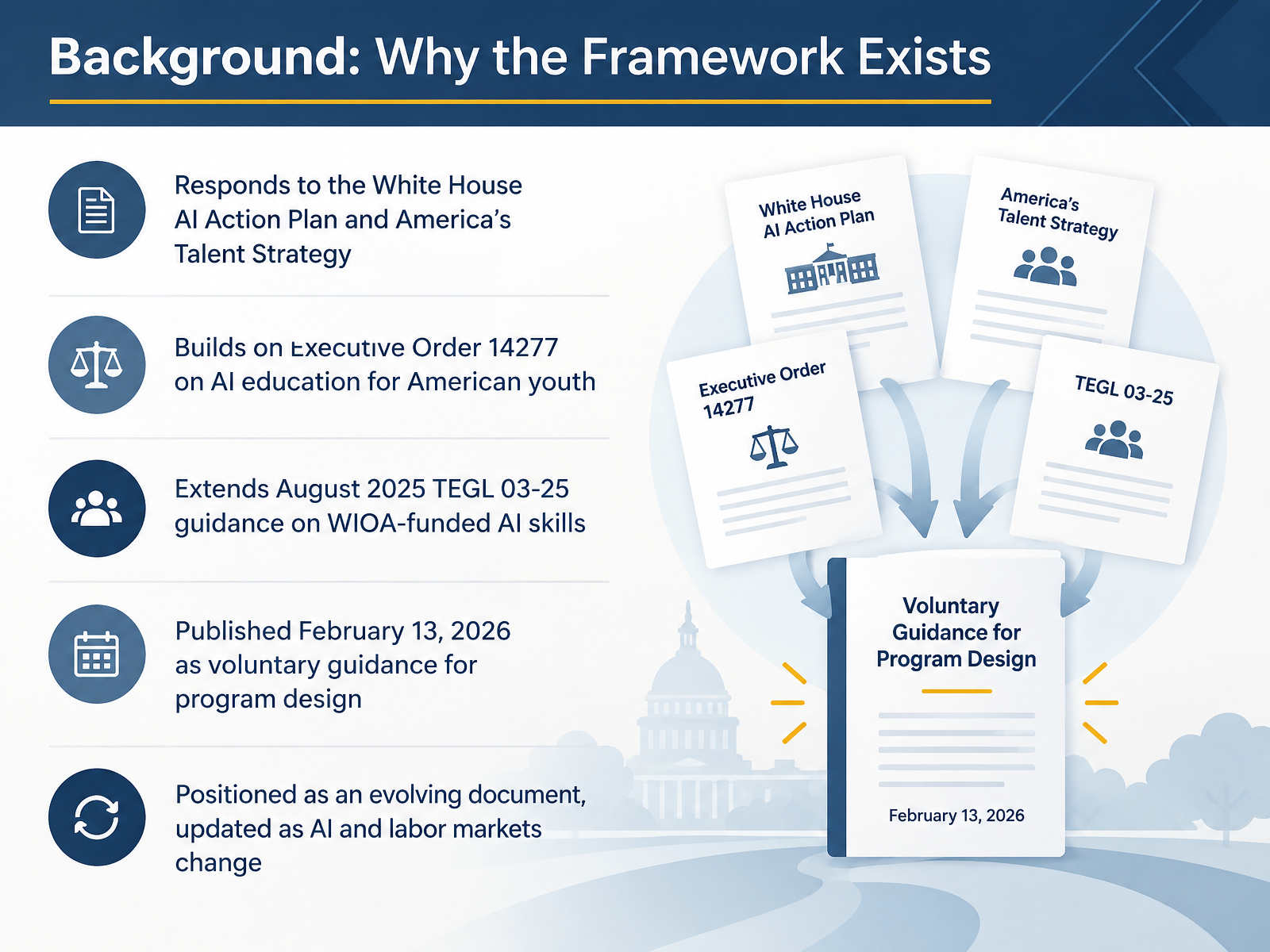
- 02Background: Why the Framework ExistsLet's look at where this framework comes from, because the origin story tells you how to use it. The Department of Labor published it on February thirteenth, twenty twenty-six, as a response to the White House AI Action Plan and America's Talent Strategy. It builds on Executive Order 14277 on AI education for American youth. It also extends the August twenty twenty-five training guidance, TEGL 03-25, on AI skills funded through the Workforce Innovation and Opportunity Act. Now, here's the practical point for you as a program designer. This is voluntary guidance, not a mandate. It gives you a common foundation for curriculum mapping without adding new compliance requirements. And it's built to evolve. The Department commits to updating it as AI capabilities and labor markets change. So treat it less like a fixed standard and more like a living reference you revisit each planning cycle. With that context in place, let's move on to the framework architecture at a glance.
 dol.govdol.govcontent.govdelivery.com+21 min
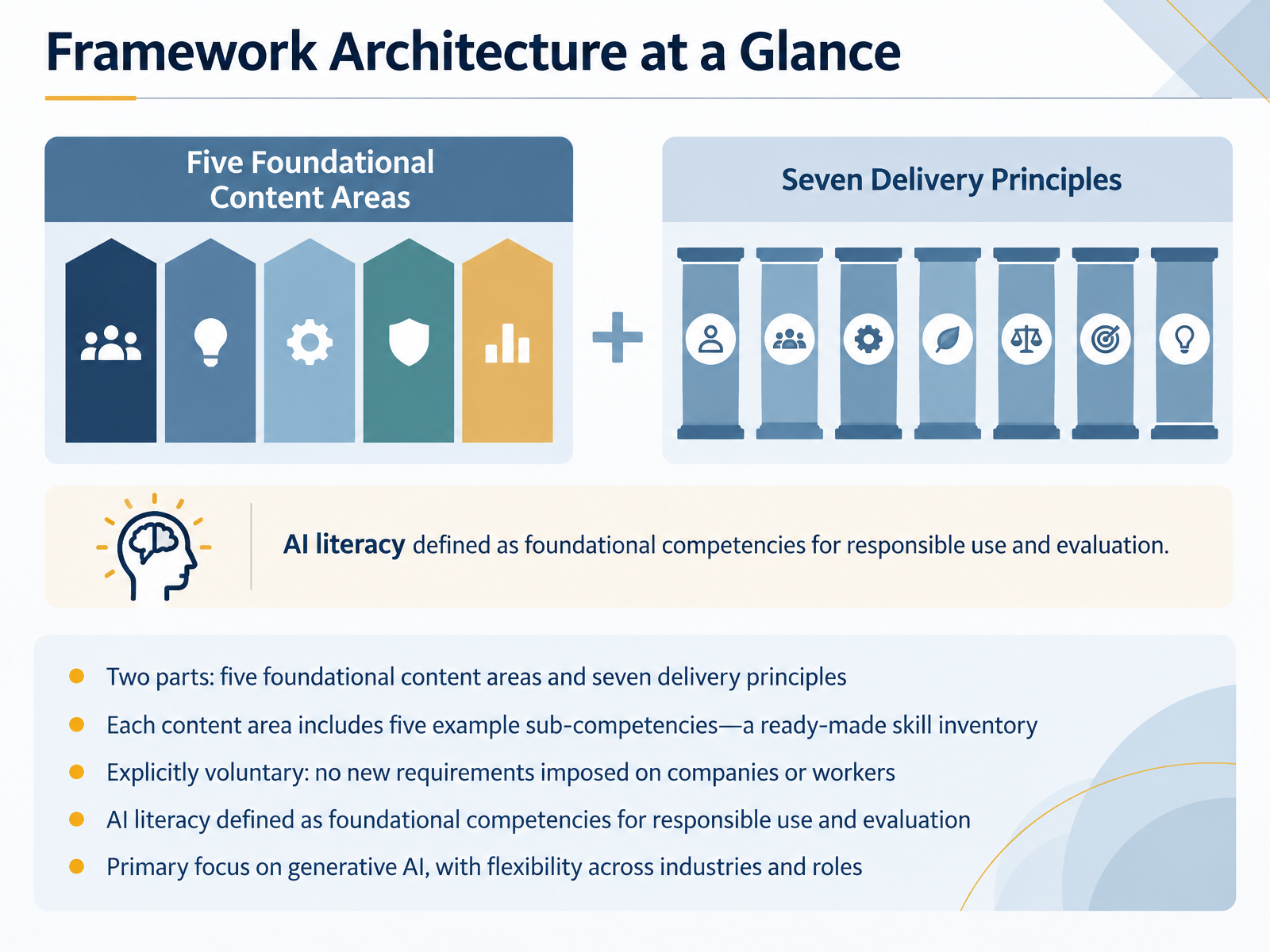
- 03Framework Architecture at a GlanceLet's look at how the framework is built, because the architecture tells you how to use it in your own curriculum mapping. It has two parts: five foundational content areas and seven delivery principles. Each content area includes five example sub-competencies. Think of those as a ready-made skill inventory you can drop into a needs analysis or a course outline. One thing to note up front: the framework is explicitly voluntary. It imposes no new requirements on companies or workers. It defines AI literacy as foundational competencies for responsible use and evaluation. The primary focus is generative AI, with flexibility across industries and roles. So when you map it to your programs, you can adapt the depth and examples to your learners. Next, we'll walk through Content Area One: Understand AI Principles.
 1 min
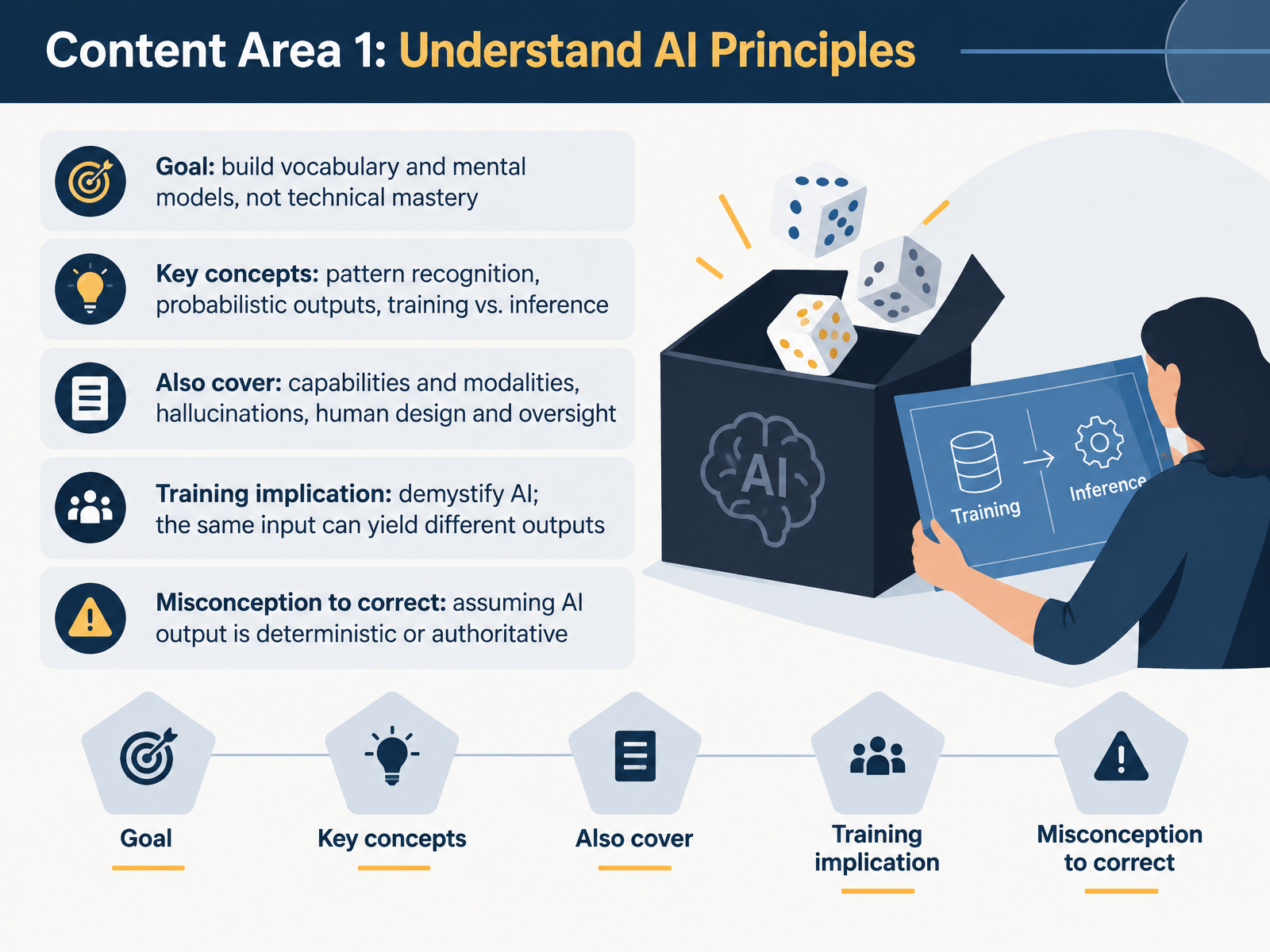
- 04Content Area 1: Understand AI PrinciplesNow let's look at the first content area, Understand AI Principles. Here's the practical problem. Your learners hear about AI everywhere, but they lack the vocabulary and mental models to use it well. So the goal is not technical mastery. It's building shared language. Cover pattern recognition and probabilistic outputs. AI systems identify statistical patterns in data. Same input can produce different outputs. That surprises people. Define training versus inference once in plain language. Training builds the model from large datasets. Inference is the model generating output in real time. Also cover capabilities and modalities, hallucinations, and human design and oversight. Every AI system reflects human decisions about data and goals. Use a quick demo to demystify: run the same prompt twice and compare results. That corrects the biggest misconception, that AI output is deterministic or authoritative. Verify before you trust. Next, we move to Content Area 2: Explore AI Uses.
 dol.govbeta.dol.govdol.gov+22 min
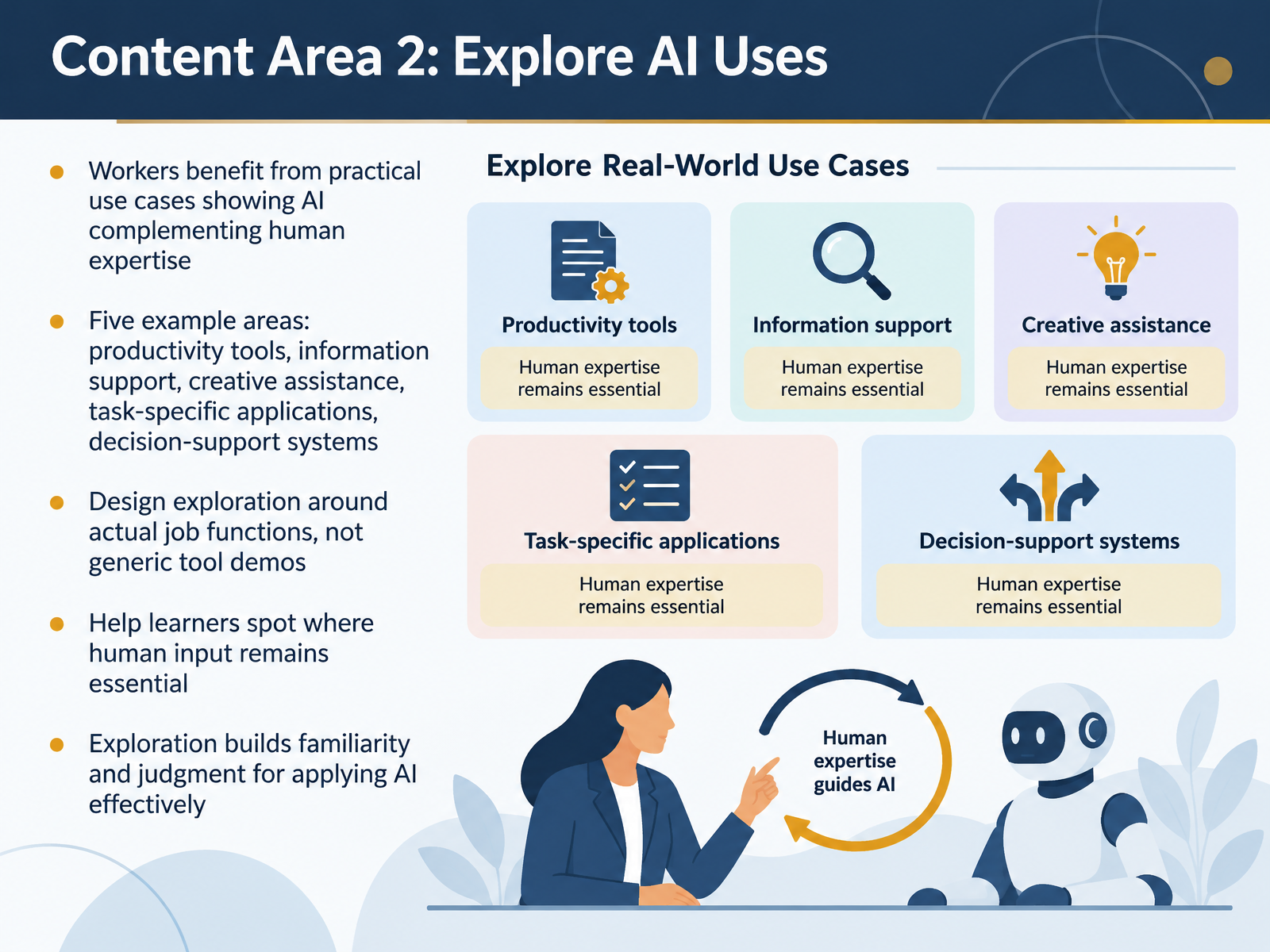
- 05Content Area 2: Explore AI UsesNow let's look at Content Area Two: Explore AI Uses. Here's the practical problem. Tool demos feel exciting, but they rarely transfer to the job. Workers need exposure to real applications that show how AI complements human expertise. The Department of Labor names five example areas: productivity tools, information support, creative assistance, task-specific applications, and decision-support systems. Think drafting a report, answering a background question, generating first-draft copy, transcribing audio, or producing a risk forecast. Notice the pattern. Each one supports a task. None replaces the person doing it. So design exploration around actual job functions, not generic tool tours. In your needs analysis and curriculum mapping, anchor each activity in a task your learners already perform. Then ask them where human input stays essential. That question builds the judgment they need later, when they direct and evaluate AI themselves. Exploration builds familiarity and judgment for applying AI effectively. Next, we move to Content Area Three: Direct AI Effectively.
 dol.govdol.govdol.gov+22 min
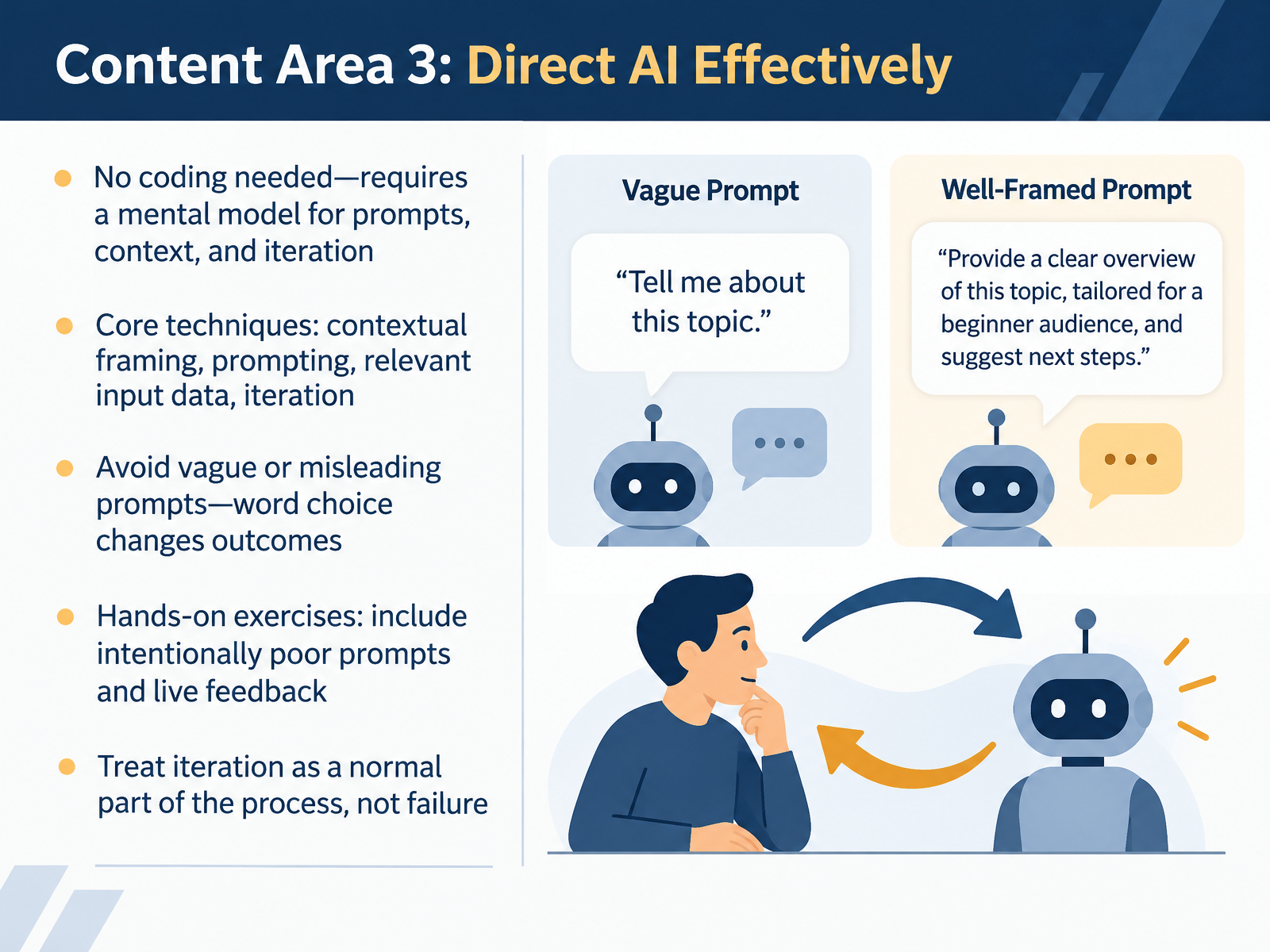
- 06Content Area 3: Direct AI EffectivelyNow let's look at the third content area, Direct AI Effectively. Here's the practical problem it solves. Your learners try an AI tool, get a mediocre answer, and quietly decide AI doesn't work. In most cases the tool isn't the issue. The input is. Directing AI well needs no coding skills. It needs a mental model for prompts, context, and iteration. That means four core techniques. Contextual framing, like naming the audience and tone. Clear prompting techniques. Supplying relevant input data or examples. And iterating on outputs. Word choice matters, because vague or misleading prompts produce vague results. So build hands-on exercises with intentionally poor prompts, then live feedback as learners rewrite them. Treat iteration as normal, not failure. That mirrors your needs analysis cycle, where you refine until the result fits the goal. Next, Content Area 4: Evaluate AI Outputs.
 dol.govdol.govbeta.dol.gov+22 min
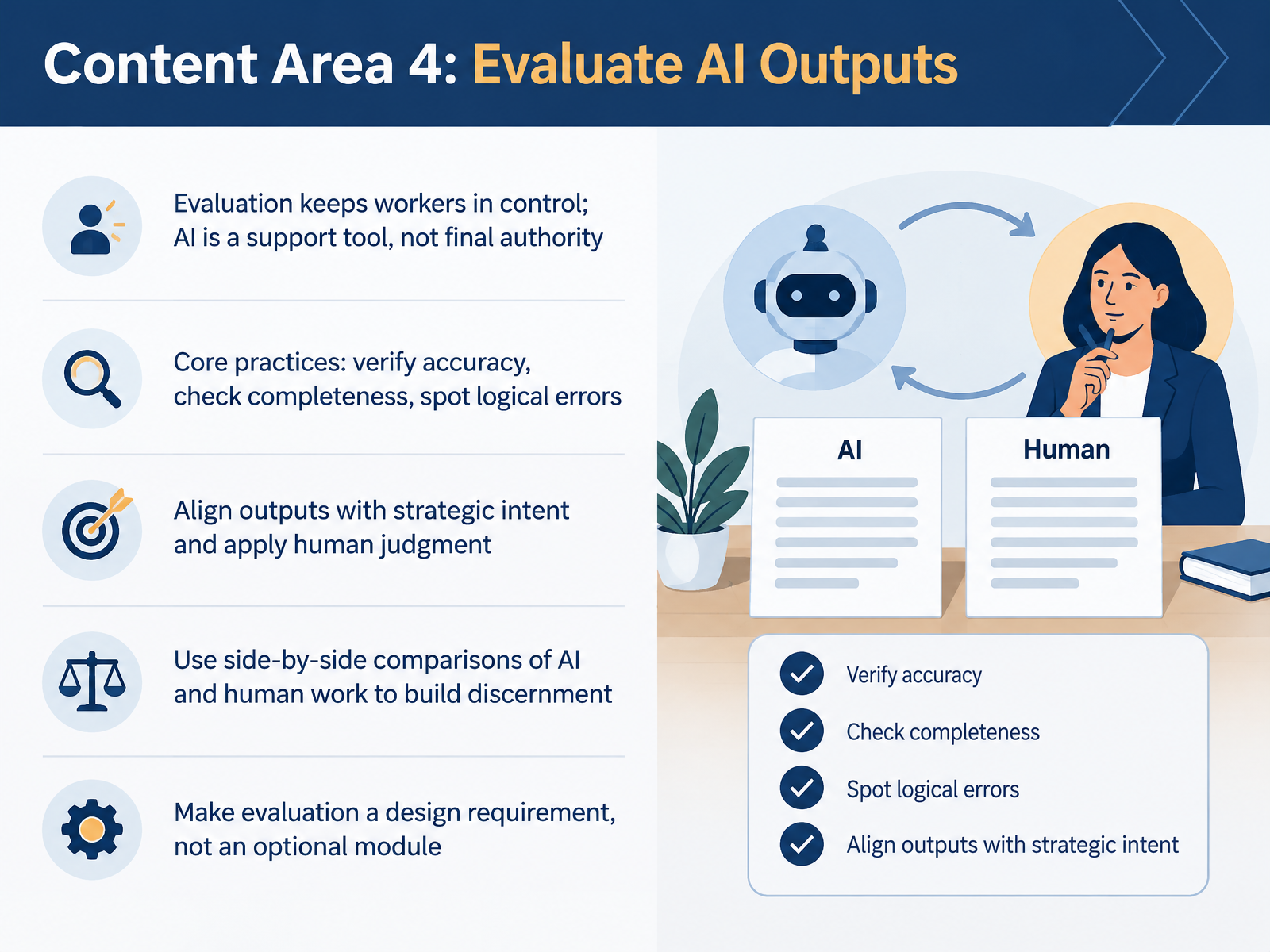
- 07Content Area 4: Evaluate AI OutputsNow let's look at Content Area Four: Evaluate AI Outputs. Here's the practical problem. Your learners are producing AI drafts fast, but nobody has defined what a good output looks like. Evaluation keeps workers in control. AI is a support tool, not final authority. Teach three core practices. Verify accuracy against trusted sources. Check completeness, so the output fully addresses the task. And spot logical errors, like missing steps or faulty assumptions. Then ask whether the output aligns with strategic intent, and where human judgment must be applied. A simple design move works well here. Have learners compare AI-generated work side by side with human work, and discuss the differences. That builds discernment faster than any lecture. One last point. Make evaluation a design requirement, not an optional module, just as you would build review steps into any workflow. That brings us to Content Area Five: Use AI Responsibly.
 dol.govdol.govdol.gov+22 min
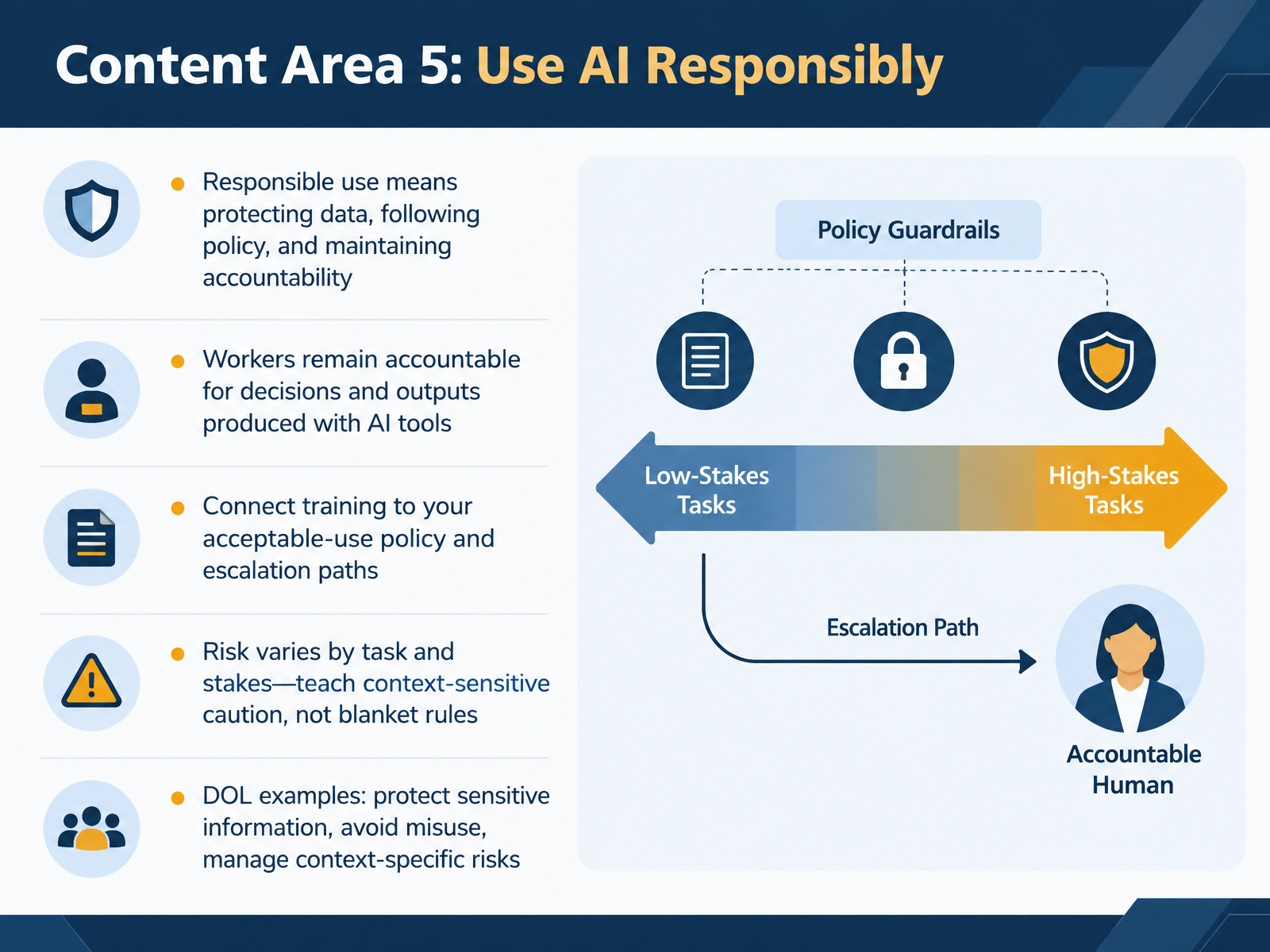
- 08Content Area 5: Use AI ResponsiblyNow let's talk about responsible use. The practical problem here is simple. Your learners are already pasting work content into AI tools, and your policy may not have caught up. So what does responsible use actually mean? Three things. Protect sensitive data. Follow policy. And keep accountability with the human, not the tool. Workers remain responsible for the decisions and outputs they produce with AI. Make that explicit in your curriculum, then connect it to two documents you likely already maintain. Your acceptable-use policy, and your escalation path for reporting problems. Here's the design trap to avoid. Blanket rules. Risk varies by task and stakes. Drafting a meeting agenda is low risk. Summarizing employee records is not. Teach context-sensitive caution, not a list of prohibitions. The Department of Labor names the same priorities. Protect sensitive information, avoid misuse or harm, and manage context-specific risks. Map each one to a scenario your learners actually face. Next, we move to the seven delivery principles, the how of AI literacy.
 dol.govdol.govbeta.dol.gov+22 min
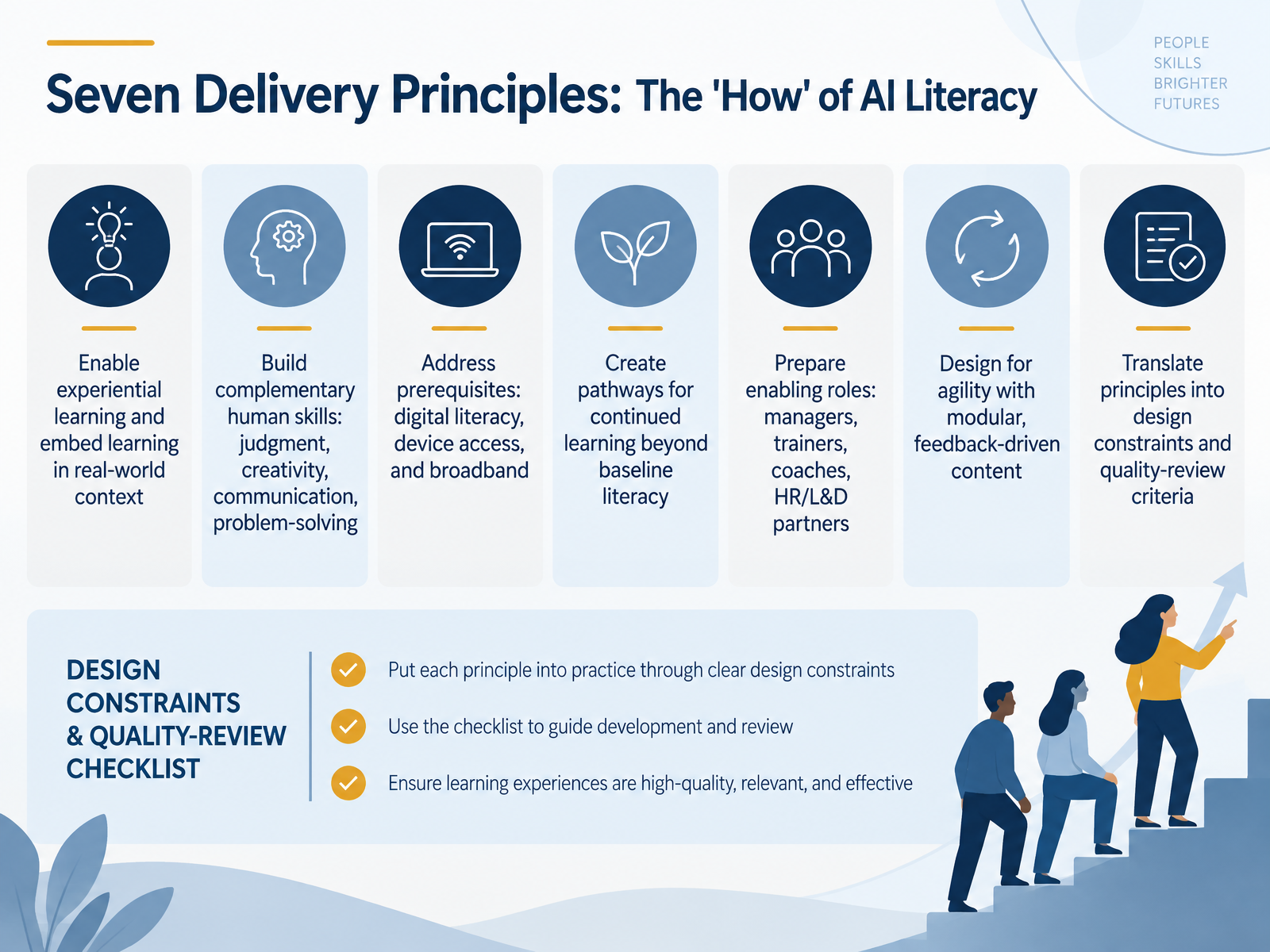
- 09Seven Delivery Principles: The 'How' of AI LiteracyNow let's turn from what to teach to how to deliver it. The Department of Labor's framework gives us seven delivery principles for AI literacy. Think of them as quality constraints you can build into your design review. First, enable experiential learning. Put learners hands-on with real tasks, like drafting a client email with AI and then improving the prompt. Second, embed learning in context so it fits your industry workflows. Third, build complementary human skills: judgment, creativity, communication, and problem-solving. Fourth, address prerequisites, including digital literacy, device access, and broadband. Fifth, create pathways for continued learning beyond the baseline. Sixth, prepare enabling roles, such as managers, trainers, coaches, and your HR and L and D partners. Seventh, design for agility with modular, feedback-driven content. Here's your takeaway: translate each principle into a design constraint and a review question. For example, does every module include a hands-on task? That turns principles into quality criteria you can actually audit. Next, we'll look at proficiency levels and role mapping.
 dol.govdol.govdol.gov+22 min
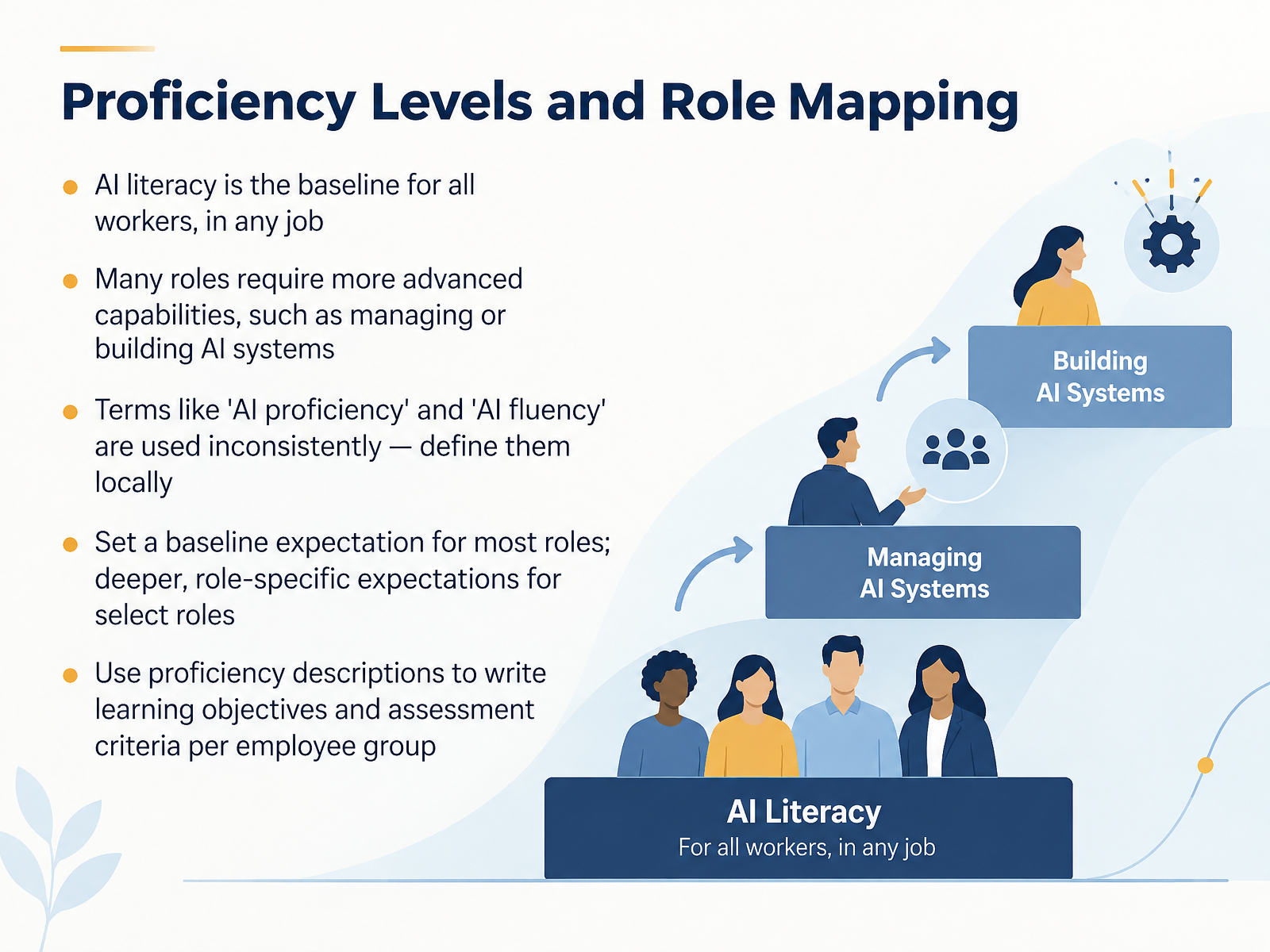
- 10Proficiency Levels and Role MappingNow let's map proficiency to roles. Here's the problem you've probably already hit: your job descriptions say AI literate, and nobody agrees on what that means. The Department of Labor is clear on two things. First, AI literacy is the baseline for every worker, in any job. Second, many roles need more, such as managing or building AI systems. The department also notes that terms like AI proficiency and AI fluency are used inconsistently. Sometimes they signal different levels of mastery. Sometimes they're just different words for the same thing. So define them locally. Set one baseline expectation for most roles, and deeper, role-specific expectations for select roles, like the analysts who configure tools or the managers who approve AI-assisted work. Then turn those descriptions into learning objectives and assessment criteria for each employee group. That's how a vague label becomes something your learners can actually demonstrate. Next, we'll look at applying the framework to training design.
 dol.govdol.govdol.gov+22 min
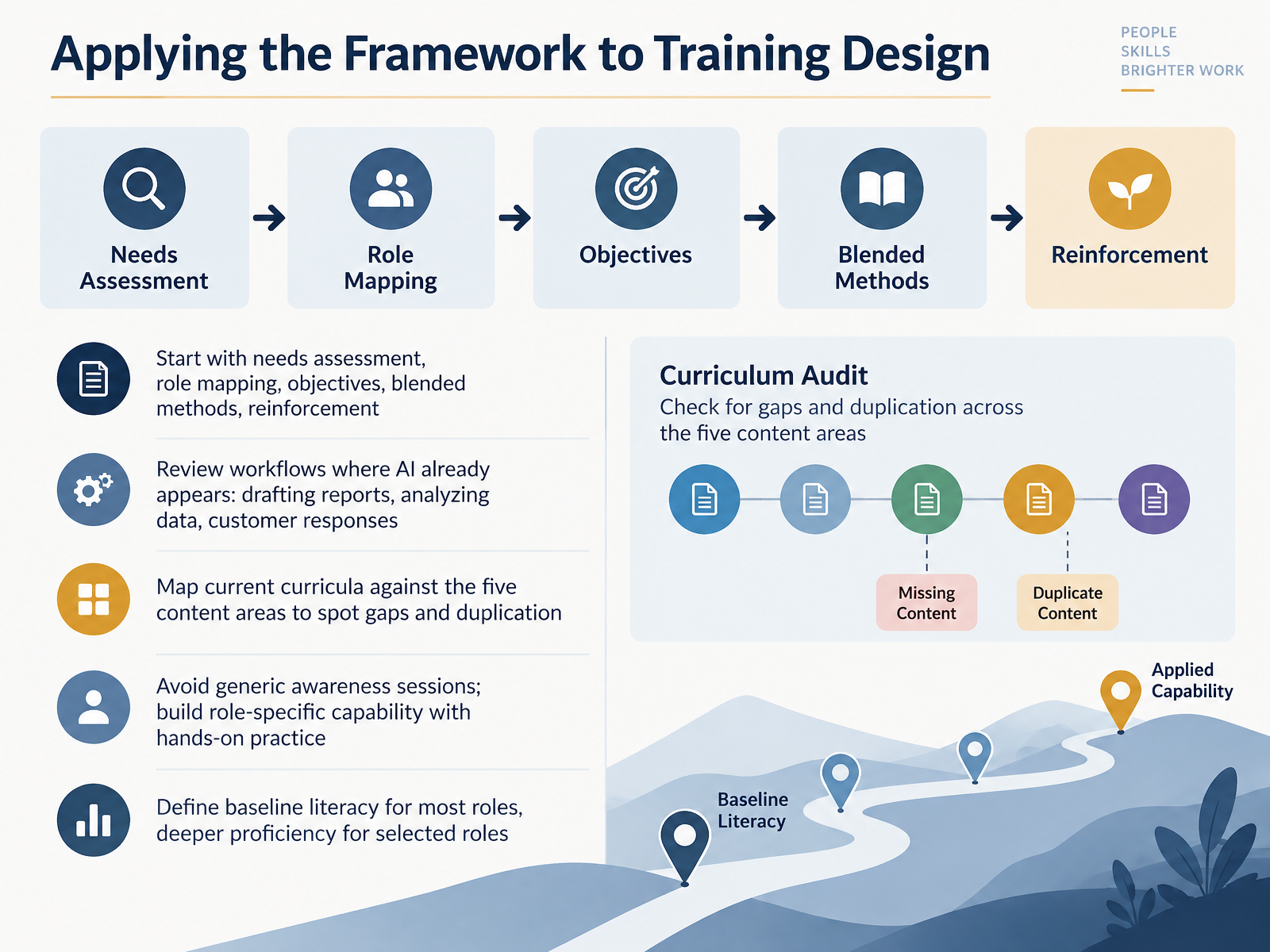
- 11Applying the Framework to Training DesignNow let's put the framework to work in your training design. Start where you already start: needs assessment, role mapping, objectives, blended methods, and reinforcement. Then review your workflows. Where does AI already appear? Drafting reports, analyzing data, customer responses. Those are your real use cases. Next, map your current curricula against the five content areas. You'll spot gaps and duplication fast. One caution: avoid generic awareness sessions. They don't change behavior. Build role-specific capability with hands-on practice instead, like having learners compare AI drafts to their own work. Finally, define expectations. Baseline literacy for most roles, deeper proficiency for selected roles. That keeps investment targeted, not scattered.
 paradoxlearning.comdoi.orgparadoxlearning.com+22 min
- 12Assessment, Measurement, and Continuous ImprovementNow let's talk about assessment and continuous improvement. The practical problem here is simple. Most programs measure completion, not capability. So how do you know your training actually changed behavior?
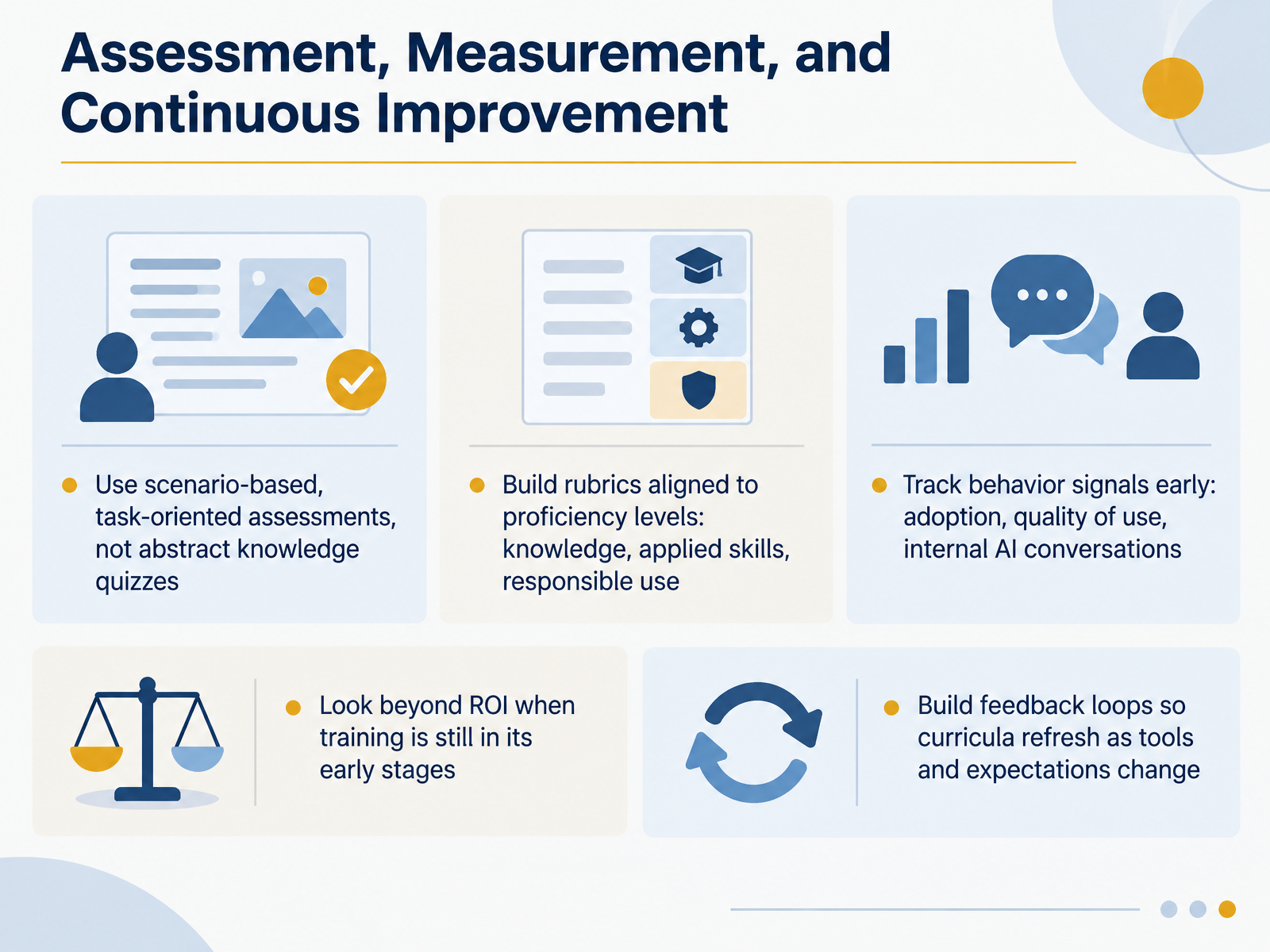
First, use scenario-based, task-oriented assessments, not abstract knowledge quizzes. Research on workforce AI literacy found that hands-on scenario tasks outperformed traditional tests. Give learners a real task, like choosing the right tool or fact-checking an output, and score that.
Second, build rubrics aligned to proficiency levels across knowledge, applied skills, and responsible use. Observable behaviors at each level make feedback concrete.
Third, track behavior signals early. Adoption, quality of use, and internal AI conversations are your leading indicators. As one L&D leader put it, curiosity is the metric. Save return on investment questions for later stages.
Finally, build feedback loops so curricula refresh as tools and expectations change. Learner input and real-world outcomes should feed your next design cycle.
Next, we'll look at the implementation roadmap and governance.
 doi.orgarxiv.orgdol.gov+22 min
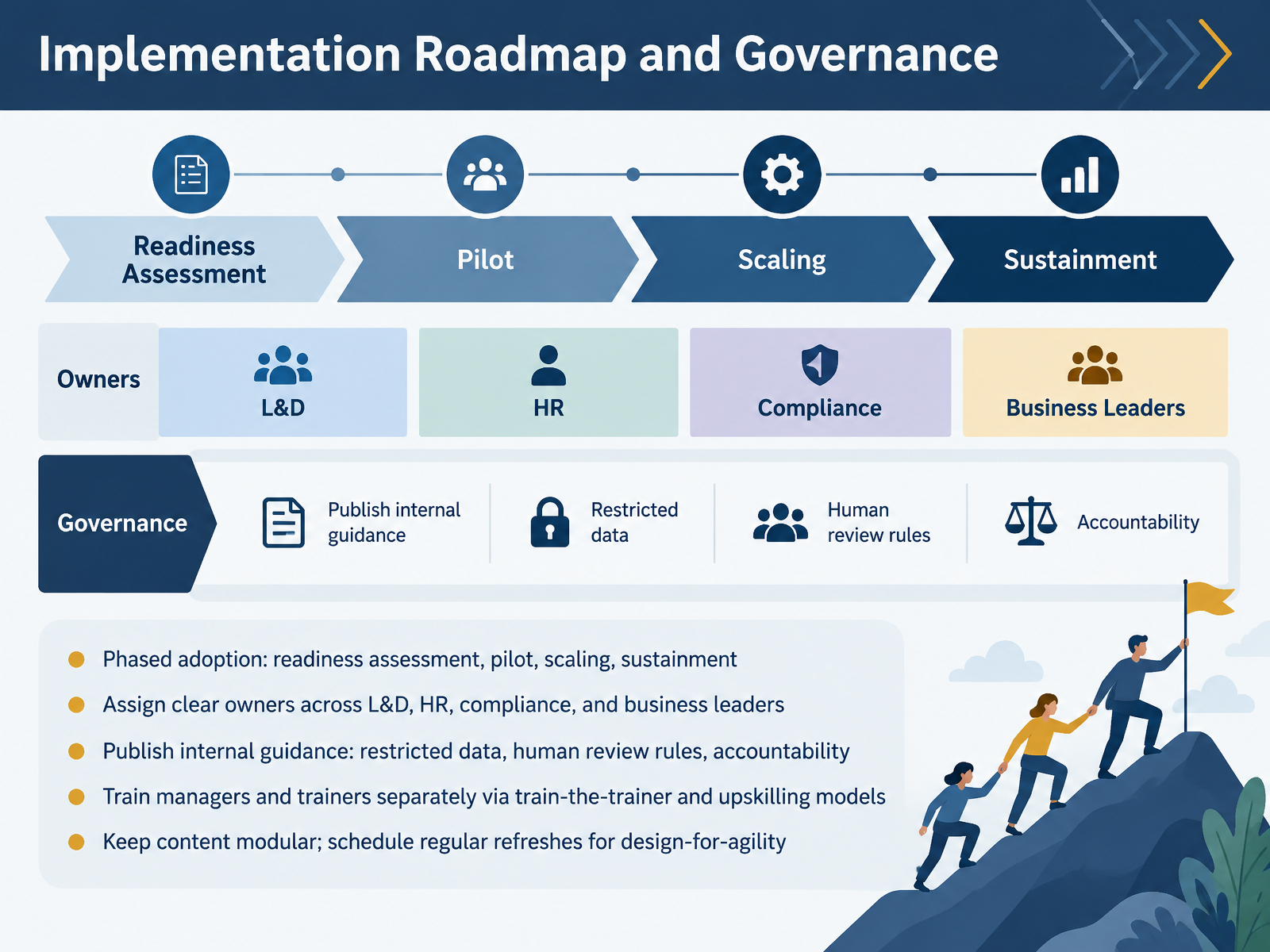
- 13Implementation Roadmap and GovernanceNow let's turn the framework into a governance plan you can actually run. Here's the practical problem: great content fails without owners and rules. So adopt in phases. Assess readiness, run a pilot, scale, then sustain. Assign clear owners across learning and development, human resources, compliance, and business leaders. Next, publish internal guidance covering restricted data, when human review is required, and who is accountable for AI-assisted outputs. Here's an example. A manager drafts a performance summary with AI, and a reviewer signs off before it is shared. Train managers and trainers separately, using train-the-trainer for instructors and upskilling for managers. Finally, keep content modular and schedule regular refreshes. That is design for agility, and it protects your investment. Before we build your own action plan, keep this takeaway: governance makes AI literacy durable.
 dol.govdol.govapprenticeship.gov+22 min
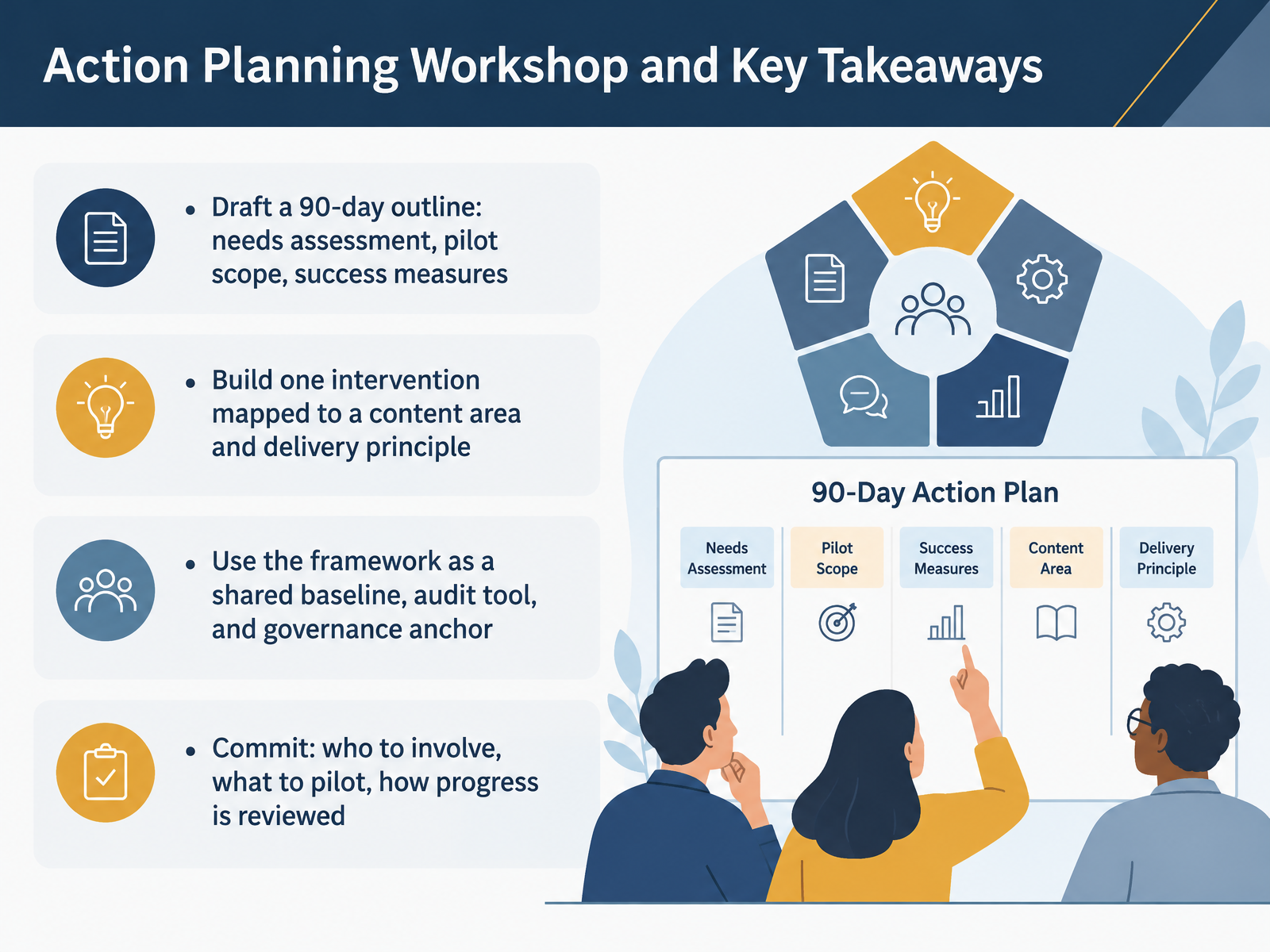
- 14Action Planning Workshop and Key TakeawaysLet's close by turning everything we covered into a plan you can act on. Start with a ninety-day outline. Name your needs assessment, your pilot scope, and your success measures. For example, one team piloted a prompting workshop with thirty employees and tracked adoption two weeks later. Next, build one intervention mapped to a content area and a delivery principle. Keep it small and testable. Then use the framework as a shared baseline, an audit tool, and a governance anchor, so everyone references the same expectations. Finally, commit. Write down who to involve, what to pilot, and how progress gets reviewed. That turns AI literacy from a course into a capability you manage. Thank you for your time and attention today. You now have a practical foundation. Take one small step this week, and keep building from there. Good luck.
 paradoxlearning.comdoi.orgparadoxlearning.com+21 min
Take the deck with you
Download this course as a file — free, no sign-up needed.
- PDF handoutEvery slide page, ready to print or share.15 pages · 3.2 MBDownload
- Narrated PowerPointThe deck that presents itself — every slide carries the digital human's narration video.15 pages · 12.8 MBDownload
- PowerPoint slidesThe full deck as a .pptx — open it in PowerPoint, Keynote, or Google Slides.15 pages · 3.1 MBDownload
Free to use in your own training — please keep the PersonWise credit page at the end.
Have your own deck? Turn it into a course
Sources consulted
Web sources consulted while building this course.
- The U.S. Department of Labor’s Artificial Intelligence Literacy Framework — dol.gov
- US Department of Labor releases AI literacy framework providing ... — dol.gov
- USDOL/ETA Advisories - Training and Employment Notices (TEN) Update TEN 07-25 - The U.S. Department of Labor’s Artificial Intelligence Literacy Framework — content.govdelivery.com
- TEN 07-25: What Workforce Professionals Need to Know - NAWDP — nawdp.org
- Exclusive: Labor Department unveils AI literacy framework — axios.com
- AI Ready | U.S. Department of Labor — beta.dol.gov
- US Department of Labor releases AI literacy framework providing foundational content areas, delivery principles to guide nationwide efforts | U.S. Department of Labor — dol.gov
- The U.S. Department of Labor’s Artificial Intelligence Literacy Framework — dol.gov
- AI Skills and Literacy in Registered Apprenticeship | Apprenticeship.gov — apprenticeship.gov
- US Department of Labor launches ‘Make America AI-Ready’ initiative | U.S. Department of Labor — dol.gov
- TEN 07-25 | U.S. Department of Labor — dol.gov
- TEN 07-25 | U.S. Department of Labor — dol.gov
- The U.S. Department of Labor’s Artificial Intelligence Literacy Framework — dol.gov
- AI Fluency vs AI Literacy: The DOL Standard | AISA — aisa.to
- AI Literacy Framework — paradoxlearning.com
- The AI literacy development canvas: Assessing and building AI literacy in organizations — doi.org
- AI Literacy: Implications for L&D - Paradox Learning — paradoxlearning.com
- AI Literacy Framework — digitallearninginstitute.com
- AI Training Program Design Framework | Pertama Partners — pertamapartners.com
- AI Literacy Assessment Revisited: A Task-Oriented Approach Aligned with Real-world Occupations — arxiv.org