Begin
15 pages · ~30 min
Developing a Knowledge Management Strategy
Learn a practical workflow to develop a knowledge management strategy, covering key steps and tools for capturing, sharing, and applying organizational knowledge.
A digital instructor presents all 15 pages. Hold “Ask” at any point and ask out loud — the answer comes from this course. No sign-up needed.
What you’ll learn
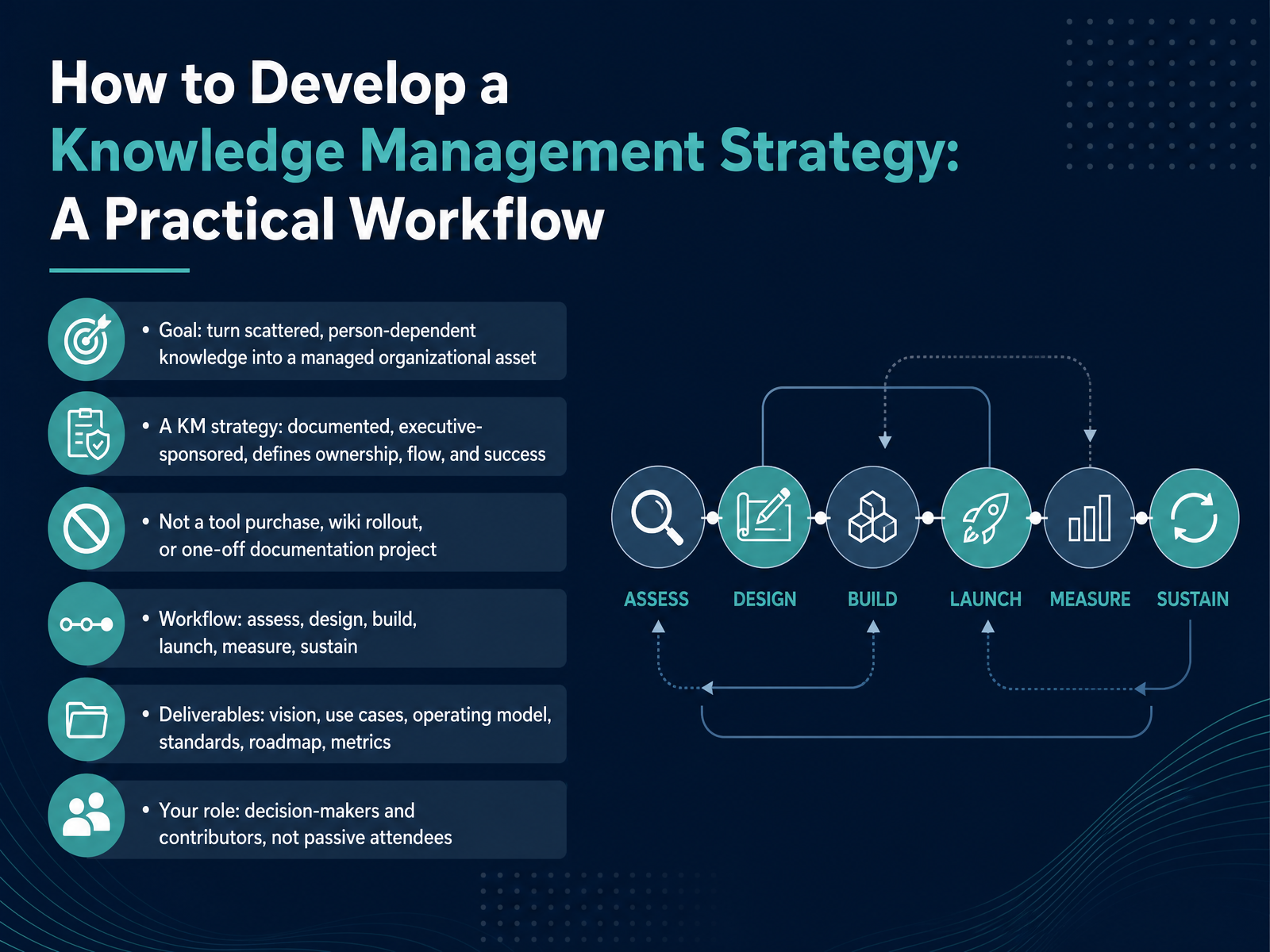
- 01How to Develop a Knowledge Management Strategy: A Practical WorkflowWelcome. Over the next few minutes, we'll walk through a practical workflow for developing a knowledge management strategy. The goal is straightforward. Turn scattered, person-dependent knowledge into a managed organizational asset. A real KM strategy is documented, executive-sponsored, and it defines ownership, knowledge flow, and what success looks like. It is not a tool purchase, a wiki rollout, or a one-off documentation project. The workflow has six stages: assess, design, build, launch, measure, and sustain. Along the way, you'll produce concrete deliverables: a vision, priority use cases, an operating model, standards, a roadmap, and metrics. Your role here is active. You are decision-makers and contributors, not passive attendees. As we move through each stage, note who owns the step, who needs to be involved, and how you'll know it's complete. Let's start with why this matters now.1 min
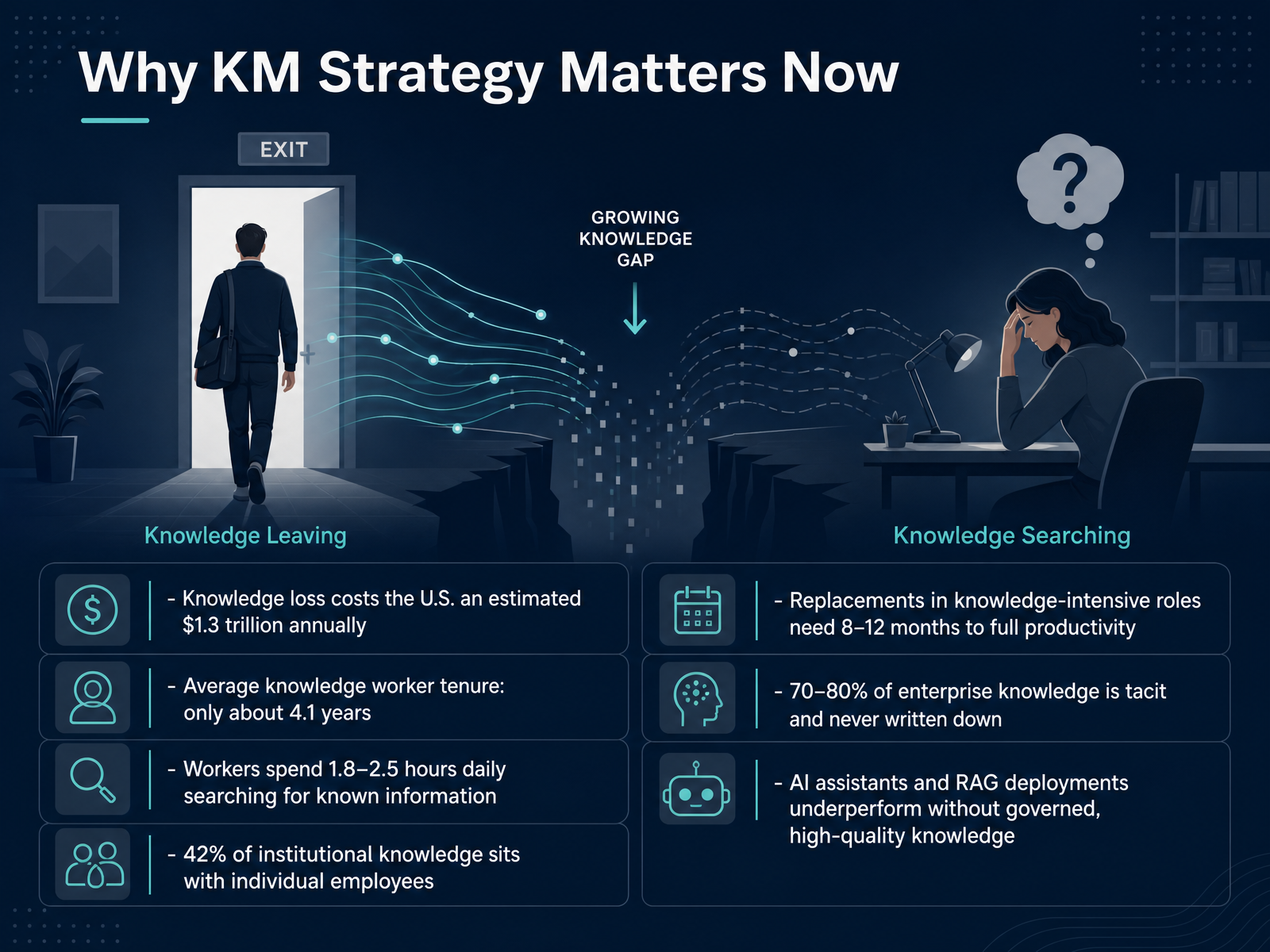
- 02Why KM Strategy Matters NowLet's ground this strategy work in the numbers. Knowledge loss costs the United States an estimated one point three trillion dollars every year. That is not abstract. Average tenure for a knowledge worker is only about four point one years. So people leave faster than you can document what they know. Meanwhile, workers spend one point eight to two and a half hours every day searching for information the organization already has. And forty two percent of institutional knowledge sits with individual employees, not with the team. When someone in a knowledge-intensive role is replaced, it takes eight to twelve months to reach full productivity. On top of that, seventy to eighty percent of enterprise knowledge is tacit and never written down. And your AI assistants and retrieval augmented generation deployments will underperform without governed, high-quality knowledge behind them. The takeaway is simple. This is an operating problem, not a side project. So before you design anything, you need a clear picture of what you have. Which brings us to the next step. Baseline assessment, mapping knowledge, people, and gaps.
 2 min
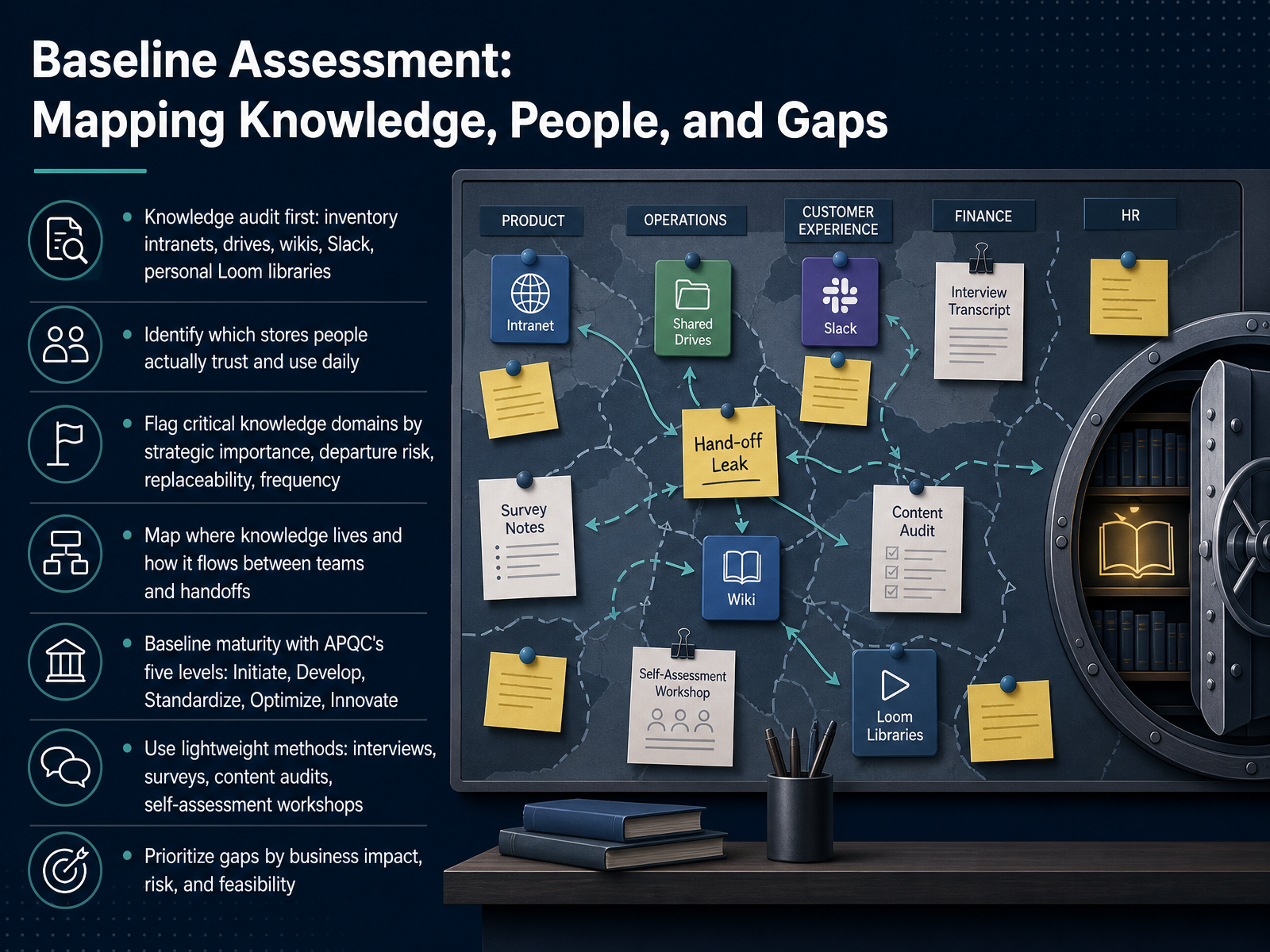
- 03Baseline Assessment: Mapping Knowledge, People, and GapsLet us move into the baseline assessment. Before you commit to any strategy, you need a clear picture of what knowledge exists, where it lives, and where it is at risk.
Start with a knowledge audit. Inventory every store your teams touch: intranets, shared drives, wikis, Slack channels, and personal Loom libraries. Personal video libraries are easy to overlook, and they often hold critical know how.
Next, identify which stores people actually trust and use daily. Adoption matters more than inventory size. A messy wiki that people open every morning is more valuable than a polished repository nobody visits.
Then flag your critical knowledge domains. Score them by strategic importance, departure risk, replaceability, and frequency of use. A domain that is high value, concentrated in one person, and hard to replace should move to the top of your list.
Map where knowledge lives and how it flows between teams and handoffs. Handoff points are where knowledge most often drops.
Baseline your maturity using APQC's five levels: Initiate, Develop, Standardize, Optimize, and Innovate. Keep the assessment lightweight. Use interviews, surveys, content audits, and self assessment workshops.
Finally, prioritize gaps by business impact, risk, and feasibility. With that baseline in hand, we turn to design: vision, principles, and priority use cases.
 2 min
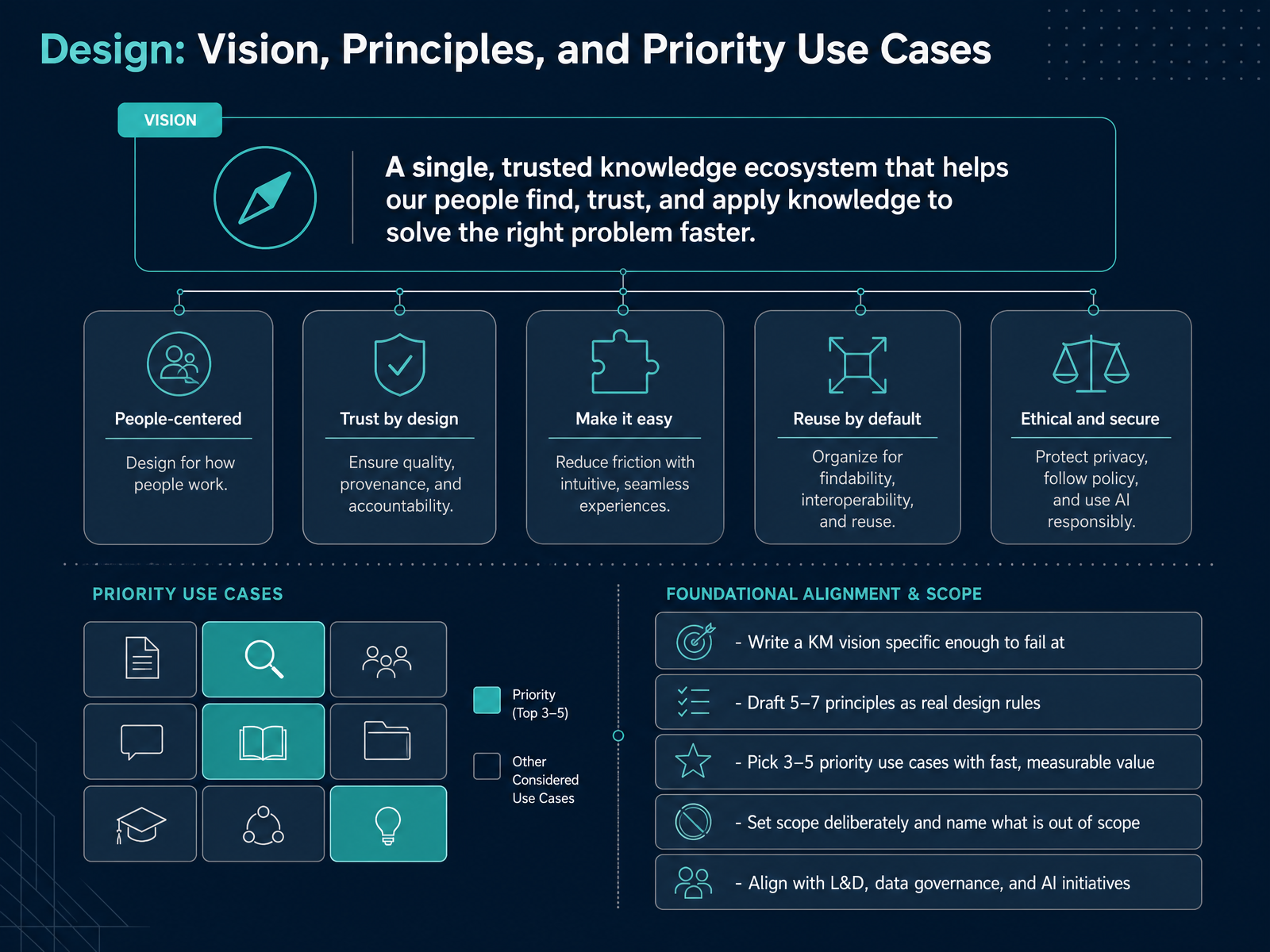
- 04Design: Vision, Principles, and Priority Use CasesLet us move from strategy into design. This is where you decide what your knowledge management effort is really trying to achieve, and how you will know if it is working.
Start with a vision specific enough to fail at. Not, we will improve knowledge sharing, but, within two quarters, every new hire can find approved answers to the top twenty customer questions without asking a colleague.
Then draft five to seven principles as real design rules. For example, single source of truth. If content conflicts, the approved source wins. Principles should decide arguments before they happen.
Next, pick three to five priority use cases with fast, measurable value. Think onboarding time, repeat support tickets, or proposal rework. Fewer use cases mean faster proof.
Set scope deliberately, and name what is out of scope. Write it down. That sentence prevents months of drift.
Finally, align with L and D, data governance, and A I initiatives. Schedule a thirty minute working session this week. Bring your vision draft, principles, and use case list.
Now let us look at the operating model, including roles, governance, and incentives.
 2 min
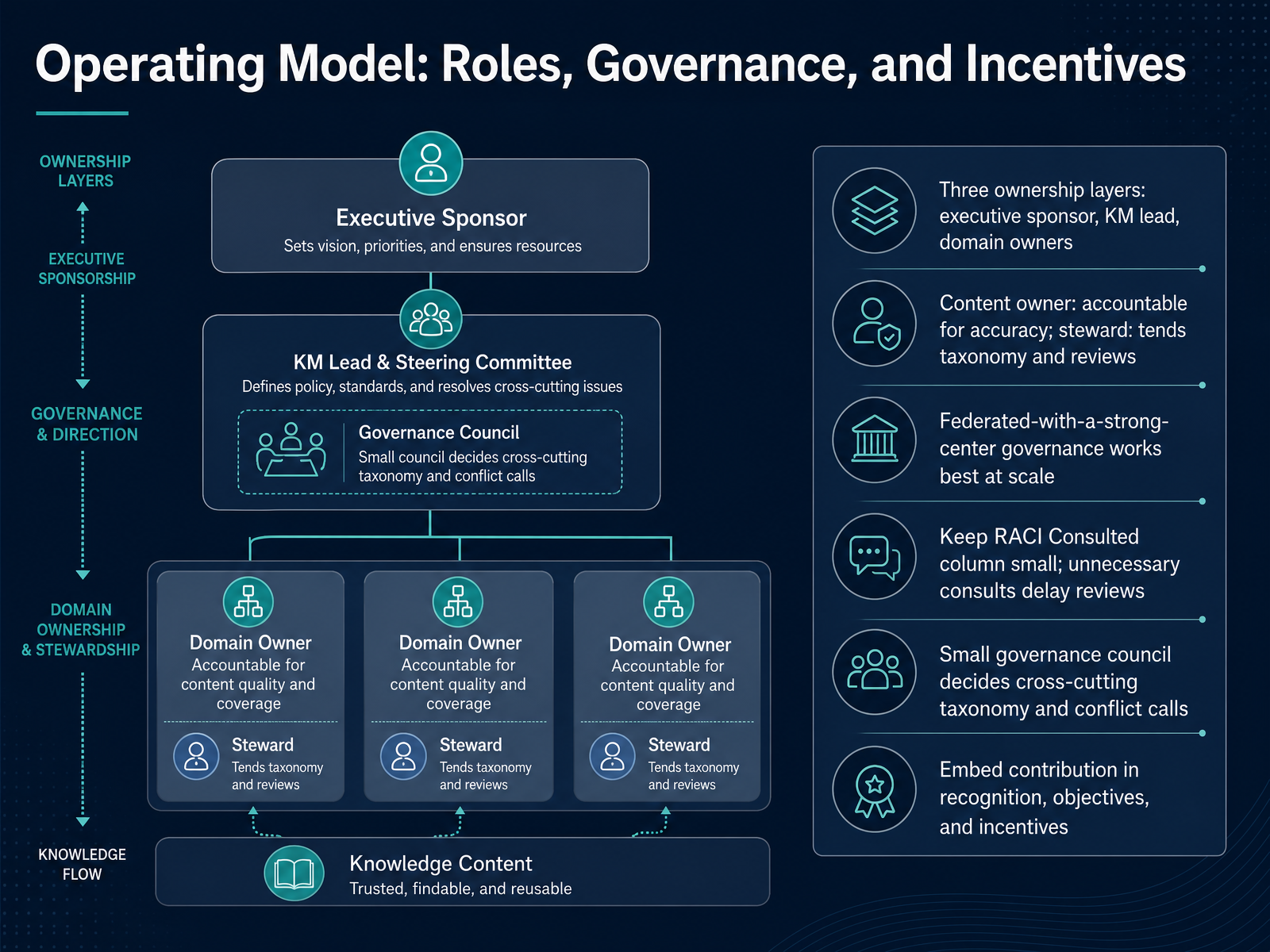
- 05Operating Model: Roles, Governance, and IncentivesLet's turn the strategy into an operating model, because good intentions fail without clear roles and real incentives. Start with three ownership layers. An executive sponsor clears barriers and funds the work. A KM lead runs the program day to day. And domain owners make decisions inside their business areas. Then separate two content roles. The content owner is accountable for accuracy. The steward tends the taxonomy and coordinates reviews. At scale, federated with a strong center works best. Domain teams stay close to the work, while a small central group keeps standards consistent. Keep your RACI Consulted column small. Every extra consult slows a review, so consult only those who can block or materially improve the outcome. A small governance council should decide cross-cutting taxonomy and resolve conflicts. Finally, embed contribution in recognition, objectives, and incentives. If publishing knowledge never shows up in someone's goals, it will always lose to competing priorities. So confirm your sponsor, name your KM lead, assign domain owners, check who holds Consulted, and add one contribution measure to a real objective. That makes the model stick. Next, we look at content and taxonomy, structuring knowledge for reuse.
 2 min
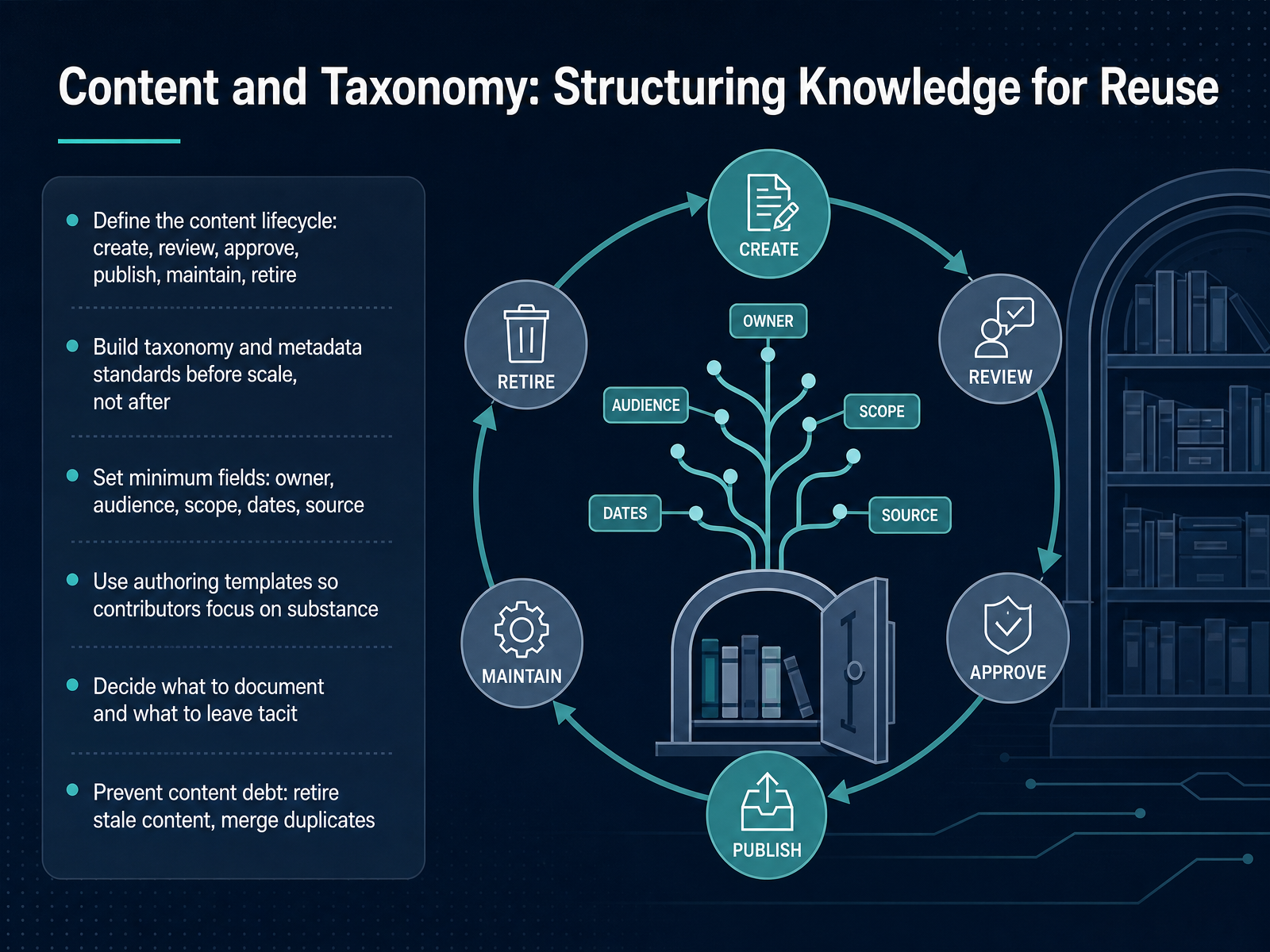
- 06Content and Taxonomy: Structuring Knowledge for ReuseNow let's focus on content and taxonomy. This is where you structure knowledge so it can actually be reused. Start by defining the content lifecycle. Create, review, approve, publish, maintain, and retire. Every item should have a clear path through those stages, with an owner at each handoff. Build your taxonomy and metadata standards before you scale, not after. Retrofitting structure onto hundreds of documents is painful and expensive. Set minimum required fields such as owner, audience, scope, dates, and source. Use authoring templates so contributors spend their energy on substance rather than formatting. Decide deliberately what to document and what to leave tacit. Not everything needs a written artifact. Finally, prevent content debt. Retire stale pages, merge duplicates, and review your library on a schedule. If you do these things, search stays clean and reuse becomes the default. That structure sets you up for the next layer, which is technology and tooling, enabling findability and flow.
 2 min
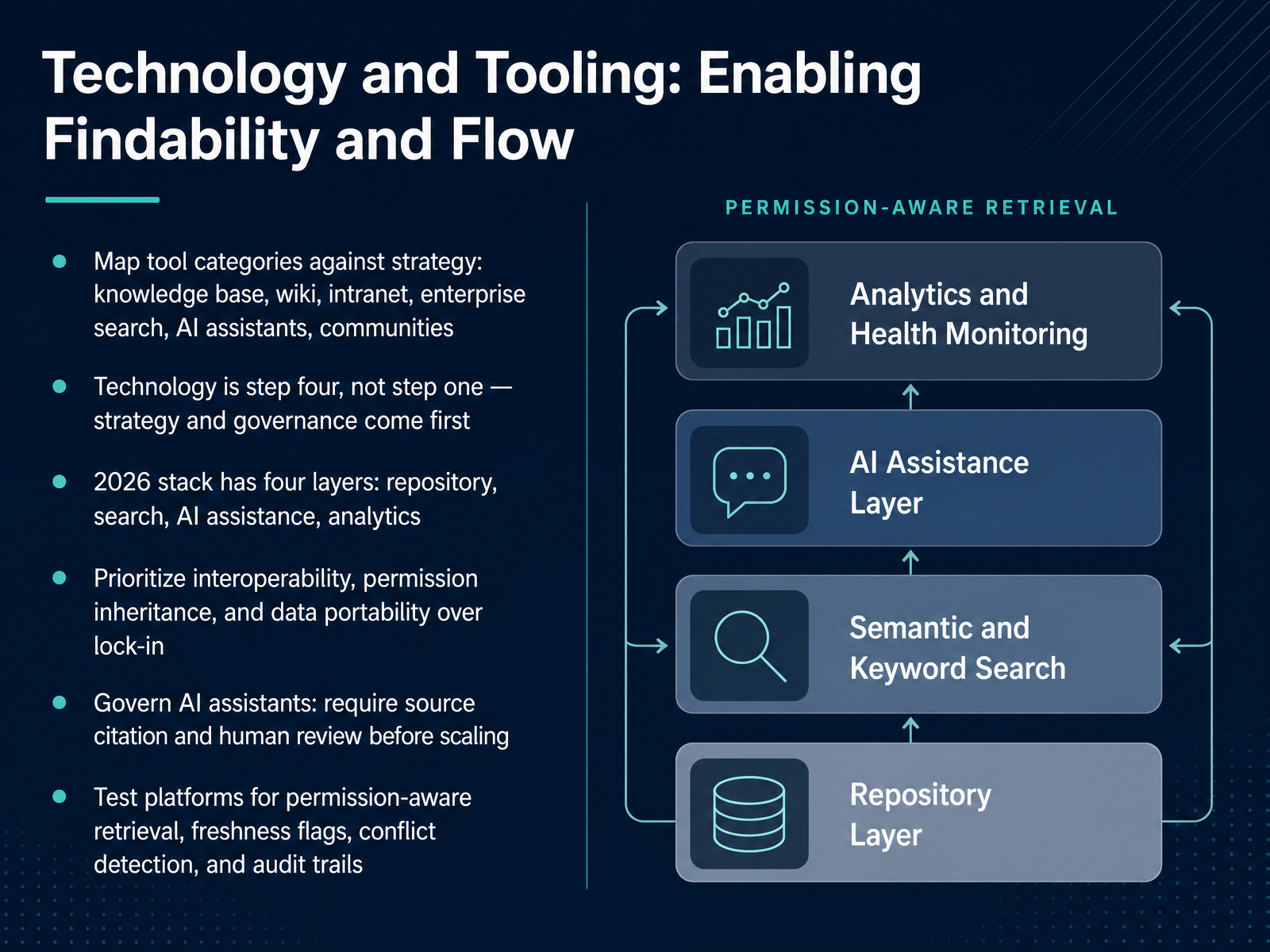
- 07Technology and Tooling: Enabling Findability and FlowNow let's talk about technology and tooling, and how it enables findability and flow. The first move here is not to buy anything. It is to map tool categories against your strategy. Look at knowledge bases, wikis, intranets, enterprise search, AI assistants, and communities. For each one, ask which strategic goal it serves. If a category has no clear owner or use case, park it. Technology is step four, not step one. Strategy and governance come first. A useful way to frame the 2026 stack is four layers. Repository, search, AI assistance, and analytics. Together, they move content from storage to discovery to action to insight. When you evaluate platforms, prioritize interoperability, permission inheritance, and data portability. Those three protect you from lock-in. Governance matters most for AI assistants. Require source citation and human review before you scale them. Then test every platform against four things: permission-aware retrieval, freshness flags, conflict detection, and audit trails. If it fails those tests, it is not ready. Here is your takeaway. Choose tools that follow your strategy and your governance, not the other way around. Next, let's look at the roadmap for sequencing the build and launch.
 2 min
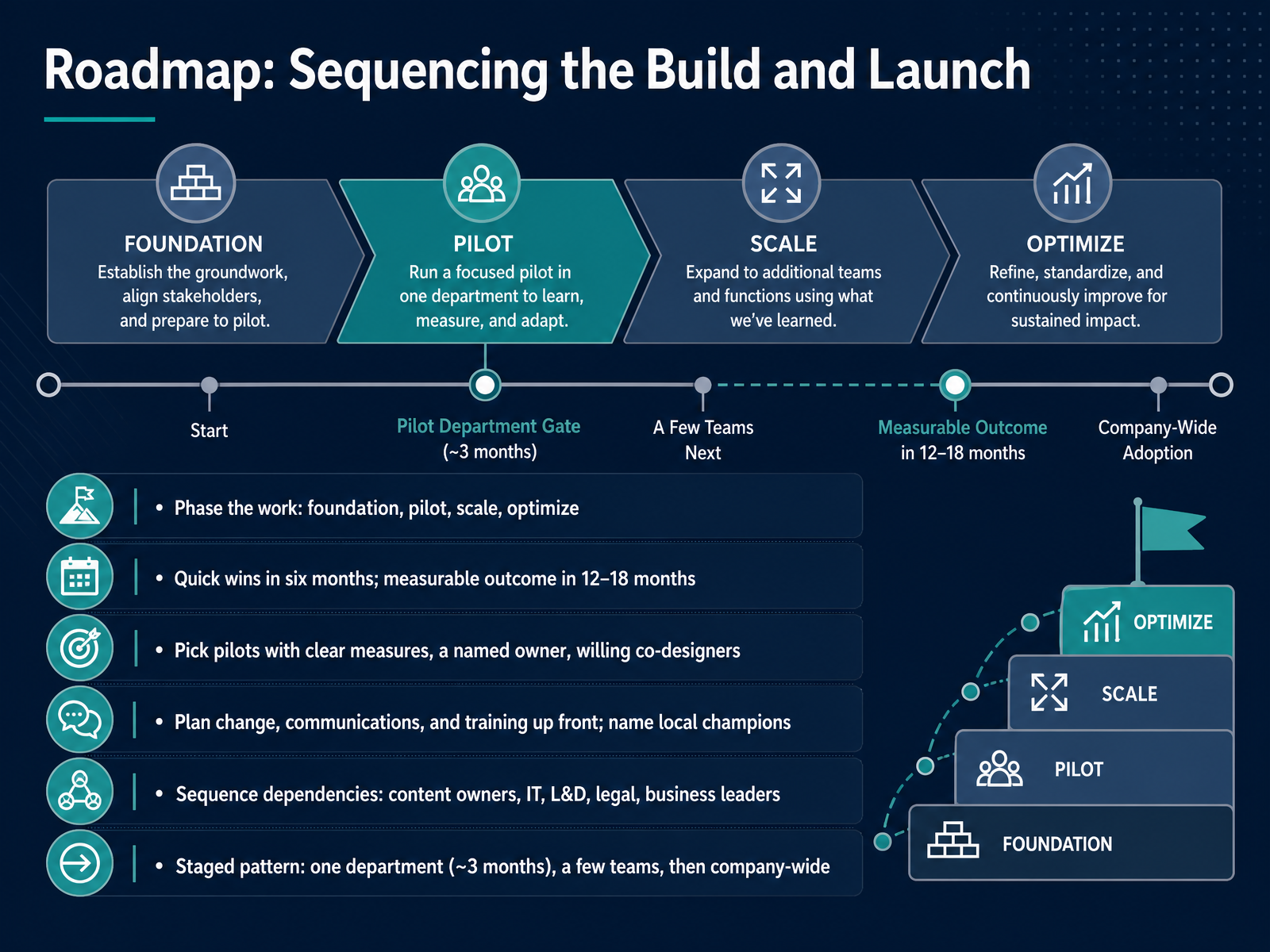
- 08Roadmap: Sequencing the Build and LaunchNow let us sequence the build and launch. Phase the work into four stages: foundation, pilot, scale, and optimize. You want quick wins in six months, and one measurable outcome in twelve to eighteen months. Choose pilots carefully. Pick ones with clear measures, a named owner, and willing co-designers. Plan change, communications, and training up front, and name local champions so adoption is not an afterthought. Then sequence your dependencies: content owners, IT, L and D, legal, and business leaders. Use a staged pattern. Start with one department for about three months, then a few teams, then company wide. Your takeaway: phase the roadmap, prove it in a pilot, and scale only what works. Next, we will look at measurement, and the metrics that prove value.
 1 min
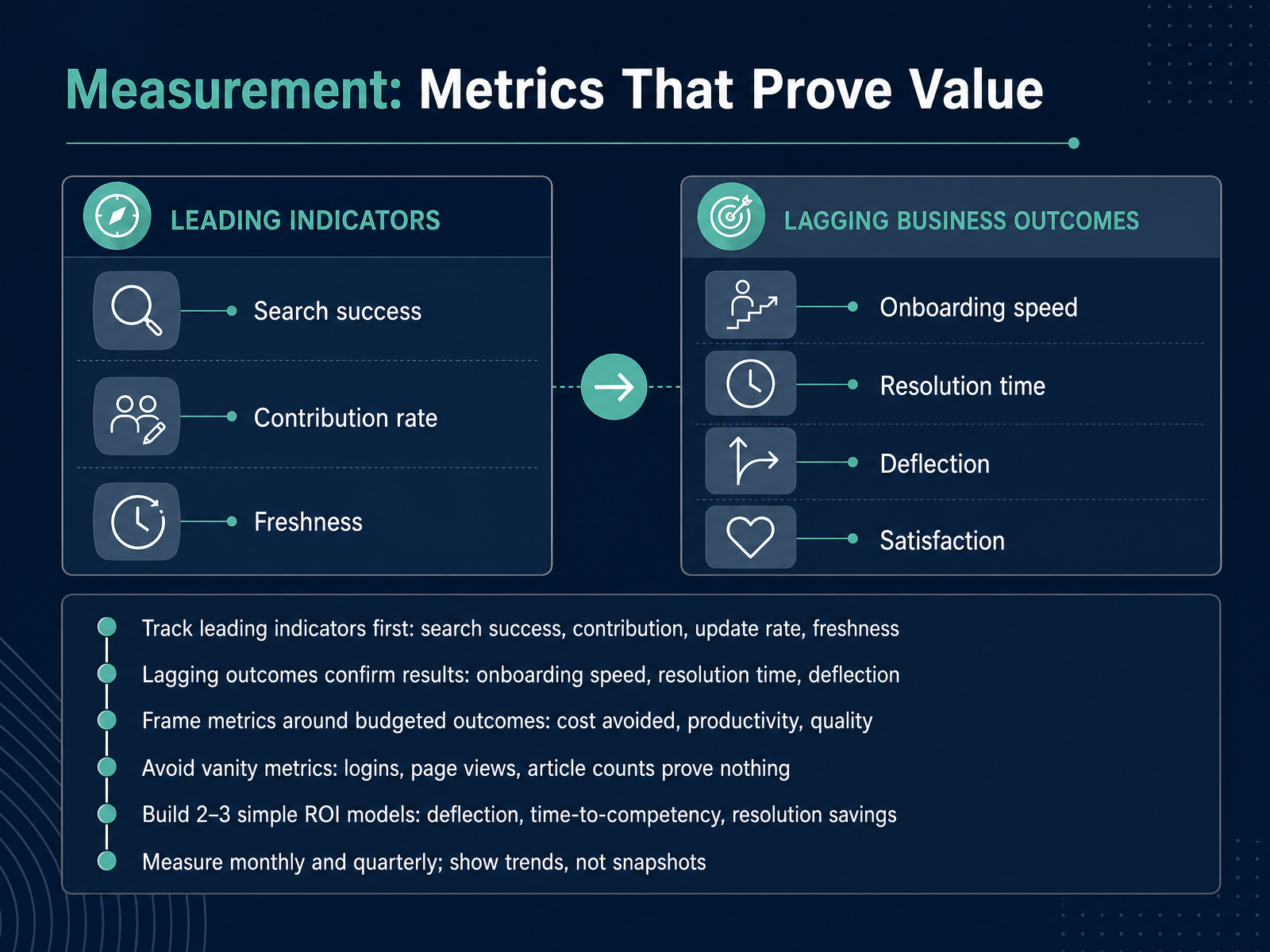
- 09Measurement: Metrics That Prove ValueNow let's talk about measurement, because metrics are how you prove value and keep funding. Start with leading indicators: search success, contribution, update rate, and freshness. For example, if search success rises from sixty to eighty percent, you know findability is improving before business outcomes shift. Then use lagging outcomes to confirm results, such as onboarding speed, resolution time, and deflection. Frame every metric around a budgeted outcome: cost avoided, productivity, or quality. Avoid vanity metrics like logins, page views, and article counts, because they prove nothing on their own. Build two or three simple ROI models: deflection, time-to-competency, and resolution savings. Measure monthly for leading indicators and quarterly for outcomes, and always show trends, not snapshots. The takeaway is this: if a metric cannot connect to a budgeted outcome, do not report it. Next, we will look at common pitfalls and how to avoid them.
 2 min
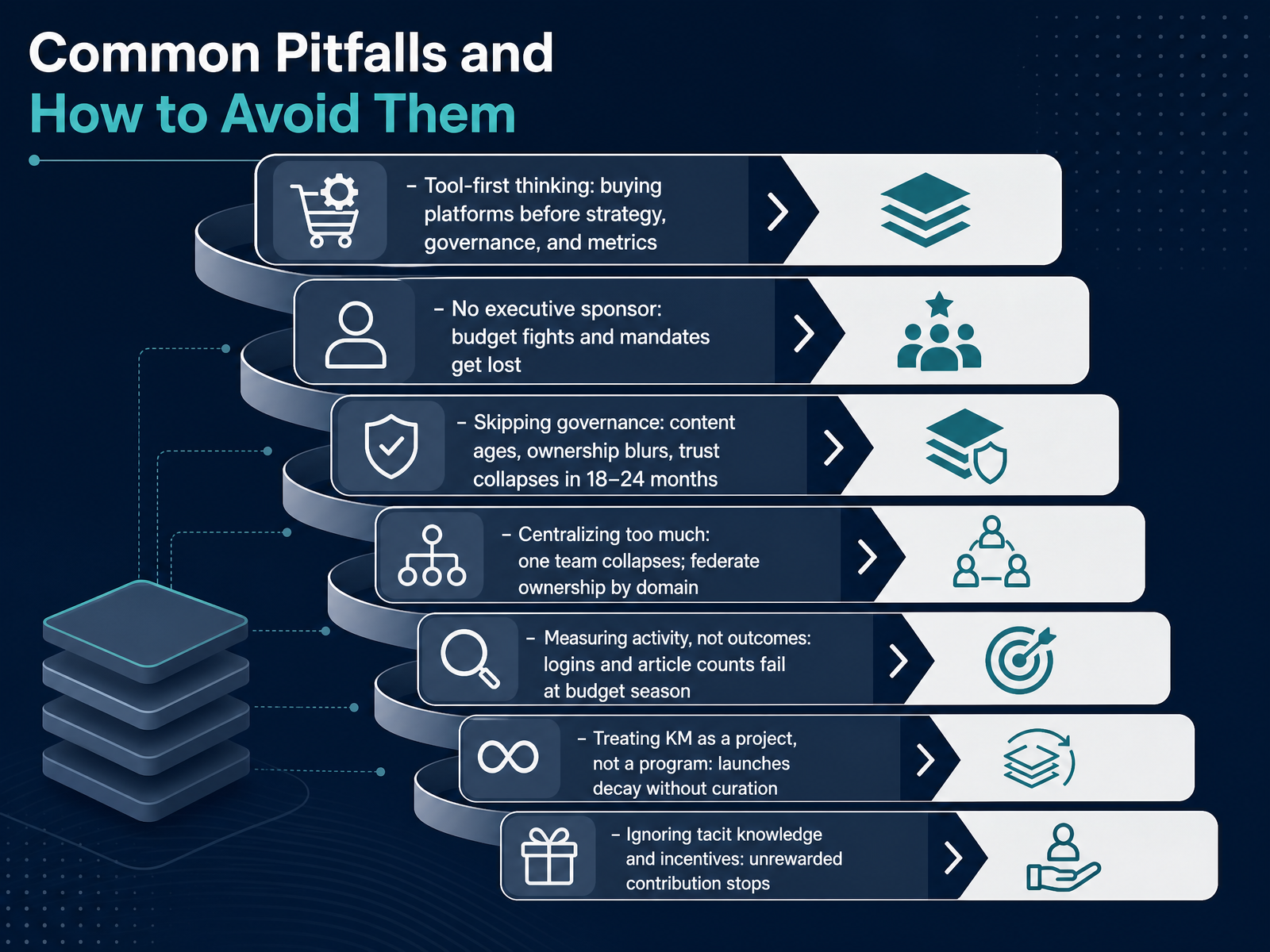
- 10Common Pitfalls and How to Avoid ThemLet's talk about the pitfalls that derail knowledge management strategies, and how to steer around them. Tool-first thinking is the most common. Teams buy a platform before they define strategy, governance, and metrics. You end up with an empty tool. Define what success looks like first, then select technology to support it. Next, no executive sponsor. Without one, budget fights and mandates get lost. Secure a sponsor who owns outcomes, not just the invoice. Skipping governance is another trap. Content ages, ownership blurs, and trust collapses within eighteen to twenty-four months. Put a lightweight governance model in place before launch. Centralizing too much is a third pitfall. One team collapses under the load. Federate ownership by domain instead, with a central team that sets standards and enables others. Measuring activity rather than outcomes fails at budget season. Logins and article counts do not prove value. Track time saved, faster onboarding, or fewer support tickets. Treating KM as a project rather than a program leads to decay after launch. Fund ongoing curation and refresh cycles. Finally, ignoring tacit knowledge and incentives. If contribution is unrewarded, it stops. Recognize and reward knowledge sharing in performance reviews and team rituals. Avoid these and your strategy will hold up. Next, let's build your first ninety days with a practical action plan.
 2 min
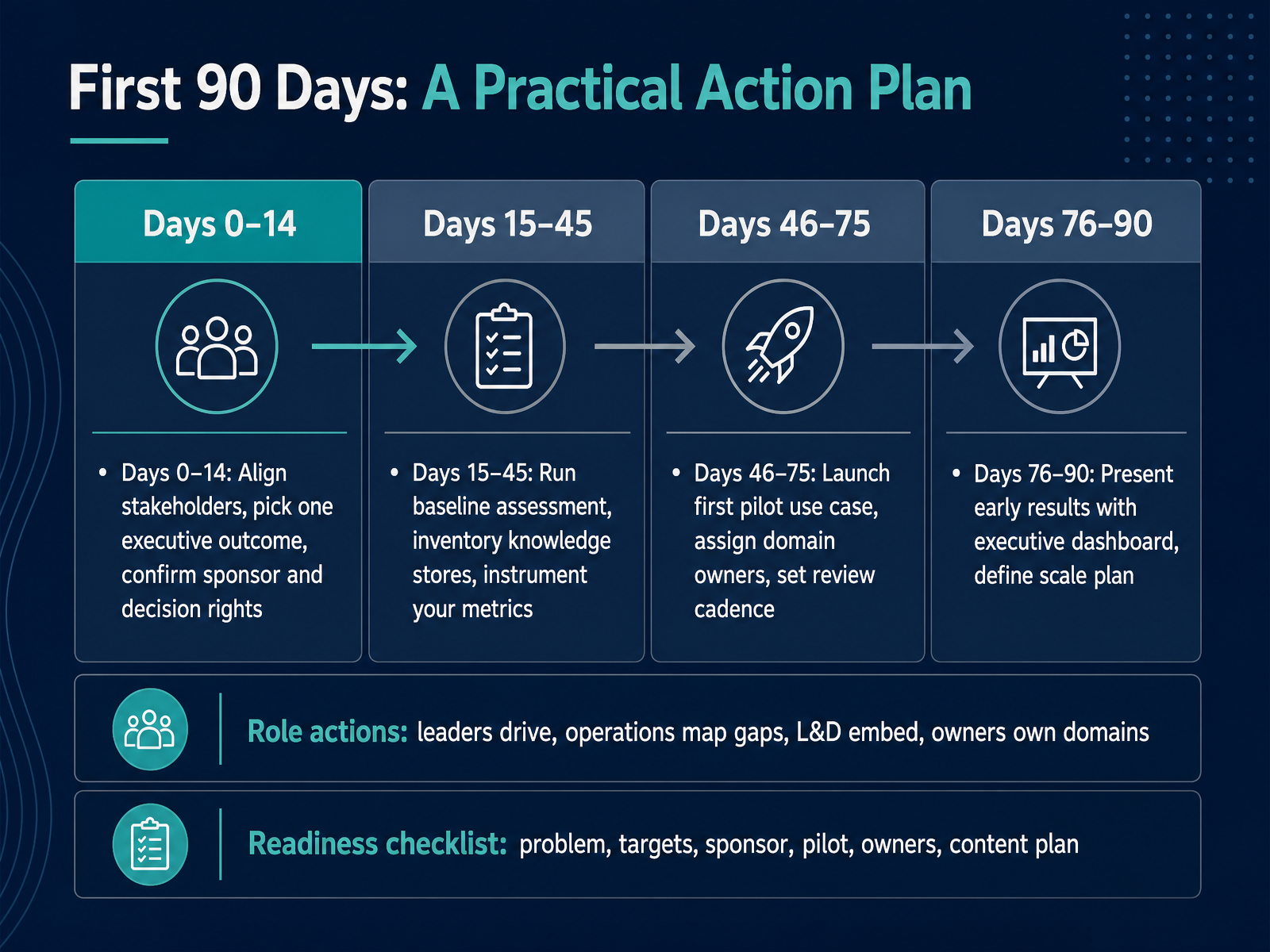
- 11First 90 Days: A Practical Action PlanNow let's put this into a first ninety day action plan. The goal in days zero to fourteen is alignment, not activity. Pick one executive outcome. Confirm your sponsor and who owns decisions. If ownership is unclear, resolve it before you spend money or time.
Days fifteen to forty five are about evidence. Run a baseline assessment, inventory your knowledge stores, and instrument your metrics. Know what good looks like before the pilot starts.
Days forty six to seventy five, launch one pilot use case. Assign domain owners and set a review cadence. Leaders drive, operations map gaps, learning and development embeds, owners own their domains.
Days seventy six to ninety, present early results with an executive dashboard and define your scale plan. Before you move, check readiness: problem, targets, sponsor, pilot, owners, and a content plan. That checklist is your gate, not your paperwork.
Next, we look at sustaining the program through continuous improvement and maturity.
 2 min
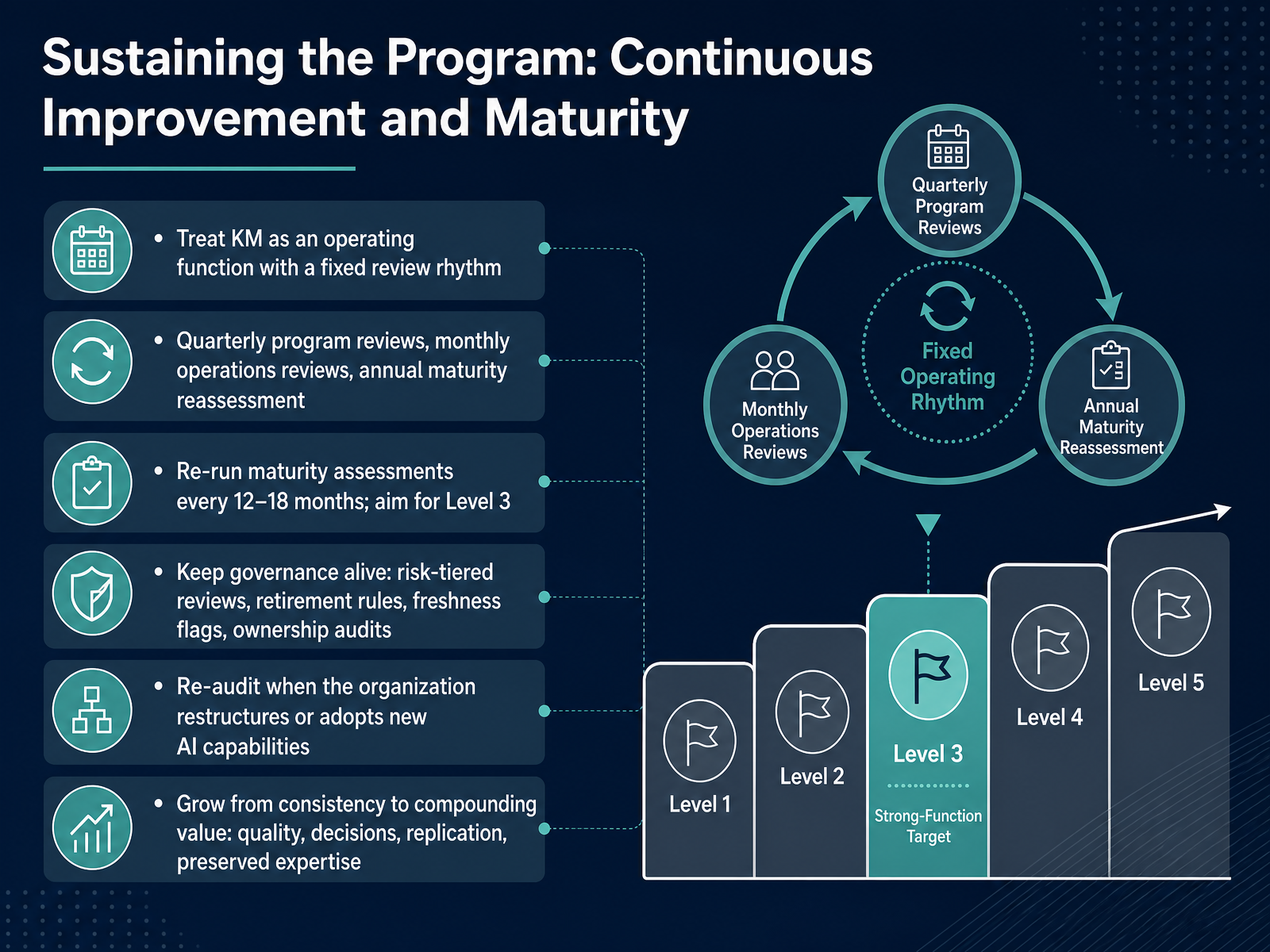
- 12Sustaining the Program: Continuous Improvement and MaturityNow let's talk about sustaining the program through continuous improvement and maturity. The core move is to treat knowledge management as an operating function, not a project. That means a fixed review rhythm. Hold quarterly program reviews, monthly operations reviews, and an annual maturity reassessment. Re-run your maturity assessment every twelve to eighteen months, and aim for Level three, where knowledge practices are consistent and repeatable. Keep governance alive with risk-tiered reviews, retirement rules, freshness flags, and ownership audits. Also re-audit when the organization restructures or adopts new AI capabilities, because both change who owns what and what knowledge matters. Your goal is to grow from consistency to compounding value. That shows up as better quality, faster decisions, replication of what works, and preserved expertise when people leave. Pick one rhythm and put owners on the calendar. Next, we'll look at case snapshots that show what good looks like in practice.
 2 min
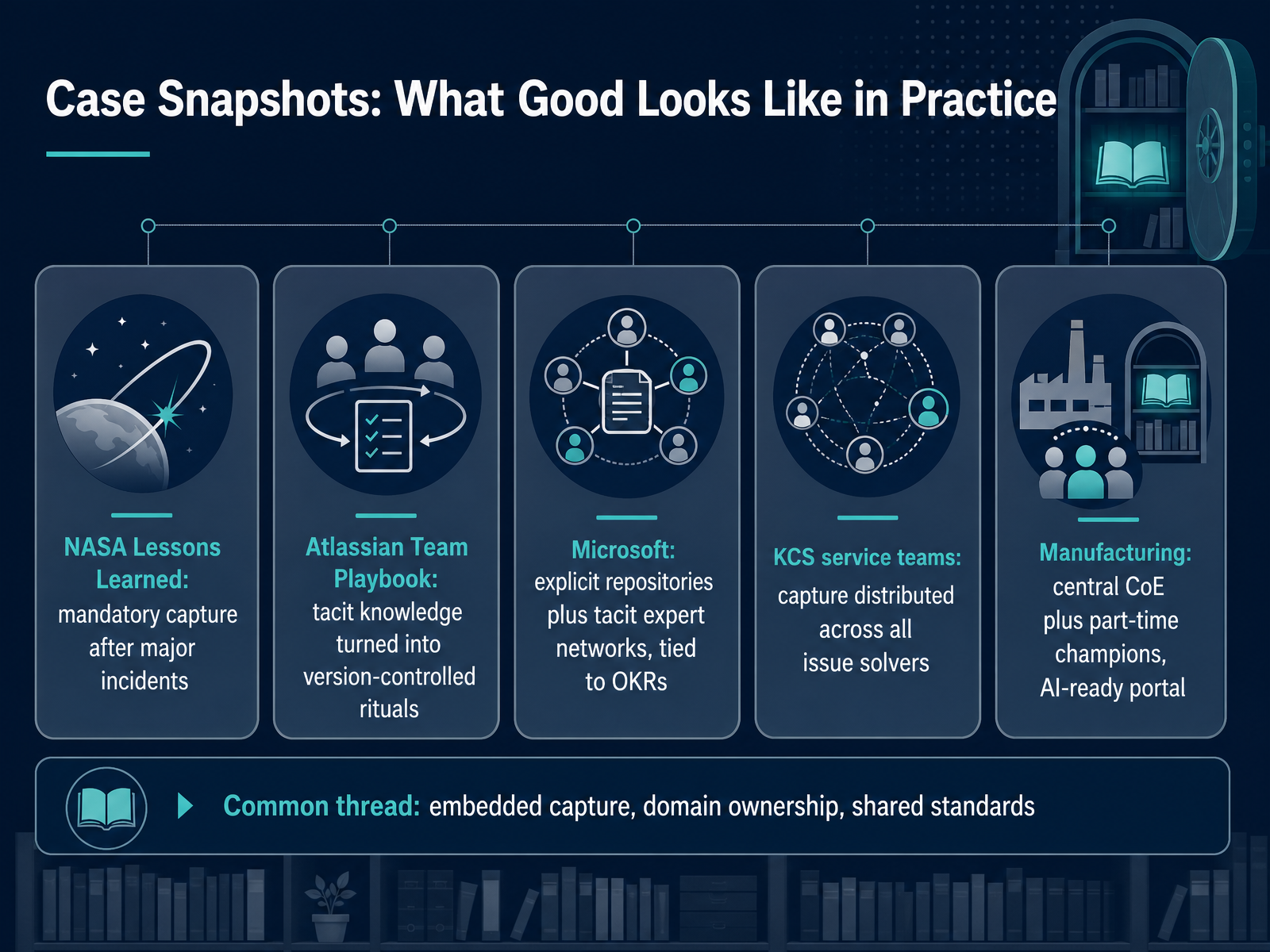
- 13Case Snapshots: What Good Looks Like in PracticeLet's ground the workflow in real examples. Six snapshots show what good looks like. NASA Lessons Learned requires mandatory capture after major incidents, so reflection isn't optional. Atlassian's Team Playbook turns tacit knowledge into version-controlled rituals, so habits become repeatable and improvable. Microsoft pairs explicit repositories with tacit expert networks, and ties both to OKRs, so knowledge work maps to business results. In KCS service teams, capture is distributed across all issue solvers, not a single author. Manufacturing uses a central center of excellence plus part-time champions and an AI-ready portal. The common thread is clear. Capture is embedded in the flow of work. Domains own their content. Standards are shared. Pick one snapshot closest to your context and note which of those three elements you already have, and which you need to build. Next, we'll put it together in a workshop: Build Your KM Strategy on One Page.
 1 min
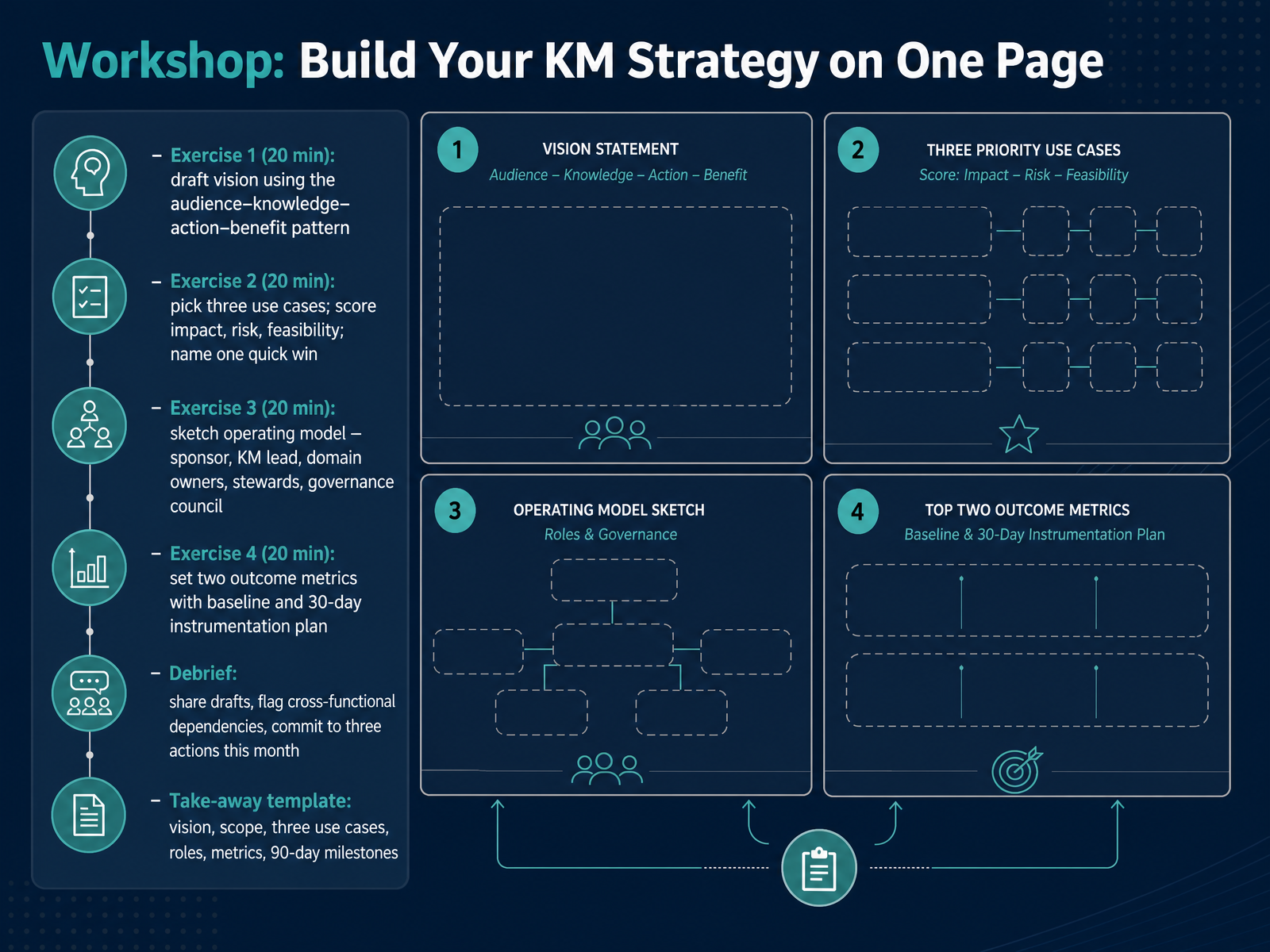
- 14Workshop: Build Your KM Strategy on One PageNow let's put everything into practice. This is the working session where you leave with a one-page knowledge management strategy. You'll have four exercises, roughly twenty minutes each.
First, draft your vision using a simple pattern: audience, knowledge, action, then benefit. Keep it to one sentence.
Second, choose three use cases. Score each on impact, risk, and feasibility. Then name one quick win you can deliver in thirty days.
Third, sketch your operating model. Assign a sponsor, a knowledge management lead, domain owners, stewards, and a governance council. Clarify who decides and who maintains content.
Fourth, set two outcome metrics. Give each a baseline and a plan to instrument it within thirty days.
Then debrief. Share your drafts, flag cross functional dependencies, and commit to three actions this month.
Use the take away template to capture your vision, scope, three use cases, roles, metrics, and ninety day milestones. Next, we'll cover next steps, resources, and course close.
 2 min
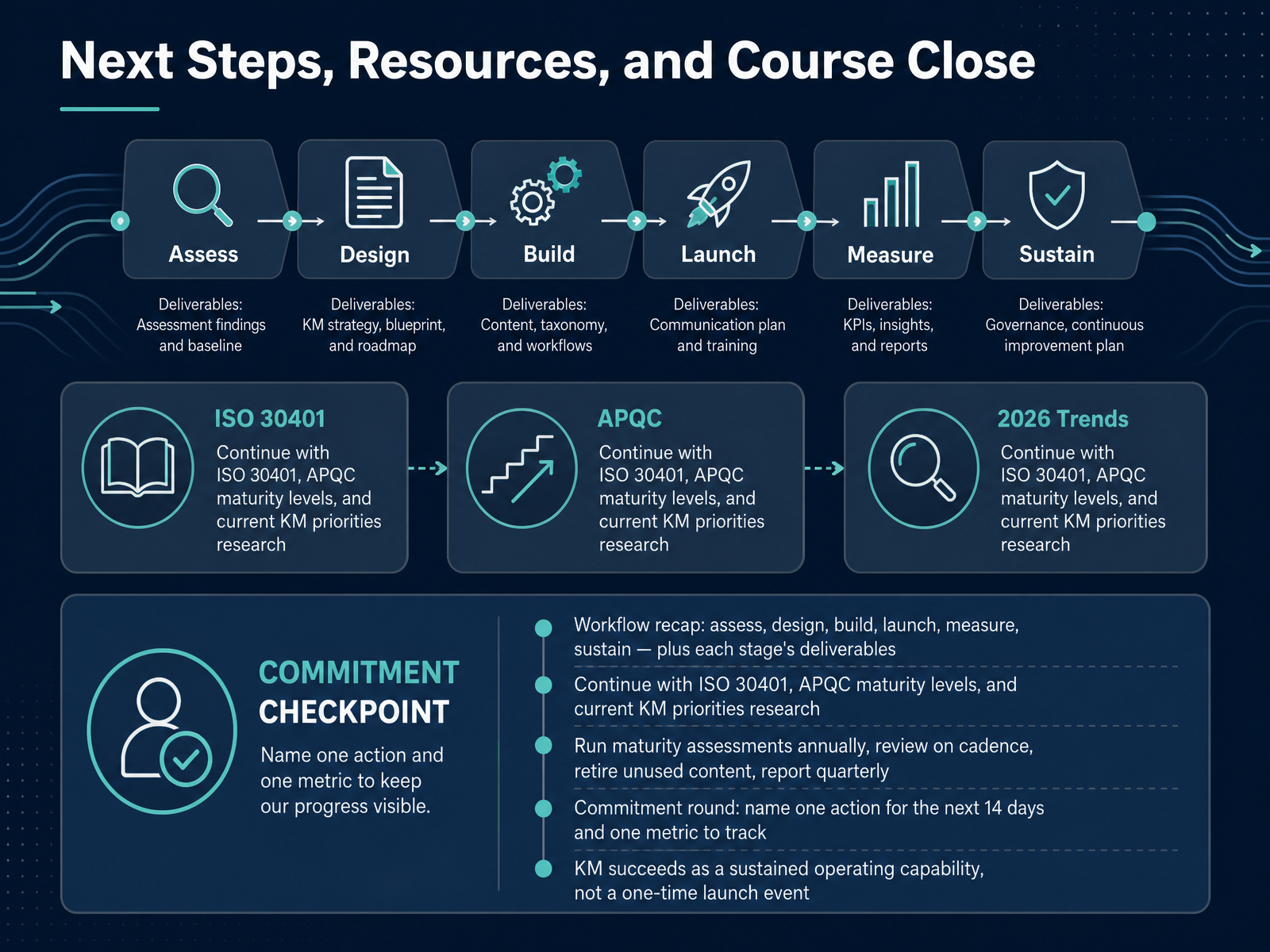
- 15Next Steps, Resources, and Course CloseLet's close by turning everything we've covered into your next moves. First, the recap. The workflow runs assess, design, build, launch, measure, and sustain. Each stage has deliverables you can point to, so keep them visible as your roadmap. Next, keep learning. ISO 30401 gives you a shared standard, APQC maturity levels help you benchmark, and current KM priorities research shows where peers are investing. Then, set your operating rhythm. Run maturity assessments annually, review content on a defined cadence, retire what nobody uses, and report progress quarterly. Now, your commitment round. Name one action you'll take in the next fourteen days, and one metric you'll track. For example, clean up one high-traffic space, or measure search success rate. Here's the takeaway. Knowledge management succeeds as a sustained operating capability, not a one-time launch event. Thank you for your attention today. You have the workflow and the tools. Pick your first step, and make it real this week.
 2 min
Take the deck with you
Download this course as a file — free, no sign-up needed.
- PDF handoutEvery slide page, ready to print or share.16 pages · 3.9 MBDownload
- Narrated PowerPointThe deck that presents itself — every slide carries the digital human's narration video.16 pages · 17.2 MBDownload
- PowerPoint slidesThe full deck as a .pptx — open it in PowerPoint, Keynote, or Google Slides.16 pages · 3.8 MBDownload
Free to use in your own training — please keep the PersonWise credit page at the end.
Have your own deck? Turn it into a course