Begin
16 pages · ~32 min
Introduction to Ecology
An introductory course for learners exploring fundamental ecological concepts, including ecosystems, biodiversity, and environmental relationships.
A digital instructor presents all 16 pages. Hold “Ask” at any point and ask out loud — the answer comes from this course. No sign-up needed.
What you’ll learn
- 01Introduction to EcologyWelcome. In this course, we will explore the science of ecology. Our goal is to build a clear understanding of how living organisms interact with each other and with their physical environment. Let's begin with a clear definition. Ecology is the scientific study of the interactions between organisms and their environment. This field spans many scales, from the study of individual organisms to entire populations, communities, ecosystems, and ultimately the global biosphere. It is important to distinguish ecology from environmentalism. Ecology is an evidence-based science, not a form of advocacy. The term itself was coined by Ernst Haeckel in 1866. Today, the discipline has evolved to integrate modern tools from molecular biology and data science. Ecological literacy provides the foundation for critical work in conservation, natural resource management, and corporate sustainability. Next, we will examine the hierarchy of ecological organization, starting with the individual organism.goldbook.iupac.orgesa.orgplant-ecology.com+21 min
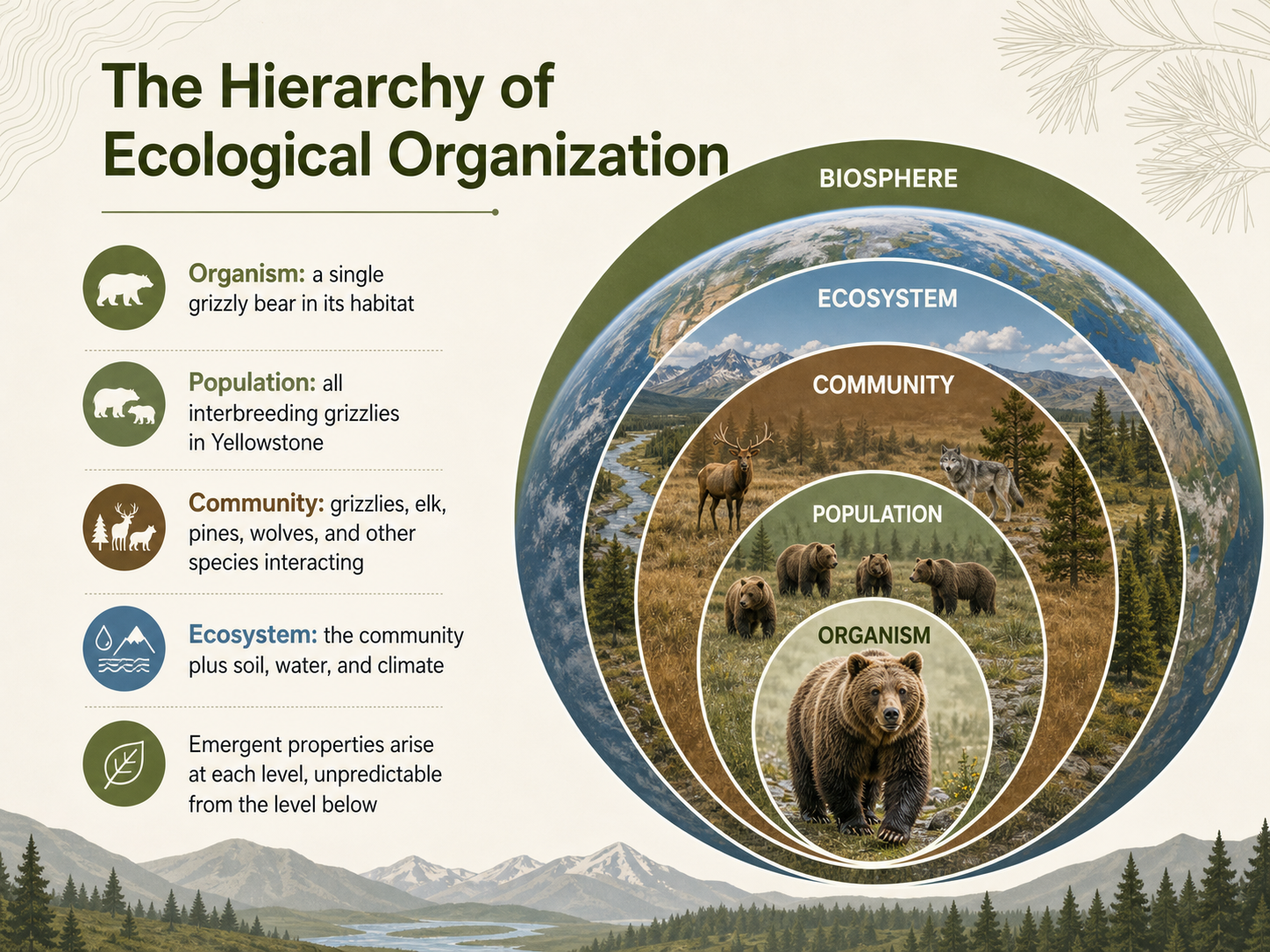
- 02The Hierarchy of Ecological OrganizationNow let's move up the levels of ecological organization. We start with a single organism, like one grizzly bear in its habitat. This is the individual level. When we group together all the interbreeding grizzlies in a specific area, such as Yellowstone, we have a population. Expand that view to include all the different species interacting in the same space—the grizzlies, elk, pine trees, and wolves—and we are looking at a community. The next level, the ecosystem, adds the non-living components. That means the community plus the soil, water, and climate. A critical concept to understand is that emergent properties arise at each new level. These are characteristics that are unpredictable from simply studying the level below. For example, you cannot predict the structure of a forest community just by studying a single tree. Next, we will examine how these systems function by looking at the core principles of energy flow in ecosystems.
 goldbook.iupac.orgesa.orgplant-ecology.com+21 min
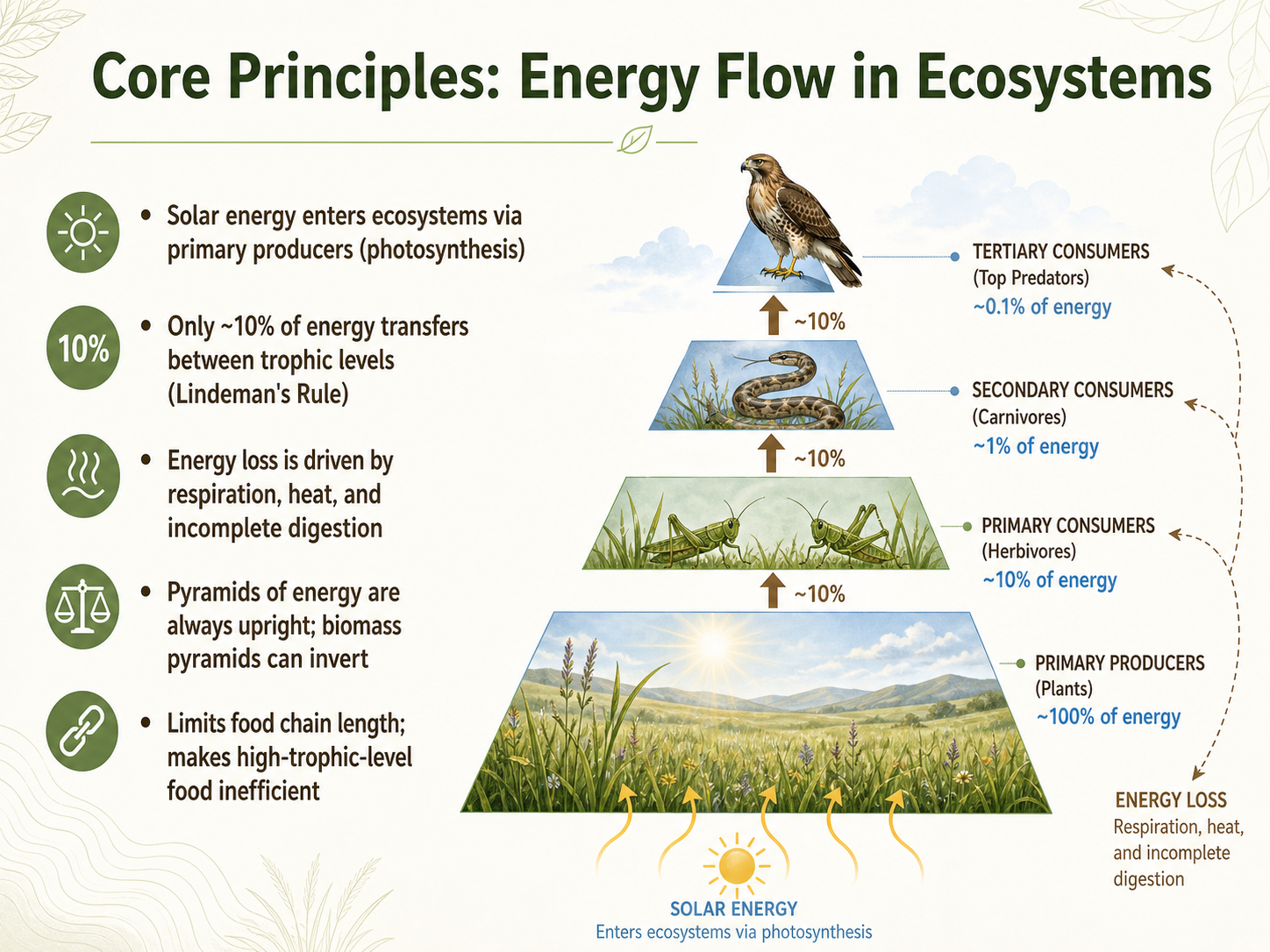
 - 03Core Principles: Energy Flow in EcosystemsNow let's explore the core principles of energy flow in ecosystems. Energy enters almost every ecosystem through primary producers, like plants and algae, which capture sunlight via photosynthesis. From there, energy moves up the food chain. But here is a critical rule: on average, only about ten percent of the energy at one trophic level is transferred to the next. This is known as Lindeman's Rule, or the ten percent rule. The other ninety percent is lost, mostly as metabolic heat from respiration, or through undigested material. Because of this consistent energy loss, a pyramid of energy is always upright. Interestingly, a pyramid of biomass can sometimes be inverted in certain aquatic ecosystems, but the energy pyramid never is. This inefficiency limits the length of food chains, typically to four or five levels, and explains why consuming food from lower trophic levels is far more energy-efficient. Next, we will shift from energy to the physical materials that sustain life, exploring matter cycling and biogeochemical cycles.
 khanacademy.orgeducation.nationalgeographic.orgen.wikipedia.org+22 min
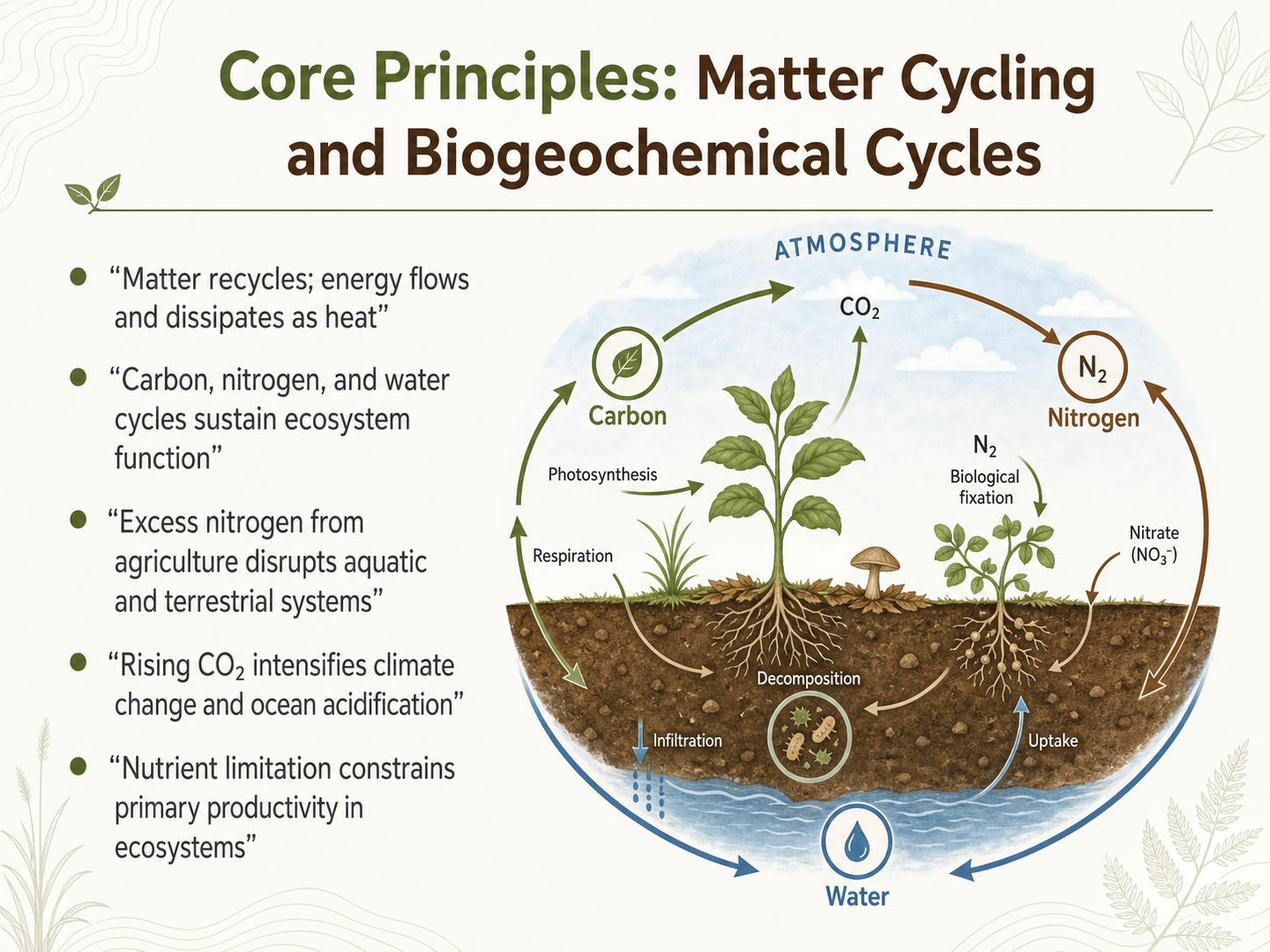
 - 04Core Principles: Matter Cycling and Biogeochemical CyclesNow let's examine the core principles of matter cycling and biogeochemical cycles. A fundamental rule in ecology is that matter recycles, while energy flows in one direction and dissipates as heat. This energy loss is described by the ten percent rule, where on average only about ten percent of the energy at one trophic level is transferred to the next. The remaining ninety percent is lost, mainly as metabolic heat. Because matter is recycled, elements like carbon, nitrogen, and water move through ecosystems in cycles that sustain all life. However, human activities can disrupt these cycles. For example, excess nitrogen from agriculture washes into waterways, causing algal blooms that deplete oxygen and harm aquatic life. It also acidifies soils in terrestrial systems. Meanwhile, rising carbon dioxide levels intensify climate change and increase ocean acidification, threatening marine organisms. Finally, nutrient limitation is a critical control on life. The availability of a single nutrient, often nitrogen or phosphorus, can constrain primary productivity, which is the total energy captured by producers. This limitation sets the base of the entire energy pyramid and determines how much life an ecosystem can support. Next, we will explore population ecology, including growth, limits, and life histories.
 khanacademy.orgeducation.nationalgeographic.orgen.wikipedia.org+22 min
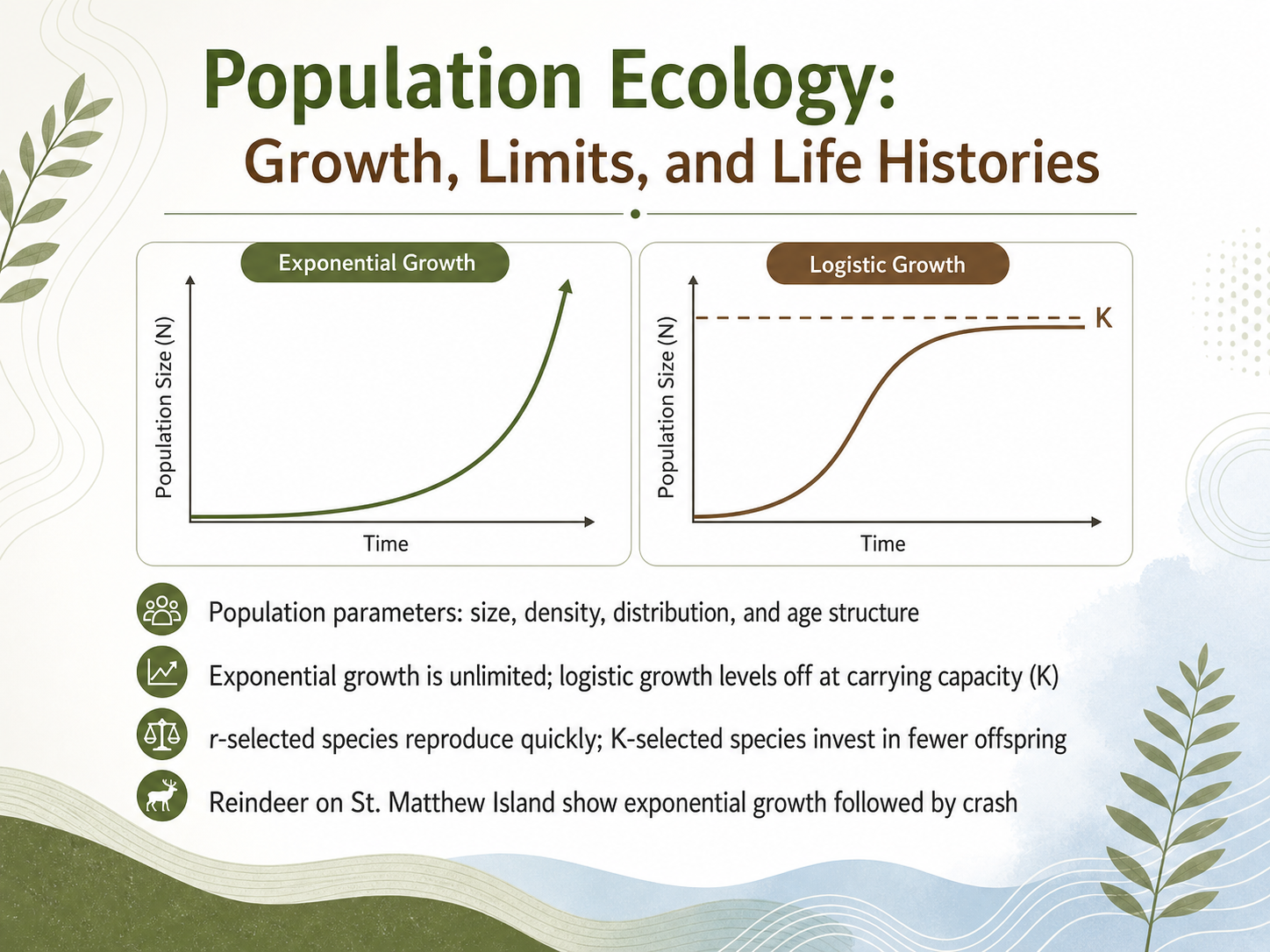
 - 05Population Ecology: Growth, Limits, and Life HistoriesNow, let's zoom in from the community level to the population level. Population ecology is the study of how groups of the same species change over time. We define a population by its size, its density, or how crowded it is, its distribution across a landscape, and its age structure. Under ideal conditions, a population can grow exponentially, producing a J-shaped curve. But this growth cannot last forever. Resources become limited, and growth slows. This creates logistic growth, which levels off at the environment's carrying capacity, or K. Species also have different reproductive strategies. R-selected species, like insects, produce many offspring quickly with little parental care. On the other hand, K-selected species, like elephants, invest heavily in just a few offspring. A classic example of population overshoot is the reindeer on St. Matthew Island. With no predators, the population exploded exponentially and then crashed dramatically when they exhausted their food supply. Next, we will build on this by exploring how these populations interact in community ecology, focusing on species interactions and niche dynamics.
 2 min
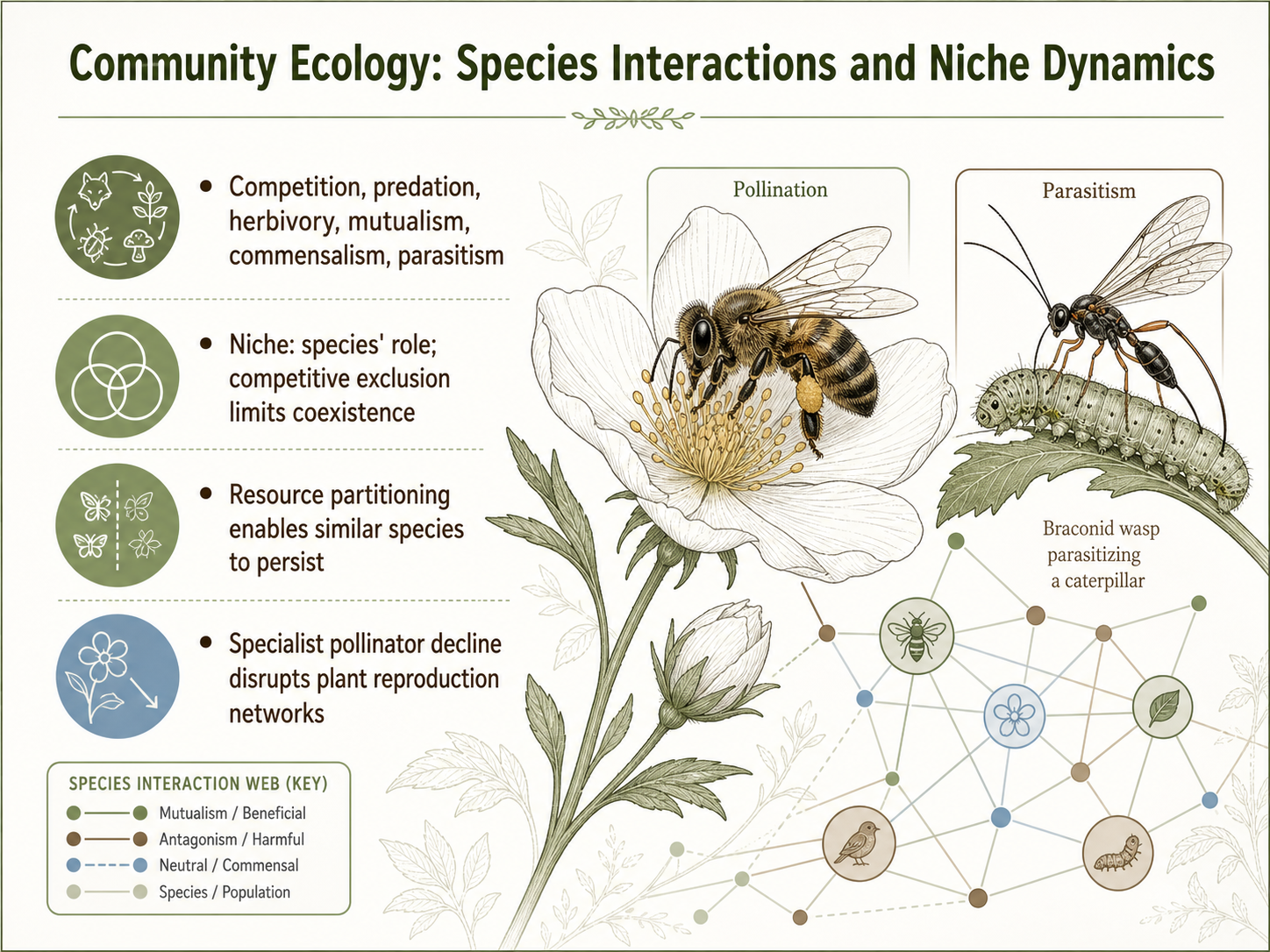
2 min - 06Community Ecology: Species Interactions and Niche DynamicsNow, let's zoom in a little closer to examine community ecology, which focuses on how different species interact and how they fit into their environment. Species interactions are defined by their effects. Competition occurs when organisms vie for the same limited resources. Predation and herbivory describe one organism consuming another. Mutualism is a partnership where both species benefit, like bees and flowering plants. Commensalism benefits one species without affecting the other, while parasitism benefits one at the host's expense. A fundamental concept here is the niche, which is a species' total role in its ecosystem, including its resource use and habitat. The competitive exclusion principle states that two species cannot occupy the exact same niche indefinitely; one will outcompete the other. However, resource partitioning allows similar species to coexist by dividing the available resources, such as birds feeding on different parts of the same tree. Understanding these connections is critical, as the decline of a specialist pollinator can disrupt an entire plant reproduction network. Next, we will explore how certain species have an outsized impact on their communities, looking at keystone species, trophic cascades, and ecological succession.
 2 min
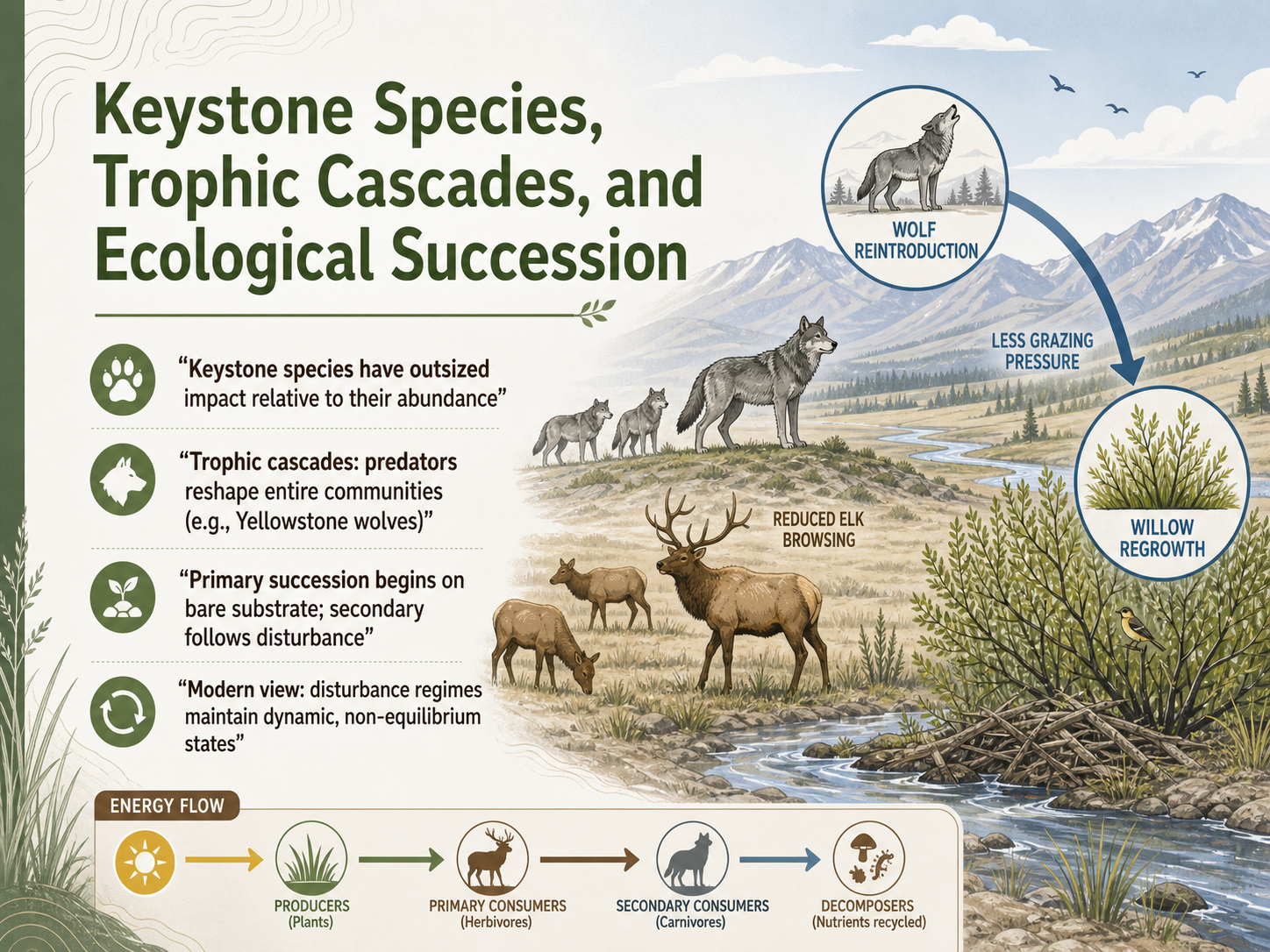
2 min - 07Keystone Species, Trophic Cascades, and Ecological SuccessionNow, let's examine how certain species and processes can completely reorganize an ecosystem. First, consider keystone species. These organisms have an impact that is far greater than their population size would suggest. Their presence or absence triggers a chain reaction. This leads us to a concept called a trophic cascade. It occurs when a top predator is added or removed, reshaping the entire community structure. The classic example is the reintroduction of wolves to Yellowstone National Park. Wolves controlled the elk population, which allowed overgrazed willow and aspen to recover. This, in turn, stabilized riverbanks and created habitat for beavers and songbirds. Shifting our focus to landscape change, we have ecological succession. Primary succession starts on bare rock, where no soil exists, such as a new volcanic island. Secondary succession follows a disturbance like a fire, where soil remains. The modern view has moved beyond a simple endpoint. We now understand that disturbance regimes, like periodic fires, maintain a dynamic, non-equilibrium state. Next, we will explore the practical measures of this variety in our discussion on biodiversity, its components, measurement, and value.
 2 min
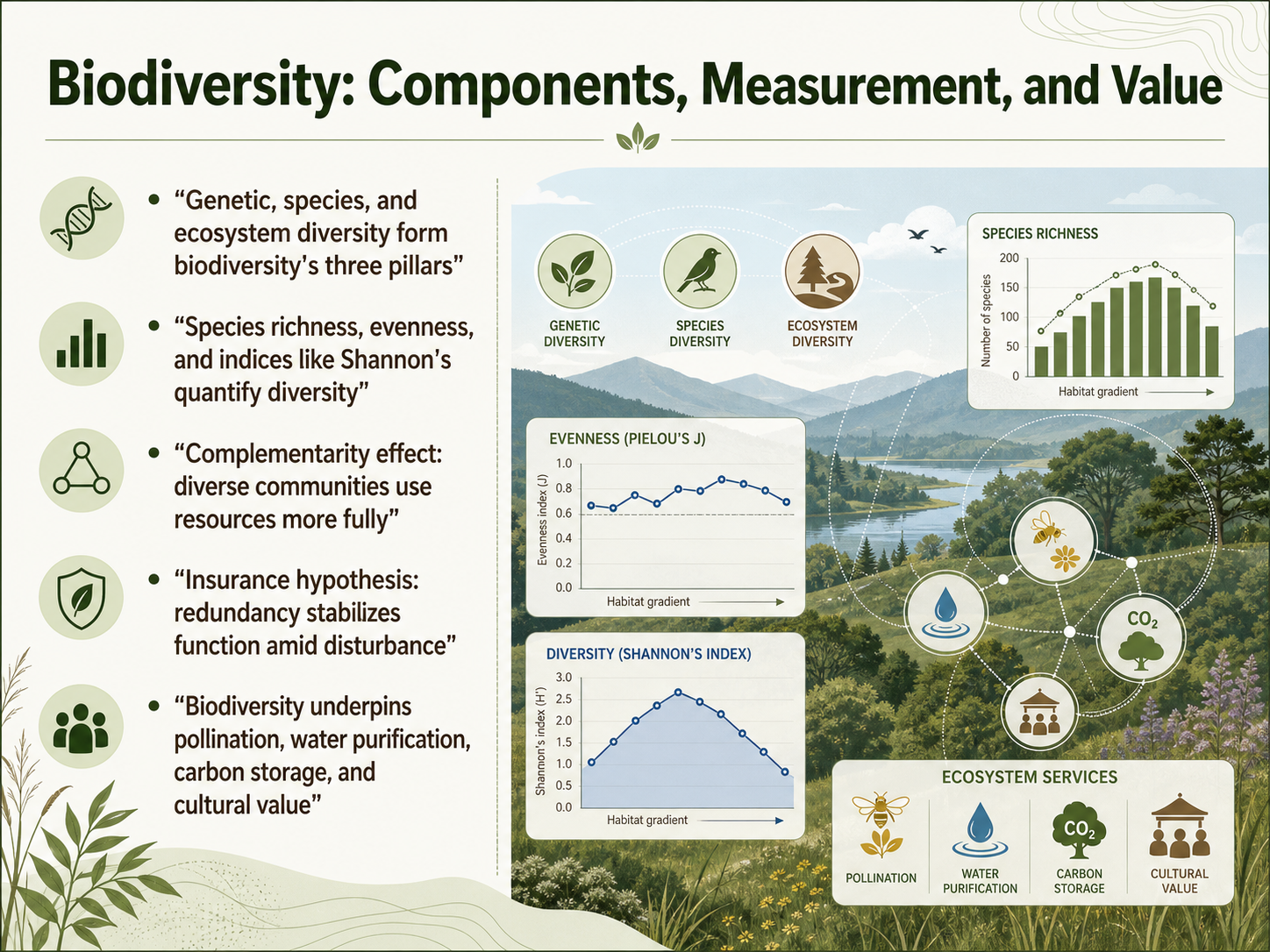
2 min - 08Biodiversity: Components, Measurement, and ValueNow let's look at the core components of biodiversity and why they matter. Biodiversity is built on three pillars. Genetic diversity is the variation within a species. Species diversity is the variety of different organisms in an area. Ecosystem diversity covers the range of habitats and ecological processes. To measure this, scientists use metrics like species richness, which is a simple count, and evenness, which describes how balanced the populations are. Indices like the Shannon index combine both into a single number. Two key mechanisms explain how this diversity supports function. The complementarity effect means that different species use resources in different ways, so a diverse community captures more total energy and nutrients. The insurance hypothesis states that having species with overlapping roles, what we call redundancy, stabilizes the system when disturbances occur. If one species declines, another can compensate. This stability is not just theoretical. Recent long-term studies across six taxonomic groups in Finland confirm a positive relationship between species richness and community stability, with functional traits playing a key mediating role. Ultimately, biodiversity underpins essential services like pollination, water purification, carbon storage, and cultural value. Next, we will examine how these concepts connect to ecosystem stability, resilience, and tipping points.
 doi.orgnature.compubmed.ncbi.nlm.nih.gov+22 min
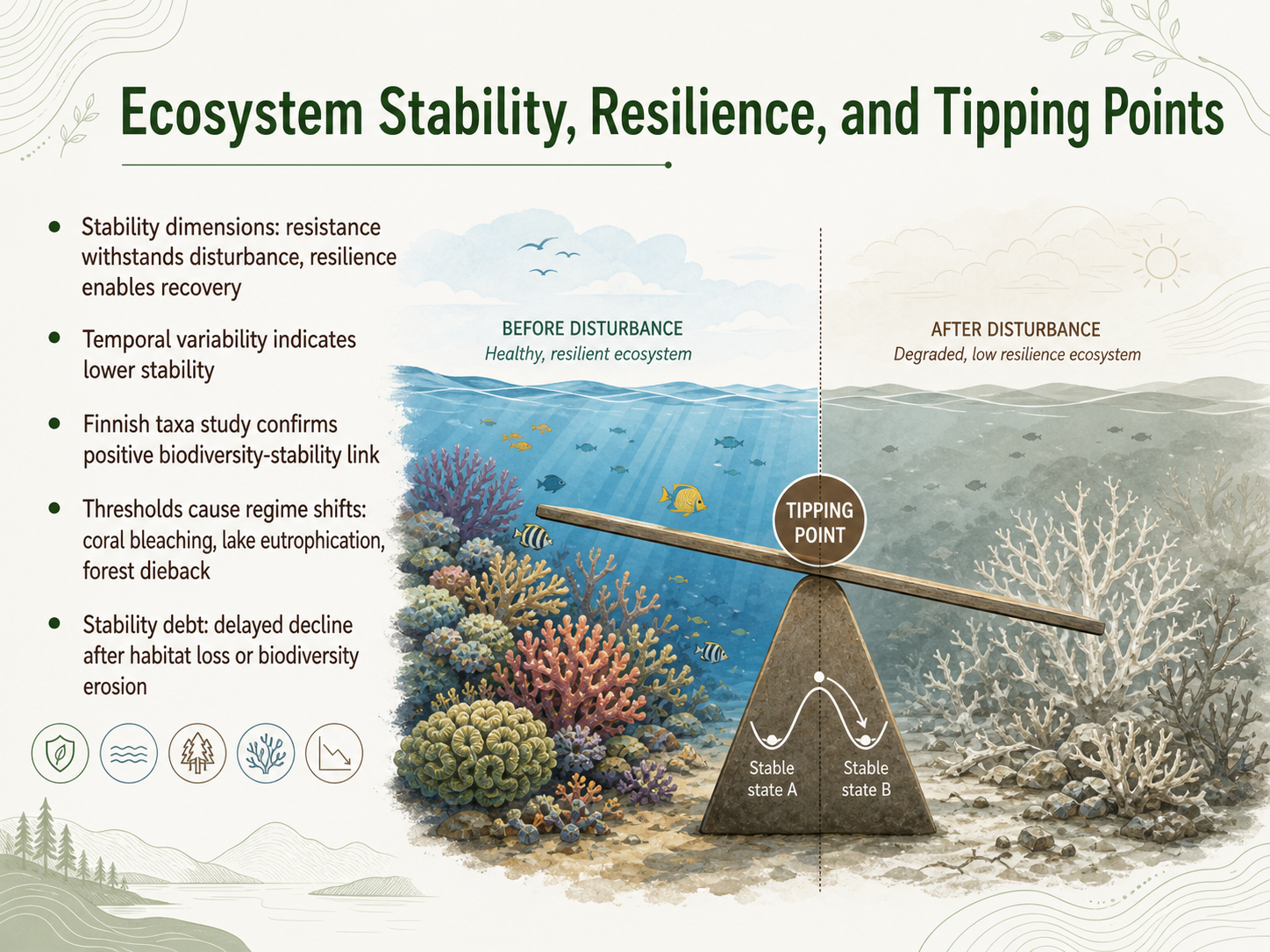
 - 09Ecosystem Stability, Resilience, and Tipping PointsNow let's talk about how ecosystems handle disturbance. We can think about stability in two dimensions. The first is resistance, which is the ability to withstand a disturbance without changing much. The second is resilience, the speed at which a system can recover after it has been disrupted. When we see high variability in a system over time, like large swings in population size, that usually signals lower stability. A major study published in 2025 analyzed long-term data from Finland, covering everything from moths to large mammals. It confirmed a clear positive link between biodiversity and stability. Essentially, more species-rich communities are generally more stable. But ecosystems also have limits. If a disturbance is too strong, it can push the system past a threshold, or a tipping point, causing a sudden regime shift to a completely different state. Classic examples include coral bleaching triggered by ocean warming, lake eutrophication from nutrient runoff, and widespread forest dieback. Finally, there is a concept called stability debt. This is a delayed decline in stability that can happen years after habitat is lost or biodiversity erodes. The system looks fine, until it suddenly isn't. Next, we will explore the world's major biomes in 'Global Biomes: Climate, Life, and Adaptations.'
 doi.orgnature.compubmed.ncbi.nlm.nih.gov+22 min
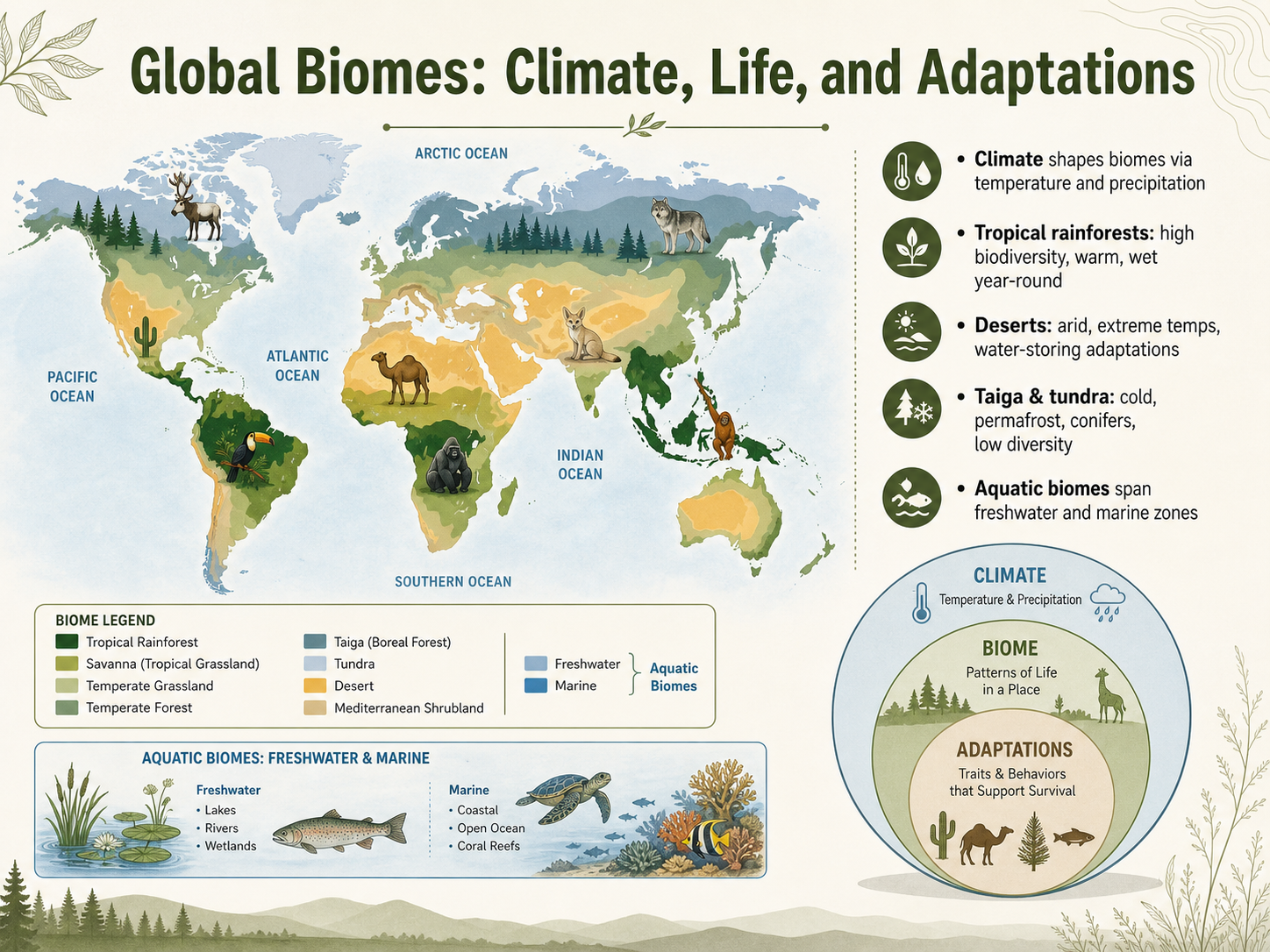
 - 10Global Biomes: Climate, Life, and AdaptationsNow, let's look at how climate creates the major biomes of our planet. The combination of temperature and precipitation is the primary force shaping these vast ecological regions. Think of tropical rainforests, for example. They are warm and wet year-round, conditions that support the highest biodiversity on Earth. In contrast, deserts are defined by extreme aridity. Organisms there survive through remarkable adaptations, like plants that store water in thick stems. Moving toward the poles, we encounter the taiga, a cold forest of hardy conifers, and the tundra, where permafrost restricts tree growth and limits diversity. Beyond these terrestrial biomes, we shouldn't forget the aquatic ones, which span freshwater rivers and lakes and the vast marine zones of the ocean. Next, we will examine how these systems are being altered by human impacts, specifically habitat loss, fragmentation, and degradation.
 2 min
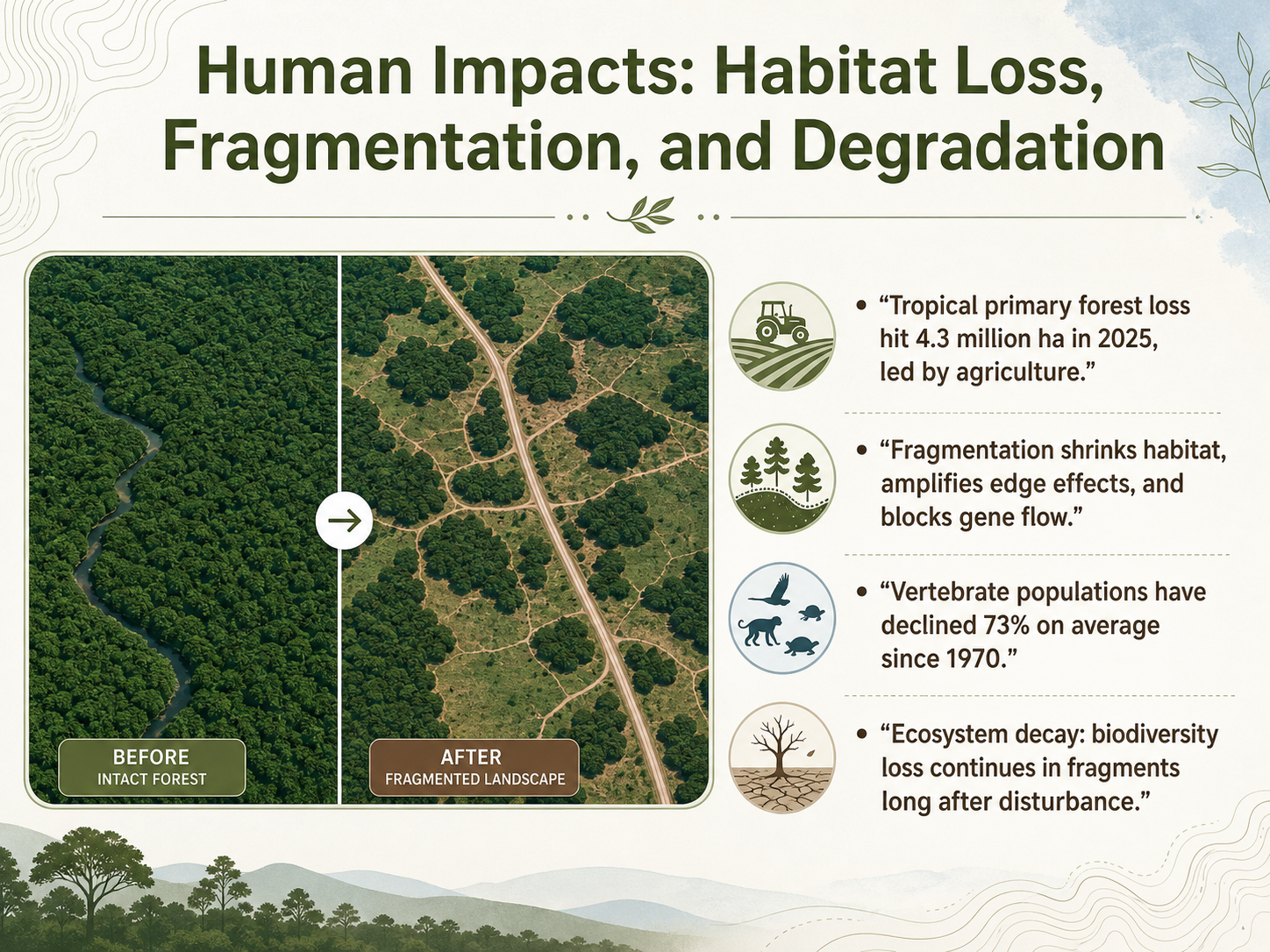
2 min - 11Human Impacts: Habitat Loss, Fragmentation, and DegradationNow let's turn to one of the most direct ways humans affect ecosystems: habitat loss, fragmentation, and degradation. In 2025 alone, the world lost four point three million hectares of tropical primary forest. That is an area of mature rainforest roughly the size of Denmark, and agriculture remains the leading cause. When large habitats are broken into smaller patches, we call that fragmentation. This process shrinks the total living space available, but it also creates edge effects. The borders of a fragment are drier, windier, and warmer than the deep interior, which stresses many species. Fragmentation also blocks gene flow between populations, leaving them more vulnerable to disease and inbreeding. The scale of these impacts is staggering. The Living Planet Report shows that monitored vertebrate populations have declined by an average of seventy-three percent since 1970. It is important to understand that the damage continues long after the initial disturbance. Scientists call this ecosystem decay. Even inside a protected fragment, species can keep disappearing over decades because the patch is simply too small or too isolated to support them. Next, we will examine three other major human impacts: climate change, pollution, and invasive species.
 science.orgtandfonline.comnature.com+22 min
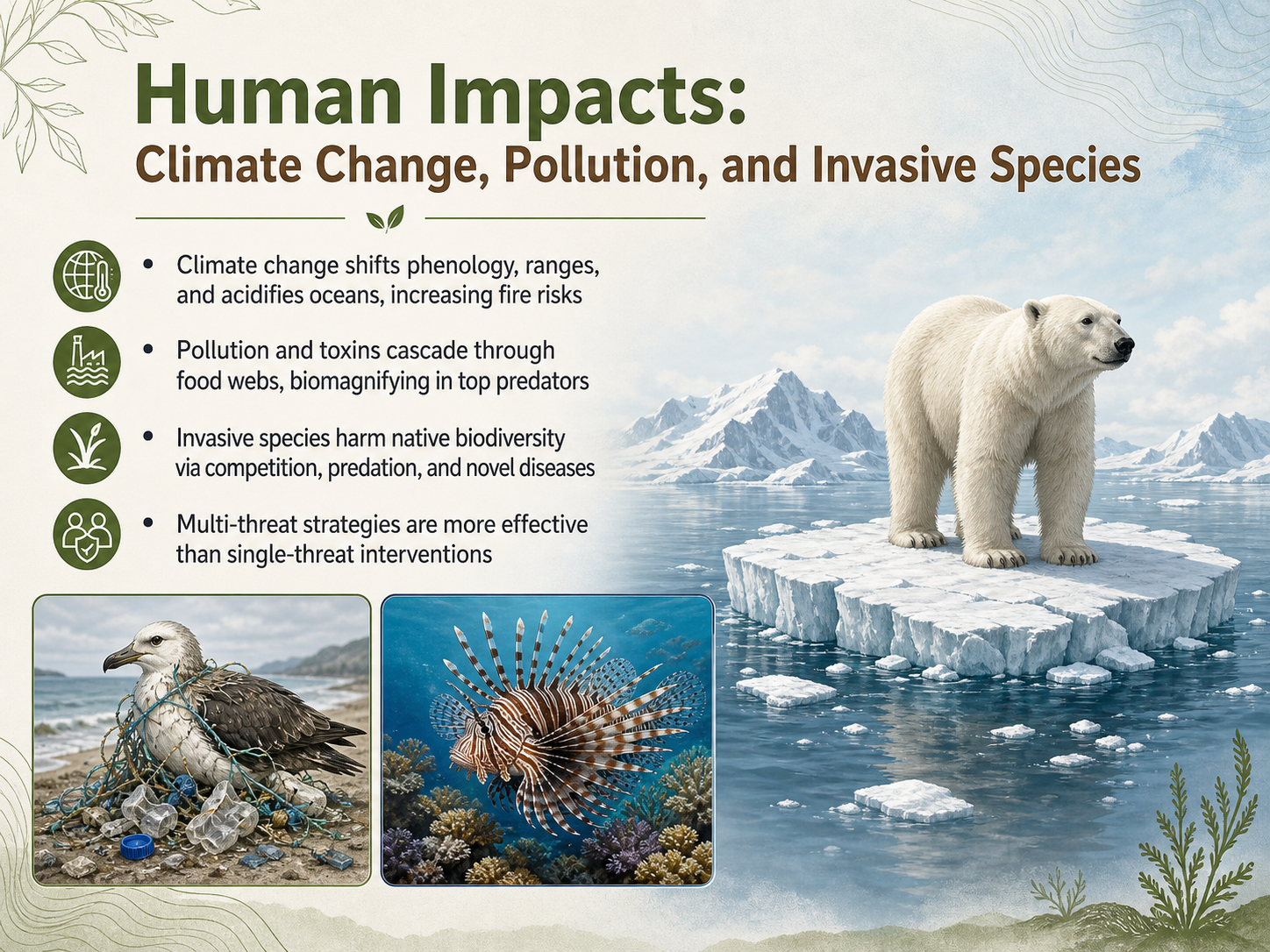
 - 12Human Impacts: Climate Change, Pollution, and Invasive SpeciesNow let’s look at three major ways humans are reshaping ecosystems: climate change, pollution, and invasive species. Climate change is driving shifts in the timing of seasonal events, known as phenology. It’s also moving species ranges toward the poles, acidifying the ocean, and increasing the frequency and intensity of wildfires. These changes ripple through entire communities. Pollution and toxins don’t stay put; they move through food webs and become more concentrated at higher trophic levels. This process is biomagnification, and it’s why top predators like eagles or orcas can carry dangerous loads of heavy metals and persistent chemicals. Invasive species add another layer of pressure. They compete with natives, prey on them directly, and introduce new diseases against which local species have little defense. The crucial lesson from recent global analysis is that populations hit by multiple threats decline much faster than those facing a single pressure. That means effective conservation can’t tackle these problems one by one. We need coordinated strategies that address several threats at once, such as combining habitat protection with pollution reduction and invasive species control. Next, we’ll explore how that coordination takes shape in practical conservation strategies, including protected areas, restoration, and sustainable practices.
 science.orgtandfonline.comnature.com+22 min
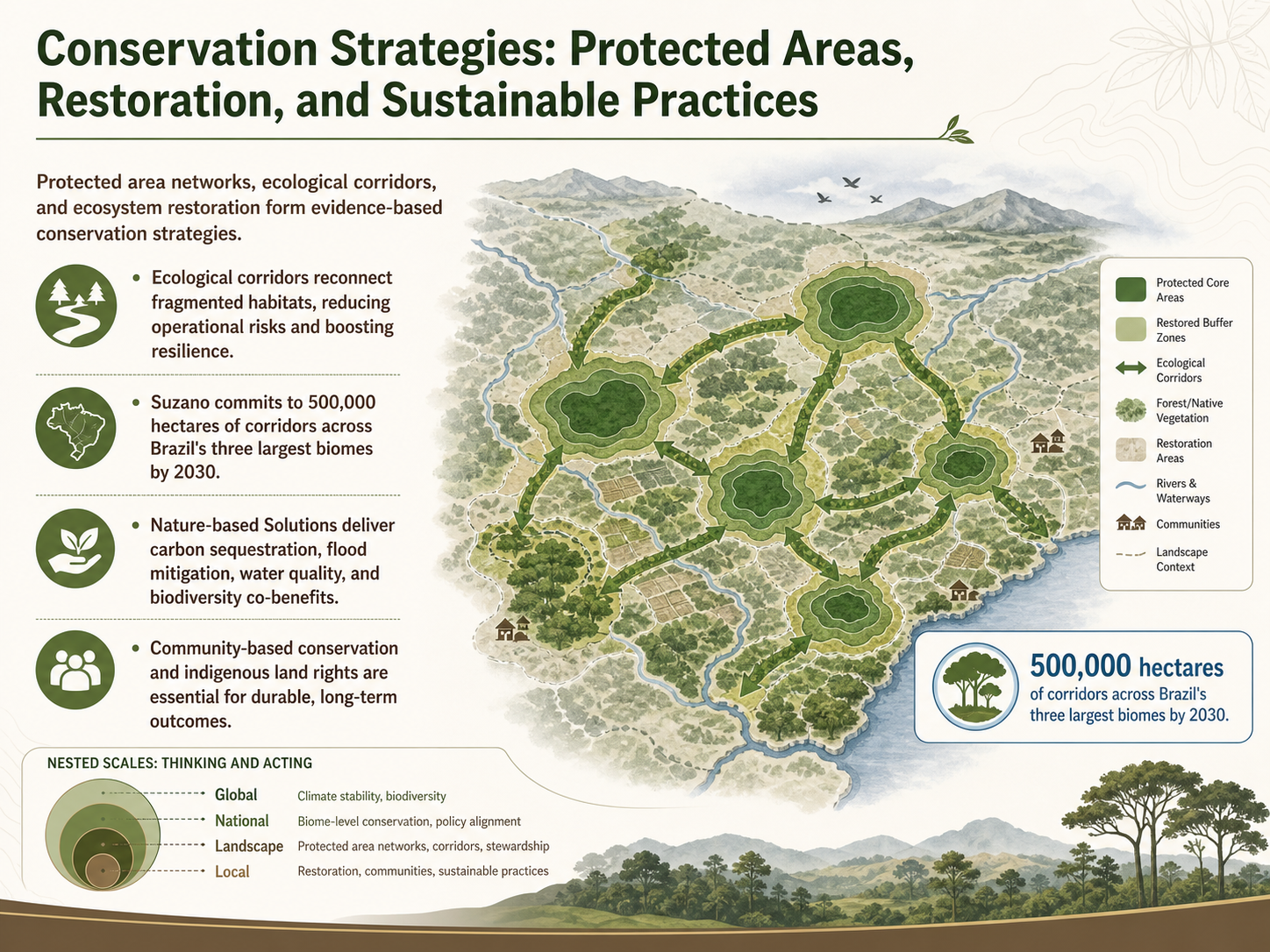
 - 13Conservation Strategies: Protected Areas, Restoration, and Sustainable PracticesNow, let's translate the principles of ecology into practical conservation strategies. Three core, evidence-based approaches are protected area networks, ecological corridors, and ecosystem restoration. These strategies are not just about setting land aside; they are active interventions to maintain and rebuild ecological function. Consider ecological corridors. When habitats become fragmented, populations are isolated, which increases their vulnerability to pests, disease, and fire. Corridors physically reconnect these fragments, reducing operational risks and boosting overall landscape resilience. A leading example is Suzano, a global forestry company. They have committed to establishing 500,000 hectares of ecological corridors across Brazil's three largest biomes by the year 2030. This initiative lowers their operational costs and opens access to green financing. We also see the power of Nature-based Solutions, which deliver a range of co-benefits like carbon sequestration, flood mitigation, and improved water quality, alongside biodiversity gains. A private sector model is emerging, where companies like Arup invest upfront in restoration projects, securing carbon removal credits while also funding community well-being and ecosystem recovery. Crucially, for any of these strategies to be durable, community-based conservation and the recognition of Indigenous land rights are essential. The long-term success of nature protection depends on local stewardship. Next, we will apply these concepts in a specific field: Applied Ecology, focusing on Ecosystem Services and Natural Capital in Business.
 science.orgtandfonline.comnature.com+22 min
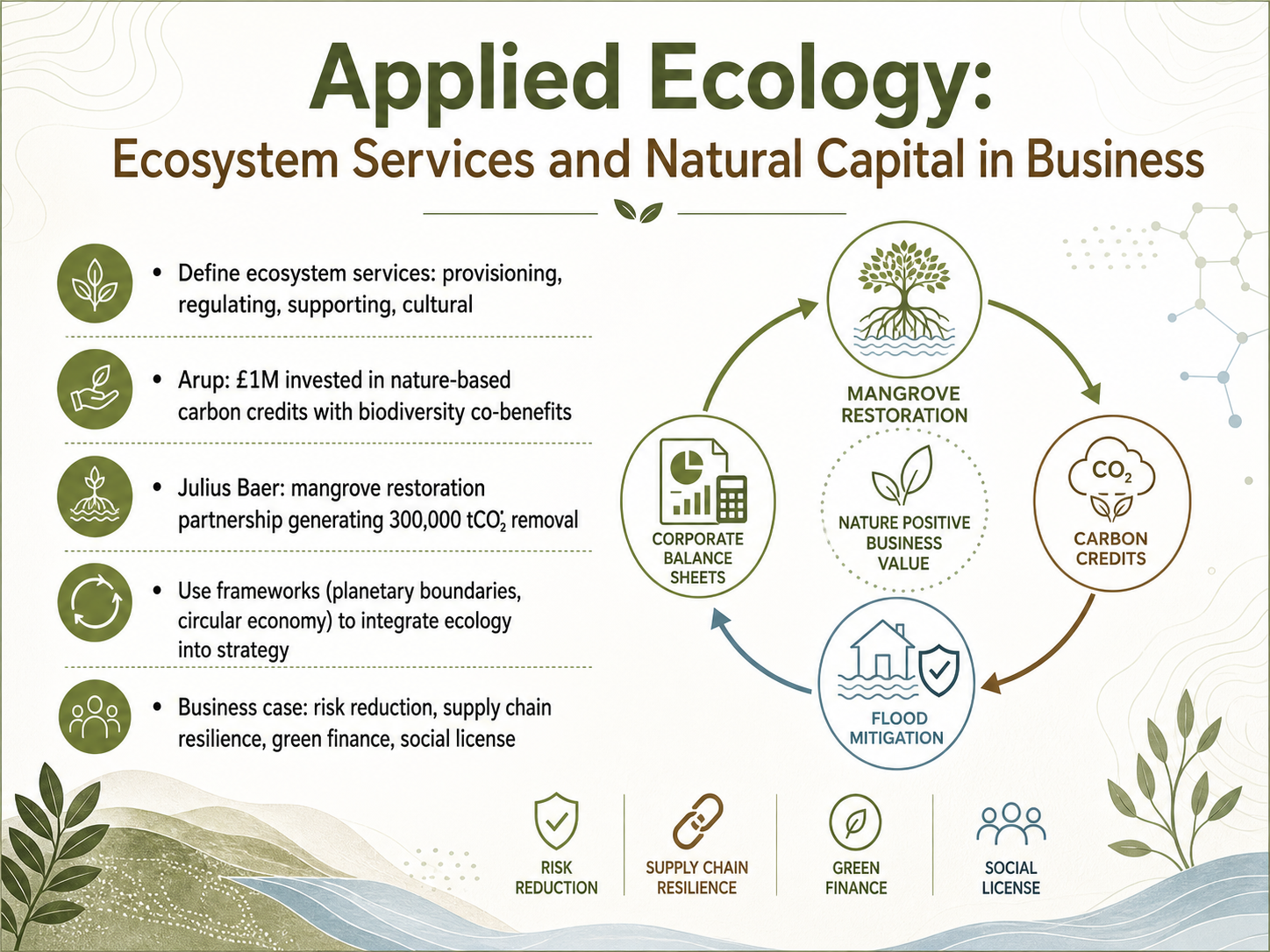
 - 14Applied Ecology: Ecosystem Services and Natural Capital in BusinessNow let's connect ecology to the business world. We call this applied ecology, specifically the concept of ecosystem services and natural capital. Think of ecosystem services as the benefits people and businesses obtain from nature. They are typically grouped into four categories: provisioning services like food and fresh water; regulating services like climate and flood control; supporting services like nutrient cycling; and cultural services like recreation and tourism. For a real-world example, consider Arup, a global consultancy. They invested one million pounds upfront in a nature-based project to secure future carbon removal credits, but the deal also delivers biodiversity gains and flood mitigation. Similarly, the bank Julius Baer partnered with a mangrove restoration project, expecting to remove three hundred thousand tonnes of carbon dioxide while also providing a quarter of the revenue to local communities. To integrate ecology into strategy, businesses use frameworks like planetary boundaries and circular economy principles. The business case is clear: these actions reduce operational risks, build supply chain resilience, open access to green finance, and strengthen a company's social license to operate. In the next slide, we'll explore the specific tools, frameworks, and certifications that make this work possible.
 2 min
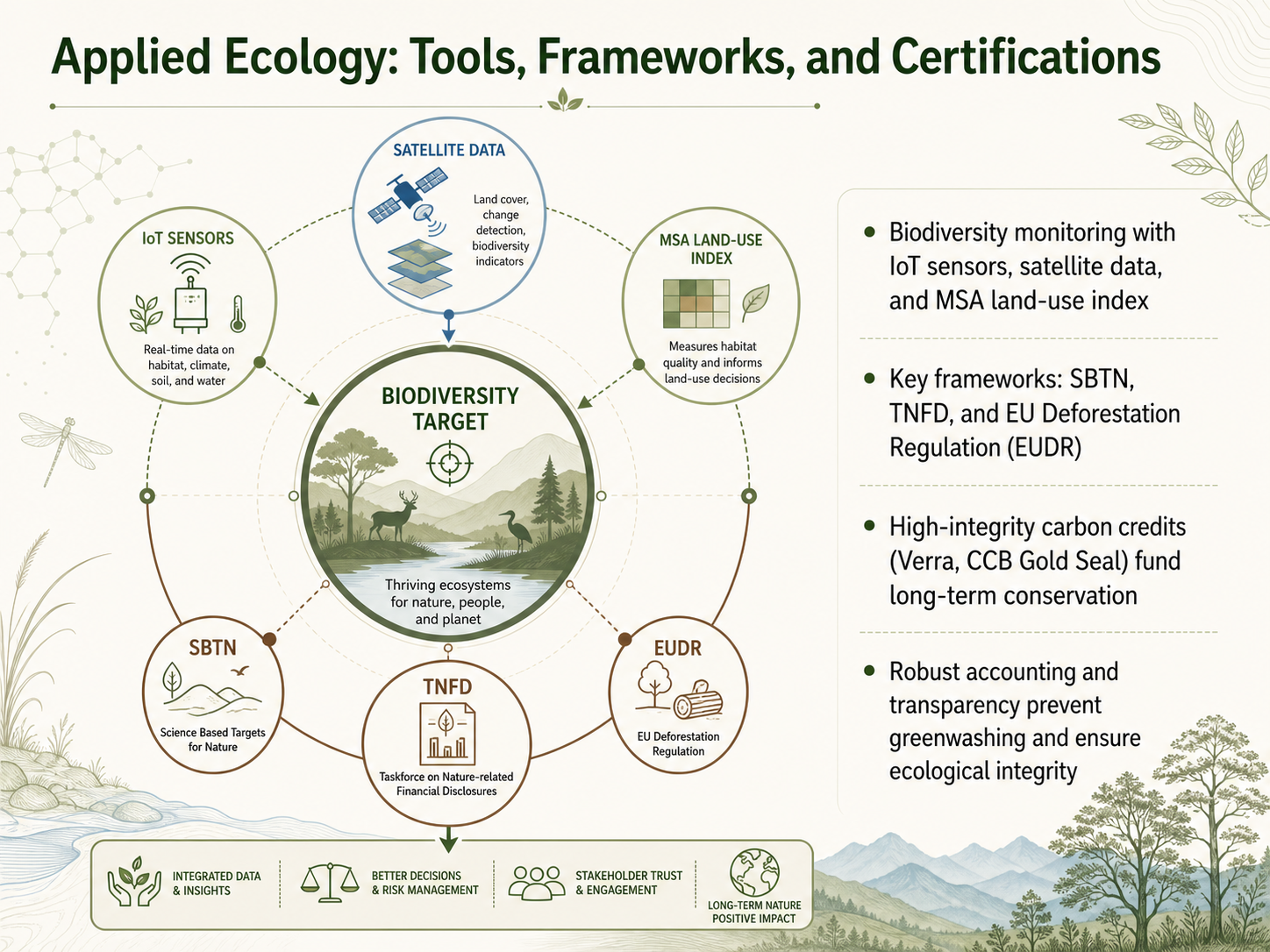
2 min - 15Applied Ecology: Tools, Frameworks, and CertificationsNow, let's look at the practical tools and frameworks that turn ecological concepts into measurable action. Applied ecology today relies on sophisticated monitoring. We can track biodiversity using IoT sensors, satellite data, and indexes like the Mean Species Abundance, or M S A, land-use metric. For example, a chemical manufacturer recently used these tools to show a 42-point improvement in biodiversity on their site compared to a control area. These data points feed into key frameworks that guide corporate strategy, including the Science Based Targets Network, the Taskforce on Nature-related Financial Disclosures, and the E U Deforestation Regulation. A critical application is in high-integrity carbon credits. Standards like Verra and the Climate, Community, and Biodiversity Gold Seal verify that projects, such as restoring mangroves or connecting forest corridors, deliver real, additional ecological benefits. Arup’s direct investment in a UK nature restoration project is a perfect case study of this approach. Ultimately, robust accounting and full transparency are what prevent greenwashing and ensure ecological integrity. This leads us to our final topic: a synthesis on connecting ecology to personal and organizational action.
 2 min
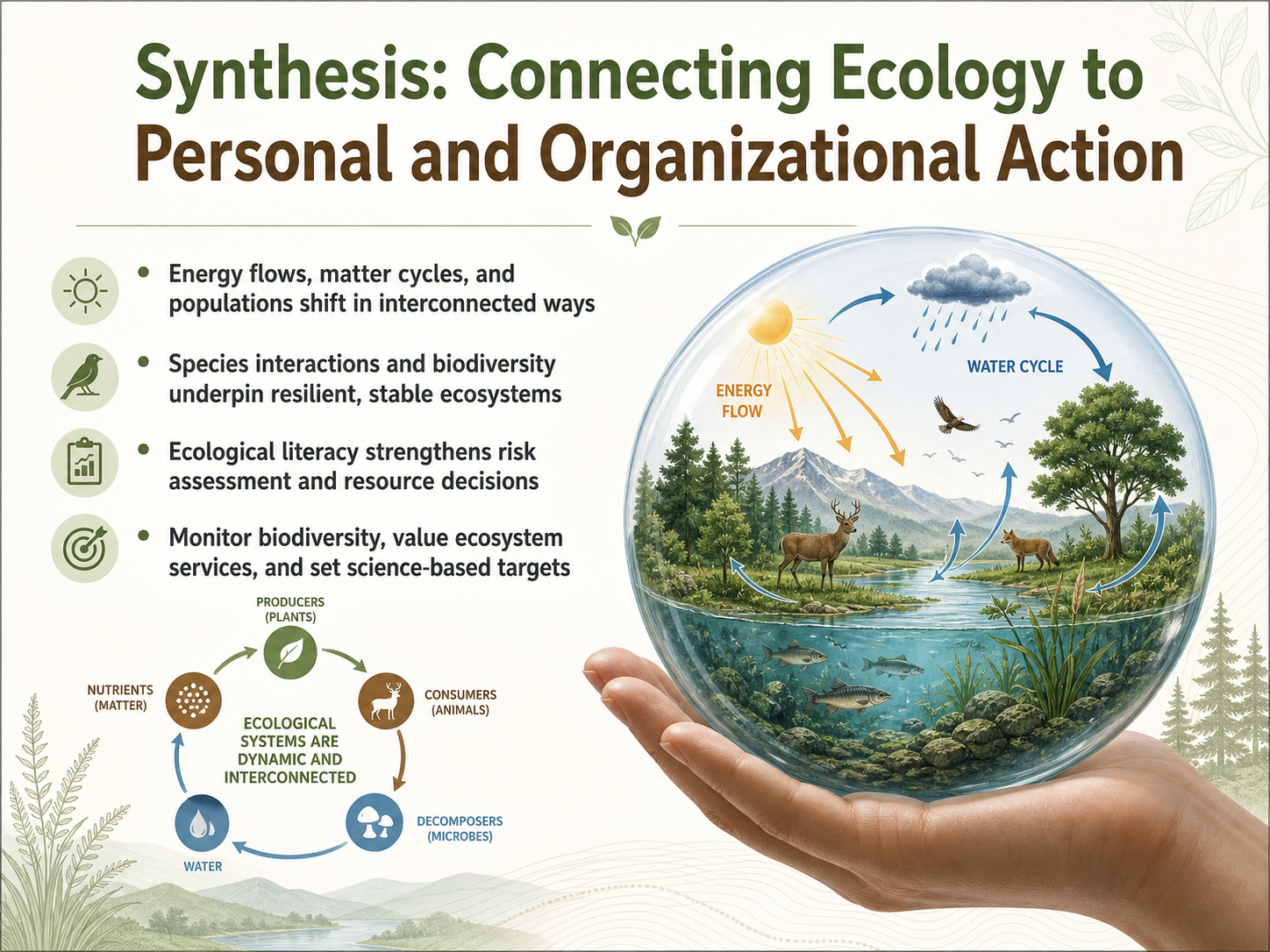
2 min - 16Synthesis: Connecting Ecology to Personal and Organizational ActionLet's bring these concepts together and connect them to real-world decisions. Ecology reveals that energy flow, nutrient cycling, and population dynamics are all linked. Disrupt one part, and the effects ripple outward. The interactions among species and the overall level of biodiversity are what give an ecosystem its resilience and stability. This understanding supports better risk assessment and smarter resource management. To put this into practice, you can start by monitoring biodiversity indicators, formally valuing the services ecosystems provide, and setting science-based targets that align with ecological limits. These are practical steps any organization can take. Thank you for joining this introduction to ecology. I encourage you to apply this ecological lens to your daily decisions and long-term planning.
 1 min
1 min
Take the deck with you
Download this course as a file — free, no sign-up needed.
- PDF handoutEvery slide page, ready to print or share.17 pages · 5.5 MBDownload
- Narrated PowerPointThe deck that presents itself — every slide carries the digital human's narration video.17 pages · 18.1 MBDownload
- PowerPoint slidesThe full deck as a .pptx — open it in PowerPoint, Keynote, or Google Slides.17 pages · 5.5 MBDownload
Free to use in your own training — please keep the PersonWise credit page at the end.
Have your own deck? Turn it into a course
Sources consulted
Web sources consulted while building this course.
- IUPAC - ecology (14610) — goldbook.iupac.org
- What Is Ecology? – Ecological Society of America — esa.org
- Rethinking about ecology: development, theories, and applications — plant-ecology.com
- Definition of Ecology — caryinstitute.org
- 44.1 The Scope of Ecology - Biology 2e | OpenStax — openstax.org
- Learn: Trophic levels and energy loss (article) | Khan Academy — khanacademy.org
- Energy Flow and the 10 Percent Rule — education.nationalgeographic.org
- Ecological efficiency — en.wikipedia.org
- Ecological pyramid - Wikipedia — en.wikipedia.org
- The Flow of Energy: Higher Trophic Levels — globalchange.umich.edu
- Cross‐Taxa Analysis of Long‐Term Data Reveals a Positive Biodiversity‐Stability Relationship With Taxon‐Specific Mechanistic Underpinning — doi.org
- Quantifying the net effect of biodiversity on ecological stability | Nature Communications — nature.com
- Partitioning Net Biodiversity Effects on Ecosystem Resistance and Resilience — pubmed.ncbi.nlm.nih.gov
- Unifying spatial scaling laws of biodiversity and ecosystem stability | NSF Public Access Repository — par.nsf.gov
- The Identification of Patterns in the Relation Between Biodiversity and Mutualistic Ecosystem Function Based on Network Resilience — mdpi.com
- The direct drivers of recent global anthropogenic biodiversity loss | Science Advances — science.org
- Full article: Biodiversity in 2026: global decline, emerging recoveries, and the need for coordinated action — tandfonline.com
- The global human impact on biodiversity | Nature — nature.com
- Tropical Rainforest Loss Slowed in 2025, but Fire is a Growing Threat to Forests Worldwide | World Resources Institute Research — gfr.wri.org
- Global evolution of habitat quality driven by anthropogenic activities: From the perspective of production-living-ecological space — doi.org