Food Webs and Energy Flow
Begin
12 pages · ~24 min
Food Webs and Energy Flow
This training explains how energy flows through food webs, helping learners understand the roles of producers, consumers, and decomposers in ecosystems.
What you’ll learn
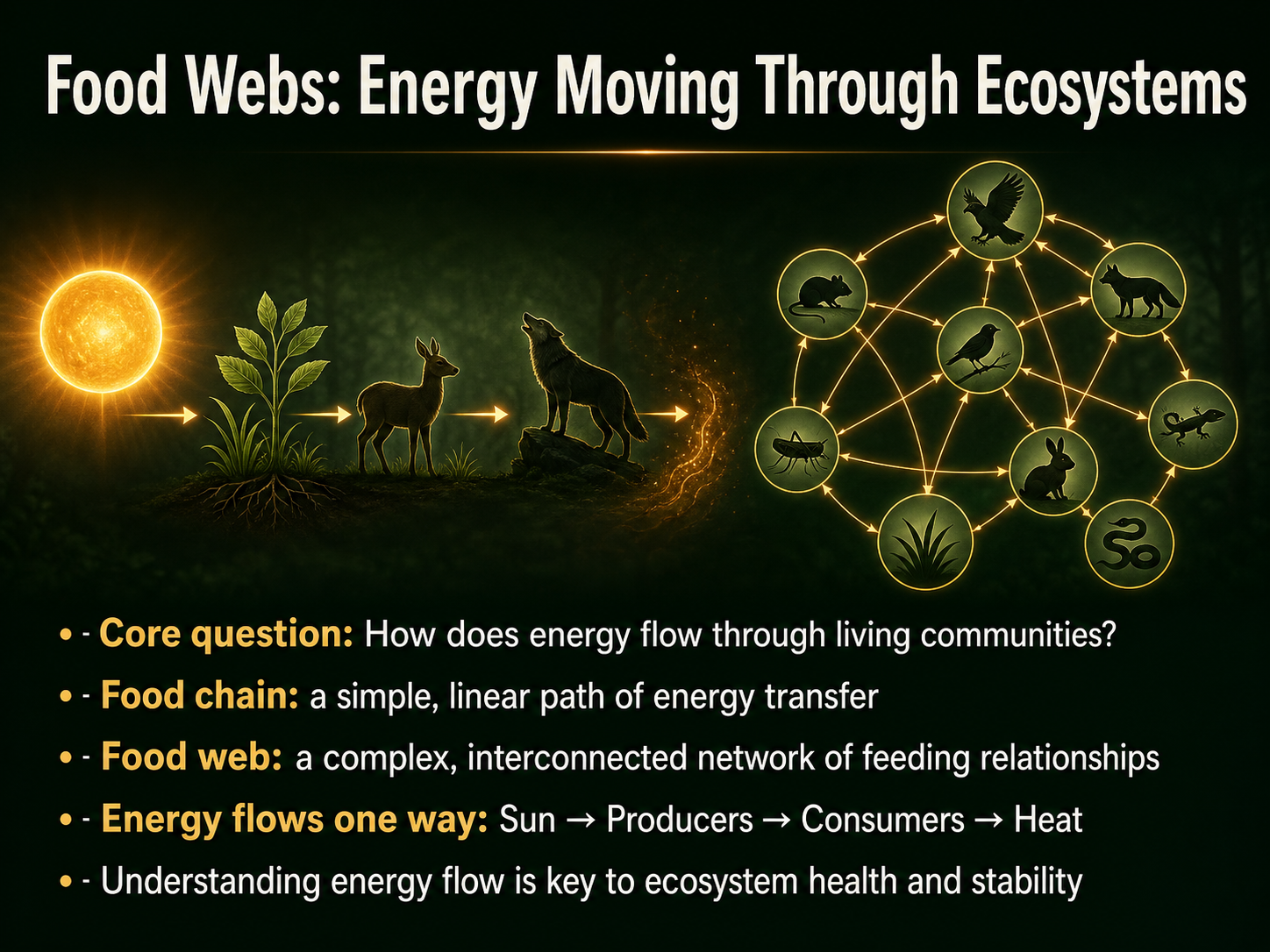
- 01Food Webs: Energy Moving Through EcosystemsWelcome. In this lesson, we will explore how energy moves through living communities. Our big question is: How does energy flow through an ecosystem? Let us start with two important tools. First, a food chain. A food chain is a simple, straight path showing who eats whom. Picture grass, a rabbit, and a fox. The energy moves in one direction along that line. Next is a food web. A food web connects many food chains together to form a complex network. Most organisms eat more than one type of food, so a web gives us a much more realistic picture. Now here is the key rule. Energy always flows one way. It starts with the Sun, moves to producers like plants, then to consumers like animals, and finally escapes as heat. Decomposers recycle materials, but the energy itself is not reused. Understanding this one-way flow helps us see why every level matters for ecosystem health and stability. Let us begin that journey now, starting where all energy enters the system: the producers. We will look at that next in 'The First Step: Producers Capture the Sun's Energy.'britannica.comen.wikipedia.orgepa.gov+22 min
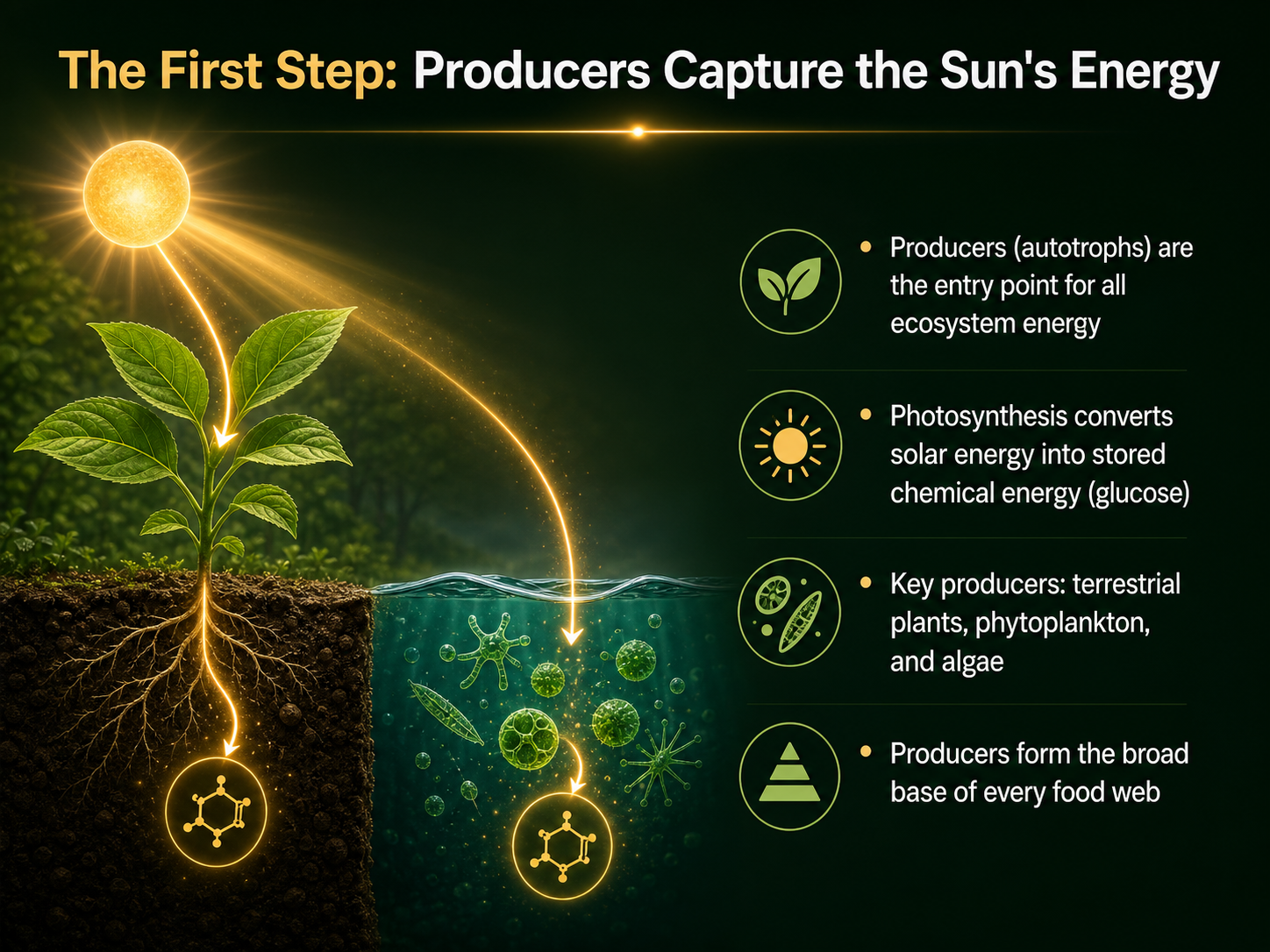
- 02The First Step: Producers Capture the Sun's EnergyNow that we have a sense of how food webs organize energy, let's go right to the very first step. Every energy story in an ecosystem begins with producers. You may also hear them called autotrophs, which simply means self-feeders. These remarkable organisms are the entry point for all ecosystem energy. They capture sunlight, or in some rare cases chemical energy, and through photosynthesis convert it into stored chemical energy in the form of glucose. Think of glucose as a tiny, natural battery that holds fuel for later use. The most familiar producers are terrestrial plants, but the base of many aquatic food webs is formed by phytoplankton and algae. Because they build their own food from inorganic sources, producers form the broad, sturdy base of every food web, supporting all other life. With our energy foundation in place, let's climb up the structure and meet the consumers. Next, we will explore the different trophic levels and their feeding roles.
 openstax.orgkhanacademy.orgbritannica.com+21 min
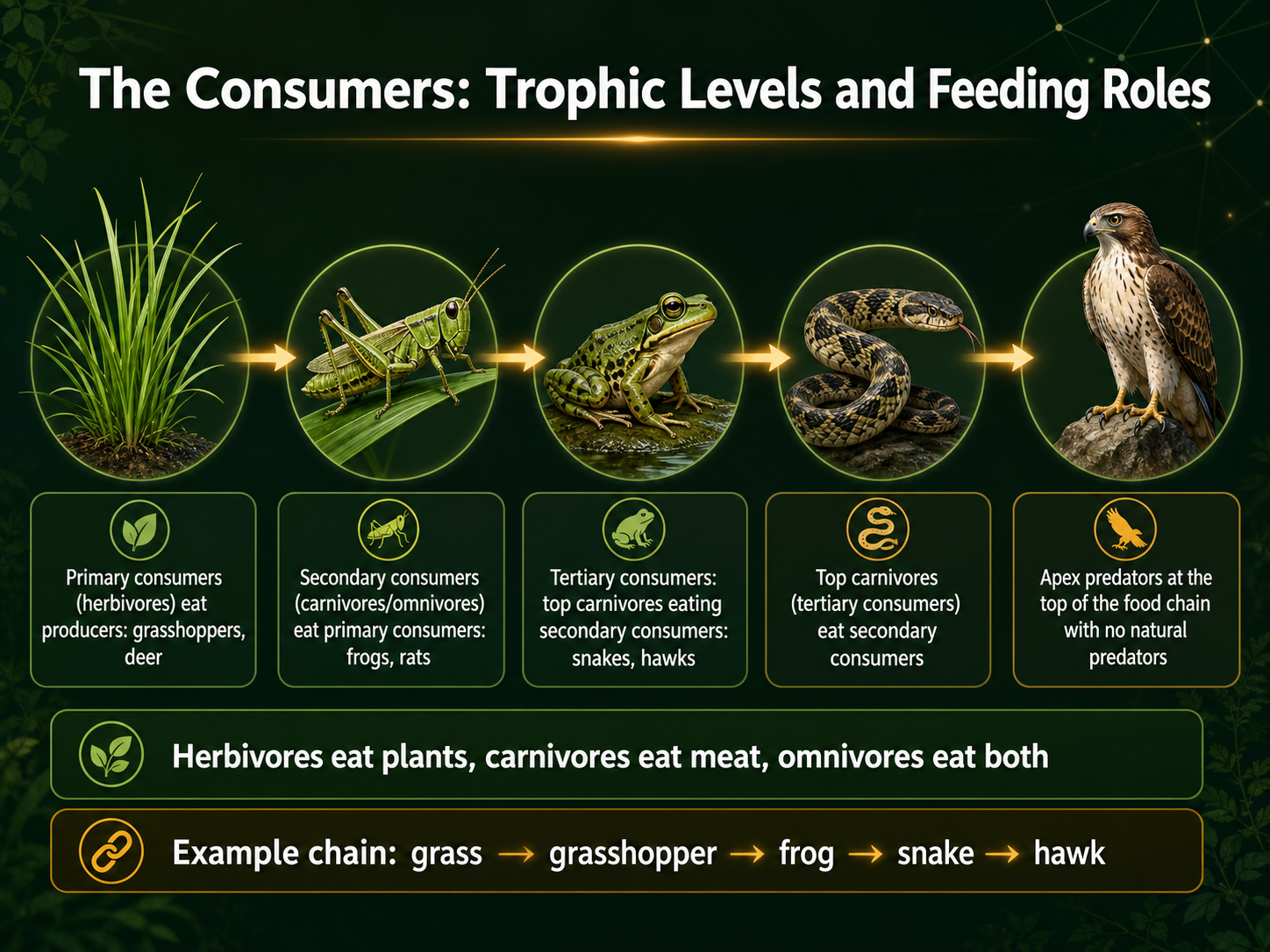
 - 03The Consumers: Trophic Levels and Feeding RolesNow that we've met the producers, let's climb to the next steps on our energy ladder—the consumers. Consumers get their energy by eating other organisms, and we group them into trophic levels based on what they eat. First up are the primary consumers, also known as herbivores. Think of a grasshopper munching on grass, or a deer browsing on leaves. These are plant eaters that take the energy the producers made and pass it along. Next come the secondary consumers. These are carnivores or omnivores that eat the primary consumers. Picture a frog snapping up that grasshopper, or a rat that might eat seeds and insects. One level higher, we find tertiary consumers. These are top carnivores that hunt secondary consumers. A snake swallowing a frog, or a hawk diving to catch a snake, are great examples. So, herbivores eat plants, carnivores eat meat, and omnivores eat both. You can actually trace a single path of energy: grass to grasshopper to frog to snake to hawk. That's a real food chain showing energy moving step by step. Let's use that chain to understand a surprising rule about energy.
 britannica.comck12.orgbio.libretexts.org+22 min
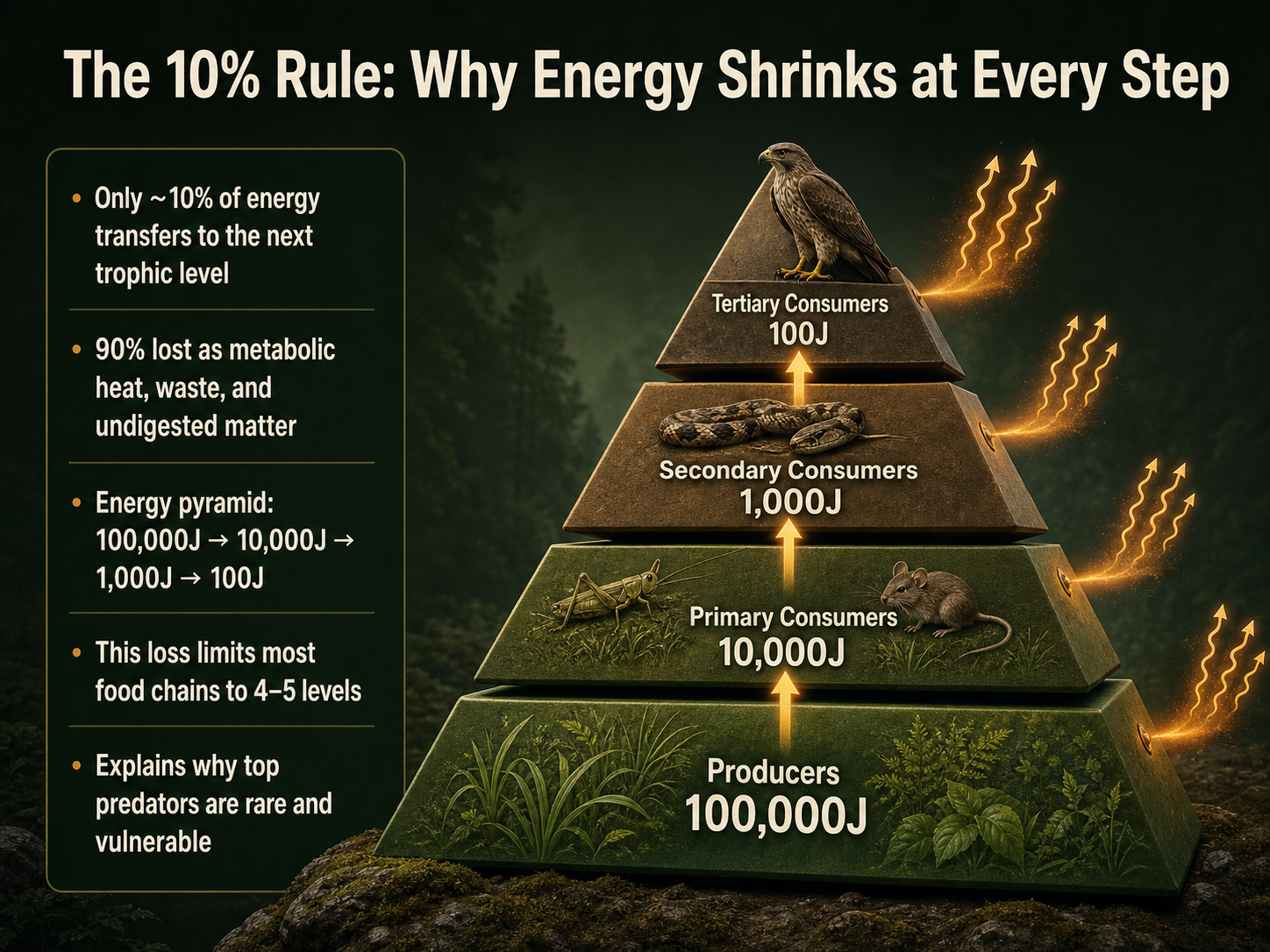
 - 04The 10% Rule: Why Energy Shrinks at Every StepNow, let's look at a rule that shapes every ecosystem: the ten percent rule. When energy moves from one trophic level to the next, only about ten percent is actually passed on. The other ninety percent is used for life processes like movement and growth, or lost as body heat, waste, and undigested matter. Imagine a bright energy pyramid that holds one hundred thousand joules at the producer level. Primary consumers capture just ten thousand joules. Secondary consumers get one thousand, and tertiary consumers receive only one hundred joules. Because energy shrinks so dramatically at each step, most food chains can only support four or five levels before the energy runs out. This also explains why top predators like hawks or tigers are rare and uniquely vulnerable. When energy at the bottom shifts, they feel it first. Let's take this idea further and see how real ecosystems weave these chains together, moving from chain to web: a more realistic view.
 education.nationalgeographic.orgen.wikipedia.orggeo.libretexts.org+21 min
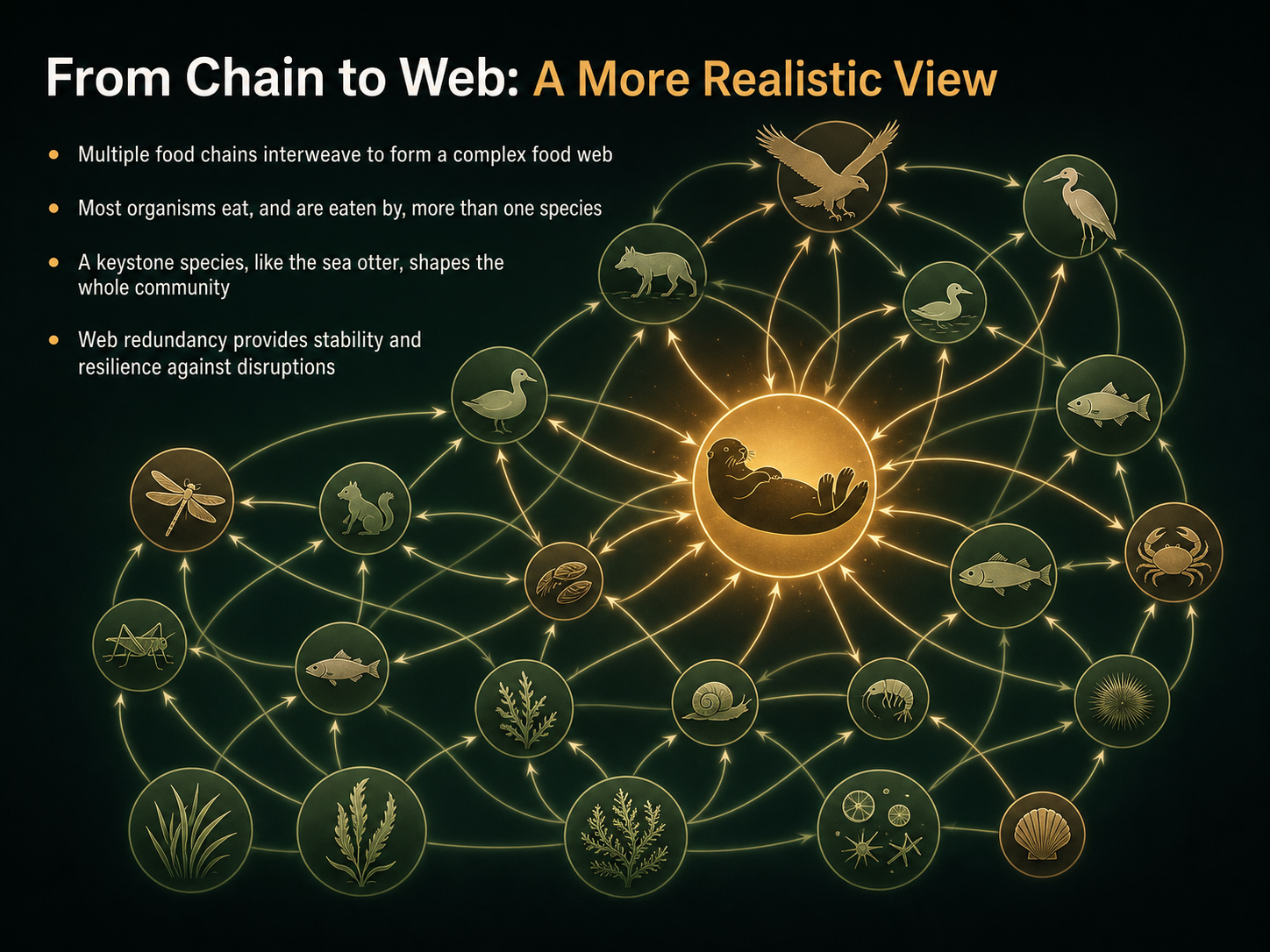
 - 05From Chain to Web: A More Realistic ViewWe have looked at energy moving along a single path. In nature, those paths overlap and cross. That is what a food web is—a network of interconnected food chains. It gives us a more realistic view of how energy flows through an ecosystem. Most organisms eat, and are eaten by, more than one species. A fox, for example, might hunt a rabbit one day and a mouse the next. This web of connections creates resilience. If one prey species declines, a predator can switch to another food source. That redundancy helps the whole community stay stable, even when disruptions occur. Now, some species have an outsized impact on this web. We call them keystone species. Think of the sea otter. It eats sea urchins. Without the otter, urchin populations would explode and destroy the kelp forests. That one predator shapes the entire community. So, a food web is not just a tangle of arrows. It is a map of interdependence. Each link represents a transfer of energy and a relationship that keeps the ecosystem in balance. Next, let us complete the picture by exploring the cleanup crew: decomposers and detritivores.
 britannica.comen.wikipedia.orgepa.gov+22 min
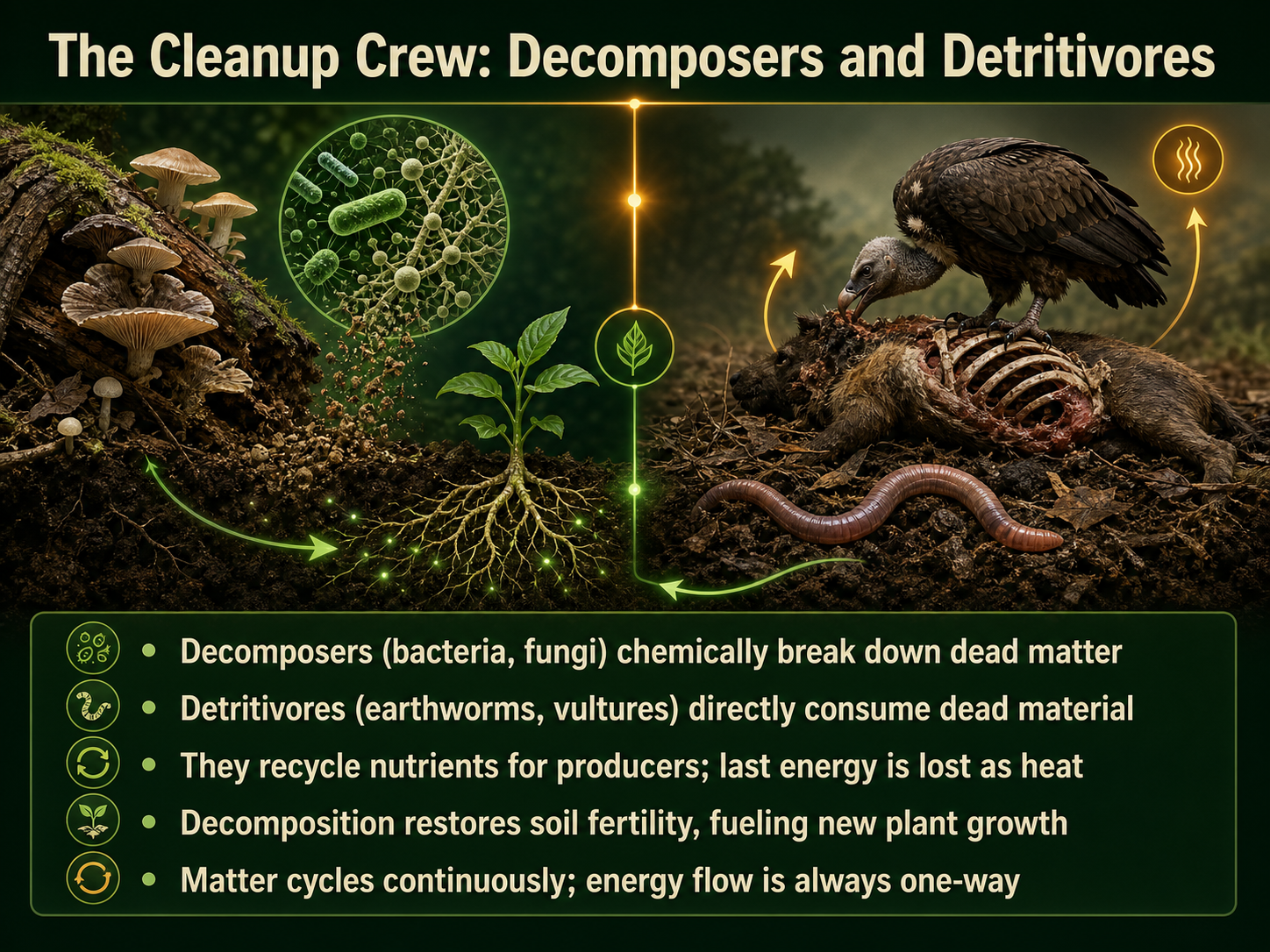
 - 06The Cleanup Crew: Decomposers and DetritivoresNow let’s meet the cleanup crew that keeps every ecosystem running: decomposers and detritivores. These organisms handle the final, essential step in the energy story. Decomposers, like bacteria and fungi, chemically break down dead plant and animal matter. Then we have detritivores—earthworms, vultures, and similar organisms—that directly consume dead material. Together, they recycle precious nutrients back into the soil. This process restores soil fertility, which fuels new plant growth and gives producers the boost they need. While nutrients cycle around and around, remember that energy flow is always one-way. The last bits of energy locked in dead matter are lost as heat during decomposition. So the cleanup crew returns matter to the system, but energy is not recycled. Next, we will explore visual models that bring these levels to life in 'Visual Models: Three Ecological Pyramids.'
 britannica.comen.wikipedia.orgepa.gov+21 min
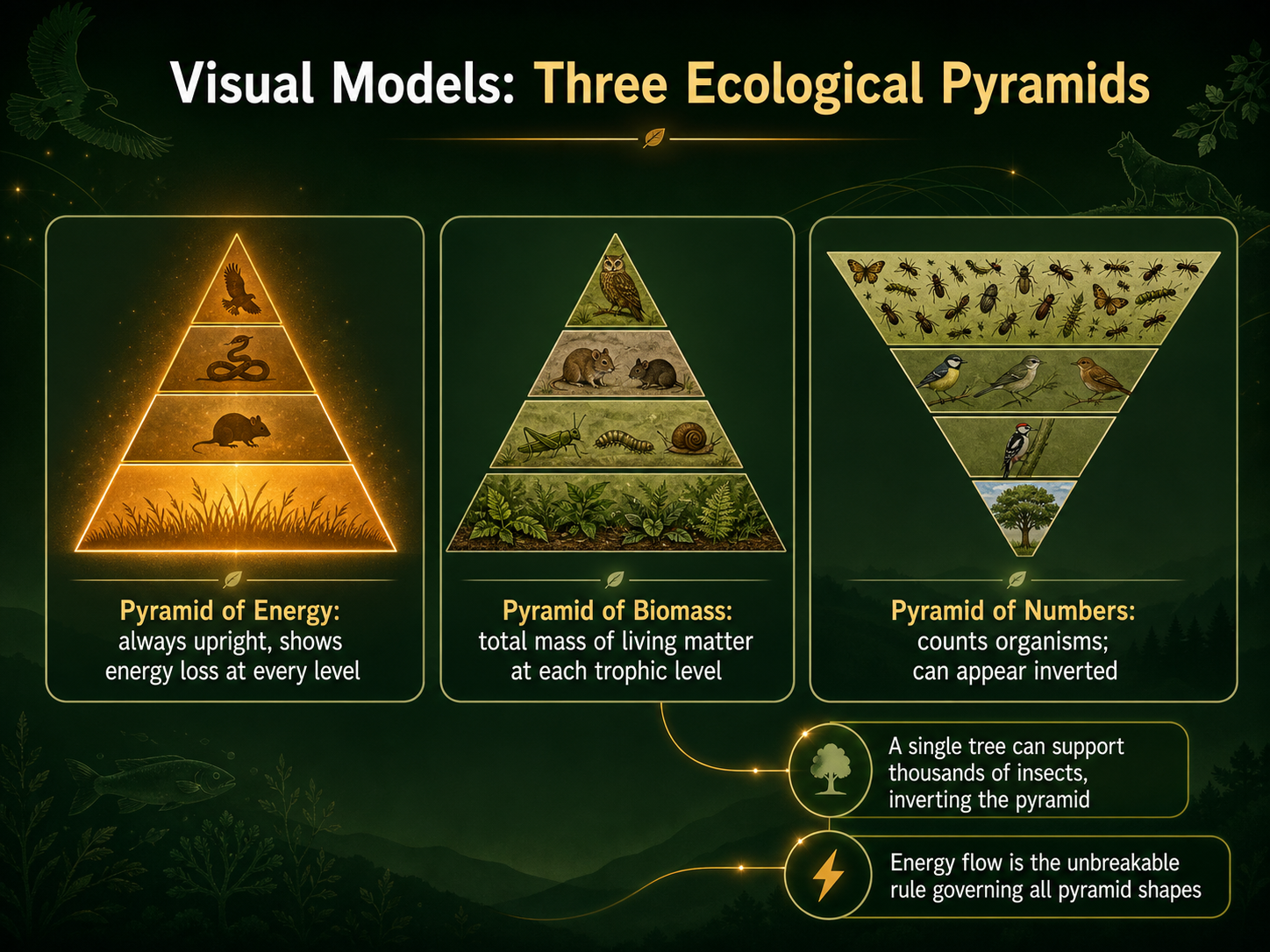
 - 07Visual Models: Three Ecological PyramidsNow, let's look at three visual models that help us see energy patterns: ecological pyramids. First, the pyramid of energy. This chart is always upright. It shows how energy decreases at every step, because about ninety percent is used for life processes or lost as heat, and only about ten percent moves up to the next level. Next, the pyramid of biomass measures the total mass of living tissue at each level. Usually, it also shrinks as you go up. But the pyramid of numbers, which simply counts individual organisms, can actually look inverted. Imagine a single large oak tree. That one producer can support thousands of insects. Here, the pyramid of numbers flips upside down. Even so, the energy pyramid never inverts. The unbreakable rule is that energy flow always narrows upward, shaping every other pyramid we draw. Let's use this idea to compare two main energy pathways: grazing webs and detrital webs.
 education.nationalgeographic.orgen.wikipedia.orggeo.libretexts.org+22 min
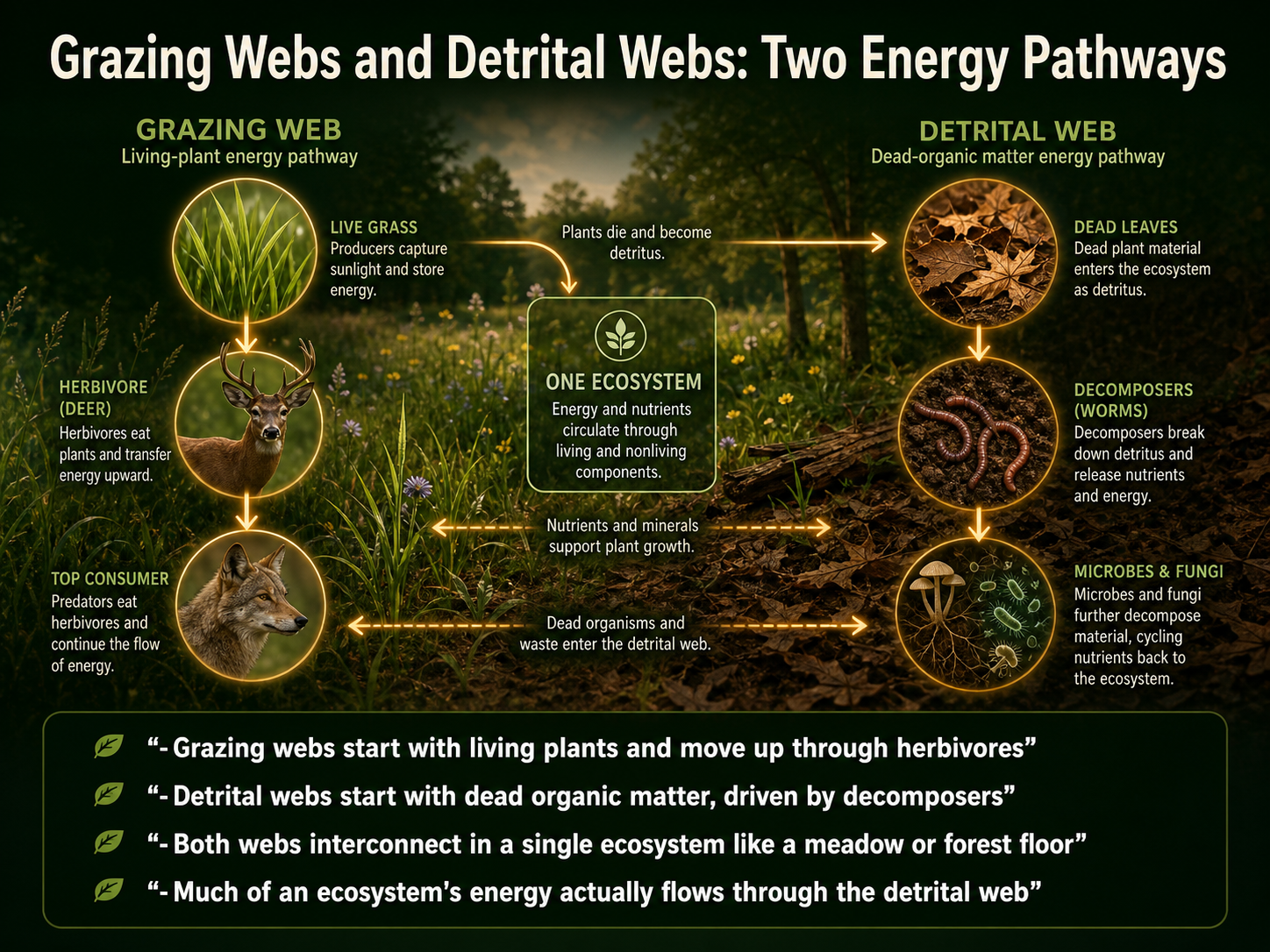
 - 08Grazing Webs and Detrital Webs: Two Energy PathwaysNow let's look at two ways energy can start its journey through an ecosystem. We call these grazing webs and detrital webs. A grazing web begins with living plants. Think of a meadow where a grasshopper eats grass, and then a bird eats the grasshopper. The energy path starts with a living producer and moves up through herbivores to consumers. In contrast, a detrital web starts with dead organic matter. Fallen leaves, dead roots, and animal waste are broken down by decomposers like fungi and bacteria. This process releases energy that other organisms, such as earthworms and beetles, can use. What’s really interesting is that these two webs are not separate. In a single forest floor or meadow, they interconnect constantly. An earthworm from the detrital web might be eaten by a bird that also feeds on live caterpillars. It’s one big, united system. And here’s a surprising fact. Much of an ecosystem’s total energy actually flows through the detrital web, not through the grazing web we can easily see. Next, we’ll explore what happens when this connected network gets disrupted.
 2 min
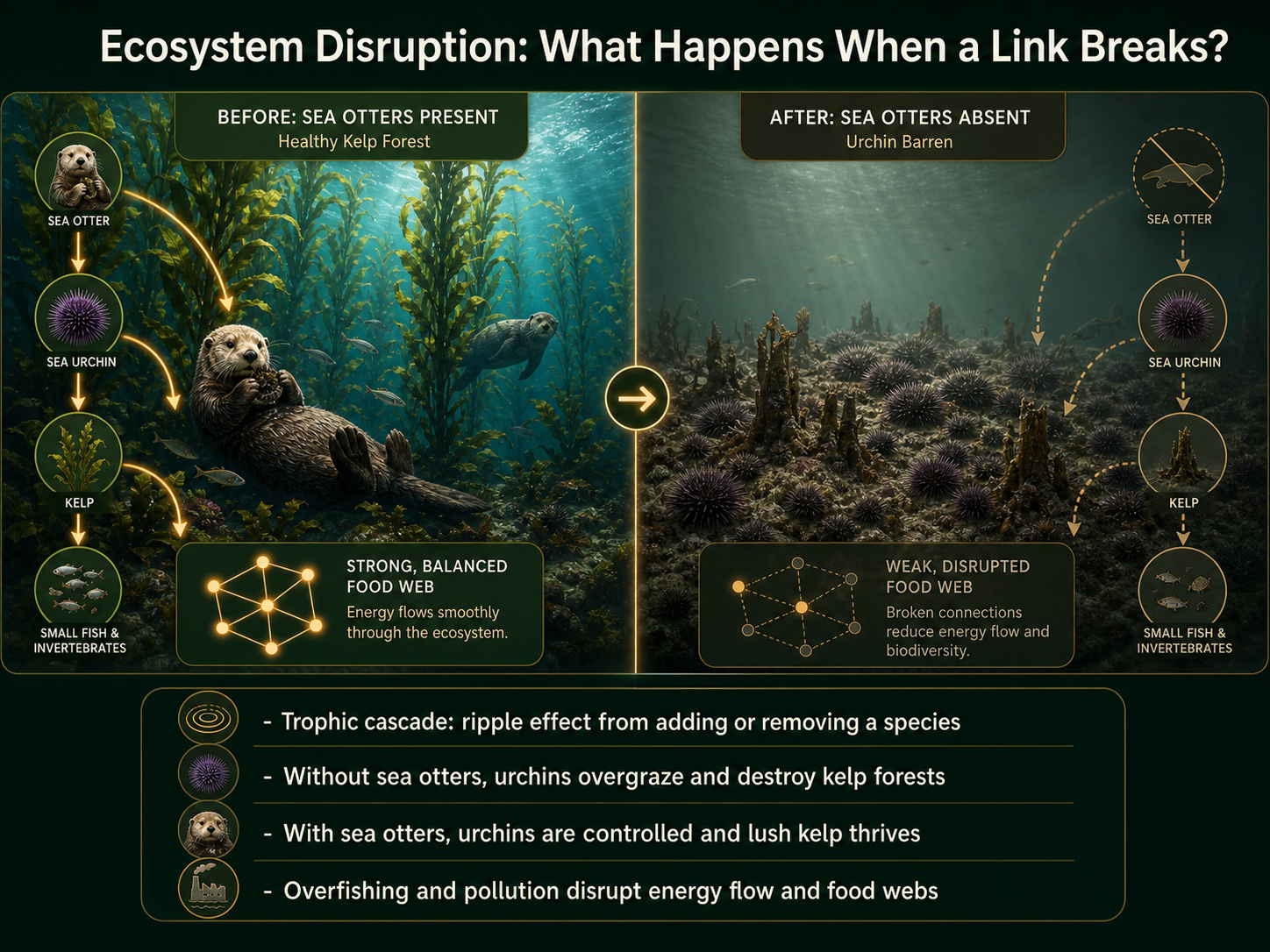
2 min - 09Ecosystem Disruption: What Happens When a Link Breaks?Now let's see what happens when a link in the food web breaks. We call this a trophic cascade, a ripple effect that moves through the ecosystem when a species is added or removed. Imagine a coastal kelp forest. When sea otters are present, they eat sea urchins. This keeps the urchin population in check, allowing lush kelp forests to thrive and support a rich community of fish and invertebrates. But what if the otters disappear? Without that key predator, sea urchin numbers can explode. These hungry herbivores overgraze, destroying the kelp and turning a vibrant underwater forest into an empty urchin barren. This same kind of disruption can happen through overfishing or pollution. Removing too many top predators or introducing harmful substances cuts the energy flow and unravels the careful balance. It's a powerful reminder that every organism, from the smallest producer to the apex consumer, plays a role. Up next, we'll explore what happens when toxins, not just missing links, start moving through this web in a process called bioaccumulation and biomagnification.
 2 min
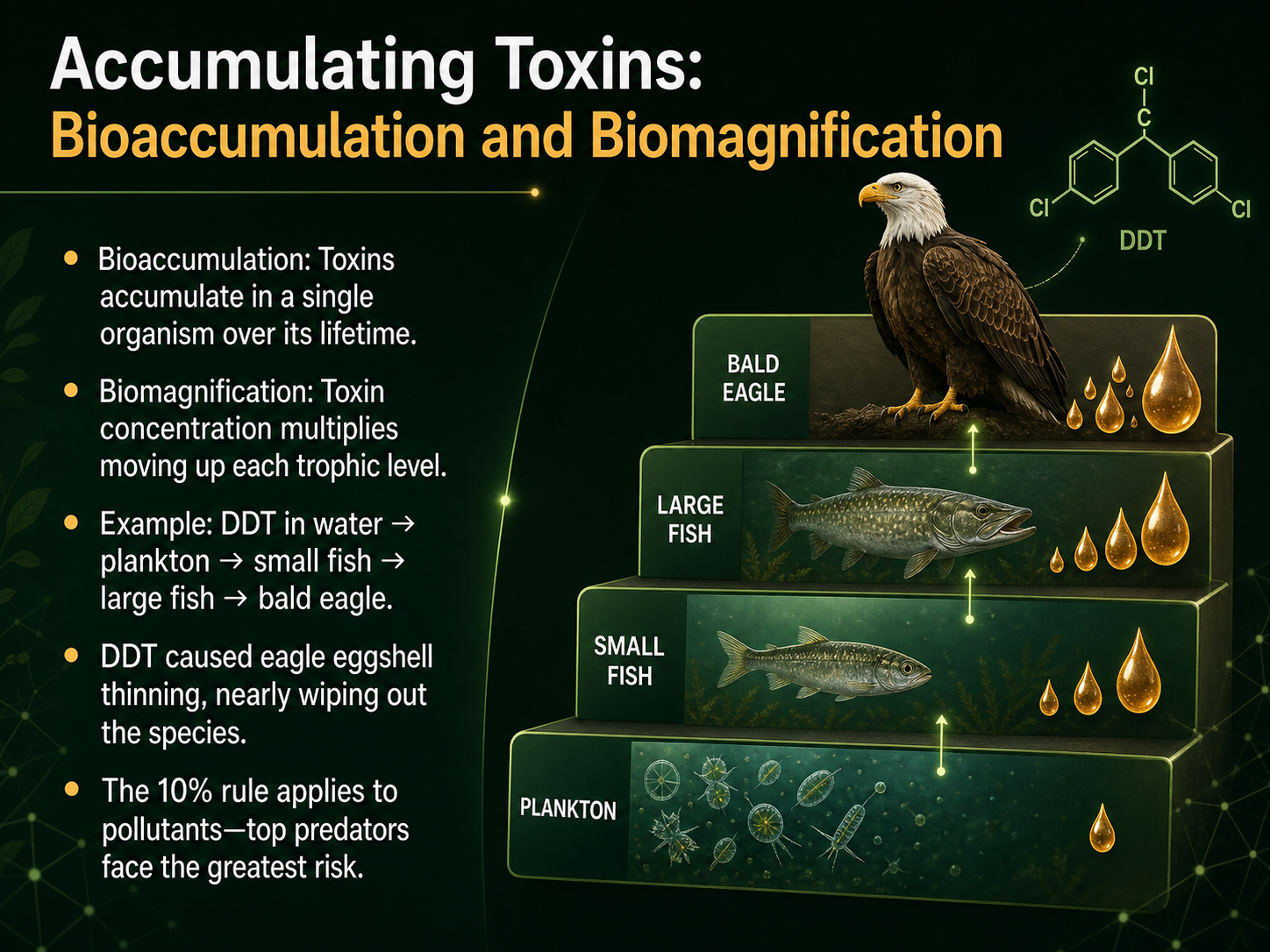
2 min - 10Accumulating Toxins: Bioaccumulation and BiomagnificationEnergy isn't the only thing that moves through a food web. Sometimes toxins do too, and their journey is quite different. Let's talk about two important processes: bioaccumulation and biomagnification. Bioaccumulation means a toxin builds up inside a single organism over its lifetime. If a small fish absorbs a little bit of a pollutant every day, and its body can't break it down, the toxin just keeps accumulating. Biomagnification takes this a step further. As you move up each trophic level, the concentration of the toxin multiplies. A classic example is the pesticide DDT. It started in water, then moved into plankton. Small fish ate lots of plankton, large fish ate many small fish, and finally, bald eagles ate the large fish. At each step, the toxin became more concentrated. By the time it reached the eagle, the dose was strong enough to cause eggshell thinning, which nearly wiped out the entire species. This shows how the ten percent rule applies to pollutants: only a small amount of energy is passed on, but toxins are passed on fully and accumulate, putting top predators at the greatest risk. Now, let's shift our focus from living food webs to ancient ones. In the next slide, 'Ancient Sunlight: Fossil Fuels in the Energy Picture,' we'll explore how energy from the past powers our world today.
 2 min
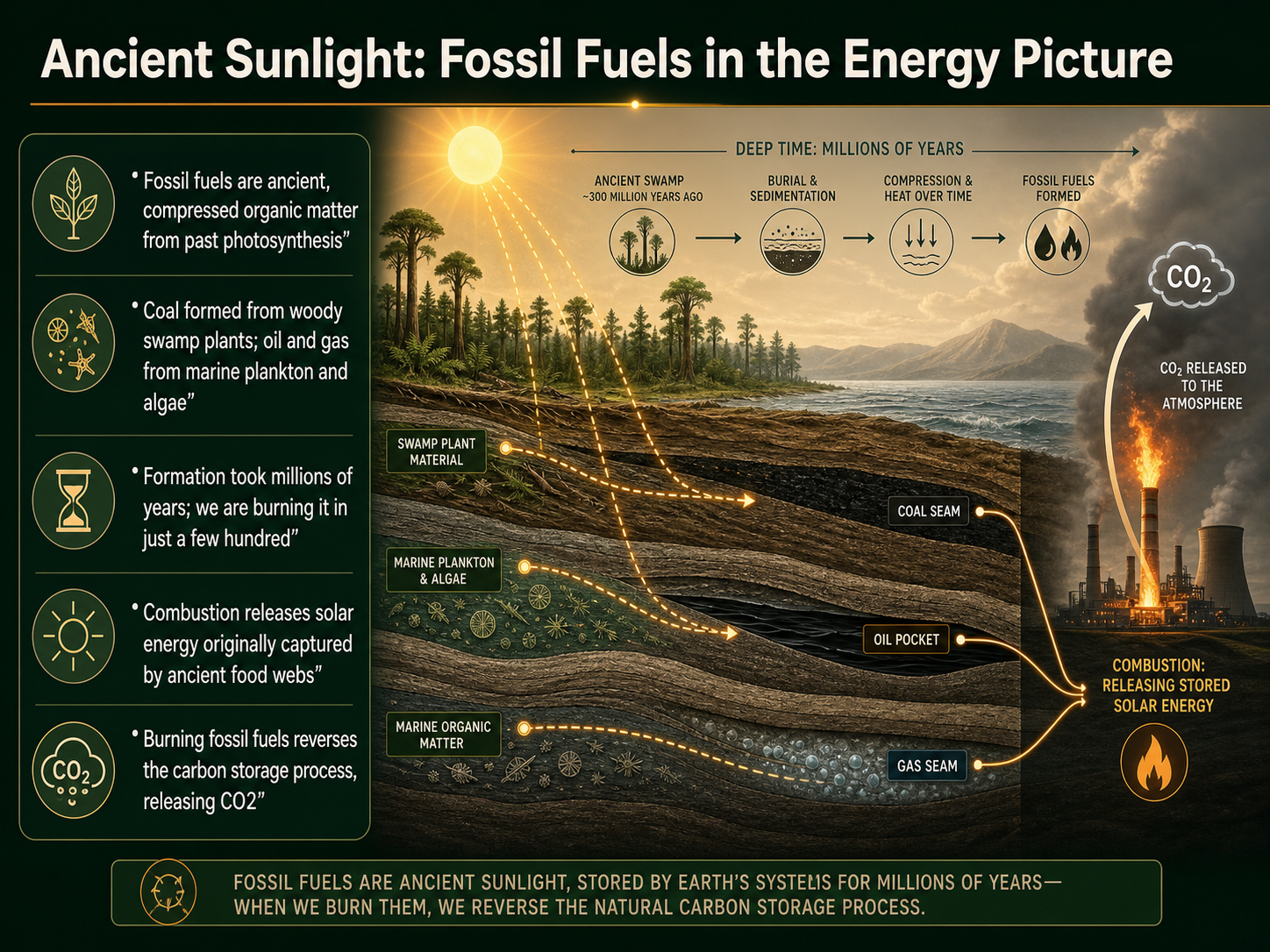
2 min - 11Ancient Sunlight: Fossil Fuels in the Energy PictureNow let's connect our food web story to a powerful source of energy we use every day: fossil fuels. Think of coal, oil, and natural gas as ancient, concentrated sunlight. This energy was originally captured by plants and algae through photosynthesis millions of years ago. When these organisms died in swamps or on ocean floors without much oxygen, they didn't fully decay. Instead, they were buried under layers of sediment. Over immense timescales, heat and pressure transformed that organic matter. Woody swamp plants became coal. Tiny marine plankton and algae turned into oil and natural gas. Here's the critical part: this formation process took millions of years to store that ancient solar energy. Now, we are burning through these vast reserves in just a few hundred years. When we combust fossil fuels, we are actually releasing the solar energy that was locked away by those ancient food webs. But we are also reversing the carbon storage process, releasing carbon dioxide back into the atmosphere at an extraordinary rate. It's a profound connection between our modern world and the energy pathways of the deep past. Next, we'll bring everything together in our final slide: Our Role in the Web: Summary and Reflection.
 2 min
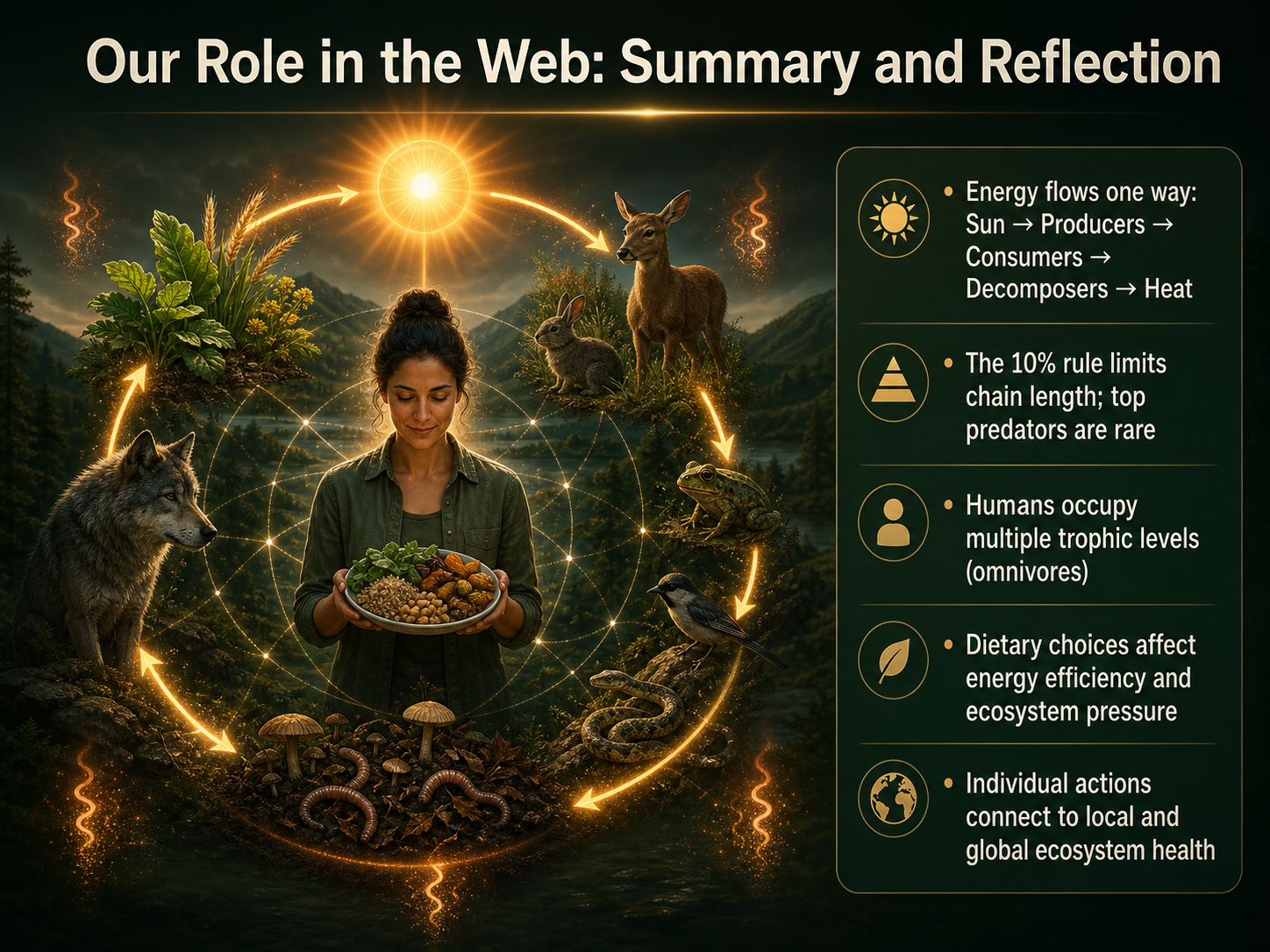
2 min - 12Our Role in the Web: Summary and ReflectionWelcome to our final reflection. Let's quickly trace the path we've followed. Energy flows one way: from the sun to producers, then to consumers, and finally to decomposers, with heat leaving the system at every step. We also learned the ten percent rule, which explains why each link gets less energy and why top predators are so rare. As humans, we're a special case because we eat at multiple trophic levels. We can act as primary consumers when we eat plants, or secondary consumers when we eat meat. This flexibility gives us a choice. Eating lower on the food chain uses energy more directly and can reduce pressure on ecosystems. It’s a powerful reminder that our daily decisions connect us to the health of our entire planet. Thank you for walking this path of energy with me. I hope you leave with curiosity and a sense of connection to every meal and every ecosystem you touch. Keep exploring and caring for the web of life.
 2 min
2 min
Take the deck with you
Download this course as a file — free, no sign-up needed.
- PDF handoutEvery slide page, ready to print or share.13 pages · 4.2 MBDownload
- Narrated PowerPointThe deck that presents itself — every slide carries the digital human's narration video.13 pages · 14.0 MBDownload
- PowerPoint slidesThe full deck as a .pptx — open it in PowerPoint, Keynote, or Google Slides.13 pages · 4.1 MBDownload
Free to use in your own training — please keep the PersonWise credit page at the end.
Have your own deck? Turn it into a course
Sources consulted
Web sources consulted while building this course.
- Food web | Definition, Ecosystem, Food Chain, & Examples — britannica.com
- Food web — en.wikipedia.org
- Food Chains and Food Webs — epa.gov
- Food Web: Concept and Applications — nature.com
- Food Web — education.nationalgeographic.org
- 37.2 Energy Flow through Ecosystems - Biology for AP® Courses | OpenStax — openstax.org
- Energy flow and primary productivity (article) — khanacademy.org
- Ecosystem - Trophic Levels, Food Chains, Interactions | Britannica — britannica.com
- Energy Transfer in Ecosystems — education.nationalgeographic.org
- Energy Flow through Ecosystems – Environmental Science — open.maricopa.edu
- Trophic level | Definition, Examples, & Facts — britannica.com
- Flexi answers - In which trophic levels can you find the following: Producer, primary consumer, secondary consumer, tertiary consumer, herbivores, omnivores, carnivores? | CK-12 Foundation — ck12.org
- 3.3.4: Food Chains and Food Webs - Biology LibreTexts — bio.libretexts.org
- Trophic level — en.wikipedia.org
- Trophic Level - Definition, Examples, and Diagram — sciencefacts.net
- Energy Flow and the 10 Percent Rule — education.nationalgeographic.org
- Ecological efficiency — en.wikipedia.org
- 5.8.2: Quantifying Food Webs - Geosciences LibreTexts — geo.libretexts.org
- The Flow of Energy: Higher Trophic Levels — globalchange.umich.edu
- 10% Rule of Energy Transfer | Definition & Pyramid ... — study.com