Sales Enablement Manager Workflow
Begin
13 pages · ~26 min
Sales Enablement Manager Workflow
This training guides aspiring and current sales enablement managers through a practical workflow to build, manage, and optimize enablement programs that drive sales performance.
What you’ll learn
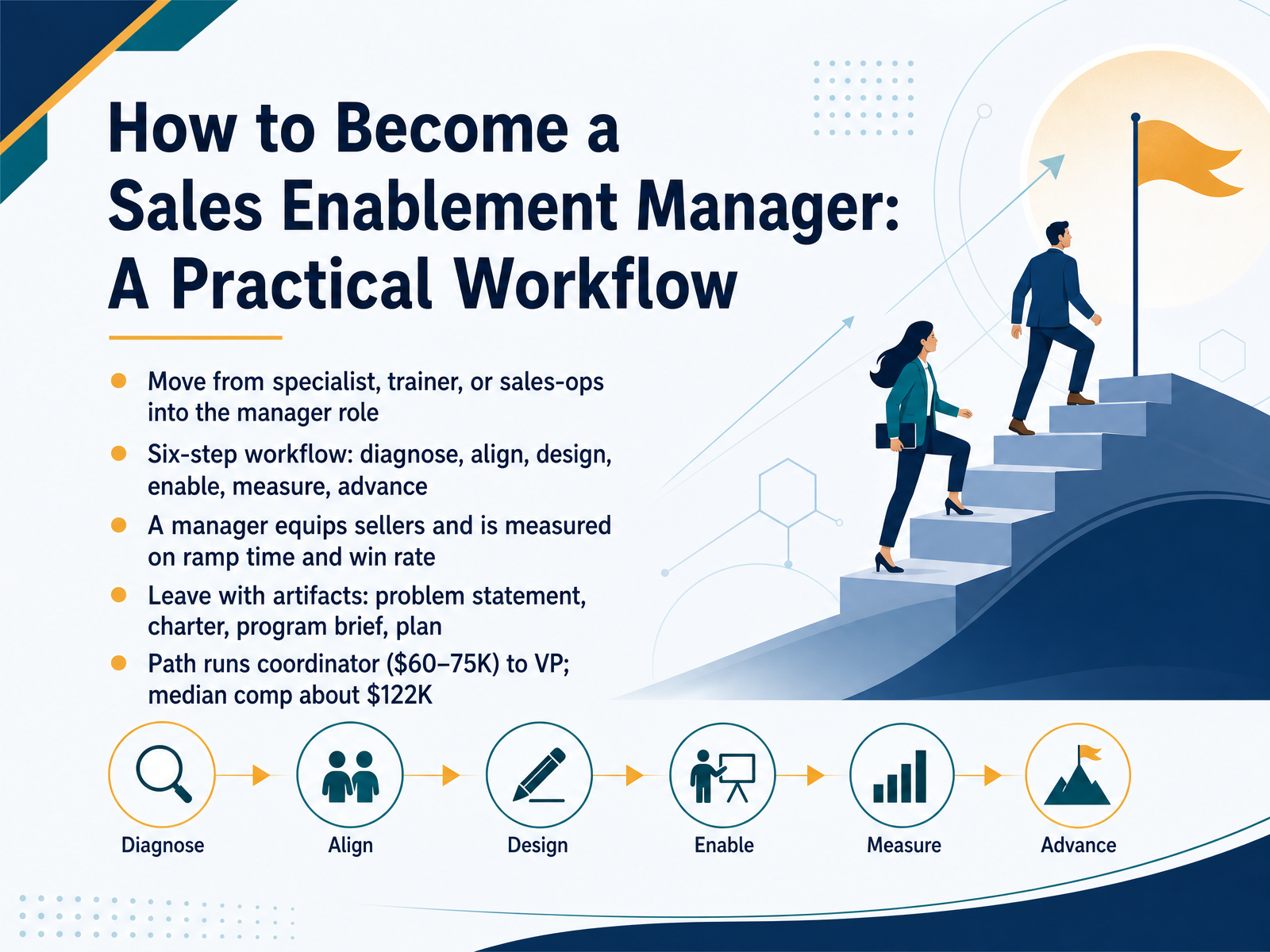
- 01How to Become a Sales Enablement Manager: A Practical WorkflowWelcome. If you're a specialist, a trainer, or sitting in sales operations, this course shows you how to make the move into a Sales Enablement Manager role. Not the title, the actual work. Here's the frame. You'll learn a six-step workflow: diagnose, align, design, enable, measure, and advance. At each step, you'll produce a real artifact. A problem statement, a charter, a program brief, and a plan. That's your portfolio, and it's also your first ninety days on the job. Now, a manager doesn't just run training. You equip sellers, and you're measured on outcomes like ramp time and win rate. So every recommendation today ties back to those numbers, even when your budget is tight and your data is incomplete. One more thing on the path. You can start as an enablement coordinator around sixty to seventy-five thousand, and grow toward VP of Revenue Enablement. Median pay sits near one hundred twenty-two thousand. Let's start with what the role actually owns.resources.rework.comsaleslabelconsulting.comindeed.com+22 min
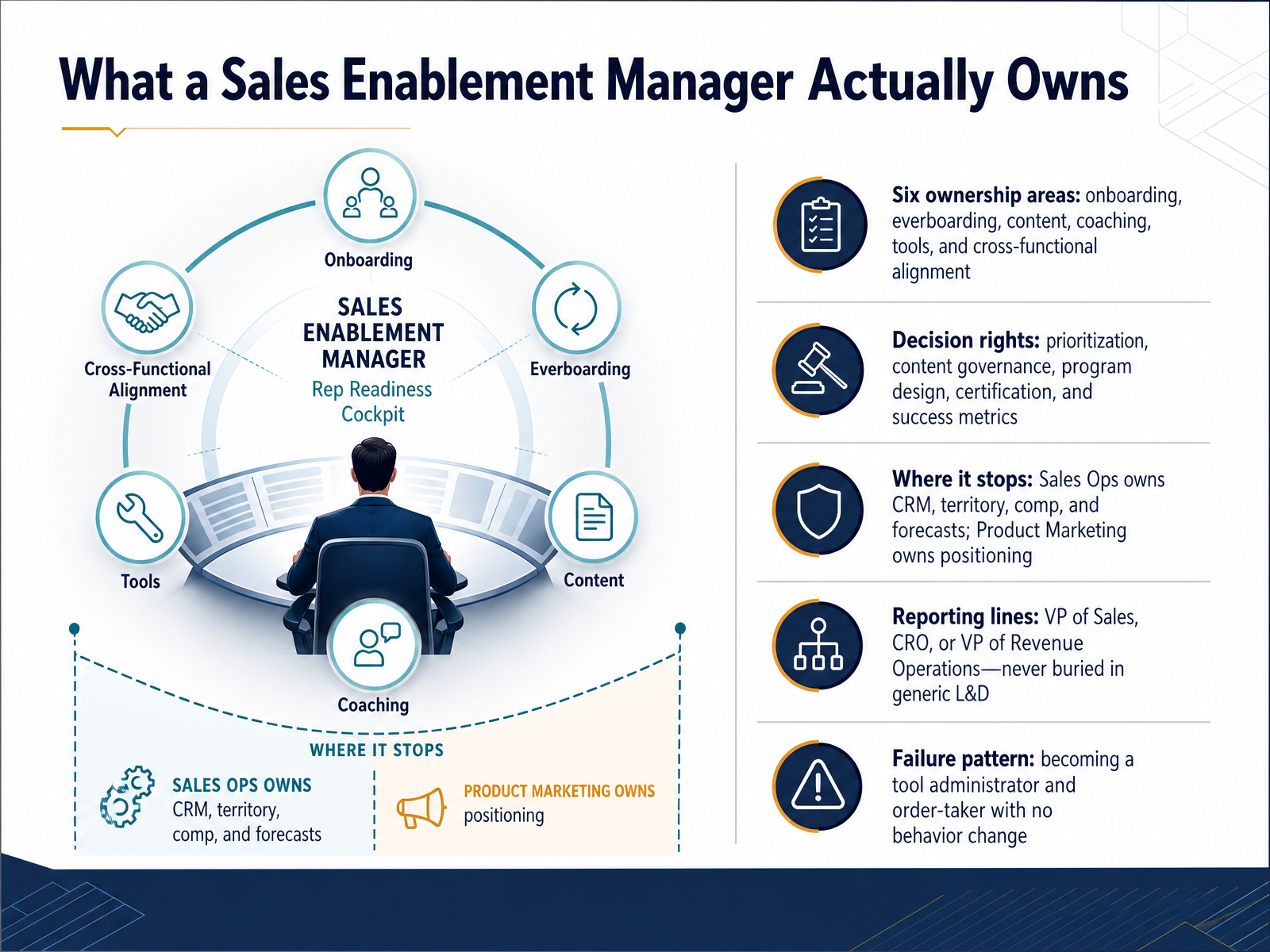
- 02What a Sales Enablement Manager Actually OwnsSo let's get clear on what a sales enablement manager actually owns, because scope confusion is the number one reason this role fails. You own six areas: onboarding, everboarding, content, coaching, tools, and cross functional alignment. Within those, you hold real decision rights over prioritization, content governance, program design, certification, and success metrics. Just as important is where your ownership stops. Sales ops owns the CRM, territory, comp, and forecasts. Product marketing owns positioning. And you never sit buried in generic L and D, because that usually disconnects you from live deals. Your reporting line typically runs to the V P of Sales, the C R O, or the V P of Revenue Operations. Watch the common failure pattern: drifting into a tool administrator and order taker with no behavior change. So protect your focus. Build programs that change how reps sell, then measure them against ramp time, win rates, and quota attainment. Next, let's map the scope. The Scope Map: Enablement Manager vs. Specialist, Trainer, and Sales Ops.
 pulserevops.comguideflow.comfedericopresicci.com+21 min
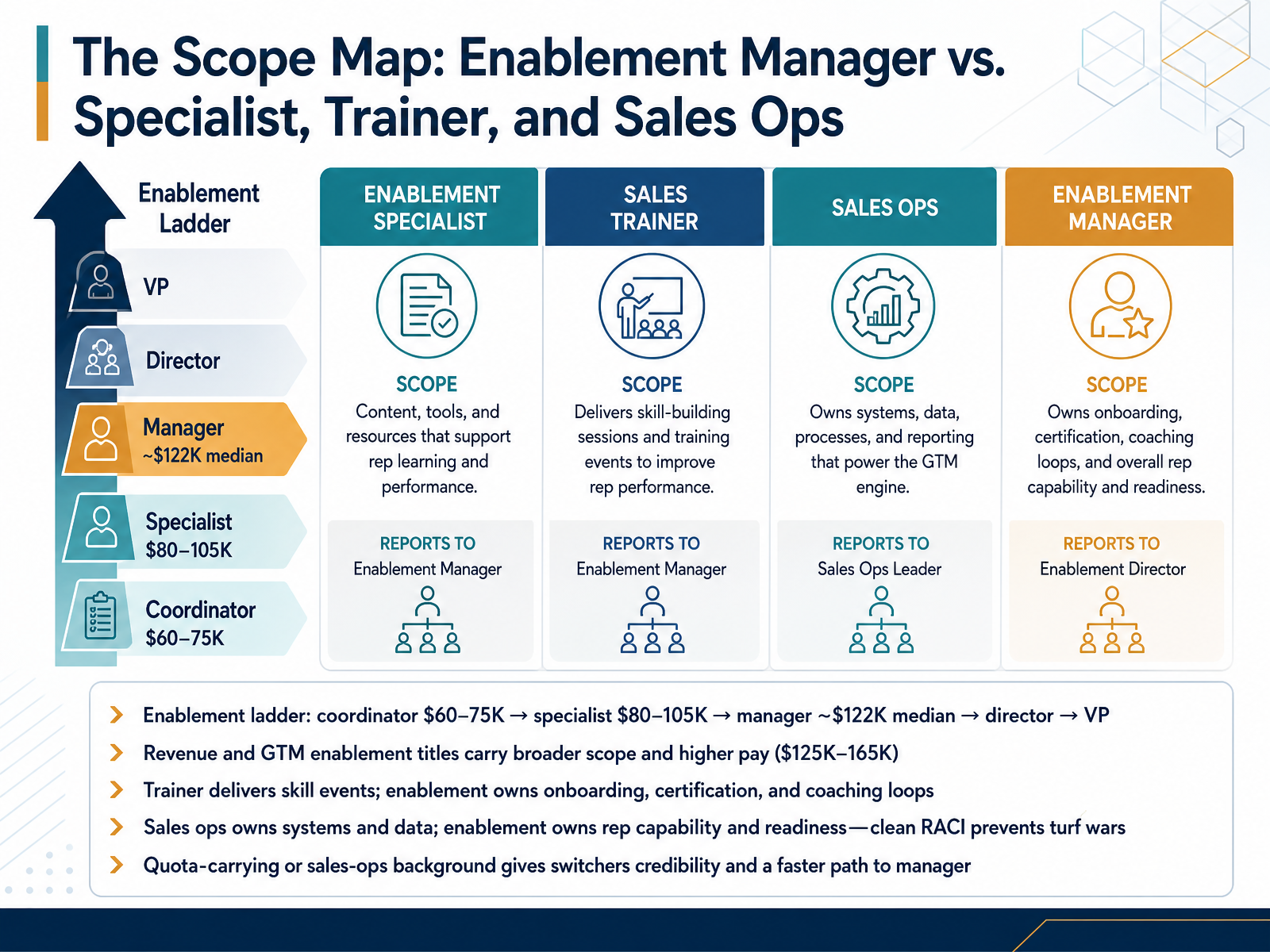
 - 03The Scope Map: Enablement Manager vs. Specialist, Trainer, and Sales OpsLet's map the scope, because titles here are not interchangeable. The enablement ladder runs from coordinator at sixty to seventy-five thousand dollars, to specialist at eighty to one hundred five, to manager at roughly a one hundred twenty-two thousand dollar median, then director and V P. Revenue and G T M enablement titles carry broader scope and higher pay, often one hundred twenty-five to one hundred sixty-five thousand. The daily difference matters. A trainer delivers skill events. Enablement owns onboarding, certification, and coaching loops. Sales ops owns systems and data. Enablement owns rep capability and readiness. Write a clean RACI, and you prevent turf wars before they start. One more point for switchers. A quota-carrying or sales-ops background gives you credibility and a faster path to manager. Now let's start with diagnostics. Step one, diagnose, find the real performance gap before you build anything.
 resources.rework.comsaleslabelconsulting.comindeed.com+22 min
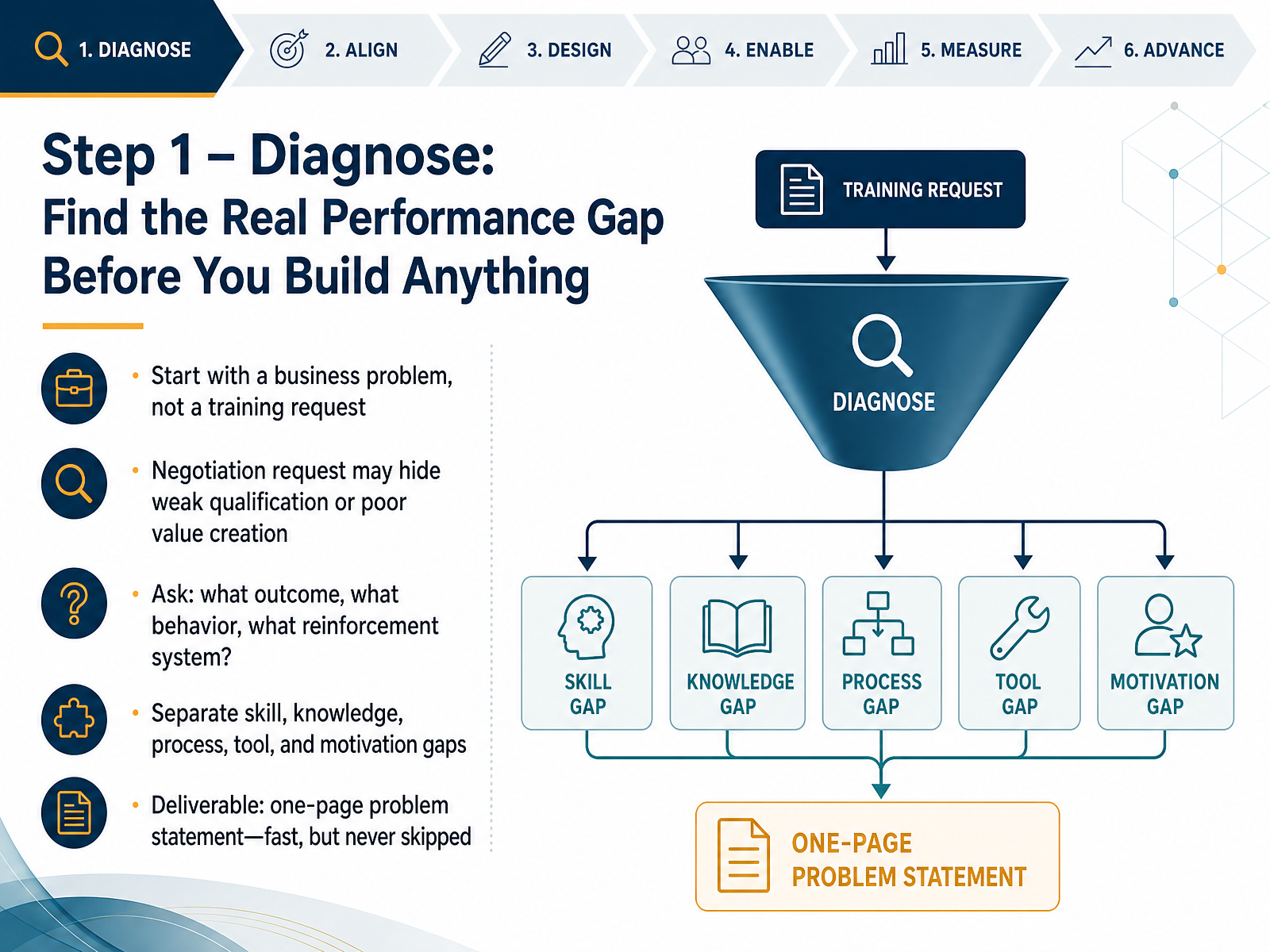
 - 04Step 1 – Diagnose: Find the Real Performance Gap Before You Build AnythingStep one is diagnosis. Start with the business problem, not the training request. A request for negotiation training may hide weak qualification or poor value creation. Before you build anything, ask three questions: what outcome needs to change, what behavior will drive it, and what reinforcement system will sustain it? Then separate the gap type. Is it skill, knowledge, process, tooling, or motivation? Each demands a different response. Speak with your top and bottom performers, sit in on live calls, and check the data. If you cannot isolate the root cause, consider a targeted diagnostic or assessment to help pinpoint where execution breaks down. Your deliverable is a one-page problem statement. Keep it fast, but never skip it. Step two is align: stakeholders, intake, and the enablement charter.
 caugia.comsalessense.co.uktrainingindustry.com+21 min
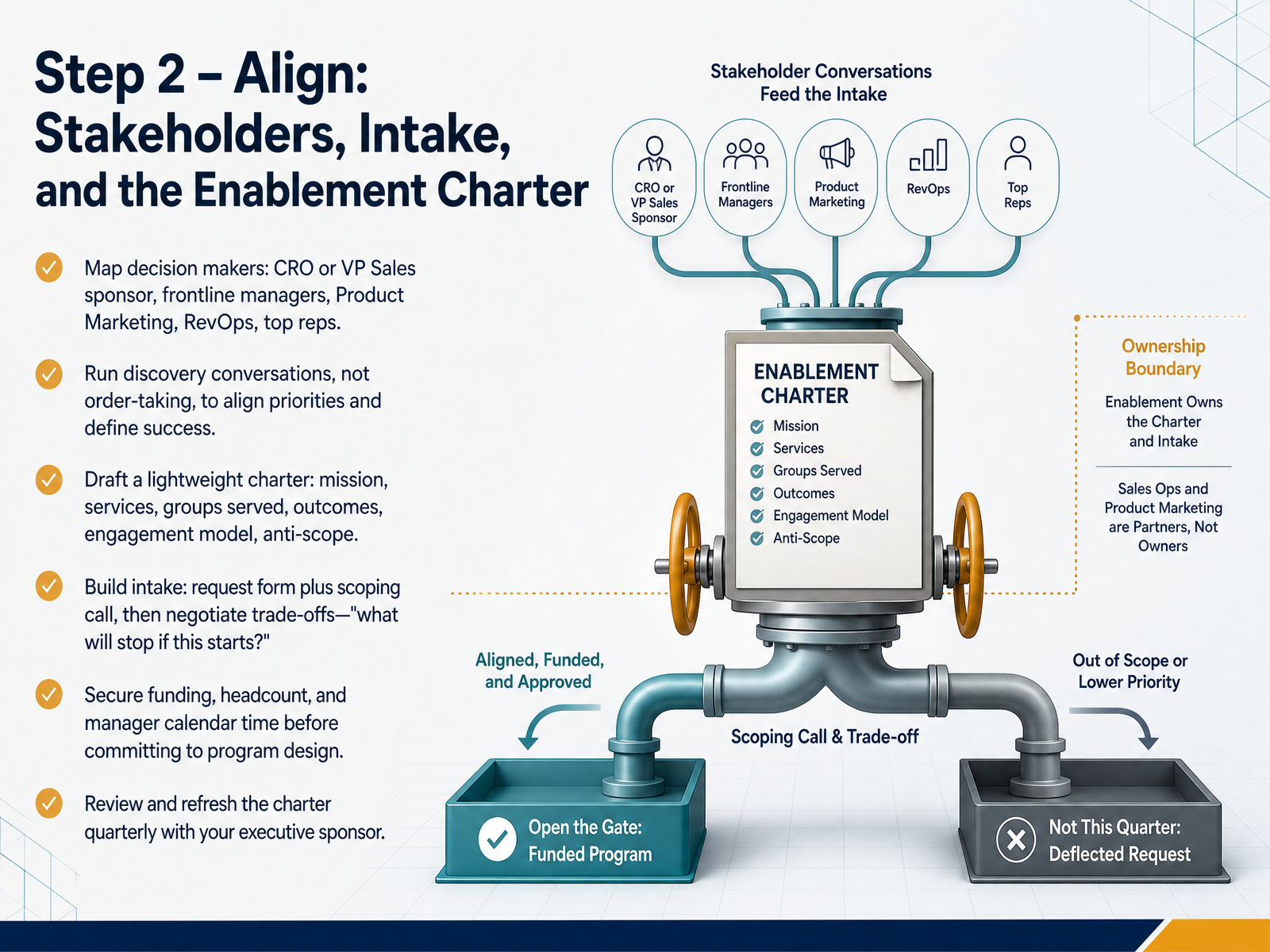
 - 05Step 2 – Align: Stakeholders, Intake, and the Enablement CharterNow let's align. In this step, you'll map decision makers and turn that alignment into a lightweight enablement charter. Start with the people who decide: your C R O or V P of Sales as executive sponsor, frontline managers, Product Marketing, RevOps, and a few top reps. Next, run discovery conversations, not order-taking. Ask what problem they're solving and how they'll measure success, even when the data is incomplete. Then draft a charter on one to three slides: mission, services, groups served, outcomes, engagement model, and anti-scope. Build an intake process with a request form and a scoping call. Use scoping calls like sales discovery for enablement. When a new request lands, ask the trade-off question: what will stop if this starts? Before you commit to program design, secure funding, headcount, and manager calendar time. Finally, review and refresh the charter quarterly with your executive sponsor. That keeps priorities current and protects your team's focus. Step 3, Design: Programs That Change Behavior, Not Just Knowledge.
 salesenablementcollective.comcdn2.hubspot.netfedericopresicci.com+22 min
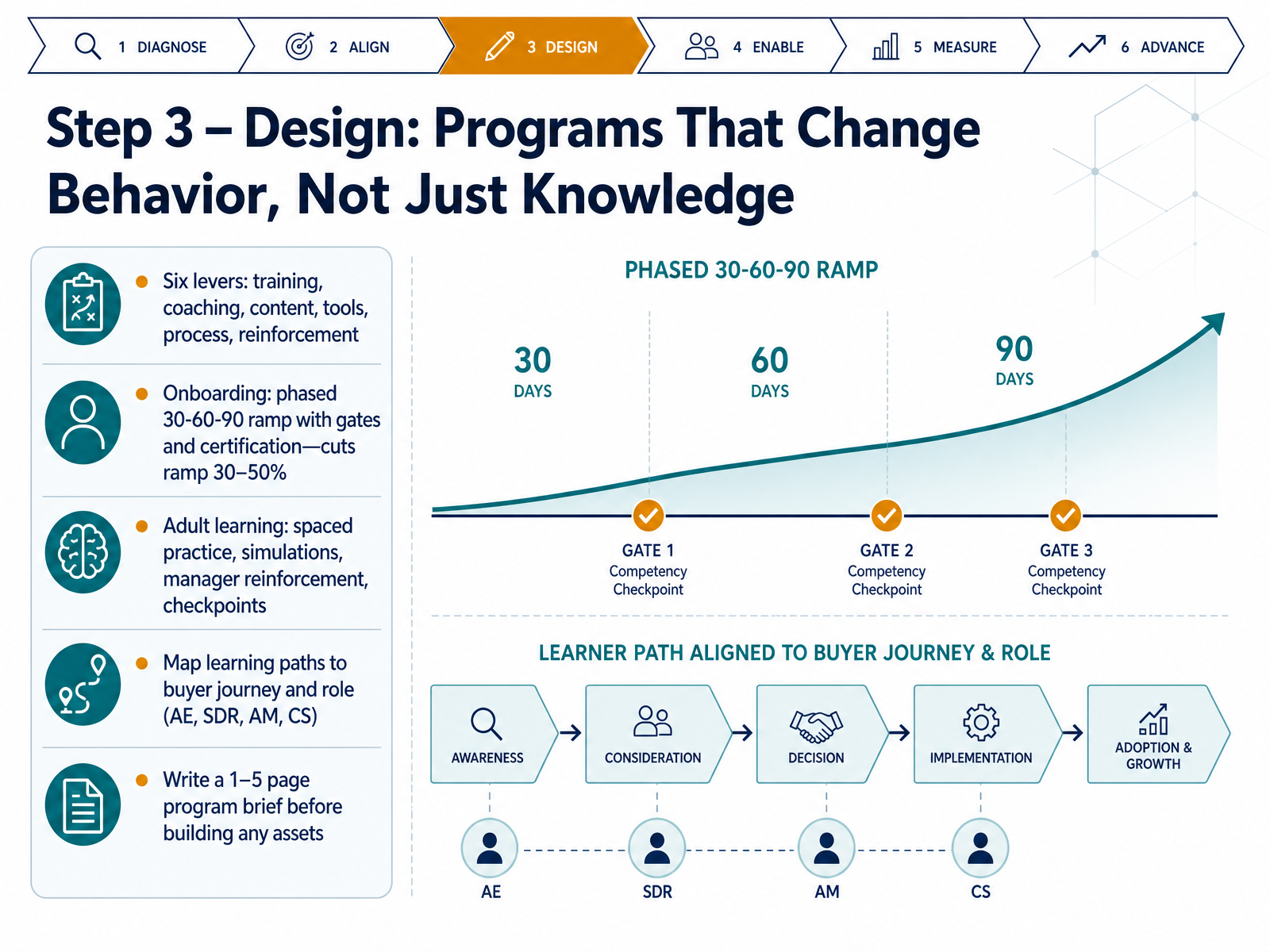
 - 06Step 3 – Design: Programs That Change Behavior, Not Just KnowledgeNow let's talk design. The goal here isn't knowledge. It's behavior change. So work with six levers: training, coaching, content, tools, process, and reinforcement. Pull the wrong one and nothing moves. For onboarding, build a phased 30-60-90 ramp with gates and certification. Done well, that cut ramp time by thirty to fifty percent. Then apply adult learning: spaced practice, simulations, manager reinforcement, and checkpoints. Map every learning path to the buyer journey and to role. An AE and an SDR need different things. Before you build a single asset, write a one to five page program brief. Define outcomes, scope, and what's explicitly out of scope. Keep it tight, even with incomplete data. That brief is your contract with stakeholders, and it's what stops scope creep cold. Next, Step 4, Enable the Field: Rollout, Managers, and Adoption.
 salesenablementcollective.comsaleslabelconsulting.comprospeo.io2 min
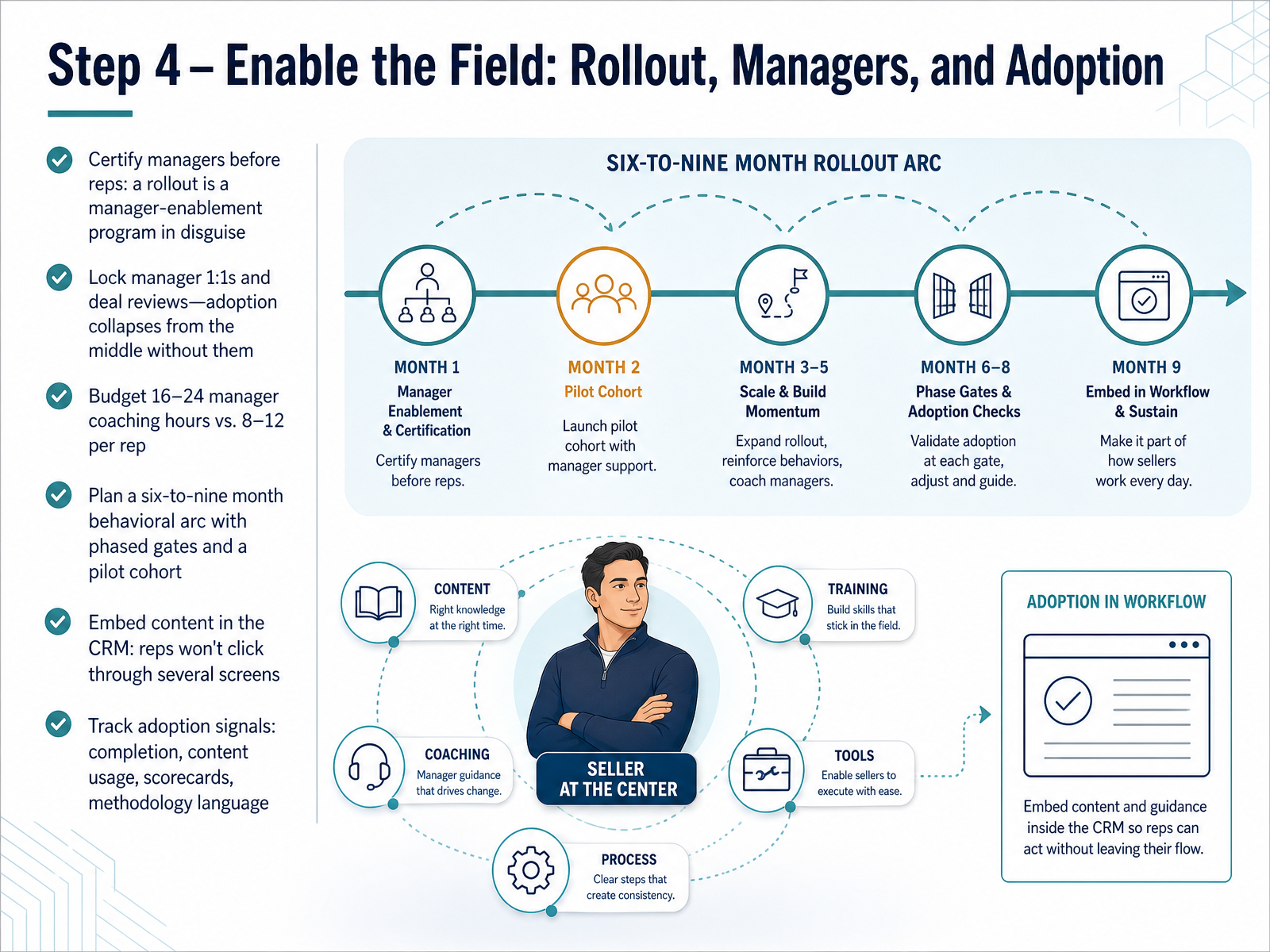
 - 07Step 4 – Enable the Field: Rollout, Managers, and AdoptionNow for Step Four, enable the field. Here's the mindset shift: your rollout is a manager-enablement program in disguise. Certify managers fully before reps see anything, because reps whose managers can't coach the framework abandon the vocabulary by month four. Lock manager one-on-ones and deal reviews permanently, with no opt-out. Adoption collapses from the middle without them. Then budget accordingly. Roughly sixteen to twenty-four manager coaching hours versus eight to twelve per rep. Plan a six-to-nine month behavioral arc with phased gates every sixty days, starting with a pilot cohort of eight to twelve people, including a couple of top performers for internal credibility. Embed content directly in the CRM, because reps won't click through several screens mid-deal. Finally, track adoption signals weekly: certification completion, content usage, manager scorecards, and whether methodology language actually shows up in recorded calls. Next, Step Five. Measure, and prove impact with a four-level story.
 saleslabelconsulting.comsalesenablementcollective.com2 min
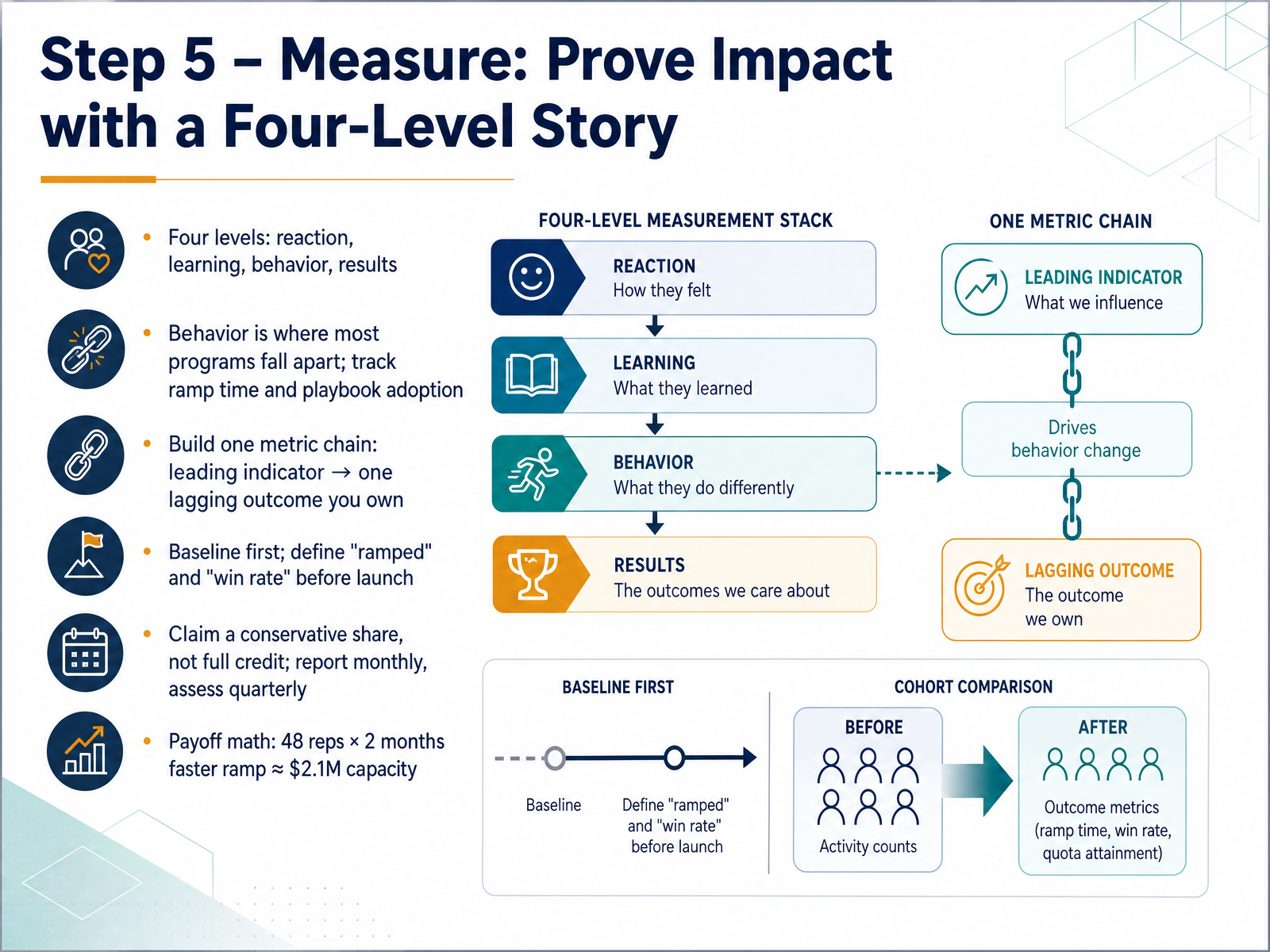
 - 08Step 5 – Measure: Prove Impact with a Four-Level StoryNow let's talk measurement, Step Five. Use the four levels: reaction, learning, behavior, and results. Behavior is where most programs fall apart, so track ramp time and playbook adoption there. Build one metric chain: pick a leading indicator, then tie it to one lagging outcome you own. Baseline first. Define what "ramped" and "win rate" mean before you launch, not after. Then claim a conservative share, never full credit. Report monthly, assess quarterly. Here's the payoff math. Forty-eight reps, each ramping two months faster, adds roughly two point one million dollars in capacity. That's a number your CFO will respect.
 prospeo.iosaleslabelconsulting.com1 min
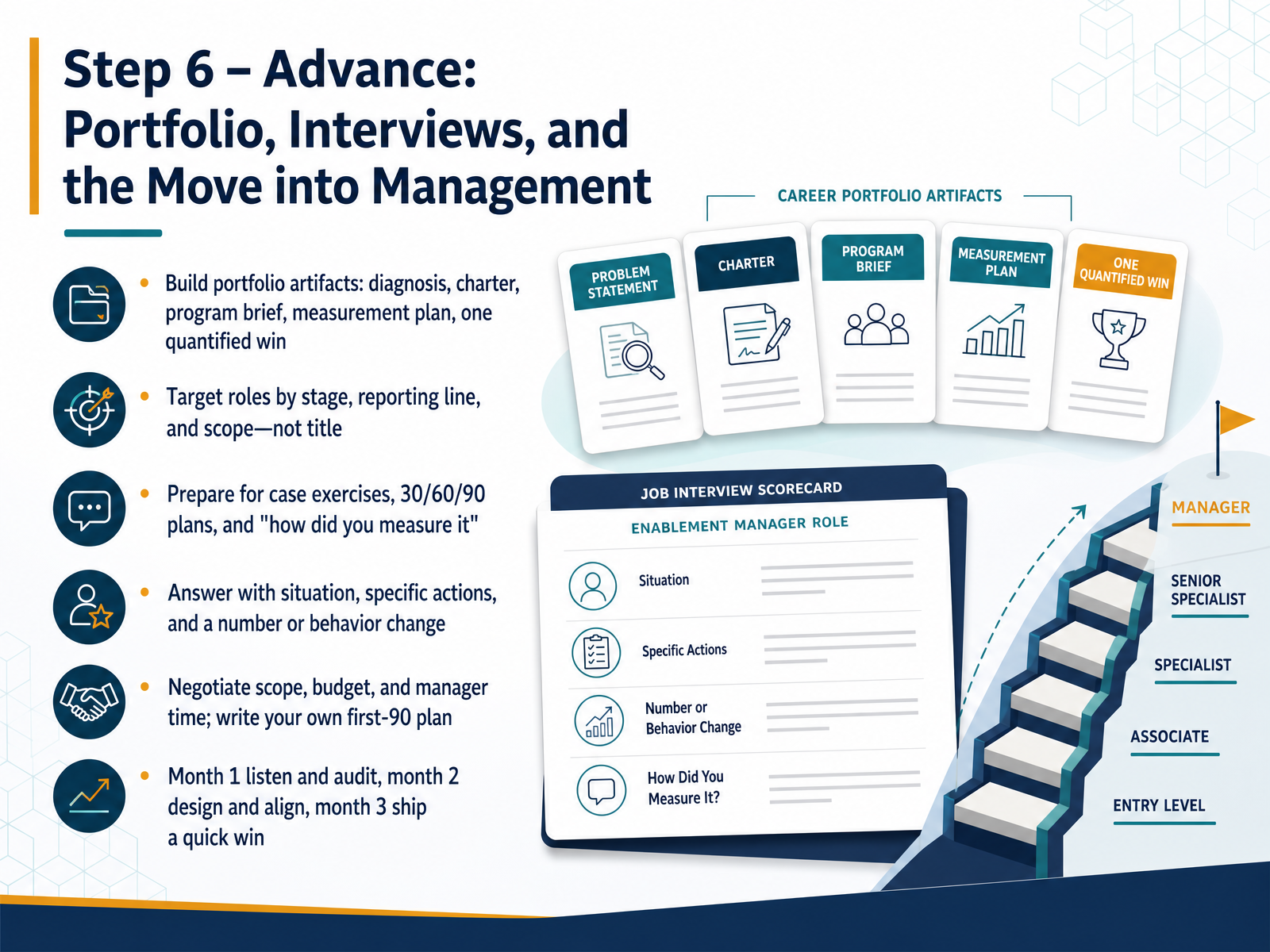
 - 09Step 6 – Advance: Portfolio, Interviews, and the Move into ManagementNow let's talk about advancing into the manager role. Start by building a portfolio, not a resume, with five artifacts: a diagnosis, a charter, a program brief, a measurement plan, and one quantified win. Target roles by stage, reporting line, and scope, not by title. In interviews, expect case exercises and the question that decides most outcomes: how did you measure it? Answer with situation, specific actions, and a number or a behavior change. Then negotiate scope, budget, and manager time, and write your own first ninety day plan. Month one, listen and audit. Month two, design and align. Month three, ship a quick win that proves the system works. Keep that plan to one page, and bring your baseline to target numbers into every conversation.
 1 min
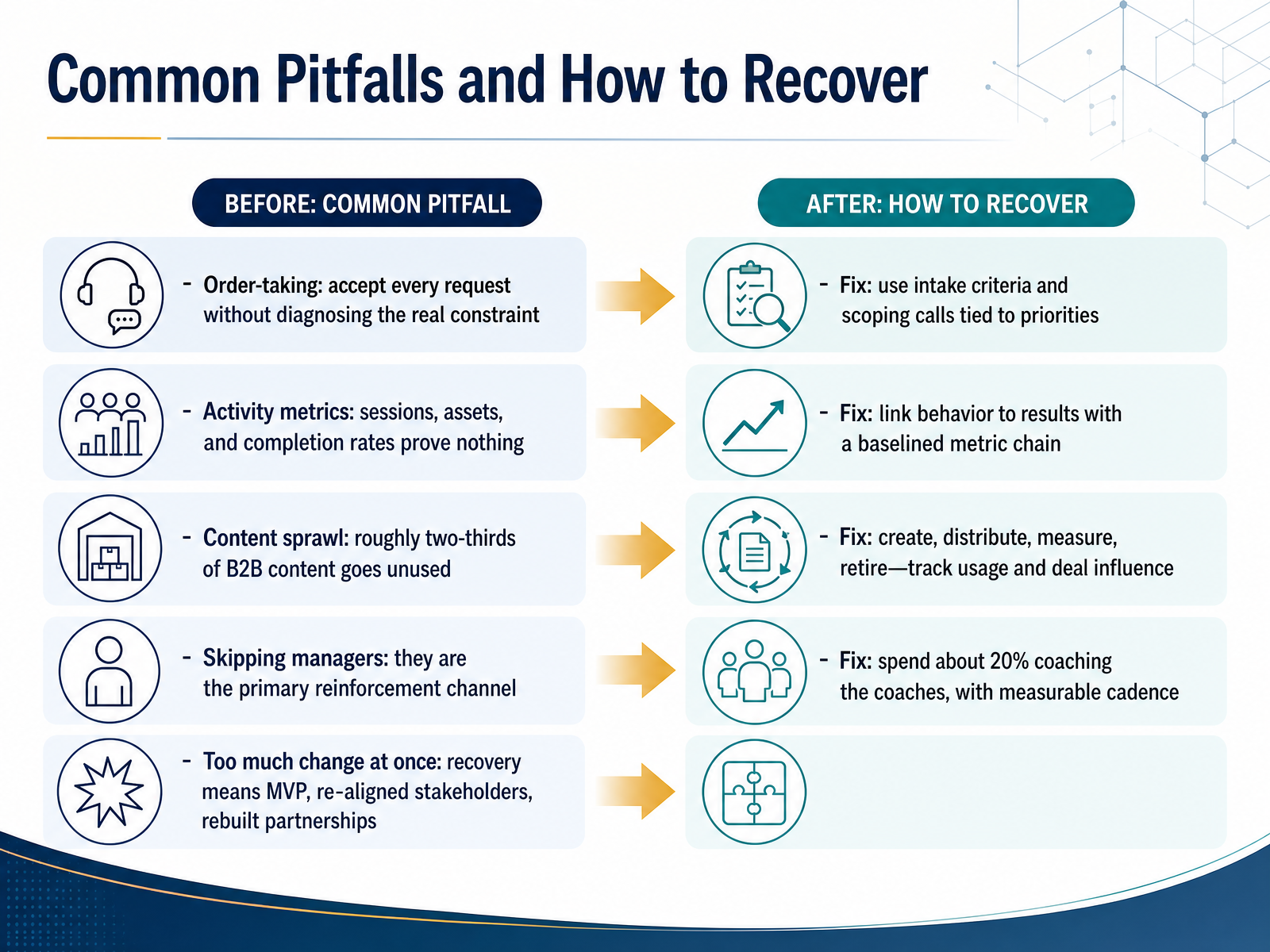
1 min - 10Common Pitfalls and How to RecoverLet's walk through the pitfalls you'll hit as an enablement manager, and how to recover from each one. First, order-taking. If you accept every request without diagnosing the real constraint, you become a vending machine. Fix it with intake criteria and a scoping call tied to sales priorities. Second, activity metrics. Sessions and completion rates prove nothing on their own. Link behavior to results with a baselined metric chain. Third, content sprawl. Roughly two-thirds of B2B content goes unused. Create, distribute, measure, retire. Track usage and deal influence. Fourth, skipping managers. They're your primary reinforcement channel. Spend about twenty percent of your time coaching the coaches, with a measurable cadence. Fifth, too much change at once. Recovery means an MVP, re-aligned stakeholders, and rebuilt partnerships. Next, we'll look at judgment calls and trade-offs under constraints.
 saleslabelconsulting.comsalesenablementcollective.comcdn2.hubspot.net+22 min
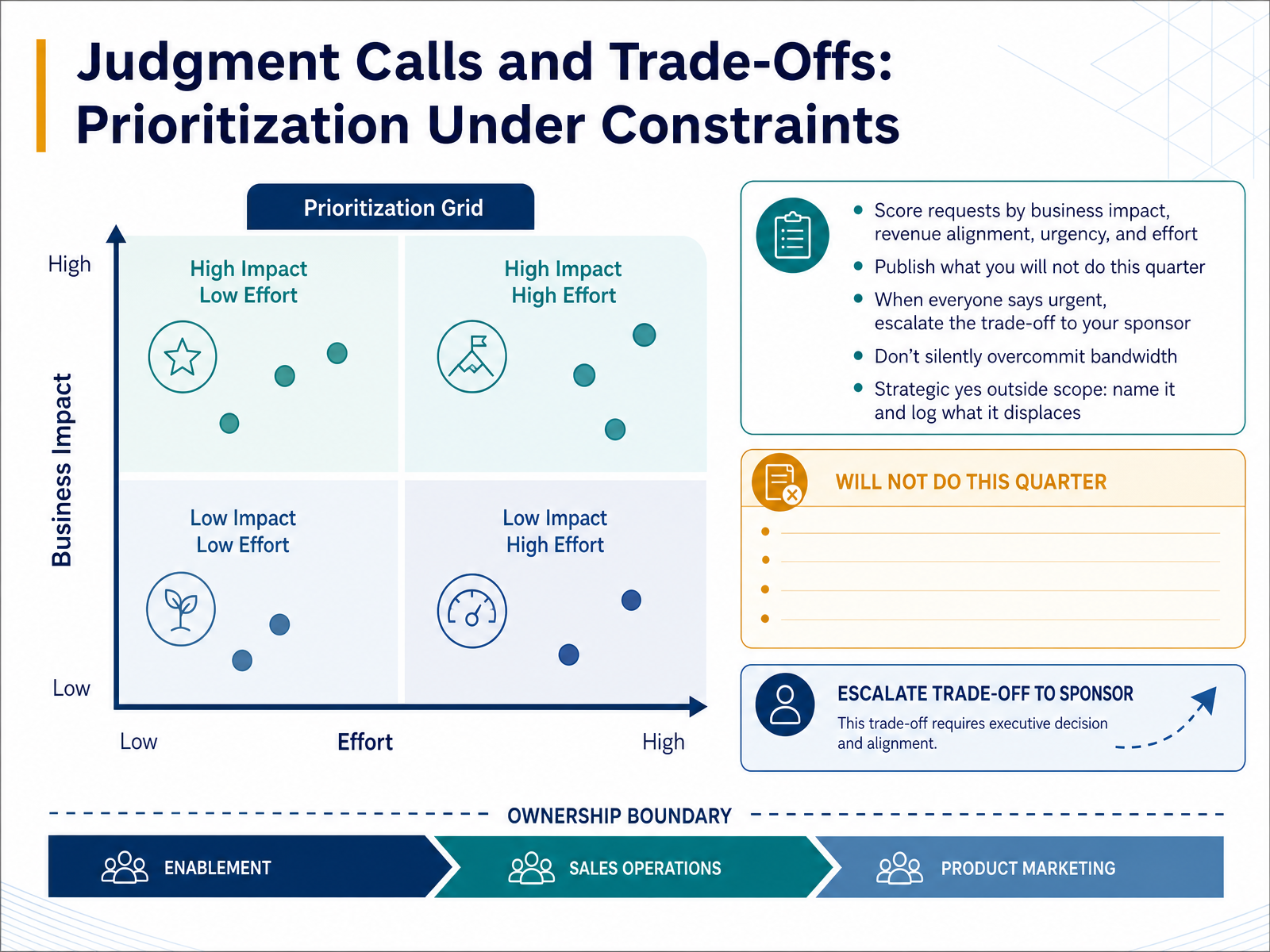
 - 11Judgment Calls and Trade-Offs: Prioritization Under ConstraintsNow let's talk about judgment calls and trade-offs, because prioritization under constraints is where enablement managers earn their keep. Your funnel is simple. Score every request against four things: business impact, revenue alignment, urgency, and effort. Then do the hard part. Publish what you will not do this quarter. That single list protects your team and sets expectations early. When everyone claims their request is urgent, don't absorb the conflict. Escalate the trade-off to your sponsor with two or three options and a recommendation. And never silently overcommit bandwidth. If you say yes to something outside your scope, call it a strategic yes, name who asked, and log exactly what it displaces. That way, every priority decision is visible, defensible, and tied to revenue. Next, let's build your personal plan in Your Next 30 Days: A Personal Enablement Workflow Plan.
 salesenablementcollective.comcdn2.hubspot.netfedericopresicci.com+21 min
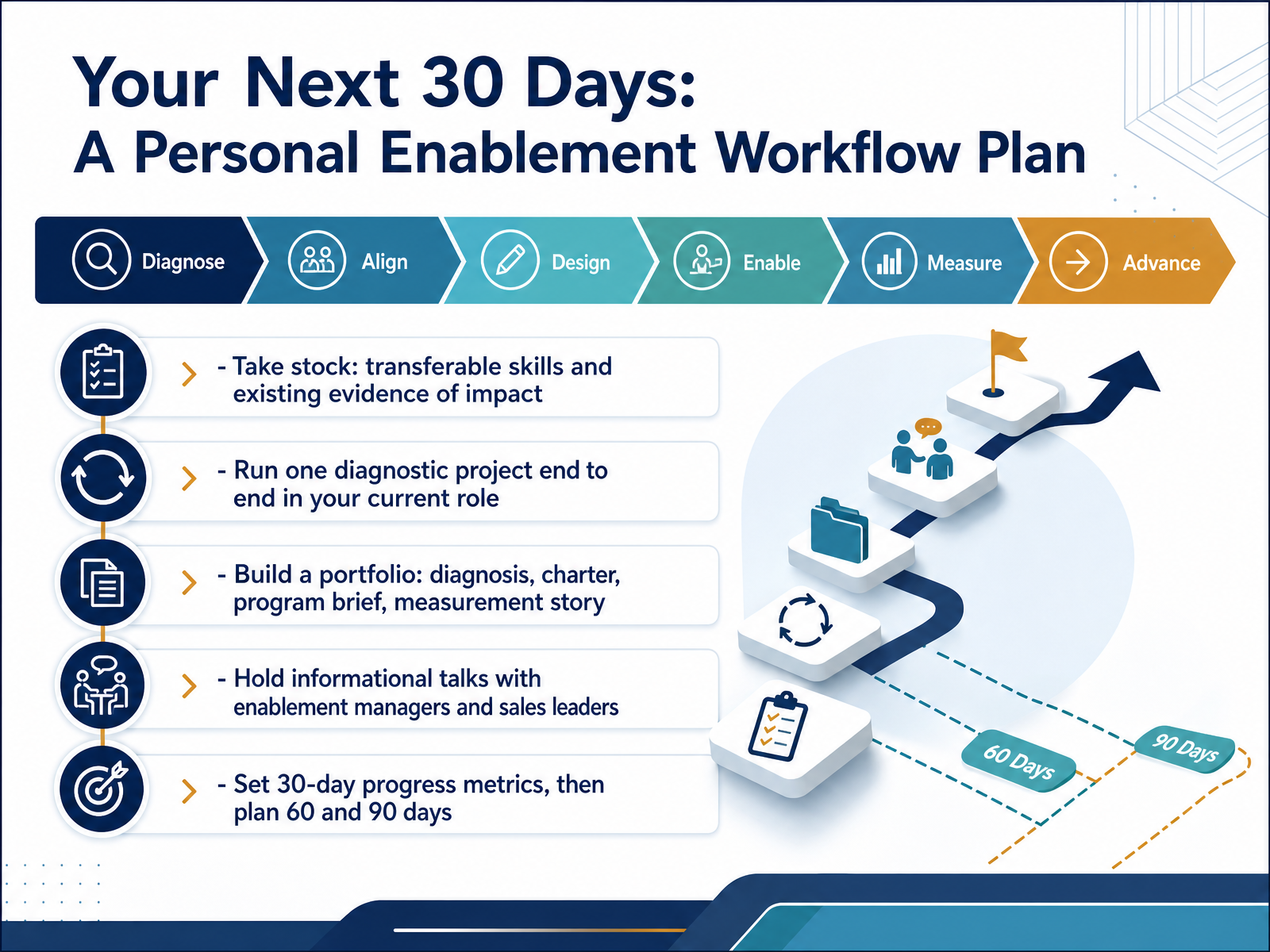
 - 12Your Next 30 Days: A Personal Enablement Workflow PlanLet's turn all of this into a thirty-day plan you can actually run. Start by taking stock. List your transferable skills and the evidence of impact you already have, even if your data is incomplete. Next, run one diagnostic project end to end in your current role. Keep it small. For example, audit onboarding drop-off, then write a one-page recommendation. From that work, build a portfolio. Show your diagnosis, a draft charter, a program brief, and a measurement story. Then hold informational talks with enablement managers and sales leaders. Ask how they measure success, and where enablement sits in the organization. Finally, set thirty-day progress metrics, then plan sixty and ninety days. Pick just two or three metrics, like conversations completed or one project shipped. Keep it realistic around busy sales calendars. Now, let's recap the six-step workflow and the one habit that makes it stick.
 prospeo.io1 min
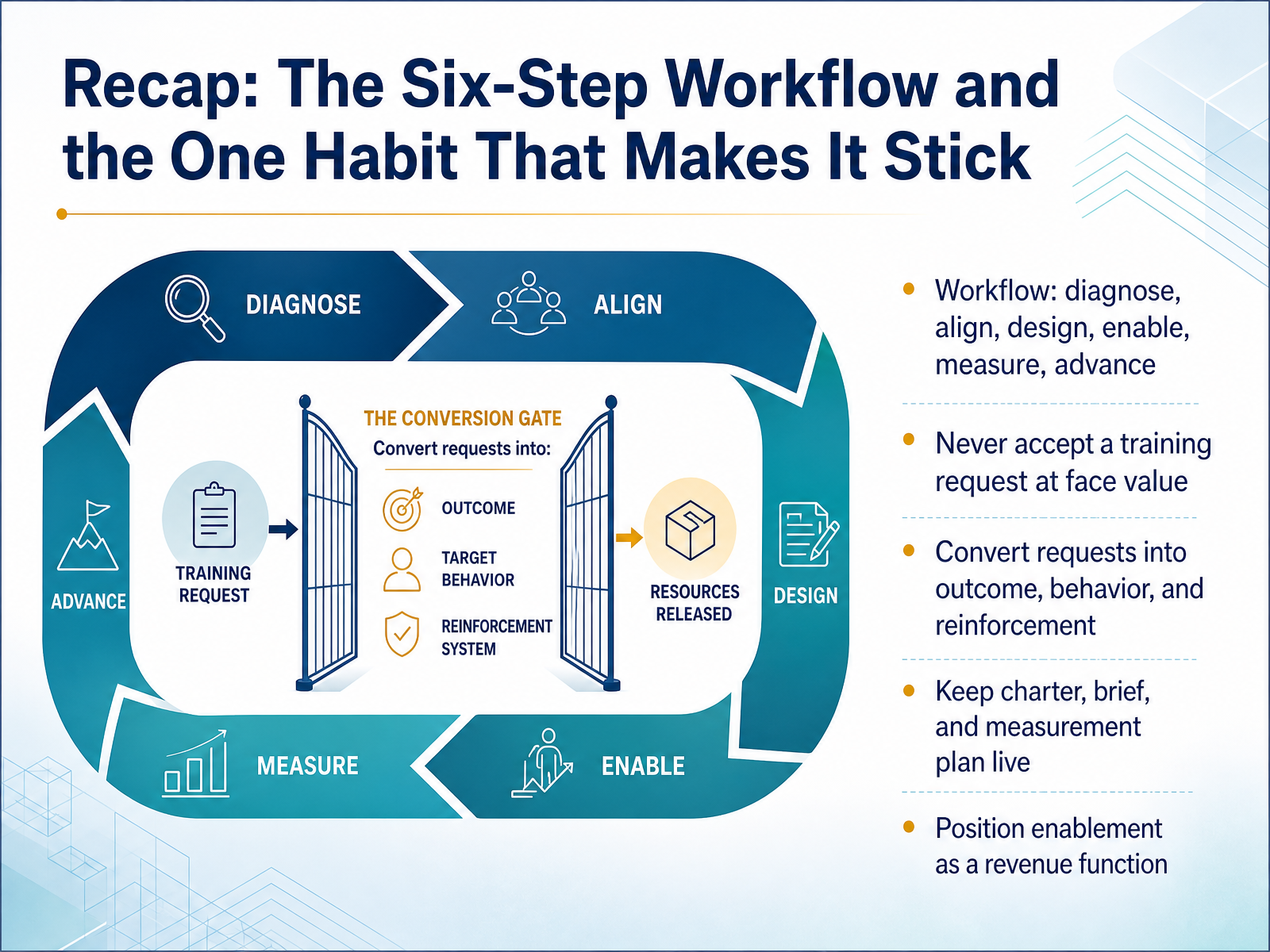
 - 13Recap: The Six-Step Workflow and the One Habit That Makes It StickLet's pull it all together. The workflow is six steps: diagnose, align, design, enable, measure, advance. And the one habit that makes it stick? Never accept a training request at face value. When someone asks for negotiation training, convert that request into three things: the outcome you want, the behavior that drives it, and the reinforcement that sustains it. Maybe the real issue is qualification, not closing. Then keep your charter, your brief, and your measurement plan live. Review them quarterly. They are governing documents, not shelfware. Finally, position enablement as a revenue function. Speak in terms of win rate, ramp time, and deal velocity, because that is the language your executives already track. Do that consistently, and you stop being a vending machine and become a strategic partner. You have the framework now. Start with one request this week, diagnose it properly, and let the results speak. Thanks for sticking with me, and go make an impact.
 salesenablementcollective.comcdn2.hubspot.netfedericopresicci.com+21 min
Take the deck with you
Download this course as a file — free, no sign-up needed.
- PDF handoutEvery slide page, ready to print or share.14 pages · 3.7 MBDownload
- Narrated PowerPointThe deck that presents itself — every slide carries the digital human's narration video.14 pages · 11.9 MBDownload
- PowerPoint slidesThe full deck as a .pptx — open it in PowerPoint, Keynote, or Google Slides.14 pages · 3.6 MBDownload
Free to use in your own training — please keep the PersonWise credit page at the end.
Have your own deck? Turn it into a course
Sources consulted
Web sources consulted while building this course.
- Sales Enablement Manager Job Description Template - Complete 2026 Hiring Guide — resources.rework.com
- Role of Sales Enablement Manager: 2026 Impact Guide — saleslabelconsulting.com
- What Is a Sales Enablement Manager? — indeed.com
- What does a sales enablement manager do? Role, salary, and daily workflow - Guideflow Blog — guideflow.com
- Sales Enablement Manager Job Description, Salary & Career Outlook | JobDescription.org — jobdescription.org
- What is Sales Enablement and what does the function own? — pulserevops.com
- The Sales Enablement Manager – A Day in the Life — federicopresicci.com
- When should we hire a dedicated sales enablement manager vs…? — pulserevops.com
- Sales enablement vs sales operations: 9 key differences explained — salesenablementcollective.com
- Sales Enablement Diagnostics for B2B SaaS: Why Your Team Knows the Strategy but Cannot Execute It | Caugia — caugia.com
- Sales Performance Diagnostic Assessment | SalesSense — salessense.co.uk
- How to Diagnose Sales Performance Problems Before Training — trainingindustry.com
- Free Sales Enablement Assessment | A Sales Growth Company — salesgrowth.com
- Sales Enablement Evaluation: 2026 Framework — prospeo.io
- Sales enablement charter template — salesenablementcollective.com
- Sales Enablement Charter Template — cdn2.hubspot.net
- Sales Enablement Program Charter Template (With Example) — federicopresicci.com
- Why Your Sales Enablement Strategy Needs a Charter — acelera.group
- https://www.salesenablementcollective.com/enablement-charter-playbook-download/ — salesenablementcollective.com
- Designing a sales onboarding program from scratch — salesenablementcollective.com