Begin
14 pages · ~28 min
Cloud Computing Patterns and Pitfalls
Explore real-world cloud computing examples to understand common architectural patterns, their strengths, and potential pitfalls for cloud practitioners.
A digital instructor presents all 14 pages. Hold “Ask” at any point and ask out loud — the answer comes from this course. No sign-up needed.
What you’ll learn
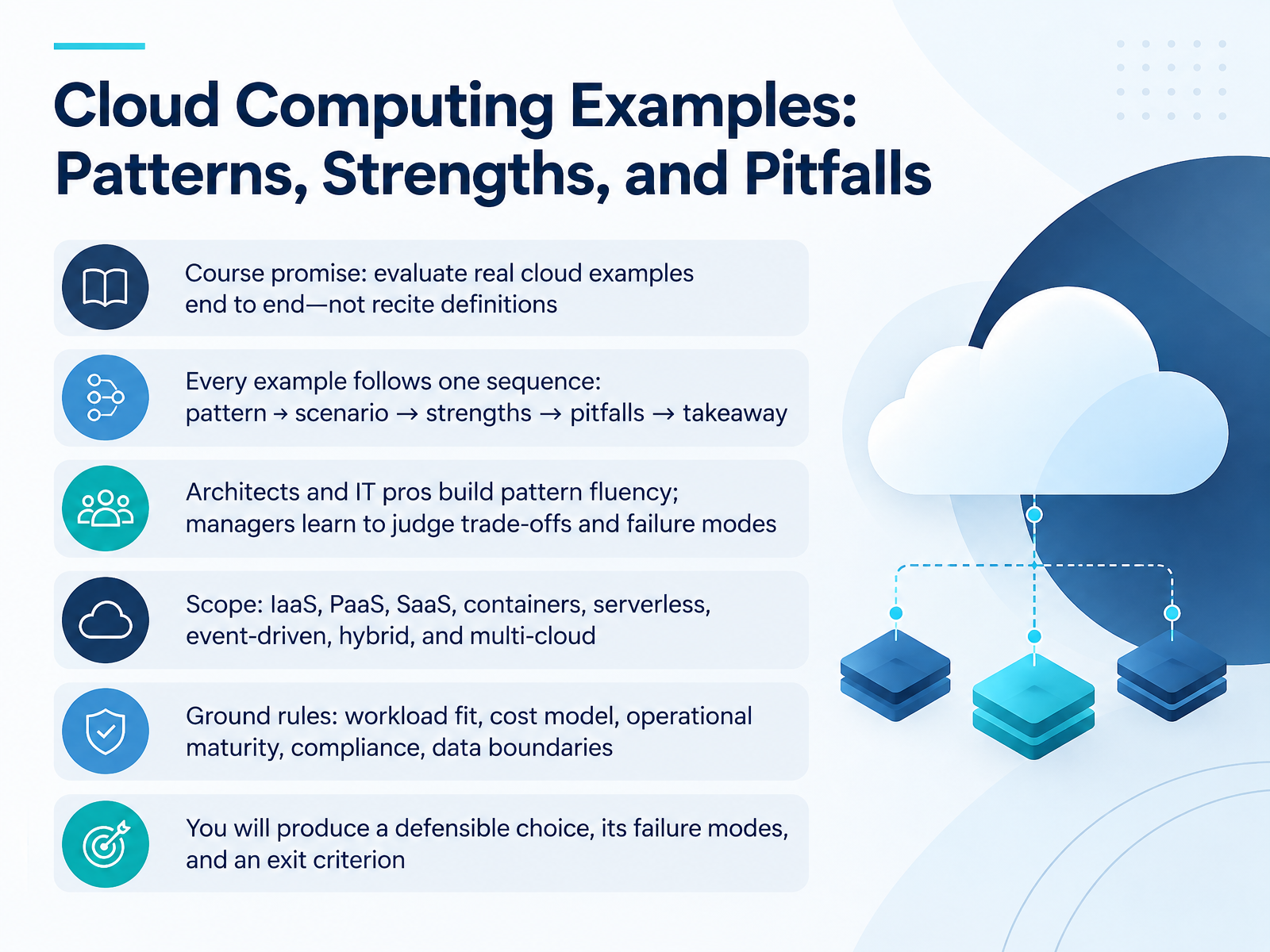
- 01Cloud Computing Examples: Patterns, Strengths, and PitfallsWelcome. This course is about evaluating real cloud examples end to end, not reciting definitions. Every example follows the same sequence: pattern, scenario, strengths, pitfalls, takeaway. Architects and IT professionals build pattern fluency. Managers learn to judge trade-offs and failure modes. We cover infrastructure, platform, and software as a service, containers, serverless, event-driven, hybrid, and multi-cloud. Our ground rules are workload fit, cost model, operational maturity, compliance, and data boundaries. For each example, you will produce a defensible choice, its failure modes, and an exit criterion. Remember, the goal is not the most cloud services, it is a design that is secure, reliable, and cost-aware. Next, we look at the background, from data centers to cloud-native patterns.zoomnod.comcalmops.comaenix.io+21 min
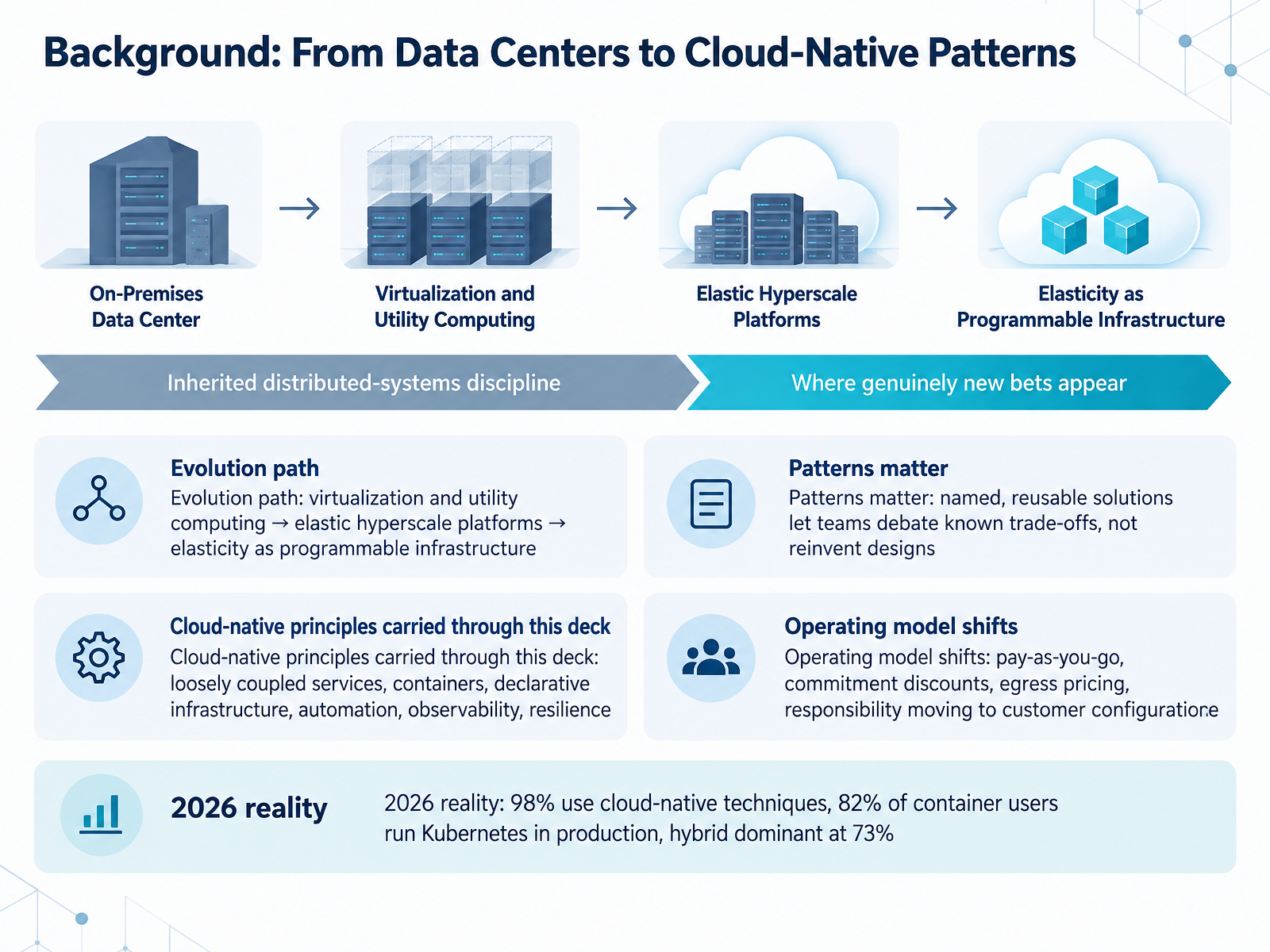
- 02Background: From Data Centers to Cloud-Native PatternsLet's set the context before we compare any specific patterns. Cloud computing didn't appear all at once. It moved through stages. First came virtualization and utility computing, where you rented a slice of a server. Then elastic hyperscale platforms, where capacity could expand in minutes. Today, elasticity itself is programmable infrastructure, driven by code and policy.
The reason we use named patterns is practical. A pattern is a reusable solution with known trade-offs. It lets your team debate architecture using shared terms instead of redesigning from scratch every time.
Several cloud-native principles run through this deck. Loosely coupled services, containers, declarative infrastructure, automation, observability, and resilience.
The operating model also changed. You pay as you go, commitment discounts lower steady-state cost, egress is priced, and much of the responsibility now sits with your configuration, not the provider's defaults.
The 2026 numbers confirm how mainstream this is. Ninety-eight percent of organizations use cloud-native techniques. Eighty-two percent of container users run Kubernetes in production. And hybrid remains dominant at seventy-three percent.
Next, we'll define seven comparison criteria for judging any cloud example.
 zoomnod.comcalmops.comaenix.io+22 min
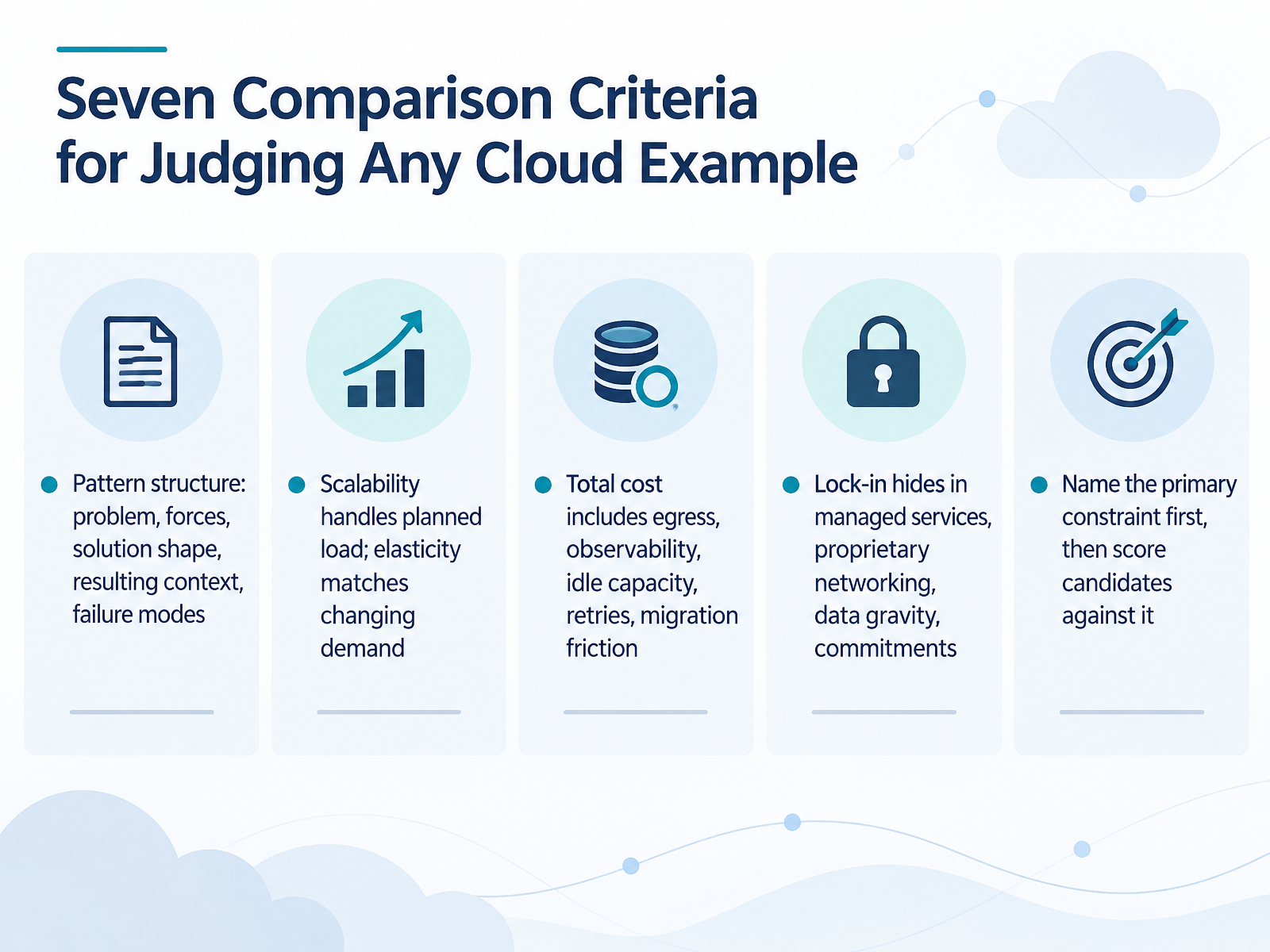
 - 03Seven Comparison Criteria for Judging Any Cloud ExampleLet's lay out seven criteria you can use to judge any cloud example consistently. First, look at pattern structure: what problem it solves, the forces at play, the shape of the solution, the resulting context, and its known failure modes. Second, separate scalability from elasticity. Scalability handles planned load; elasticity matches changing demand. Third, calculate total cost, not just compute: egress, observability, idle capacity, retries, and migration friction all count. Fourth, check where lock-in hides: managed services, proprietary networking, data gravity, and long-term commitments. Fifth, name the primary constraint first, whether that is cost, latency, compliance, or operational capacity, then score candidates against it. Finally, apply these criteria in parallel across candidates so the comparison stays fair and transferable to your own environment. Next, we'll apply them to a concrete case: pattern example, lift-and-shift migration to cloud VMs.
 zoomnod.comcalmops.comaenix.io+21 min
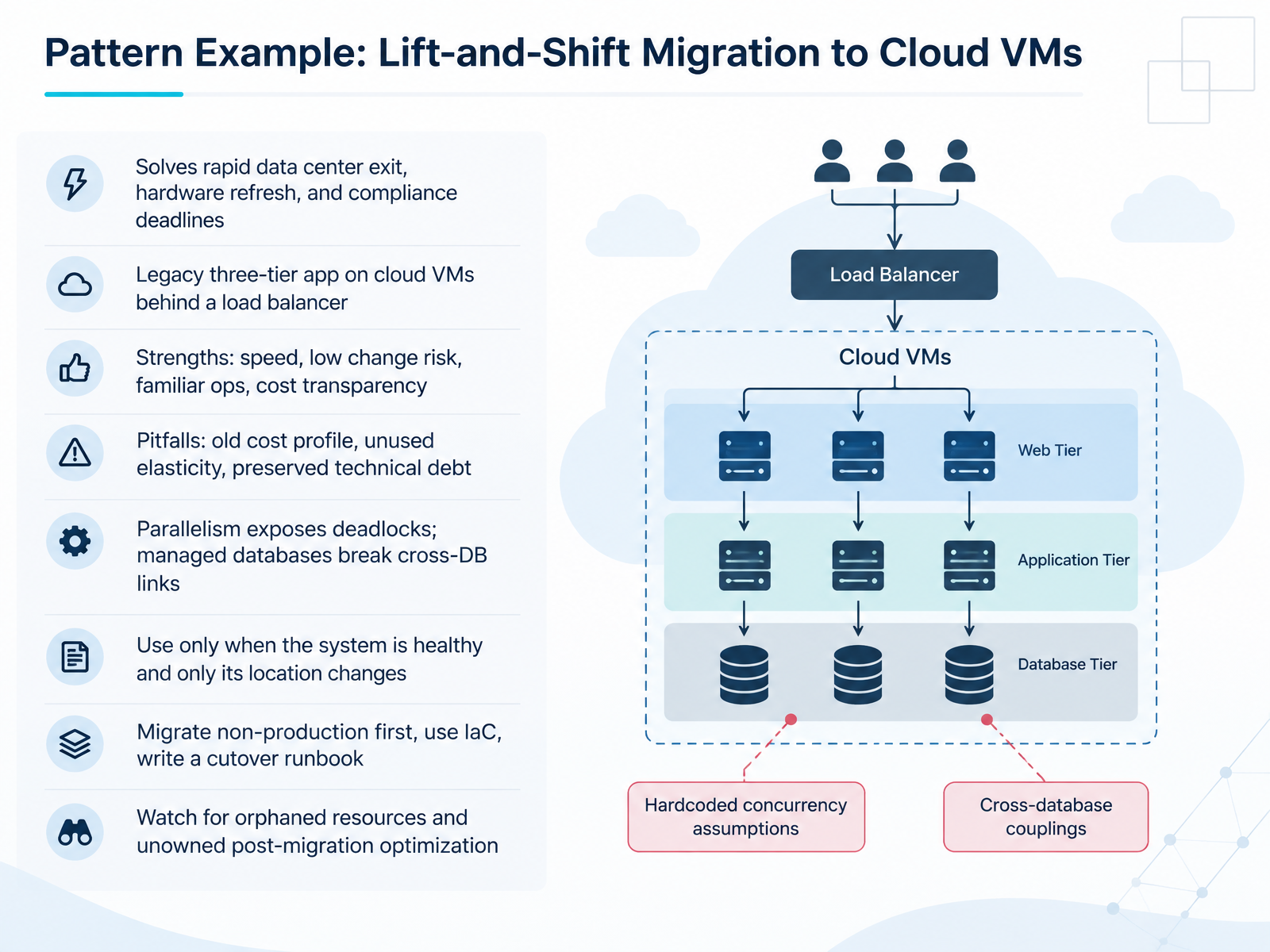
 - 04Pattern Example: Lift-and-Shift Migration to Cloud VMsNow let's look at a pattern many teams start with: lift and shift, moving workloads to cloud virtual machines. It fits a narrow but real problem. You need to exit a data center quickly, refresh aging hardware, or meet a compliance deadline, and you don't have time to redesign the application. A typical example is a legacy three-tier app running on cloud VMs behind a load balancer. The strengths are speed, low change risk, familiar operations, and clear cost visibility. The pitfalls are equally clear: you carry over the old cost profile, you don't use elasticity, and you preserve technical debt. Two failure modes are worth naming. Raising parallelism can expose deadlocks that sequential execution was hiding. And managed databases often break cross-database links that legacy code depends on. So use lift and shift only when the system is healthy and only its location changes. Migrate non-production first, define infrastructure as code, and write a cutover runbook. Then watch for orphaned resources and unowned post-migration optimization. Next, we'll look at a more modern pattern: containers and microservices on Kubernetes.
 zoomnod.comcalmops.comaenix.io+22 min
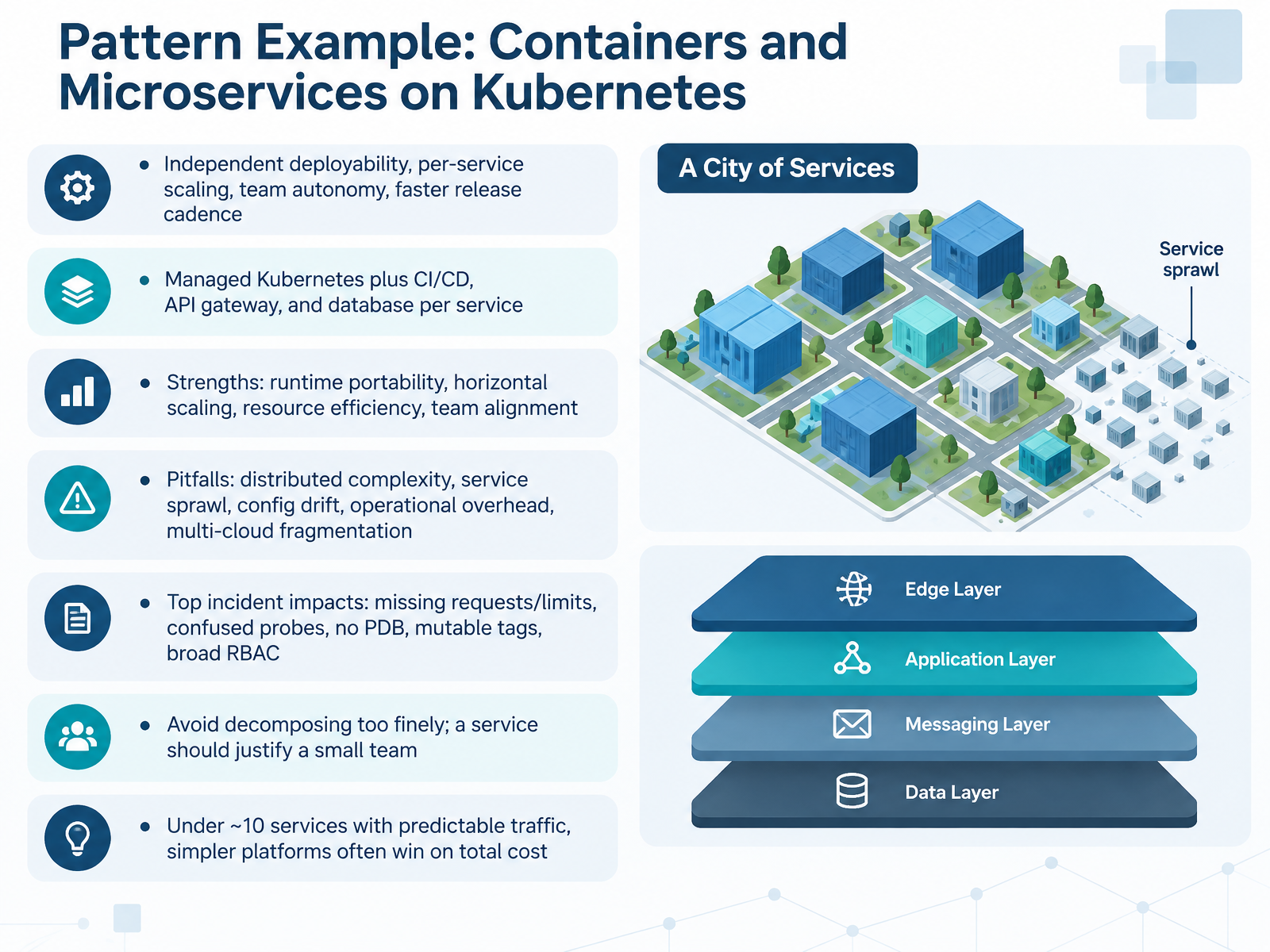
 - 05Pattern Example: Containers and Microservices on KubernetesNow let's walk through a concrete example: containers and microservices on Kubernetes. The appeal is real. You get independent deployability, per-service scaling, team autonomy, and faster releases. A typical setup pairs managed Kubernetes with CI/CD, an API gateway, and a database per service. The strengths follow: runtime portability, horizontal scaling, resource efficiency, and teams aligned to services. But the pitfalls are equally concrete. Distributed complexity, service sprawl, config drift, operational overhead, and multi-cloud fragmentation. In practice, the top incident drivers are missing requests and limits, confused probes, no Pod Disruption Budget, mutable image tags, and overly broad RBAC. So avoid decomposing too finely. A service should justify a small team. And if you have under about ten services with predictable traffic, simpler platforms often win on total cost. That sets up our next pattern: serverless and event-driven workloads.
 zoomnod.comcalmops.comaenix.io+22 min
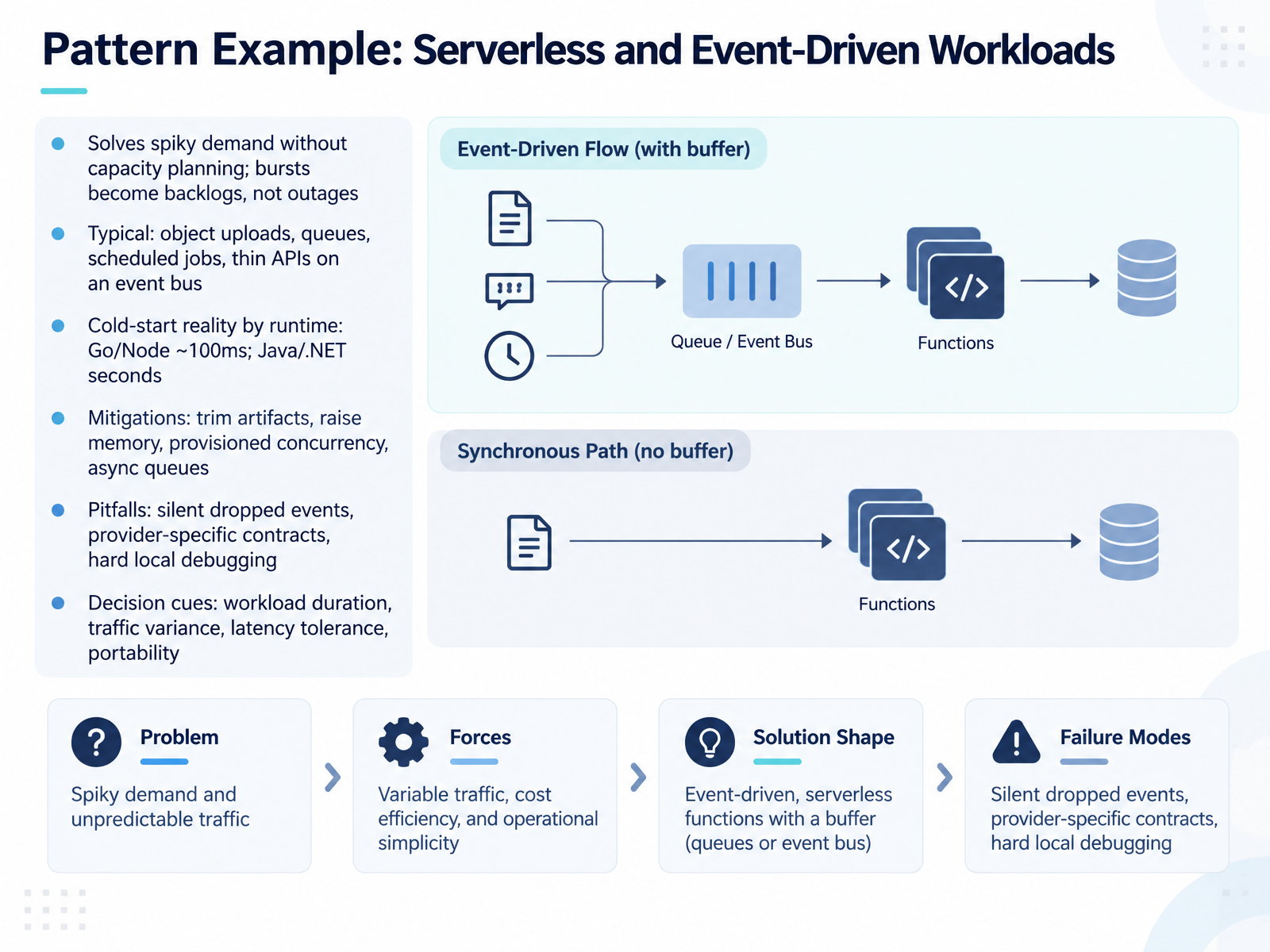
 - 06Pattern Example: Serverless and Event-Driven WorkloadsNext, let's look at serverless and event-driven workloads. The core appeal is simple. You don't capacity plan for spikes. Bursts become backlogs in a queue, not outages, because the platform scales out per event. Typical fits include object uploads, message queues, scheduled jobs, and thin APIs sitting on an event bus. But cold starts are real, and they vary by runtime. Go and Node.js often initialize in around one hundred milliseconds. Java and .NET can take seconds. To mitigate, trim your deployment artifact, raise memory, which also raises CPU, use provisioned concurrency for latency-sensitive paths, and push tolerant work into async queues. Watch the pitfalls. Events can be dropped silently without a dead-letter queue, contracts are provider-specific, and local debugging is harder. So decide on four cues. Workload duration, traffic variance, latency tolerance, and portability needs.
 zoomnod.comcalmops.comaenix.io+22 min
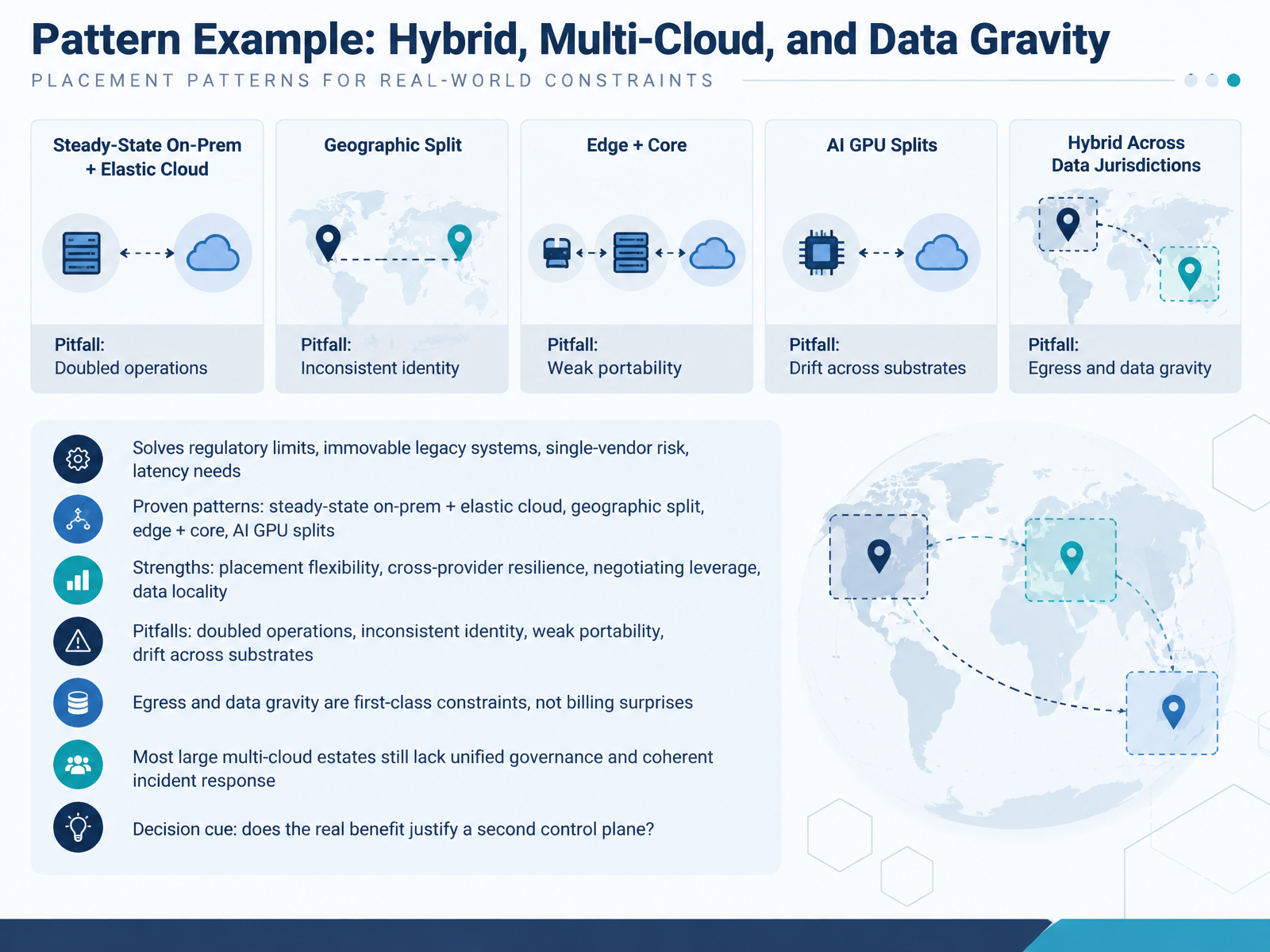
 - 07Pattern Example: Hybrid, Multi-Cloud, and Data GravityLet's look at a pattern that shows up constantly in real estates: hybrid and multi-cloud, shaped by what we call data gravity. It solves real problems. Regulatory limits, immovable legacy systems, single-vendor risk, and latency needs. The proven patterns are familiar: steady-state workloads on premises with elastic capacity in the cloud, geographic splits by jurisdiction, edge plus core, and AI training on dedicated GPUs. The strengths are real: placement flexibility, cross-provider resilience, negotiating leverage, and data locality. But the pitfalls are just as real: doubled operations, inconsistent identity, weak portability, and drift between substrates. And here is the part teams underestimate. Egress and data gravity are first-class constraints, not billing surprises. Moving a petabyte is an architecture decision, not a line item you optimize later. Most large multi-cloud estates still lack unified governance and coherent incident response. So use one decision cue: does the real benefit justify running a second control plane? If not, stay pure and optimize in place. If yes, design data flow explicitly from day one. Next, we'll look at cross-cutting strengths that show up in every pattern.
 zoomnod.comcalmops.comaenix.io+22 min
 - 08Cross-Cutting Strengths That Show Up in Every PatternLet's step back and look at the strengths that show up across nearly every cloud pattern, and the trade-offs that come with each one.
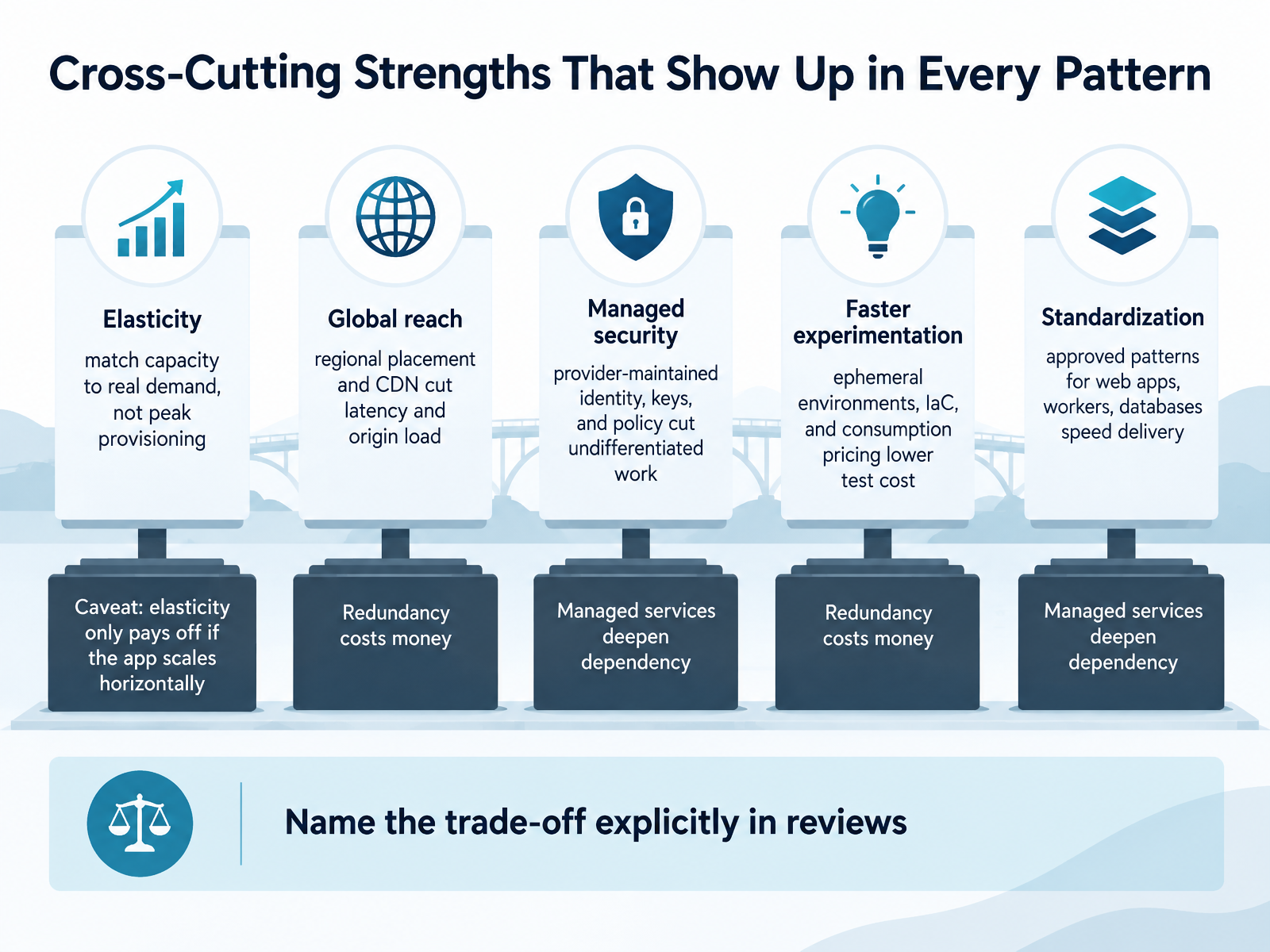
Elasticity means matching capacity to real demand instead of provisioning for peak. But it only pays off if your application scales horizontally. If it holds state on a single server, autoscaling adds cost without adding throughput.
Global reach works through regional placement and a CDN, which cut latency and reduce origin load. Managed security, like provider-maintained identity, keys, and policy, removes undifferentiated work from your team. Faster experimentation comes from ephemeral environments, infrastructure as code, and consumption pricing. And standardization, a small set of approved patterns for web apps, workers, and databases, speeds delivery because teams stop redesigning common problems.
Now the counterweight. Redundancy costs money, and managed services deepen your dependency on one provider. So name the trade-off explicitly in your architecture reviews. If you cannot state what you gave up, you have not finished the decision.
Next, we will look at the pitfalls that surface when these strengths are applied without that discipline: cost drift, misconfiguration, and reliability anti-patterns.
 zoomnod.comcalmops.comaenix.io+22 min
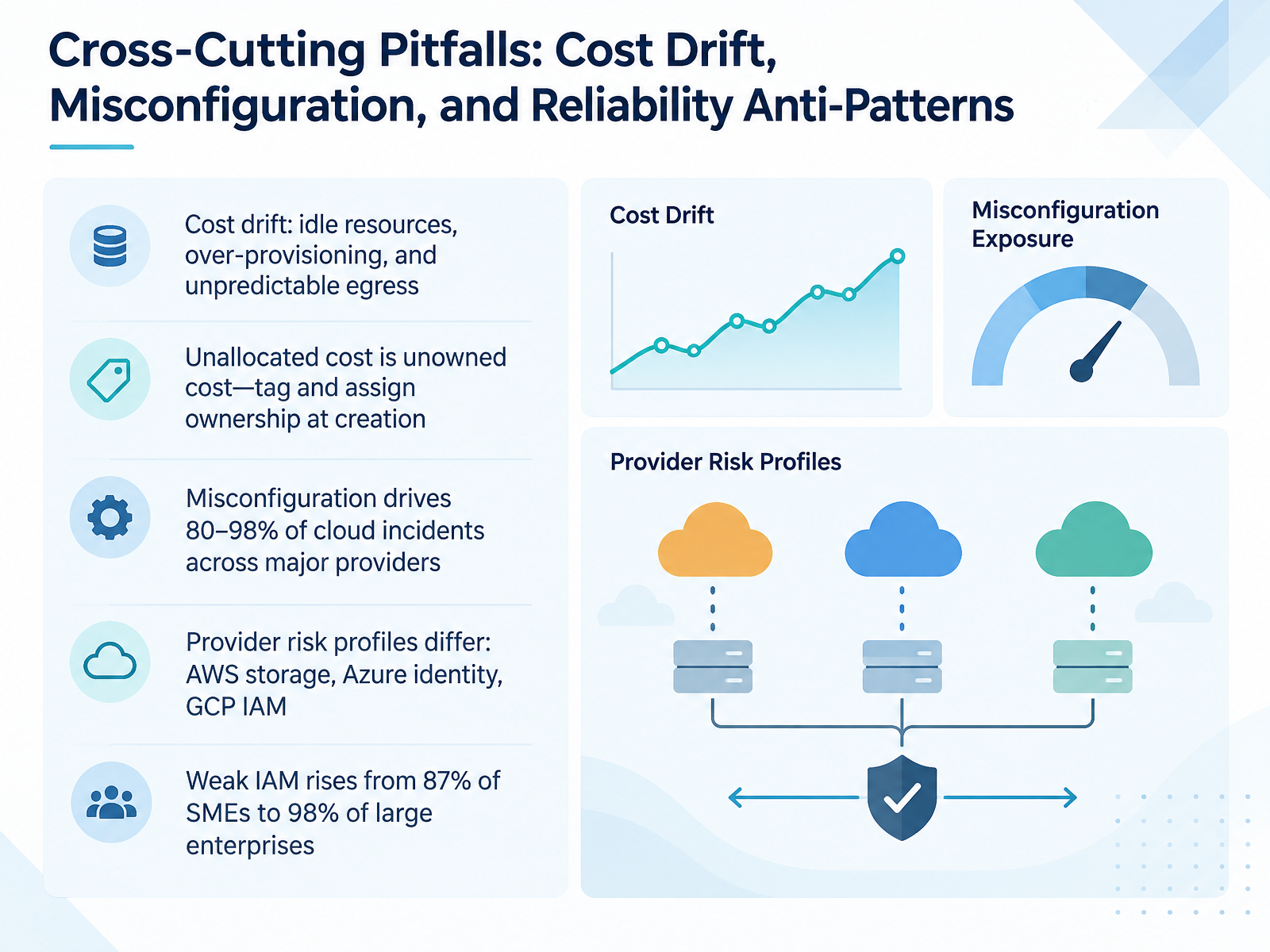
 - 09Cross-Cutting Pitfalls: Cost Drift, Misconfiguration, and Reliability Anti-PatternsNow let's look at the pitfalls that cut across every cloud pattern, starting with cost drift. Three sources dominate: idle resources nobody turned off, over-provisioning that stays in place, and egress charges that surprise teams at month end. The practical fix is ownership. Unallocated cost is unowned cost, so enforce tags at resource creation through infrastructure as code, not after the fact. Misconfiguration is the second pitfall, and it drives most cloud incidents. Data from three thousand organizations shows weak IAM and missing logging affect roughly eighty to ninety-eight percent of accounts across providers. Risk profiles also differ. AWS misconfigurations cluster around storage and network exposure. Azure around storage keys and identity, especially missing multifactor authentication. Google Cloud around IAM, with three quarters of accounts missing OS Login controls. One pattern stands out: weak IAM rises from eighty-seven percent of small and midsize organizations to ninety-eight percent of large enterprises. More people means more roles, and one overprivileged identity can bypass every other control. With that, let's move into cost and governance discipline through FinOps in practice.
 resources.flexera.comcncf.iohalkwinds.com+22 min
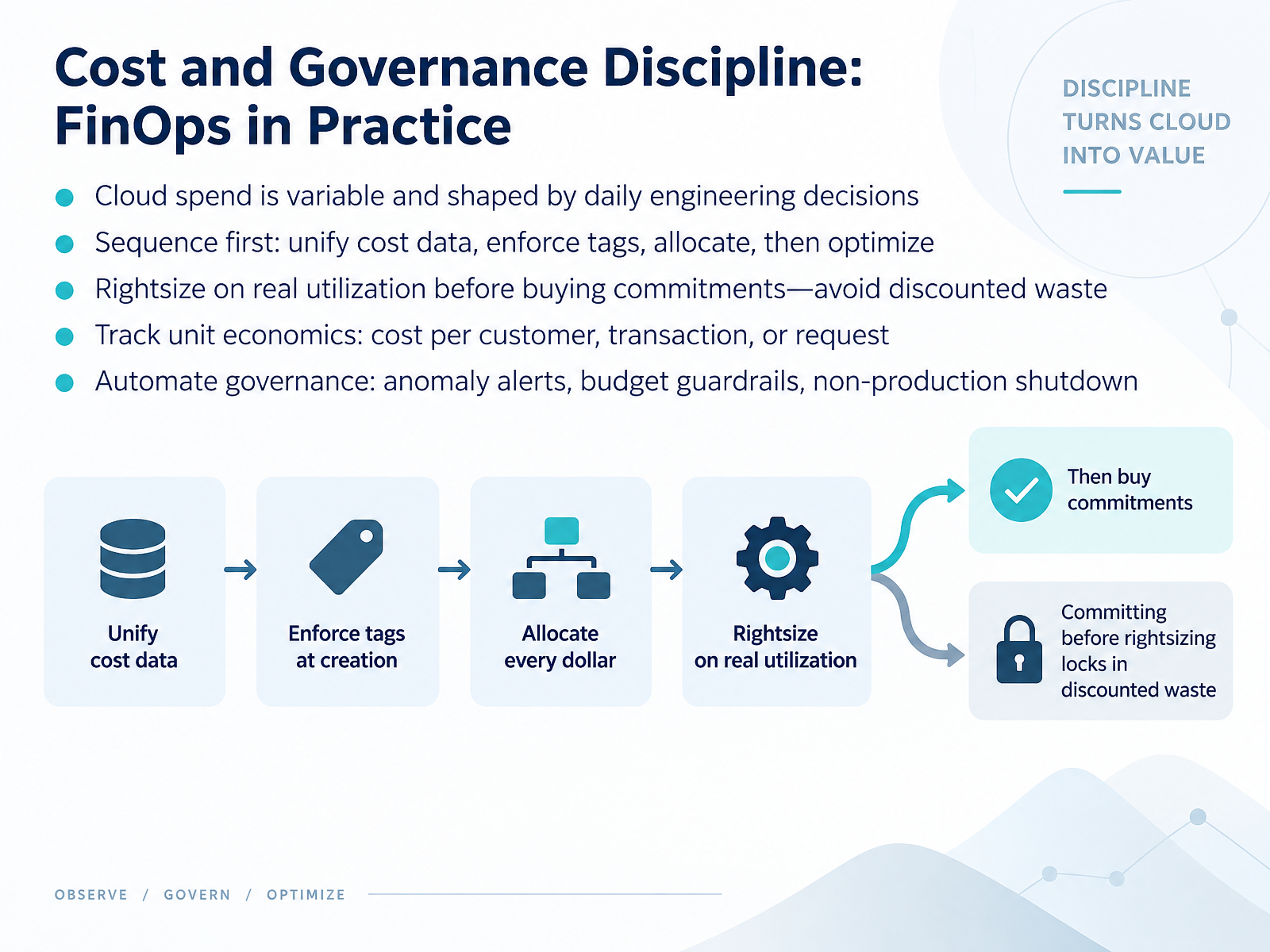
 - 10Cost and Governance Discipline: FinOps in PracticeLet's look at cost and governance discipline, because FinOps only works when it becomes a daily engineering habit. Cloud spend is variable, and it is shaped by decisions your teams make every day, like instance sizes, retention policies, and how long test environments stay running. The sequence matters. First, unify cost data across providers. Then enforce tags, allocate spend to owners, and only then optimize. Rightsize against real utilization before you buy commitments. Otherwise, you lock in discounted waste for one to three years. Track unit economics, such as cost per customer, per transaction, or per request. That tells you whether spend is growing for the right reasons. Finally, automate governance: anomaly alerts, budget guardrails, and automatic shutdown of non-production environments. Those controls catch problems in hours, not on the monthly invoice. Next, we will use a decision framework for selecting a pattern in a real scenario.
 resources.flexera.comcncf.iohalkwinds.com+22 min
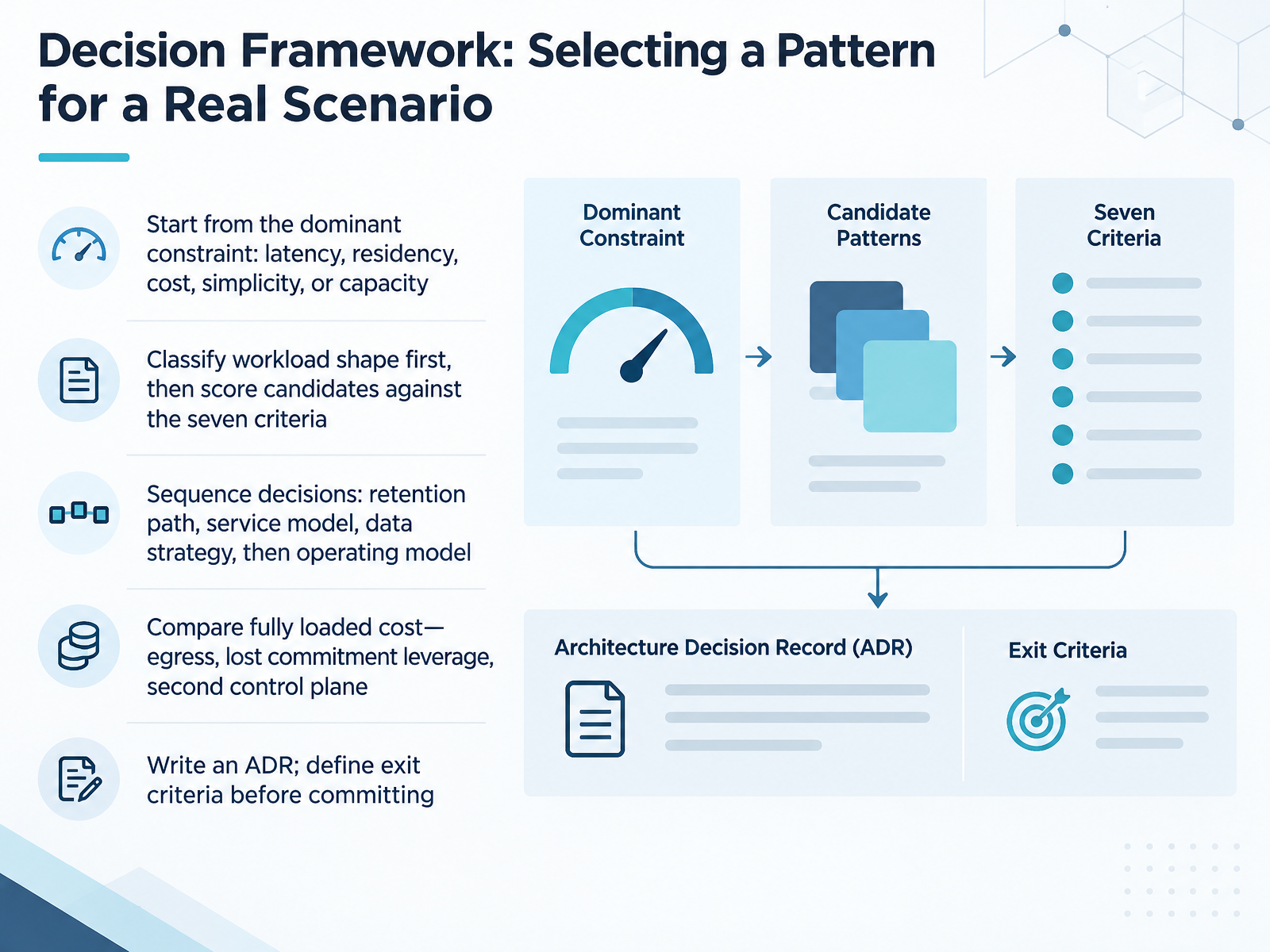
 - 11Decision Framework: Selecting a Pattern for a Real ScenarioLet's bring the patterns together into a decision framework you can actually apply. Start with the dominant constraint. Is it latency, data residency, cost, operational simplicity, or raw capacity? Name it first, because it eliminates options fast. Next, classify the workload shape. A stateless API, a batch pipeline, and a stateful database each score differently against your criteria. Once you know the shape, score your candidates against the seven criteria we covered. Then sequence the decisions deliberately: retention path first, then service model, then data strategy, and only then the operating model. Sequence matters because the operating model is the most expensive thing to reverse. Now compare fully loaded cost, not sticker price. Include egress, the commitment discount you lose by splitting spend, and the real cost of running a second control plane. Finally, write an Architecture Decision Record and define your exit criteria before you commit, so leaving stays a decision, not a crisis. Next, we'll walk through a concrete case: Case Walkthrough 1: Elastic E-Commerce Under Spiky Demand.
 zoomnod.comcalmops.comaenix.io+22 min
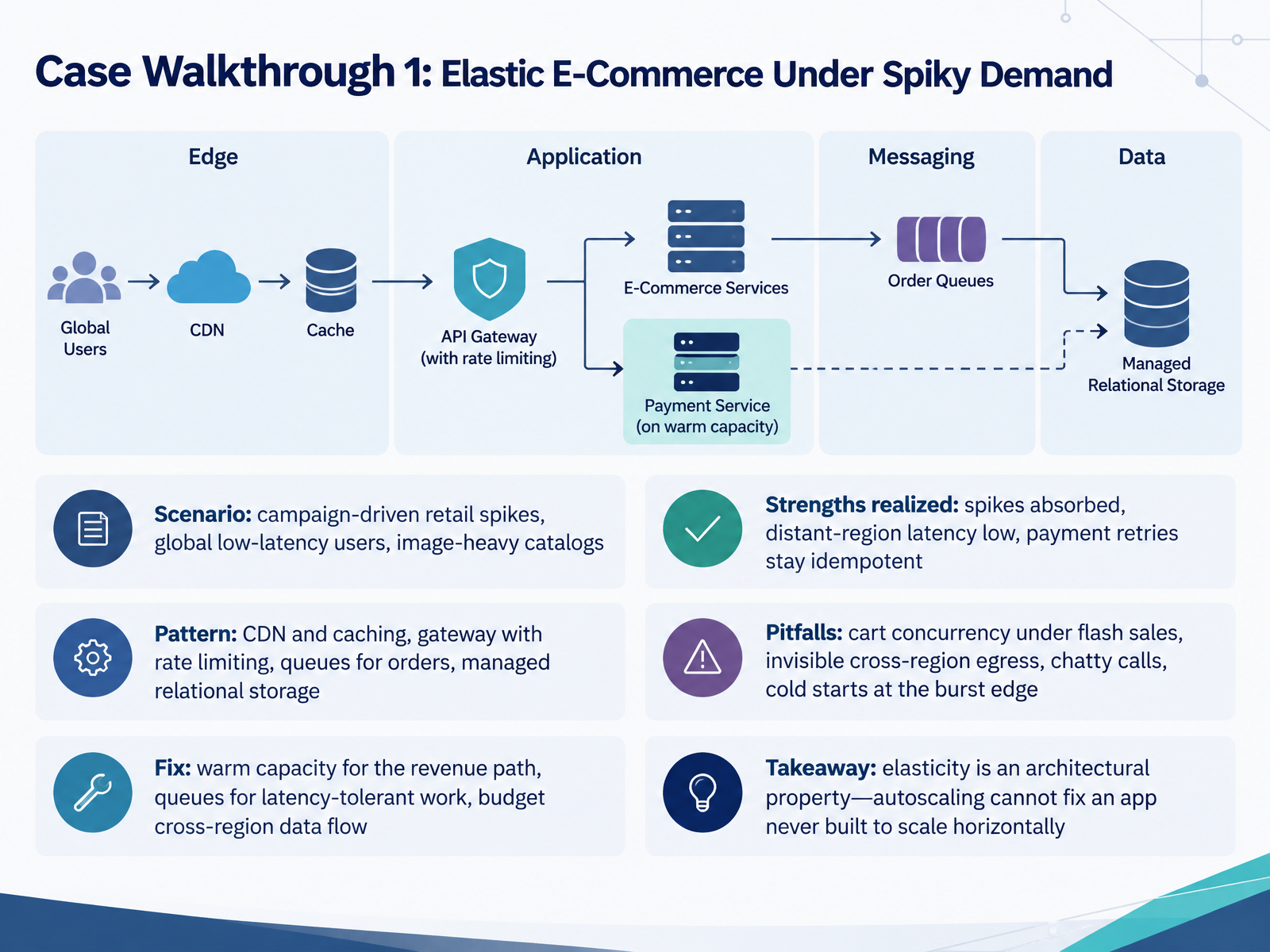
 - 12Case Walkthrough 1: Elastic E-Commerce Under Spiky DemandLet's ground these patterns in a concrete case: elastic e-commerce under spiky demand. The scenario is familiar. Campaign-driven retail spikes, users distributed globally who expect low latency, and image-heavy product catalogs. The pattern combines a CDN and caching, an API gateway with rate limiting, queues for order processing, and managed relational storage. When it works, the strengths are clear. Spikes get absorbed instead of overwhelming the origin. Distant-region latency stays low because assets are cached close to users. And payment retries stay idempotent, so a transient failure does not double-charge anyone. The pitfalls are equally concrete. Cart concurrency breaks down during flash sales when many users update the same item. Cross-region egress is often invisible until the bill arrives. Chatty service calls multiply latency and cost. And cold starts hit hardest right at the burst edge, exactly when you need capacity. The fix is architectural, not operational. Warm capacity for the revenue path. Queues for latency-tolerant work. And an explicit budget for cross-region data flow. The takeaway: elasticity is an architectural property. Autoscaling cannot fix an application that was never built to scale horizontally. Next, we look at a very different constraint profile in Case Walkthrough 2: Regulated Data Analytics Across Jurisdictions.
 zoomnod.comcalmops.comaenix.io+22 min
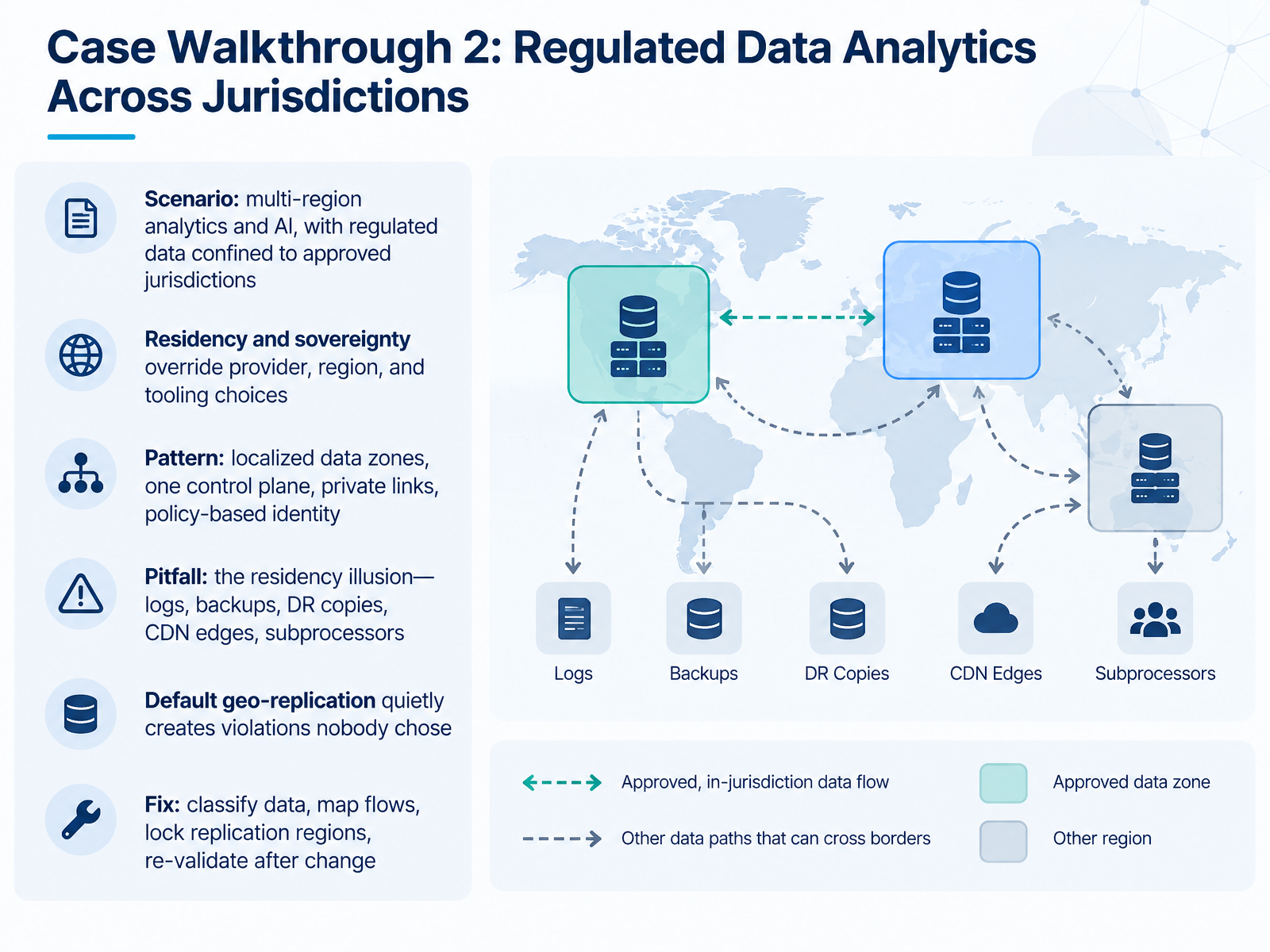
 - 13Case Walkthrough 2: Regulated Data Analytics Across JurisdictionsNow, consider a harder case: regulated analytics across multiple jurisdictions. Imagine an organization running analytics and AI in several regions, where regulated data must stay inside approved countries. Here, residency and sovereignty override provider, region, and tooling choices. The pattern that works is localized data zones, one control plane, private links, and policy-based identity. But watch for the residency illusion. You may choose the right region for your database, yet logs, backups, disaster recovery copies, CDN edge caches, and subprocessors can still move data across borders. Default geo-replication quietly creates violations nobody intentionally chose. For example, an Azure storage account might replicate to a secondary region automatically, or an S3 bucket might allow cross-region replication that nobody approved. The fix is disciplined: classify data, map flows end to end, lock replication to approved regions, and re-validate after every change. That turns a policy into an enforceable architecture. Next, we look at IoT ingestion, a comparison table, and key takeaways.
 nvlpubs.nist.govkansoftware.comcommitissues.com+21 min
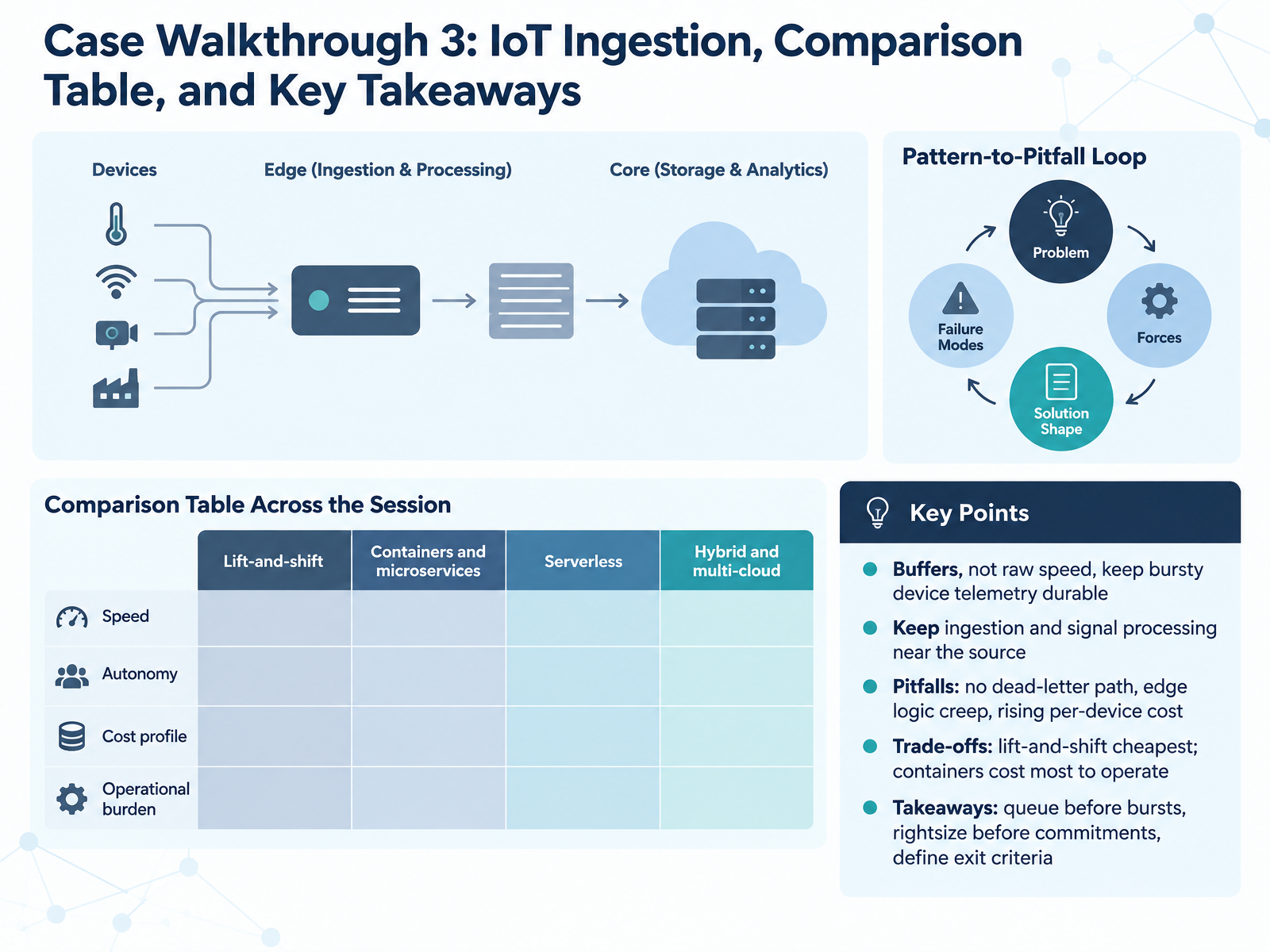
 - 14Case Walkthrough 3: IoT Ingestion, Comparison Table, and Key TakeawaysLet's close with the IoT ingestion case, then pull the patterns together. In this scenario, devices emit telemetry in unpredictable bursts. The lesson is clear: buffers, not raw speed, keep that telemetry durable. Put a queue in front of your processing so bursty writes land in stable storage first. Also keep ingestion and signal processing near the source, which cuts latency and data movement. Now the pitfalls. No dead-letter path means failed messages vanish silently. Edge logic creep means business logic drifts onto devices, where it is hard to version and debug. And per-device cost rises quietly as fleets grow. Comparing deployment choices: lift-and-shift is the cheapest to migrate, while containers cost the most to operate, because you own orchestration, observability, and patching. So, the takeaways. Queue before bursts. Rightsize before you commit. And define exit criteria before you commit. That is the discipline that makes these patterns hold up. Thanks for working through this course with me. Apply these trade-offs deliberately, and you will design cloud systems that stay reliable and cost-aware as they scale.
 zoomnod.comcalmops.comaenix.io+22 min
Take the deck with you
Download this course as a file — free, no sign-up needed.
- PDF handoutEvery slide page, ready to print or share.15 pages · 3.3 MBDownload
- Narrated PowerPointThe deck that presents itself — every slide carries the digital human's narration video.15 pages · 17.0 MBDownload
- PowerPoint slidesThe full deck as a .pptx — open it in PowerPoint, Keynote, or Google Slides.15 pages · 3.2 MBDownload
Free to use in your own training — please keep the PersonWise credit page at the end.
Have your own deck? Turn it into a course
Sources consulted
Web sources consulted while building this course.
- Cloud Architecture for Business in 2026 — zoomnod.com
- Cloud Architecture Patterns: Modern Design Principles for 2026 - Calmops | Tech, Business & Indie Hacker Knowledge Base — calmops.com
- Hybrid cloud architecture patterns 2026 — what works, what fails, and how to choose – Ænix — aenix.io
- Cloud‑Native Architecture in 2026: Patterns, Trade‑offs, and Practical Builds – TheLinuxCode — thelinuxcode.com
- Real-World Applications of Cloud Computing: Patterns I Ship in Production (2026) – TheLinuxCode — thelinuxcode.com
- 2026 State of the Cloud Report: Cloud spend, AI & FinOps benchmarks — resources.flexera.com
- Annual Cloud — cncf.io
- Multi Cloud Adoption Report 2026 | Halkwinds Research — halkwinds.com
- What 2026 cloud data tells us about spend, scale and strategy — flexera.com
- Cloud Computing Statistics 2026 | 50+ Data Points & Insights | Searchlab — searchlab.nl
- NIST IR 8613 ipd, Multi-Cloud Security Challenges: Understanding the Security and Compliance Implications of a Multi-Cloud Architecture — nvlpubs.nist.gov
- Hybrid Cloud Architecture for Regulated Workloads — kansoftware.com
- A Field Guide to Data Residency in 2026 — Commit Issues — commitissues.com
- Multi-Cloud Data Sovereignty Issues Across Regions - Multicloud Hosting — multicloudhosting.com
- Hybrid Cloud Playbook for UK Enterprises — quicktech.cloud