Team Building Communication Skills
Begin
14 pages · ~28 min
Team Building Communication Skills
This training teaches core communication techniques through team-building exercises, helping participants strengthen collaboration, active listening, and clarity in workplace interactions.
What you’ll learn
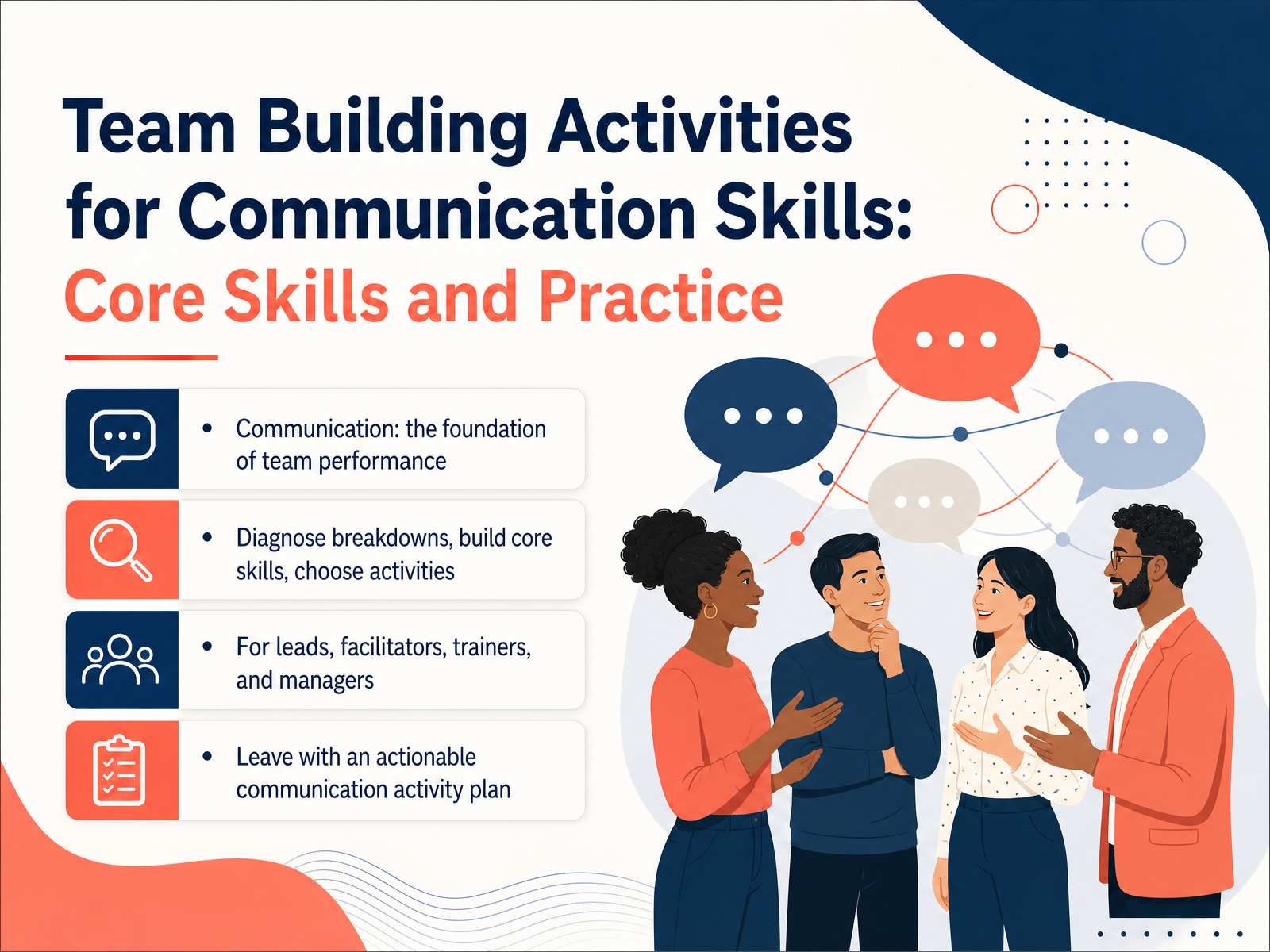
- 01Team Building Activities for Communication Skills: Core Skills and PracticeWelcome. If you lead a team or facilitate training, you already know that communication isn't just a soft skill. It's the foundation of team performance. When communication breaks down, projects stall, conflicts surface, and trust erodes. But here's the thing: most communication problems aren't personality problems. They're structural. Unclear roles, missing feedback loops, or a lack of psychological safety. In this session, we'll focus on practical outcomes. We'll cover how to diagnose breakdowns, build core skills like active listening and structured messages, and choose activities that actually address your team's specific gaps. Not generic icebreakers. You'll leave with an actionable communication activity plan you can run with your own team. Let's get started by looking at how communication breaks down in teams.https-sage-cnpereading-com-443.webvpn1.xju.edu.cnucd.iescholarship.shu.edu+21 min
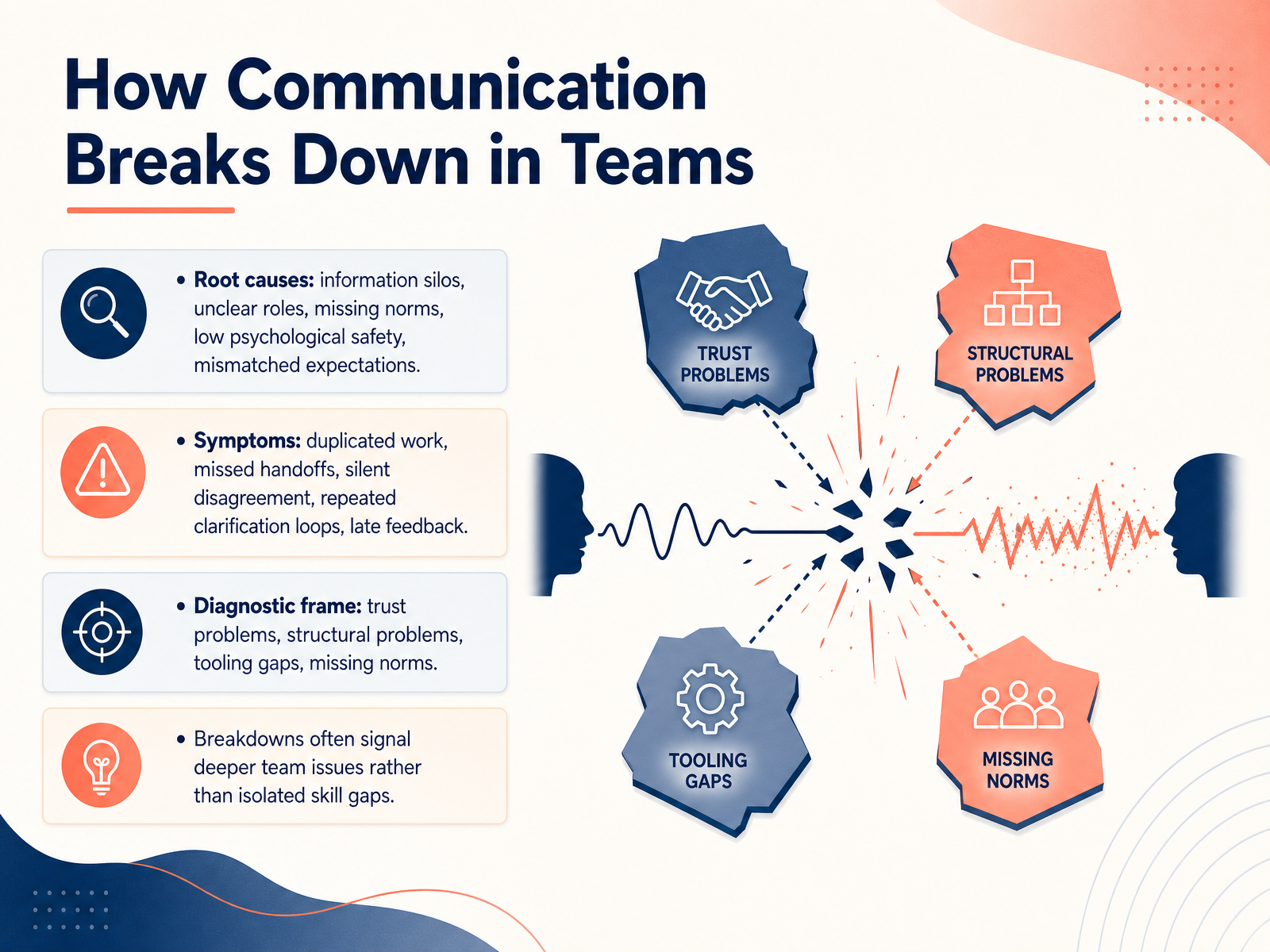
- 02How Communication Breaks Down in TeamsLet’s start by looking at why communication breaks down in the first place, because the fix depends entirely on the cause. A breakdown rarely happens in isolation. It usually points to something deeper. The most common root causes fall into four categories: trust problems, structural problems, tooling gaps, and missing norms. Trust problems show up when people go quiet in high-stakes moments. Structural problems mean decision rights are unclear, so context gets lost in handoffs. Tooling gaps look like information scattered across too many platforms. And missing norms mean no one has agreed on response times or how to handle disagreement. The symptoms are equally telling. Duplicated work, delayed feedback, silent disagreement, endless clarification loops. When you see these patterns, resist the urge to call it a training issue. If someone doesn’t know who owns a decision, more communication training won’t help. You need to fix the structure. If people agree in public but resist in private, that’s a safety issue. In practice, most teams have more than one cause, but structural issues are the most common. Diagnose first, then design your activity around the real gap. Next, let’s walk through a lightweight diagnostic approach you can use with your team.
 questworks.iohappeo.compsychologytoday.com+22 min
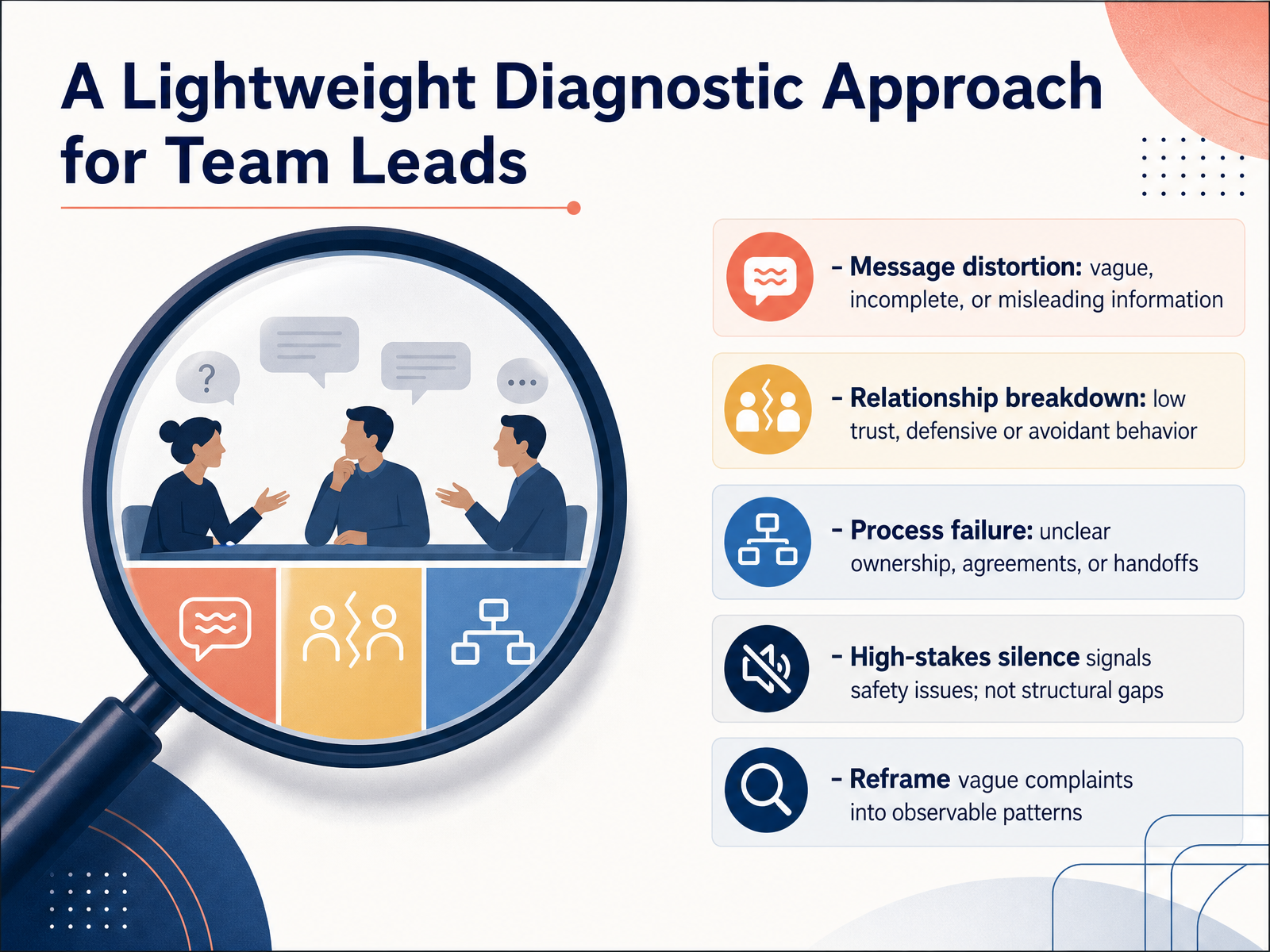
 - 03A Lightweight Diagnostic Approach for Team LeadsLet’s talk about diagnosis. When communication breaks down, it’s tempting to label it a people problem. But in practice, it usually falls into one of three buckets. Message distortion, where information is vague or misleading. Relationship breakdown, where trust is low, and people get defensive or silent. Or process failure, where ownership and handoffs are unclear. Here’s the key insight. If your team is quiet only when the stakes are high, that is a safety issue, not a structural gap. That distinction matters because the fix is completely different. So before you run an activity, reframe the vague complaint into an observable pattern. Instead of they don’t communicate, look for a repeatable behavior, like decisions not being documented, or concerns raised in private chats, not with the group. With that pattern named, you can choose the right exercise. Next, we’ll cover the core skills of listening and questioning that will anchor your sessions.
 questworks.iohappeo.compsychologytoday.com+22 min
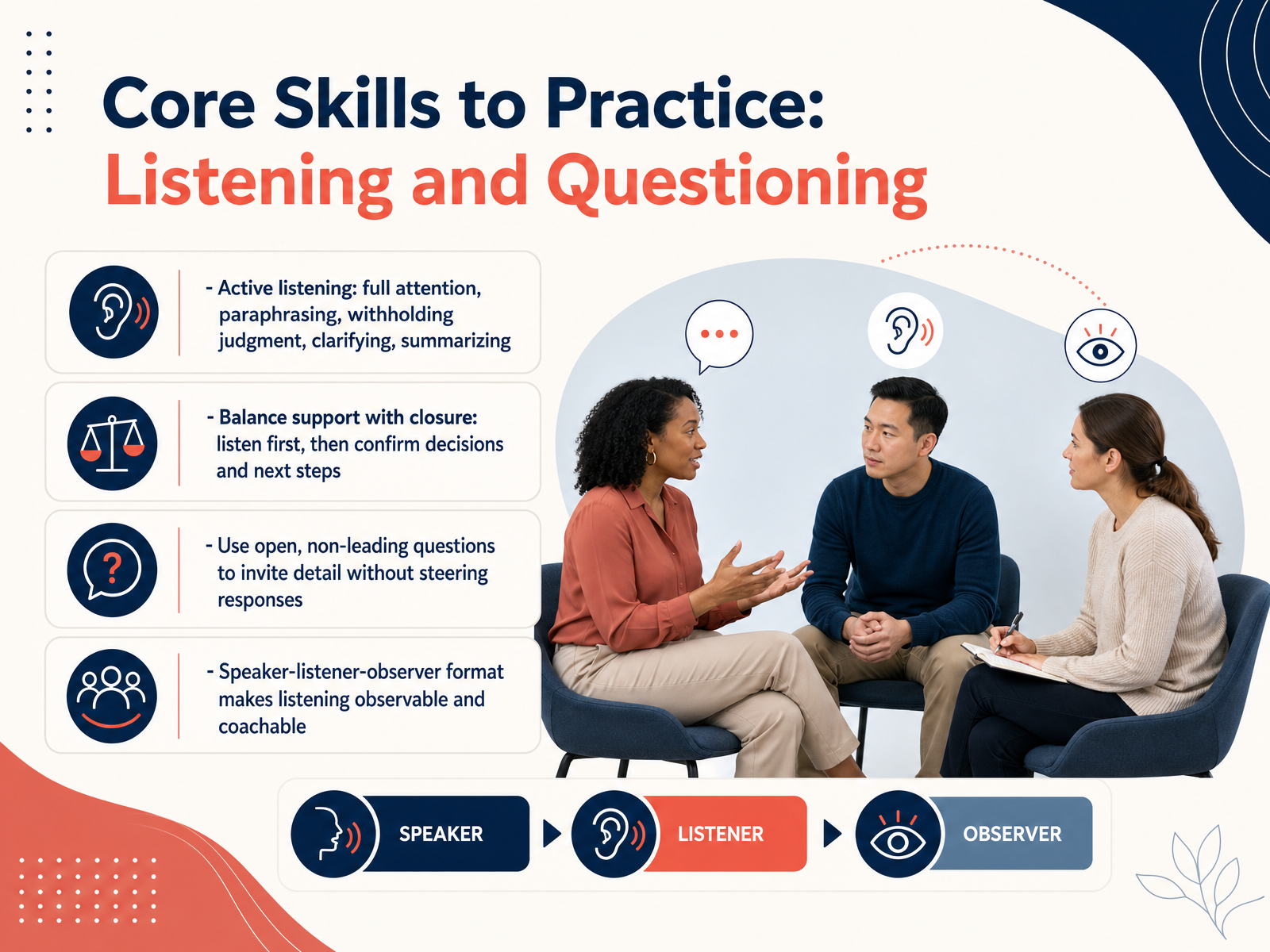
 - 04Core Skills to Practice: Listening and QuestioningLet’s get concrete about the two skills that do the heaviest lifting in team communication: listening and questioning. Active listening isn't just staying quiet while someone talks. It's giving them your full attention, paraphrasing their key points back to confirm you understand, withholding judgment so they feel safe to share, and clarifying anything ambiguous before you summarize. That last step matters. A good summary doesn't just close the conversation—it validates what you heard and sets up clear next steps. When you pair that with open, non-leading questions like, 'Tell me more about that,' or, 'What options have you considered?' you invite detail without steering the speaker toward the answer you expected. When it's time to practice this, the speaker-listener-observer format is the fastest way to make these skills visible and coachable. The observer gives feedback on what they saw, which turns an abstract concept into observable behavior. Now, let’s look at the counterpart skill: giving feedback and summarizing intentionally.
 mindtools.comlearningguild.comccl.org+22 min
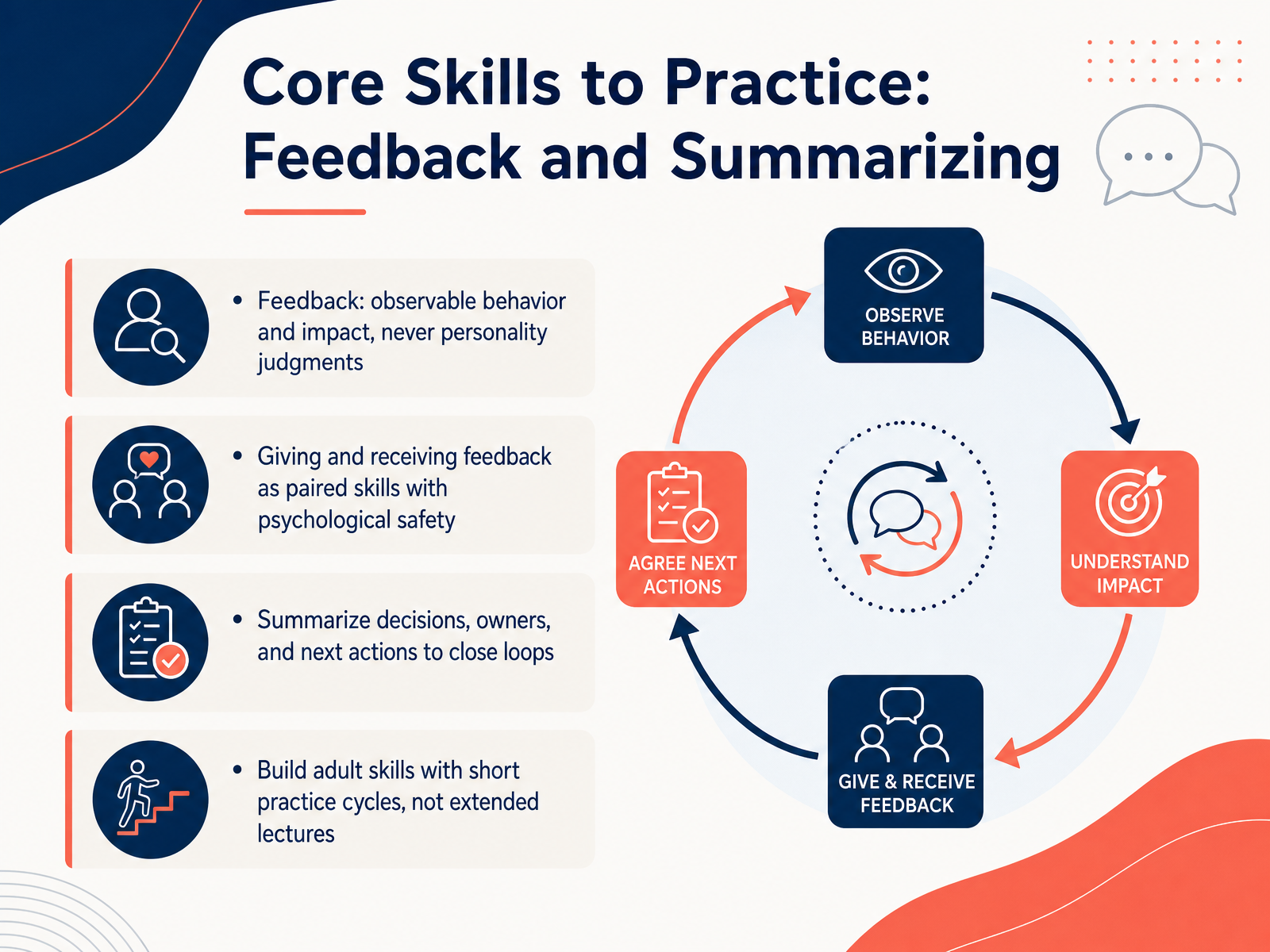
 - 05Core Skills to Practice: Feedback and SummarizingSo, when you set up your team-building session, focus on two core skills: feedback and summarizing. For feedback, keep it behavioral, not personal. Describe what you saw and the impact it had, rather than making a judgment about the person's character. And remember, giving feedback is only half the skill. Receiving it well is just as important, which means you need an environment where people feel safe enough to be open and honest without fear of blame. As the facilitator, you model that. In practice, use short, paired exercises. Have one person share an observation, and the other practice receiving it without getting defensive. After any discussion or activity, always close the loop. Summarize the key decisions, who owns the next actions, and what happens next. This is what turns conversation into progress. Adults learn these skills through short practice cycles, not lectures. Keep the theory brief, get them into the exercise quickly, and then debrief. That's where the real learning happens. Next, let's look at some activity frameworks you can use to build these communication skills with your team.
 mindtools.comlearningguild.comccl.org+22 min
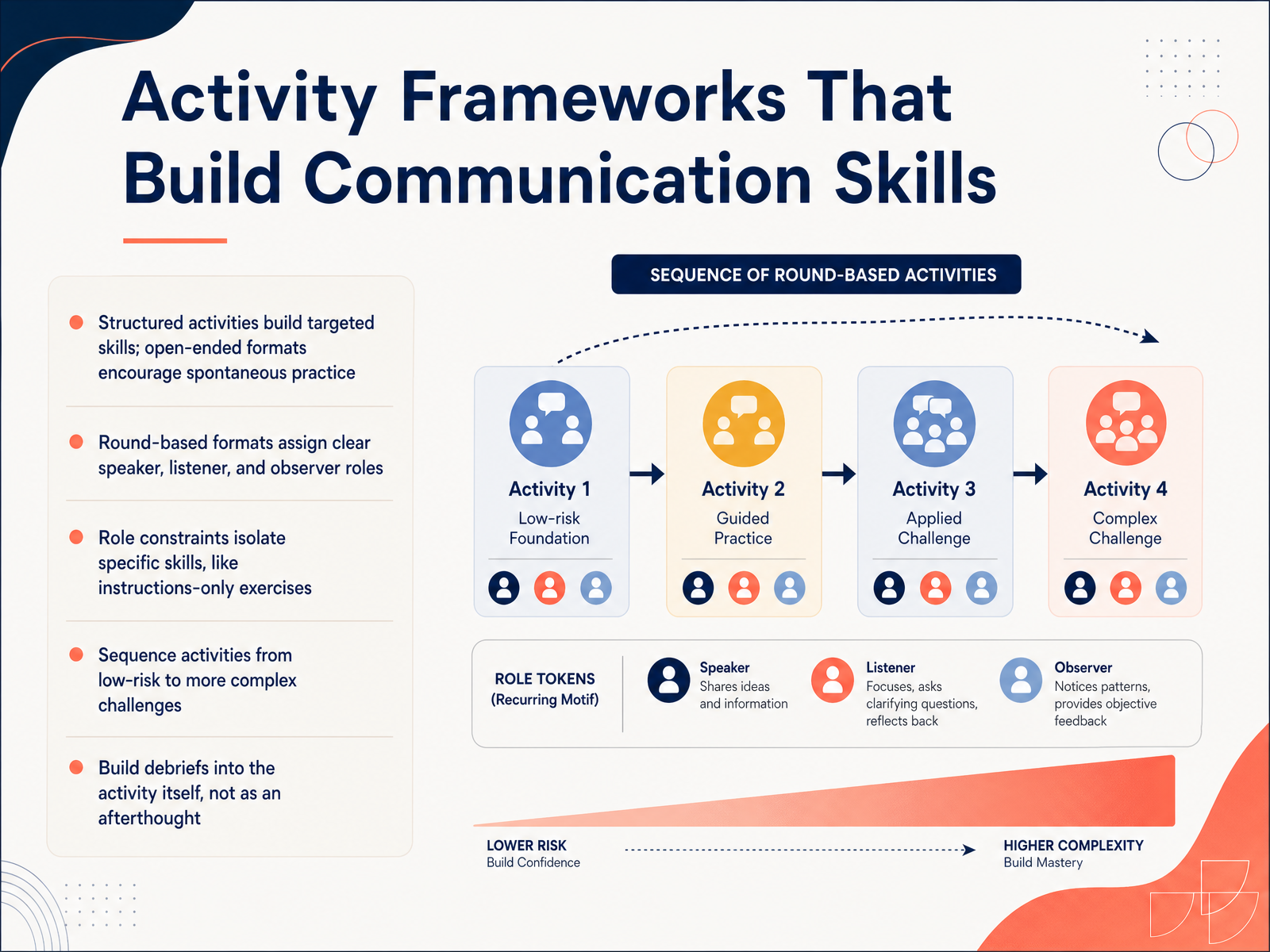
 - 06Activity Frameworks That Build Communication SkillsNow, let's look at how to design activities so they actually build communication skills. The framework matters more than the game itself. Structured exercises target specific skills, while open-ended formats give people room to practice spontaneously. A round-based format is your most reliable tool. Each round assigns clear roles: a speaker, a listener, and an observer. Rotate those roles so everyone experiences each perspective. You can also use role constraints to isolate one skill at a time. For example, an instructions-only exercise forces the speaker to be precise and the listener to ask clarifying questions. Build a progression. Start with low-risk activities to warm people up, then move to more complex challenges that require coordination and problem-solving. The most common mistake is treating the debrief as an afterthought. You need to build reflection into the activity itself. Stop between rounds and ask the team what broke down and what they will change. Pause here for a second. That single step doubles the learning value of everything you run. Next, we will cover debriefing methods that turn activities into lasting learning.
 https-sage-cnpereading-com-443.webvpn1.xju.edu.cnucd.iescholarship.shu.edu+22 min
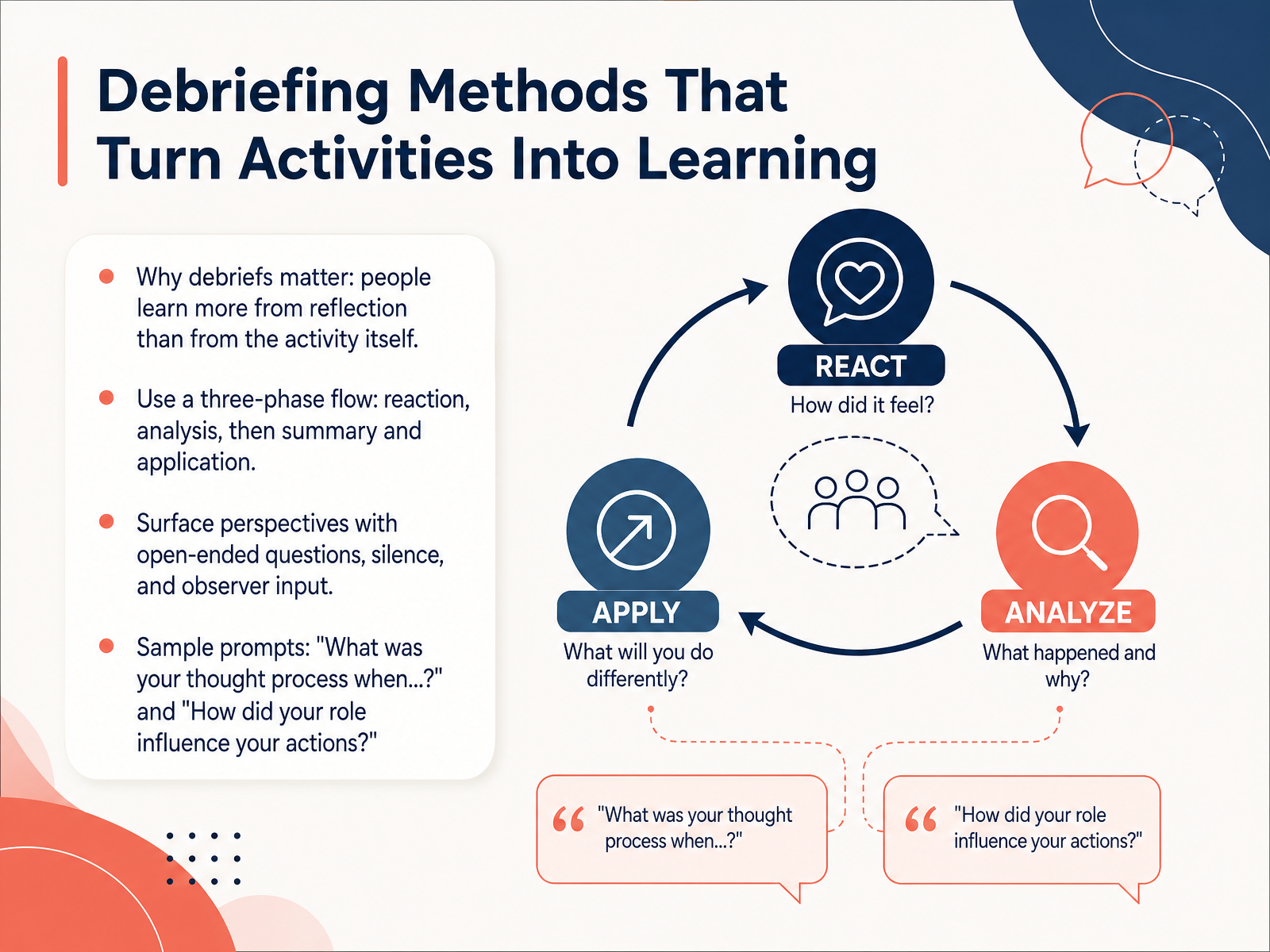
 - 07Debriefing Methods That Turn Activities Into LearningNow let’s talk about the part that turns a good activity into real learning: the debrief. Here’s the thing—people learn more from reflecting on what happened than from the activity itself. So don’t treat the debrief as an afterthought. Structure it in three phases. First, reaction. Let people vent and share how it felt. Then move to analysis. Ask what happened, why it happened, and what patterns emerged. Finally, summarize and apply. What will we do differently next time? As you guide the discussion, resist the urge to fill silence. Ask open-ended questions, wait, and let observers contribute. Try prompts like, “What was your thought process when…?” or “How did your role influence your actions?” These questions pull out the real insights that generic feedback misses. Keep it tight. A focused ten-minute debrief often delivers more value than a rambling thirty-minute one. Next, let’s look at how to facilitate these communication activities safely.
 https-sage-cnpereading-com-443.webvpn1.xju.edu.cnucd.iescholarship.shu.edu+21 min
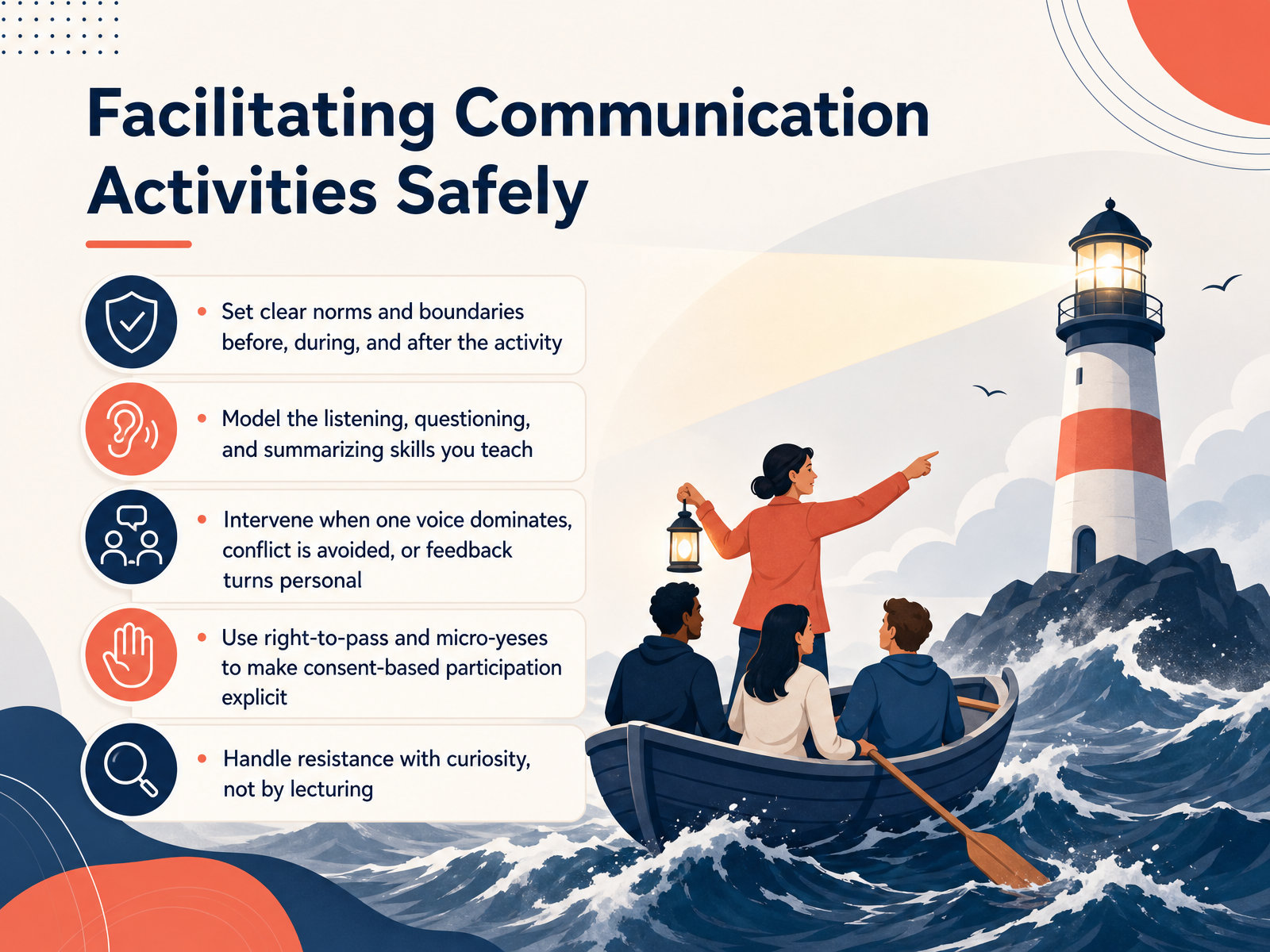
 - 08Facilitating Communication Activities SafelyBefore you launch any activity, take a beat to think about safety. You are not running a therapy session, but you are creating a space where people will take interpersonal risks. So set clear norms before you begin, and name them out loud. Something simple like, what is said here stays here, or ideas are separate from people, sets the boundary. Then, you have to model the behavior you are teaching. If the exercise is about listening, you need to be the best listener in the room. When one voice dominates, or the conflict gets too hot, or feedback turns personal, do not let it ride. Intervene early and calmly. Use the right to pass so that opting out is always valid, and collect micro-yeses before pushing for depth. If someone resists, get curious. Ask them what they need to participate fully. You are the container, so hold it steady. That means your facilitation is what makes the skill practice possible. Coming up next, we will look at specific moves you can use to ensure everyone participates equally.
 points-of-you.comempathable.comaippt.com+22 min
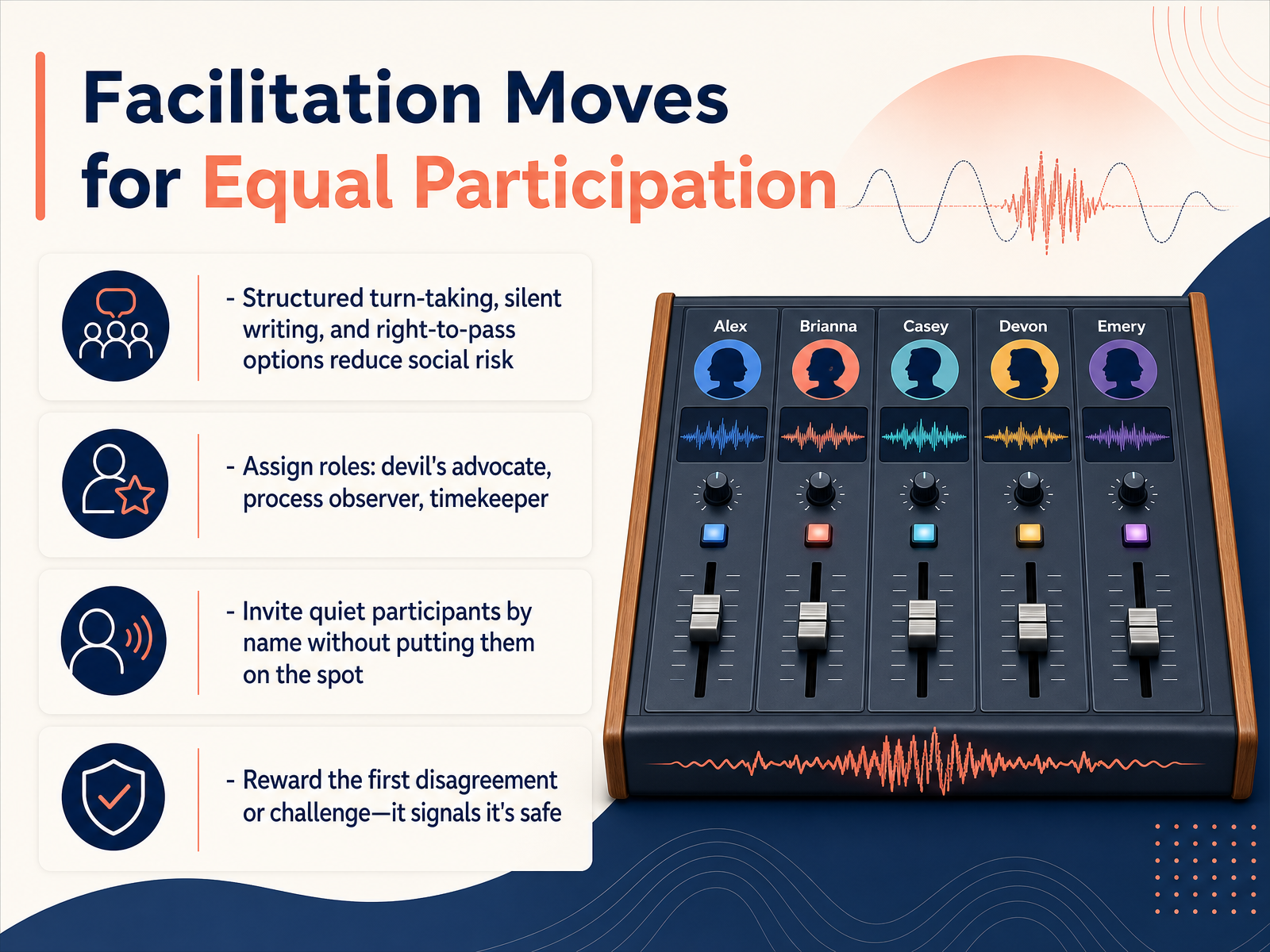
 - 09Facilitation Moves for Equal ParticipationLet's talk about equal participation. When you ask a room for input, the same three voices tend to dominate, and the quiet ones stay quiet. That's a structural problem, not a personal one. So fix the structure. Use structured turn-taking. Try silent writing first: everyone jots down their thoughts for three minutes before anyone speaks. That collects ideas from everyone, not just the fast talkers. Build in a clear right to pass, so opting out is a legitimate choice, not a retreat. Assign rotating roles. A devil's advocate makes disagreement a job, not a personality trait. A process observer watches who speaks and who doesn't. A timekeeper keeps things moving. If someone is quiet, invite them in by name, but with a low-stakes opening. Ask something like, 'You've been quiet on this, what's your read?' Give them a moment to respond, or to decline. And most importantly, reward the first challenge or disagreement you hear. Say thank you visibly. Acknowledge the risk they just took. That moment tells the whole room that it is safe to be honest. When the first objection is welcomed instead of punished, you'll get many more after it. Coming up next, we'll look at activity variations by team size and context.
 https-sage-cnpereading-com-443.webvpn1.xju.edu.cnucd.iescholarship.shu.edu+22 min
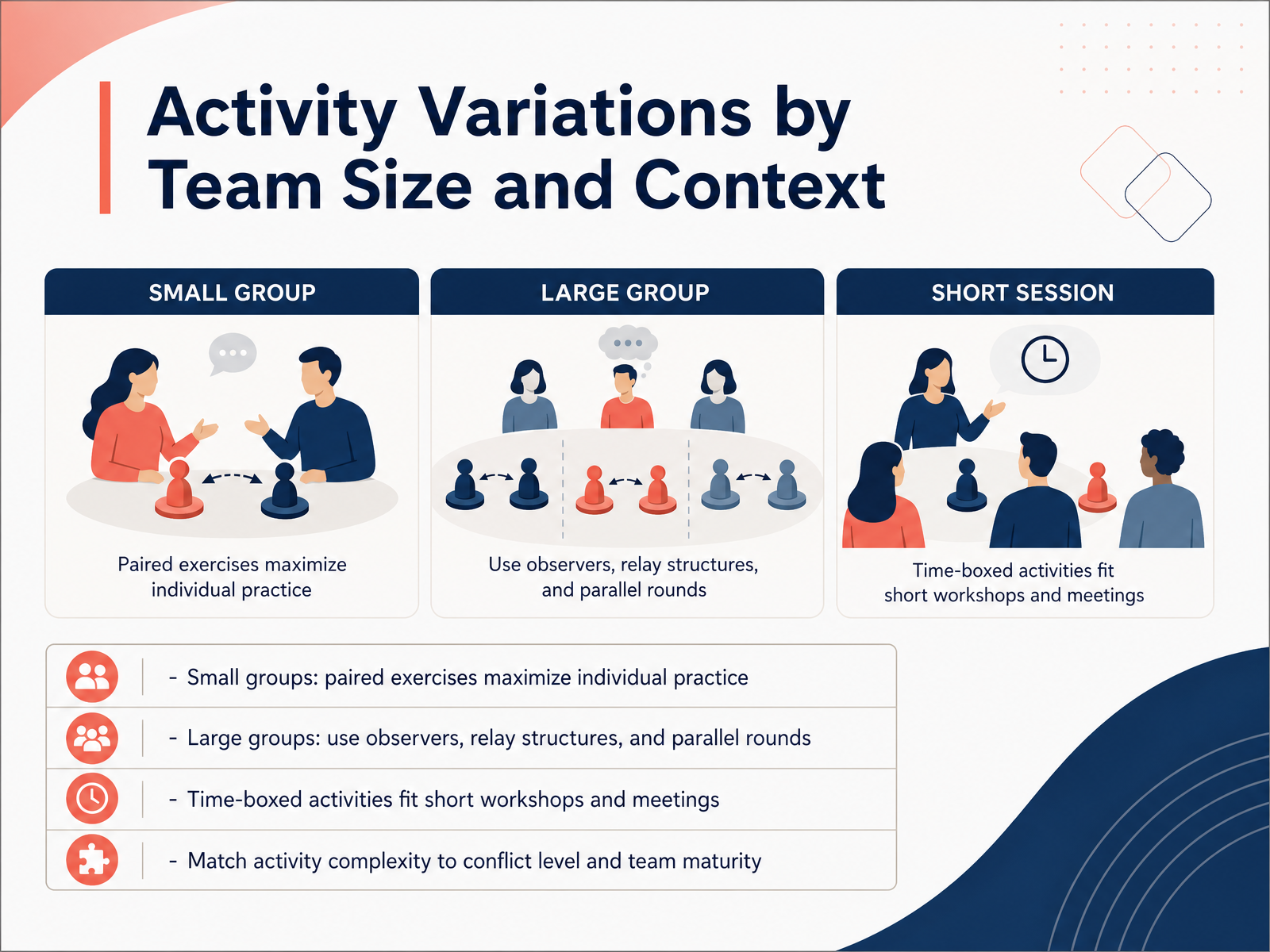
 - 10Activity Variations by Team Size and ContextNow let's look at how to adapt these activities for different team sizes and contexts. For small groups, paired exercises are your best bet. They maximize individual practice and give everyone a chance to speak and listen actively. Think back-to-back drawing or active listening pairs. For larger groups, you'll want to use observers, relay structures, or parallel rounds. That keeps everyone engaged and ensures you're not losing the learning in the crowd. Time-boxed activities are a smart fit for short workshops or team meetings where the clock is tight. Just be disciplined about the debrief. Match the complexity of the activity to the team's maturity and the level of conflict. A new team or a group in a sensitive situation does better with low-risk listening and perspective-taking exercises. More mature teams can handle the tougher conversations. The key is to choose deliberately and make sure the structure serves the goal.
 https-sage-cnpereading-com-443.webvpn1.xju.edu.cnucd.iescholarship.shu.edu+21 min
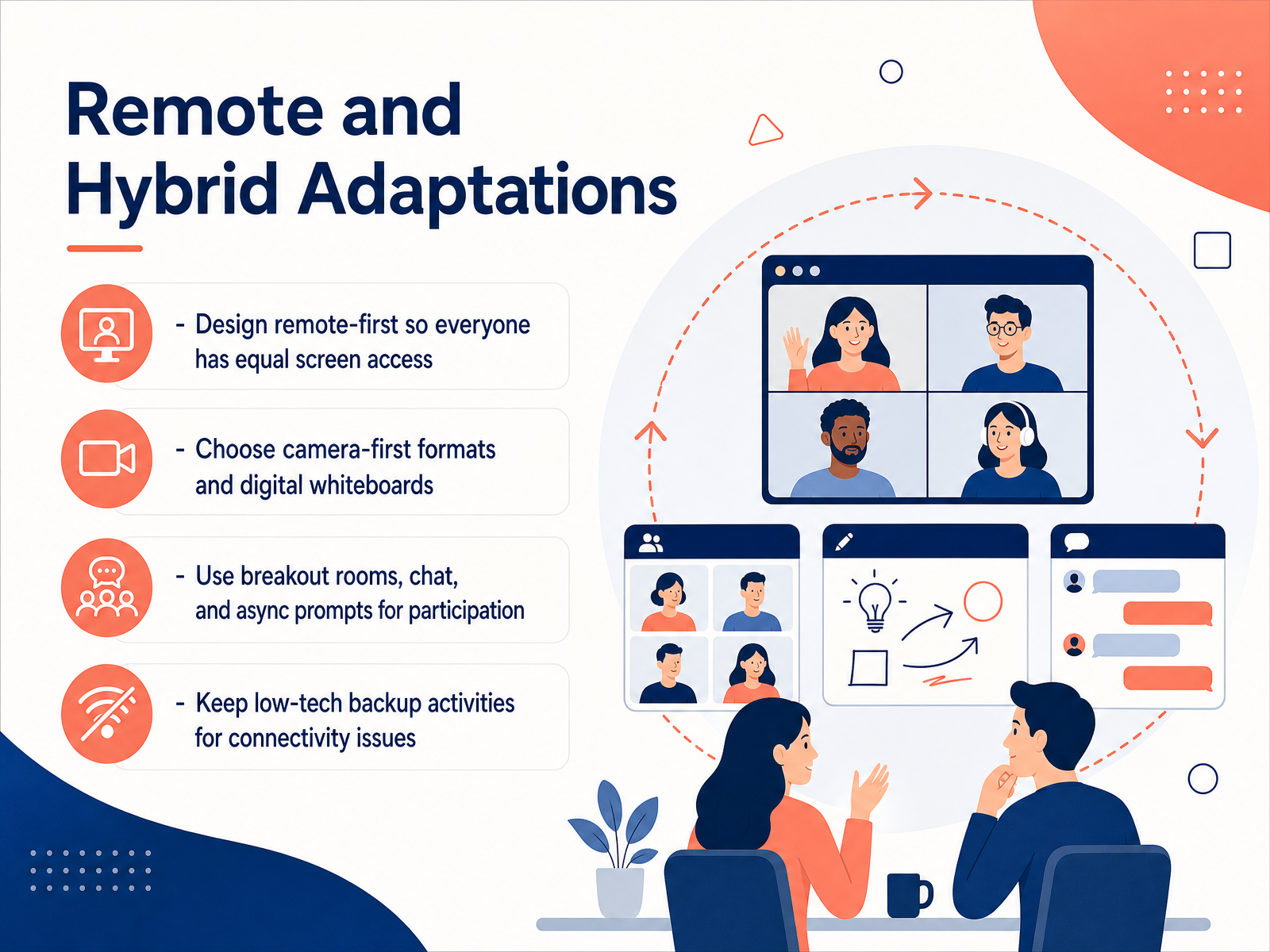
 - 11Remote and Hybrid AdaptationsNow, let’s talk about adapting these activities for remote and hybrid teams. Here’s the core principle I want you to hold onto: design remote-first. That means you plan the activity as if everyone is joining from their own screen, even if some people are in the same office. This guarantees equal access and equal participation for everyone. Avoid anything that gives the room an advantage, like physical whiteboards or office scavenger hunts where remote people just watch. Instead, choose camera-first formats and use a shared digital whiteboard like Miro or FigJam as your primary surface. This way, everyone is contributing through the same tool, from their own device. Use breakout rooms, the chat function, or asynchronous prompts to make sure quieter team members and those in different time zones have a way to contribute. And finally, always have a low-tech backup activity ready. If someone’s connection drops, you need a quick, simple option to keep the session moving without leaving them behind. The best-in-class rule is simple: if the experience can’t be equal for both groups, change the activity. Now, let’s look at how to select and sequence the right activities for your team’s specific goals.
 2 min
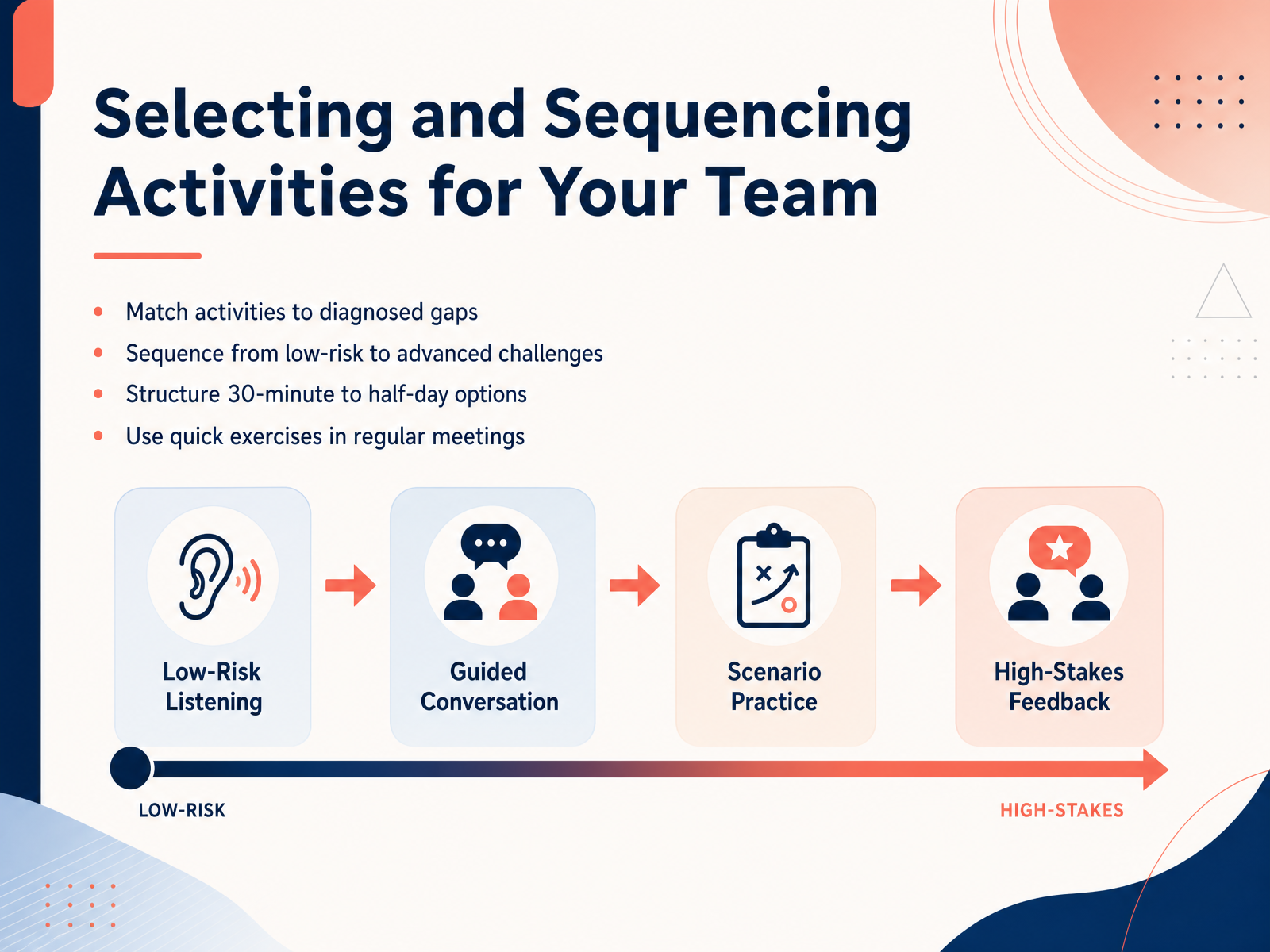
2 min - 12Selecting and Sequencing Activities for Your TeamThe real skill is choosing the right activity at the right time. Start by creating a simple chart to track common barriers you have observed, from unclear project updates to skipped feedback loops. Then, sequence what you choose for your teams: open with a low-risk exercise, one where people do not feel exposed, like practicing paraphrasing with a partner. Once they have had that small win and built a little trust, layer in a more complex challenge, one that requires coordinating effort or negotiating different viewpoints within a clear deadline. Time-box the work too. A quick stand-up exercise can fit neatly into a thirty-minute block, while a full structured simulation deserves a half-day session focused on one skill. And do not always wait for a big event. Short, five-minute practices embedded into your weekly meeting agenda often drive lasting change. Whatever you pick, be deliberate, and make sure everyone knows exactly which behavior they are strengthening today. Next, let us look at how to measure these improvements without over-engineering the process.
 https-sage-cnpereading-com-443.webvpn1.xju.edu.cnucd.iescholarship.shu.edu+22 min
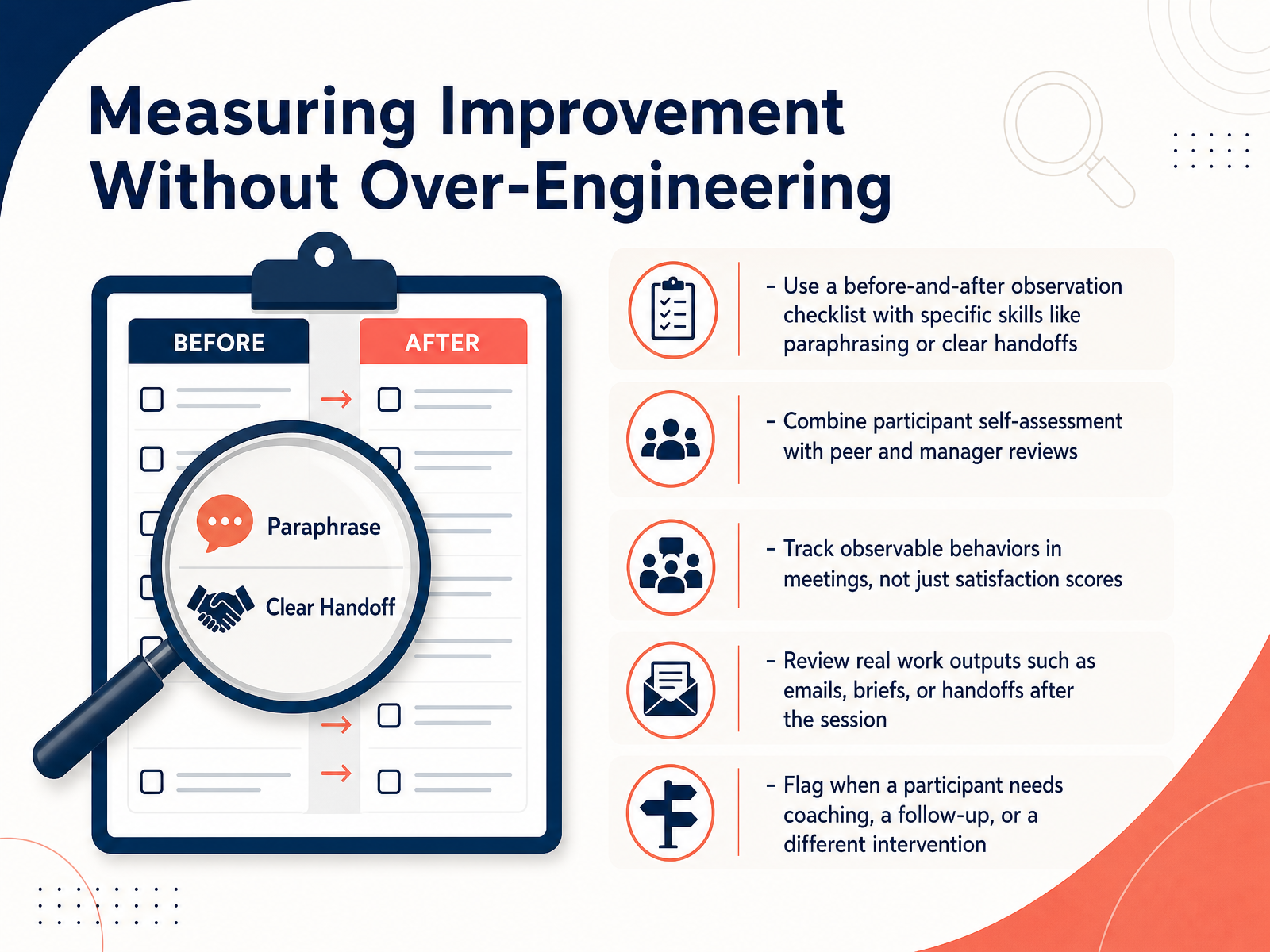
 - 13Measuring Improvement Without Over-EngineeringLet’s talk about measuring improvement without over-engineering the process. You don’t need a complex analytics platform to know if your session worked. Start with a simple before-and-after observation checklist. Focus on the specific skills your session targeted, like paraphrasing during a disagreement or clarity in project handoffs. Structure it so managers and peers are looking for the same behaviors, not vague impressions. Pair that with honest self-assessment from participants. Their confidence ratings before and after, collected consistently, reveal mindset shifts you won’t catch from the outside. And whenever possible, bring in peer or manager review to balance the picture. Then track what actually happens in real meetings. Count how often someone asks a clarifying question or offers a suggestion now versus before the training. That observable change carries far more weight than a satisfaction score. Also review real work outputs. Pull samples of emails, briefs, or handoff documents from before and after, and compare them for tone and clarity. Once you have this data, use it to make decisions. If someone shows no movement after a focused cycle, that score staying flat is a signal. It tells you the intervention was a mismatch, and that person likely needs targeted coaching, a structured follow-up, or a completely different approach. Remember, a one-time assessment is just a snapshot. Reassess at sixty to ninety days to see what actually sticks. Keep the process light, consistent, and tied to observable behavior. With simple checklists and real work samples, you’ll have the evidence you need to guide each participant forward. Next, we’ll turn that insight into a concrete action plan for you as the facilitator.
 2 min
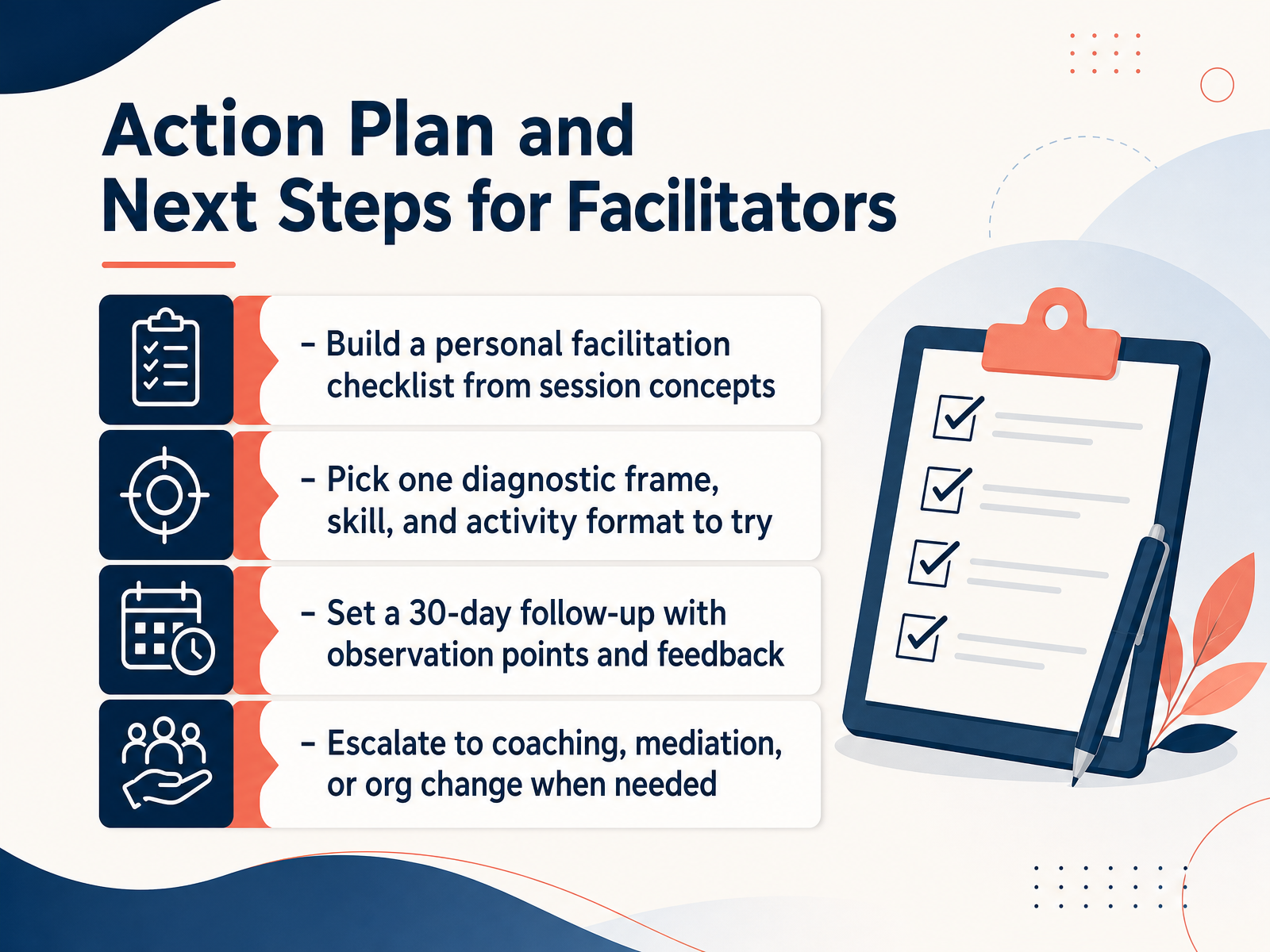
2 min - 14Action Plan and Next Steps for FacilitatorsWe've covered a lot of ground today, so let's turn that into action. Start by building your own personal facilitation checklist from the concepts we've discussed today. What are the non-negotiables for how you'll set up and run your sessions? Second, don't try to do everything at once. Pick just one diagnostic frame, one core skill, and one activity format to try in your next team session. Focus your energy there. Then, commit to a thirty-day follow-up. Schedule it now, in your calendar, before you leave. Define two or three specific observation points, like how often people speak up or whether meetings end with clear owners. And remember to ask the team directly for feedback on how it's working. Finally, be clear about your limits as a facilitator. If you see trust deficits or deep conflict that workshops can't solve, that's your signal. Escalate to coaching, mediation, or an organizational change conversation. Skilled facilitation creates the opening for change, but it also knows when the real work lives elsewhere. You have the tools. Now, go put them to work. Thank you for your attention today, and good luck with your next session.
 questworks.iohappeo.compsychologytoday.com+22 min
Take the deck with you
Download this course as a file — free, no sign-up needed.
- PDF handoutEvery slide page, ready to print or share.15 pages · 3.5 MBDownload
- Narrated PowerPointThe deck that presents itself — every slide carries the digital human's narration video.15 pages · 26.5 MBDownload
- PowerPoint slidesThe full deck as a .pptx — open it in PowerPoint, Keynote, or Google Slides.15 pages · 3.4 MBDownload
Free to use in your own training — please keep the PersonWise credit page at the end.
Have your own deck? Turn it into a course
Sources consulted
Web sources consulted while building this course.
- Can You Hear Me Now? The Communication Challenge — https-sage-cnpereading-com-443.webvpn1.xju.edu.cn
- Structured Interdisciplinary Rounds - UCD School of Nursing, Midwifery and Health Systems — ucd.ie
- The Communication Conundrum Exercise: Pedagogy for Project-Based Learning — scholarship.shu.edu
- Jarvis Manufacturing — https-sage-cnpereading-com-443.webvpn1.xju.edu.cn
- Implementing briefing and debriefing during rounds — doi.org
- How to Fix a Team That Won't Communicate: Diagnostic | QuestWorks — questworks.io
- Bad Communication In The Workplace - Happeo — happeo.com
- Why Workplace Communication Fails | Psychology Today — psychologytoday.com
- Why Communication Problems Are Almost Never About Comms — leadershipstorybank.com
- How to Improve Team Communication When Basics Fail — textlauren.com
- Listening in Parts — mindtools.com
- Why On-the-Job Learning Boosts Active Listening & Engagement - Learning Guild — learningguild.com
- Active Listening Techniques: Best Practices for Leaders — ccl.org
- Active Listening Training for Teams | Duarte — duarte.com
- Effective Active Listening: Examples, Techniques & Exercises [2026] • Asana — asana.com
- 12 Psychological Safety Workshop Activities That Work - Points of You® — points-of-you.com
- Psychological Safety Exercises: A Facilitator's Toolkit & Checklist — empathable.com
- Communication Skills Workshop (AI Generator + Examples) - AiPPT — aippt.com
- Psychological Safety in Meetings: A Facilitator's Guide · LeaderFactor — leaderfactor.com
- Comprehensive Guide to Communication Team Building Activities — leadershipiq.com