Begin
14 pages · ~28 min
Capacity Planning in Operations
Learn to balance organizational capacity with demand using forecasting, bottleneck analysis, and resource optimization strategies for effective operations management.
A digital instructor presents all 14 pages. Hold “Ask” at any point and ask out loud — the answer comes from this course. No sign-up needed.
What you’ll learn
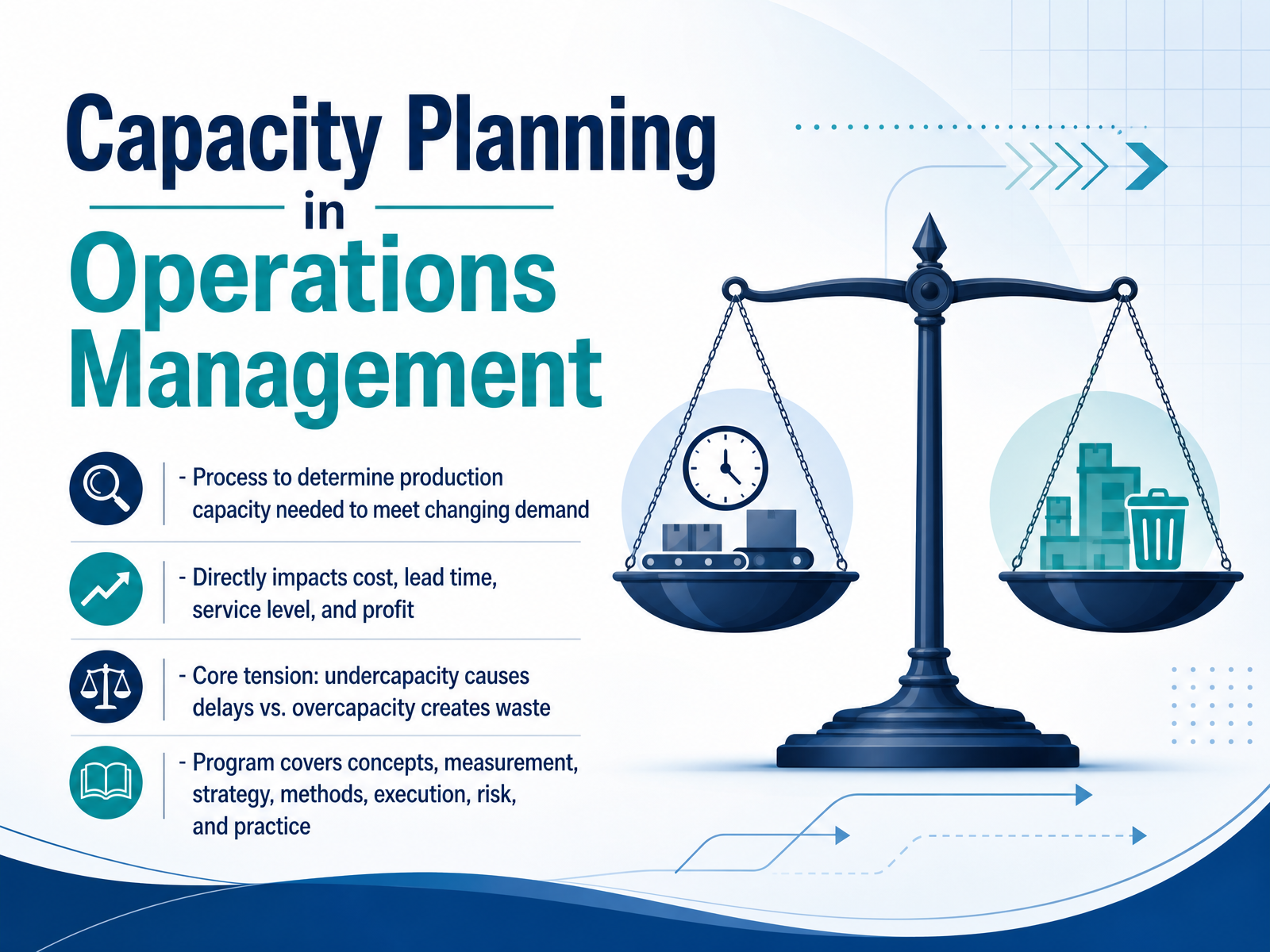
- 01Capacity Planning in Operations ManagementWelcome. In this program, we are going to focus on capacity planning, one of the most consequential levers you manage as an operations leader. The goal here is simple: to give you a practical framework for deciding how much capacity your operation needs as demand shifts. At its core, this is a process that determines the production capacity required to meet changing demand. It is not just a theoretical exercise. Your decisions directly affect your unit costs, your lead times, your service levels, and ultimately, your profitability. As you know, the central tension is acute. If you underestimate capacity, you face delays, stockouts, and frustrated customers. If you overestimate, you are paying for idle people, idle machines, and wasted floor space. Our time together will walk through the concepts, how to measure capacity, strategic choices, execution, and the risks involved. We will keep the focus on the trade-offs you face in your role. As we begin, think about your current operation: where are you feeling the squeeze of undercapacity, and where are you carrying costly slack? We will start by examining why getting this balance right is so critical.rowtonstraining.comen.wikipedia.orgebooks.inflibnet.ac.in+22 min
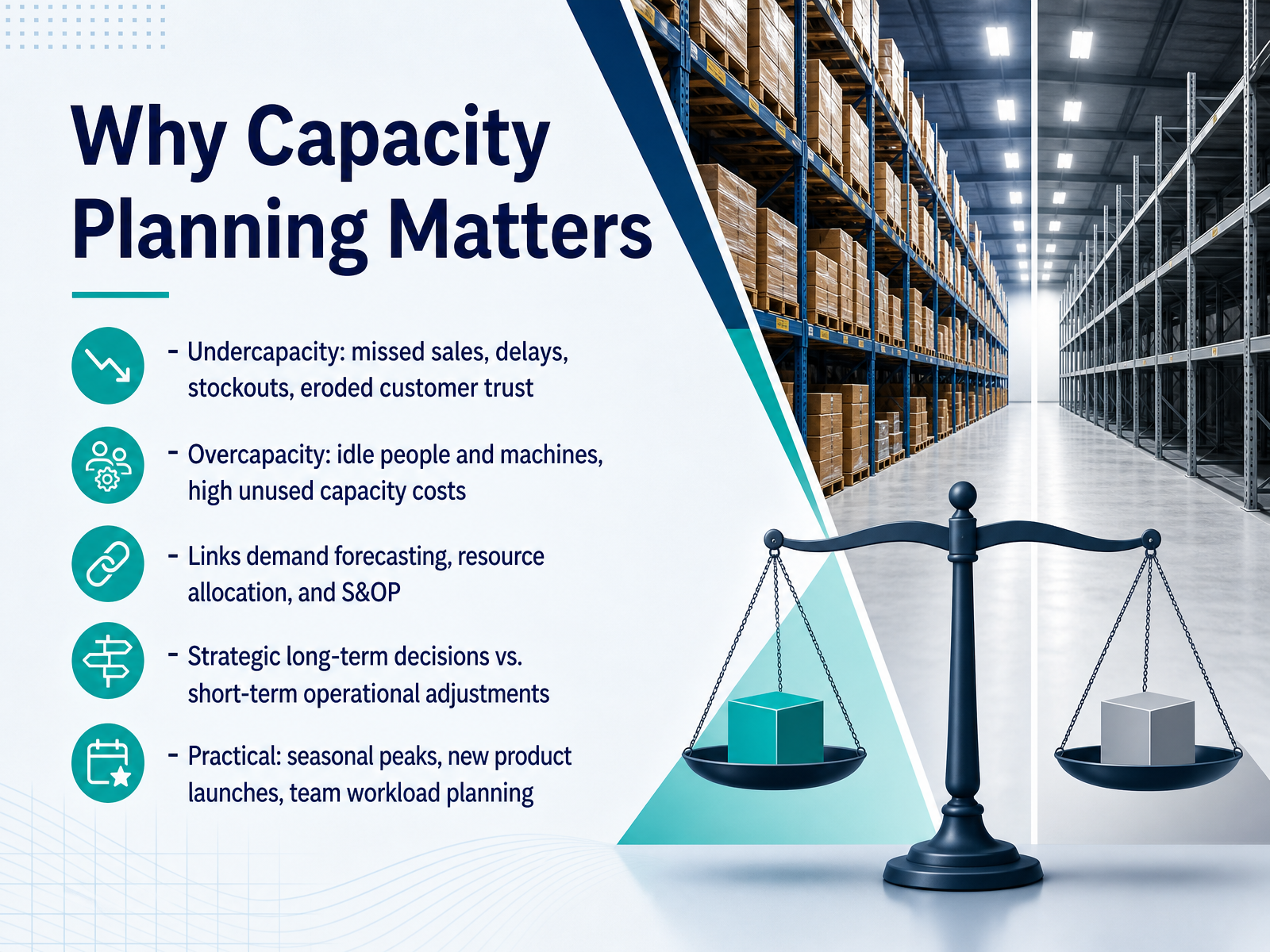
- 02Why Capacity Planning MattersLet's get straight to why capacity planning deserves your attention as a leader. The risk isn't just a number on a spreadsheet. If you underinvest in capacity, you face missed sales, late deliveries, and stockouts. The real cost there is customer trust, which is painfully slow to rebuild. On the flip side, overinvesting leaves you paying for idle people and idle machines. That is cash tied up in unused resources. Effective capacity planning connects your demand forecast to how you allocate your team and assets, and it is a key input to your sales and operations planning. It also forces you to think on two different timelines. Long term, you are making strategic calls about facilities and major equipment. Short term, you are adjusting shifts and workload to absorb volatility. Think about how this plays out in your world, whether you are planning for a seasonal peak, supporting a new product launch, or simply trying to balance your team’s workload without burning people out. The goal is to match supply to demand without falling into either extreme. Next, let's look at the core concepts that define how we measure and manage this capacity.
 rowtonstraining.comen.wikipedia.orgebooks.inflibnet.ac.in+21 min
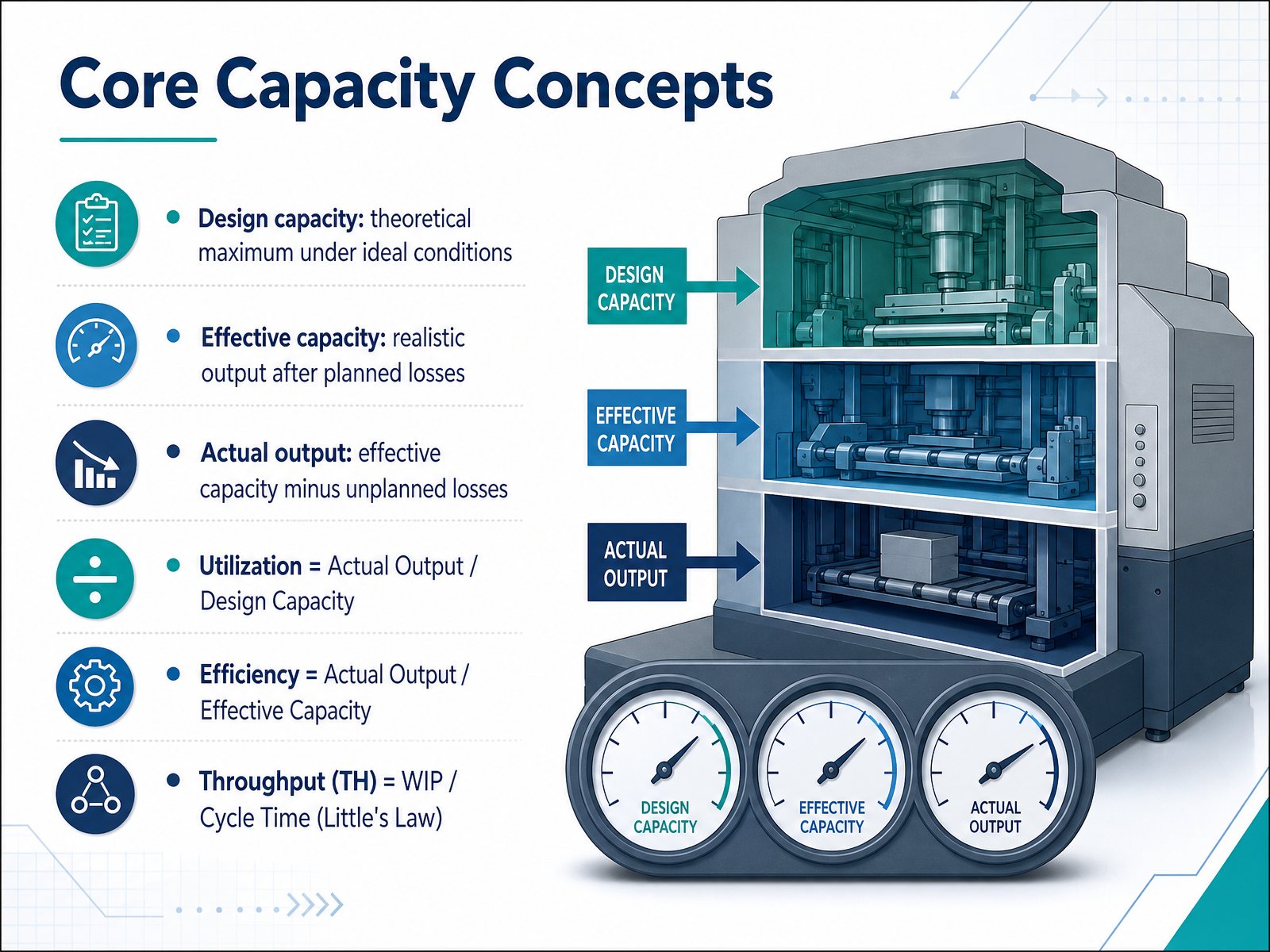
 - 03Core Capacity ConceptsNow let’s get clear on the numbers you are actually managing against. Capacity is not one number; it is three. Design capacity is the theoretical maximum, the perfect world where every machine runs at full speed with no interruptions. Effective capacity is what you can realistically sustain after planned losses, like changeovers, scheduled maintenance, breaks, and product mix. Actual output is what remains after unplanned losses, such as breakdowns or defects. This distinction drives two ratios. Utilization is actual output divided by design capacity. Efficiency is actual output divided by effective capacity. Here is the point: planning against design capacity overpromises and misses commitments. Plan against effective capacity. Finally, Little’s Law links throughput, work in process, and cycle time. Throughput equals WIP divided by cycle time. If you want to cut cycle time, reduce WIP while holding throughput steady. Up next, we’ll focus on bottlenecks and system capacity, because that is where your effective constraint actually lives.
 fabrico.iotamcam.tamu.edusymestic.com+22 min
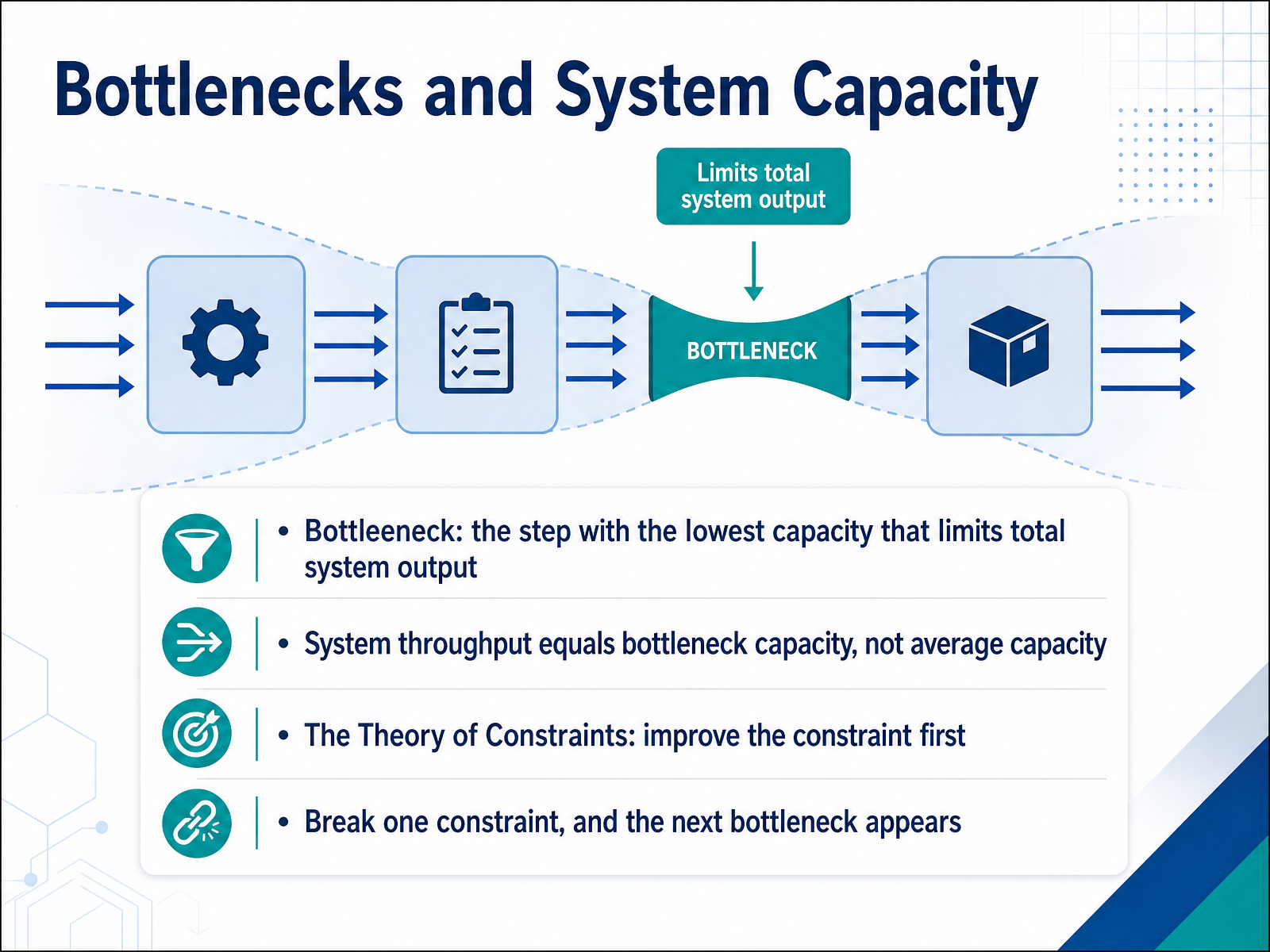
 - 04Bottlenecks and System CapacityNow, let’s get specific about bottlenecks and how they define system capacity. Remember, in any multi-step process, the bottleneck is the step with the lowest capacity. It’s the limiting factor. The key insight is that your total system throughput equals the capacity of that single slowest step, not the average of all your steps. So, if one stage can only process thirty units an hour while others can do fifty, your system outputs thirty units an hour, period. This is the basis of the Theory of Constraints. It tells you to focus your improvement effort on the constraint first. Investing time or money to speed up a non-bottleneck step has almost no impact on overall output. But here’s the practical challenge: once you successfully improve the current bottleneck, the constraint doesn't disappear. It simply moves. A new bottleneck appears at the next-most-limiting step. So, managing capacity is a continuous cycle of identifying and elevating constraints. With that in mind, let’s examine how we measure and model the demand that puts pressure on these constraints.
 opess.ethz.choreilly.commdpi.com+21 min
 - 05Measuring and Modeling DemandNow let’s turn to measuring and modeling demand. Demand forecasts are your foundational input here. If the forecast is off, every downstream capacity decision inherits that error. So the first step is to convert demand into required hours. Take your time standards and compare them against your actually available hours, not just your theoretical capacity. That means accounting for shifts, absenteeism, equipment availability, and routine downtime. Next, address variability explicitly. Seasonality, forecast error, and demand spikes are not exceptions. They are part of the plan. Use short, medium, and long term horizons so you can see both immediate constraints and longer term resource commitments. For the short term, focus on weekly or daily feasibility. For the medium term, look at labor and shift decisions. For the long term, think about capital, facilities, and structural capacity. When uncertainty is high, do not lock in one number. Run scenarios, hold capacity buffers where the cost of shortage is high, and schedule frequent review cycles. Good capacity modeling is not about finding the perfect forecast. It is about making the forecast usable for resourcing decisions. With that foundation in place, we can move to capacity strategy and planning horizons.
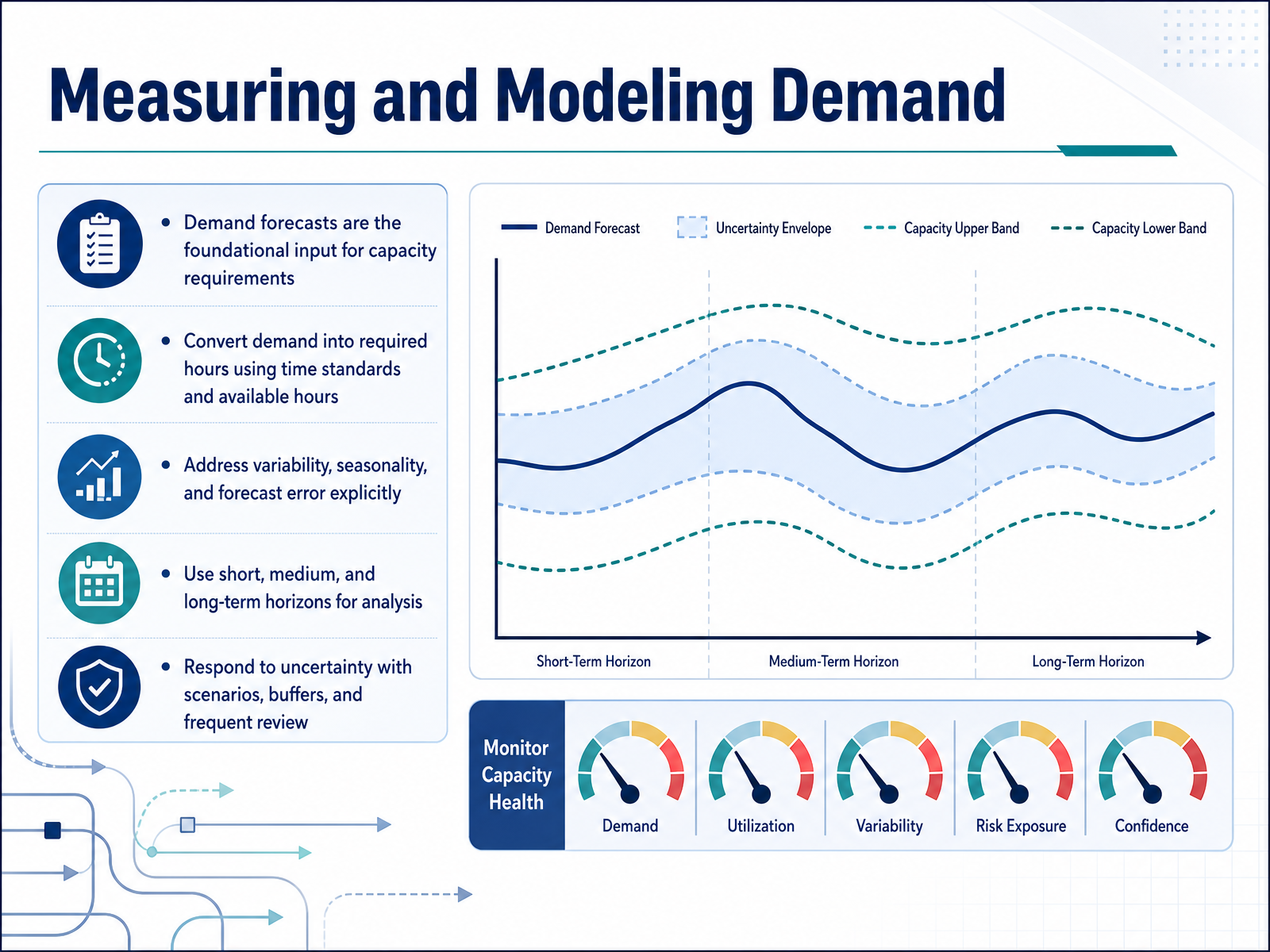 cips.orginvestopedia.complex.rockwellautomation.com+22 min
 - 06Capacity Strategy and Planning HorizonsNow, let's turn to how you choose a capacity strategy and the time horizons you need to plan across. The core decision is about timing. A lead strategy means you add capacity before demand arrives. It protects service levels and helps you capture market share, but it's a riskier bet on your forecast. A lag strategy is the opposite. You wait until demand is proven, which controls cost but can create delays and backlogs if demand spikes suddenly. A matching or tracking strategy sits between the two. You add capacity in small, frequent steps, which reduces risk but demands accurate, real-time demand data. These choices also play out across different timelines. Long-term strategic decisions, made over one to five years, might involve new facilities, major equipment, or make-or-buy choices. Short-term operational decisions, made over days or weeks, focus on shifts, overtime, and daily task allocation. Strategic levers like outsourcing and capacity sharing give you flexibility, but the right mix depends on your risk tolerance, your cost structure, and what the market will bear. Next, we'll look at the specific planning methods and tools that support these strategies.
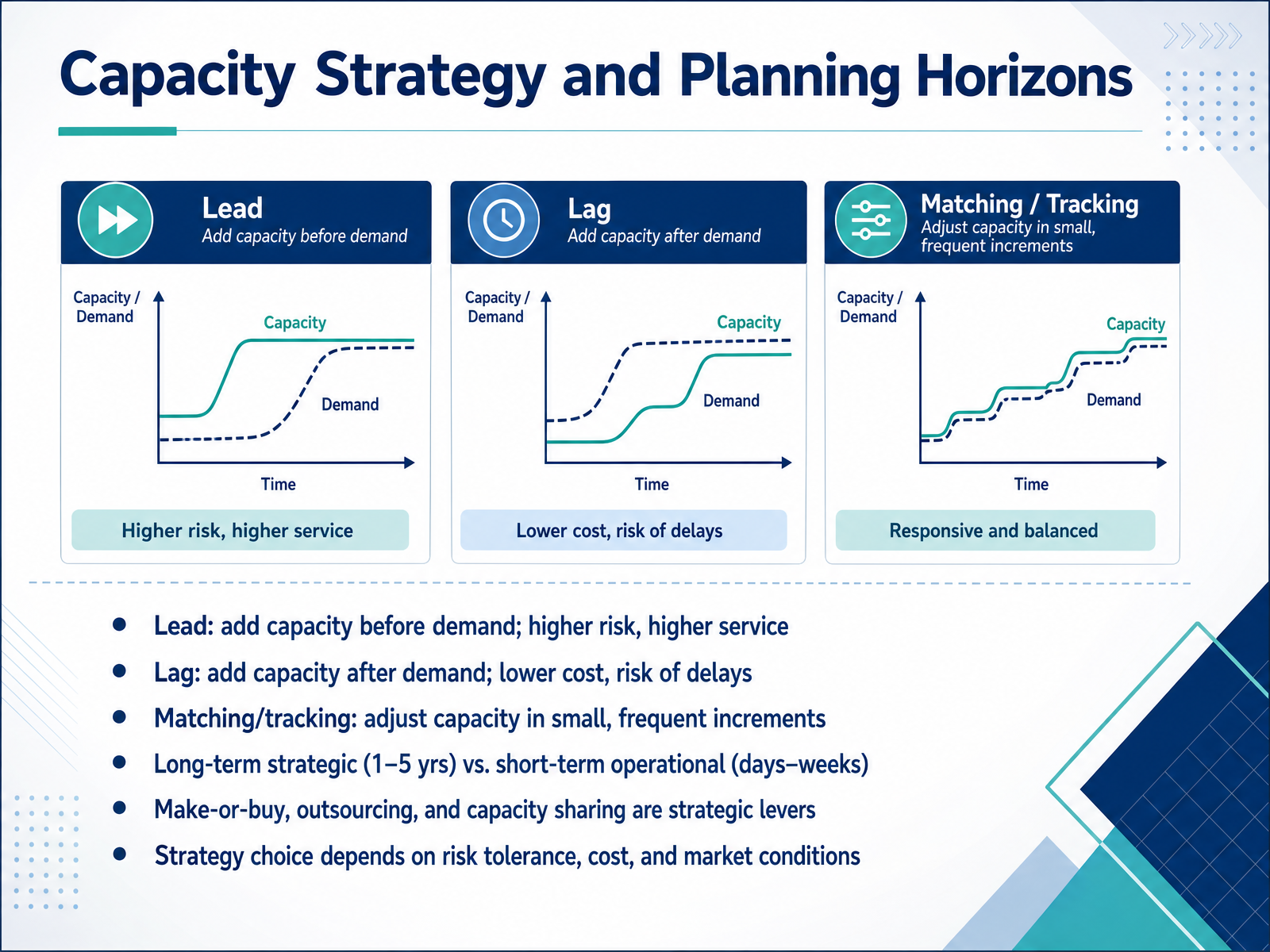 netsuite.complex.rockwellautomation.com2 min
 - 07Planning Methods and ToolsLet's move into the specific methods and tools you'll use to turn a demand plan into an actionable capacity picture. At the highest level, Rough Cut Capacity Planning, or R C C P, is your early warning system. It quickly checks the master schedule against your critical resources, like bottleneck machines or key labor groups, before you commit to detailed planning. If a plan fails here, you can adjust it while changes are still cheap. Once you run M R P, Capacity Requirements Planning, or C R P, provides the detailed validation. It uses routings and work centers to check load down to the hour or production rate, giving you the confidence that the schedule is executable. For a broader view, aggregate planning looks two to twelve months out to align overall capacity with demand trends. To test your options, simulation and spreadsheet tools let you run what-if scenarios, helping you decide whether to add shifts, outsource, or adjust forecasts without disrupting the shop floor. Remember the hierarchy: demand plan to master production schedule, then M R P and C R P, and finally detailed scheduling. Each layer adds precision, but skipping a step creates risk. Next, we'll apply these concepts to capacity decisions in services.
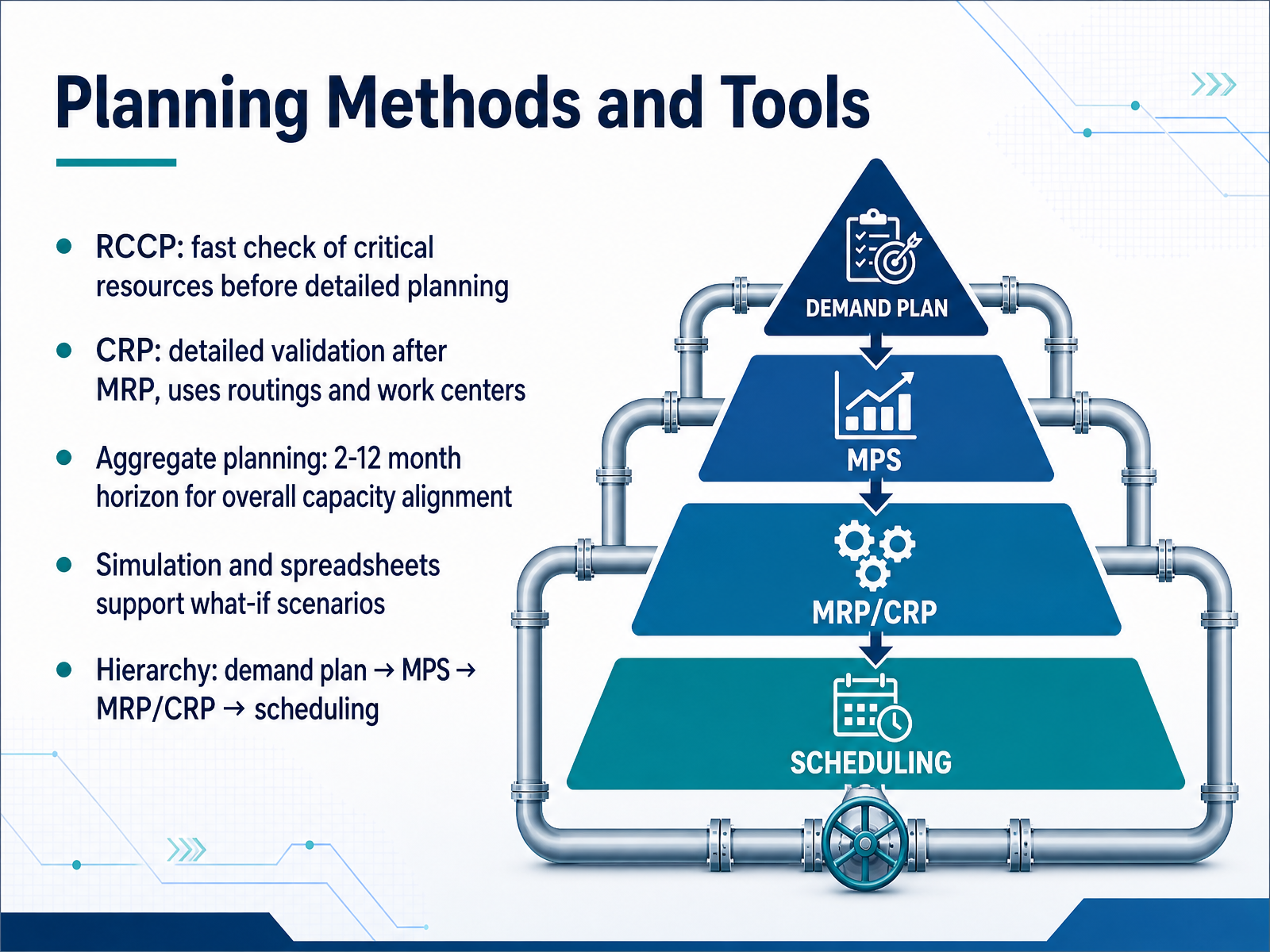 plex.rockwellautomation.comcips.orginvestopedia.com+22 min
 - 08Capacity Decisions in ServicesNow let's turn to services, where capacity decisions carry a different kind of pressure. Unlike physical goods, services cannot be stored. An empty hotel room or an idle consultant hour is value lost forever. This perishability makes the timing of demand the central problem for service leaders. Add to that the fact that your customer is present during delivery. Wait time is not a minor inconvenience; it largely defines the experience. The customer may forgive a delay if the value is high, but rarely forgets it. To protect service quality, you have to manage the demand itself. Pricing, reservations, and targeted promotions can shift some load from peak periods. Early bird pricing or off-peak scheduling are not just discounts; they are capacity tools. And how do you measure capacity here? The old manufacturing question of units per hour rarely translates cleanly. In a hospital you might measure beds, in a clinic it is staff hours, and in a restaurant it is seats. The measure you choose determines every downstream trade-off. So the real decision is which constraint truly governs the customer's outcome. And that leads us directly to managing constraints and bottlenecks.
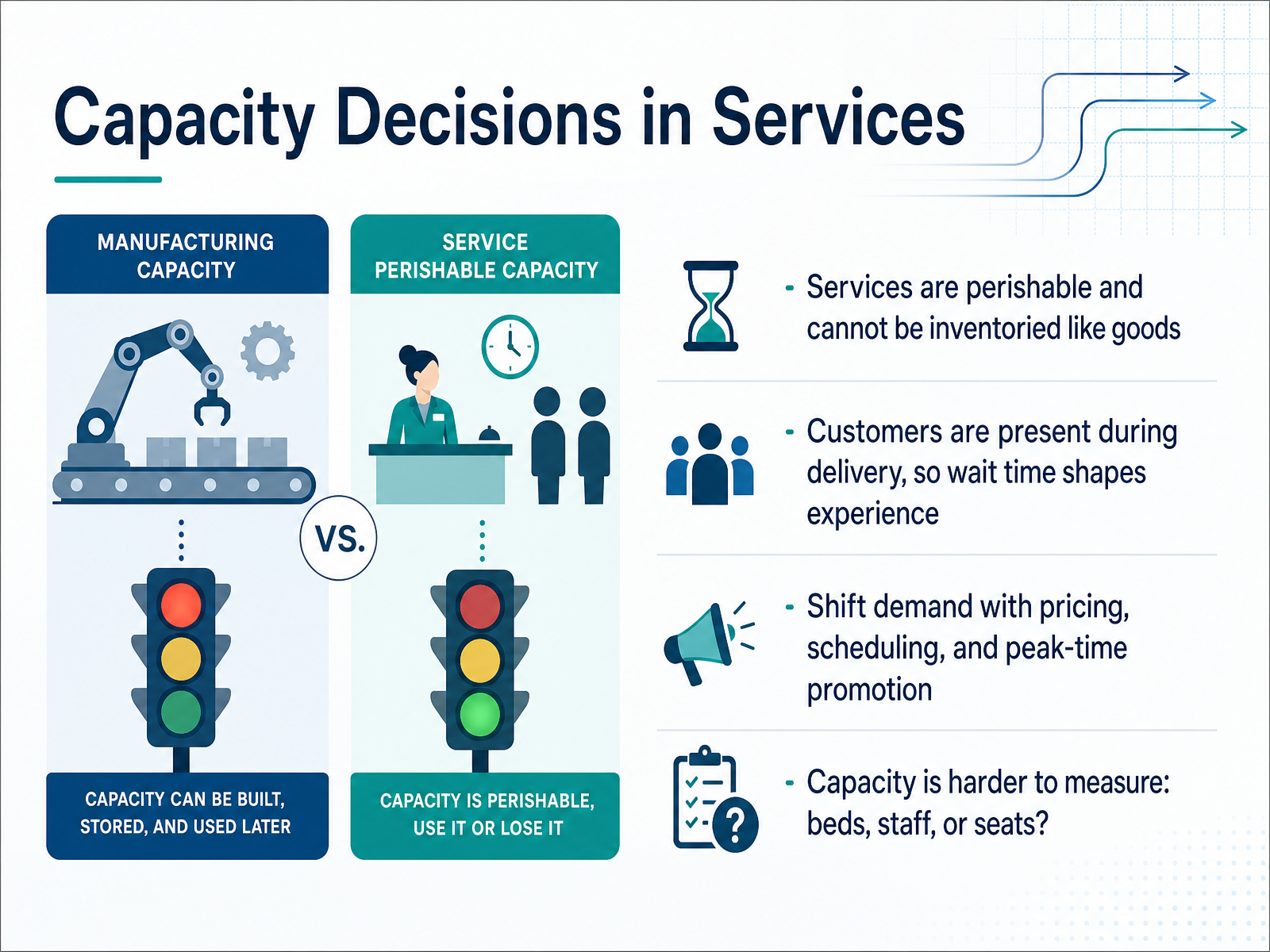 netsuite.comrowtonstraining.comen.wikipedia.org+22 min
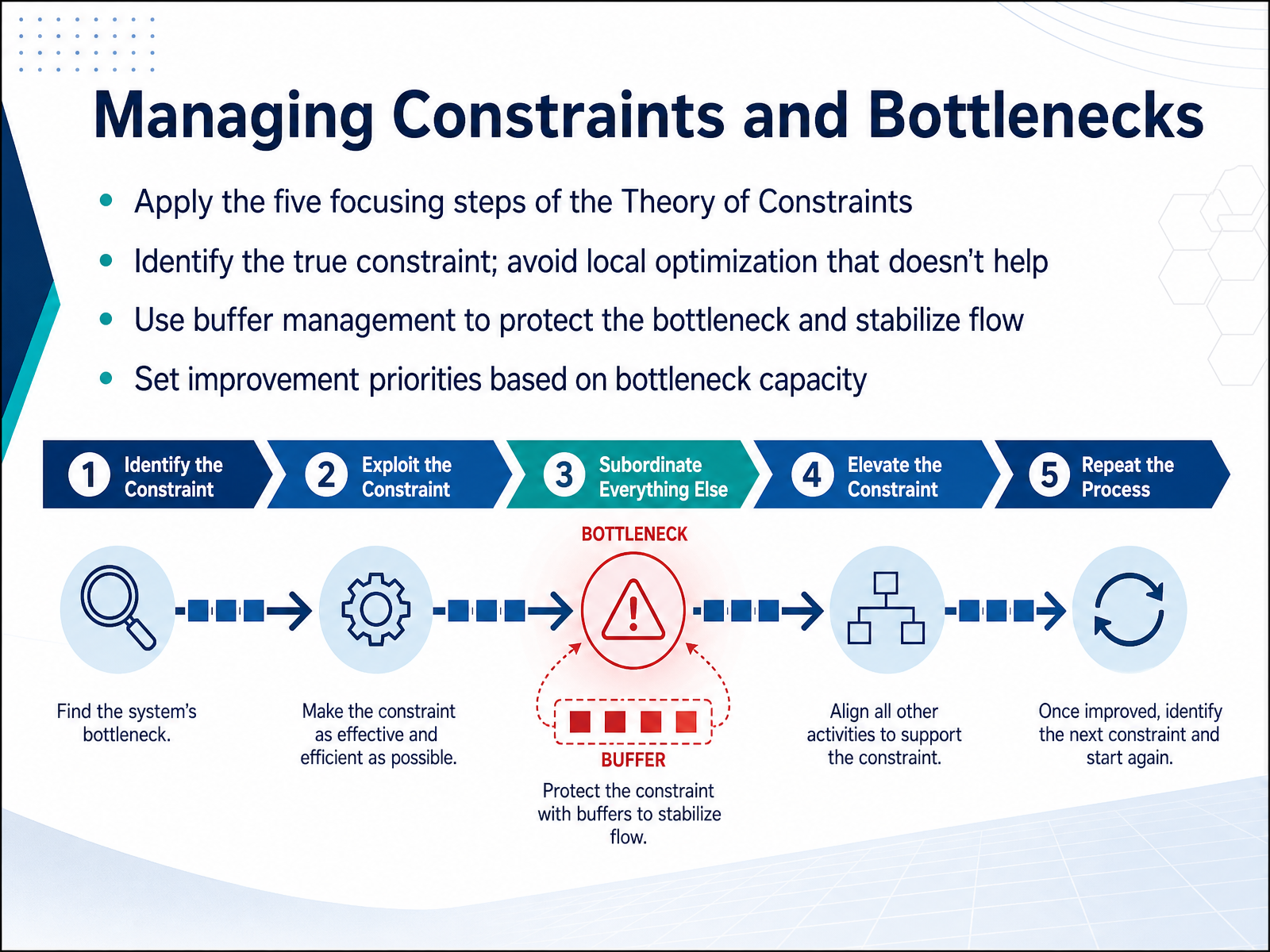
 - 09Managing Constraints and BottlenecksLet’s look at managing constraints and bottlenecks directly. In capacity planning, your system can only move as fast as its slowest resource. The Theory of Constraints gives you a practical five step cycle for dealing with this. First, identify the real limiting constraint. That’s not always the busiest machine. It’s the resource where required capacity consistently exceeds available capacity. Second, exploit that constraint. Run it during breaks, reduce setup time, and never let it sit idle. Third, subordinate everything else to it. Let non-bottleneck resources work at the pace the constraint sets, even if that means they are not fully utilized. Local efficiency at non-constraints often just builds unwanted inventory and creates false load. Fourth, elevate the constraint. Add capacity only after you have fully exploited what you already have. Finally, go back and find the next constraint. As one bottleneck clears, another one emerges. To keep flow stable, use buffers. An upstream buffer prevents the bottleneck from being starved, and a downstream buffer protects customer delivery if the bottleneck has a temporary problem. Set improvement priorities based on bottleneck capacity. A one percent gain at the true constraint is worth more than a large gain somewhere else that never reaches the customer. Now let’s turn to how we measure that improvement with capacity metrics and performance.
 opess.ethz.choreilly.commdpi.com+22 min
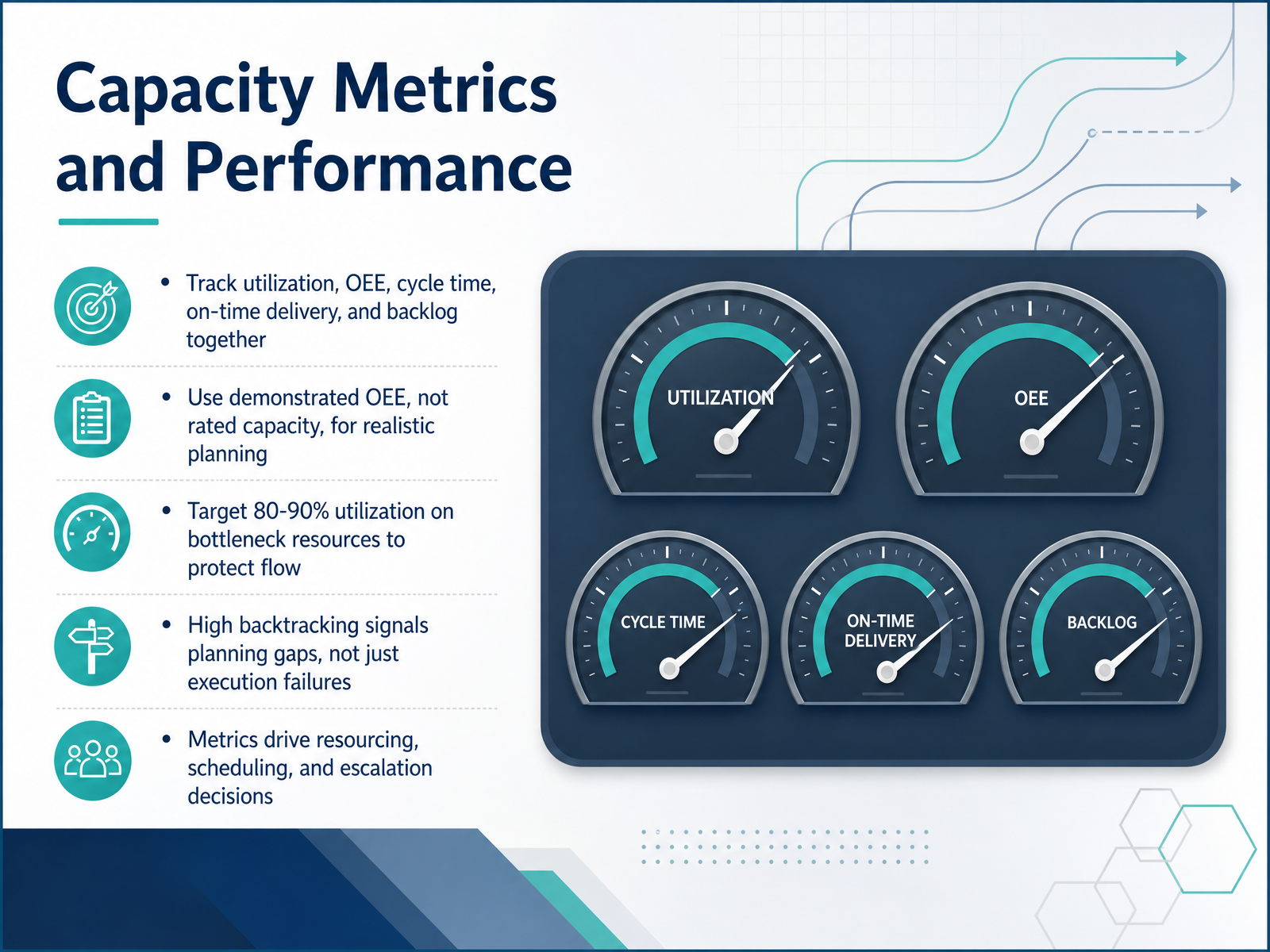
 - 10Capacity Metrics and PerformanceNow let's get practical about metrics. When you're managing capacity, the numbers that matter most need to be tracked together: utilization, OEE, cycle time, on-time delivery, and backlog. In isolation, any one of these can mislead you. A high utilization rate with a growing backlog tells you flow has broken down. Good on-time delivery with declining utilization suggests you're carrying too much idle capacity. The full picture only appears when you read them side by side. Here's a key shift in thinking: use demonstrated OEE, not rated capacity, for realistic planning. Rated capacity is what a machine should do on paper. Demonstrated capacity reflects what actually happens with your mix, your maintenance, and your people. One more decision point: target eighty to ninety percent utilization on bottleneck resources. Not one hundred. At full load, any small disruption immediately becomes late orders. And if you're seeing a lot of backtracking in the workflow, treat it as a signal. It usually points to a planning gap, not just weak execution. These metrics are not for the monthly report. They should directly shape resourcing, scheduling, and when you escalate. Up next, we'll look at how to handle risk, uncertainty, and flexibility.
 netsuite.com2 min
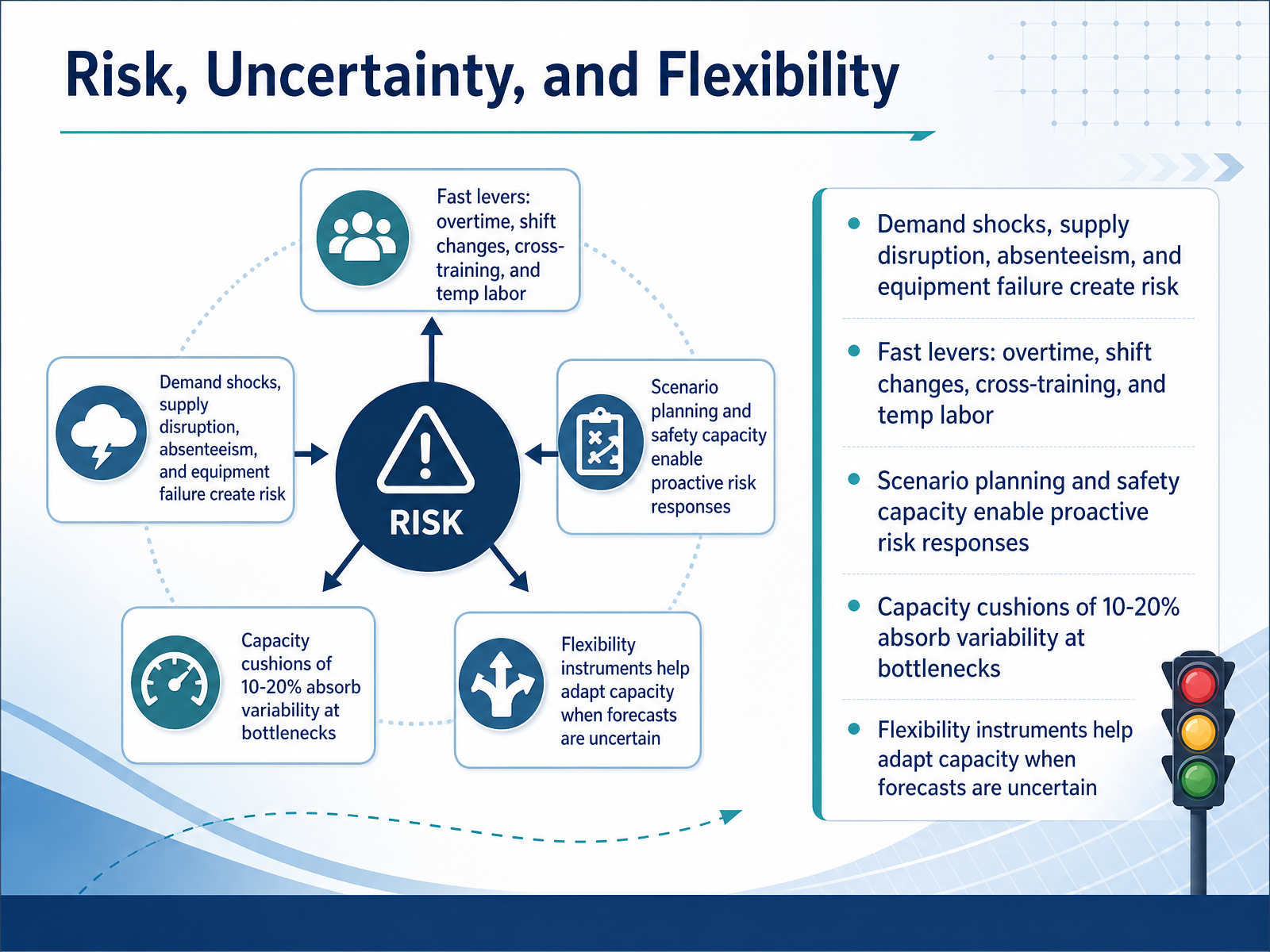
 - 11Risk, Uncertainty, and FlexibilityRisk is a normal part of running operations. Demand shifts suddenly, suppliers miss deliveries, a key team member calls in sick, or a piece of equipment fails at the worst possible time. The question is not whether these disruptions will happen, but how quickly you can respond. Fast levers like overtime, shift changes, cross-training, and temporary labor give you options when speed matters most. For example, if one narrow skill becomes a bottleneck, a few cross-trained employees can immediately relieve pressure without adding headcount. At the same time, scenario planning and safety capacity let you prepare before disruption hits, so your response is a decision, not a reaction. A capacity cushion of ten to twenty percent at bottlenecks absorbs variability before it becomes a delivery problem. When forecasts are uncertain, flexibility instruments such as overtime accounts and adjustable maintenance windows help you adapt capacity without locking in fixed costs. The key is to match your levers to the type of uncertainty you actually face, keeping team impact and execution risk in view. Next, we will move from planning to execution.
 2 min
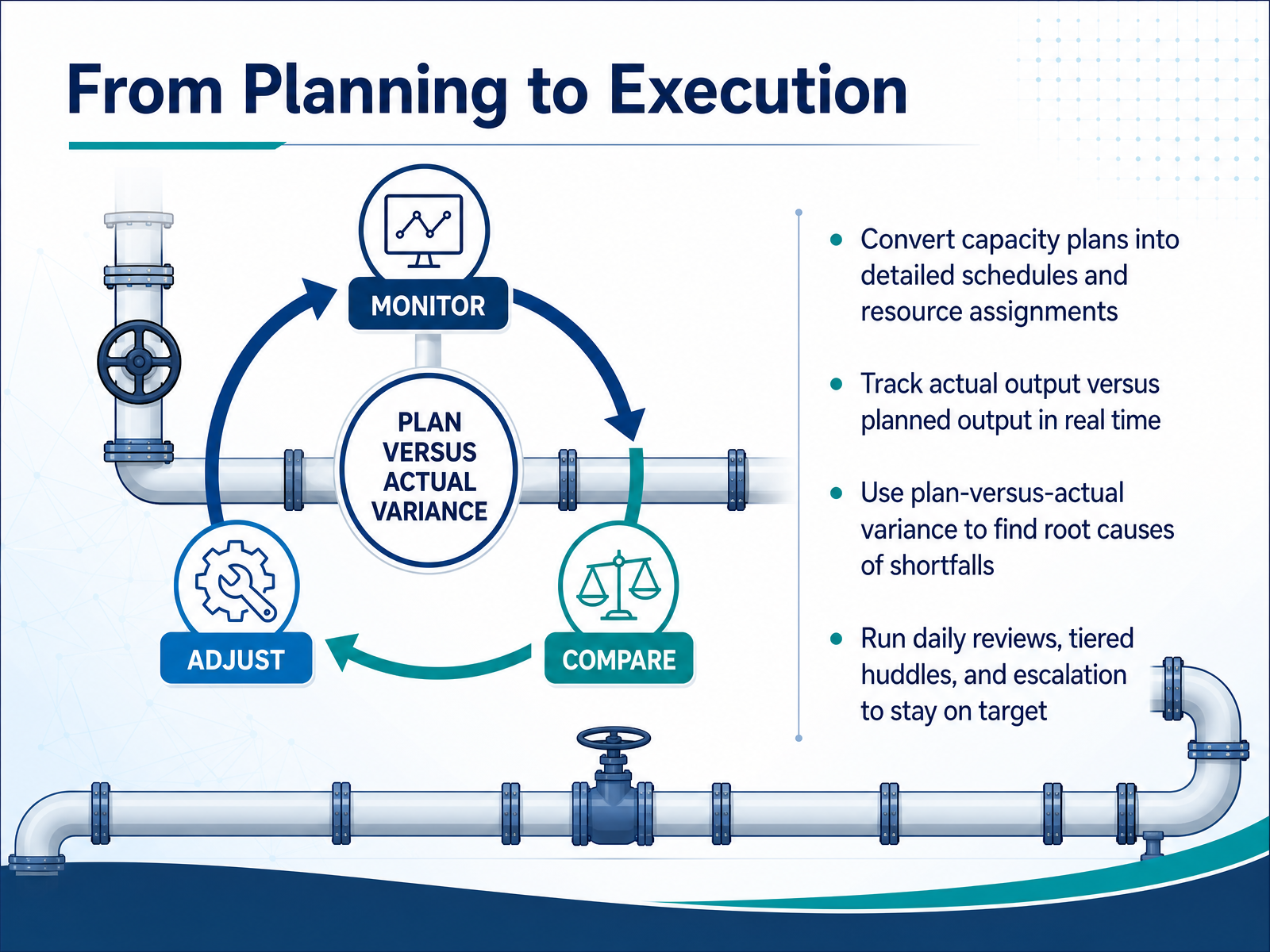
2 min - 12From Planning to ExecutionSo the plan is validated, and now we shift from deciding what is feasible to making it happen. This is where capacity management either earns its keep or stays on a spreadsheet. Your first move is to convert the plan into detailed schedules and resource assignments. That means translating the approved hours into named equipment, named teams, and named shifts. Once execution begins, track actual output against planned output in real time, not just at the end of the week. When a gap appears, treat it as a signal, not a surprise. Use the plan-versus-actual variance to find the root cause. Was it unplanned downtime, a long changeover, or a material shortage? The data should point to the driver. Then run daily reviews, tiered huddles, and a clear escalation path. Keep those meetings short, focused on the bottleneck, and tied to a decision or an owner. The goal is a closed loop. Plan, execute, compare, correct. Next, we will move into how to put capacity planning into practice.
 plex.rockwellautomation.com2 min
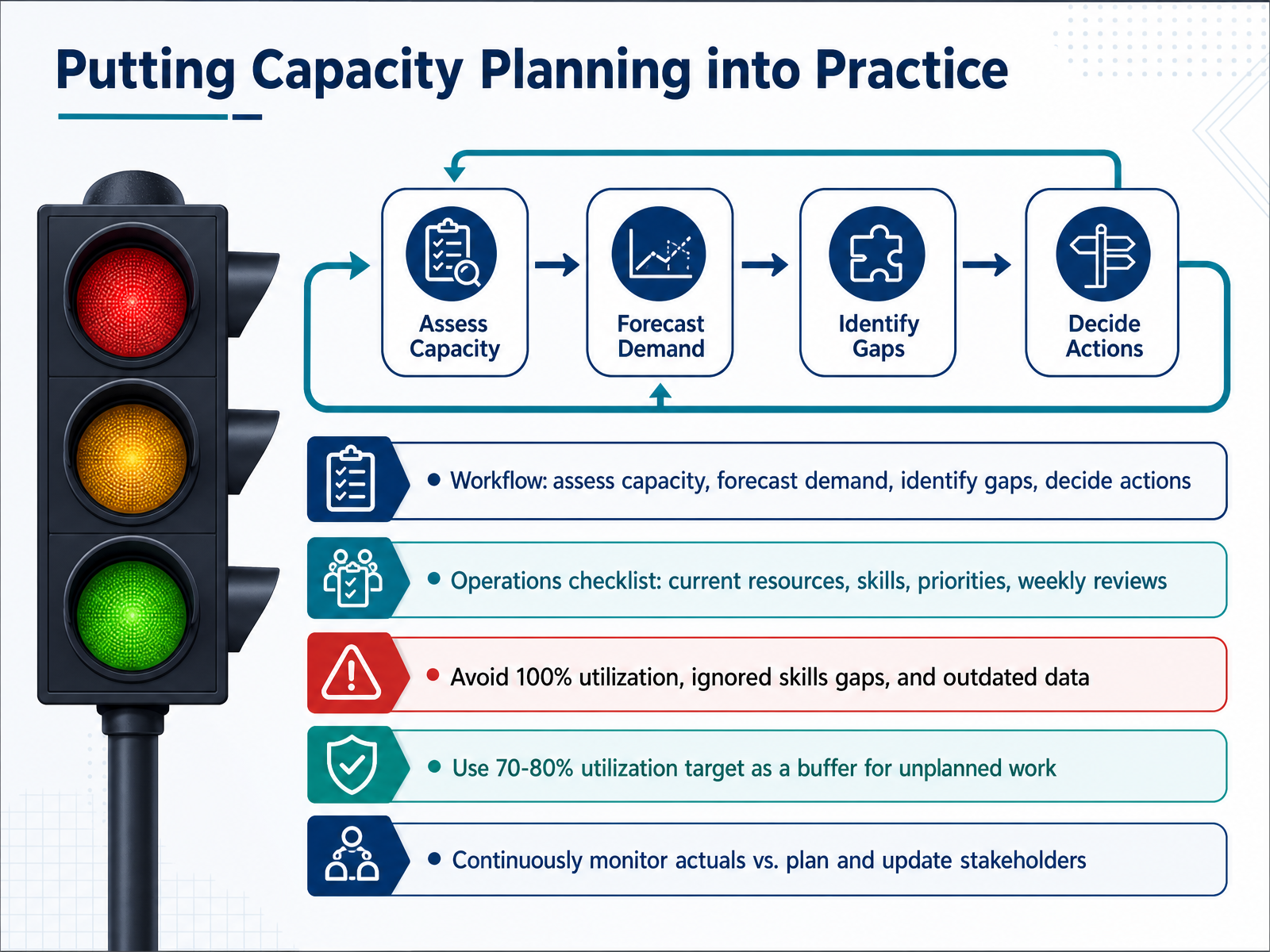
 - 13Putting Capacity Planning into PracticeLet's turn this into a working routine. The practical flow is simple: assess your current capacity, forecast the demand ahead, identify where the gaps are, and decide what actions you will take. Your recurring checklist should stay focused on current resources, the skills you actually have against the skills you need, and your current priorities. Then review it weekly. Keep your plans grounded in real data. Avoid three common traps: planning to one hundred percent utilization, ignoring skills gaps because the hours look sufficient, and making decisions on outdated information. A utilization target of seventy to eighty percent is not a sign of low ambition. It is the buffer you need for unplanned work, absences, and urgent requests. Finally, treat this as a continuous loop. Compare actuals against the plan every week, and update your stakeholders before small variances become delivery risks. That discipline is what turns capacity planning from a spreadsheet exercise into a real operating advantage. Next, we will close with the key takeaways and the next steps you can put into action.
 netsuite.com1 min
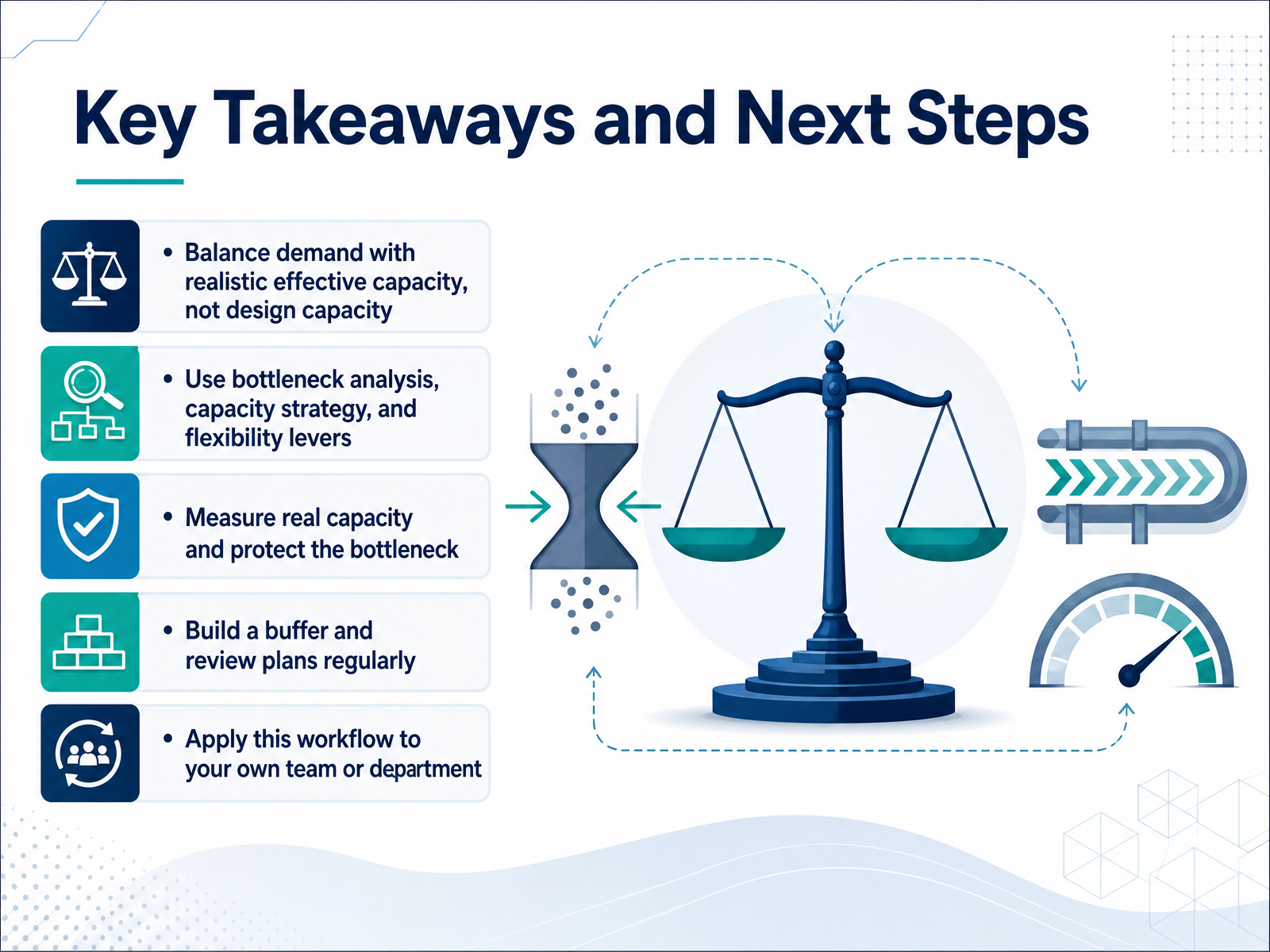
 - 14Key Takeaways and Next StepsLet's bring this together as a final checklist for your own team. First, plan against effective capacity, not the ideal number. That means accounting for real availability, skills, and the inevitable unplanned work. Second, keep your analysis focused. Find the bottleneck, choose a lead, lag, or match strategy deliberately, and use flexibility levers like cross-training or temporary support before adding permanent cost. Third, protect your constraint. Measure actual output, monitor backlog, and keep a buffer, typically around ten to twenty percent, so variability does not immediately become a missed delivery. Finally, treat the plan as a living document. Review it monthly with your team, and weekly when demand shifts. The practical next step is simple. Pick one team or department, apply this workflow, and see where the real constraint actually sits. Thank you for joining this session. The goal is not a perfect forecast, but a management rhythm that keeps promises realistic and your team sustainable.
 netsuite.com2 min
Take the deck with you
Download this course as a file — free, no sign-up needed.
- PDF handoutEvery slide page, ready to print or share.15 pages · 3.8 MBDownload
- Narrated PowerPointThe deck that presents itself — every slide carries the digital human's narration video.15 pages · 15.9 MBDownload
- PowerPoint slidesThe full deck as a .pptx — open it in PowerPoint, Keynote, or Google Slides.15 pages · 3.7 MBDownload
Free to use in your own training — please keep the PersonWise credit page at the end.
Have your own deck? Turn it into a course
Sources consulted
Web sources consulted while building this course.
- What is Capacity Planning in Operations Management? - Rowtons Training — rowtonstraining.com
- Capacity planning — en.wikipedia.org
- Capacity Planning: Importance and Measures – Operations Management — ebooks.inflibnet.ac.in
- Capacity Planning Defined | NetSuite — netsuite.com
- Capacity Planning - Meaning, Classification and its Goals - Management Study Guide — managementstudyguide.com
- Design Capacity vs Effective Capacity: The Theoretical Max vs the Realistic Max — fabrico.io
- Basic Factory Dynamics — tamcam.tamu.edu
- Capacity Planning: Theoretical vs. Effective Capacity, Horizons & Why Most Plans Fail — symestic.com
- Calculating the Capacity of Chemical Plants — aiche.org
- Production Capacity: Formula, Types & the Hidden Capacity in Your Plant — symestic.com
- 5.1.5b Beyond MRP II: The “Theory of Constraints” — opess.ethz.ch
- Bottleneck Analysis and the Theory of Constraints - Operations Management: Sustainability and Supply Chain Management, Twelfth Edition [Book] — oreilly.com
- A Comprehensive Review of Theories, Methods, and Techniques for Bottleneck Identification and Management in Manufacturing Systems — mdpi.com
- Chapter 7: Capacity Planning and Management — pure.port.ac.uk
- Theory of Constraints of Eliyahu M. Goldratt - Theory of Constraints Institute — tocinstitute.org
- Capacity Requirement Planning Guide — cips.org
- Capacity Requirements Planning (CRP): Definition, Process, and Importance — investopedia.com
- Capacity Planning: An Industry Guide | Rockwell Automation | Plex | US — plex.rockwellautomation.com
- Capacity Planning: An Industry Guide | Rockwell Automation | Plex | US — rockwellautomation.com
- What is Capacity Planning (CRP)? | Definition and Types of ... — cin7.com