Begin
14 pages · ~28 min
Sales Enablement Process Essentials
Sales enablement training covering key stages, roles, and deliverables to equip sales teams with the skills and tools for effective process execution.
A digital instructor presents all 14 pages. Hold “Ask” at any point and ask out loud — the answer comes from this course. No sign-up needed.
What you’ll learn
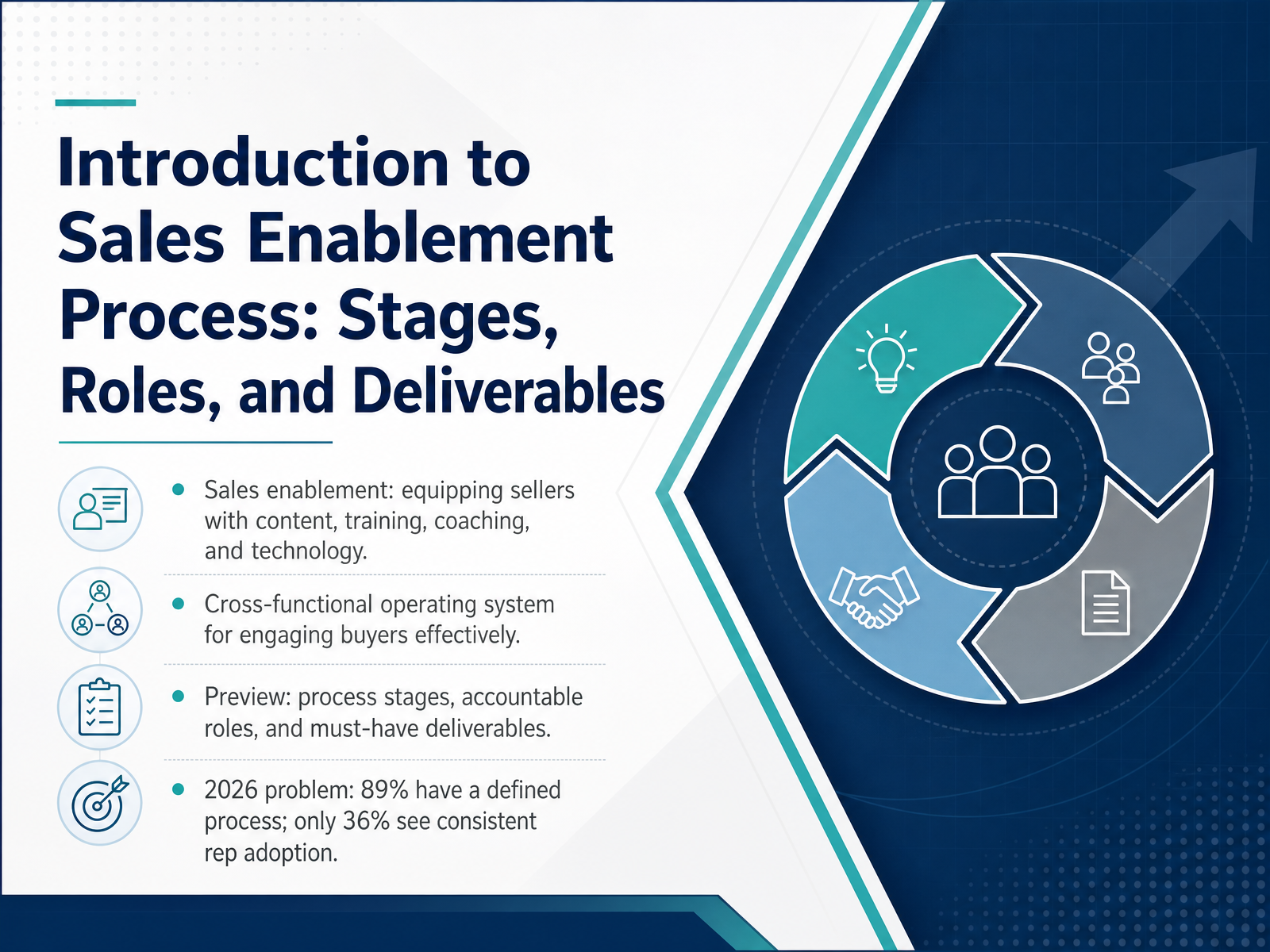
- 01Introduction to Sales Enablement Process: Stages, Roles, and DeliverablesWelcome. In this course, we are going to break down the sales enablement process from a vague concept into a repeatable operating system. Our goal is to give you a clear picture of the stages, the accountable roles, and the specific deliverables that keep the engine running. We are not going to talk about abstract theory. We are going to talk about things like stage gates, handoff points, and the content lifecycle, because those are the daily mechanics of your job. To frame why this matters right now, consider the current problem. In 2026, eighty nine percent of sales teams have a defined process. But only thirty six percent see consistent rep adoption. That fifty three point gap is the execution gap, and it is where most enablement investments are lost. So today, we are going to focus on how to close that gap by building a process that reps actually run, not one that just sits in a document. Let's start by looking at why a structured enablement process matters in the first place.g2.comgartner.comhighspot.com+22 min
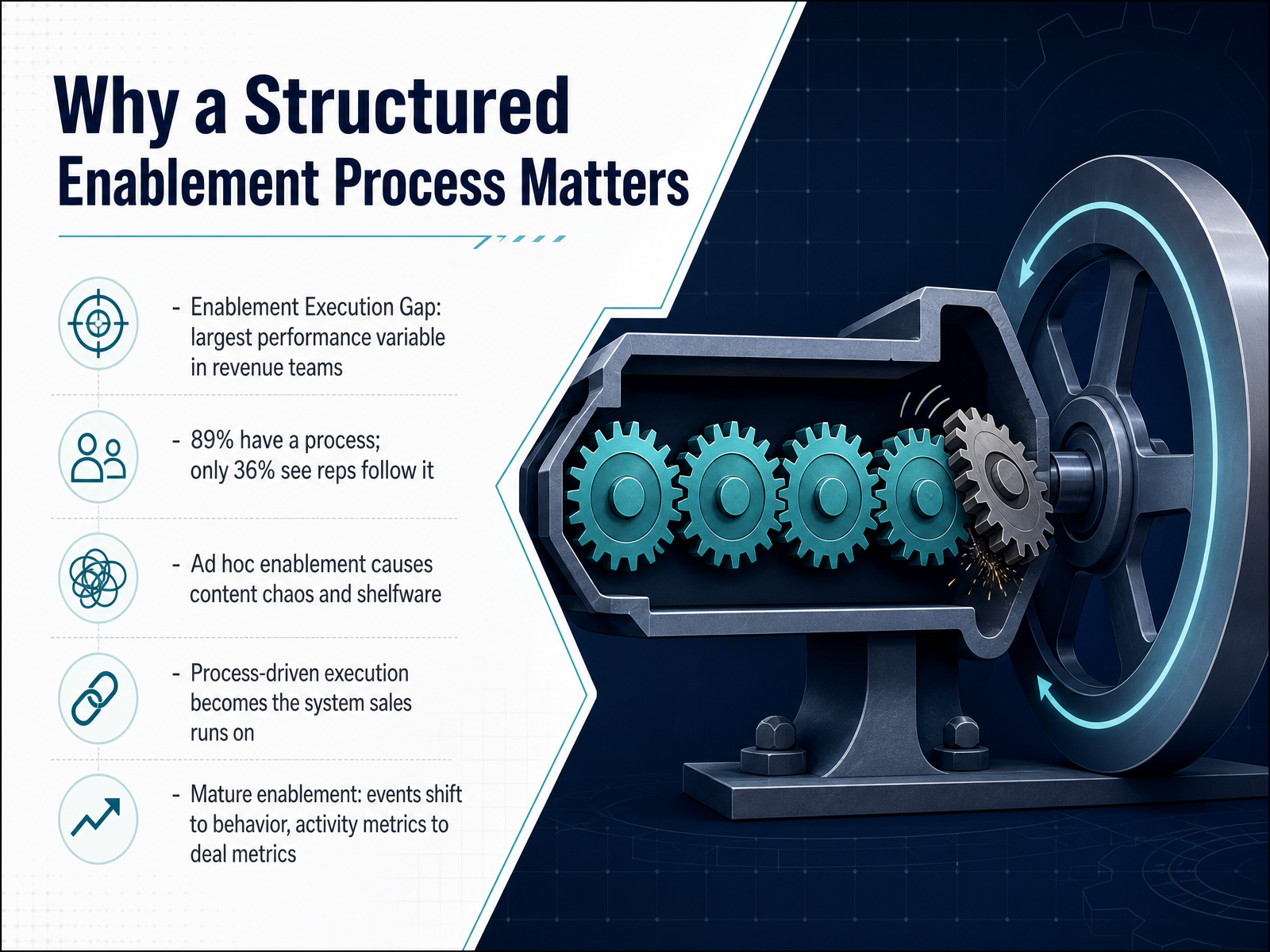
- 02Why a Structured Enablement Process MattersLet’s talk about why a structured enablement process matters so much right now. The research is clear. Eighty nine percent of revenue teams have a defined sales process. But only thirty six percent see their reps actually follow it consistently. That fifty three point gap is what the State of Sales Enablement now calls the Enablement Execution Gap. And it is the single biggest performance variable in modern revenue teams. It predicts quota attainment more strongly than territory design, compensation structure, or even your chosen sales methodology. When enablement runs ad hoc, the result is predictable. Content becomes chaos. Assets turn into shelfware. Reps learn to ignore the process because managers do not enforce it, and the guidance never lives where the deal is actually being worked. Process driven execution flips that. It becomes the operating system the revenue team runs on. In mature enablement organizations, the focus shifts from running training events to driving measurable behavior change. And the metrics move with it. Activity metrics like completions and content views give way to deal metrics like stage conversion, inspection frequency, and quota attainment. Teams that inspect deals against a structured process hit quota at six point three times the rate of teams that do not. That is the difference between a process on paper and a process in practice. Next, we need to diagnose exactly where that execution gap comes from and what it looks like in your current workflow.
 federicopresicci.comlxahub.comsupered.io+22 min
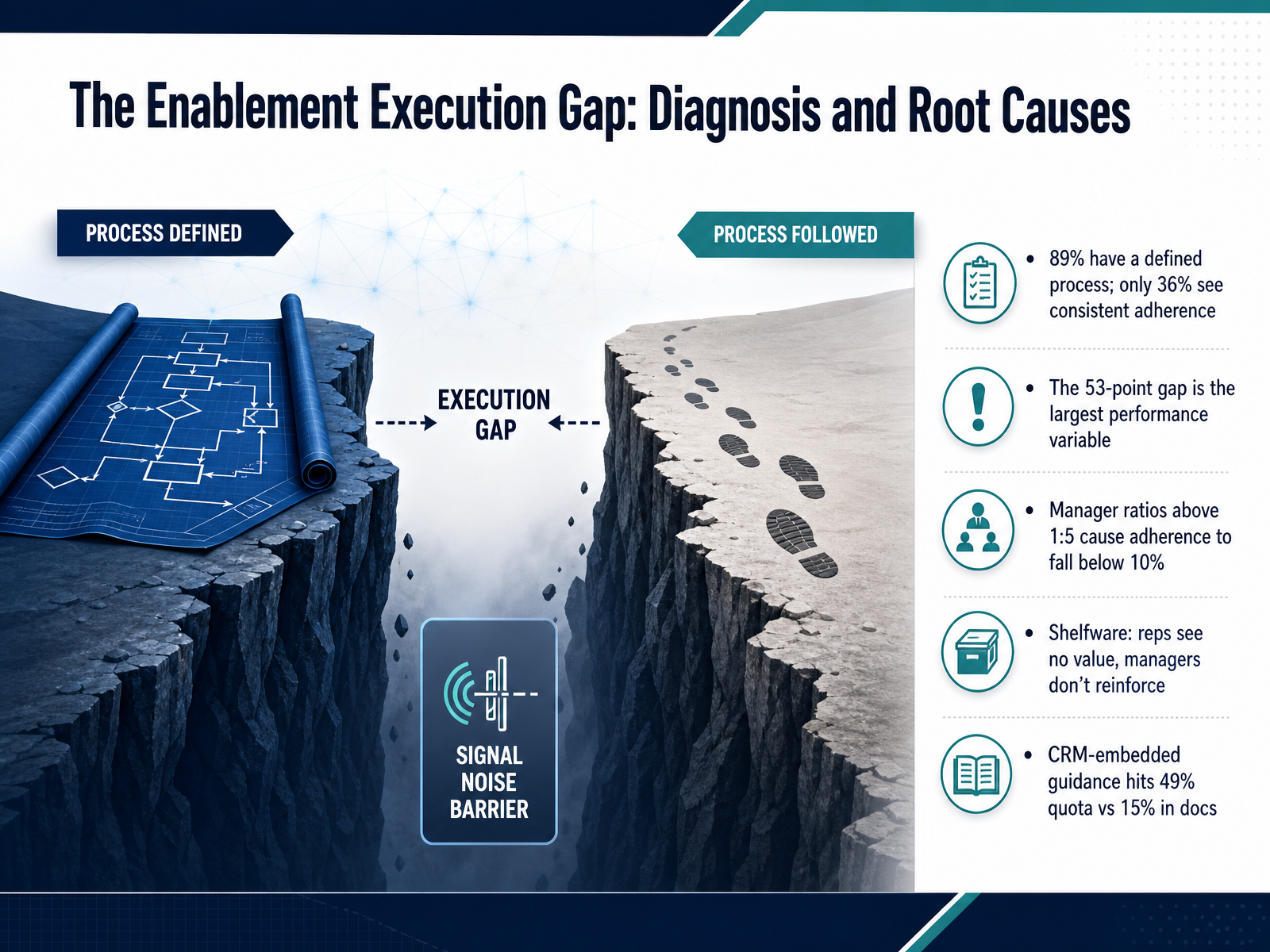
 - 03The Enablement Execution Gap: Diagnosis and Root CausesNow let's get specific about the enablement execution gap, because the data here should reframe how you look at your own process. The headline number is stark. Eighty-nine percent of revenue teams say they have a defined sales process. But only thirty-six percent see reps actually follow it consistently. That fifty-three point gap is not a documentation problem. It is the single largest performance variable in the study, bigger than territory design or compensation. Now look at the manager ratio. When a manager supports five reps or fewer, nearly half of those teams reach high adherence. Push that ratio to six or more reps, and adherence collapses to under ten percent. That is a capacity cliff, not a talent issue. The same pattern shows up in shelfware. Reps don't see the value, and managers don't have the bandwidth to reinforce it. The fix is not more content. It is putting guidance where the work actually happens. Teams that embed process steps directly in the CRM hit quota at forty-nine percent. Teams that leave the same guidance in documents and wikis sit at fifteen percent. That is more than a three times difference. The operating takeaway is clear. Adherence is your primary currency, and workflow placement drives adherence.
 federicopresicci.comlxahub.comsupered.io+22 min
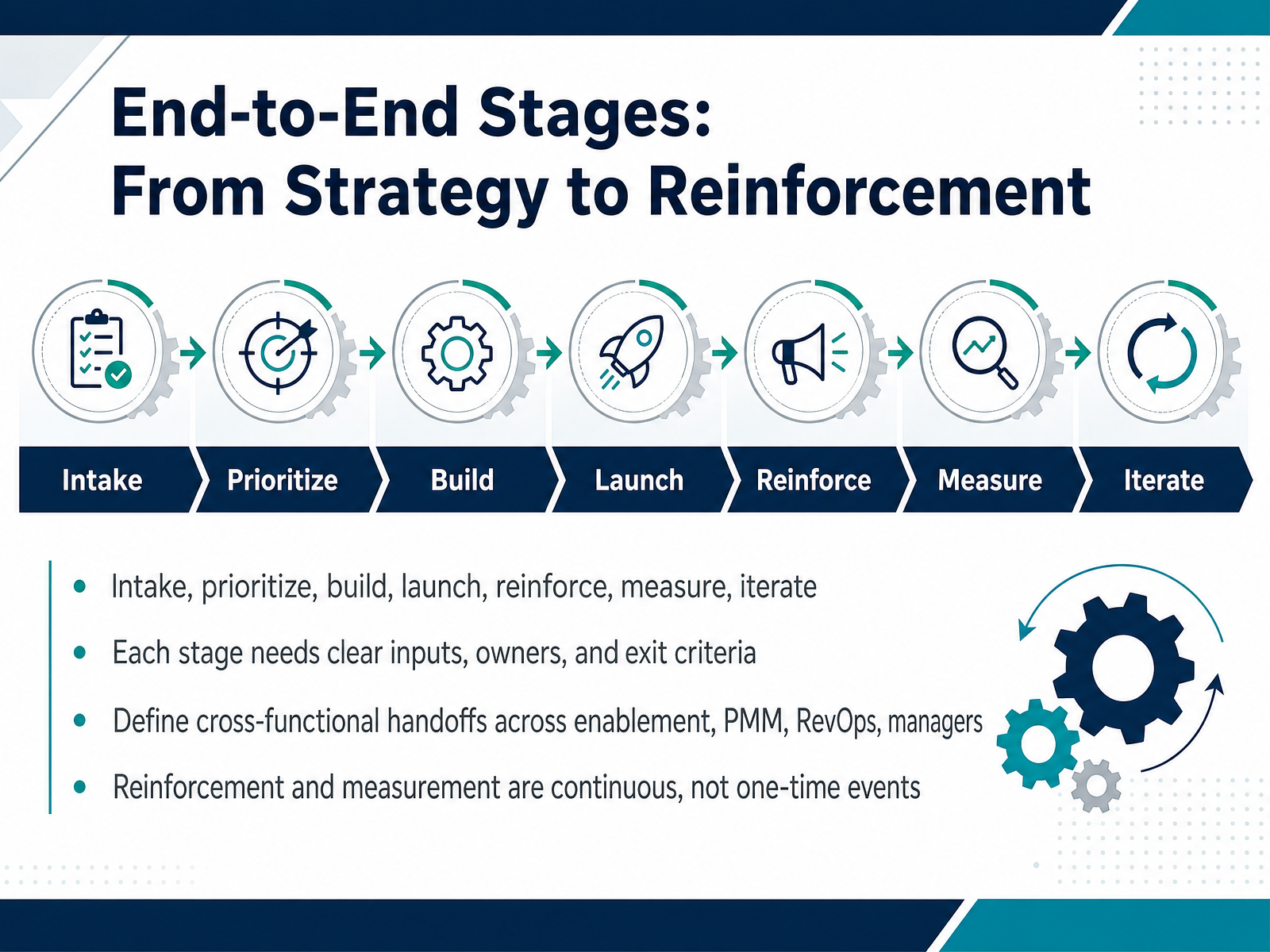
 - 04End-to-End Stages: From Strategy to ReinforcementNow let's map the full process, because if the stages aren't connected, the system breaks down. We move through seven stages: intake, prioritize, build, launch, reinforce, measure, and iterate. That's the operating rhythm. Each stage needs three things to function: clear inputs, a named owner, and defined exit criteria. If any of those are missing, you get handoffs that stall and work that circles back. The owners aren't all in enablement. Product marketing feeds the build stage. RevOps owns the measurement data. And frontline managers are critical during launch and reinforcement, because they're the ones who turn assets into actual rep behavior. A key point here: reinforcement and measurement are not one-time events. They run continuously. You launch once, but you coach, inspect, and adjust on an ongoing cadence. That's what separates a process that exists on paper from one that actually changes how deals are worked. Up next, we'll look at the stage gates and exit criteria that prevent downstream failure.
 prospeo.iofedericopresicci.comfedericopresicci.com+22 min
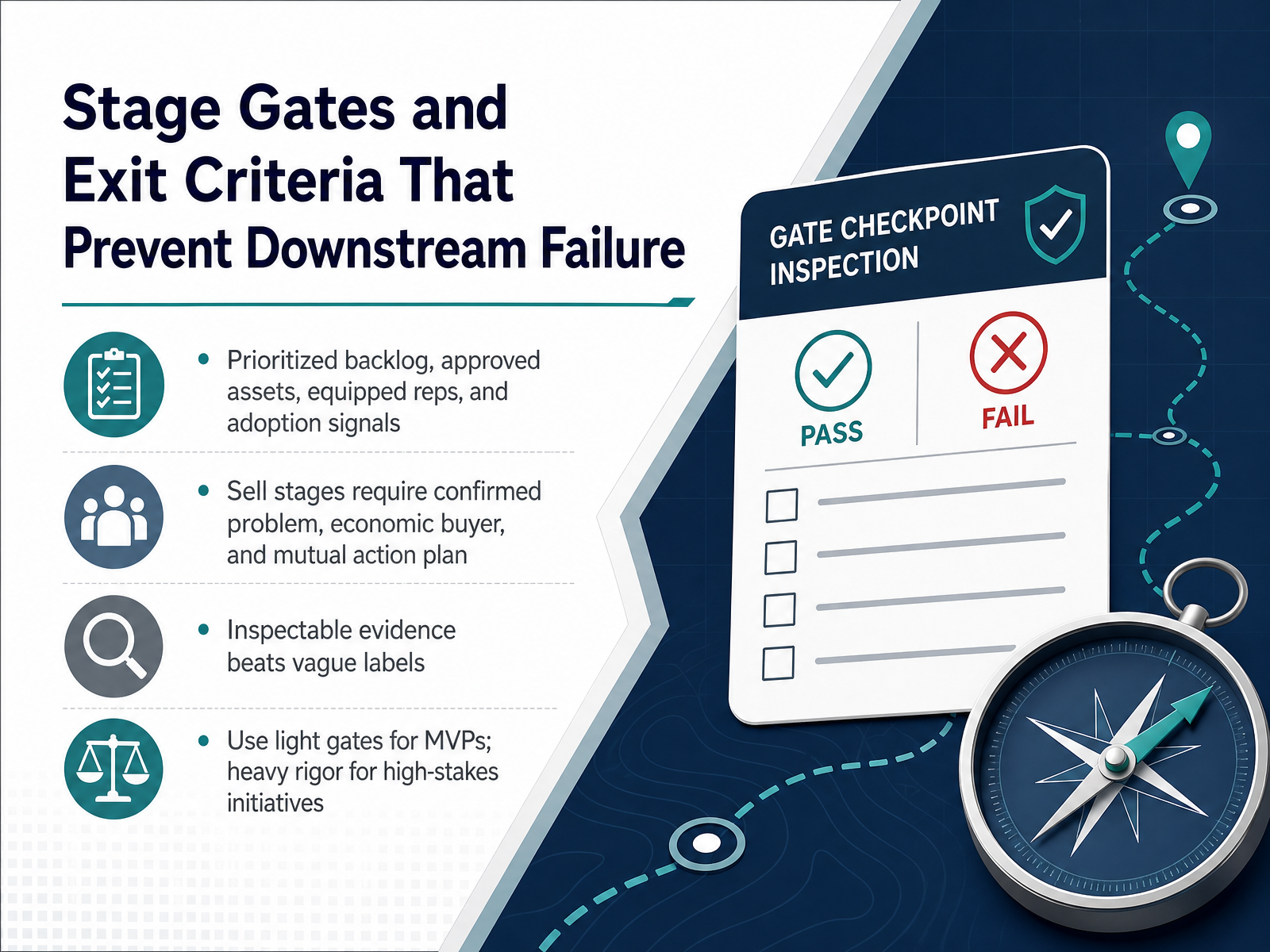
 - 05Stage Gates and Exit Criteria That Prevent Downstream FailureLet's talk about stage gates, because this is where we stop problems before they become inherited issues downstream. First, at the enablement level, you need four clear signals before something moves forward: a prioritized backlog, approved assets, equipped reps, and adoption signals. If any one of those is missing, you are not ready for the next gate. Now, on the selling side, a deal should not advance through sell stages unless you have real evidence, not just a CRM label. That means a confirmed problem, a verified economic buyer, and a mutual action plan in place. The principle here is simple: inspectable evidence beats vague labels every time. And you should scale the rigor to the risk. Use light gates for minimum viable products and early pilots, but apply heavy rigor to high-stakes initiatives that affect quota or major launches. The point is not to create bureaucracy. It is to make each gate a decision point with real exit criteria, so you catch gaps early instead of cleaning up chaos later. Next, let's look at who owns each of these stages with a RACI view.
 prospeo.iofedericopresicci.comfedericopresicci.com+21 min
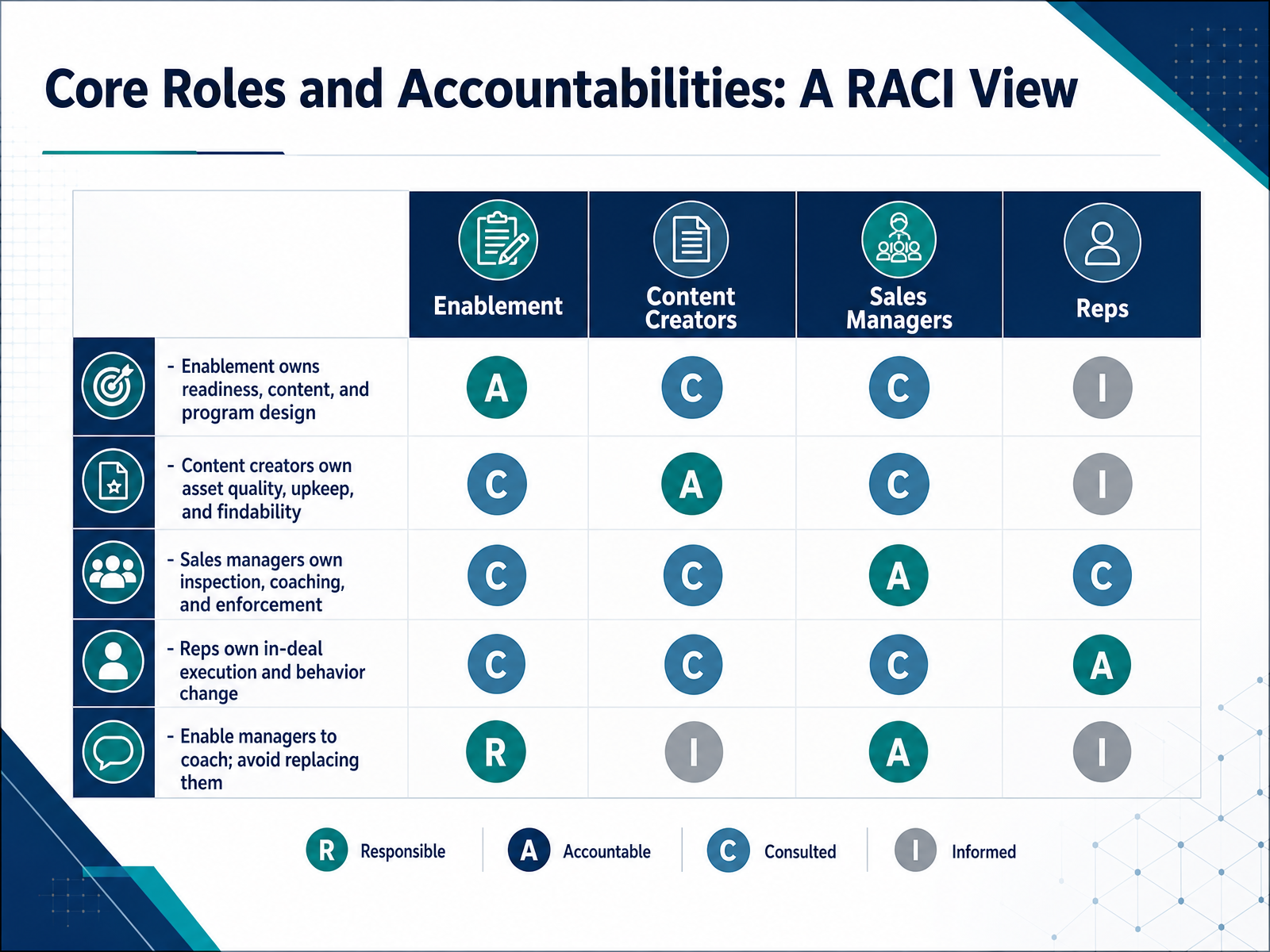
 - 06Core Roles and Accountabilities: A RACI ViewLet’s get specific about who actually owns what. When enablement stalls, it’s rarely because of effort. It’s usually because roles got blurred, so the work falls through the cracks. The fix is a clean RACI view. Enablement owns readiness, content, and program design. That means we build the journey, set the stage gates, and define what good looks like. Content creators own asset quality, upkeep, and findability. They manage the content lifecycle so reps aren’t hunting through stale decks. Sales managers own inspection, coaching, and enforcement. This is the handoff point where enablement stops and frontline leadership takes over. And reps own in-deal execution and behavior change. If reps don’t apply it, nothing else matters. The critical rule here: enable managers to coach. Don’t replace them. Your job is to give them the guides and the data, then get out of the way. Next, we’ll look at why that sales manager role is your highest-ROI lever.
 federicopresicci.comshowell.comtechtarget.com+22 min
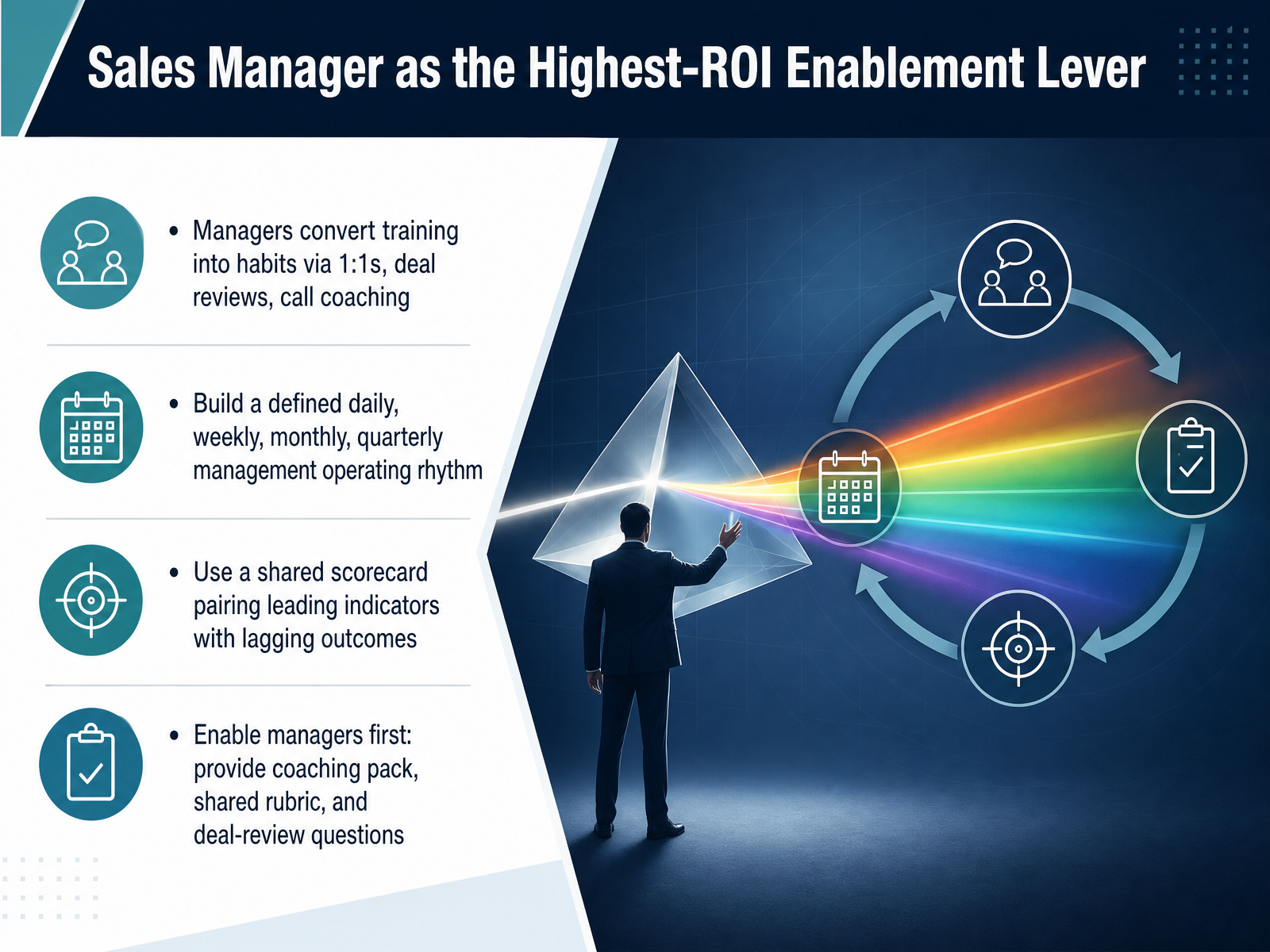
 - 07Sales Manager as the Highest-ROI Enablement LeverLet’s talk about the single highest-ROI enablement lever you have: the front-line sales manager. Tools and content don’t change behavior on their own. Managers do. They convert training into habits through the regular rhythm of one-on-ones, deal reviews, and call coaching. That means enablement has to stop treating the manager as a passive participant and start giving them an operating system. First, build a defined management cadence covering daily, weekly, monthly, and quarterly routines. This is not about adding complexity. It is about making inspection and coaching predictable. Second, use a shared scorecard that pairs leading indicators, like coaching coverage and deal review completion, with lagging outcomes, like win rate and ramp time. If you only review quota at month-end, you have already lost the ability to change the outcome. Third, enable managers first. Do not just ask them to coach. Equip them with a monthly coaching pack, a shared skill rubric, and a specific set of deal review questions. When you make the manager’s job easier, they multiply the effect of every program you ship. Next, let’s look at the key deliverables across the enablement journey.
 federicopresicci.comlxahub.comsupered.io+21 min
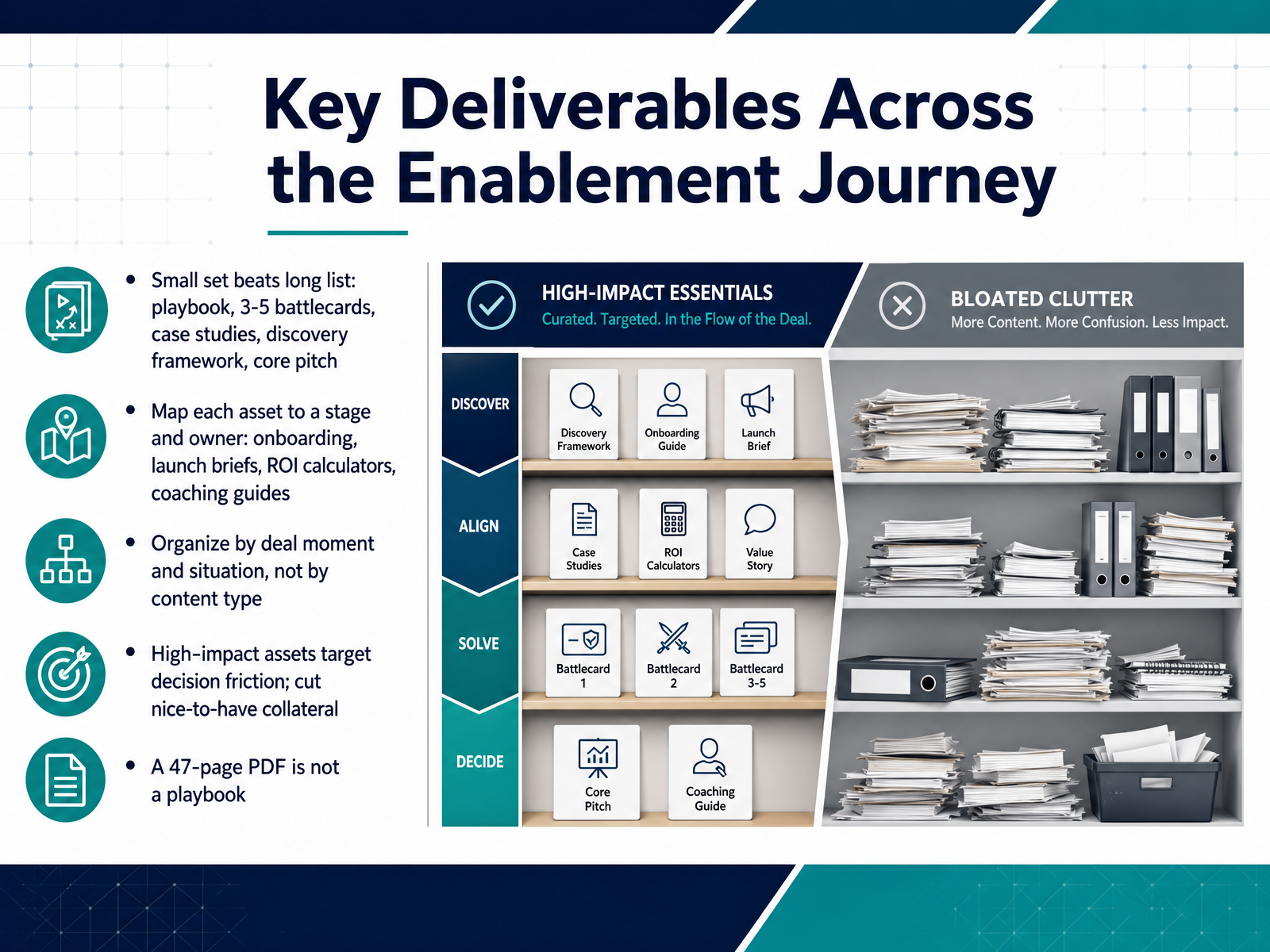
 - 08Key Deliverables Across the Enablement JourneyHere is the truth about enablement deliverables: a small, sharp set beats a long list every time. You do not need a library of fifty assets. You need a playbook, three to five battlecards, a few targeted case studies, a discovery framework, and a core pitch. The key is to map each asset to a specific stage and a clear owner. Onboarding needs its own set. Launch briefs serve the product introduction moment. ROI calculators support the business case. Coaching guides belong with managers. Organize everything by deal moment and situation, not by content type. A rep in a competitive deal should not have to browse a folder called marketing collateral. They should find the exact battlecard for that competitor in seconds. High-impact assets are the ones that attack decision friction. Cut the nice-to-have collateral. If you would not want a rep pulling it up live in front of a buyer, it does not earn a place in the workflow. And remember, a forty-seven page PDF is not a playbook. It is a document destined to be ignored. Keep assets scannable, findable, and tied to a moment. That mindset is what makes the next step possible: designing a content-driven enablement workflow.
 federicopresicci.comlxahub.comsupered.io+22 min
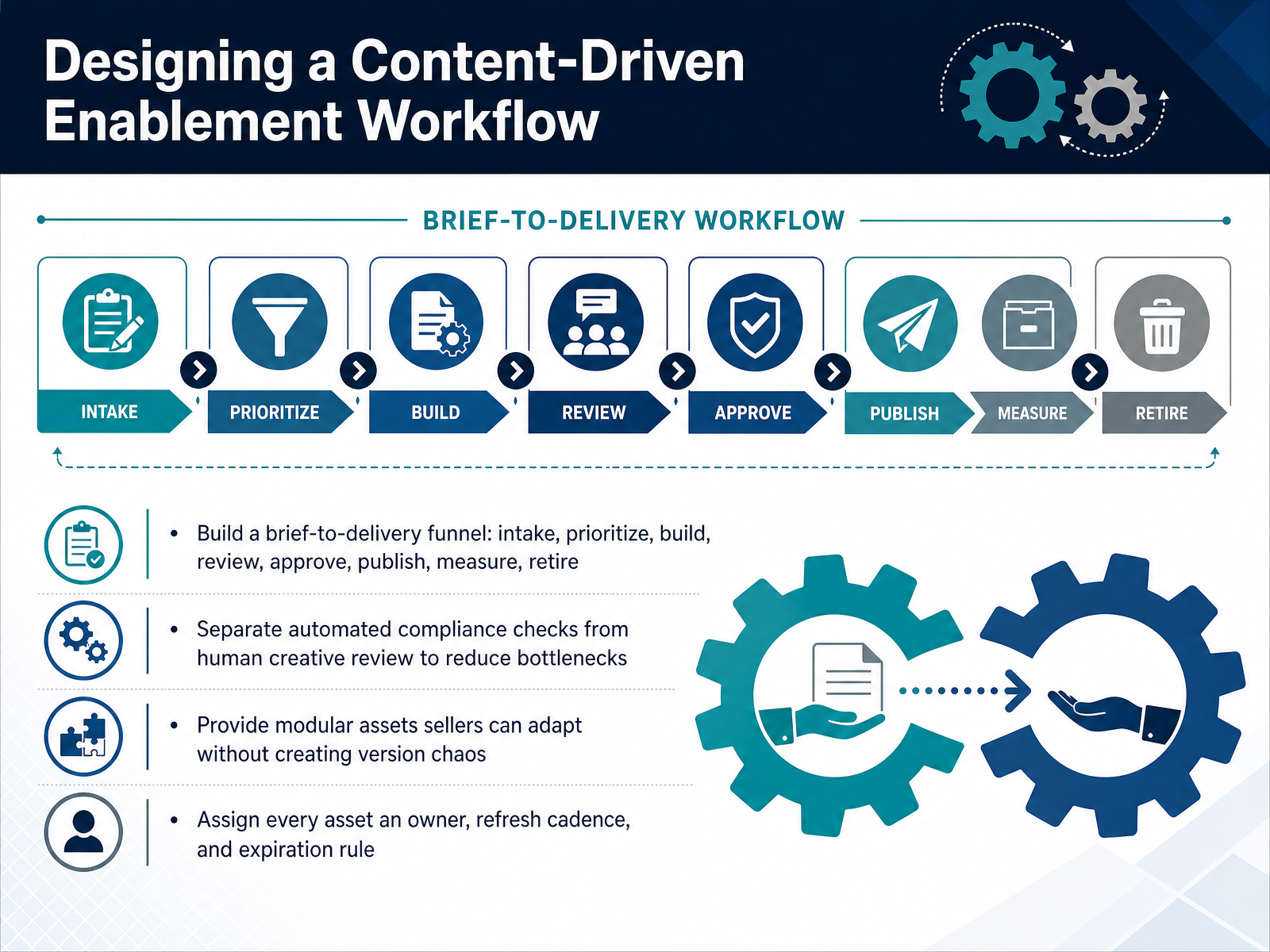
 - 09Designing a Content-Driven Enablement WorkflowNow let's turn that process into a workflow that actually moves content forward. Start by building a clear brief-to-delivery funnel. The stages are intake, prioritize, build, review, approve, publish, measure, and retire. Each stage should have a clear handoff point so nothing sits in limbo. Next, separate automated compliance checks from human creative review. Let the system catch disclosure issues or brand violations first, then let people focus on quality and message fit. That alone removes a major bottleneck. Also, provide modular assets sellers can adapt. Give them approved building blocks, like slide sections or email blocks, rather than letting them recreate entire decks. Finally, assign every asset an owner, a refresh cadence, and an expiration rule. If a battlecard has no owner and no review date, it loses seller trust fast. Consistent stage gates and clear ownership keep the content lifecycle dependable. That operational discipline also sets up our next topic, content governance and approval models.
 2 min
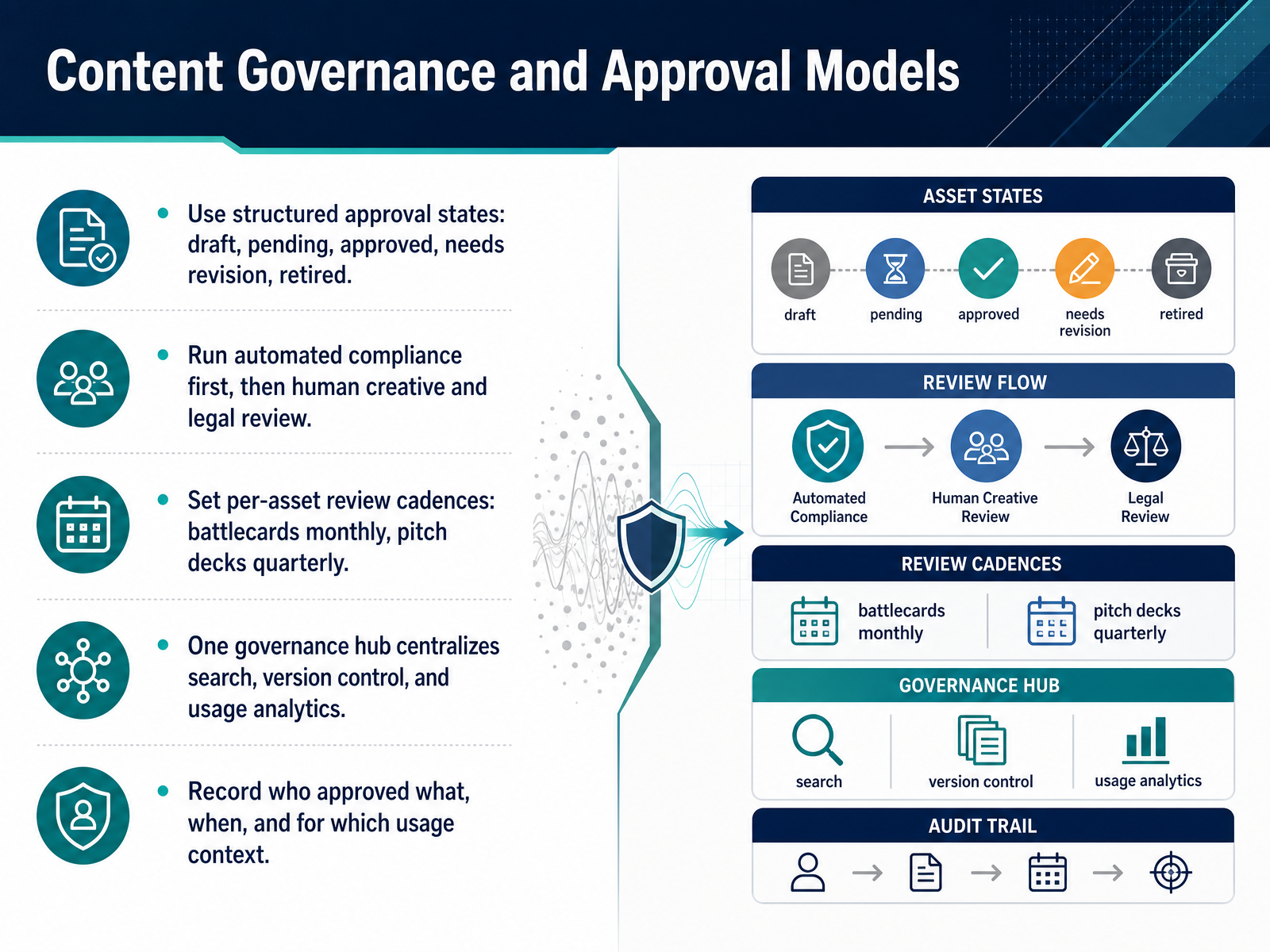
2 min - 10Content Governance and Approval ModelsNow let's talk about how we govern all of this content so it stays compliant and current. Without a clear approval model, even great assets become a liability. I recommend using structured approval states: draft, pending, approved, needs revision, and retired. That way nothing is vague. Run automated compliance checks first, then let humans handle creative and legal review. This keeps your experts focused on strategy instead of rule checking. Set a specific review cadence for each asset type. Battlecards need monthly attention, while pitch decks can be reviewed quarterly. But none of this works without one governance hub. That hub should centralize search, version control, and usage analytics, so reps always pull from the right source. Finally, record an audit trail. Know who approved what, when, and for which usage context. That record protects the team and speeds up future decisions. This brings us to our next topic: Enabling the Enablers: Coaching, Adoption, and Change Management.
 1 min
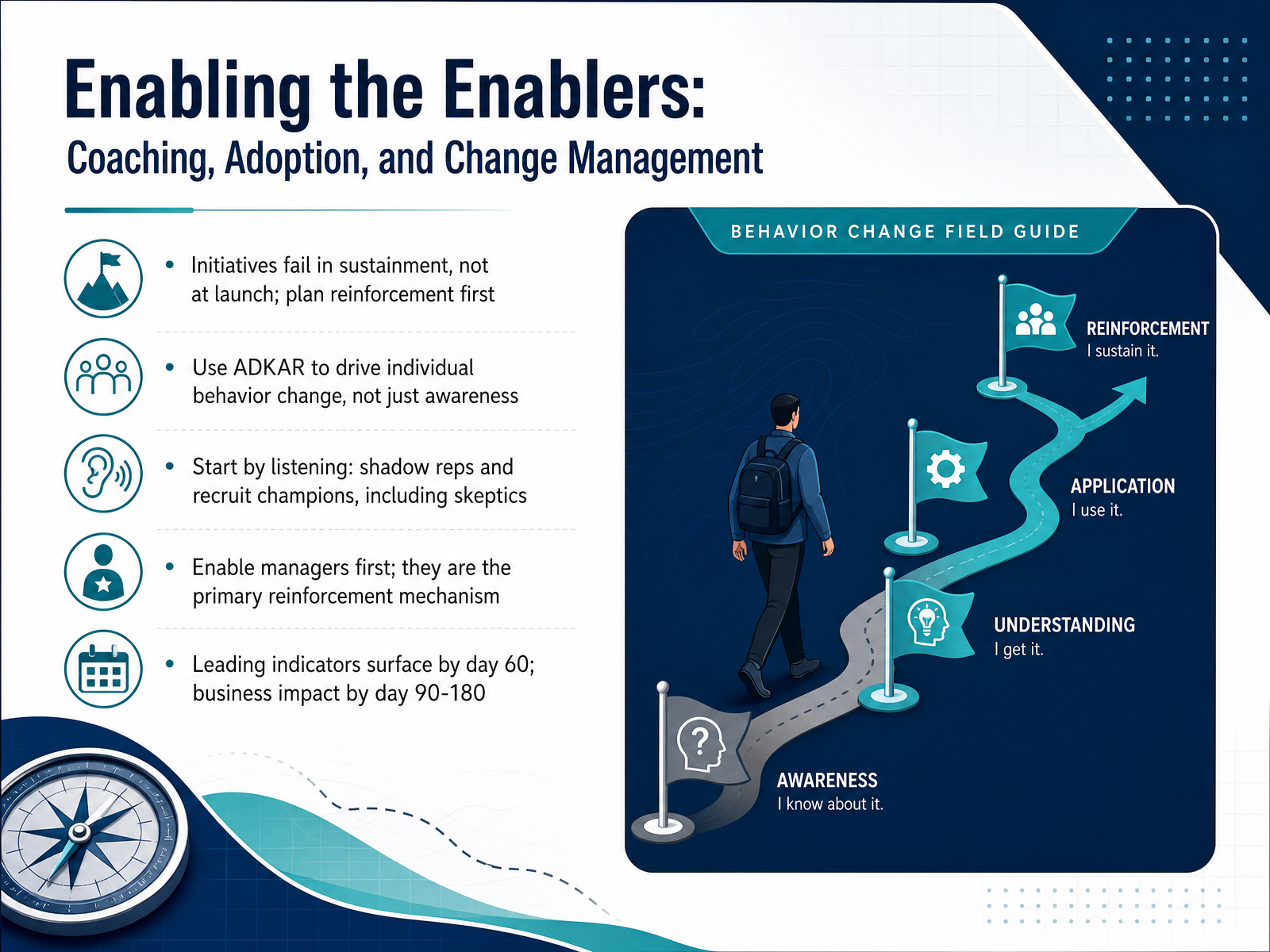
1 min - 11Enabling the Enablers: Coaching, Adoption, and Change ManagementLet's get real about what makes or breaks enablement. Most initiatives don't fail at launch, they fail in sustainment. So the moment you scope a program, plan for reinforcement first. Use ADKAR to drive individual behavior change. Help reps move from awareness through desire, knowledge, ability, and reinforcement. But start by listening. Shadow reps, listen to real calls, and build a champions council that includes satisfied users and skeptics. Skeptics who convert become your most credible advocates. Most importantly, enable managers first. They are the primary reinforcement mechanism, not your LMS or content library. Give them coaching packs, deal review checklists, and a consistent weekly rhythm. If managers don't coach the new behavior in live deals, adoption flatlines within weeks. Set expectations now. Leading indicators like workflow adoption and coaching coverage should surface by day sixty. Business impact in win rate and deal size typically appears between days ninety and one eighty. That timeline protects the program from premature cancellation. Next, let's look at how to measure enablement effectiveness.
 federicopresicci.comlxahub.comsupered.io+21 min
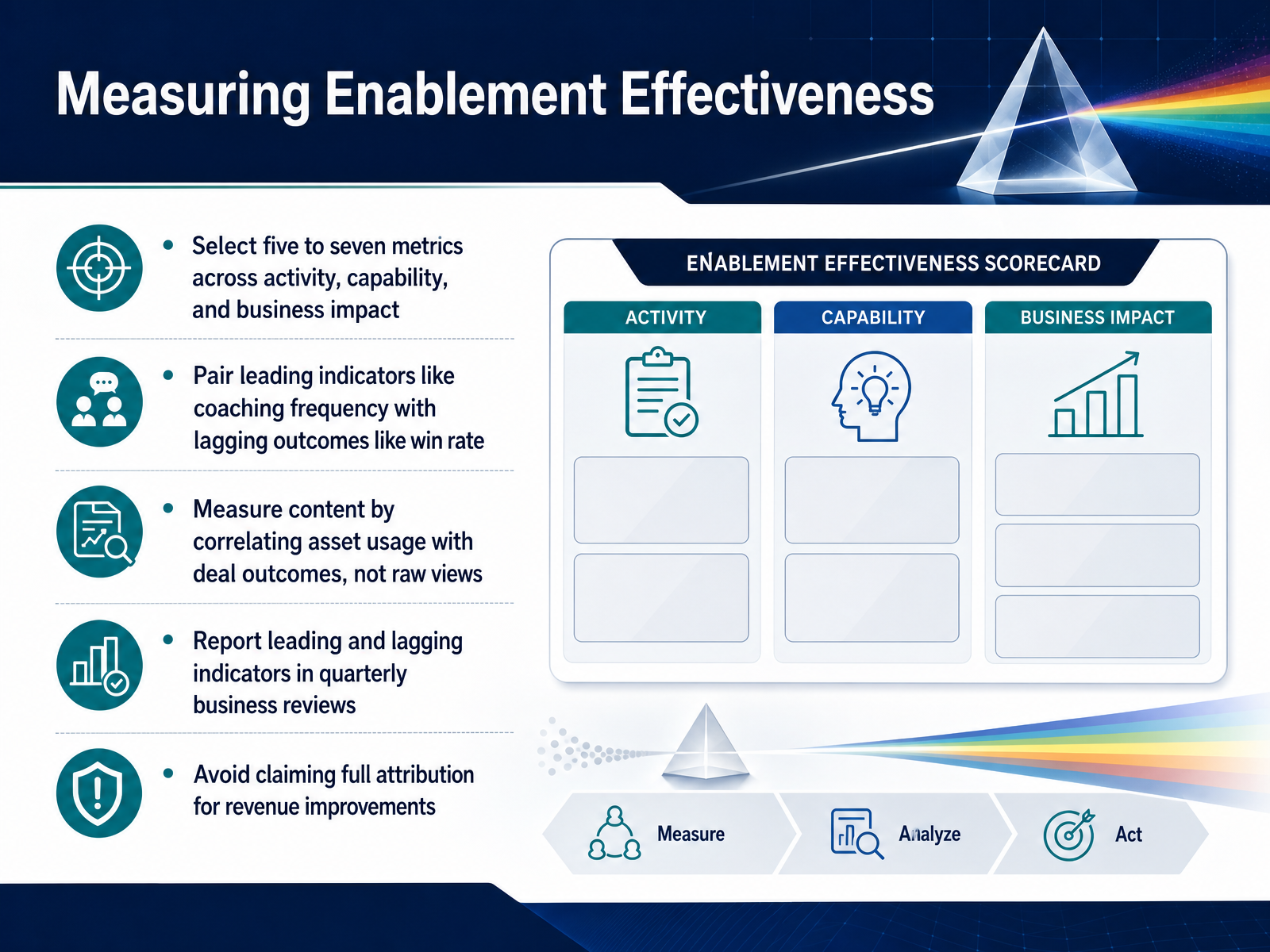
 - 12Measuring Enablement EffectivenessNow, let’s talk about how we prove all of this works. Measurement is where enablement either earns a seat at the leadership table, or gets treated as a cost center. So keep it focused. Pick five to seven metrics across three buckets: activity, capability, and business impact. Activity tells you if reps are engaging. Capability tells you if they’re getting better. Business impact tells you if it’s showing up in revenue. Pair a leading indicator, like coaching frequency, with a lagging outcome, like win rate. That gives you both an early signal and a final result. For content, skip the vanity metric of raw views. Instead, correlate asset usage with deal outcomes. Did the accounts that used the new business case actually close faster or larger? That’s the number that matters. Report these leading and lagging indicators together in your quarterly business reviews. And a critical rule: avoid claiming full attribution. We know enablement contributed, but positioning your work as an influence, not the sole cause, builds credibility. Next, we’ll move from measurement to action with an implementation roadmap and quick wins.
 federicopresicci.comlxahub.comsupered.io+22 min
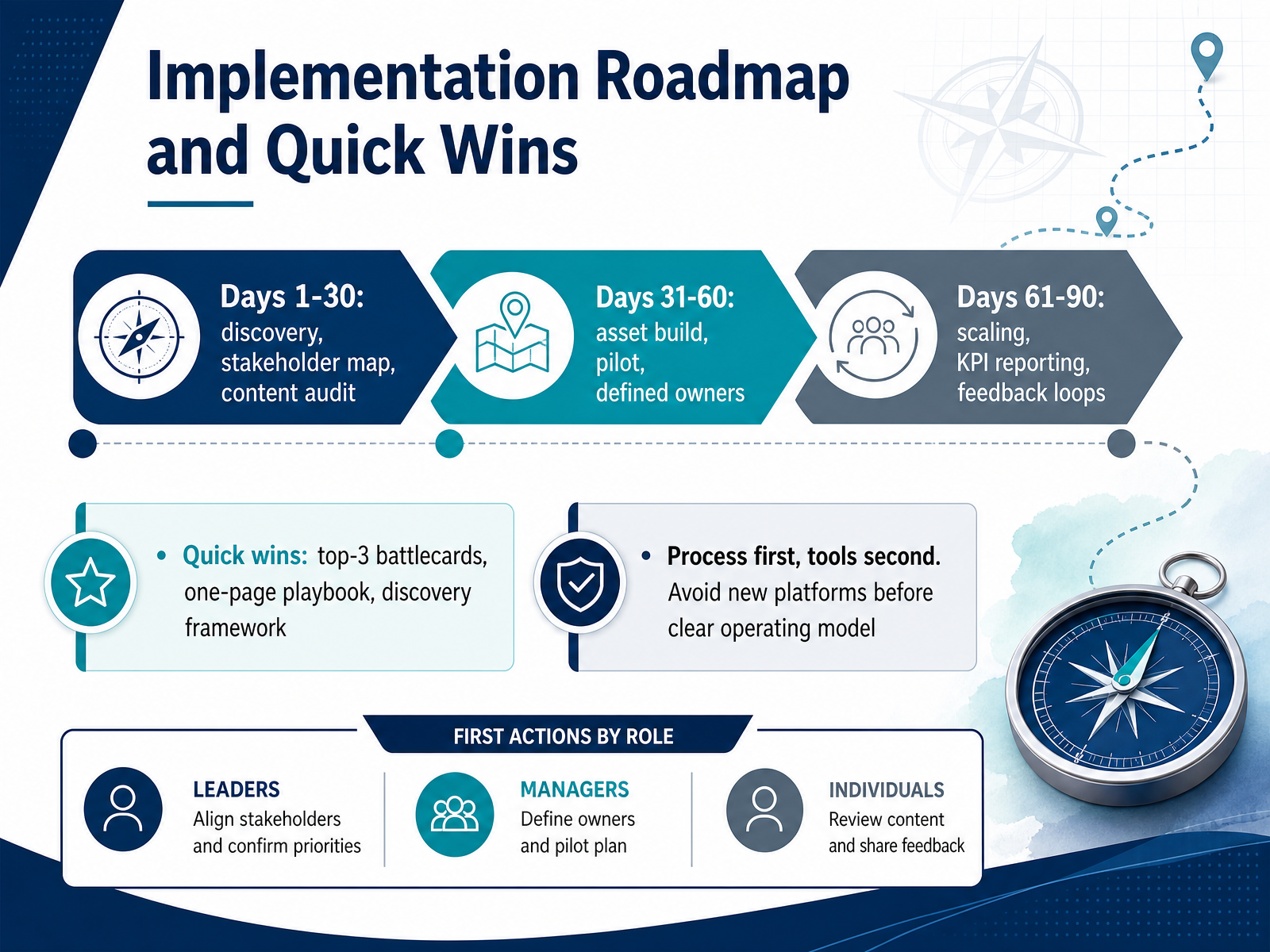
 - 13Implementation Roadmap and Quick WinsLet's turn this framework into an operating plan. The first thirty days are about discovery. Build your stakeholder map, run a content audit, and document what reps actually use. Days thirty-one through sixty are where you shift to building. Create the priority assets, launch a pilot with a small group, and name a single owner for every deliverable. Then, days sixty-one through ninety become about scaling. Activate the full team, start KPI reporting, and build feedback loops so the assets improve based on real deal evidence. And don't wait ninety days to show value. The quick wins here are deliberate. Pick your top three battlecards, write a one-page playbook, and give reps a reusable discovery framework. These are high-credibility, low-complexity moves that build momentum fast. One caution before you start. Get the process right before you buy tools. A new platform layered on top of a broken operating model just gives you more expensive shelfware. Define the stages, owners, and handoff points first. That sets you up perfectly for our final slide, where we'll pull this together into your enablement blueprint.
 prospeo.iofedericopresicci.comfedericopresicci.com+21 min
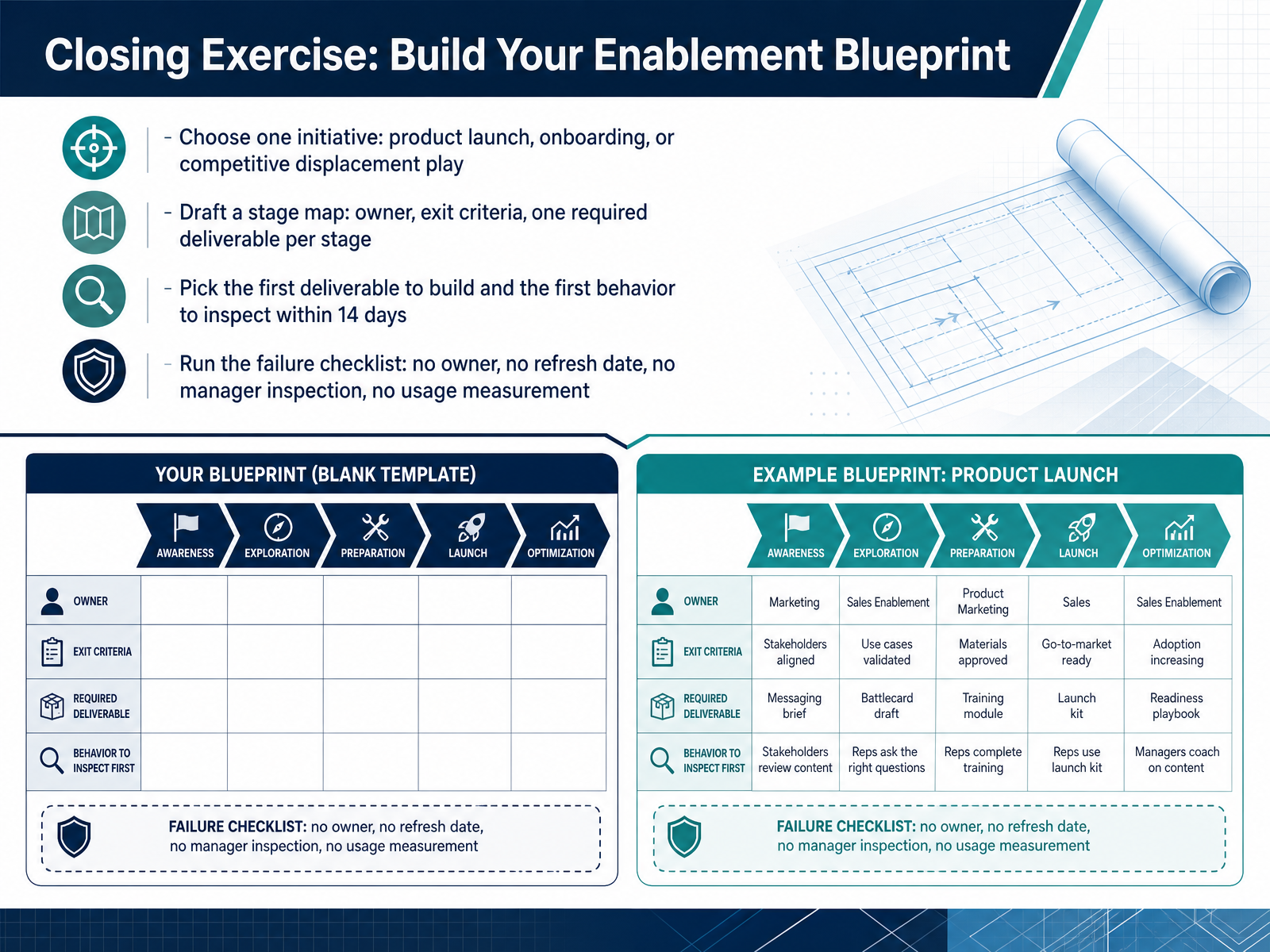
 - 14Closing Exercise: Build Your Enablement BlueprintLet's turn this framework into a concrete action plan. Pick one initiative, just one. Maybe it's a product launch, a new onboarding path, or a competitive displacement play. Then draft a simple stage map. For each stage, name the owner, define the exit criteria, and identify one required deliverable. Keep it operational, not theoretical. Next, choose your first move. Pick the very first deliverable you will build, and decide on the single behavior you will inspect within fourteen days. This creates immediate momentum and a quick feedback loop. Finally, run the failure checklist before you start. Ask yourself, is there no clear owner? Is there no refresh date on the content? Is there no manager inspection point? And is there no way to measure usage? If you answer yes to any of those, fix that gap now. A blueprint is only as strong as its weakest handoff point. Thank you for working through this process. Now go build something your reps will actually use.
 prospeo.iofedericopresicci.comfedericopresicci.com+22 min
Take the deck with you
Download this course as a file — free, no sign-up needed.
- PDF handoutEvery slide page, ready to print or share.15 pages · 3.9 MBDownload
- Narrated PowerPointThe deck that presents itself — every slide carries the digital human's narration video.15 pages · 16.1 MBDownload
- PowerPoint slidesThe full deck as a .pptx — open it in PowerPoint, Keynote, or Google Slides.15 pages · 3.8 MBDownload
Free to use in your own training — please keep the PersonWise credit page at the end.
Have your own deck? Turn it into a course
Sources consulted
Web sources consulted while building this course.
- Sales Enablement Guide: Strategy, Metrics, and Software (2026) — g2.com
- Sales Enablement Strategy — gartner.com
- 10 Sales Enablement Best Practices [2026 Edition] — highspot.com
- What is sales enablement? Strategies + guide - Zendesk — zendesk.com
- Sales Enablement: The Complete 2026 Guide (Strategy, Tools, KPIs) | Nimitai — nimitai.com
- The State of Sales Enablement Maturity Report 2026 — federicopresicci.com
- The State of Revenue Enablement 2026 — lxahub.com
- The State of Sales Enablement 2026. Free Report. — supered.io
- The State of Sales Enablement Report 2025 — hs-4668355.f.hubspotemail.net
- Sales Enablement Maturity Model: The Real Axis — supered.io
- Sales Enablement Process: 7-Stage Framework (2026) — prospeo.io
- How to Build a Sales Enablement Program That Delivers Real Impact — federicopresicci.com
- Sales Enablement Checklist: Build High-Impact Programs — federicopresicci.com
- Sales Enablement Framework | Demand Metric — demandmetric.com
- Sales Enablement Project Plan: 6-Phase Template (2026) — prospeo.io
- Sales Enablement Roles and Responsibilities – Expert Overview — federicopresicci.com
- Sales Enablement Roles: Defining Key Roles and Responsibilities in Sales Enablement — showell.com
- What does a sales enablement manager do? | TechTarget — techtarget.com
- Sales Enablement Manager Job Description | Hiring — nextinhr.com
- What Does a Sales Enablement Professional Do? [+ Template Job Description] — blog.hubspot.com