Customer Service Case Studies: Patterns and Tradeoffs
Begin
14 pages · ~28 min
Customer Service Case Studies: Patterns and Tradeoffs
Analyze real-world customer service scenarios to identify response patterns and evaluate tradeoffs in decision-making. Designed for service professionals seeking practical problem-solving skills.
What you’ll learn
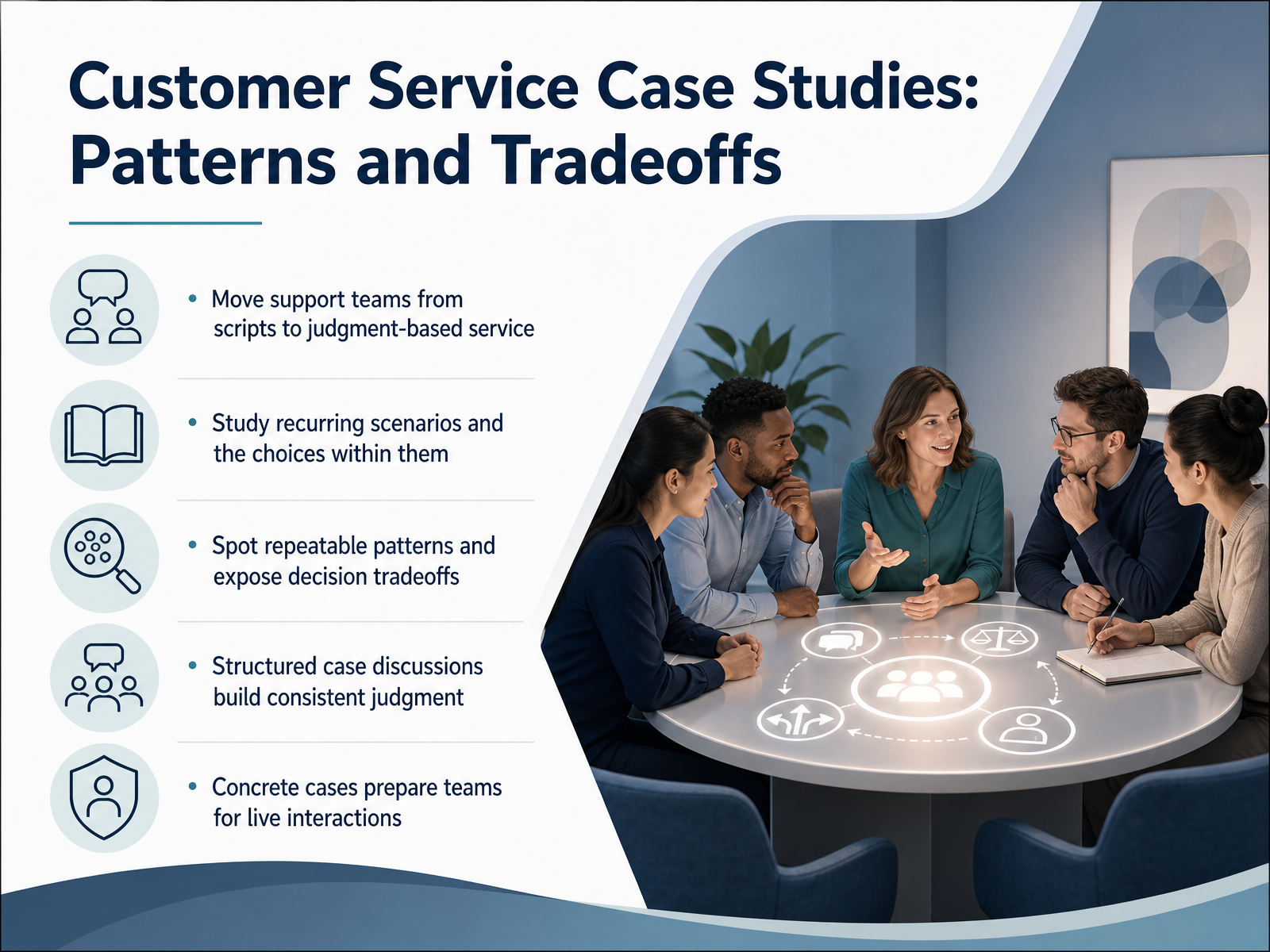
- 01Customer Service Case Studies: Patterns and TradeoffsWelcome. This course is about moving your support team from scripted responses to something far more durable: judgment. We're going to study recurring customer scenarios and break down the choices inside them. Not as right-or-wrong lessons, but as strategic tradeoffs. The goal is to spot repeatable patterns so your team can recognize a situation, weigh the options, and act with consistency. Structured case discussions are how you build that judgment. They turn experience into a shared playbook. By working through real cases, your team prepares for the pressure of live interactions. They learn to balance speed, empathy, and policy before the customer is waiting on the line. Let's begin with why case-based learning works for support teams.fastercapital.comeportfolio.ursularkoranteng.compure.rug.nl+21 min
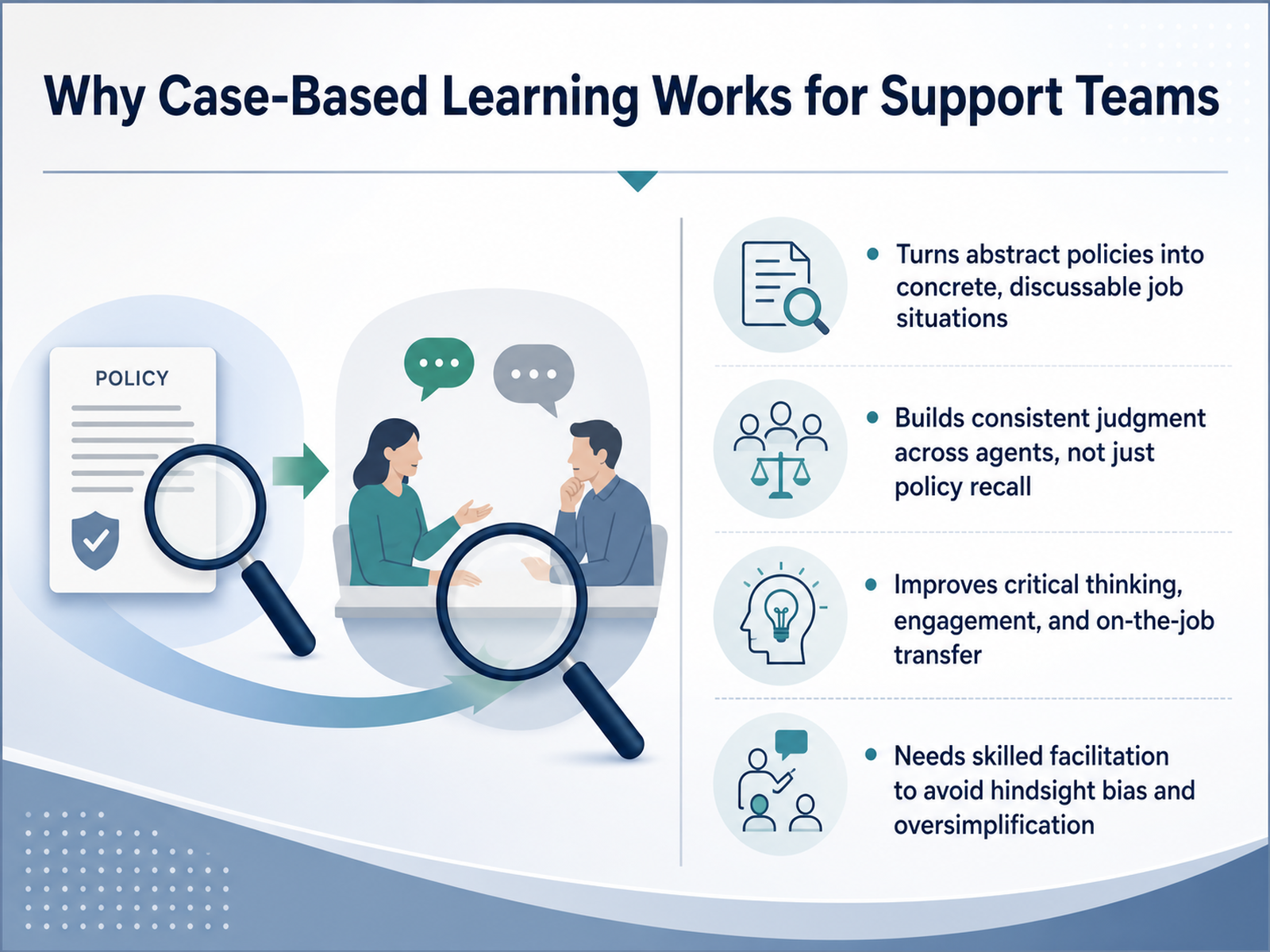
- 02Why Case-Based Learning Works for Support TeamsWhy lean on case studies instead of just more policy decks? Because policies are abstract until they hit a real customer. Case studies turn those rules into concrete, discussable situations your team can actually debate and learn from. That builds consistent judgment across agents, not just better recall of the handbook. When your team analyzes real scenarios, they practice critical thinking and stay engaged far more than they would reading another slide. The payoff is transfer: what they practice in training shows up on the live call. But there is a tradeoff. Cases only work if facilitation is skilled. Without careful debriefing, you risk hindsight bias, where everything looks obvious after the fact, or oversimplification, where a messy situation gets reduced to a hero or a villain. Done well, case studies are one of the fastest ways to build the judgment your team needs. That leads us to the next question: how do you spot the patterns that keep repeating across your worst calls?
 fastercapital.comeportfolio.ursularkoranteng.compure.rug.nl+21 min
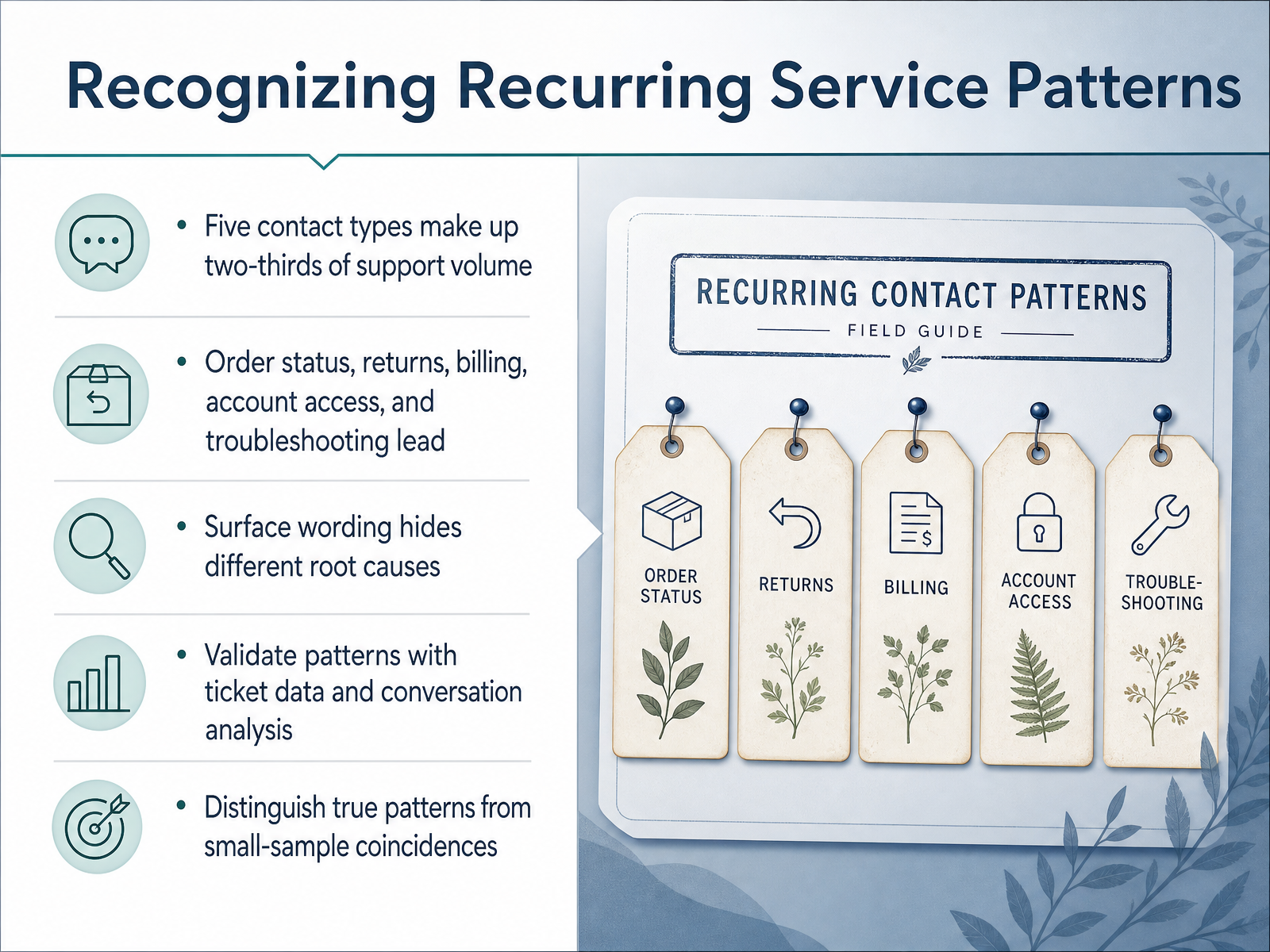
 - 03Recognizing Recurring Service PatternsOnce you start tagging tickets, the same five patterns surface repeatedly: order and delivery status, returns and refunds, billing disputes, account access, and technical troubleshooting. Together, those five often drive about two-thirds of total contact volume. But the surface wording will fool you. What looks like a refund request could really be a failure to understand the policy, and what sounds like a billing issue might be a pricing confusion. So, don't trust categories you assign by gut. Pull your own data and do a real conversation analysis to validate the pattern. Beware of small samples. One angry account making noise all week is not a trend. That is a single escalation. You need recurring frequency across different customers before you act. So, you are looking for true, repeatable patterns that reflect systemic friction, not isolated voices. Once these patterns are solid, the next question is what to do about them. That brings us to mapping the tradeoffs behind your service decisions.
 robylon.ailutpub.lut.fidocs.pega.com+22 min
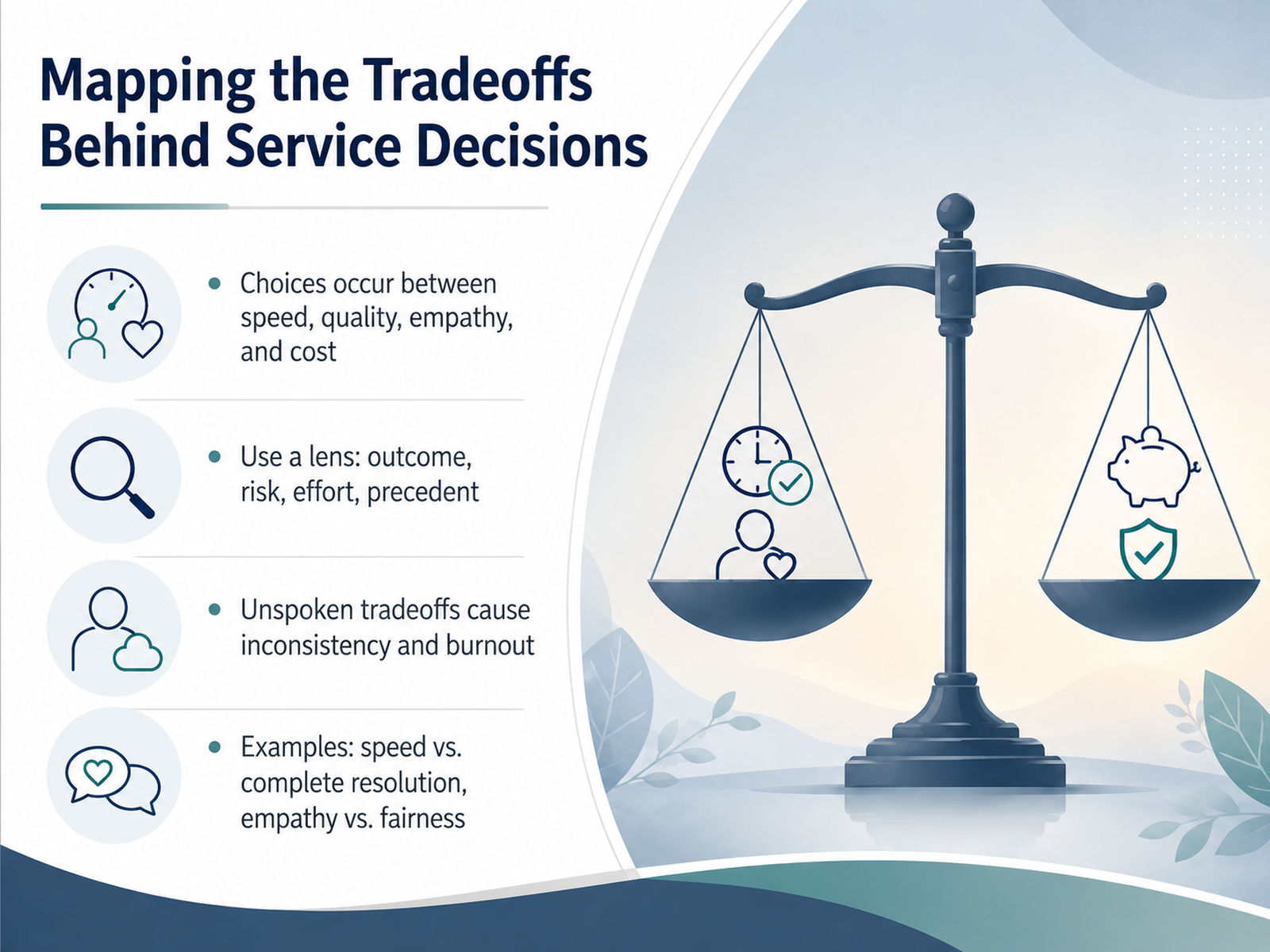
 - 04Mapping the Tradeoffs Behind Service DecisionsEvery service decision is a tradeoff between speed, quality, empathy, and cost. But the real tension isn't just picking one over another. It's deciding what to prioritize in a specific moment. Use a simple lens to make this consistent. Ask: what is the outcome the customer needs, what is the risk if we get this wrong, how much effort are we willing to invest, and does this set a precedent we can uphold? If you skip this analysis, these tradeoffs stay unspoken, and agents make inconsistent calls in the moment, which drives customer frustration and agent burnout. Consider the classic conflict between empathy and fairness. Two customers with the same problem will both want an exception. Fully accommodating the first feels right, but if you reject the second because you've hit a quota, you've created an unfair system. And here's the key pattern: tradeoffs become easier when you decide your default in advance, not during the interaction. Name the tradeoff, apply the lens, and the decision becomes consistent. Next, we look at complaint and escalation patterns to see these tradeoffs play out under pressure.
 doi.orgsage.cnpereading.comarxiv.org+22 min
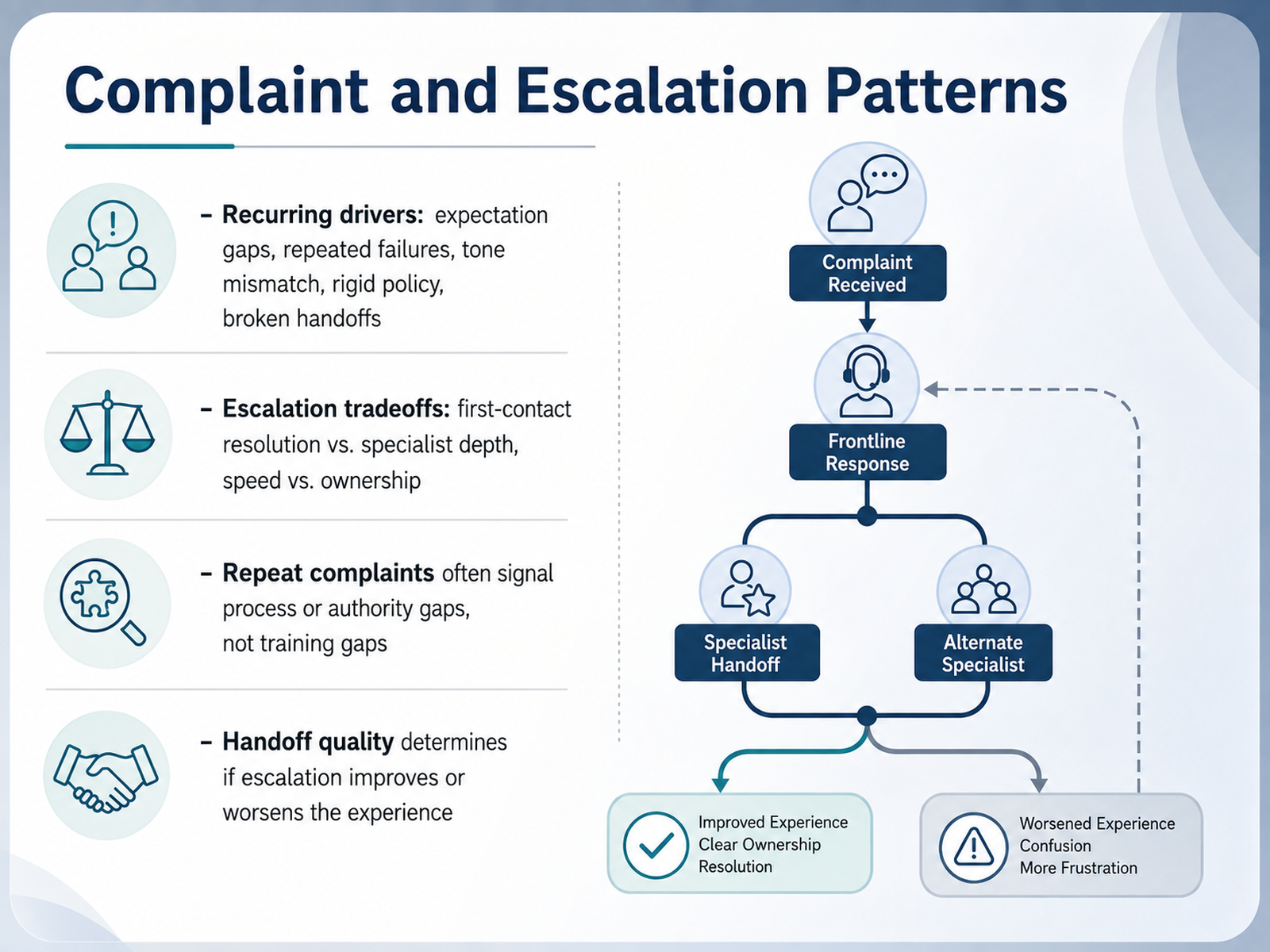
 - 05Complaint and Escalation PatternsLet’s look at complaint and escalation patterns. The drivers are rarely random. Recurring complaints usually trace back to expectation gaps, repeated failures, tone mismatches, rigid policies, or broken handoffs across teams. When you see a pattern, don’t default to more training. Repeat complaints are more often a signal of a process or authority gap. The issue recurs because nobody owns the fix. Escalation itself is a tradeoff. First-contact resolution can conflict with the need for specialist depth. And pushing for speed can undermine a sense of ownership. The real test is handoff quality. A clean escalation with full context can actually improve the relationship. A vague handoff to an anonymous queue will make things worse. The customer feels every internal gap. So when you design your escalation path, define what gets escalated, who owns it, and what context travels with it. That’s the difference between escalation as a resolution tool and escalation as another layer of friction. Next, we’ll look at how emotional intensity changes the tradeoffs you’re willing to make.
 voc.aioipub.comreputation-insider.com+22 min
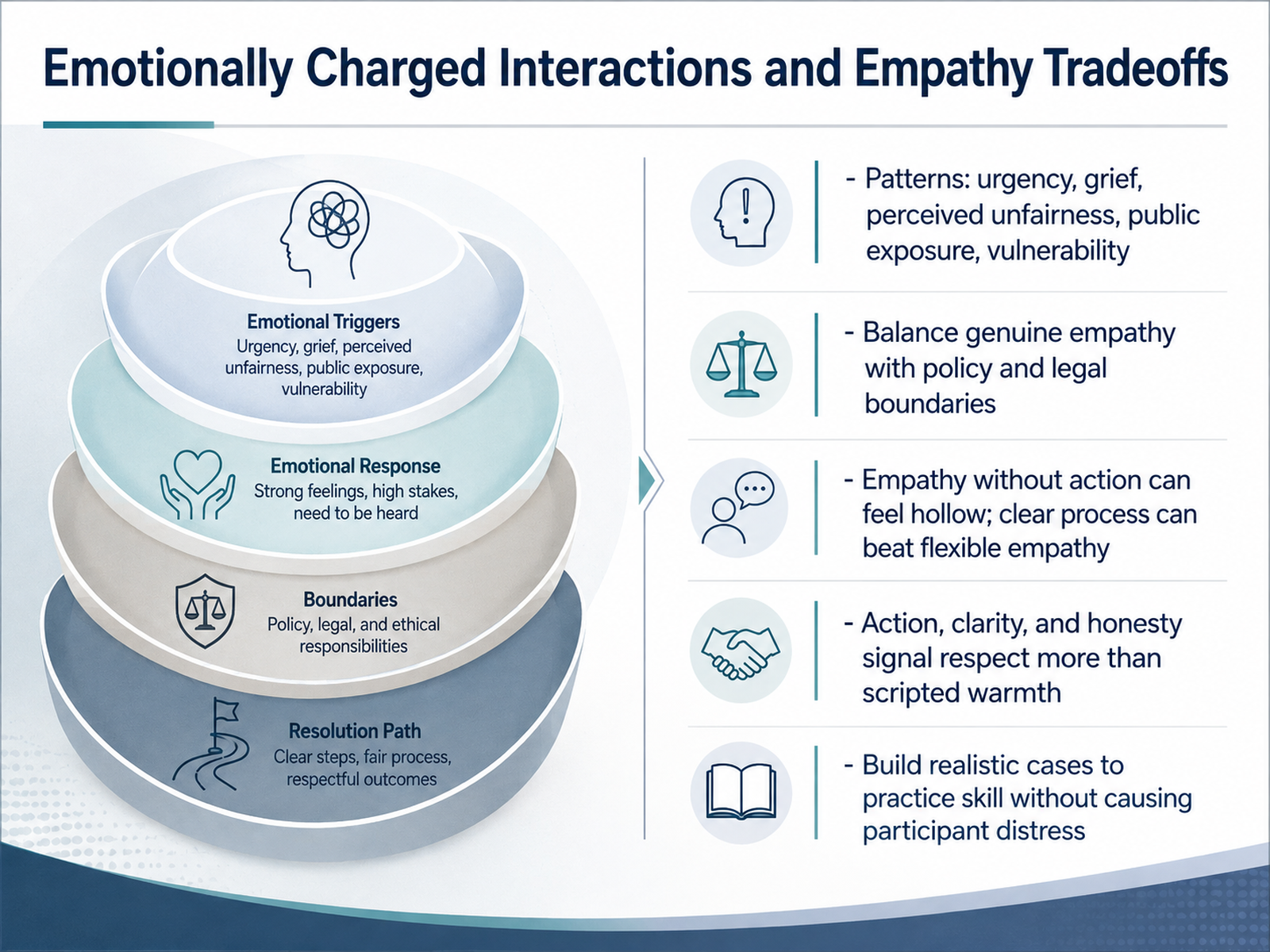
 - 06Emotionally Charged Interactions and Empathy TradeoffsLet’s turn to emotionally charged interactions. The patterns here are familiar: urgency, grief, perceived unfairness, public exposure, and vulnerability. The tradeoff is between genuine empathy and your policy and legal boundaries. Here’s the trap: empathy without action feels hollow. Worse, it can inflame the situation. A clear process often outperforms flexible empathy because it gives the customer a concrete path forward. Action, clarity, and honesty signal respect far more than scripted warmth. When you train your team, build realistic scenarios that carry emotional weight, but design them to avoid causing participants real distress. The goal is to practice the skill, not to relive trauma. The pattern to internalize: match your empathy to your authority to act, and be honest about both.
 voc.aioipub.comreputation-insider.com+21 min
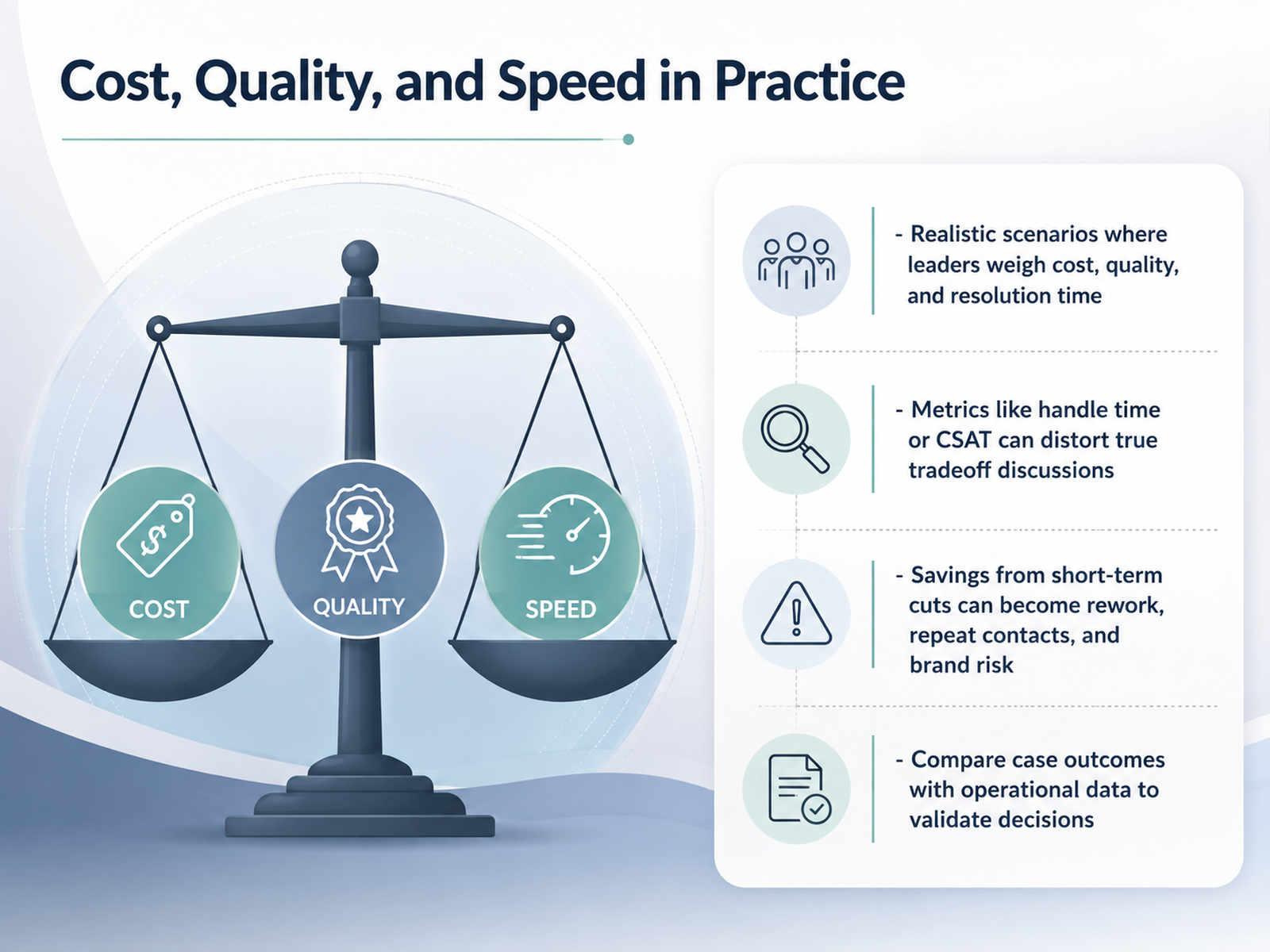
 - 07Cost, Quality, and Speed in PracticeLet’s look at how cost, quality, and speed actually collide in practice. The tension isn’t theoretical. Realistic scenarios show leaders weighing a shorter handle time against the risk of an incomplete fix, weighing a low-cost deflection against the customer’s need for a human touch. The trap is letting any single metric run the conversation. A dashboard that rewards a two-minute average handle time may quietly encourage agents to close cases prematurely. The result: the customer calls back, the ticket reopens, and what looked like a saving becomes rework. Similarly, a CSAT score can look healthy even when contact volume stays high, masking the real cost of repeat contacts. So when you compare case outcomes, do it against operational data. Track whether a fast resolution held, whether the deflection reduced follow-ups, and whether the cheaper channel actually protected the brand. If the data shows a pattern of repeat contacts after a specific shortcut, then the shortcut wasn’t a genuine gain. Validate decisions by the downstream effect, not just the immediate number. Now let’s turn that into a repeatable structure for discussing these cases.
 doi.orgsage.cnpereading.comarxiv.org+21 min
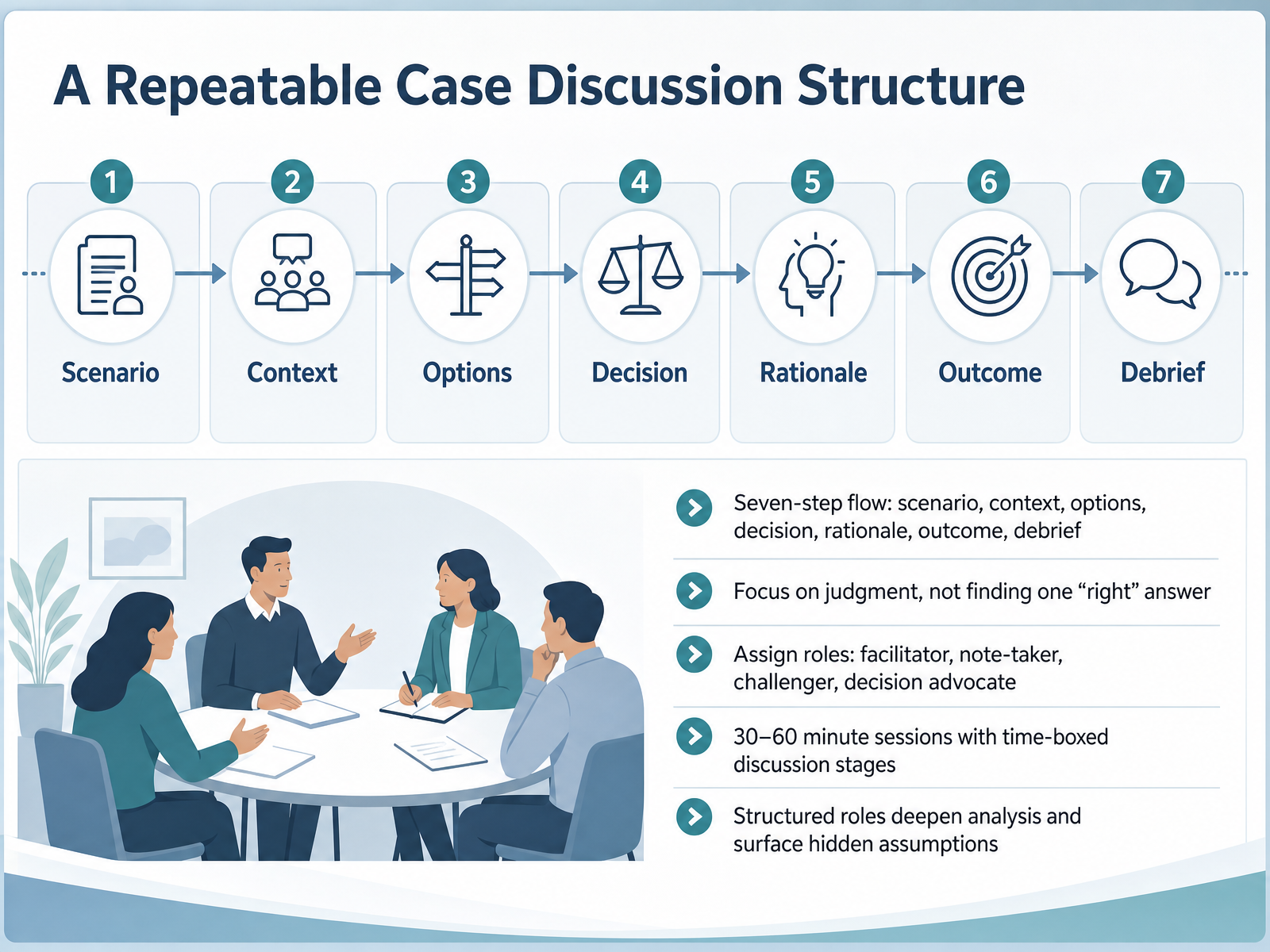
 - 08A Repeatable Case Discussion StructureSo how do you make this repeatable across your team? Use a consistent structure. Walk through seven steps: the scenario, its context, the options on the table, the decision itself, the rationale behind it, the outcome, and then a focused debrief. But keep the goal front and center: this is about sharpening judgment, not finding the one right answer. Assign roles to keep the discussion honest. A facilitator to move things along, a note-taker to capture the thread, a challenger to pressure-test assumptions, and a decision advocate to defend a specific path. That structure surfaces the hidden assumptions that derail real calls. And run the session in 30 to 60 minutes, time-boxing each stage so the conversation has urgency, not sprawl. The roles force people to argue positions, not just opinions. Before you open your next session, think about which difficult case from last month would expose the most interesting tradeoff for your team.
 fastercapital.comeportfolio.ursularkoranteng.compure.rug.nl+21 min
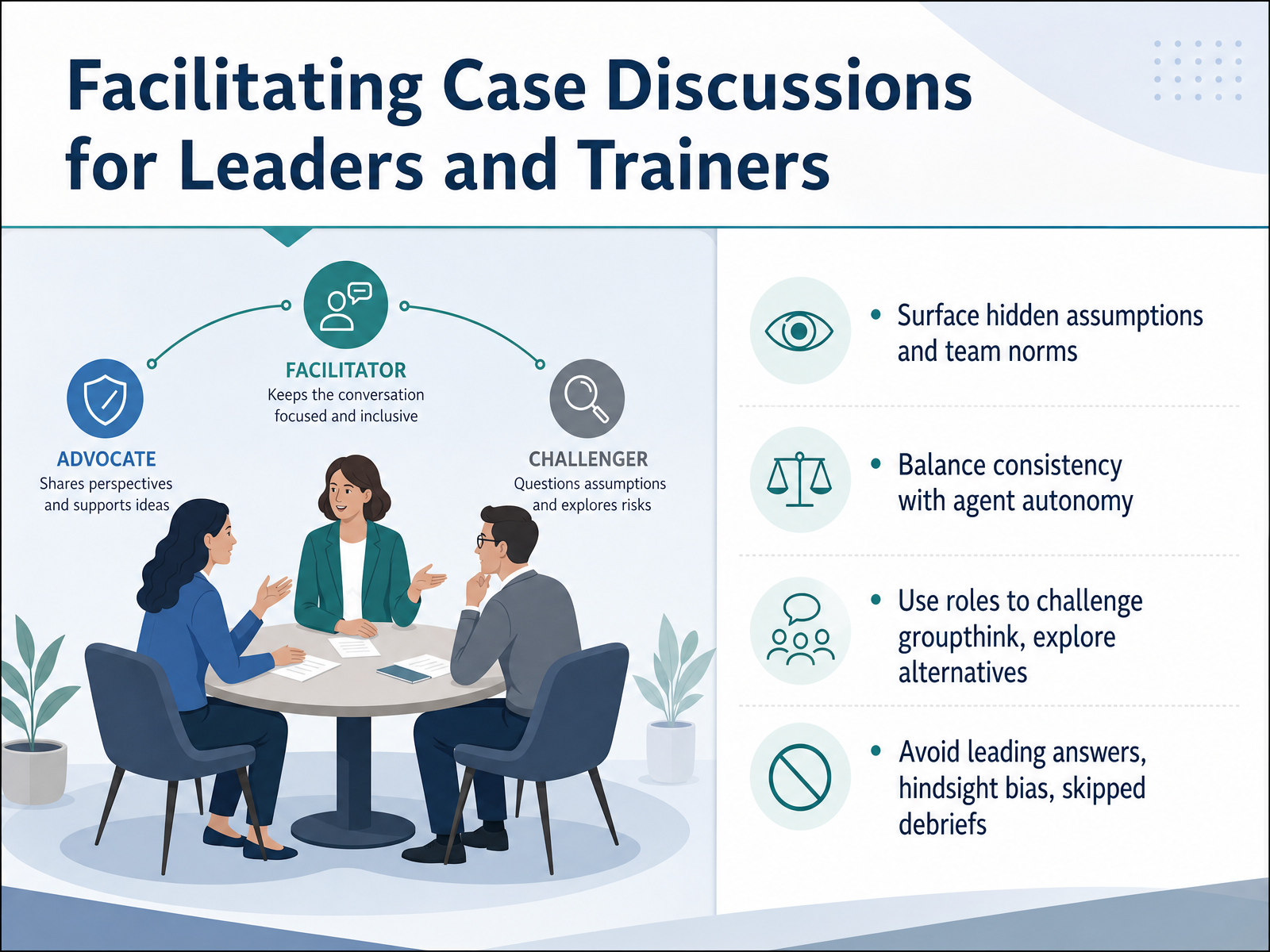
 - 09Facilitating Case Discussions for Leaders and TrainersLet’s talk about facilitating the discussion itself, because this is where cases either sharpen judgment or just reinforce what the room already believes. Start by surfacing hidden assumptions. Ask what unwritten rules the team operates by. You will often find that agents follow norms that were never codified, sometimes in direct conflict with policy. Next, balance consistency with agent autonomy. A case debrief should not produce one scripted answer, but it should reveal the boundaries of acceptable tradeoffs, such as when empathy overrides handle time or when escalation is the disciplined choice. Use role rotation to challenge groupthink. Assign a devil’s advocate, or have someone argue for the resolution they would not personally choose. This forces the group to explore alternatives instead of anchoring on the first reasonable answer. Finally, avoid the two silent killers of case learning: leading questions and hindsight bias. Once you reveal the outcome, it is impossible to unhear it. Debrief the decision process first, and only then discuss the result. Skipped debriefs are the third trap, so protect that time as rigorously as you protect live coaching. Next, we will look at how to build a case library from real work.
 fastercapital.comeportfolio.ursularkoranteng.compure.rug.nl+22 min
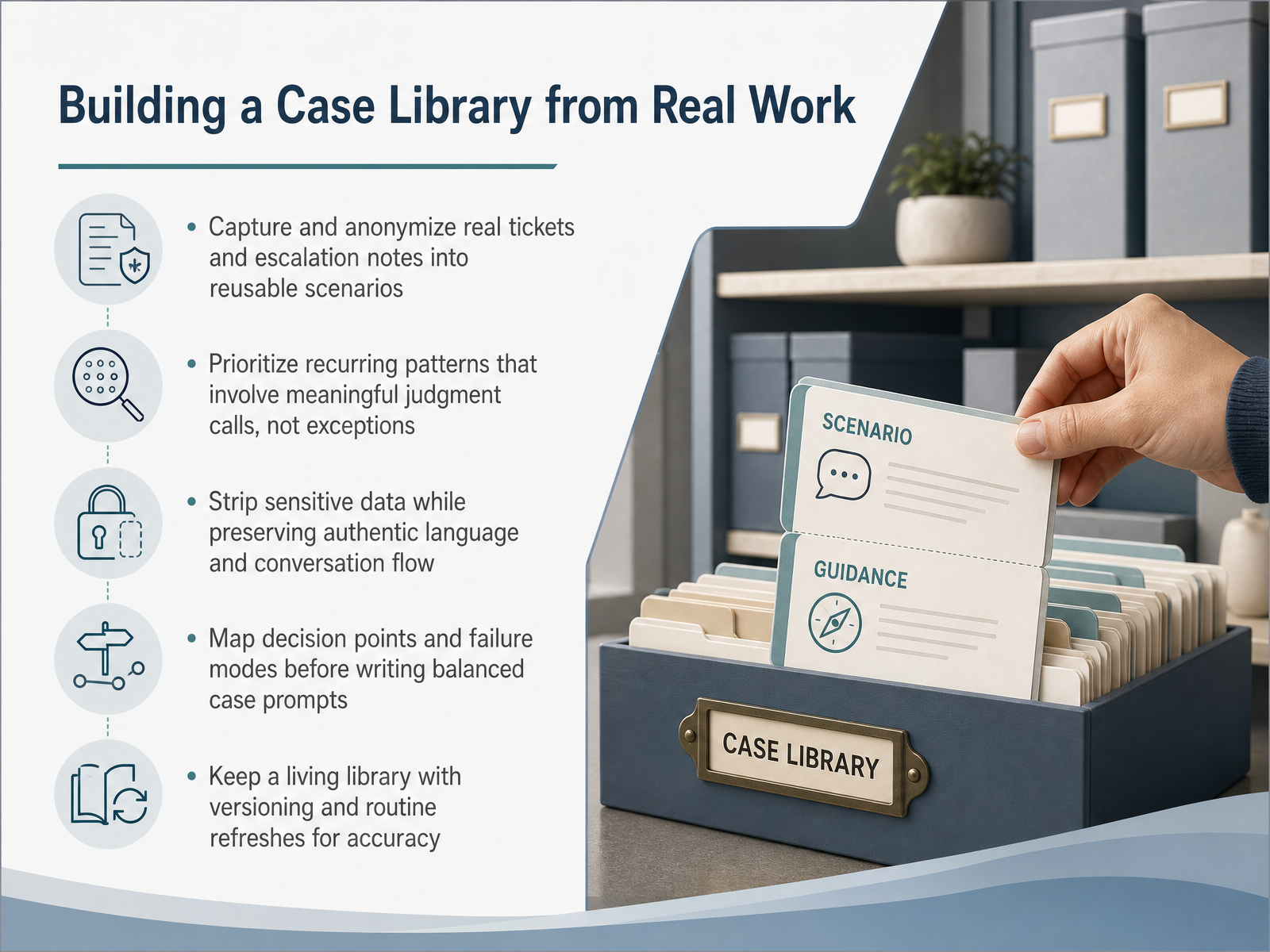
 - 10Building a Case Library from Real WorkNow let’s turn that thinking outward, toward the raw material of your own case library. You don’t need to invent scenarios—your ticket history is already full of them. Start by capturing real tickets and escalation notes, then anonymize them into reusable scenarios. Strip out names, account IDs, and any sensitive data, but preserve the authentic language and conversation flow. That authenticity is what makes the practice feel real. Prioritize recurring patterns that involve meaningful judgment calls—billing disputes, access issues, escalation decisions—not the rare exceptions. A one-off edge case is interesting, but it won’t build durable skill. Before you write the case prompt, map out the decision points and the likely failure modes. Where did the agent go wrong? What was the tradeoff between empathy and policy? Then build balanced prompts that let learners sit with that tension. Finally, keep the library alive. Version your cases, set a routine refresh cycle, and retire anything that no longer matches your current process. A stale case trains people for a world that doesn’t exist anymore. From here, let’s move from building that library to using it—from case practice to live support judgment.
 robylon.ailutpub.lut.fidocs.pega.com+22 min
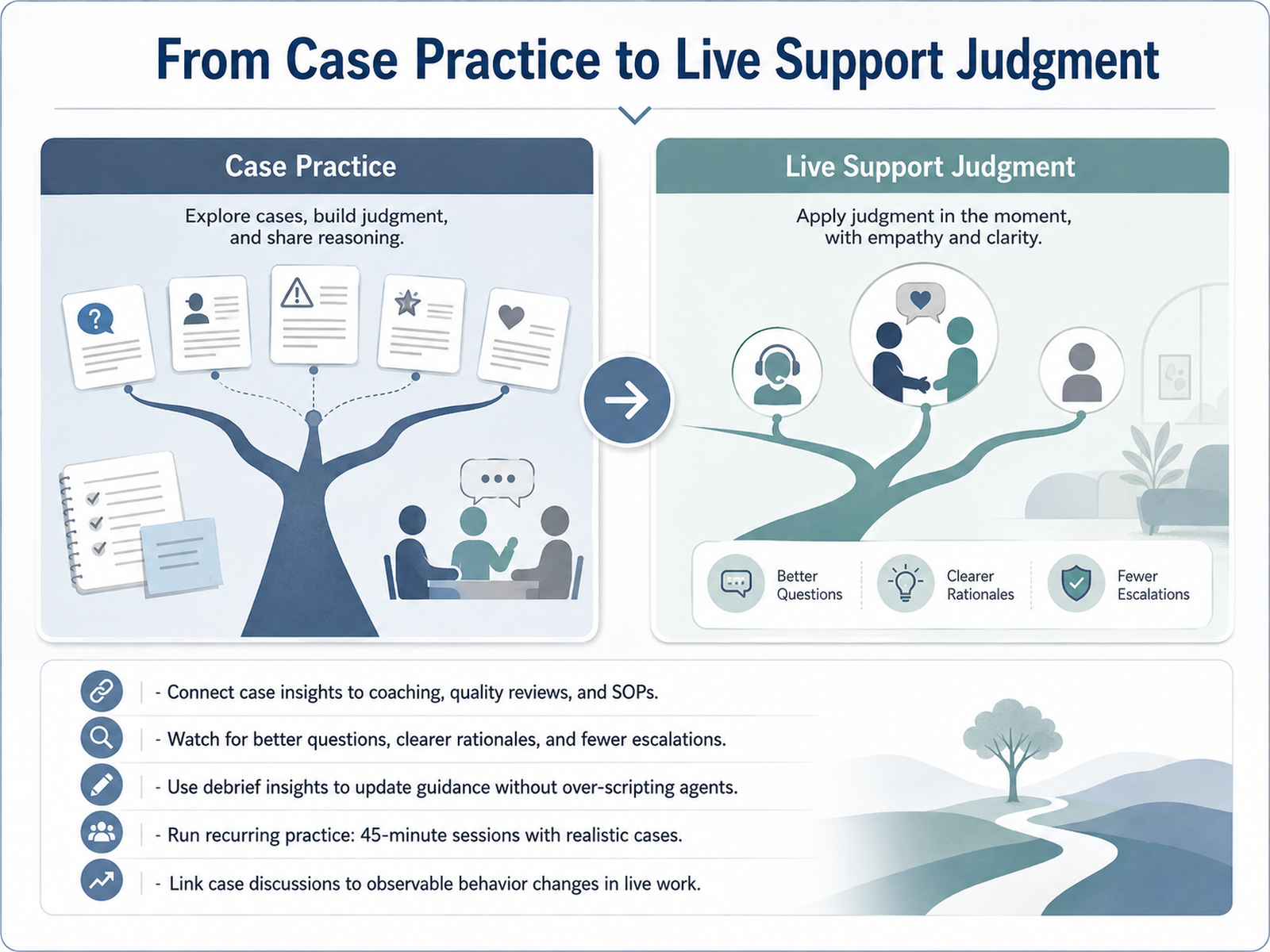
 - 11From Case Practice to Live Support JudgmentSo how do we take these case insights from the practice room to the live floor? Connect them to coaching, quality reviews, and updates to your standard operating procedures. If a case reveals a pattern of hesitation around a particular escalation trigger, that is a coaching signal, not just a discussion point. Watch for observable changes in live behavior. Better probing questions. Clearer rationales for decisions. Fewer escalations on issues your team used to pass up. Use the debrief insights to refine guidance. The goal is precision, not scripting. You want agents to internalize the principle, not recite a paragraph. Build recurring practice into the rhythm. Forty-five minute sessions with realistic, current cases keep the judgment sharp without pulling people off the floor for half a day. And close the loop. Link the case discussion to what you see in call reviews and quality scores. If the behavior shifts, the case worked. If it doesn't, revisit the scenario and the coaching around it. That link between practice and performance is where the real return on this training shows up. Next, we'll look at the measures and signals that confirm the change is lasting.
 fastercapital.comeportfolio.ursularkoranteng.compure.rug.nl+22 min
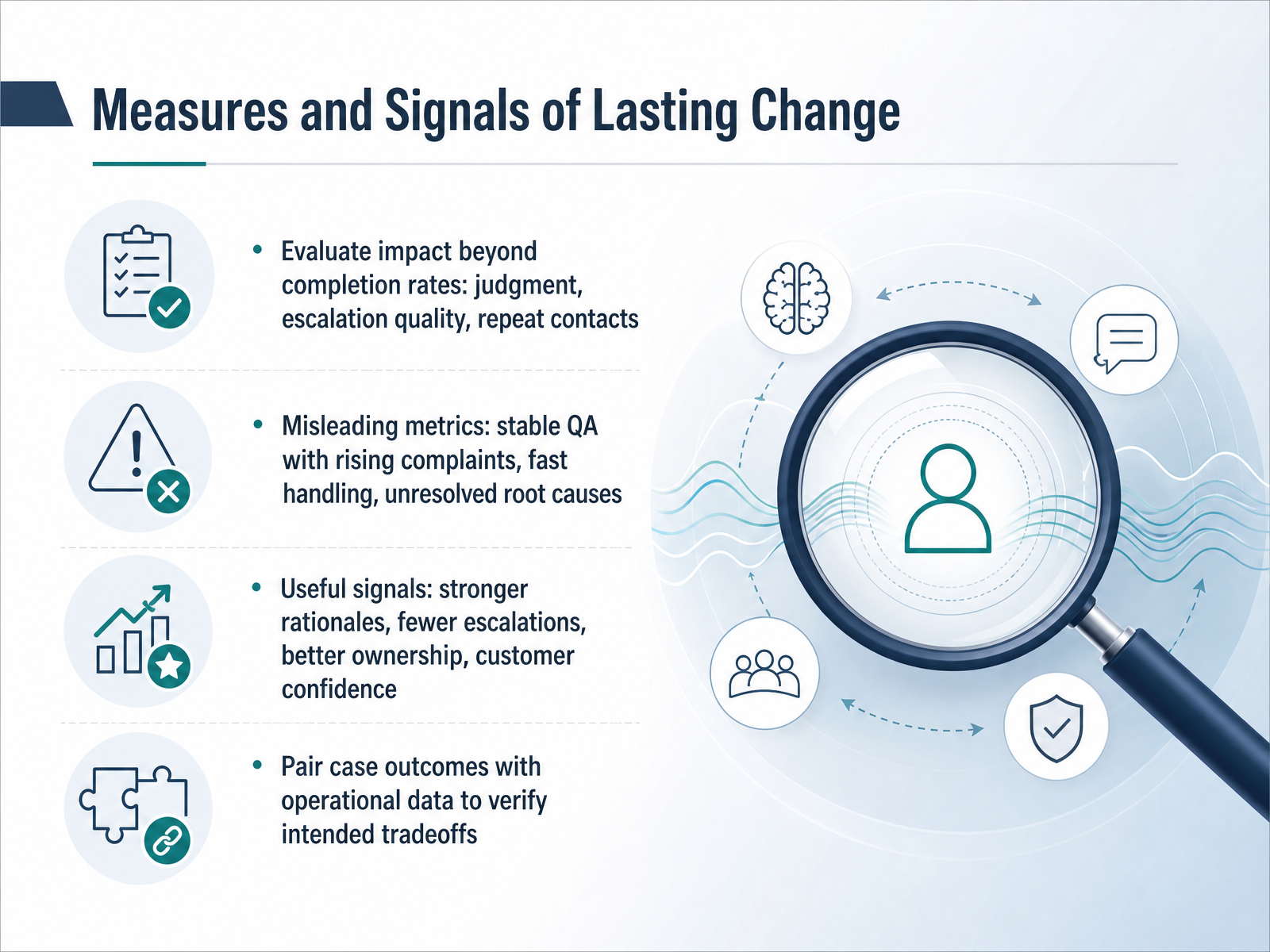
 - 12Measures and Signals of Lasting ChangeNow let's talk about measures and signals of lasting change. Completion rates are table stakes; they don't prove anything. Judge impact instead by judgment, escalation quality, repeat contacts, and ownership. Be wary of metrics that lie. Stable quality scores alongside rising complaints should trigger suspicion, not celebration. Same with fast handle times that hide unresolved root causes. Those are just beautifully tracked symptoms. Look for meaningful signals instead: sharper rationales in tickets, fewer escalations, stronger agent ownership, and customer confidence in the resolution. And never validate change in isolation. Pair your case outcomes with operational data to confirm you actually achieved the tradeoff you planned, rather than a shift you didn't intend. Lasting change shows up in behavior, not in dashboards. Next, let's look at common pitfalls in case-based training.
 robylon.ailutpub.lut.fidocs.pega.com+22 min
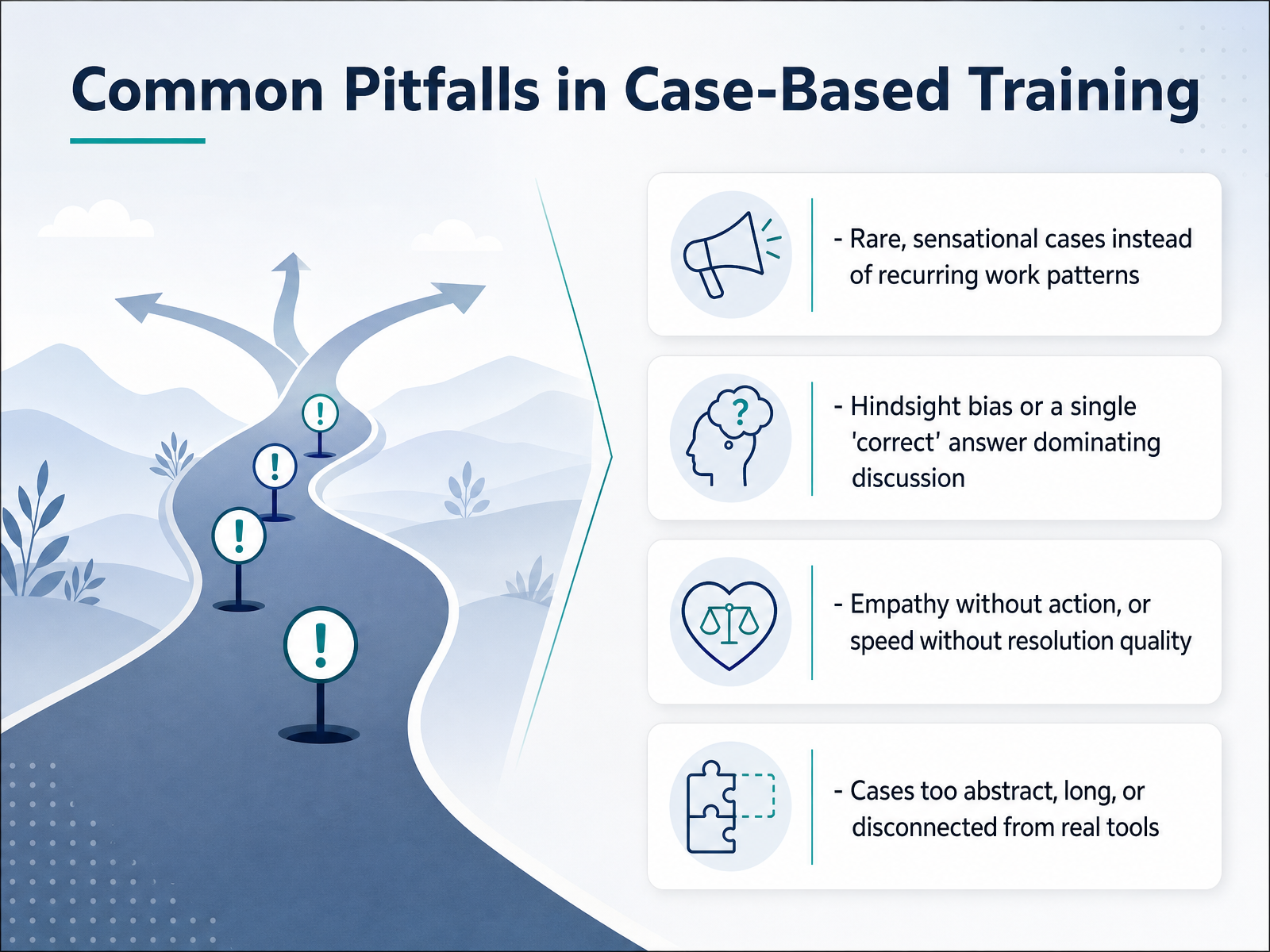
 - 13Common Pitfalls in Case-Based TrainingLet’s talk about the traps that quietly undermine case-based training. First, teams gravitate toward rare, sensational cases. Those may feel engaging, but they don’t build the muscle for repeatable patterns that drive daily volume. Anchor your case library in the recurring interactions that actually shape your metrics. Second, beware of hindsight bias. If a discussion converges on a single correct answer, you are teaching obedience, not judgment. Push for the tradeoff behind each decision point, and let competing resolutions stand on their merits. Third, empathy without action is theater. And speed without resolution quality is just a short call that comes back as a repeat contact. Fast empathy techniques let you acknowledge emotion and move into problem solving without inflating handle time. Fourth, if cases are abstract or too long, they detach from the real tools and screens agents use. Mirror your CRM in the practice environment so the skill transfers directly to the workflow. Strong cases reflect real work, demand judgment over recall, and force a balance between care and efficiency. Keep that pattern in mind as we move into the action plan for leaders and trainers.
 fastercapital.comeportfolio.ursularkoranteng.compure.rug.nl+22 min
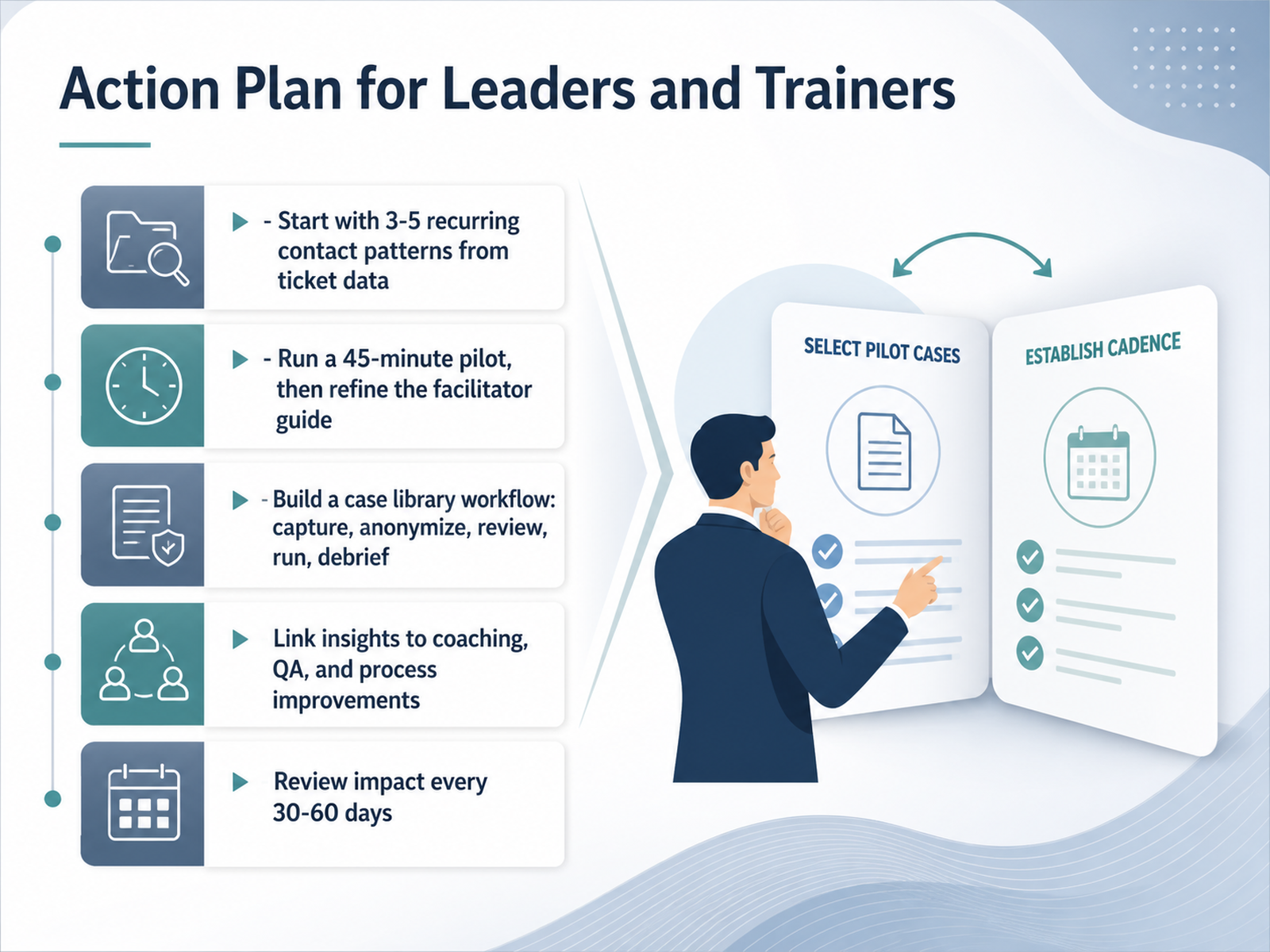
 - 14Action Plan for Leaders and TrainersSo where do we go from here? Start with a simple audit. Pull your ticket data and identify three to five recurring contact patterns, not individual cases, but patterns. Next, run a forty-five minute pilot with your trainers and a cross-section of frontline agents. Let them experience the case studies and then refine the facilitator guide together. Establish a repeatable workflow for your case library: capture a recurring ticket, anonymize it, review it for training value, run it with your team, and debrief on what worked. Then, and this is critical, link your case-based insights back to coaching plans, QA scores, and process improvements. This is how training stops being an event and becomes an operating system. Finally, schedule a review every thirty to sixty days to measure impact and refresh your library. This is not a one-time project. It is an ongoing cycle that keeps your team sharp as customer expectations shift. Take the patterns we discussed today, apply them in your own context, and turn those hard-won lessons into proactive advantages. Thank you for your time, and good luck building your case library.
 eportfolio.ursularkoranteng.com2 min
Take the deck with you
Download this course as a file — free, no sign-up needed.
- PDF handoutEvery slide page, ready to print or share.15 pages · 3.3 MBDownload
- Narrated PowerPointThe deck that presents itself — every slide carries the digital human's narration video.15 pages · 13.2 MBDownload
- PowerPoint slidesThe full deck as a .pptx — open it in PowerPoint, Keynote, or Google Slides.15 pages · 3.2 MBDownload
Free to use in your own training — please keep the PersonWise credit page at the end.
Have your own deck? Turn it into a course
Sources consulted
Web sources consulted while building this course.
- Customer Service Training How to Use Case Study Based Learning | FasterCapital Article Guide — fastercapital.com
- Customer Service Excellence Case Study - ePortfolio — eportfolio.ursularkoranteng.com
- University of Groningen — pure.rug.nl
- Retailer Credit & Loyalty Financial Services Operation Delivers On-the-Fly Policy Answers With Situational Simulations and AI-Assisted Knowledge Retrieval – The eLearning Blog — elearning.company
- A Blended-Learning Transformation For Customer Service In Technology | TrainingPros — trainingpros.com
- What 10M Support Emails Taught Us About Intent | Robylon — robylon.ai
- Service request categorization framework for customer support in a global manufacturing company — lutpub.lut.fi
- Pega Customer Service case types — docs.pega.com
- Customer Support Contact Rate Stats in 2026 | Stealth Agents — stealthagents.com
- Customer service tiers and escalation paths explained | TechTarget — techtarget.com
- Quality–Speed Conundrum: Trade-offs in Customer-Intensive Services — doi.org
- Customer Service Operations: A Gatekeeper Framework — sage.cnpereading.com
- https://www.arxiv.org/pdf/2602.13998 — arxiv.org
- How to balance empathy and efficiency in customer service — aircall.io
- Human or AI-powered? The optimal customer service for an e-commerce platform supply chain with competing brands - ScienceDirect — sciencedirect.com
- Review Mining for Support Operations: Turn Complaint Patterns Into Better Triage | VOC.AI — voc.ai
- From Complaint to Resolution: A Case of a Large Global Actor – Company X - Research Paper | OiPub — oipub.com
- Turning customer support patterns into reputation fixes — reputation-insider.com
- Escalating an Issue: Your 2026 Playbook — clepher.com
- Customer Escalation Management: The B2B Playbook (2026) — supportbench.com