Begin
14 pages · ~28 min
Writing Systems of the World
This training explores the world's major writing systems—alphabets, syllabaries, and logograms—for learners seeking to understand how different cultures represent language in written form.
A digital instructor presents all 14 pages. Hold “Ask” at any point and ask out loud — the answer comes from this course. No sign-up needed.
What you’ll learn
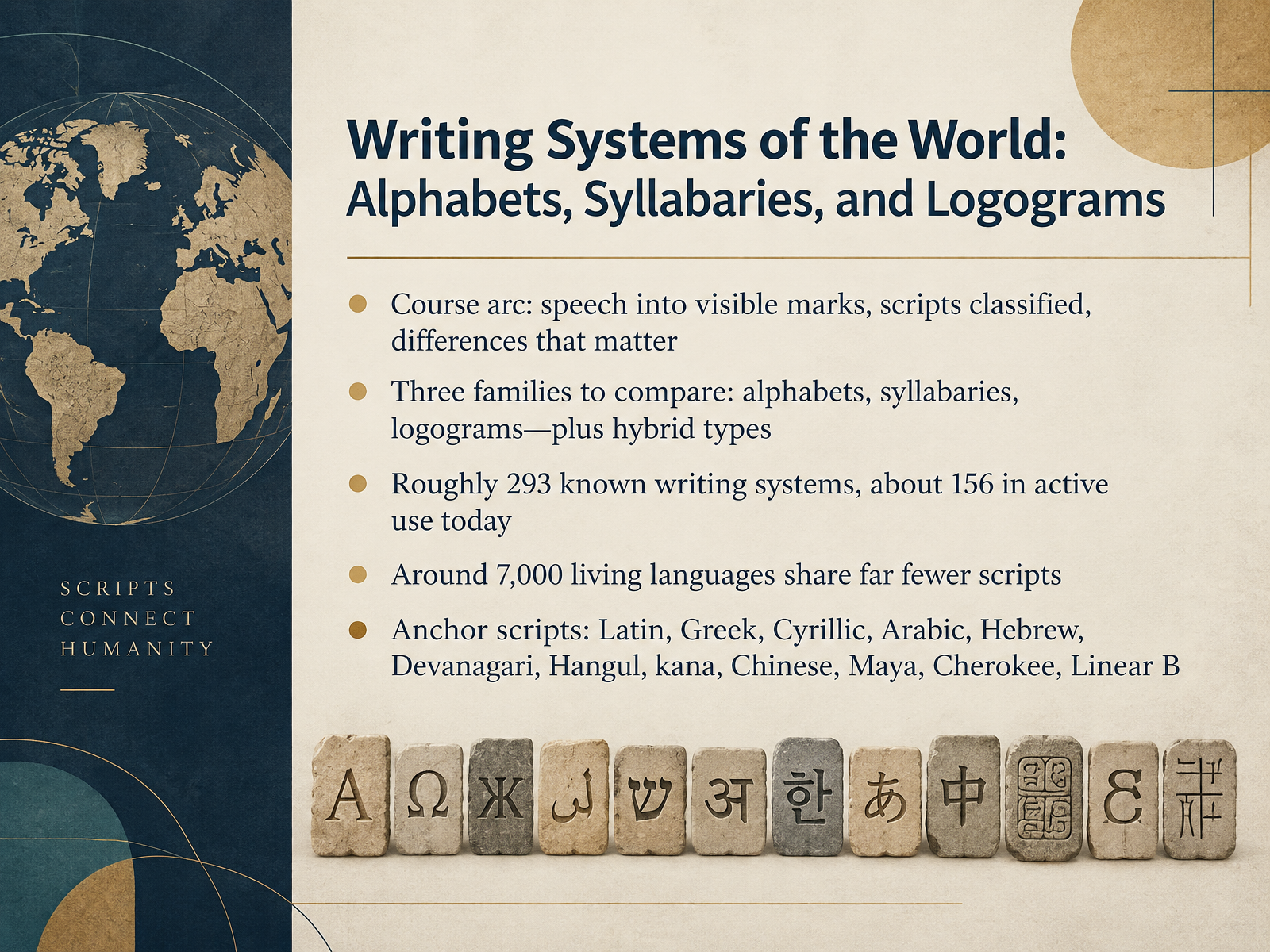
- 01Writing Systems of the World: Alphabets, Syllabaries, and LogogramsWelcome. I am glad you are here. Today we are exploring writing systems of the world, and our goal is simple. We want to understand how speech becomes visible marks on a page or screen, and how those marks are organized into families.
Think of it as a map. We will move from raw sound to script, then sort scripts into a few big families. The main three are alphabets, syllabaries, and logograms, plus some hybrids that blend them. Along the way, notice the scale. There are roughly two hundred ninety three known writing systems, and about one hundred fifty six are still in active use today. Yet around seven thousand living languages share far fewer scripts.
We will anchor our comparison in real examples, including Latin, Greek, Cyrillic, Arabic, Hebrew, Devanagari, Hangul, kana, Chinese, Maya, Cherokee, and Linear B. By the end, you will see your own reading and writing in a new light.
Next, we start with the basics in From Speech to Script: Core Concepts and Terminology.unesco.orgunesco.orgdatabrowser.uis.unesco.org+21 min
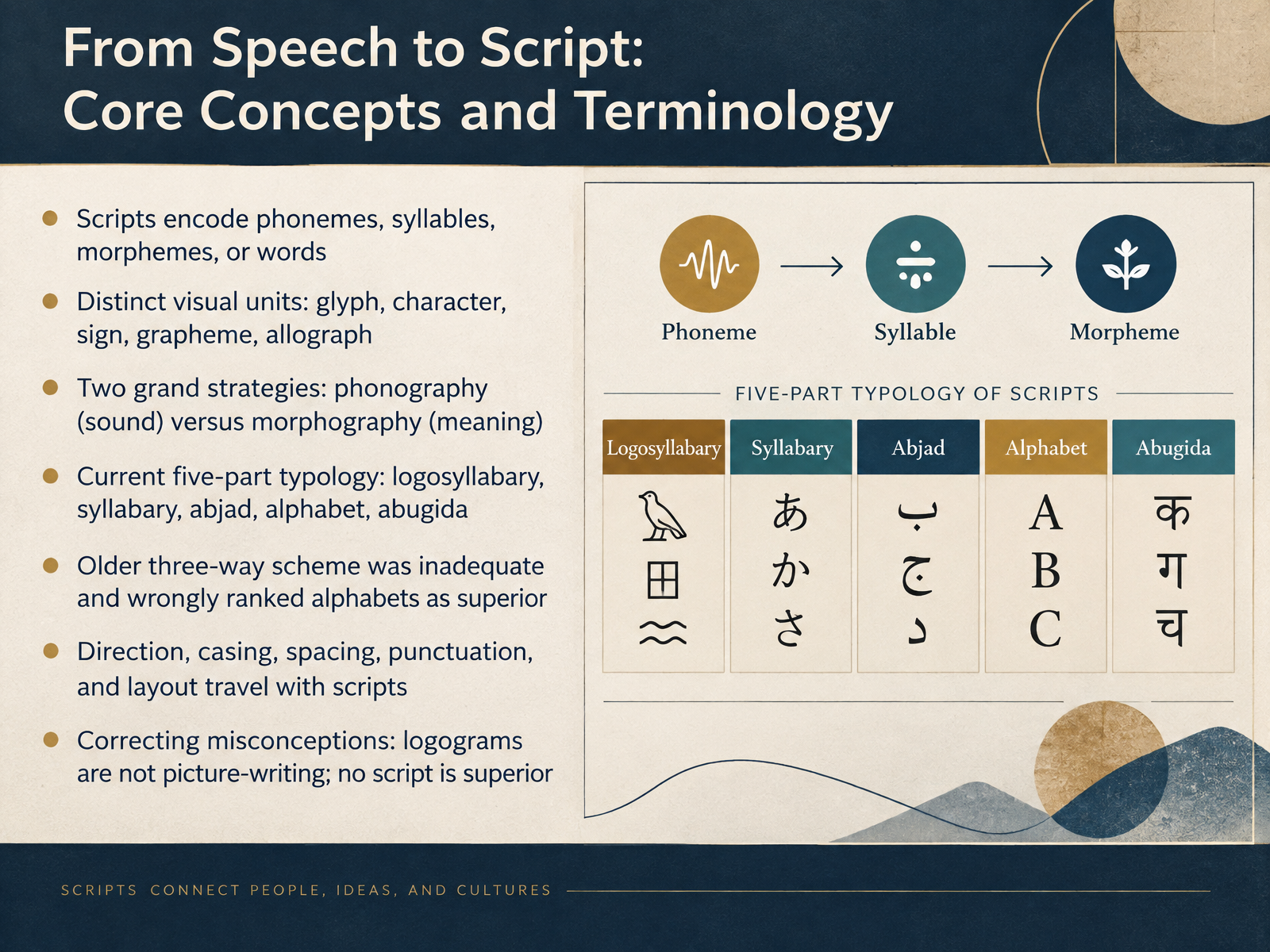
- 02From Speech to Script: Core Concepts and TerminologyNow let's build the vocabulary we'll use all the way through. Every script encodes something: phonemes, which are individual sounds, or syllables, or morphemes, the smallest units of meaning, or whole words. The visual units have names too. A glyph is any written mark, while a grapheme is the smallest unit that distinguishes meaning, and an allograph is simply a variant shape of the same letter, like the two forms of lowercase a. Broadly, writing works in two ways. Phonography encodes sound. Morphography encodes meaning. Notice how today's five-part typology refines this: logosyllabary, syllabary, abjad, alphabet, and abugida. An earlier three-way scheme was inadequate, and it wrongly ranked alphabets as superior. Think of it as tools in a toolbox: each fits its language. Direction, casing, spacing, punctuation, and layout travel with scripts as well. One misconception to correct: logograms are not picture-writing, and no script is superior. Your own alphabet feels obvious because you learned it, not because it is best. Next, we'll see how scripts travel, from Proto-Sinaitic to the alphabet family.
 doi.orgwritingsystems.orgdoi.org+22 min
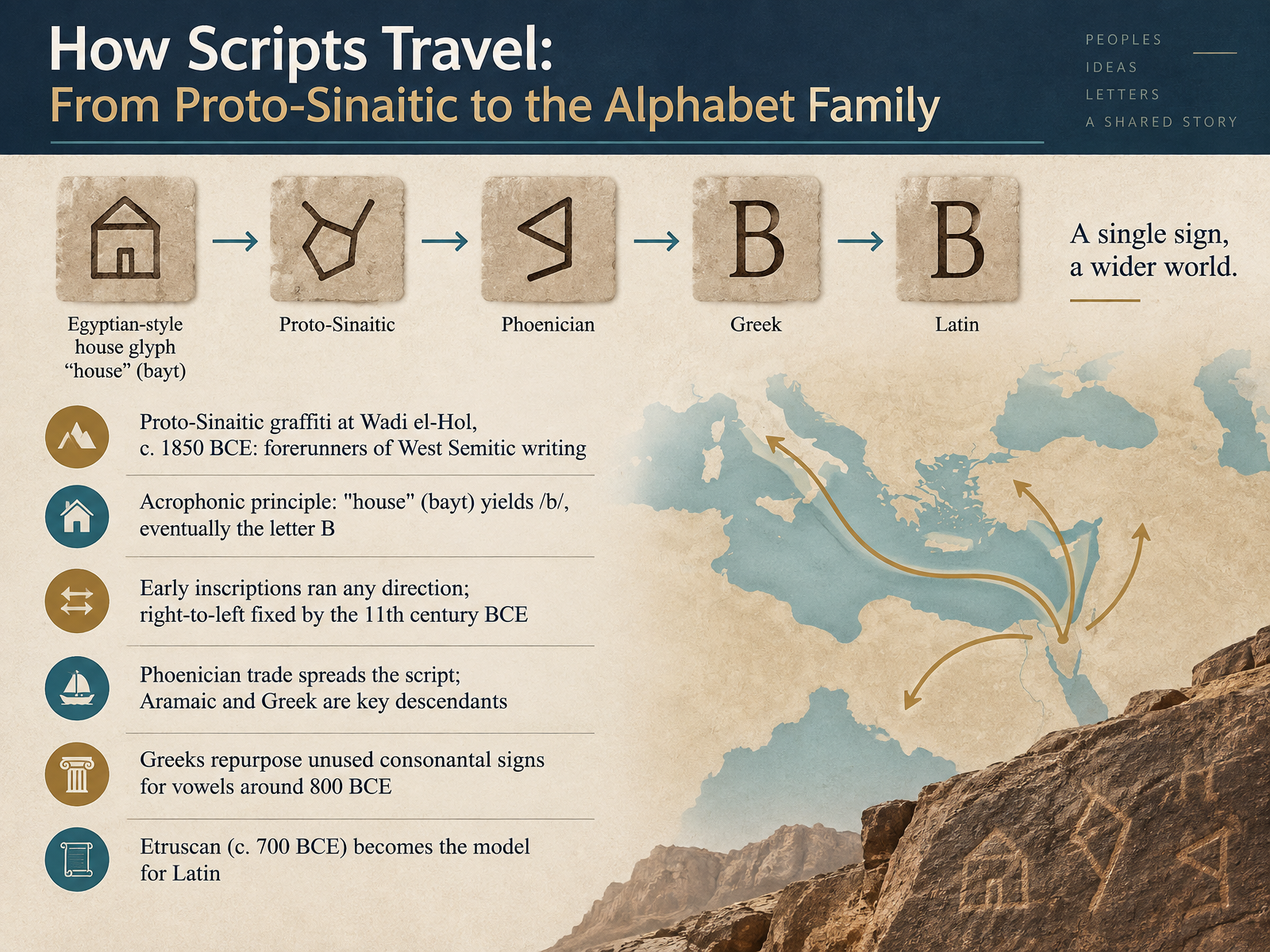
- 03How Scripts Travel: From Proto-Sinaitic to the Alphabet FamilyLet's look at how one early script traveled and multiplied. Around 1850 BCE, workers in the Egyptian desert left graffiti at a place called Wadi el-Hol. These rough marks are forerunners of West Semitic writing. Notice how they worked: the acrophonic principle. Each sign stood for the first sound of a familiar word. The word for house, bayt, gave the sound b, and that sign eventually became our letter B. Early inscriptions could run in any direction, even back and forth like an ox plowing. By the eleventh century BCE, right to left became fixed. Phoenician traders then carried the script across the Mediterranean. Aramaic and Greek are its key descendants. Around 800 BCE, the Greeks repurposed unused consonant signs to write vowels. And Etruscan, around 700 BCE, became the model for Latin. So when you read this sentence, you are using a chain of adaptations that began with a few desert signs. Next, we turn to alphabets and abjads: consonants, vowels, and direction.
 en.wikipedia.orgdoi.orgaegeussociety.org+22 min
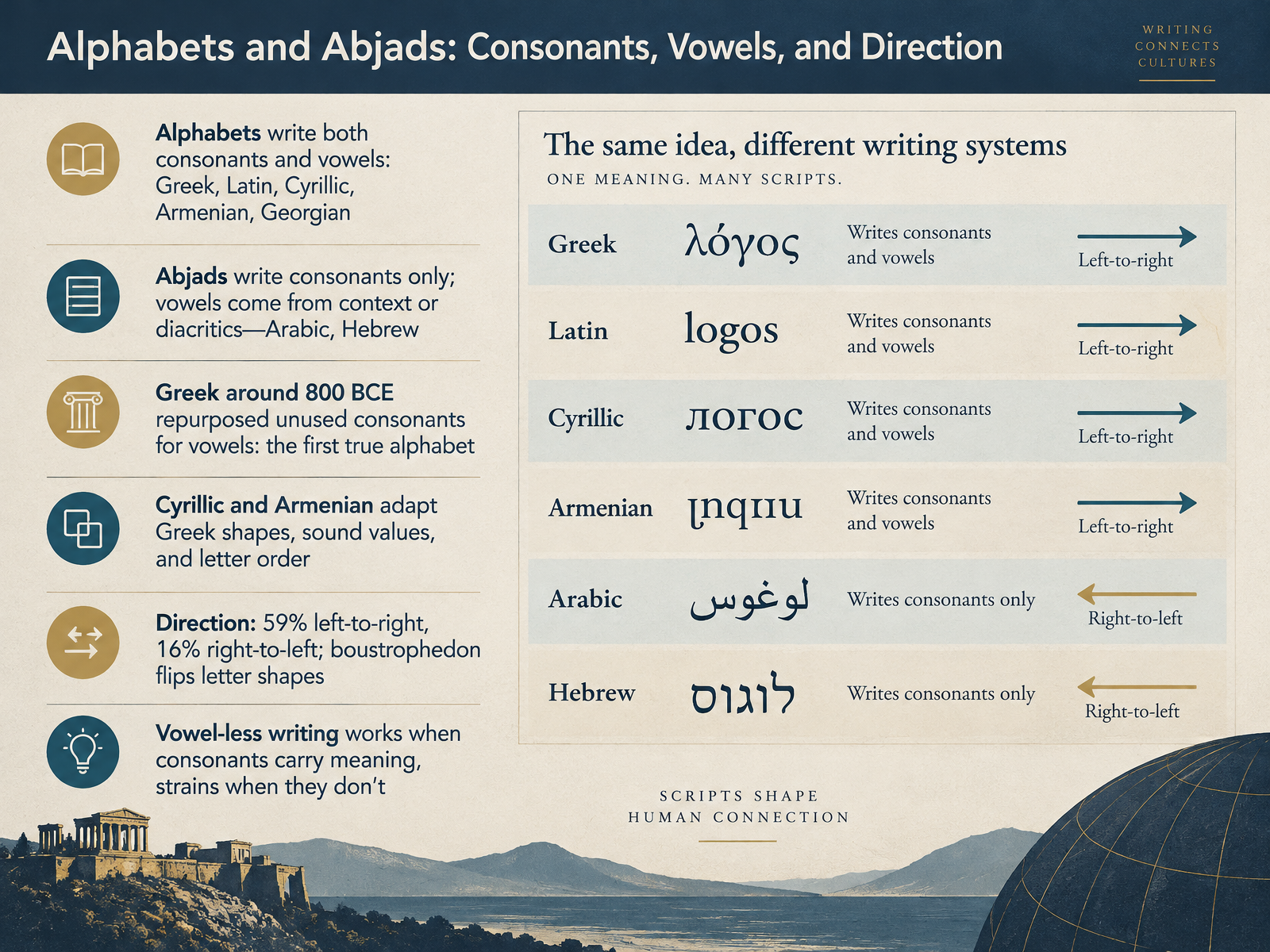
- 04Alphabets and Abjads: Consonants, Vowels, and DirectionNow let's look at how alphabets handle vowels. An alphabet writes both consonants and vowels with separate letters. Greek, Latin, Cyrillic, Armenian, and Georgian all work this way. An abjad, by contrast, writes consonants only. Vowels come from context, or from small marks called diacritics. Arabic and Hebrew are the classic examples. Around eight hundred before the common era, the Greeks repurposed Phoenician consonants they didn't need and turned them into vowel letters. Notice how that made Greek the first true alphabet. Cyrillic and Armenian later adapted Greek shapes, sound values, and even letter order. Direction matters too. About fifty-nine percent of scripts run left to right, and about sixteen percent run right to left. Some early Greek writing used boustrophedon, which flips direction each line and mirrors the letter shapes. Vowel-less writing works when consonants carry the meaning, and strains when they don't. Think of texting without vowels: you can usually fill in the gaps, but it takes extra effort. Next, we turn to syllabaries and abugidas, which encode whole syllables.
 en.wikipedia.orgdoi.orgaegeussociety.org+22 min
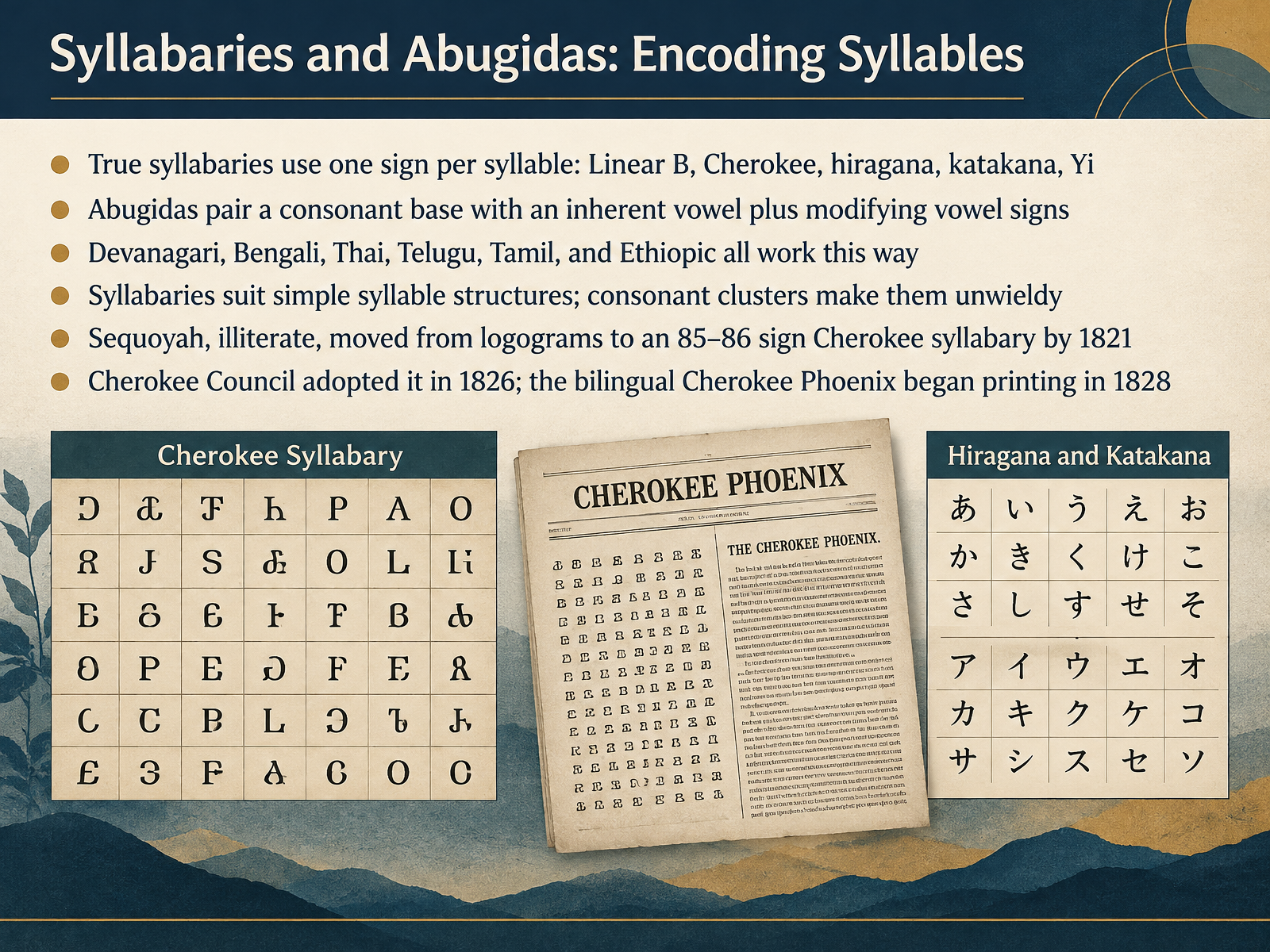
- 05Syllabaries and Abugidas: Encoding SyllablesNow let's look at writing systems that encode whole syllables. A true syllabary uses one sign for each syllable. Known examples include Linear B, Cherokee, the Japanese hiragana and katakana, and the Yi script. Abugidas work differently. Each consonant letter carries a built-in vowel, usually an "a" sound, and small added marks change that vowel. Think of it as a base letter with a switch attached. Devanagari, Bengali, Thai, Telugu, Tamil, and Ethiopic all work this way. Notice how syllabaries suit languages with simple syllable structures. Consonant clusters make them unwieldy, because every cluster needs its own signs. The Cherokee story is remarkable. Sequoyah, who could not read or write, first experimented with logograms. By 1821 he had built a syllabary of about eighty-five or eighty-six signs. The Cherokee Council adopted it in 1826, and the bilingual Cherokee Phoenix newspaper began printing in 1828. So when you sound out a word letter by letter, remember that many readers reach the same place syllable by syllable. Next, we turn to logograms and morphographic systems, looking at Chinese characters and beyond.
 en.wikipedia.orgnps.govunicode.org+22 min
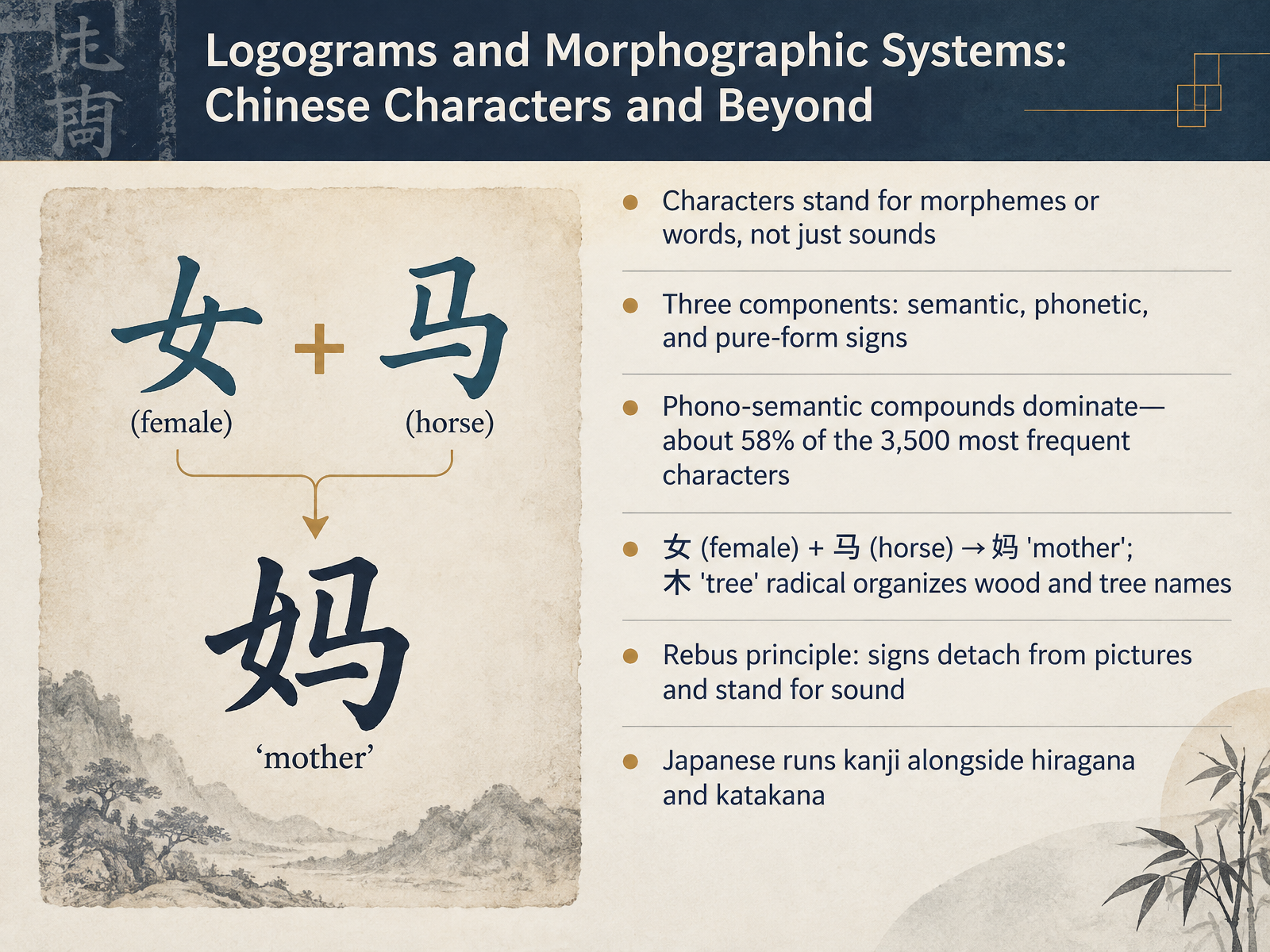
- 06Logograms and Morphographic Systems: Chinese Characters and BeyondNow let's look at logograms, where a character stands for a whole morpheme or word, not just a sound. Chinese is the classic example. Here's the useful part: characters are built from components, and those components come in three kinds. A semantic sign hints at meaning. A phonetic sign hints at sound. And a pure-form sign does neither; it just helps tell one character apart from another. Notice how the most common type combines meaning and sound. These phono-semantic compounds make up about fifty-eight percent of the three thousand five hundred most frequent characters. Think of it as a puzzle: the meaning piece plus the sound piece. For example, the female component plus the horse component gives ma, meaning mother. And the tree radical organizes many wood and tree names, like pine and cypress. There's also the rebus principle, where a sign detaches from its picture and stands for a sound instead. Japanese shows this mixing too, running Chinese kanji alongside two kana syllabaries. So next time you see a Chinese character, try spotting the meaning clue and the sound clue. That same component logic is what we'll explore further as we move on to hybrid systems and new scripts like Hangul and modern Japanese invention.
 doi.orgwritingsystems.orgdoi.org+22 min
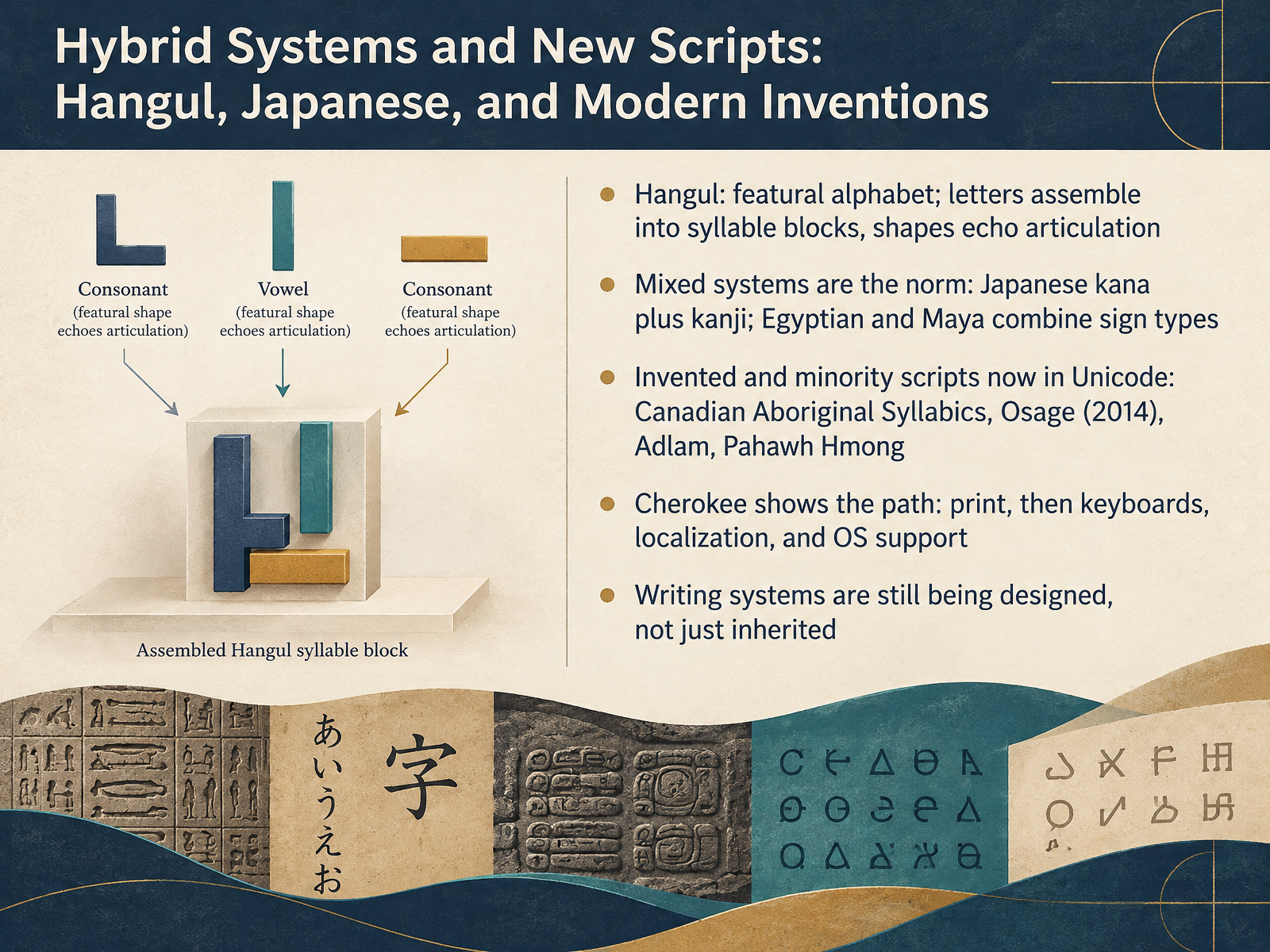
- 07Hybrid Systems and New Scripts: Hangul, Japanese, and Modern InventionsNow let's look at hybrid systems, and at scripts that people invented on purpose. Take Hangul, the Korean alphabet. It's called a featural alphabet, meaning the letter shapes echo how your mouth and tongue actually make the sound. And notice how letters don't just sit in a line. They pack together into neat syllable blocks, almost like fitting puzzle pieces into a square. Hybrid systems, though, are really the norm. Japanese mixes kana syllables with Chinese kanji characters. Egyptian and Maya combined several kinds of signs too. Invented and minority scripts are alive as well, and many now live in Unicode, the shared digital standard for text. Canadian Aboriginal Syllabics, Osage, standardized in 2014, Adlam, and Pahawh Hmong are all encoded. Think of Cherokee as the path forward. Sequoyah's syllabary moved from print to keyboards, localization, and operating system support. So writing systems are still being designed, not just inherited. The screen you're reading this on proves it. Next, we turn to scripts we still can't read, in Undeciphered Scripts: What We Know and What We Don't.
 doi.orgwritingsystems.orgdoi.org+22 min
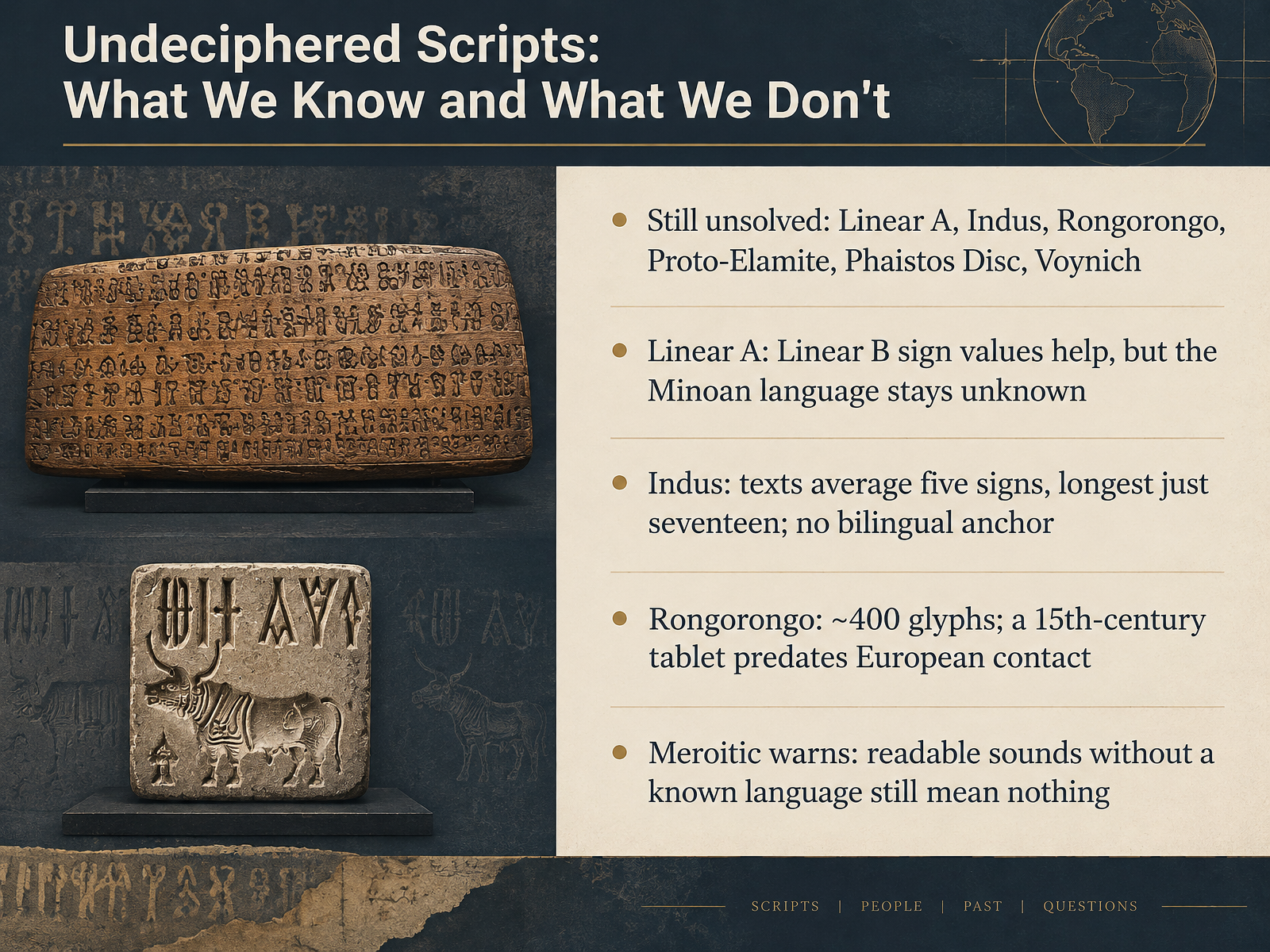
- 08Undeciphered Scripts: What We Know and What We Don'tNow let's turn to the scripts that still keep their secrets. Several remain unsolved today, including Linear A, the Indus script, Rongorongo, Proto-Elamite, the Phaistos Disc, and the Voynich manuscript. Take Linear A, the Minoan script from Crete. Its signs often match values we know from Linear B, which was deciphered in the nineteen fifties. So we can sound out many signs. But the Minoan language behind them is still unknown, so most texts stay out of reach. The Indus script faces a different problem. Its inscriptions are strikingly short, averaging about five signs, with the longest just seventeen. And there is no bilingual anchor, no parallel text in a known language to crack the code. Rongorongo, from Easter Island, has roughly four hundred glyphs, and one tablet dates to the fifteenth century, well before European contact. That tells us the script may have been invented independently. Finally, Meroitic offers a warning. Its sounds are readable, yet the language has no known relatives, so the words still mean nothing to us. Notice the pattern here. Sometimes we lack the sounds, sometimes the language, and sometimes enough text. Either way, a writing system can stay silent for centuries. Next, let's see how scholars actually go about reading a lost script, in Decipherment and Discovery: How Lost Scripts Are Read.
 2 min
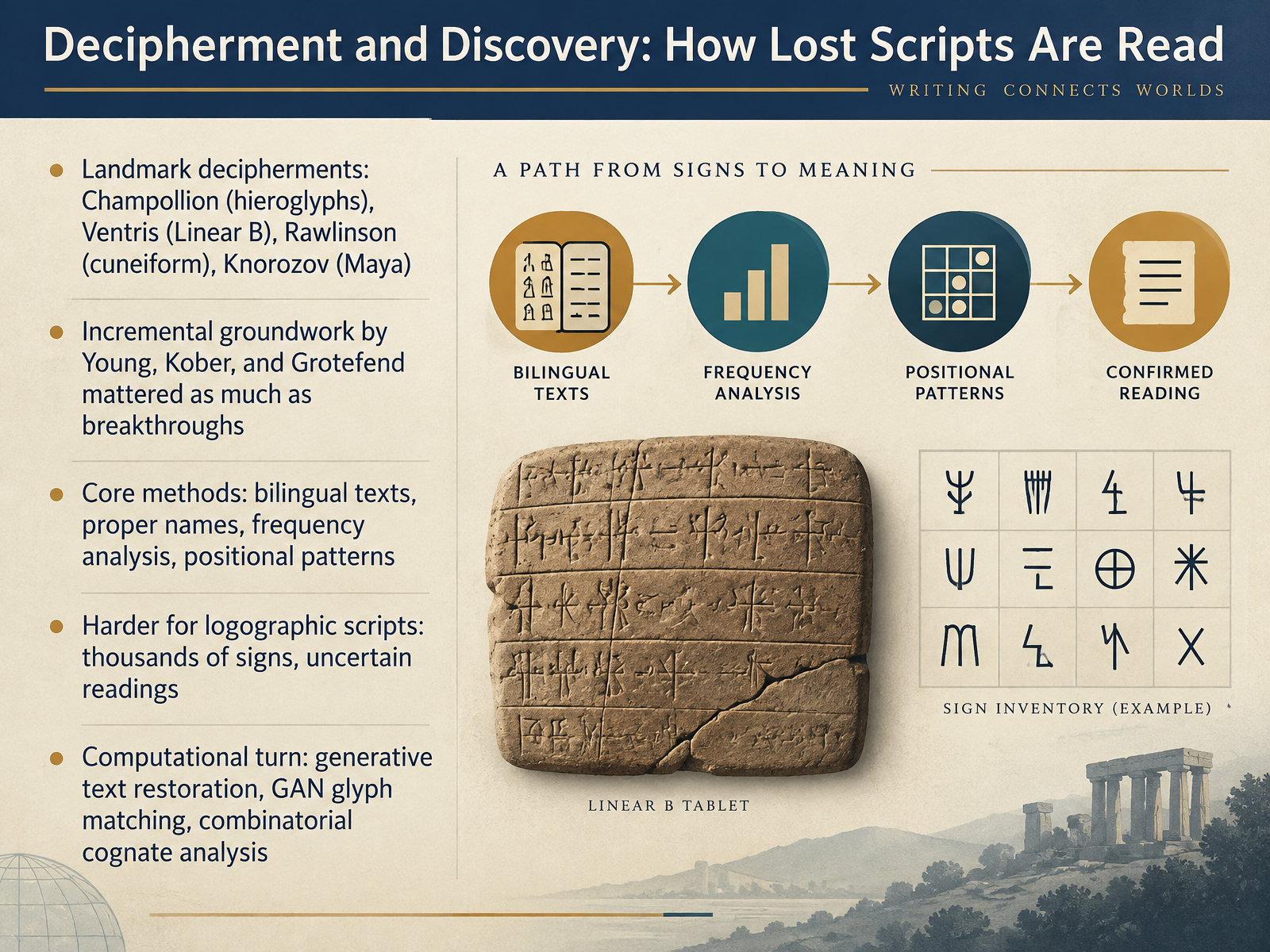
- 09Decipherment and Discovery: How Lost Scripts Are ReadNow let's look at how lost scripts actually get read. A few decipherments are famous: Champollion with Egyptian hieroglyphs, Ventris with Linear B, Rawlinson with cuneiform, and Knorozov with Maya writing. But notice how much of the work came from quieter groundwork by people like Young, Kober, and Grotefend. Think of it as a relay race, not a single sprint. The core methods are bilingual texts, proper names, frequency analysis, and positional patterns, meaning where a sign tends to sit in a line. Logographic scripts are harder, because thousands of signs must be matched, and readings stay uncertain. Today, computers are joining in. Generative models help restore damaged text. Generative adversarial networks, or GANs, match glyphs across inscriptions. And combinatorial analysis compares possible cognates between languages. So when you read a familiar word today, remember that someone, or now something, had to decode every sign first. Next, we turn to scripts, languages, and identities, and their social and political dimensions.
 2 min
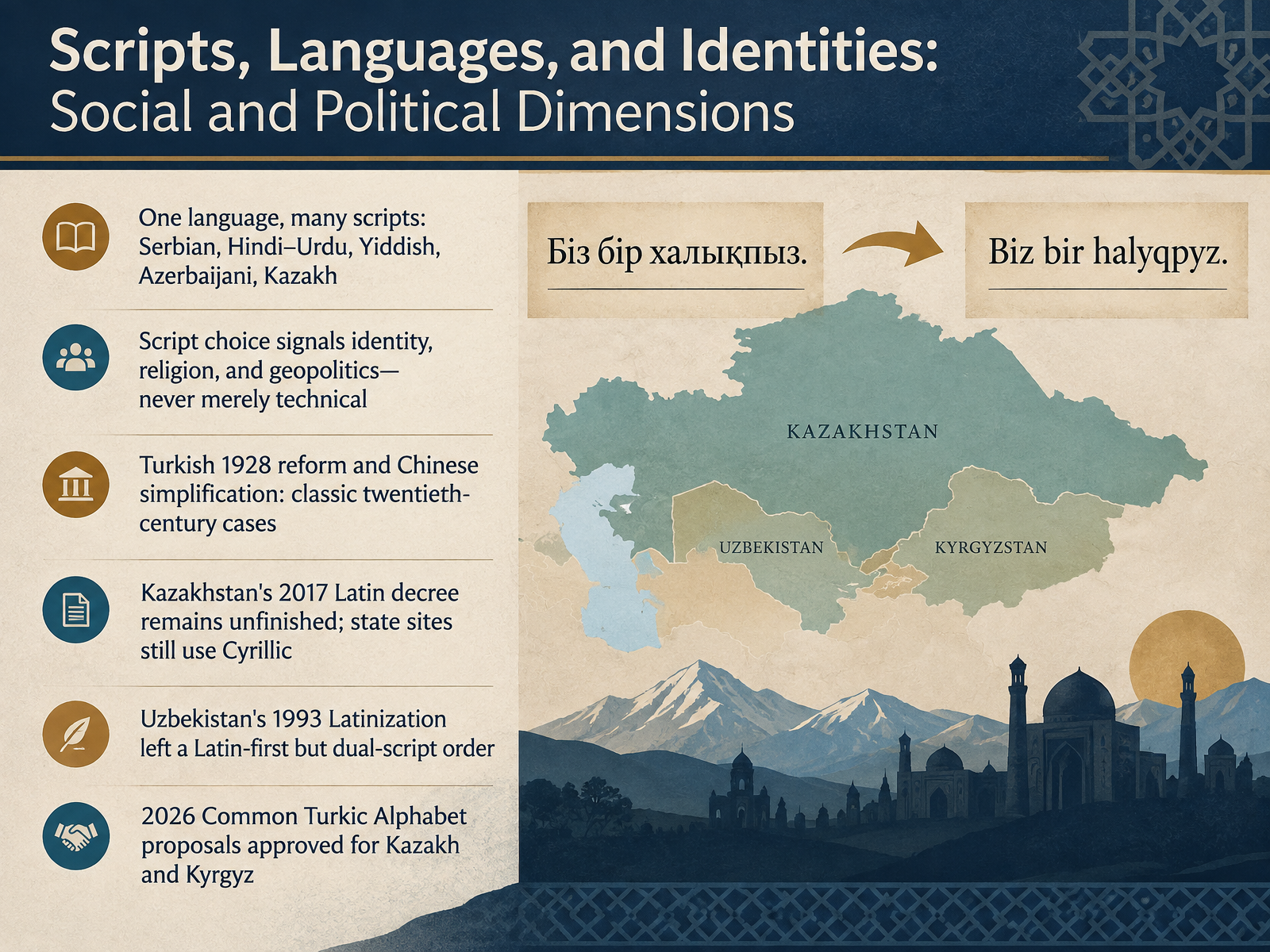
- 10Scripts, Languages, and Identities: Social and Political DimensionsNow let's step back and look at the bigger picture. Script choice is never just a technical decision. It carries identity, religion, and geopolitics. Notice how one language can be written in several scripts. Serbian uses both Cyrillic and Latin. Hindi and Urdu are closely related, yet Devanagari and Arabic script pull them in different cultural directions. Yiddish, Azerbaijani, and Kazakh have each changed scripts across their histories. Think of a script as a flag you write with. Turkey's switch to Latin in 1928, and China's simplification of characters, are classic twentieth-century cases. More recently, Kazakhstan's 2017 Latin decree remains unfinished, and central state websites still present Kazakh in Cyrillic. Uzbekistan's 1993 Latinization left a Latin-first but dual-script order. And in 2026, Common Turkic Alphabet proposals were approved for Kazakh and Kyrgyz. Ask yourself how your own script feels like home. Next, we look at writing in the digital age: encoding, fonts, and input.
 unesco.orgunesco.orgdatabrowser.uis.unesco.org+22 min
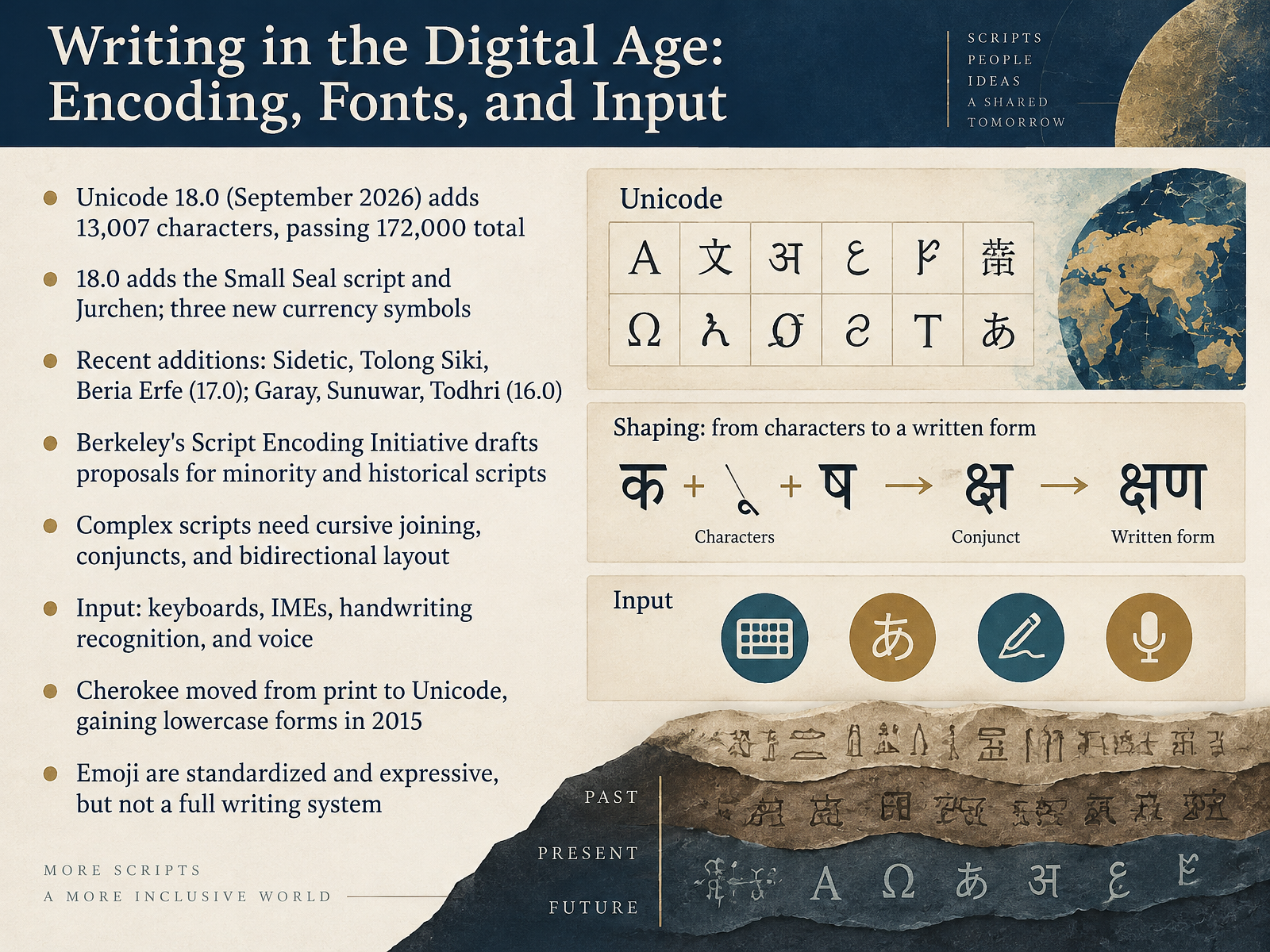
- 11Writing in the Digital Age: Encoding, Fonts, and InputNow let's bring writing into the digital age. Unicode is the shared catalogue that gives every character a number, so your screen can show scripts from around the world. Version eighteen point zero, released in September twenty twenty-six, adds thirteen thousand seven characters, pushing the total past one hundred seventy-two thousand. It includes the Small Seal script and Jurchen, plus three new currency symbols. Recent versions added Sidetic, Tolong Siki, and Beria Erfe, and before that Garay, Sunuwar, and Todhri. Much of this work comes from the Script Encoding Initiative at Berkeley, which drafts proposals for minority and historical scripts. Encoding is only half the story. Complex scripts need cursive joining, conjuncts, and bidirectional layout, and input can happen through keyboards, input method editors, handwriting, or voice. Cherokee is a lovely example. It moved from print into Unicode, and in twenty fifteen it gained lowercase forms. Think of it as a digital alphabet that keeps growing. Emoji are standardized and expressive, but they are not a full writing system. Every message you send relies on this invisible shared standard. Next, we'll look at museum and classroom applications for reading scripts on display.
 en.wikipedia.orgnps.govunicode.org+22 min
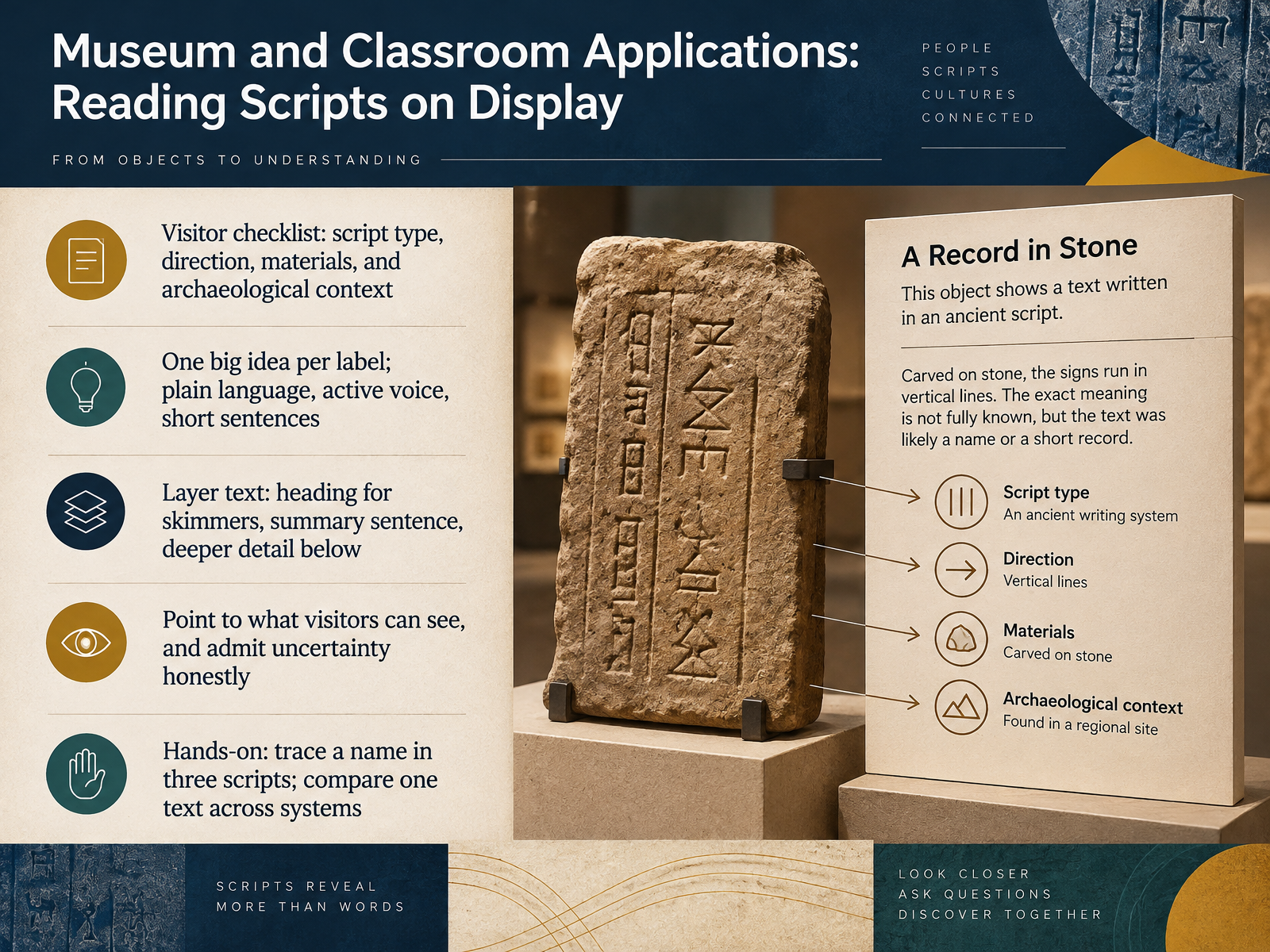
- 12Museum and Classroom Applications: Reading Scripts on DisplayNow let's bring all of this into the museum and the classroom. Good exhibit labels help visitors read a script on display without feeling lost. So give visitors a simple checklist: what type of script is this, which direction does it read, what material is it written on, and where was it found. Notice how those four questions turn a mysterious object into a story. Then keep one big idea per label. Use plain language, active voice, and short sentences. Think of it as layers: a heading for skimmers, a summary sentence, then deeper detail below. Point to what visitors can actually see, and admit uncertainty honestly. It's fine to say, we don't know yet. Finally, make it hands-on. Let visitors trace a name in three scripts, or compare one text across systems. That physical act of tracing connects back to your own writing hand. Next, we'll put these tools to work in the capstone activity, where you classify, compare, and explain a script.
 unesco.orgunesco.orgdatabrowser.uis.unesco.org+21 min
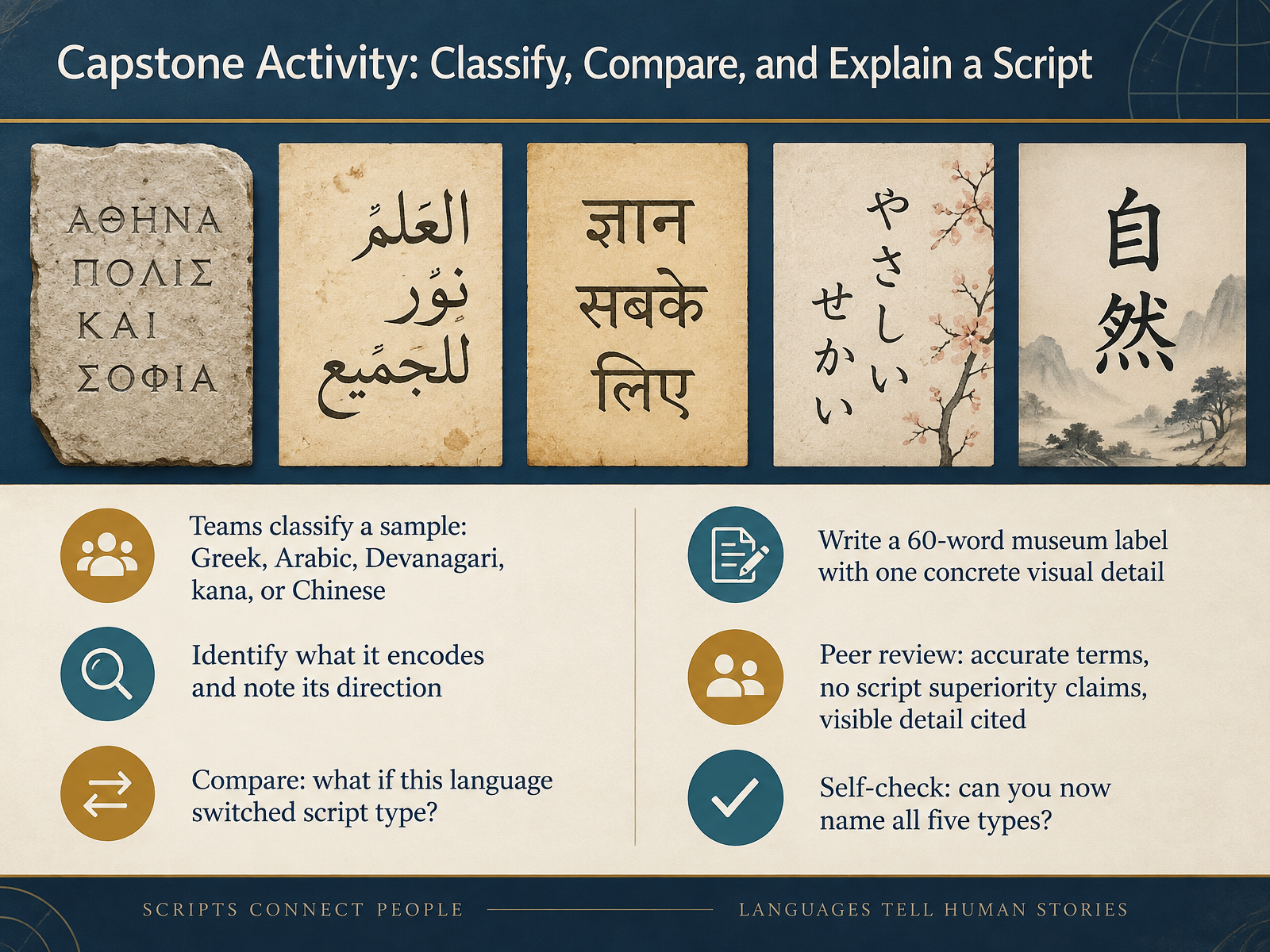
- 13Capstone Activity: Classify, Compare, and Explain a ScriptNow let's put everything into practice. This is your capstone activity. Working in teams, you'll classify a sample script: Greek, Arabic, Devanagari, kana, or Chinese. First, identify what the script encodes. Letters, consonants, syllables, or whole words and morphemes. Then note its direction of writing. Next, compare with a fun question. What if this language switched script type? Think of it as changing the tool while keeping the same job. Then write a sixty-word museum label that includes one concrete visual detail, something a visitor can actually see. Peer review checks three things: accurate terms, no claims that one script is superior, and a visible detail properly cited. Finally, a self-check. Can you now name all five types? Alphabet, abjad, abugida, syllabary, and logosyllabary. Notice how this connects to your own reading. The next time you read a line of text, ask what each sign encodes. Coming up next, Key Takeaways and Further Resources.
 doi.orgwritingsystems.orgdoi.org+22 min
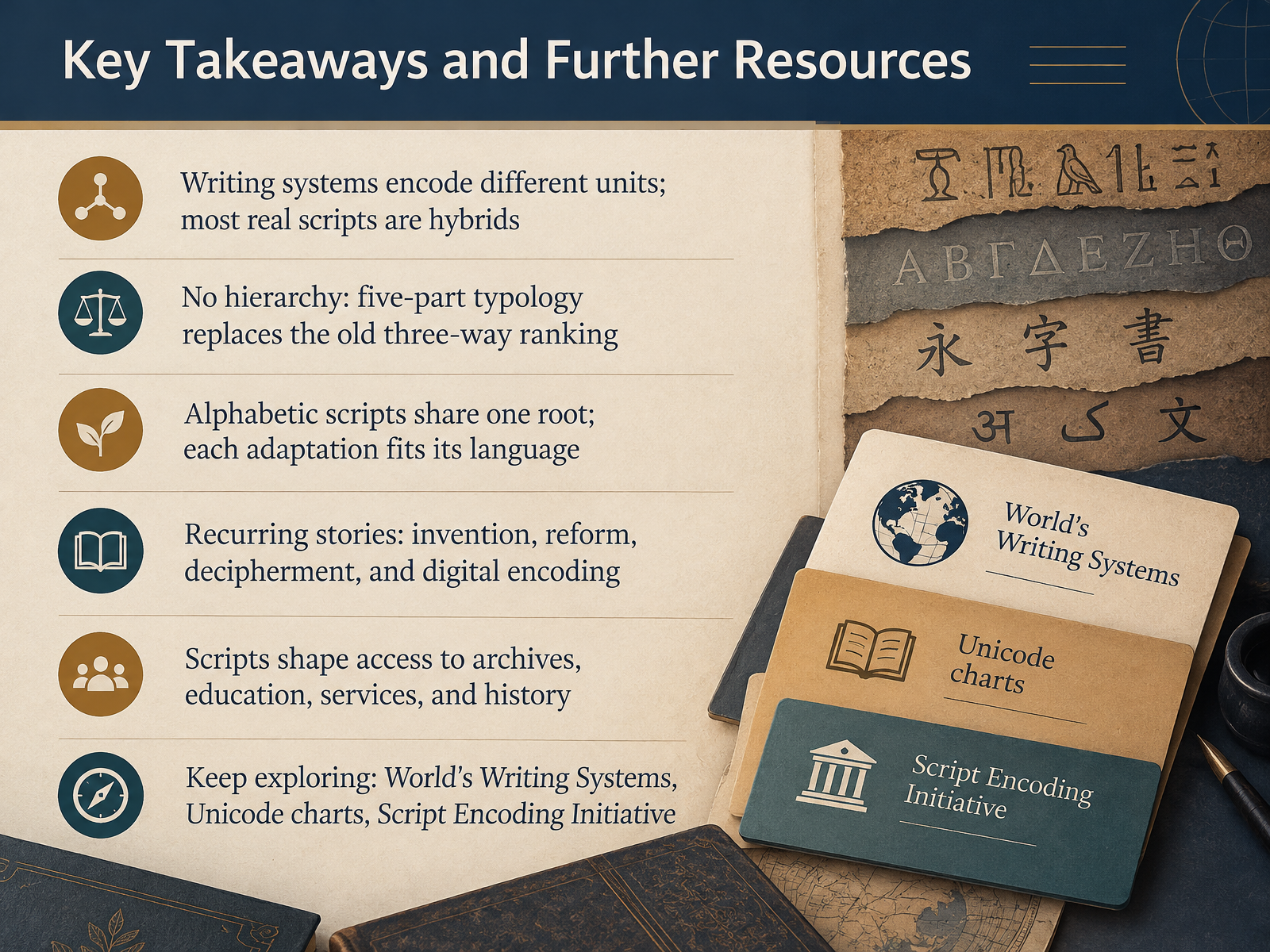
- 14Key Takeaways and Further ResourcesLet's bring it all together. Writing systems encode different units, and most real scripts are hybrids. Notice how Japanese mixes Chinese characters with kana. There is no hierarchy here. A five-part typology replaces the old three-way ranking, so no script is the best type. Alphabetic scripts share one root, yet each adaptation fits its language, like the Latin alphabet reshaping itself for Turkish or Vietnamese. Four stories keep recurring: invention, reform, decipherment, and digital encoding. And scripts shape real access to archives, education, services, and history. For example, in Kazakhstan, moving between Cyrillic and Latin touches everything from textbooks to government websites. So keep exploring. Look up the World's Writing Systems, the Unicode charts, and the Script Encoding Initiative. The next time you read a sign or a message, pause and notice the system behind it. That curiosity is yours to keep. Thank you for joining me, and happy exploring.
 unesco.orgunesco.orgdatabrowser.uis.unesco.org+22 min
Take the deck with you
Download this course as a file — free, no sign-up needed.
- PDF handoutEvery slide page, ready to print or share.15 pages · 5.8 MBDownload
- Narrated PowerPointThe deck that presents itself — every slide carries the digital human's narration video.15 pages · 16.6 MBDownload
- PowerPoint slidesThe full deck as a .pptx — open it in PowerPoint, Keynote, or Google Slides.15 pages · 5.7 MBDownload
Free to use in your own training — please keep the PersonWise credit page at the end.
Have your own deck? Turn it into a course
Sources consulted
Web sources consulted while building this course.
- Multilingualism and Linguistic diversity | UNESCO — unesco.org
- Data, facts and figures | UNESCO — unesco.org
- UIS Data Browser — databrowser.uis.unesco.org
- What are the writing systems of the world? - Geographical — geographical.co.uk
- List of writing systems — en.wikipedia.org
- 6 Writing system typology — doi.org
- Glossary | WritingSystems.org — writingsystems.org
- Writing and Writing Systems: Classification of Scripts — doi.org
- Classifying and Comparing Early Writing Systems — doi.org
- Glossary — web.archive.org
- History of the alphabet — en.wikipedia.org
- Understanding Relations Between Scripts II: Early Alphabets — doi.org
- ON THE “PHOENICIAN LETTERS” THE CASE FOR AN EARLY TRANSMISSION OF THE GREEK ALPHABET FROM AN ARCHAEOLOGICAL, EPIGRAPHIC AND LINGUISTIC PERSPECTIVE — aegeussociety.org
- INDIAN OCEAN — penn.museum
- The Origin and Development of the Alphabet | American Journal of Archaeology: Vol 31, No 3 — journals.uchicago.edu
- Cherokee syllabary — en.wikipedia.org
- Cherokee Language - Kennesaw Mountain National Battlefield Park (U.S. National Park Service) — nps.gov
- The Unicode Standard, Version 13.0 — unicode.org
- How Sequoyah, who did not read or write, created a written language for the Cherokee Nation from scratch | Blog | American Masters | PBS — pbs.org
- Cherokee Phoenix, and Indians' Advocate (New Echota [Ga.]) 1829-1834 | Library of Congress — loc.gov