Begin
15 pages · ~30 min
Customer Success Fundamentals
This training introduces customer success principles, strategies, and best practices, equipping professionals with skills to drive retention, satisfaction, and growth. Ideal for customer-facing teams.
A digital instructor presents all 15 pages. Hold “Ask” at any point and ask out loud — the answer comes from this course. No sign-up needed.
What you’ll learn
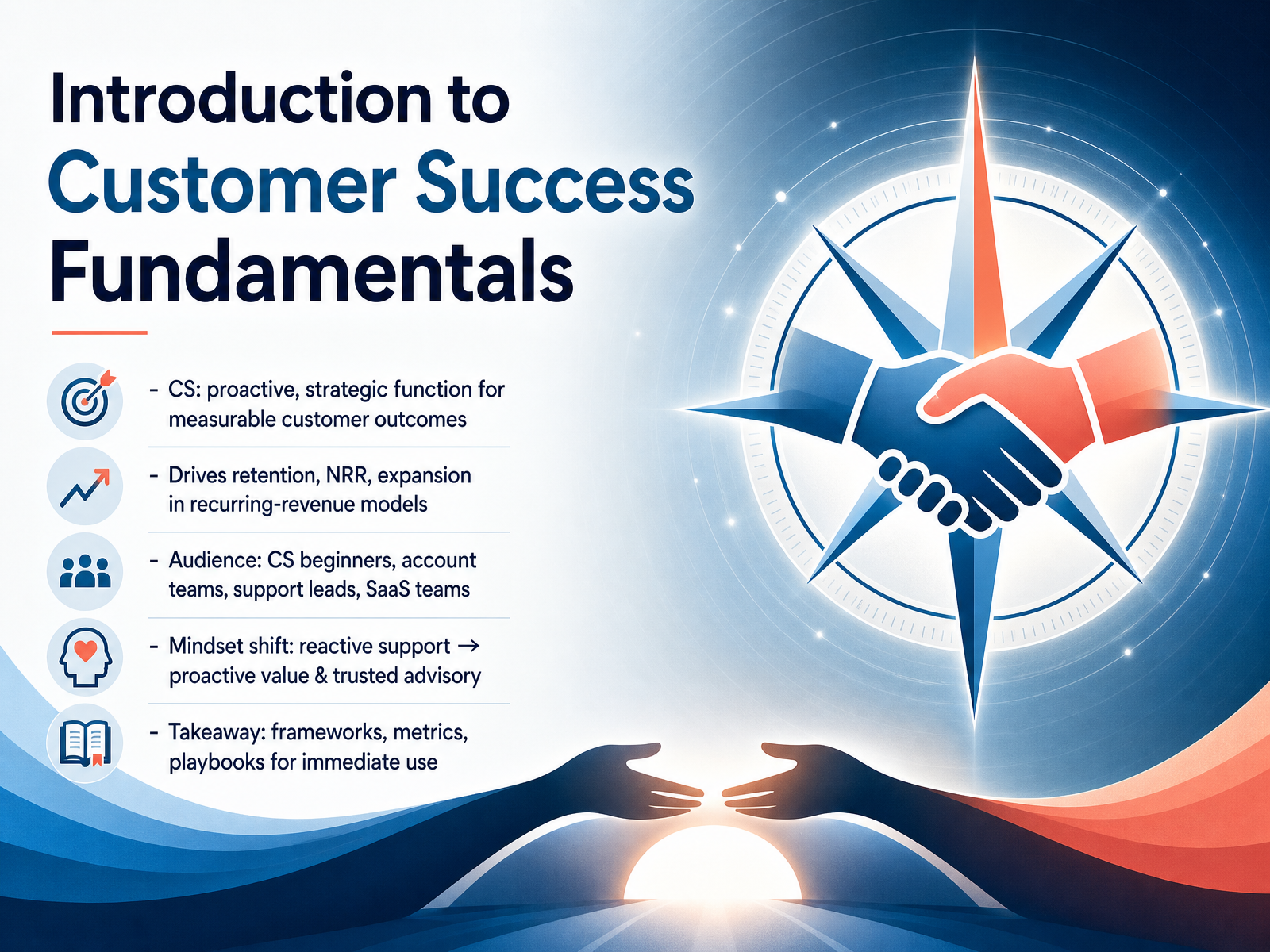
- 01Introduction to Customer Success FundamentalsWelcome. This course is designed for anyone stepping into Customer Success for the first time—whether you're on an account team, leading support, or working in a SaaS business. Over the next few minutes, we're going to demystify what this function actually does. Customer Success, or CS, isn't just reactive support. It's a proactive, strategic practice focused on helping customers achieve measurable outcomes. In a recurring-revenue model, that's everything. CS is what drives retention, protects your net revenue—often called NRR—and creates genuine expansion. The big mindset shift we'll explore is moving from simply answering tickets to becoming a trusted advisor. By the end, you'll walk away with practical frameworks, key metrics, and real-world playbooks you can use immediately. Let's start by looking at the SaaS business case for Customer Success.tsia.comcustomersuccesscollective.comblog.hubspot.com+21 min
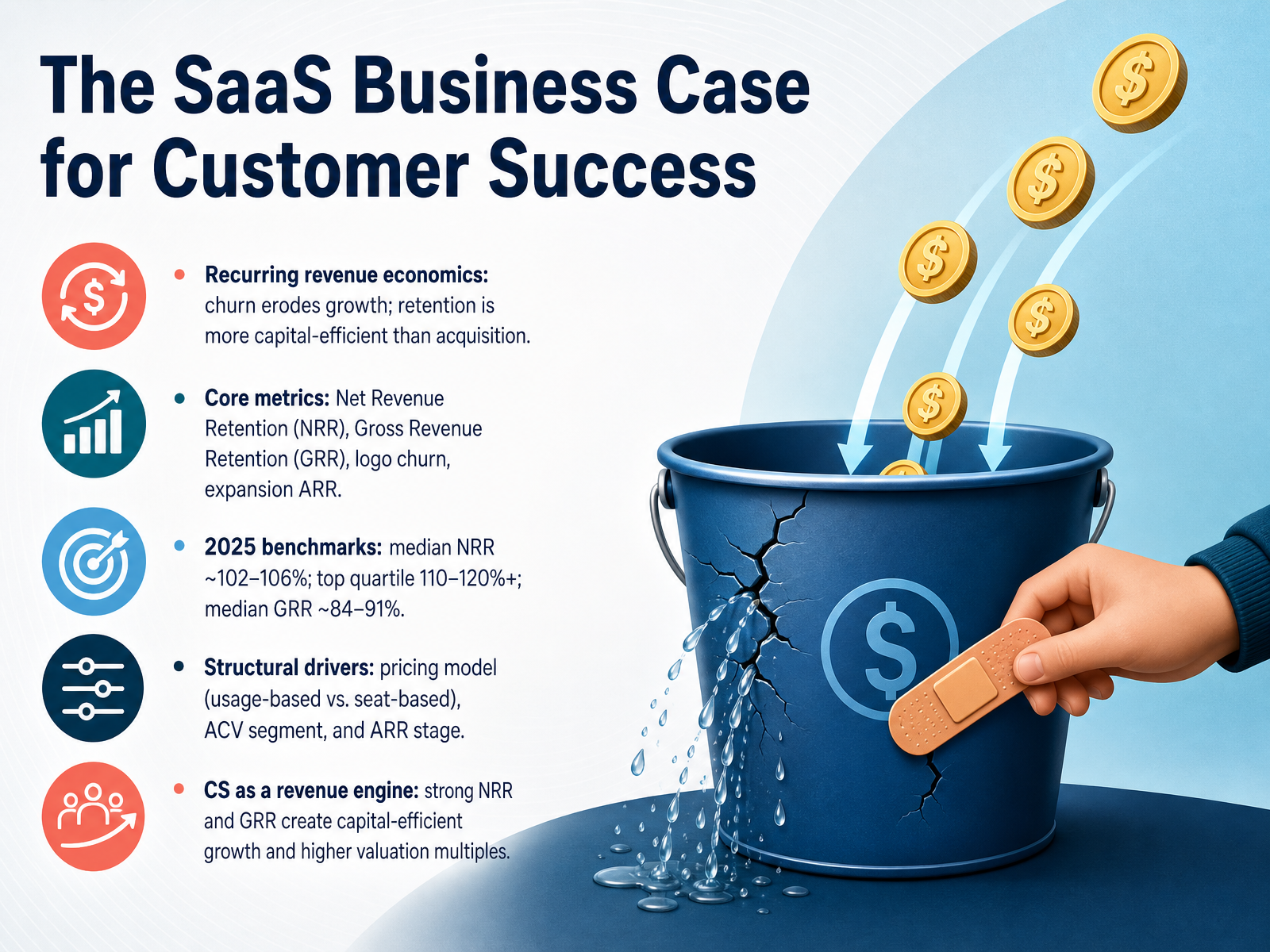
- 02The SaaS Business Case for Customer SuccessLet's zoom out and connect customer success directly to your company's bottom line. In a SaaS business, you're playing a recurring-revenue game. That means every year, you don't just need new customers—you need your current customers to stay and grow. The enemy here is churn, which is simply the rate at which customers cancel or downgrade. High churn erodes your growth because you're constantly refilling a leaky bucket. And here's the key: keeping existing revenue is far more capital-efficient than constantly spending to acquire new logos.
Now, to diagnose the health of this engine, we look at a few core metrics. Net Revenue Retention, or NRR, measures the total revenue you keep from existing customers, including any expansion. A median NRR sits around 102 to 106 percent. Gross Revenue Retention, or GRR, strips out expansion and shows only what you didn't lose; the median here is around 84 to 91 percent. Top-tier companies push NRR to 120 percent or higher. The structure of your pricing makes a big difference. Usage-based models, where customers pay for what they consume, naturally drive higher retention than seat-based models. Your contract size and company stage also set the baseline. Ultimately, a strong NRR combined with a healthy GRR doesn't just mean stability—it creates capital-efficient growth that commands higher valuation multiples from investors.
Let's carry this business case forward and see how customer success fits into your broader go-to-market engine. Next up, we'll clarify how it differs from sales, support, and account management.
 getaleph.comgetfairview.comarrguide.com+22 min
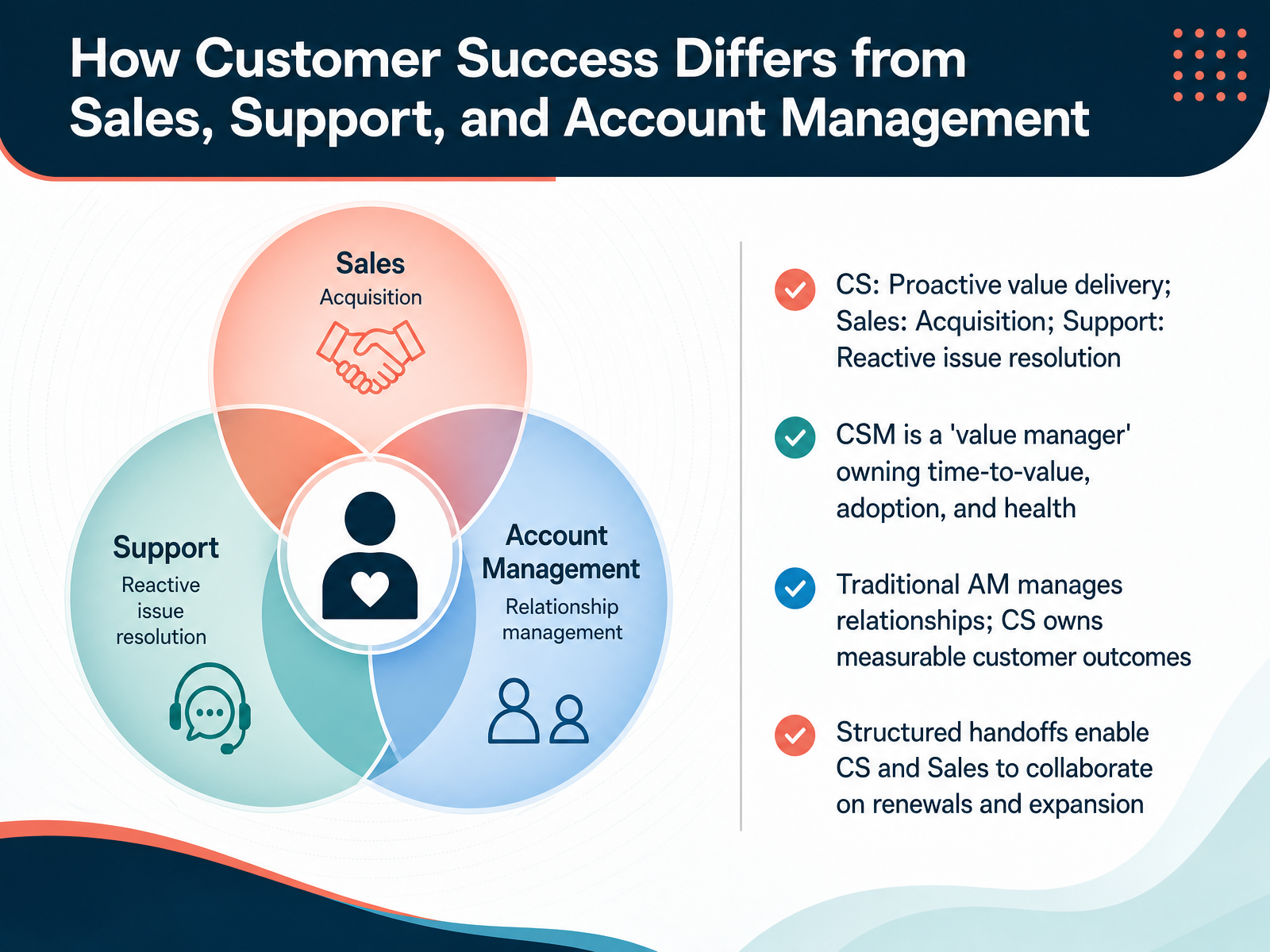
 - 03How Customer Success Differs from Sales, Support, and Account ManagementLet's clarify where Customer Success fits. It's easy to confuse with sales, support, or account management, but the focus is different. Think of it this way: Sales teams are built for acquisition—they win new customers. Support is reactive—they resolve issues after something breaks. But Customer Success is proactive. Its job is to deliver value before a problem ever appears. So where does the CSM fit? Think of them as a 'value manager.' They own time-to-value, making sure you adopt the product quickly, and they continuously monitor the health of the relationship. Traditional account management often centers on the relationship and contract; Customer Success owns the customer's measurable business outcomes. For this to work end-to-end, you need structured handoffs. When sales sets the right expectations and passes context to the CSM, you get a seamless journey. That collaboration is what fuels successful renewals and uncovers genuine expansion opportunities later. Next, let's see how these roles move through the customer lifecycle and those critical moments of truth.
 tsia.comcustomersuccesscollective.comblog.hubspot.com+22 min
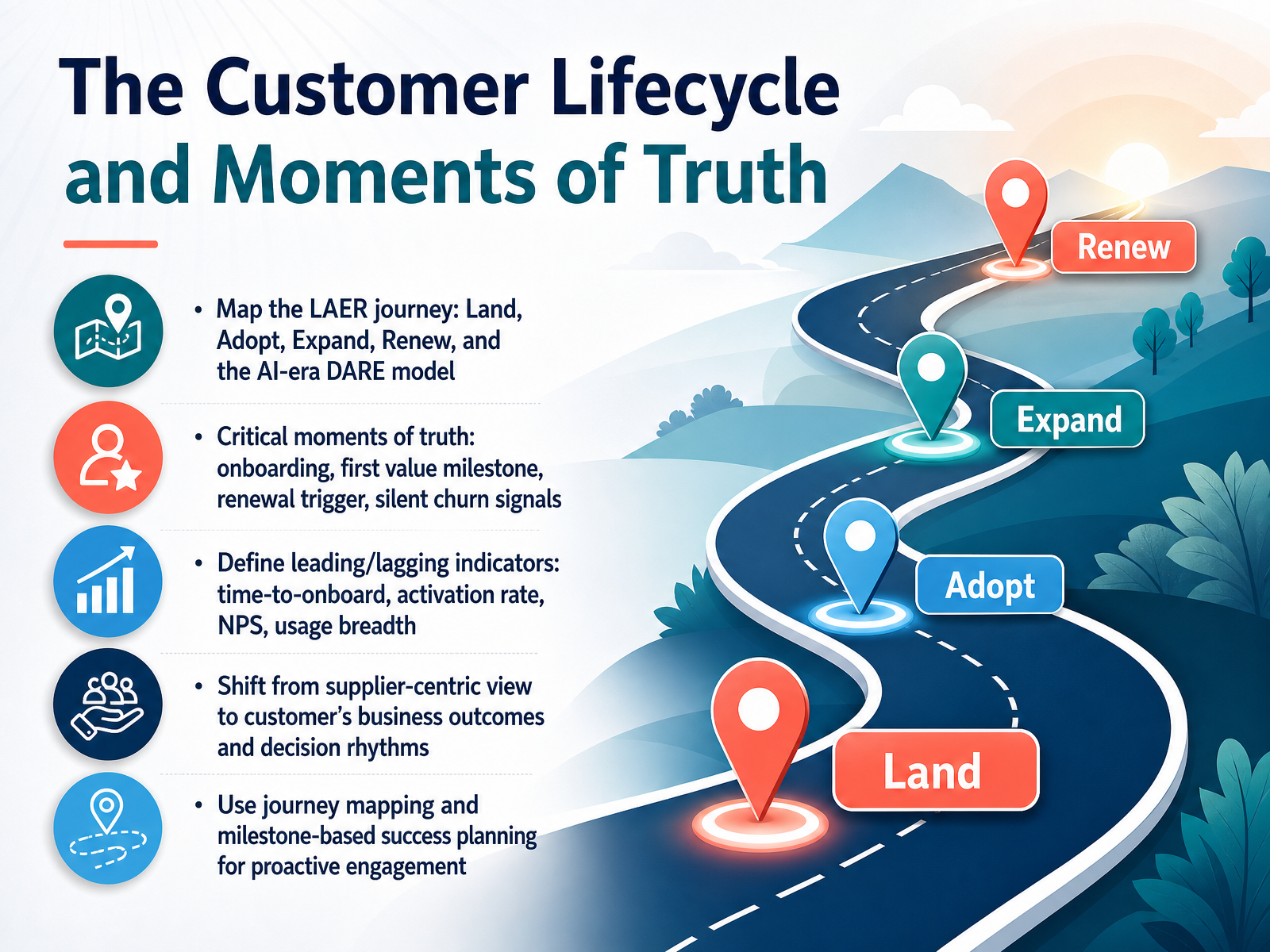
 - 04The Customer Lifecycle and Moments of TruthNow let's ground all of this in the journey your customer actually takes. We often map this with the LAER model—Land, Adopt, Expand, and Renew. But here's the shift: in the age of AI, customers aren't just buying a tool; they're paying for outcomes. That’s pushing the industry toward a new framework called DARE—Design, Activate, Realize, and Evolve—where we engineer value before we even deploy.
Instead of watching a static timeline, we need to watch for moments of truth. The first is a great onboarding, because a confused start leads straight to churn. Next is that first value milestone—the moment they realize the product actually solves their problem. Then there's the renewal trigger, and the silent churn signals we often miss, like a drop in usage by a key admin.
To stay ahead, we measure leading indicators like time-to-onboard and activation rate, not just the lagging indicators like NPS or churn rates. This lets us plan around the customer's business outcomes—their meetings, their decisions—instead of our internal checklist. It’s about proactive engagement through milestone-based success plans.
Up next, we’ll turn these outcomes into a concrete plan in our session on Jobs to Be Done and Value Framing.
 tsia.comtsia.comtsia.com+22 min
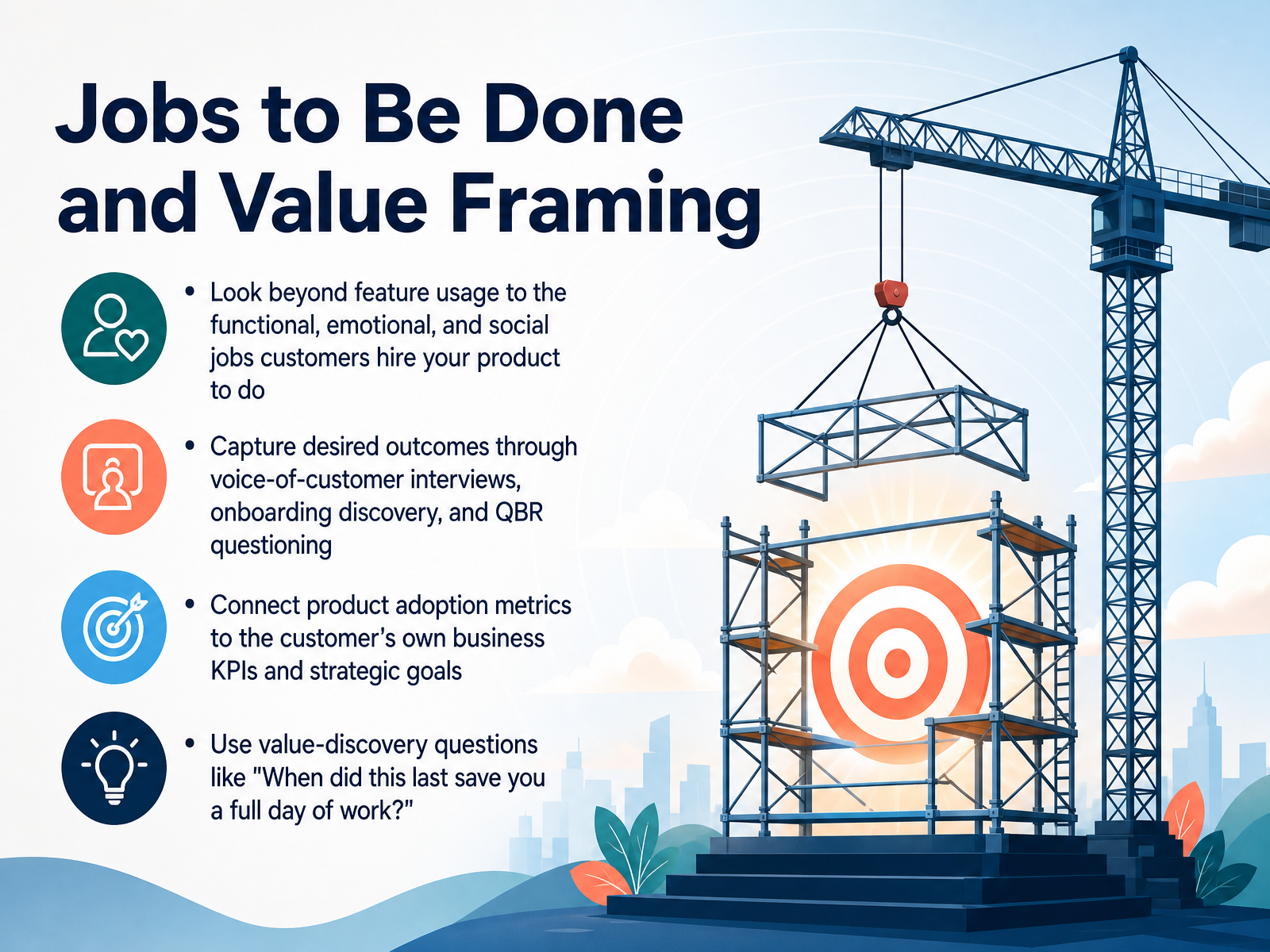
 - 05Jobs to Be Done and Value FramingNow let’s move from tracking product usage to understanding why customers really invest in your solution. At its core, this is about Jobs to Be Done and value framing. Instead of just looking at which features get clicked, ask yourself: what functional, emotional, and social jobs did your customer actually hire your product to do? Functional might be automating a report. Emotional could be reducing their team’s daily stress. Social could be helping them look like a strategic leader in front of their own boss. You uncover these deeper outcomes through voice-of-customer interviews, discovery during onboarding, and the questions you ask in a QBR—a quarterly business review. Always connect product adoption metrics back to the customer’s own business KPIs, like faster deal cycles or lower support costs. Tie your solution to their strategic goals, not just your dashboard. A simple value-discovery question can change the whole conversation: “When did this last save you a full day of work?” That single moment makes the outcome tangible and personal. So remember: frame value in their language, not yours. Coming up next, we’ll explore how to turn these insights into early warning signals with health scoring and risk signal detection.
 tsia.comtsia.comtsia.com+22 min
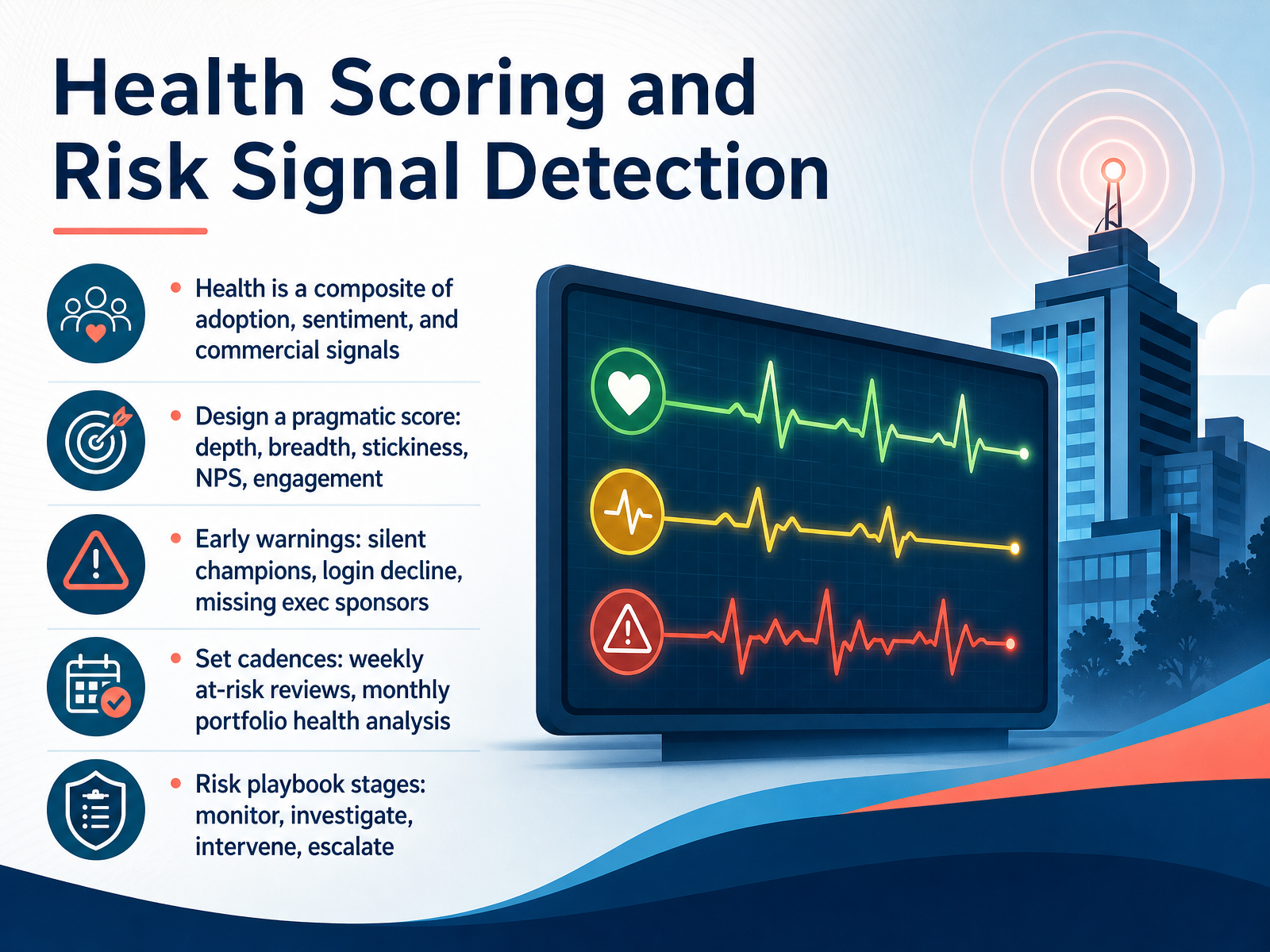
 - 06Health Scoring and Risk Signal DetectionNow let’s look at health scoring and risk signal detection—the early-warning system that tells you which accounts need attention before they’re asking to leave. Think of customer health as a composite built from three layers: adoption signals, like feature usage and login frequency; sentiment signals, like survey responses and support ticket tone; and commercial signals, such as renewal timing or contract size. No single metric gives you the full picture. To design a pragmatic health score, track the five dimensions we see working well in practice: product depth, breadth of use, stickiness, your net promoter score, and overall engagement. That mix gives you a balanced signal you can trust. But scores alone aren’t enough. You also need to spot early warnings. Watch for silent champions—power users who go quiet, a login decline across a team, or missing executive sponsors right before a renewal. When you see those patterns, your cadence matters. Run a weekly at-risk review for immediate concerns, and a monthly portfolio health analysis to spot broader trends. And when a risk fires, follow a clear risk playbook with four stages: monitor the signal, investigate the pattern, intervene with a direct action, and escalate only when you need cross-functional help. Keep that playbook simple enough that anyone on the team can follow it. Next, we’ll explore how segmentation and engagement models turn these health insights into the right conversation at the right time.
 valuecase.comtsia.comgainsight.com+22 min
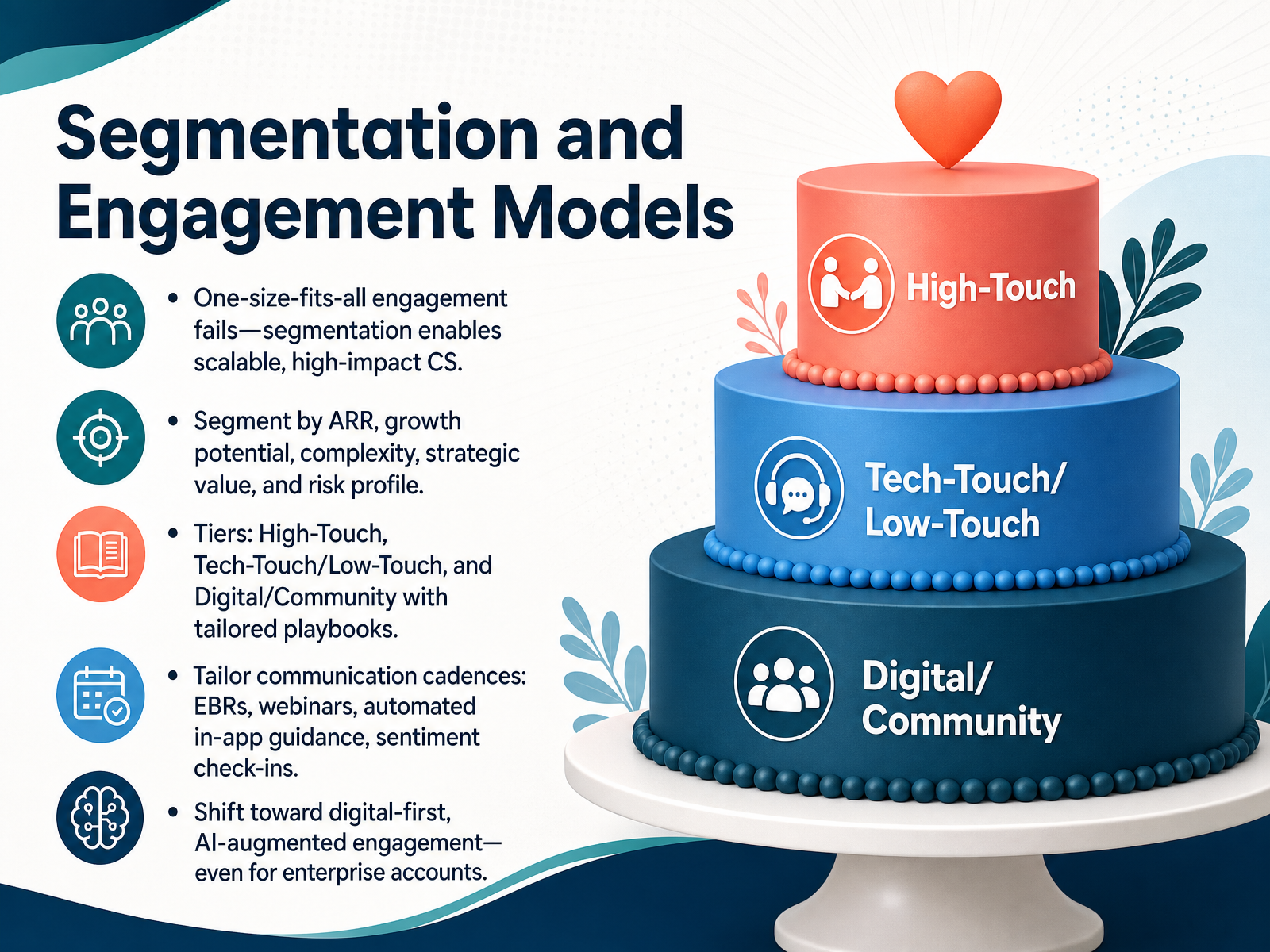
 - 07Segmentation and Engagement ModelsLet's talk about how we actually scale customer success without scaling chaos. The old way—giving everyone the same level of attention—just falls apart as you grow. Segmentation is how we solve that. Start by grouping accounts by a few practical dimensions: annual recurring revenue, growth potential, product complexity, strategic value, and risk profile. These aren't just labels. They determine which engagement tier a customer gets. High-touch accounts might get a dedicated resource and regular executive business reviews. Tech-touch accounts thrive on structured webinars and automated in-app guidance. And a digital or community tier can move toward one-to-many plays that still feel personal. Here's the mindset shift: even enterprise accounts are moving digital-first now. AI helps you watch for sentiment shifts and usage patterns across every tier, so you can intervene before a risk becomes a resignation. Ultimately, it's about matching the right action to the right account, at the right time. Up next, we'll connect this to proactive communication and what it really means to be a trusted advisor.
 valuecase.comtsia.comgainsight.com+22 min
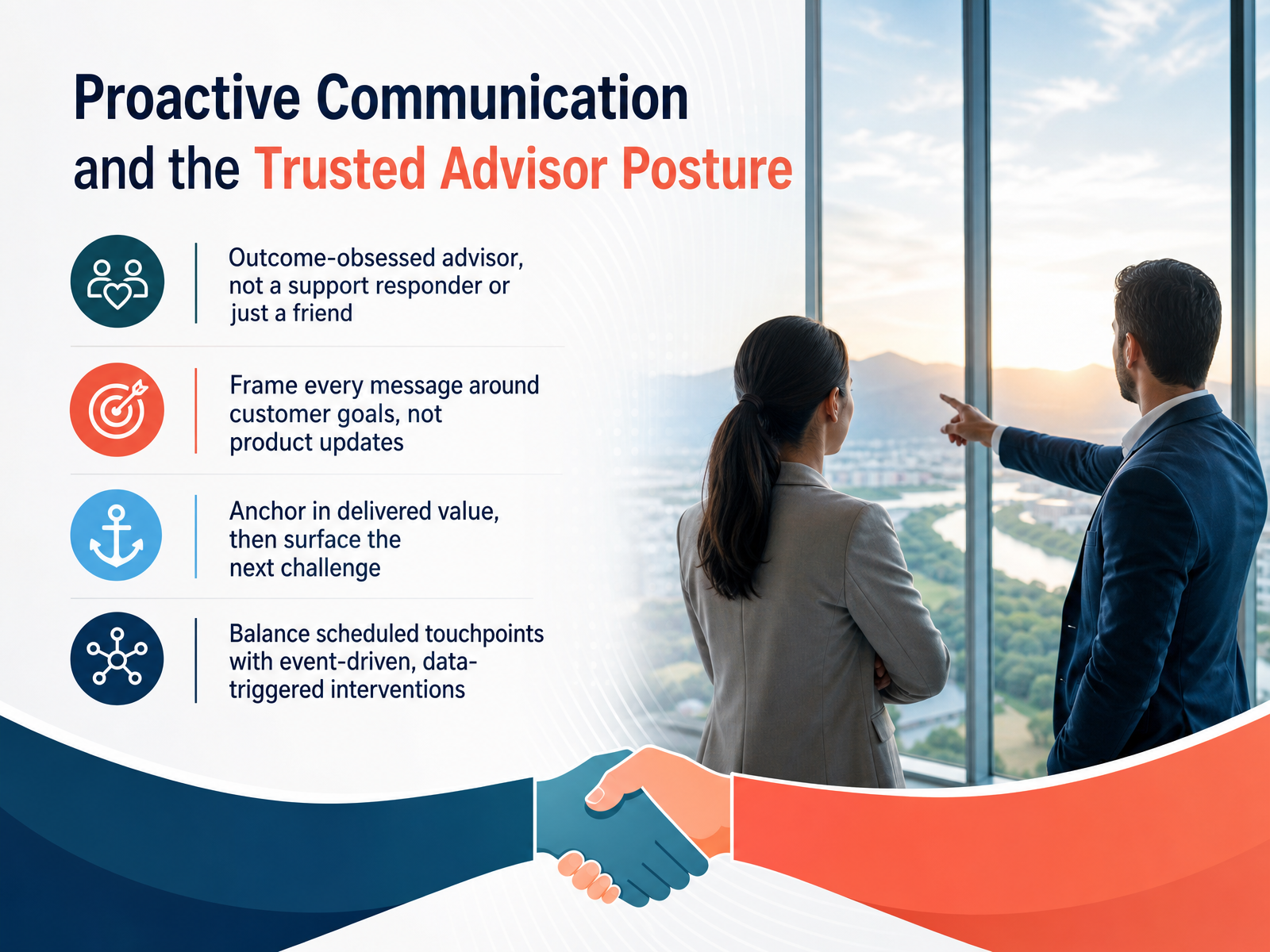
 - 08Proactive Communication and the Trusted Advisor PostureNow let's talk about how you show up in every conversation. This slide is about Proactive Communication and the Trusted Advisor Posture. It's not just a title—it's a mindset shift. You're not a support responder waiting for a ticket, and you're not just a friendly account contact. You are an outcome-obsessed advisor. That means every message you send—whether it's an email, a Slack note, or a meeting invite—should frame the conversation around the customer's business goals, not your latest product update. For example, instead of saying 'We just released a new reporting feature,' you say, 'Based on your goal to reduce reporting time, here's a new capability that directly supports that.' Always anchor in the value they've already achieved. Remind them of the cost they saved or the efficiency they gained, and then surface the next challenge they can tackle. Finally, balance your scheduled touchpoints—like quarterly business reviews or QBRs—with event-driven, data-triggered interventions. If product usage drops suddenly, that's your signal to reach out immediately, not wait for the next monthly check-in. This is how you move from being reactive to truly proactive. Next, let's explore how you take this trusted position and use it to drive Expansion: CS-Led Growth Without Becoming Sales.
 tsia.comcustomersuccesscollective.comblog.hubspot.com+22 min
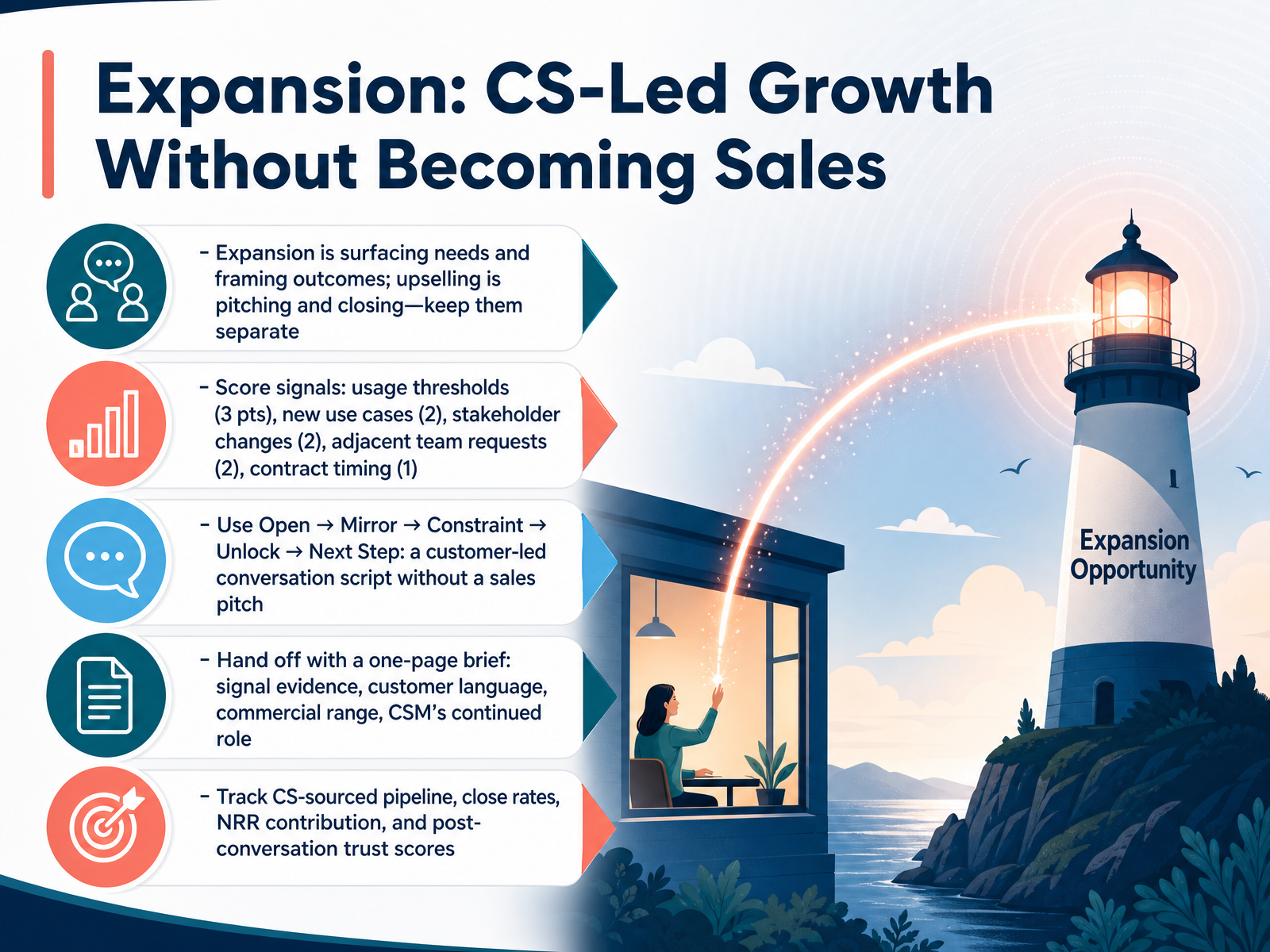
 - 09Expansion: CS-Led Growth Without Becoming SalesNow let's talk about the approach that turns expansion into a predictable, trust-building motion. The key mindset shift is this: expansion is not selling. Expansion is surfacing needs and framing outcomes. A salesperson pitches and closes. Your role, as a CS professional, is to spot the genuine gap between what the customer bought and what they now need, then frame the value of solving it. Keep those two motions completely separate.
To know when the time is right, we use a signal scoring rubric. Usage growth hitting eighty percent of a plan limit is your strongest signal, worth three points. New use cases, a stakeholder change, or an adjacent team asking for access are each worth two points. A contract anniversary within ninety days adds one point. When an account hits five points, it triggers a structured conversation.
That conversation follows a simple script: Open, Mirror, Constraint, Unlock, Next Step. You open with their achieved outcomes. You mirror what's working. You name the specific constraint they are hitting. Then you ask the most powerful question: what would solving this mean for them? Their answer becomes the business case. Finally, you present two clear paths: a workaround within their current contract, or a warm handoff to your sales partner for a commercial conversation.
Speaking of handoffs, never leave your AE cold. Prepare a one-page brief with the signal evidence, the customer's own language, a commercial range, and your continued role. You stay in the meeting to protect the relationship.
Finally, track what matters: CS-sourced pipeline, close rates, NRR contribution, and post-conversation trust scores.
With the expansion motion clear, we can now turn to the predictable rhythm that keeps everything on track. Next, we cover the renewal process: zero surprises, full evidence.
 getaleph.comgetfairview.comarrguide.com+22 min
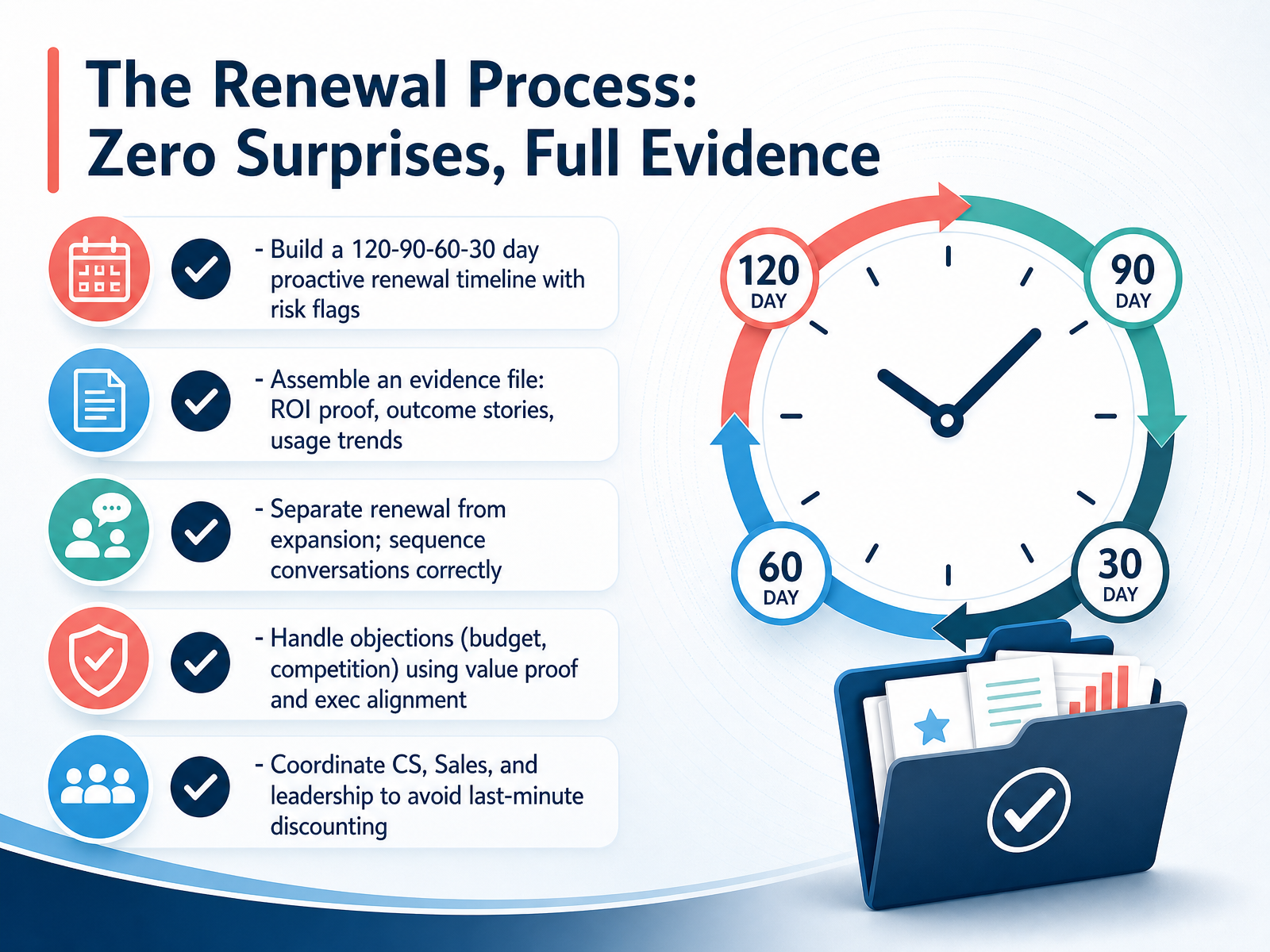
 - 10The Renewal Process: Zero Surprises, Full EvidenceNow let’s talk about the renewal process—and the motto here is zero surprises, full evidence. A strong renewal starts with a proactive timeline. We recommend a 120, 90, 60, 30 day countdown. At each checkpoint you’re looking for risk flags, not just dates. That way nothing sneaks up on you. Next, build an evidence file. This is your proof kit: return on investment data, outcome stories the customer has actually achieved, and usage trends that show real adoption. If you can’t prove value, you’re just asking for a discount. And that leads to a critical sequencing rule. Separate renewal from expansion. Lock in the base contract first, then have a separate growth conversation. Mixing the two creates friction. When objections come up—like budget pressure or a competitor—go back to your evidence file. Pair the proof with executive alignment; leadership-to-leadership trust often unblocks what a business case alone cannot. Finally, coordinate your teams. Customer success, sales, and leadership must operate as one unit. Without that, you risk last-minute discounting that erodes your margins. Up next we’ll build on this trust and shift focus to Building Customer Advocacy.
 tsia.comtsia.comtsia.com+22 min
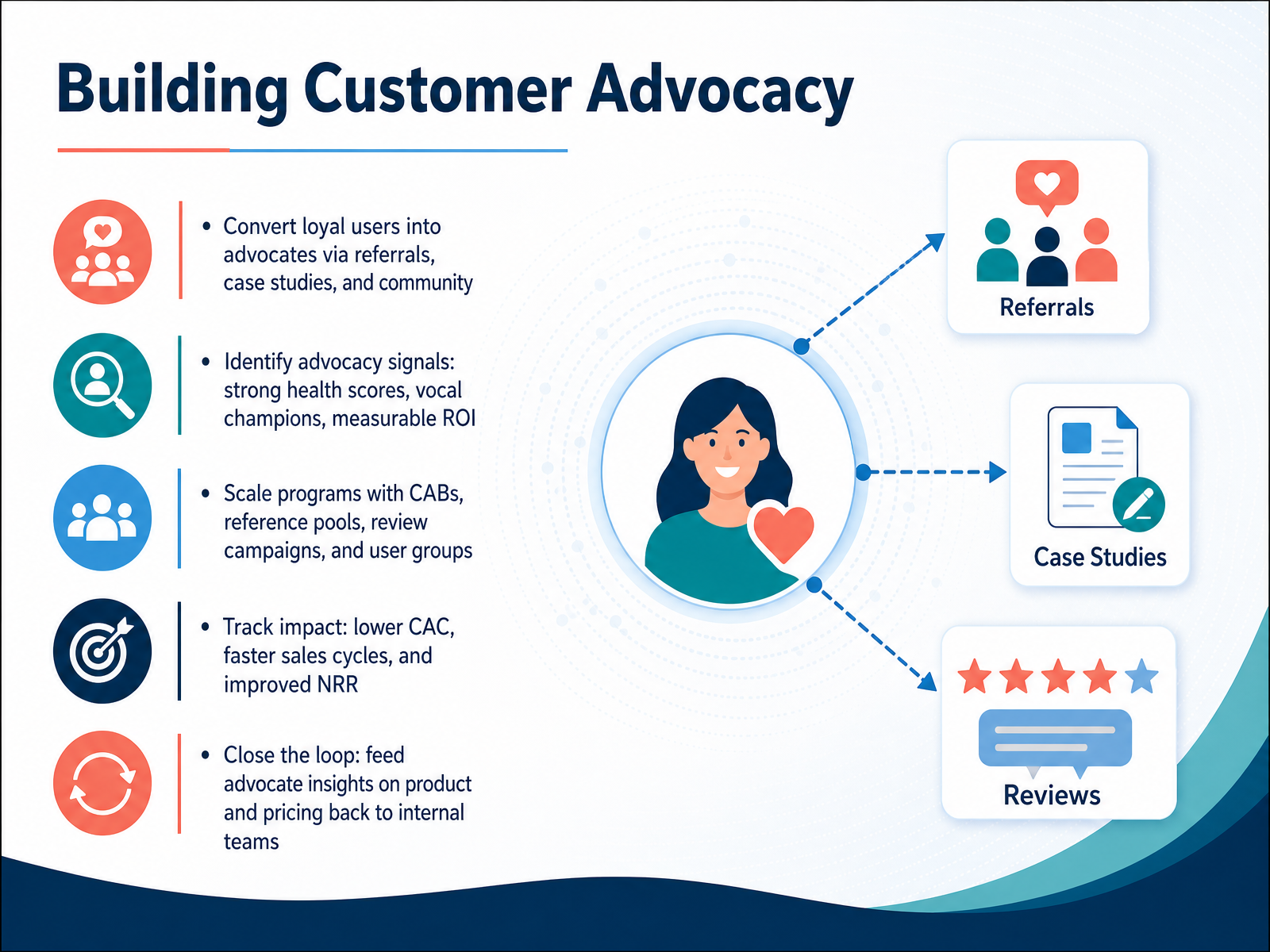
 - 11Building Customer AdvocacyNow we come to one of the most powerful outcomes of great customer success work: turning loyal users into advocates. Advocacy is what happens when your customers are so successful with your product that they actively want to promote it for you. This could mean them agreeing to a referral, participating in a case study, or sharing their story in your user community. So how do you spot these future advocates? Look for clear signals. A customer with a consistently strong health score, outspoken internal champions—people who already sing your praises inside their own company—and clear, measurable return on investment you can point to. Those are your candidates. Once you identify them, you need ways to scale that enthusiasm. Think about building a Customer Advisory Board, or CAB, to get strategic input. Create a reference pool that sales can call on. Launch structured review campaigns, and nurture peer-to-peer user groups. Finally, you have to track the real business impact. Advocacy done right lowers your cost of acquiring new customers, shortens sales cycles because prospects trust peer proof, and improves net revenue retention. And don't forget a critical step: close the loop. Feed the product and pricing insights you gather from these advocates back to your internal teams. It makes the whole company stronger. Next, we'll look at how to power all of this with the right technology, as we cover the Customer Success Tech Stack and Data Foundation.
 tsia.comcustomersuccesscollective.comblog.hubspot.com+22 min
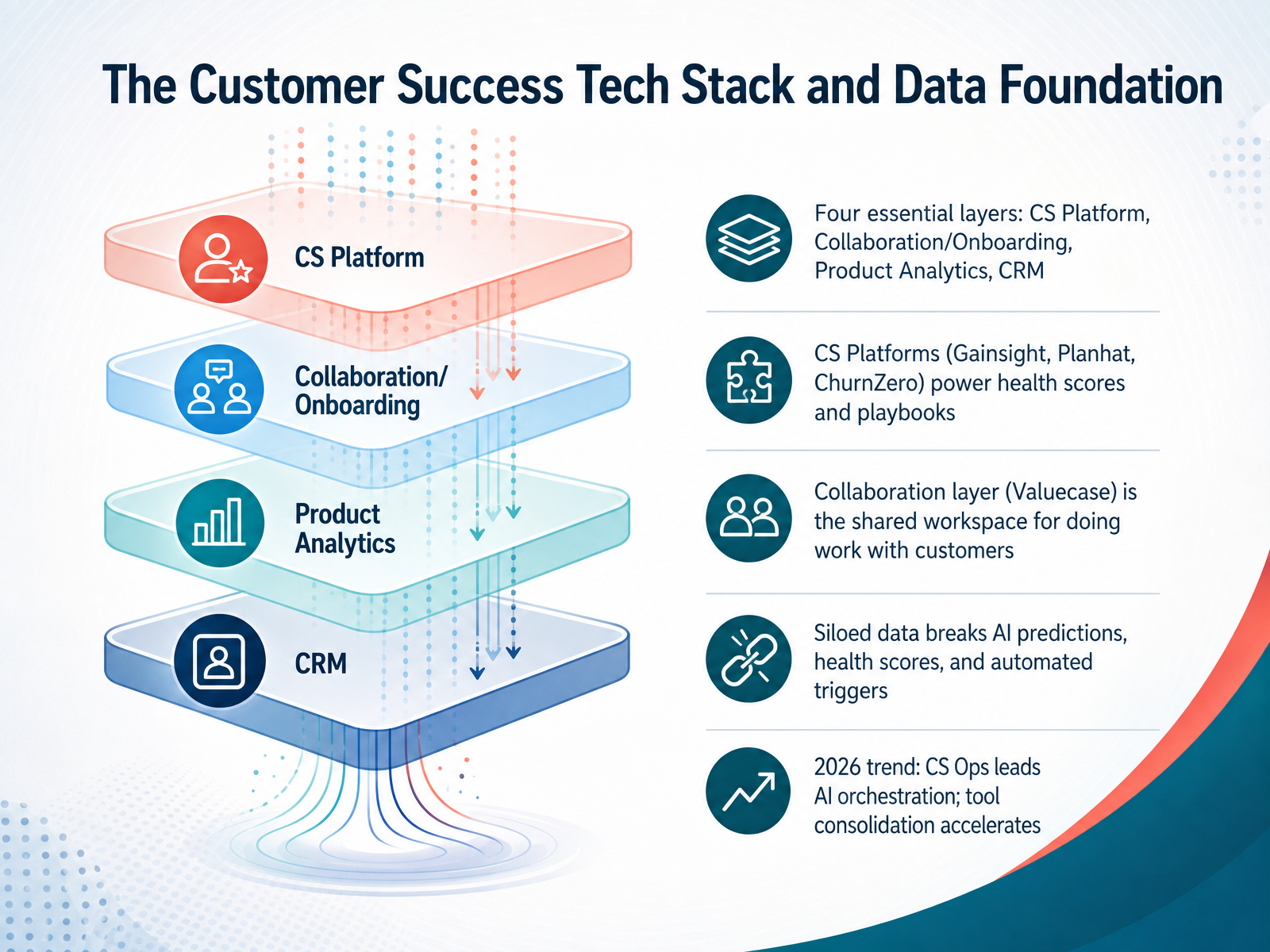
 - 12The Customer Success Tech Stack and Data FoundationLet’s get practical and look at the tools you rely on every day. Think of your tech stack as having four essential layers, each solving a different job. First is your CS platform, like Gainsight, Planhat, or ChurnZero, which acts as your internal cockpit for health scores and automated playbooks. Second is your collaboration and onboarding layer, a shared branded space, like what Valuecase provides, where you and the customer actually do the work together. Third is product analytics, where tools like Mixpanel or PostHog tell you if customers are reaching activation. The fourth foundation is your CRM, like HubSpot or Salesforce, which remains the single source of truth for the account. A modern stack runs these as complements, not substitutes. When data stays siloed between them, AI predictions, health scores, and automated triggers break down. The key 2026 trend is that CS Ops will lead AI orchestration and tool consolidation, making sure these layers talk perfectly to each other. Up next, we’ll connect this foundation to the metrics that matter and how to influence them.
 valuecase.comtsia.comgainsight.com+22 min
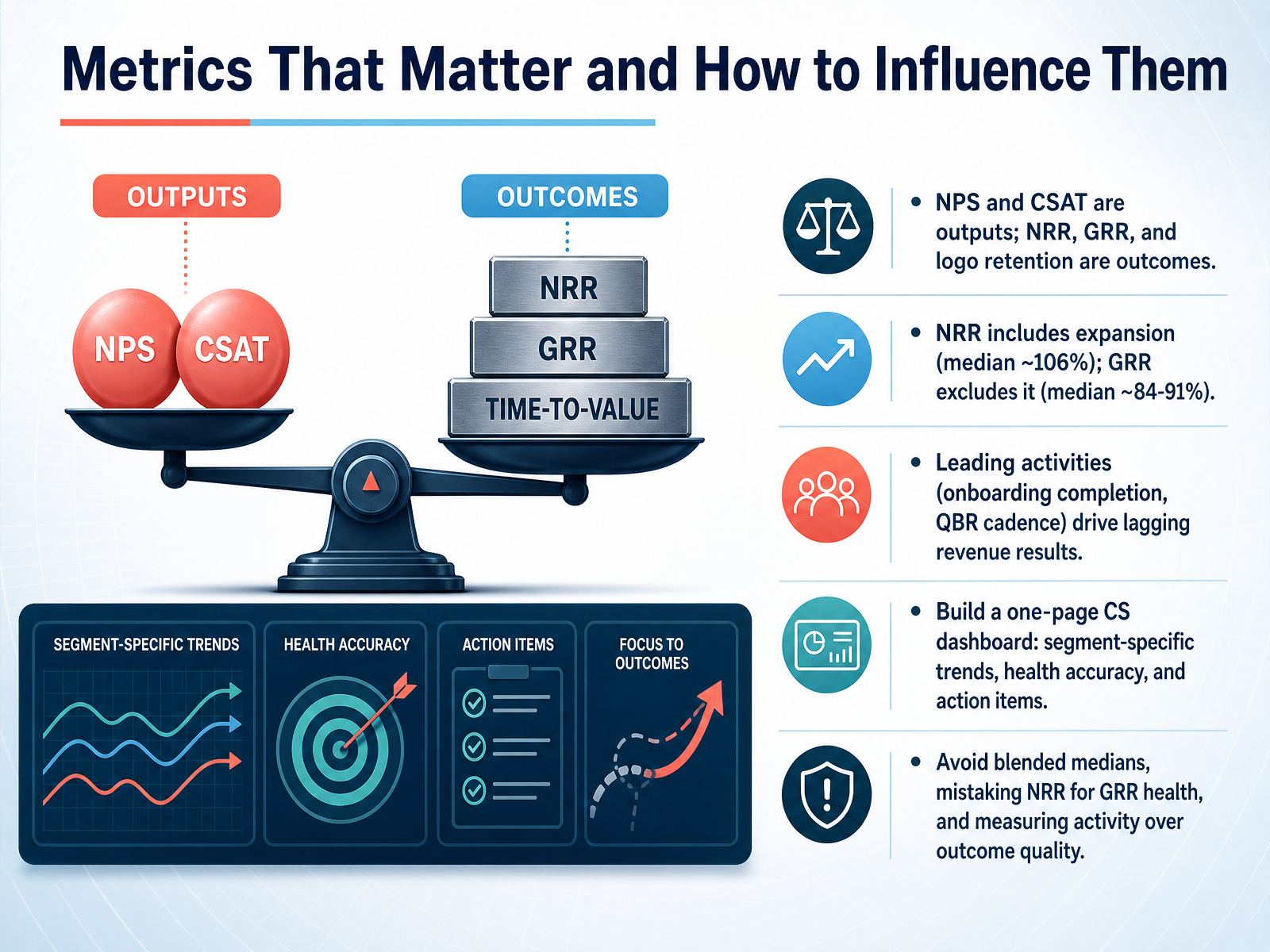
 - 13Metrics That Matter and How to Influence ThemLet's get practical about the metrics that actually move your business forward. The first thing to know is the distinction between outputs and outcomes. Metrics like NPS and CSAT tell you how customers feel—those are outputs. What really matters are outcomes: Net Revenue Retention, Gross Revenue Retention, and logo retention. Think of NRR as your growth ceiling. It includes expansion revenue from upsells, so it can exceed one hundred percent. The current median is around one hundred and two percent. GRR is your retention floor. It strips out expansion and shows only what you kept; its median sits near eighty-four percent. That gap between them is how much expansion masks underlying churn. Here's the part you control: your leading activities. Onboarding completion rates and consistent QBR cadences are the actions that drive those lagging revenue results. To see this clearly, build a simple one-page CS dashboard. Track segment-specific trends, the accuracy of your health scores, and a column for action items—not just numbers. And avoid three common traps. Don't compare yourself to a blended industry median when your ACV segment matters more. Don't confuse a high NRR with a healthy GRR. And don't measure activity volume instead of outcome quality. A hundred onboarding check-ins matter far less than ten that proved real value. Now, let's move from metrics to practical playbooks and real-world scenarios.
 getaleph.comgetfairview.comarrguide.com+22 min
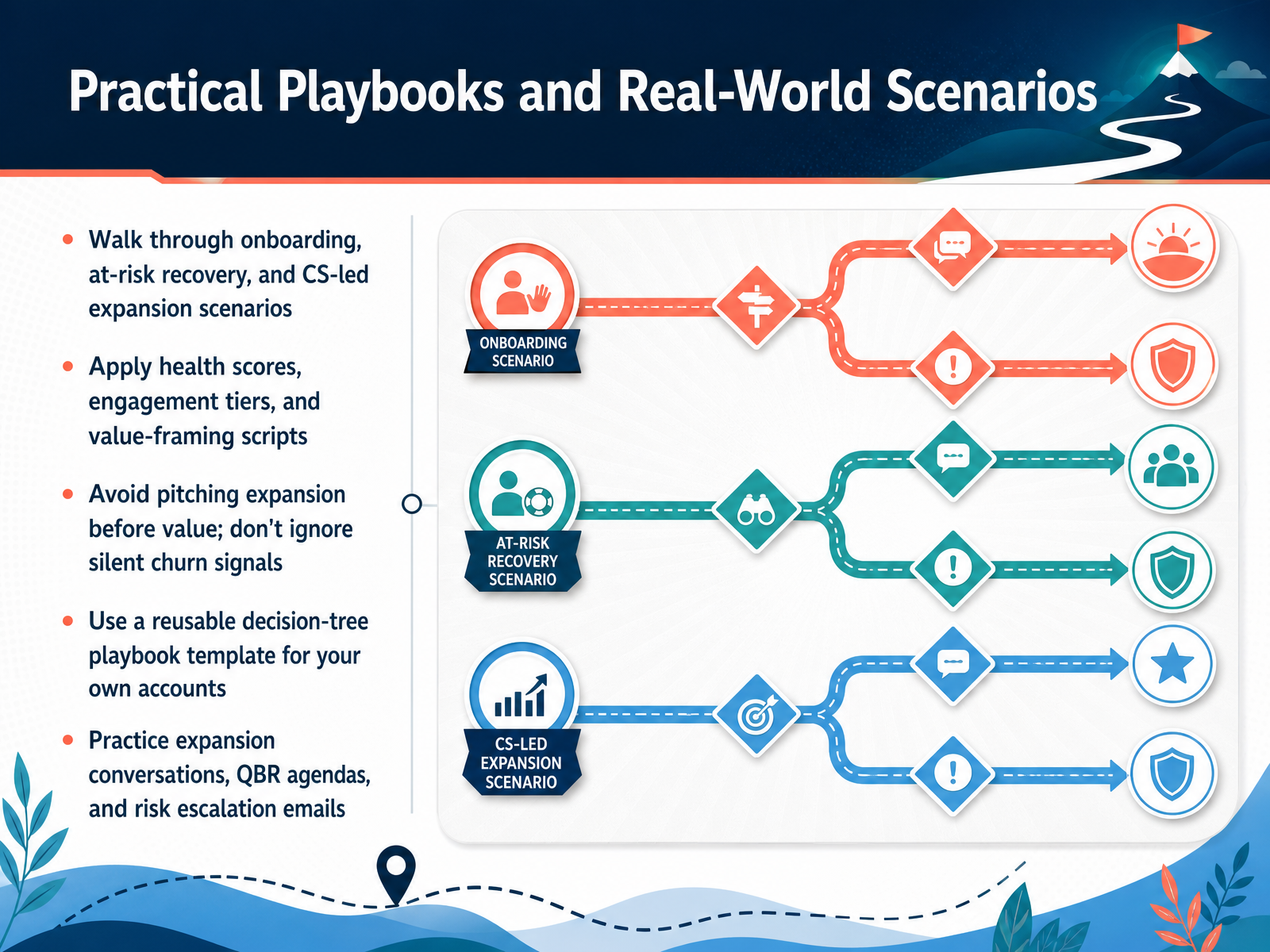
 - 14Practical Playbooks and Real-World ScenariosLet's put everything together and walk through some real scenarios. We'll start with onboarding, mapping out the first 30, 60, and 90 days so customers hit value fast instead of drifting. Then we'll cover at-risk recovery, identifying accounts with low health scores, low product usage, or silent disengagement. Silence isn't neutral, it's often a signal. This is where you apply engagement tiers, health scores, and value-framing scripts to guide honest, timely conversations. Finally, we'll practice expansion. A critical rule here: never pitch an upgrade or add-on before the customer has experienced clear, documented value. Jumping the gun erodes trust. We'll use a reusable decision-tree playbook that helps you separate a genuine growth opportunity from a renewal that needs nurturing first. You'll also draft real assets, including expansion conversation starters, QBR agendas, and a short risk escalation email template. Bottom line: consistent frameworks make you proactive instead of reactive. Up next, we'll pull these skills into a long-term practice with Next Steps and Building Your Customer Success Practice.
 2 min
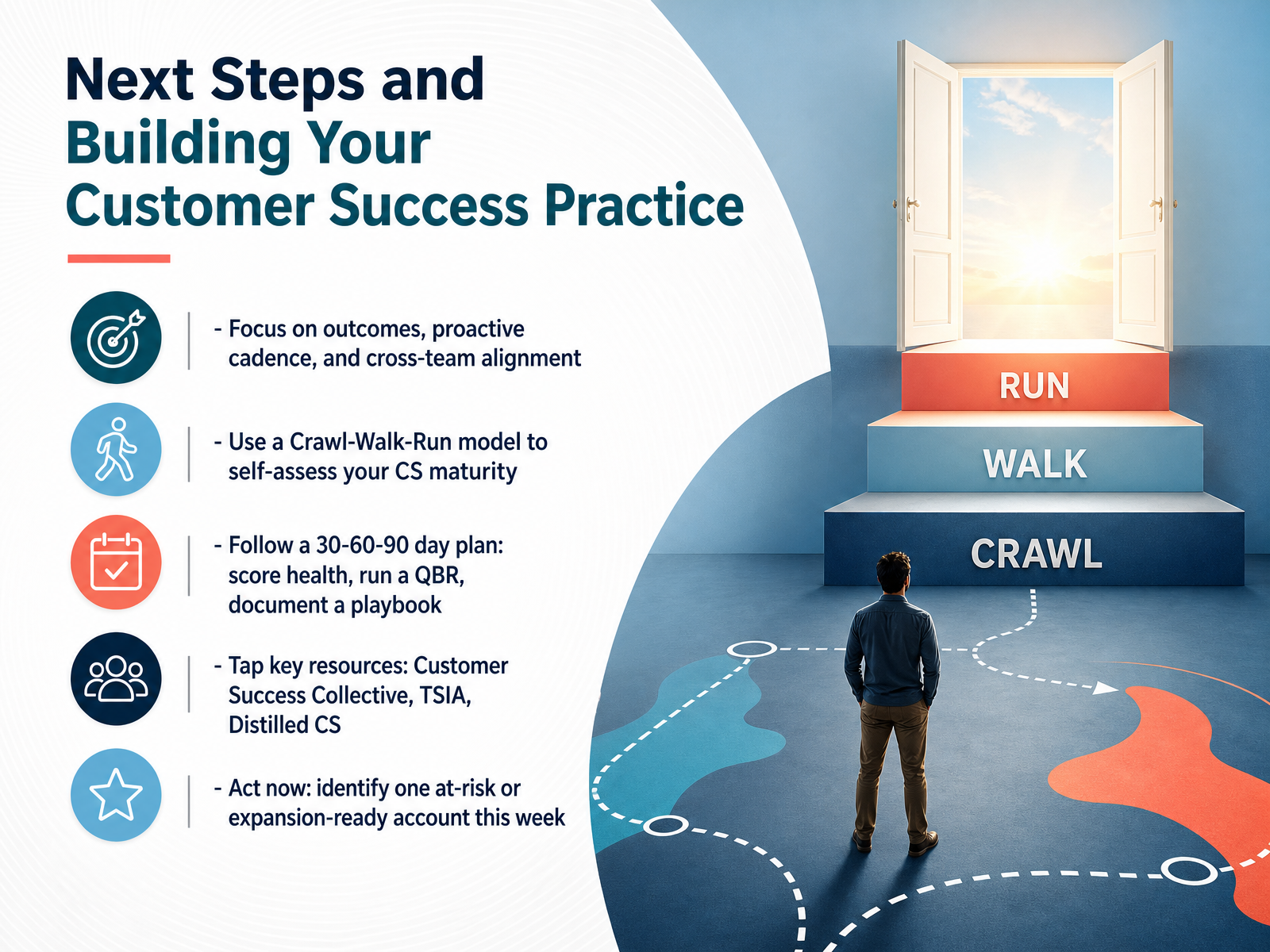
2 min - 15Next Steps and Building Your Customer Success PracticeWe've covered a lot of ground, so let's bring it all together. Building your customer success practice comes down to three things: focus on customer outcomes, establish a proactive cadence, and align closely with your sales, product, and support teams. To figure out where to start, use a Crawl-Walk-Run maturity model. Think of it as a quick self-assessment. Are you in the Crawl stage, reacting to issues as they pop up? Are you in the Walk stage, with some processes defined? Or are you in the Run stage, where you're predicting and preventing churn? Once you know your stage, build momentum with a simple 30-60-90 day plan. In the first 30 days, score your current customer health. By day 60, run your first QBR, a quarterly business review, with a key account. And by day 90, document your first proactive playbook. You're not alone in this. Tap into communities like the Customer Success Collective and research from TSIA, and take the free maturity assessment from Distilled CS. Most importantly, take action right now. Open your account list this week and identify just one at-risk account where you can intervene, or one account that's ready for expansion. That single action starts the practice. Thank you for joining this journey. Your proactive work is what turns customers into partners. You've got this.
 valuecase.comtsia.comgainsight.com+22 min
Take the deck with you
Download this course as a file — free, no sign-up needed.
- PDF handoutEvery slide page, ready to print or share.16 pages · 4.2 MBDownload
- Narrated PowerPointThe deck that presents itself — every slide carries the digital human's narration video.16 pages · 17.7 MBDownload
- PowerPoint slidesThe full deck as a .pptx — open it in PowerPoint, Keynote, or Google Slides.16 pages · 4.2 MBDownload
Free to use in your own training — please keep the PersonWise credit page at the end.
Have your own deck? Turn it into a course
Sources consulted
Web sources consulted while building this course.
- What Is Customer Success? Definition, Importance, and ... — tsia.com
- The State of Customer Success 2025 - Industry Report — customersuccesscollective.com
- What is customer success? My deep dive into the field and why it matters — blog.hubspot.com
- Customer success vs. sales: What's the difference? | TechTarget — techtarget.com
- The Definition of Customer Success — customersuccessassociation.com
- Net revenue retention (NRR) benchmarks (2026) — getaleph.com
- NDR Benchmarks for SaaS: What Good Looks Like in 2026 — Fairview — getfairview.com
- SaaS Retention Benchmarks 2026: 20 Public Companies Compared | ARRGuide — arrguide.com
- SaaS Churn Rate Benchmarks 2026: By Industry & ARR — ChurnBase — churnbase.io
- B2B SaaS NRR Benchmarks — 939 Companies by Segment & ACV Tier — optif.ai
- The Case for Customer Success in Managed Services | TSIA — tsia.com
- LAER-Based Customer Growth | Proven Framework — tsia.com
- The Customer Success Maturity Model in 4 Phases | TSIA — tsia.com
- The Four Phases to Becoming LAER Efficient | TSIA — tsia.com
- The State of Customer Growth and Renewal 2025 | TSIA — tsia.com
- The Customer Success Tech Stack in 2026: Where Every Tool Fits — valuecase.com
- The State of Customer Success 2026: Proving Value in the Age of AI ... — tsia.com
- The 2026 CS Survival Guide: Hire Ops, Consolidate Tools, Redefine Roles | Gainsight Software — gainsight.com
- Customer Success in 2026: Trends, Goals, and Fears — custify.com
- New research: AI in customer success—what’s working and what it means - ChurnZero — churnzero.com