User Stories & Acceptance Criteria
Begin
16 pages · ~32 min
User Stories & Acceptance Criteria
Learn to write clear user stories and acceptance criteria to effectively capture requirements and guide development teams.
What you’ll learn
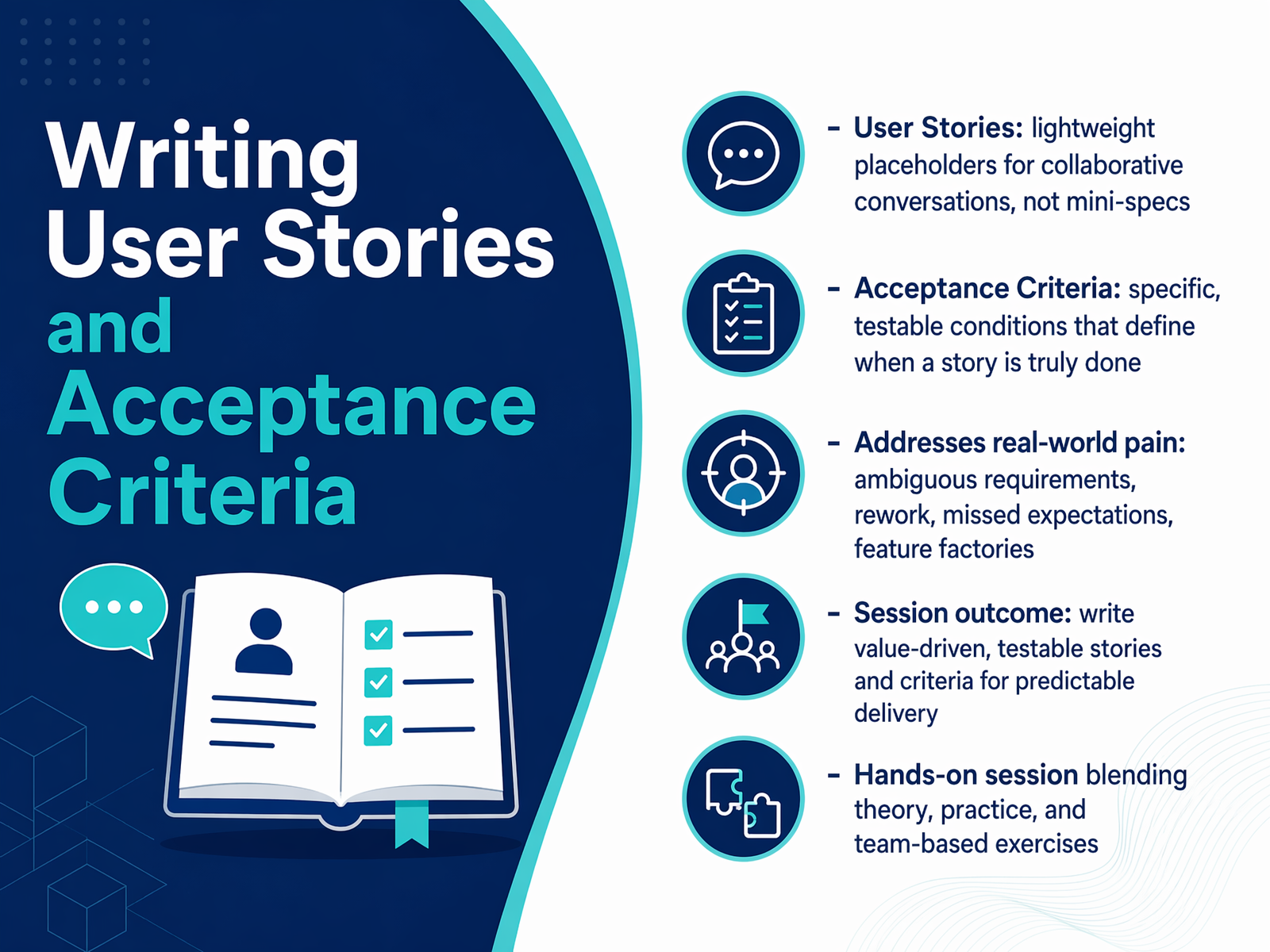
- 01Writing User Stories and Acceptance CriteriaWelcome. Today we are here to talk about writing user stories and acceptance criteria. If you have ever been handed a vague requirement, dealt with rework, or felt like you were just churning out features in a factory, this session is directly for you. Our goal is to move you from writing tickets that describe tasks to writing value-driven, testable stories that lead to predictable delivery. We are going to get hands-on. We will blend a bit of theory with practical exercises, working as a team to translate a real user need into a clear, actionable piece of work. Let us start by grounding ourselves in the true purpose of a user story. It is not a mini-specification document. It is a lightweight placeholder for a collaborative conversation. And the acceptance criteria? Those are the specific, testable conditions that define when the story is truly done. Let's first look at the real cost of unclear requirements.agile.appliedframeworks.comvisual-paradigm.comnextagile.ai+22 min
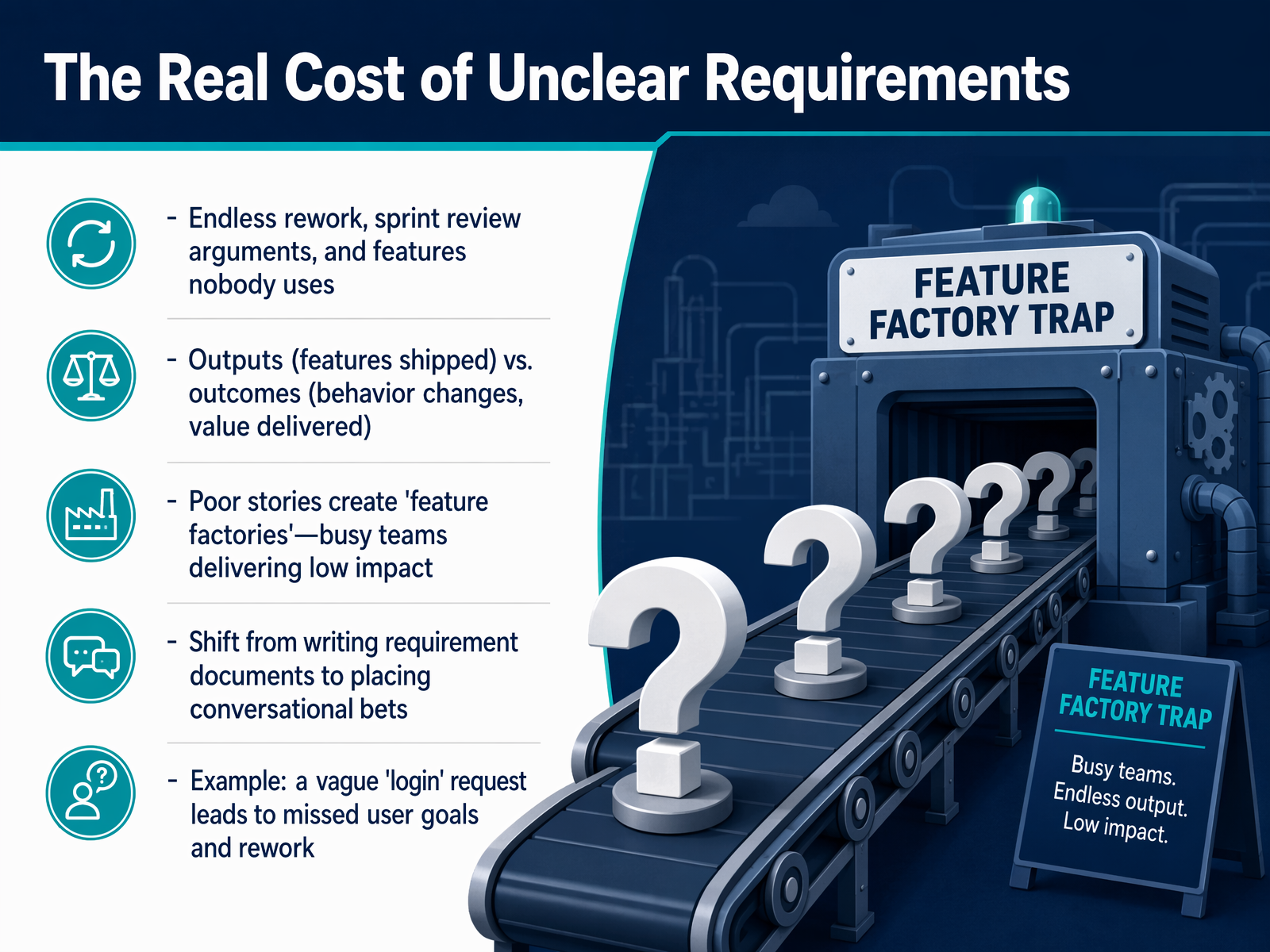
- 02The Real Cost of Unclear RequirementsSo, what really happens when requirements aren't clear? The costs are much bigger than most teams realize. You see endless rework, arguments during sprint reviews, and worst of all, features that nobody actually uses. This happens because teams often focus on outputs, things like features shipped, instead of outcomes, the actual behavior changes and value delivered. This output-first mindset creates what we call feature factories: busy teams delivering a lot of work, but very little impact. The core shift we need to make is from writing heavy requirement documents to placing what I call conversational bets. We use user stories as a promise to have a conversation about the right outcome. For example, a vague request like build a login screen seems simple enough. But it misses the user's real goal. Are they logging in to track an order, save a configuration, or access a secure document? Without that understanding, the team builds the wrong thing, the sprint review ends in disappointment, and the rework cycle begins all over again. That's the real cost of unclear requirements. To avoid this, we need a more reliable way to structure the conversation. That brings us to our next topic: The Three Cs: Card, Conversation, and Confirmation.
 productwithmustache.comscrumalliance.orgatlassian.com+22 min
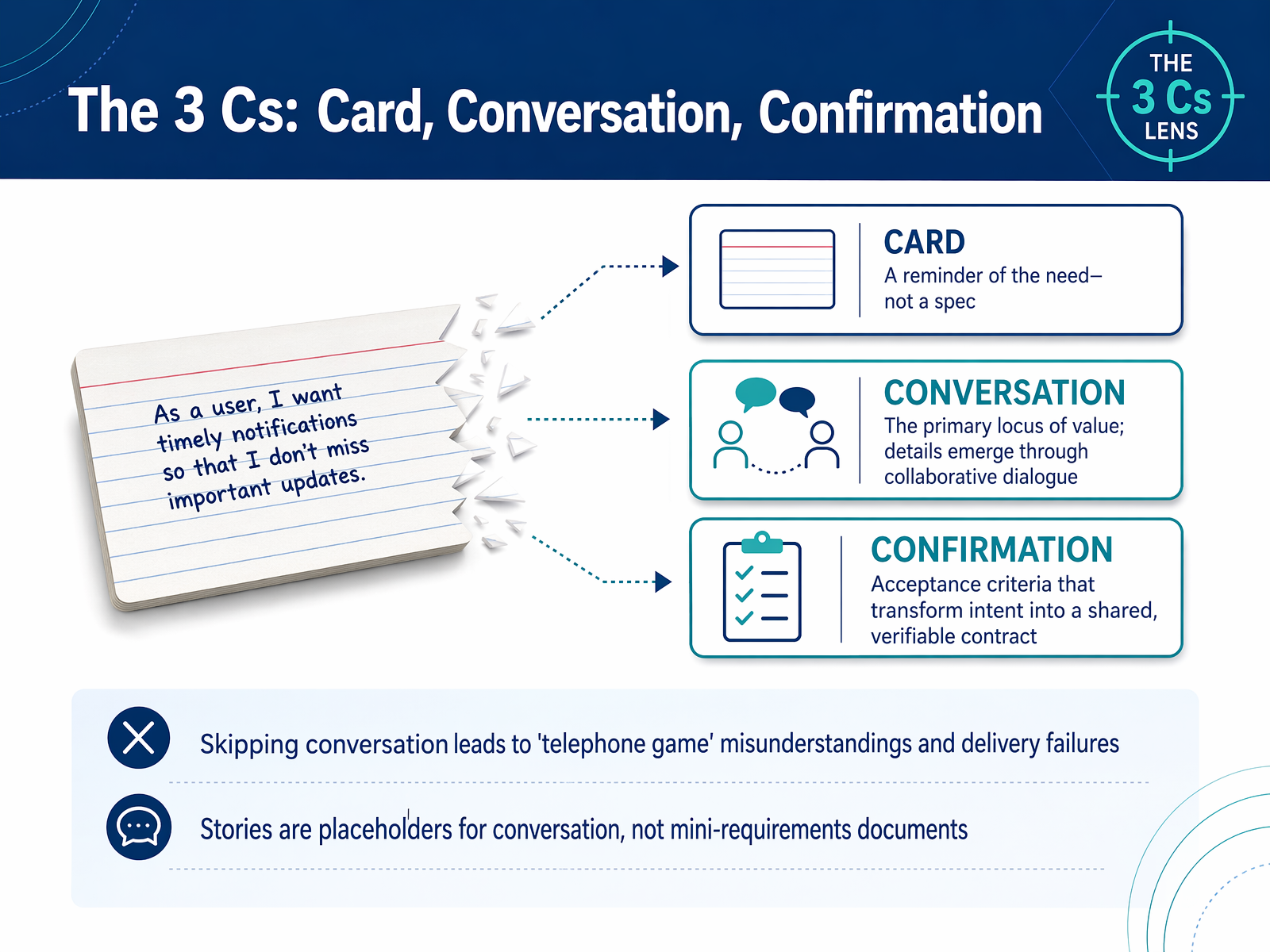
 - 03The 3 Cs: Card, Conversation, ConfirmationNow let's unpack the three C's: Card, Conversation, and Confirmation. Think of the Card as a physical token, like a sticky note. It holds just enough text to remind us of the user need—it's a ticket to a conversation, not a detailed specification. If the text doesn't fit, you need a smaller card. The real value lives in the Conversation. This is the collaborative dialogue between the team, the product owner, and stakeholders. Details about the user's goal, edge cases, and potential solutions emerge here. Skipping this conversation turns agile delivery into a game of telephone, leading to misunderstandings and failed outcomes. Finally, Confirmation transforms our shared intent into a verifiable contract. It is captured as acceptance criteria, which are concrete, testable examples that define what 'done' actually means. To put it simply, stories are placeholders for conversation, not mini-requirements documents. When you keep the card small and prioritize the discussion, you unlock the true power of this practice. Next, we'll look at User Story Anatomy and the INVEST Criteria.
 ronjeffries.comagilealliance.orgronjeffries.com+22 min
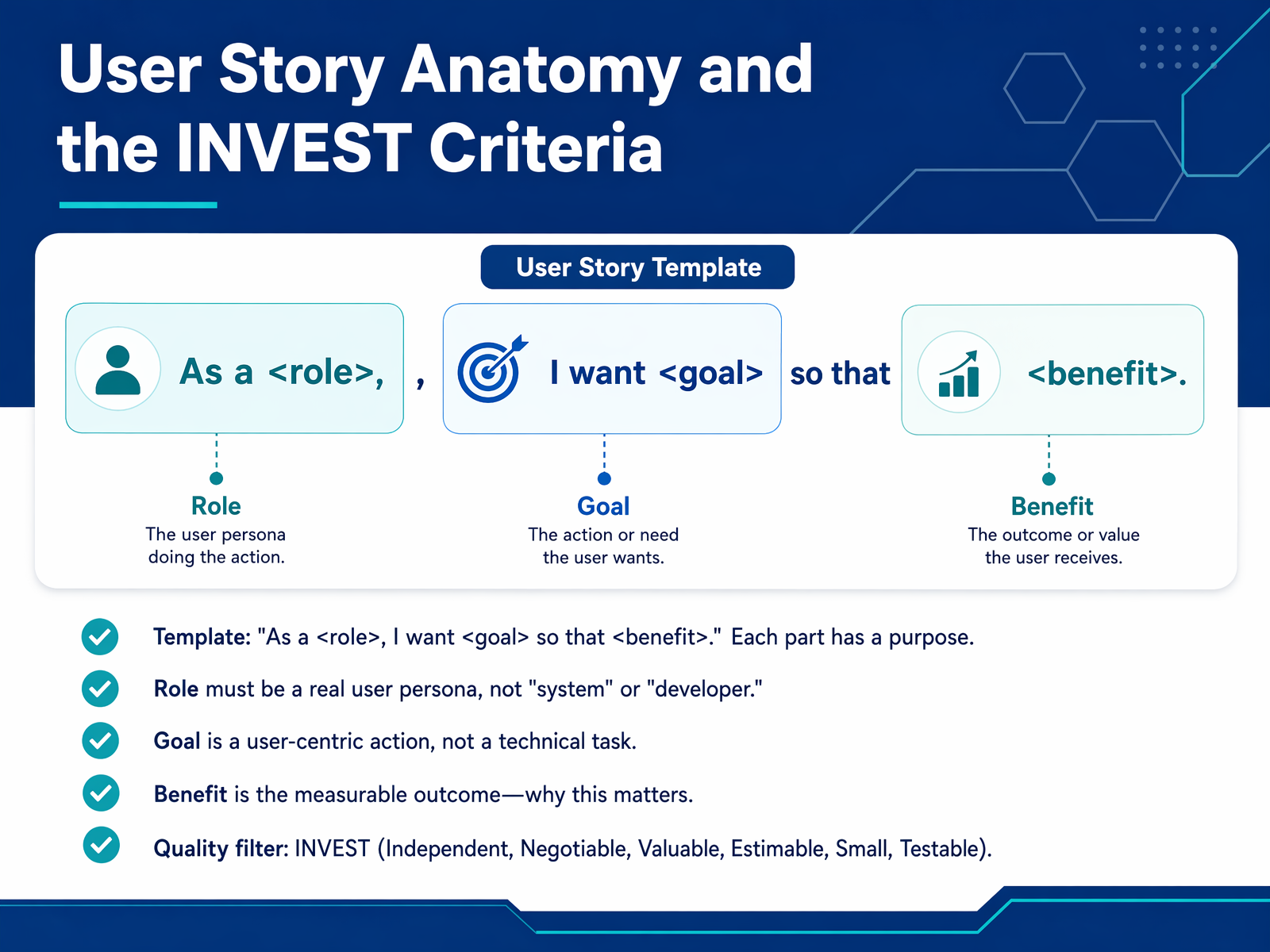
 - 04User Story Anatomy and the INVEST CriteriaNow let's look at the anatomy of a user story and the INVEST criteria. You know the template: "As a role, I want a goal, so that a benefit." But each part has a specific purpose. The role must be a real user persona, not a system or developer. The goal is a user-centric action, not a technical task. And the benefit is the measurable outcome, the reason this matters. To ensure quality, run your story through the INVEST filter. That's Independent, Negotiable, Valuable, Estimable, Small, and Testable. For example, a story that's too large or depends on another story isn't ready. INVEST helps you refine your work until it's clear and actionable. Next, we'll dig deeper into the benefit with "Outcome over Output: The 'So That' Clause."
 builder.aipivotaltracker.comskills.visual-paradigm.com+21 min
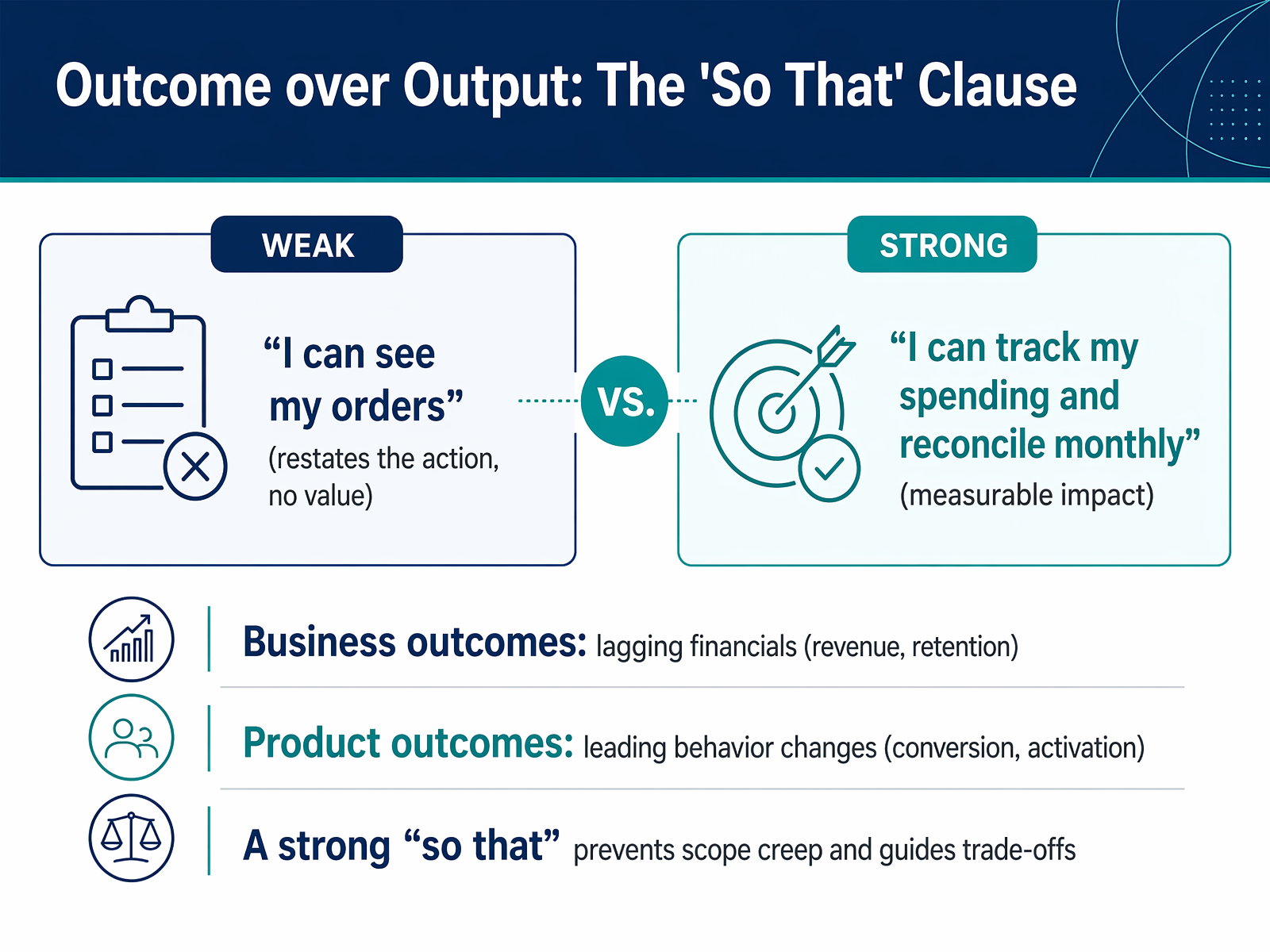
 - 05Outcome over Output: The 'So That' ClauseNow, let's talk about the most important part of any user story: the outcome. You'll often see stories that just restate the action, like 'I can see my orders.' That's a weak story because it describes an output, not a value. A strong story uses the 'so that' clause to explain the measurable impact. For example, 'I can track my spending and reconcile monthly.' This shift from output to outcome is critical. It helps you distinguish between business outcomes, which are lagging financials like revenue or retention, and product outcomes, which are leading behavior changes like conversion or activation. A well-crafted 'so that' clause prevents scope creep. When the team knows the real reason behind the work, they can make better trade-off decisions during development. This focus on outcome over output is the key to shipping features that actually change user behavior. Next, let's explore how to put this into practice with vertical slicing, so you can deliver real value every iteration.
 productwithmustache.comscrumalliance.orgatlassian.com+22 min
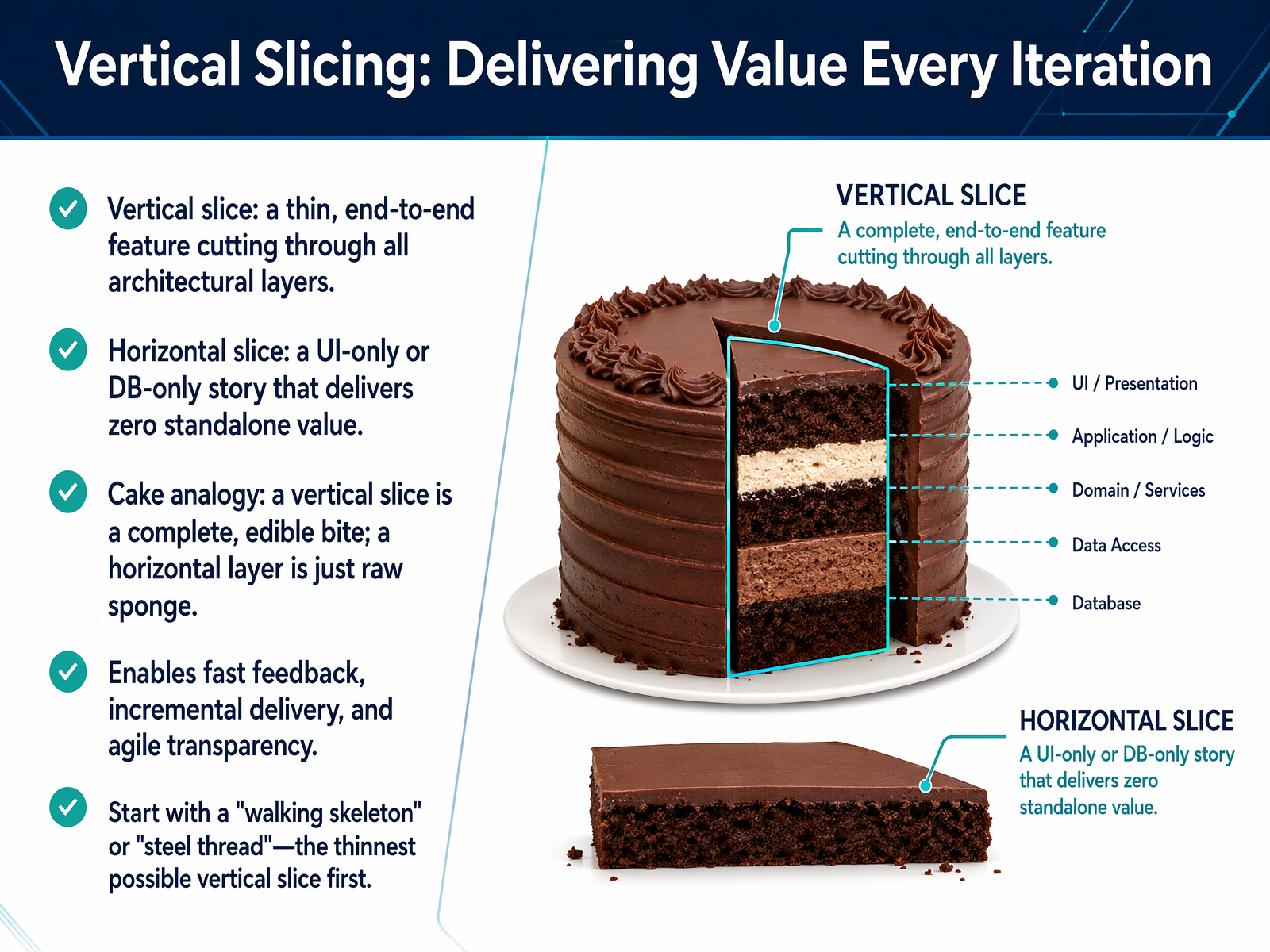
 - 06Vertical Slicing: Delivering Value Every IterationNow let's talk about a concept that often trips up teams, but it's absolutely critical: vertical slicing. Think of a vertical slice as a thin, end-to-end piece of a feature. It cuts through every layer of your architecture—the user interface, the business logic, and the database—to deliver a tiny bit of complete, testable value to the user. This is the opposite of a horizontal slice, which is a task focused on just one layer, like a database-only story. A horizontal slice delivers zero value by itself. Imagine a cake. A vertical slice is a perfect, edible bite with all the layers. A horizontal slice is just a raw layer of sponge—nobody wants to eat that. When you build in vertical slices, you enable fast feedback, because you can demo real, working software every sprint. You get incremental delivery and true agile transparency. The best way to start is with a 'walking skeleton' or a 'steel thread.' This is the thinnest possible vertical slice that barely implements a feature, just to prove the architecture works end-to-end. Once you have that, you can build on it. Next, we'll explore practical story splitting strategies to help you find these thin slices.
 agile.appliedframeworks.comvisual-paradigm.comnextagile.ai+22 min
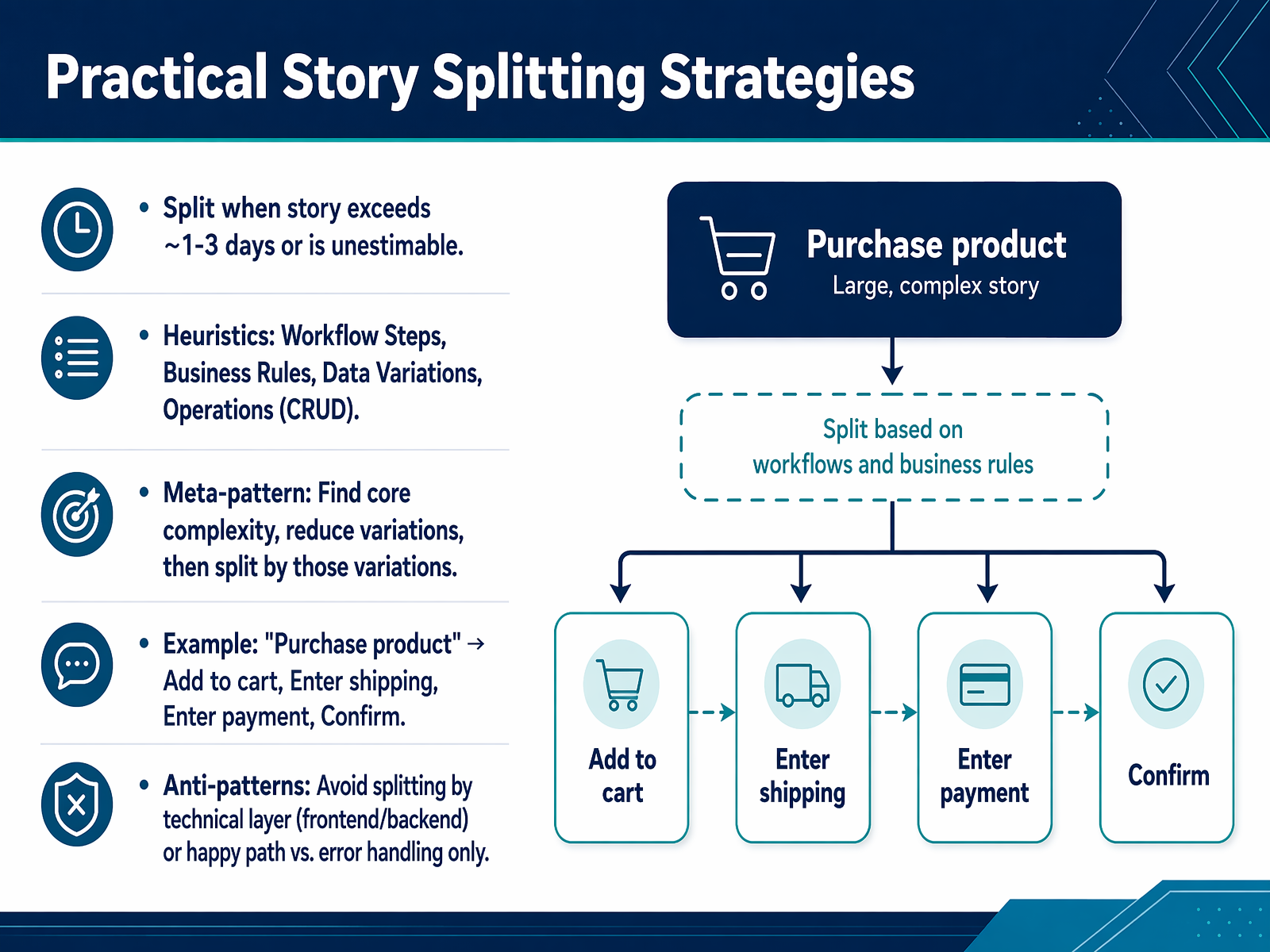
 - 07Practical Story Splitting StrategiesNow, let's get practical and talk about how to actually split a story that's too big. You should consider splitting a user story whenever it exceeds roughly one to three days of work, or if the team simply can't estimate it. A good place to start is by using common heuristics, like splitting by the steps in a workflow, by different business rules, by variations in data, or by basic operations, often remembered as CRUD: create, read, update, and delete. There's also a powerful meta-pattern you can apply. First, find the core complexity of the story, then reduce the number of variations, and finally split by those remaining variations. For example, a large story like 'Purchase a product' can be cleanly split into distinct workflow steps: 'Add product to cart,' 'Enter shipping information,' 'Enter payment details,' and 'Confirm order.' As you do this, be careful to avoid common anti-patterns. Don't split stories by technical layers, like separating the frontend from the backend, because that doesn't deliver a complete piece of user value. Also, avoid splitting a story into just the happy path and then a separate error handling story. Each slice should be a small, testable piece of working software. Next, we'll connect these well-structured stories to the conditions that define when they are truly done, by looking at acceptance criteria.
 agile.appliedframeworks.comvisual-paradigm.comnextagile.ai+22 min
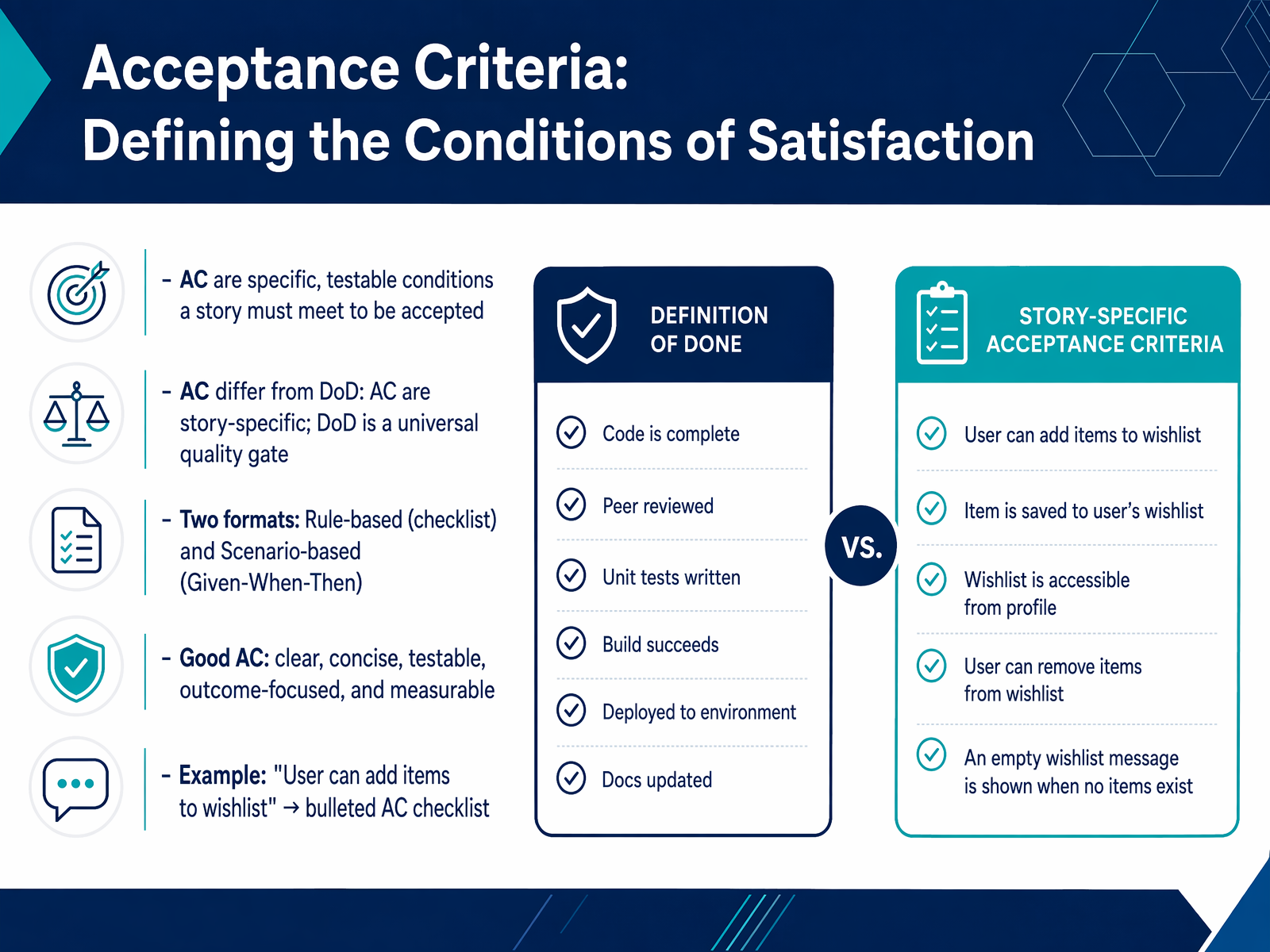
 - 08Acceptance Criteria: Defining the Conditions of SatisfactionNow let's get specific about what acceptance criteria really are and how to write them well. Think of acceptance criteria as the conditions of satisfaction for a user story. They are the specific, testable conditions that a story must meet before it can be accepted as done. They're not the same as your Definition of Done. Your Definition of Done is a universal quality gate that applies to every piece of work the team produces. Acceptance criteria, on the other hand, are unique to each individual story. You'll typically use one of two formats. The first is a rule-based checklist, which is great for simple, independent conditions. The second is a scenario-based format using Given-When-Then, which is perfect for describing sequential user flows. No matter which format you choose, good acceptance criteria share the same core traits. They must be clear, concise, testable, outcome-focused, and measurable. For example, for a story about a user adding items to a wishlist, you wouldn't write a vague sentence. Instead, you'd create a bulleted checklist of precise, verifiable statements, like 'The user can add an item from the product detail page' and 'The wishlist persists after the user logs out and back in.' This precision removes ambiguity and gives everyone the same definition of success. Next, we'll take a closer look at writing Gherkin-style acceptance criteria.
 2 min
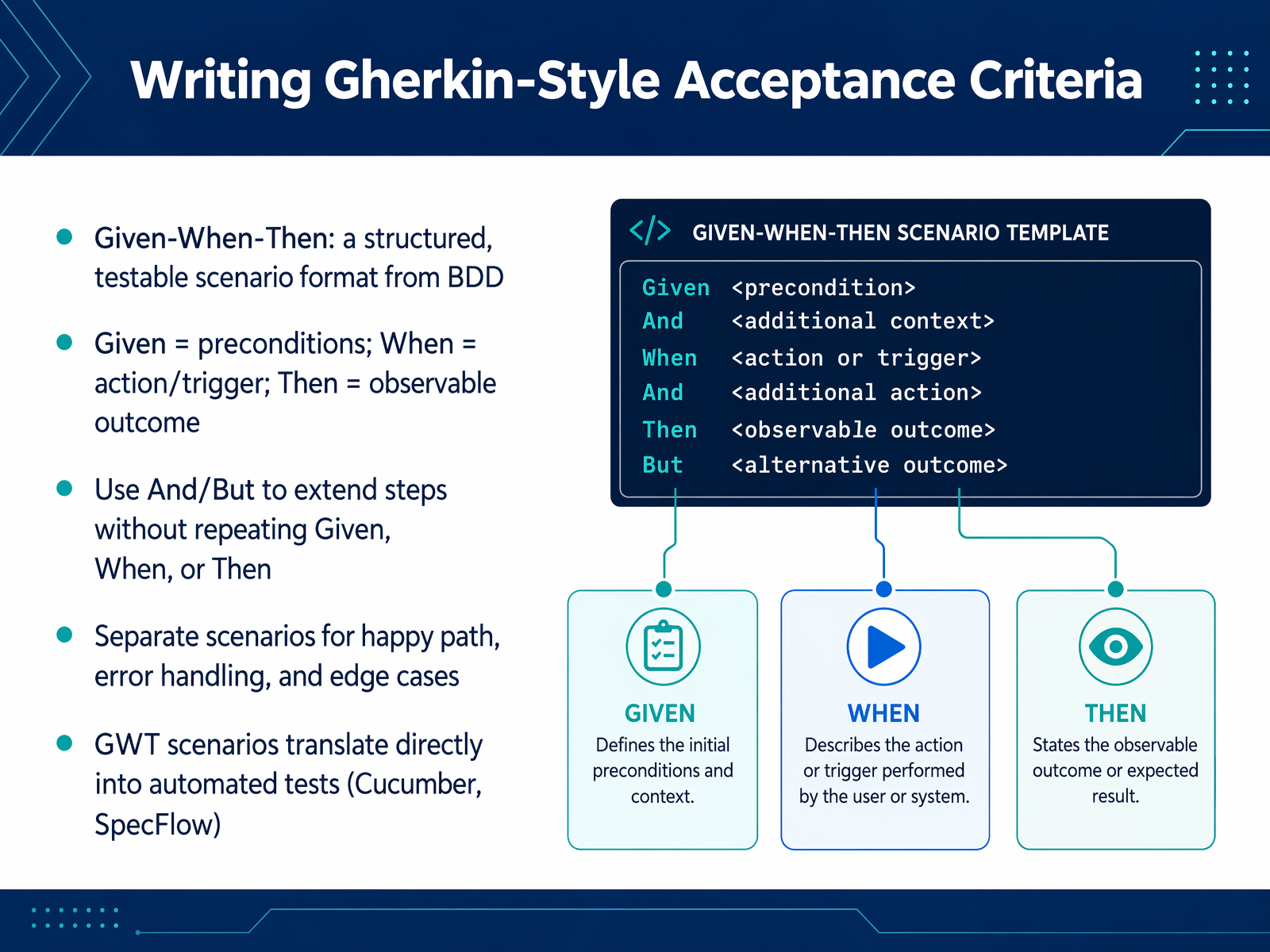
2 min - 09Writing Gherkin-Style Acceptance CriteriaNow let's look at a structured way to write acceptance criteria: the Gherkin-style format, often called Given-When-Then. This approach comes from Behavior-Driven Development and gives you a clear, testable scenario pattern. The Given part sets your preconditions, the state of the system before the action. When describes the specific action or trigger. Then defines the observable outcome you expect to see. You can also use the keywords And or But to add more steps without repeating Given, When, or Then. For example: Given a registered user is on the login page, And the user has entered a valid email, When the user clicks the sign-in button, Then the user should be redirected to the dashboard. It's critical to write separate scenarios for the happy path, error handling, and edge cases. This structured approach translates directly into automated tests using tools like Cucumber or SpecFlow, making your criteria immediately executable. Next, we'll put these skills into practice in a collaborative story-writing workshop.
 2 min
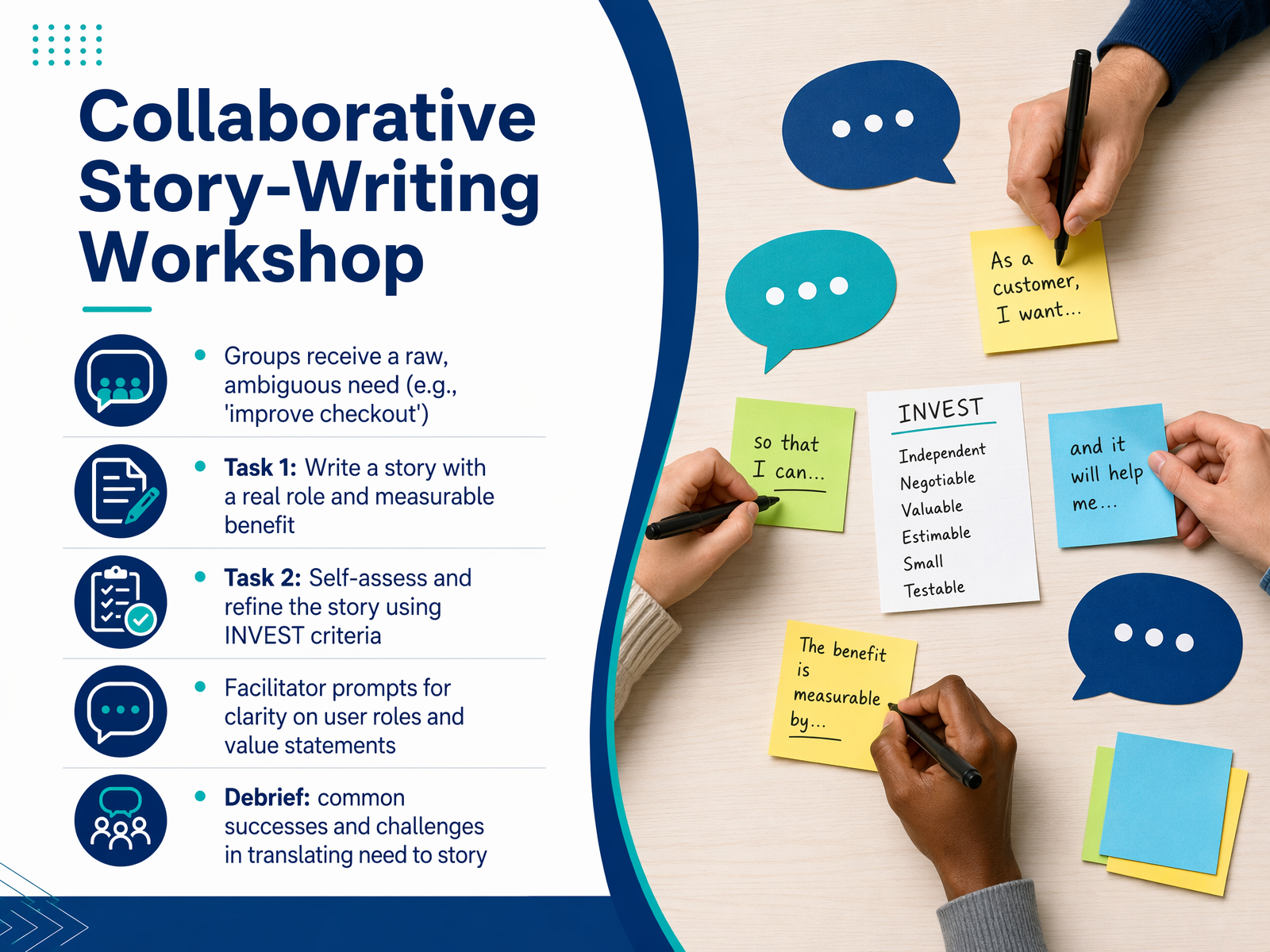
2 min - 10Collaborative Story-Writing WorkshopLet's put all this into practice with a collaborative story-writing workshop. Imagine your group receives a raw, ambiguous need like 'improve checkout.' That's it—no role, no measurable benefit. Your first task is to write a real user story from that. You should define a specific role, like a first-time mobile shopper, and a measurable benefit, such as completing a purchase in under sixty seconds. Next, you self-assess and refine that story using the INVEST criteria. Is it independent? Is it truly valuable? Your facilitator will prompt you to clarify the user role and the value statement, pushing you past vague ideas. The debrief is where the learning crystallizes. You'll discuss common successes and challenges—like how hard it can be to translate a vague need into a small, testable story. This workshop shows you that good stories are built, not just written. Up next, we'll deep-dive into refining acceptance criteria together.
 builder.aipivotaltracker.comskills.visual-paradigm.com+22 min
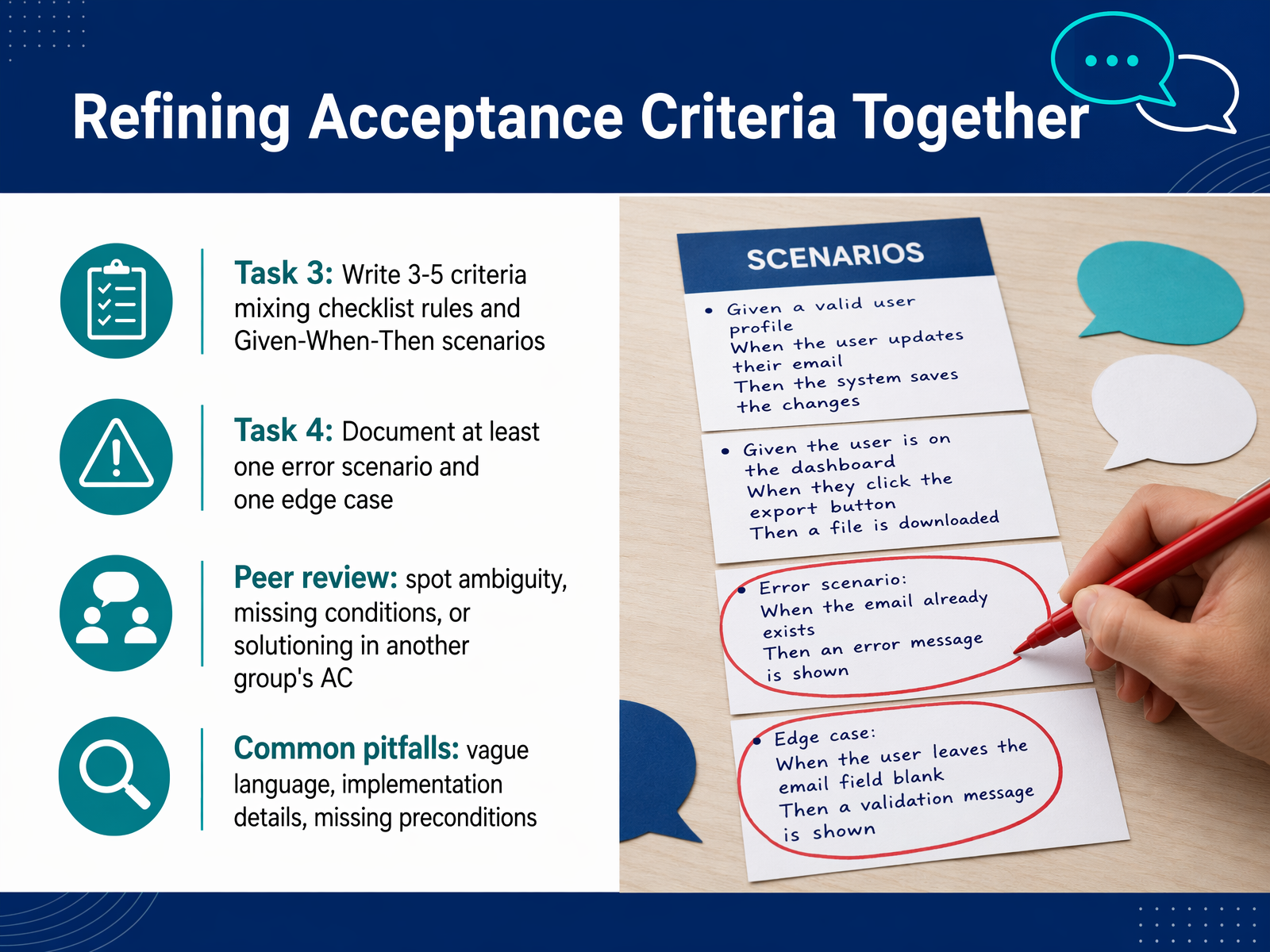
 - 11Refining Acceptance Criteria TogetherNow, let's put all this into practice by refining acceptance criteria together. This is a collaborative exercise where you'll actively work with your team's story. Start with Task Three: write three to five criteria that mix checklist rules and Given-When-Then scenarios. For example, a checklist item might be, 'The search bar retains the user's query,' while a scenario could be, 'Given the user is on the login page, When they enter an incorrect password, Then they see an error message.' Then, for Task Four, document at least one error scenario and one edge case. Think about what happens when an API request fails or when a user submits a form with empty fields. After you've drafted your criteria, you'll move into a peer review. Look at another group's work and spot any ambiguity, missing conditions, or, most importantly, signs of solutioning—where the criteria describe the how, not the what. Common pitfalls to watch for include vague language, including implementation details like database queries, and missing preconditions. Remember, the 'Given' clause is critical. This hands-on practice will sharpen your ability to write clear, testable contracts. Next, we'll build on this by examining common anti-patterns and how to fix them.
 2 min
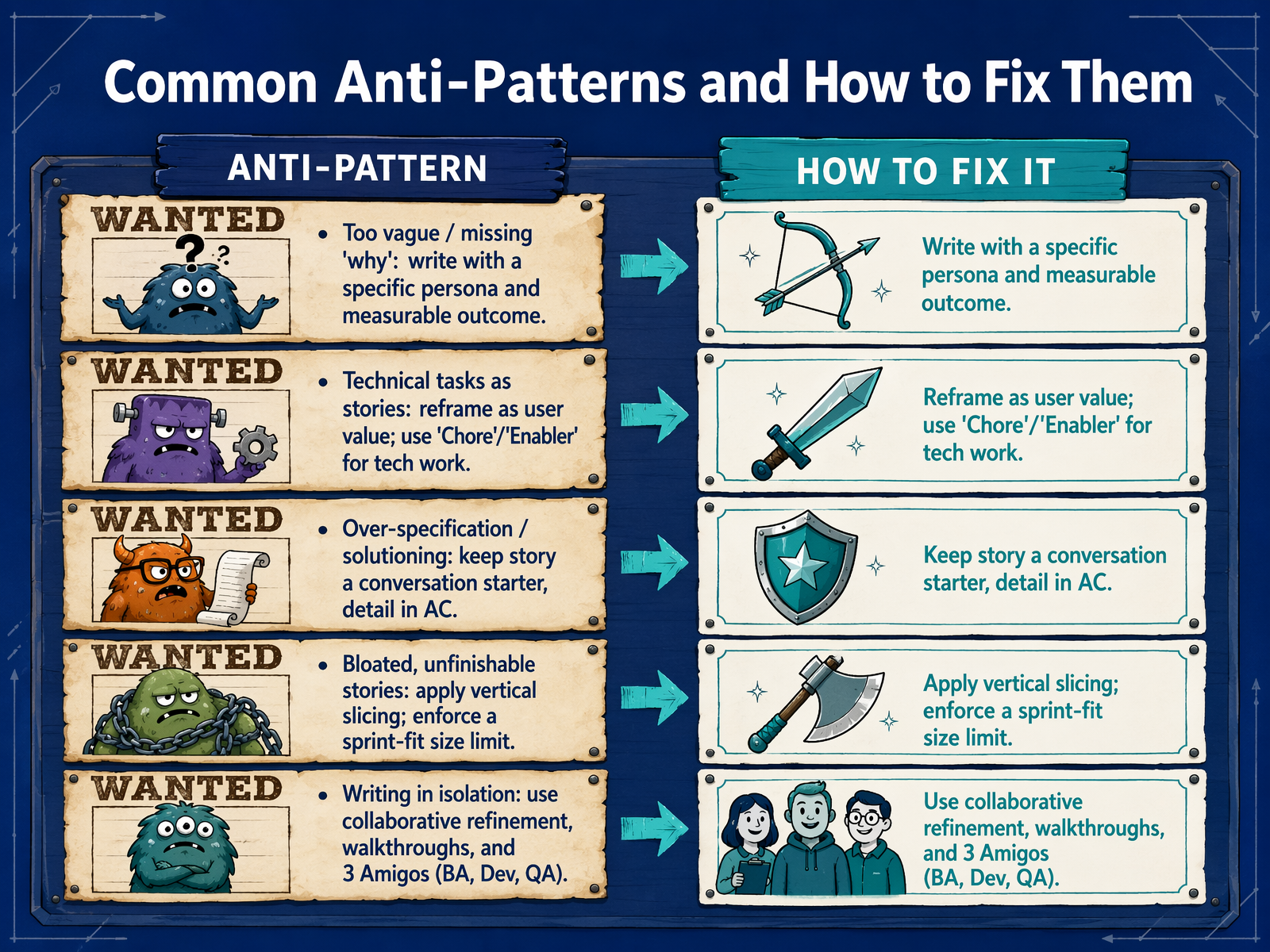
2 min - 12Common Anti-Patterns and How to Fix ThemNext, let's talk about common user story anti-patterns and how to fix them. First, stories that are too vague or missing the "why." Always write with a specific persona and a measurable outcome. Second, technical tasks disguised as stories. Reframe these around user value, and use labels like "Chore" or "Enabler" for pure technical work. Third, over-specification or solutioning inside the story. Keep the story a conversation starter, and put the details into the acceptance criteria using the Given-When-Then format. Fourth, bloated, unfinishable stories. Apply vertical slicing to break them down, and enforce a sprint-fit size limit so each story delivers a testable slice of value. Fifth, writing in isolation. Use collaborative refinement, regular walkthroughs, and the three amigos approach, bringing together a business analyst, developer, and quality assurance person. The story is not the specification; the conversation is the specification. Strong stories are small, valuable, and testable, and they are built together. Next, we will explore how to avoid the feature factory by moving to outcome-driven backlogs.
 agile.appliedframeworks.comvisual-paradigm.comnextagile.ai+22 min
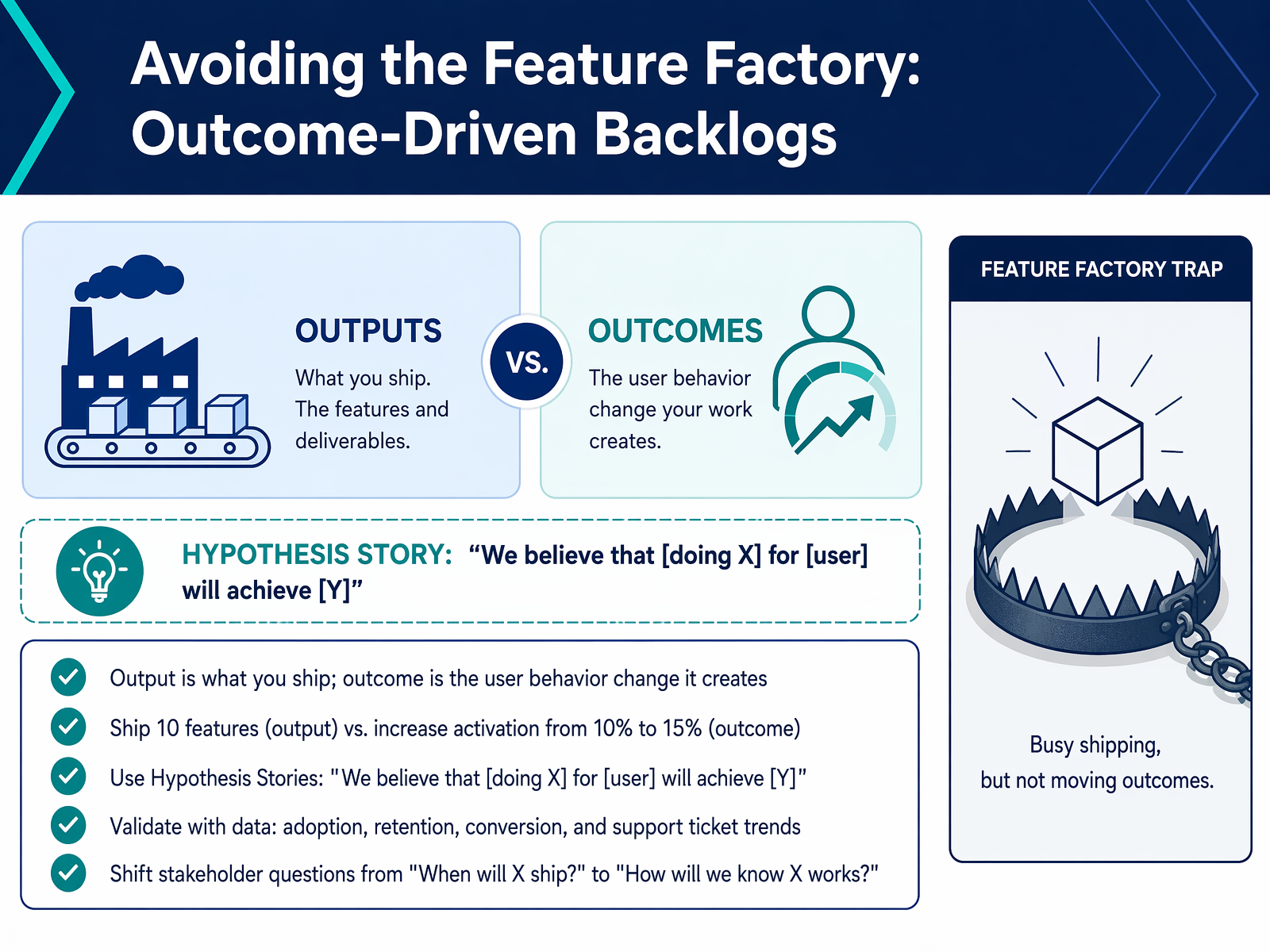
 - 13Avoiding the Feature Factory: Outcome-Driven BacklogsNow, let's talk about something really important: avoiding the feature factory and shifting to an outcome-driven backlog. The key distinction is simple but powerful. Output is what you ship, like ten new features. An outcome is the user behavior change that creates, such as increasing user activation from ten percent to fifteen percent. Shipping features is not the same as changing user behavior. To make this shift, frame your work as hypothesis stories. Use the format: "We believe that doing X for this user will achieve Y." Then, validate that belief with data. Look at adoption, retention, conversion, and support ticket trends. This changes the conversation with stakeholders. Instead of asking, "When will X ship?" they should ask, "How will we know X works?" Moving from output to outcome is how you ensure your team is building value, not just busywork. Next, we'll take this into practice with our next topic: Refining the Backlog: From Good to Great.
 productwithmustache.comscrumalliance.orgatlassian.com+22 min
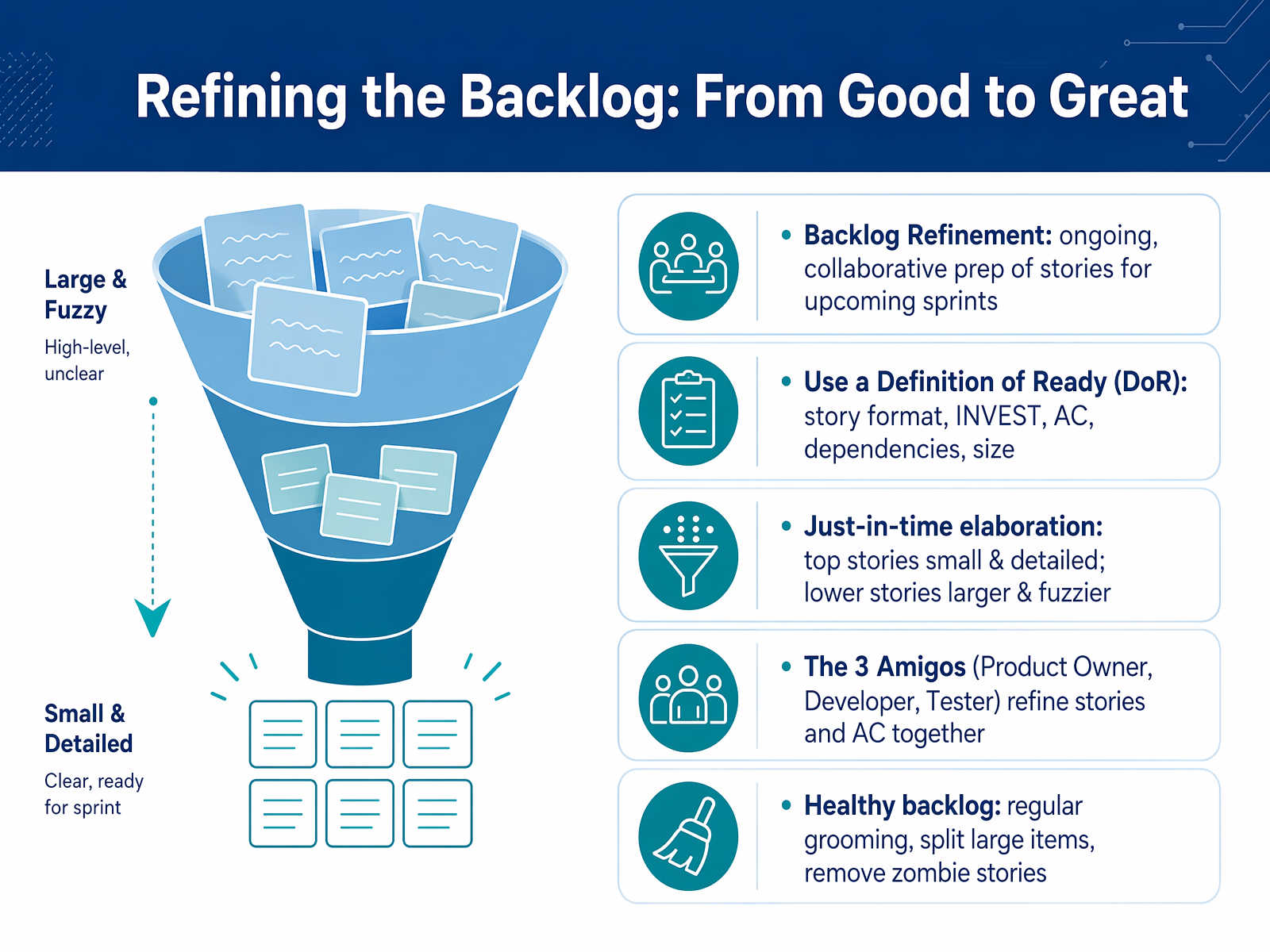
 - 14Refining the Backlog: From Good to GreatNow that you have a strong foundation, let's look at how to refine your backlog from good to great. Backlog refinement is an ongoing, collaborative process where the team prepares stories for upcoming sprints. A key tool here is the Definition of Ready, or DoR. Before a story enters a sprint, check its format, ensure it meets the INVEST criteria, has clear acceptance criteria, and that any dependencies and size are understood. You should practice just-in-time elaboration. This means the stories at the top of your backlog are small and detailed, ready for the next sprint, while stories further down can remain larger and fuzzier. A powerful practice is the Three Amigos session, where the Product Owner, a Developer, and a Tester refine stories and acceptance criteria together. This shared conversation catches edge cases early and builds a shared understanding. Finally, a healthy backlog requires regular grooming. Split large items that won't fit in a sprint, and remove zombie stories that are no longer relevant. Up next, we'll explore how to integrate these stories into your agile workflow.
 builder.aipivotaltracker.comskills.visual-paradigm.com+21 min
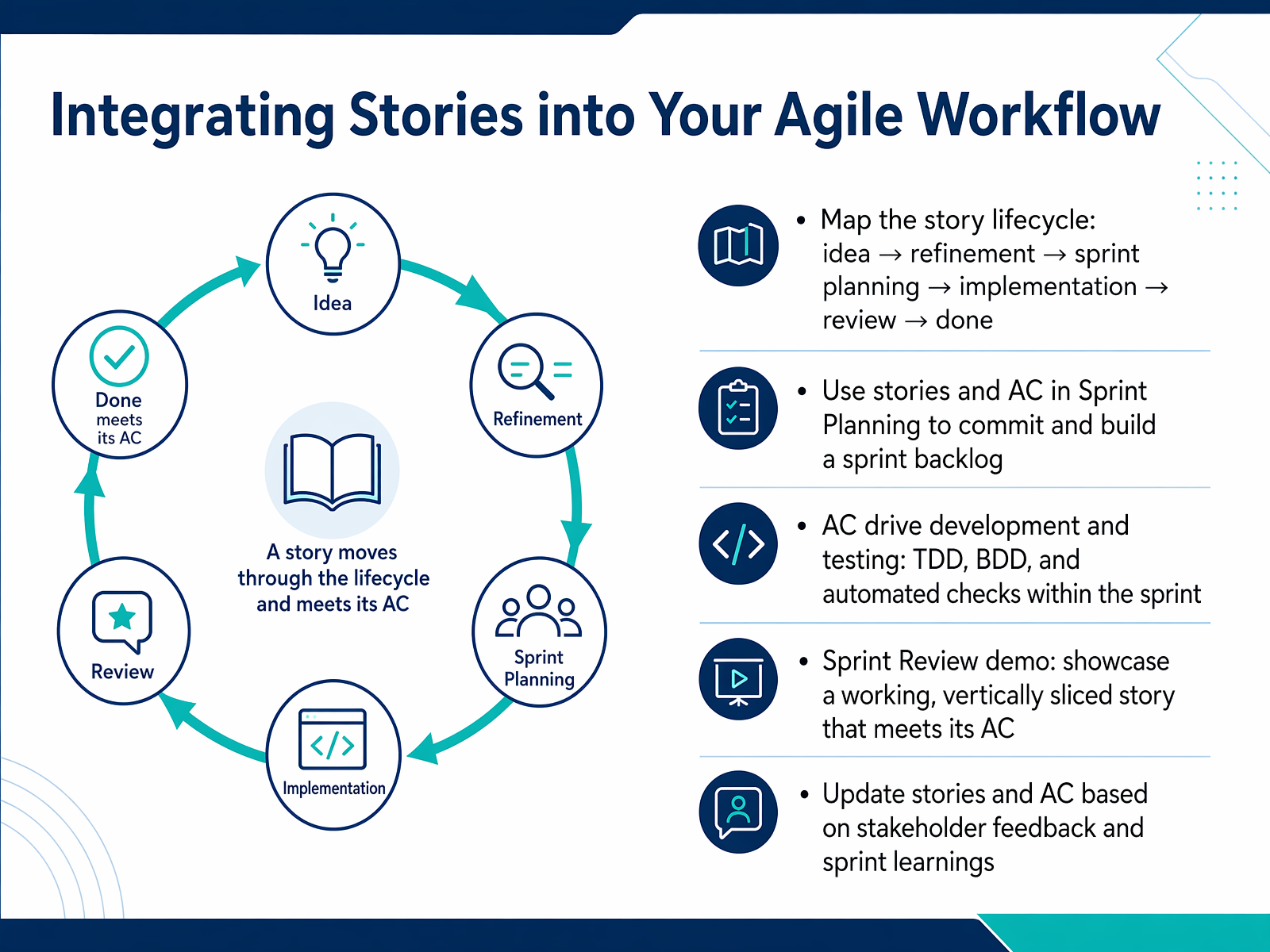
 - 15Integrating Stories into Your Agile WorkflowNow let's look at how you integrate stories into your agile workflow. The story lifecycle starts with an idea, moves through refinement, sprint planning, implementation, and review, and finally reaches done. During sprint planning, you use stories and their acceptance criteria to commit to work and build your sprint backlog. The acceptance criteria then drive development and testing, supporting practices like test-driven development, behavior-driven development, and automated checks within the sprint. In the sprint review, you demo a working, vertically sliced story that meets its acceptance criteria. This means showing a complete feature slice, not just a technical layer. Finally, you update stories and acceptance criteria based on stakeholder feedback and what you learned during the sprint. This keeps your backlog healthy and aligned with real needs. Next, we'll walk through an action plan and concrete next steps to apply these practices immediately.
 agile.appliedframeworks.comvisual-paradigm.comnextagile.ai+21 min
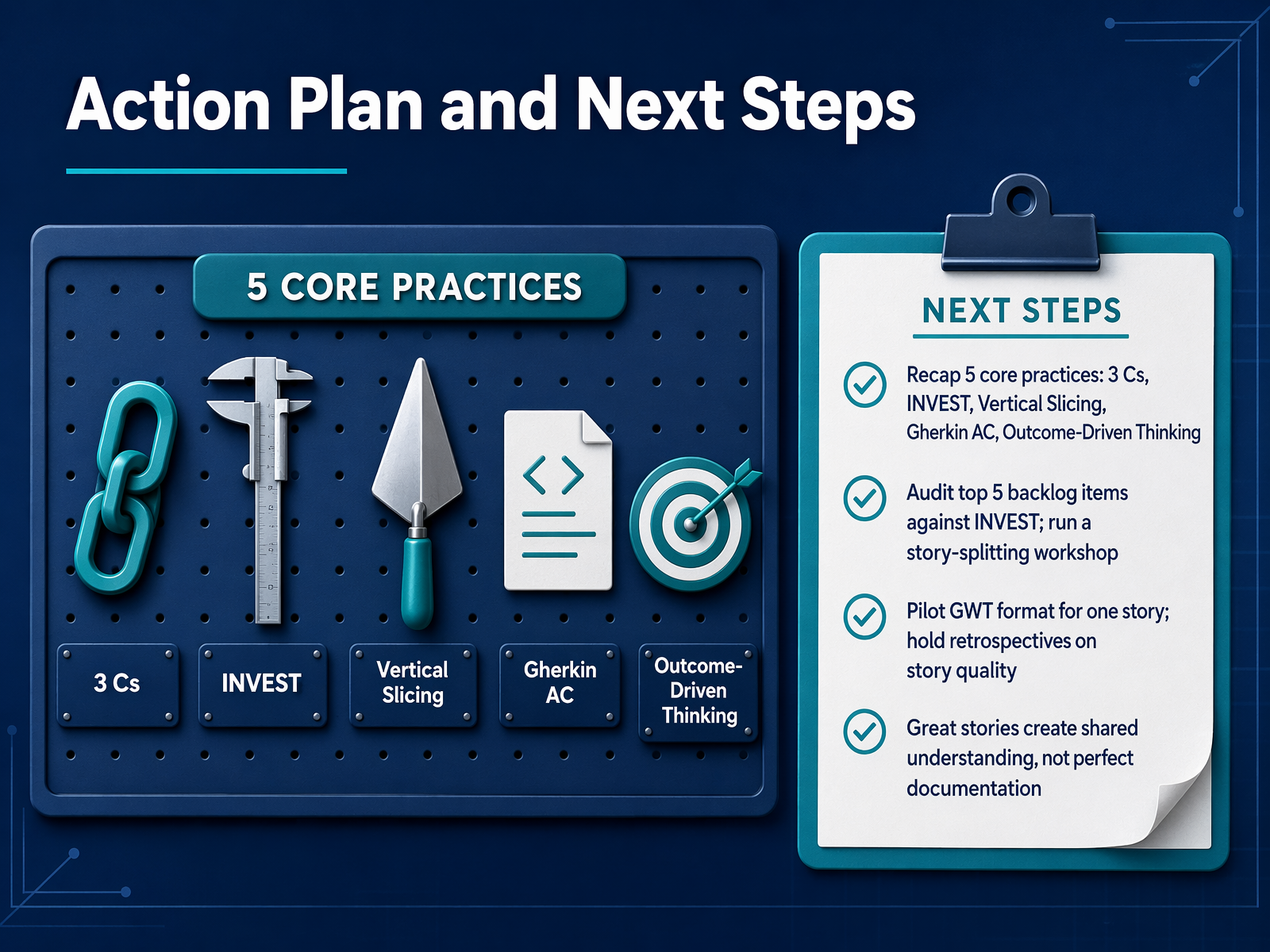
 - 16Action Plan and Next StepsLet's turn these concepts into action. Start this week by auditing your top five backlog items against the INVEST criteria. Look for dependencies, vague value statements, or stories that are simply too large. Next, run a story-splitting workshop with your team. Take one oversized story and break it down using vertical slicing, so each piece delivers a true user outcome. For your next sprint, pilot the Given-When-Then format on just one story. Use it to define clear, testable acceptance criteria, then hold a quick retrospective specifically on story quality. What worked? What was still ambiguous? Remember, the goal is not perfect documentation. Great stories create shared understanding. They spark the right conversations and build a shared vision of what done really means. Thank you for joining this course. Now, go turn your backlog into a tool for clarity and real value.
 builder.aipivotaltracker.comskills.visual-paradigm.com+22 min
Take the deck with you
Download this course as a file — free, no sign-up needed.
- PDF handoutEvery slide page, ready to print or share.17 pages · 4.3 MBDownload
- Narrated PowerPointThe deck that presents itself — every slide carries the digital human's narration video.17 pages · 16.6 MBDownload
- PowerPoint slidesThe full deck as a .pptx — open it in PowerPoint, Keynote, or Google Slides.17 pages · 4.1 MBDownload
Free to use in your own training — please keep the PersonWise credit page at the end.
Have your own deck? Turn it into a course
Sources consulted
Web sources consulted while building this course.
- User Stories: Making the Vertical Slice - Applied Frameworks — agile.appliedframeworks.com
- User Story Splitting - Vertical Slice vs Horizontal Slice — visual-paradigm.com
- Vertical Slicing and Horizontal Slicing in Agile: User Story Slicing Techniques — nextagile.ai
- The Humanizing Work Guide to Splitting User Stories — humanizingwork.com
- How to Best Slice User Stories — Jeremy Jarrell — jeremyjarrell.com
- Requirements vs User Stories: Outputs to Outcomes — productwithmustache.com
- PowerPoint Presentation — scrumalliance.org
- Outcomes vs Outputs: Driving Value in Product Development | Atlassian — atlassian.com
- Outcome Over Output — martinfowler.com
- Outcome vs Output: Key Differences and Examples — talent500.com
- Three-C's Revisited — ronjeffries.com
- What are the Three C's — agilealliance.org
- Stories and the Three C's - Revisited Yet Again — ronjeffries.com
- Mastering User Stories With The 3Cs — leanwisdom.com
- Three C's - Public Agile — publicagile.org
- How to create awesome app user stories (examples, frameworks & more) — builder.ai
- How to INVEST in Your User Stories — pivotaltracker.com
- Applying the INVEST Criteria in Daily Practice — skills.visual-paradigm.com
- INVEST in User Stories — capgemini.github.io
- How to evaluate your user stories using the INVEST criteria — towerhousestudio.com