Begin
14 pages · ~28 min
Cybersecurity Anti-Patterns and Safer Alternatives
This training helps employees recognize common cybersecurity anti-patterns and adopt safer alternatives to reduce risk.
A digital instructor presents all 14 pages. Hold “Ask” at any point and ask out loud — the answer comes from this course. No sign-up needed.
What you’ll learn
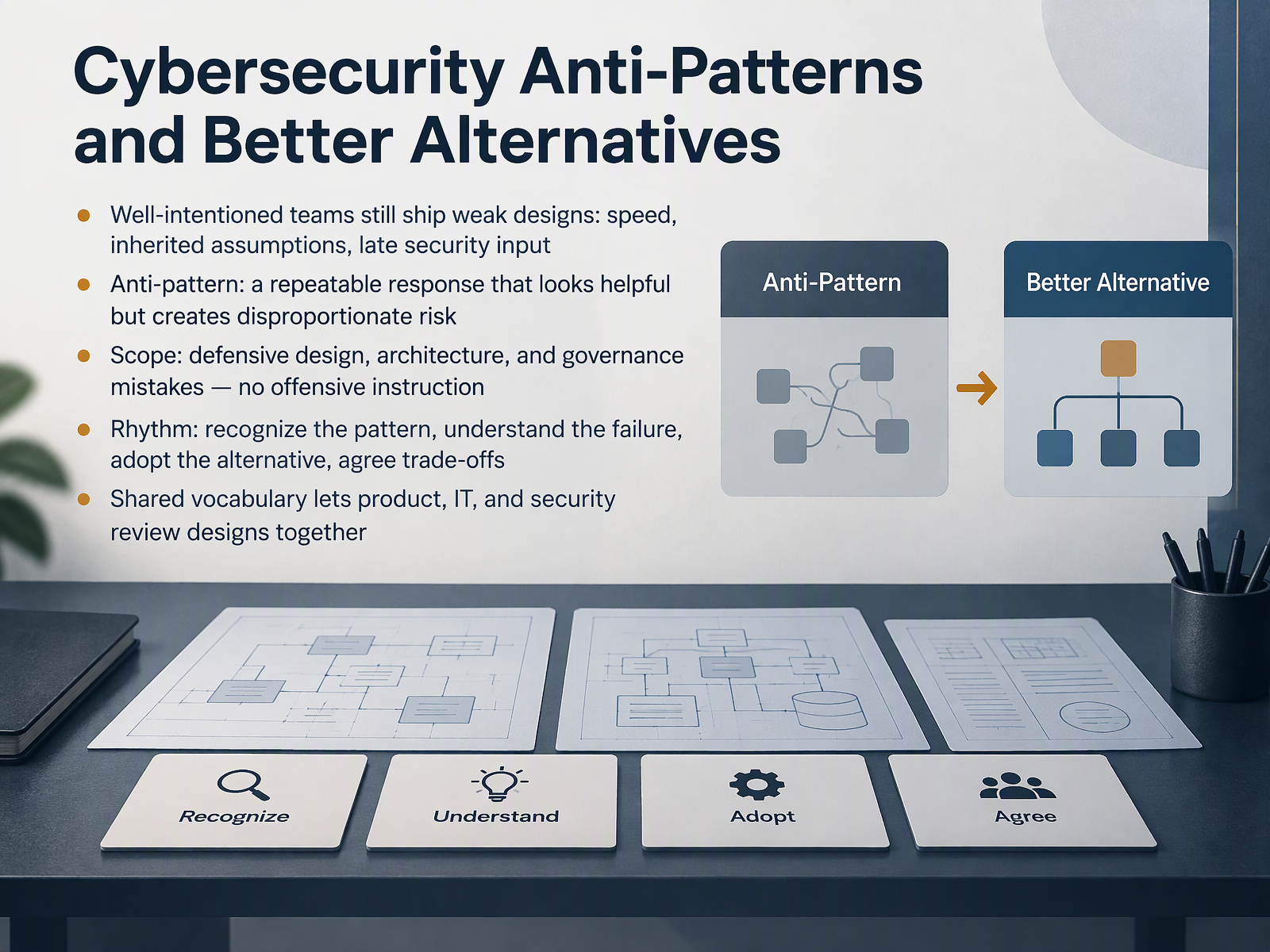
- 01Cybersecurity Anti-Patterns and Better AlternativesWelcome. This course is about cybersecurity anti-patterns and better alternatives. Our goal is practical. By the end, you will recognize common defensive design and governance mistakes, and you will know a concrete alternative for each one. This is not offensive training. We stay on the defensive side. Well-intentioned teams still ship weak designs. Usually for familiar reasons: delivery speed, inherited assumptions, and security input arriving too late. An anti-pattern is a repeatable response that looks helpful but creates disproportionate risk. What it looks like: a design review that always ends with we will fix it after launch. What to do instead: agree the security decision before the sprint closes, and write down the tradeoff. The rhythm is simple. Recognize the pattern, understand the failure, adopt the alternative, agree the trade-offs. One shared vocabulary lets product, IT, and security review designs together. Takeaway: name one recurring habit in your next team discussion, and test it against this definition. Next, we look at why defensive weaknesses persist.assets.hacken.iosecuritycompass.comdlt.com+22 min
- 02Why Defensive Weaknesses PersistLet's look at why defensive weaknesses persist, even in teams that care about security.
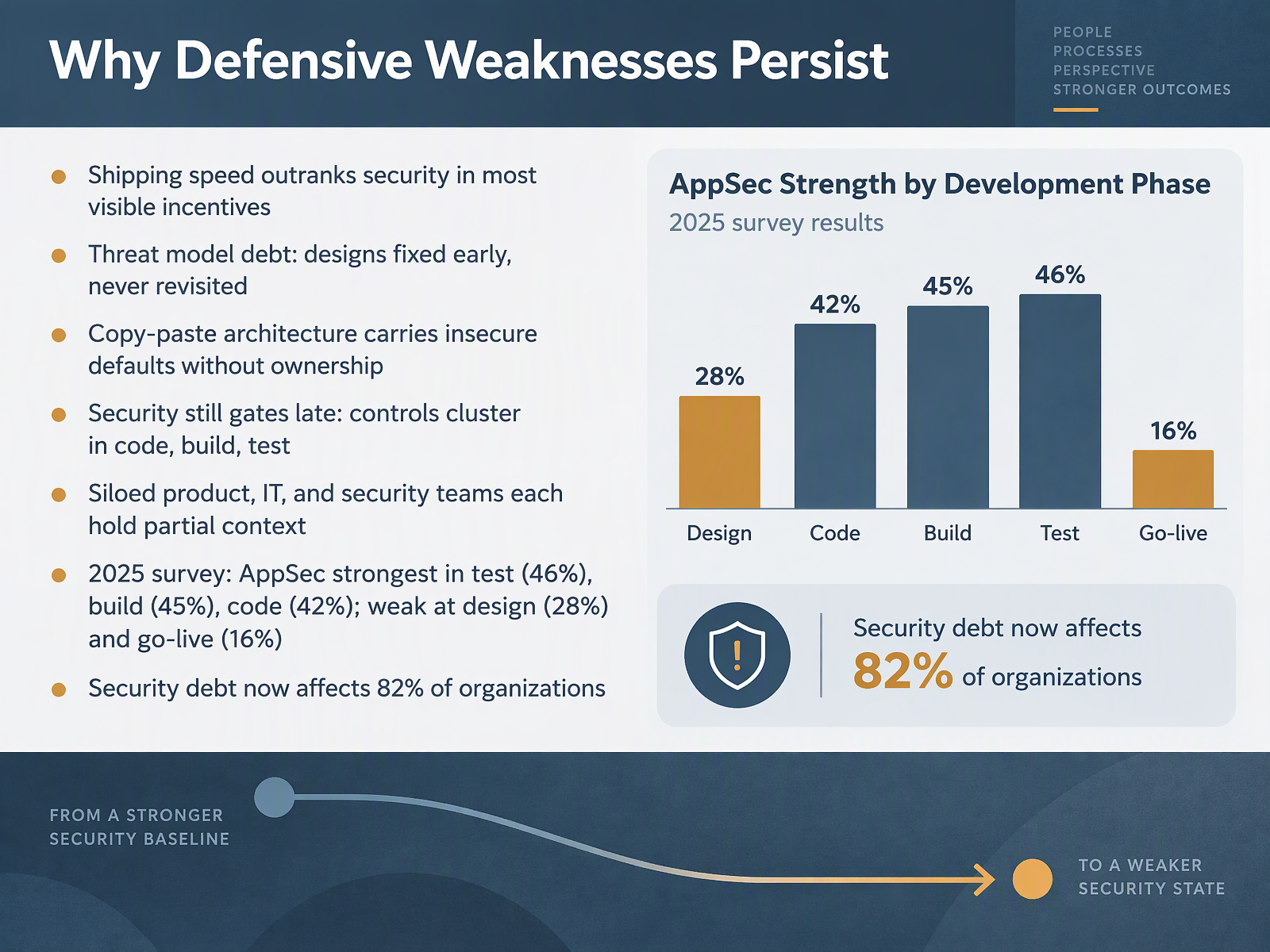
First, shipping speed outranks security in most visible incentives. The demo date is visible. The missed threat model is not.
Second, threat model debt. Designs get fixed early and are never revisited, so the model no longer matches the system.
Third, copy and paste architecture carries insecure defaults forward without a clear owner.
Fourth, security still gates late. Controls cluster in code, build, and test.
A twenty twenty five survey shows this clearly. AppSec is strongest in test at forty six percent, build at forty five, and code at forty two. It is weakest at design, twenty eight percent, and go live, sixteen percent.
Fifth, product, IT, and security each hold partial context, so no one sees the whole picture. And security debt now affects eighty two percent of organizations.
What it looks like: controls appear late, designs go stale, and ownership is unclear.
What to do instead: assign a design owner, revisit threat models at each major change, and add a lightweight go live security check. The tradeoff is a small time cost early, in exchange for fewer late surprises.
Takeaway for your next team discussion: ask who owns the threat model, and when it was last updated.
Next, we will use a recognition framework built around four lenses.
 assets.hacken.iosecuritycompass.comdlt.com+22 min
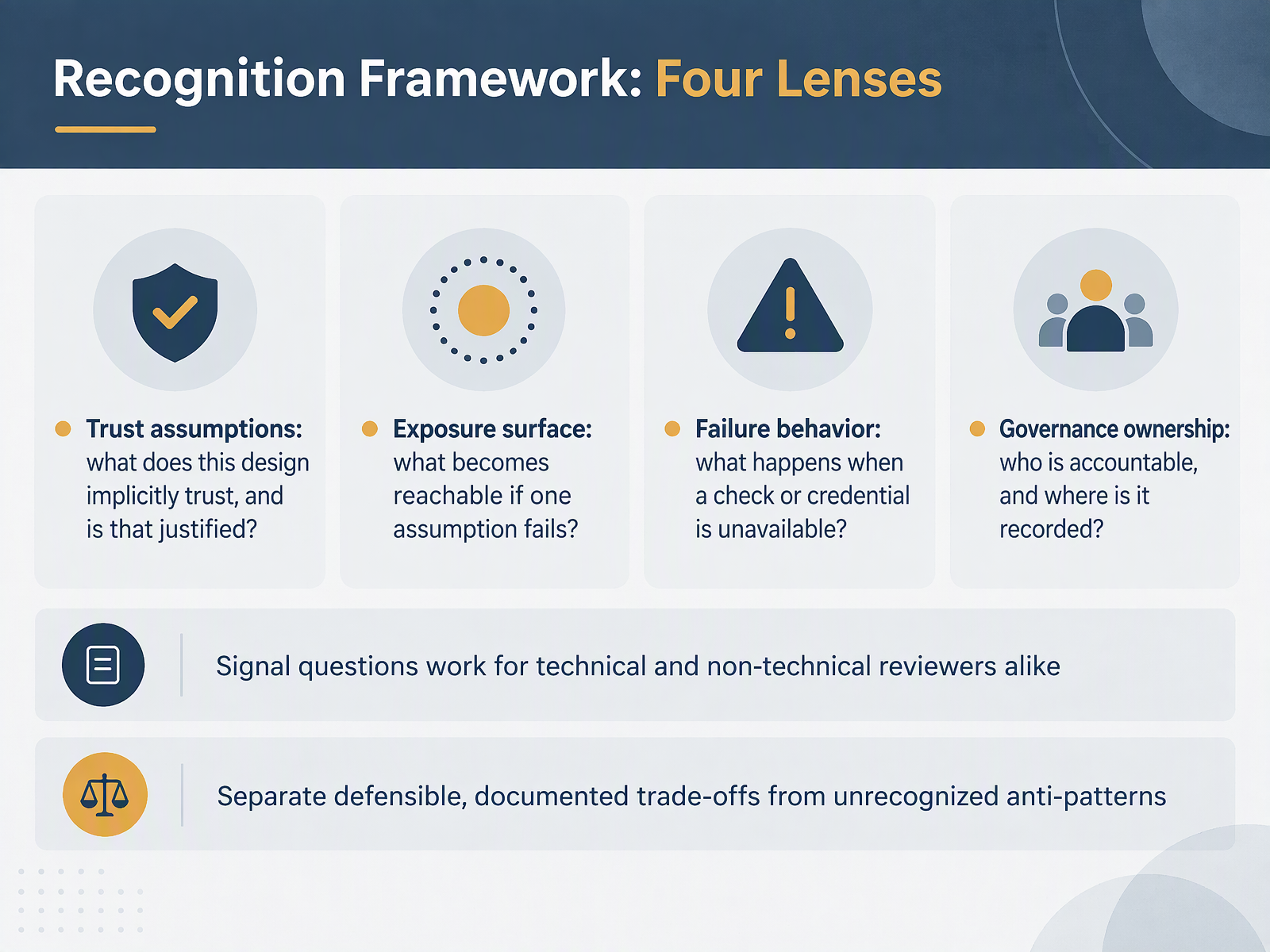
- 03Recognition Framework: Four LensesNow let's look at a simple framework for spotting anti-patterns before they reach your backlog. It uses four lenses. Trust assumptions: what does this design implicitly trust, and is that trust justified? Exposure surface: if one assumption fails, what becomes reachable? Failure behavior: what happens when a check or credential is unavailable? And governance ownership: who is accountable, and where is that recorded? These are signal questions, not verdicts. They work for engineers, product managers, and reviewers alike because each one points to a visible design choice. What it looks like: a design that quietly trusts a default setting nobody reviewed. What to do instead: name the assumption, name the owner, and record the decision in your risk register. That record is how you separate a defensible, documented trade-off from an unrecognized anti-pattern. Takeaway for your next team discussion: run these four questions on one design under review, then write down the assumptions and the owner. Next, we'll apply them to anti-patterns in identity and access.
 nacdonline.orgccb.belgium.benvlpubs.nist.gov+22 min
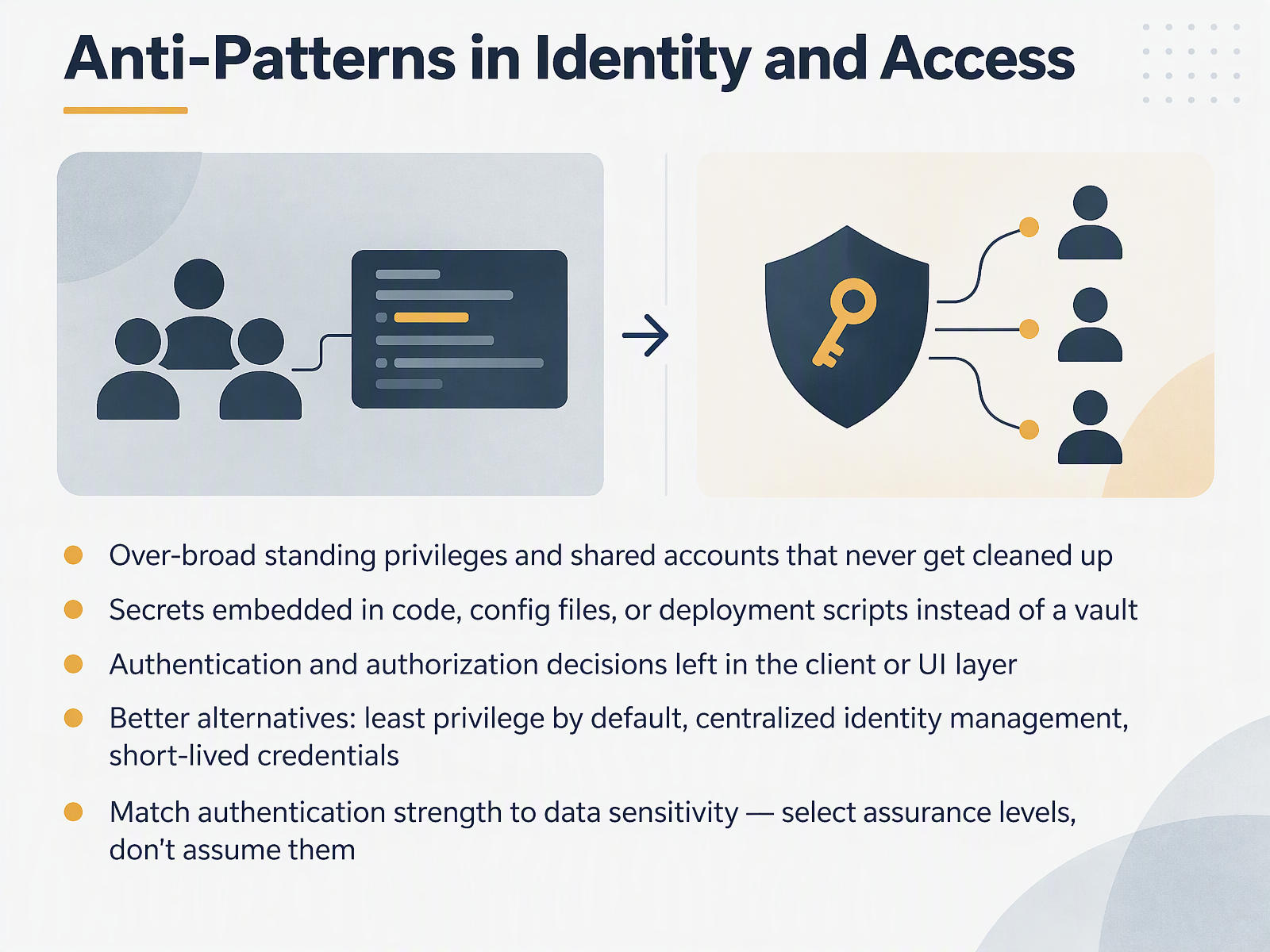
- 04Anti-Patterns in Identity and AccessNow let's look at identity and access. First, what it looks like. Standing privileges that are too broad, and shared accounts that never get cleaned up. Secrets embedded in code, config files, or deployment scripts instead of a vault. And authentication or authorization decisions left in the client or UI layer. Here is the distinction that matters. Client-side checks are detectable, not prevented. Anyone can bypass them. What to do instead. Apply least privilege by default. Use centralized identity management. And issue short-lived credentials rather than long-lived ones. Now for the tradeoff. These controls add friction. Onboarding slows, and teams need a vault and a token service. That cost is predictable and worth stating up front. One more point. Match authentication strength to data sensitivity. NIST Special Publication 800 63 revision four frames this as assurance levels. Select levels deliberately, and do not assume them. The takeaway for your next team discussion. List your shared accounts and embedded secrets, then agree which one moves to a vault first. Next, we turn to anti-patterns in data handling and privacy.
 nist.govcsrc.nist.govcsrc.nist.gov+22 min
- 05Anti-Patterns in Data Handling and PrivacyNext, let's look at anti-patterns in data handling and privacy. The most familiar one is collect now, classify later. Data gets hoarded because it may be useful someday, and it never gets minimized. What it looks like is a backlog item that says, just store the full payload for now. Another common habit is copying production data into development and test environments. Another is plain-text logging of tokens, session IDs, credentials, personal data, and full request bodies. What to do instead. Classify and minimize at intake, so every field has a stated purpose. When you must keep a value for correlation, mask, tokenize, or hash it, and remember that hashing is not fully reversible proof when the input space is small. Then apply retention and disposal to logs, backups, and debug output. Protect logs centrally, with restricted read access and access that is recorded. The key distinction here is collected versus needed. Takeaway for your next team discussion: ask what each data field is for, and what removes it. Coming up next, anti-patterns in resilience and failure handling.
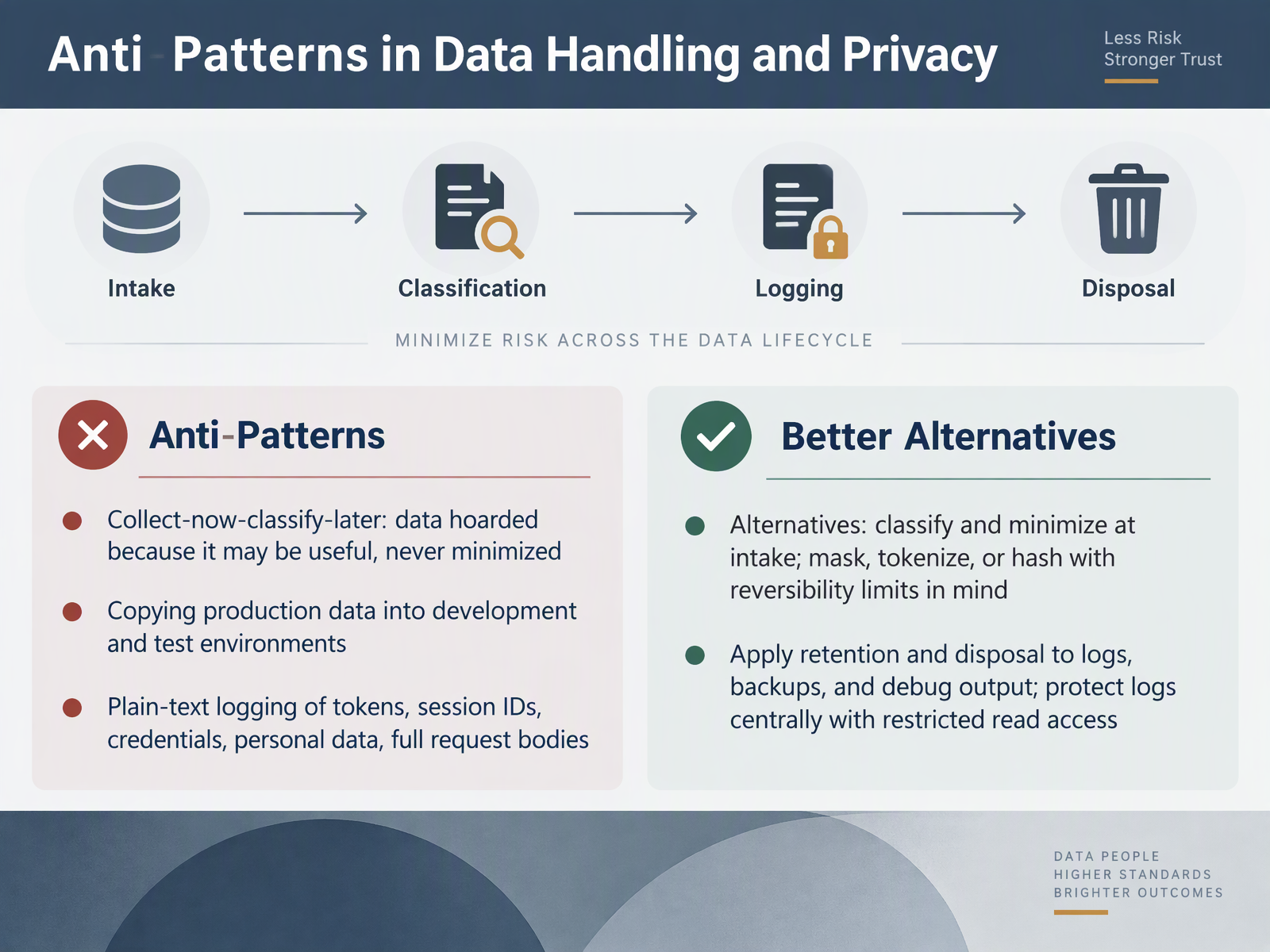 cheatsheetseries.owasp.orgdevguide.owasp.orgmas.owasp.org+22 min
- 06Anti-Patterns in Resilience and Failure HandlingNext, let's look at resilience and failure handling. One common anti-pattern is failing open. When a policy service or dependency is unavailable, the check is skipped, and access is allowed. What it looks like: an outage quietly disables a control. What to do instead: choose fail-safe defaults, so the safe answer is deny, and the outage stays visible. Treat error messages, retries, and fallbacks as security decisions, not neutral plumbing. Bounded retries limit load, and observable degradation keeps the failure honest rather than silent. Also watch single points of trust and bypass paths that become the real access route. Make trust decisions explicit in design review. Ask one question: during an outage, which control stops working, and what happens then? Take that question into your next design review, and move on to anti-patterns in cloud configuration.
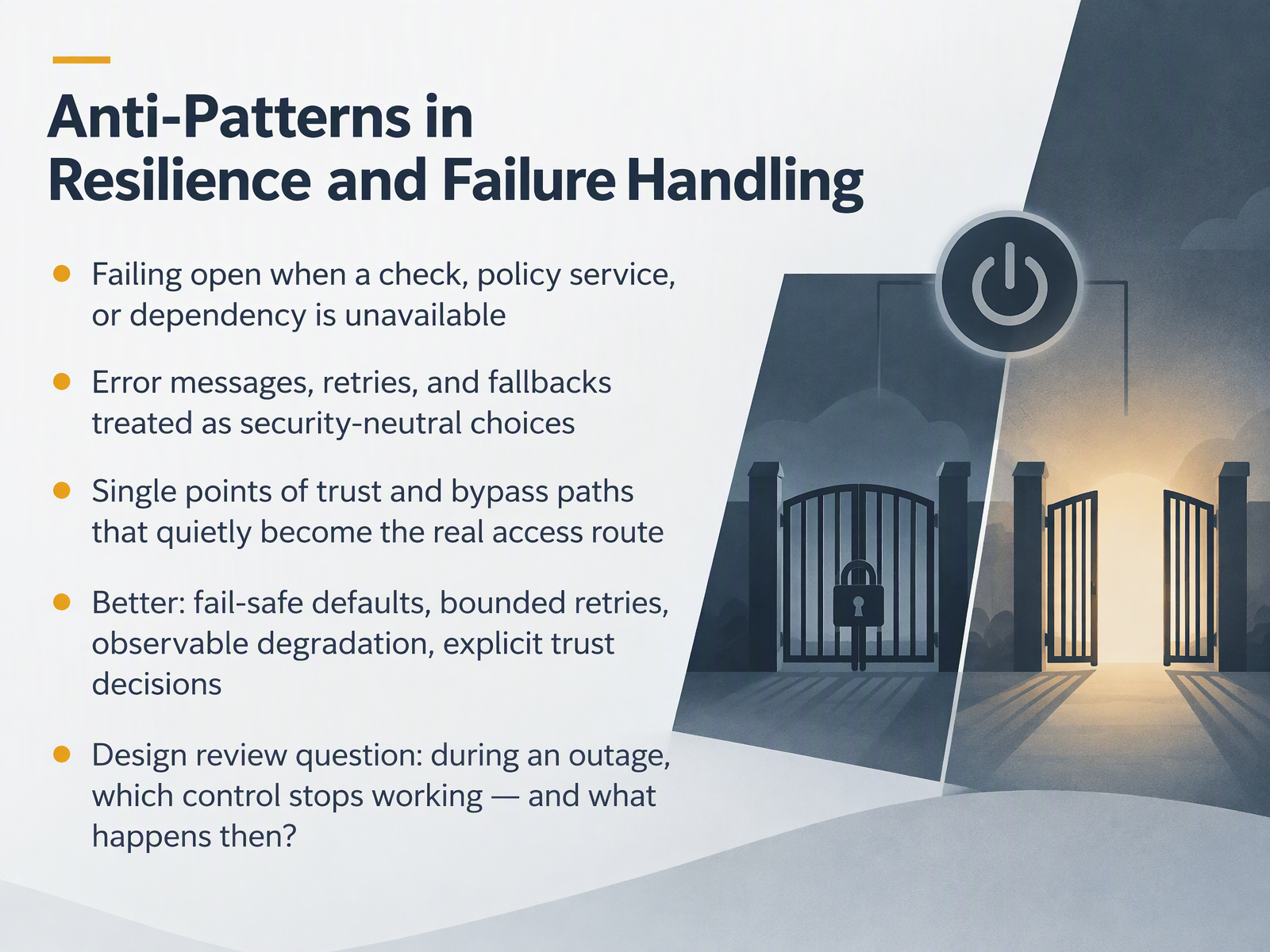 2 min
- 07Anti-Patterns in Cloud ConfigurationNow let's look at cloud configuration, where small default choices carry real weight. Default-open settings cause accidental public exposure of storage and admin interfaces. A quick way to check: are your buckets and consoles reachable from the internet by default? Here is the common misconception. The provider secures everything. Not true. You always own your data, identities, accounts, and access management. What it looks like is a clean green-field baseline that slowly drifts to weaker settings. Exceptions get made, and nobody notices. What to do instead: publish a secure baseline before design. Enforce guardrails as policy-as-code. Then monitor for drift continuously, and separate accounts or environments to limit blast radius. The tradeoff is some upfront friction on every change. Your takeaway: confirm who owns each cloud account, and add a drift check to your next planning session. Next, we turn to anti-patterns in third-party and supply chain trust.
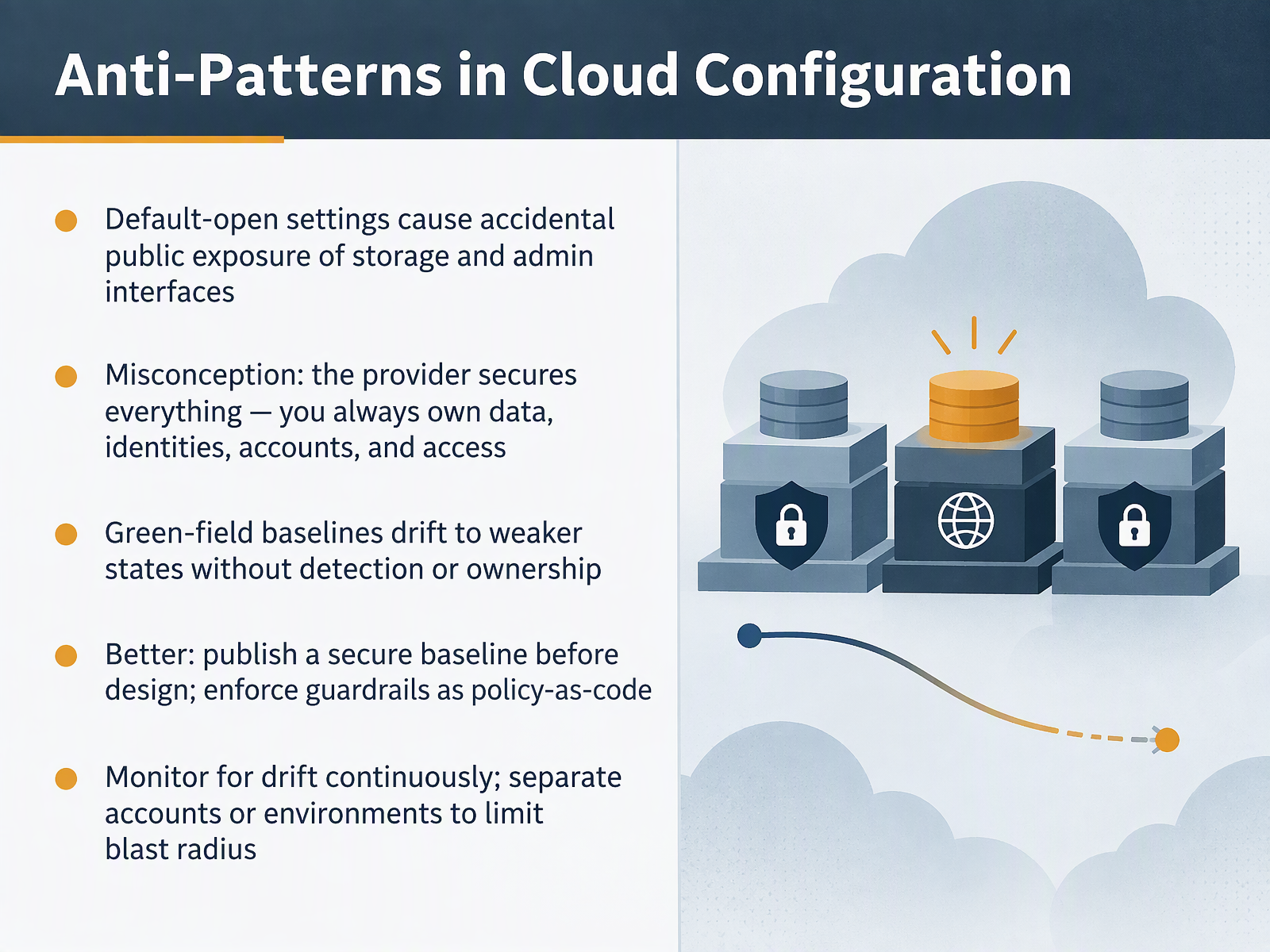 2 min
- 08Anti-Patterns in Third-Party and Supply Chain TrustNext, let's look at how trust gets extended across your supply chain. The core anti-pattern is unbounded trust. A vendor or an open source library gets the same loose review regardless of how sensitive the data is that touches it. What it looks like: one approval tier for every supplier. What to do instead: proportionate review, where the depth of assessment matches the data and business criticality. The tradeoff is more effort on the few suppliers that matter most, and less paperwork on the rest. Then there is shadow IT, meaning integrations nobody has inventoried or owns. What it looks like: a tool connected to your systems with no named owner. What to do instead: assign an owner to every integration and track your components with a software bill of materials and continuous supply chain monitoring. Watch for non-production environments treated as low priority, because dependencies and builds still flow through them. The takeaway: list your core processes, name the suppliers they truly depend on, and write down a fallback plan for each. That gives continuity a concrete answer in your next review. That leads us into anti-patterns in governance and security metrics.
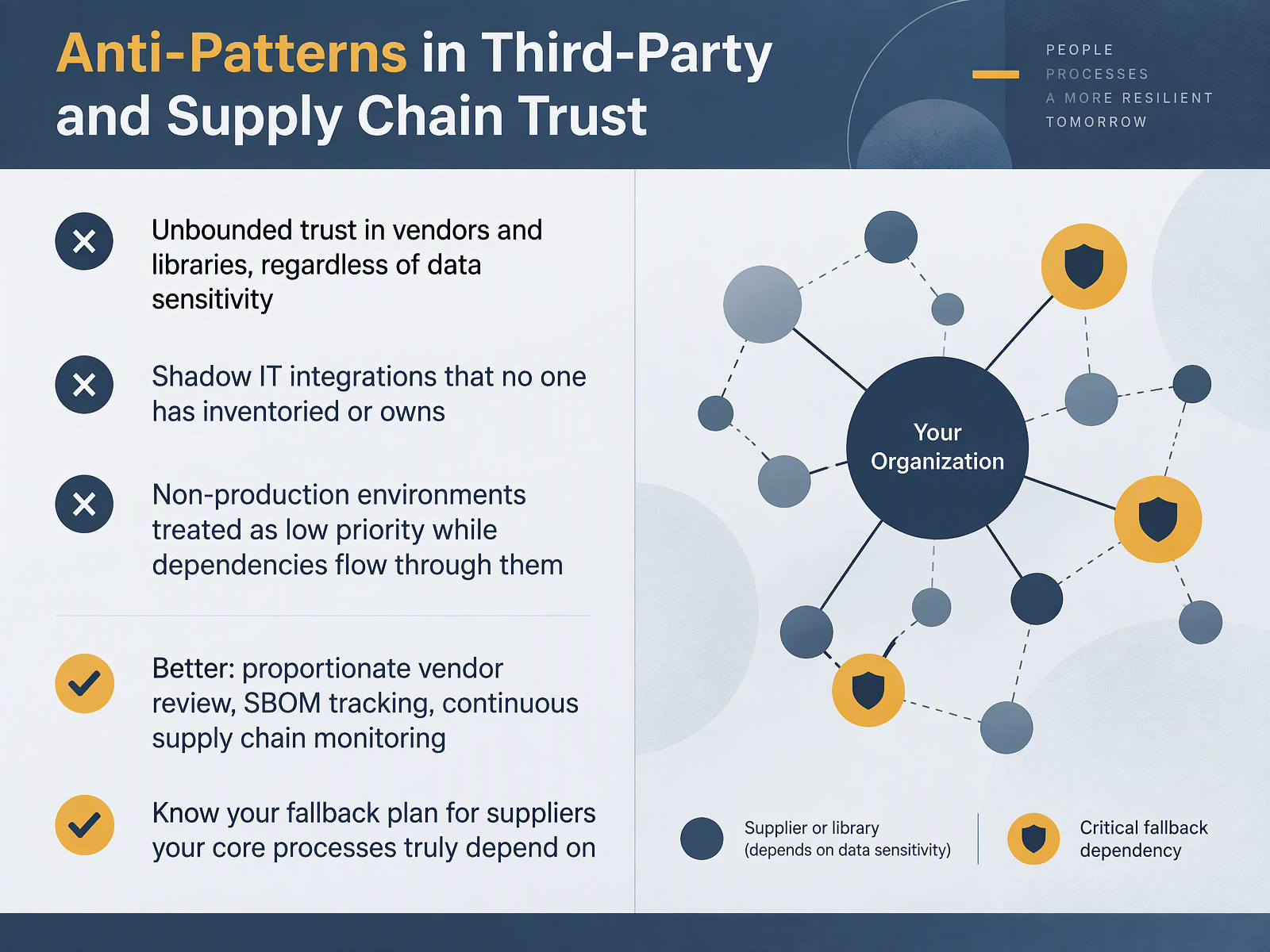 2 min
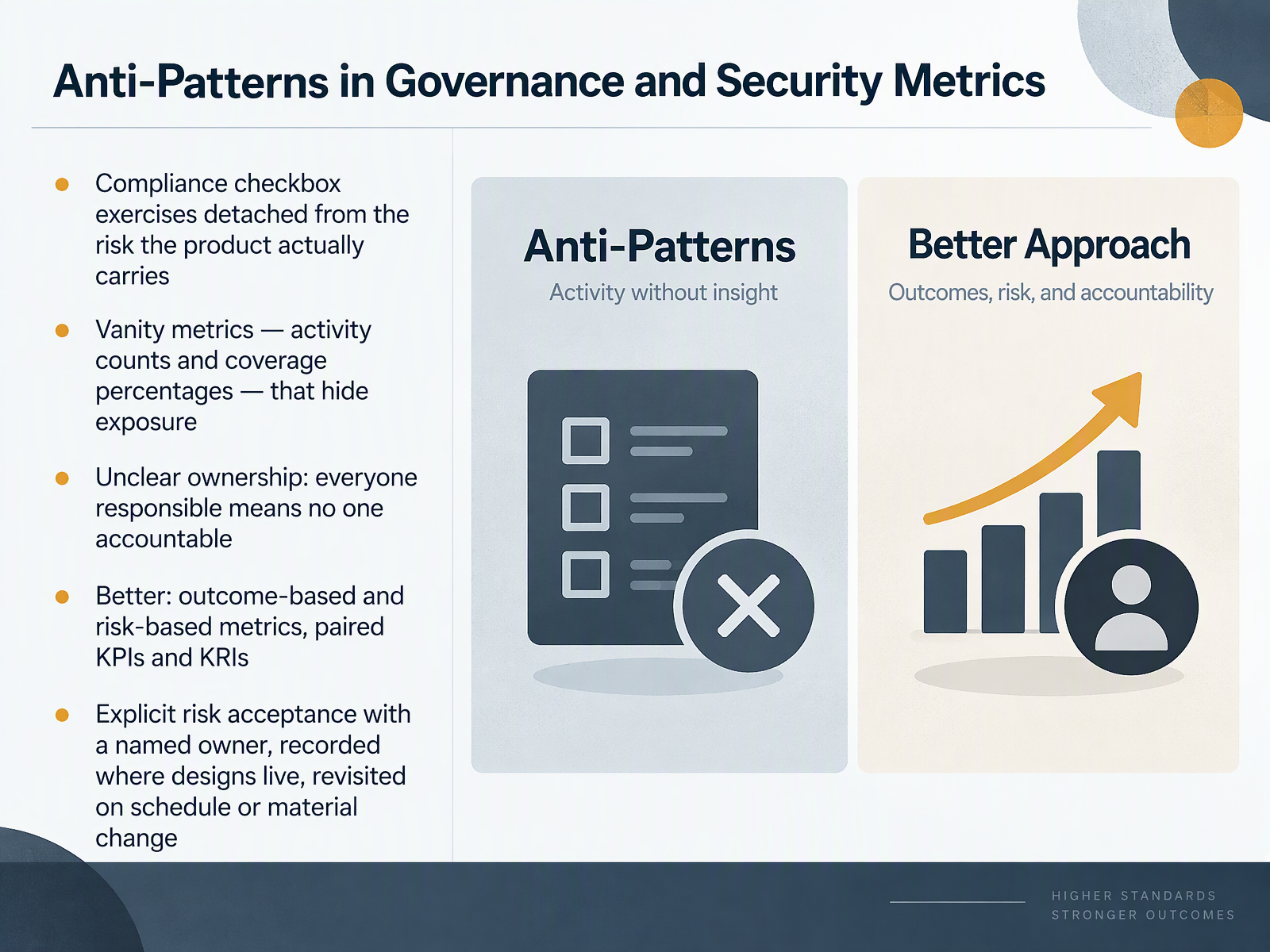
- 09Anti-Patterns in Governance and Security MetricsLet us turn to governance and security metrics, where good intentions often go wrong. First, compliance checkbox exercises detached from the risk your product actually carries. What it looks like: a team marks a framework item complete, but nothing about exposure changes. What to do instead: tie each control to a named risk and an expected reduction in that risk. Second, vanity metrics. Activity counts and coverage percentages feel good, but they can hide exposure. A coverage percentage should never buy permission to ignore a critical uncovered dependency. Third, unclear ownership. When everyone is responsible, no one is accountable. Better: outcome-based and risk-based metrics, pairing key performance indicators with key risk indicators. And record explicit risk acceptance with a named owner, where designs live, revisited on schedule or on material change. Here is your takeaway for the next team discussion: ask which metric changed a decision, and who owns the risk if it did not. Next, we move from anti-pattern to alternative, with a repeatable playbook.
 nacdonline.orgccb.belgium.benvlpubs.nist.gov+22 min
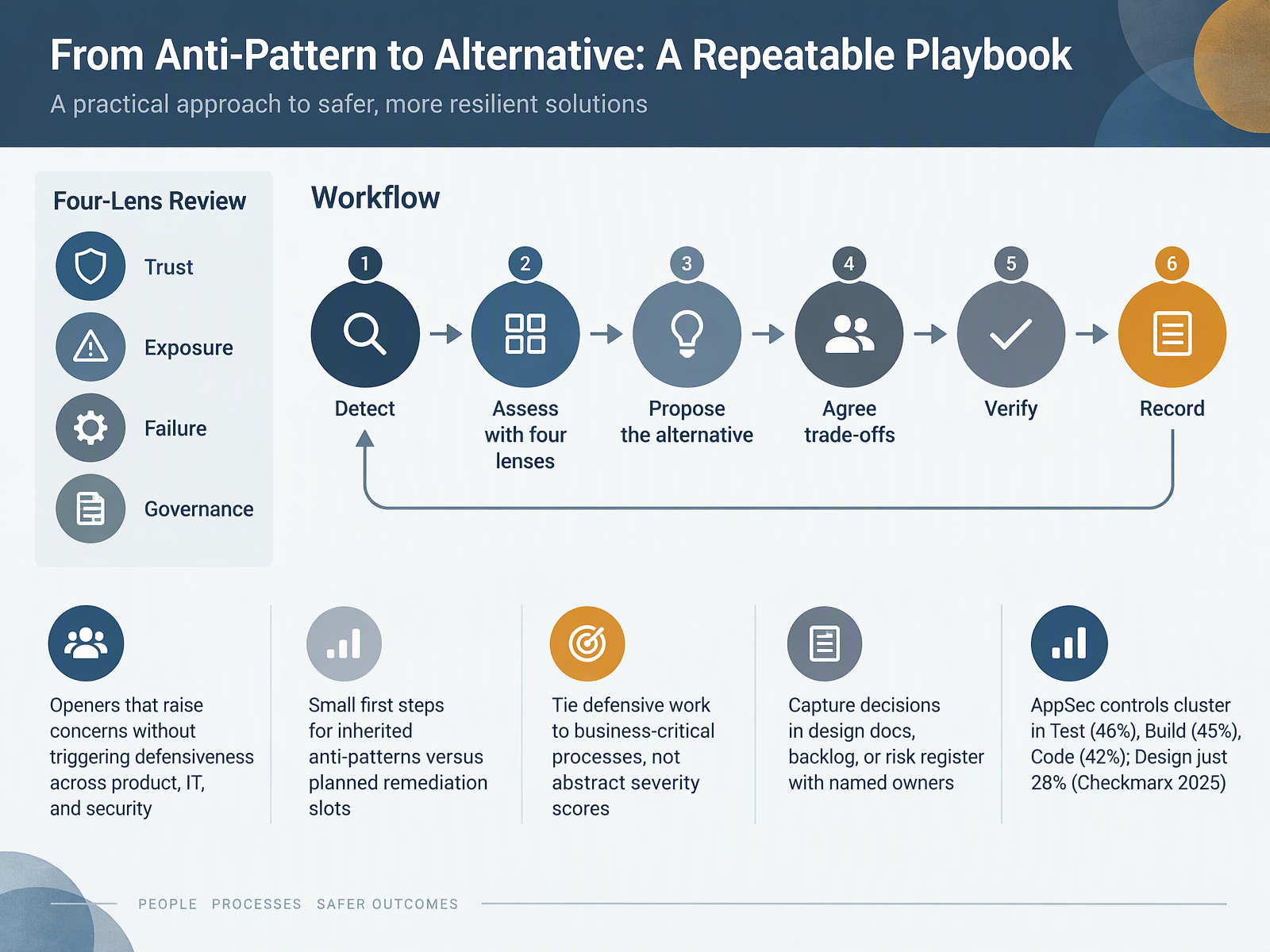
- 10From Anti-Pattern to Alternative: A Repeatable PlaybookHere is a repeatable way to move from anti-pattern to alternative. The workflow runs in six steps: detect the issue, assess it through four lenses, propose an alternative, agree the trade-offs, verify the result, and record the decision. Open the conversation in a way that raises the concern without triggering defensiveness. Try: 'I want us to look at this together,' rather than 'this is wrong.' What it looks like: a workshop that opens with blame. What to do instead: open with a shared question. For inherited anti-patterns, start small and time-boxed. For planned remediation, reserve a slot in the sprint. Tie the work to business-critical processes, not abstract severity scores. Capture decisions in the design doc, backlog, or risk register, with a named owner. AppSec controls cluster in Test at forty-six percent, Build at forty-five, and Code at forty-two. Design sits at just twenty-eight percent, from Checkmarx twenty twenty-five. That gap is where the design lens earns its place. Takeaway: bring one inherited anti-pattern to your next team discussion, and agree a small first step with a named owner. Next, we will put this into practice in the workshop: Spot the Anti-Pattern.
 assets.hacken.iosecuritycompass.comdlt.com+22 min
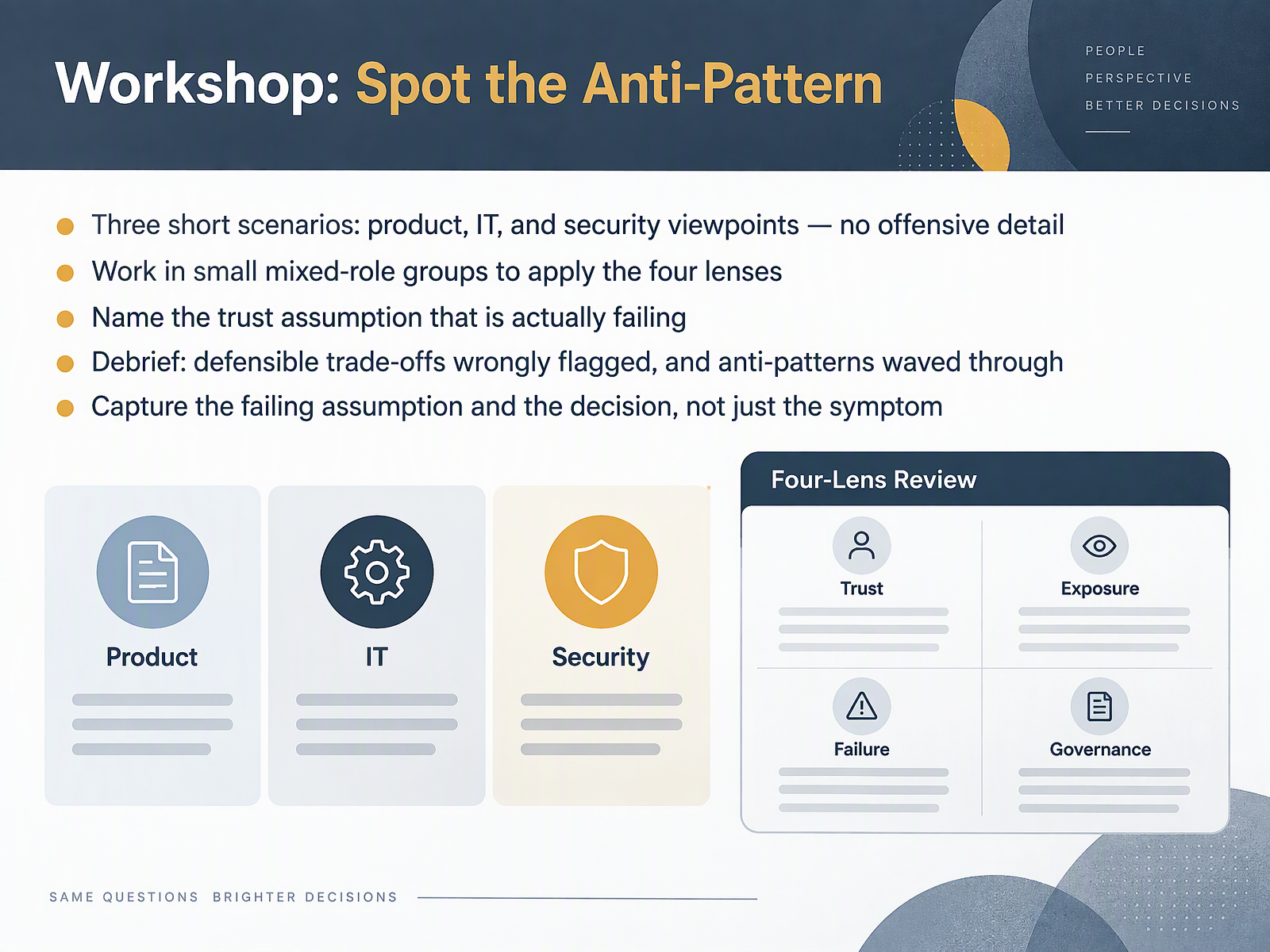
- 11Workshop: Spot the Anti-PatternLet's put the four lenses to work. Here you have three short scenarios, one from product, one from IT, and one from security. They stay conceptual, with no offensive detail. In small mixed-role groups, apply the four lenses to each one. Your goal is to name the trust assumption that is actually failing. What it looks like: someone blames the symptom, such as noisy alerts or logs missing a field. What to do instead: trace back to the assumption underneath, like trusting that production defaults stay secure. During the debrief, we look at two things. Which defensible trade-offs were wrongly flagged? And which anti-patterns did we wave through? Capture the failing assumption and the decision, not just the symptom. That record is what your next review meeting can actually use. Takeaway: before you judge a scenario, write one sentence naming the assumption you believe it rests on. Next, we choose the alternative and name the trade-off.
 cheatsheetseries.owasp.orgdevguide.owasp.orgmas.owasp.org+21 min
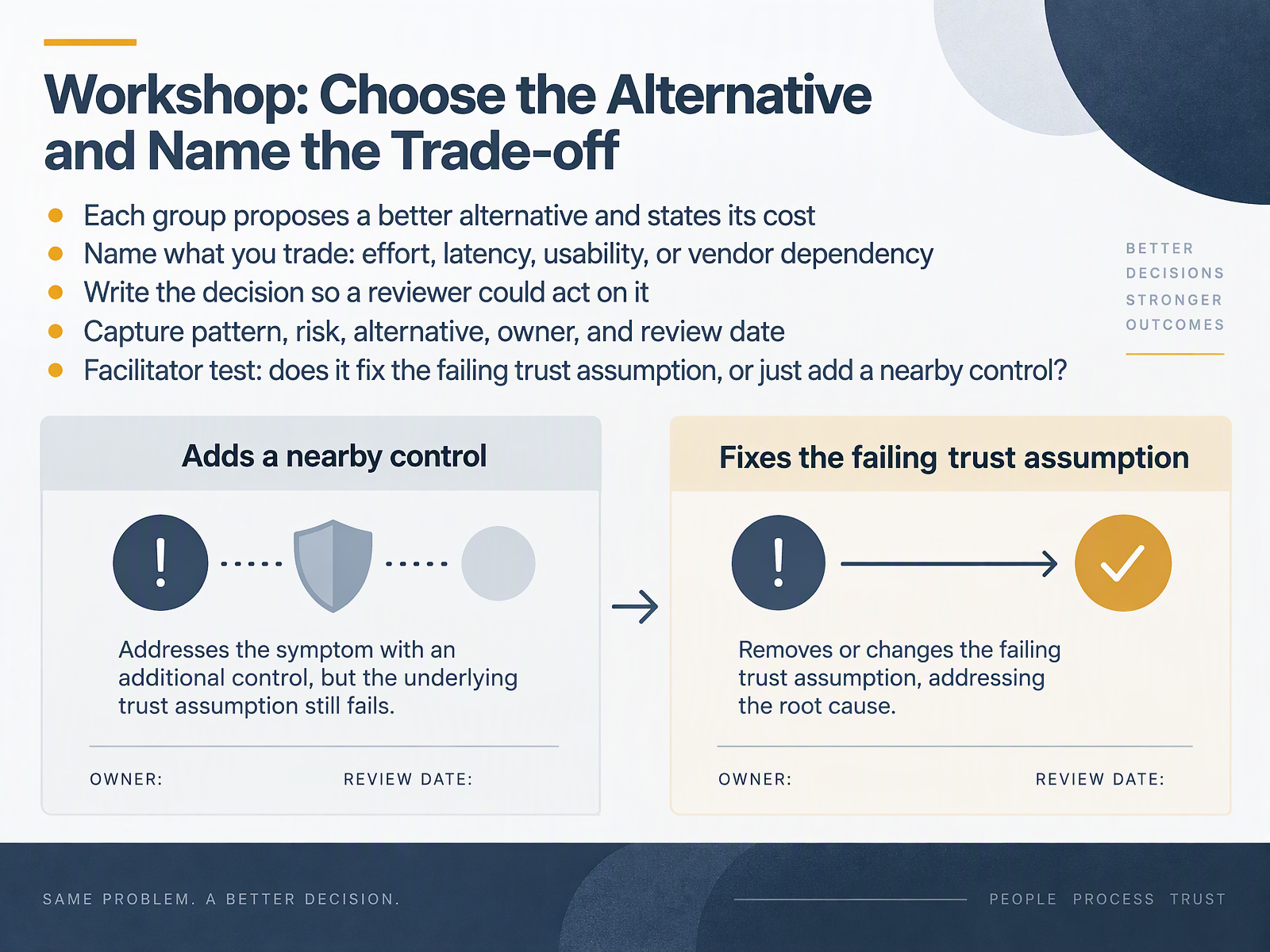
- 12Workshop: Choose the Alternative and Name the Trade-offNow let's put that into practice. In each group, propose a better alternative and state its cost. Name the trade you are making: effort, latency, usability, or vendor dependency. Write the decision so a reviewer could act on it. Capture five things: the pattern, the risk, the alternative, the owner, and the review date. Here is the facilitator test. Does your proposal fix the failing trust assumption, or does it just add a nearby control? That distinction matters. A nearby control can look reassuring while the original assumption still fails. What it looks like is a new dashboard next to an unverified dependency. What to do instead is name the assumption, state the alternative, and accept the cost in writing. Takeaway: before your next review meeting, write one decision in that five-part format and test it against the trust assumption. Next, we look at role-specific blind spots to watch.
 assets.hacken.iosecuritycompass.comdlt.com+22 min
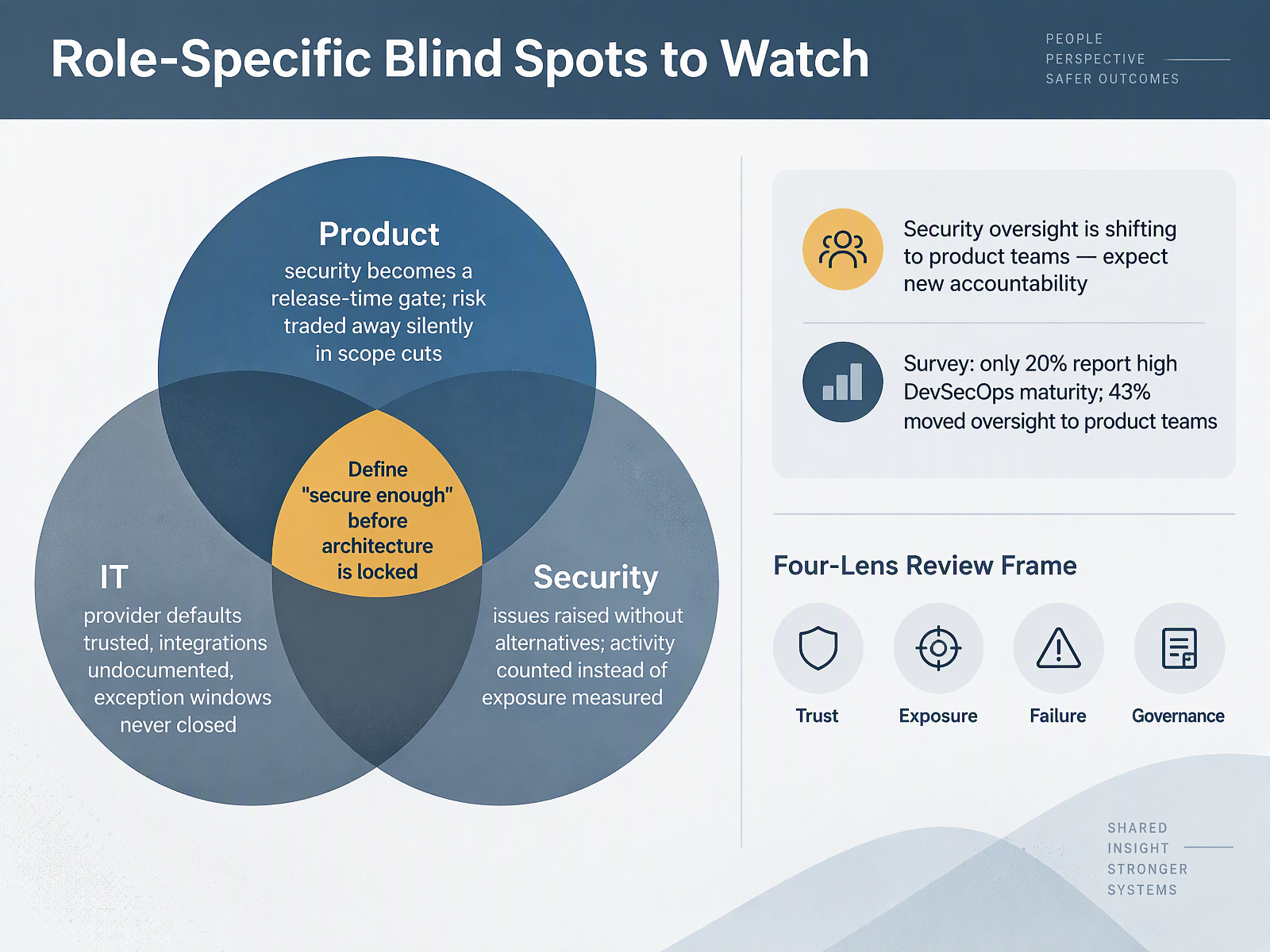
- 13Role-Specific Blind Spots to WatchLet's talk about blind spots by role. Product often treats security as a release-time gate, and risk gets traded away silently in scope cuts. What it looks like: a security review pulled into the last sprint. What to do instead: define "secure enough" before architecture is locked, and record any risk you accept. IT tends to trust provider defaults, leave integrations undocumented, and keep exception windows open. Those are governance decisions you can see in your backlog. Security has its own blind spot: raising issues without alternatives, and counting activity instead of exposure measured. This matters more now, because oversight is shifting to product teams. In one survey, only twenty percent reported high DevSecOps maturity, while forty-three percent moved oversight to product teams. The takeaway: agree on "secure enough" in your next team discussion. That sets up the next part, Commitments and Next Steps.
 assets.hacken.iosecuritycompass.comdlt.com+22 min
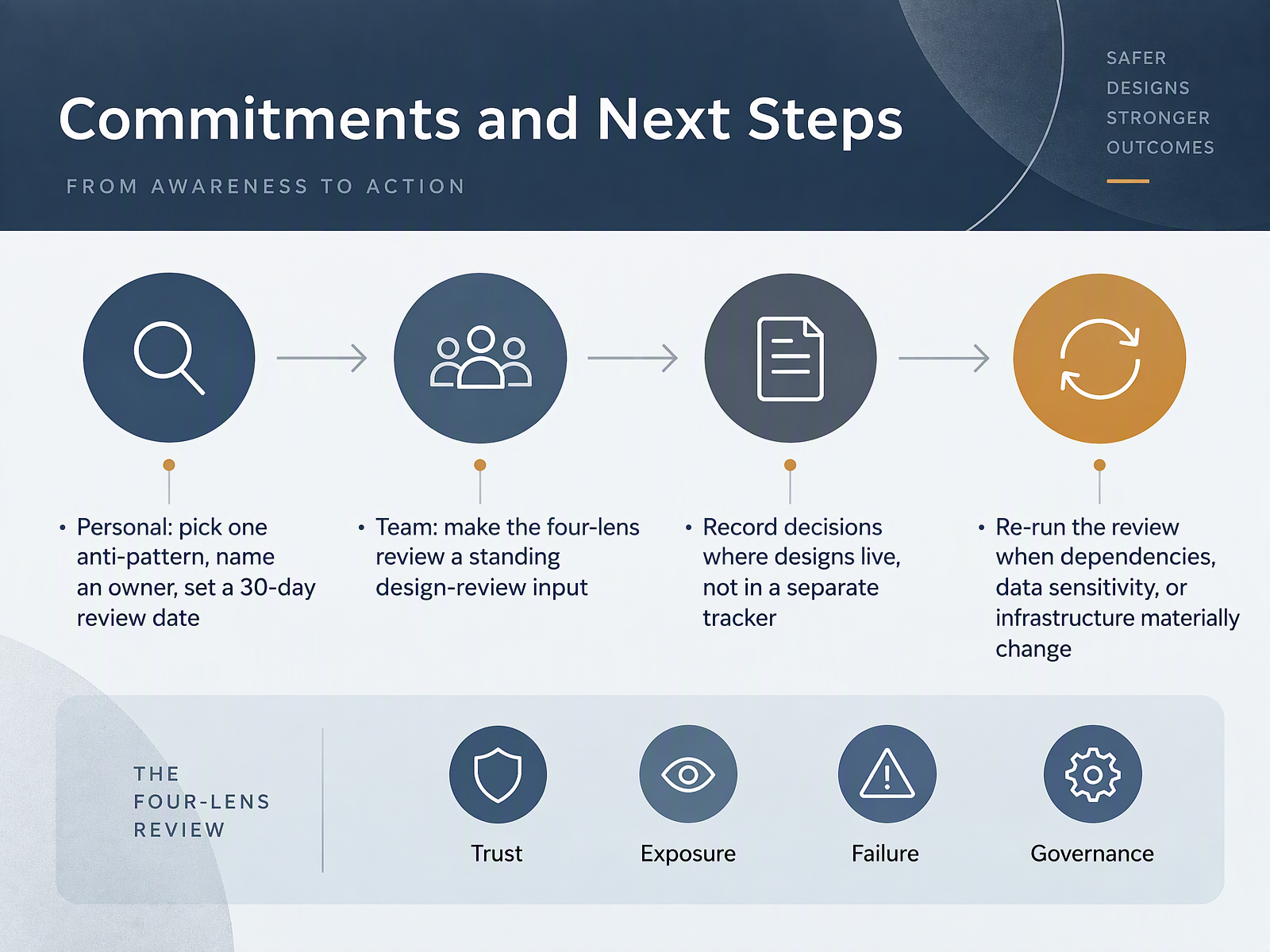
- 14Commitments and Next StepsLet's close by turning everything into commitments you can actually keep. Start personally. Pick one anti-pattern you saw today. Name a single owner for it. Then set a review date thirty days out. That one date turns a good intention into a decision with a deadline. Next, at team level, make the four-lens review a standing input to design review. Not a one-time workshop. A regular agenda item with a home. Record those decisions where your designs already live. A separate tracker quietly drifts out of date, and the design record becomes the source of truth people actually read. Finally, re-run the review when dependencies, data sensitivity, or infrastructure materially change. Those changes shift risk, and a stale review gives false comfort. So here is your takeaway. Pick one anti-pattern this week, name the owner, set the date, and write it down where the design lives. Thank you for your attention today. You now have practical habits to carry into your next team discussion. Go make one small, durable improvement.
 assets.hacken.iosecuritycompass.comdlt.com+22 min
Take the deck with you
Download this course as a file — free, no sign-up needed.
- PDF handoutEvery slide page, ready to print or share.15 pages · 3.3 MBDownload
- Narrated PowerPointThe deck that presents itself — every slide carries the digital human's narration video.15 pages · 13.8 MBDownload
- PowerPoint slidesThe full deck as a .pptx — open it in PowerPoint, Keynote, or Google Slides.15 pages · 3.2 MBDownload
Free to use in your own training — please keep the PersonWise credit page at the end.
Have your own deck? Turn it into a course
Sources consulted
Web sources consulted while building this course.
- Survey — assets.hacken.io
- The State of Security by Design and Threat Modeling in 2025 — securitycompass.com
- A CISO’s Guide — dlt.com
- Global Checkmarx Research Finds Nearly Half of Development Teams “Own” AppSec — checkmarx.com
- PRIORITIZE, PROTECT, PROVE — veracode.com
- Board-Level Cybersecurity Metrics | NACD — nacdonline.org
- Reporting Cyber Risk to Boards — ccb.belgium.be
- NIST Cybersecurity Framework 2.0: Cybersecurity, Enterprise Risk Management, and Workforce Management Quick-Start Guide — nvlpubs.nist.gov
- Staging Cybersecurity Risks for Enterprise Risk Management and Governance Oversight — nvlpubs.nist.gov
- IR 8286C Rev. 1, Staging Cybersecurity Risks for Enterprise Risk Management and Governance Oversight | CSRC — csrc.nist.gov
- NIST SP 800-63-4: Digital Identity Guidelines | NIST — nist.gov
- SP 800-63-4, Digital Identity Guidelines | CSRC — csrc.nist.gov
- SP 1800-35, Implementing a Zero Trust Architecture: High-Level Document | CSRC — csrc.nist.gov
- Identity and access management | NIST — nist.gov
- Digital Identity Guidelines — nvlpubs.nist.gov
- Logging - OWASP Cheat Sheet Series — cheatsheetseries.owasp.org
- Implement Security Logging and Monitoring - OWASP Developer Guide — devguide.owasp.org
- MASTG-BEST-0022: Disable Verbose and Debug Logging in Production Builds - OWASP Mobile Application Security — mas.owasp.org
- C9: Implement Security Logging and Monitoring — top10proactive.owasp.org
- Handling sensitive data | OpenTelemetry — opentelemetry.io