Scientific Thinking Fundamentals
Begin
16 pages · ~32 min
Scientific Thinking Fundamentals
This training teaches learners how to formulate scientific questions, evaluate evidence, and use models to explain natural phenomena.
What you’ll learn
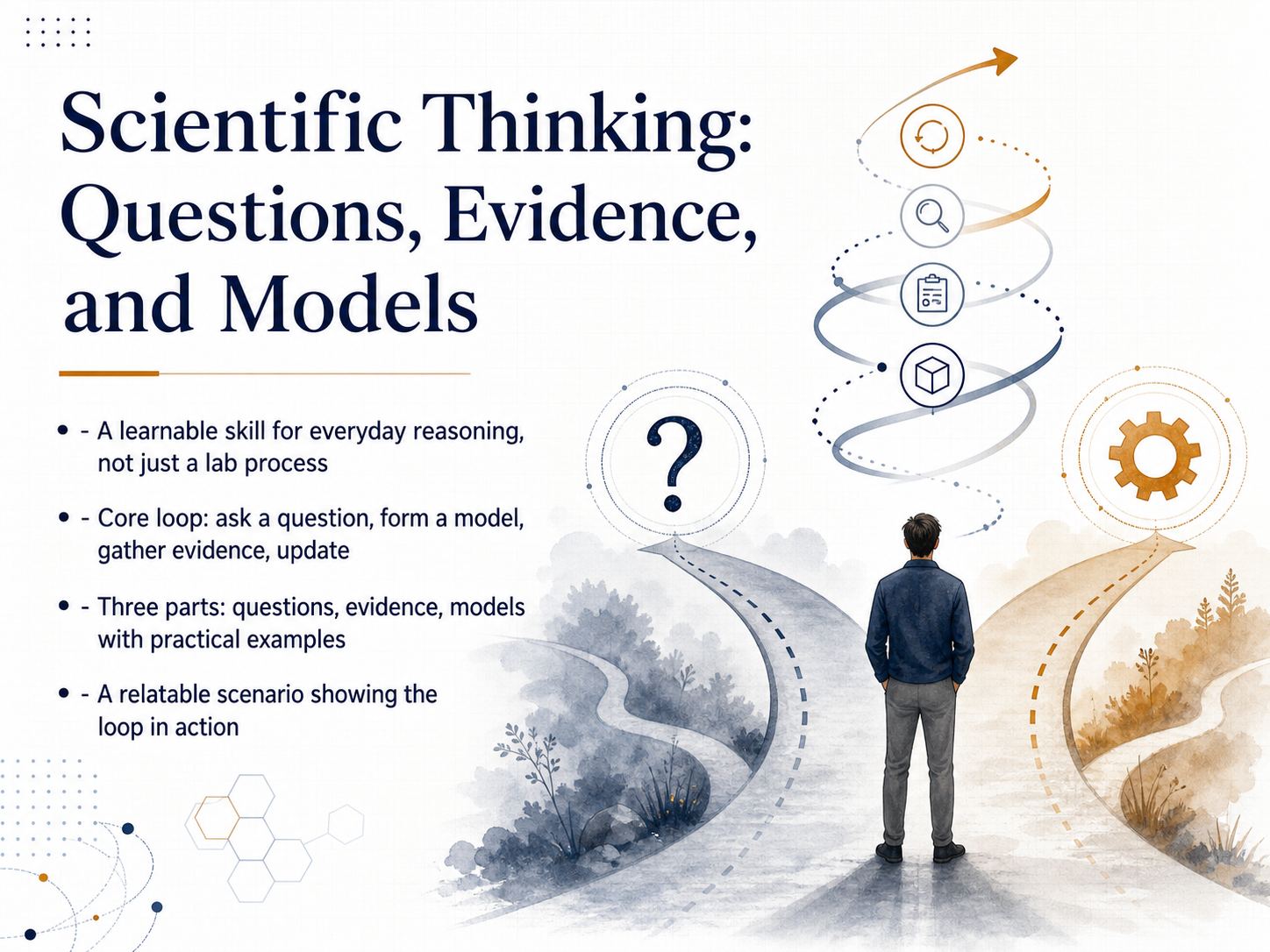
- 01Scientific Thinking: Questions, Evidence, and ModelsWelcome. I’m glad you’re here. This course is about scientific thinking, but not the version you might remember from a lab coat and a clipboard. We’re talking about a practical skill for everyday reasoning. A way to make better decisions when information is messy or incomplete. At its heart, it’s a simple loop. You ask a clear question, you form a working model—your best explanation, you gather evidence to test it, and then you update your thinking. That’s it. We’ll break this down into three core parts: how to ask sharper questions, how to seek and interpret evidence, and how to build models that actually help. We’ll use real, relatable examples, not abstract theories. And in just a moment, we’ll walk through a familiar scenario to see the whole loop in action. For now, let’s start by defining what scientific thinking really looks like as a life skill.2 min
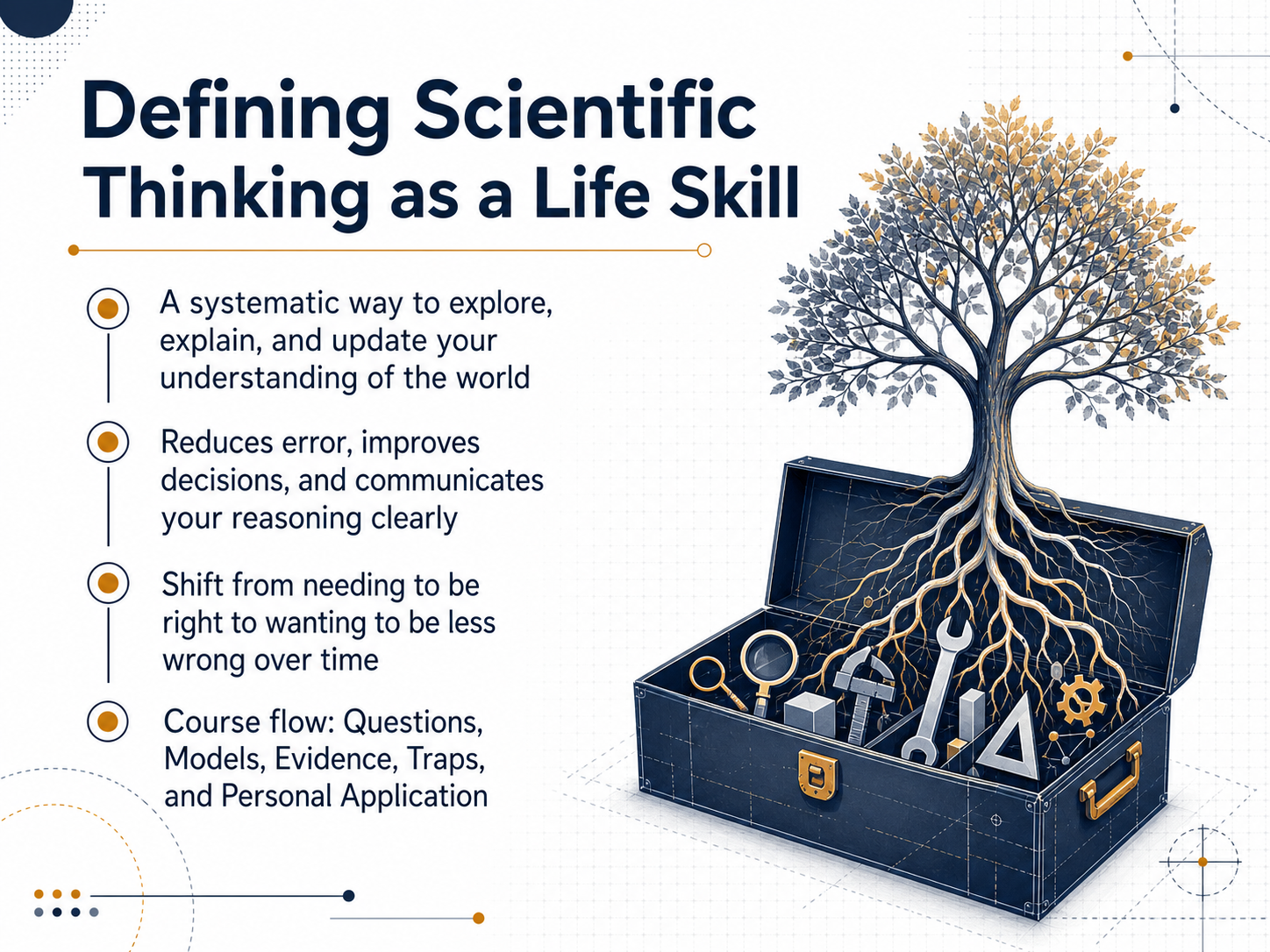
- 02Defining Scientific Thinking as a Life SkillSo, let's step back and define what we're really talking about. Scientific thinking isn't just for labs or people in white coats. It's a life skill. Think of it as a systematic way to explore, explain, and update how you understand the world. It's a set of habits that reduces errors and helps you make better decisions. More than that, it helps you communicate your reasoning clearly so others can see exactly how you got there. The real shift here is moving from a need to be right all the time, to wanting to be less wrong over time. That's a powerful mindset. We'll build this skill over the next few sections. We'll start with how to ask better questions, then build models, test them with evidence, watch out for common traps, and finally, we'll apply it all to your own life. Let's get started with the engine that drives all of this. Up next: what makes a question truly scientific.
 1 min
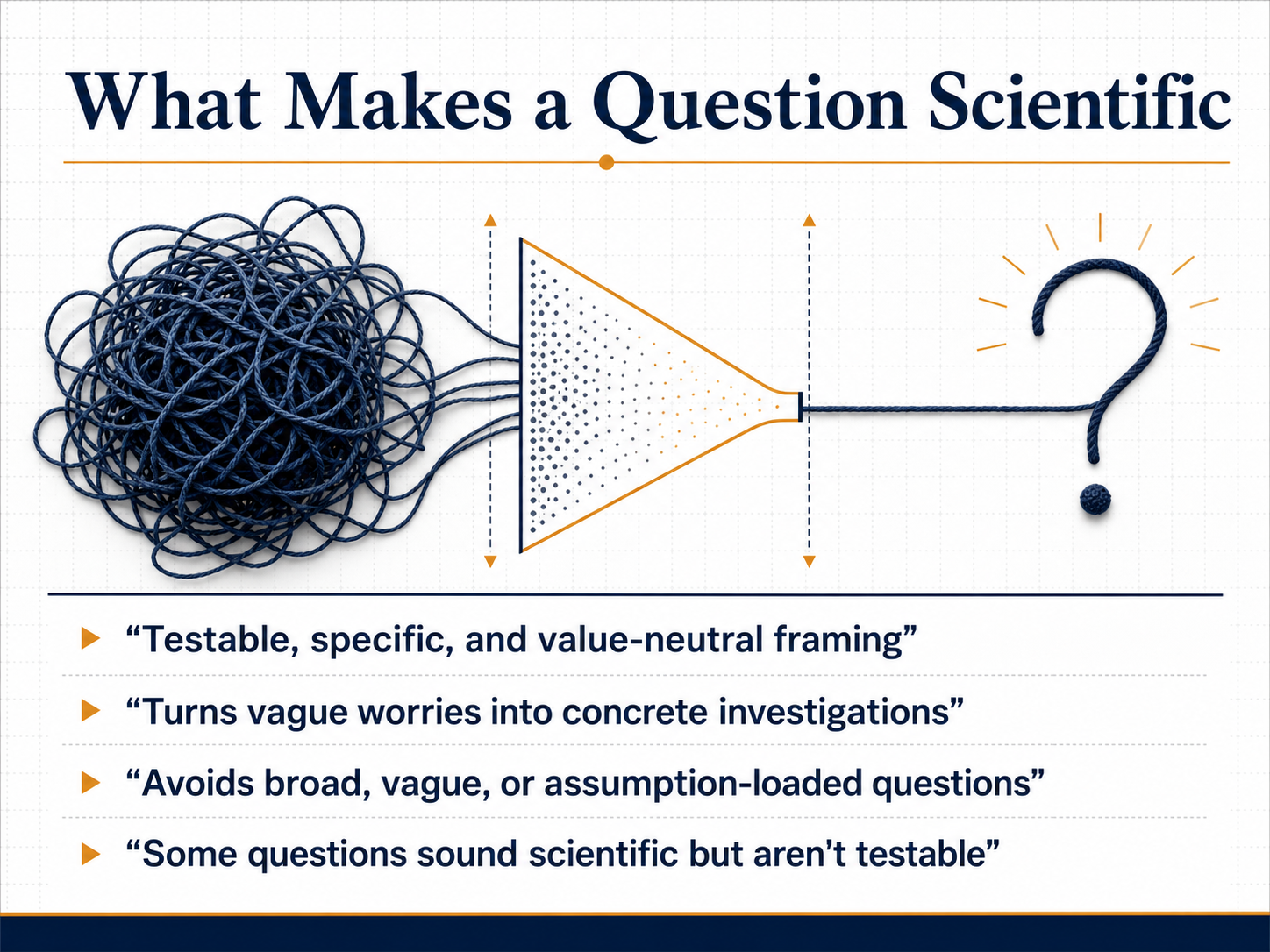
1 min - 03What Makes a Question ScientificSo what actually makes a question scientific? Three things really matter. First, it has to be testable. You need to be able to gather evidence that could support or challenge it. Second, it's specific. A scientific question points to something you can observe or measure, not just a vague feeling. And third, it's value-neutral. It asks what is, not what should be. Think of it this way. A vague worry like 'Why is our process so broken?' is hard to test. But turn it into 'Does adding step X increase errors by more than five percent?' and suddenly you have a concrete investigation. Watch out for questions that sound scientific but aren't. 'Is this the best approach?' carries a hidden assumption. 'What caused the universe to exist?' is a profound question, but it's not testable in a hands-on way. When you frame a question, ask yourself: Can I design a test for this? If the answer is no, it might be a great question, but it's not a scientific one. Now, once you have a solid question, you need a way to organize your thinking. That's where models come in. Let's talk about moving from implicit intuition to explicit models.
 1 min
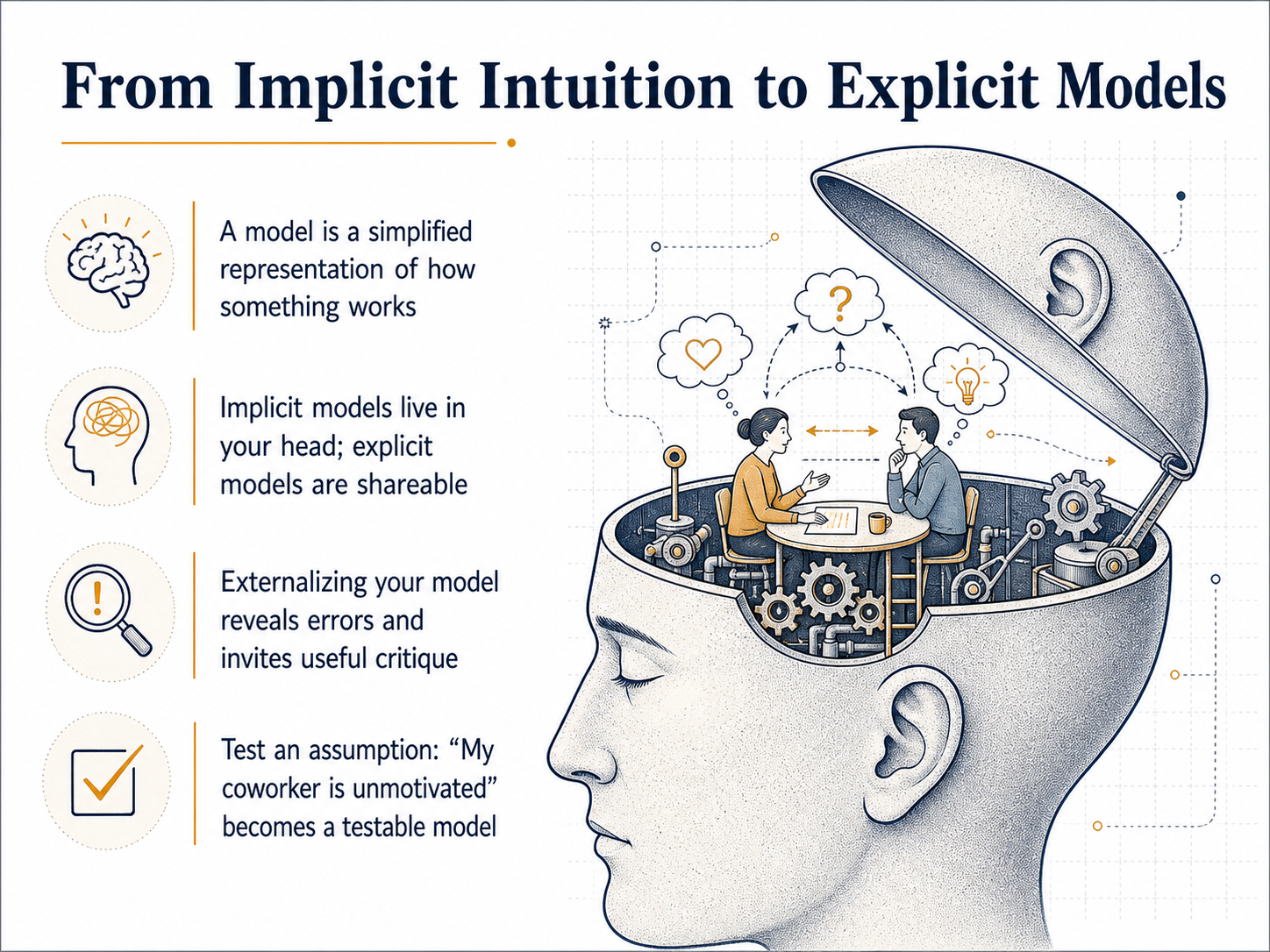
1 min - 04From Implicit Intuition to Explicit ModelsWe all carry models around in our heads. A model is just a simplified picture of how something works. It's your brain's shortcut for making sense of the world. The trouble is, when a model stays locked inside your head, it's invisible. No one can check it, not even you. So let's make it visible. Take an implicit thought and turn it into an explicit, shareable model. This simple act does two powerful things. It reveals hidden errors in your own thinking. And it invites useful critique from others. Here's a quick test. Think of a thought like, 'My coworker is unmotivated.' That's a fuzzy, internal judgment. But we can externalize it. Write it down. What would you expect to see if that were true? Maybe they miss deadlines or avoid taking on new tasks. Now you have a testable model. You can look for evidence for or against it. Making your thinking explicit is the first step toward thinking scientifically. Next, we'll look at three simple model types you can use every day.
 2 min
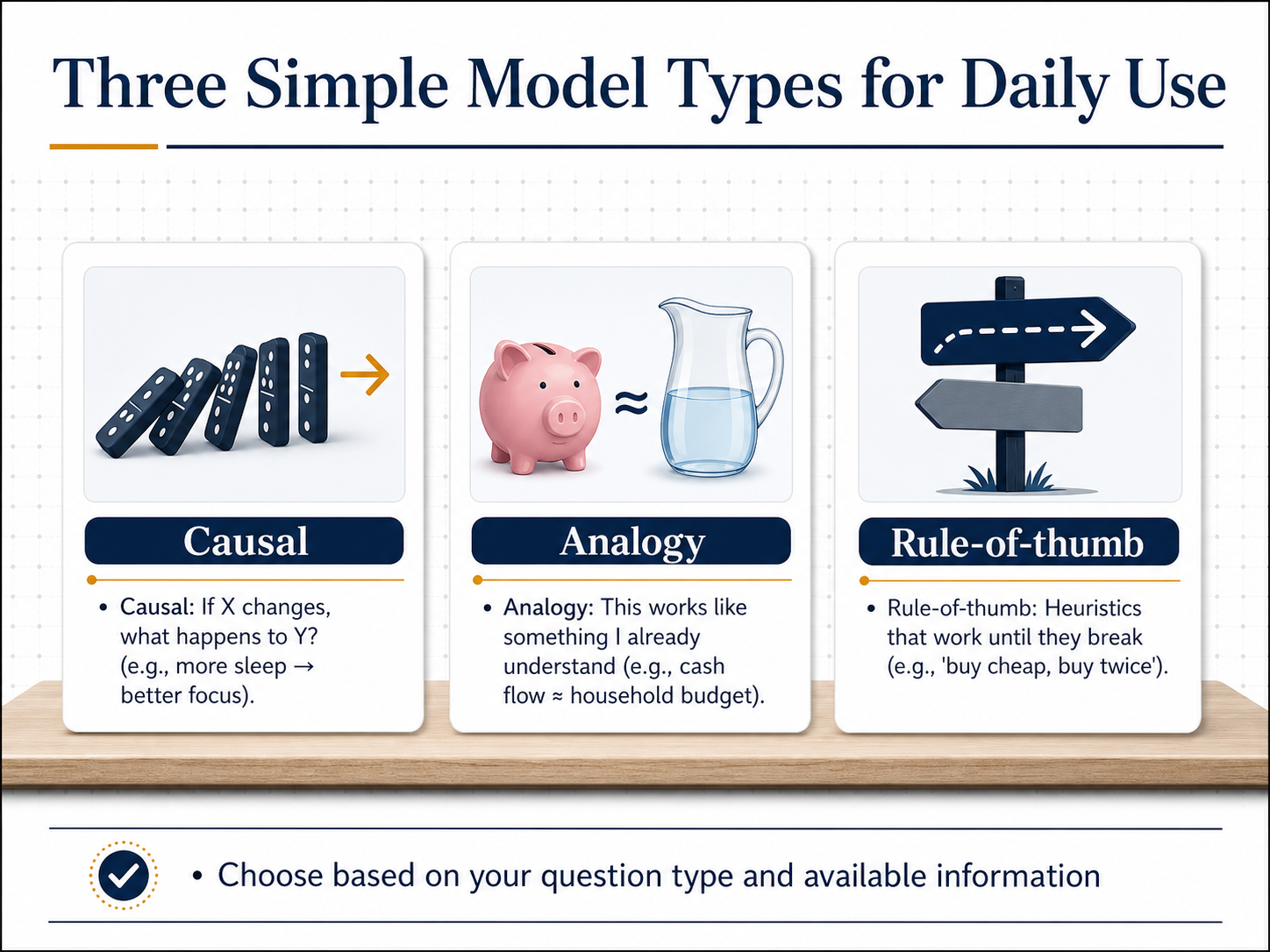
2 min - 05Three Simple Model Types for Daily UseLet's look at three simple model types you can use every day. First, causal models. These ask: if X changes, what happens to Y? More sleep might lead to better focus. It's a straightforward cause-and-effect check. Second, analogy models. This works like something you already understand. Think of cash flow as being like a household budget. You map the unfamiliar onto the familiar. Third, rule-of-thumb models. These are heuristics that work until they break. 'Buy cheap, buy twice' is a classic one. It's usually true, until you find that rare bargain. Choose the model type based on your question and the information you have. Want to understand why something happened? Start with causal. Facing something completely new? Build an analogy. Need a quick, practical guide? Use a rule of thumb. Now, once you have a model, you need to test it. That brings us to our next topic: evidence, what counts and why.
 1 min
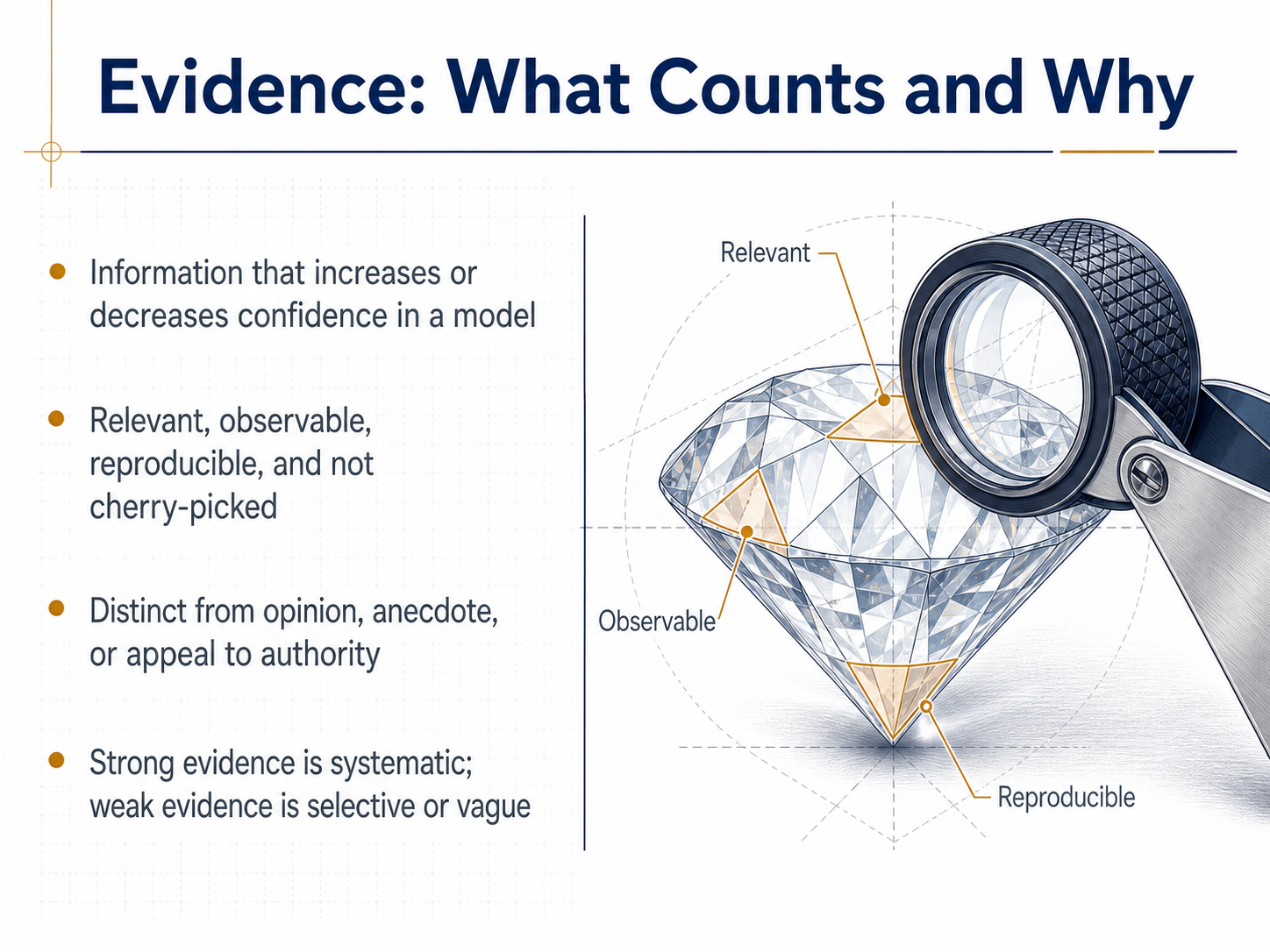
1 min - 06Evidence: What Counts and WhyLet's talk about evidence. In a scientific thinking model, evidence is simply information that either increases or decreases your confidence in an explanation. It's the feedback loop that tells you whether you're on the right track. But not all information is created equal. To count as good evidence, it needs to be a few things. First, it must be relevant to the model you're testing. Second, it should be observable and reproducible—meaning someone else could see the same thing if they looked. And third, it cannot be cherry-picked. You have to consider all the data, not just the parts that agree with you. This is what separates evidence from opinion, anecdote, or simply trusting an authority figure. Strong evidence is systematic. It comes from a structured process. Weak evidence is often selective or vague. It's a story that feels right, rather than a pattern you can actually verify. So, how do you apply this in practice? That's what we'll look at next, when we cover gathering evidence in everyday life.
 2 min
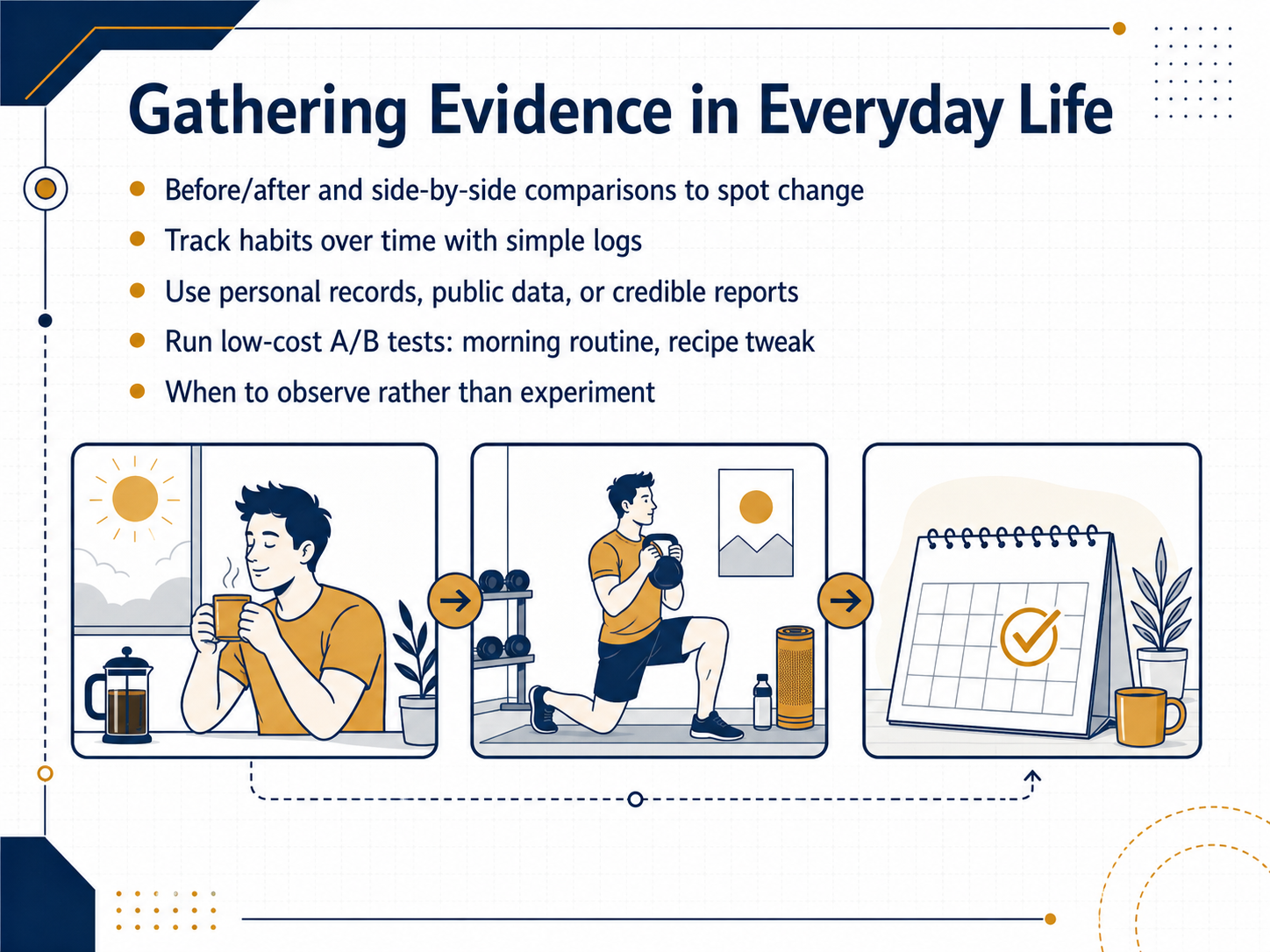
2 min - 07Gathering Evidence in Everyday LifeLet's move from questioning to gathering evidence. The good news is you're already doing this. Every time you compare something, you're collecting data. Think of before-and-after photos, or a side-by-side taste test of two coffee beans. That's direct comparison, and it's a powerful way to spot change. To understand patterns, start tracking a habit over time. A simple log works wonders. Just jot down your energy level at three in the afternoon for a week. You'll see a trend. You can also tap into information you already have: personal records, public data sets, or a credible news report. And you can run your own low-cost tests. We call these A/B tests. Change one thing in your morning routine and see what happens. Or tweak a single ingredient in a recipe. The key is isolating one variable. Now, there are times when you should observe, not experiment. If you're studying a complex system you can't control, like team dynamics in a meeting, just watch and take notes. So, you have a full toolkit: compare, track, test, and observe. Next, let's talk about the crucial step that follows. How do you interpret all this evidence without jumping to conclusions?
 2 min
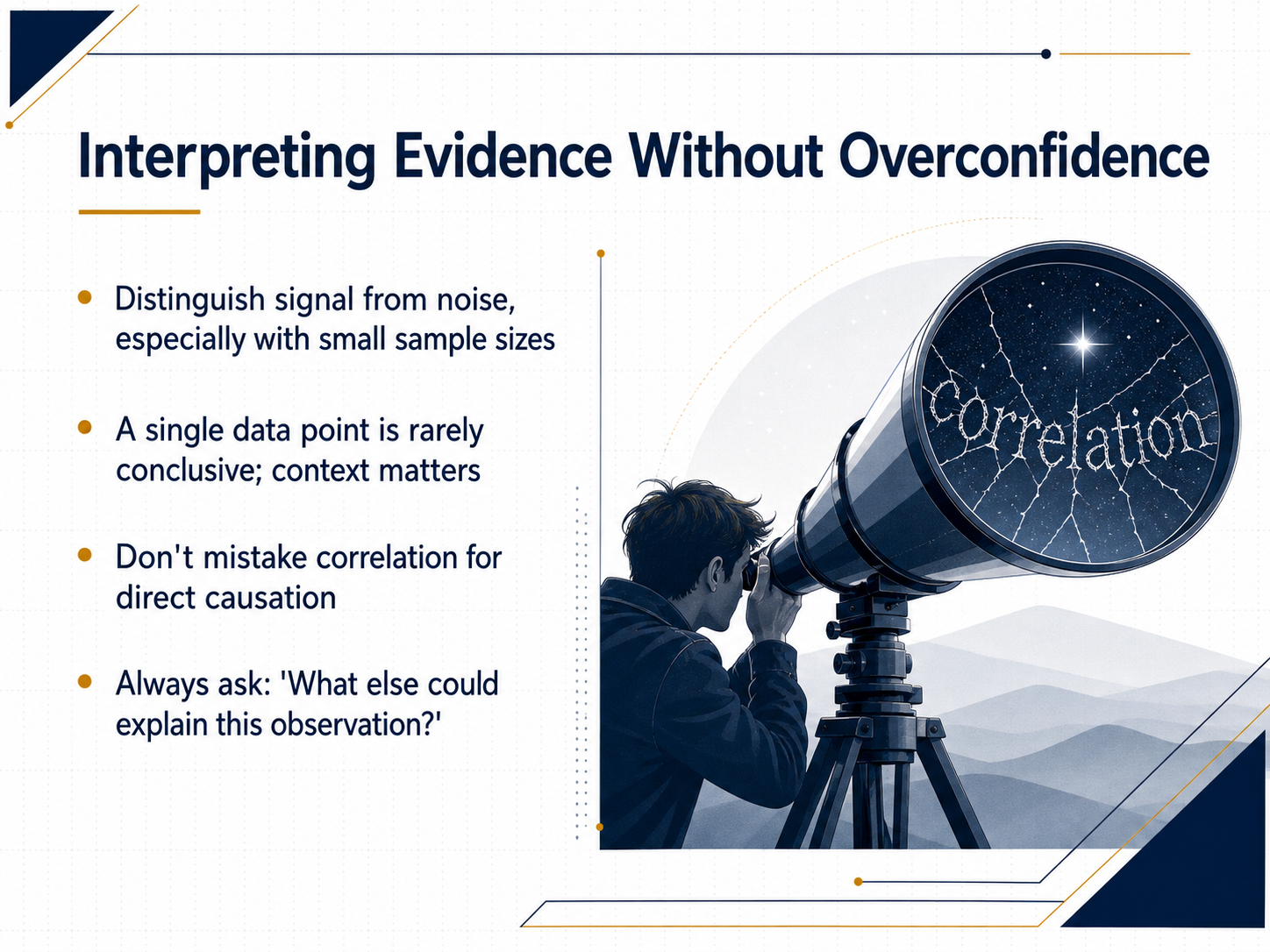
2 min - 08Interpreting Evidence Without OverconfidenceNow, let's talk about a skill that separates good thinkers from great ones: interpreting evidence without getting overconfident. First, learn to distinguish signal from noise, especially when you only have a few data points. A single surprising result can feel like a breakthrough, but with a small sample, it's often just random variation. Don't build a new theory on it. A single data point is rarely conclusive. Context is everything. Ask what happened before, what happened after, and what the normal range looks like. Next, be ruthless about a common trap. Don't mistake correlation for direct causation. Just because two things move together doesn't mean one caused the other. Ice cream sales and sunburn rates both rise in summer, but ice cream doesn't cause sunburn. The shared cause is hot weather. Finally, make this question a reflex: What else could explain this observation? Treat it like a challenge. Try to disprove your own favorite idea before you accept it. If your explanation survives that test, your confidence grows on solid ground. Let's carry this careful mindset forward as we discuss updating your model when evidence surprises you.
 2 min
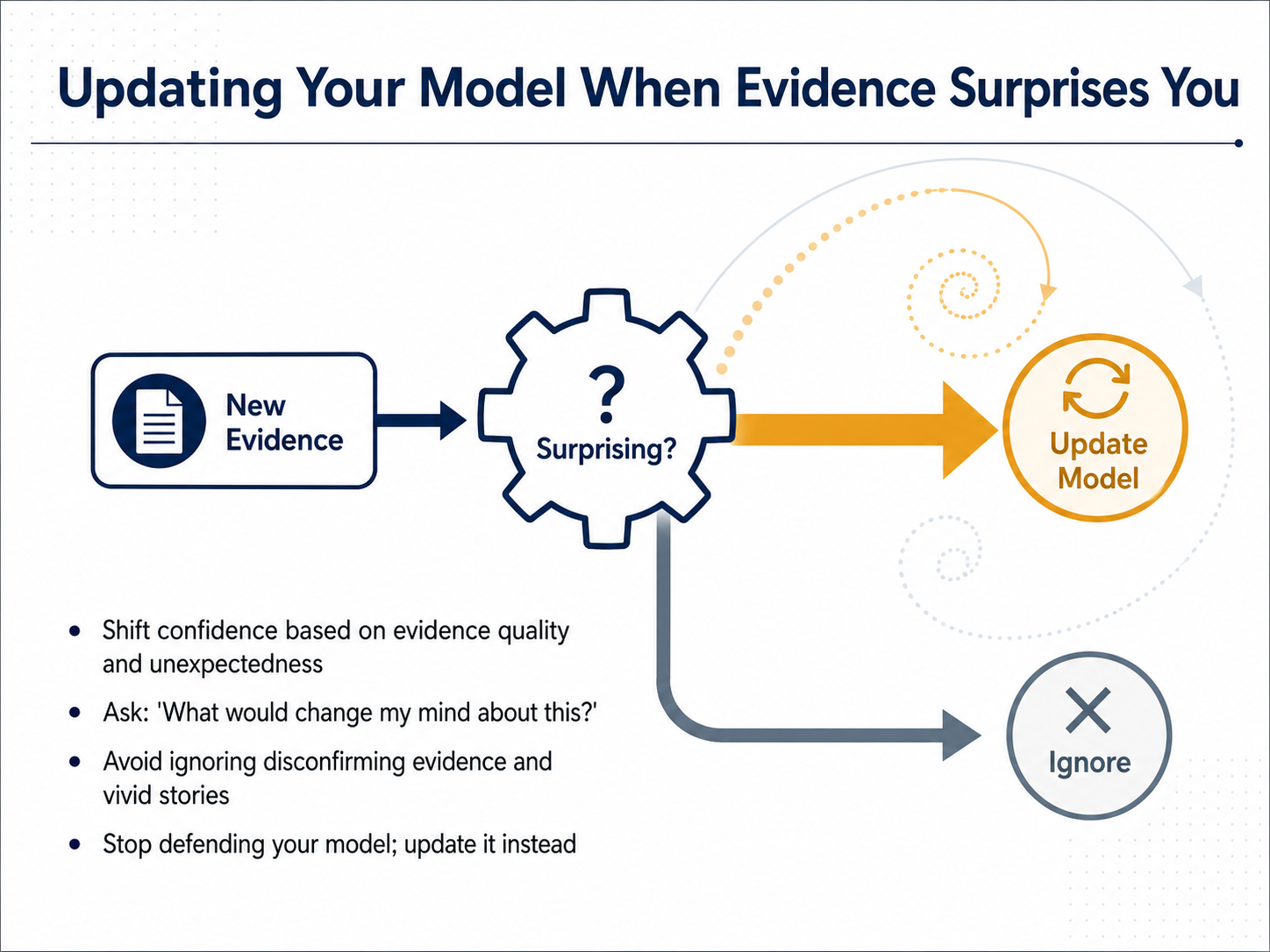
2 min - 09Updating Your Model When Evidence Surprises YouSo what happens when the evidence doesn't match your model? That surprise is actually a gift. It's your signal to update. The key is to shift your confidence based on two things: the quality of the evidence and how unexpected it is. A blurry photo isn't as strong as a controlled experiment. A one-off anomaly might be a fluke, but a pattern of surprises tells you something fundamental is wrong. Get into the habit of asking one question: 'What would change my mind about this?' If you can't answer that, you're not holding a model; you're holding a dogma. Our brains are wired to protect our existing beliefs, so you have to watch out for two traps. First, the urge to ignore or explain away disconfirming evidence. And second, getting seduced by a single, vivid story that feels true but isn't backed by data. Stop defending your model. Your goal isn't to be right; it's to get it right. Update it instead. Next, we'll look at how to spot confirmation bias and its close cousins.
 1 min
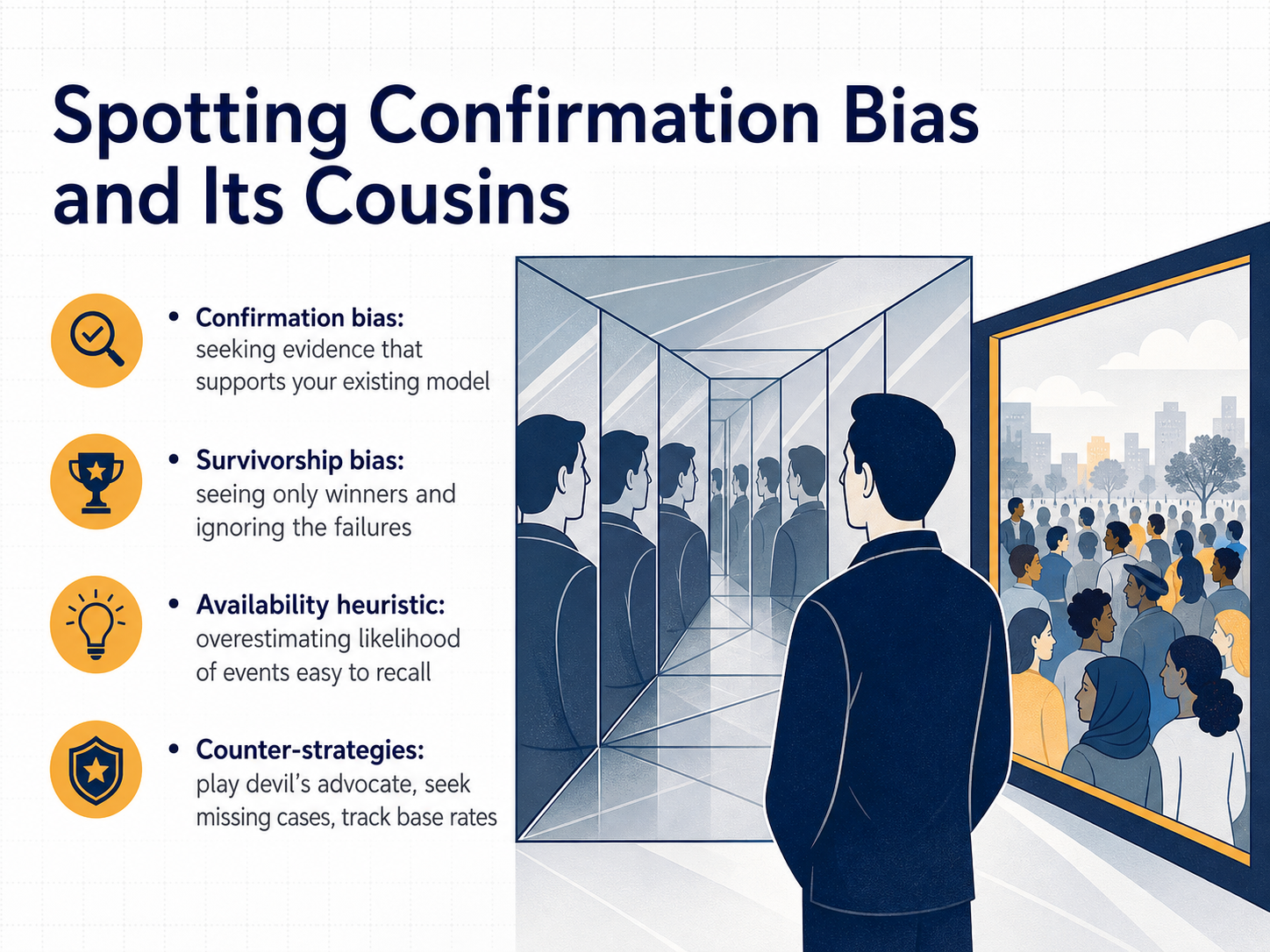
1 min - 10Spotting Confirmation Bias and Its CousinsHere's a truth about the human mind. Our models love to be right. So we tend to look only for evidence that agrees with us. That's confirmation bias. It makes us feel smart while we miss the real picture. Then there's survivorship bias. We study the successful startups, the winning stock picks. But we ignore the thousands that failed silently. The data is incomplete. Availability heuristic is another trick. We overestimate dramatic events, like plane crashes, just because they're easy to remember. Steady, boring risks fly under the radar. To push back, play devil's advocate. Argue against your own favorite idea. Actively seek the missing cases, the failures, the data that isn't memorable. And track base rates. What's the real, underlying probability? These are the tools of honest thinking. Keep them close. Next, we'll tackle a classic mix-up: correlation and causation.
 1 min
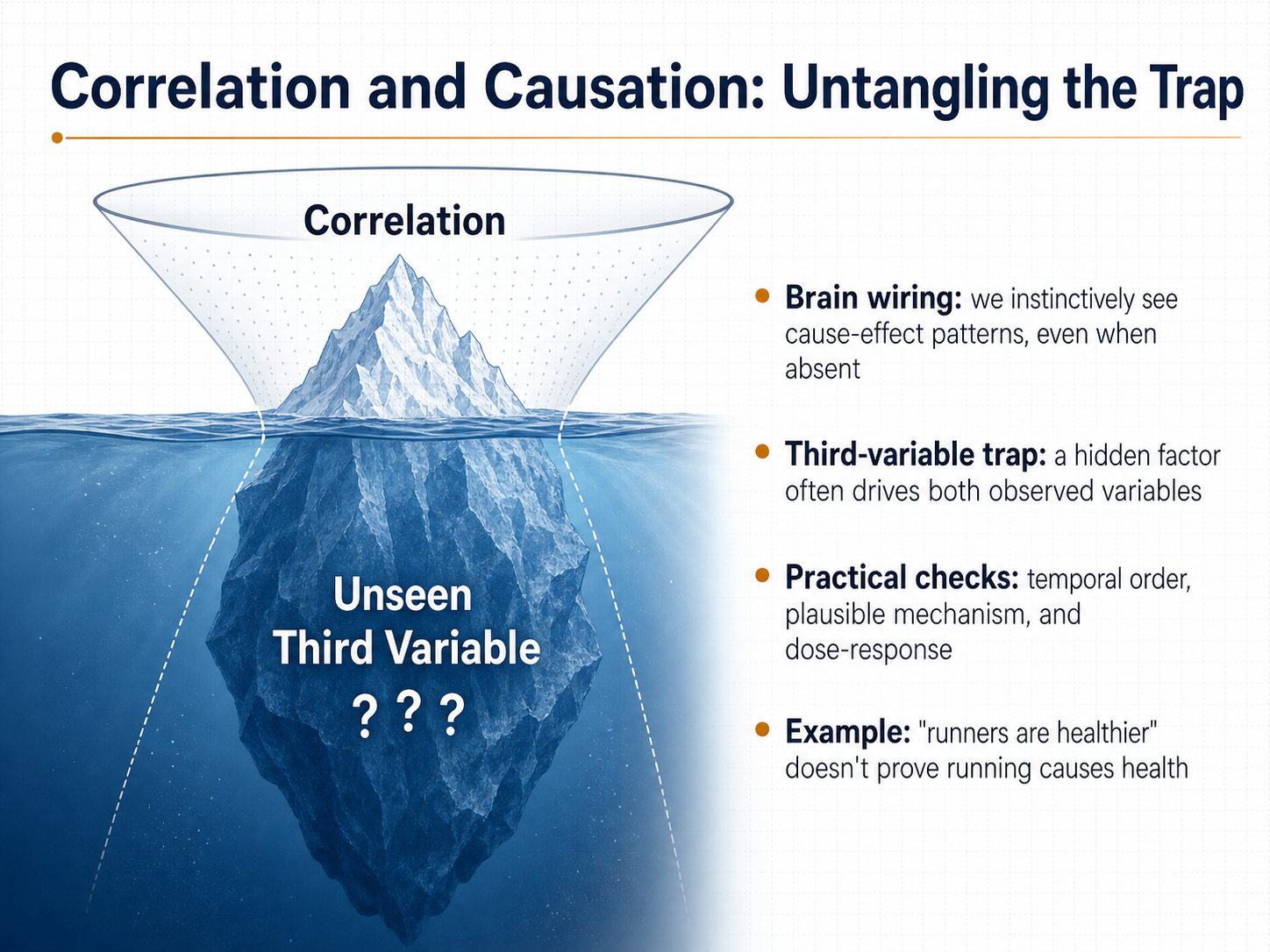
1 min - 11Correlation and Causation: Untangling the TrapNow, let's untangle one of the trickiest traps in scientific thinking: the difference between correlation and causation. Your brain is wired to see cause-and-effect patterns. It's a shortcut. But that wiring can trick you, making you see a direct cause where none exists. The real danger is the third-variable trap. A hidden factor often drives both things you're observing. Take the classic example: studies show runners are healthier. Does that prove running causes health? Not necessarily. A hidden third variable—like overall lifestyle or access to healthcare—could be driving both the choice to run and the health outcome. So, how do you avoid the trap? Use three practical checks. First, check temporal order. The cause must come before the effect. Second, look for a plausible mechanism. Is there a believable physical or biological process connecting them? And third, look for a dose-response relationship. Does more of the supposed cause reliably lead to more of the effect? These checks don't prove causation, but they make your case a lot stronger. Let's carry this careful thinking into the next layer of our model and explore some common reasoning traps.
 2 min
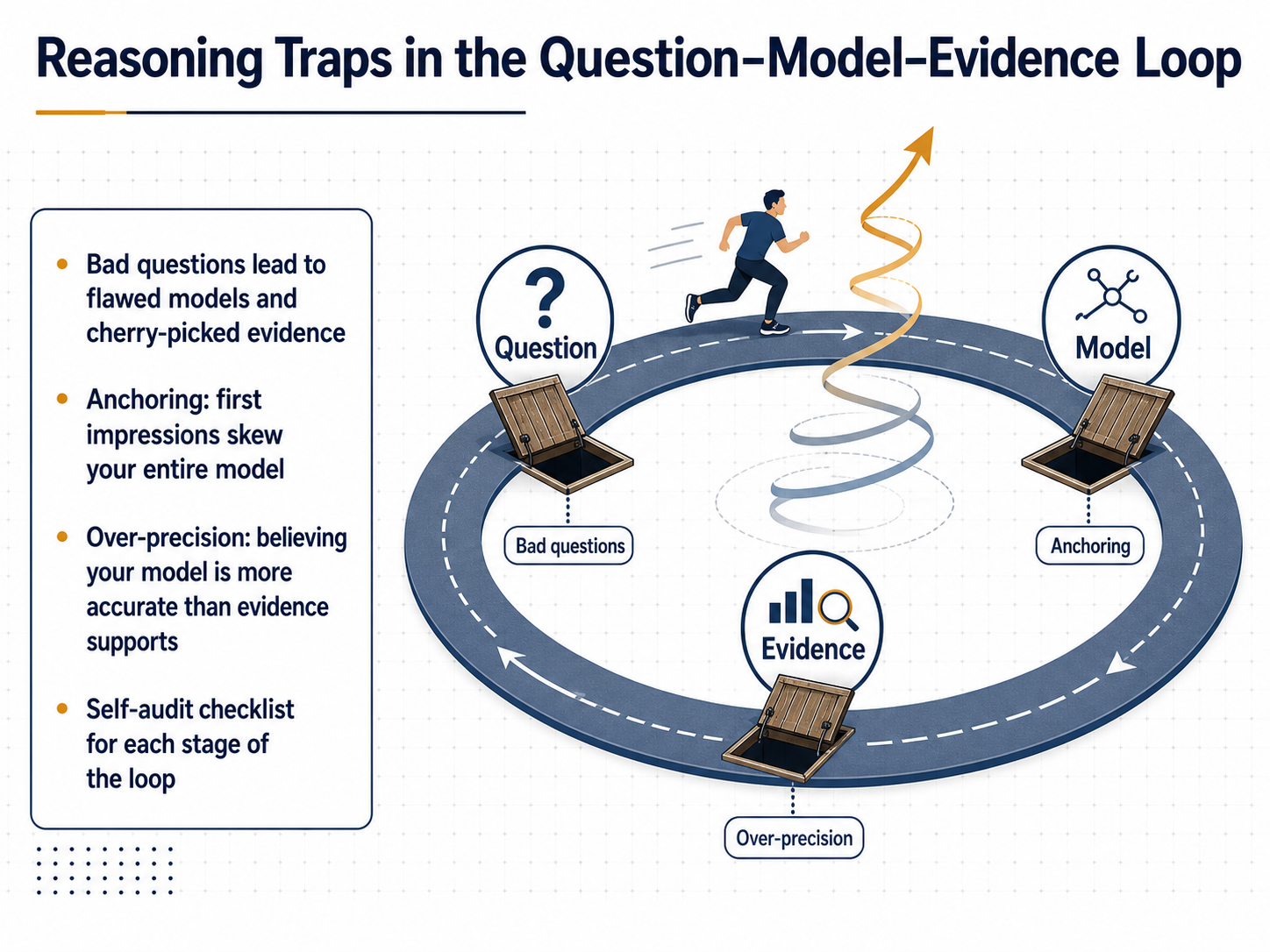
2 min - 12Reasoning Traps in the Question–Model–Evidence LoopGood questions keep your loop strong. But bad questions can quietly break it. They lead to flawed models, and then you start cherry-picking evidence that only confirms what you already think. Let's look at two common traps. First, anchoring. This is when your first impression locks in your model. You see one data point and everything else gets twisted to fit. Second, over-precision. This is believing your model is exact, even when your evidence is messy. You might say a task takes three point two hours, when in reality, you just have a rough guess. To catch these, use a quick self-audit. When questioning, ask yourself: am I really curious, or just looking for a yes? When building your model, ask: is this anchored to my first idea? And when checking evidence, ask: am I considering all the data, or just the parts I like? That simple check at each stage keeps your loop honest. Next, let's walk through a full example to see this in action.
 2 min
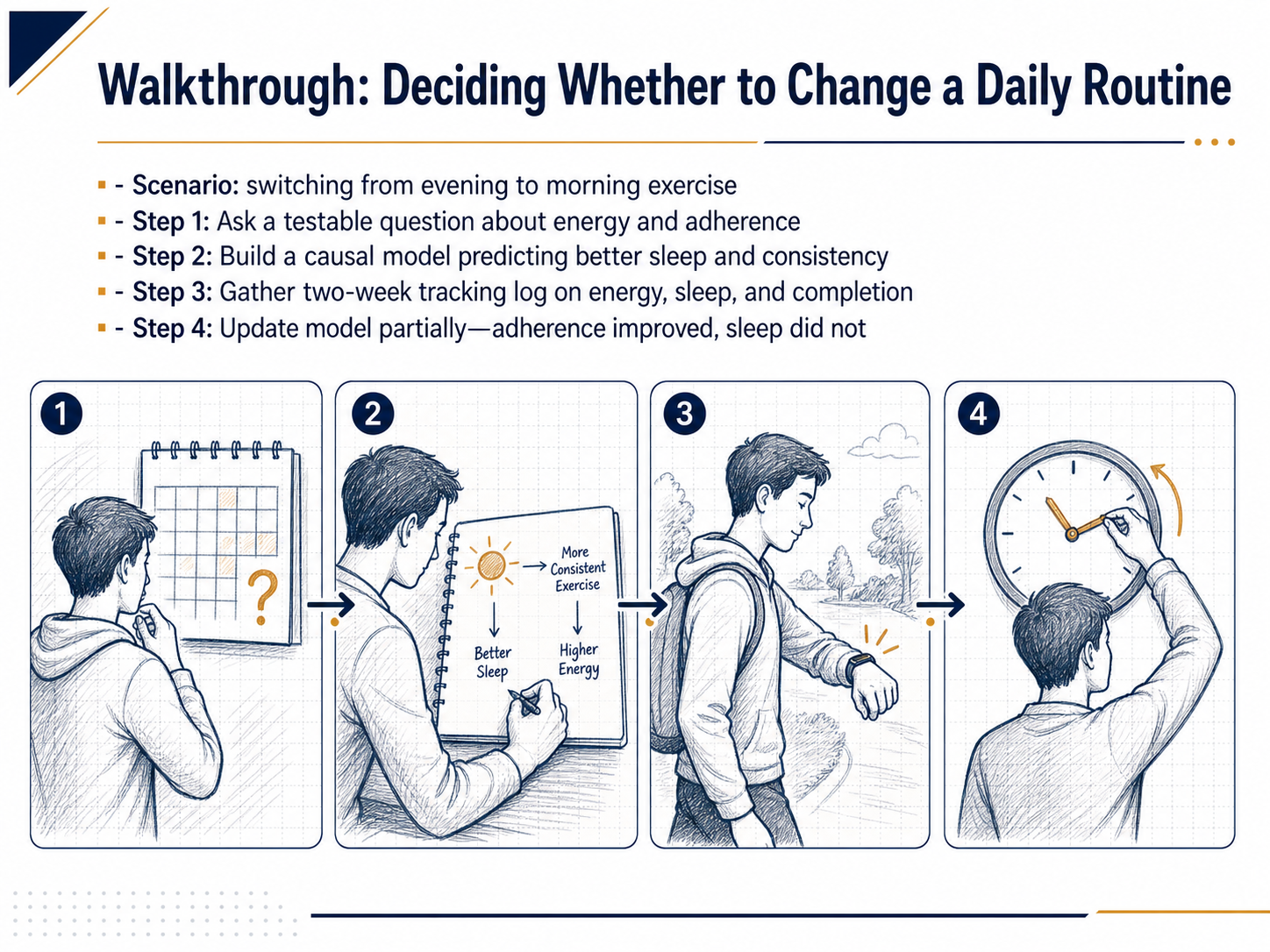
2 min - 13Walkthrough: Deciding Whether to Change a Daily RoutineLet's walk through a real example. Suppose you want to switch your workout from evening to morning. Your first step is to ask a testable question. Not just 'Will this feel better?' but something like 'Will morning exercise increase my energy and my consistency over the next two weeks?' Next, you build a simple causal model. You predict that morning workouts will tire you out earlier, leading to better sleep, which then makes it easier to keep showing up. So your model is a single chain: timing affects sleep affects adherence. Now, gather evidence. Track it for two weeks. Log your energy, your sleep quality, and whether you actually completed the workout each day. It doesn't have to be fancy, just honest data. Finally, look at your log. You discover that your adherence did improve. You were more consistent. But your sleep did not change. So you update your model. You keep the part about consistency, but you discard the assumption that sleep was the mechanism. This is how you refine your thinking. Up next, we'll look at how to document and share that reasoning clearly.
 2 min
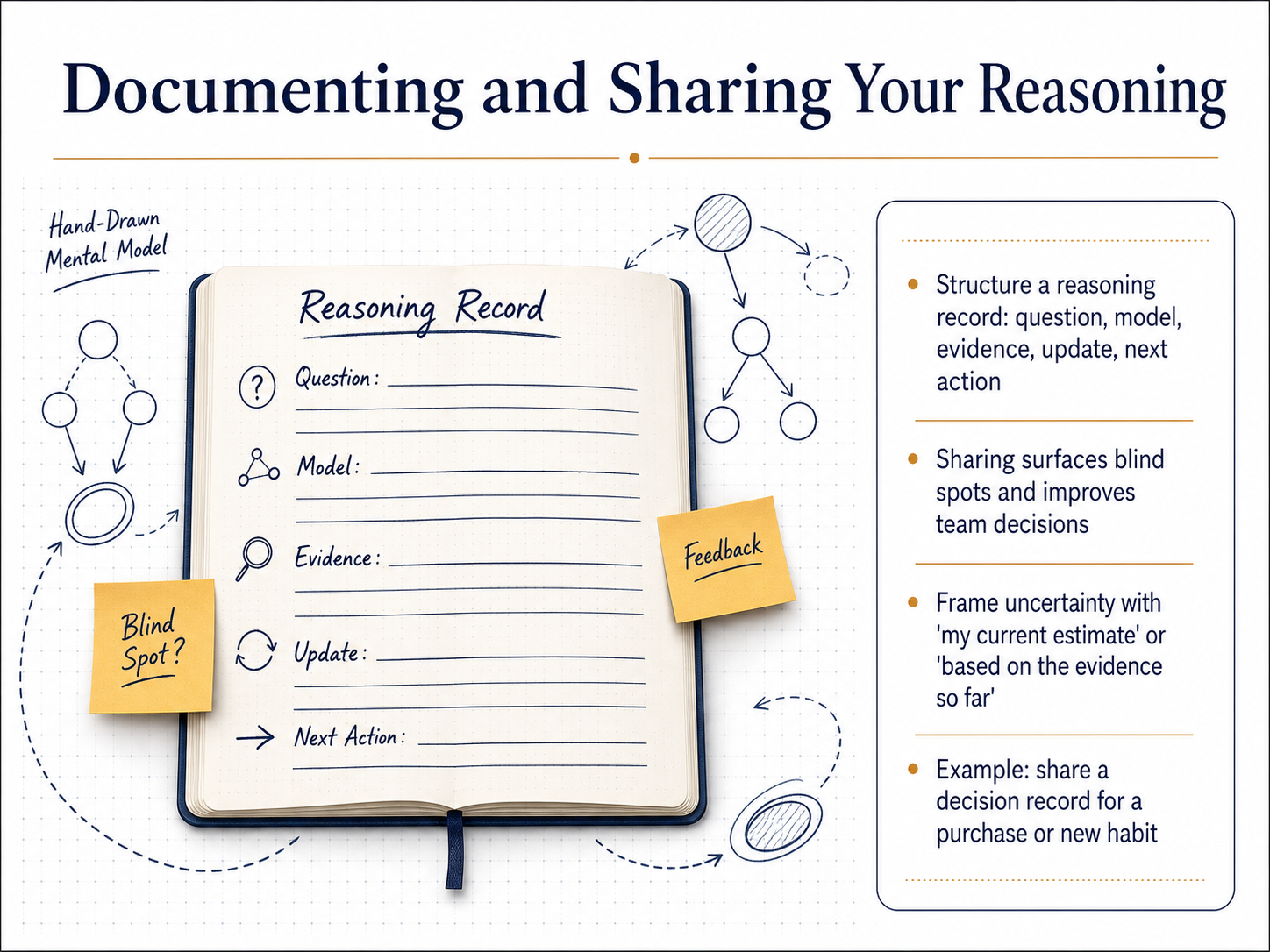
2 min - 14Documenting and Sharing Your ReasoningIf you keep all your reasoning in your head, it's easy to miss a gap. So let's make it tangible. When you document your thinking, use a simple structure. Start with your question. Then state your initial model, or your best guess. Next, record the evidence you gathered and what you learned. Then, update your model. Finally, define your very next action. This creates a clean trail anyone can follow. Sharing that record is a force multiplier. It surfaces blind spots you missed and makes your whole team's decisions sharper. But you don't need to sound like you have all the answers. Frame your uncertainty clearly. Say, 'My current estimate is...' or 'Based on the evidence so far, I'd lean toward...' This invites better conversation, not criticism. For example, you could share a quick decision record for a major software purchase, or even for starting a new exercise habit. Same structure, same clarity. Now, let's turn this into a lasting practice. Next up: Building Your Scientific Thinking Habit.
 2 min
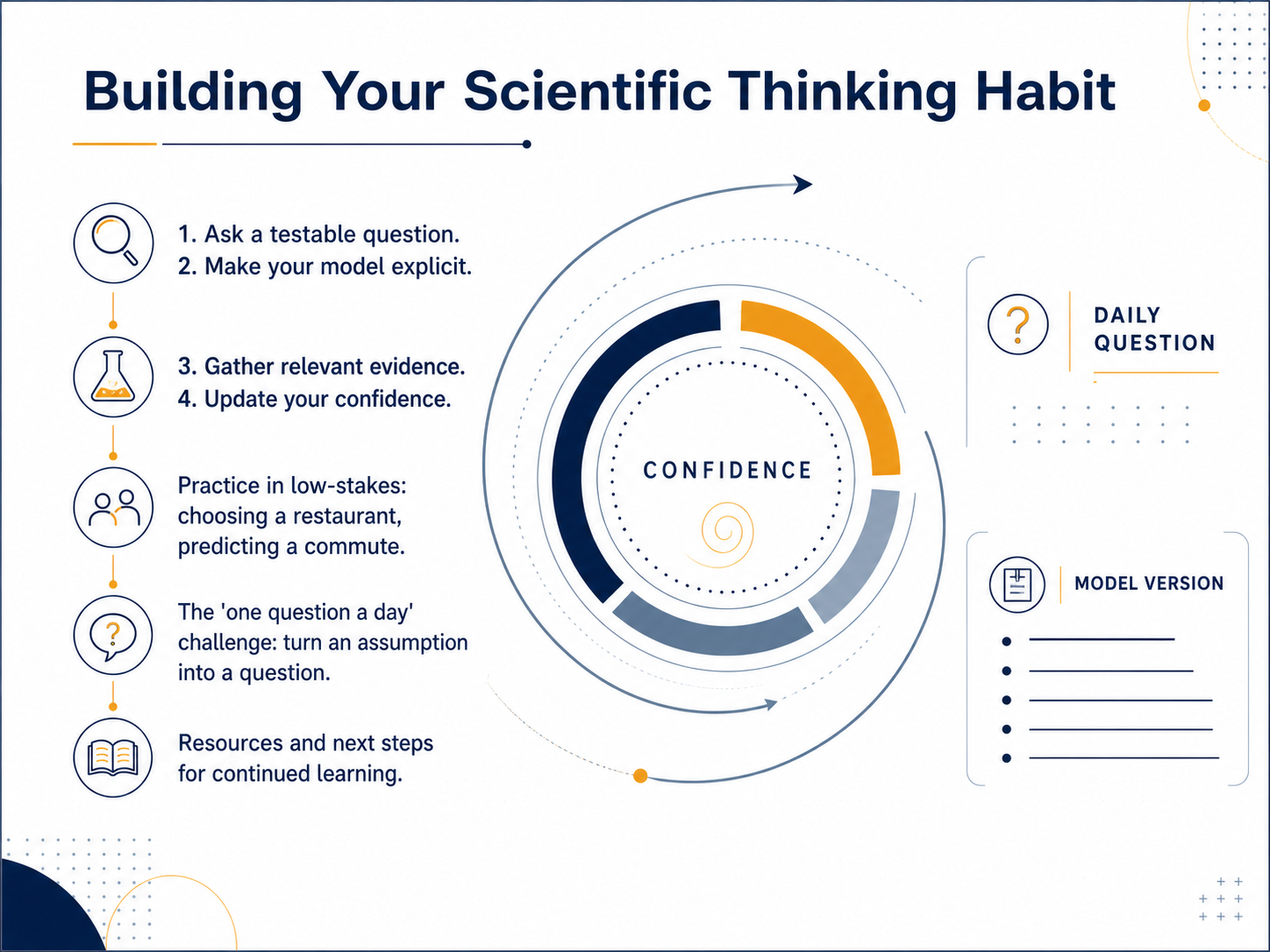
2 min - 15Building Your Scientific Thinking HabitSo, how do you actually make this a habit? Let's get practical. The cycle is simple: one, ask a testable question. Two, make your model explicit. Three, gather relevant evidence. Four, update your confidence. That's it. But you don't need a lab. Practice in low-stakes situations. Choosing a restaurant. Predicting your commute. See if your mental model of traffic holds up. I challenge you to try the 'one question a day' challenge. Just take a single assumption you have and turn it into a question. Then, be curious about the answer. When you're ready for more, the resources that follow will give you a clear path to keep going. Now, let's bring this all together with some key takeaways and your next steps.
 1 min
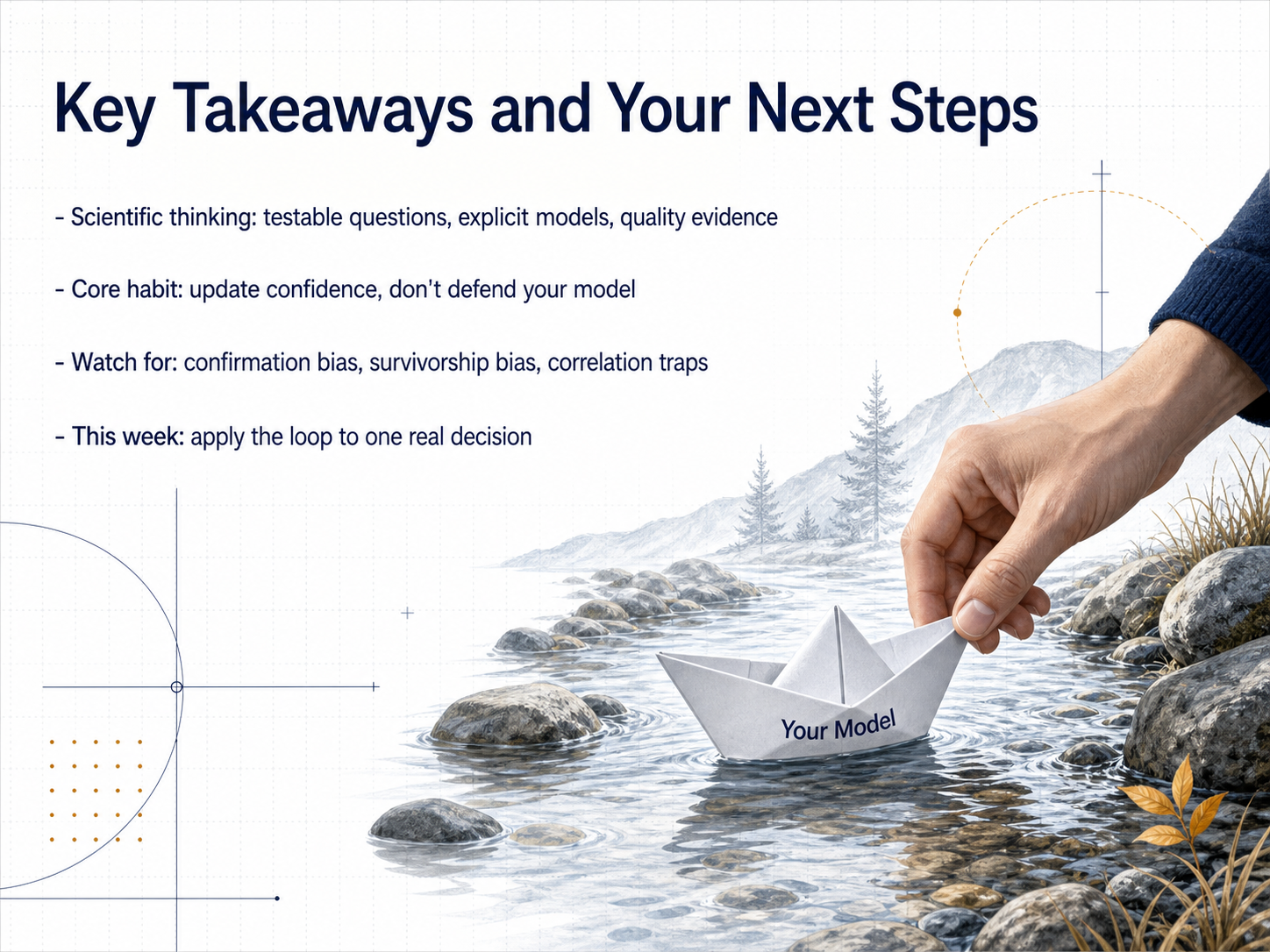
1 min - 16Key Takeaways and Your Next StepsLet's bring this together. Scientific thinking is a practical loop. Start with a testable question. Make your model explicit. Then gather quality evidence. The core habit is to update your confidence in the model, not defend it. Watch out for a few traps. Confirmation bias, where you only see what you expect. Survivorship bias, where you only study the winners. And correlation traps, where you mistake a link for a cause. This week, your move is simple. Take one real decision you're facing and run it through the full loop. Question, model, evidence, update. That's it. You've got a solid first model. Now go test it. Thank you.
 1 min
1 min
Take the deck with you
Download this course as a file — free, no sign-up needed.
- PDF handoutEvery slide page, ready to print or share.17 pages · 4.7 MBDownload
- Narrated PowerPointThe deck that presents itself — every slide carries the digital human's narration video.17 pages · 15.0 MBDownload
- PowerPoint slidesThe full deck as a .pptx — open it in PowerPoint, Keynote, or Google Slides.17 pages · 4.6 MBDownload
Free to use in your own training — please keep the PersonWise credit page at the end.
Have your own deck? Turn it into a course