Brand Awareness Strategy: Goals and Tradeoffs
Begin
14 pages · ~28 min
Brand Awareness Strategy: Goals and Tradeoffs
Learn to set measurable brand awareness goals, evaluate strategic choices, and understand tradeoffs to build an effective brand awareness campaign.
What you’ll learn
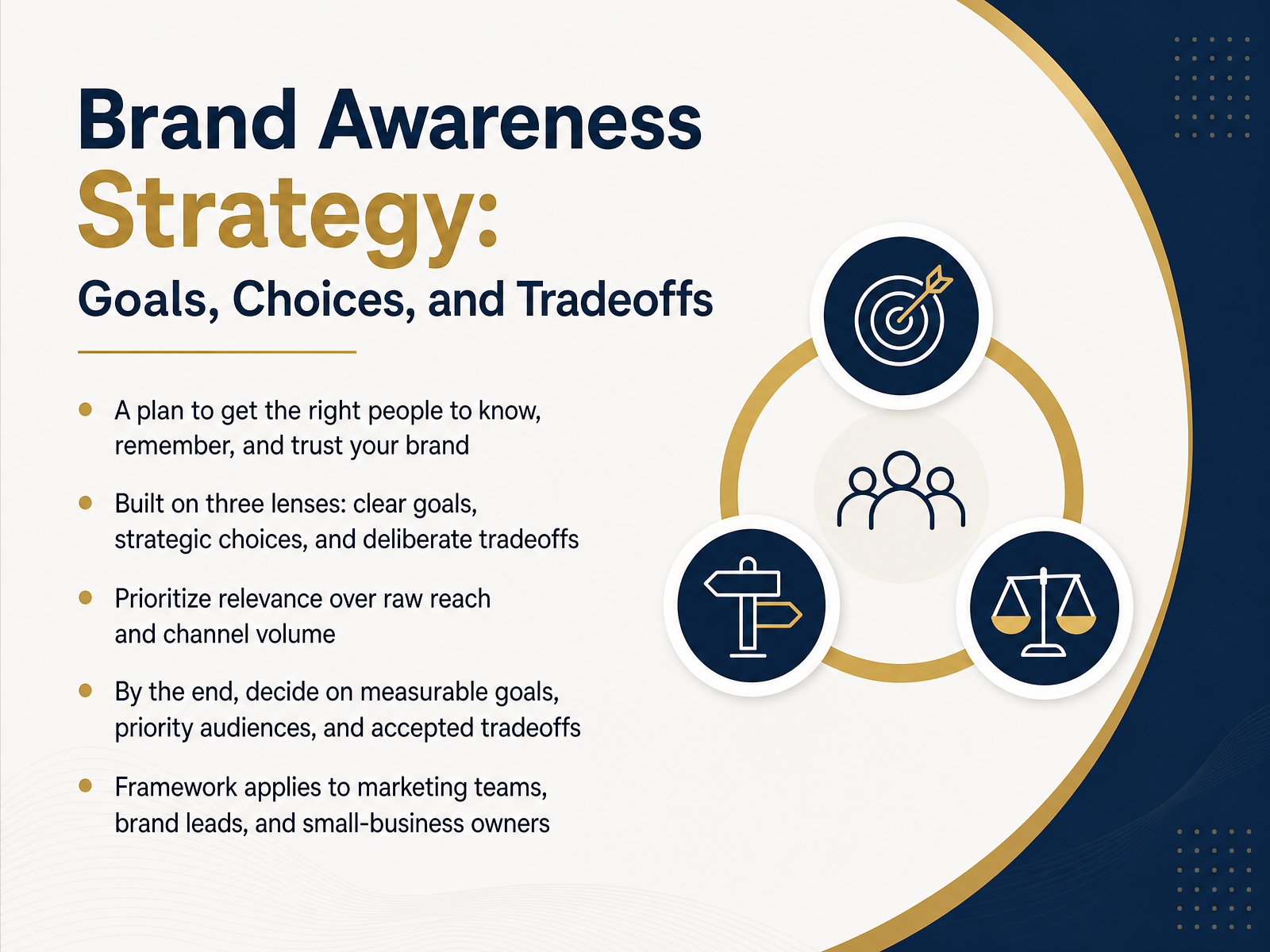
- 01Brand Awareness Strategy: Goals, Choices, and TradeoffsWelcome. If you're here, you already know that visibility doesn't automatically create preference. The real goal of a brand awareness strategy is much more specific. It's a plan to get the right people to know, remember, and trust your brand so that you come to mind at the exact moment of choice. Throughout this course, we're going to frame every decision through three lenses: clear goals, strategic choices, and deliberate tradeoffs. We aren't chasing raw reach or channel volume. We're prioritizing relevance. That means instead of convincing your stakeholders that more impressions are always better, you'll be armed to defend choices that build long-term equity. By the end, you should be ready to decide on measurable goals, identify your priority audiences, and clearly accept the costs of ignoring low-potential segments. So let's start by grounding ourselves in what awareness actually is, and what it is not.gwi.comqualtrics.comonlinelibrary.wiley.com+21 min
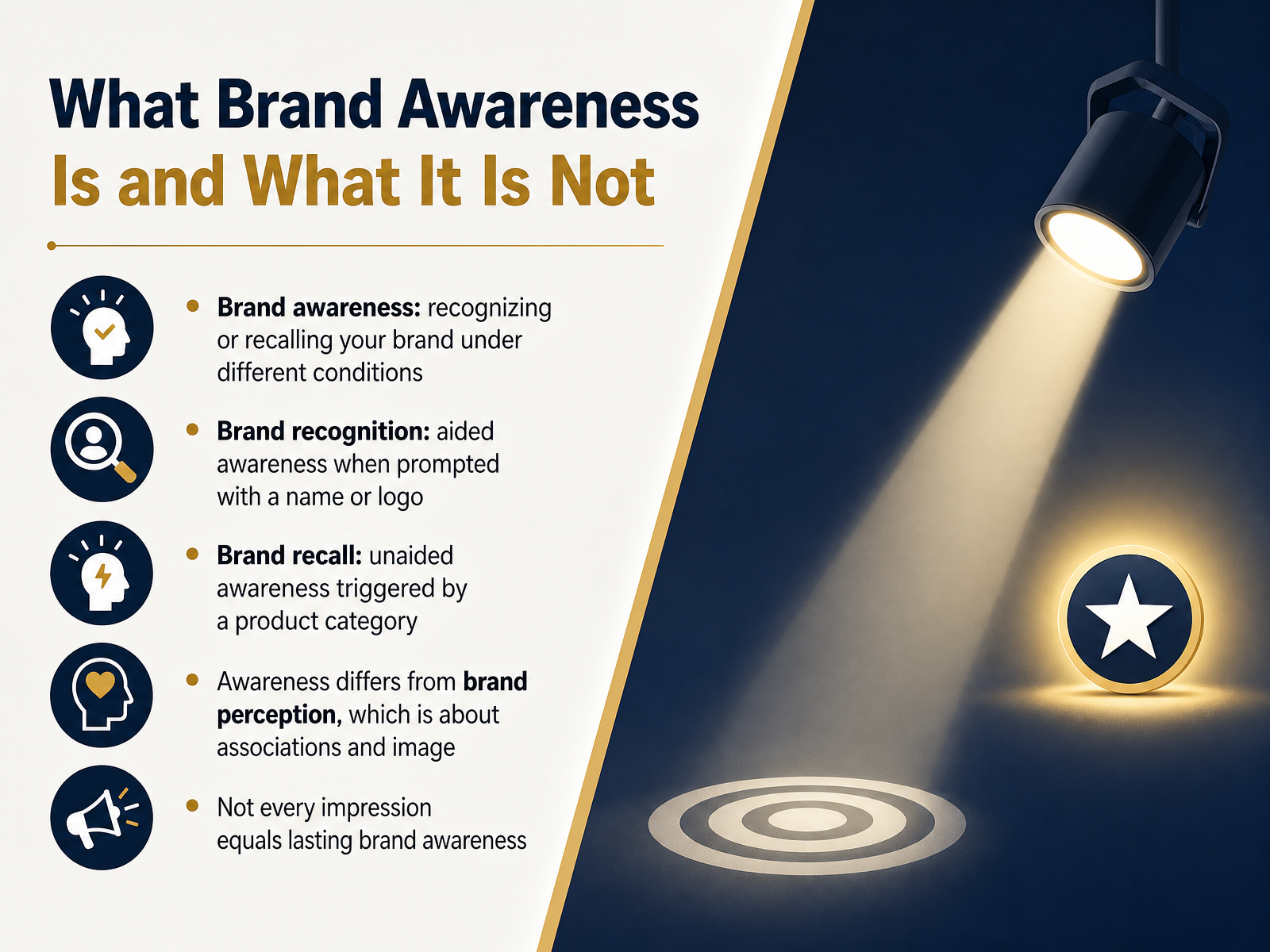
- 02What Brand Awareness Is and What It Is NotNow let's get precise about what brand awareness actually is, because the terms around it often get used interchangeably, and that can undermine the strategy we set later. Brand awareness is simply the extent to which consumers can recognize or recall your brand under different conditions. But that definition splits into two very different tests. Brand recognition is aided awareness. You show someone your logo or name, and they confirm they know it. It reflects familiarity, often built through repeated exposure at the point of purchase or in advertising. Brand recall is unaided awareness. You give someone a category, like sports drinks or project management software, and they pull your brand from memory without seeing it first. Recall is much harder to earn. In practical terms, it's eight to ten times more difficult to get a customer to recall a brand than to simply recognize one. And neither of these is the same as brand perception. Perception is about what people associate with your brand, things like quality, price, or personality. Awareness is just whether the brand is in memory at all. Also, remember that not every impression equals lasting awareness. A view, a click, or a brief exposure may not create the memory strength needed for recognition or recall later. So the goal is not just reach. The goal is a durable memory trace that shows up at the moment of choice. Up next, we'll look at the memory foundation behind that goal: recall, recognition, and salience.
 qualtrics.comsurveymonkey.comen.wikipedia.org+22 min
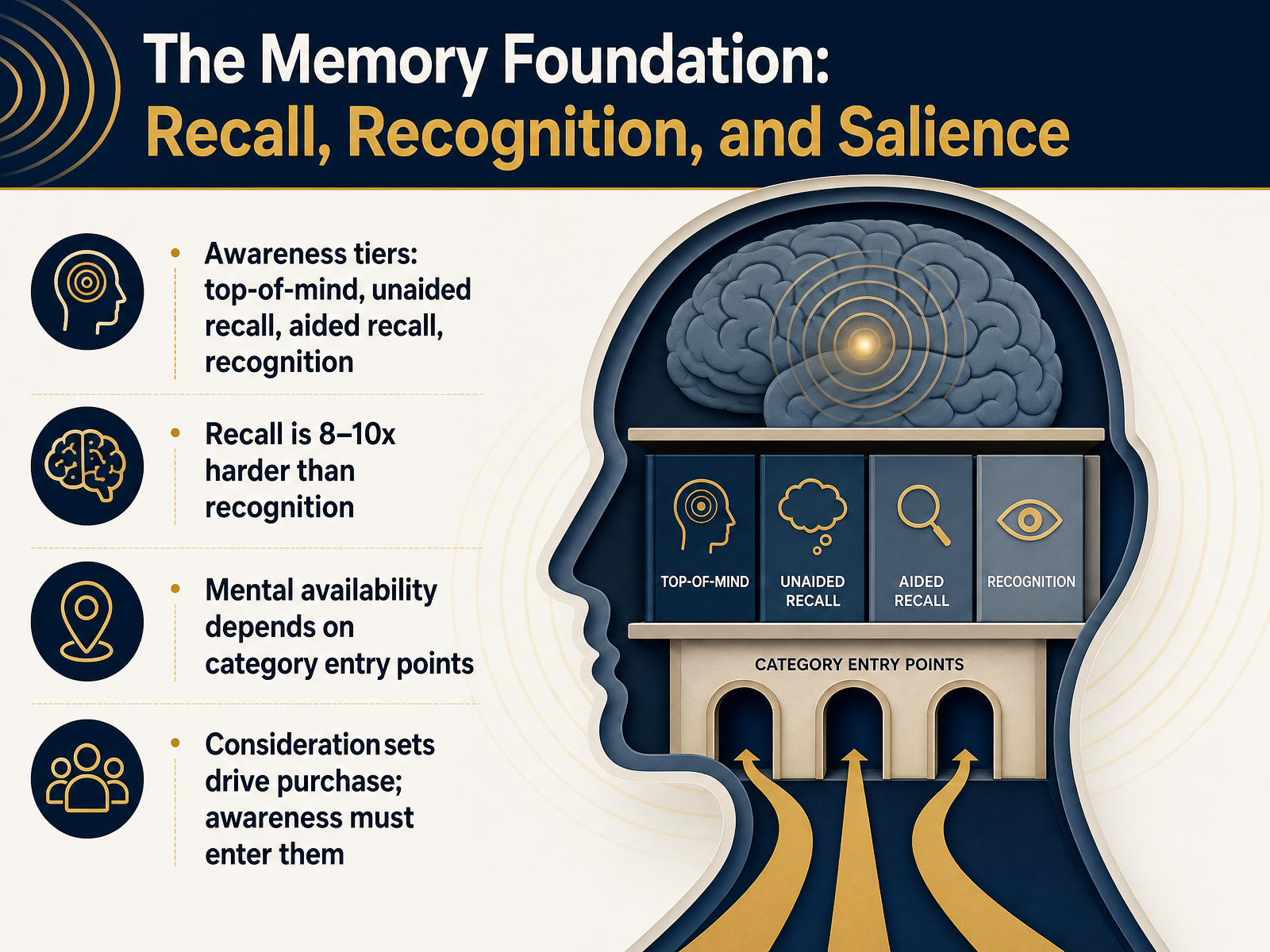
 - 03The Memory Foundation: Recall, Recognition, and SalienceAwareness is not one thing. It is a ladder, and each rung demands a different kind of memory work. At the bottom, you have recognition. A buyer sees your logo or packaging and thinks, yes, I know them. Aided recall sits next: given a list, they can pick you out. Unaided recall is harder. Ask someone to name brands in your category, and if they say your name without help, you have earned real retrieval. At the top sits top-of-mind. When the moment arrives, your brand comes first. That is where purchase decisions actually start. Here is the strategic reality. Recall is roughly eight to ten times harder to achieve than recognition. So every dollar you spend must be clear about which rung you are targeting. Mental availability depends on category entry points: the situations, needs, and triggers where buyers reach for a solution. If your brand is not attached to those moments, awareness stays passive. And passive awareness does not drive choice. Consideration sets are small, often just three to five brands. Your real goal is not being known. It is being retrieved when the category need fires. Next, we will turn that into measurable goals.
 gwi.comqualtrics.comonlinelibrary.wiley.com+22 min
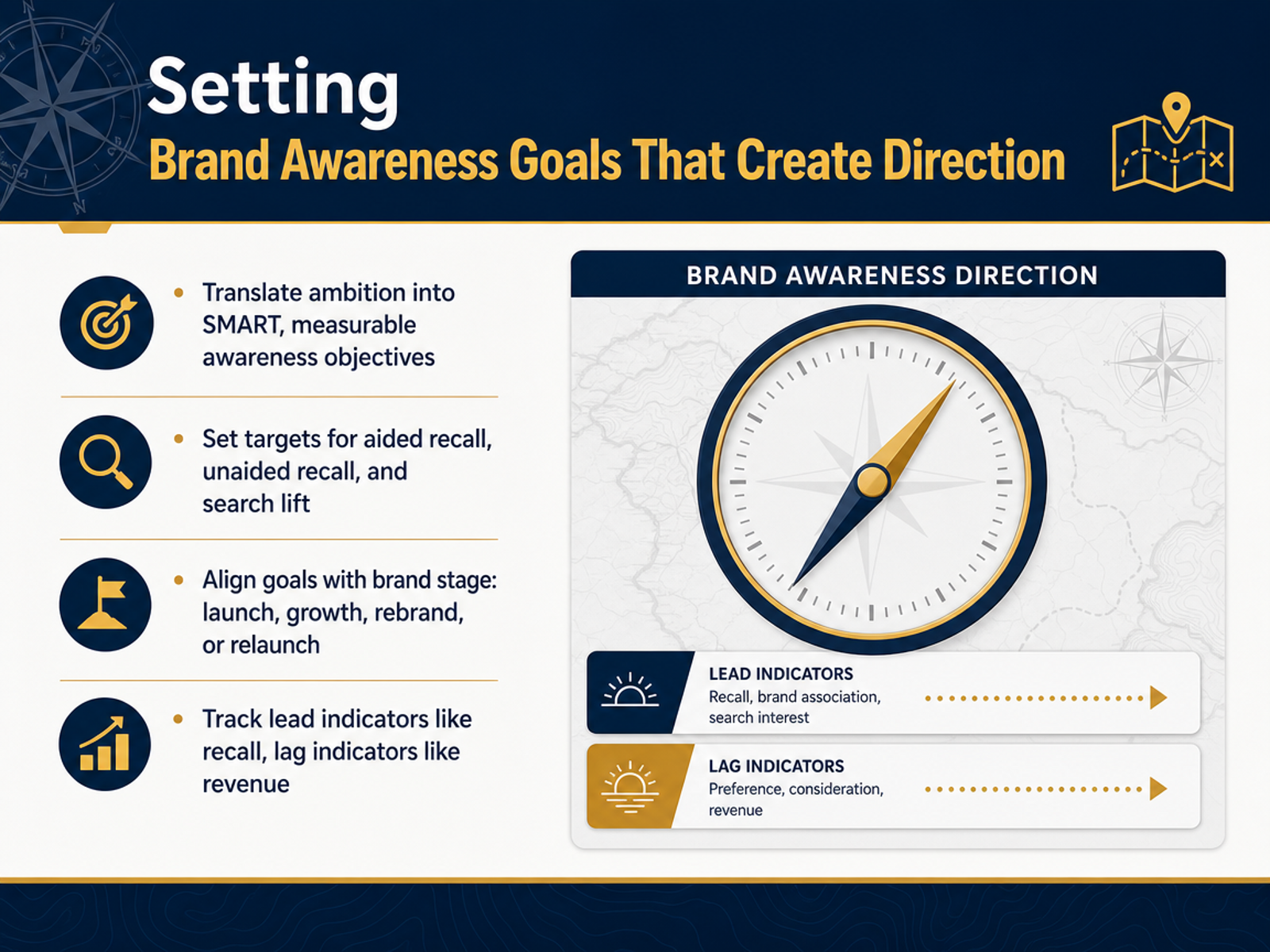
 - 04Setting Brand Awareness Goals That Create DirectionAwareness without a target is just noise. So before you choose budgets or channels, you need to define what winning actually looks like. Start by translating your ambition into specific, measurable objectives. Instead of saying we need more visibility, commit to moving unaided recall among finance leaders in the Midwest from twenty percent to thirty percent by the end of the fiscal year. Choose your metrics based on your brand's stage. If you are launching, focus on foundational recognition. If you are rebranding, track how quickly new associations replace old ones. You also need a balanced scorecard. Unaided recall is a strong leading indicator of future demand. Search lift tells you if your investment is creating active intent. But remember, awareness is the means, not the end. You are ultimately trying to move revenue. So measure the early signals like recall and search volume, and anchor them to the lagging outcome of sales. This creates the direction you need to make defensible choices, not just chase reach for its own sake. And that clarity is exactly what we need as we move into those choices.
 gwi.comqualtrics.comonlinelibrary.wiley.com+21 min
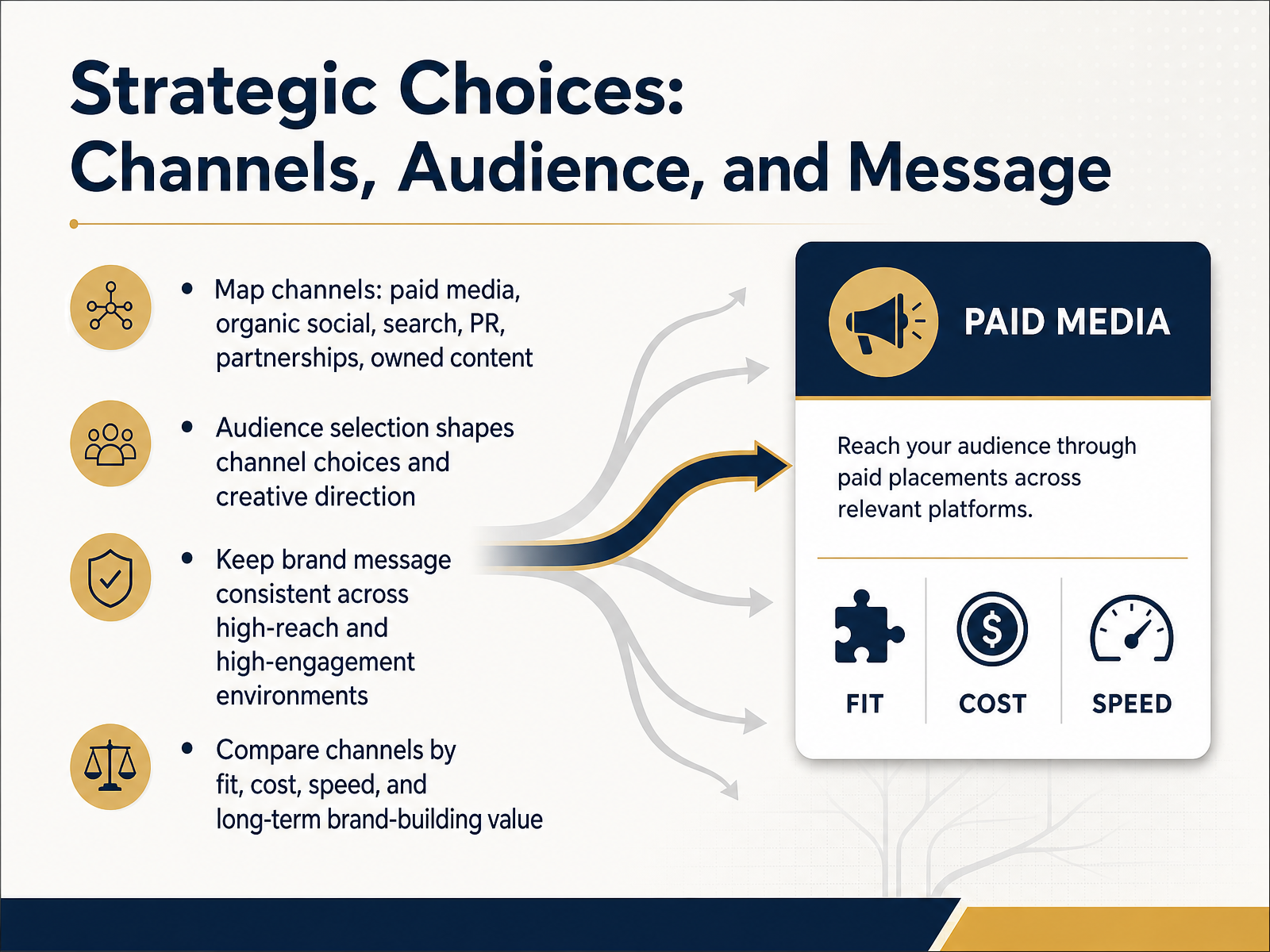
 - 05Strategic Choices: Channels, Audience, and MessageSo the real work of a strategy comes down to this: which channels do you pick, and why. Start by mapping the full landscape. Paid media, organic social, search, PR, partnerships, and owned content. Each one plays a different role in building awareness. The audience you choose shapes everything downstream. If you are targeting younger consumers, short-form video and creator partnerships might anchor the plan. If you are going after enterprise buyers, LinkedIn and category-level thought leadership matter more. Your channel mix has to follow your audience, not your habits. Once you know who you need to reach, keep the message consistent, but adapt the format. A high-reach channel like video may introduce the brand story, while a high-engagement channel like social invites your audience to interact with it. And when you compare channels, do not judge them all by the same yardstick. Ask four questions. How well does it fit the audience? What is the real cost? How fast can you scale it? And what does it build over the long term? A cheap reach channel may not build equity. A costly B2B channel may be exactly the right bet. The answer depends on the tradeoffs you are willing to defend. Next, let's look at what the data actually shows about channel effectiveness in 2026.
 searchlab.nlmarketingscoop.comwebtonic.io+21 min
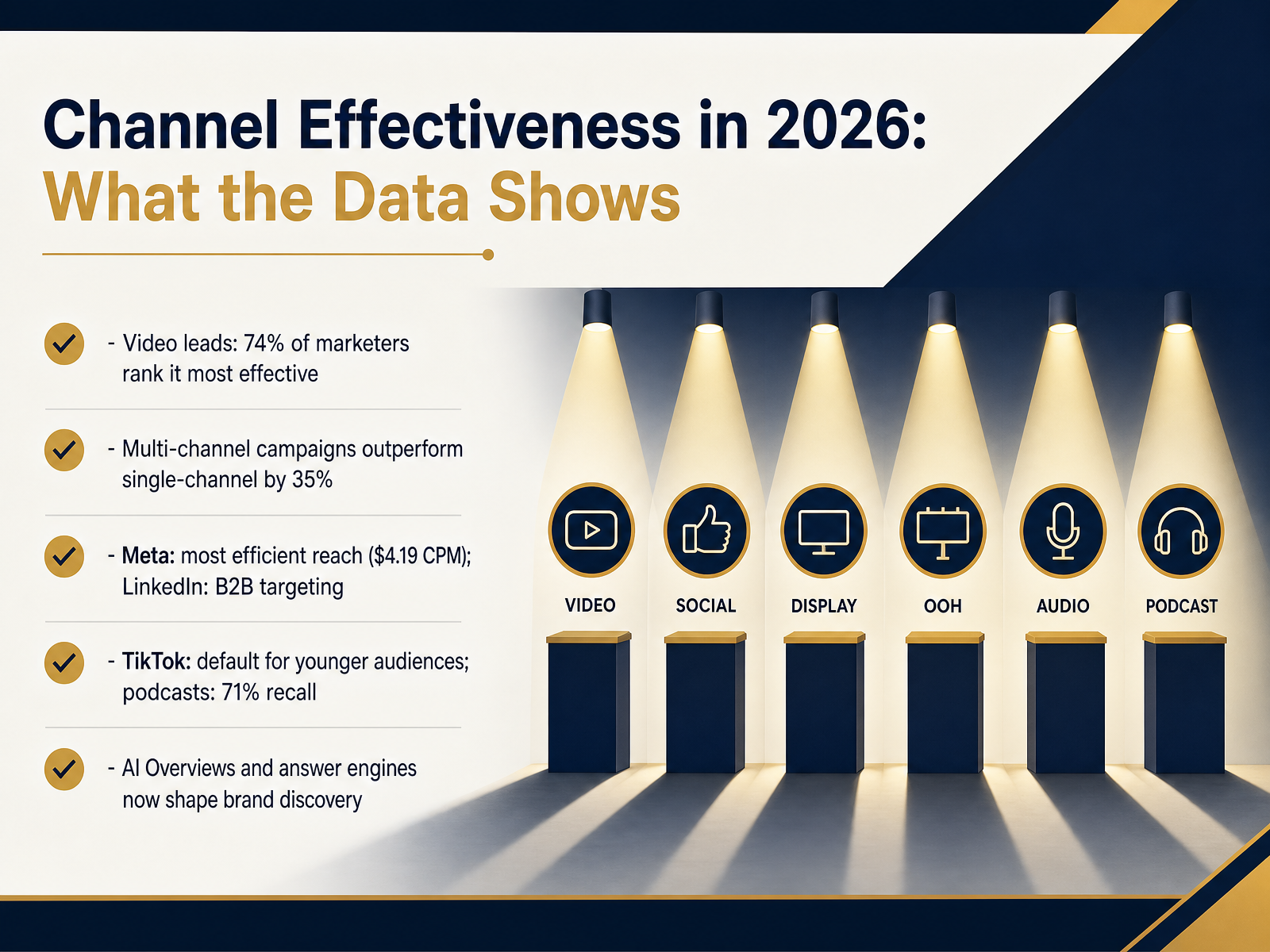
 - 06Channel Effectiveness in 2026: What the Data ShowsSo what does the effectiveness picture actually look like right now? If there's one headline, it's that video still leads. Seventy-four percent of marketers rank it as their most effective awareness channel. But the more important finding is about combination. Multi-channel campaigns outperform single-channel efforts by thirty-five percent on awareness metrics, and that gap is widening. The channel choice itself comes down to specific tradeoffs. Meta remains the most efficient reach at around four dollars and nineteen cents CPM, which makes it a strong foundation. LinkedIn is far more expensive, but for B2B audiences, the targeting precision is unmatched and its costs are actually dropping this year. Podcasts are worth watching, with seventy-one percent brand recall and rapid growth. And one structural shift shapes all of this: AI Overviews and answer engines now determine which brands even get discovered before a customer searches. That raises the stakes for showing up consistently across channels where your audience already spends attention. Next, let's look at the core tradeoffs in brand awareness planning.
 searchlab.nlmarketingscoop.comwebtonic.io+21 min
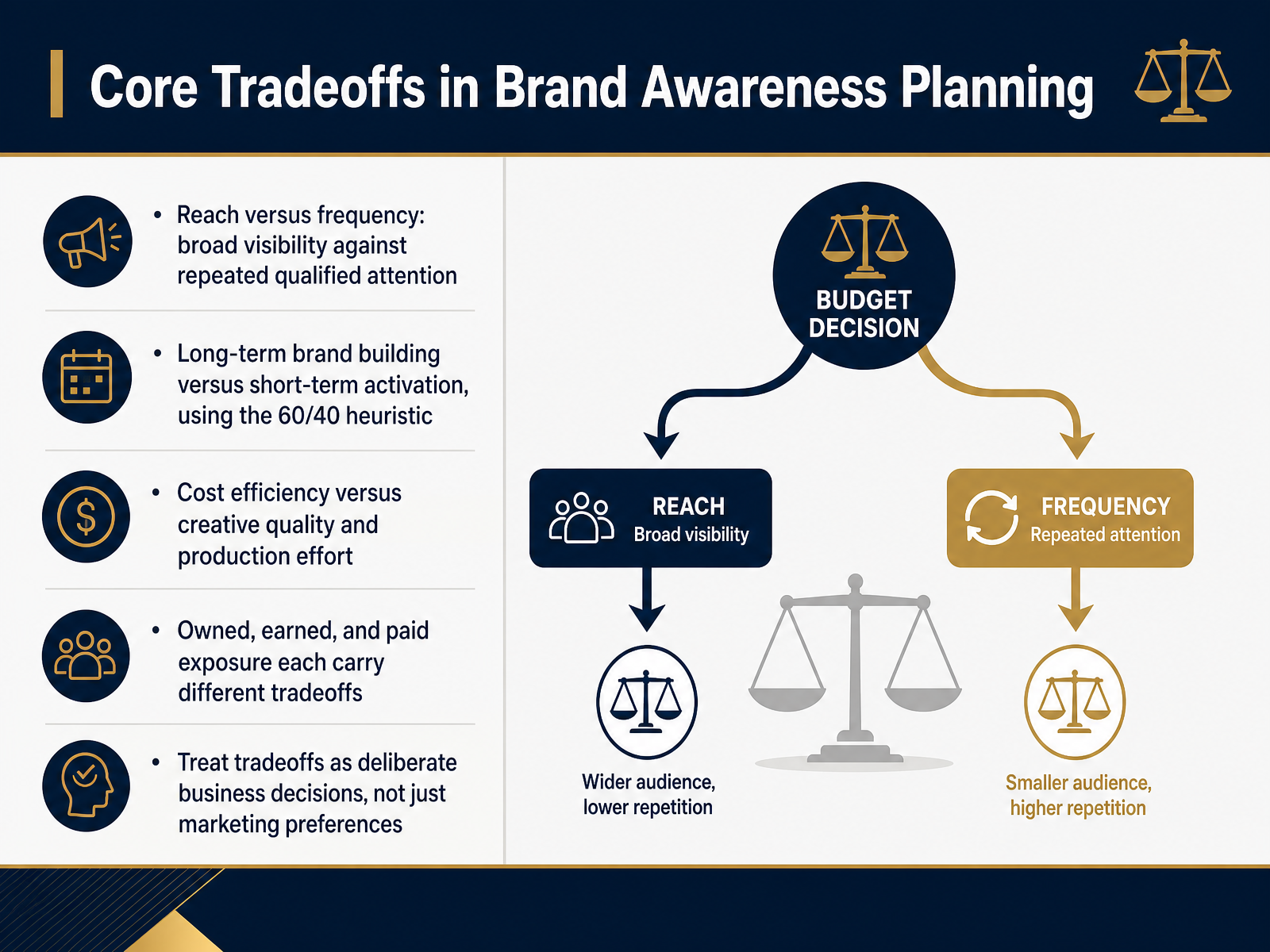
 - 07Core Tradeoffs in Brand Awareness PlanningLet's talk about the tradeoffs you'll need to make, because brand awareness planning is really a series of deliberate choices. First, there's reach versus frequency. Do you want to show your message to a lot of people once, or to a smaller group several times? Broad reach introduces you to new audiences. Higher frequency builds recall with people who are already aware. Your goal determines that balance. Next, consider long-term brand building versus short-term activation. The sixty forty heuristic from Binet and Field suggests roughly sixty percent brand building and forty percent activation, but it's a starting point, not a rule. Use it to challenge a short-term bias, then adapt it to your business. You're also trading cost efficiency against creative quality. Cheaper production can buy more impressions, but stronger creative is what makes those impressions memorable. Finally, owned, earned, and paid channels each carry different risks and rewards. Paid gives you control and speed. Owned builds equity over time. Earned requires relevance and trust. The key is to treat these as business decisions you can defend, not just marketing preferences. Up next, we'll look at measuring brand awareness without overcounting.
 hbr.orgstrategus.comdilate.com.au+22 min
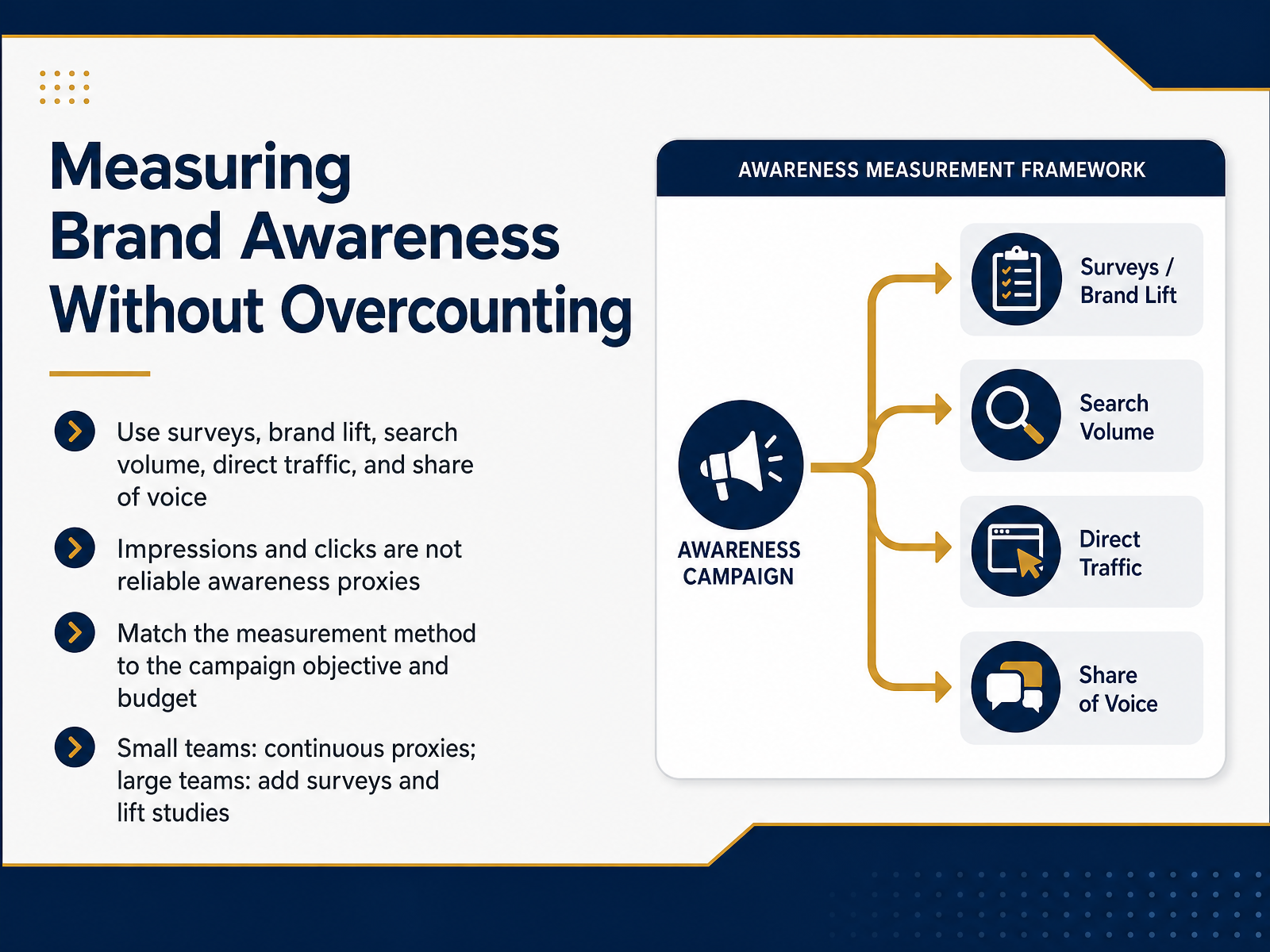
 - 08Measuring Brand Awareness Without OvercountingHere's the natural tension with brand awareness: the most common metrics often aren't the most useful. Impressions and clicks tell you about exposure, not memory. They show who saw an ad, not who can recall your brand when it matters. If you need to defend a strategy, start by separating those two ideas. Use surveys, brand lift studies, search volume, direct traffic, and share of voice as your core signals. These get closer to actual recognition and recall. But every method has a tradeoff. Surveys give you direct evidence of unaided and aided recall, yet they cost money and have lag time. Branded search and direct traffic are cheap and continuous, but they are proxies, not proof. So match the method to your objective and budget. For small teams, consistent proxies work well because you can watch trends weekly without extra spend. For larger teams, add quarterly surveys and controlled lift studies to get definitive answers. The key is not perfect data, it is the right combination for the decision you must defend. Next, let's look more closely at brand lift studies and behavioral proxies.
 semrush.com1 min
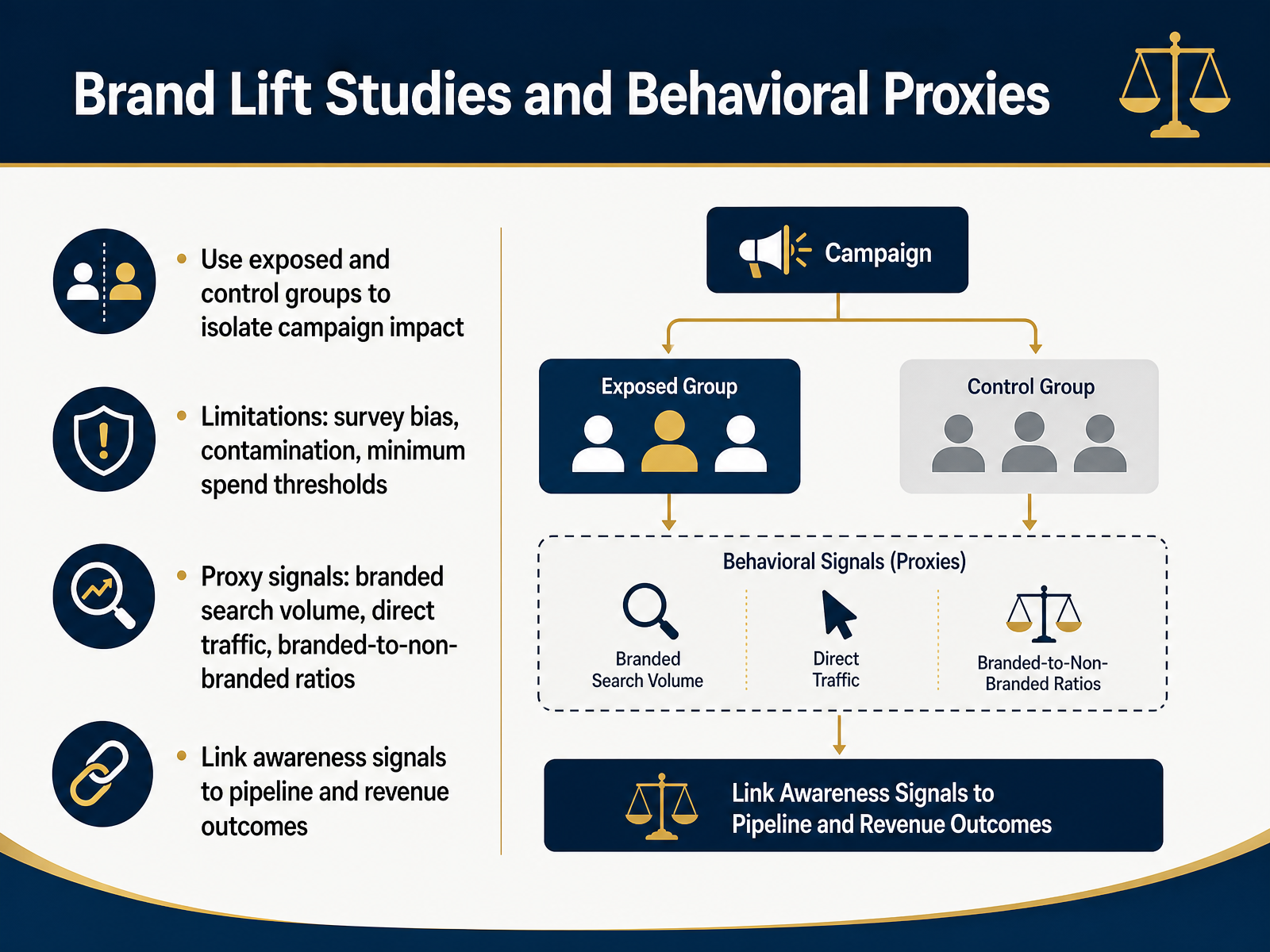
 - 09Brand Lift Studies and Behavioral ProxiesNow let's translate the goal of brand awareness into measurement choices you can actually defend. Brand lift studies are the industry standard for isolating campaign impact because they compare an exposed group to a control group. But they come with real limitations. Survey bias can creep in when low response rates attract a specific type of respondent, and contamination happens when a control group still sees your ads through another channel. Many platforms also set minimum spend thresholds, which makes formal lift studies impractical for smaller campaigns. That's where behavioral proxies earn their place. Branded search volume tells you whether people remember your name when no one is prompting them. Direct traffic signals unprompted navigation, and a rising branded to non-branded ratio shows your brand is creating pull rather than just riding on content discovery. None of these proxies are perfect on their own. Their real value appears when you connect awareness signals to pipeline and revenue outcomes, so you can show stakeholders how brand investment creates demand downstream. Next, we'll move from measurement into a decision framework that turns these tradeoffs into a working brand awareness strategy.
 semrush.com1 min
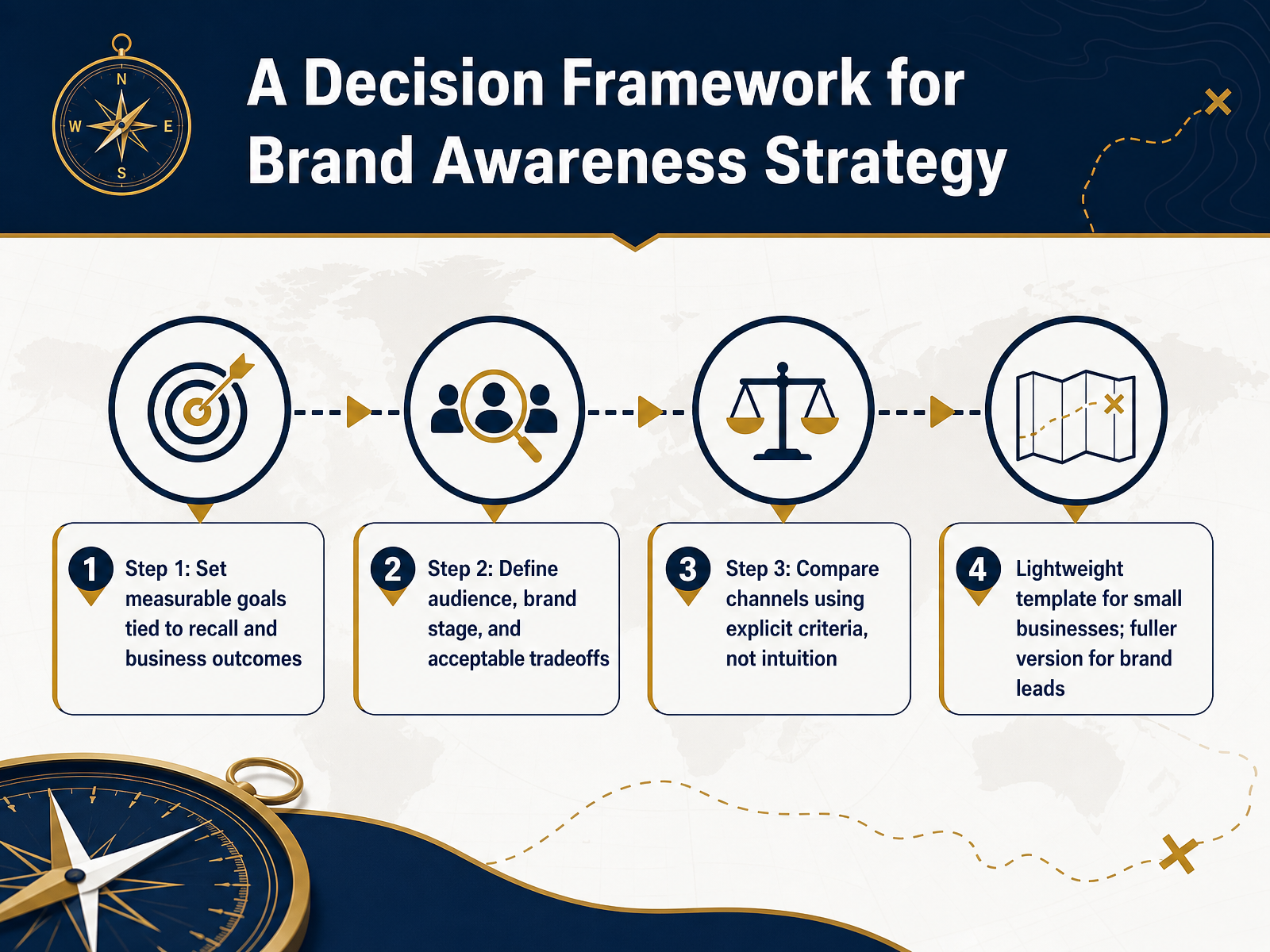
 - 10A Decision Framework for Brand Awareness StrategySo how do you actually turn all of this into a decision you can defend? Here's a framework that keeps the discussion structured. Step one, set measurable goals tied to recall and business outcomes. Not just more visibility. Be specific about unaided recall, category entry points, or intent signals like branded search. Step two, define your audience, your brand stage, and the tradeoffs you're willing to accept. Are you fighting for salience in a new market, or protecting equity as a mature player? That changes what you're willing to give up. Step three, compare channels using explicit criteria, not intuition. Real behavior, cost per lifted user, and long-term equity. Not what feels right in a planning meeting. And remember, this doesn't need to be a heavy process. A lightweight one-page version works for small businesses, while brand leads may need a fuller model that ties awareness to pricing power and retention. The point is not the size of the template. It's that you can explain why you chose the mix you did. Next, let's look at what changes when the budget itself becomes the constraint, in small budgets versus large budgets.
 gwi.comqualtrics.comonlinelibrary.wiley.com+22 min
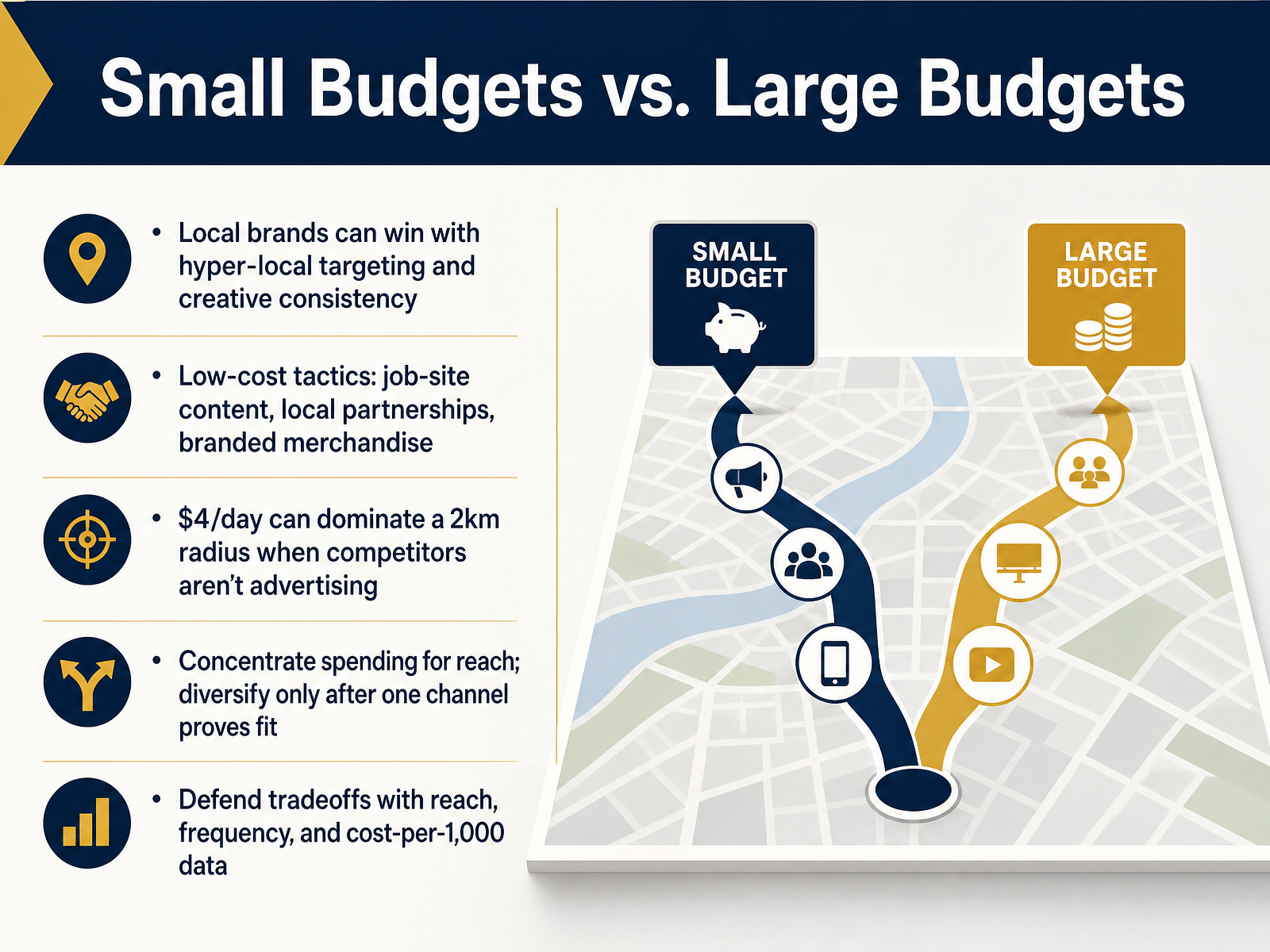
 - 11Small Budgets vs. Large BudgetsNow let's talk about what actually happens with small budgets versus large budgets. Because most of us aren't working with a blank check, and that's fine. A small budget forces discipline, and it can still win if you use it surgically. The playbook is hyper-local targeting paired with creative consistency. Think about a local locksmith or a contractor. They are not trying to reach millions of people. They need to dominate a two kilometer radius around their shop. When you narrowly define your audience, you can cut through. I have seen a business spend four dollars a day and reach every adult in their service area, simply because no competitor was paying for attention there. The cost per thousand impressions was absurdly low. Now, if you have almost no cash, the alternatives are just as strategic. Job-site content, like a short video of a crew at work, builds trust. Local partnerships, like co-branding a tea or a pizza night, embed you in the community. Even branded merchandise turns customers into walking billboards. The guiding principle for spending is concentration. Pick one channel. Prove it works. Only then diversify. When a stakeholder asks why you are not on every platform, you defend the choice with three numbers: reach, frequency, and cost per thousand. That is a defensible tradeoff. And keeping that discipline is exactly how you avoid the common planning mistakes we will cover next.
 2 min
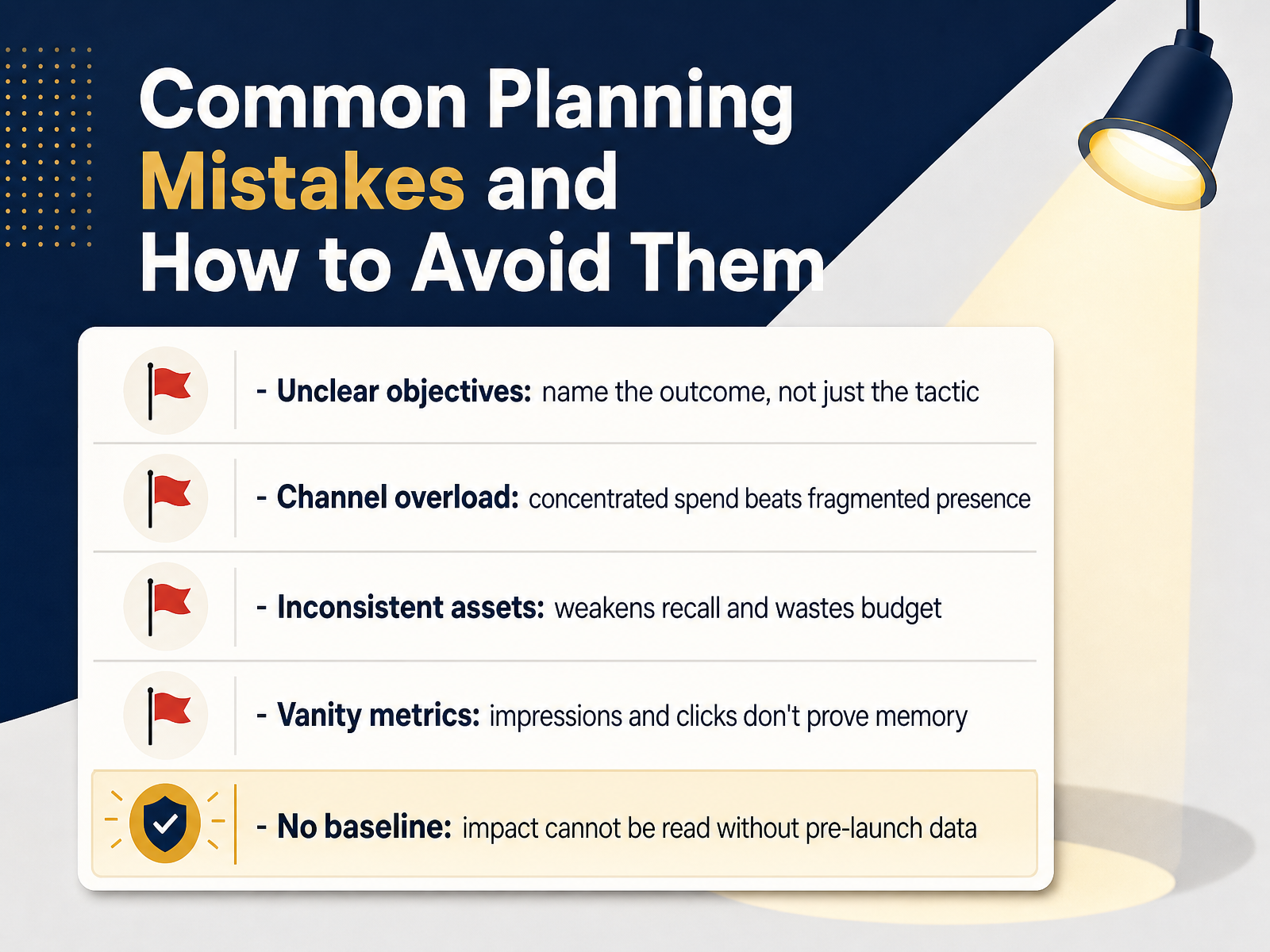
2 min - 12Common Planning Mistakes and How to Avoid ThemNow let's talk about the planning mistakes that quietly drain awareness budgets, because most of them aren't obvious until after launch. The first is unclear objectives. "Run some video ads" is not a goal. Name the outcome you're trying to create, like higher unaided recall or a lift in branded search, not just the tactic. Second, watch out for channel overload. When budgets are tight, spreading spend across too many places creates the illusion of presence without real impact. Concentrated weight in fewer channels usually wins. Third, inconsistent assets. If your look, tone, or message shifts from one platform to the next, you're making it harder for people to encode the brand, and that's wasted money. Fourth, vanity metrics. Impressions and clicks tell you about exposure, not memory. They don't prove anyone will actually remember you later. And fifth, no baseline. If you don't record branded search or direct traffic before launch, you can't read the impact after. So the takeaway is simple. Pick one clear outcome, concentrate your spend, keep your assets consistent, measure memory signals over vanity numbers, and set your baseline early. That mindset sets up the next slide well, because now we need to address the tension between building the brand and chasing performance.
 gwi.commarketingscoop.com2 min
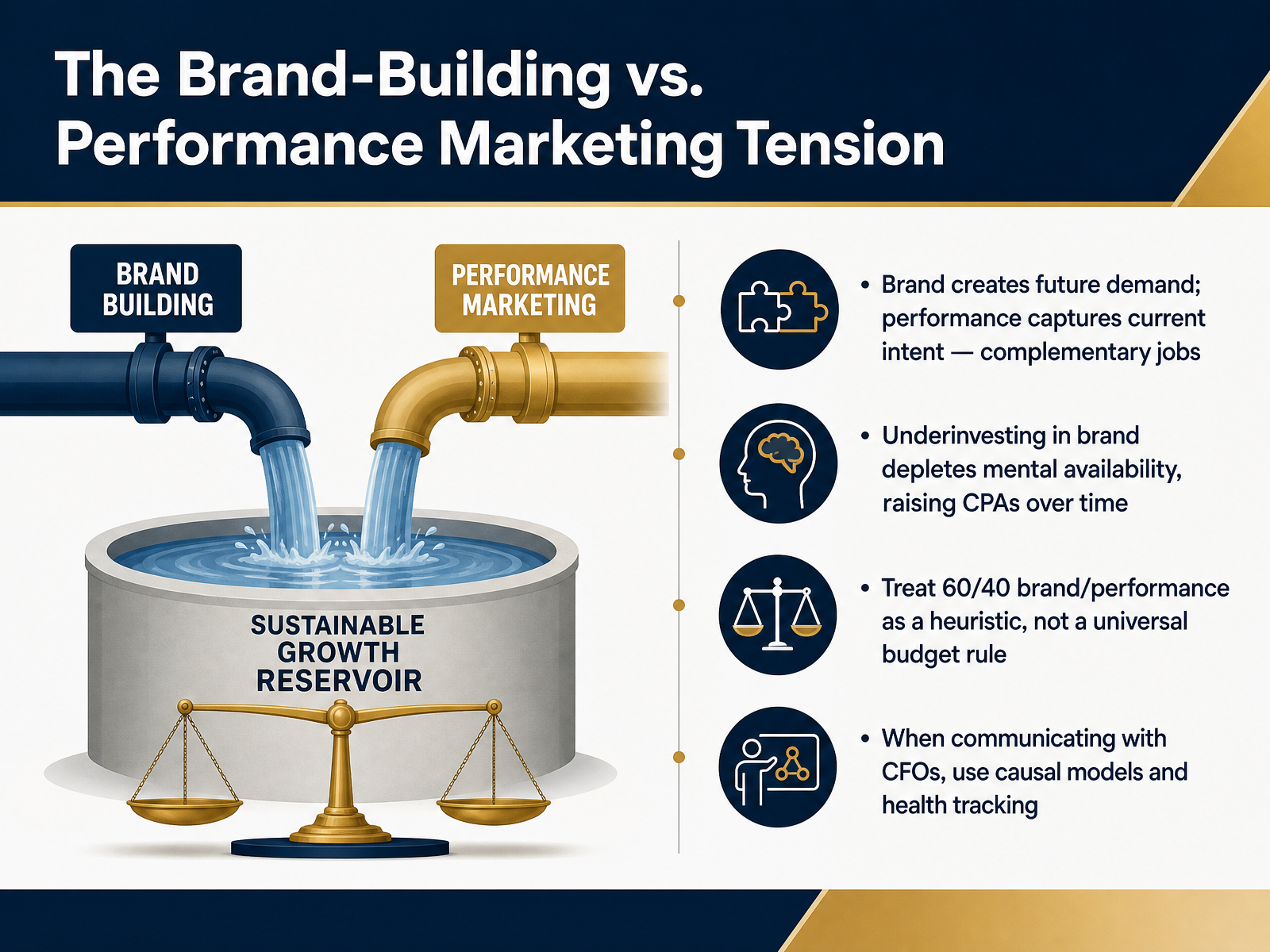
 - 13The Brand-Building vs. Performance Marketing TensionLet’s talk about one of the most persistent tensions you face: the tug-of-war between brand building and performance marketing. The truth is, these aren’t competing forces. They do two complementary jobs. Brand creates future demand, building mental availability so that when a buyer enters the market, your name is already in the room. Performance captures the intent that exists right now. The problem arises when you underinvest in brand. The cost doesn’t show up all at once. It shows up as rising CPAs, a shrinking pool of in-market buyers, and campaigns that have to work harder every single time just to get a click. You have probably seen this play out. Now, you may have heard the sixty-forty split. While it is a useful heuristic from Binet and Field’s research, it is not a universal budget law. It serves as a challenge to extreme short-term bias. Your actual allocation needs to depend on your category, your growth stage, and your cash position. And when you need to defend that allocation to your CFO, do not rely on last-click attribution. Use causal models, incrementality tests, and brand health tracking. You need to show how brand consideration acts as a multiplier on your performance efficiency. Next, let’s look at how to apply this framework directly to your brand.
 hbr.orgstrategus.comdilate.com.au+22 min
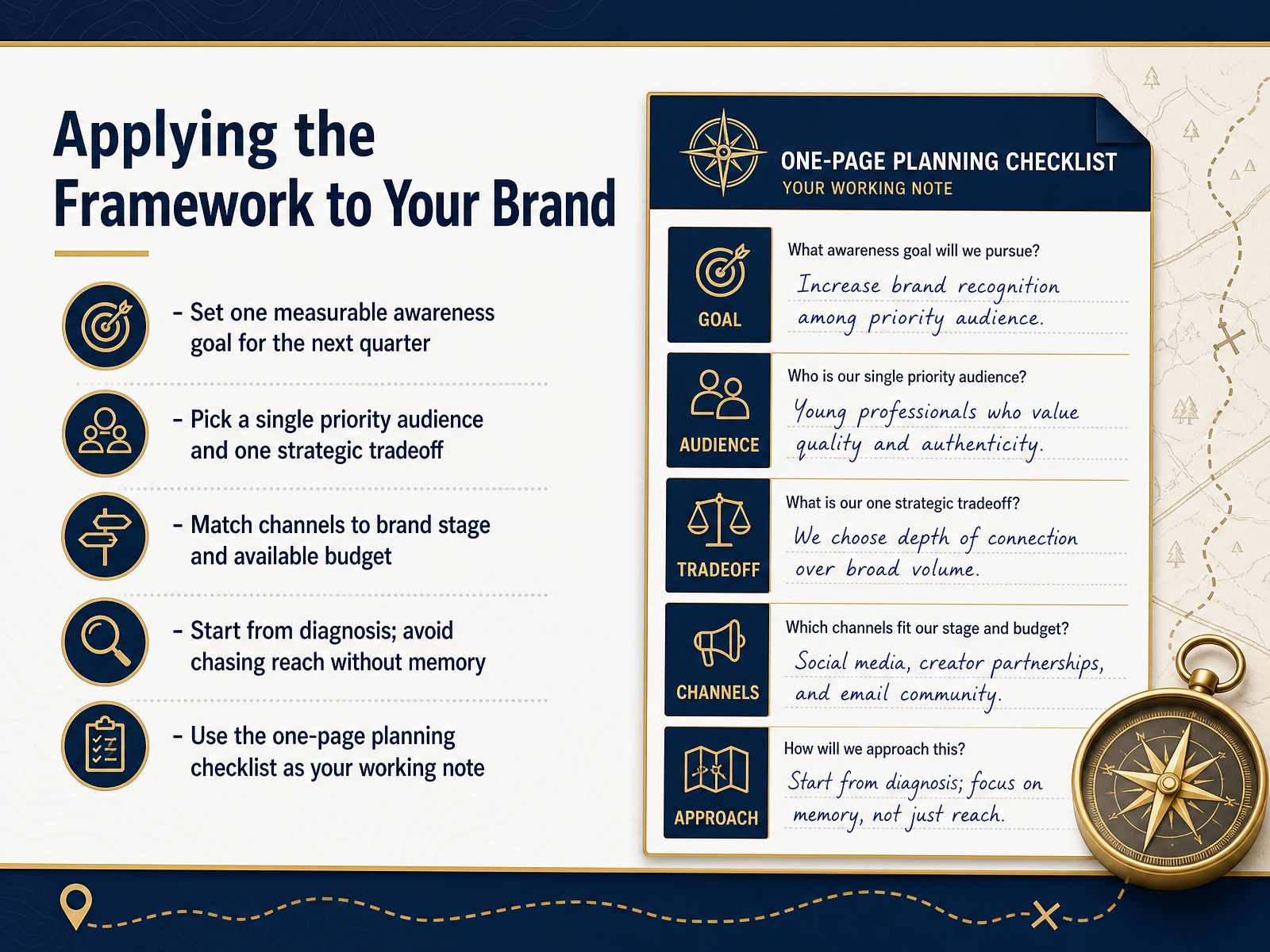
 - 14Applying the Framework to Your BrandSo, how do you apply this framework without letting it become another planning deck that sits on a shelf. Start with one measurable awareness goal for the next quarter. Not three. One. Then pick a single priority audience and name the tradeoff you are willing to make, because trying to reach everyone usually means being remembered by no one. Match your channels to where your brand actually is in its development. A brand that is still building recognition should not spread a small budget across five platforms. Start from diagnosis, not from a creative idea. Reach without memory is just paid noise. Use the one page planning checklist as your working note, revisit it every few weeks, and let it guide the conversations you have with stakeholders. That is the whole game. Set a clear goal, choose one audience, accept one tradeoff, and measure whether people remember you. Thank you for working through this with me. Now take the framework and make one decision today that sharpens your next quarter.
 gwi.commarketingscoop.com2 min
Take the deck with you
Download this course as a file — free, no sign-up needed.
- PDF handoutEvery slide page, ready to print or share.15 pages · 3.6 MBDownload
- Narrated PowerPointThe deck that presents itself — every slide carries the digital human's narration video.15 pages · 17.6 MBDownload
- PowerPoint slidesThe full deck as a .pptx — open it in PowerPoint, Keynote, or Google Slides.15 pages · 3.5 MBDownload
Free to use in your own training — please keep the PersonWise credit page at the end.
Have your own deck? Turn it into a course
Sources consulted
Web sources consulted while building this course.
- Brand Awareness Strategy | GWI — gwi.com
- Brand Awareness: The Ultimate Guide - Qualtrics — qualtrics.com
- A model of brand awareness and brand attitude advertising strategies — onlinelibrary.wiley.com
- Build Strong Brands with the Aaker Brand Equity Model — umbrex.com
- by Kevin Lane KellerBRAND PLANNING — marksherrington.com
- Brand Awareness: How To Measure And Improve It | SurveyMonkey — surveymonkey.com
- Brand awareness — en.wikipedia.org
- Note on Measuring Brand Awareness, Brand Image, Brand Equity and Brand Value — flora.insead.edu
- Brand awareness — en.wikipedia.org
- Brand Awareness Statistics 2026 | 50+ Data Points & Insights | Searchlab — searchlab.nl
- Brand Awareness Campaigns: A 2026 Playbook for Paid Search and Social Before the Click — marketingscoop.com
- Brand Awareness: 4 Levels & How to Measure | Web Tonic™ — webtonic.io
- B2B Paid Awareness Benchmarks: CTR, CPM & CPC Data (Q1 2026) — Refine Labs — refinelabs.com
- Where to Invest Your Brand Marketing Budget in 2026 — meltwater.com
- How Brand Building and Performance Marketing Can Work Together — hbr.org
- What is Reach And Frequency in Advertising: When to Use Each — strategus.com
- How much should you spend on brand vs performance? | Dilate — dilate.com.au
- Brand vs performance marketing: finding the right balance for sustainable growth | Analytical Alley — analyticalalley.com
- FAQ on brand marketing: Measuring what matters as C-Suites demand proof — emarketer.com
- How to Measure Brand Awareness: The 10 Metrics That Matter — semrush.com