Begin
14 pages · ~28 min
Data Science Initiative Planning
This course helps data and business leaders plan a data science initiative, covering goal setting, scoping, and execution for successful outcomes.
A digital instructor presents all 14 pages. Hold “Ask” at any point and ask out loud — the answer comes from this course. No sign-up needed.
What you’ll learn
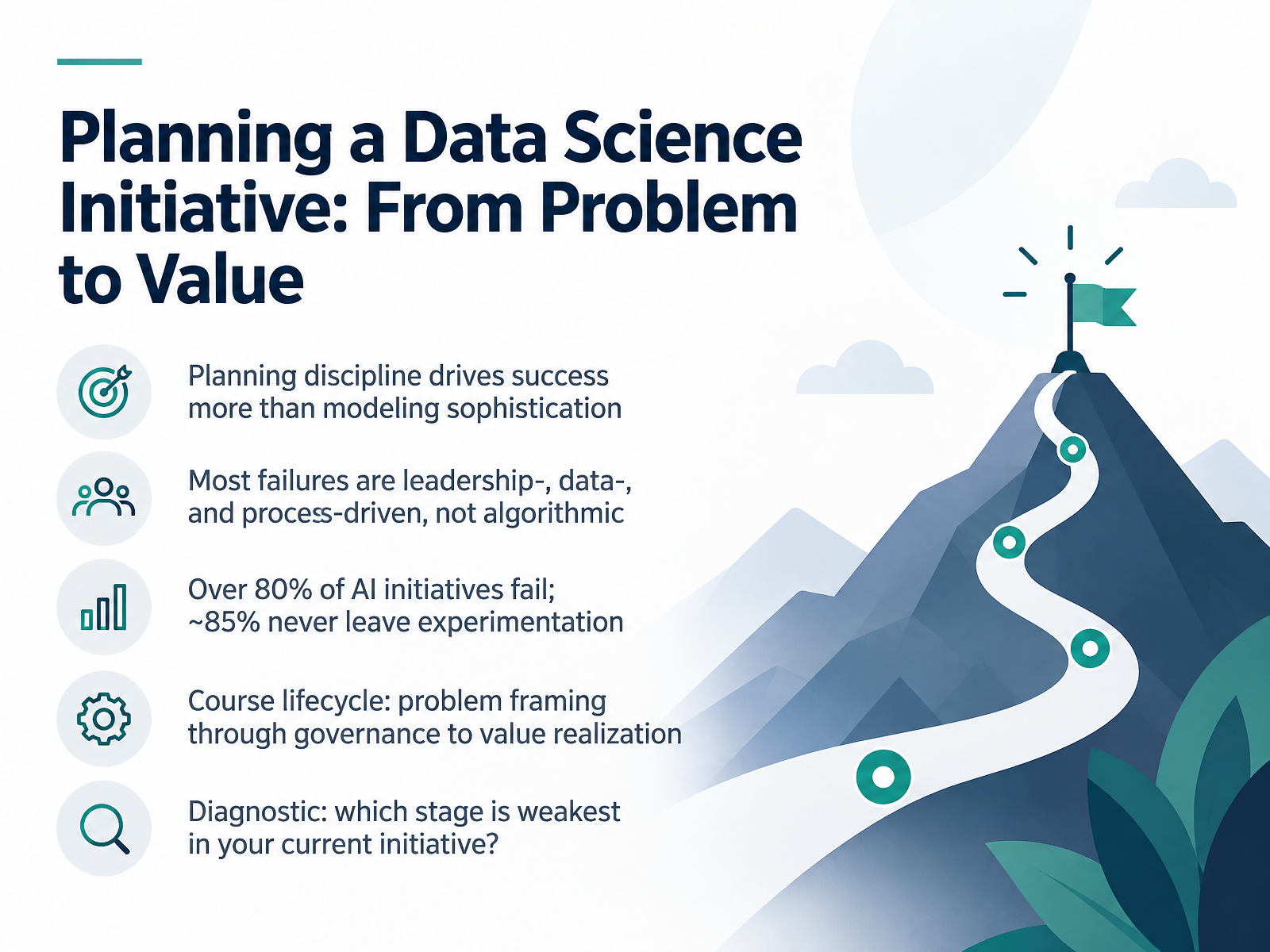
- 01Planning a Data Science Initiative: From Problem to ValueWelcome. Over the next several slides, we are going to work through how to plan a data science initiative, from framing the problem to realizing value. The goal is not to make you a better modeler. It is to help you make scope and feasibility decisions you can defend.
Here is the central claim, and it should shape everything that follows. Planning discipline drives success more than modeling sophistication. The evidence backs this up. In a RAND study of experienced practitioners, leadership-driven and data-driven failures were cited far more often than algorithmic ones. And the headline numbers are sobering. More than eighty percent of AI initiatives fail, and around eighty-five percent never progress beyond experimentation.
We will move through the full lifecycle, from problem framing, through data and governance, to value realization and ongoing operation.
So before we begin, a diagnostic question to hold on to. In your current initiative, which stage is weakest? Be honest about that, because it tells you where to place your first planning effort.
Let us move on to the course map, roles, and working definitions.mdpi.comdoi.orgdoi.org+22 min
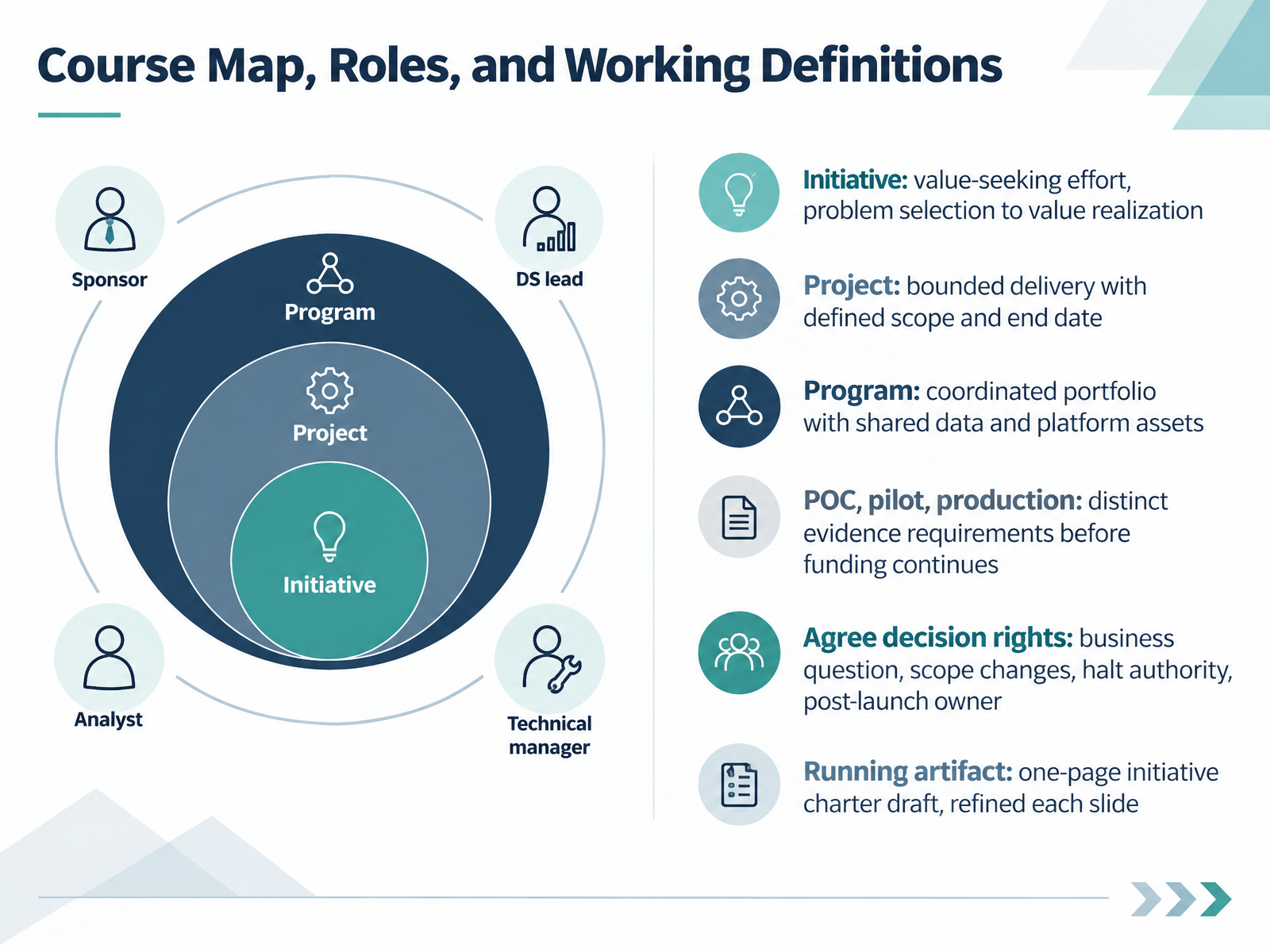
- 02Course Map, Roles, and Working DefinitionsNow let's get aligned on language, roles, and decision rights, because ambiguity here is one of the most common reasons initiatives stall. First, four working definitions. An initiative is a value-seeking effort that runs from problem selection through value realization. It is not the same as a project, which is bounded delivery with a defined scope and end date. A program is a coordinated portfolio, sharing data and platform assets across projects. And POC, pilot, and production are distinct stages, each with its own evidence requirements before funding continues. Second, agree decision rights up front. Who owns the business question, who approves scope changes, who holds halt authority, and who owns the solution after launch. That last role, the post-launch owner, is where many otherwise successful efforts quietly decay. As a running artifact, we will build a one-page initiative charter draft, and refine it at each step. By the end, you should have something you can take to a sponsor. Next, we frame the business problem before the model.
 mdpi.comdoi.orgdoi.org+22 min
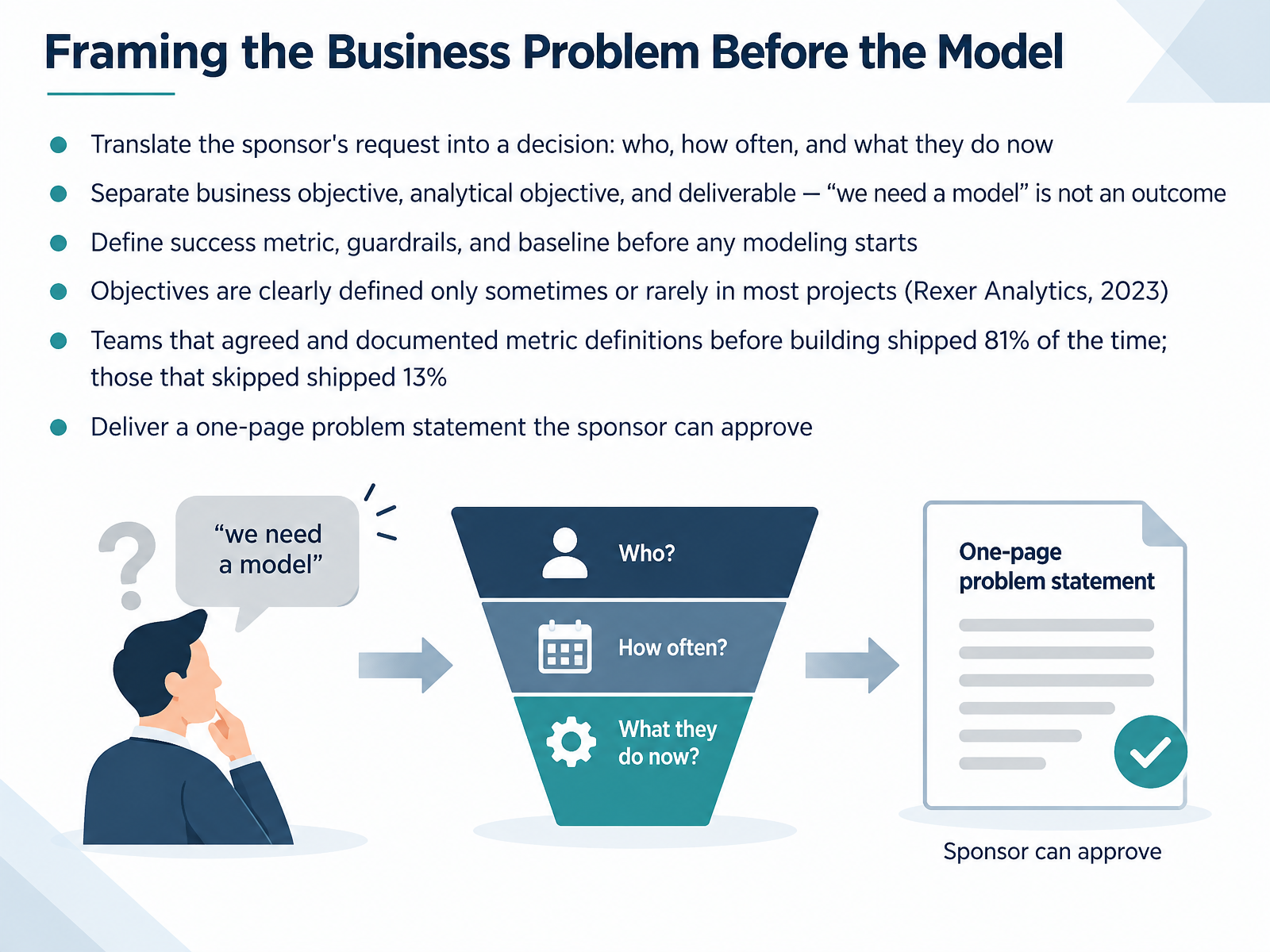
- 03Framing the Business Problem Before the ModelBefore any modeling discussion, we frame the business problem. Start by translating the sponsor's request into a decision. Who makes it, how often, and what do they do today? That last part matters, because you cannot improve a process you cannot describe. Next, separate three things that often get merged: the business objective, the analytical objective, and the deliverable. We need a model is not an outcome. The outcome is fewer fraudulent transactions cleared, or faster claims triage. Then, before modeling starts, define the success metric, the guardrails, and the baseline you are comparing against. This is where most projects quietly go wrong. Rexer Analytics found that only about twenty nine percent of practitioners said objectives were clearly defined most of the time, and twenty six percent said it rarely happened. The payoff for fixing this is large. In one audit of forty seven enterprise engagements, teams that agreed and documented metric definitions before building shipped eighty one percent of the time. Teams that skipped that step shipped thirteen percent. Both figures are observational, but that gap is the largest single difference in the dataset. So the concrete output here is a one page problem statement your sponsor can approve, and that approval should happen before anyone opens a notebook. Let's move on to feasibility and value assessment.
 mdpi.comdoi.orgdoi.org+22 min
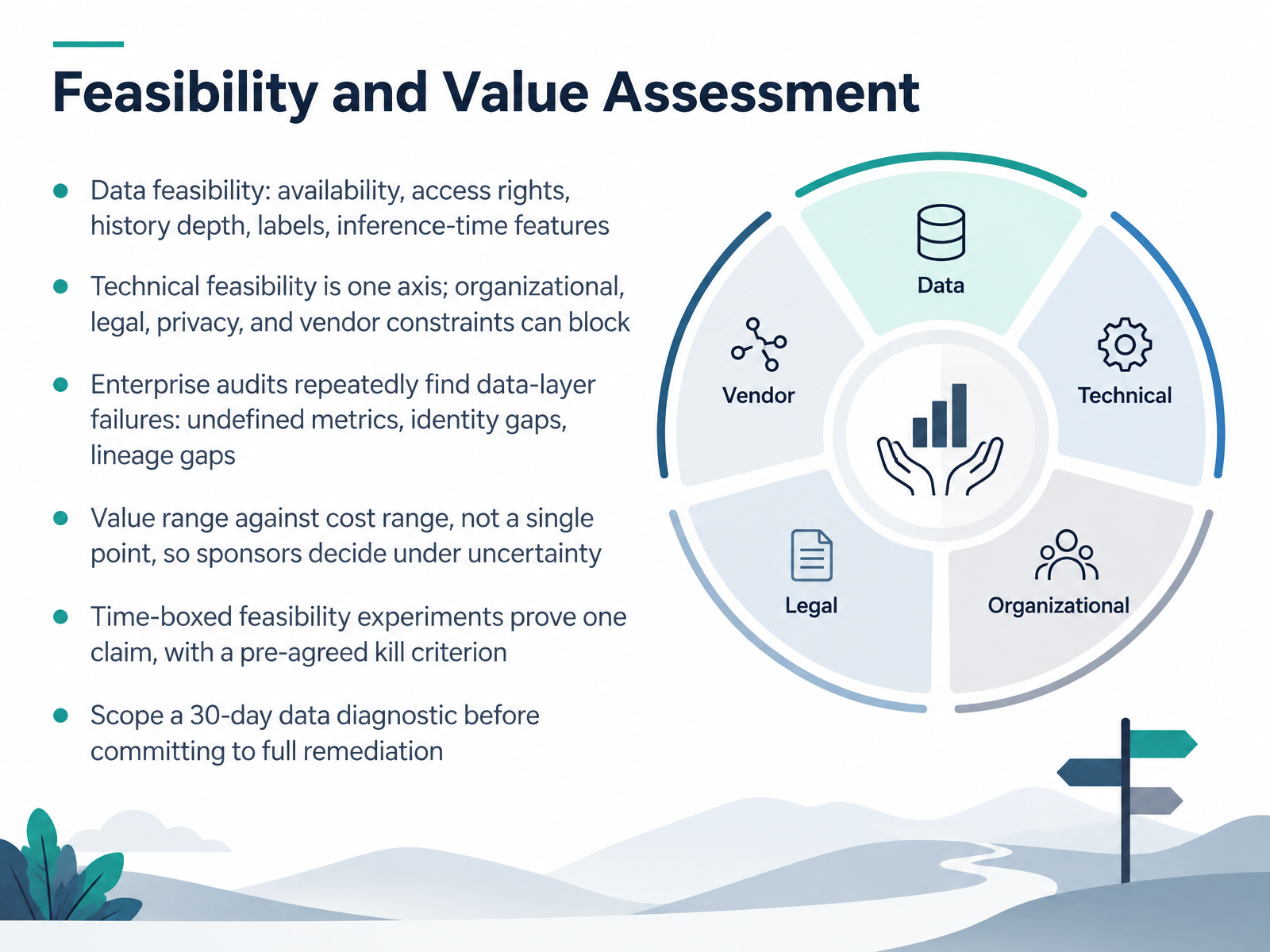
- 04Feasibility and Value AssessmentLet's turn to feasibility and value assessment. Start with data feasibility, and treat it as five separate questions. Is the data available, do we have the rights to use it, how deep is the history, are there labels, and can we compute the same features at inference time? That last one quietly kills projects, because a feature that only exists in the training warehouse is not available in production. Technical feasibility is only one axis. Organizational, legal, privacy, and vendor constraints can block a project that is technically sound, so validate those before you commit budget. Enterprise audits keep finding the same data-layer failures: undefined metrics, identity gaps, and lineage gaps at inference time. Value should be expressed as a range against a cost range, not a single number, so sponsors can decide under uncertainty. Run time-boxed feasibility experiments that prove one claim each, with a kill criterion agreed in advance. And scope a thirty-day data diagnostic before committing to full remediation. Now let's talk about scoping into value-bearing increments.
 mdpi.comdoi.orgdoi.org+21 min
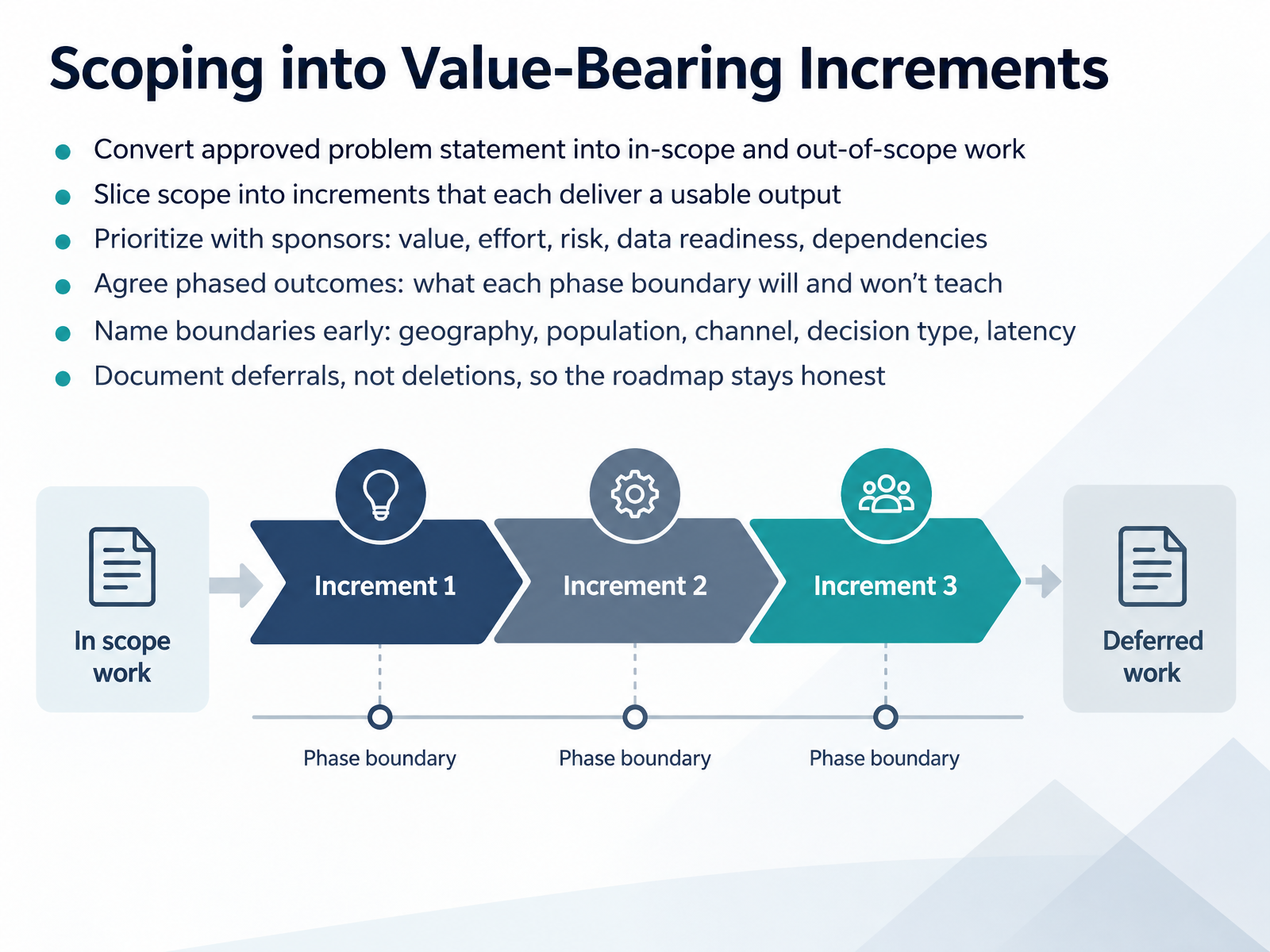
- 05Scoping into Value-Bearing IncrementsLet's walk through scoping into value-bearing increments. Once a problem statement is approved, your first job is converting it into explicit in-scope and out-of-scope work. Then slice that scope into increments where each one delivers a usable output, not a partial model. Prioritize those increments jointly with sponsors against value, effort, risk, data readiness, and dependencies. Notice data readiness sits in that list. In a study of forty-seven enterprise engagements, roughly seventy-five percent never reached production, and the model was almost never the blocker. The data layer was. Teams that spent six to eight weeks settling metric definitions before building shipped about eighty-one percent of the time, against thirteen percent for those that skipped it. So agree phased outcomes: what each phase boundary will and will not teach you. Name boundaries early, including geography, population, channel, decision type, and latency. And document deferrals rather than deletions, so the roadmap stays honest. Next, we move to Data Foundation, Governance, and Compliance Constraints.
 mdpi.comdoi.orgdoi.org+22 min
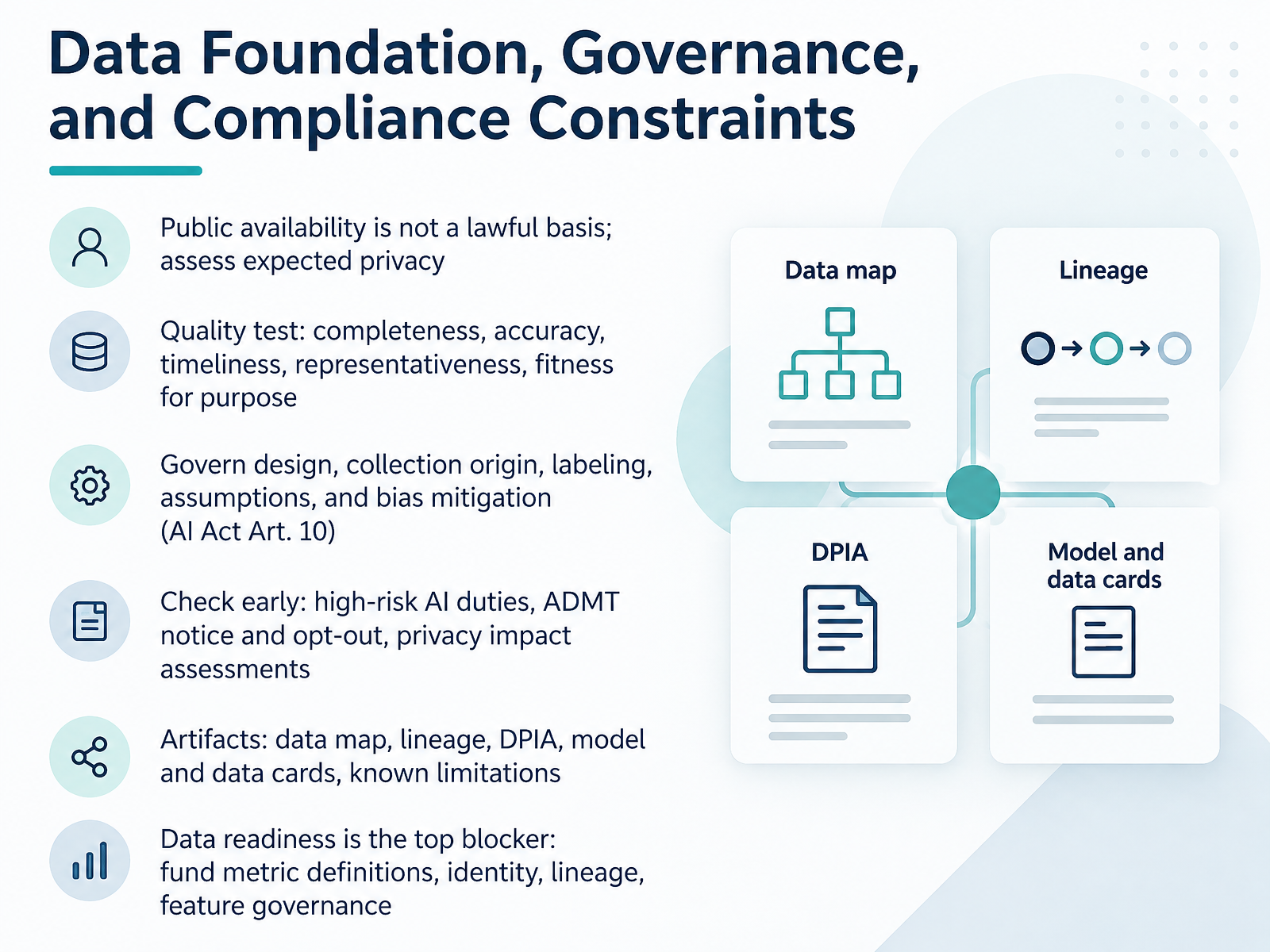
- 06Data Foundation, Governance, and Compliance ConstraintsNow let's talk about the constraints that decide feasibility before any modeling begins: data foundation, governance, and compliance. Start here. Public availability is not a lawful basis. You still have to assess the data subject's reasonable expectations of privacy, and that assessment changes scope and cost. Next, apply a quality test: completeness, accuracy, timeliness, representativeness, and fitness for purpose. Poor data quality remains one of the most cited causes of data science failure, so treat it as a gating criterion, not a cleanup task. If you are in scope for high-risk AI, Article 10 requires governance across design choices, collection origin, labeling, assumptions, and bias mitigation, documented and auditable. Check duties early: high-risk obligations, automated decision-making notice and opt-out rights, and privacy impact assessments. Build artifacts as you go: a data map, lineage, a DPIA, model and data cards, and known limitations. In practice, data readiness is the top blocker. Fund metric definitions, identity resolution, lineage, and feature governance up front. Settle definitions before model work, or expect delays you cannot recover. With that foundation set, let's turn to the team that will own it: Team, Roles, and Operating Model.
 ai-act-service-desk.ec.europa.euico.org.ukaesia.digital.gob.es+22 min
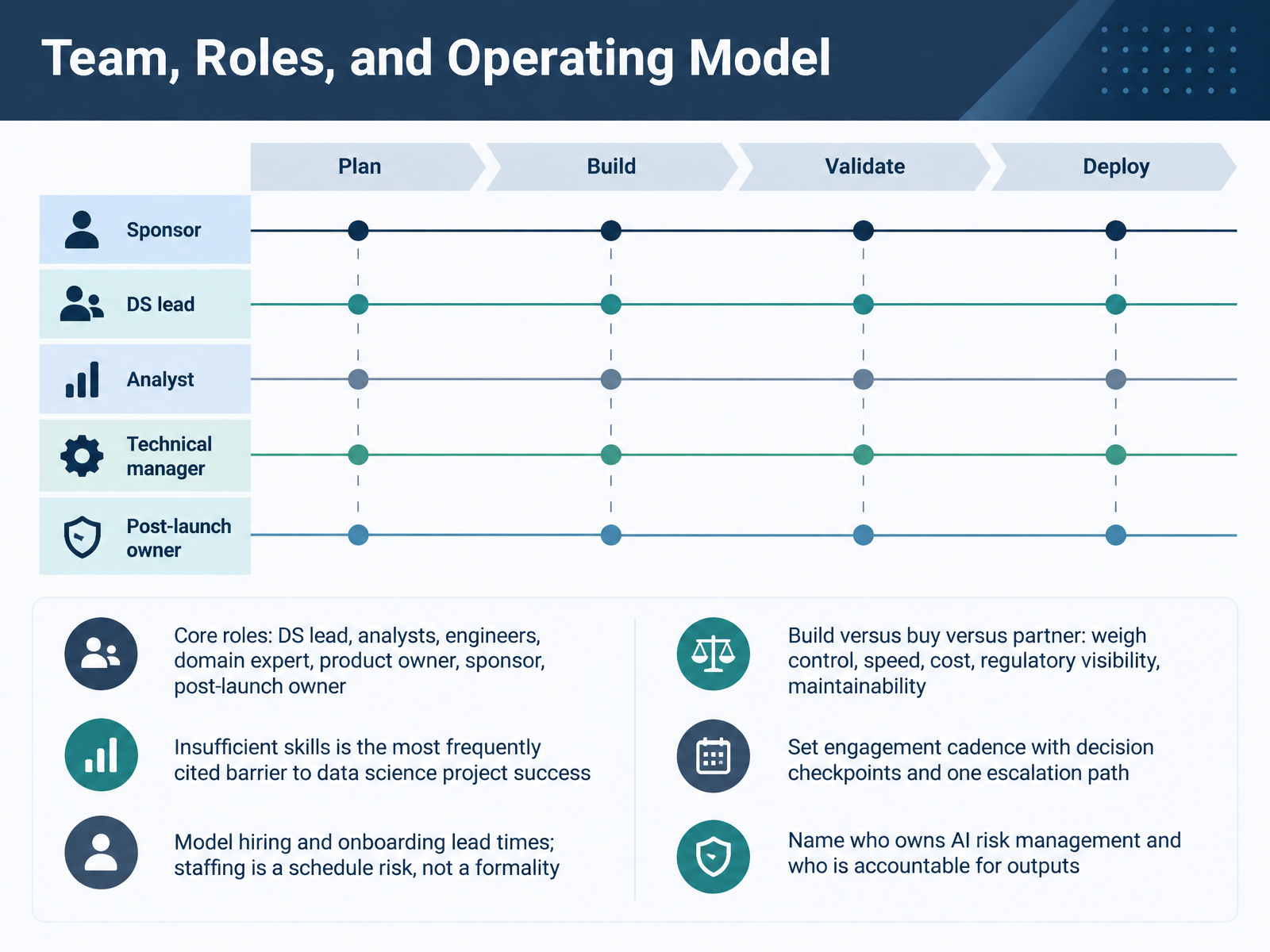
- 07Team, Roles, and Operating ModelLet's turn to team, roles, and operating model. Start with the core roles: a data science lead, analysts, engineers, a domain expert, a product owner, a sponsor, and a named post-launch owner. That last one matters. Ambiguous post-deployment ownership is a common governance pitfall, so decide now who owns the model after go-live. Insufficient skills is the most frequently cited barrier to data science project success, cited in twenty of the twenty-six studies in that systematic review. Treat staffing as a schedule risk, not a formality. Model hiring and onboarding lead times explicitly. Then weigh build versus buy versus partner on control, speed, cost, regulatory visibility, and maintainability. Set an engagement cadence with decision checkpoints and one escalation path, and name who owns AI risk management and who is accountable for outputs. Next, we move to milestones, estimating under uncertainty, and risk controls.
 mdpi.comdoi.orgdoi.org+21 min
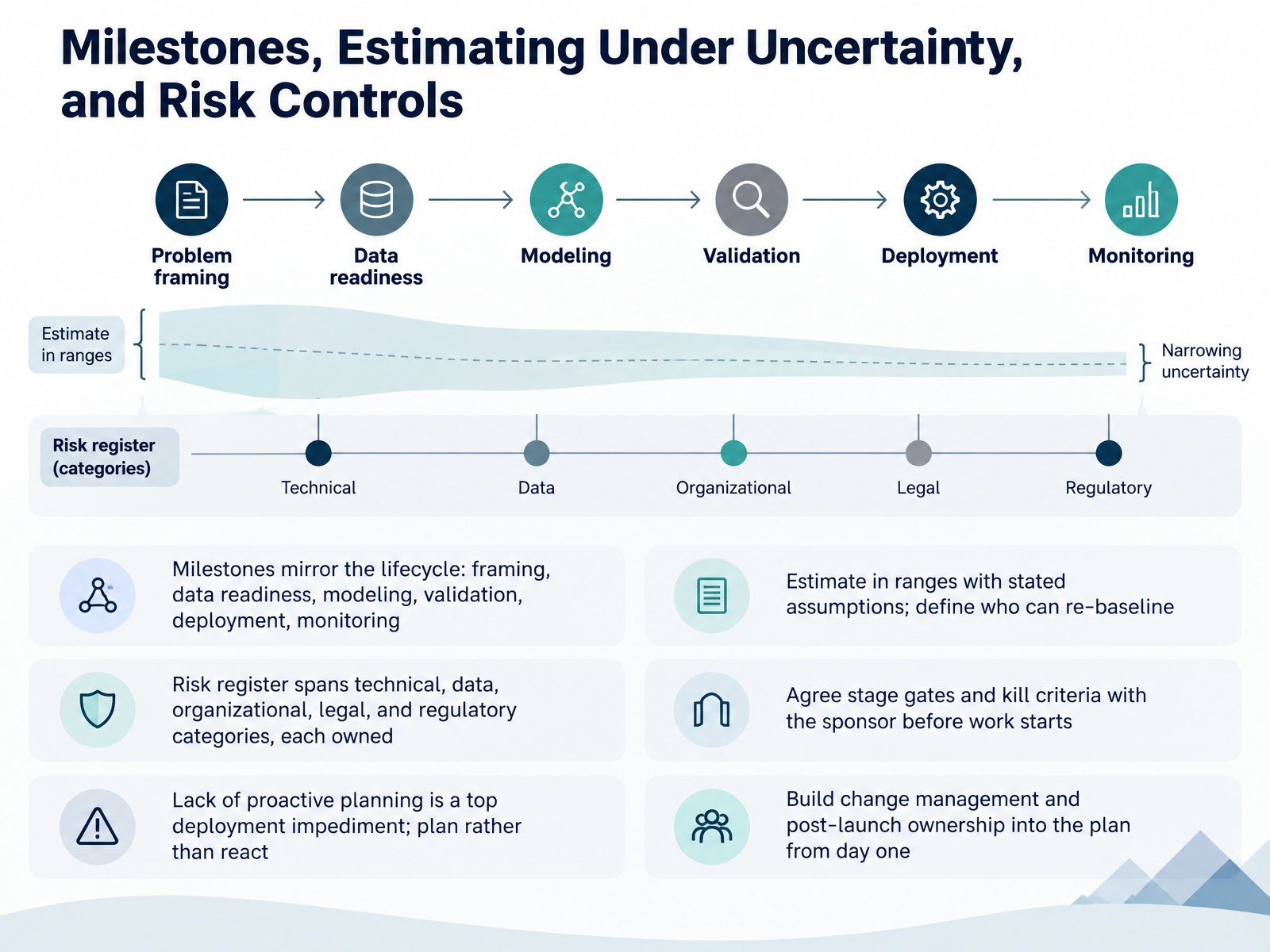
- 08Milestones, Estimating Under Uncertainty, and Risk ControlsNow let's make the plan defensible. Set milestones that mirror the lifecycle: framing, data readiness, modeling, validation, deployment, monitoring. At each one, ask what evidence proves the gate is passed.
Estimate in ranges, not points, and write down the assumptions behind them. Say explicitly who can re-baseline, and under what conditions.
Stand up a risk register that spans technical, data, organizational, legal, and regulatory categories, with a named owner for each. And agree your stage gates and kill criteria with the sponsor before work starts, not after a bad quarter.
This matters because the research is consistent. In one survey, the top impediments to deployment were a lack of proactive planning and unclear ownership. Across enterprise audits, roughly three in four stalled projects had a data-layer problem, not a model problem. So build change management and post-launch ownership into the plan from day one.
Next, we'll look at evaluation, deployment, and MLOps readiness.
 mdpi.comdoi.orgdoi.org+21 min
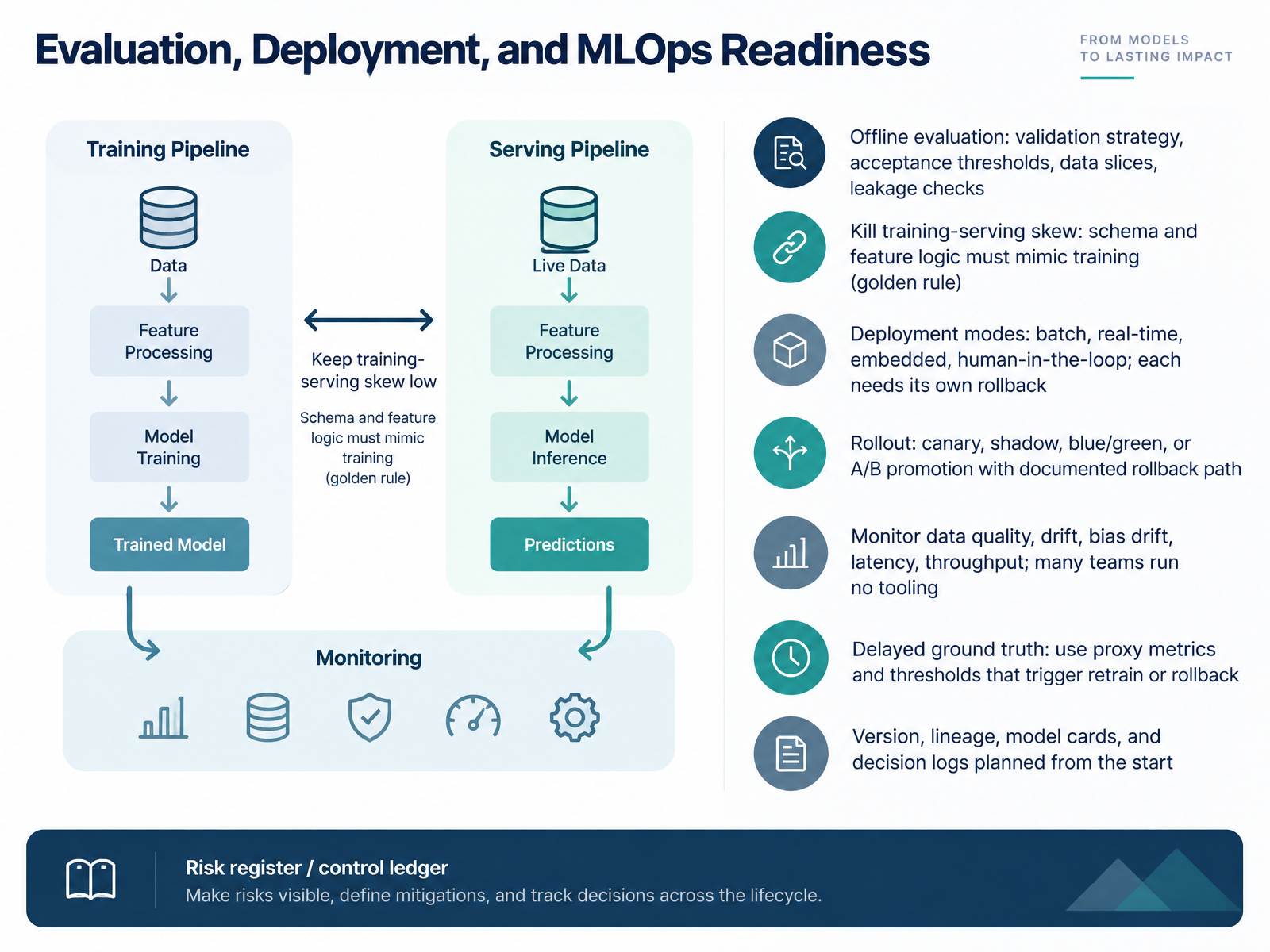
- 09Evaluation, Deployment, and MLOps ReadinessLet's move to evaluation, deployment, and MLOps readiness, because this is where most initiatives quietly fail. Start with offline evaluation. You need a validation strategy that mirrors production, acceptance thresholds agreed before you see results, and performance broken out by data slices. Then run explicit leakage checks, confirming that ground truth labels never entered your training features. The golden rule is that training and serving must mimic each other as closely as possible, since schema or feature skew between the two will silently corrupt predictions. Deployment mode matters just as much. Batch, real-time, embedded, and human-in-the-loop each carry different rollback mechanics, and each needs its own documented rollback path. For rollout, choose canary, shadow, blue/green, or A/B promotion, and validate thresholds before you scale traffic. In production, monitor data quality, drift, bias drift, latency, and throughput, because many teams are still running no tooling at all. When ground truth is delayed, fall back on proxy metrics with thresholds that trigger retraining or rollback. Finally, plan versioning, lineage, model cards, and decision logs from the start. Next, we turn to cost, benefit, and the business case.
 docs.aws.amazon.comdocs.aws.amazon.comdevelopers.google.com+22 min
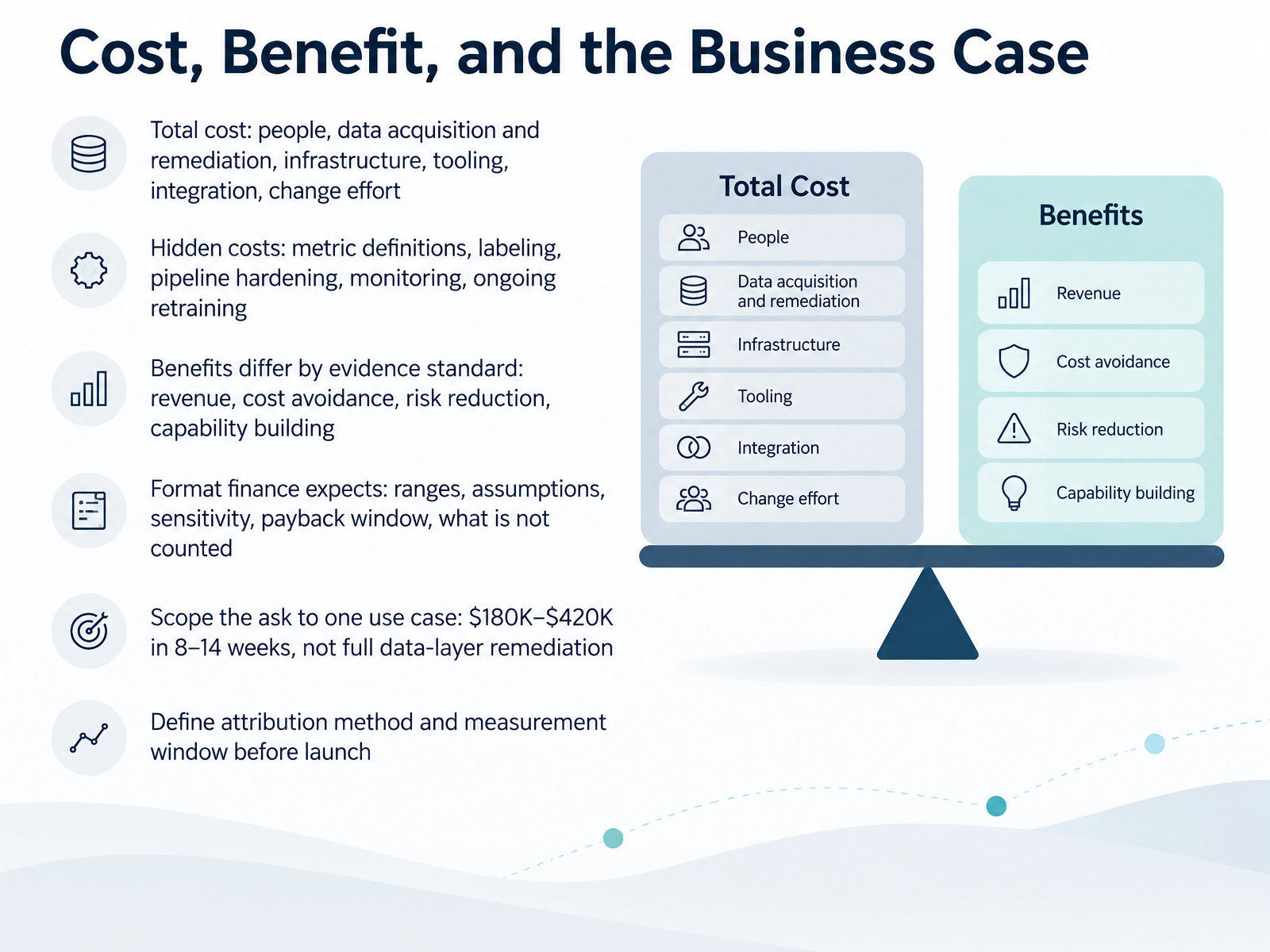
- 10Cost, Benefit, and the Business CaseLet's talk about the numbers, because this is where good initiatives get quietly killed. Build the total cost from six lines: people, data acquisition and remediation, infrastructure and tooling, integration work, and the change effort itself. Then add the hidden costs practitioners consistently miss. Metric definitions, labeling, pipeline hardening, monitoring, and retraining. One audit of forty seven enterprise engagements found the model was almost never the blocker. The data layer was, and stalled projects had absorbed roughly four point two million dollars each before being abandoned. On benefits, be explicit about your evidence standard. Revenue claims need attribution. Cost avoidance and risk reduction need a baseline. Capability building is real, but label it as such. Finance expects ranges, stated assumptions, sensitivity, a payback window, and a list of what you are not counting. And scope the ask to one use case. About one hundred eighty thousand to four hundred twenty thousand dollars in eight to fourteen weeks, not full data layer remediation, which runs six to twelve months and far more. Finally, define your attribution method and measurement window before launch, not after. That single decision protects both the budget and your credibility. Next, Governance, Risk Materiality, and Approval Package.
 mdpi.comdoi.orgdoi.org+22 min
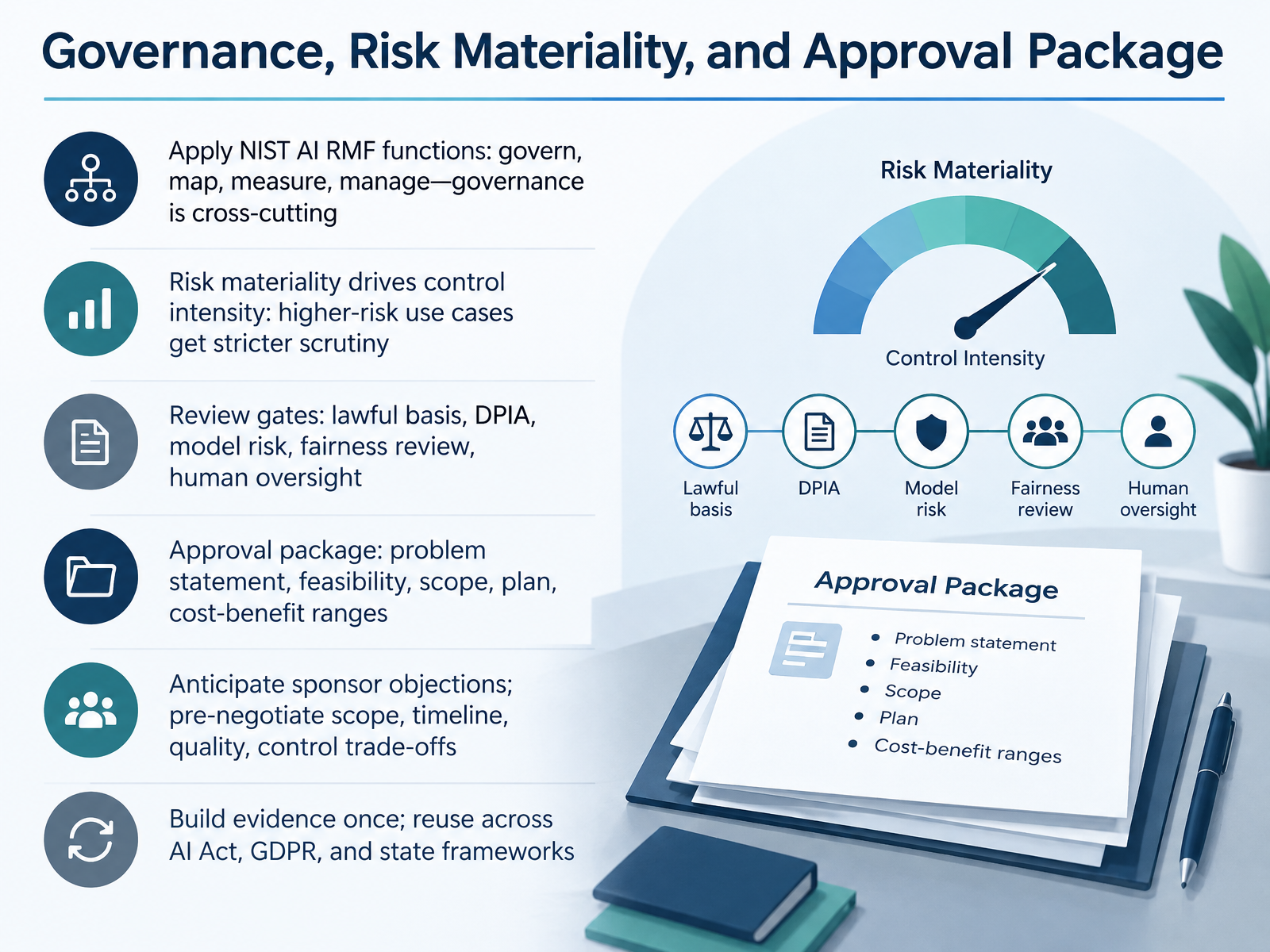
- 11Governance, Risk Materiality, and Approval PackageLet's turn to governance, risk materiality, and the approval package itself. Start with the NIST AI Risk Management Framework functions: govern, map, measure, and manage. Govern is cross-cutting. It sets risk tolerance, accountability, and documentation standards that every other function inherits. So budget for governance capacity, not just model work. Next, risk materiality drives control intensity. A credit-scoring model and an internal summarization tool should not face the same review depth. Higher materiality means stricter scrutiny, more evidence, and slower gates. Then review gates: lawful basis, data protection impact assessment, model risk review, fairness review, and human oversight. Each gate should have a named owner and a defined artifact, so approval is a decision, not a conversation. Your approval package needs six things: problem statement, feasibility, scope, plan, cost-benefit ranges, and anticipated sponsor objections, because scope, timeline, quality, and control trade-offs should be pre-negotiated, not discovered late. And build evidence once. Reuse the same artifacts across the AI Act, GDPR, and state frameworks. That is where feasibility cost drops. Next, Value Realization and Post-Launch Ownership.
 nist.govairc.nist.govlearn.microsoft.com+22 min
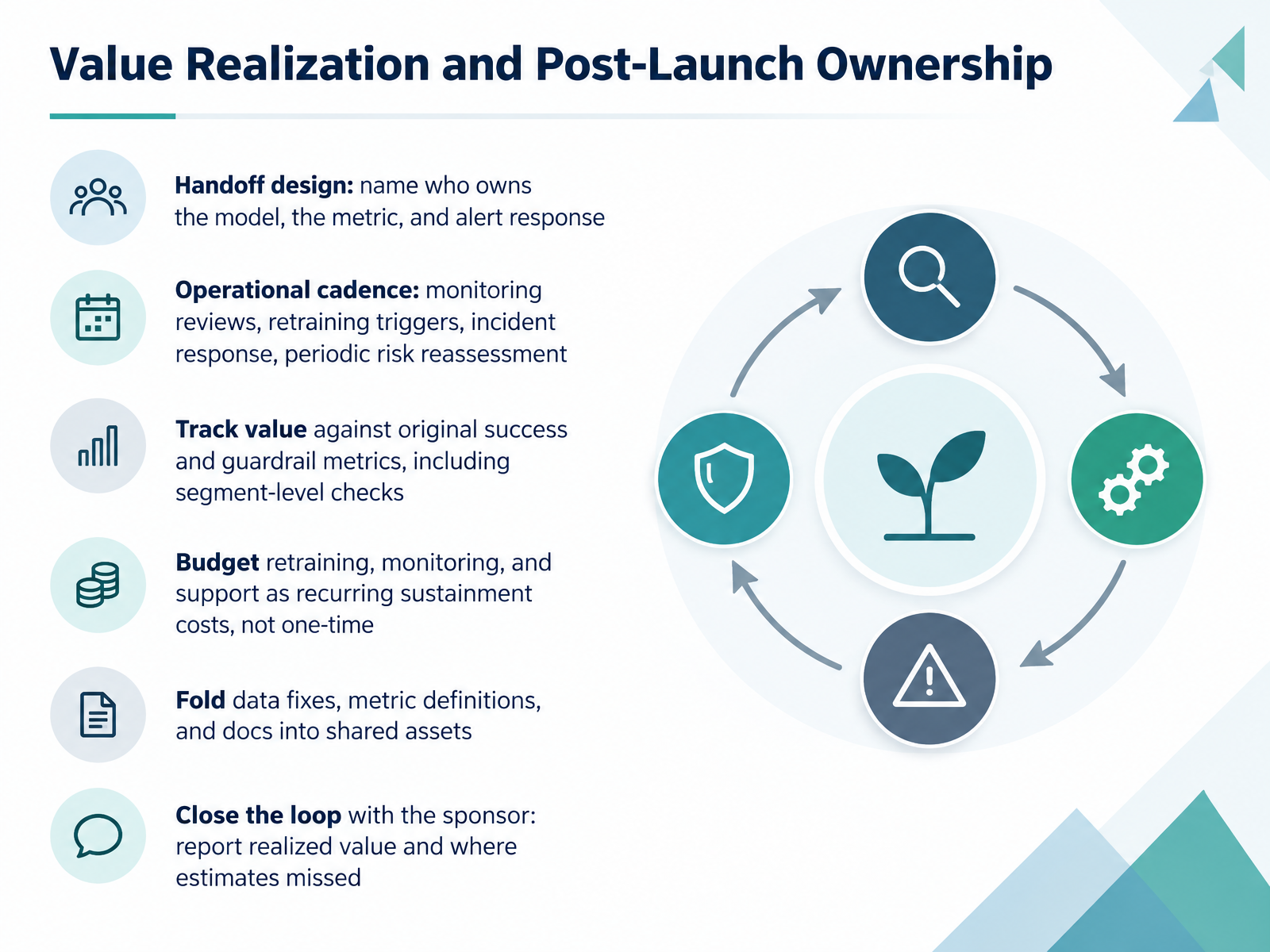
- 12Value Realization and Post-Launch OwnershipLet's turn to value realization and post-launch ownership. Launch is not the finish line, and the handoff is where initiatives quietly fail. Design it explicitly. Name who owns the model, who owns the business metric, and who responds when an alert fires. If nobody owns the alert, you don't have monitoring, you have dashboards. Then set an operational cadence: scheduled monitoring reviews, defined retraining triggers, incident response, and periodic risk reassessment, ideally quarterly for higher-risk models. Track realized value against your original success and guardrail metrics, including segment-level checks. Aggregate stability can hide a single high-value segment degrading. Also budget monitoring, retraining, and support as recurring sustainment costs, not one-time build costs. Fold data fixes, metric definitions, and documentation into shared assets. And close the loop with the sponsor: report realized value and where your estimates missed. Next, common failure modes and planning anti-patterns.
 docs.aws.amazon.comdocs.aws.amazon.comdevelopers.google.com+21 min
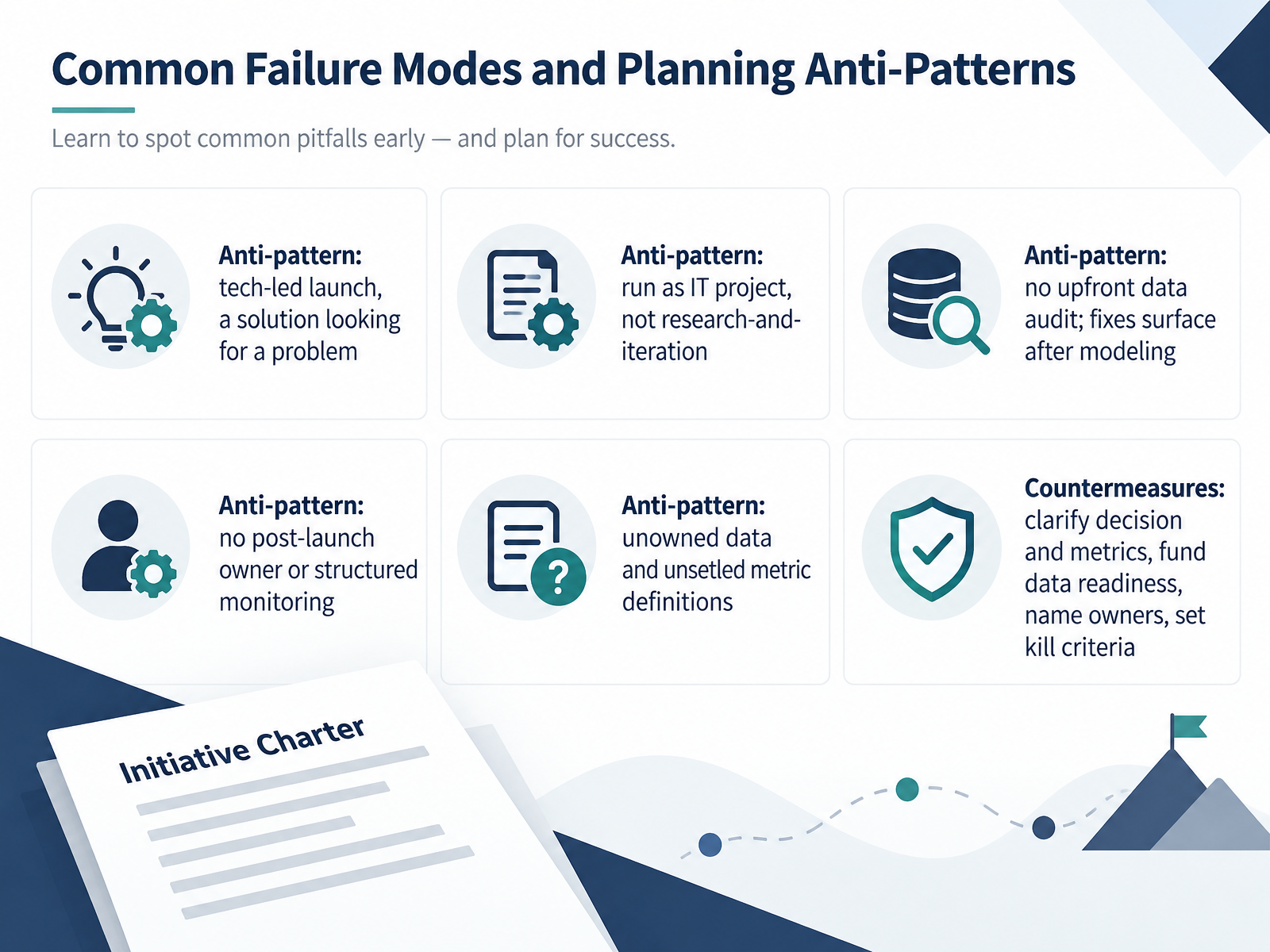
- 13Common Failure Modes and Planning Anti-PatternsLet's walk through the failure modes that derail these initiatives, because they're predictable and, more importantly, avoidable. First anti-pattern: a technology-led launch. That's the solution looking for a problem. The evidence here is blunt. RAND's interviews with experienced practitioners found leadership-driven failures, where the problem and the metric were never clearly communicated, were the single most common root cause, cited by roughly eighty-four percent. Second: running this as an IT project rather than research and iteration. Data science is exploratory by nature. If your plan assumes a fixed scope and a single delivery date, you're building in the wrong assumptions. Third: no upfront data audit. In one review of forty-seven enterprise engagements, about seventy-five percent never reached production, and the blocker was almost never the model. It was the data layer underneath. Teams that spent six to eight weeks settling metric definitions shipped about eighty-one percent of the time. Teams that skipped that step, thirteen percent. Fourth: no post-launch owner and no structured monitoring. Ambiguous ownership and unstructured monitoring are consistently cited as governance pitfalls that draw regulatory scrutiny. Fifth: unowned data and unsettled metric definitions. The countermeasures are the same list, inverted. Clarify the decision and the metrics. Fund data readiness as a line item, not an afterthought. Name a single accountable owner. And set kill criteria before you start, so a dead project can actually be stopped. In the next segment, we'll put all of this into practice in the workshop: Building the One-Page Initiative Plan.
 mdpi.comdoi.orgdoi.org+22 min
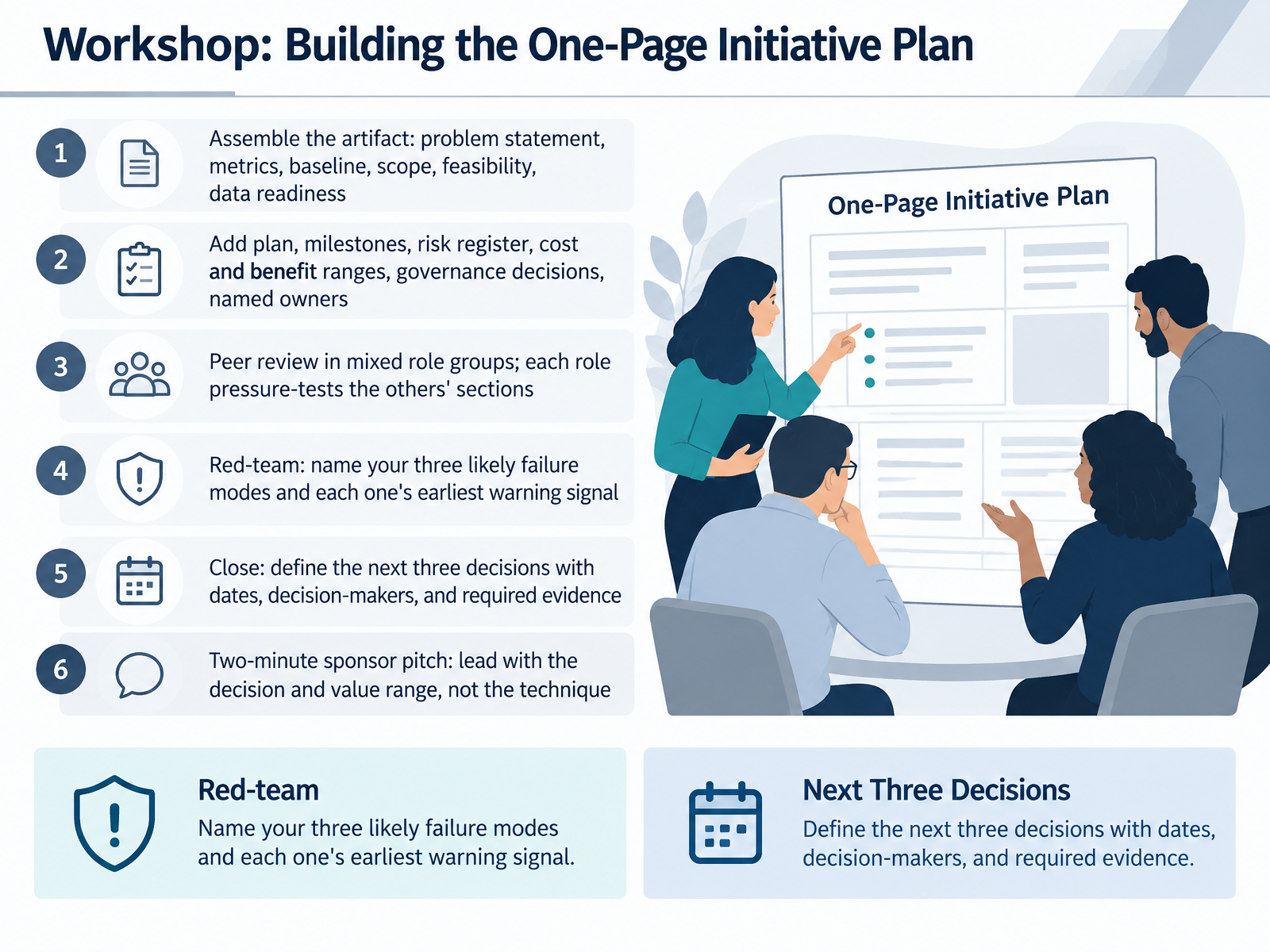
- 14Workshop: Building the One-Page Initiative PlanLet's bring this all together in the workshop. As we close, you're assembling a one-page plan, and brevity is doing real analytical work. Force the problem statement, target metric, baseline, scope, feasibility, and data readiness onto a single page. What you cannot fit is usually what you have not decided. Then add the plan, milestones, risk register, cost and benefit ranges, governance decisions, and named owners. Every risk needs a name beside it, or it is not a risk, it is a wish. Now stress-test it. Peer review in mixed-role groups works because each role catches what the others miss. Data scientists ask whether the metric is computable; architects ask whether the pipeline holds; legal and compliance ask about lawful basis and data protection. Then red-team: name your three most likely failure modes and each one's earliest warning signal. State them as observable triggers, not hazards. Say what you will see first, and who checks. Close by defining the next three decisions, each with a date, a decision-maker, and the required evidence. That is how you convert optimism into a schedule. And before you present, practice the two-minute sponsor pitch. Lead with the decision requested and the value range, not the technique. If you cannot state the decision in the first sentence, you are not ready. Thank you for working through this with me, and good luck with your plans. You now have the structure to make them defensible.
 mdpi.comdoi.orgdoi.org+22 min
Take the deck with you
Download this course as a file — free, no sign-up needed.
- PDF handoutEvery slide page, ready to print or share.15 pages · 3.2 MBDownload
- Narrated PowerPointThe deck that presents itself — every slide carries the digital human's narration video.15 pages · 16.1 MBDownload
- PowerPoint slidesThe full deck as a .pptx — open it in PowerPoint, Keynote, or Google Slides.15 pages · 3.2 MBDownload
Free to use in your own training — please keep the PersonWise credit page at the end.
Have your own deck? Turn it into a course
Sources consulted
Web sources consulted while building this course.
- Data Science Project Barriers—A Systematic Review — mdpi.com
- From data to impact: a multivocal review of success factors and criteria for data science projects — doi.org
- Institutional Factors That Impact the Success of Big Data Science Projects — doi.org
- The Root Causes of Failure for Artificial Intelligence Projects and How They Can Succeed: Avoiding the Anti-Patterns of AI | RAND — rand.org
- WHY DO ANALYTICS AND AI PROJECTS FAIL? — mbs.edu
- Article 10: Data and data governance | AI Act Service Desk — ai-act-service-desk.ec.europa.eu
- About this guidance | ICO — ico.org.uk
- Date of publication: XXXXX, XX XXXX — aesia.digital.gob.es
- Generative AI and the EUDPR. Orientations for ensuring data protection compliance when using Generative AI systems. — edps.europa.eu
- Data Privacy AI Regulatory and Compliance Update 2026 — kasowitz.com
- AWS Prescriptive Guidance - Evaluating your ML project with the MLOps checklist — docs.aws.amazon.com
- MLOPS01-BP03 Monitor model adherence to business requirements - Machine Learning Lens — docs.aws.amazon.com
- Production ML systems: Monitoring pipelines | Machine Learning | Google for Developers — developers.google.com
- Productionization | Machine Learning | Google for Developers — developers.google.com
- https://docs.aws.amazon.com/wellarchitected/latest/machine-learning-lens/mlops06-bp02.html — docs.aws.amazon.com
- AI Risk Management Framework | NIST — nist.gov
- AI RMF Core - AIRC — airc.nist.gov
- Govern AI - Cloud Adoption Framework | Microsoft Learn — learn.microsoft.com
- Governing AI Across its Lifecycle: A Framework for Risk Practitioners — isaca.org
- AI Risk Management Toolkit: guidance - GOV.UK — gov.uk