Begin
14 pages · ~28 min
English Paraphrasing and Summarizing Skills
This training helps English learners paraphrase and summarize effectively, building the skills to restate ideas clearly and concisely in their own words.
A digital instructor presents all 14 pages. Hold “Ask” at any point and ask out loud — the answer comes from this course. No sign-up needed.
What you’ll learn
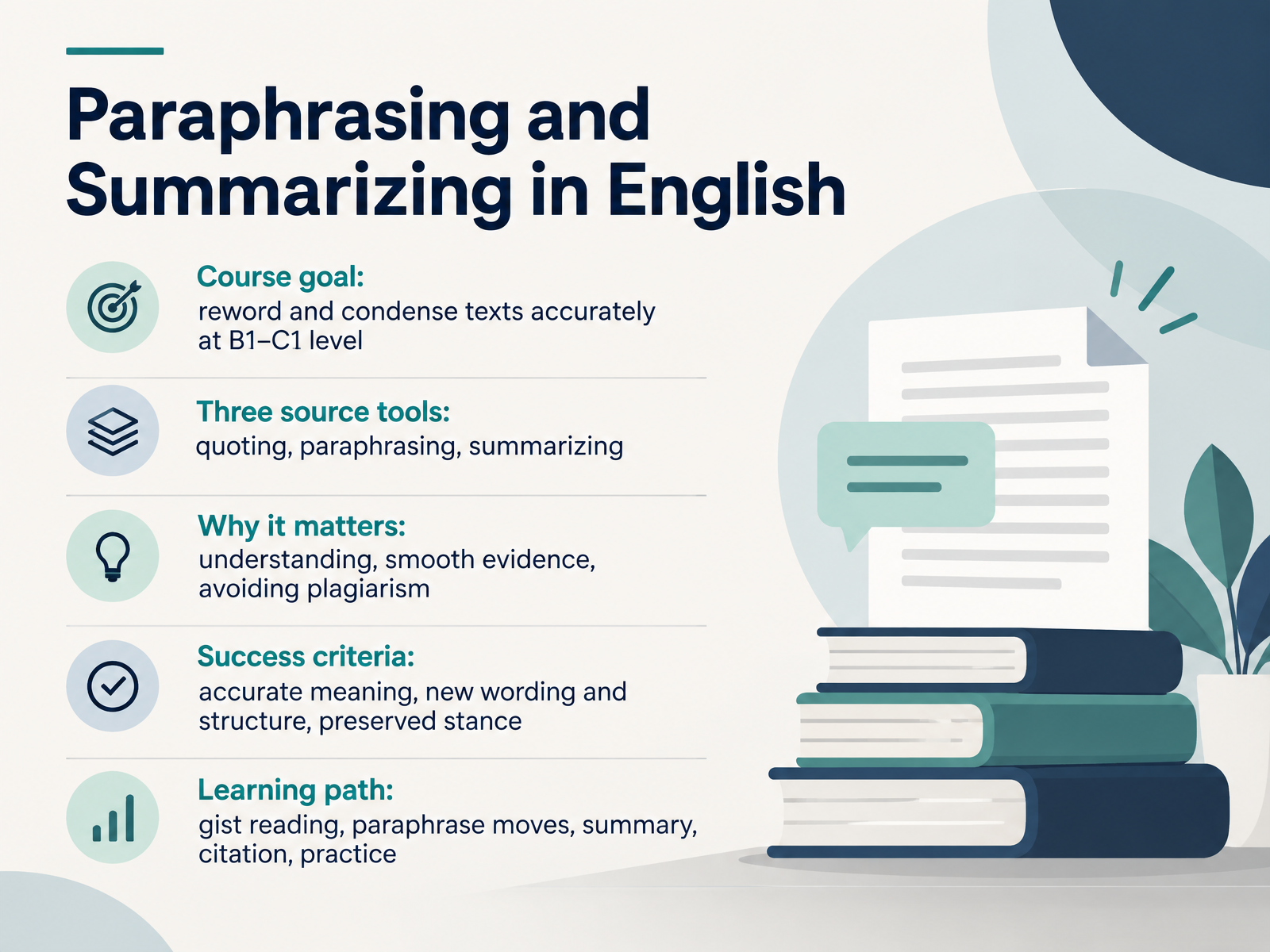
- 01Paraphrasing and Summarizing in EnglishWelcome. Today we're building a skill you'll use in almost every essay, report, and workplace document: rewording and condensing English texts accurately. This course is designed for B1 to C1 learners, so the pace should suit you well. Our goal is simple. By the end, you'll be able to take a source text and restate it, or shorten it, without losing its meaning. You have three main tools for working with sources: quoting, paraphrasing, and summarizing. These matter for three reasons. They help you understand what you read. They let your evidence flow smoothly. And they help you avoid plagiarism. We'll measure success in three ways: the meaning stays accurate, the wording and structure are genuinely new, and the author's stance is preserved. Here's our path. We'll start with gist reading, then learn paraphrase moves, move into summary, cover citation, and finish with practice. One small step before we continue. Look at the slide list and pick the tool you rely on most. Now let's move on to the next slide: Paraphrase, Summary, or Quote? Making the Right Choice.guides.library.jhu.eduadvice.writing.utoronto.caanu.edu.au+22 min
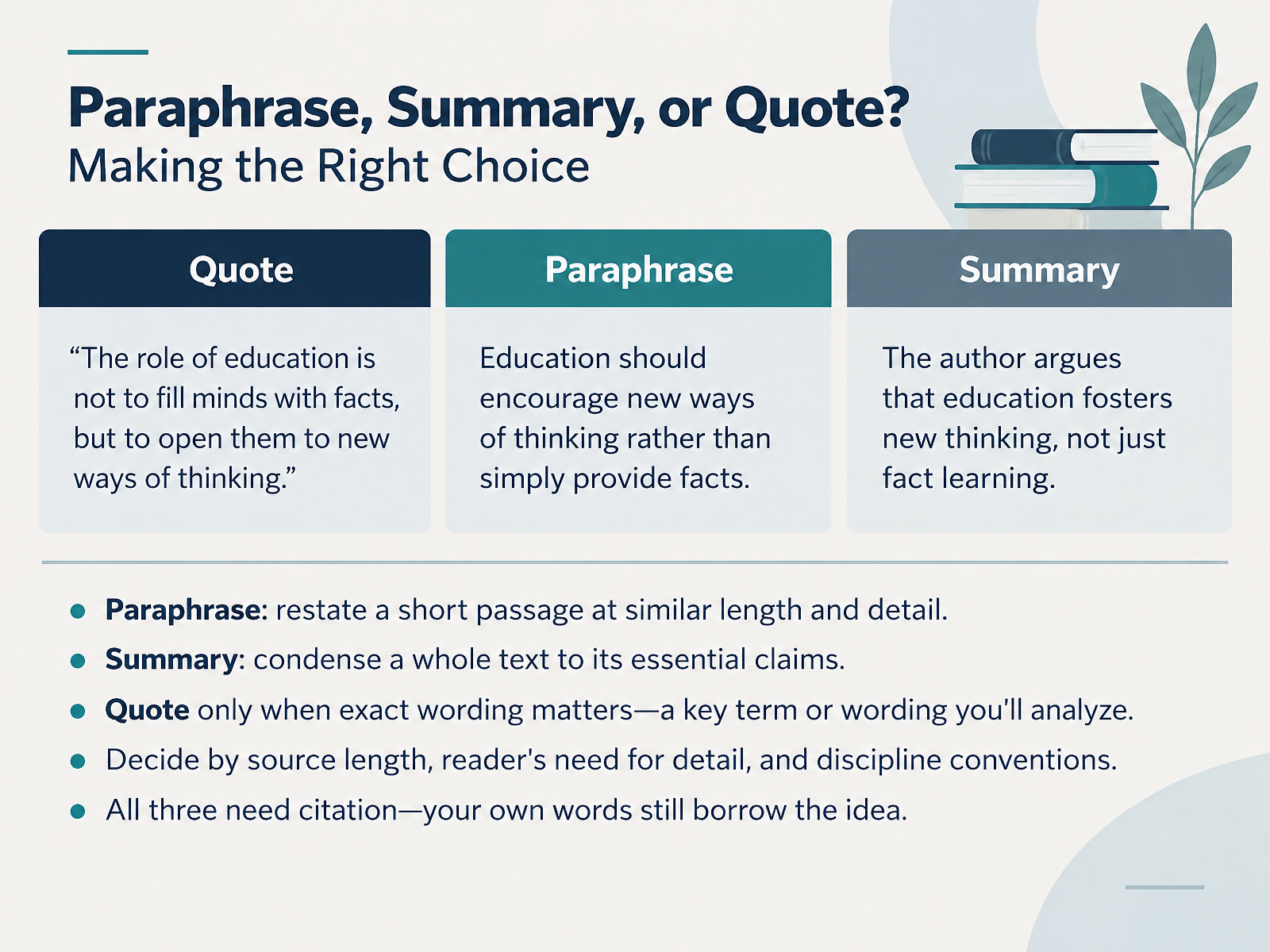
- 02Paraphrase, Summary, or Quote? Making the Right ChoiceNow let's look at choosing between three tools: paraphrase, summary, and quote. A paraphrase restates a short passage at similar length and detail. A summary condenses a whole text to its essential claims. Quote only when the exact wording matters, such as a key term or a sentence you plan to analyze. To decide, ask three questions. How long is the source? How much detail does your reader need? And what does your discipline expect? One common pitfall is rewording sentence by sentence and losing the source's main claim. So pause, name the main claim in one line, then reword around it. And remember, all three need a citation. Your own words still borrow the idea. Before we move on, take one source you're using and say its main claim in a single sentence. That one step will guide your choice. Next, we'll look at reading for gist and key information.
 guides.library.jhu.eduadvice.writing.utoronto.caanu.edu.au+22 min
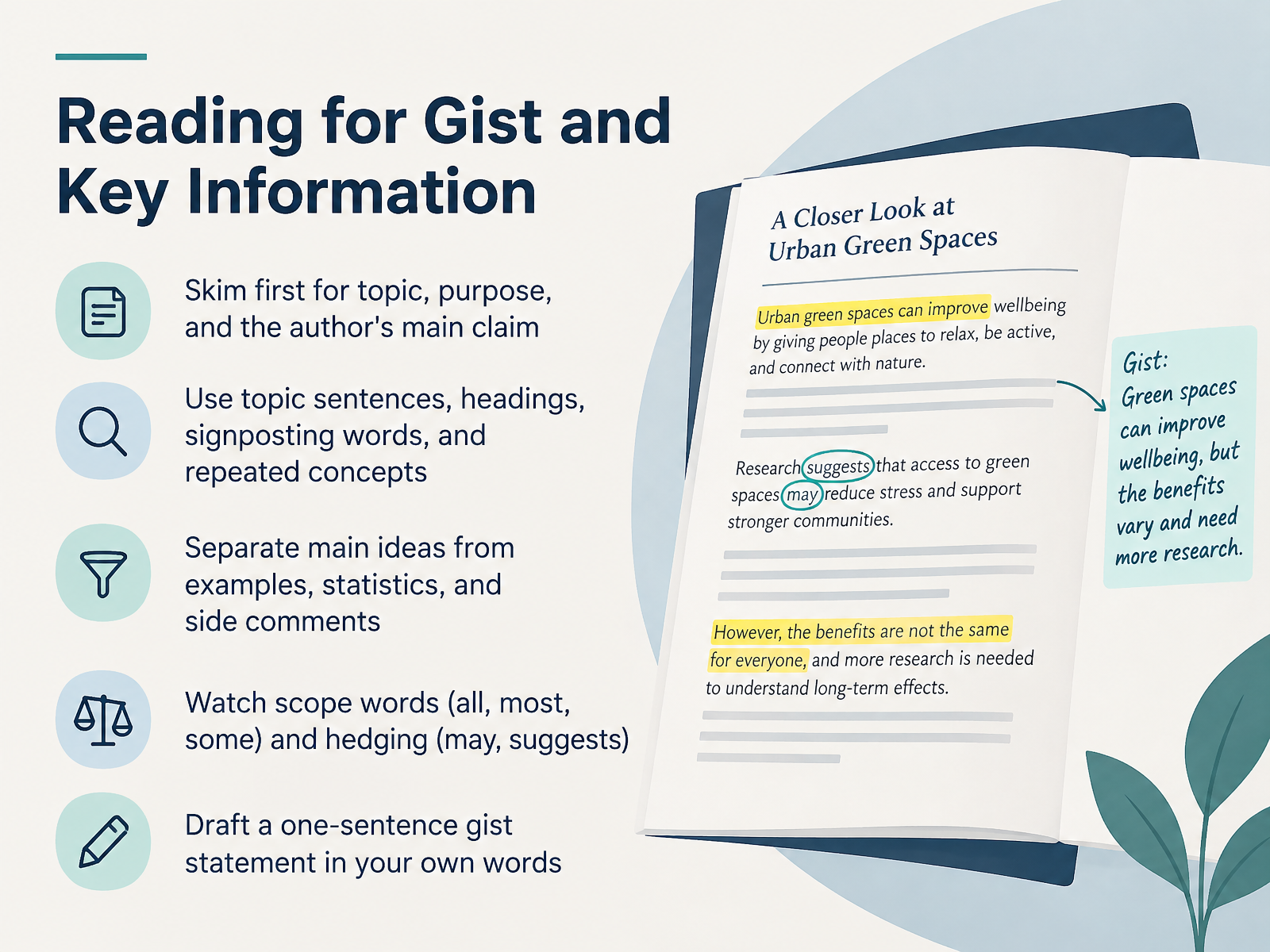
- 03Reading for Gist and Key InformationBefore you reword anything, you need to understand it. That means reading for gist first. Skim the text to find three things: the topic, the author's purpose, and the main claim. Don't read every word yet. Topic sentences, headings, and signposting words like however or therefore will guide you. Repeated concepts also point to what matters most.
Next, separate main ideas from examples, statistics, and side comments. These support the claim, but they don't belong in a summary. Also watch scope words like all, most, and some, and hedging like may or suggests. They affect how strong the claim really is.
Then close the source and draft one sentence that captures the gist in your own words. That sentence becomes your anchor. So here's your prompt: take a short article, skim it, and write a single gist sentence before you summarize anything. Working from notes, not from the source, makes that much easier, and that's where we go next.
 guides.library.jhu.eduadvice.writing.utoronto.caanu.edu.au+22 min
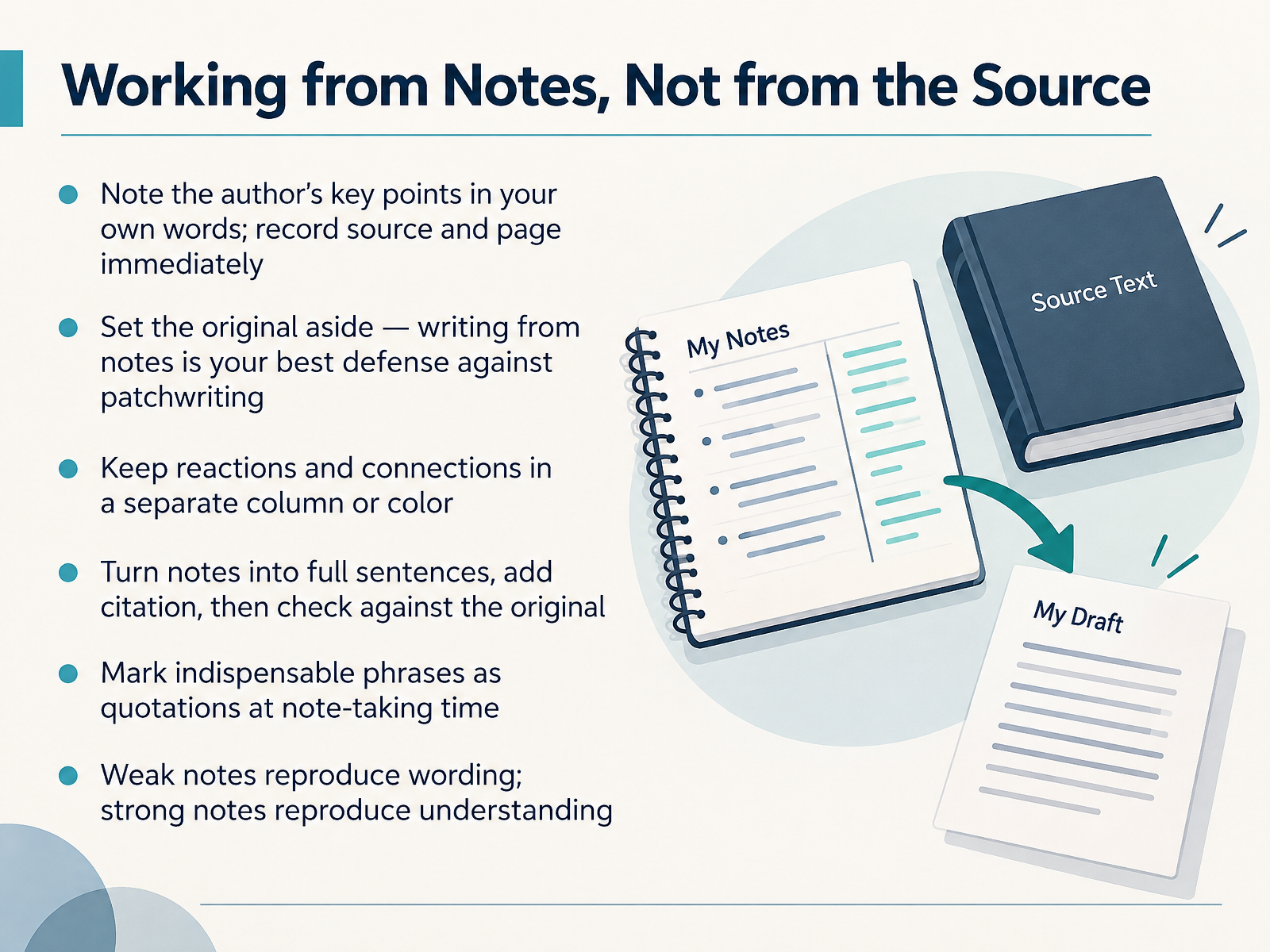
- 04Working from Notes, Not from the SourceNow let's talk about writing from notes, not from the source. When you read a source, capture the author's key points in your own words, and record the source and page number immediately. Then set the original aside. Writing from your notes is your best defense against patchwriting, where your wording stays too close to the original. Keep your reactions and connections in a separate column or color, so your ideas stay clearly yours. When you draft, turn those notes into full sentences, add the citation, and then check against the original for accuracy. If a phrase is indispensable, mark it as a quotation at note-taking time. Remember the core idea: weak notes reproduce wording, strong notes reproduce understanding. So today, try this with one source. Take notes in your own words, close the original, and draft a sentence from memory before you check it. Next, we'll look at paraphrasing techniques: changing wording and structure.
 hss.caltech.edusites.lsa.umich.edumerriam-webster.com+22 min
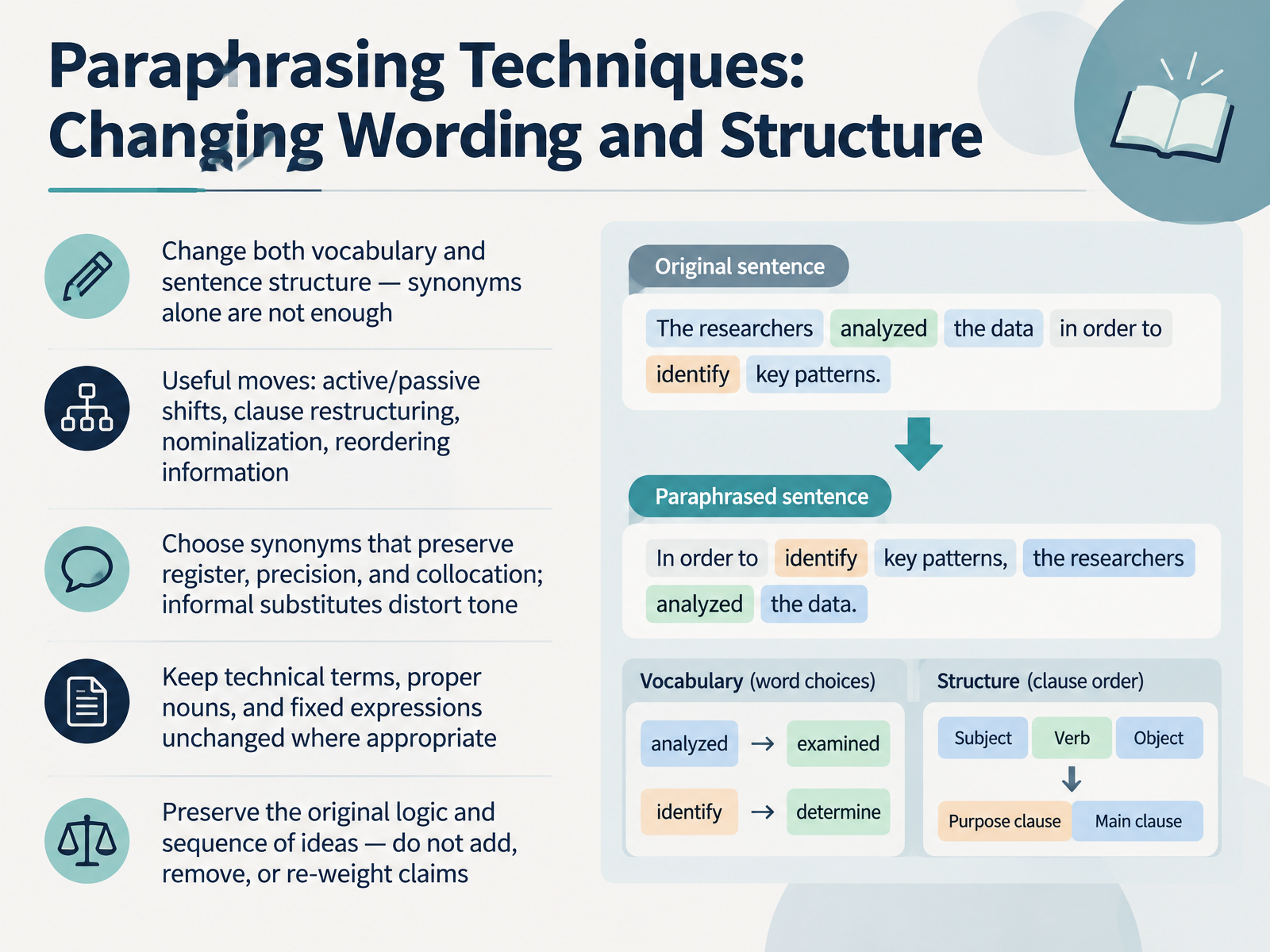
- 05Paraphrasing Techniques: Changing Wording and StructureLet's move on to paraphrasing techniques, focusing on how to change both wording and structure. Swapping in synonyms alone is not enough. You need to reshape the sentence too. Useful moves include shifting between active and passive voice, restructuring clauses, turning verbs into nouns, and reordering information. For example, instead of 'The team analyzed the data,' you could write 'The data were analyzed by the team,' or 'An analysis of the data was carried out.' When you choose synonyms, protect register, precision, and collocation. An informal substitute, like 'looked at' for 'analyzed,' distorts the tone. Keep technical terms, proper nouns, and fixed expressions unchanged where appropriate. And above all, preserve the original logic and sequence of ideas. Do not add, remove, or re-weight claims. Here is one step for you now. Take a short sentence from your current reading and rewrite it using two of these moves. Next, we look at what patchwriting is and why it fails.
 guides.library.jhu.eduadvice.writing.utoronto.caanu.edu.au+21 min
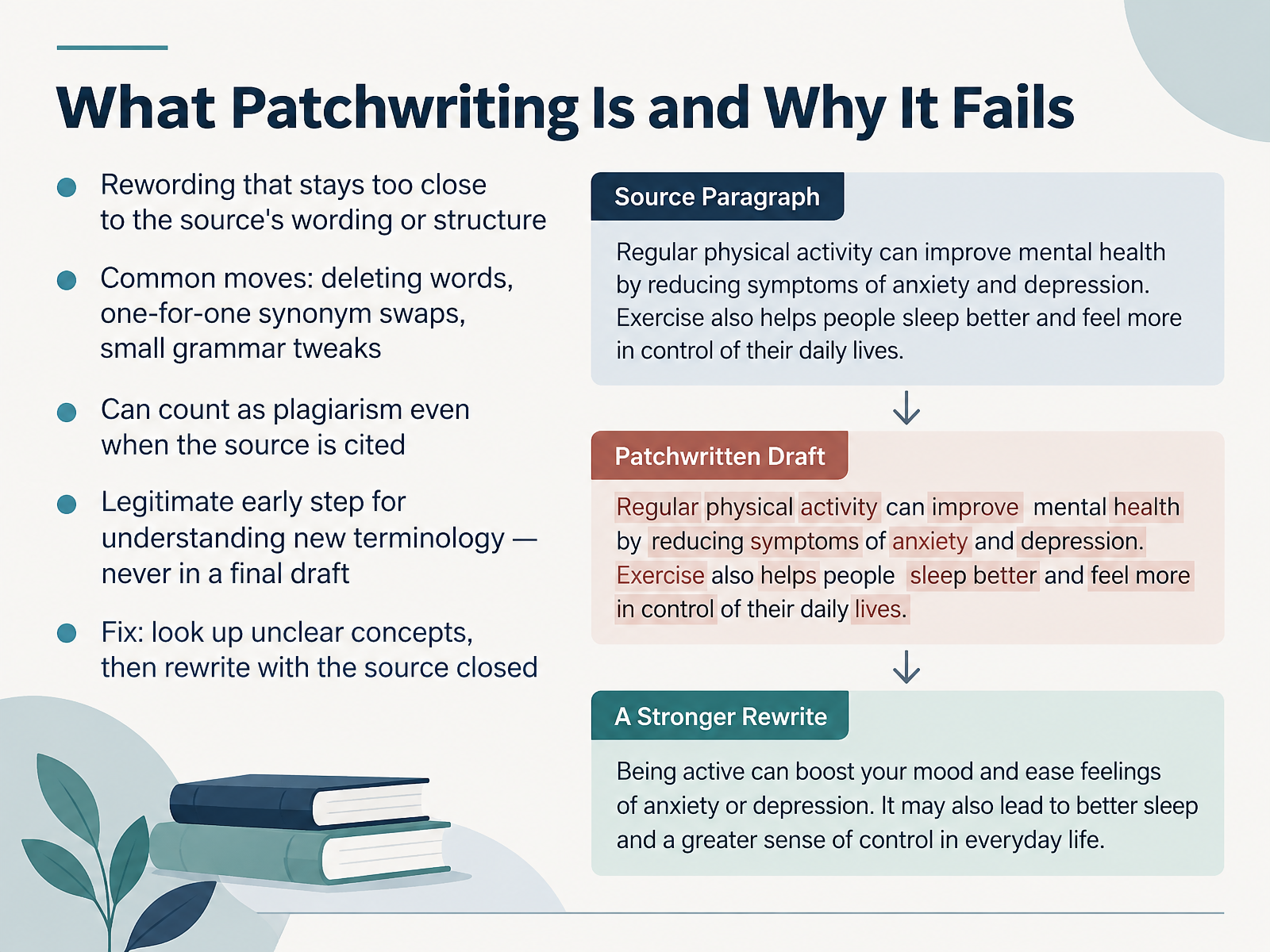
- 06What Patchwriting Is and Why It FailsNow let's look at a common trap: patchwriting. This is rewording that stays too close to the source, in wording or in structure. The usual moves are simple: you delete a few words, swap in one-for-one synonyms, or make small grammar tweaks. And here is the part that surprises people: patchwriting can count as plagiarism even when you cite the source. On the other hand, it can be a legitimate early step for understanding new terminology. Just never leave it in a final draft. To fix it, look up the concepts you are unsure about, then close the source and rewrite from your own understanding. Try that closed-book rewrite on one sentence right now. Next, we move on to summarizing: selecting, condensing, and restating.
 hss.caltech.edusites.lsa.umich.edumerriam-webster.com+21 min
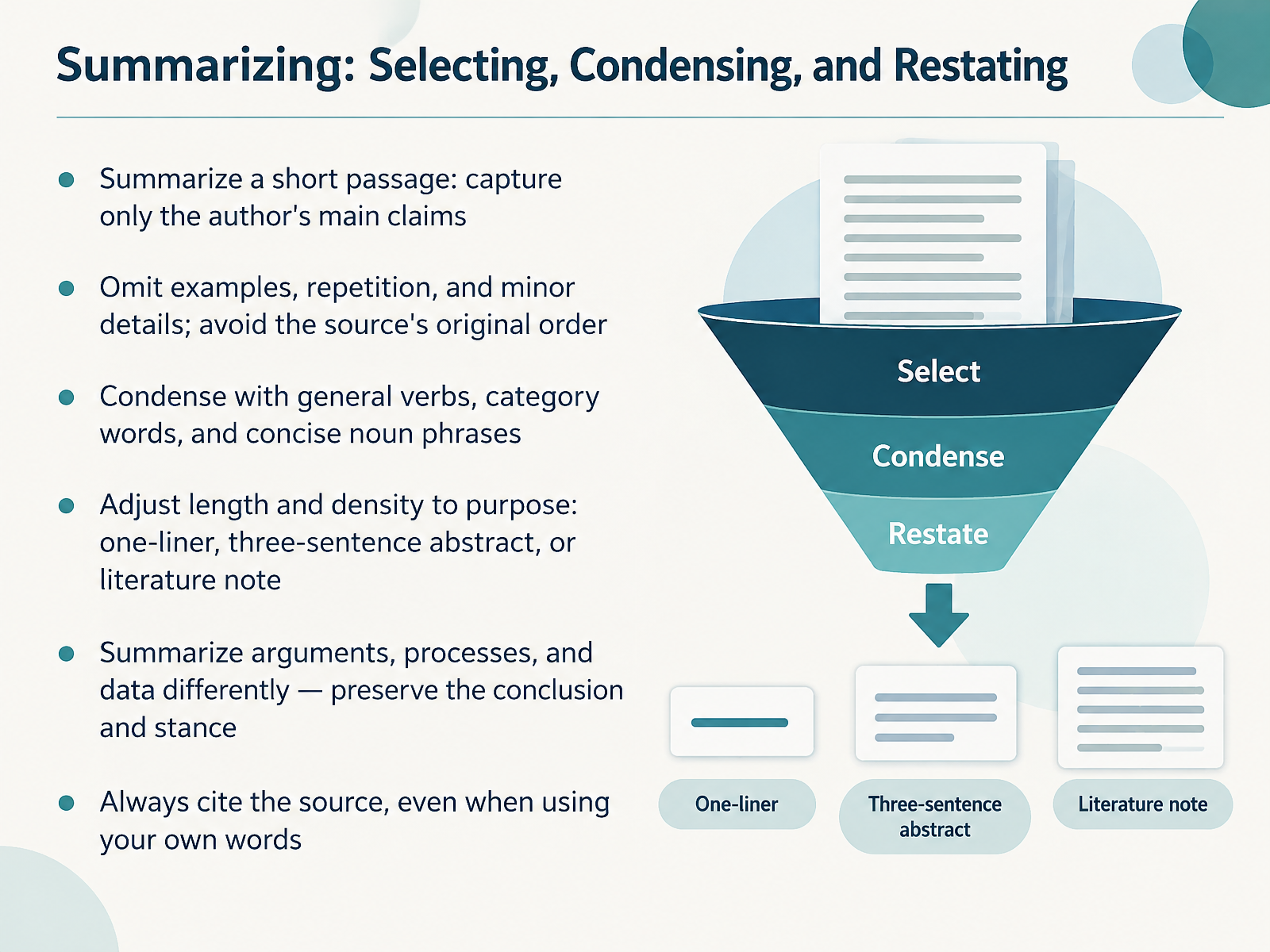
- 07Summarizing: Selecting, Condensing, and RestatingNow let's turn to summarizing. Here, you select, condense, and restate. Start with a short passage and capture only the author's main claims. Leave out examples, repetition, and minor details. And don't follow the original order. Group the ideas in a way that makes sense to your reader. Condense using general verbs, category words, and concise noun phrases. For example, instead of listing three separate expenses, write, the project spent heavily on equipment. Match length to purpose: a one-line takeaway, a three-sentence abstract, or a literature note. Arguments, processes, and data need different treatment, but always preserve the conclusion and the author's stance. One more thing. Always cite the source, even when the words are your own. Your prompt for now: summarize your current reading in three sentences, then check that you kept the main claim and the conclusion. Next, we'll look at reporting verbs, attribution, and citation basics.
 guides.library.jhu.eduadvice.writing.utoronto.caanu.edu.au+22 min
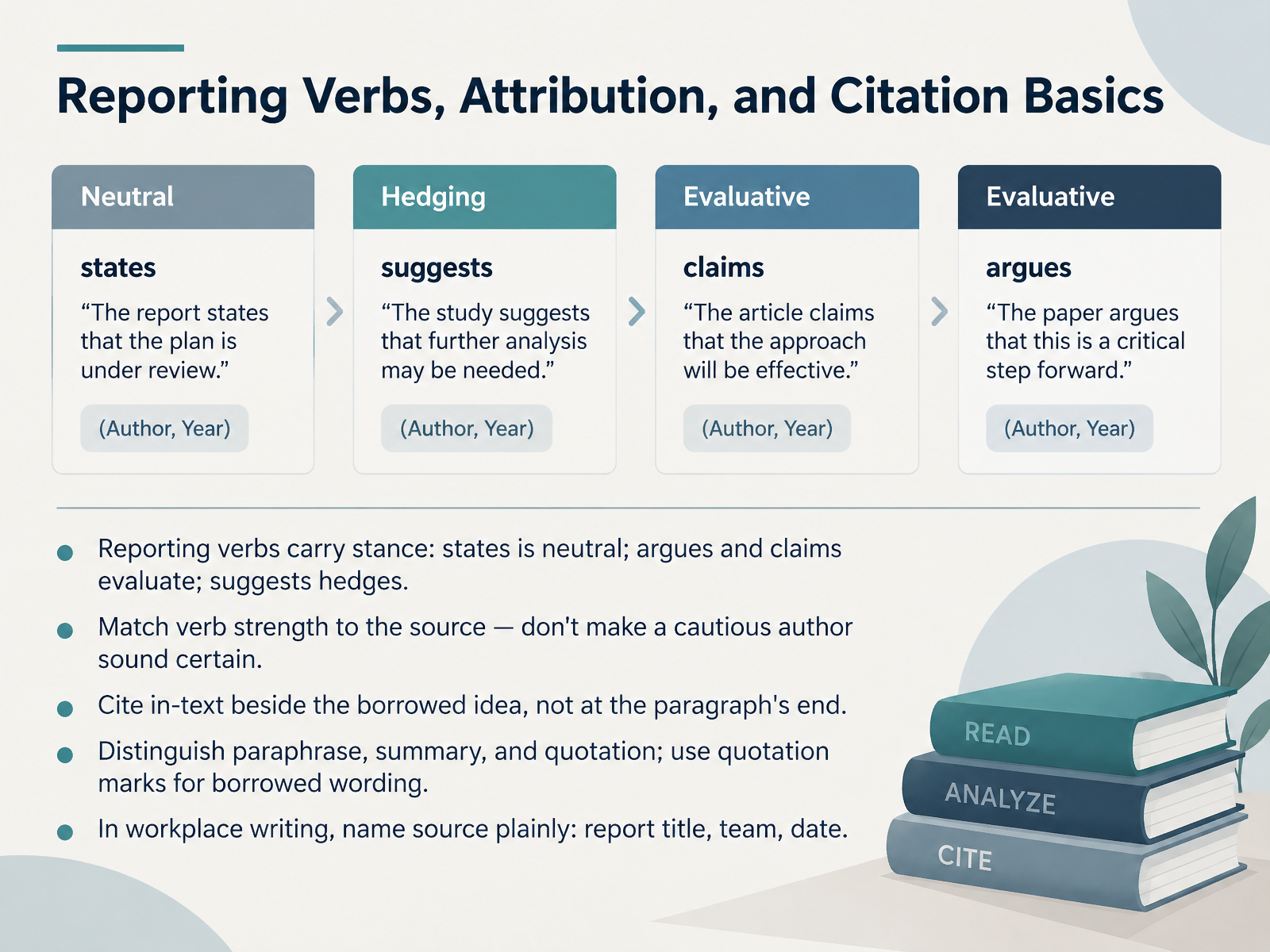
- 08Reporting Verbs, Attribution, and Citation BasicsLet's turn to reporting verbs and attribution. Reporting verbs carry stance. States is neutral. Argues and claims evaluate. And suggests hedges. So match the verb to the source. If an author is cautious, don't write that they prove something. Write that they suggest it. Next, cite in-text right beside the borrowed idea, not at the end of the paragraph. Your reader should see, sentence by sentence, which words are yours. Also keep paraphrase, summary, and quotation distinct. Paraphrase restates an idea at similar length. Summary condenses the main claim. And any borrowed wording goes in quotation marks. In workplace writing, name the source plainly: report title, team, and date. Here's your step now. Take one report you use, and rewrite your attribution as a plain sentence with the title, team, and date. That keeps your stance honest and your sourcing clear. Next, we'll look at checking accuracy and fidelity to the source.
 hss.caltech.edusites.lsa.umich.edumerriam-webster.com+22 min
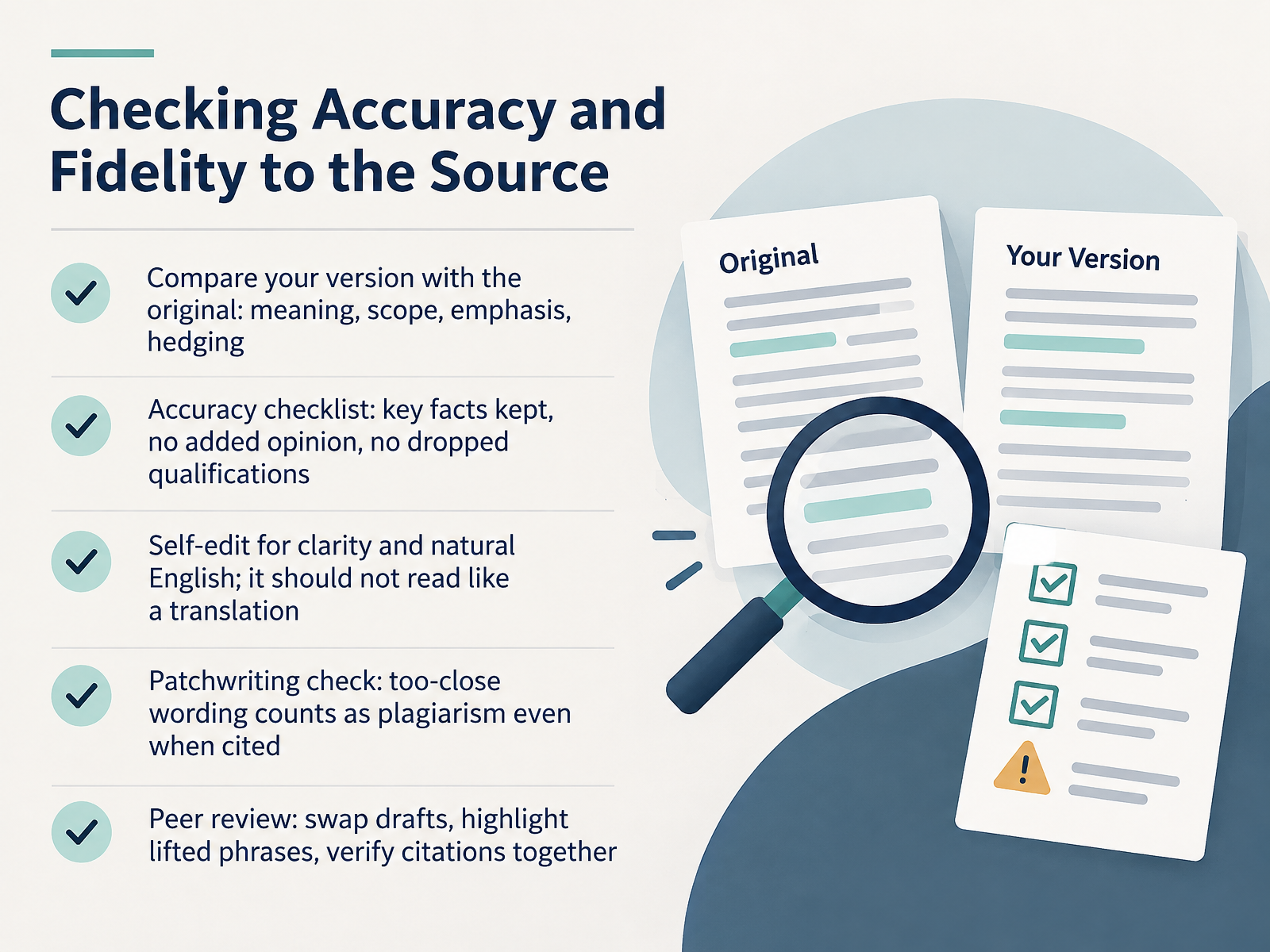
- 09Checking Accuracy and Fidelity to the SourceNow let's talk about checking your work for accuracy and fidelity to the source. Start by comparing your version with the original. Check four things. Meaning: did you keep the main claim? Scope: did you keep the same limits? Emphasis: did you keep what the author stressed? And hedging: did you keep words like may, likely, or suggests? Then run an accuracy checklist. Key facts kept. No added opinion. No dropped qualifications. After that, self-edit for clarity and natural English. Your version should not read like a translation. And watch for patchwriting. If your wording stays too close to the original, even with a citation, it can count as plagiarism. So try peer review. Swap drafts, highlight any lifted phrases, and verify citations together. Here is one step for now. Read your paraphrase next to the original, sentence by sentence, and mark anything that is too close. Next, we'll look at common pitfalls and quick fixes.
 hss.caltech.edusites.lsa.umich.edumerriam-webster.com+22 min
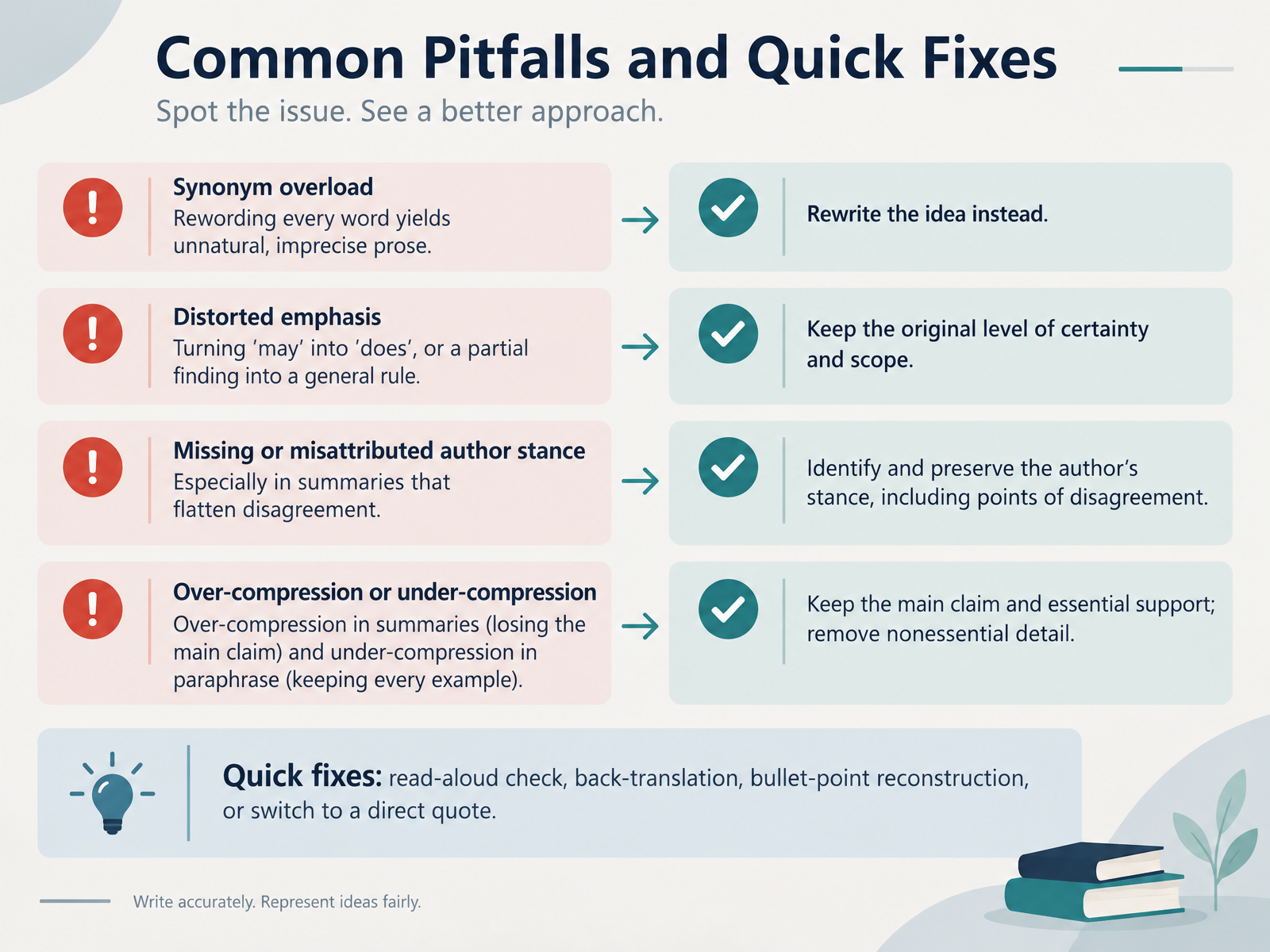
- 10Common Pitfalls and Quick FixesNow let's look at common pitfalls, and how to fix them quickly. The first is synonym overload. If you reword every single word, the result sounds unnatural and often imprecise. Lower the synonym list, and rewrite the idea instead. Second, distorted emphasis. Changing may into does, or turning a partial finding into a general rule, changes the author's meaning. Third, missing or misattributed author stance. Summaries often flatten disagreement by dropping who claimed what. Fourth, over-compression in summaries, where you lose the main claim, and under-compression in paraphrase, where you keep every example. Here are four quick fixes. Do a read-aloud check, try back-translation, rebuild the passage from bullet points, or switch to a direct quote when the wording itself matters. Pick one text you are working on today, and run the read-aloud check on your latest paraphrase. Next, we will move into practice with rewording an academic abstract.
 hss.caltech.edusites.lsa.umich.edumerriam-webster.com+22 min
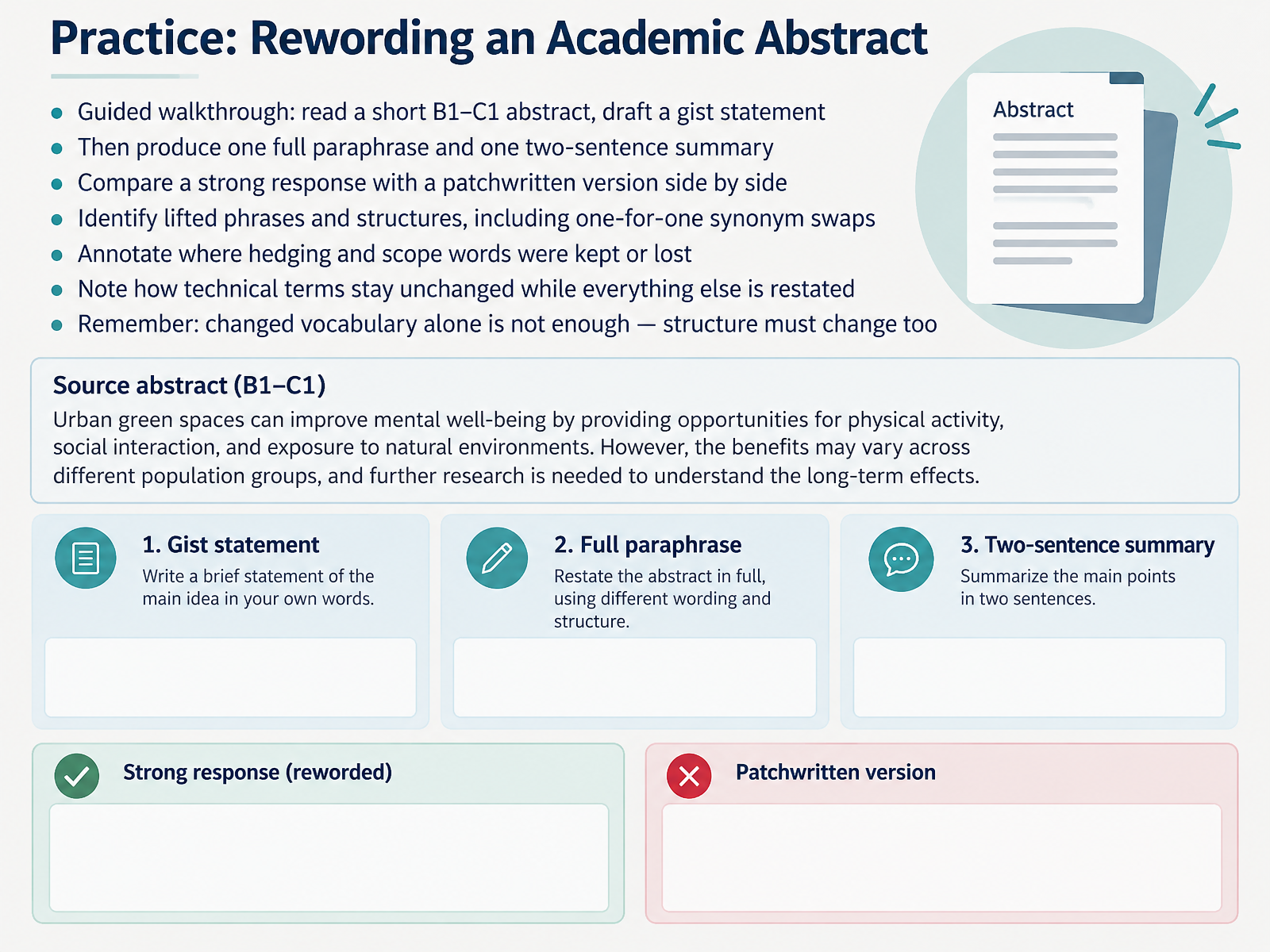
- 11Practice: Rewording an Academic AbstractNow let's put this into practice with an academic abstract. First, read the short text and draft a one-sentence gist statement. Say the main claim in your own words before you touch the details. Then write one full paraphrase, and one summary in two sentences. Keep them separate, so you can see what each one does. Next, compare a strong response with a patchwritten version side by side. Look for lifted phrases and sentence structures, including one-for-one synonym swaps. These are the clearest warning signs. Mark where hedging words, like may or suggest, and scope words, like often or in this sample, were kept or dropped. Also note how the technical terms stay unchanged while everything else is restated. Here is the reminder to hold onto. Changed vocabulary alone is not enough. The structure must change too. Pause now and annotate your draft for those points. When you are ready, we will move on to practice with workplace texts, an email thread and a report excerpt.
 hss.caltech.edusites.lsa.umich.edumerriam-webster.com+22 min
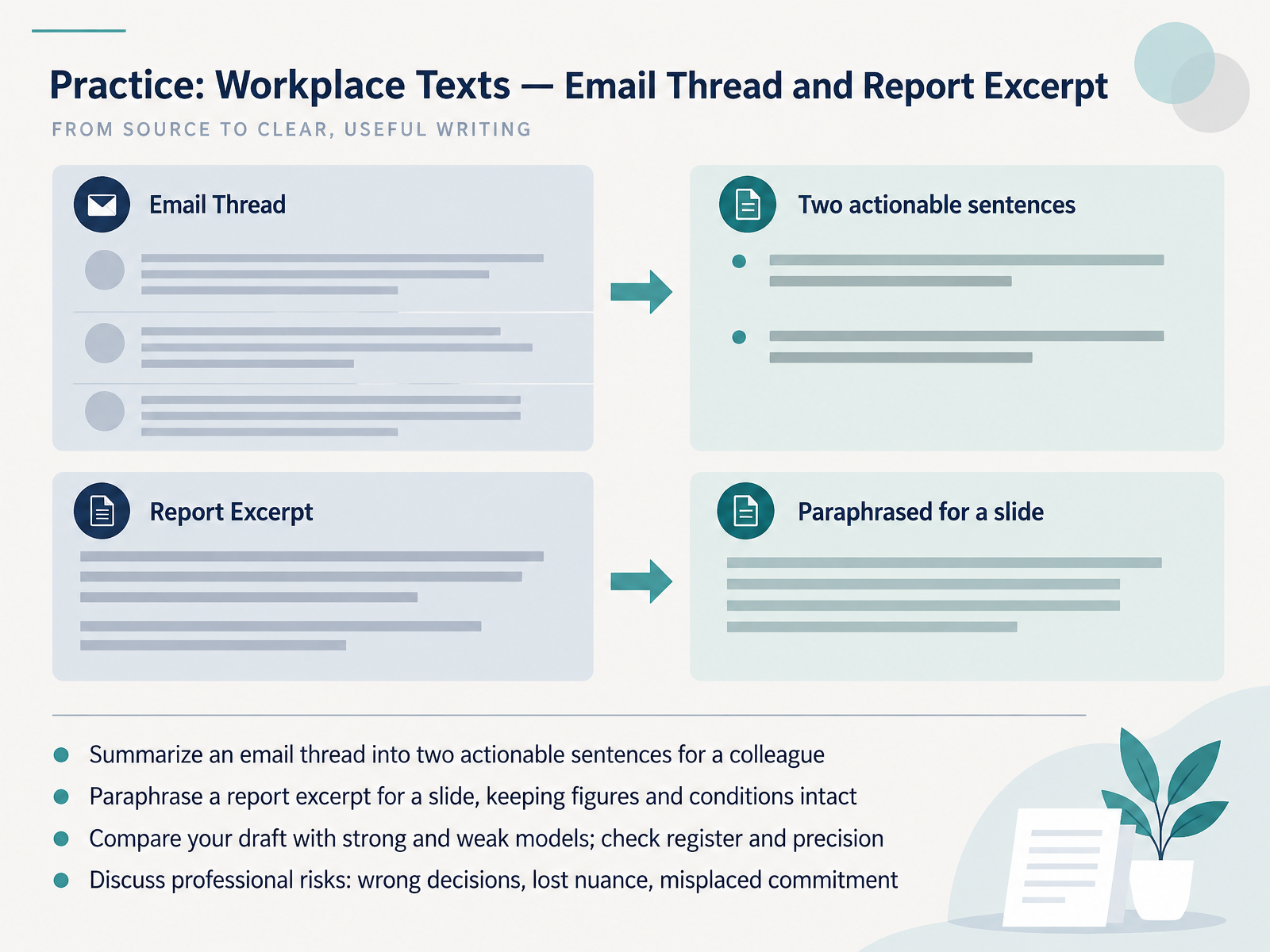
- 12Practice: Workplace Texts — Email Thread and Report ExcerptNow let's put this into practice with workplace texts. First, summarize an email thread into two actionable sentences for a colleague. Capture what happened and what you need them to do. Next, paraphrase a report excerpt for a slide. Here, keep the figures and conditions intact. Do not round numbers or drop qualifiers like "provided that" or "unless." Then compare your draft with strong and weak models. Strong models preserve the source's main claim and match the register. Weak ones sound over-literal or lose the main point. Finally, discuss professional risks. A weak summary can lead to wrong decisions, lost nuance, or a misplaced commitment. Before you send anything, reread your draft and ask: does this keep the source's meaning and the correct tone? Next, we'll apply these skills to study and work scenarios.
 guides.library.jhu.eduadvice.writing.utoronto.caanu.edu.au+21 min
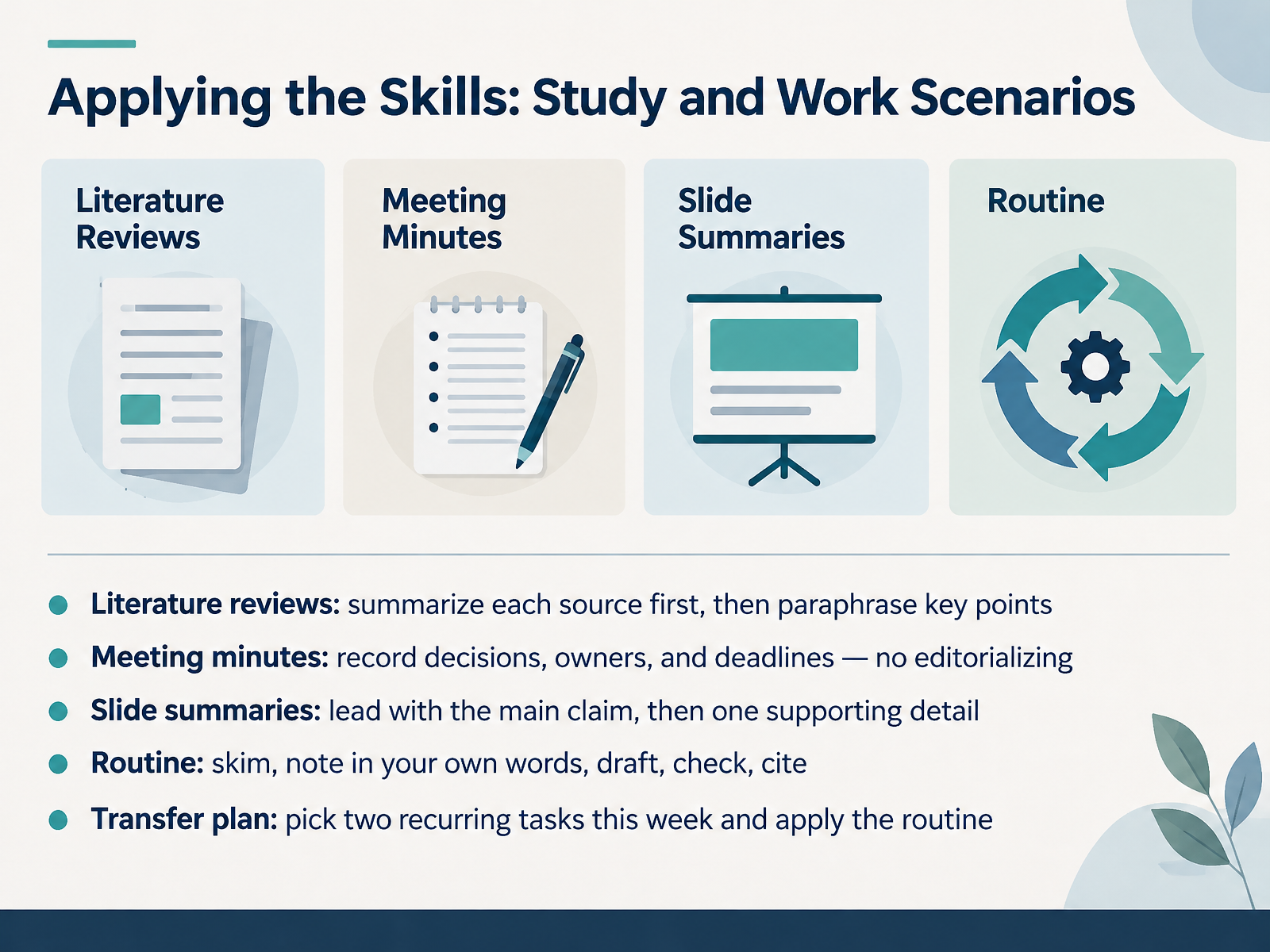
- 13Applying the Skills: Study and Work ScenariosNow let's put these skills to work in real study and workplace tasks. In a literature review, summarize each source first, in your own words, and then paraphrase the key points you plan to use. In meeting minutes, record only decisions, owners, and deadlines. No editorializing. For slide summaries, lead with the main claim, then add one supporting detail. Build a routine: skim, note in your own words, draft, check, and cite. Avoid that common pitfall of changing a few words or losing the source's main claim. This week, pick two recurring tasks and apply that routine. Next, we'll move to review, self-assessment, and next steps.
 hss.caltech.edusites.lsa.umich.edumerriam-webster.com+21 min
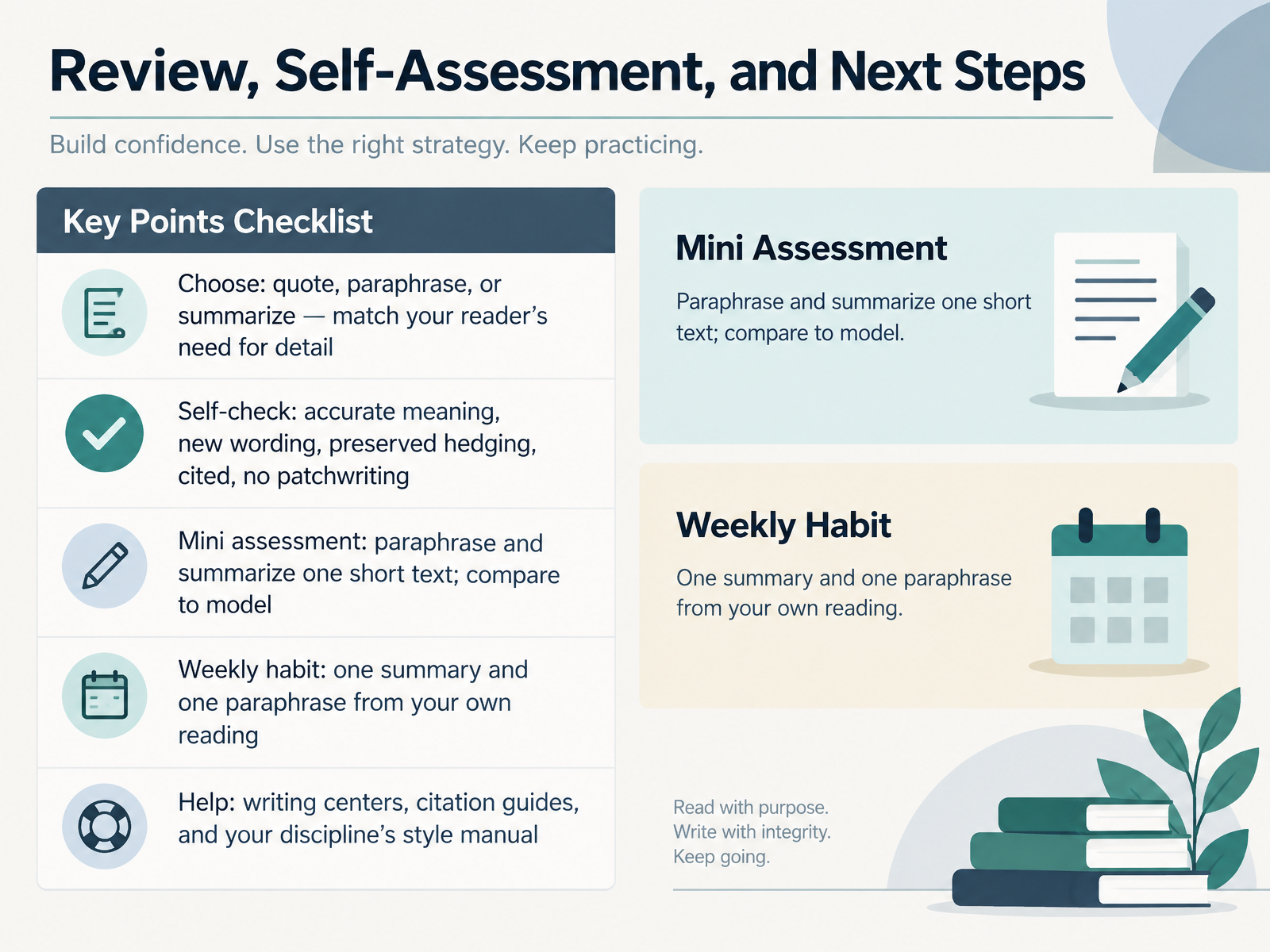
- 14Review, Self-Assessment, and Next StepsLet's bring everything together. First, choose your tool. Quote, paraphrase, or summarize, based on how much detail your reader needs. Quote when the exact words matter, paraphrase when the idea matters, and summarize when only the main claim matters. Next, run a quick self-check. Is the meaning accurate? Is the wording genuinely new? Have you preserved hedging words like may or suggests? Is it cited? And is it free of patchwriting, meaning you haven't just swapped a few synonyms? Try the mini assessment: take one short text, paraphrase it, summarize it, and compare your versions to a model. Then build a weekly habit. Each week, write one summary and one paraphrase from your own reading. Finally, know your help: writing centers, citation guides, and your discipline's style manual. So here is your immediate step. After this session, pick one paragraph from your current reading, and write both a paraphrase and a one-sentence summary of it. Thank you for your steady work throughout this course. Rewording well takes practice, and you are already building it. Keep going, one text at a time.
 hss.caltech.edusites.lsa.umich.edumerriam-webster.com+22 min
Take the deck with you
Download this course as a file — free, no sign-up needed.
- PDF handoutEvery slide page, ready to print or share.15 pages · 3.4 MBDownload
- Narrated PowerPointThe deck that presents itself — every slide carries the digital human's narration video.15 pages · 23.1 MBDownload
- PowerPoint slidesThe full deck as a .pptx — open it in PowerPoint, Keynote, or Google Slides.15 pages · 3.3 MBDownload
Free to use in your own training — please keep the PersonWise credit page at the end.
Have your own deck? Turn it into a course
Sources consulted
Web sources consulted while building this course.
- Paraphrasing & Summarizing - Avoiding Plagiarism - Guides at Johns Hopkins University — guides.library.jhu.edu
- Paraphrase and Summary | Writing Advice — advice.writing.utoronto.ca
- Using sources appropriately | Australian National University — anu.edu.au
- The Writing Center | When to Summarize, Paraphrase, and... — writingcenter.gmu.edu
- Paraphrase and Summary | Wingspan: Center for Learning and Writing Support — writing.ku.edu
- Last updated: December 2024 — hss.caltech.edu
- Patchwriting as a Technique — sites.lsa.umich.edu
- What is 'Patchwriting'? | Merriam-Webster — merriam-webster.com
- Patchwriting, Plagiarism, Pedagogy: Definitions and Implications — doi.org
- Avoiding Plagiarism and Patchwriting - Center for Scholarly Communication - IUP — iup.edu