Technical Writing Report Analysis
Begin
14 pages · ~28 min
Technical Writing Report Analysis
Learn to craft effective technical reports by examining real-world examples, identifying patterns, leveraging strengths, and avoiding common pitfalls.
What you’ll learn
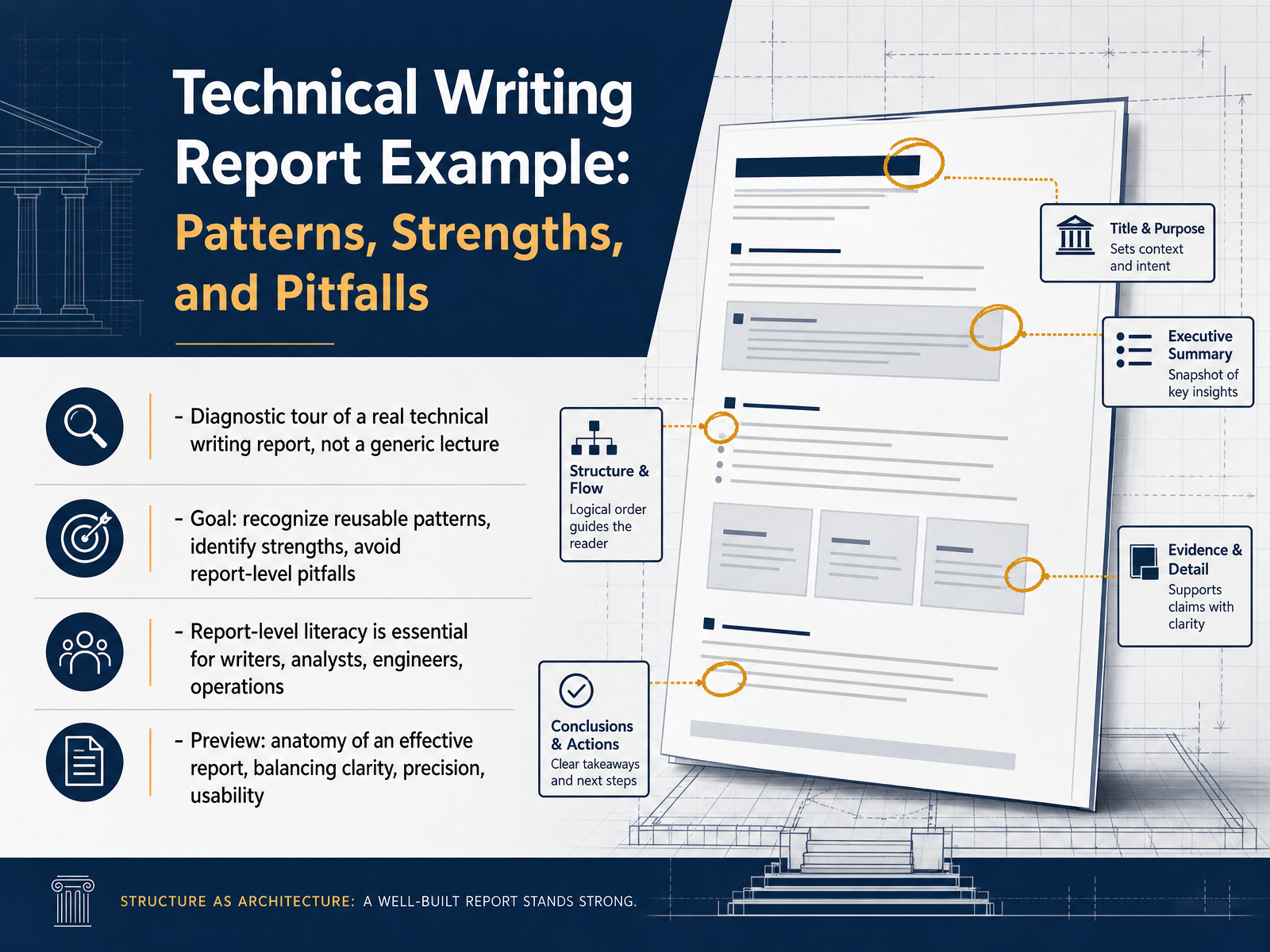
- 01Technical Writing Report Example: Patterns, Strengths, and PitfallsWelcome. This session is about the technical writing report example: the patterns that make one work, the strengths you should copy, and the pitfalls that quietly undermine your credibility. This isn't a generic lecture. We are going to take a real report on a diagnostic tour. Our goal is simple: to give you the report-level literacy you need, whether you are a writer, an analyst, an engineer, or in operations. You will learn to recognize reusable patterns, spot genuine strengths, and avoid the structural mistakes that cost your readers time. We will walk through the anatomy of an effective report. And we will focus on the balance that matters most: clarity, precision, and usability. When you finish, you will know what good looks like, and you will know exactly where your own drafts can improve. Let's begin by looking at why this report-level view matters so much.nps.edupressbooks.atlanticoer-relatlantique.cawac.colostate.edu+22 min
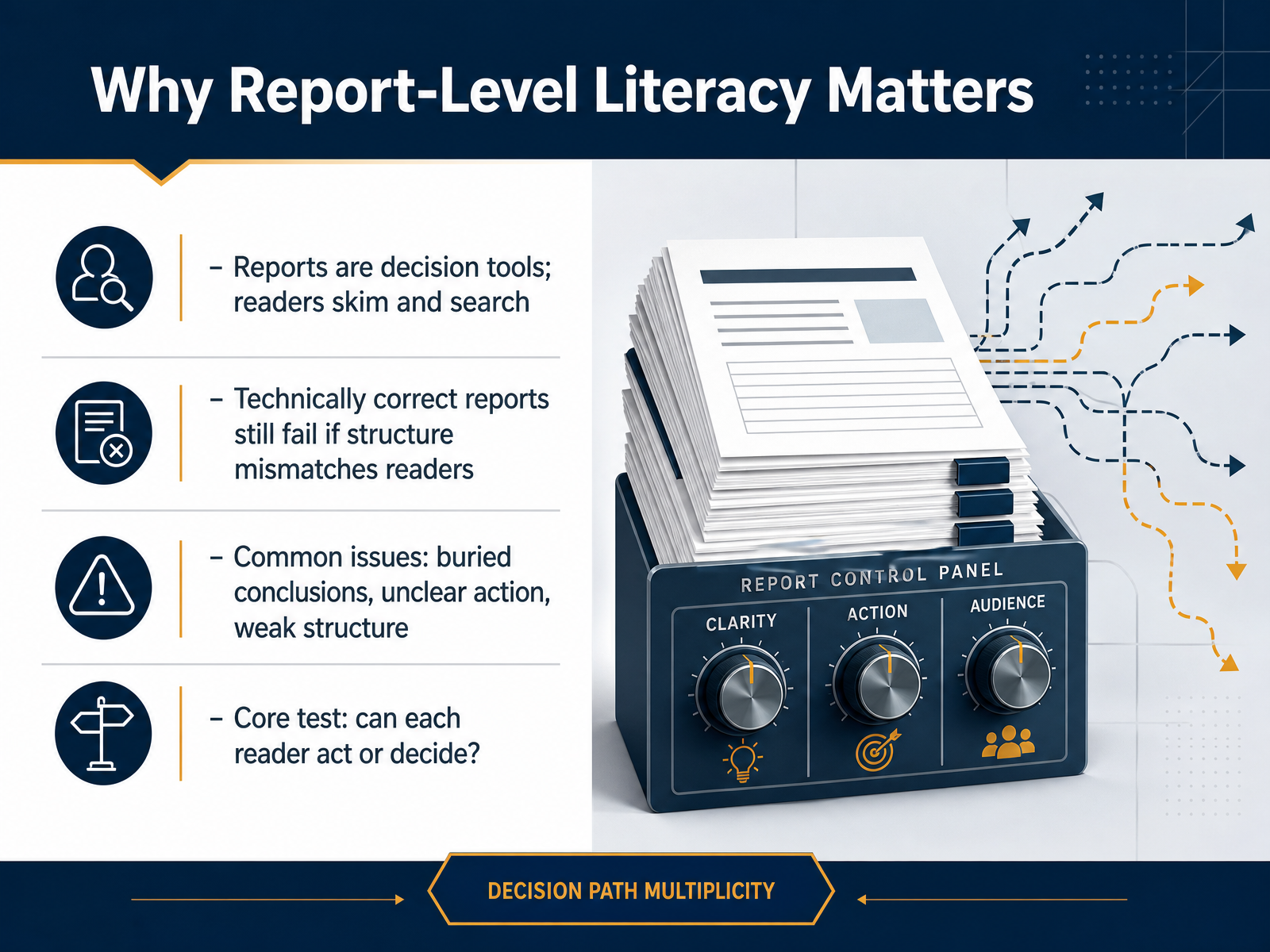
- 02Why Report-Level Literacy MattersLet’s talk about why report-level literacy matters. In a technical environment, reports are decision tools, not just records of work. Readers skim and search; they rarely read from cover to cover. They are looking for specific answers, and they need to find them fast. A report can be technically perfect yet still fail if its structure doesn’t match how people actually read. The common issues are consistent: conclusions buried at the end, unclear actions, and weak overall structure. If the reader has to dig for the point, the report has already lost its value. There is a core test for every technical report you write. Can each intended reader act or decide based on what you have given them? If an executive cannot find the recommendation, or an engineer cannot locate the evidence, the structure is wrong. Keep that reader test in mind as we now examine the standard anatomy of a report and the structural patterns that support it.
 nps.edupressbooks.atlanticoer-relatlantique.cawac.colostate.edu+22 min
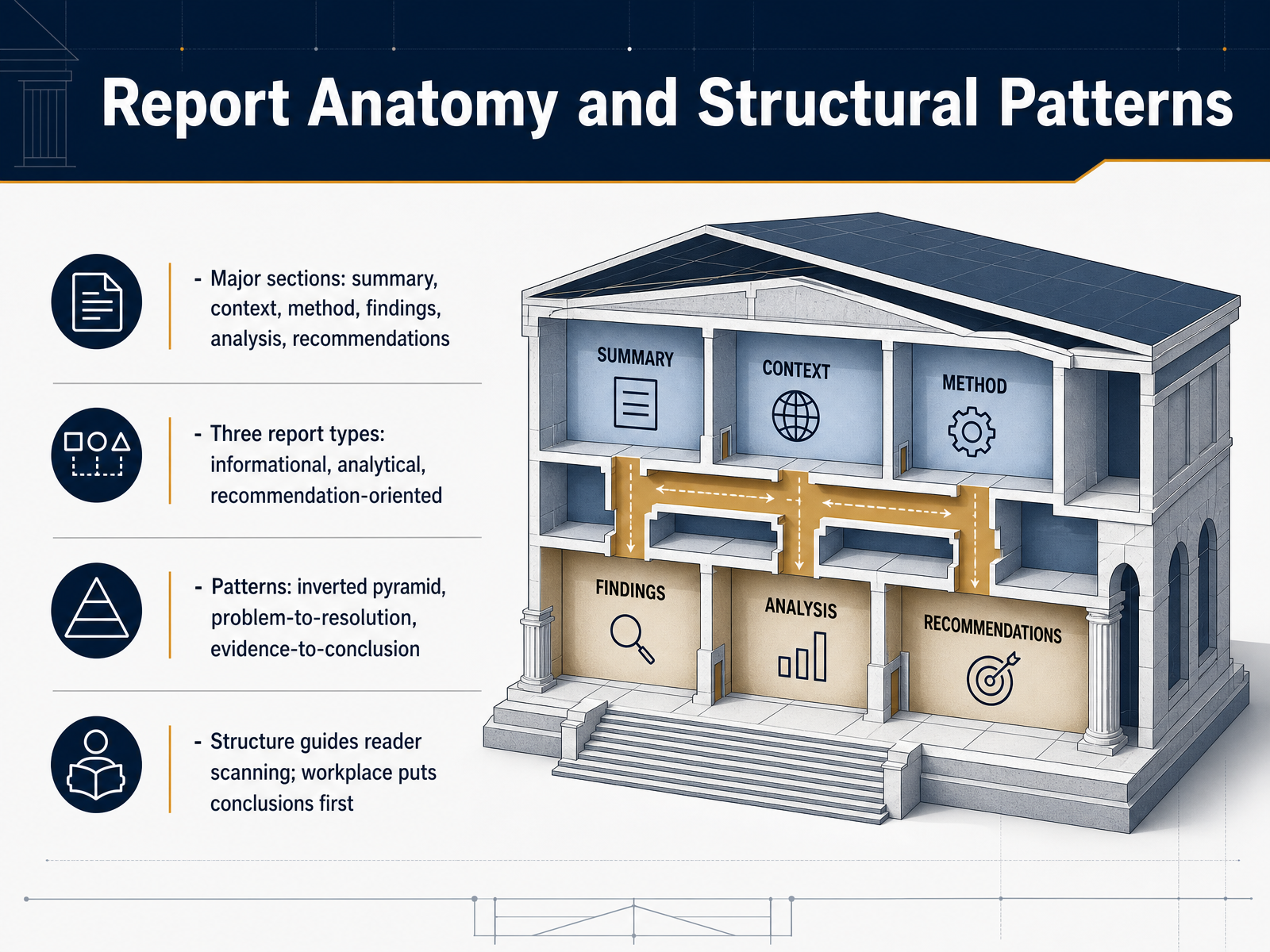
 - 03Report Anatomy and Structural PatternsLet's talk about anatomy and structure. Most technical reports share the same core sections: summary, context, method, findings, then analysis leading to recommendations. But what distinguishes a great report from a mediocre one isn't just the presence of these sections, it's how they're arranged. Think in terms of three report types. The informational report shares data. The analytical report digs into why. And the recommendation-oriented report pushes for a specific decision. Your purpose dictates which pattern you apply. The inverted pyramid puts the broad conclusion up front before narrowing into supporting detail. Problem-to-resolution frames everything around the issue being solved. And evidence-to-conclusion builds the case methodically before revealing its verdict. Here's the crucial point for workplace writing. Human investigation follows one direction, problem, then method, then results, then conclusion. But reader needs follow the reverse. Busy decision makers scan for the answer first, then dig into your evidence if they trust it. So structure your report for easy scanning, and always front-load the conclusion. Next, we'll examine the executive summary, the single section that most often makes or breaks a technical report, and how to craft one that actually drives decisions.
 nps.edupressbooks.atlanticoer-relatlantique.cawac.colostate.edu+22 min
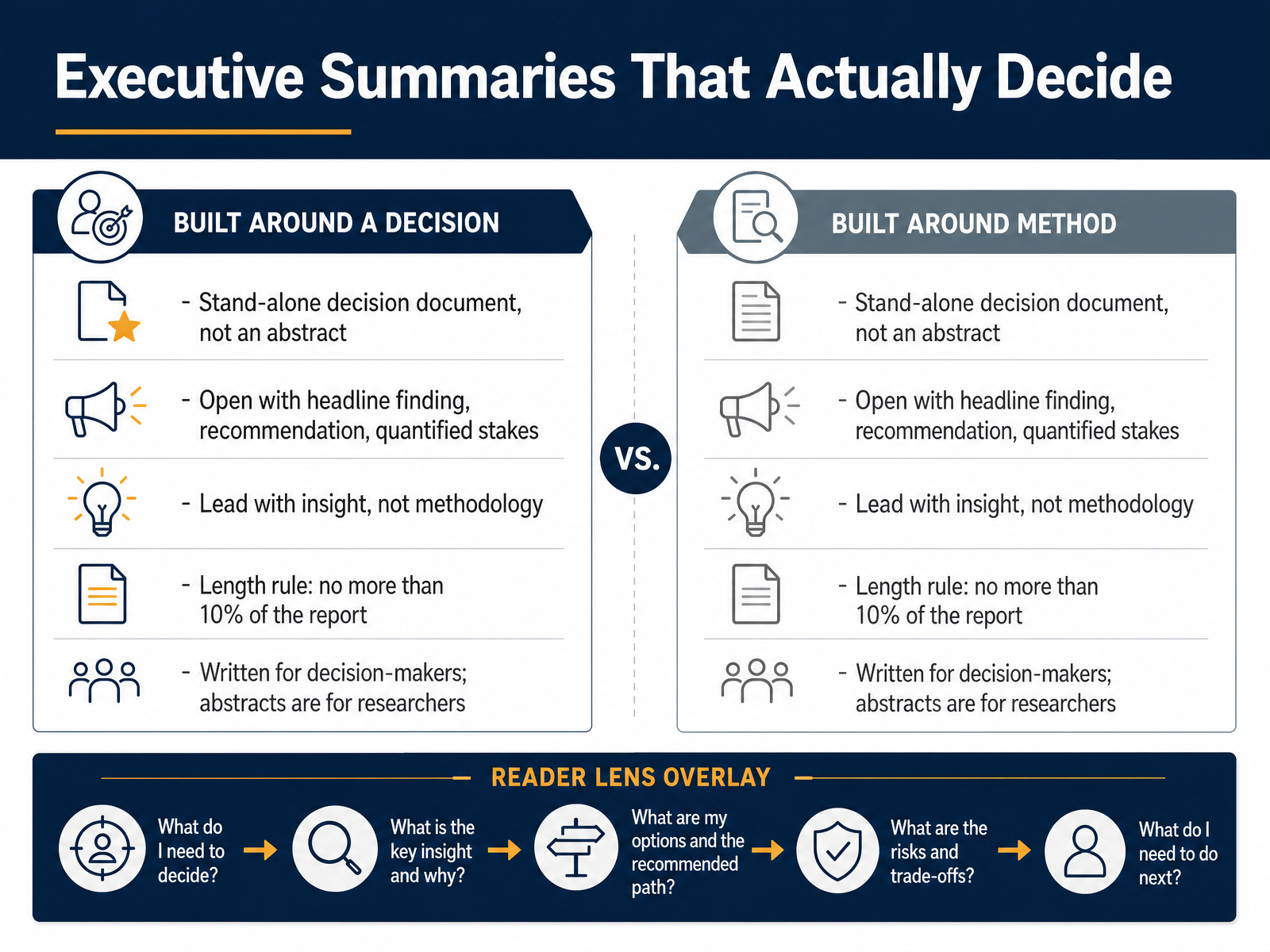
 - 04Executive Summaries That Actually DecideLet’s examine the single most important page in your technical report: the executive summary. This is not an abstract. An abstract is a screening tool for researchers. The executive summary is a stand-alone decision document. It must give a busy decision-maker everything they need to act, without reading further. Open with your headline finding, your recommendation, and the quantified stakes. For example, start with: “The system’s failure rate has doubled in six months, and we recommend replacing the cooling unit at a cost of forty thousand dollars to avoid an estimated two hundred thousand in downtime.” Lead with the insight, not your methodology. The first sentence should never describe the procedure. State the conclusion, then point to the evidence. Keep the summary to no more than ten percent of the report’s total length. Write it after the full report is finalized. So, the test is simple: if a reader assigned to approve or reject the work reads only this page, can they decide? Now, let’s look at what separates a strong technical report from a document that simply gets filed away.
 nps.edupressbooks.atlanticoer-relatlantique.cawac.colostate.edu+21 min
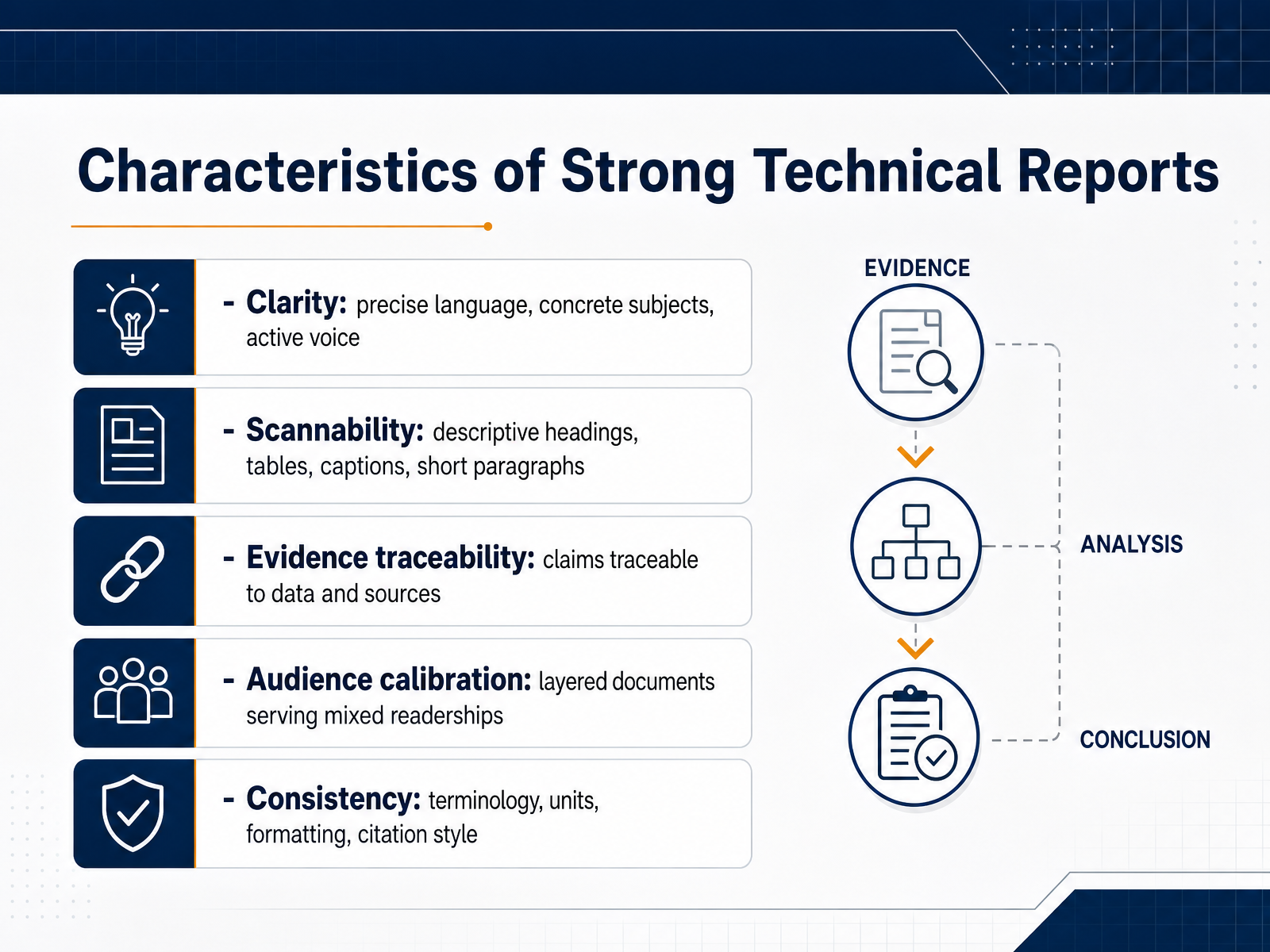
 - 05Characteristics of Strong Technical ReportsNow let's examine what separates a strong technical report from a weak one. Five characteristics matter most. First, clarity. Use precise language, concrete subjects, and active voice. Instead of writing, "The test was conducted by the team," write, "The team conducted the test." Second, scannability. Busy readers need descriptive headings, clearly labeled tables, and captions that explain visuals. Keep paragraphs short. Third, evidence traceability. Every claim must link back to data or sources. If you state a failure rate, the reader should be able to trace it directly to your test results. Fourth, audience calibration. Technical reports serve mixed readerships, from executives to engineers. Use appendices for deep detail so the main body stays accessible to everyone. Finally, consistency. Terminology, units, formatting, and citation style must remain uniform throughout. Inconsistent references undermine credibility quickly. Remember, strong reports reduce the reader's effort while preserving technical rigor.
 theiet.orgcontentxprtz.comeng.kuleuven.be+21 min
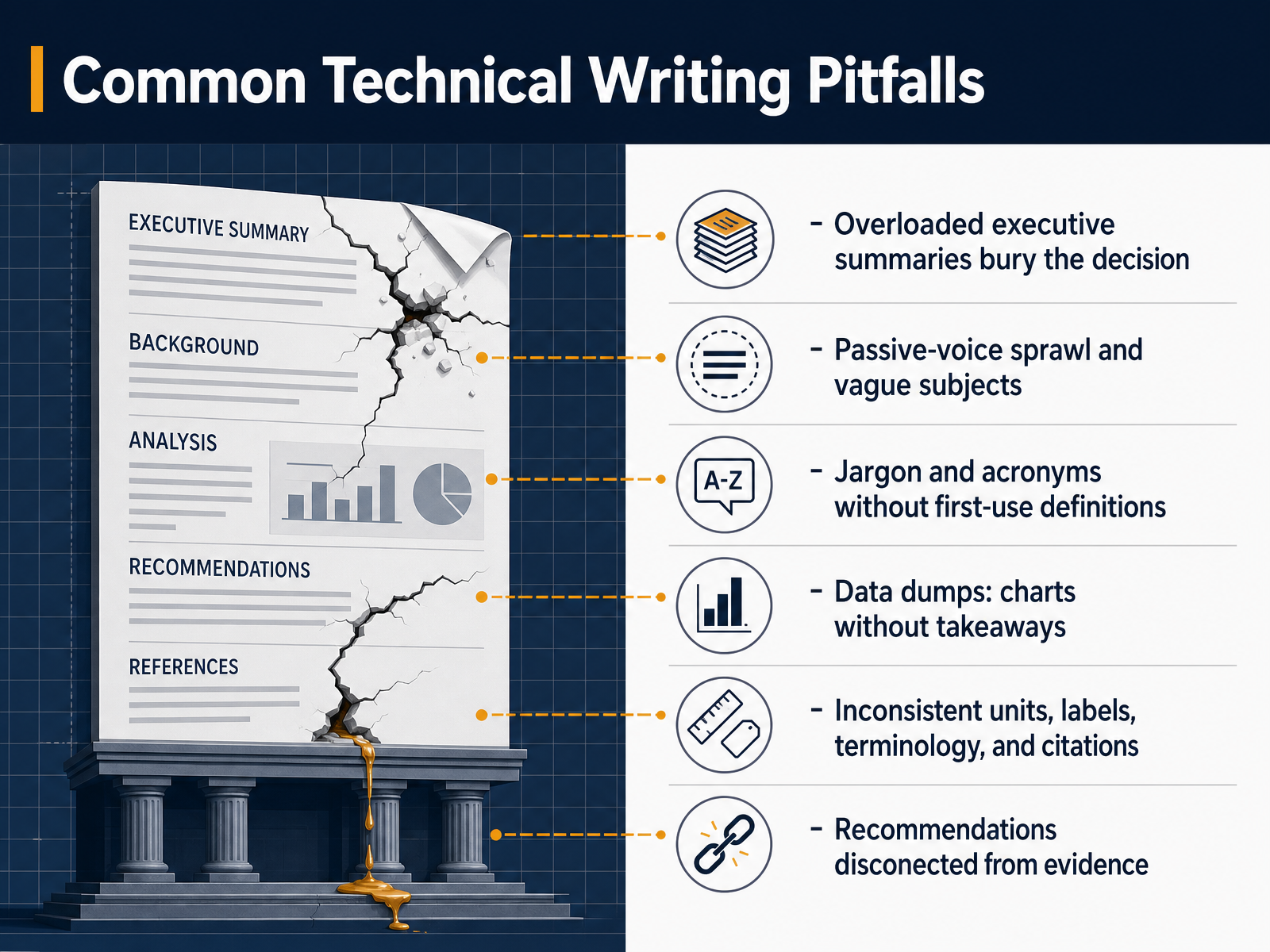
 - 06Common Technical Writing PitfallsNow let’s look at where reports most often go wrong. The first pattern is the overloaded executive summary. If a decision-maker has to dig through three paragraphs of background to find the actual recommendation, you have buried the point. State the decision, the key evidence, and the required action in the opening lines. Next, passive-voice sprawl. Sentences like, “The data were analyzed,” leave the reader guessing who acted and how. In most cases, name the actor: “We analyzed the data.” Jargon and acronyms without first-use definitions shut out readers who need the information. Define every abbreviation at first use, and keep specialized terms only where they earn their place. Data dumps are charts without takeaways. A figure should make one point, and the text should say what that point is. If it does not, the reader is doing your analysis for you. Also watch for inconsistency in units, labels, terminology, and citations. Mixed systems and shifting names erode trust in your precision. Finally, recommendations that are not connected to evidence invite pushback. Each recommendation should trace back to a specific finding. If it cannot, it is an opinion. Keep those patterns in mind as we move to voice, precision, and sentence-level clarity.
 theiet.orgcontentxprtz.comeng.kuleuven.be+22 min
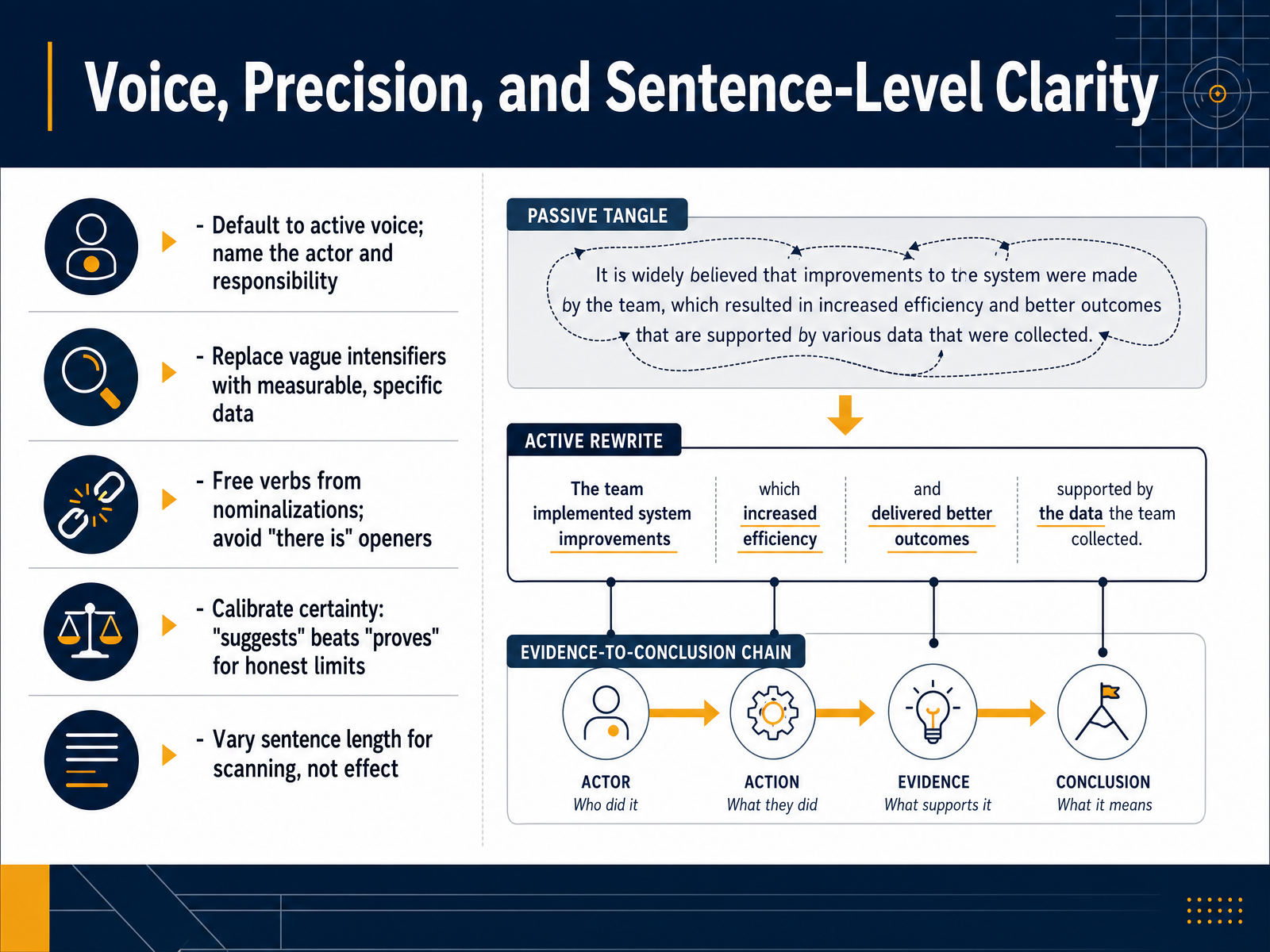
 - 07Voice, Precision, and Sentence-Level ClarityNow let's tighten the prose itself. Voice, precision, and sentence-level clarity are where credibility is won or lost. Default to active voice. Name the actor and the responsibility. Instead of saying, "The valve should be closed by the operator," say "Close the valve." The actor is the operator, and the imperative makes that unmistakable. Replace vague intensifiers with measurable data. "Significantly faster" tells the reader nothing. "Two hundred twenty-five to two hundred fifty percent faster" tells them exactly what to expect. Free verbs from nominalizations. "Make a decision" becomes "decide." "Conduct an analysis" becomes "analyze." And avoid openers like "There is" or "There are." They force the sentence to add a generic subject and verb. Just name the real subject directly. Calibrate certainty honestly. "Suggests" beats "proves" when the evidence only points in a direction. Overclaiming invites skepticism; honest limits invite trust. Finally, vary sentence length for scanning, not for dramatic effect. Keep most sentences in the fifteen-word range, and break anything over thirty-five words into two. Your readers will be scanning for answers, not savoring the prose. Up next, we'll look at how to handle evidence, data presentation, and interpretation.
 developers.google.comdevelopers.google.comarielgroup.com+21 min
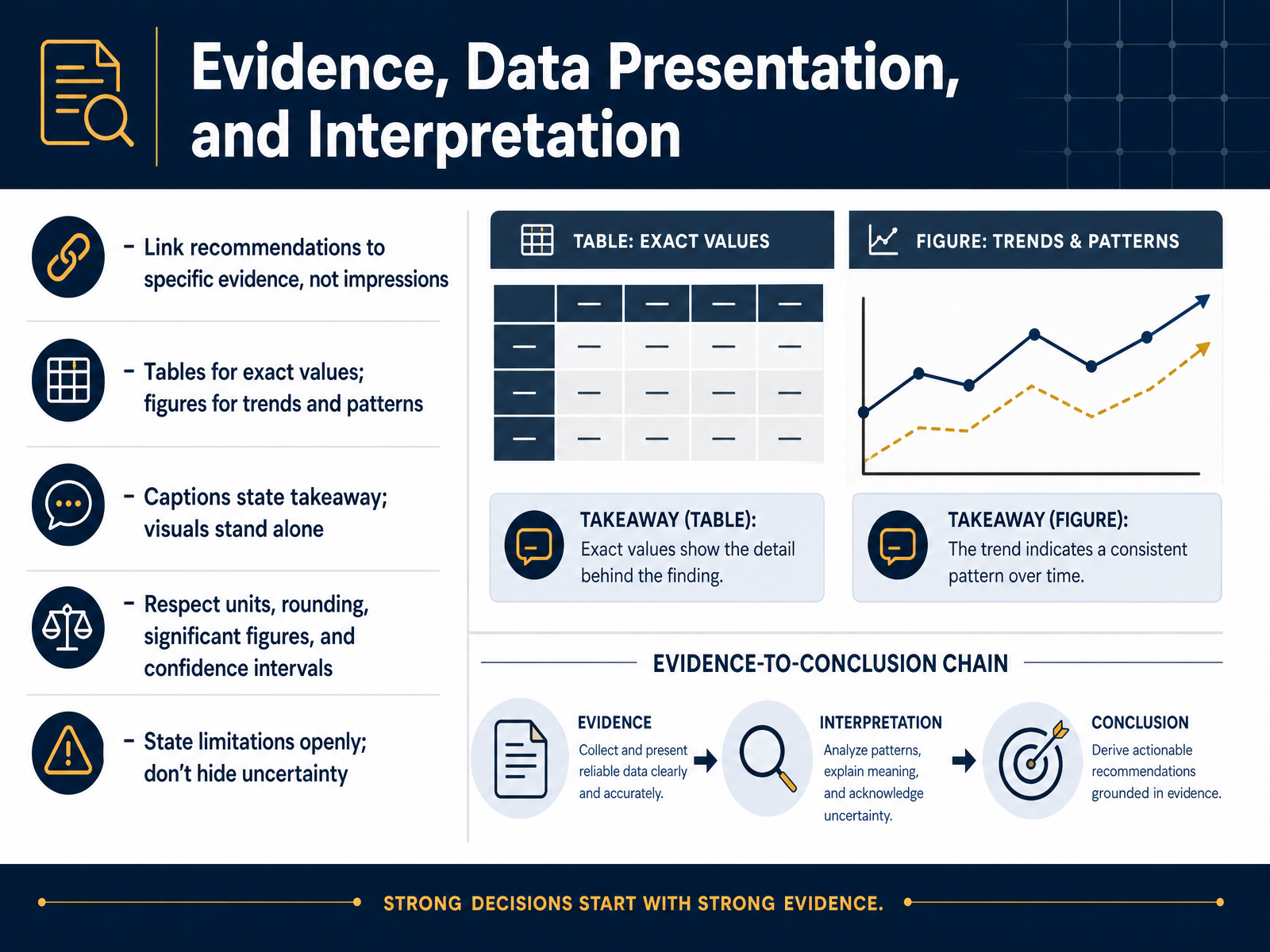
 - 08Evidence, Data Presentation, and InterpretationNow let's talk about evidence: how you present data, and how you interpret it. This is where a technical report stands or falls. First, link every recommendation to specific evidence, not to impressions. If you state that a component failed due to thermal stress, point to the temperature log or the material analysis. A claim without a traceable source is just an opinion. Next, choose the right format. Use tables when exact values matter, and figures when you need to show trends or patterns. If the numbers are the story, use a table. If the relationship is the story, use a graph. Captions must do real work. A caption should state the takeaway, not just describe the visual. When a reader looks at a figure alone, they should understand its message without reading the surrounding text. Respect the details of measurement. Keep units consistent, report rounding honestly, and match the number of significant figures to what your instrument can actually measure. Show confidence intervals where they apply. Finally, state limitations openly, without hiding uncertainty. A report that discloses a margin of error is far more credible than one that implies perfect precision. So, present the data faithfully, interpret it carefully, and let the evidence guide every conclusion. Next, let's analyze a worked report example to see these patterns in practice.
 cdi.mecon.gob.arengineering.purdue.edupmc.ncbi.nlm.nih.gov+22 min
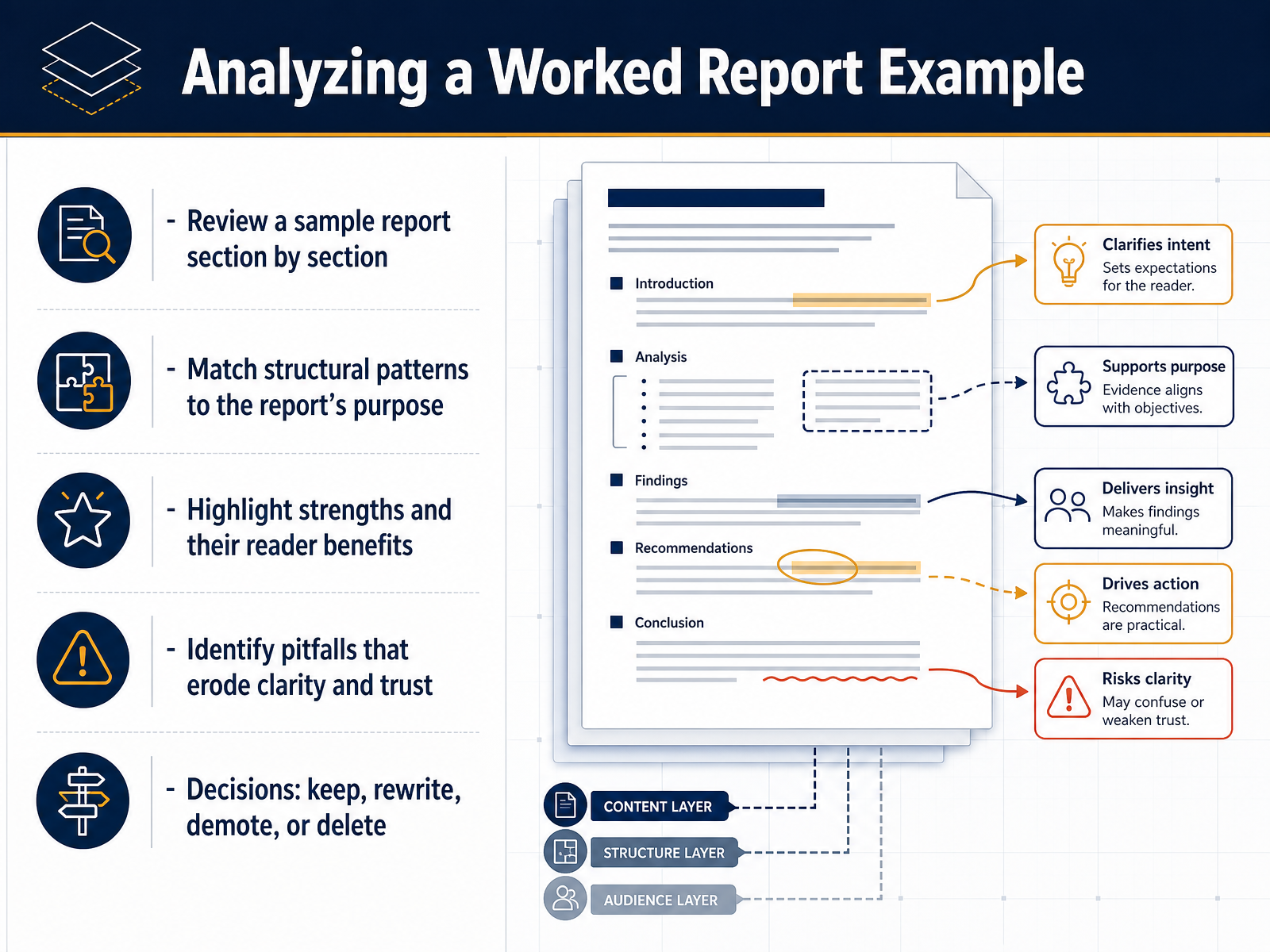
 - 09Analyzing a Worked Report ExampleLet's put this into practice with a worked example. We'll review a sample report section by section, matching its structural patterns to its intended purpose. As we go, we'll highlight the strengths and explain the direct benefit to you as the reader. But we'll also flag the pitfalls, the places where clarity erodes and trust starts to slip. For every issue we find, we'll make a call: keep it, rewrite it, demote it to an appendix, or delete it entirely. That decision framework is what turns critique into action. When you spot a strong pattern, name it and keep it. When you spot a vague claim or a buried conclusion, that's a rewrite. If it's background detail that only some readers need, demote it. And if it doesn't serve the report's purpose, delete it without hesitation. Next, we'll consider how different roles, executives, engineers, analysts, and operators, each read the same report differently.
 theiet.orgdatafield.dev1 min
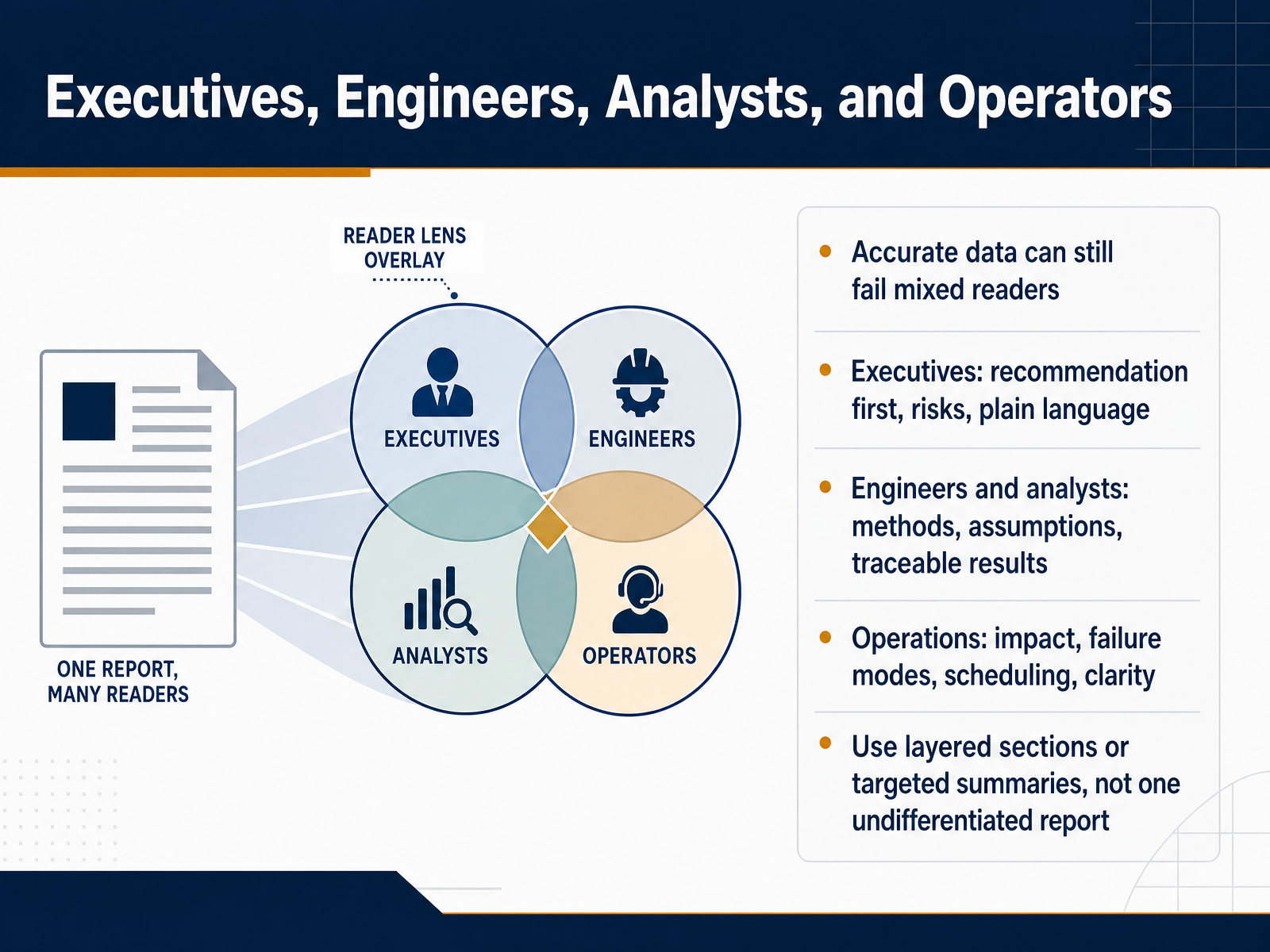
 - 10Executives, Engineers, Analysts, and OperatorsLet us look at who actually reads the report. The trap is writing one undifferentiated document for four different readers. Executives need the recommendation up front, the key risks, and plain language. Engineers and analysts need the methods, the assumptions, and results they can trace. Operations needs the practical impact, the failure modes, and scheduling implications. The data can be accurate and still fail if the structure does not match the reader. The fix is layered sections or targeted summaries. An executive reads a one-page brief. The analyst digs into an appendix. Operators get a checklist of actions and constraints. Design the report so each reader can find their answer without wading through the rest. Next, we will practice a revision that applies this multi-audience structure.
 nps.edutheiet.orgcontentxprtz.com+21 min
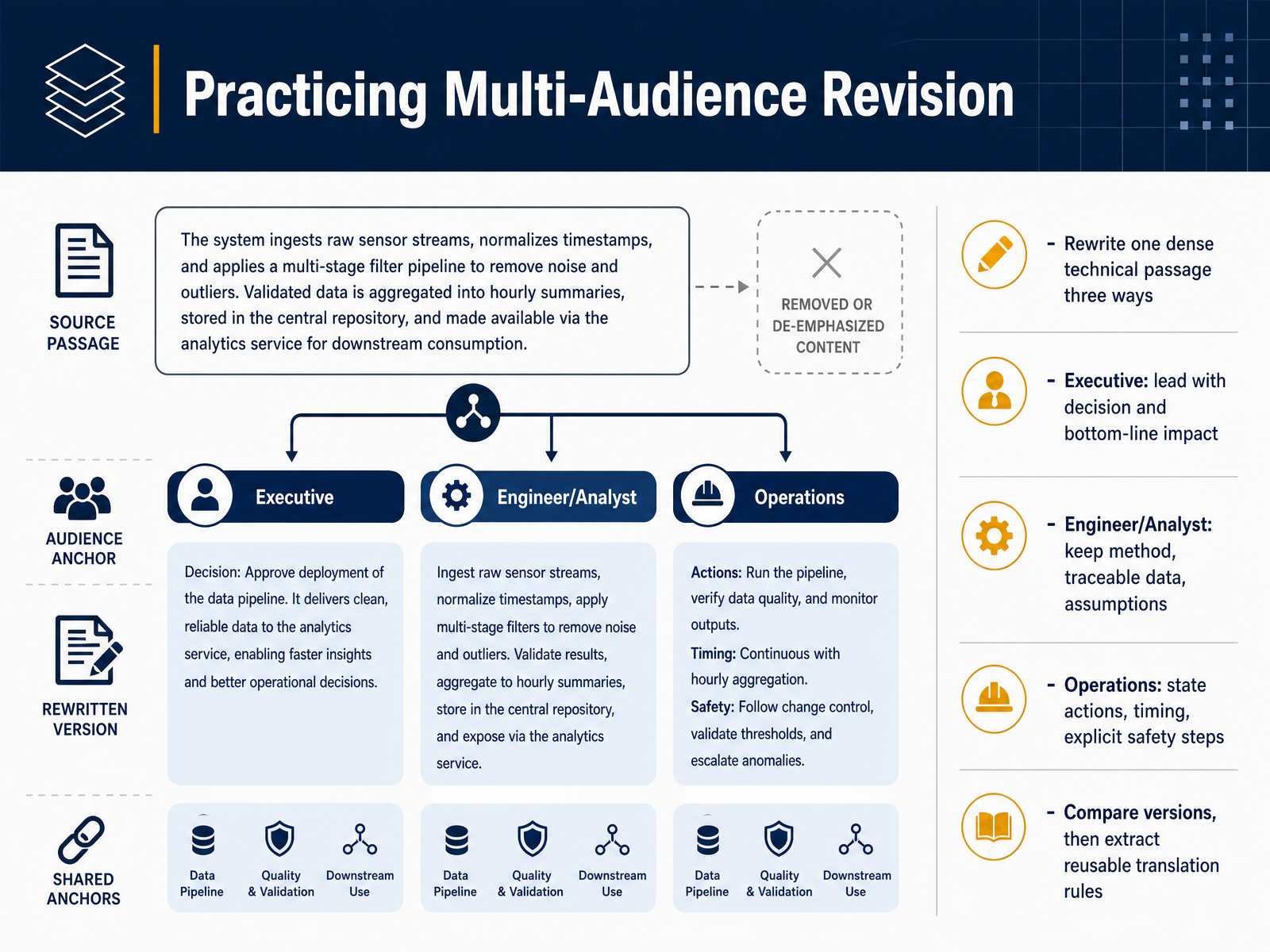
 - 11Practicing Multi-Audience RevisionLet's put this into practice. Take one dense passage from a report you're writing, and rewrite it three times. First, for an executive: lead with the decision and the bottom-line impact. No background, no method, just what they need to know and why it matters. Then for an engineer or analyst: keep the method, the traceable data, and the assumptions explicit. They need enough detail to verify your work. Finally, for operations: state the actions, the timing, and any safety steps without ambiguity. Compare your three versions side by side. Notice what changes are structural, like what you lead with, versus just wording. Then extract a reusable translation rule from each pair. For example, when writing for executives, always put the conclusion before the analysis. When writing for operations, always specify the who, what, and when. Build a small set of these rules and apply them to your next report. That's how you move from audience awareness to audience mastery. Up next, we'll turn your attention to the review and revision workflow.
 nps.edudevelopers.google.comdevelopers.google.com+22 min
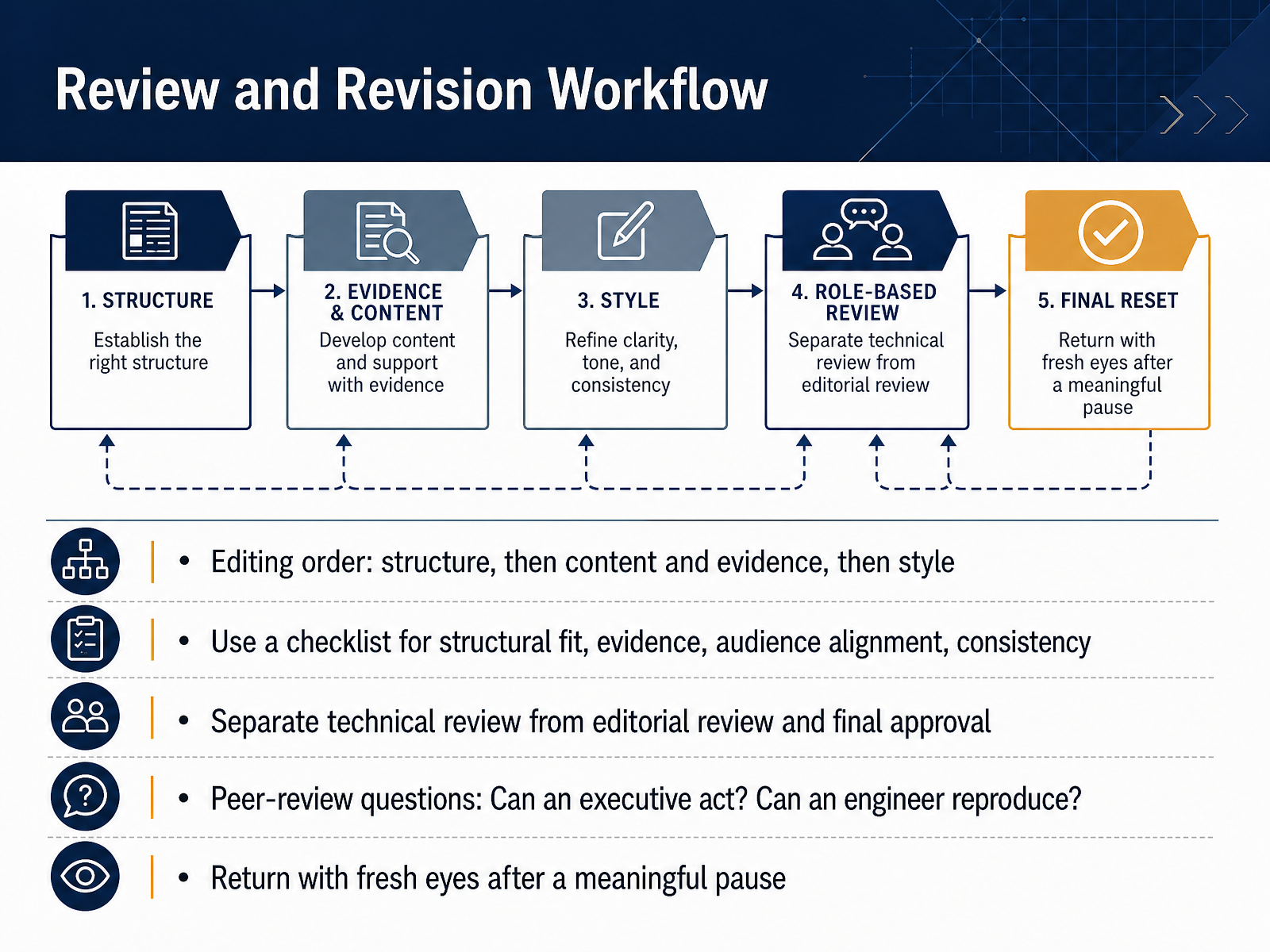
 - 12Review and Revision WorkflowLet’s walk through the review and revision workflow — the sequence that turns a solid draft into a dependable report. Your first pass should target structure, not style. Check that the sections build in a logical order and that headings reflect what actually follows. Once the structure holds, move to content and evidence. Is every claim supported? Is the data traceable? Save style, phrasing, and grammar for last. Work from a checklist that keeps you honest: fit against the original brief, evidence strength, audience alignment, and consistency of terms and formatting. Keep technical review and editorial review separate. A technical reviewer verifies the analysis is correct. An editor confirms the document is clear and compliant. Final approval belongs to one accountable owner, not a committee. As you review, ask two questions. Can an executive act on this recommendation without reading further? Can an engineer reproduce the work from the method alone? Each reviewer should return with fresh eyes after a pause, even if only for a few hours. Distance exposes assumptions you no longer notice. This discipline is far easier when the team works from shared templates and checklists, which is exactly where we go next.
 theiet.orgcontentxprtz.comeng.kuleuven.be+22 min
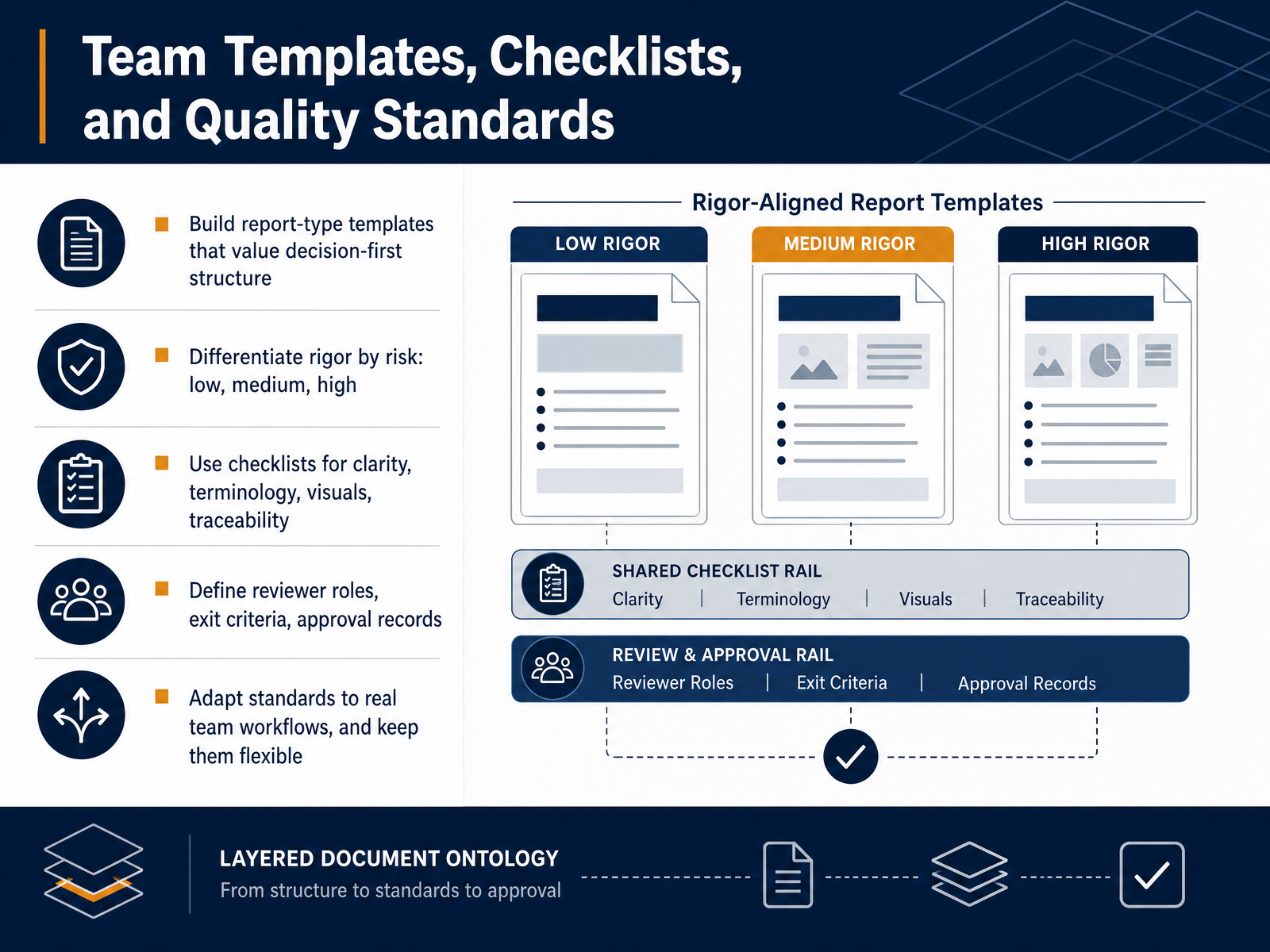
 - 13Team Templates, Checklists, and Quality StandardsLet's talk about how to make quality repeatable across your team. The goal isn't to burden writers with bureaucracy; it's to remove guesswork from every report. First, build report-type templates that value decision-first structure. Put the conclusion, the recommendation, or the key finding at the top where the reader expects it. For example, a template might require a findings summary before any methodology section. Just remember, a template is a starting point, not a replacement for thinking. Second, differentiate rigor by risk. A low-risk internal note doesn't need the same approvals as a high-risk compliance report or a final safety analysis. Scale the weight of review, evidence, and formality to the consequences of being wrong. Third, use checklists, but make them useful. Focus on clarity, terminology, visuals, and traceability. Keep them short, actionable, and adaptable to a writer's personal weak points. Fourth, define reviewer roles, exit criteria, and approval records with specific owners and sign-off requirements. Finally, adapt these standards to your actual workflows and keep them flexible enough to revise. In practice, standards should be living tools. Next, let's look at an action plan for applying these patterns and removing common pitfalls.
 2 min
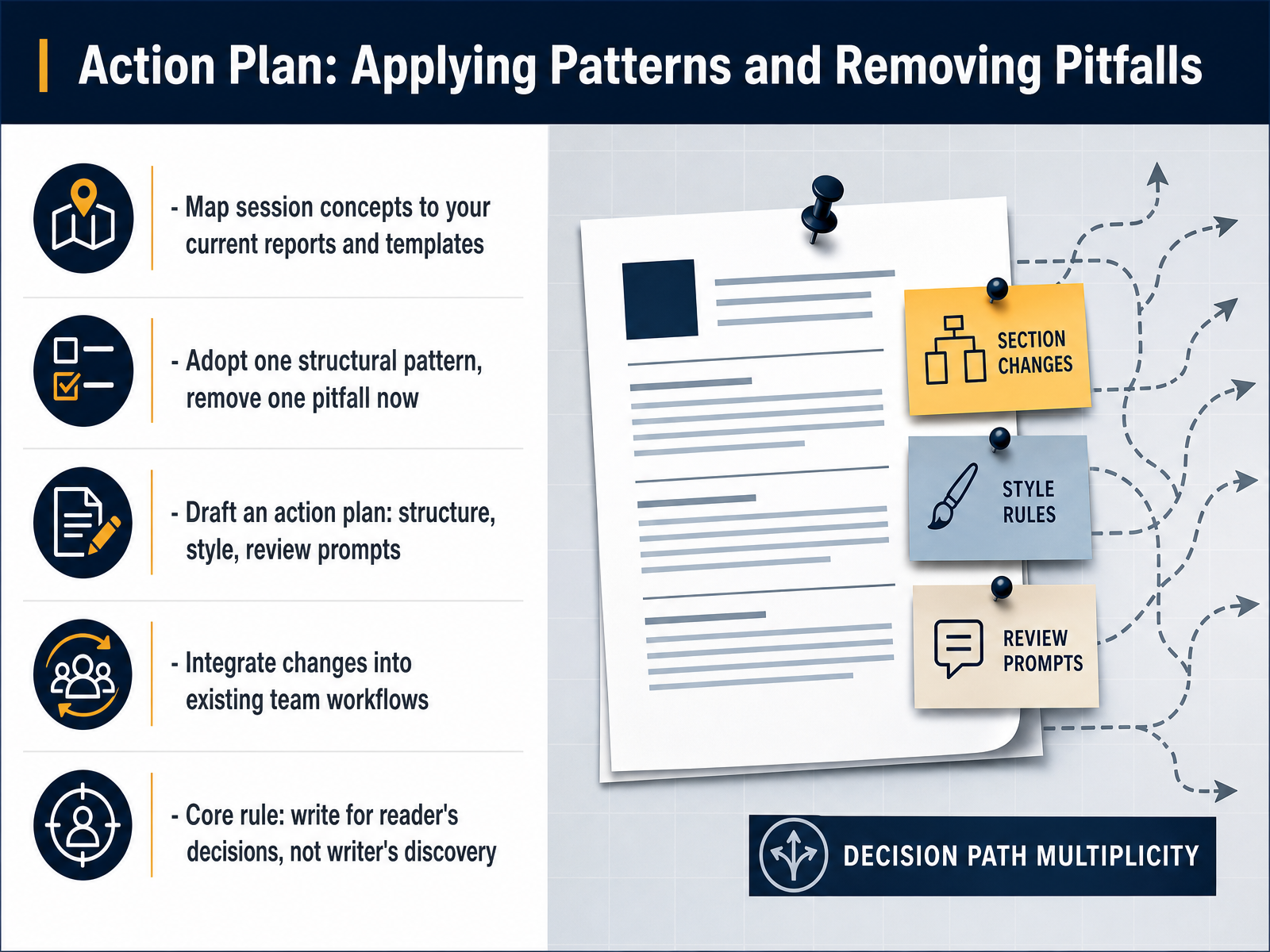
2 min - 14Action Plan: Applying Patterns and Removing PitfallsHere’s how to turn this session into steady practice. First, map these patterns and pitfalls against your current reports and templates. Be honest about where they show up. Next, adopt one structural pattern and remove one pitfall in your next document. Don’t try to overhaul everything at once. Draft a short action plan covering structure, style, and review prompts you’ll use before sending work out. Then, integrate those changes into your team’s workflows, not as a side project, but as the default way you operate. Use checklists to keep quality consistent, and set clear owners and exit criteria for reviews. The core rule remains simple: write for your reader’s decisions, not for your own discovery process. Lead with what they need to act on, and support it with the detail they can audit. Thank you for joining. Take one pattern, one pitfall, and one document, and put this into practice this week.
 nps.edu2 min
Take the deck with you
Download this course as a file — free, no sign-up needed.
- PDF handoutEvery slide page, ready to print or share.15 pages · 3.8 MBDownload
- Narrated PowerPointThe deck that presents itself — every slide carries the digital human's narration video.15 pages · 16.7 MBDownload
- PowerPoint slidesThe full deck as a .pptx — open it in PowerPoint, Keynote, or Google Slides.15 pages · 3.6 MBDownload
Free to use in your own training — please keep the PersonWise credit page at the end.
Have your own deck? Turn it into a course
Sources consulted
Web sources consulted while building this course.
- Technical Reports, Executive Summaries, and Abstracts — nps.edu
- A Guide to Writing Formal Technical Reports — pressbooks.atlanticoer-relatlantique.ca
- Engineering Technical Reports - The WAC Clearinghouse — wac.colostate.edu
- A guide to technical report writing — ias.ieee.org
- Technical reports — students.unimelb.edu.au
- A guide to technical report writing — theiet.org
- Technical Report Writing - Contentxprtz — contentxprtz.com
- Practical guidelines for writing a technical or scientific report — eng.kuleuven.be
- What makes a good technical report? — rotorlab.tamu.edu
- Chapter 13: Lab Reports and Technical Reports: Documenting... | Technical Writing — datafield.dev
- Clear sentences | Technical Writing | Google for Developers — developers.google.com
- Active voice vs. passive voice | Technical Writing | Google for Developers — developers.google.com
- 5 Common Mistakes in Writing Technical Documents — arielgroup.com
- Chapter 3: Clarity: How to Say What You Mean in the Fewest... | Technical Writing — datafield.dev
- 2.2 Sentence-Level Revision: Nominals, Noun Stacks, Redundancy, Expletives, Passive Voice, Readability – Technical Communication Across the Professions — oer.pressbooks.pub
- ANSI/NISO Z39.18-2005, Scientific and Technical Reports -- Preparation, Presentation, and Preservation — cdi.mecon.gob.ar
- Report Visuals and Data Display - Engelberth Research Group - Purdue University — engineering.purdue.edu
- Guidelines for Reporting of Figures and Tables for Clinical ... — pmc.ncbi.nlm.nih.gov
- Tables and Figures | Engineering Writing Center — engineering.usu.edu
- Basic Guidelines for Reporting Non-Clinical Data - Assay Guidance Manual - NCBI Bookshelf — ncbi.nlm.nih.gov