Begin
14 pages · ~28 min
Customer Education Case Study Patterns
This training examines customer education case studies to help learning professionals identify recurring patterns and weigh key tradeoffs when designing customer education programs.
A digital instructor presents all 14 pages. Hold “Ask” at any point and ask out loud — the answer comes from this course. No sign-up needed.
What you’ll learn
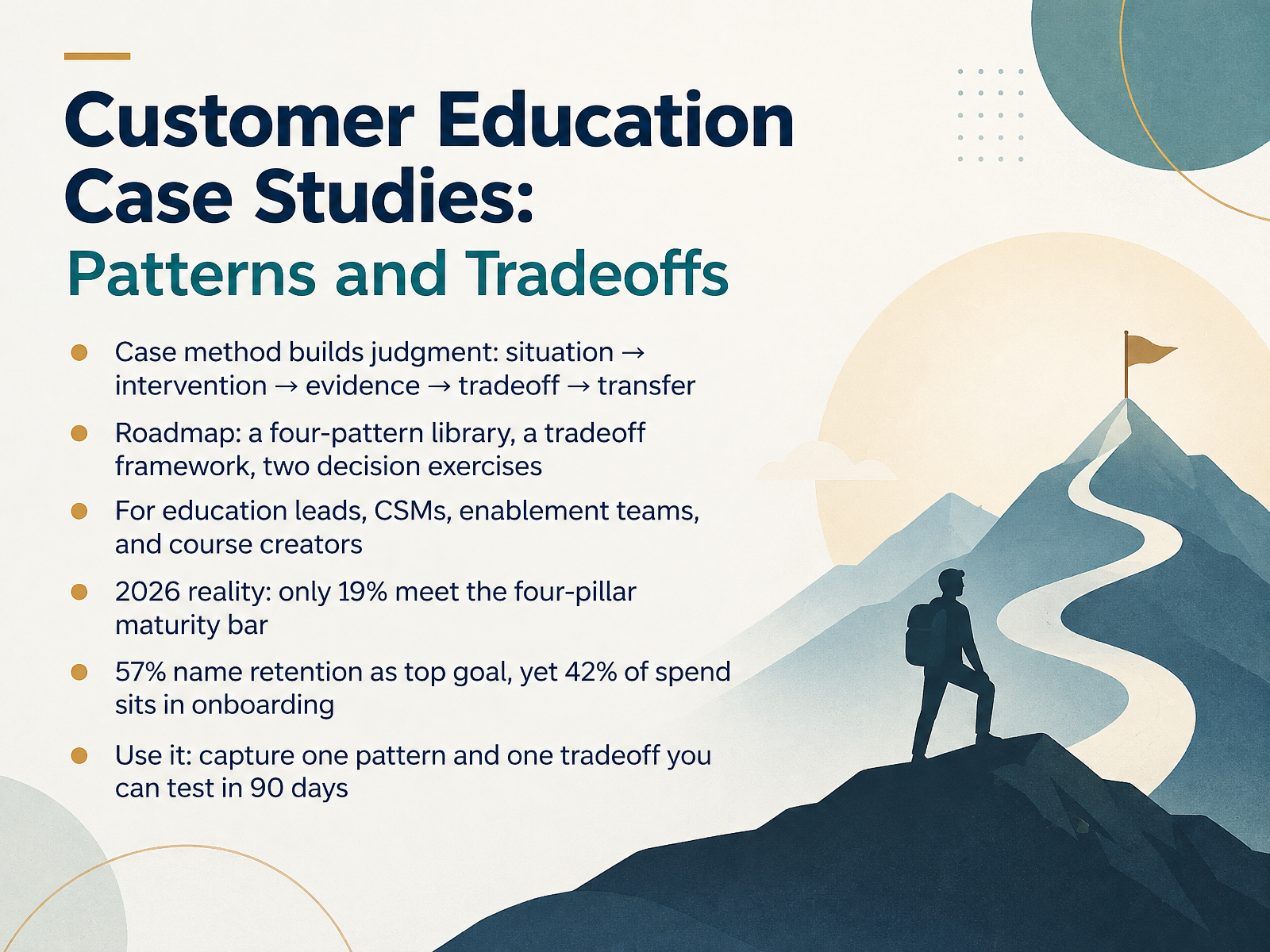
- 01Customer Education Case Studies: Patterns and TradeoffsWelcome. This course is about building judgment, not collecting stories. We use the case method: situation, intervention, evidence, tradeoff, then transfer to your own program. We will move through a four-pattern library, a tradeoff framework, and two decision exercises. This is built for education leads, customer success managers, enablement teams, and course creators. Here is the 2026 context. Only nineteen percent of programs meet the four-pillar maturity bar: an accountable sponsor, dedicated budget, current content, and measurable outcomes. Fifty-seven percent name retention as the top goal, yet forty-two percent of spend sits in onboarding. So your task is concrete. Capture one pattern and one tradeoff you can test in ninety days. Next, we cover how to read a case: vocabulary, evidence, and attribution.absorbai.comlearningnews.comkommunikasjon.ntb.no+22 min
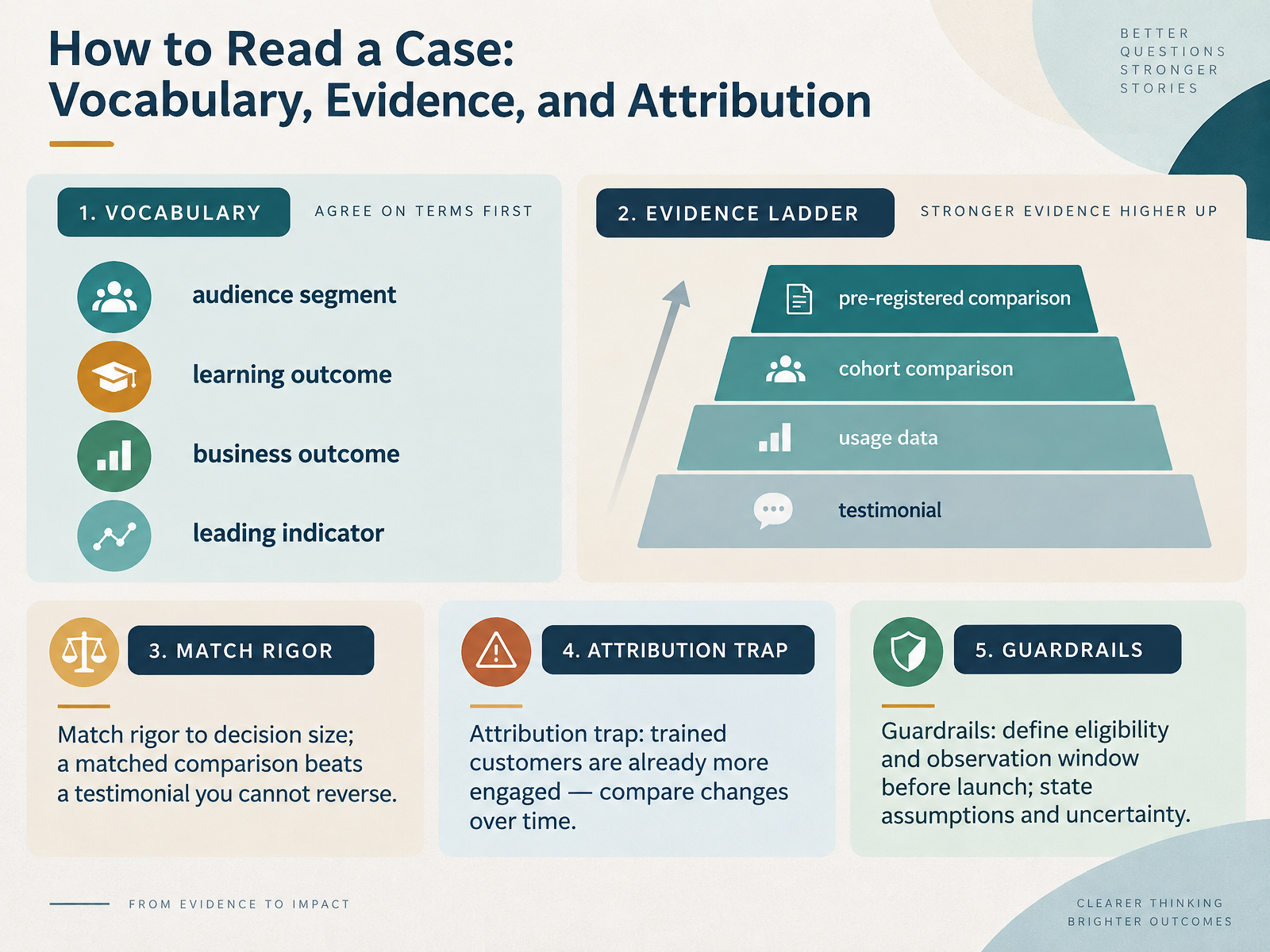
- 02How to Read a Case: Vocabulary, Evidence, and AttributionBefore you read any case study, agree on your terms. Define audience segment, learning outcome, business outcome, and leading indicator. If your CSMs and course creators mean different things by adoption, the case will not survive review. Next, rank your evidence. A testimonial is the weakest. Usage data is better. A cohort comparison is stronger. A pre-registered comparison is strongest. The tradeoff is cost. Match rigor to decision size. A matched comparison beats a testimonial you cannot reverse. Then watch the attribution trap. Trained customers are already more engaged. So compare changes over time, not levels. One team saw adoption rise twenty-one points among trained accounts and nine among comparison accounts. The real difference was twelve points. Finally, set guardrails before launch. Define eligibility and the observation window. State your assumptions and your uncertainty. Takeaway: before your next case review, write down the evidence rung and who owns each metric. Next, where the field actually stands in twenty twenty-six.
 corsoproduction.comintellum.comtechsmith.com+22 min
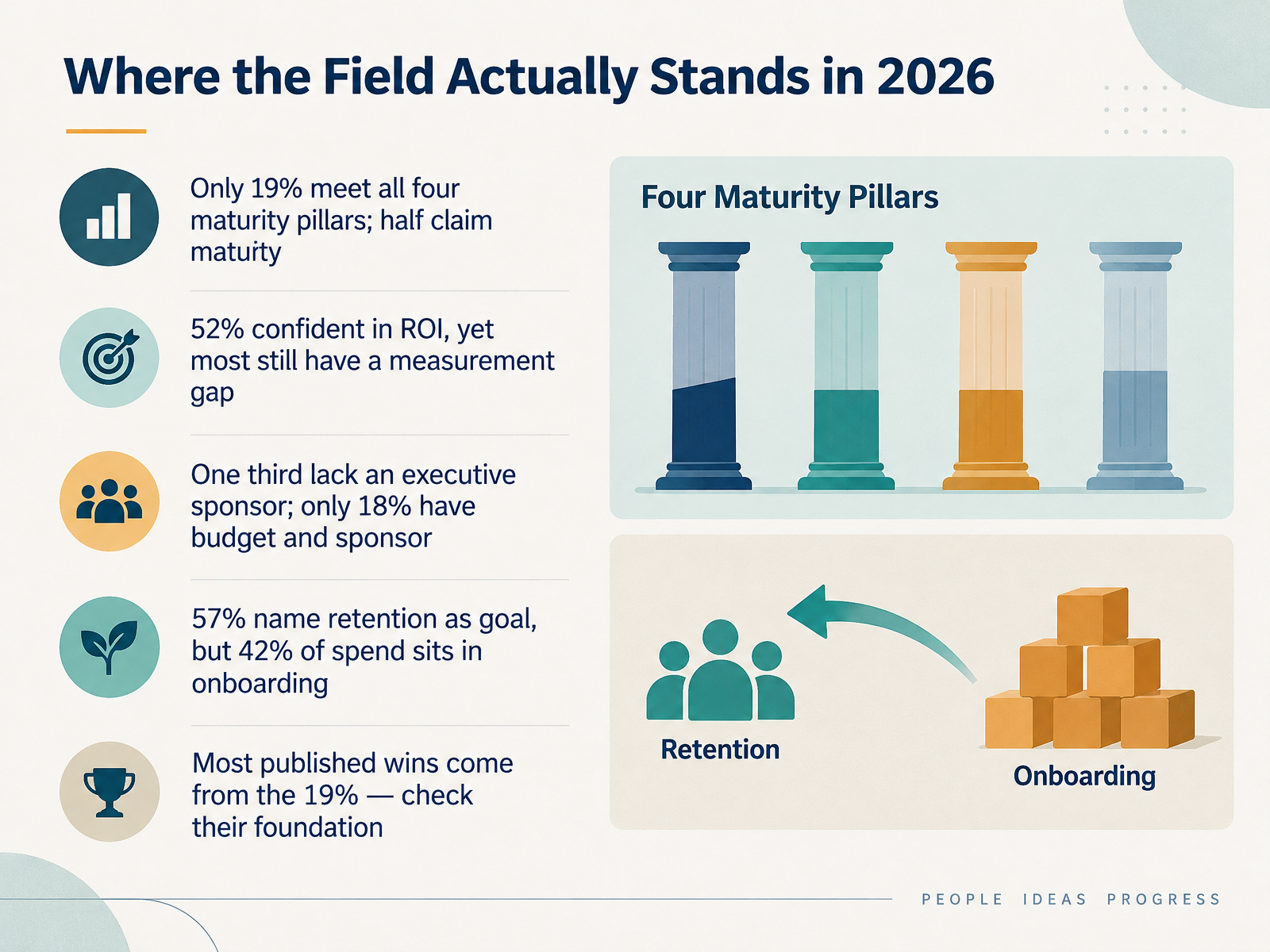
- 03Where the Field Actually Stands in 2026So let's look at where the field actually stands in twenty twenty-six. First, about half of programs call themselves mature. By contrast, only nineteen percent meet all four maturity pillars. Pillars here means an accountable sponsor, a dedicated budget, current content, and a measurable line to a business outcome. Second, fifty-two percent feel confident about return on investment, yet most of them still report at least one measurement gap, from missing analytics to disconnected systems. Third, one third have no executive sponsor at all, and only eighteen percent hold both a budget and a sponsor. Fourth, fifty-seven percent name retention as the goal, but forty-two percent of spend sits in onboarding, before renewal risk peaks. So check the foundation behind the wins you read, because most come from that nineteen percent. Now let's examine one pattern this raises: onboarding academies that shorten time-to-value.
 absorbai.comlearningnews.comkommunikasjon.ntb.no+22 min
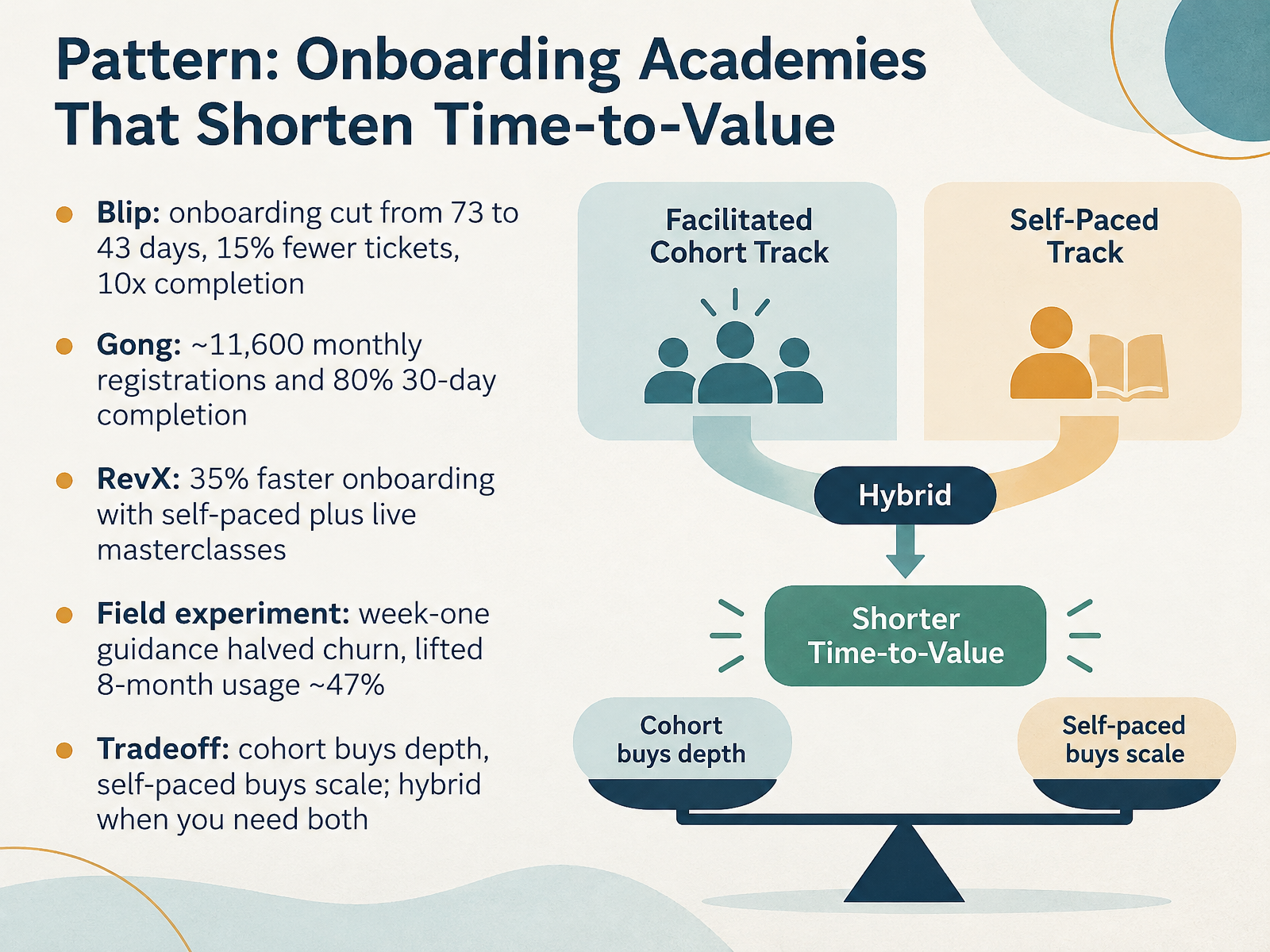
- 04Pattern: Onboarding Academies That Shorten Time-to-ValueNow let's look at the first pattern: onboarding academies that shorten time to value. The claim is simple. A structured academy moves customers to value faster than ad hoc training. Blip cut onboarding from seventy-three days to forty-three, with fifteen percent fewer tickets and ten times completion. By contrast, Gong runs about eleven thousand six hundred monthly registrations with an eighty percent thirty-day completion rate. RevX combined self-paced courses with live masterclasses and got thirty-five percent faster onboarding. And a field experiment found week-one guidance halved churn and lifted eight-month usage by about forty-seven percent. The tradeoff is this. Cohorts buy depth. Self-paced buys scale. Go hybrid when you need both. So decide who owns the academy, how your CSMs hand off to it, and what your course creators build first.
 learnworlds.comtrainn.cocasestudies.com+21 min
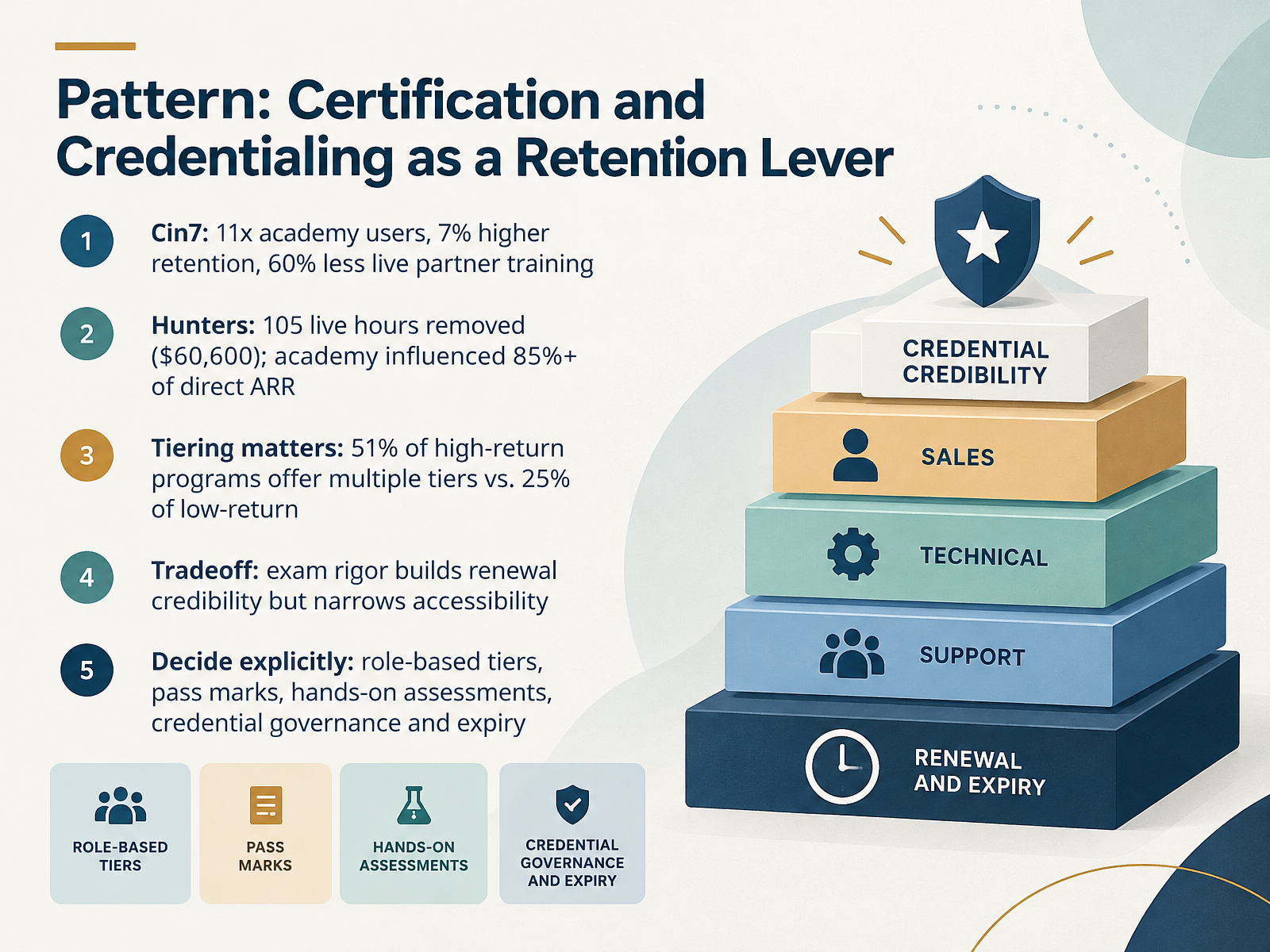
- 05Pattern: Certification and Credentialing as a Retention LeverNext, let's look at certification as a retention lever. At Cin7, Academy users grew eleven times over two years. Customers who enrolled in one course retained seven percent better. And live partner training fell by sixty percent. By contrast, Hunters removed one hundred five live hours, worth sixty thousand six hundred dollars, while the academy influenced over eighty five percent of direct annual recurring revenue. Here is the pattern. Tiering matters. Fifty one percent of high-return programs offer multiple tiers, versus twenty five percent of low-return programs. The tradeoff is real. Exam rigor builds renewal credibility, but it narrows accessibility. So decide explicitly. Define role-based tiers, pass marks, and hands-on assessments. Then assign credential governance and expiry dates. Who on your enablement team owns that policy? For course creators, the ask is a modular exam bank. Our next pattern is in-product education and contextual learning.
 gainsight.comtalentedlearning.comskilljar.com+22 min
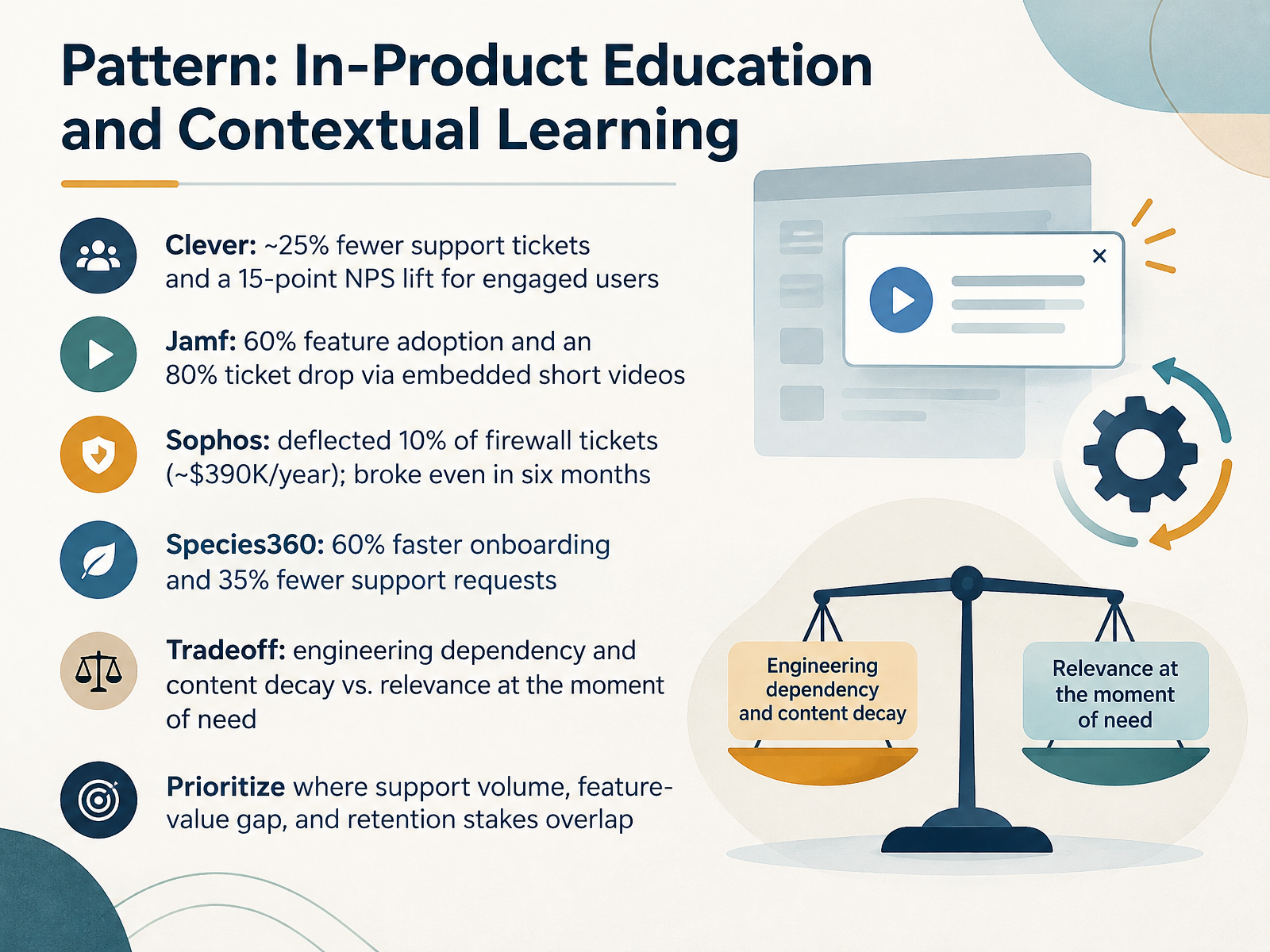
- 06Pattern: In-Product Education and Contextual LearningNow let's look at in-product education and contextual learning. The core claim is simple: putting help inside the product reduces support volume and speeds adoption. Clever saw roughly twenty-five percent fewer support tickets and a fifteen-point NPS lift for users who engaged with content. Jamf used short embedded videos called Jamf Shorts, reaching sixty percent adoption of a key feature and an eighty percent ticket drop on one workflow. Sophos deflected ten percent of firewall tickets, about three hundred ninety thousand dollars a year, and broke even in six months. Species360 cut onboarding time by sixty percent and support requests by thirty-five percent. The tradeoff is engineering dependency and content decay, against relevance at the moment of need. So prioritize where support volume, feature-value gaps, and retention stakes overlap. Before you commit, ask: which workflows justify engineering time, and who owns content freshness? Next, we move to community-led and peer learning at scale.
 2 min
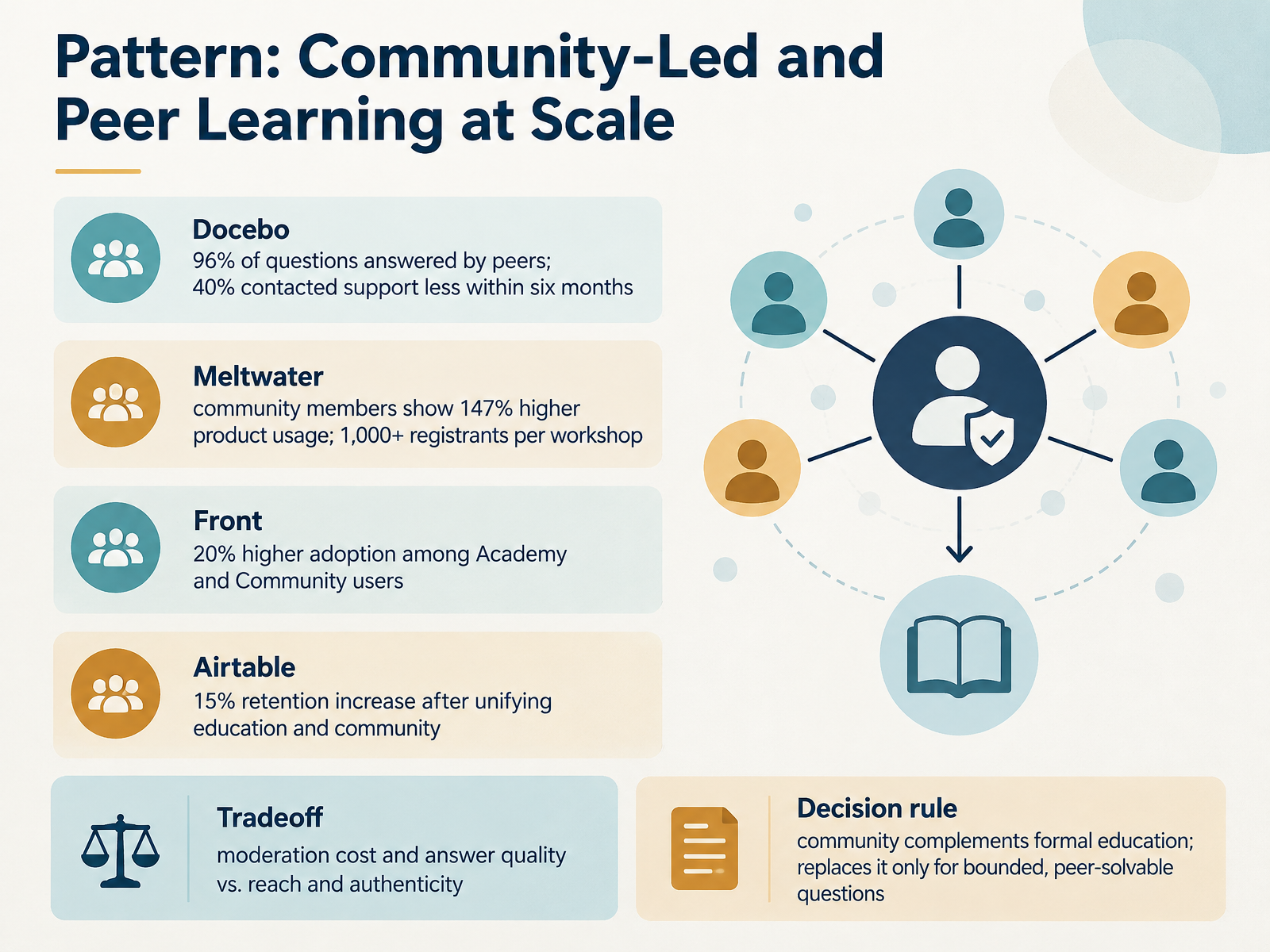
- 07Pattern: Community-Led and Peer Learning at ScaleNow let's look at community-led and peer learning at scale. First, the pattern: peers can absorb much of the everyday question load. At Docebo, 96 percent of questions were answered by peers, and 40 percent contacted support less within six months. Second, engagement can compound. Meltwater found community members showed 147 percent higher product usage, with over 1,000 workshop registrants per session. Front saw 20 percent higher adoption among Academy and Community users. Airtable gained a 15 percent retention increase after unifying education and community. The tradeoff is moderation cost and answer quality versus reach and authenticity. Your decision rule: community complements formal education. It replaces it only for bounded, peer-solvable questions. So decide which questions your CSMs and course creators keep formal. Next, the Tradeoff Matrix: Cost, Scale, Depth, and Speed.
 1 min
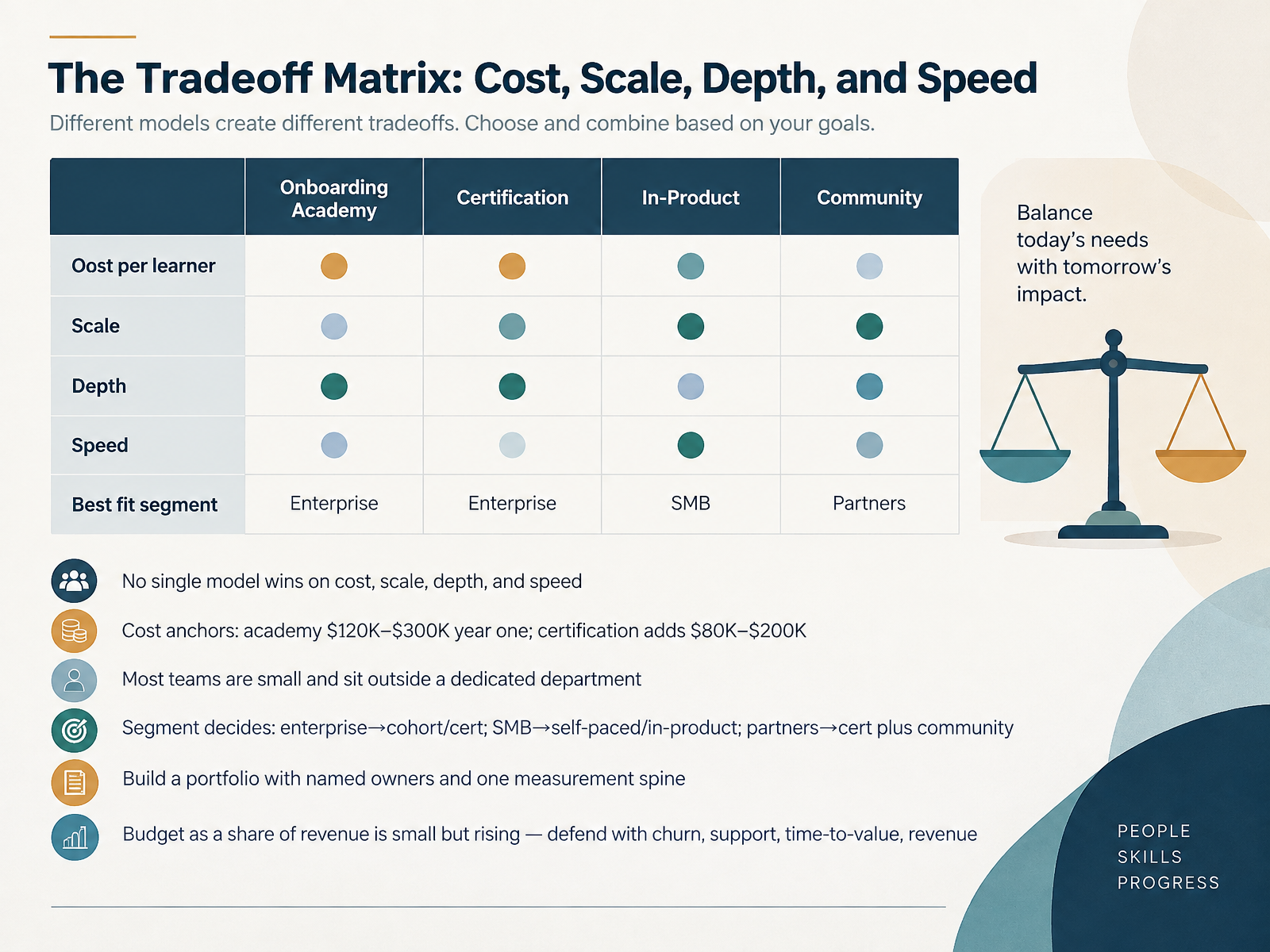
- 08The Tradeoff Matrix: Cost, Scale, Depth, and SpeedNow let's look at the tradeoff matrix: cost, scale, depth, and speed. No single model wins on all four. First, cost anchors. A customer academy runs roughly one hundred twenty thousand to three hundred thousand dollars in year one. Certification adds another eighty thousand to two hundred thousand. Second, most teams are small and sit outside a dedicated department. So the tradeoff is this: breadth costs money, and depth costs time. Segment decides. Enterprise buyers often need cohort programs and certification. SMB customers do better with self-paced, in-product learning. Partners need certification plus community. Your decision: build a portfolio with named owners and one measurement spine. Budget is still a small share of revenue, but it is rising. Defend it with churn, support cost, time-to-value, and revenue, not completion counts. Next, we move to design choices that travel: content, format, and localization.
 thoughtleadership.forrester.comcorsoproduction.comintellum.com+22 min
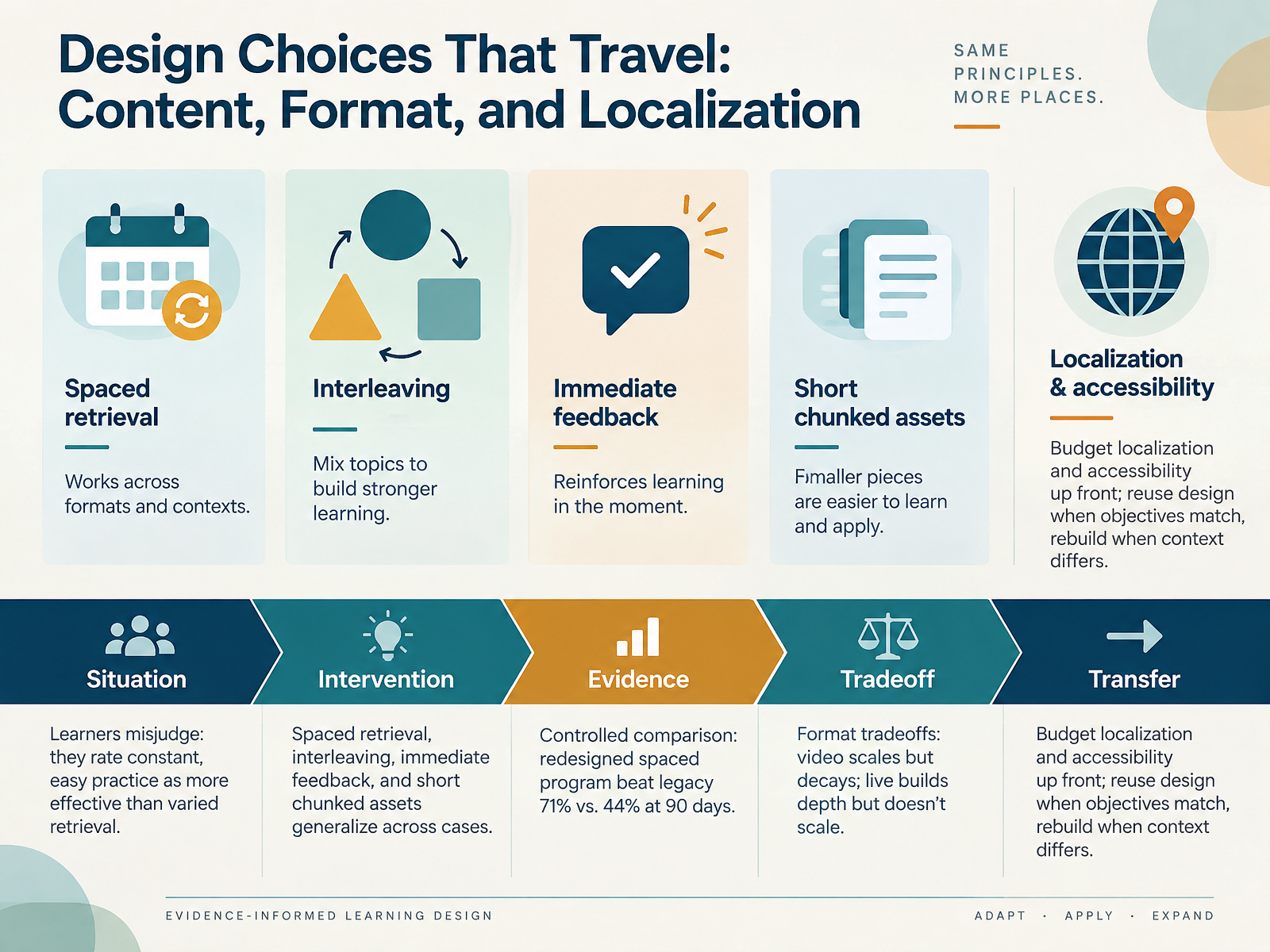
- 09Design Choices That Travel: Content, Format, and LocalizationNow let's look at design choices that travel across cases. First, four methods generalize well: spaced retrieval, interleaving, immediate feedback, and short chunked assets. In one controlled comparison, a redesigned spaced program beat the legacy program at ninety days, seventy one percent versus forty four percent. Here's the catch. Learners misjudge. They rate constant, easy practice as more effective than varied retrieval. So expect pushback when you make practice harder. The tradeoff is format. Video scales but decays, while live sessions build depth but don't scale. Finally, budget localization and accessibility up front. Reuse the design when objectives match, and rebuild when context differs. Decision prompt: which of your assets can you reuse, and which needs rebuilding for context? Next, we'll examine failure modes and warning signs.
 1 min
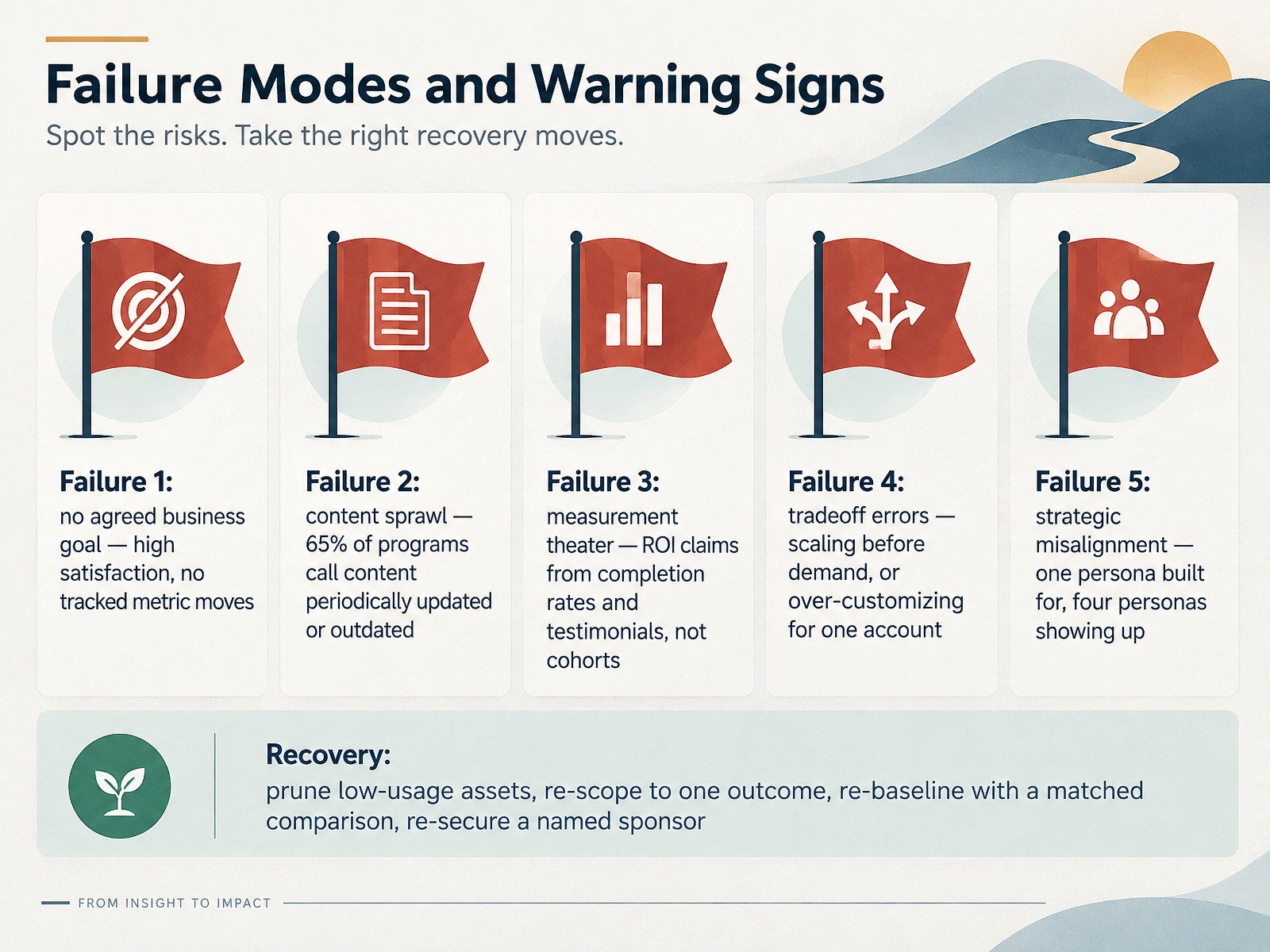
- 10Failure Modes and Warning SignsNow let's name the failure modes, so you can spot them early. First, no agreed business goal. Satisfaction is high, but no tracked metric moves. Second, content sprawl. Sixty-five percent of programs call their content periodically updated or outdated. Third, measurement theater. Teams claim ROI from completion rates and testimonials, not matched cohorts. The tradeoff is speed versus credibility. Fourth, tradeoff errors. You scale before demand exists, or over-customize for one account. Fifth, strategic misalignment. You build for one persona, and four personas show up. Recovery follows a sequence. Prune low-usage assets. Re-scope to one outcome. Re-baseline with a matched comparison. And re-secure a named sponsor. Before your next review, pick one failure mode and assign an owner to fix it. Next, we connect education to revenue with metrics finance trusts.
 absorbai.comlearningnews.comkommunikasjon.ntb.no+22 min
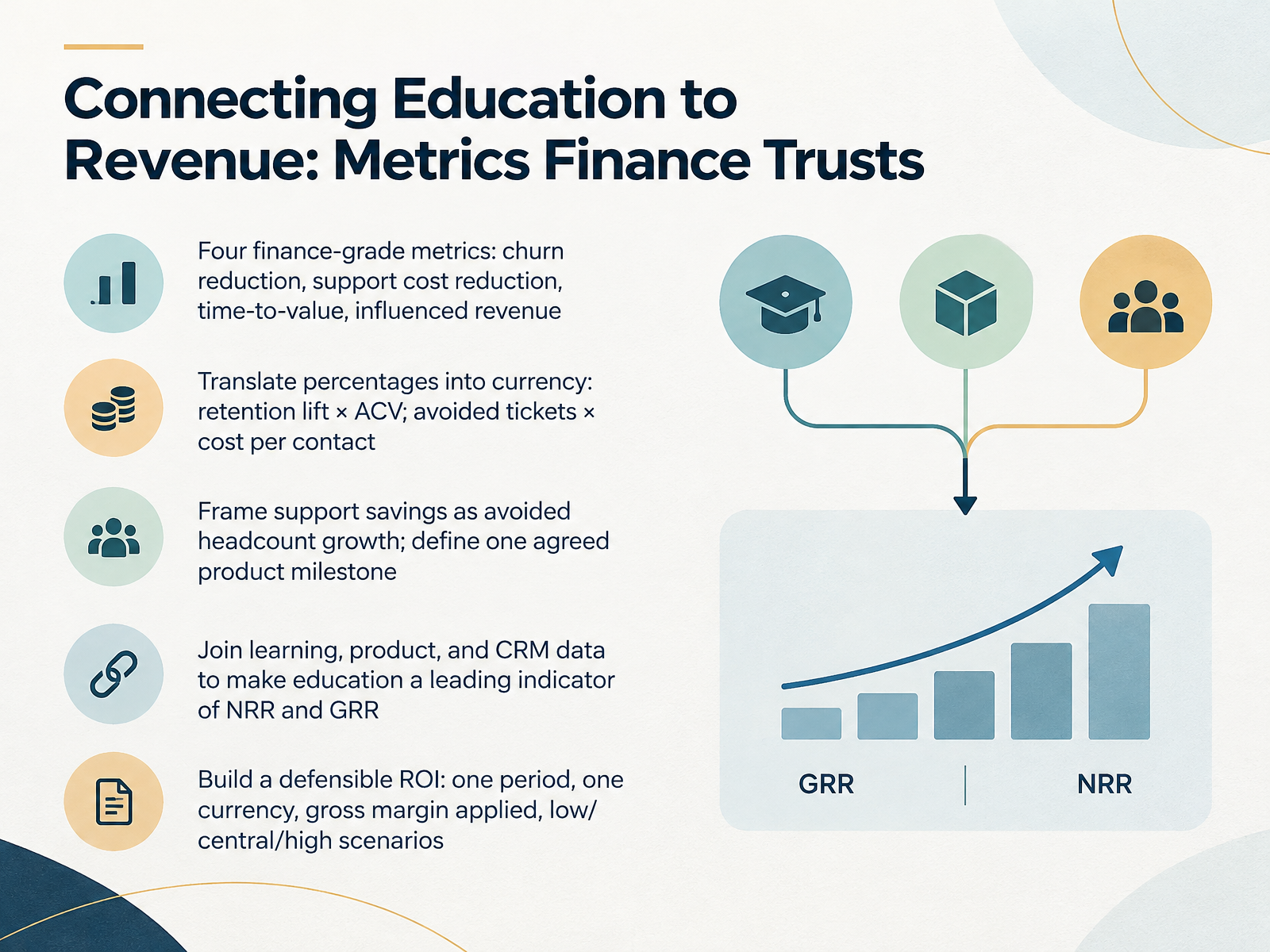
- 11Connecting Education to Revenue: Metrics Finance TrustsNow let's connect education to revenue with metrics finance actually trusts. Start with four finance-grade measures: churn reduction, support cost reduction, time-to-value, and influenced revenue. First, translate every percentage into currency. Multiply your retention lift by average contract value. Multiply avoided tickets by cost per contact. Next, frame support savings as avoided headcount growth, not a ticket drop. And define one agreed product milestone, so time-to-value becomes days saved. The tradeoff is rigor: vague outcomes won't survive review. Then join learning, product, and CRM data. That makes education a leading indicator of net revenue retention and gross revenue retention, the share of revenue you keep before expansion. Finally, build a defensible return on investment: one period, one currency, gross margin applied, and low, central, and high scenarios. Your decision prompt: which single metric will you make finance-grade this quarter? Next, we put this to work in the diagnostic workshop, where you score your program against the pattern library.
 corsoproduction.comintellum.comtechsmith.com+22 min
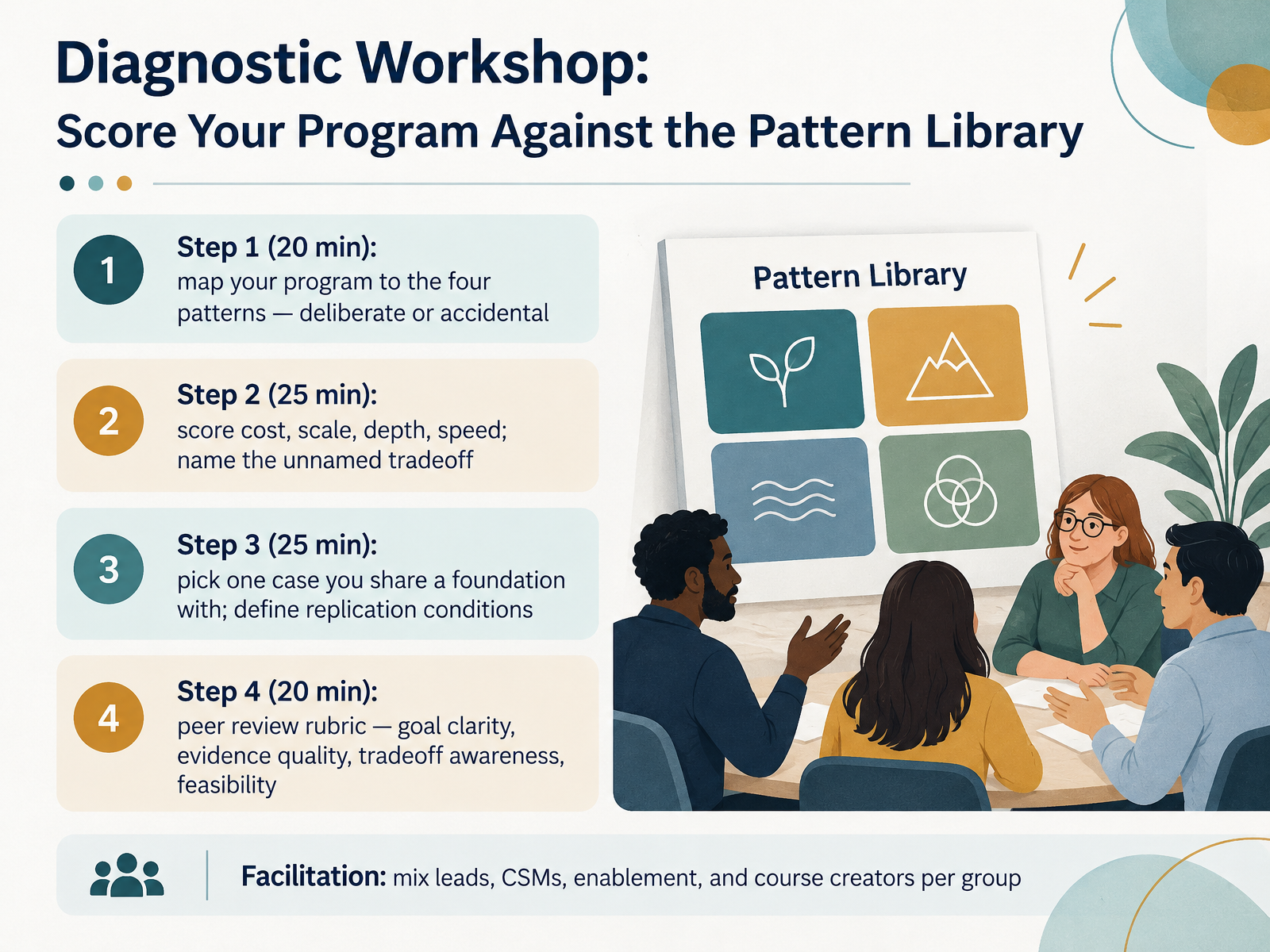
- 12Diagnostic Workshop: Score Your Program Against the Pattern LibraryNext, you run the workshop itself. Here is a structure that turns the pattern library into decisions. First, in twenty minutes, map your program to the four patterns. Ask one question: is each pattern deliberate or accidental? Second, in twenty five minutes, score cost, scale, depth, and speed. Then name the tradeoff nobody has said aloud. For example, deeper certification may slow time to value. The tradeoff is real, so write it down. Third, in twenty five minutes, pick one case that shares your foundation. Define the conditions for replicating it. Fourth, in twenty minutes, run peer review on goal clarity, evidence quality, tradeoff awareness, and feasibility. Mix leads, customer success managers, enablement, and course creators in each group. Before you run it, decide who owns each step in your workbook. Next, we build your 90-Day Decision Plan and Internal Case Library.
 absorbai.comlearningnews.comkommunikasjon.ntb.no+22 min
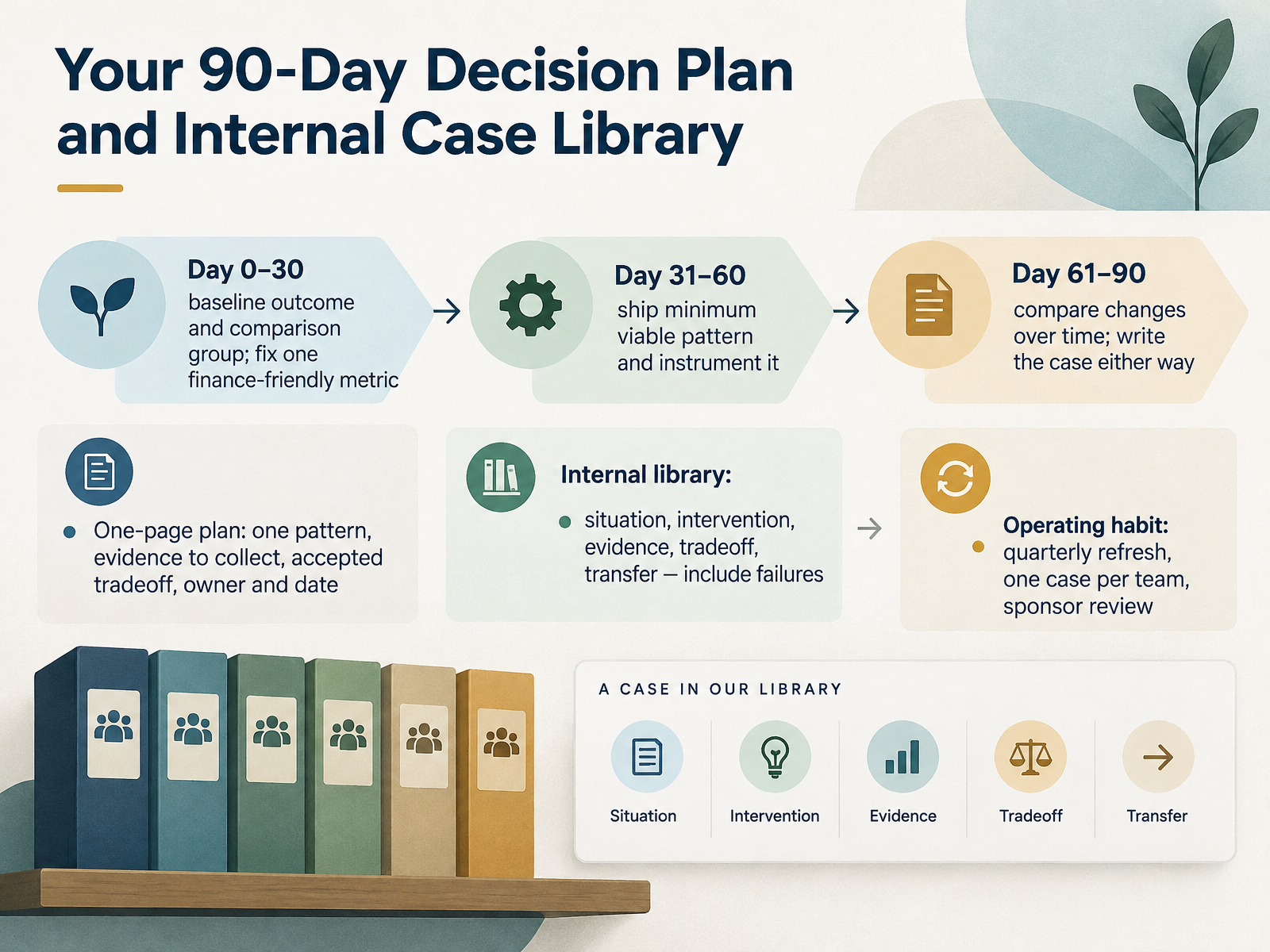
- 13Your 90-Day Decision Plan and Internal Case LibraryNow let's turn this into a decision plan you can actually run. Start with a one-page plan. It names one pattern, the evidence you will collect, the tradeoff you accept, and one owner with a date. For days zero to thirty, fix one finance-friendly metric and establish a baseline with a comparison group. That means dollars tied to retention or support cost avoided, not completion rates. From day thirty-one to sixty, ship a minimum viable version of the pattern and instrument it. By day sixty-one to ninety, compare changes over time and write the case either way. Next, build an internal library. Each case records the situation, intervention, evidence, tradeoff, and how it transfers, and you include failures. Your operating habit is a quarterly refresh, one case per team, and a sponsor review. So decide today: which single pattern gets your ninety days? That leads us into key takeaways and next steps.
 corsoproduction.comintellum.comtechsmith.com+22 min
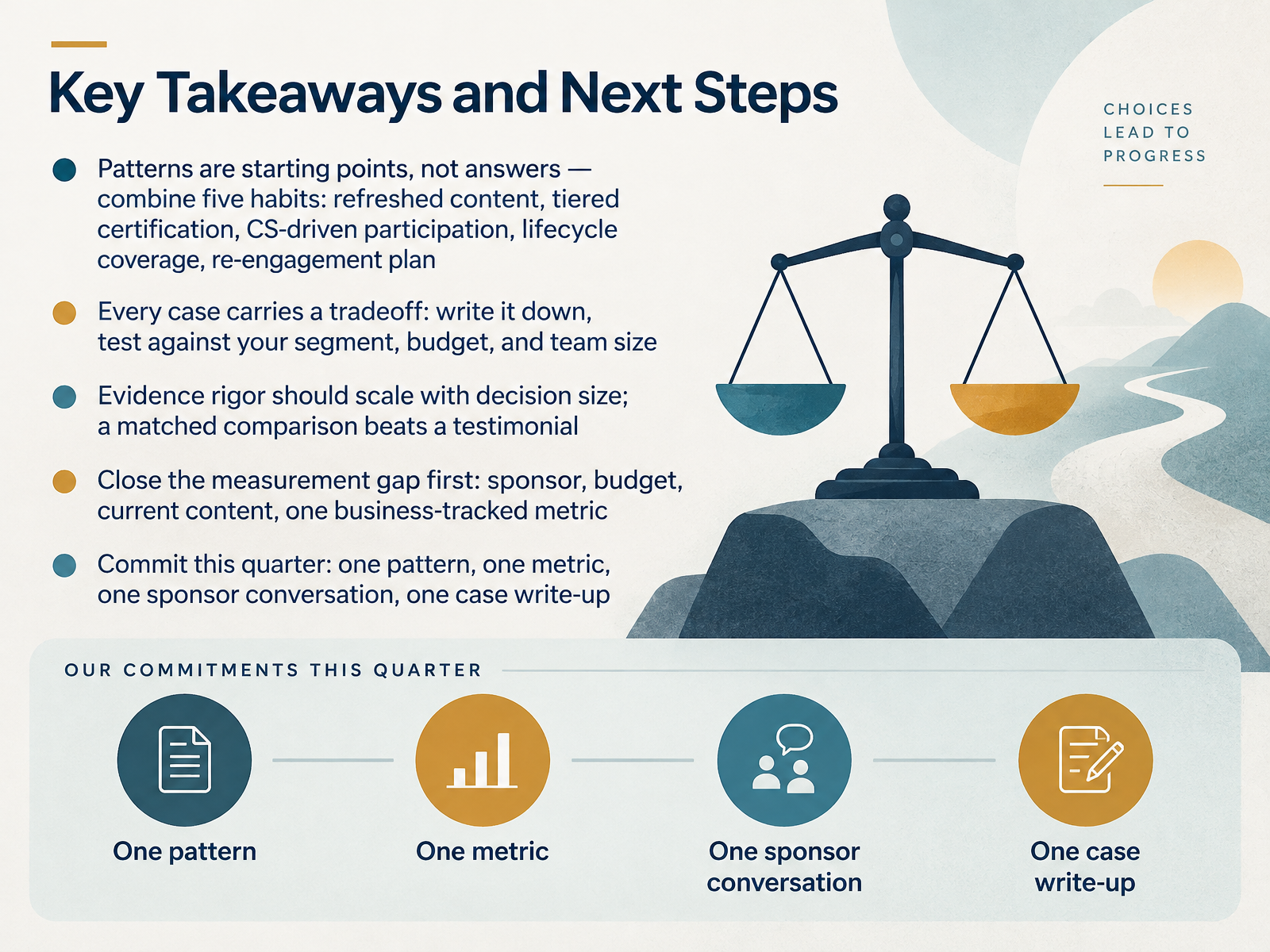
- 14Key Takeaways and Next StepsLet's pull the course together. First, treat patterns as starting points, not answers. Combine the five habits: refreshed content, tiered certification, Customer Success driven participation, lifecycle coverage, and a re-engagement plan. Second, every case carries a tradeoff. Write it down and test it against your segment, budget, and team size. Third, scale evidence rigor to decision size. A matched comparison beats a testimonial when the stakes are high. Fourth, close the measurement gap first: sponsor, budget, current content, and one business tracked metric. Then commit this quarter: one pattern, one metric, one sponsor conversation, and one case write-up. Thank you for working through these cases with me. You now have a practical way to test patterns against your own context. Go pick your one pattern and start.
 absorbai.comlearningnews.comkommunikasjon.ntb.no+22 min
Take the deck with you
Download this course as a file — free, no sign-up needed.
- PDF handoutEvery slide page, ready to print or share.15 pages · 3.8 MBDownload
- Narrated PowerPointThe deck that presents itself — every slide carries the digital human's narration video.15 pages · 13.9 MBDownload
- PowerPoint slidesThe full deck as a .pptx — open it in PowerPoint, Keynote, or Google Slides.15 pages · 3.7 MBDownload
Free to use in your own training — please keep the PersonWise credit page at the end.
Have your own deck? Turn it into a course
Sources consulted
Web sources consulted while building this course.
- The state of customer education in 2026 | Absorb LMS Software — absorbai.com
- Only 19% of customer education programmes meet maturity benchmark - Learning News — learningnews.com
- New Absorb Software and Lighthouse Research & Advisory ... — kommunikasjon.ntb.no
- The Customer Education Gap: What Separates High-Performing Programs from the Rest (webinar) | Absorb LMS Software — absorblms.com
- 2026 State of AI in Customer Education - LearnWorlds — learnworlds.com
- Customer Education KPIs: 9 Metrics and an ROI Model - Corso — corsoproduction.com
- Customer Education Metrics to Measure | Intellum — intellum.com
- 3 Metrics that Prove Customer Education ROI to Finance | TechSmith — techsmith.com
- Drive Business Success Through Customer Education — thoughtleadership.forrester.com
- New Absorb Software and Lighthouse Research & Advisory Study Reveals How the Highest-Performing Customer Education Programs Turn Learning into Measurable Growth | Financial Post — financialpost.com
- Blip Academy success story - LearnWorlds — learnworlds.com
- The Wingman Academy: How Wingman uses Trainn to onboard customers faster — trainn.co
- Case Study: Gong achieves scalable customer training and improved UX with Skilljar | CaseStudies.com — casestudies.com
- Hunters: $950K saved in sales ramp time | Juno — junojourney.com
- Dixa Customer Video Training Hub — synthesia.io
- Usage Explodes 11x for Cin7 Customer Education, Increasing Retention 7% | Gainsight Software — gainsight.com
- Qlik + Intellum - Talented Learning — talentedlearning.com
- Alarm.com Academy Leads to Monumental Growth in Partner Education and Engagement — skilljar.com
- Partner Training Case Study: How Acme Scaled with LMS - Article | Upscend — upscend.com
- How Software Companies Use Digital Badges for Partner Certification | IssueBadge — blog.issuebadge.com