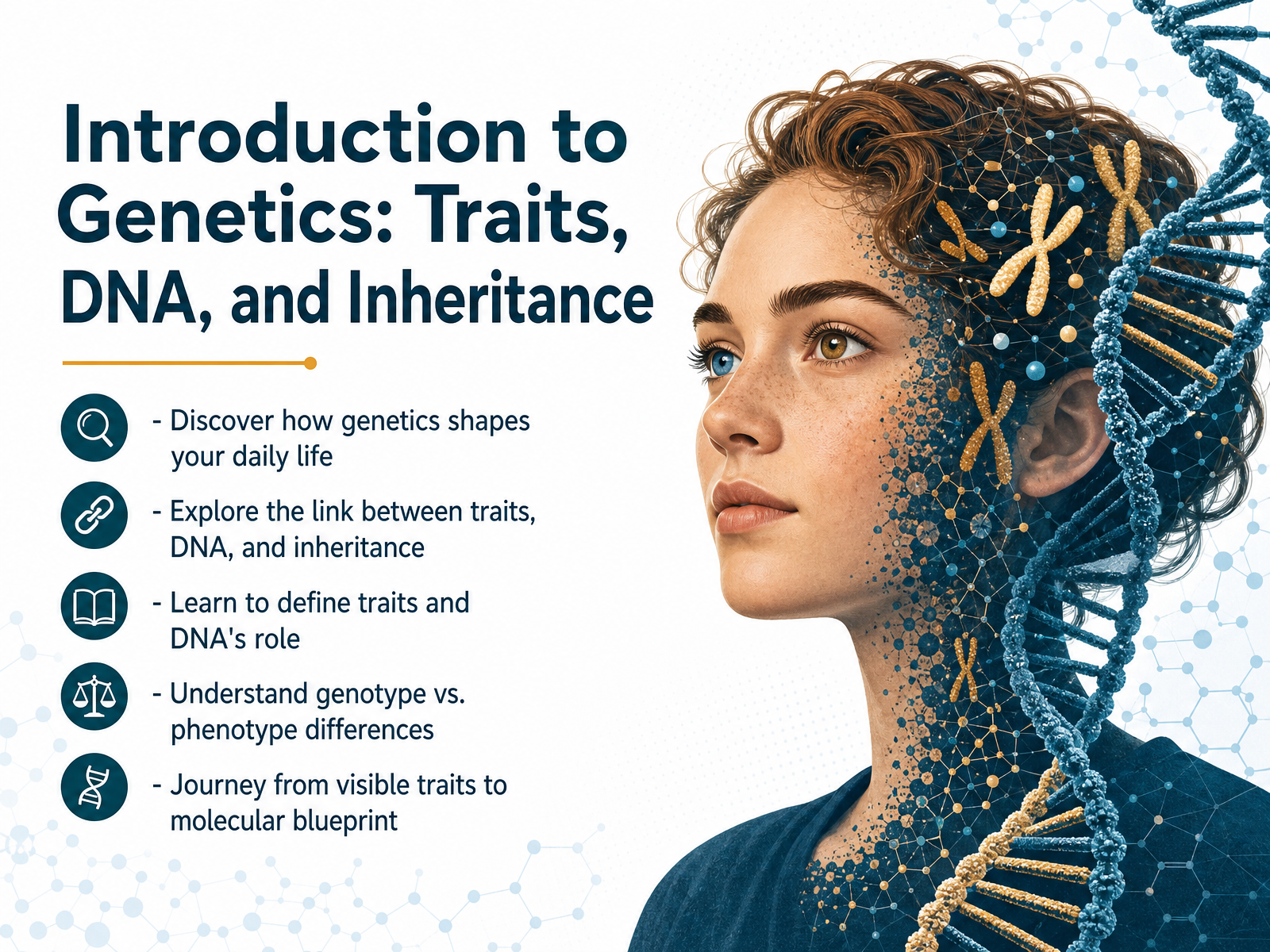
Introduction to Genetics: Traits and Inheritance
Begin
15 pages · ~30 min
Introduction to Genetics: Traits and Inheritance
This training introduces fundamentals of genetics, covering traits, DNA structure, and inheritance patterns for learners new to the subject.
What you’ll learn
- 01Introduction to Genetics: Traits, DNA, and InheritanceWelcome to Introduction to Genetics: Traits, DNA, and Inheritance. I'm so glad you're here. Genetics can sound complicated, but at its heart, it's the story of what makes you, you. Today, we're going to explore that story together. We'll start by defining what traits are and uncover the key role DNA plays inside your cells. Then, we'll unravel the relationship between traits, DNA, and how they are passed down through inheritance. You'll also learn the important difference between your genotype—the genetic instructions you carry—and your phenotype, which is the visible result, like your eye color or your height. Our journey will take us from the traits you can see in your own family right down to the molecular blueprint that makes it all possible. It's going to be a fascinating look at the hidden code of life. Let's begin with the most familiar part of this story. Coming up next: What Are Traits, Really?2 min
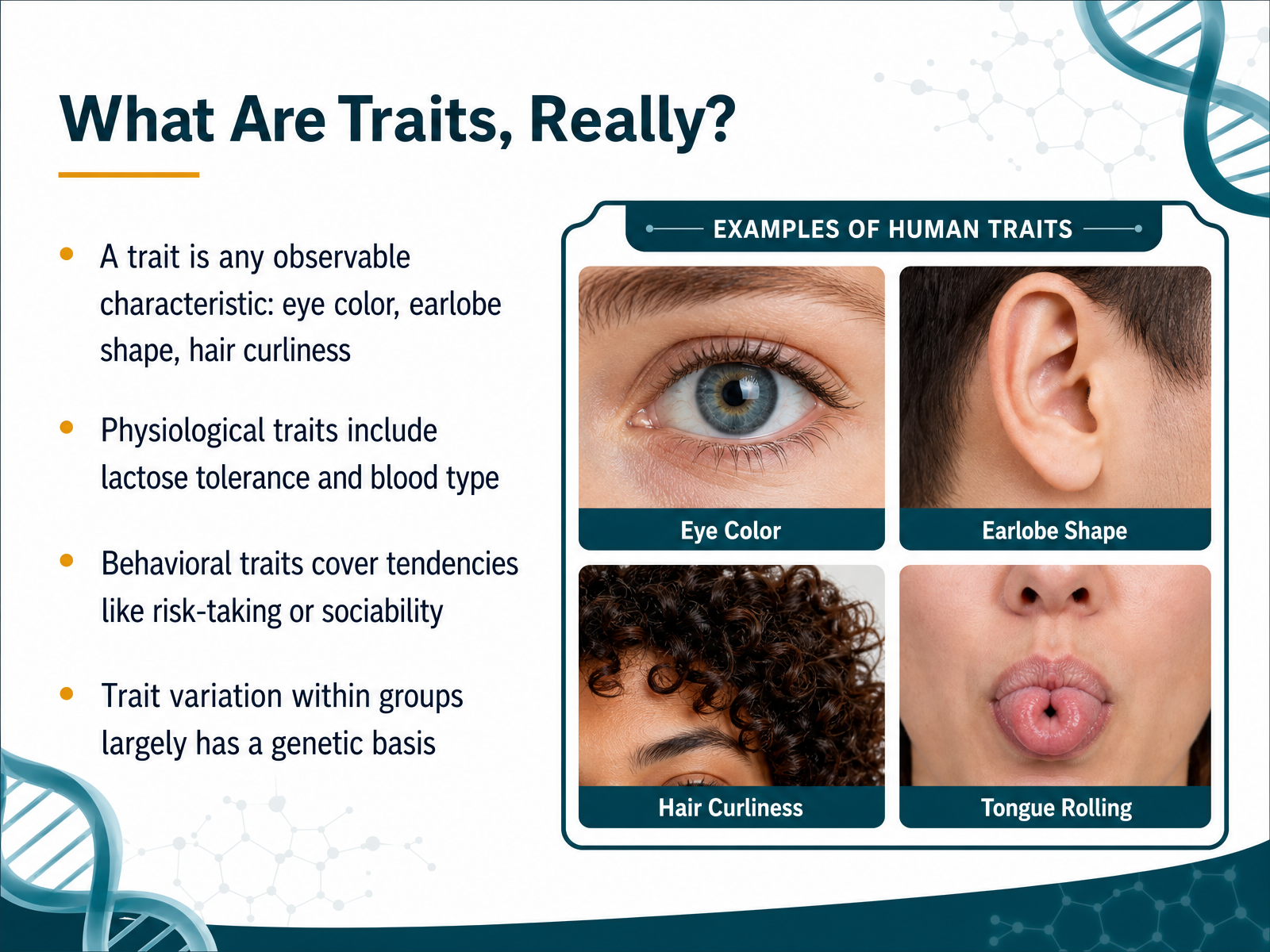
- 02What Are Traits, Really?We just touched on some big ideas. Now, let’s zoom in on a simple question: what are traits, really? In everyday words, a trait is any feature you can observe about a person. Your eye color is a trait. So is the shape of your earlobes, or whether your hair is straight or curly. But traits are not just about what we see on the outside. There are also physiological traits, the ones happening inside your body. For example, being able to digest milk as an adult, which we call lactose tolerance, is a trait. Your blood type is another one. Then we have behavioral traits. These cover tendencies, like how sociable a person is, or how willing they are to take risks. Now, here is the fascinating part. When we look at the wonderful variety in any group of people, a large part of that variation comes down to genetics. It is the instruction book that makes each of us unique. Next, let's see how these traits show up in our daily lives, in ways you might not even notice.
 2 min
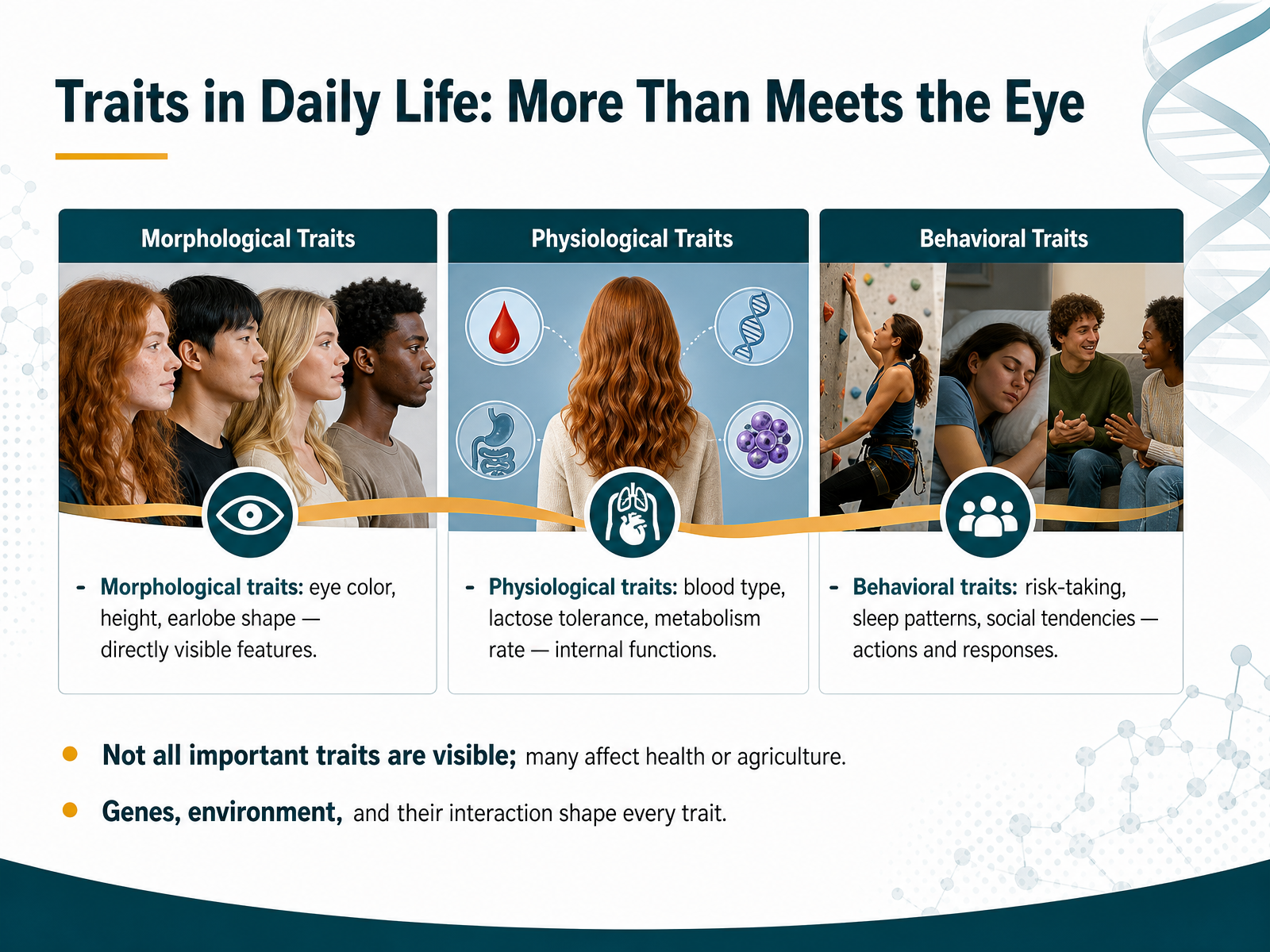
2 min - 03Traits in Daily Life: More Than Meets the EyeNow let's make this real by looking at traits we see, and don't see, every single day. Some traits are right there on the surface. We call these morphological traits. Eye color, your height, whether your earlobes are attached or hang free. These are directly visible features. But traits go much deeper than what we can see in a mirror. Inside your body, you have physiological traits. Things like your blood type, whether you can digest milk easily as an adult, or how fast your metabolism runs. These internal functions are traits too. Then there are behavioral traits. How much risk you tend to take, whether you're a night owl or an early bird, or how outgoing you feel in a group. These are patterns in actions and responses. The big idea is that not all important traits are visible. Many affect our health, and in farming, they affect things like crop yield or drought resistance. Here's the key point. Every single trait is shaped by your genes, your environment, and the constant interaction between them. So as we move forward, the natural question is, what are these genes actually made of? Let’s find out by looking at DNA, the instruction manual deep inside your cells.
 2 min
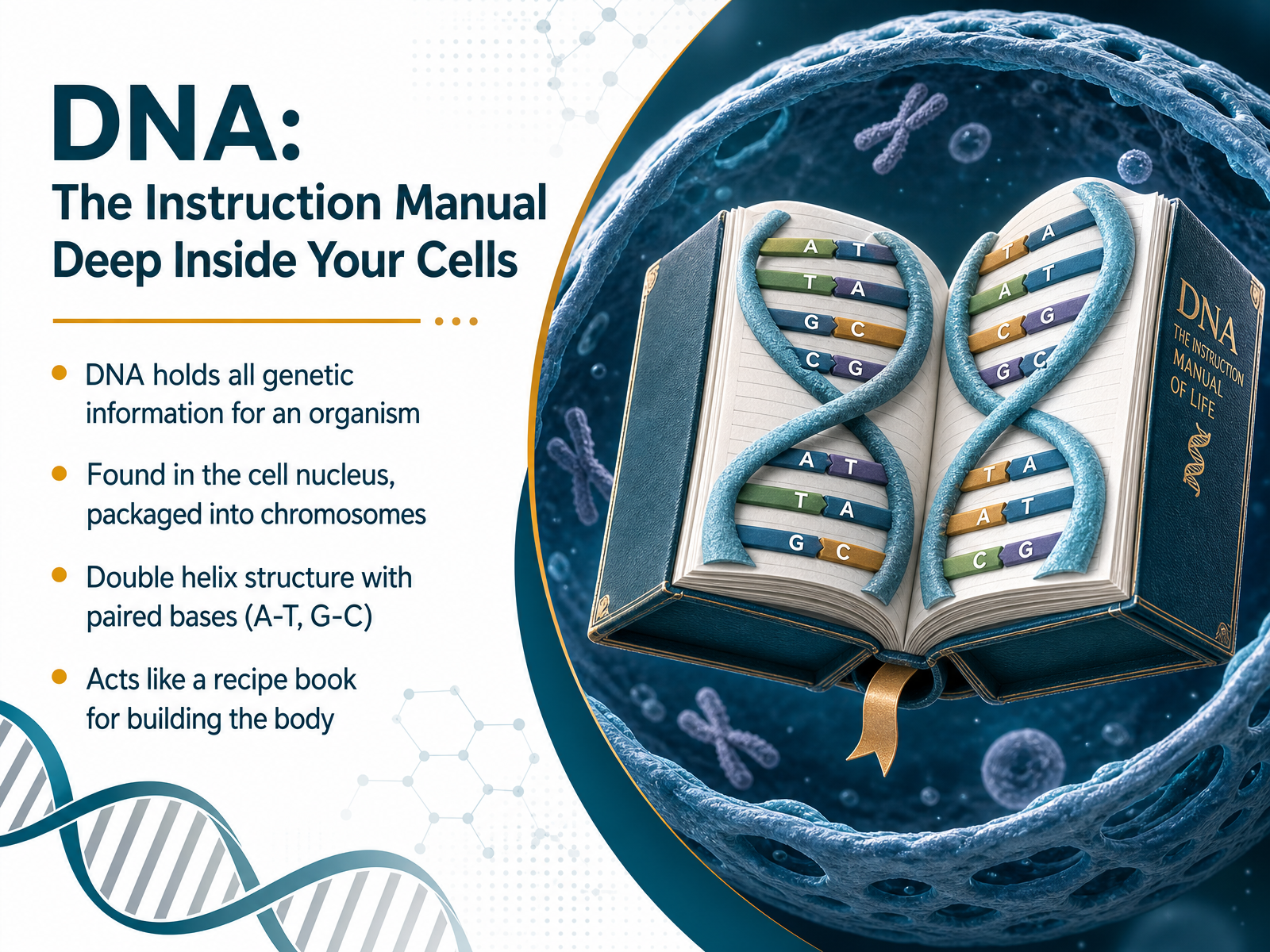
2 min - 04DNA: The Instruction Manual Deep Inside Your CellsNow let's zoom in even further and look at what's inside nearly every cell in your body. The real instruction manual is a molecule called DNA. Think of DNA as a complete recipe book, containing all the genetic information that makes you who you are. This recipe book is safely stored inside the cell's control center, the nucleus. To keep everything organized, the long DNA strands are neatly packaged into structures called chromosomes. If you could see DNA up close, it looks like a twisted ladder, a shape scientists call a double helix. The rungs of this ladder are made of chemical pairs that fit together like puzzle pieces. A always pairs with T, and G always pairs with C. These simple pairing rules are the language the body uses to read the instructions. So, just like a recipe book tells you how to bake a cake, your DNA tells your cells how to build and maintain your entire body. Now that we can see the instruction manual, let's look more closely at its famous twisted shape in the next slide, The Double Helix: Cracking the Code.
 2 min
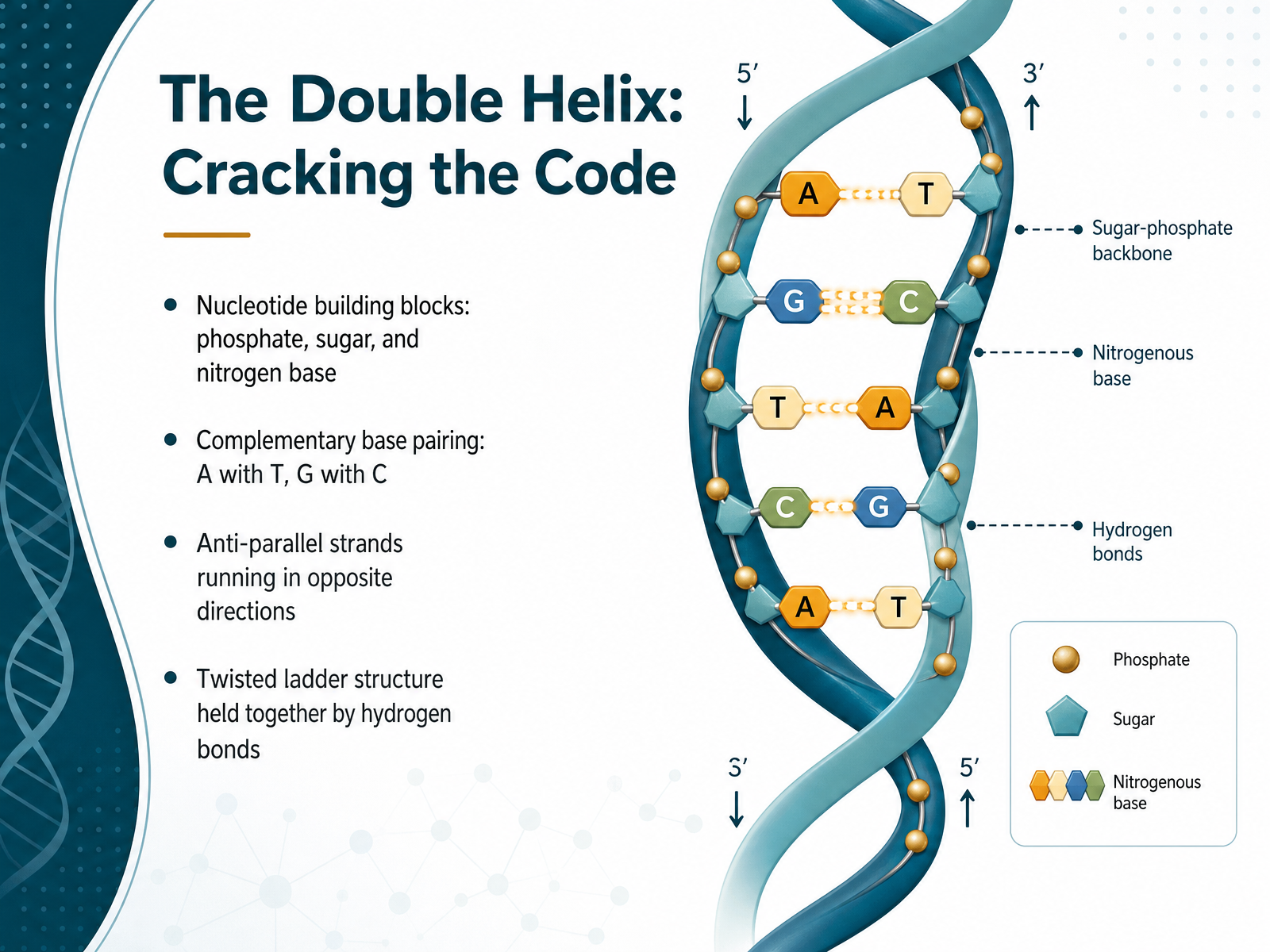
2 min - 05The Double Helix: Cracking the CodeLet's take a closer look at the famous shape of DNA, the double helix. Picture a twisted ladder. That's our model. The sides of this ladder are made of alternating sugar and phosphate molecules. They form the strong backbone. Now, the rungs of the ladder are what we really care about because they hold the code. Each rung is built from pairs of special chemicals called nitrogen bases. There are four types: adenine, thymine, guanine, and cytosine. But they are picky partners. Adenine always pairs with thymine, and guanine always pairs with cytosine. We call this complementary base pairing. Think of it like a lock and key, A with T and G with C. This pairing rule is the secret. It means if you know the sequence on one strand, you automatically know the sequence on the other. One last key detail: the two strands run in opposite directions. They are anti-parallel, like two escalators moving side-by-side but going opposite ways. This whole elegant structure is held together by weak connections called hydrogen bonds, which keep the ladder twisted and stable. So, this twisted ladder structure, with its strict pairing rules, is exactly how the information is securely stored. Next, we will explore how specific sections of this twisted ladder, called genes, actually mean business.
 2 min
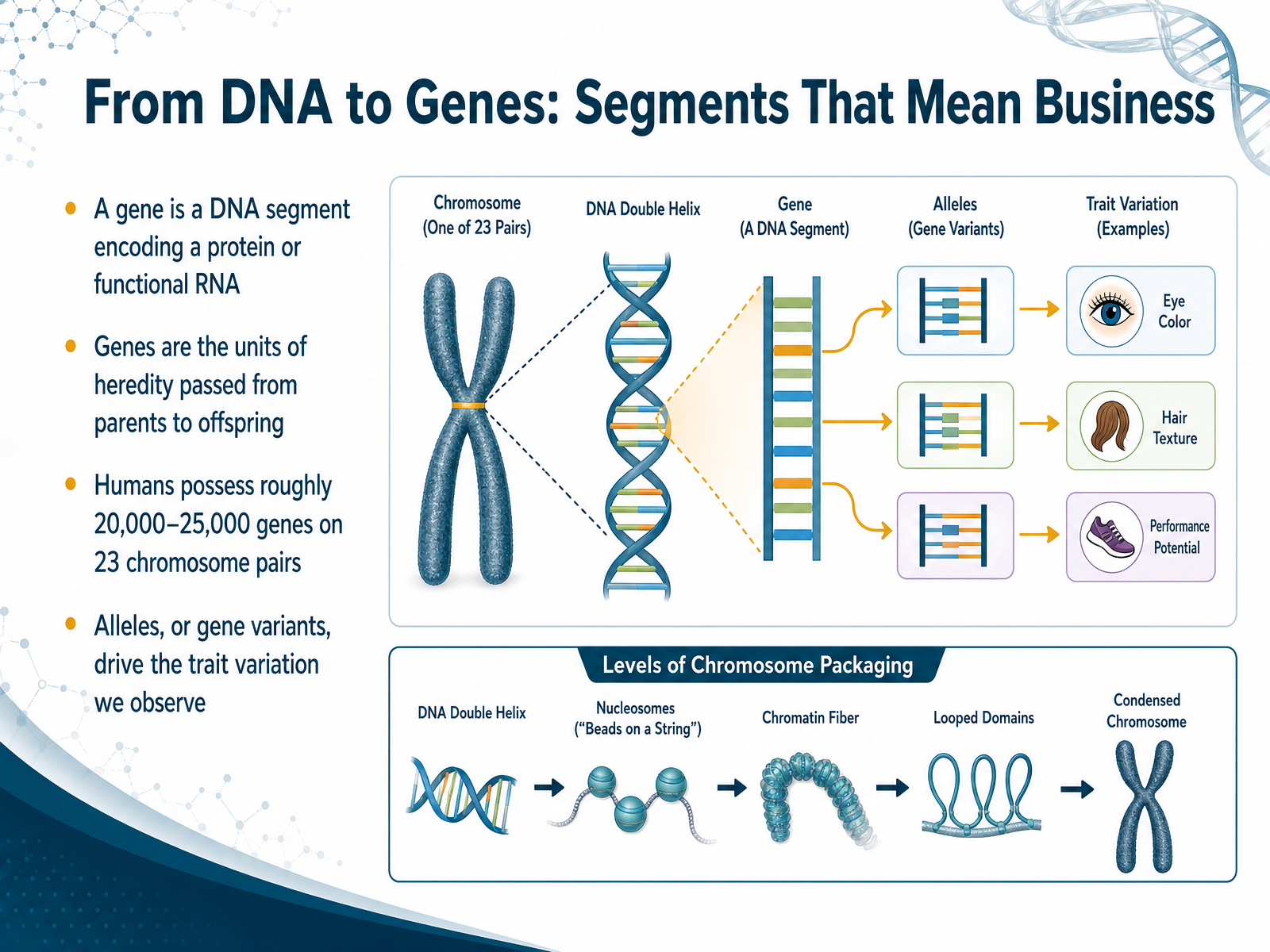
2 min - 06From DNA to Genes: Segments That Mean BusinessNow that we know how DNA is packed, let's take a closer look at what's actually inside those twisted strands. A gene is simply a specific segment of DNA that contains the instructions for making a protein or a functional RNA molecule. Think of your DNA as a giant instruction book. Each gene is one clear, meaningful sentence in that book. These genes are the actual units of heredity. They are the physical messages that are copied and passed down from parents to their children. In total, humans have somewhere around twenty to twenty-five thousand genes spread across our twenty-three pairs of chromosomes. But if we all have thousands of similar genes, why do we look so different? The answer lies in variations of these genes, which we call alleles. Alleles are simply different versions of the same gene. For example, the gene that decides your hair color can have an allele for black hair, an allele for brown hair, or an allele for blonde hair. It is the specific combination of alleles that you inherit that creates the unique traits you see in your family. Next, let's zoom in on a perfect example of this. We'll meet a specific gene called MC1R, which quite literally helps paint your hair.
 2 min
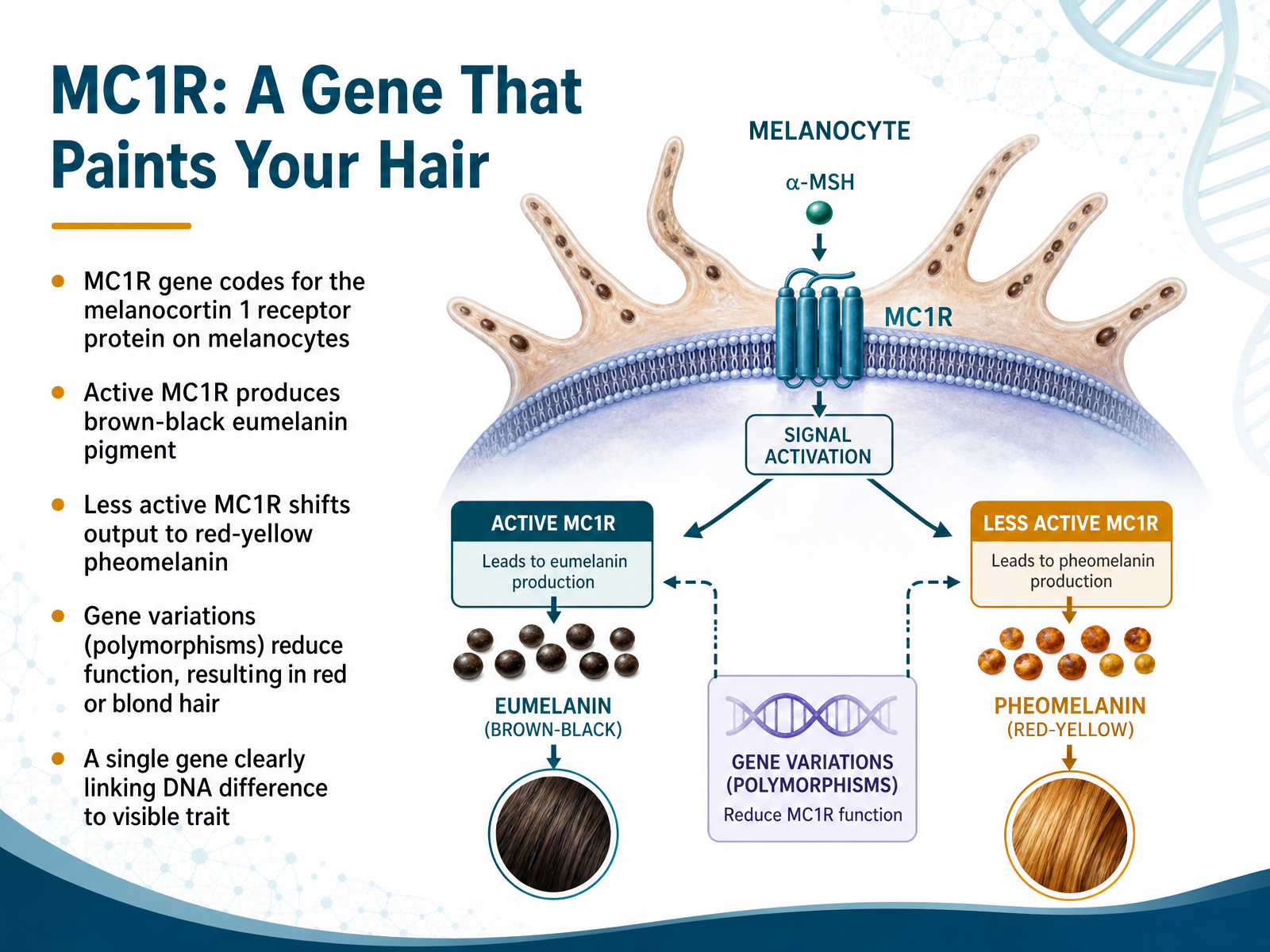
2 min - 07MC1R: A Gene That Paints Your HairHere is where we can really see a single gene at work. The gene is called MC1R. It holds the instructions for building a protein on our pigment-producing cells. When this protein is fully active, it tells the cells to make a dark brown-black pigment named eumelanin. If the MC1R gene has a small spelling change, the protein works less efficiently. Now the balance shifts, and the cells produce a red-yellow pigment called pheomelanin instead. This change in the DNA, called a polymorphism, directly leads to red hair or blond hair. It is a beautiful, clear connection between a DNA difference and a visible trait. Next, we will step back and look at how all your genes are packaged, as we explore chromosomes, genes, and you, the big picture.
 1 min
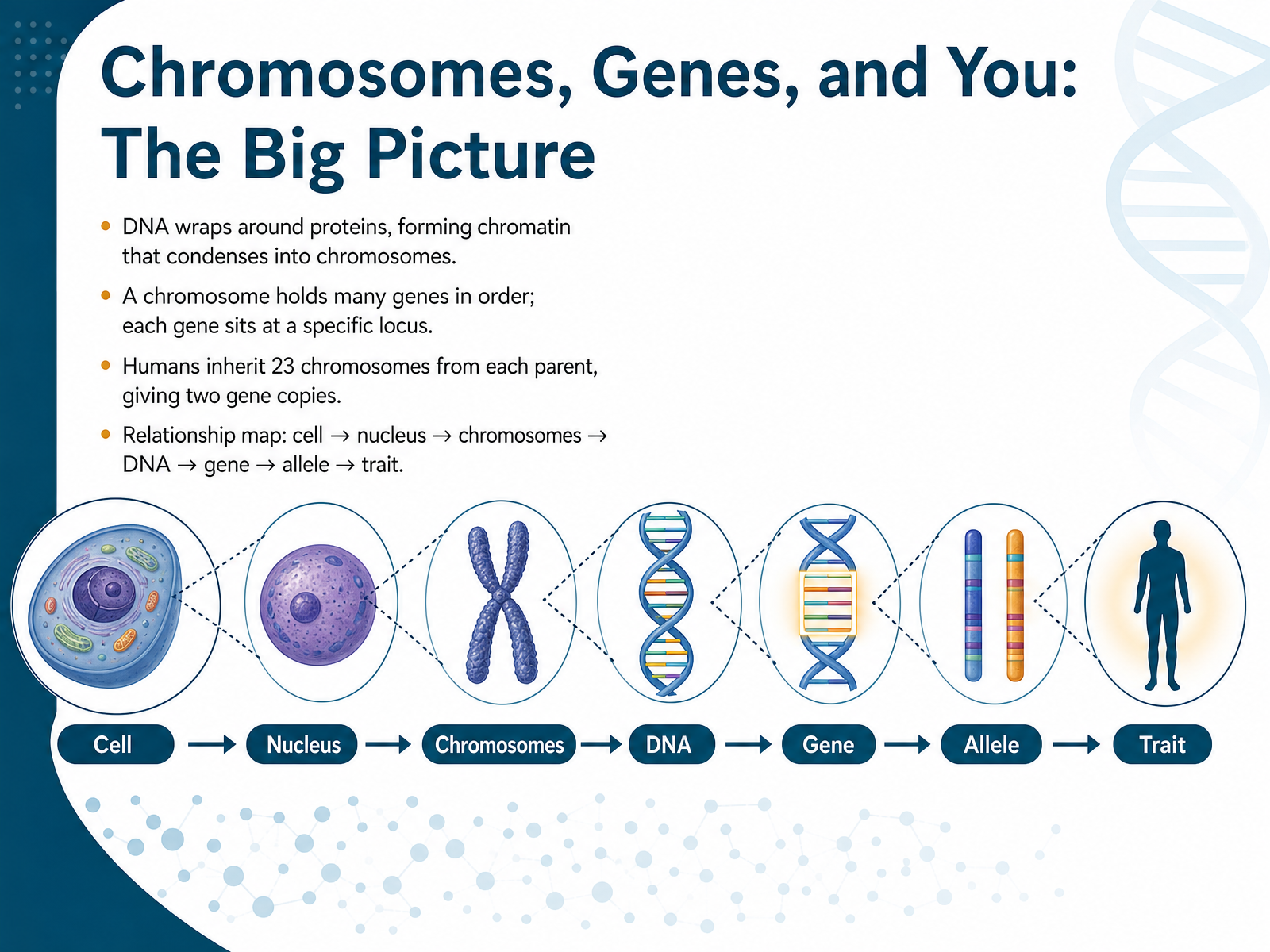
1 min - 08Chromosomes, Genes, and You: The Big PictureNow let's zoom out and see how everything fits together inside your cells. Imagine your DNA not as a loose string, but carefully wrapped around proteins, like thread on a spool. This packed form is called chromatin. When a cell gets ready to divide, the chromatin condenses even further into tight bundles we see as chromosomes. Think of a single chromosome as a long, organized library shelf. On that shelf sit many genes, arranged in a specific order. The exact physical address of a gene on that shelf is called its locus. We each inherit a full set of these shelves. You received 23 chromosomes from your mother's egg and 23 from your father's sperm. That gives you two copies of nearly every gene. So the big picture flows like this: start with the whole cell, move into its nucleus, find the chromosomes, then the DNA, zoom in to a gene, look at its variant form called an allele, and finally see the trait that appears. Next, we will explore how those traits travel through generations.
 2 min
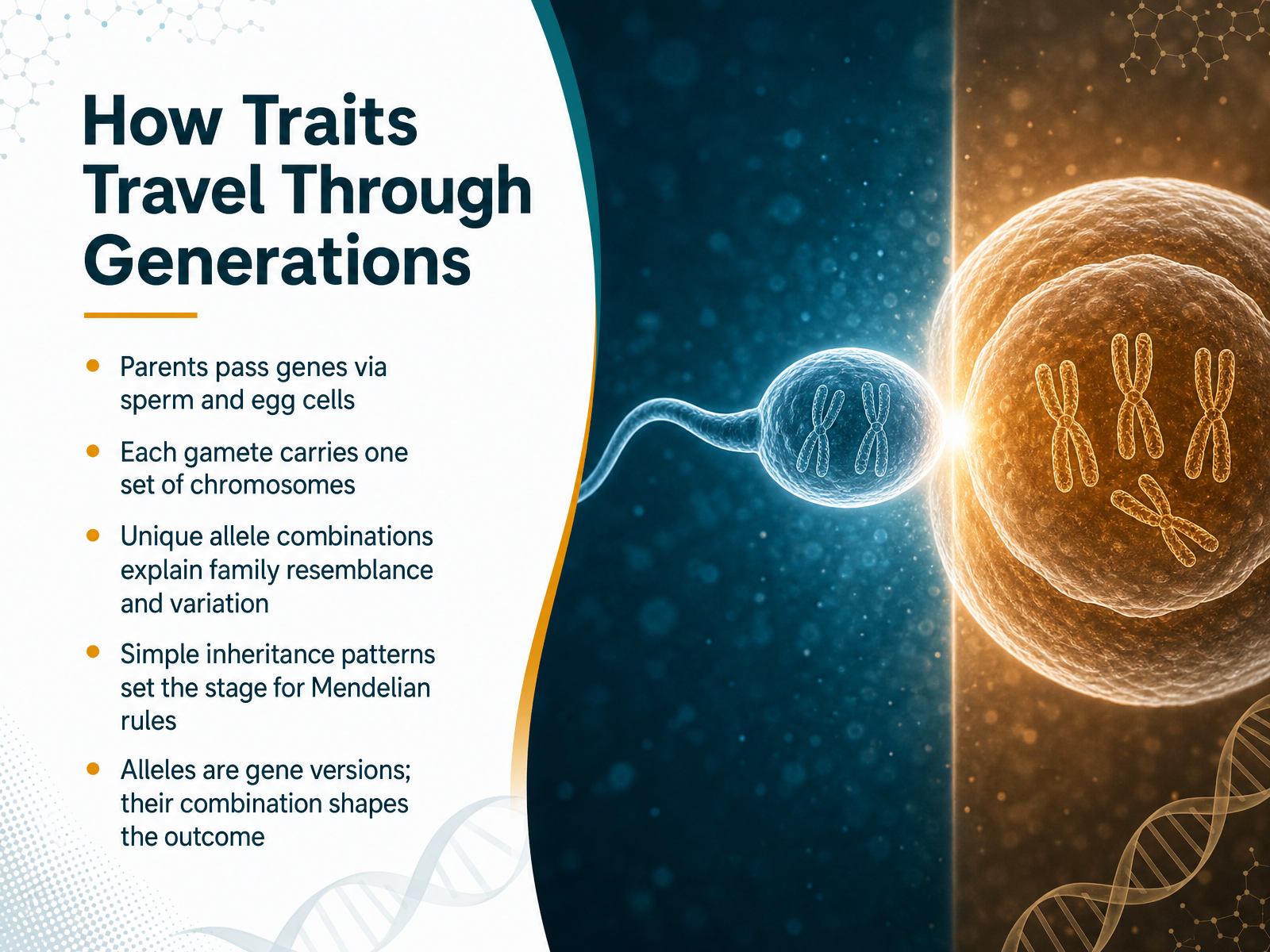
2 min - 09How Traits Travel Through GenerationsSo, how exactly do traits travel from parents to children? It happens through special cells called sperm and egg cells, or gametes. When a baby is made, each parent contributes one gamete. Importantly, a gamete carries only one set of chromosomes, not the usual pair. This means each parent passes down just one copy of each gene. The specific version of a gene they pass down is called an allele. Because each parent donates different allele combinations, children look similar to their family but are also wonderfully unique. Some of these pairings follow simple, predictable patterns, which sets the stage for what we call Mendelian rules. Let's look closer at a powerful tool for predicting these patterns next, by exploring dominant, recessive, and the mighty Punnett square.
 1 min
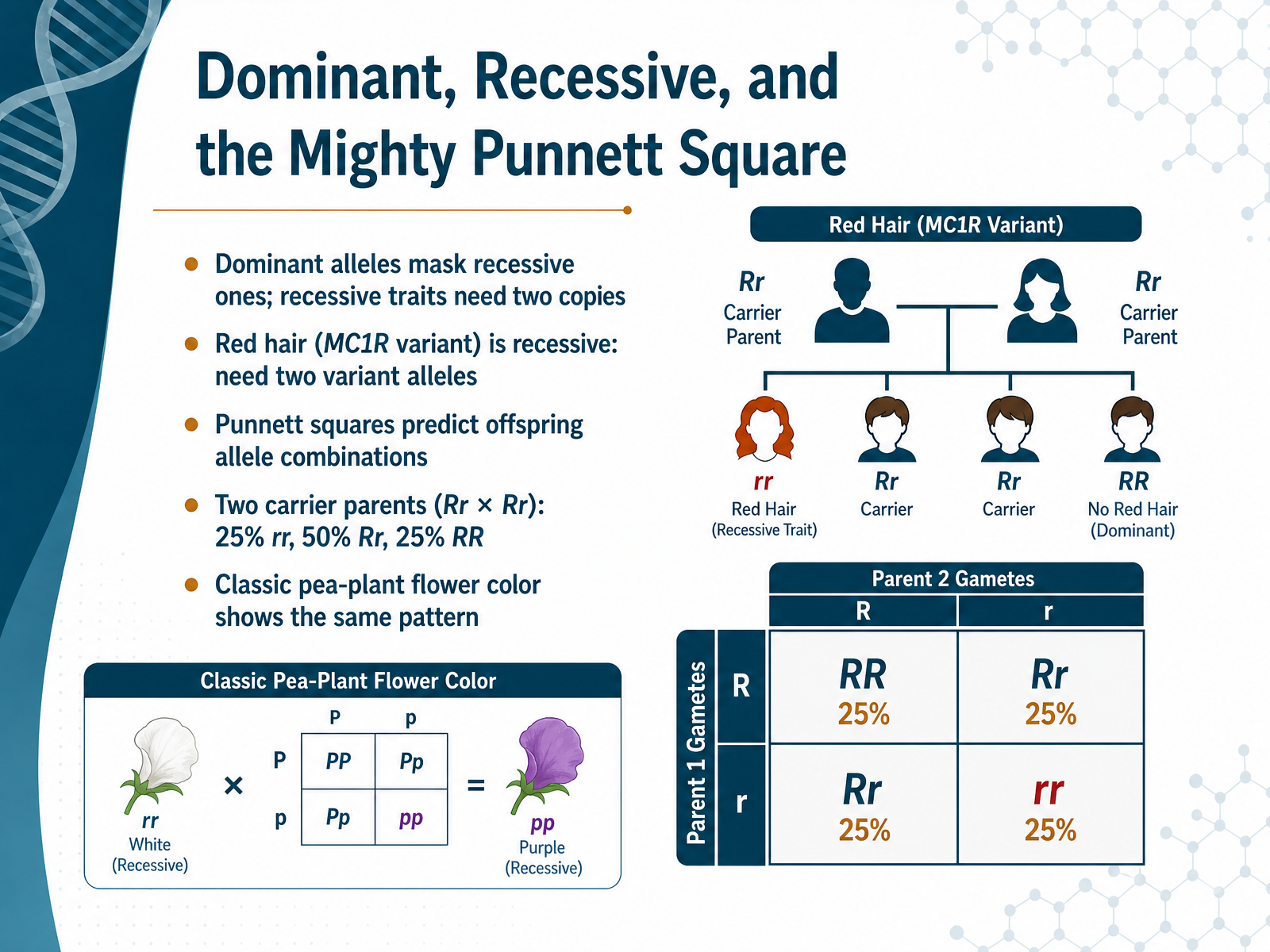
1 min - 10Dominant, Recessive, and the Mighty Punnett SquareNow, let's see how traits are passed down and why some seem to disappear. This brings us to dominant and recessive alleles, and a helpful tool called the Punnett square. Think of a dominant allele as a strong voice in the conversation. If it's present, its trait is the one we see. It masks the instructions of a recessive allele. A recessive trait only shows up when an individual has two copies of that recessive allele. Red hair is a perfect example of a recessive trait. It's linked to a specific variant of the MC1R gene. To have red hair, you need to inherit two copies of that variant, one from each parent. Now, how can we predict the chances of this happening? We use the Punnett square. It's a simple grid that helps us visualize the possible combinations of alleles from two parents. Let's look at two parents who are carriers. They each have one dominant allele for non-red hair, and one recessive allele for red hair. We can write their genetic makeup as a big R and a little r. When we set up their cross on a Punnett square, the pattern is clear. There is a twenty-five percent chance their child will inherit two little r's and have red hair. There is a fifty percent chance the child will be a carrier just like the parents, with one big R and one little r. And there is a twenty-five percent chance the child will inherit two big R's and not be a carrier. This is the exact same pattern Mendel saw in his pea plants with purple and white flower colors. Next, we'll explore a fascinating question. Why red hair can hide in a family for generations, with a focus on what it means to be a carrier.
 2 min
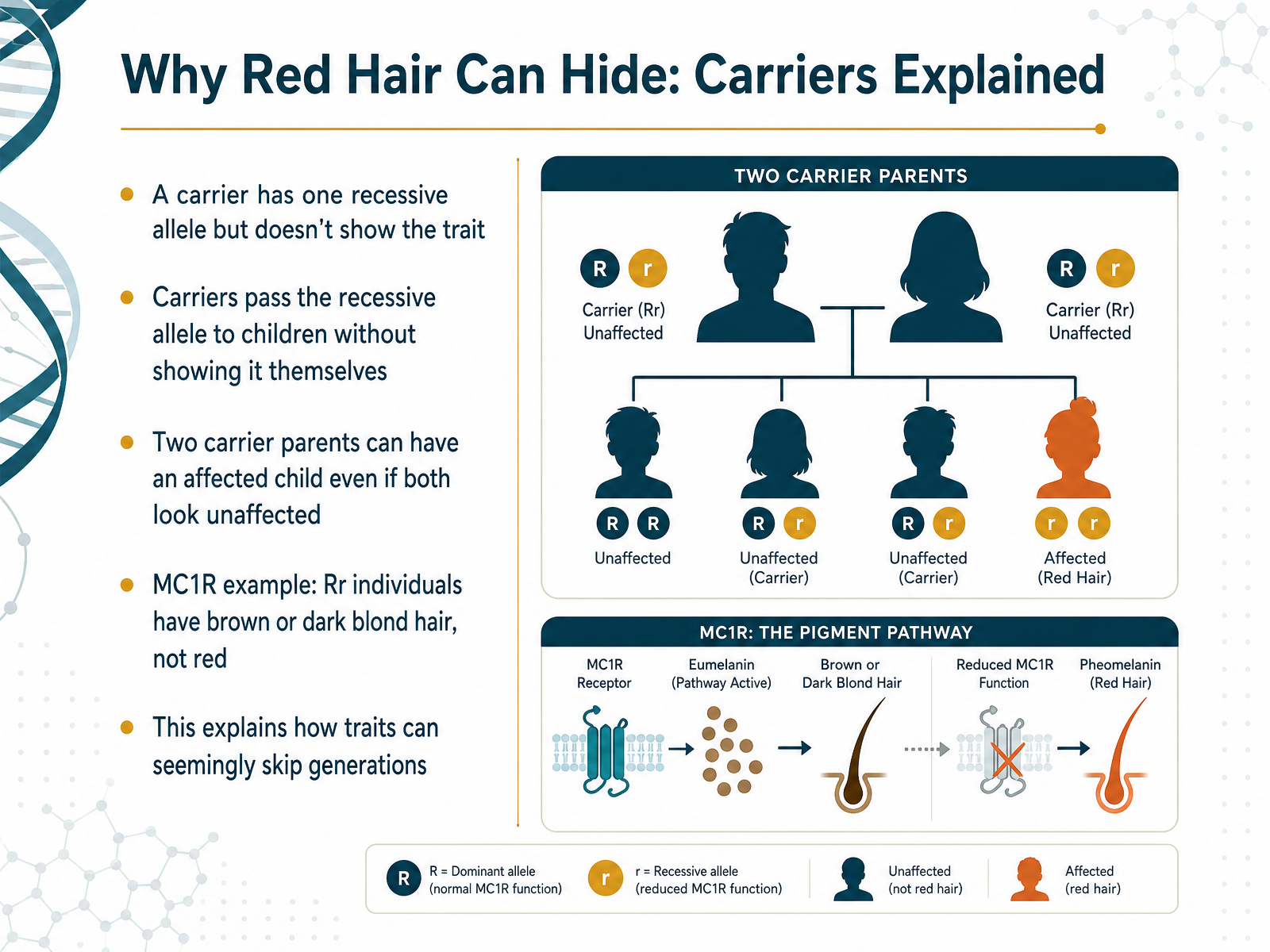
2 min - 11Why Red Hair Can Hide: Carriers ExplainedSo far, we have talked about traits showing up clearly. But here is a surprising twist. A trait can hide. To understand how, we need the idea of a carrier. A carrier is someone who has one recessive allele but does not show the trait. They carry the hidden version without it being visible. Think of the MC1R gene. A person with one red hair allele and one non-red allele, written as big R little r, usually has brown or dark blond hair, not red. They look like they have no connection to red hair at all. But they still carry that little r allele. And they can pass it to their children. If two carriers have a child together, that child might inherit two little r alleles. Suddenly, red hair appears where neither parent showed it. This is how traits can skip a generation. It seems like the trait came from nowhere, but it was just hiding. This brings us to an important difference we will explore next, the difference between what you see and what is in the genes, also known as genotype versus phenotype.
 2 min
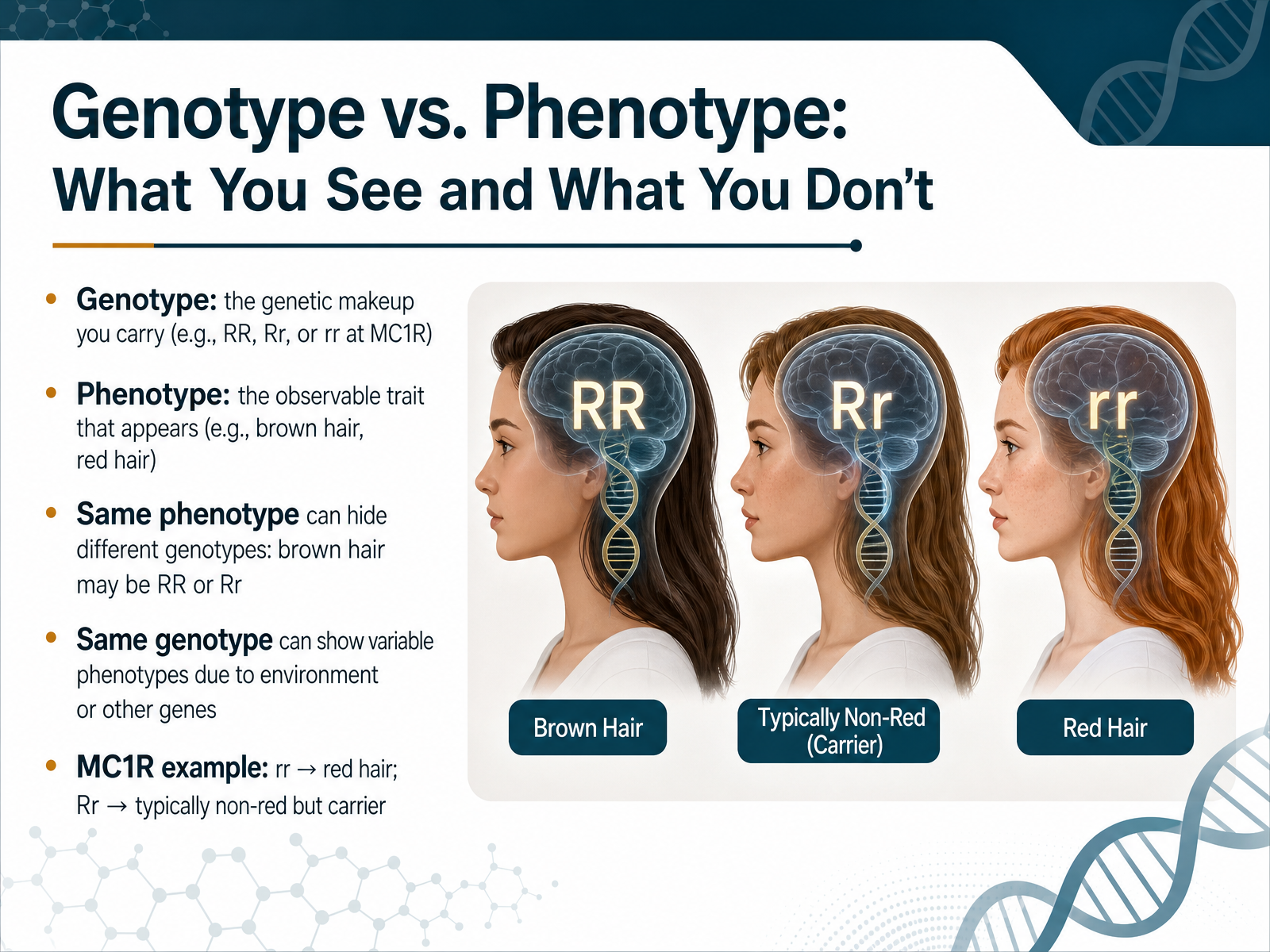
2 min - 12Genotype vs. Phenotype: What You See and What You Don'tLet's now look at two important words: genotype and phenotype. They help us separate what’s written in your genetic code from what you can actually see. Your genotype is the pair of gene versions you carry for a trait. For the hair color gene MC1R, your genotype could be two non-red versions, or one of each, or two red versions. Scientists often write these pairs with letters like capital R, lowercase r. Your phenotype is what shows up on the outside. Red hair, brown hair, not-red hair. Here is something surprising. Two people can have the same brown hair phenotype but different genotypes. One person may carry two non-red versions, while another carries one of each. The brown still appears, but the second person is a carrier. The opposite can also happen. The same genotype does not always produce exactly the same phenotype, because environment or other genes can shift the final look. With the MC1R example, two lowercase r copies means red hair phenotype. One capital R and one lowercase r usually means a non-red phenotype, but the red version is still hidden inside. So genotype lives under the surface, and phenotype is what meets the eye. Next, let’s explore why simple patterns like this are often just the beginning, in 'It's Almost Always More Complicated: Beyond Simple Inheritance.'
 2 min
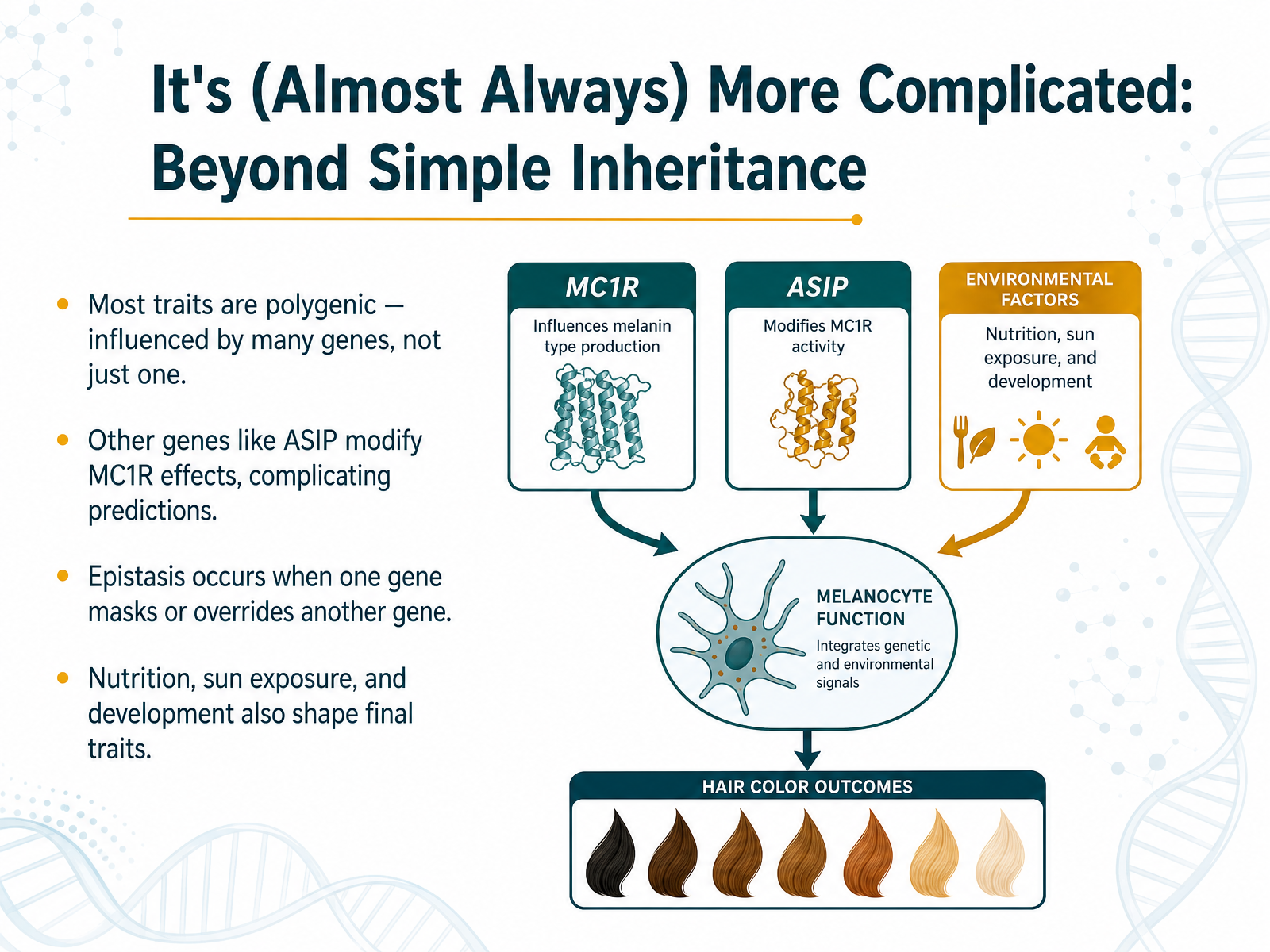
2 min - 13It's (Almost Always) More Complicated: Beyond Simple InheritanceWe've been talking about single genes so far. But the real picture is usually more like a team effort. Most traits are polygenic, which simply means many genes work together to shape what we see. Hair color is a great example. You already know the MC1R gene plays a role, but another gene called ASIP can step in and modify that effect, making predictions a lot trickier. It gets even more interesting with something called epistasis. That's when one gene can completely mask or override another, like a light switch that turns off a circuit. And remember, genes are not the whole story. Nutrition, sun exposure, and how we develop all leave their mark on the final trait. So we begin to see why inheritance rarely works as a simple straightforward recipe. Now, let's put all of these pieces together, from DNA to what we actually see in the mirror.
 2 min
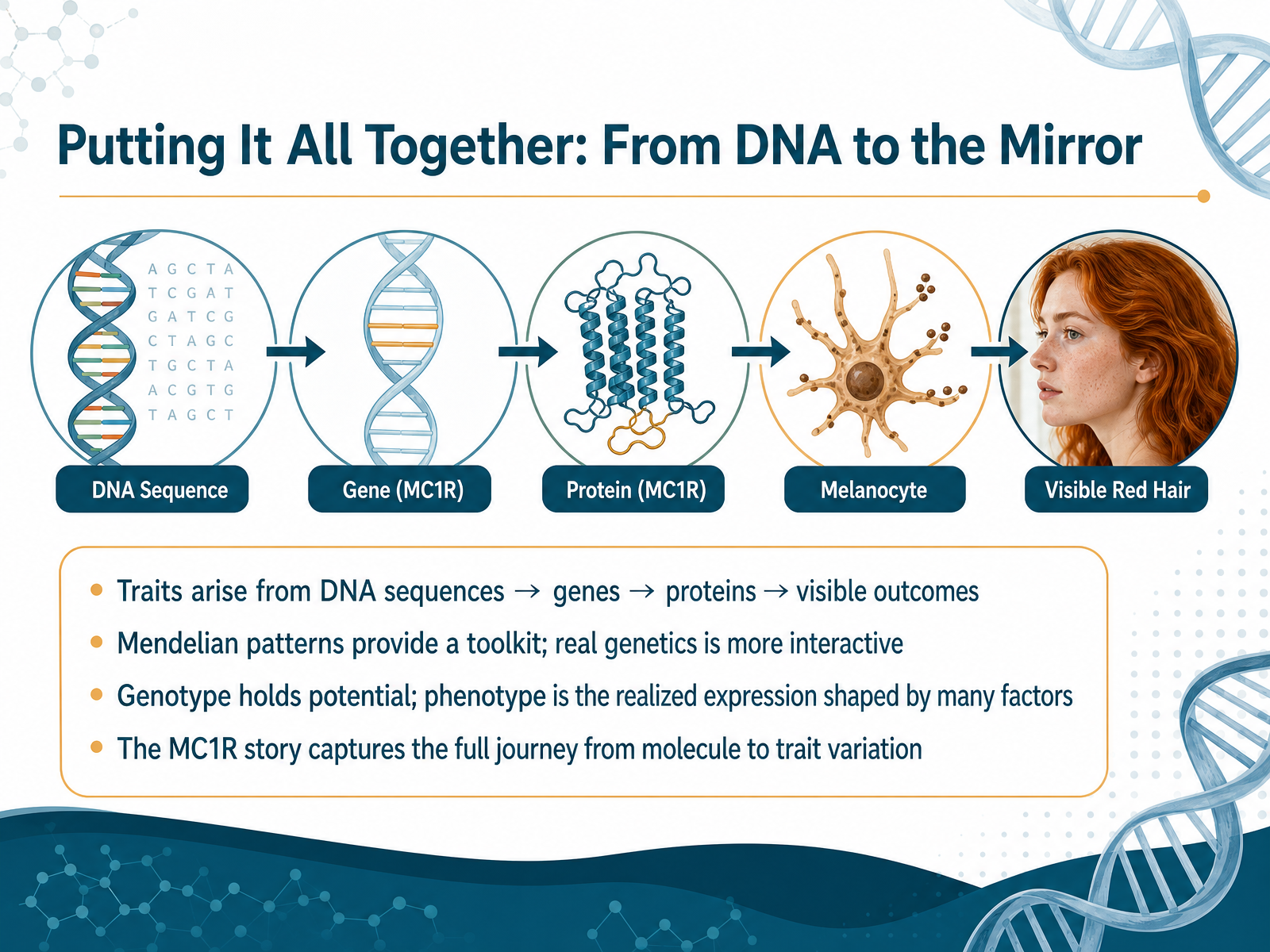
2 min - 14Putting It All Together: From DNA to the MirrorNow let's connect all the dots. You started with a piece of DNA, and it led you to something you can see in the mirror. A gene is a stretch of DNA that holds the instructions for a protein. That protein then goes to work inside your body, creating what we call a trait. We looked at Mendel's patterns, like dominant and recessive. Those rules are a great starting toolkit, but real inheritance is rarely that simple. Most traits are shaped by many genes and also by your environment. So when we talk about a person's genotype, we mean the genetic potential carried in their DNA. The phenotype is the actual result you observe, the final expression of that potential. Remember the redhead story with the MC1R gene? It is the perfect map of this whole journey. A tiny change in the DNA sequence led to a different receptor protein, which changed the pigment production, and the final visible trait was red hair. It is a single, clear line from molecule to mirror. Next, we will wrap everything up with a quick summary and look at what comes next.
 2 min
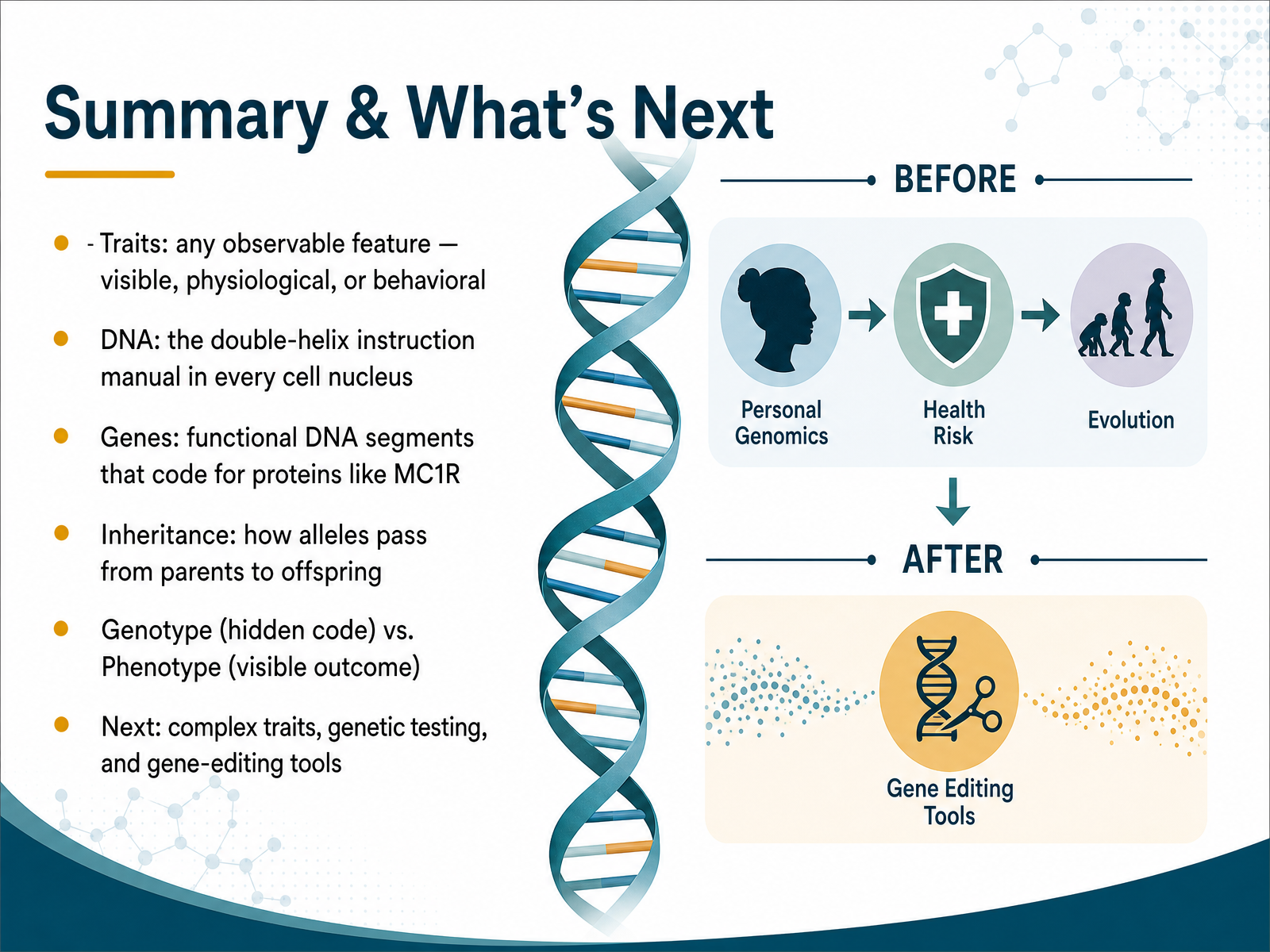
2 min - 15Summary & What's NextWe have covered a lot of ground together, so let's take a moment to reflect on the big picture. We learned that a trait is any feature you can observe, like your eye color, your height, or even the way you laugh. Inside nearly every one of your cells, you have a complete instruction manual called DNA, shaped like a lovely twisted ladder. Specific sections of this manual are called genes, and they act like individual recipes. For example, the MC1R gene is the recipe for the protein that helps decide your hair color. The process of passing these gene recipes from parents to children is called inheritance. And here is a crucial idea that often gets mixed up: your genotype is the hidden code you carry, but your phenotype is the visible trait that actually shows up. That is the core story of genetics. Thank you for bringing your curiosity today. As you look around at your own family, I hope you start seeing these patterns everywhere. What comes next is even more exciting: we will explore complex traits, the world of genetic testing, and powerful gene-editing tools. Keep asking questions, and I will see you in the next module.
 2 min
2 min
Take the deck with you
Download this course as a file — free, no sign-up needed.
- PDF handoutEvery slide page, ready to print or share.16 pages · 4.4 MBDownload
- Narrated PowerPointThe deck that presents itself — every slide carries the digital human's narration video.16 pages · 16.8 MBDownload
- PowerPoint slidesThe full deck as a .pptx — open it in PowerPoint, Keynote, or Google Slides.16 pages · 4.4 MBDownload
Free to use in your own training — please keep the PersonWise credit page at the end.
Have your own deck? Turn it into a course